24-Hour Urine Sodium and Potassium Biomarkers: A Comprehensive Guide for Clinical Research and Drug Development
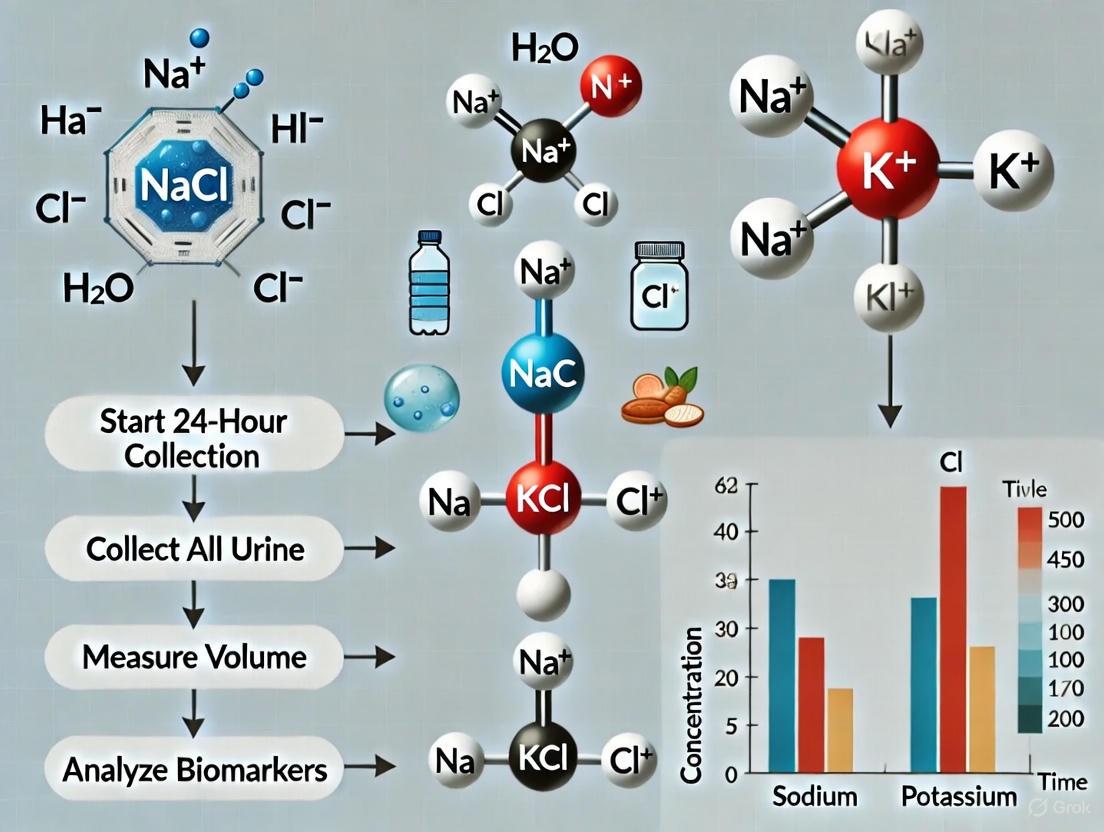
This article provides a comprehensive resource for researchers and drug development professionals on the use of 24-hour urine collection for sodium and potassium biomarker analysis.
24-Hour Urine Sodium and Potassium Biomarkers: A Comprehensive Guide for Clinical Research and Drug Development
Abstract
This article provides a comprehensive resource for researchers and drug development professionals on the use of 24-hour urine collection for sodium and potassium biomarker analysis. It covers the foundational role of these biomarkers in cardiovascular and metabolic disease research, detailing established and emerging protocols for sample collection, processing, and analysis. The content addresses common methodological challenges and optimization strategies, and offers a critical evaluation of alternative assessment methods compared to the gold-standard 24-hour urine collection. Synthesizing current evidence and best practices, this guide aims to support the rigorous application of urinary electrolyte assessment in clinical studies and therapeutic development.
The Critical Role of 24-Hour Urine Electrolytes in Clinical Research and Disease Pathogenesis
Cardiovascular disease (CVD) remains a leading cause of global mortality, necessitating refined tools for risk assessment and early intervention. The quantification of dietary sodium and potassium intake has emerged as a critical component in cardiovascular risk stratification. While these electrolytes have traditionally been evaluated individually, compelling evidence now indicates that the sodium-to-potassium (Na/K) ratio provides a more powerful and integrated biomarker for predicting cardiovascular outcomes than either measurement alone [1] [2] [3]. This assessment is particularly relevant in high-risk populations, including those with chronic inflammatory conditions such as rheumatoid arthritis (RA), where traditional risk factors do not fully account for the elevated CVD burden [1]. Framed within the context of 24-hour urine collection research, this document details the scientific validation, measurement protocols, and practical applications of the urinary Na/K ratio as a superior biomarker for cardiovascular risk assessment in research and clinical development settings.
Quantitative Evidence: Substantiating the Na/K Ratio as a Superior Predictor
Key Epidemiological and Clinical Findings
Recent studies across diverse populations have consistently demonstrated the prognostic value of the Na/K ratio. The following table summarizes critical findings from pivotal studies.
Table 1: Key Evidence Supporting the Na/K Ratio in Cardiovascular Risk Assessment
| Study / Population | Design | Key Findings on Na/K Ratio | Reference |
|---|---|---|---|
| Rheumatoid Arthritis (RA) Patients (n=61) | Cross-sectional | Inverse correlation with subendocardial viability ratio (SEVR), a marker of myocardial perfusion. Association remained significant after multivariate adjustment. | [1] |
| General Iranian Population (n=2,050) | Longitudinal (10.6 yrs) | Higher ratio associated with a 99% increased risk of CVD events (HR=1.99, 95% CI: 1.13–3.52). | [2] |
| Multi-Cohort Study (HPFS, NHS, etc.) (n>10,000) | Pooled prospective | Significant association with increased cardiovascular risk; every 1,000 mg/day increase in Na excretion & 1,000 mg/day decrease in K excretion similarly affected risk (~18%). | [3] |
| Ohasama Study, Japan | Cross-sectional | Highest tertile of spot urine Na/K ratio had ~2x higher prevalence of elevated BNP (≥35 pg/mL), indicating asymptomatic heart failure. | [4] |
Comparative Performance of Assessment Methods
The accuracy of Na/K ratio measurement is contingent upon the methodology used for electrolyte quantification. The table below compares the primary assessment methods, highlighting the superiority of 24-hour urine collection.
Table 2: Comparison of Sodium and Potassium Intake Assessment Methods
| Method | Principle | Advantages | Limitations & Accuracy |
|---|---|---|---|
| 24-Hour Urine Collection | Direct measurement of Na & K excreted over 24 hours. | Considered the gold standard for estimating intake at the group level [5] [6]. | High participant burden. May lack accuracy on an individual level without multiple collections [6]. |
| Spot Urine Collection | Estimation of 24-h excretion using algorithms (Kawasaki, Tanaka). | Practical, low-cost, and suitable for large-scale studies. | Less accurate than 24-h urine. Performance varies by algorithm and population [7] [5]. |
| Food Frequency Questionnaire (FFQ) | Self-reported frequency of food consumption. | Can assess a wide variety of nutrients; low cost. | Poor agreement with urinary biomarkers for sodium; better for potassium [6]. Prone to recall bias. |
| 24-Hour Diet Recall | Interviewer-administered recall of all foods consumed. | More detailed than FFQ; less burdensome than records. | Significant under-reporting, especially for sodium [8]. |
Experimental Protocols: Precise Measurement of the Na/K Ratio
Gold-Standard Protocol: 24-Hour Urine Collection and Analysis
This protocol is optimized for research settings requiring the highest data quality, as utilized in controlled feeding studies [7] [3].
I. Participant Preparation and Collection Kit
- Materials: 5-Liter collection jug with wide mouth, containing boric acid as a preservative [9]; insulated cooler with ice packs; detailed instruction sheet; compliance logbook.
- Instructions: Provide participants with verbal and written instructions. Emphasize the need to collect every void over a full 24-hour period, starting after the first morning void and including the first void the next morning.
II. 24-Hour Urine Collection Procedure
- Initiation: Participants discard the first morning urine. Note the exact time (e.g., 07:00). This marks the start of the 24-hour collection period.
- Collection: For all subsequent urinations, participants void directly into the collection jug or into a clean, dry container and immediately transfer it to the jug. The jug must be kept refrigerated or in a cooler with ice packs throughout the collection period.
- Completion: The collection ends by including the first morning void of the next day, exactly 24 hours after initiation.
- Documentation: Participants record the start and end times, total volume if possible, and any missed voids or spills in the logbook.
III. Sample Handling, Transport, and Analysis
- Processing: Upon receipt, the total urine volume is measured and recorded. The sample is thoroughly mixed, and aliquots are taken for analysis.
- Storage: Aliquots should be frozen at -20°C or -80°C for long-term storage. Potassium is stable indefinitely when frozen [9].
- Biochemical Analysis:
- Sodium and Potassium: Analyze using ion-selective electrodes (ISE), the most common method used in the cited studies [7] [8].
- Creatinine: Measure via spectrophotometric detection (e.g., Jaffe method) to assess collection completeness [7]. Collections with creatinine values outside expected ranges (e.g., <0.1 mmol/kg for women or <0.15 mmol/kg for men) may be considered incomplete.
IV. Data Calculation
- Urinary Na/K Ratio: Calculate using the molar concentrations (mmol/L) of sodium and potassium from the 24-hour sample.
Na/K Ratio = Urinary Sodium (mmol/L) / Urinary Potassium (mmol/L)
Alternative Protocol: Estimation from a Spot Urine Sample
For large-scale epidemiological studies where 24-hour collection is impractical, the following protocol can be used, acknowledging its limitations [7].
- Sample Collection: Collect a first-morning void (spot urine) sample. A mid-morning spot sample can be used if standardized.
- Analysis: Measure sodium, potassium, and creatinine concentrations in the spot sample.
- Estimation: Apply a prediction algorithm, such as the Kawasaki or Tanaka equations, to estimate 24-hour sodium and potassium excretion from the spot urine concentrations [7]. Note that these estimates are less accurate on an individual level.
The Researcher's Toolkit: Essential Reagents and Materials
Table 3: Essential Research Reagents and Materials for Urinary Electrolyte Analysis
| Item | Specification / Example | Primary Function |
|---|---|---|
| 24-Hr Urine Collection Jug | 5L, wide-mouth, HDPE plastic with secure lid. | Safe and complete collection of 24-hour urine output. |
| Preservative | Boric Acid crystals or tablets. | Preserves urine constituents and inhibits bacterial growth during collection. |
| Ion-Selective Electrode (ISE) | Automated clinical chemistry analyzer (e.g., Roche Diagnostics). | Quantitative analysis of sodium and potassium concentrations in urine. |
| Creatinine Assay Kit | Spectrophotometric (Jaffe method) or enzymatic. | Assesses completeness of 24-hour urine collection. |
| Quality Control Materials | Commercial urinalysis controls (e.g., CLINIQA standards). | Ensures accuracy and precision of analytical instruments [9]. |
| Standard Reference Materials | NIST SRM 2670a (Toxic Elements in Urine). | Method validation and calibration [9]. |
| Algorithm Software | Custom scripts for Kawasaki/Tanaka equations. | Estimates 24-hour excretion from spot urine samples. |
Workflow and Data Interpretation
The following diagram illustrates the logical workflow for implementing the Na/K ratio in a research or risk assessment context.
The integration of the sodium-to-potassium ratio, derived from 24-hour urine collections, represents a significant advancement in cardiovascular risk biomarker research. Its validation across diverse populations and its superior predictive power compared to individual electrolyte measures make it an indispensable tool for researchers and drug development professionals. By adhering to the detailed protocols and methodologies outlined in this document, the scientific community can standardize the assessment of this critical biomarker, thereby enhancing the accuracy of future epidemiological studies and the efficacy of clinical interventions aimed at mitigating cardiovascular risk.
The quantitative analysis of sodium (Na) and potassium (K) electrolytes from 24-hour urine collections provides critical biomarkers for understanding the interplay between diet, chronic inflammation, and disease progression. Emerging evidence firmly establishes that an imbalance in urinary sodium-to-potassium ratio is linked to adverse cardiovascular and renal outcomes, particularly in high-risk populations such as patients with rheumatoid arthritis (RA) and chronic kidney disease (CKD). This protocol details the methodologies for precise measurement and application of these biomarkers, enabling researchers and drug developers to quantify cardiovascular risk, monitor disease activity, and evaluate therapeutic interventions in chronic inflammatory and metabolic conditions.
The following tables consolidate key quantitative findings from recent studies investigating urinary electrolytes and their clinical correlates.
Table 1: Association of Urinary Electrolytes with Clinical Parameters in Rheumatoid Arthritis [10]
| Urinary Biomarker | Associated Clinical Parameters | Correlation Direction & Significance | Statistical Values (Beta, p-value) |
|---|---|---|---|
| Sodium Excretion | High-Density Lipoprotein Cholesterol (HDL-c) | Negative | - |
| Uric Acid | Positive | - | |
| Subendocardial Viability Ratio (SEVR) | Inverse (Adjusted) | Beta = -0.247, p = 0.034 | |
| Potassium Excretion | Estimated Glomerular Filtration Rate (eGFR) | Positive | - |
| RA Disease Activity (DAS28) | Negative | - | |
| Inflammatory Load (e.g., CRP, ESR) | Negative | - | |
| Sodium-to-Potassium Ratio | Subendocardial Viability Ratio (SEVR) | Inverse (Adjusted) | Beta = -0.247, p = 0.026 |
Table 2: Proteomic Biomarkers of Dietary Potassium and Associated CKD Risk [11]
| Plasma Protein | Association with Dietary Potassium | Hazard Ratio (HR) for Incident CKD (95% CI) |
|---|---|---|
| Pigment Epithelium-Derived Factor | Inverse | HR: 1.57 (95% CI not provided in snippet) |
| Follistatin-Related Protein 3 | Inverse | HR: 1.55 (95% CI not provided in snippet) |
| TOM1-like Protein 1 | Positive | HR: 0.72 (95% CI not provided in snippet) |
| Serine/Threonine-Protein Kinase Pim-1 | Positive | HR: 0.74 (95% CI not provided in snippet) |
| 30-Protein Score | Positive | HR: 0.93 (95% CI: 0.88–0.98, P=0.01) |
| 6-Protein Mediator Score | - | HR: 0.87 (95% CI: 0.83–0.92, P=8.09×10⁻⁷) |
Table 3: Comparative Reliability of Urinary Biomarker Assessment Methods [12]
| Assessment Method | Sodium (Na) Correlation with Intake | Potassium (K) Correlation with Intake | Cross-Validated R² (CVR²) |
|---|---|---|---|
| 24-Hour Urine Collection | 0.57 | 0.57 | Na: 38.5%K: 40.2%Na/K: 42.0% |
| Estimated from Spot Urine | 0.38 - 0.44 (depending on algorithm) | 0.38 - 0.44 (depending on algorithm) | Lower than 24-hour collection |
Detailed Experimental Protocols
Protocol for 24-Hour Urine Collection and Processing
This standardized protocol ensures accurate and reliable measurement of sodium, potassium, creatinine, and microalbumin excretion.
Materials and Reagents
- Urine Collection Container: 3-Liter, polyethylene, pre-labeled container.
- Cooler or Refrigerator: For sample storage at 4°C during and immediately after collection.
- Preservative: Depending on laboratory requirements (e.g., boric acid tablets may be used, though often cooling alone is sufficient).
- Instruction Sheet: For participant education.
- Transport Box: Insulated, for secure transport to the laboratory.
Step-by-Step Procedure
Participant Instruction and Initiation:
- Instruct participants to maintain their usual dietary habits and fluid intake.
- On the morning of the collection day, ask the participant to empty their bladder upon waking and discard this first void. Note this exact time as the start time.
- For all subsequent urination events over the next 24 hours, the participant must void directly into the provided container and immediately return it to the cooler or refrigerator.
Collection and Storage:
- Ensure the collection container is kept cold (4°C) throughout the 24-hour period.
- The final urine sample should be the first-morning void of the following day, exactly 24 hours after the start time.
Completion and Transport:
- Immediately after the final void, the participant should seal the container and transport it to the research site as soon as possible.
- Upon receipt, record the total volume and aliquot samples for specific assays. Store aliquots at -80°C if not analyzed immediately.
Quality Control and Sample Validation
Completeness of the 24-hour urine collection is critical. Apply the following exclusion criteria to minimize measurement error [10] [12]:
- Urine volume < 500 mL or > 5000 mL.
- Reported collection duration < 22 hours or > 26 hours.
- Estimated volume loss > 100 mL.
- 24-hour creatinine excretion outside expected ranges for the participant's age, sex, and muscle mass.
Protocol for Assessment of Cardiovascular Health Markers
This protocol outlines non-invasive vascular function tests to correlate with urinary electrolyte findings.
Materials and Equipment
- Applanation Tonometry Device: e.g., SphygmoCor (AtCor Medical).
- Calibrated, Automated Electronic Sphygmomanometer: e.g., Omron HEM-7071.
- Electrocardiogram (ECG) Monitor.
- Examination Table.
Step-by-Step Procedure for Arterial Tonometry
Participant Preparation:
- Conduct measurements in a quiet, temperature-controlled room (21-24°C).
- The participant should refrain from smoking, caffeine, tea, alcohol, and intense exercise for at least 12 hours prior.
- The participant rests in the supine position for a minimum of 15 minutes before measurement.
Pulse Wave Analysis (PWA) for SEVR and AIx:
- Using the tonometer, obtain high-fidelity radial artery waveform recordings.
- The device software uses a generalized transfer function to derive the corresponding central aortic pressure waveform.
- Subendocardial Viability Ratio (SEVR/Buckberg Index) is automatically calculated as the ratio of the diastolic pressure time index (DPTI, representing myocardial oxygen supply) to the systolic pressure time index (SPTI, representing demand). A value below 100% indicates poor subendocardial perfusion.
- Augmentation Index (AIx@75) is calculated as the difference between the second and first systolic peaks of the central pressure waveform, expressed as a percentage of the pulse pressure, and normalized to a heart rate of 75 bpm.
Pulse Wave Velocity (PWV) Measurement:
- Measure the distance from the suprasternal notch to the carotid artery site, and from the suprasternal notch to the femoral artery site.
- Using the tonometer, sequentially record the pulse wave at the carotid and femoral arteries while simultaneously recording ECG.
- The device calculates the transit time between the R-wave on the ECG and the foot of the pulse wave at each site.
- Carotid-Femoral PWV is calculated as the distance (meters) divided by the transit time (seconds). A value ≥ 10 m/s is considered abnormal according to international guidelines [10].
Visualizing the Research Workflow and Pathophysiology
The following diagrams illustrate the core experimental workflow and the biological pathways linking urinary electrolytes to chronic disease.
Experimental Workflow for Urinary Biomarker Research
Pathophysiological Link Between Electrolytes and Disease
The Scientist's Toolkit: Research Reagent Solutions
Table 4: Essential Materials and Assays for Urinary Electrolyte Research
| Item / Reagent | Function / Application in Research | Specification Notes |
|---|---|---|
| 24-Hour Urine Containers | Biological sample collection and temporary storage. | 3L capacity, polyethylene, leak-proof lid. |
| Boric Acid Preservative Tablets | Preserves urinary analytes (e.g., microalbumin) if required by lab protocol. | Use per manufacturer's instructions for sample volume. |
| Urine Test Strips | Rapid, qualitative assessment of pH, protein, blood, and other parameters for initial QC. | Not a substitute for quantitative analysis. |
| Ion-Selective Electrode (ISE) / ICP-MS | Quantitative measurement of sodium and potassium concentrations in urine. | ISE is standard; ICP-MS offers higher precision. |
| Enzymatic Creatinine Assay Kit | Quantifies urinary creatinine to validate completeness of 24-hour collection. | Essential for normalizing analyte excretion or identifying under-collection. |
| Immunoassay for Microalbumin | Quantifies low levels of albuminuria (e.g., ELISA, immunoturbidimetry). | Key biomarker for endothelial and renal glomerular dysfunction. |
| SphygmoCor System | Non-invasive assessment of SEVR, AIx, and PWV via applanation tonometry. | Gold-standard for central aortic waveform analysis. |
| SomaScan Platform | High-throughput proteomic profiling for biomarker discovery (e.g., potassium-related proteins). | Utilizes modified aptamers to quantify thousands of proteins. |
{customtable} {customtable} {customtable} {customtable} {customtable} {customtable} {customtable} {customtable} {customtable} {customtable} {customtable} {customtable} {customtable} {customtable} {customtable} {customtable} {customtable} {customtable} {customtable} {customtable} {customtable} {customtable} {customtable} {customtable} {customtable} {customtable} {customtable} {customtable} {customtable} {customtable} {customtable} {customtable} {customtable} {customtable} {customtable} {customtable} {customtable} {customtable} {customtable} {customtable} {customtable} {customtable} {customtable} {customtable} {customtable} {customtable} {customtable} {customtable} {customtable} {customtable} {customtable} {customtable} {customtable} {customtable} {customtable} {customtable} {customtable} {customtable} {customtable} {customtable} {customtable} {customtable} {customtable} {customtable} {customtable} {customtable} {customtable} {customtable} {customtable} {customtable} {customtable} {customtable} {customtable} {customtable} {customtable} {customtable} {customtable} {customtable} {customtable} {customtable} {customtable} {customtable} {customtable} {customtable} {customtable} {customtable} {customtable} {customtable} {customtable} {customtable} {customtable} {customtable} {customtable} {customtable} {customtable} {customtable} {customtable} {customtable} {customtable} {customtable} {customtable} {customtable} {customtable} {customtable} {customtable} {customtable} {customtable} {customtable} {customtable} {customtable} {customtable} {customtable} {customtable} {customtable} {customtable} {customtable} {customtable} {customtable} {customtable} {customtable} {customtable} {customtable} {customtable} {customtable} {customtable} {customtable} {customtable} {customtable} {customtable} {customtable} {customtable} {customtable} {customtable} {customtable} {customtable} {customtable} {customtable} {customtable} {customtable} {customtable} {customtable} {customtable} {customtable} {customtable} {customtable} {customtable} {customtable} {customtable} {customtable} {customtable} {customtable} {customtable} {customtable} {customtable} {customtable} {customtable} {customtable} {customtable} {customtable} {customtable} {customtable} {customtable} {customtable} {customtable} {customtable} {customtable} {customtable} {customtable} {customtable} {customtable} {customtable} {customtable} {customtable} {customtable} {customtable} {customtable} {customtable} {customtable} {customtable} {customtable} {customtable} {customtable} {customtable} {customtable} {customtable} {customtable} {customtable} {customtable} {customtable} {customtable} {customtable} {customtable} {customtable} {customtable} {customtable} {customtable} {customtable} {customtable} {customtable} {customtable} {customtable} {customtable} {customtable} {customtable} {customtable} {customtable} {customtable} {customtable} {customtable} {customtable} {customtable} {customtable} {customtable} {customtable} {customtable} {customtable} {customtable} {customtable} {customtable} {customtable} {customtable} {customtable} {customtable} {customtable} {customtable} {customtable} {customtable} {customtable} {customtable} {customtable} {customtable} {customtable} {customtable} {customtable} {customtable} {customtable} {customtable} {customtable} {customtable} {customtable} {customtable} {customtable} {customtable} {customtable} {customtable} {customtable} {customtable} {customtable} {customtable} {customtable} {customtable} {customtable} {customtable} {customtable} {customtable} {customtable} {customtable} {customtable} {customtable} {customtable} {customtable} {customtable} {customtable} {customtable} {customtable} {customtable} {customtable} {customtable} {customtable} {customtable} {customtable} {customtable} {customtable} {customtable} {customtable} {customtable} {customtable} {customtable} {customtable} {customtable} {customtable} {customtable} {customtable} {customtable} {customtable} {customtable} {customtable} {customtable} {customtable} {customtable} {customtable} {customtable} {customtable} {customtable} {customtable} {customtable} {customtable} {customtable} {customtable} {customtable} {customtable} {customtable} {customtable} {customtable} {customtable} {customtable} {customtable} {customtable} {customtable} {customtable} {customtable} {customtable} {customtable} {customtable} {customtable} {customtable} {customtable} {customtable} {customtable} {customtable} {customtable} {customtable} {customtable} {customtable} {customtable} {customtable} {customtable} {customtable} {customtable} {customtable} {customtable} {customtable} {customtable} {customtable} {customtable} {customtable} {customtable} {customtable} {customtable} {customtable} {customtable} {customtable} {customtable} {customtable} {customtable} {customtable} {customtable} {customtable} {customtable} {customtable} {customtable} {customtable} {customtable} {customtable} {customtable} {customtable} {customtable} {customtable} {customtable} {customtable} {customtable} {customtable} {customtable} {customtable} {customtable} {customtable} {customtable} {customtable} {customtable} {customtable} {customtable} {customtable} {customtable} {customtable} {customtable} {customtable} {customtable} {customtable} {customtable} {customtable} {customtable} {customtable} {customtable} {customtable} {customtable} {customtable} {customtable} {customtable} {customtable} {customtable} {customtable} {customtable} {customtable} {customtable} {customtable} {customtable} {customtable} {customtable} {customtable} {customtable} {customtable} {customtable} {customtable} {customtable} {customtable} {customtable} {customtable} {customtable} {customtable} {customtable} {customtable} {customtable} {customtable} {customtable} {customtable} {customtable} {customtable} {customtable} {customtable} {customtable} {customtable} {customtable} {customtable} {customtable} {customtable} {customtable} {customtable} {customtable} {customtable} {customtable} {customtable} {customtable} {customtable} {customtable} {customtable} {customtable} {customtable} {customtable} {customtable} {customtable} {customtable} {customtable} {customtable} {customtable} {customtable} {customtable} {customtable} {customtable} {customtable} {customtable} {customtable} {customtable} {customtable} {customtable} {customtable} {customtable} {customtable} {customtable} {customtable} {customtable} {customtable} {customtable} {customtable} {customtable} {customtable} {customtable} {customtable} {customtable} {customtable} {customtable} {customtable} {customtable} {customtable} {customtable} {customtable} {customtable} {customtable} {customtable} {customtable} {customtable} {customtable} {customtable} {customtable} {customtable} {customtable} {customtable} {customtable} {customtable} {customtable} {customtable} {customtable} {customtable} {customtable} {customtable} {customtable} {customtable} {customtable} {customtable} {customtable} {customtable} {customtable} {customtable} {customtable} {customtable} {customtable} {customtable} {customtable} {customtable} {customtable} {customtable} {customtable} {customtable} {customtable} {customtable} {customtable} {customtable} {customtable} {customtable} {customtable} {customtable} {customtable} {customtable} {customtable} {customtable} {customtable} {customtable} {customtable} {customtable} {customtable} {customtable} {customtable} {customtable} {customtable} {customtable} {customtable} {customtable} {customtable} {customtable} {customtable} {customtable} {customtable} {customtable} {customtable} {customtable} {customtable} {customtable} {customtable} {customtable} {customtable} {customtable} {customtable} {customtable} {customtable} {customtable} {customtable} {customtable} {customtable} {customtable} {customtable} {customtable} {customtable} {customtable} {customtable} {customtable} {customtable} {customtable} {customtable} {customtable} {customtable} {customtable} {customtable} {customtable} {customtable} {customtable} {customtable} {customtable} {customtable} {customtable} {customtable} {customtable} {customtable} {customtable} {customtable} {customtable} {customtable} {customtable} {customtable} {customtable} {customtable} {customtable} {customtable} {customtable} {customtable} {customtable} {customtable} {customtable} {customtable} {customtable} {customtable} {customtable} {customtable} {customtable} {customtable} {customtable} {customtable} {customtable} {customtable} {customtable} {customtable} {customtable} {customtable} {customtable} {customtable} {customtable} {customtable} {customtable} {customtable} {customtable} {customtable} {customtable} {customtable} {customtable} {customtable} {customtable} {customtable} {customtable} {customtable} {customtable} {customtable} {customtable} {customtable} {customtable} {customtable} {customtable} {customtable} {customtable} {customtable} {customtable} {customtable} {customtable} {customtable} {customtable} {customtable} {customtable} {customtable} {customtable} {customtable} {customtable} {customtable} {customtable} {customtable} {customtable} {customtable} {customtable} {customtable} {customtable} {customtable} {customtable} {customtable} {customtable} {customtable} {customtable} {customtable} {customtable} {customtable} {customtable} {customtable} {customtable} {customtable} {customtable} {customtable} {customtable} {customtable} {customtable} {customtable} {customtable} {customtable} {customtable} {customtable} {customtable} {customtable} {customtable} {customtable} {customtable} {customtable} {customtable} {customtable} {customtable} {customtable} {customtable} {customtable} {customtable} {customtable} {customtable} {customtable} {customtable} {customtable} {customtable} {customtable} {customtable} {customtable} {customtable} {customtable} {customtable} {customtable} {customtable} {customtable} {customtable} {customtable} {customtable} {customtable} {customtable} {customtable} {customtable} {customtable} {customtable} {customtable} {customtable} {customtable} {customtable} {customtable} {customtable} {customtable} {customtable} {customtable} {customtable} {customtable} {customtable} {customtable} {customtable} {customtable} {customtable} {customtable} {customtable} {customtable} {customtable} {customtable} {customtable} {customtable} {customtable} {customtable} {customtable} {customtable} {customtable} {customtable} {customtable} {customtable} {customtable} {customtable} {customtable} {customtable} {customtable} {customtable} {customtable} {customtable} {customtable} {customtable} {customtable} {customtable} {customtable} {customtable} {customtable} {customtable} {customtable} {customtable} {customtable} {customtable} {customtable} {customtable} {customtable} {customtable} {customtable} {customtable} {customtable} {customtable} {customtable} {customtable} {customtable} {customtable} {customtable} {customtable} {customtable} {customtable} {customtable} {customtable} {customtable} {customtable} {customtable} {customtable} {customtable} {customtable} {customtable} {customtable} {customtable} {customtable} {customtable} {customtable} {customtable} {customtable} {customtable} {customtable} {customtable} {customtable} {customtable} {customtable} {customtable} {customtable} {customtable} {customtable} {customtable} {customtable} {customtable} {customtable} {customtable} {customtable} {customtable} {customtable} {customtable} {customtable} {customtable} {customtable} {customtable} {customtable} {customtable} {customtable} {customtable} {customtable} {customtable} {customtable} {customtable} {customtable} {customtable} {customtable} {customtable} {customtable} {customtable} {customtable} {customtable} {customtable} {customtable} {customtable} {customtable} {customtable} {customtable} {customtable} {customtable} {customtable} {customtable} {customtable} {customtable} {customtable} {customtable} {customtable} {customtable} {customtable} {customtable} {customtable} {customtable} {customtable} {customtable} {customtable} {customtable} {customtable} {customtable} {customtable} {customtable} {customtable} {customtable} {customtable} {customtable} {customtable} {customtable} {customtable} {customtable} {customtable} {customtable} {customtable} {customtable} {customtable} {customtable} {customtable} {customtable} {customtable} {customtable} {customtable} {customtable} {customtable} {customtable} {customtable} {customtable} {customtable} {customtable} {customtable} {customtable} {customtable} {customtable} {customtable} {customtable} {customtable} {customtable} {customtable} {customtable} {customtable} {customtable} {customtable} {customtable} {customtable} {customtable} {customtable} {customtable} {customtable} {customtable} {customtable} {customtable} {customtable} {customtable} {customtable} {customtable} {customtable} {customtable} {customtable} {customtable} {customtable} {customtable} {customtable} {customtable} {customtable} {customtable} {customtable} {customtable} {customtable} {customtable} {customtable} {customtable} {customtable} {customtable} {customtable} {customtable} {customtable} {customtable} {customtable} {customtable} {customtable} {customtable} {customtable} {customtable} {customtable} {customtable} {customtable} {customtable} {customtable} {customtable} {customtable} {customtable} {customtable} {customtable} {customtable} {customtable} {customtable} {customtable} {customtable} {customtable} {customtable} {customtable} {customtable} {customtable} {customtable} {customtable} {customtable} {customtable} {customtable} {customtable} {customtable} {customtable} {customtable} {customtable} {customtable} {customtable} {customtable} {customtable} {customtable} {customtable} {customtable} {customtable} {customtable} {customtable} {customtable} {customtable} {customtable} {customtable} {customtable} {customtable} {customtable} {customtable} {customtable} {customtable} {customtable} {customtable} {customtable} {customtable} {customtable} {customtable} {customtable} {customtable} {customtable} {customtable} {customtable} {customtable} {customtable} {customtable} {customtable} {customtable} {customtable} {customtable} {customtable} {customtable} {customtable} {customtable} {customtable} {customtable} {customtable} {customtable} {customtable} {customtable} {customtable} {customtable} {customtable} {customtable} {customtable} {customtable} {customtable} {customtable} {customtable} {customtable} {customtable} {customtable} {customtable} {customtable} {customtable} {customtable} {customtable} {customtable} {customtable} {customtable} {customtable} {customtable} {customtable} {customtable} {customtable} {customtable} {customtable} {customtable} {customtable} {customtable} {customtable} {customtable} {customtable} {customtable} {customtable} {customtable} {customtable} {customtable} {customtable} {customtable} {customtable} {customtable} {customtable} {customtable} {customtable} {customtable} {customtable} {customtable} {customtable} {customtable} {customtable} {customtable} {customtable} {customtable} {customtable} {customtable} {customtable} {customtable} {customtable} {customtable} {customtable} {customtable} {customtable} {customtable} {customtable} {customtable} {customtable} {customtable} {customtable} {customtable} {customtable} {customtable} {customtable} {customtable} {customtable} {customtable} {customtable} {customtable} {customtable} {customtable} {customtable} {customtable} {customtable} {customtable} {customtable} {customtable} {customtable} {customtable} {customtable} {customtable} {customtable} {customtable} {customtable} {customtable} {customtable} {customtable} {customtable} {customtable} {customtable} {customtable} {customtable} {customtable} {customtable} {customtable} {customtable} {customtable} {customtable} {customtable} {customtable} {customtable} {customtable} {customtable} {customtable} {customtable} {customtable} {customtable} {customtable} {customtable} {customtable} {customtable} {customtable} {customtable} {customtable} {customtable} {customtable} {customtable} {customtable} {customtable} {customtable} {customtable} {customtable} {customtable} {customtable} {customtable} {customtable} {customtable} {customtable} {customtable} {customtable} {customtable} {customtable} {customtable} {customtable} {customtable} {customtable} {customtable} {customtable} {customtable} {customtable} {customtable} {customtable} {customtable} {customtable} {customtable} {customtable} {customtable} {customtable} {customtable} {customtable} {customtable} {customtable} {customtable} {customtable} {customtable} {customtable} {customtable} {customtable} {customtable} {customtable} {customtable} {customtable} {customtable} {customtable} {customtable} {customtable} {customtable} {customtable} {customtable} {customtable} {customtable} {customtable} {customtable} {customtable} {customtable} {customtable} {customtable} {customtable} {customtable} {customtable} {customtable} {customtable} {customtable} {customtable} {customtable} {customtable} {customtable} {customtable} {customtable} {customtable} {customtable} {customtable} {customtable} {customtable} {customtable} {customtable} {customtable} {customtable} {customtable} {customtable} {customtable} {customtable} {customtable} {customtable} {customtable} {customtable} {customtable} {customtable} {customtable} {customtable} {customtable} {customtable} {customtable} {customtable} {customtable} {customtable} {customtable} {customtable} {customtable} {customtable} {customtable} {customtable} {customtable} {customtable} {customtable} {customtable} {customtable} {customtable} {customtable} {customtable} {customtable} {customtable} {customtable} {customtable} {customtable} {customtable} {customtable} {customtable} {customtable} {customtable} {customtable} {customtable} {customtable} {customtable} {customtable} {customtable} {customtable} {customtable} {customtable} {customtable} {customtable} {customtable} {customtable} {customtable} {customtable} {customtable} {customtable} {customtable} {customtable} {customtable} {customtable} {customtable} {customtable} {customtable} {customtable} {customtable} {customtable} {customtable} {customtable} {customtable} {customtable} {customtable} {customtable} {customtable} {customtable} {customtable} {customtable} {customtable} {customtable} {customtable} {customtable} {customtable} {customtable} {customtable} {customtable} {customtable} {customtable} {customtable} {customtable} {customtable} {customtable} {customtable} {customtable} {customtable} {customtable} {customtable} {customtable} {customtable} {customtable} {customtable} {customtable} {customtable} {customtable} {customtable} {customtable} {customtable} {customtable} {customtable} {customtable} {customtable} {customtable} {customtable} {customtable} {customtable} {customtable} {customtable} {customtable} {customtable} {customtable} {customtable} {customtable} {customtable} {customtable} {customtable} {customtable} {customtable} {customtable} {customtable} {customtable} {customtable} {customtable} {customtable} {customtable} {customtable} {customtable} {customtable} {customtable} {customtable} {customtable} {customtable} {customtable} {customtable} {customtable} {customtable} {customtable} {customtable} {customtable} {customtable} {customtable} {customtable} {customtable} {customtable} {customtable} {customtable} {customtable} {customtable} {customtable} {customtable} {customtable} {customtable} {customtable} {customtable} {customtable} {customtable} {customtable} {customtable} {customtable} {customtable} {customtable} {customtable} {customtable} {customtable} {customtable} {customtable} {customtable} {customtable} {customtable} {customtable} {customtable} {customtable} {customtable} {customtable} {customtable} {customtable} {customtable} {customtable} {customtable} {customtable} {customtable} {customtable} {customtable} {customtable} {customtable} {customtable} {customtable} {customtable} {customtable} {customtable} {customtable} {customtable} {customtable} {customtable} {customtable} {customtable} {customtable} {customtable} {customtable} {customtable} {customtable} {customtable} {customtable} {customtable} {customtable} {customtable} {customtable} {customtable} {customtable} {customtable} {customtable} {customtable} {customtable} {customtable} {customtable} {customtable} {customtable} {customtable} {customtable} {customtable} {customtable} {customtable} {customtable} {customtable} {customtable} {customtable} {customtable} {customtable} {customtable} {customtable} {customtable} {customtable} {customtable} {customtable} {customtable} {customtable} {customtable} {customtable} {customtable} {customtable} {customtable} {customtable} {customtable} {customtable} {customtable} {customtable} {customtable} {customtable} {customtable} {customtable} {customtable} {customtable} {customtable} {customtable} {customtable} {customtable} {customtable} {customtable} {customtable} {customtable} {customtable} {customtable} {customtable} {customtable} {customtable} {customtable} {customtable} {customtable} {customtable} {customtable} {customtable} {customtable} {customtable} {customtable} {customtable} {customtable} {customtable} {customtable} {customtable} {customtable} {customtable} {customtable} {customtable} {customtable} {customtable} {customtable} {customtable} {customtable} {customtable} {customtable} {customtable} {customtable} {customtable} {customtable} {customtable} {customtable} {customtable} {customtable} {customtable} {customtable} {customtable} {customtable} {customtable} {customtable} {customtable} {customtable} {customtable} {customtable} {customtable} {customtable} {customtable} {customtable} {customtable} {customtable} {customtable} {customtable} {customtable} {customtable} {customtable} {customtable} {customtable} {customtable} {customtable} {customtable} {customtable} {customtable} {customtable} {customtable} {customtable} {customtable} {customtable} {customtable} {customtable} {customtable} {customtable} {customtable} {customtable} {customtable} {customtable} {customtable} {customtable} {customtable} {customtable} {customtable} {customtable} {customtable} {customtable} {customtable} {customtable} {customtable} {customtable} {customtable} {customtable} {customtable} {customtable} {customtable} {customtable} {customtable} {customtable} {customtable} {customtable} {customtable} {customtable} {customtable} {customtable} {customtable} {customtable} {customtable} {customtable} {customtable} {customtable} {customtable} {customtable} {customtable} {customtable} {customtable} {customtable} {customtable} {customtable} {customtable} {customtable} {customtable} {customtable} {customtable} {customtable} {customtable} {customtable} {customtable} {customtable} {customtable} {customtable} {customtable} {customtable} {customtable} {customtable} {customtable} {customtable} {customtable} {customtable} {customtable} {customtable} {customtable} {customtable} {customtable} {customtable} {customtable} {customtable} {customtable} {customtable} {customtable} {customtable} {customtable} {customtable} {customtable} {customtable} {customtable} {customtable} {customtable} {customtable} {customtable} {customtable} {customtable} {customtable} {customtable} {customtable} {customtable} {customtable} {customtable} {customtable} {customtable} {customtable} {customtable} {customtable} {customtable} {customtable} {customtable} {customtable} {customtable} {customtable} {customtable} {customtable} {customtable} {customtable} {customtable} {customtable} {customtable} {customtable} {customtable} {customtable} {customtable} {customtable} {customtable} {customtable} {customtable} {customtable} {customtable} {customtable} {customtable} {customtable} {customtable} {customtable} {customtable} {customtable} {customtable} {customtable} {customtable} {customtable} {customtable} {customtable} {customtable} {customtable} {customtable} {customtable} {customtable} {customtable} {customtable} {customtable} {customtable} {customtable} {customtable} {customtable} {customtable} {customtable} {customtable} {customtable} {customtable} {customtable} {customtable} {customtable} {customtable} {customtable} {customtable} {customtable} {customtable} {customtable} {customtable} {customtable} {customtable} {customtable} {customtable} {customtable} {customtable} {customtable} {customtable} {customtable} {customtable} {customtable} {customtable} {customtable} {customtable} {customtable} {customtable} {customtable} {customtable} {customtable} {customtable} {customtable} {customtable} {customtable} {customtable} {customtable} {customtable} {customtable} {customtable} {customtable} {customtable} {customtable} {customtable} {customtable} {customtable} {customtable} {customtable} {customtable} {customtable} {customtable} {customtable} {customtable} {customtable} {customtable} {customtable} {customtable} {customtable} {customtable} {customtable} {customtable} {customtable} {customtable} {customtable} {customtable} {customtable} {customtable} {customtable} {customtable} {customtable} {customtable} {customtable} {customtable} {customtable} {customtable} {customtable} {customtable} {customtable} {customtable} {customtable} {customtable} {customtable} {customtable} {customtable} {customtable} {customtable} {customtable} {customtable} {customtable} {customtable} {customtable} {customtable} {customtable} {customtable} {customtable} {customtable} {customtable} {customtable} {customtable} {customtable} {customtable} {customtable} {customtable} {customtable} {customtable} {customtable} {customtable} {customtable} {customtable} {customtable} {customtable} {customtable} {customtable} {customtable} {customtable} {customtable} {customtable} {customtable} {customtable} {customtable} {customtable} {customtable} {customtable} {customtable} {customtable} {customtable} {customtable} {customtable} {customtable} {customtable} {customtable} {customtable} {customtable} {customtable} {customtable} {customtable} {customtable} {customtable} {customtable} {customtable} {customtable} {customtable} {customtable} {customtable} {customtable} {customtable} {customtable} {customtable} {customtable} {customtable} {customtable} {customtable} {customtable} {customtable} {customtable} {customtable} {customtable} {customtable} {customtable} {customtable} {customtable} {customtable} {customtable} {customtable} {customtable} {customtable} {customtable} {customtable} {customtable} {customtable} {customtable} {customtable} {customtable} {customtable} {customtable} {customtable} {customtable} {customtable} {customtable} {customtable} {customtable} {customtable} {customtable} {customtable} {customtable} {customtable} {customtable} {customtable} {customtable} {customtable} {customtable} {customtable} {customtable} {customtable} {customtable} {customtable} {customtable} {customtable} {customtable} {customtable} {customtable} {customtable} {customtable} {customtable} {customtable} {customtable} {customtable} {customtable} {customtable} {customtable} {customtable} {customtable} {customtable} {customtable} {customtable} {customtable} {customtable} {customtable} {customtable} {customtable} {customtable} {customtable} {customtable} {customtable} {customtable} {customtable} {customtable} {customtable} {customtable} {customtable} {customtable} {customtable} {customtable} {customtable} {customtable} {customtable} {customtable} {customtable} {customtable} {customtable} {customtable} {customtable} {customtable} {customtable} {customtable} {customtable} {customtable} {customtable} {customtable} {customtable} {customtable} {customtable} {customtable} {customtable} {customtable} {customtable} {customtable} {customtable} {customtable} {customtable} {customtable} {customtable} {customtable} {customtable} {customtable} {customtable} {customtable} {customtable} {customtable} {customtable} {customtable} {customtable} {customtable} {customtable} {customtable} {customtable} {customtable} {customtable} {customtable} {customtable} {customtable} {customtable} {customtable} {customtable} {customtable} {customtable} {customtable} {customtable} {customtable} {customtable} {customtable} {customtable} {customtable} {customtable} {customtable} {customtable} {customtable} {customtable} {customtable} {customtable} {customtable} {customtable} {customtable} {customtable} {customtable} {customtable} {customtable} {customtable} {customtable} {customtable} {customtable} {customtable} {customtable} {customtable} {customtable} {customtable} {customtable} {customtable} {customtable} {customtable} {customtable} {customtable} {customtable} {customtable} {customtable} {customtable} {customtable} {customtable} {customtable} {customtable} {customtable} {customtable} {customtable} {customtable} {customtable} {customtable} {customtable} {customtable} {customtable} {customtable} {customtable} {customtable} {customtable} {customtable} {customtable} {customtable} {customtable} {customtable} {customtable} {customtable} {customtable} {customtable} {customtable} {customtable} {customtable} {customtable} {customtable} {customtable} {customtable} {customtable} {customtable} {customtable} {customtable} {customtable} {customtable} {customtable} {customtable} {customtable} {customtable} {customtable} {customtable} {customtable} {customtable} {customtable} {customtable} {customtable} {customtable} {customtable} {customtable} {customtable} {customtable} {customtable} {customtable} {customtable} {customtable} {customtable} {customtable} {customtable} {customtable} {customtable} {customtable} {customtable} {customtable} {customtable} {customtable} {customtable} {customtable} {customtable} {customtable} {customtable} {customtable} {customtable} {customtable} {customtable} {customtable} {customtable} {customtable} {customtable} {customtable} {customtable} {customtable} {customtable} {customtable} {customtable} {customtable} {customtable} {customtable} {customtable} {customtable} {customtable} {customtable} {customtable} {customtable} {customtable} {customtable} {customtable} {customtable} {customtable} {customtable} {customtable} {customtable} {customtable} {customtable} {customtable} {customtable} {customtable} {customtable} {customtable} {customtable} {customtable} {customtable} {customtable} {customtable} {customtable} {customtable} {customtable} {customtable} {customtable} {customtable} {customtable} {customtable} {customtable} {customtable} {customtable} {customtable} {customtable} {customtable} {customtable} {customtable} {customtable} {customtable} {customtable} {customtable} {customtable} {customtable} {customtable} {customtable} {customtable} {customtable} {customtable} {customtable} {customtable} {customtable} {customtable} {customtable} {customtable} {customtable} {customtable} {customtable} {customtable} {customtable} {customtable} {customtable} {customtable} {customtable} {customtable} {customtable} {customtable} {customtable} {customtable} {customtable} {customtable} {customtable} {customtable} {customtable} {customtable} {customtable} {customtable} {customtable} {customtable} {customtable} {customtable} {customtable} {customtable} {customtable} {customtable} {customtable} {customtable} {customtable} {customtable} {customtable} {customtable} {customtable} {customtable} {customtable} {customtable} {customtable} {customtable} {customtable} {customtable} {customtable} {customtable} {customtable} {customtable} {customtable} {customtable} {customtable} {customtable} {customtable} {customtable} {customtable} {customtable} {customtable} {customtable} {customtable} {customtable} {customtable} {customtable} {customtable} {customtable} {customtable} {customtable} {customtable} {customtable} {customtable} {customtable} {customtable} {customtable} {customtable} {customtable} {customtable} {customtable} {customtable} {customtable} {customtable} {customtable} {customtable} {customtable} {customtable} {customtable} {customtable} {customtable} {customtable} {customtable} {customtable} {customtable} {customtable} {customtable} {customtable} {customtable} {customtable} {customtable} {customtable} {customtable} {customtable} {customtable} {customtable} {customtable} {customtable} {customtable} {customtable} {customtable} {customtable} {customtable} {customtable} {customtable} {customtable} {customtable} {customtable} {customtable} {customtable} {customtable} {customtable} {customtable} {customtable} {customtable} {customtable} {customtable} {customtable} {customtable} {customtable} {customtable} {customtable} {customtable} {customtable} {customtable} {customtable} {customtable} {customtable} {customtable} {customtable} {customtable} {customtable} {customtable} {customtable} {customtable} {customtable} {customtable} {customtable} {customtable} {customtable} {customtable} {customtable} {customtable} {customtable} {customtable} {customtable} {customtable} {customtable} {customtable} {customtable} {customtable} {customtable} {customtable} {customtable} {customtable} {customtable} {customtable} {customtable} {customtable} {customtable} {customtable} {customtable} {customtable} {customtable} {customtable} {customtable} {customtable} {customtable} {customtable} {customtable} {customtable} {customtable} {customtable} {customtable} {customtable} {customtable} {customtable} {customtable} {customtable} {customtable} {customtable} {customtable} {customtable} {customtable} {customtable} {customtable} {customtable} {customtable} {customtable} {customtable} {customtable} {customtable} {customtable} {customtable} {customtable} {customtable} {customtable} {customtable} {customtable} {customtable} {customtable} {customtable} {customtable} {customtable} {customtable} {customtable} {customtable} {customtable} {customtable} {customtable} {customtable} {customtable} {customtable} {customtable} {customtable} {customtable} {customtable} {customtable} {customtable} {customtable} {customtable} {customtable} {customtable} {customtable} {customtable} {customtable} {customtable} {customtable} {customtable} {customtable} {customtable} {customtable} {customtable} {customtable} {customtable} {customtable} {customtable} {customtable} {customtable} {customtable} {customtable} {customtable} {customtable} {customtable} {customtable} {customtable} {customtable} {customtable} {customtable} {customtable} {customtable} {customtable} {customtable} {customtable} {customtable} {customtable} {customtable} {customtable} {customtable} {customtable} {customtable} {customtable} {customtable} {customtable} {customtable} {customtable} {customtable} {customtable} {customtable} {customtable} {customtable} {customtable} {customtable} {customtable} {customtable} {customtable} {customtable} {customtable} {customtable} {customtable} {customtable} {customtable} {customtable} {customtable} {customtable} {customtable} {customtable} {customtable} {customtable} {customtable} {customtable} {customtable} {customtable} {customtable} {customtable} {customtable} {customtable} {customtable} {customtable} {customtable} {customtable} {customtable} {customtable} {customtable} {customtable} {customtable} {customtable} {customtable} {customtable} {customtable} {customtable} {customtable} {customtable} {customtable} {customtable} {customtable} {customtable} {customtable} {customtable} {customtable} {customtable} {customtable} {customtable} {customtable} {customtable} {customtable} {customtable} {customtable} {customtable} {customtable} {customtable} {customtable} {customtable} {customtable} {customtable} {customtable} {customtable} {customtable} {customtable} {customtable} {customtable} {customtable} {customtable} {customtable} {customtable} {customtable} {customtable} {customtable} {customtable} {customtable} {customtable} {customtable} {customtable} {customtable} {customtable} {customtable} {customtable} {customtable} {customtable} {customtable} {customtable} {customtable} {customtable} {customtable} {customtable} {customtable} {customtable} {customtable} {customtable} {customtable} {customtable} {customtable} {customtable} {customtable} {customtable} {customtable} {customtable} {customtable} {customtable} {customtable} {customtable} {customtable} {customtable} {customtable} {customtable} {customtable} {customtable} {customtable} {customtable} {customtable} {customtable} {customtable} {customtable} {customtable} {customtable} {customtable} {customtable} {customtable} {customtable} {customtable} {customtable} {customtable} {customtable} {customtable} {customtable} {customtable} {customtable} {customtable} {customtable} {customtable} {customtable} {customtable} {customtable} {customtable} {customtable} {customtable} {customtable} {customtable} {customtable} {customtable} {customtable} {customtable} {customtable} {customtable} {customtable} {customtable} {customtable} {customtable} {customtable} {customtable} {customtable} {customtable} {customtable} {customtable} {customtable} {customtable} {customtable} {customtable} {customtable} {customtable} {customtable} {customtable} {customtable} {customtable} {customtable} {customtable} {customtable} {customtable} {customtable} {customtable} {customtable} {customtable} {customtable} {customtable} {customtable} {customtable} {customtable} {customtable} {customtable} {customtable} {customtable} {customtable} {customtable} {customtable} {customtable} {customtable} {customtable} {customtable} {customtable} {customtable} {customtable} {customtable} {customtable} {customtable} {customtable} {customtable} {customtable} {customtable} {customtable} {customtable} {customtable} {customtable} {customtable} {customtable} {customtable} {customtable} {customtable} {customtable} {customtable} {customtable} {customtable} {customtable} {customtable} {customtable} {customtable} {customtable} {customtable} {customtable} {customtable} {customtable} {customtable} {customtable} {customtable} {customtable} {customtable} {customtable} {customtable} {customtable} {customtable} {customtable} {customtable} {customtable} {customtable} {customtable} {customtable} {customtable} {customtable} {customtable} {customtable} {customtable} {customtable} {customtable} {customtable} {customtable} {customtable} {customtable} {customtable} {customtable} {customtable} {customtable} {customtable} {customtable} {customtable} {customtable} {customtable} {customtable} {customtable} {customtable} {customtable} {customtable} {customtable} {customtable} {customtable} {customtable} {customtable} {customtable} {customtable} {customtable} {customtable} {customtable} {customtable} {customtable} {customtable} {customtable} {customtable} {customtable} {customtable} {customtable} {customtable} {customtable} {customtable} {customtable} {customtable} {customtable} {customtable} {customtable} {customtable} {customtable} {customtable} {customtable} {customtable} {customtable} {customtable} {customtable} {customtable} {customtable} {customtable} {customtable} {customtable} {customtable} {customtable} {customtable} {customtable} {customtable} {customtable} {customtable} {customtable} {customtable} {customtable} {customtable} {customtable} {customtable} {customtable} {customtable} {customtable} {customtable} {customtable} {customtable} {customtable} {customtable} {customtable} {customtable} {customtable} {customtable} {customtable} {customtable} {customtable} {customtable} {customtable} {customtable} {customtable} {customtable} {customtable} {customtable} {customtable} {customtable} {customtable} {customtable} {customtable} {customtable} {customtable} {customtable} {customtable} {customtable} {customtable} {customtable} {customtable} {customtable} {customtable} {customtable} {customtable} {customtable} {customtable} {customtable} {customtable} {customtable} {customtable} {customtable} {customtable} {customtable} {customtable} {customtable} {customtable} {customtable} {customtable} {customtable} {customtable} {customtable} {customtable} {customtable} {customtable} {customtable} {customtable} {customtable} {customtable} {customtable} {customtable} {customtable} {customtable} {customtable} {customtable} {customtable} {customtable} {customtable} {customtable} {customtable} {customtable} {customtable} {customtable} {customtable} {customtable} {customtable} {customtable} {customtable} {customtable} {customtable} {customtable} {customtable} {customtable} {customtable} {customtable} {customtable} {customtable} {customtable} {customtable} {customtable} {customtable} {customtable} {customtable} {customtable} {customtable} {customtable} {customtable} {customtable} {customtable} {customtable} {customtable} {customtable} {customtable} {customtable} {customtable} {customtable} {customtable} {customtable} {customtable} {customtable} {customtable} {customtable} {customtable} {customtable} {customtable} {customtable} {customtable} {customtable} {customtable} {customtable} {customtable} {customtable} {customtable} {customtable} {customtable} {customtable} {customtable} {customtable} {customtable} {customtable} {customtable} {customtable} {customtable} {customtable} {customtable} {customtable} {customtable} {customtable} {customtable} {customtable} {customtable} {customtable} {customtable} {customtable} {customtable} {customtable} {customtable} {customtable} {customtable} {customtable} {customtable} {customtable} {customtable} {customtable} {customtable} {customtable} {customtable} {customtable} {customtable} {customtable} {customtable} {customtable} {customtable} {customtable} {customtable} {customtable} {customtable} {customtable} {customtable} {customtable} {customtable} {customtable} {customtable} {customtable} {customtable} {customtable} {customtable} {customtable} {customtable} {customtable} {customtable} {customtable} {customtable} {customtable} {customtable} {customtable} {customtable} {customtable} {customtable} {customtable} {customtable} {customtable} {customtable} {customtable} {customtable} {customtable} {customtable} {customtable} {customtable} {customtable} {customtable} {customtable} {customtable} {customtable} {customtable} {customtable} {customtable} {customtable} {customtable} {customtable} {customtable} {customtable} {customtable} {customtable} {customtable} {customtable} {customtable} {customtable} {customtable} {customtable} {customtable} {customtable} {customtable} {customtable} {customtable} {customtable} {customtable} {customtable} {customtable} {customtable} {customtable} {customtable} {customtable} {customtable} {customtable} {customtable} {customtable} {customtable} {customtable} {customtable} {customtable} {customtable} {customtable} {customtable} {customtable} {customtable} {customtable} {customtable} {customtable} {customtable} {customtable} {customtable} {customtable} {customtable} {customtable} {customtable} {customtable} {customtable} {customtable} {customtable} {customtable} {customtable} {customtable} {customtable} {customtable} {customtable} {customtable} {customtable} {customtable} {customtable} {customtable} {customtable} {customtable} {customtable} {customtable} {customtable} {customtable} {customtable} {customtable} {customtable} {customtable} {customtable} {customtable} {customtable} {customtable} {customtable} {customtable} {customtable} {customtable} {customtable} {customtable} {customtable} {customtable} {customtable} {customtable} {customtable} {customtable} {customtable} {customtable} {customtable} {customtable} {customtable} {customtable} {customtable} {customtable} {customtable} {customtable} {customtable} {customtable} {customtable} {customtable} {customtable} {customtable} {customtable} {customtable} {customtable} {customtable} {customtable} {customtable} {customtable} {customtable} {customtable} {customtable} {customtable} {customtable} {customtable} {customtable} {customtable} {customtable} {customtable} {customtable} {customtable} {customtable} {customtable} {customtable} {customtable} {customtable} {customtable} {customtable} {customtable} {customtable} {customtable} {customtable} {customtable} {customtable} {customtable} {customtable} {customtable} {customtable} {customtable} {customtable} {customtable} {customtable} {customtable} {customtable} {customtable} {customtable} {customtable} {customtable} {customtable} {customtable} {customtable} {customtable} {customtable} {customtable} {customtable} {customtable} {customtable} {customtable} {customtable} {customtable} {customtable} {customtable} {customtable} {customtable} {customtable} {customtable} {customtable} {customtable} {customtable} {customtable} {customtable} {customtable} {customtable} {customtable} {customtable} {customtable} {customtable} {customtable} {customtable} {customtable} {customtable} {customtable} {customtable} {customtable} {customtable} {customtable} {customtable} {customtable} {customtable} {customtable} {customtable} {customtable} {customtable} {customtable} {customtable} {customtable} {customtable} {customtable} {customtable} {customtable} {customtable} {customtable} {customtable} {customtable} {customtable} {customtable} {customtable} {customtable} {customtable} {customtable} {customtable} {customtable} {customtable} {customtable} {customtable} {customtable} {customtable} {customtable} {customtable} {customtable} {customtable} {customtable} {customtable} {customtable} {customtable} {customtable} {customtable} {customtable} {customtable} {customtable} {customtable} {customtable} {customtable} {customtable} {customtable} {customtable} {customtable} {customtable} {customtable} {customtable} {customtable} {customtable} {customtable} {customtable} {customtable} {customtable} {customtable} {customtable} {customtable} {customtable} {customtable} {customtable} {customtable} {customtable} {customtable} {customtable} {customtable} {customtable} {customtable} {customtable} {customtable} {customtable} {customtable} {customtable} {customtable} {customtable} {customtable} {customtable} {customtable} {customtable} {customtable} {customtable} {customtable} {customtable} {customtable} {customtable} {customtable} {customtable} {customtable} {customtable} {customtable} {customtable} {customtable} {customtable} {customtable} {customtable} {customtable} {customtable} {customtable} {customtable} {customtable} {customtable} {customtable} {customtable} {customtable} {customtable} {customtable} {customtable} {customtable} {customtable} {customtable} {customtable} {customtable} {customtable} {customtable} {customtable} {customtable} {customtable} {customtable} {customtable} {customtable} {customtable} {customtable} {customtable} {customtable} {customtable} {customtable} {customtable} {customtable} {customtable} {customtable} {customtable} {customtable} {customtable} {customtable} {customtable} {customtable} {customtable} {customtable} {customtable} {customtable} {customtable} {customtable} {customtable} {customtable} {customtable} {customtable} {customtable} {customtable} {customtable} {customtable} {customtable} {customtable} {customtable} {customtable} {customtable} {customtable} {customtable} {customtable} {customtable} {customtable} {customtable} {customtable} {customtable} {customtable} {customtable} {customtable} {customtable} {customtable} {customtable} {customtable} {customtable} {customtable} {customtable} {customtable} {customtable} {customtable} {customtable} {customtable} {customtable} {customtable} {customtable} {customtable} {customtable} {customtable} {customtable} {customtable} {customtable} {customtable} {customtable} {customtable} {customtable} {customtable} {customtable} {customtable} {customtable} {customtable} {customtable} {customtable} {customtable} {customtable} {customtable} {customtable} {customtable} {customtable} {customtable} {customtable} {customtable} {customtable} {customtable} {customtable} {customtable} {customtable} {customtable} {customtable} {customtable} {customtable} {customtable} {customtable} {customtable} {customtable} {customtable} {customtable} {customtable} {customtable} {customtable} {customtable} {customtable} {customtable} {customtable} {customtable} {customtable} {customtable} {customtable} {customtable} {customtable} {customtable} {customtable} {customtable} {customtable} {customtable} {customtable} {customtable} {customtable} {customtable} {customtable} {customtable} {customtable} {customtable} {customtable} {customtable} {customtable} {customtable} {customtable} {customtable} {customtable} {customtable} {customtable} {customtable} {customtable} {customtable} {customtable} {customtable} {customtable} {customtable} {customtable} {customtable} {customtable} {customtable} {customtable} {customtable} {customtable} {customtable} {customtable} {customtable} {customtable} {customtable} {customtable} {customtable} {customtable} {customtable} {customtable} {customtable} {customtable} {customtable} {customtable} {customtable} {customtable} {customtable} {customtable} {customtable} {customtable} {customtable} {customtable} {customtable} {customtable} {customtable} {customtable} {customtable} {customtable} {customtable} {customtable} {customtable} {customtable} {customtable} {customtable} {customtable} {customtable} {customtable} {customtable} {customtable} {customtable} {customtable} {customtable} {customtable} {customtable} {customtable} {customtable} {customtable} {customtable} {customtable} {customtable} {customtable} {customtable} {customtable} {customtable} {customtable} {customtable} {customtable} {customtable} {customtable} {customtable} {customtable} {customtable} {customtable} {customtable} {customtable} {customtable} {customtable} {customtable} {customtable} {customtable} {customtable} {customtable} {customtable} {customtable} {customtable} {customtable} {customtable} {customtable} {customtable} {customtable} {customtable} {customtable} {customtable} {customtable} {customtable} {customtable} {customtable} {customtable} {customtable} {customtable} {customtable} {customtable} {customtable} {customtable} {customtable} {customtable} {customtable} {customtable} {customtable} {customtable} {customtable} {customtable} {customtable} {customtable} {customtable} {customtable} {customtable} {customtable} {customtable} {customtable} {customtable} {customtable} {customtable} {customtable} {customtable} {customtable} {customtable} {customtable} {customtable} {customtable} {customtable} {customtable} {customtable} {customtable} {customtable} {customtable} {customtable} {customtable} {customtable} {customtable} {customtable} {customtable} {customtable} {customtable} {customtable} {customtable} {customtable} {customtable} {customtable} {customtable} {customtable} {customtable} {customtable} {customtable} {customtable} {customtable} {customtable} {customtable} {customtable} {customtable} {customtable} {customtable} {customtable} {customtable} {customtable} {customtable} {customtable} {customtable} {customtable} {customtable} {customtable} {customtable} {customtable} {customtable} {customtable} {customtable} {customtable} {customtable} {customtable} {customtable} {customtable} {customtable} {customtable} {customtable} {customtable} {customtable} {customtable} {customtable} {customtable} {customtable} {customtable} {customtable} {customtable} {customtable} {customtable} {customtable} {customtable} {customtable} {customtable} {customtable} {customtable} {customtable} {customtable} {customtable} {customtable} {customtable} {customtable} {customtable} {customtable} {customtable} {customtable} {customtable} {customtable} {customtable} {customtable} {customtable} {customtable} {customtable} {customtable} {customtable} {customtable} {customtable} {customtable} {customtable} {customtable} {customtable} {customtable} {customtable} {customtable} {customtable} {customtable} {customtable} {customtable} {customtable} {customtable} {customtable} {customtable} {customtable} {customtable} {customtable} {customtable} {customtable} {customtable} {customtable} {customtable} {customtable} {customtable} {customtable} {customtable} {customtable} {customtable} {customtable} {customtable} {customtable} {customtable} {customtable} {customtable} {customtable} {customtable} {customtable} {customtable} {customtable} {customtable} {customtable} {customtable} {customtable} {customtable} {customtable} {customtable} {customtable} {customtable} {customtable} {customtable} {customtable} {customtable} {customtable} {customtable} {customtable} {customtable} {customtable} {customtable} {customtable} {customtable} {customtable} {customtable} {customtable} {customtable} {customtable} {customtable} {customtable} {customtable} {customtable} {customtable} {customtable} {customtable} {customtable} {customtable} {customtable} {customtable} {customtable} {customtable} {customtable} {customtable} {customtable} {customtable} {customtable} {customtable} {customtable} {customtable} {customtable} {customtable} {customtable} {customtable} {customtable} {customtable} {customtable} {customtable} {customtable} {customtable} {customtable} {customtable} {customtable} {customtable} {customtable} {customtable} {customtable} {customtable} {customtable} {customtable} {customtable} {customtable} {customtable} {customtable} {customtable} {customtable} {customtable} {customtable} {customtable} {customtable} {customtable} {customtable} {customtable} {customtable} {customtable} {customtable} {customtable} {customtable} {customtable} {customtable} {customtable} {customtable} {customtable} {customtable} {customtable} {customtable} {customtable} {customtable} {customtable} {customtable} {customtable} {customtable} {customtable} {customtable} {customtable} {customtable} {customtable} {customtable} {customtable} {customtable} {customtable} {customtable} {customtable} {customtable} {customtable} {customtable} {customtable} {customtable} {customtable} {customtable} {customtable} {customtable} {customtable} {customtable} {customtable} {customtable} {customtable} {customtable} {customtable} {customtable} {customtable} {customtable} {customtable} {customtable} {customtable} {customtable} {customtable} {customtable} {customtable} {customtable} {customtable} {customtable} {customtable} {customtable} {customtable} {customtable} {customtable} {customtable} {customtable} {customtable} {customtable} {customtable} {customtable} {customtable} {customtable} {customtable} {customtable} {customtable} {customtable} {customtable} {customtable} {customtable} {customtable} {customtable} {customtable} {customtable} {customtable} {customtable} {customtable} {customtable} {customtable} {customtable} {customtable} {customtable} {customtable} {customtable} {customtable} {customtable} {customtable} {customtable} {customtable} {customtable} {customtable} {customtable} {customtable} {customtable} {customtable} {customtable} {customtable} {customtable} {customtable} {customtable} {customtable} {customtable} {customtable} {customtable} {customtable} {customtable} {customtable} {customtable} {customtable} {customtable} {customtable} {customtable} {customtable} {customtable} {customtable} {customtable} {customtable} {customtable} {customtable} {customtable} {customtable} {customtable} {customtable} {customtable} {customtable} {customtable} {customtable} {customtable} {customtable} {customtable} {customtable} {customtable} {customtable} {customtable} {customtable} {customtable} {customtable} {customtable} {customtable} {customtable} {customtable} {customtable} {customtable} {customtable} {customtable} {customtable} {customtable} {customtable} {customtable} {customtable} {customtable} {customtable} {customtable} {customtable} {customtable} {customtable} {customtable} {customtable} {customtable} {customtable} {customtable} {customtable} {customtable} {customtable} {customtable} {customtable} {customtable} {customtable} {customtable} {customtable} {customtable} {customtable} {customtable} {customtable} {customtable} {customtable} {customtable} {customtable} {customtable} {customtable} {customtable} {customtable} {customtable} {customtable} {customtable} {customtable} {customtable} {customtable} {customtable} {customtable} {customtable} {customtable} {customtable} {customtable} {customtable} {customtable} {customtable} {customtable} {customtable} {customtable} {customtable} {customtable} {customtable} {customtable} {customtable} {customtable} {customtable} {customtable} {customtable} {customtable} {customtable} {customtable} {customtable} {customtable} {customtable} {customtable} {customtable} {customtable} {customtable} {customtable} {customtable} {customtable} {customtable} {customtable} {customtable} {customtable} {customtable} {customtable} {customtable} {customtable} {customtable} {customtable} {customtable} {customtable} {customtable} {customtable} {customtable} {customtable} {customtable} {customtable} {customtable} {customtable} {customtable} {customtable} {customtable} {customtable} {customtable} {customtable} {customtable} {customtable} {customtable} {customtable} {customtable} {customtable} {customtable} {customtable} {customtable} {customtable} {customtable} {customtable} {customtable} {customtable} {customtable} {customtable} {customtable} {customtable} {customtable} {customtable} {customtable} {customtable} {customtable} {customtable} {customtable} {customtable} {customtable} {customtable} {customtable} {customtable} {customtable} {customtable} {customtable} {customtable} {customtable} {customtable} {customtable} {customtable} {customtable} {customtable} {customtable} {customtable} {customtable} {customtable} {customtable} {customtable} {customtable} {customtable} {customtable} {customtable} {customtable} {customtable} {customtable} {customtable} {customtable} {customtable} {customtable} {customtable} {customtable} {customtable} {customtable} {customtable} {customtable} {customtable} {customtable} {customtable} {customtable} {customtable} {customtable} {customtable} {customtable} {customtable} {customtable} {customtable} {customtable} {customtable} {customtable} {customtable} {customtable} {customtable} {customtable} {customtable} {customtable} {customtable} {customtable} {customtable} {customtable} {customtable} {customtable} {customtable} {customtable} {customtable} {customtable} {customtable} {customtable} {customtable} {customtable} {customtable} {customtable} {customtable} {customtable} {customtable} {customtable} {customtable} {customtable} {customtable} {customtable} {customtable} {customtable} {customtable} {customtable} {customtable} {customtable} {customtable} {customtable} {customtable} {customtable} {customtable} {customtable} {customtable} {customtable} {customtable} {customtable} {customtable} {customtable} {customtable} {customtable} {customtable} {customtable} {customtable} {customtable} {customtable} {customtable} {customtable} {customtable} {customtable} {customtable} {customtable} {customtable} {customtable} {customtable} {customtable} {customtable} {customtable} {customtable} {customtable} {customtable} {customtable} {customtable} {customtable} {customtable} {customtable} {customtable} {customtable} {customtable} {customtable} {customtable} {customtable} {customtable} {customtable} {customtable} {customtable} {customtable} {customtable} {customtable} {customtable} {customtable} {customtable} {customtable} {customtable} {customtable} {customtable} {customtable} {customtable} {customtable} {customtable} {customtable} {customtable} {customtable} {customtable} {customtable} {customtable} {customtable} {customtable} {customtable} {customtable} {customtable} {customtable} {customtable} {customtable} {customtable} {customtable} {customtable} {customtable} {customtable} {customtable} {customtable} {customtable} {customtable} {customtable} {customtable} {customtable} {customtable} {customtable} {customtable} {customtable} {customtable} {customtable} {customtable} {customtable} {customtable} {customtable} {customtable} {customtable} {customtable} {customtable} {customtable} {customtable} {customtable} {customtable} {customtable} {customtable} {customtable} {customtable} {customtable} {customtable} {customtable} {customtable} {customtable} {customtable} {customtable} {customtable} {customtable} {customtable} {customtable} {customtable} {customtable} {customtable} {customtable} {customtable} {customtable} {customtable} {customtable} {customtable} {customtable} {customtable} {customtable} {customtable} {customtable} {customtable} {customtable} {customtable} {customtable} {customtable} {customtable} {customtable} {customtable} {customtable} {customtable} {customtable} {customtable} {customtable} {customtable} {customtable} {customtable} {customtable} {customtable} {customtable} {customtable} {customtable} {customtable} {customtable} {customtable} {customtable} {customtable} {customtable} {customtable} {customtable} {customtable} {customtable} {customtable} {customtable} {customtable} {customtable} {customtable} {customtable} {customtable} {customtable} {customtable} {customtable} {customtable} {customtable} {customtable} {customtable} {customtable} {customtable} {customtable} {customtable} {customtable} {customtable} {customtable} {customtable} {customtable} {customtable} {customtable} {customtable} {customtable} {customtable} {customtable} {customtable} {customtable} {customtable} {customtable} {customtable} {customtable} {customtable} {customtable} {customtable} {customtable} {customtable} {customtable} {customtable} {customtable} {customtable} {customtable} {customtable} {customtable} {customtable} {customtable} {customtable} {customtable} {customtable} {customtable} {customtable} {customtable} {customtable} {customtable} {customtable} {customtable} {customtable} {customtable} {customtable} {customtable} {customtable} {customtable} {customtable} {customtable} {customtable} {customtable} {customtable} {customtable} {customtable} {customtable} {customtable} {customtable} {customtable} {customtable} {customtable} {customtable} {customtable} {customtable} {customtable} {customtable} {customtable} {customtable} {customtable} {customtable} {customtable} {customtable} {customtable} {customtable} {customtable} {customtable} {customtable} {customtable} {customtable} {customtable} {customtable} {customtable} {customtable} {customtable} {customtable} {customtable} {customtable} {customtable} {customtable} {customtable} {customtable} {customtable} {customtable} {customtable} {customtable} {customtable} {customtable} {customtable} {customtable} {customtable} {customtable} {customtable} {customtable} {customtable} {customtable} {customtable} {customtable} {customtable} {customtable} {customtable} {customtable} {customtable} {customtable} {customtable} {customtable} {customtable} {customtable} {customtable} {customtable} {customtable} {customtable} {customtable} {customtable} {customtable} {customtable} {customtable} {customtable} {customtable} {customtable} {customtable} {customtable} {customtable} {customtable} {customtable} {customtable} {customtable} {customtable} {customtable} {customtable} {customtable} {customtable} {customtable} {customtable} {customtable} {customtable} {customtable} {customtable} {customtable} {customtable} {customtable} {customtable} {customtable} {customtable} {customtable} {customtable} {customtable} {customtable} {customtable} {customtable} {customtable} {customtable} {customtable} {customtable} {customtable} {customtable} {customtable} {customtable} {customtable} {customtable} {customtable} {customtable} {customtable} {customtable} {customtable} {customtable} {customtable} {customtable} {customtable} {customtable} {customtable} {customtable} {customtable} {customtable} {customtable} {customtable} {customtable} {customtable} {customtable} {customtable} {customtable} {customtable} {customtable} {customtable} {customtable} {customtable} {customtable} {customtable} {customtable} {customtable} {customtable} {customtable} {customtable} {customtable} {customtable} {customtable} {customtable} {customtable} {customtable} {customtable} {customtable} {customtable} {customtable} {customtable} {customtable} {customtable} {customtable} {customtable} {customtable} {customtable} {customtable} {customtable} {customtable} {customtable} {customtable} {customtable} {customtable} {customtable} {customtable} {customtable} {customtable} {customtable} {customtable} {customtable} {customtable} {customtable} {customtable} {customtable} {customtable} {customtable} {customtable} {customtable} {customtable} {customtable} {customtable} {customtable} {customtable} {customtable} {customtable} {customtable} {customtable} {customtable} {customtable} {customtable} {customtable} {customtable} {customtable} {customtable} {customtable} {customtable} {customtable} {customtable} {customtable} {customtable} {customtable} {customtable} {customtable} {customtable} {customtable} {customtable} {customtable} {customtable} {customtable} {customtable} {customtable} {customtable} {customtable} {customtable} {customtable} {customtable} {customtable} {customtable} {customtable} {customtable} {customtable} {customtable} {customtable} {customtable} {customtable} {customtable} {customtable} {customtable} {customtable} {customtable} {customtable} {customtable} {customtable} {customtable} {customtable} {customtable} {customtable} {customtable} {customtable} {customtable} {customtable} {customtable} {customtable} {customtable} {customtable} {customtable} {customtable} {customtable} {customtable} {customtable} {customtable} {customtable} {customtable} {customtable} {customtable} {customtable} {customtable} {customtable} {customtable} {customtable} {customtable} {customtable} {customtable} {customtable} {customtable} {customtable} {customtable} {customtable} {customtable} {customtable} {customtable} {customtable} {customtable} {customtable} {customtable} {customtable} {customtable} {customtable} {customtable} {customtable} {customtable} {customtable} {customtable} {customtable} {customtable} {customtable} {customtable} {customtable} {customtable} {customtable} {customtable} {customtable} {customtable} {customtable} {customtable} {customtable} {customtable} {customtable} {customtable} {customtable} {customtable} {customtable} {customtable} {customtable} {customtable} {customtable} {customtable} {customtable} {customtable} {customtable} {customtable} {customtable} {customtable} {customtable} {customtable} {customtable} {customtable} {customtable} {customtable} {customtable} {customtable} {customtable} {customtable} {customtable} {customtable} {customtable} {customtable} {customtable} {customtable} {customtable} {customtable} {customtable} {customtable} {customtable} {customtable} {customtable} {customtable} {customtable} {customtable} {customtable} {customtable} {customtable} {customtable} {customtable} {customtable} {customtable} {customtable} {customtable} {customtable} {customtable} {customtable} {customtable} {customtable} {customtable} {customtable} {customtable} {customtable} {customtable} {customtable} {customtable} {customtable} {customtable} {customtable} {customtable} {customtable} {customtable} {customtable} {customtable} {customtable} {customtable} {customtable} {customtable} {customtable} {customtable} {customtable} {customtable} {customtable} {customtable} {customtable} {customtable} {customtable} {customtable} {customtable} {customtable} {customtable} {customtable} {customtable} {customtable} {customtable} {customtable} {customtable} {customtable} {customtable} {customtable} {customtable} {customtable} {customtable} {customtable} {customtable} {customtable} {customtable} {customtable} {customtable} {customtable} {customtable} {customtable} {customtable} {customtable} {customtable} {customtable} {customtable} {customtable} {customtable} {customtable} {customtable} {customtable} {customtable} {customtable} {customtable} {customtable} {customtable} {customtable} {customtable} {customtable} {customtable} {customtable} {customtable} {customtable} {customtable} {customtable} {customtable} {customtable} {customtable} {customtable} {customtable} {customtable} {customtable} {customtable} {customtable} {customtable} {customtable} {customtable} {customtable} {customtable} {customtable} {customtable} {customtable} {customtable} {customtable} {customtable} {customtable} {customtable} {customtable} {customtable} {customtable} {customtable} {customtable} {customtable} {customtable} {customtable} {customtable} {customtable} {customtable} {customtable} {customtable} {customtable} {customtable} {customtable} {customtable} {customtable} {customtable} {customtable} {customtable} {customtable} {customtable} {customtable} {customtable} {customtable} {customtable} {customtable} {customtable} {customtable} {customtable} {customtable} {customtable} {customtable} {customtable} {customtable} {customtable} {customtable} {customtable} {customtable} {customtable} {customtable} {customtable} {customtable} {customtable} {customtable} {customtable} {customtable} {customtable} {customtable} {customtable} {customtable} {customtable} {customtable} {customtable} {customtable} {customtable} {customtable} {customtable} {customtable} {customtable} {customtable} {customtable} {customtable} {customtable} {customtable} {customtable} {customtable} {customtable} {customtable} {customtable} {customtable} {customtable} {customtable} {customtable} {customtable} {customtable} {customtable} {customtable} {customtable} {customtable} {customtable} {customtable} {customtable} {customtable} {customtable} {customtable} {customtable} {customtable} {customtable} {customtable} {customtable} {customtable} {customtable} {customtable} {customtable} {customtable} {customtable} {customtable} {customtable} {customtable} {customtable} {customtable} {customtable} {customtable} {customtable} {customtable} {customtable} {customtable} {customtable} {customtable} {customtable} {customtable} {customtable} {customtable} {customtable} {customtable} {customtable} {customtable} {customtable} {customtable} {customtable} {customtable} {customtable} {customtable} {customtable} {customtable} {customtable} {customtable} {customtable} {customtable} {customtable} {customtable} {customtable} {customtable} {customtable} {customtable} {customtable} {customtable} {customtable} {customtable} {customtable} {customtable} {customtable} {customtable} {customtable} {customtable} {customtable} {customtable} {customtable} {customtable} {customtable} {customtable} {customtable} {customtable} {customtable} {customtable} {customtable} {customtable} {customtable} {customtable} {customtable} {customtable} {customtable} {customtable} {customtable} {customtable} {customtable} {customtable} {customtable} {customtable} {customtable} {customtable} {customtable} {customtable} {customtable} {customtable} {customtable} {customtable} {customtable} {customtable} {customtable} {customtable} {customtable} {customtable} {customtable} {customtable} {customtable} {customtable} {customtable} {customtable} {customtable} {customtable} {customtable} {customtable} {customtable} {customtable} {customtable} {customtable} {customtable} {customtable} {customtable} {customtable} {customtable} {customtable} {customtable} {customtable} {customtable} {customtable} {customtable} {customtable} {customtable} {customtable} {customtable} {customtable} {customtable} {customtable} {customtable} {customtable} {customtable} {customtable} {customtable} {customtable} {customtable} {customtable} {customtable} {customtable} {customtable} {customtable} {customtable} {customtable} {customtable} {customtable} {customtable} {customtable} {customtable} {customtable} {customtable} {customtable} {customtable} {customtable} {customtable} {customtable} {customtable} {customtable} {customtable} {customtable} {customtable} {customtable} {customtable} {customtable} {customtable} {customtable} {customtable} {customtable} {customtable} {customtable} {customtable} {customtable} {customtable} {customtable} {customtable} {customtable} {customtable} {customtable} {customtable} {customtable} {customtable} {customtable} {customtable} {customtable} {customtable} {customtable} {customtable} {customtable} {customtable} {customtable} {customtable} {customtable} {customtable} {customtable} {customtable} {customtable} {customtable} {customtable} {customtable} {customtable} {customtable} {customtable} {customtable} {customtable} {customtable} {customtable} {customtable} {customtable} {customtable} {customtable} {customtable} {customtable} {customtable} {customtable} {customtable} {customtable} {customtable} {customtable} {customtable} {customtable} {customtable} {customtable} {customtable} {customtable} {customtable} {customtable} {customtable} {customtable} {customtable} {customtable} {customtable} {customtable} {customtable} {customtable} {customtable} {customtable} {customtable} {customtable} {customtable} {customtable} {customtable} {customtable} {customtable} {customtable} {customtable} {customtable} {customtable} {customtable} {customtable} {customtable} {customtable} {customtable} {customtable} {customtable} {customtable} {customtable} {customtable} {customtable} {customtable} {customtable} {customtable} {customtable} {customtable} {customtable} {customtable} {customtable} {customtable} {customtable} {customtable} {customtable} {customtable} {customtable} {customtable} {customtable} {customtable} {customtable} {customtable} {customtable} {customtable} {customtable} {customtable} {customtable} {customtable} {customtable} {customtable} {customtable} {customtable} {customtable} {customtable} {customtable} {customtable} {customtable} {customtable} {customtable} {customtable} {customtable} {customtable} {customtable} {customtable} {customtable} {customtable} {customtable} {customtable} {customtable} {customtable} {customtable} {customtable} {customtable} {customtable} {customtable} {customtable} {customtable} {customtable} {customtable} {customtable} {customtable} {customtable} {customtable} {customtable} {customtable} {customtable} {customtable} {customtable} {customtable} {customtable} {customtable} {customtable} {customtable} {customtable} {customtable} {customtable} {customtable} {customtable} {customtable} {customtable} {customtable} {customtable} {customtable} {customtable} {customtable} {customtable} {customtable} {customtable} {customtable} {customtable} {customtable} {customtable} {customtable} {customtable} {customtable} {customtable} {customtable} {customtable} {customtable} {customtable} {customtable} {customtable} {customtable} {customtable} {customtable} {customtable} {customtable} {customtable} {customtable} {customtable} {customtable} {customtable} {customtable} {customtable} {customtable} {customtable} {customtable} {customtable} {customtable} {customtable} {customtable} {customtable} {customtable} {customtable} {customtable} {customtable} {customtable} {customtable} {customtable} {customtable} {customtable} {customtable} {customtable} {customtable} {customtable} {customtable} {customtable} {customtable} {customtable} {customtable} {customtable} {customtable} {customtable} {customtable} {customtable} {customtable} {customtable} {customtable} {customtable} {customtable} {customtable} {customtable} {customtable} {customtable} {customtable} {customtable} {customtable} {customtable} {customtable} {customtable} {customtable} {customtable} {customtable} {customtable} {customtable} {customtable} {customtable} {customtable} {customtable} {customtable} {customtable} {customtable} {customtable} {customtable} {customtable} {customtable} {customtable} {customtable} {customtable} {customtable} {customtable} {customtable} {customtable} {customtable} {customtable} {customtable} {customtable} {customtable} {customtable} {customtable} {customtable} {customtable} {customtable} {customtable} {customtable} {customtable} {customtable} {customtable} {customtable} {customtable} {customtable} {customtable} {customtable} {customtable} {customtable} {customtable} {customtable} {customtable} {customtable} {customtable} {customtable} {customtable} {customtable} {customtable} {customtable} {customtable} {customtable} {customtable} {customtable} {customtable} {customtable} {customtable} {customtable} {customtable} {customtable} {customtable} {customtable} {customtable} {customtable} {customtable} {customtable} {customtable} {customtable} {customtable} {customtable} {customtable} {customtable} {customtable} {customtable} {customtable} {customtable} {customtable} {customtable} {customtable} {customtable} {customtable} {customtable} {customtable} {customtable} {customtable} {customtable} {customtable} {customtable} {customtable} {customtable} {customtable} {customtable} {customtable} {customtable} {customtable} {customtable} {customtable} {customtable} {customtable} {customtable} {customtable} {customtable} {customtable} {customtable} {customtable} {customtable} {customtable} {customtable} {customtable} {customtable} {customtable} {customtable} {customtable} {customtable} {customtable} {customtable} {customtable} {customtable} {customtable} {customtable} {customtable} {customtable} {customtable} {customtable} {customtable} {customtable} {customtable} {customtable} {customtable} {customtable} {customtable} {customtable} {customtable} {customtable} {customtable} {customtable} {customtable} {customtable} {customtable} {customtable} {customtable} {customtable} {customtable} {customtable} {customtable} {customtable} {customtable} {customtable} {customtable} {customtable} {customtable} {customtable} {customtable} {customtable} {customtable} {customtable} {customtable} {customtable} {customtable} {customtable} {customtable} {customtable} {customtable} {customtable} {customtable} {customtable} {customtable} {customtable} {customtable} {customtable} {customtable} {customtable} {customtable} {customtable} {customtable} {customtable} {customtable} {customtable} {customtable} {customtable} {customtable} {customtable} {customtable} {customtable} {customtable} {customtable} {customtable} {customtable} {customtable} {customtable} {customtable} {customtable} {customtable} {customtable} {customtable} {customtable} {customtable} {customtable} {customtable} {customtable} {customtable} {customtable} {customtable} {customtable} {customtable} {customtable} {customtable} {customtable} {customtable} {customtable} {customtable} {customtable} {customtable} {customtable} {customtable} {customtable} {customtable} {customtable} {customtable} {customtable} {customtable} {customtable} {customtable} {customtable} {customtable} {customtable} {customtable} {customtable} {customtable} {customtable} {customtable} {customtable} {customtable} {customtable} {customtable} {customtable} {customtable} {customtable} {customtable} {customtable} {customtable} {customtable} {customtable} {customtable} {customtable} {customtable} {customtable} {customtable} {customtable} {customtable} {customtable} {customtable} {customtable} {customtable} {customtable} {customtable} {customtable} {customtable} {customtable} {customtable} {customtable} {customtable} {customtable} {customtable} {customtable} {customtable} {customtable} {customtable} {customtable} {customtable} {customtable} {customtable} {customtable} {customtable} {customtable} {customtable} {customtable} {customtable} {customtable} {customtable} {customtable} {customtable} {customtable} {customtable} {customtable} {customtable} {customtable} {customtable} {customtable} {customtable} {customtable} {customtable} {customtable} {customtable} {customtable} {customtable} {customtable} {customtable} {customtable} {customtable} {customtable} {customtable} {customtable} {customtable} {customtable} {customtable} {customtable} {customtable} {customtable} {customtable} {customtable} {customtable} {customtable} {customtable} {customtable} {customtable} {customtable} {customtable} {customtable} {customtable} {customtable} {customtable} {customtable} {customtable} {customtable} {customtable} {customtable} {customtable} {customtable} {customtable} {customtable} {customtable} {customtable} {customtable} {customtable} {customtable} {customtable} {customtable} {customtable} {customtable} {customtable} {customtable} {customtable} {customtable} {customtable} {customtable} {customtable} {customtable} {customtable} {customtable} {customtable} {customtable} {customtable} {customtable} {customtable} {customtable} {customtable} {customtable} {customtable} {customtable} {customtable} {customtable} {customtable} {customtable} {customtable} {customtable} {customtable} {customtable} {customtable} {customtable} {customtable} {customtable} {customtable} {customtable} {customtable} {customtable} {customtable} {customtable} {customtable} {customtable} {customtable} {customtable} {customtable} {customtable} {customtable} {customtable} {customtable} {customtable} {customtable} {customtable} {customtable} {customtable} {customtable} {customtable} {customtable} {customtable} {customtable} {customtable} {customtable} {customtable} {customtable} {customtable} {customtable} {customtable} {customtable} {customtable} {customtable} {customtable} {customtable} {customtable} {customtable} {customtable} {customtable} {customtable} {customtable} {customtable} {customtable} {customtable} {customtable} {customtable} {customtable} {customtable} {customtable} {customtable} {customtable} {customtable} {customtable} {customtable} {customtable} {customtable} {customtable} {customtable} {customtable} {customtable} {customtable} {customtable} {customtable} {customtable} {customtable} {customtable} {customtable} {customtable} {customtable} {customtable} {customtable} {customtable} {customtable} {customtable} {customtable} {customtable} {customtable} {customtable} {customtable} {customtable} {customtable} {customtable} {customtable} {customtable} {customtable} {customtable} {customtable} {customtable} {customtable} {customtable} {customtable} {customtable} {customtable} {customtable} {customtable} {customtable} {customtable} {customtable} {customtable} {customtable} {customtable} {customtable} {customtable} {customtable} {customtable} {customtable} {customtable} {customtable} {customtable} {customtable} {customtable} {customtable} {customtable} {customtable} {customtable} {customtable} {customtable} {customtable} {customtable} {customtable} {customtable} {customtable} {customtable} {customtable} {customtable} {customtable} {customtable} {customtable} {customtable} {customtable} {customtable} {customtable} {customtable} {customtable} {customtable} {customtable} {customtable} {customtable} {customtable} {customtable} {customtable} {customtable} {customtable} {customtable} {customtable} {customtable} {customtable} {customtable} {customtable} {customtable} {customtable} {customtable} {customtable} {customtable} {customtable} {customtable} {customtable} {customtable} {customtable} {customtable} {customtable} {customtable} {customtable} {customtable} {customtable} {customtable} {customtable} {customtable} {customtable} {customtable} {customtable} {customtable} {customtable} {customtable} {customtable} {customtable} {customtable} {customtable} {customtable} {customtable} {customtable} {customtable} {customtable} {customtable} {customtable} {customtable} {customtable} {customtable} {customtable} {customtable} {customtable} {customtable} {customtable} {customtable} {customtable} {customtable} {customtable} {customtable} {customtable} {customtable} {customtable} {customtable} {customtable} {customtable} {customtable} {customtable} {customtable} {customtable} {customtable} {customtable} {customtable} {customtable} {customtable} {customtable} {customtable} {customtable} {customtable} {customtable} {customtable} {customtable} {customtable} {customtable} {customtable} {customtable} {customtable} {customtable} {customtable} {customtable} {customtable} {customtable} {customtable} {customtable} {customtable} {customtable} {customtable} {customtable} {customtable} {customtable} {customtable} {customtable} {customtable} {customtable} {customtable} {customtable} {customtable} {customtable} {customtable} {customtable} {customtable} {customtable} {customtable} {customtable} {customtable} {customtable} {customtable} {customtable} {customtable} {customtable} {customtable} {customtable} {customtable} {customtable} {customtable} {customtable} {customtable} {customtable} {customtable} {customtable} {customtable} {customtable} {customtable} {customtable} {customtable} {customtable} {customtable} {customtable} {customtable} {customtable} {customtable} {customtable} {customtable} {customtable} {customtable} {customtable} {customtable} {customtable} {customtable} {customtable} {customtable} {customtable} {customtable} {customtable} {customtable} {customtable} {customtable} {customtable} {customtable} {customtable} {customtable} {customtable} {customtable} {customtable} {customtable} {customtable} {customtable} {customtable} {customtable} {customtable} {customtable} {customtable} {customtable} {customtable} {customtable} {customtable} {customtable} {customtable} {customtable} {customtable} {customtable} {customtable} {customtable} {customtable} {customtable} {customtable} {customtable} {customtable} {customtable} {customtable} {customtable} {customtable} {customtable} {customtable} {customtable} {customtable} {customtable} {customtable} {customtable} {customtable} {customtable} {customtable} {customtable} {customtable} {customtable} {customtable} {customtable} {customtable} {customtable} {customtable} {customtable} {customtable} {customtable} {customtable} {customtable} {customtable} {customtable} {customtable} {customtable} {customtable} {customtable} {customtable} {customtable} {customtable} {customtable} {customtable} {customtable} {customtable} {customtable} {customtable} {customtable} {customtable} {customtable} {customtable} {customtable} {customtable} {customtable} {customtable} {customtable} {customtable} {customtable} {customtable} {customtable} {customtable} {customtable} {customtable} {customtable} {customtable} {customtable} {customtable} {customtable} {customtable} {customtable} {customtable} {customtable} {customtable} {customtable} {customtable} {customtable} {customtable} {customtable} {customtable} {customtable} {customtable} {customtable} {customtable} {customtable} {customtable} {customtable} {customtable} {customtable} {customtable} {customtable} {customtable} {customtable} {customtable} {customtable} {customtable} {customtable} {customtable} {customtable} {customtable} {customtable} {customtable} {customtable} {customtable} {customtable} {customtable} {customtable} {customtable} {customtable} {customtable} {customtable} {customtable} {customtable} {customtable} {customtable} {customtable} {customtable} {customtable} {customtable} {customtable} {customtable} {customtable} {customtable} {customtable} {customtable} {customtable} {customtable} {customtable} {customtable} {customtable} {customtable} {customtable} {customtable} {customtable} {customtable} {customtable} {customtable} {customtable} {customtable} {customtable} {customtable} {customtable} {customtable} {customtable} {customtable} {customtable} {customtable} {customtable} {customtable} {customtable} {customtable} {customtable} {customtable} {customtable} {customtable} {customtable} {customtable} {customtable} {customtable} {customtable} {customtable} {customtable} {customtable} {customtable} {customtable} {customtable} {customtable} {customtable} {customtable} {customtable} {customtable} {customtable} {customtable} {customtable} {customtable} {customtable} {customtable} {customtable} {customtable} {customtable} {customtable} {customtable} {customtable} {customtable} {customtable} {customtable} {customtable} {customtable} {customtable} {customtable} {customtable} {customtable} {customtable} {customtable} {customtable} {customtable} {customtable} {customtable} {customtable} {customtable} {customtable} {customtable} {customtable} {customtable} {customtable} {customtable} {customtable} {customtable} {customtable} {customtable} {customtable} {customtable} {customtable} {customtable} {customtable} {customtable} {customtable} {customtable} {customtable} {customtable} {customtable} {customtable} {customtable} {customtable} {customtable} {customtable} {customtable} {customtable} {customtable} {customtable} {customtable} {customtable} {customtable} {customtable} {customtable} {customtable} {customtable} {customtable} {customtable} {customtable} {customtable} {customtable} {customtable} {customtable} {customtable} {customtable} {customtable} {customtable} {customtable} {customtable} {customtable} {customtable} {customtable} {customtable} {customtable} {customtable} {customtable} {customtable} {customtable} {customtable} {customtable} {customtable} {customtable} {customtable} {customtable} {customtable} {customtable} {customtable} {customtable} {customtable} {customtable} {customtable} {customtable} {customtable} {customtable} {customtable} {customtable} {customtable} {customtable} {customtable} {customtable} {customtable} {customtable} {customtable} {customtable} {customtable} {customtable} {customtable} {customtable} {customtable} {customtable} {customtable} {customtable} {customtable} {customtable} {customtable} {customtable} {customtable} {customtable} {customtable} {customtable} {customtable} {customtable} {customtable} {customtable} {customtable} {customtable} {customtable} {customtable} {customtable} {customtable} {customtable} {customtable} {customtable} {customtable} {customtable} {customtable} {customtable} {customtable} {customtable} {customtable} {customtable} {customtable} {customtable} {customtable} {customtable} {customtable} {customtable} {customtable} {customtable} {customtable} {customtable} {customtable} {customtable} {customtable} {customtable} {customtable} {customtable} {customtable} {customtable} {customtable} {customtable} {customtable} {customtable} {customtable} {customtable} {customtable} {customtable} {customtable} {customtable} {customtable} {customtable} {customtable} {customtable} {customtable} {customtable} {customtable} {customtable} {customtable} {customtable} {customtable} {customtable} {customtable} {customtable} {customtable} {customtable} {customtable} {customtable} {customtable} {customtable} {customtable} {customtable} {customtable} {customtable} {customtable} {customtable} {customtable} {customtable} {customtable} {customtable} {customtable} {customtable} {customtable} {customtable} {customtable} {customtable} {customtable} {customtable} {customtable} {customtable} {customtable} {customtable} {customtable} {customtable} {customtable} {customtable} {customtable} {customtable} {customtable} {customtable} {customtable} {customtable} {customtable} {customtable} {customtable} {customtable} {customtable} {customtable} {customtable} {customtable} {customtable} {customtable} {customtable} {customtable} {customtable} {customtable} {customtable} {customtable} {customtable} {customtable} {customtable} {customtable} {customtable} {customtable} {customtable} {customtable} {customtable} {customtable} {customtable} {customtable} {customtable} {customtable} {customtable} {customtable} {customtable} {customtable} {customtable} {customtable} {customtable} {customtable} {customtable} {customtable} {customtable} {customtable} {customtable} {customtable} {customtable} {customtable} {customtable} {customtable} {customtable} {customtable} {customtable} {customtable} {customtable} {customtable} {customtable} {customtable} {customtable} {customtable} {customtable} {customtable} {customtable} {customtable} {customtable} {customtable} {customtable} {customtable} {customtable} {customtable} {customtable} {customtable} {customtable} {customtable} {customtable} {customtable} {customtable} {customtable} {customtable} {customtable} {customtable} {customtable} {customtable} {customtable} {customtable} {customtable} {customtable} {customtable} {customtable} {customtable} {customtable} {customtable} {customtable} {customtable} {customtable} {customtable} {customtable} {customtable} {customtable} {customtable} {customtable} {customtable} {customtable} {customtable} {customtable} {customtable} {customtable} {customtable} {customtable} {customtable} {customtable} {customtable} {customtable} {customtable} {customtable} {customtable} {customtable} {customtable} {customtable} {customtable} {customtable} {customtable} {customtable} {customtable} {customtable} {customtable} {customtable} {customtable} {customtable} {customtable} {customtable} {customtable} {customtable} {customtable} {customtable} {customtable} {customtable} {customtable} {customtable} {customtable} {customtable} {customtable} {customtable} {customtable} {customtable} {customtable} {customtable} {customtable} {customtable} {customtable} {customtable} {customtable} {customtable} {customtable} {customtable} {customtable} {customtable} {customtable} {customtable} {customtable} {customtable} {customtable} {customtable} {customtable} {customtable} {customtable} {customtable} {customtable} {customtable} {customtable} {customtable} {customtable} {customtable} {customtable} {customtable} {customtable} {customtable} {customtable} {customtable} {customtable} {customtable} {customtable} {customtable} {customtable} {customtable} {customtable} {customtable} {customtable} {customtable} {customtable} {customtable} {customtable} {customtable} {customtable} {customtable} {customtable} {customtable} {customtable} {customtable} {customtable} {customtable} {customtable} {customtable} {customtable} {customtable} {customtable} {customtable} {customtable} {customtable} {customtable} {customtable} {customtable} {customtable} {customtable} {customtable} {customtable} {customtable} {customtable} {customtable} {customtable} {customtable} {customtable} {customtable} {customtable} {customtable} {customtable} {customtable} {customtable} {customtable} {customtable} {customtable} {customtable} {customtable} {customtable} {customtable} {customtable} {customtable} {customtable} {customtable} {customtable} {customtable} {customtable} {customtable} {customtable} {customtable} {customtable} {customtable} {customtable} {customtable} {customtable} {customtable} {customtable} {customtable} {customtable} {customtable} {customtable} {customtable} {customtable} {customtable} {customtable} {customtable} {customtable} {customtable} {customtable} {customtable} {customtable} {customtable} {customtable} {customtable} {customtable} {customtable} {customtable} {customtable} {customtable} {customtable} {customtable} {customtable} {customtable} {customtable} {customtable} {customtable} {customtable} {customtable} {customtable} {customtable} {customtable} {customtable} {customtable} {customtable} {customtable} {customtable} {customtable} {customtable} {customtable} {customtable} {customtable} {customtable} {customtable} {customtable} {customtable} {customtable} {customtable} {customtable} {customtable} {customtable} {customtable} {customtable} {customtable} {customtable} {customtable} {customtable} {customtable} {customtable} {customtable} {customtable} {customtable} {customtable} {customtable} {customtable} {customtable} {customtable} {customtable} {customtable} {customtable} {customtable} {customtable} {customtable} {customtable} {customtable} {customtable} {customtable} {customtable} {customtable} {customtable} {customtable} {customtable} {customtable} {customtable} {customtable} {customtable} {customtable} {customtable} {customtable} {customtable} {customtable} {customtable} {customtable} {customtable} {customtable} {customtable} {customtable} {customtable} {customtable} {customtable} {customtable} {customtable} {customtable} {customtable} {customtable} {customtable} {customtable} {customtable} {customtable} {customtable} {customtable} {customtable} {customtable} {customtable} {customtable} {customtable} {customtable} {customtable} {customtable} {customtable} {customtable} {customtable} {customtable} {customtable} {customtable} {customtable} {customtable} {customtable} {customtable} {customtable} {customtable} {customtable} {customtable} {customtable} {customtable} {customtable} {customtable} {customtable} {customtable} {customtable} {customtable} {customtable} {customtable} {customtable} {customtable} {customtable} {customtable} {customtable} {customtable} {customtable} {customtable} {customtable} {customtable} {customtable} {customtable} {customtable} {customtable} {customtable} {customtable} {customtable} {customtable} {customtable} {customtable} {customtable} {customtable} {customtable} {customtable} {customtable} {customtable} {customtable} {customtable} {customtable} {customtable} {customtable} {customtable} {customtable} {customtable} {customtable} {customtable} {customtable} {customtable} {customtable} {customtable} {customtable} {customtable} {customtable} {customtable} {customtable} {customtable} {customtable} {customtable} {customtable} {customtable} {customtable} {customtable} {customtable} {customtable} {customtable} {customtable} {customtable} {customtable} {customtable} {customtable} {customtable} {customtable} {customtable} {customtable} {customtable} {customtable} {customtable} {customtable} {customtable} {customtable} {customtable} {customtable} {customtable} {customtable} {customtable} {customtable} {customtable} {customtable} {customtable} {customtable} {customtable} {customtable} {customtable} {customtable} {customtable} {customtable} {customtable} {customtable} {customtable} {customtable} {customtable} {customtable} {customtable} {customtable} {customtable} {customtable} {customtable} {customtable} {customtable} {customtable} {customtable} {customtable} {customtable} {customtable} {customtable} {customtable} {customtable} {customtable} {customtable} {customtable} {customtable} {customtable} {customtable} {customtable} {customtable} {customtable} {customtable} {customtable} {customtable} {customtable} {customtable} {customtable} {customtable} {customtable} {customtable} {customtable} {customtable} {customtable} {customtable} {customtable} {customtable} {customtable} {customtable} {customtable} {customtable} {customtable} {customtable} {customtable} {customtable} {customtable} {customtable} {customtable} {customtable} {customtable} {customtable} {customtable} {customtable} {customtable} {customtable} {customtable} {customtable} {customtable} {customtable} {customtable} {customtable} {customtable} {customtable} {customtable} {customtable} {customtable} {customtable} {customtable} {customtable} {customtable} {customtable} {customtable} {customtable} {customtable} {customtable} {customtable} {customtable} {customtable} {customtable} {customtable} {customtable} {customtable} {customtable} {customtable} {customtable} {customtable} {customtable} {customtable} {customtable} {customtable} {customtable} {customtable} {customtable} {customtable} {customtable} {customtable} {customtable} {customtable} {customtable} {customtable} {customtable} {customtable} {customtable} {customtable} {customtable} {customtable} {customtable} {customtable} {customtable} {customtable} {customtable} {customtable} {customtable} {customtable} {customtable} {customtable} {customtable} {customtable} {customtable} {customtable} {customtable} {customtable} {customtable} {customtable} {customtable} {customtable} {customtable} {customtable} {customtable} {customtable} {customtable} {customtable} {customtable} {customtable} {customtable} {customtable} {customtable} {customtable} {customtable} {customtable} {customtable} {customtable} {customtable} {customtable} {customtable} {customtable} {customtable} {customtable} {customtable} {customtable} {customtable} {customtable} {customtable} {customtable} {customtable} {customtable} {customtable} {customtable} {customtable} {customtable} {customtable} {customtable} {customtable} {customtable} {customtable} {customtable} {customtable} {customtable} {customtable} {customtable} {customtable} {customtable} {customtable} {customtable} {customtable} {customtable} {customtable} {customtable} {customtable} {customtable} {customtable} {customtable} {customtable} {customtable} {customtable} {customtable} {customtable} {customtable} {customtable} {customtable} {customtable} {customtable} {customtable} {customtable} {customtable} {customtable} {customtable} {customtable} {customtable} {customtable} {customtable} {customtable} {customtable} {customtable} {customtable} {customtable} {customtable} {customtable} {customtable} {customtable} {customtable} {customtable} {customtable} {customtable} {customtable} {customtable} {customtable} {customtable} {customtable} {customtable} {customtable} {customtable} {customtable} {customtable} {customtable} {customtable} {customtable} {customtable} {customtable} {customtable} {customtable} {customtable} {customtable} {customtable} {customtable} {customtable} {customtable} {customtable} {customtable} {customtable} {customtable} {customtable} {customtable} {customtable} {customtable} {customtable} {customtable} {customtable} {customtable} {customtable} {customtable} {customtable} {customtable} {customtable} {customtable} {customtable} {customtable} {customtable} {customtable} {customtable} {customtable} {customtable} {customtable} {customtable} {customtable} {customtable} {customtable} {customtable} {customtable} {customtable} {customtable} {customtable} {customtable} {customtable} {customtable} {customtable} {customtable} {customtable} {customtable} {customtable} {customtable} {customtable} {customtable} {customtable} {customtable} {customtable} {customtable} {customtable} {customtable} {customtable} {customtable} {customtable} {customtable} {customtable} {customtable} {customtable} {customtable} {customtable} {customtable} {customtable} {customtable} {customtable} {customtable} {customtable} {customtable} {customtable} {customtable} {customtable} {customtable} {customtable} {customtable} {customtable} {customtable} {customtable} {customtable} {customtable} {customtable} {customtable} {customtable} {customtable} {customtable} {customtable} {customtable} {customtable} {customtable} {customtable} {customtable} {customtable} {customtable} {customtable} {customtable} {customtable} {customtable} {customtable} {customtable} {customtable} {customtable} {customtable} {customtable} {customtable} {customtable} {customtable} {customtable} {customtable} {customtable} {customtable} {customtable} {customtable} {customtable} {customtable} {customtable} {customtable} {customtable} {customtable} {customtable} {customtable} {customtable} {customtable} {customtable} {customtable} {customtable} {customtable} {customtable} {customtable} {customtable} {customtable} {customtable} {customtable} {customtable} {customtable} {customtable} {customtable} {customtable} {customtable} {customtable} {customtable} {customtable} {customtable} {customtable} {customtable} {customtable} {customtable} {customtable} {customtable} {customtable} {customtable} {customtable} {customtable} {customtable} {customtable} {customtable} {customtable} {customtable} {customtable} {customtable} {customtable} {customtable} {customtable} {customtable} {customtable} {customtable} {customtable} {customtable} {customtable} {customtable} {customtable} {customtable} {customtable} {customtable} {customtable} {customtable} {customtable} {customtable} {customtable} {customtable} {customtable} {customtable} {customtable} {customtable} {customtable} {customtable} {customtable} {customtable} {customtable} {customtable} {customtable} {customtable} {customtable} {customtable} {customtable} {customtable} {customtable} {customtable} {customtable} {customtable} {customtable} {customtable} {customtable} {customtable} {customtable} {customtable} {customtable} {customtable} {customtable} {customtable} {customtable} {customtable} {customtable} {customtable} {customtable} {customtable} {customtable} {customtable} {customtable} {customtable} {customtable} {customtable} {customtable} {customtable} {customtable} {customtable} {customtable} {customtable} {customtable} {customtable} {customtable} {customtable} {customtable} {customtable} {customtable} {customtable} {customtable} {customtable} {customtable} {customtable} {customtable} {customtable} {customtable} {customtable} {customtable} {customtable} {customtable} {customtable} {customtable} {customtable} {customtable} {customtable} {customtable} {customtable} {customtable} {customtable} {customtable} {customtable} {customtable} {customtable} {customtable} {customtable} {customtable} {customtable} {customtable} {customtable} {customtable} {customtable} {customtable} {customtable} {customtable} {customtable} {customtable} {customtable} {customtable} {customtable} {customtable} {customtable} {customtable} {customtable} {customtable} {customtable} {customtable} {customtable} {customtable} {customtable} {customtable} {customtable} {customtable} {customtable} {customtable} {customtable} {customtable} {customtable} {customtable} {customtable} {customtable} {customtable} {customtable} {customtable} {customtable} {customtable} {customtable} {customtable} {customtable} {customtable} {customtable} {customtable} {customtable} {customtable} {customtable} {customtable} {customtable} {customtable} {customtable} {customtable} {customtable} {customtable} {customtable} {customtable} {customtable} {customtable} {customtable} {customtable} {customtable} {customtable} {customtable} {customtable} {customtable} {customtable} {customtable} {customtable} {customtable} {customtable} {customtable} {customtable} {customtable} {customtable} {customtable} {customtable} {customtable} {customtable} {customtable} {customtable} {customtable} {customtable} {customtable} {customtable} {customtable} {customtable} {customtable} {customtable} {customtable} {customtable} {customtable} {customtable} {customtable} {customtable} {customtable} {customtable} {customtable} {customtable} {customtable} {customtable} {customtable} {customtable} {customtable} {customtable} {customtable} {customtable} {customtable} {customtable} {customtable} {customtable} {customtable} {customtable} {customtable} {customtable} {customtable} {customtable} {customtable} {customtable} {customtable} {customtable} {customtable} {customtable} {customtable} {customtable} {customtable} {customtable} {customtable} {customtable} {customtable} {customtable} {customtable} {customtable} {customtable} {customtable} {customtable} {customtable} {customtable} {customtable} {customtable} {customtable} {customtable} {customtable} {customtable} {customtable} {customtable} {customtable} {customtable} {customtable} {customtable} {customtable} {customtable} {customtable} {customtable} {customtable} {customtable} {customtable} {customtable} {customtable} {customtable} {customtable} {customtable} {customtable} {customtable} {customtable} {customtable} {customtable} {customtable} {customtable} {customtable} {customtable} {customtable} {customtable} {customtable} {customtable} {customtable} {customtable} {customtable} {customtable} {customtable} {customtable} {customtable} {customtable} {customtable} {customtable} {customtable} {customtable} {customtable} {customtable} {customtable} {customtable} {customtable} {customtable} {customtable} {customtable} {customtable} {customtable} {customtable} {customtable} {customtable} {customtable} {customtable} {customtable} {customtable} {customtable} {customtable} {customtable} {customtable} {customtable} {customtable} {customtable} {customtable} {customtable} {customtable} {customtable} {customtable} {customtable} {customtable} {customtable} {customtable} {customtable} {customtable} {customtable} {customtable} {customtable} {customtable} {customtable} {customtable} {customtable} {customtable} {customtable} {customtable} {customtable} {customtable} {customtable} {customtable} {customtable} {customtable} {customtable} {customtable} {customtable} {customtable} {customtable} {customtable} {customtable} {customtable} {customtable} {customtable} {customtable} {customtable} {customtable} {customtable} {customtable} {customtable} {customtable} {customtable} {customtable} {customtable} {customtable} {customtable} {customtable} {customtable} {customtable} {customtable} {customtable} {customtable} {customtable} {customtable} {customtable} {customtable} {customtable} {customtable} {customtable} {customtable} {customtable} {customtable} {customtable} {customtable} {customtable} {customtable} {customtable} {customtable} {customtable} {customtable} {customtable} {customtable} {customtable} {customtable} {customtable} {customtable} {customtable} {customtable} {customtable} {customtable} {customtable} {customtable} {customtable} {customtable} {customtable} {customtable} {customtable} {customtable} {customtable} {customtable} {customtable} {customtable} {customtable} {customtable} {customtable} {customtable} {customtable} {customtable} {customtable} {customtable} {customtable} {customtable} {customtable} {customtable} {customtable} {customtable} {customtable} {customtable} {customtable} {customtable} {customtable} {customtable} {customtable} {customtable} {customtable} {customtable} {customtable} {customtable} {customtable} {customtable} {customtable} {customtable} {customtable} {customtable} {customtable} {customtable} {customtable} {customtable} {customtable} {customtable} {customtable} {customtable} {customtable} {customtable} {customtable} {customtable} {customtable} {customtable} {customtable} {customtable} {customtable} {customtable} {customtable} {customtable} {customtable} {customtable} {customtable} {customtable} {customtable} {customtable} {customtable} {customtable} {customtable} {customtable} {customtable} {customtable} {customtable} {customtable} {customtable} {customtable} {customtable} {customtable} {customtable} {customtable} {customtable} {customtable} {customtable} {customtable} {customtable} {customtable} {customtable} {customtable} {customtable} {customtable} {customtable} {customtable} {customtable} {customtable} {customtable} {customtable} {customtable} {customtable} {customtable} {customtable} {customtable} {customtable} {customtable} {customtable} {customtable} {customtable} {customtable} {customtable} {customtable} {customtable} {customtable} {customtable} {customtable} {customtable} {customtable} {customtable} {customtable} {customtable} {customtable} {customtable} {customtable} {customtable} {customtable} {customtable} {customtable} {customtable} {customtable} {customtable} {customtable} {customtable} {customtable} {customtable} {customtable} {customtable} {customtable} {customtable} {customtable} {customtable} {customtable} {customtable} {customtable} {customtable} {customtable} {customtable} {customtable} {customtable} {customtable} {customtable} {customtable} {customtable} {customtable} {customtable} {customtable} {customtable} {customtable} {customtable} {customtable} {customtable} {customtable} {customtable} {customtable} {customtable} {customtable} {customtable} {customtable} {customtable} {customtable} {customtable} {customtable} {customtable} {customtable} {customtable} {customtable} {customtable} {customtable} {customtable} {customtable} {customtable} {customtable} {customtable} {customtable} {customtable} {customtable} {customtable} {customtable} {customtable} {customtable} {customtable} {customtable} {customtable} {customtable} {customtable} {customtable} {customtable} {customtable} {customtable} {customtable} {customtable} {customtable} {customtable} {customtable} {customtable} {customtable} {customtable} {customtable} {customtable} {customtable} {customtable} {customtable} {customtable} {customtable} {customtable} {customtable} {customtable} {customtable} {customtable} {customtable} {customtable} {customtable} {customtable} {customtable} {customtable} {customtable} {customtable} {customtable} {customtable} {customtable} {customtable} {customtable} {customtable} {customtable} {customtable} {customtable} {customtable} {customtable} {customtable} {customtable} {customtable} {customtable} {customtable} {customtable} {customtable} {customtable} {customtable} {customtable} {customtable} {customtable} {customtable} {customtable} {customtable} {customtable} {customtable} {customtable} {customtable} {customtable} {customtable} {customtable} {customtable} {customtable} {customtable} {customtable} {customtable} {customtable} {customtable} {customtable} {customtable} {customtable} {customtable} {customtable} {customtable} {customtable} {customtable} {customtable} {customtable} {customtable} {customtable} {customtable} {customtable} {customtable} {customtable} {customtable} {customtable} {customtable} {customtable} {customtable} {customtable} {customtable} {customtable} {customtable} {customtable} {customtable} {customtable} {customtable} {customtable} {customtable} {customtable} {customtable} {customtable} {customtable} {customtable} {customtable} {customtable} {customtable} {customtable} {customtable} {customtable} {customtable} {customtable} {customtable} {customtable} {customtable} {customtable} {customtable} {customtable} {customtable} {customtable} {customtable} {customtable} {customtable} {customtable} {customtable} {customtable} {customtable} {customtable} {custom
The quantitative analysis of urine constitutes a cornerstone of clinical diagnostics and biomedical research, providing a non-invasive window into systemic physiological and pathophysiological processes. Among the most informative urinary biomarkers are albumin, creatinine, and electrolytes, whose integrated analysis offers powerful insights into renal health, metabolic status, and cardiovascular risk. The measurement of urinary microalbumin and creatinine, specifically their ratio (uACR), has emerged as a critical tool for detecting early-stage kidney disease, particularly in high-risk populations such as those with diabetes, hypertension, or autoimmune conditions [13] [14]. When contextualized within a broader research framework of 24-hour urine collection for sodium and potassium biomarkers, these analytes provide a comprehensive picture of renal handling, dietary intake, and their interplay with chronic disease pathways. This integration is especially relevant given recent evidence that electrolyte imbalances often coincide with and may exacerbate renal dysfunction [15] [16]. For researchers and drug development professionals, establishing robust protocols for the simultaneous quantification of these parameters is essential for advancing our understanding of cardiorenal metabolic syndromes and evaluating novel therapeutic interventions.
Quantitative Data Synthesis
The interpretation of urinary biomarker data requires an understanding of established reference ranges, clinical thresholds, and their prognostic significance. The tables below synthesize key quantitative values from the literature to facilitate standardized analysis and reporting in research settings.
Table 1: Urine Albumin-Creatinine Ratio (uACR) Classification and Risk Stratification
| Category | uACR Value (mg/g) | Clinical Significance | Recommended Action |
|---|---|---|---|
| Normal | < 30 [13] [14] | Lowest risk for kidney failure or cardiovascular events [14] | Repeat test in 3-6 months to confirm [14] |
| Moderately Increased (Microalbuminuria) | 30 - 299 [13] [14] | Higher risk for kidney disease progression and cardiovascular events [14] | Confirm with a second test within 3-6 months; if 2 of 3 tests are positive, indicates kidney disease [13] [14] |
| Severely Increased | ≥ 300 [13] [14] | Significantly higher risk for kidney failure and cardiovascular events [14] | Confirm with repeat testing; strongly indicates kidney disease [13] [14] |
Table 2: Urinary Electrolyte Reference Values and Pathological Associations
| Analyte | Typical Reference / Key Value | Associated Health Risks / Conditions |
|---|---|---|
| Sodium (Na⁺) | Varies by intake; > 2000 mg/day often indicates high intake [17] | High intake associated with hypertension and impaired coronary microvascular perfusion [10] |
| Potassium (K⁺) | Varies by intake | Low intake correlates with higher disease activity and inflammatory load; inverse correlation with myocardial perfusion [10] |
| Sodium-to-Potassium Ratio | Optimal ratio ≤ 1 [10] | Higher ratio is a more reliable indicator of cardiovascular risk than either electrolyte alone; inversely correlates with subendocardial viability ratio (SEVR) [10] |
| Albumin (24-hr) | < 30 mg/24 hours [18] | 30-300 mg/24 hours defines microalbuminuria, a marker for incipient nephropathy and generalized vascular disease [18] |
Table 3: Longitudinal Electrolyte Patterns and CKD Progression
Based on an 11-year follow-up study of CKD patients [16]
| Trajectory Group | Electrolyte Profile | Hazard Ratio for Dialysis | Annual eGFR Decline |
|---|---|---|---|
| Group 1 (Reference) | Stable Na, K, Ca, P | 1.00 (Reference) | - |
| Group 3 (High-Risk) | Higher K and P, Lower Na and Ca | 3.68 | -2.6 mL/min/1.73 m² |
Experimental Protocols
24-Hour Urine Collection Protocol for Albumin, Creatinine, and Electrolytes
The 24-hour urine collection is considered the gold standard for accurately quantifying total daily excretion of analytes and is essential for integrating renal and electrolyte data [17] [19].
Materials:
- Large, sterile urine collection container (typically 3-5 L capacity) [19]
- Appropriate chemical preservative (e.g., boric acid, thymol) as specified by the testing laboratory [18]
- Cooler or refrigerator for sample storage during and after collection
- Standardized questionnaire for recording collection start/stop times and volume
Procedure:
- Initiation: Begin the collection upon waking in the morning. The first morning urine is discarded, and the exact time is recorded [13] [19].
- Collection Period: For the next 24 hours, collect every subsequent urine sample into the provided container. This includes the first morning void of the following day, which completes the 24-hour cycle [19].
- Storage: Keep the collection container refrigerated or on ice throughout the 24-hour period to preserve analyte integrity [13] [19].
- Completion: After adding the final void, the container is sealed. The total collection volume (in mL) and the total time of the collection must be recorded and provided to the lab [18].
- Sample Submission: The entire container or a well-mixed aliquot (as per lab instructions) is shipped to the laboratory under appropriate temperature conditions (typically refrigerated) [19] [18].
Quality Control:
- Assessing Completeness: The completeness of the collection is typically verified by measuring total 24-hour creatinine excretion. Collections are often considered incomplete if creatinine excretion is <20 mg/kg in men and <15 mg/kg in women [17] [19]. Some protocols exclude samples with a volume <500 mL or >5000 mL, or a reported collection time outside 22-26 hours [10] [17].
- Correction for Incompleteness: To mitigate the effects of undercollection, a correction factor can be applied using the following equation [17]:
Corrected Analyte Excretion = Measured Analyte Excretion × (Estimated Creatinine Excretion / Measured Creatinine Excretion)Where estimated creatinine excretion (mg/24h) is derived from:699 - 421.9 (if female) + (7.64 × weight in pounds) - 25.82 (if White) - (2.67 × age in years)[17].
Spot Urine Sample Protocol for Albumin-Creatinine Ratio (uACR)
A random "spot" urine sample is a convenient and validated method for screening the albumin-creatinine ratio, though it is less accurate for quantifying absolute electrolyte excretion [13] [14].
Materials:
- Small, sterile urine collection cup (30-100 mL capacity)
- Cleansing wipes
- Aliquot tube for lab transfer
Procedure:
- Preparation: Wash hands with soap and water [13] [14].
- Cleaning: Clean the genital area with a provided wipe. For females, separate the labia and wipe the inner sides from front to back. For males, wipe the entire head of the penis, pulling back the foreskin if present [13].
- Clean-Catch Collection:
- Storage and Transfer: Cap the cup securely. If not transported immediately, refrigerate the sample. A 4 mL aliquot is often sufficient for laboratory analysis [18].
Protocol for Assessment of Coronary Microvascular Perfusion (SEVR)
This protocol describes the non-invasive assessment of subendocardial viability ratio (SEVR) using applanation tonometry, a method used to investigate the link between urinary biomarkers and cardiovascular health [10].
Materials:
- SphygmoCor or similar applanation tonometry device
- Examination table
- Electrocardiogram (ECG) monitor
Procedure:
- Patient Preparation: Participants should abstain from smoking, caffeine, tea, alcohol, and intense exercise for at least 2 hours before the assessment. Measurements are performed in a quiet, temperature-controlled room with the patient lying in a supine position for a rest period of >15 minutes [10].
- Measurement: The pulse wave is recorded at the radial artery using the tonometer. An electrocardiogram is recorded simultaneously to calculate wave transit time [10].
- Analysis: The device software automatically calculates the SEVR (Buckberg index) from the derived aortic pressure waveform. It is the ratio of the area under the diastolic segment (diastolic pressure time index, DPTI) to the area under the systolic segment (tension time index, TTI):
SEVR = DPTI / TTI[10]. Lower values, especially below 100%, indicate poorer perfusion of the subendocardium [10].
Visualization of Workflows and Pathways
The following diagrams, generated using Graphviz DOT language, illustrate the core experimental and analytical pathways described in this protocol.
24-Hour Urine Analysis Research Workflow
Analytical & Clinical Interpretation Pathway
The Scientist's Toolkit: Research Reagent Solutions
Table 4: Essential Reagents and Materials for Urinary Biomarker Analysis
| Item | Function / Application | Key Considerations |
|---|---|---|
| 24-Hour Urine Collection Container | Large-capacity container for total urine collection over 24 hours [19]. | Should be made of chemically inert plastic; typically 3-5 L capacity. |
| Chemical Preservatives | Stabilize urine analytes and prevent bacterial growth during collection [19] [18]. | Choice is critical. Acceptable: Boric Acid, Thymol, Sodium Carbonate. Unacceptable: Strong acids (HCl, HNO₃, Acetic Acid) which precipitate albumin [18]. |
| Immunoturbidity Kits | Quantification of urinary albumin via antigen-antibody reaction [18]. | High specificity for human albumin; used on automated clinical chemistry analyzers. |
| Ion-Selective Electrolyte Analyzer | Measurement of sodium (Na⁺) and potassium (K⁺) concentrations [15]. | Provides direct, rapid measurement from urine; requires regular calibration. |
| Spectrophotometry Kits | Measurement of calcium, magnesium, phosphorus, urea, and creatinine [15]. | Kits based on specific reactions (e.g., Jaffe for creatinine, Berthelot for urea). |
| Aliquot Tubes | For transferring a representative sample of the well-mixed 24-hour collection to the lab [18]. | 4-5 mL plastic tubes are standard; must be compatible with laboratory automation systems. |
Best Practices in 24-Hour Urine Collection: From Participant Instruction to Laboratory Analysis
Standardized Protocols for Participant Instruction and Sample Collection
The accurate measurement of sodium and potassium intake is critical for research in cardiovascular health, chronic disease management, and nutritional epidemiology. The 24-hour urine collection method is widely recognized as the gold standard biomarker for assessing these electrolyte excretions, providing a quantitative estimate of habitual intake [10] [5]. This protocol outlines standardized procedures for participant instruction and sample collection to ensure reliable and reproducible data in research settings. The sodium-to-potassium ratio derived from 24-hour urine collections has emerged as a particularly powerful indicator of cardiovascular risk, especially in high-risk populations such as those with rheumatoid arthritis and other chronic inflammatory conditions [10] [20]. Proper implementation of these standardized protocols minimizes pre-analytical errors, which account for 46-68.2% of laboratory testing errors, thereby enhancing data validity and cross-study comparability [21].
Experimental Protocols and Methodologies
Participant Eligibility and Ethical Considerations
Research personnel must obtain written informed consent approved by the governing Institutional Review Board (IRB) or Research Ethics Board before initiating any study procedures [21]. The consent process should facilitate genuine dialogue, allowing participants to understand their role, the study purpose, potential risks, and benefits. For participants with conditions that may impair decision-making capacity, special attention must be paid to assessing competence to consent [21].
Inclusion Criteria: Adults ≥18 years with established diagnoses relevant to the research objectives (e.g., rheumatoid arthritis based on American College of Rheumatology criteria) [10].
Exclusion Criteria:
- Recent cardiovascular events (myocardial infarction, unstable angina, stroke) within past 6 months
- Estimated glomerular filtration rate (eGFR) ≤45 mL/min/1.73m² [10]
- Stage III-IV NYHA heart failure
- Moderate-to-severe hepatic dysfunction
- Active malignancy, infection, or any disease with poor prognosis [10]
Pre-Collection Participant Instruction
Proper participant education is fundamental to collection success. Provide both verbal explanations and written instructions covering:
- Purpose and Importance: Explain why the 24-hour collection is necessary and how it contributes to research validity.
- Initiation Protocol: Instruct participants to begin collection by emptying their bladder upon waking and discarding this first void [22].
- Collection Technique: Demonstrate how to collect all urine for the subsequent 24-hour period in the provided container.
- Conclusion Protocol: Explain that the collection ends with the inclusion of the first morning void of the next day [22].
- Dietary Stability: Advise participants to maintain their usual dietary habits and avoid making changes to their sodium or potassium intake during the collection period [10].
- Container Management: Instruct participants to keep the collection container refrigerated or on ice throughout the 24-hour period.
- Medication Documentation: Ask participants to maintain accurate records of all medications taken during the collection period.
- Activity Log: Request documentation of unusual activities or stressors that might affect electrolyte excretion.
24-Hour Urine Collection Procedure
The following workflow details the standardized protocol for 24-hour urine collection:
Collection Protocol:
- Initiation: On day 1 at 7:00 AM (or upon waking), the participant voids completely and discards this first urine specimen [22].
- Collection Period: For the next 24 hours, the participant collects ALL urine voided into the provided container.
- Storage: The collection container must be refrigerated at 4°C or kept on ice throughout the 24-hour period to preserve analyte integrity.
- Completion: On day 2 at 7:00 AM (or 24 hours after initiation), the participant voids again and adds this final specimen to the collection container [22].
- Transport: The completed collection should be delivered to the laboratory within 2 hours of completion [22].
Quality Assessment: Researchers should verify collection completeness using established criteria. Exclude samples with:
- Urine volume <500 mL or >5000 mL
- Collection duration <22 hours or >26 hours
- Estimated volume loss >100 mL
- 24-hour creatinine excretion outside expected ranges [10]
Sample Handling and Processing
Upon receipt in the laboratory:
- Documentation: Record total volume, collection start and end times, and any protocol deviations.
- Aliquoting: Mix the total collection thoroughly and aliquot into appropriate storage tubes.
- Preservation: For sodium and potassium analysis, no preservatives are required if samples are processed immediately [22].
- Storage: Freeze aliquots at -20°C or -80°C for long-term storage. Potassium remains stable indefinitely when properly frozen [9].
Table 1: Acceptance Criteria for 24-Hour Urine Collections
| Parameter | Acceptance Range | Exclusion Criteria |
|---|---|---|
| Collection Duration | 22-26 hours | <22 hours or >26 hours |
| Total Volume | 500-5000 mL | <500 mL or >5000 mL |
| Estimated Volume Loss | ≤100 mL | >100 mL |
| Creatinine Excretion | Sex-specific expected ranges | Outside 2 standard deviations of mean |
Comparative Methodologies
Gold Standard vs. Alternative Methods
While 24-hour urine collection remains the reference method, researchers should understand the limitations of alternative approaches:
Table 2: Comparison of Urinary Sodium and Potassium Assessment Methods
| Method | Correlation with Actual Intake | Advantages | Limitations |
|---|---|---|---|
| 24-Hour Urine Collection | Na: r=0.57 [12]K: r=0.38-0.44 [12] | Gold standardComprehensive assessment | Participant burdenCostly implementation |
| Spot Urine (First Void) | Lower than 24-hour collection [12] [5] | Reduced burdenConvenient | High variabilityRequires estimation algorithms |
| Spot Urine (Algorithms) | Inconsistent correlations [12] | Statistical correctionMultiple formulas available | Questionable reliabilityAlgorithm-dependent results |
Biomarker Calibration Approaches
For large-scale epidemiologic studies where 24-hour collections may be impractical, calibration equations can be developed using biomarker substudies. This approach applies statistical corrections to self-reported dietary data based on objective measures from a subset of participants [20]. The process involves:
- Substudy Design: Recruit a representative subset of participants to complete both 24-hour urine collections and standard dietary assessments.
- Equation Development: Use regression models to relate self-reported intakes to biomarker measures.
- Cohort Application: Apply calibration equations to the entire study population to correct for measurement error in self-reported data [20].
Research Reagent Solutions and Essential Materials
Table 3: Essential Materials for 24-Hour Urine Collection and Analysis
| Item | Specifications | Purpose/Function |
|---|---|---|
| Collection Container | 3L capacity, wide-mouth, leak-proof, sterile | Total urine collection over 24-hour period |
| Transport Tubes | Plastic screw-top, 12-15 mL capacity | Aliquot transport for multiple analyses |
| Preservatives | Varies by analytes of interest | Analyte stabilization (if required) |
| Storage Containers | Cryovials, polypropylene | Long-term sample preservation at -80°C |
| Quality Control Materials | NIST SRM 2670a toxic elements in urine [9] | Analytical method validation |
| Temperature Monitoring | Refrigeration logs, temperature strips | Sample integrity verification |
| Standard Reference Materials | CLINIQA standards (for ISE methods) [9] | Instrument calibration and QC |
Data Interpretation and Analytical Considerations
Conversion Calculations
Convert urinary excretion measures to estimated intake using established formulas:
- Sodium Intake: Urinary sodium (mmol/24 h) × 58.5 (to convert to mg NaCl) ÷ 0.93 (to account for 93% urinary excretion) [10]
- Potassium Intake: Urinary potassium (mmol/24 h) × 39 (to convert to mg) ÷ 0.77 (to account for 77% gastrointestinal absorption) [10]
- Sodium-to-Potassium Ratio: Na (mmol/24 h) ÷ K (mmol/24 h)
Clinical and Research Applications
The sodium-to-potassium ratio has demonstrated significant clinical relevance in various populations:
- Rheumatoid Arthritis: Inverse correlation with subendocardial viability ratio (SEVR), indicating impaired coronary microvascular perfusion [10]
- Postmenopausal Women: Hazard ratio of 1.13 (95% CI: 1.04, 1.22) for coronary heart disease with 20% increase in ratio [20]
- General Population: Association with hypertension incidence and cardiovascular disease risk [20]
Methodological Validation and Quality Assurance
Implement comprehensive quality assurance protocols throughout the collection and analysis process:
- Pre-Analytical Phase: Standardize participant instruction, collection procedures, and sample handling to minimize introduction of variability [21].
- Analytical Phase: Utilize standard reference materials and participate in proficiency testing programs to ensure measurement accuracy.
- Post-Analytical Phase: Apply appropriate statistical methods to account for potential confounding factors such as medication use, kidney function, and seasonal variations [9].
The following diagram illustrates the complete experimental workflow from participant recruitment to data analysis:
By adhering to these standardized protocols for participant instruction and sample collection, researchers can generate high-quality, reliable data on sodium and potassium excretion that advances our understanding of diet-disease relationships and informs public health recommendations.
The accurate measurement of sodium and potassium in 24-hour urine collections serves as a critical biomarker for assessing dietary intake, understanding electrolyte balance, and researching their role in conditions like hypertension and metabolic syndrome [12] [23]. The integrity of these samples is paramount, as pre-analytical variables during preservation, storage, and transport can significantly compromise the reliability of test results. This application note synthesizes current evidence to provide detailed protocols for ensuring sample integrity in 24-hour urine collections for sodium and potassium biomarker research.
Key Challenges in Urine Sample Integrity
The primary challenges in maintaining urine sample integrity are analyte degradation and bacterial growth. Research indicates that 24-hour urine excretion measurement performs better as a biomarker for Na and K intake than estimates from spot urine samples, underscoring the need for rigorous collection and handling protocols [12]. Different urine constituents exhibit varying stability, creating a complex challenge for comprehensive analysis. For instance, one study noted that hemoglobin (Hb), leucocyte esterase (LE), and protein (Pro) analyses should be performed within 4 hours for reliable results, while glucose (Glc) was stable until the end of 48 hours under various storage conditions [24].
Stability of Key Analytics
Quantitative Stability Data
The following table summarizes the stability of key urine analytes relevant to electrolyte and kidney function research under different storage conditions, as evidenced by empirical studies.
Table 1: Stability of Urine Analytes Under Different Storage Conditions
| Analyte | Room Temperature (No Preservative) | Refrigerated (4°C) | With Preservative (e.g., BD UAP) | Frozen |
|---|---|---|---|---|
| Sodium & Potassium | Stable for ≤14 days at 15-25°C (not recommended due to bacterial growth) [9] | Information Missing | Information Missing | Stable indefinitely [9] |
| Potassium (Stability in Kidney Disease) | Information Missing | Information Missing | Information Missing | Stable for up to 6 freeze-thaw cycles at -80°C; up to 5 cycles at -20°C [9] |
| Urine Protein (Xylene Study) | No significant difference vs. control after 24h [25] | No significant difference vs. control after 24h [25] | No significant difference vs. control after 24h (xylene) [25] | Information Missing |
| Hemoglobin (Hb) | Unstable after 4 hours [24] | Unstable after 4 hours [24] | Unstable after 4 hours [24] | Information Missing |
| Leucocyte Esterase (LE) | Unstable after 4 hours [24] | Unstable after 4 hours [24] | Unstable after 4 hours [24] | Information Missing |
| Nitrite (Nit) | Information Missing | Stable up to 8 hours [24] | Stable up to 24 hours [24] | Information Missing |
| Glucose (Glc) | Stable up to 48 hours [24] | Stable up to 48 hours [24] | Stable up to 48 hours [24] | Information Missing |
Impact of Preservation on Urine Protein Quantification
A 2025 study specifically investigated the effect of xylene as a preservative for 24-hour urinary protein quantification across different temperatures. The study found that there was no statistically significant difference in the 24-h urine protein concentration between the preservative group and the group without preservatives at 37°C, 24–26°C, or 4°C (F = 0.006, P = 0.993; F = 0.013, P = 0.987; F = 0.022, P = 0.977, respectively) [25]. This suggests that for protein quantification, refrigeration or storage at room temperature without preservatives is a viable, simpler, and safer alternative to using potentially hazardous chemicals like xylene.
Detailed Experimental Protocols
Protocol for Evaluating Urine Analyte Stability
The following methodology is adapted from studies on urine stability and preservative efficacy [24] [25].
Objective: To determine the stability of sodium, potassium, and other relevant analytes in 24-hour urine samples under various preservation and storage conditions.
Materials & Reagents:
- Freshly voided human urine samples (≥80 mL volume, ensuring adequate volume for multiple aliquots).
- Sterile urine collection cups.
- Preservative tubes (e.g., BD Vacutainer Urinalysis Preservative (BD UAP) tubes containing chlorhexidine, ethylparaben, and sodium propionate) [24].
- Non-additive (plain) urine tubes.
- Automated urine chemistry analyzer (e.g., reflectance photometer for chemical strips).
- Ice bath or refrigerator (4°C).
- Incubators set to room temperature (20-25°C) and 37°C.
Procedure:
- Sample Preparation: After collection, mix the urine sample thoroughly. Aliquot the sample into multiple non-additive tubes (for refrigeration) and preservative tubes (for room temperature storage).
- Baseline Measurement: Analyze all target analytes (sodium, potassium, protein, creatinine, etc.) immediately after collection and aliquoting. This serves as the baseline (T=0) reference value.
- Storage Conditions:
- Store non-additive tubes at 4°C.
- Store preservative tubes at room temperature (20-25°C), protected from light.
- Time-Point Analysis: Analyze each aliquot at pre-determined time points (e.g., 4, 8, 12, 24, and 48 hours). All analyses should be performed on the same calibrated instruments.
- Data Analysis:
- Use Cohen’s kappa coefficient (κ) to evaluate the agreement between results at different time points and the baseline values. A κ > 0.80 is typically accepted as good agreement, indicating stability [24].
- Calculate false positive (FP) and false negative (FN) rates for categorical tests.
- For quantitative data like sodium and potassium, use repeated measures ANOVA or the Friedman test to compare mean or median values across time points. A P-value < 0.05 is considered statistically significant.
Standard Operating Procedure for 24-Hour Urine Collection
This protocol ensures the integrity of the sample from the moment of collection [26].
Workflow Overview:
Pre-Collection Preparation:
- Container: Provide participants with a large, clean, and dedicated container for collection [26].
- Preservative: Based on the research objectives, decide whether to add a preservative (e.g., for long transport times) or to rely on refrigeration. If used, the type and volume of preservative must be standardized [25].
- Instructions: Provide clear, written, and verbal instructions to participants. Emphasize the importance of collecting every drop of urine during the 24-hour period.
Collection Process:
- On the day of collection, the participant should void their first morning urine into the toilet and note the exact time. This first sample is not saved [26].
- For the next 24 hours, all urine must be collected into the provided container.
- After each void, the participant must immediately seal the container and store it in a refrigerator or on ice in a cooler [26].
- Exactly 24 hours after the start time, the participant should attempt to void one final time and add this sample to the collection container.
Post-Collection Handling:
- Once the collection is complete, the container should be securely sealed.
- The participant should transport the sample to the lab as soon as possible, keeping it cool during transport [26].
- Upon receipt, the lab should note the total volume, mix the sample thoroughly, and proceed with aliquoting and analysis or storage at -20°C or -80°C.
The Scientist's Toolkit: Research Reagent Solutions
Table 2: Essential Materials for 24-Hour Urine Biomarker Research
| Item | Function & Application | Key Considerations |
|---|---|---|
| BD Vacutainer Urinalysis Preservative (BD UAP) Tubes | Contains chlorhexidine, ethylparaben, and sodium propionate to inhibit bacterial growth and stabilize some analytes at room temperature [24]. | Nitrite was stable for 24h, but hemoglobin, leukocyte esterase, and protein required analysis within 4h even with this preservative [24]. |
| Xylene | Traditional chemical preservative forming a physical barrier to inhibit bacterial growth for urine protein quantification [25]. | Carcinogenic; study showed no significant benefit over refrigeration for protein stability; poses safety risks and potential assay interference [25]. |
| Non-Additive Urine Tubes | Standard tubes for urine collection when immediate refrigeration is the primary preservation method. | Essential for protocols comparing preservative efficacy or when preservatives are deemed unnecessary [24] [25]. |
| Standard Reference Materials (SRM) | Certified reference materials (e.g., NIST SRM 2670a) for quality control and calibration of instruments measuring urinary sodium and potassium [9]. | Critical for ensuring analytical accuracy and inter-laboratory comparability of results. |
| Automated Urine Analyzers | Platforms (e.g., H-800, FUS-200) for high-throughput chemical strip reading (reflectance photometry) and particle counting (digital imaging) [24]. | Require daily calibration and quality control; visual verification of automated sediment classification is recommended [24]. |
Based on the current evidence, the following recommendations are made to ensure the integrity of 24-hour urine samples for sodium and potassium biomarker research:
- Refrigeration is Primary: For most research applications, immediate and consistent refrigeration (4°C) of the collection container during and after the 24-hour period is the most critical and universally applicable step [26].
- Freeze for Long-Term Storage: For biobanking or delayed analysis, urine samples should be aliquoted and stored frozen at -20°C or -80°C. Potassium has been shown to be stable indefinitely in frozen conditions [9].
- Use Preservatives Judiciously: Chemical preservatives like xylene may not provide significant advantages for protein stability over refrigeration and introduce safety concerns [25]. Commercial preservative tubes can extend the stability of some analytes (e.g., nitrite) but are not a panacea, as others (e.g., hemoglobin) still degrade rapidly [24]. Their use should be validated for the specific analytes of interest.
- Standardize and Educate: Robust, standardized protocols and thorough participant education are non-negotiable for minimizing pre-analytical errors related to incomplete collection, improper storage, or delays in transport [26].
- Analyze Promptly: Regardless of preservation method, analysis within 4 hours of collection completion is ideal for the broadest panel of urine constituents. If this is impossible, define and adhere to stability windows for your target biomarkers [24].
Application Notes
Ion-selective electrodes (ISEs) present a robust, simple, and compact alternative to traditional methods for quantifying ions and metabolites in urine, making them particularly suitable for large-scale studies and point-of-care applications. Their integration into 24-hour urine research for sodium, potassium, and creatinine assessment helps address critical challenges in nutritional epidemiology and renal function monitoring.
Table 1: Performance Comparison of Creatinine Sensing Techniques
| Method | Principle | Typical Linear Range | Key Advantages | Key Limitations |
|---|---|---|---|---|
| Jaffé Reaction (Historical Standard) | Colorimetric reaction with picric acid [27] [28] | N/A | Widely established in clinical labs [28] | Susceptible to interferences (e.g., glucose, acetone) [28] |
| Enzymatic (Amperometric) | Multi-enzyme system detecting H₂O₂ or NH₄⁺ [27] [29] | Varies with design | High specificity [27] | Enzyme cost, purification, and stability issues [27] |
| Potentiometric ISE (Non-Enzymatic) | Calix[4]pyrrole ionophore for creatininium cation [28] | 1 µM – 10 mM [28] | High sensitivity (LOD: 10⁻⁶.² M), robust, simple instrumentation [28] | Requires membrane optimization [28] |
| Paper-Based IS-OECT | Ion-selective membrane on organic electrochemical transistor [30] | 30–140 µM (Creatinine) [30] | High signal power, low vulnerability to noise, portable [30] | Output is a current, requires signal conversion [30] |
The sodium-to-potassium ratio in urine, a critical biomarker for cardiovascular risk, is positively associated with hypertension and cardiovascular disease incidence [20]. Accurate assessment of individual sodium and potassium intake is crucial, yet the standard method—24-hour urine collection—has limitations. While it is considered the best available tool for population-level estimates, long-term balance studies show it can lack accuracy at the individual level due to day-to-day variations in intake and excretion [6]. Furthermore, self-reported dietary data, such as from food frequency questionnaires (FFQs), systematically underestimate intake, but can be calibrated using 24-hour urinary excretion biomarkers to reduce bias in diet-disease association studies [20] [8].
Creatinine normalization is employed to account for variations in urine concentration. The concentration of creatinine in urine is used as a normalization factor to minimize variability due to volume dilution [28]. Beyond normalization, 24-hour urinary creatinine excretion itself can serve as an index of muscle mass, as its production is proportional to total body creatine, which is primarily located in muscle tissue [31].
Experimental Protocols
Protocol: Fabrication of a Paper-Based Ion-Selective Organic Electrochemical Transistor (IS-OECT) for Potassium and Creatinine
This protocol details the creation of a highly sensitive, portable sensor for parallel ion detection, adapted from recent research [30].
Research Reagent Solutions
| Item | Function/Brief Explanation |
|---|---|
| Photography-quality paper (200 μm thick) | Low-cost, flexible substrate for the device. |
| Gold (Au) sputtering target | Forms the source and drain electrodes. |
| PEDOT:PSS solution | Forms the conductive organic channel of the transistor. |
| Dimethyl sulfoxide (DMSO) | Treats the PEDOT:PSS channel to improve conductivity. |
| Ion-Selective Membrane (ISM) cocktail | Provides selectivity for the target ion (e.g., K⁺ or creatininium). |
| Ag/AgCl flat tip probe | Serves as the gate electrode. |
| Acetic acid/Magnesium acetate buffer (pH 3.8) | Shifts creatinine equilibrium to cationic creatininium form for detection [30]. |
Workflow Diagram: IS-OECT Fabrication and Measurement
Step-by-Step Procedure:
- Electrode Patterning: Place a 0.5 mm wide adhesive tape on the paper substrate to define the electrode gap. Sputter a 100 nm thick layer of gold. Remove the tape to reveal two Au electrodes separated by a 0.5 mm gap [30].
- Channel Definition: Attach a hydrophobic mask with a 3 mm diameter window over the gap. Drop-cast 1.5 μL of filtered PEDOT:PSS solution to cover the window, forming the channel. Dry at room temperature, then at 100 °C for 20 minutes [30].
- Conductivity Enhancement: Treat the dry channel with 1 μL of DMSO and allow it to dry [30].
- Channel Conditioning: Rinse the sensor with distilled water and condition the PEDOT:PSS channel by immersing it in a 10⁻² M solution of the target cation (K⁺ or creatininium) for 2 hours. Rinse and dry at room temperature [30].
- Membrane Application: Drop-cast 5 μL of the optimized Ion-Selective Membrane (ISM) cocktail onto the channel. Dry for 5 minutes. Repeat twice more for a total of 15 μL of ISM. Dry the system overnight at room temperature [30].
- Final Sensor Conditioning: Before first use, condition the functionalized channel by immersion in a 10⁻¹ M solution of the target ion [30].
- Measurement: Perform measurements in a 0.05 M acetic acid/magnesium acetate buffer at pH 3.8 (to protonate creatinine). Use an Ag/AgCl probe as the gate electrode and apply a 0 V gate voltage. The drain current (I_d) is measured [30].
- Signal Transduction: Convert the output current (I_d) to a voltage using a custom circuit with a shunt resistor (e.g., 0.5 Ω) and a differential amplifier (e.g., AD8428). This allows the signal to be read by low-cost data acquisition systems [30].
Protocol: Potentiometric Determination of Creatinine in Urine Using an Ionophore-Based Ion-Selective Electrode
This protocol describes the use of a highly selective calix[4]pyrrole-based ionophore for direct creatinine determination in urine samples [28].
Step-by-Step Procedure:
- Electrode Preparation:
- Use a glassy carbon rod as the electrode body.
- Polish one end sequentially with abrasive paper and alumina slurry (1 and 0.03 μm) to a mirror finish [28].
- Membrane Cocktail Preparation:
- Prepare the ion-selective membrane mixture. A typical composition includes:
- 1.0 wt% Calix[4]pyrrole ionophore
- 65.0 wt% orth-Nitrophenyl octyl ether (o-NPOE) plasticizer
- 33.0 wt% Carboxylated Poly(vinyl chloride) (PVC-COOH)
- 1.0 wt% Tri-dodecylmethylammonium chloride (TDMAC) as a lipophilic additive [28].
- Prepare the ion-selective membrane mixture. A typical composition includes:
- Membrane Deposition:
- Drop-cast the membrane cocktail directly onto the polished glassy carbon surface and allow the solvent to evaporate, forming a thin film [28].
- Sample Preparation:
- Dilute urine samples. Analysis of 50 real urine samples showed that dilution is a crucial step to reduce matrix interference and achieve results that correlate excellently with the standard Jaffé method [28].
- Measurement and Validation:
- Perform potentiometric measurements against a standard reference electrode.
- Validate the method by comparing results against the standard Jaffé reaction or chromatographic techniques [28].
Protocol: Standard 24-Hour Urine Collection for Biomarker Research
This is a core protocol for epidemiological and clinical studies investigating sodium, potassium, and creatinine excretion [19].
Workflow Diagram: 24-Hour Urine Collection Protocol
Step-by-Step Procedure:
- Patient Instruction: Provide clear, detailed education on the strict collection guidelines. Emphasize that adherence is critical for accuracy [19].
- Initiation: The patient discards their first morning urine. This moment marks the start of the 24-hour collection period [19].
- Collection: Over the next 24 hours, the patient collects every drop of urine voided into a sterilized container provided by the laboratory [19].
- Completion: The collection ends 24 hours after it began by including the first morning void of the next day [19].
- Preservation: The collection container must be kept refrigerated or on ice throughout the entire 24-hour period to stabilize the sample [19].
- Documentation and Submission: The total volume of urine is recorded. The patient should note if any urine was lost. A representative sample is submitted to the laboratory for analysis, often for volume, pH, sodium, potassium, creatinine, and other analytes [19].
Table 2: Key Considerations for 24-Hour Urine Analysis
| Aspect | Consideration & Impact |
|---|---|
| Completeness Check | Collections should be 23-25 hours, with no reported loss. Creatinine excretion indexed to body weight can be used (Men: 14.4–33.6 mg/kg; Women: 10.8–25.2 mg/kg) [32]. |
| Data Normalization | Creatinine concentration is used to normalize for urinary dilution, minimizing variability [28]. |
| Estimating Muscle Mass | 24-hour urinary creatinine excretion can be used as an index of total body muscle mass [31]. |
| Dietary Intake Calibration | 24-hour urinary sodium/potassium are recovery biomarkers used to calibrate errors in self-reported dietary data [20] [8]. |
| Analytical Techniques | Ion-selective electrodes are commonly used in clinical labs for urinary sodium and potassium analysis [8]. |
Criteria for Validating Completeness of 24-Hour Urine Collections
The 24-hour urine collection is a cornerstone methodology in clinical and epidemiological research for the accurate assessment of physiological excretion and dietary intake of electrolytes, particularly sodium and potassium [19]. As a recovery biomarker, it provides a quantitative estimate of intake that surpasses the reliability of self-reported dietary assessments [7]. However, the analytical validity of data derived from this method is entirely contingent upon the completeness of the specimen collection. Incomplete collections, resulting from missed voids or timing errors, systematically underestimate true excretion values and compromise data integrity [33]. This application note details the established criteria and protocols for validating the completeness of 24-hour urine collections, with a specific focus on research involving sodium and potassium biomarkers.
Validation Criteria and Performance Metrics
The completeness of a 24-hour urine collection can be assessed using multiple criteria. The following table summarizes the primary methods, their application, and their documented performance against the reference standard of para-aminobenzoic acid (PABA) recovery.
Table 1: Criteria for Assessing Completeness of 24-Hour Urine Collections
| Validation Method | Description & Application | Performance Metrics vs. PABA | Key Limitations |
|---|---|---|---|
| PABA Recovery | Participants ingest 240 mg PABA (3 x 80 mg tablets) with meals; urinary PABA recovery is measured [33]. | Reference standard. Incomplete collection rates range from 6% to 47% across studies [33]. | Requires participant adherence to tablet regimen. Potential for drug interactions with colorimetric analysis [33]. |
| Creatinine Index | Compares measured 24-hr urinary creatinine excretion to expected values based on sex, age, and weight [33]. | Sensitivity: 6-63%; Specificity: 57-99.7% [33]. A creatinine index <0.7 is the most sensitive marker for identifying incompleteness [33]. | Creatinine excretion varies with lean body mass, protein intake, age, and kidney function [19] [33]. Large inter- and intra-individual variability [33]. |
| Total Urine Volume | Uses a minimum volume threshold (e.g., <500 mL) to flag potentially incomplete samples [33]. | Mean volume is significantly higher in PABA-complete collections [33]. | No standardized threshold; low specificity as volume is highly dependent on fluid intake. |
| Collection Time | Relies on self-reported start and stop times to verify a 24-hour (±15-30 min) collection window. | Self-reported collection time does not differ significantly between complete and incomplete collections based on PABA [33]. | Poor indicator of actual completeness; participants may misreport times or miss voids within the window. |
Detailed Experimental Protocols
Protocol for 24-Hour Urine Collection with PABA Validation
This protocol ensures standardized specimen collection and includes steps for using PABA as an objective recovery marker.
Materials:
- Large, pre-preserved urine collection jug [34]
- Urine collection hat (females) or urinal (males) [35]
- Cooler or refrigerator for specimen storage [34]
- PABA tablets (3 x 80 mg) [33]
- Instruction sheet for the participant
Procedure:
- Initial Void: Direct the participant to empty their bladder completely into the toilet upon waking on day 1. This void is discarded. Record this precise time as the start time of the collection [34].
- PABA Administration: Provide the participant with three 80 mg PABA tablets. Instruct them to take one tablet with each main meal (breakfast, lunch, dinner) during the 24-hour collection period [33].
- Subsequent Collection: For the next 24 hours, the participant must collect every drop of urine in the provided container. Each void should be poured from the collection hat/urinal into the large storage jug [34] [35].
- Storage: The collection jug must be kept cool at all times, either in a refrigerator or in a cooler on ice [34] [35].
- Final Void: On day 2, as close as possible to the start time, the participant must empty their bladder one final time and add this void to the collection jug. This marks the end time [35].
- Specimen Transport: The participant should bring the completed collection to the lab or clinic as soon as possible, within 24 hours of completion, while keeping it cool [34].
Protocol for Assessing Completeness Post-Collection
This workflow outlines the sequential steps for validating collection completeness upon receipt of the specimen in the laboratory.
Impact of Incomplete Collection on Research Data
Inclusion of incomplete 24-hour urine collections introduces significant bias into research findings, particularly for electrolyte excretion studies. Pooled analysis from five studies (n=1,781 specimens) demonstrated that mean 24-hour sodium excretion was 19.6 mmol higher in participants with collections deemed complete by PABA criteria compared to those with incomplete collections [33]. This represents a substantial underestimation of sodium intake when incomplete samples are included, which can directly impact conclusions about population-level sodium consumption and its relationship to health outcomes such as hypertension and cardiovascular disease [36] [33]. The sensitivity of spot urine samples to estimate 24-hour sodium and potassium excretion is also limited, with one controlled-feeding study reporting correlation coefficients of only 0.57 for sodium and 0.38–0.44 for potassium between intake and actual 24-hour excretion, highlighting the superiority of a properly collected and validated 24-hour specimen [7].
The Researcher's Toolkit: Essential Reagents and Materials
Table 2: Key Research Reagents and Materials for 24-Hour Urine Studies
| Item | Function/Application |
|---|---|
| PABA Tablets (80 mg) | An objective, exogenous marker administered orally to validate the completeness of urine collection through quantitative recovery analysis in the lab [33]. |
| Boric Acid Preservative | A chemical preservative added to the urine collection container to stabilize the specimen and prevent bacterial degradation of analytes during the collection period [7]. |
| Cryogenic Vials & -80°C Freezer | For long-term storage of urine aliquots prior to batch analysis, preserving the integrity of labile metabolites and biomarkers [7] [36]. |
| Liquid Chromatography-Tandem Mass Spectrometry (LC-MS/MS) | The gold-standard analytical technique for the precise quantification of a wide range of analytes, including metanephrines, catecholamines, and complex metabolomic profiles [19] [36]. |
| Ion-Selective Electrode | A common method for the direct and efficient measurement of sodium and potassium ions in urine specimens [7]. |
Rigorous validation of collection completeness is a non-negotiable prerequisite for generating high-quality data from 24-hour urine studies. While no single method is flawless, a tiered approach combining objective biomarkers like PABA with creatinine index calculations provides the most robust defense against the introduction of bias from incomplete specimens. Adherence to the detailed protocols and criteria outlined herein is essential for ensuring the reliability of research findings in sodium and potassium biomarker research, ultimately strengthening the scientific evidence base for public health guidelines and clinical practice.
Overcoming Analytical Challenges and Optimizing Urine Biomarker Recovery
The accurate measurement of sodium and potassium intake via 24-hour urine collection is a keystone of nutritional epidemiology and hypertension research [37]. However, the validity of these biomarkers is critically dependent on the completeness of the urine collection. Incomplete collections lead to underestimation of true electrolyte excretion, potentially biasing population-level intake estimates and obscuring relationships with health outcomes. Research indicates that between 6% and 47% of 24-hour urine collections may be incomplete [38]. This document outlines standardized protocols for assessing collection completeness using volume and creatinine-based checks, providing researchers and drug development professionals with essential tools for data quality assurance.
Quantitative Data on Completeness Criteria
Performance of Completeness Assessment Methods
The following table summarizes evidence on the accuracy of various methods for identifying incomplete 24-hour urine collections, using para-aminobenzoic acid (PABA) recovery as the reference standard [37] [38].
Table 1: Accuracy of Methods for Assessing Completeness of 24-Hour Urine Collection vs. PABA Recovery
| Assessment Method | Sensitivity Range | Specificity Range | Key Findings and Limitations |
|---|---|---|---|
| Creatinine Excretion Criteria | 6% to 63% | 57% to 99.7% | The most sensitive method was a creatinine index <0.7. Specificity can be high, but sensitivity is often low. |
| Urine Volume | Not Quantified | Not Quantified | Mean volume was significantly higher in collections deemed complete by PABA. A volume <300 mL is often used as an exclusion criterion [39]. |
| Self-Reported Missed Voids | Not Quantified | Not Quantified | Self-reported collection time did not systematically differ by PABA-based completion status. Unreliable as a sole metric. |
Impact of Incomplete Collections and Updated Reference Values
Inclusion of incomplete collections systematically biases results. Pooled analyses show that the mean 24-hour sodium excretion was 19.6 mmol higher in participants with complete collections compared to those with incomplete collections [37] [38].
Traditional reference values for 24-hour urinary creatinine excretion (177–221 μmol/kg for men, 133–177 μmol/kg for women) are based on decades-old studies and may be outdated. A modern Swiss population-based study proposed new formulas that incorporate Body Mass Index (BMI), which inversely correlates with creatinine excretion [39]. The following table presents predicted 24-hour creatinine excretion for a reference individual.
Table 2: Predicted 24-Hour Urinary Creatinine Excretion (μmol/kg) Based on Age, Sex, and BMI*
| Sex | Age | BMI 22 | BMI 25 | BMI 30 |
|---|---|---|---|---|
| Male | 40 years | 199 | 189 | 173 |
| 60 years | 185 | 176 | 161 | |
| Female | 40 years | 156 | 148 | 136 |
| 60 years | 142 | 135 | 124 |
*Calculated for a 70 kg individual based on a linear regression model (Sex: Male=1, Female=0; Age in years; BMI in kg/m²) [39].
Experimental Protocols
Core Protocol for 24-Hour Urine Collection and Completeness Assessment
Objective: To collect a complete 24-hour urine sample and objectively verify its completeness using volume and creatinine-based criteria.
Materials:
- Large, wide-mouth, sealable collection container(s)
- Cooler or insulated bag with ice packs for storage
- Written and pictorial instructions for the participant
- Data sheet for recording start/stop times and self-reported issues
Procedure:
Participant Instruction and Initiation:
- Provide standardized verbal and written instructions. Emphasize that the collection must include all urine passed in a full 24-hour period.
- On the day of collection, instruct the participant to discard their first morning urine and note this as the start time.
- All urine for the next 24 hours, including the first morning void of the following day, must be collected in the provided container, which should be kept cool (e.g., in a refrigerator or cooler with ice packs).
Termination and Processing:
- After collecting the final morning void 24 hours after the start, the participant ends the collection.
- The total collection volume is measured and recorded. The urine is thoroughly mixed, and an aliquot is taken for analysis.
- The aliquot is stabilized, typically by freezing at -20°C or lower until analysis [7] [9].
Completeness Assessment:
- Step 1 - Volume Check: Exclude collections with a total volume of less than 300 mL [39] or 500 mL [40], as predetermined by the study protocol.
- Step 2 - Creatinine Check: Analyze the aliquot for creatinine concentration. Calculate total 24-hour creatinine excretion (concentration × volume). Compare the result to predicted values based on the participant's sex, age, and weight (or BMI). Collections falling significantly below the expected range (e.g., below the 5th percentile of the predicted value) should be flagged as potentially incomplete.
- Step 3 - Combined Assessment: The final determination of completeness should be based on a combination of volume, creatinine criteria, and self-report (e.g., participant admitting to a missed void).
Protocol for Validation Using PABA
For studies requiring the highest level of confidence in completeness, PABA can be used as an objective recovery biomarker [38].
Materials:
- PABA tablets (3 x 80 mg doses)
- Colorimetric assay or High-Performance Liquid Chromatography (HPLC) for PABA analysis
Procedure:
- The participant is instructed to take one 80 mg PABA tablet with each main meal (breakfast, lunch, dinner) on the day of the 24-hour urine collection.
- The urine collection is performed as described in the core protocol.
- The total urine PABA recovery is measured. A recovery of < 85% of the ingested 240 mg PABA is typically used to define an incomplete collection [38].
Workflow Diagram
The following diagram illustrates the logical decision process for assessing the completeness of a 24-hour urine collection.
Diagram 1: Logical workflow for assessing 24-hour urine collection completeness.
The Scientist's Toolkit
Table 3: Essential Research Reagent Solutions and Materials
| Item | Function/Application |
|---|---|
| Boric Acid Preservative | Added to the primary collection container to stabilize the urine sample by inhibiting bacterial growth during the collection period [40]. |
| Para-Aminobenzoic Acid (PABA) | An objective recovery biomarker. Participants ingest 240 mg (3 x 80 mg) during the collection. Low urinary recovery (<85%) indicates an incomplete collection [38]. |
| Creatinine Assay Kit (Jaffe/Spectrophotometric) | For quantifying urinary creatinine concentration, which is used to calculate total 24-hour creatinine excretion and apply completeness criteria [7]. |
| Ion-Selective Electrode (ISE) | A standard method for the precise measurement of sodium and potassium concentrations in urine aliquots [7] [40]. |
| Standard Reference Materials (SRM) | Certified reference materials (e.g., NIST SRM 2670a) used for quality control and calibration of laboratory analyzers to ensure accurate electrolyte measurement [9]. |
The precision of metabolomic data is heavily dependent on sample preparation and extraction, which are among the most error-susceptible and variable steps in the analytical workflow [41]. This challenge is particularly acute in the context of 24-hour urine collection for sodium and potassium biomarker research, where the complex matrix of animal fluids—containing proteins, salts, and lipids—can significantly interfere with metabolite detection [41]. The comprehensive metabolic snapshot provided by 24-hour urine collections offers invaluable insights into habitual sodium and potassium intakes, which are considered "gold-standard" measurements for understanding cardiovascular disease risk [42]. However, without optimized preparation protocols, the translational potential of these discoveries remains limited.
Gas chromatography-mass spectrometry (GC-MS) has emerged as a "gold standard" in metabolomics due to its high chromatographic separation power, reproducible retention times, and robust quantitation capabilities [43] [44]. The technology enables identification of compounds through comparison with extensive spectral libraries, with the NIST14 library containing GC-MS mass spectra for 242,477 unique compounds [44]. Yet, the effectiveness of GC-MS analysis is profoundly influenced by upstream sample preparation decisions, especially for urine-based biomarker studies where variability in sample collection and processing can significantly impact results [45].
This application note provides a comprehensive framework for optimizing peptide and metabolite extraction specifically for GC-MS metabolomics within the context of 24-hour urine collection for sodium and potassium biomarker research. We integrate methodological details with pragmatic case examples to offer constructive guidance for maximizing the reliability and biological relevance of metabolomic investigations.
Sample Collection and Pre-processing Considerations for Urine
Collection Protocols and Variability
Urine specimens demonstrate a high degree of variability in volume, protein concentration, pH (ranging from 4 to 8), and composition due to factors such as age, health, diet, and proteolysis during bladder storage [45]. For 24-hour urine collections, which are considered the clinical "gold standard" for sodium and potassium intake assessment [42], proper handling is essential to prevent degradation and contamination of urine protein, particularly via lysis of suspended cells [45]. First morning urine provides the least variability in protein concentration, while random spot collections display higher variability (61% relative standard deviation) but facilitate quicker processing [45].
Table 1: Comparison of Urine Collection Methods for Metabolomic Analysis
| Collection Method | Protein Concentration Variability (RSD) | Practical Advantages | Limitations for Metabolomics |
|---|---|---|---|
| 24-hour collection | 39% | Gold-standard for quantitative assessment of sodium/potassium excretion [42] | Awkward for patients; potential degradation during storage; requires refrigeration |
| First morning urine | 41% | Least variable protein concentration; concentrated metabolites | Longer bladder storage time may increase proteolysis |
| Random spot collection | 61% | Convenient for patients; easier coordination between patients and researchers | Higher variability requires careful normalization |
The Human Kidney and Urine Proteome Project (HKUPP) recommends midstream collection of random or 2nd morning urine, freezing within 4 hours of collection or addition of sodium azide or boric acid to prevent bacterial growth, centrifugation at 10,000 × g for 10 minutes to remove cells and debris, and minimization of freezing and thawing cycles [45].
Normalization Strategies
Normalization of protein concentration is critical for proteomics and protein biomarker experiments. While one method uses the ratio of each protein's expression to the total protein in the sample, more precise normalization may be performed by calculating ratios to other excreted molecules [45]. Potential normalization factors include:
- Creatinine: Widely used as internal standard for urine analyses
- Albumin: Consistently represents approximately 7% of urinary protein [45]
- Cystatin C: Proposed as a stable protein for normalization [45]
- N-acetyl-beta-D-glucosaminidase: Enzyme used for normalization in specific contexts [45]
Each normalization factor should be carefully examined for stability under different disease conditions, especially in the context of sodium and potassium biomarker research where renal function may vary [45].
Metabolite Extraction Techniques for GC-MS Analysis
The selection of appropriate metabolite extraction methods is crucial for achieving comprehensive metabolome coverage. No single protocol optimally extracts all metabolite classes, requiring researchers to select methods based on their specific analytical targets [41].
Table 2: Comparison of Metabolite Extraction Methods for GC-MS Metabolomics
| Extraction Method | Principle | Optimal For | Limitations | Recovery Efficiency |
|---|---|---|---|---|
| Protein Precipitation | Organic solvents denature and precipitate proteins | High-throughput analysis; polar metabolites | May co-precipitate metabolites; incomplete removal of interfering compounds | Variable; depends on solvent choice |
| Liquid-Liquid Extraction (LLE) | Partitioning between immiscible solvents based on polarity | Broad metabolite classes; separation from salts | Emulsion formation; difficult automation; multiple steps | Moderate to high for targeted compounds |
| Solid-Phase Extraction (SPE) | Selective adsorption to functionalized silica or polymer sorbents | Sample clean-up; fractionation; concentration | Column variability; requires method optimization | High for specific compound classes |
| Solid-Phase Microextraction (SPME) | Absorption onto coated fiber | Volatile compounds; minimal solvent use | Limited fiber chemistries; competition effects | Low to moderate but highly reproducible |
| QuEChERS | Quick, Easy, Cheap, Effective, Rugged, Safe; salt-induced phase separation | Polar compounds; pesticides; clinical samples | May require additional clean-up; not ideal for all metabolites | High for polar compounds |
Optimization for Urine Matrices
For urine samples in sodium and potassium biomarker research, specific considerations apply. The high salt content of urine can interfere with both extraction and derivatization efficiency. In studies investigating 24-hour urinary sodium and potassium excretions, researchers have successfully utilized protein precipitation methods combined with LC-MS analysis, identifying 38 metabolites associated with higher sodium excretion, including piperine, phosphatidylethanolamine, and C5:1 carnitine [42]. These findings highlight the importance of optimized extraction for capturing biologically relevant metabolites.
Hybrid approaches often yield the best results for urine matrices. A ternary solvent combination of hydrophilic (water) and lipophilic (isopropanol) solvents with acetonitrile as a medium polarity solvent can provide broad metabolite coverage [44]. Additionally, a lipid clean-up step after initial extraction and desiccation is recommended, as excessive lipids can hamper trimethylsilylation reactions, particularly for amino acids and polyamines [44].
Derivatization Protocols for GC-MS Analysis
Two-Step Derivatization Process
Most metabolites require chemical derivatization to make them volatile enough for GC-MS analysis. The standard two-step derivatization protocol includes:
Methoximation: Carbonyl moieties are converted into corresponding oximes using hydroxylamine or alkoxyamines to protect carbonyl groups, primarily ketones and aldehydes, and reduce ring formation in sugars [43] [44].
Silylation: Polar functional groups (-COOH, -OH, -NH, -SH) are derivatized with silylating agents to reduce polarity and increase thermal stability and volatility [43]. Trimethylsilylation is the most common approach, using reagents such as N-methyl-N-(trimethylsilyl)trifluoroacetamide (MSTFA) [44].
Modern robotic autosamplers can automate this two-step derivatization process by using optimum heating temperatures for each step and overlapping the derivatization steps of two consecutive samples to improve throughput and reproducibility [43].
Quality Control in Derivatization
The derivatization process requires careful quality control to ensure reproducibility:
- Dryness: Samples must be completely dry before silylation as water interferes with the reaction
- Time and Temperature: Standardization of derivatization time and temperature is critical
- Reagent Freshness: Silylation reagents are moisture-sensitive and must be stored properly
- Internal Standards: Stable isotope-labeled internal standards should be added prior to derivatization to correct for variability in reaction efficiency
Integrated Workflow for Urine-Based Biomarker Discovery
The following workflow diagram illustrates the optimized integrated protocol for urine sample preparation and analysis in sodium and potassium biomarker studies:
Analytical Platform Considerations
GC-MS Versus LC-MS for Metabolite Profiling
The choice between GC-MS and LC-MS involves important trade-offs. GC-MS generates reproducible molecular fragmentation patterns through electron ionization (EI), making it ideal for compound identification using extensive spectral libraries [43] [44]. The NIST14 library contains GC-MS mass spectra for 242,477 unique compounds, approximately one-third with recorded standardized retention times [44]. This enables the use of two orthogonal parameters (mass spectral and retention index matching) for compound identification.
In contrast, LC-MS/MS spectral libraries are significantly smaller, with only 8,171 unique compounds in the NIST14 library or 12,099 in the Metlin LC-MS/MS library [44]. However, LC-MS requires minimal sample preparation and no derivatization for many compounds, making it suitable for thermally unstable metabolites [41].
For sodium and potassium biomarker studies, GC-MS excels at detecting small molecular metabolites (<650 Da) including small acids, alcohols, hydroxyl acids, amino acids, sugars, fatty acids, and organic acids that may be perturbed by electrolyte imbalances [44].
Complementary Techniques
Ion chromatography (IC)-MS is particularly well-suited for analyzing charged or very polar metabolites (e.g., sugar phosphates, amino acids) that are difficult to analyze by conventional LC-MS [43]. This technique can provide valuable complementary data for sodium and potassium biomarker studies where ionic metabolites are of particular interest.
Capillary electrophoresis (CE)-MS has also been applied to urine metabolomics, with one study identifying as many as 4,094 peptides in unfractionated and undigested samples [45]. This approach offers an additional orthogonal separation mechanism that can enhance metabolome coverage.
Research Reagent Solutions
Table 3: Essential Research Reagents for Urine Metabolite Extraction and Analysis
| Reagent Category | Specific Examples | Function in Workflow | Considerations for Urine Analysis |
|---|---|---|---|
| Derivatization Reagents | MSTFA, MBTFA, TMS | Silylation of polar functional groups for volatility | Moisture-sensitive; must ensure complete sample dryness |
| Methoximation Reagents | Methoxyamine hydrochloride | Protection of carbonyl groups before silylation | Critical for reducing sugar ring formation |
| Extraction Solvents | Methanol, Acetonitrile, Isopropanol | Protein precipitation; metabolite extraction | Ternary solvent systems improve coverage [44] |
| Solid-Phase Extraction | C18, Mixed-mode, Ion exchange | Sample clean-up; fractionation; concentration | Select sorbent based on target metabolites |
| Internal Standards | Stable isotope-labeled metabolites | Normalization of extraction efficiency | Should cover multiple chemical classes |
| Preservation Agents | Sodium azide, Boric acid | Prevent bacterial growth in urine | Essential for 24-hour collections [45] |
Applications to Sodium and Potassium Biomarker Research
The optimized protocols described in this application note directly support the discovery and validation of sodium and potassium biomarkers in 24-hour urine collections. In one study of 1028 healthy older adults, researchers investigated associations between habitual sodium and potassium intakes measured by 2-4 24-hour urine samples with plasma metabolites quantified using LC-MS/MS [42]. The study found that higher sodium excretion was associated with 38 metabolites and specific metabolic pathways including enhanced biotin and propanoate metabolism and enhanced degradation of lysine and branched-chain amino acids [42].
These findings demonstrate how robust sample preparation enables the identification of subtle metabolic perturbations associated with electrolyte balance. The metabolomics signature for a higher sodium low-potassium diet was associated with multiple components of elevated cardiometabolic risk, including positive correlations with fasting insulin (Spearman's ρ = 0.27), C-peptide (ρ = 0.30), and triglyceride (ρ = 0.46), and negative correlations with adiponectin (ρ = -0.40) and HDL cholesterol (ρ = -0.42) [42].
Sample preparation and extraction continue to be key drivers of data quality and reproducibility in metabolomics [41]. This application note has detailed how classical methods such as protein precipitation can be optimized for urine-based sodium and potassium biomarker studies, while contemporary approaches like microextraction and hybrid systems are transforming throughput, sensitivity, and reproducibility.
Future directions in the field include the integration of automation, artificial intelligence for method optimization, and green extraction chemistries [41]. Additionally, the expanding role of hybrid and automated systems, including robotic platforms and microfluidics, will enhance reproducibility and scalability for large-cohort research [41]. These advancements will further strengthen the role of GC-MS metabolomics in understanding the metabolic implications of sodium and potassium homeostasis and their relationship to cardiovascular health.
By providing a thorough, comparative, and integrative review of sample preparation techniques, this application note offers constructive advice for researchers seeking to optimize metabolomic studies utilizing 24-hour urine collections for sodium and potassium biomarker discovery.
Urea hydrolysis, catalyzed by the urease enzyme, presents a significant pre-analytical challenge in the accurate measurement of sodium (Na) and potassium (K) biomarkers in 24-hour urine collections. This process generates ammonia and carbon dioxide, leading to a pH increase, potential nitrogen loss via volatilization, and the formation of precipitates that can occlude analytes. This application note examines the role of urease pre-treatment as a stabilization method, evaluating its scientific rationale alongside the practical controversies surrounding its implementation in clinical and research settings. We provide a detailed protocol for assessing urease activity and inhibitor efficacy, alongside a structured analysis of inhibitor candidates, to support researchers in developing robust urine stabilization strategies for ensuring the integrity of electrolyte measurements.
The 24-hour urinary excretion of sodium and potassium is considered the gold standard recovery biomarker for assessing dietary intake of these essential electrolytes, which are critical in epidemiological studies of hypertension and cardiovascular disease [7] [20] [5]. However, the validity of these measurements is contingent upon the chemical stability of the urine sample throughout the collection and storage process.
The primary threat to this stability is the enzymatic hydrolysis of urea, a reaction catalyzed by urease (EC 3.5.1.5). Urease, a dinickel enzyme, catalyzes the hydrolysis of urea to ammonia and carbon dioxide [46]. In aqueous solutions like urine, these products establish an equilibrium with ammonium (NH₄⁺) and bicarbonate (HCO₃⁻) ions, respectively. The generation of ammonia causes a marked increase in urinary pH, which can have several deleterious effects:
- Volatilization of Nitrogen: Ammonia can be lost from the sample, leading to an underestimation of total nitrogen.
- Precipitation and Scaling: Elevated pH levels promote the formation of insoluble precipitates, such as struvite (magnesium ammonium phosphate) and calcium phosphates [47]. This can cause scaling and pipe blockage in automated systems and, more critically, can occlude sodium and potassium ions within the precipitate, leading to analytically significant underestimation of their concentrations.
- Malodorous Compounds: The pH shift can favor the formation of unpleasant-smelling nitrogenous compounds.
Consequently, uncontrolled urea hydrolysis compromises the accuracy of Na and K quantification, which is a fundamental requirement for high-quality research. Preventing this hydrolysis through urease inhibition is therefore a crucial pre-analytical step.
The Rationale for Urease Pre-Treatment
The core rationale for urease pre-treatment is to stabilize urea in urine specimens from the moment of collection until analysis. By inhibiting the urease enzyme, either by inactivating it or blocking its active site, the cascade of pH-driven chemical changes is prevented. This stabilization ensures that:
- The concentration of ammonium in the sample remains constant.
- The urinary pH is maintained close to its initial physiological value.
- The loss of Na and K through co-precipitation is minimized, thereby preserving the accuracy of these key biomarker measurements.
Urease inhibitors achieve this by interacting with the enzyme through specific mechanisms, which are explored in the following section.
Experimental Protocols for Urease Inhibition Assessment
Protocol: Screening for Anti-Ureolytic Activity
This protocol is adapted from methodologies used to evaluate compounds against bacterial and plant ureases [46] [47], and can be used to test the efficacy of potential inhibitors in a urine matrix.
Objective: To quantify the ability of a test compound to inhibit urease-mediated urea hydrolysis in a simulated or real urine sample.
Materials:
- Purified urease enzyme (e.g., Jack bean urease) or a urease-producing bacterial strain (e.g., Klebsiella pneumoniae).
- Urine sample (synthetic or pooled human urine).
- Test inhibitor compound (e.g., Catechol, Hydroquinone, Disulfiram).
- Urea solution.
- Phenol red pH indicator or a calibrated pH meter.
- Spectrophotometer or a plate reader capable of measuring absorbance at 557 nm.
- Incubator or water bath maintained at 37°C.
Procedure:
- Preparation of Reaction Mixtures:
- Prepare a urea solution (e.g., 40 mM final concentration) in urine or an appropriate buffer.
- Add the pH indicator (e.g., phenol red) to the solution.
- Aliquot the urea-indicator solution into test tubes or microplate wells.
- Inhibitor Addition:
- Add different concentrations of the test inhibitor to the aliquots. Include a positive control (urease without inhibitor) and a negative control (no urease).
- Initiation of Reaction:
- Start the enzymatic reaction by adding a standardized amount of urease enzyme to each tube/well.
- Kinetic Measurement:
- Immediately transfer the plates/tubes to a spectrophotometer and monitor the increase in absorbance at 557 nm (A₅₅₇) over time. The rate of color change from yellow to red is proportional to the pH increase caused by ammonia production.
- Data Analysis:
- Calculate the rate of pH increase (dA₅₅₇/dt) for each sample.
- Determine the percentage inhibition using the formula:
Inhibition (%) = [1 - (Rate_inhibitor / Rate_control)] × 100
Protocol: Long-Term Urine Stabilization Assay
Objective: To evaluate the sustained efficacy of an inhibitor in preventing urea hydrolysis during extended storage, mimicking real-world conditions.
Materials: Similar to Section 3.1, with a focus on containers suitable for long-term storage.
Procedure:
- Sample Setup: Spike fresh urine samples with a known concentration of urease. Divide the urine into several containers.
- Inhibitor Treatment: Add the candidate inhibitor to the urine samples at the desired concentration(s). Maintain an untreated control.
- Storage: Store all samples under defined conditions (e.g., 4°C, room temperature).
- Monitoring: At predetermined time points (e.g., days 1, 3, 7, 15), sacrifice samples to measure the ammonium concentration (using an ion-selective electrode or colorimetric assay) and pH.
- Analysis: Plot ammonium concentration and pH versus time. An effective inhibitor will maintain low ammonium levels and a stable pH throughout the storage period [47].
Research Reagent Solutions for Urease Inhibition Studies
The following table details key reagents used in the investigation of urease inhibition, particularly in the context of urine stabilization.
Table 1: Essential Research Reagents for Urease Inhibition Studies
| Research Reagent | Function & Application | Key Characteristics |
|---|---|---|
| Catechol (CAT) | Potent urease inhibitor; used to stabilize urea in stored urine [47]. | Polyphenolic compound; forms covalent attachments to block the enzyme's active site [47]. |
| Hydroquinone (HYD) | Effective urease inhibitor for urine stabilization [47]. | Polyphenolic compound; shares a similar mechanism of action to Catechol [47]. |
| Disulfiram (DSF) | Urease inhibitor identified in pharmaceutical screens [47]. | Disulfide-containing compound; efficacy is pH-sensitive, performing better at higher pH [47]. |
| Acetohydroxamic Acid (AHA) | Well-known, classic urease inhibitor [46]. | Substrate analogue; acts as a competitive reversible inhibitor of urease [46]. |
| Jack Bean Urease (JBU) | Standardized enzyme source for in vitro inhibition assays [46]. | Purified plant urease; allows for direct, cell-free screening of inhibitor efficacy against the enzyme itself [46]. |
| Phenol Red | pH indicator for kinetic urease activity assays [46]. | Absorbance shift at 557 nm; enables real-time, spectrophotometric monitoring of urea hydrolysis via pH change [46]. |
Quantitative Analysis of Urease Inhibitors
Data from systematic screens under standardized conditions are crucial for comparing inhibitor efficacy. The following table summarizes findings from key studies.
Table 2: Comparative Efficacy of Selected Urease Inhibitors
| Inhibitor Class | Example Compound | Reported Inhibition Efficiency | Key Findings & Context |
|---|---|---|---|
| Polyphenolics | Catechol (CAT) | Up to 97-98.3% [47] | Excellent long-term urine stabilization; effective over a wide pH range. |
| Polyphenolics | Hydroquinone (HYD) | Up to 90.6% [47] | Strong inhibitor; performance comparable to catechol. |
| Disulfides | Disulfiram (DSF) | Up to 82.4-97.6% [47] | Highly effective, but efficiency is strongly pH-dependent (improves at pH ≥8). |
| Substrate Analogues | 4-Bromophenyl Boronic Acid | 51.7% [46] | Significant inhibition of purified Jack bean urease. |
| Metal Ion Chelators | EDTA | Variable [46] | Reduces ureolysis in bacteria by sequestering Ni²⁺ ions essential for urease activity; may increase activity of purified enzyme. |
| Metal Ion Chelators | L-Cysteine | Variable [46] | Efficiently reduces bacterial ureolytic activity without affecting nickel import, suggesting a direct interaction with the enzyme. |
Visualizing Experimental Workflows and Inhibition Mechanisms
Urease Inhibition Screening Workflow
Proposed Mechanisms of Urease Inhibition
Controversies and Analytical Considerations
While the scientific rationale for urease inhibition is sound, its application in the context of 24-hour urine biomarker research is not without controversy and requires careful consideration.
- Introduction of Interference: The very compounds used to inhibit urease could potentially interfere with the analytical methods used to quantify sodium and potassium. For instance, high concentrations of organic inhibitors could affect ion-selective electrodes or spectroscopic assays. It is imperative to validate that the chosen inhibitor does not cross-interfere with the primary biomarker measurements.
- Variable Efficacy in Complex Matrices: The efficiency of an inhibitor can be highly dependent on the urine matrix itself. Factors such as pH, phosphate concentration, and salinity have been shown to influence the performance of even potent inhibitors like disulfiram [47]. An inhibitor validated in a simple buffer may perform differently in real urine.
- Toxicity and Safety: Many effective inhibitors, such as polyphenolics and disulfiram, have known bioactivities and toxicities [46] [47]. Their use requires careful handling procedures and raises concerns about environmental disposal if implemented on a large scale.
- The Gold Standard and Practical Burdens: The 24-hour urine collection remains the gold standard for estimating sodium and potassium intake because it integrates diurnal variation [7] [5]. Any pre-treatment protocol must be simple and robust enough not to add excessive burden to participants, which could compromise compliance and collection quality. The necessity of adding a chemical stabilizer may be a complicating factor in large-scale, decentralized studies.
Urease pre-treatment represents a powerful strategy to mitigate a significant pre-analytical variable in the measurement of urinary sodium and potassium. The inhibition of urea hydrolysis preserves sample integrity, prevents analyte loss, and ensures the reliability of these critical biomarkers.
Based on the current evidence, the following recommendations are proposed:
- Risk Assessment: For studies where a significant delay between urine collection and processing is anticipated, or where samples are collected in warm climates, the use of a urease inhibitor should be strongly considered.
- Inhibitor Selection: Selection should be based on efficacy, lack of analytical interference, and safety. Polyphenolic compounds like catechol show high efficacy across a broad pH range.
- Method Validation: Any urease inhibition protocol must be rigorously validated within the specific analytical pipeline. This includes testing for interference and confirming stabilization efficacy over the intended storage duration and conditions.
- Standardized Reporting: Research publications should explicitly state whether and how urine samples were stabilized against urea hydrolysis, as this is a key factor in assessing data quality.
In conclusion, while the controversy regarding practical implementation exists, the chemical rationale for urease pre-treatment is compelling. By adopting a systematic and validated approach to urine stabilization, researchers can significantly enhance the accuracy and validity of their findings in nutritional and cardiovascular epidemiology.
Intra-individual variability—the natural day-to-day fluctuation in biomarker excretion—poses a significant challenge in nutritional and epidemiological research. This variability can obscure true exposure-outcome relationships and reduce the statistical power of studies investigating diet-disease associations. For biomarkers with short biological half-lives, such as sodium and certain environmental chemicals, a single measurement may poorly represent long-term exposure status. This application note examines the critical role of repeated measurements in accounting for intra-individual variability, with specific application to 24-hour urine collection for sodium and potassium biomarker research. We provide evidence-based protocols and practical frameworks for researchers seeking to optimize biomarker assessment in human studies.
The Problem of Intra-individual Variability in Biomarker Research
Intra-individual variability presents a fundamental methodological challenge in nutritional epidemiology and exposure science. For urinary sodium, studies have demonstrated considerable day-to-day fluctuations within individuals, which can be as substantial as variability between different people [48]. This variability arises from multiple sources, including true changes in dietary intake, temporal patterns of consumption, and physiological factors affecting absorption and excretion.
The intraclass correlation coefficient (ICC) quantifies the proportion of total variance attributable to between-person differences. In large cohort studies, the ICC for sodium in repeated 24-hour urine samples has been reported at 0.32-0.34 over one year and 0.33-0.68 over shorter intervals [49]. These values indicate that a substantial portion of the total variability stems from within-person fluctuations rather than consistent between-person differences.
When intra-individual variability is not adequately addressed, it introduces measurement error that can distort disease association estimates. Studies have shown that single 24-hour urine collections may insufficiently represent habitual intake for some biomarkers, potentially leading to erroneous conclusions in diet-disease relationships [49] [6]. This measurement error often biases associations toward the null, potentially masking true effects.
Table 1: Intraclass Correlation Coefficients (ICC) for Various Urinary Biomarkers
| Biomarker | Time Between Collections | ICC Range | Recommended Number of Collections for r≥0.8 |
|---|---|---|---|
| Sodium | 1 week to 1 year | 0.32-0.68 | 3-4 |
| Potassium | 1 week to 1 year | >0.40 | 2-3 |
| Calcium | 1 week to 1 year | >0.40 | 2-3 |
| Bisphenol A | Varying intervals | 0.39 | 4-5 |
| Phthalates | Varying intervals | ≤0.26 | 10+ |
Quantitative Evidence: The Magnitude of Variability and Its Implications
Understanding the quantitative aspects of intra-individual variability is essential for designing robust studies. Research demonstrates that the ratio of between-person (sb) to total variability (sobs) for urinary sodium using three repeated samples was 0.706 for spot urine and 0.798 for 24-h urine collections [50] [48]. This indicates that approximately 70-80% of the variability stems from between-person differences when using three collections, a substantial improvement over single measurements.
The practical implication of this variability is significant. When correction methods were applied to multiple 24-hour urine collections, the distribution curve contracted substantially at the upper end, with the 90th percentile decreasing from 157 to 136 mmoL/day and the 95th percentile from 220 to 178 mmoL/day [48]. This correction provides a more accurate representation of habitual intake by reducing the influence of extreme single-day values.
For research aiming to classify individuals according to recommended intake levels, the impact of variability is particularly pronounced. In one study, the sensitivity of spot urine equations to detect salt intake ≤5 g/day was only 13% for the INTERSALT equation, while other commonly used equations had zero sensitivity [50]. This highlights the limitation of relying on single measurements for clinical classification.
Table 2: Impact of Repeated Measurements on Sodium Excretion Estimates
| Metric | Single Measurement | After Correction with 3 Repeated Measurements |
|---|---|---|
| Ratio of Between-Person to Total Variance | ||
| Spot urine sodium | - | 0.706 |
| 24-hour urine sodium | - | 0.798 |
| Distribution Percentiles (mmoL/day) | ||
| 90th percentile | 157 | 136 |
| 95th percentile | 220 | 178 |
| Sensitivity to Detect Intake ≤5g/day | ||
| INTERSALT equation | 13% | No improvement observed |
Methodological Approaches for Accounting for Intra-individual Variability
Repeated Biospecimen Collection Strategies
The most direct approach to addressing intra-individual variability involves collecting multiple biospecimens per participant. For 24-hour urine collections, evidence suggests that three collections provide a reasonable balance between participant burden and measurement accuracy, achieving a correlation of ≥0.8 with true long-term urinary excretion for most minerals and electrolytes [49].
The timing of repeated collections should reflect the research question. For assessing habitual intake, collections spaced over different seasons account for seasonal variation in diet. The Women's Health Initiative (WHI) implemented a structured approach with samples collected "evenly spanned over 4 seasons" to capture this variability [49].
For certain environmental chemicals with very high within-person variability, such as phthalates (ICC≤0.26), even multiple collections may be insufficient to adequately characterize long-term exposure, requiring alternative strategies or larger sample sizes [49].
Statistical Correction Methods
When extensive repeated sampling is not feasible, statistical methods can partially correct for intra-individual variability. The variance components ratio approach calculates adjusted values using the formula:
Adjusted value = [(individual measurement - group mean) × (sb/sobs)] + group mean
where sb represents between-person variability and sobs represents total observed variability [48]. This approach effectively "shrinks" extreme values toward the group mean, providing a better estimate of habitual intake.
The regression calibration method uses biomarker measurements from a subset of the study population to correct measurement error in self-reported dietary data. This approach has been successfully applied in large cohort studies like the Women's Health Initiative to examine sodium-potassium ratio associations with cardiovascular disease [20] [51].
Sample Pooling Strategies
For certain analytes, pooling multiple urine samples from the same individual before analysis can reduce costs while addressing variability. Research comparing pooling strategies found that equal-volume pools perform equivalently to more complex volume-weighted or creatinine-based pooling methods for biomarkers like bisphenol A and triclosan [52].
This approach involves combining equal aliquots from each void over the collection period. Importantly, standardization for specific gravity or creatinine after pooling is not recommended for all biomarkers, as it may actually decrease correlation with volume-weighted concentrations for some chemicals [52].
Detailed Experimental Protocols
Protocol for Multiple 24-Hour Urine Collections
Purpose: To obtain reliable estimates of habitual sodium and potassium excretion by accounting for day-to-day variability through repeated collections.
Materials:
- 4-L urine collection containers with appropriate preservatives (e.g., thymol or lithium impregnated sponge)
- Cooler boxes with ice packs for sample transport
- Instruction sheets with visual aids
- Short questionnaires for collection timing and potential losses
Procedure:
- Participant Training: Provide comprehensive verbal and written instructions emphasizing the importance of collecting every void during the 24-hour period, including the first void of the next day.
- Collection Initiation: Instruct participants to discard the first morning urine and note the time, then collect all subsequent urine for exactly 24 hours.
- Sample Preservation: Ensure participants add provided preservatives to the collection container immediately after the first void.
- Temperature Control: During collection, instruct participants to keep the container cool (refrigerated or in a cooler with ice packs).
- Volume Measurement: After the final void, ask participants to measure and record the total volume, or use pre-calibrated containers.
- Aliquot Preparation: Invert the container 10 times to ensure homogeneity before preparing 50mL aliquots for analysis.
- Shipping: Ship aliquots in insulated coolers with cold packs via overnight courier to the analytical laboratory.
- Repeat Protocol: Repeat this process for 3-4 non-consecutive days, ideally spanning different seasons to capture seasonal variation.
Quality Control:
- Assess completeness using urinary creatinine criteria (≥4 mmoL/day for women, ≥6 mmoL/day for men) [48]
- Consider para-aminobenzoic acid (PABA) recovery as a more rigorous completeness check [6]
- Exclude samples with reported collection errors or significant losses
Protocol for Regression Calibration in Large Cohort Studies
Purpose: To correct measurement error in self-reported dietary data using biomarker measurements from a subset when extensive biomarker collection is not feasible for the entire cohort.
Materials:
- Food frequency questionnaire (FFQ) data from the full cohort
- 24-hour urine sodium and potassium measurements from the calibration subset
- Covariate data (age, BMI, clinical characteristics)
Procedure:
- Calibration Subset Selection: Recruit a representative subset of 300-500 participants from the main cohort for biomarker collection.
- Biomarker Collection: Conduct multiple 24-hour urine collections (ideally 3-4) from each participant in the calibration subset following the protocol in section 5.1.
- Model Development: Fit calibration models with biomarker measurements as the dependent variable and FFQ estimates, along with relevant covariates, as independent variables.
- Model Application: Apply the calibration equations to the entire cohort to generate calibrated intake estimates for each participant.
- Disease Association Analysis: Use the calibrated estimates in Cox proportional hazards or other regression models to examine diet-disease associations.
Women's Health Initiative Example: The WHI application of this method demonstrated significant associations between the calibrated sodium-to-potassium ratio and cardiovascular disease risk that were not apparent using uncalibrated FFQ data [20] [51]. For coronary heart disease, the hazard ratio for a 20% increase in the sodium-to-potassium ratio was 1.13 (95% CI: 1.04, 1.22) using calibrated estimates.
The Scientist's Toolkit: Essential Research Reagents and Materials
Table 3: Essential Materials for 24-Hour Urine Collection Studies
| Item | Specifications | Function/Purpose | Considerations |
|---|---|---|---|
| 24-Hour Urine Collection Container | 4-L capacity, leak-proof lid, made of chemically resistant plastic | Collection and temporary storage of all urine voids during 24-hour period | Should include appropriate preservative; some systems include lithium sponge for volume assessment |
| Preservative | Thymol crystals (1g) or lithium impregnated sponge | Prevents microbial growth and stabilizes analytes during collection | Thymol does not affect sodium, potassium, or creatinine measurements [48] |
| Transport Cooler | Insulated box with frozen ice packs | Maintains sample integrity during transport to laboratory | Temperature should be monitored upon receipt |
| Aliquot Tubes | 50mL capacity, leak-proof, made of materials compatible with planned analyses | Preparation of representative samples for analysis | Should be filled after thorough mixing of the total collection |
| Instruction Materials | Visual aids, simple language, multiple formats (print, digital) | Ensures participant understanding and protocol adherence | Should include troubleshooting advice for common collection issues |
| Completeness Markers | PABA tablets or creatinine criteria | Verification of complete 24-hour collections | PABA recovery is the gold standard; creatinine criteria are more practical for large studies |
Intra-individual variability presents a substantial methodological challenge in nutritional biomarker research, particularly for short-half-life biomarkers like sodium and potassium. The evidence consistently demonstrates that single measurements, whether from 24-hour urine collections or spot samples, inadequately represent habitual intake for individual-level assessments. Through strategic implementation of repeated measurements, appropriate statistical corrections, and careful study design, researchers can substantially improve the accuracy of exposure assessment and enhance the validity of diet-disease association studies. The protocols and frameworks presented here provide practical approaches for addressing this fundamental methodological issue in 24-hour urine biomarker research.
24-Hour Urine vs. Alternatives: A Critical Validation of Spot Urine and Dietary Recall Methods
Spot urine formulas provide a practical alternative to the cumbersome 24-hour urine collection for estimating sodium and potassium excretion, a critical measurement in cardiovascular and renal disease research. While these formulas show utility for population-level estimations in epidemiological studies, their application at the individual level in clinical practice or drug development is substantially limited by systematic bias and poor accuracy. This assessment reviews the performance of the Kawasaki, INTERSALT, and Tanaka methods, highlighting that their validity varies significantly across specific populations, including hypertensive cohorts in Northeast China and patients with Chronic Kidney Disease (CKD). Researchers and clinicians must therefore carefully consider the intended use and target population when selecting and interpreting these estimation tools.
Quantitative Performance Comparison of Spot Urine Formulas
Table 1: Performance Characteristics of Spot Urine Formulas Across Different Populations
| Formula Name | Study Population | Mean Bias (vs. measured 24-h Na) | Precision & Accuracy Notes | Recommended Use Context |
|---|---|---|---|---|
| INTERSALT | Hypertensive Patients, Northeast China (n=1154) [53] | +0.31 g/day Na (least biased) | ICC: 0.499; Best performance at individual level (17.4% of estimates within 10% of measured value) | Population-level estimation in hypertensive groups |
| Mage | Hypertensive Patients, Northeast China (n=1154) [53] | +0.80 g/day Na | ICC: 0.402; Least bias in lower salt intake subgroup | Population-level, stratified by intake level |
| Tanaka | Hypertensive Patients, Northeast China (n=1154) [53] | +0.88 g/day Na | ICC: 0.468 | Population-level estimation |
| Kawasaki | Hypertensive Patients, Northeast China (n=1154) [53] | +1.95 g/day Na (most biased) | ICC: 0.511 | Not recommended in this population |
| Kawasaki | Chinese Adults (PURE subsudy, n=116) [54] | -740 mg/day Na (least biased) | All methods underestimated true excretion; Least biased but still inaccurate | Research with caution in general Chinese adults |
| Tanaka | Chinese Adults (PURE subsudy, n=116) [54] | -2305 mg/day Na | Systematic underestimation | Not recommended in this population |
| INTERSALT | Chinese Adults (PURE subsudy, n=116) [54] | -2797 mg/day Na (most biased) | Systematic underestimation | Not recommended in this population |
| Tanaka | Stage 3-4 CKD Patients (n=129) [55] | -8.2 mmol/day Na (least biased) | Poor precision and accuracy; Underestimates at high intake | Not recommended for CKD patients |
| INTERSALT | Stage 3-4 CKD Patients (n=129) [55] | Not Specified | Highest accuracy but still low: only 57% of estimates within 30% of measured value | Not recommended for CKD patients |
Table 2: Performance of Spot Urine for Other Biomarkers
| Biomarker / Method | Population | Correlation / Agreement with 24-h Urine | Key Findings and Limitations |
|---|---|---|---|
| Na/K Ratio (Single Casual Urine, 2nd void ~9 a.m.) | Treated Hypertensive Patients [56] | Correlation exists but casual ratio ~23.5% lower | Concordance with 24-h ratio categories was only 46.0%; tends to underestimate at low ratios, overestimate at high ratios. |
| Spot Urine pH (Dipstick) | Urolithiasis Patients [57] | Overall Accuracy: 59.7% (within 0.5 pH unit) | Accuracy is poor, especially for alkaline urine (>6.5 pH): 35%. Not a reliable alternative to 24-h pH electrode measurement. |
| Spot Urine Protein/Creatinine Ratio (UPCR) | Multiethnic CKD Patients [58] | R² = 0.64 for predicting 24-h protein | Predictive performance for clinical endpoints (ESRD, death) was similar to 24-h urine protein. |
Experimental Protocols for Validation and Application
Core Protocol for Validating Spot Urine Formulas
This protocol outlines the standard methodology for validating the accuracy of spot urine-based estimation formulas against the gold standard of 24-hour urine collection, as utilized in multiple cited studies [59] [53] [54].
I. Participant Preparation and Inclusion
- Recruitment: Recruit a representative sample from the target population (e.g., hypertensive, CKD, general adult).
- Informed Consent: Obtain written informed consent approved by an institutional ethics review board.
- Inclusion Criteria: Typically adults within a specific age range (e.g., 35-70 years). Glomerular filtration rate (eGFR) may be specified (e.g., ≥60 ml/min/1.73 m²).
- Exclusion Criteria:
- Use of diuretic medications.
- Pregnancy, breastfeeding, or menstruation.
- Severe chronic kidney disease, liver dysfunction, or secondary hypertension.
- Documented urinary tract infection.
II. Urine Collection Procedures
- 24-Hour Urine Collection:
- Participants begin collection after the first morning void, collecting all urine for the next 24 hours, including the first void of the following morning.
- Provide a large, pre-labeled container (e.g., 4-5 L plastic drum).
- Participants record start/finish times, any missed voids, medication use, and physical activity.
- Spot Urine Collection:
- Sample Handling:
- Total 24-hour urine volume is measured and recorded upon return.
- Aliquots (e.g., 2 mL) of both 24-hour and spot urine are taken after homogenization.
- Samples are stored at 4°C short-term and frozen at -20°C for longer storage before analysis.
III. Laboratory Analysis
- Urinary Sodium (Na+) and Potassium (K+): Measured using ion-selective electrode potentiometry or emission flame photometry [59] [54].
- Urinary Creatinine (Cr): Measured using enzymatic (creatininase) or Jaffé kinetic methods [58] [59].
- Quality Control: Analyses should be performed in accredited laboratories, with creatinine assays calibrated to be traceable to isotope dilution mass spectrometry (IDMS) standards [58].
IV. Data Processing and Statistical Validation
- Calculating Measured 24-h Excretion:
24-h UNa (mmol/d) = 24-h Urine Na+ concentration (mmol/L) * 24-h Total Volume (L)[54].
- Applying Estimation Formulas: Calculate predicted 24-h sodium excretion using the spot urine Na, Cr, and participant demographics (age, sex, weight, height) in the Kawasaki, Tanaka, and INTERSALT formulas [53].
- Assessing Agreement:
- Bias: Calculate mean difference between estimated and measured values.
- Precision & Accuracy: Use Bland-Altman plots to visualize agreement and systematic bias. Calculate the Intraclass Correlation Coefficient (ICC). Determine the percentage of estimates falling within 30% of the measured value (P30) [53] [55].
Diagram 1: Experimental workflow for validating spot urine estimation formulas against the 24-hour urine gold standard.
Protocol for Applying Formulas in Population Studies
For researchers aiming to use these formulas to estimate sodium intake in cohort studies, the following steps are recommended:
- Formula Selection: Choose the formula that has been validated with the least bias in a population most similar to your study cohort. For example, the INTERSALT formula may be preferred for hypertensive populations in Northeast China [53].
- Standardized Spot Collection: Instruct participants to provide a first- or second-morning void spot urine sample using a standardized protocol. The second-morning void (around 9 a.m.) may offer a better correlation with 24-h Na/K ratio [56].
- Demographic Data: Collect necessary variables for the chosen formula (e.g., age, sex, weight, height).
- Laboratory Analysis: Measure spot urine Na, K, and Cr concentrations as described in the validation protocol.
- Calculation: Input the laboratory values and demographic data into the chosen formula to estimate 24-hour sodium excretion for each participant.
- Data Interpretation: Interpret results as group averages (e.g., mean sodium intake for a city or cohort), acknowledging the inherent individual-level inaccuracy of the estimates. Do not use these for clinical decision-making for individuals.
The Scientist's Toolkit: Essential Research Reagents & Materials
Table 3: Key Materials and Reagents for Urinary Biomarker Research
| Item | Specification / Example | Primary Function in Research Context |
|---|---|---|
| 24-Hour Urine Container | 5-L plastic container with lid [59] | Collection and storage of total 24-hour urine output from participants. |
| Spot Urine Container | 300 mL plastic bottle [54] | Collection of a single, spot urine sample. |
| Laboratory Analyzer | Cobas C8000 (Roche) [59], HITACHI 7600-020 [53], Siemens Advia 2400 [58] | Automated, high-throughput measurement of urinary sodium, potassium, and creatinine concentrations. |
| Creatinine Assay | Enzymatic (creatininase) method, IDMS-standardized [58] | Precisely measures urinary creatinine concentration, used to normalize spot analyte concentrations and validate collection completeness. |
| Sodium/Potassium Assay | Ion-Selective Electrode (ISE) Potentiometry [59] [53] | Precisely measures urinary sodium and potassium ion concentrations. |
| Statistical Software | R, SPSS, JMP, Medcalc [58] [59] [57] | Perform complex statistical analyses, including Bland-Altman plots, ICC, and linear regression, to validate formula performance. |
Decision Pathway for Researchers
The following diagram outlines the critical decision process for researchers considering the use of spot urine formulas, based on their study objectives and population.
Diagram 2: Decision pathway for selecting a urine biomarker assessment method based on study objectives and population.
Accurate measurement of sodium intake is fundamental for research on hypertension, cardiovascular disease, and chronic kidney disease. Within the critical context of 24-hour urine collection for sodium and potassium biomarkers research, dietary recall methods serve as a practical but imperfect tool for population-level assessment. Systematic analyses reveal that 24-hour diet recall underestimates population mean sodium intake by an average of 607 mg per day compared to the gold standard 24-hour urinary collection [60]. This substantial discrepancy poses significant challenges for epidemiological research and clinical interventions aimed at sodium reduction.
This Application Note quantifies the sodium measurement discrepancy between dietary recall and urinary biomarkers, identifies factors contributing to this underestimation, and provides evidence-based protocols to improve the accuracy of dietary sodium assessment in research settings. The guidance is specifically tailored for researchers, scientists, and drug development professionals requiring reliable sodium intake data for clinical trials and population studies.
Quantifying the Discrepancy: Dietary Recall Versus Urinary Biomarkers
Magnitude of Underestimation
Multiple validation studies demonstrate consistent underestimation of sodium intake when using dietary recall methodologies. A comprehensive meta-analysis of 28 studies established that 24-hour diet recall underestimates sodium intake by approximately 607 mg daily compared to 24-hour urine collection [60]. This systematic bias substantially impacts research outcomes and nutritional epidemiology.
Table 1: Sodium Intake Discrepancies Between Assessment Methods
| Assessment Method | Mean Sodium (mg/day) | Discrepancy from Gold Standard | Key Limitations |
|---|---|---|---|
| 24-hour Urine Collection (Gold Standard) | ~3950 (global average) | Reference method | High participant burden, impractical for large studies |
| 24-hour Diet Recall | ~3343 (estimated) | -607 mg | Underestimates processed food sodium, misses discretionary salt |
| Spot Urine + Equations | Variable overestimation | -492 to +1781 mg | High individual variability, population-specific equations required |
| Food Frequency Questionnaire (FFQ) | Significant underestimation | Poor correlation with urine | Recall bias, database inaccuracies for processed foods |
Comparative Performance of Assessment Methods
Different dietary assessment methods demonstrate varying degrees of accuracy when validated against 24-hour urinary sodium excretion:
- 24-hour diet recalls show weak correlation with 24-hour urinary excretion, with one study finding no significant correlation for sodium despite a moderate correlation for potassium (r=0.342, p=0.004) [61].
- Spot urine samples using established equations tend to overestimate 24-hour sodium excretion (bias range: -1781 to -492 mg) but show moderate correlation with 24-hour collections (r=0.469-0.596, p≤0.01) [62].
- Food Frequency Questionnaires (FFQs) generally perform poorly for sodium assessment due to inability to capture discretionary salt and variable sodium content in processed foods [6].
- Enhanced FFQs specifically designed for sodium assessment show promise, with one study demonstrating smaller bias (-290 ± 1336 mg) and stronger correlation (r=0.497, p≤0.01) with 24-hour urine collections [62].
Factors Contributing to Dietary Recall Inaccuracy
Methodological Limitations
The systematic underestimation of sodium intake through dietary recall stems from several methodological challenges:
- Inadequate capture of discretionary salt: Table salt and cooking salt additions are frequently underreported, with discretionary salt contributing significantly to total sodium intake [62].
- Hidden sodium in processed foods: Over 70% of dietary sodium comes from processed and packaged foods, with substantial variation between brands and recipes that standard food composition databases cannot accurately capture [20].
- Recall bias and underreporting: Participants frequently omit items, misestimate portions, or alter eating behaviors during assessment periods [6].
- Database limitations: Food composition tables often lack comprehensive coverage of regional foods, restaurant meals, and reformulated products [61].
Methodological Improvements to Enhance Accuracy
Research indicates several strategies can reduce the magnitude of underestimation in dietary recall:
- Multiple-pass 24-hour recall techniques that include specific cues for frequently forgotten foods can improve accuracy [60].
- Incorporating discretionary salt assessment through targeted questions about salt added during cooking and at the table reduces underestimation [62].
- Multiple days of dietary recall (≥3 days) better capture usual intake and reduce day-to-day variability [61].
- Study-specific calibration equations developed from biomarker subsamples can correct for systematic biases in self-reported data [20].
Table 2: Impact of Methodological Improvements on Recall Accuracy
| Methodological Factor | Effect on Sodium Estimate | Evidence Strength |
|---|---|---|
| Multiple-pass interview method | Reduces underestimation | Meta-analysis of 28 studies [60] |
| Inclusion of discretionary salt questions | Improves completeness | Specialized NaFFQ development [62] |
| Urine completeness validation | Increases agreement between methods | Quality assessment in meta-analysis [60] |
| Study population-specific calibration | Corrects systematic bias | Women's Health Initiative calibration [20] |
| Multiple recall days (≥3) | Better captures usual intake | 72-hour recall validation [61] |
Experimental Protocols for Enhanced Sodium Intake Assessment
Protocol 1: Enhanced 24-Hour Dietary Recall with Discretionary Salt Capture
Purpose: To improve the accuracy of 24-hour dietary recall for sodium intake estimation by incorporating structured discretionary salt assessment.
Materials:
- Standardized multiple-pass 24-hour recall form
- Food measurement aids (photo atlas, common household measures)
- Discretionary salt module (table salt, cooking salt, seasonings)
- Nutrition analysis software with updated food composition database
- Quality control checklist
Procedure:
- Conduct 24-hour dietary recall using a validated multiple-pass method consisting of five steps:
- Quick list: Rapid recall of all foods/beverages consumed
- Forgotten foods: Prompt with commonly omitted items
- Time and occasion: Chronological organization
- Detail cycle: Comprehensive description of foods and portions
- Final review: Probe for any additional items [60]
Administer discretionary salt module for each eating occasion:
- "How much salt did you add during cooking?" (quantified with visual aids)
- "Did you add salt at the table?" (type and frequency)
- "What seasonings or condiments did you use?" (brand-specific when possible) [62]
Convert food consumption to nutrient intake using nutrition analysis software:
- Prioritize brand-specific nutrient information when available
- Apply standard conversion factors for discretionary salt (e.g., 0.45g per "pinch") [61]
Execute quality control procedures:
- Verify completeness of recall using predefined criteria
- Cross-check unusual values or omissions
- Document any protocol deviations
Validation: Implement in a subsample with concurrent 24-hour urine collection to develop study-specific calibration equations [20].
Protocol 2: Urine Collection for Biomarker Validation
Purpose: To establish a reliable biomarker reference method for validating and calibrating dietary recall data.
Materials:
- 24-hour urine collection containers (3L capacity)
- Cold chain storage facilities (-20°C freezer)
- Para-aminobenzoic acid (PABA) tablets for completeness verification
- Urine analysis equipment (indirect potentiometry preferred)
- Collection instruction cards with pictorial guides
Procedure:
- Instruct participants on proper 24-hour urine collection:
- Discard first morning void, note time as collection start
- Collect all subsequent voids for 24 hours, including next morning first void
- Maintain collection at 4°C during collection period
- Record start and end times, any missed voids [10]
Administer PABA tablets (80 mg three times daily) to verify completeness:
- Recovery >85% indicates adequate collection [6]
Analyze urine samples for sodium, potassium, and creatinine:
- Use indirect potentiometry with ion-selective electrodes for sodium/potassium
- Apply Jaffe reaction or enzymatic methods for creatinine
- Calculate 24-hour excretions [61]
Apply completeness verification criteria:
- Collection duration 22-26 hours
- Urine volume 500-5000 mL
- Creatinine index within expected range for body mass [10]
Compute sodium intake from excretion:
- Sodium intake (mg) = 24-hour urinary sodium (mg) / 0.93
- Accounts for non-urinary sodium losses [10]
Research Reagent Solutions for Sodium Biomarker Studies
Table 3: Essential Research Reagents and Materials
| Item | Function | Specifications |
|---|---|---|
| PABA Tablets | Urine collection completeness verification | 80mg tablets, administered 3x daily during collection [6] |
| Ion-Selective Electrodes | Urinary sodium and potassium quantification | Indirect potentiometry method; provides precise concentration measurements [61] |
| Creatinine Assay Kits | Urine completeness assessment and normalization | Jaffe reaction or enzymatic methods; quality controls for precision [63] |
| Dietary Analysis Software | Nutrient intake calculation from recall data | Nutritionist Pro, NDS-R, or DIAL with customized database; includes brand-specific foods [62] [61] |
| Electronic Sphygmomanometer | Blood pressure monitoring for outcome assessment | Validated device (e.g., Omron HEM-7071); standardized protocol for measurements [63] |
| Urine Collection Containers | 24-hour urine specimen collection | 3L capacity, wide-mouth, leak-proof with temperature stability [10] |
Methodological Workflow and Decision Pathway
The following diagram illustrates the methodological decision pathway for selecting and implementing sodium intake assessment methods in research contexts:
The consistent 607 mg underestimation of sodium intake by 24-hour dietary recall presents a significant methodological challenge in nutritional epidemiology and clinical research. This systematic bias can be mitigated through enhanced dietary assessment protocols that incorporate discretionary salt measurement, multiple-pass interview techniques, and study-specific calibration using 24-hour urinary biomarkers. For research requiring precise sodium intake data at the individual level, multiple 24-hour urine collections remain the most reliable approach, while enhanced dietary methods can provide reasonable population estimates when biomarker calibration is incorporated. These protocols provide researchers with evidence-based strategies to improve sodium intake assessment accuracy while acknowledging the practical constraints of different study designs.
Application Notes
The accurate assessment of sodium and potassium intake is crucial for research in cardiovascular and renal health, as well as for monitoring adherence in clinical trials and dietary interventions. The 24-hour urine collection is the current standard for estimating daily excretion of these electrolytes, but it is burdensome, prone to collection errors, and often inconvenient for participants [19] [6]. Spot urine samples, while convenient, introduce significant variability due to diurnal rhythms in solute excretion and hydration status, making them unreliable for estimating individual 24-hour excretion [6] [64].
The method of timed voids—collecting and analyzing all urine produced during specific, defined periods within the 24-hour cycle—emerges as a potential compromise. This approach aims to balance analytical accuracy with reduced participant burden [65]. Research indicates that analyzing a limited set of timed voids can effectively predict total 24-hour sodium and potassium excretion, offering a pragmatic alternative for large-scale studies where perfect compliance with full 24-hour collections is challenging [65].
Table 1: Comparison of Urine Collection Methods for Sodium and Potassium Biomarker Research
| Feature | 24-Hour Urine Collection | Timed Voids | Spot Urine |
|---|---|---|---|
| Primary Use | Gold standard for estimating total daily solute excretion [6] | Predicting 24-h excretion; validation of dietary instruments [65] | Population-level screening; not recommended for individual intake estimation [6] |
| Accuracy | High for complete collections, but individual day-to-day biological variation exists [6] | Good correlation with 24-h excretion; accuracy increases with number of voids used [65] | Poor for individual-level estimation due to high variability [6] [64] |
| Participant Burden | Very high (inconvenient, requires carrying container) [6] | Moderate (requires collection at specific times, but not all day) | Very Low |
| Risk of Collection Error | High (missed voids are common) [19] | Moderate (requires adherence to timing) | Low |
| Key Advantage | Direct measure of total volume and solute excretion | Balanced approach between accuracy and feasibility | Extreme ease of collection |
| Key Disadvantage | Cumbersome, often leads to poor compliance [6] | Requires predictive models, which reduces precision [65] | High inaccuracy for individual clinical or research decisions [6] |
Quantitative Performance of Timed Voids
A key calibration study investigated the performance of different combinations of timed voids in predicting 24-hour sodium and potassium levels. The results, including the subsequent impact on statistical power in validation studies, are summarized below [65].
Table 2: Performance of Optimal Timed Void Combinations in Predicting 24-Hour Excretion
| Void Combination | Optimal Timings (Sodium) | Optimal Timings (Potassium) | Required Sample Size Increase to Recover Precision* |
|---|---|---|---|
| Single Void | Evening | Evening | ~2.6-2.7x |
| Paired Voids | Afternoon + Overnight | Morning + Evening | ~1.7-2.1x |
| Triple Voids | Morning + Evening + Overnight | Morning + Afternoon + Evening | ~1.5-1.6x |
Compared to using a full 24-hour urine collection as the reference method. Precision loss is measured by the need for a larger sample size to achieve equivalent statistical power [65].
The study concluded that predicted 24-hour urinary levels from timed voids could estimate group-level biases and attenuation factors for self-reported dietary instruments without apparent bias, albeit with less precision than observed 24-hour collections [65].
Experimental Protocols
Protocol: Calibration of Timed Voids for Sodium and Potassium Biomarker Research
This protocol is adapted from a urine calibration study to develop equations for predicting 24-hour sodium and potassium excretion from a limited number of timed voids [65].
1. Participant Preparation and 24-Hour Urine Collection
- Recruitment: Enroll adult participants (e.g., aged 18-39) who are willing to undergo rigorous sample collection.
- Materials Provided: Supply participants with multiple pre-labeled containers for each separate void, a large container for the total 24-hour composite, a cold pack or refrigerator for storage, and detailed written instructions.
- Collection Initiation: Instruct participants to discard the first morning void. Note the exact time; this marks the start of the 24-hour collection period.
- Timed Void Collection: For the next 24 hours, participants collect every urine void in a separate, labeled container, recording the date and time of each void.
- 24-Hour Composite: Simultaneously, participants pour a representative aliquot from each separate void into the total 24-hour composite container.
- Collection Conclusion: The collection ends with the inclusion of the first morning void of the next day, 24 hours after initiation.
- Dietary Recall: On the same day, collect self-reported dietary intake using a standardized 24-hour recall instrument.
2. Sample Processing and Analysis
- Transport and Storage: Ensure all samples are transported to the lab on cold packs and stored at appropriate temperatures until analysis.
- Laboratory Analysis: Analyze the total 24-hour composite sample for sodium, potassium, and creatinine concentration. Analyze each of the individual timed voids for the same analytes.
- Data Curation: Create a dataset linking each participant's demographic data (age, sex, race, BMI), 24-hour excretion data, and analyte levels for each timed void.
3. Statistical Modeling and Validation
- Data Transformation: Log-transform the 24-hour urinary sodium and potassium levels to normalize their distributions.
- Model Development: Use linear regression to develop prediction equations. The dependent variable is the log-transformed 24-h analyte level.
- Independent Variables: For each combination of timed voids (e.g., single voids, pairs, triples), include the log-transformed analyte levels from those specific voids. The models should also adjust for age, sex, race, BMI, and log-transformed creatinine from the timed voids.
- Model Selection: Evaluate all possible combinations of timed voids. Select the optimal combination that minimizes the Mean Squared Prediction Error (MSE) for sodium and potassium, respectively.
- Validation: Use cross-validation techniques to assess the performance of the final models in predicting the 24-h excretion levels.
Protocol: Implementing Timed Voids in a Validation Study
This protocol outlines how to use the established prediction equations in a subsequent study to validate a self-reported dietary instrument.
1. Study Population and Data Collection
- Enroll the target population for the validation study.
- Administer the self-reported dietary instrument (e.g., FFQ, 24-hour recall) to be validated.
- Instruct participants to collect the pre-specified optimal timed voids (e.g., morning, afternoon, evening, and overnight voids) following the same separate-container and timing-recording procedures as in the calibration protocol. Do not collect a full 24-hour composite.
2. Data Analysis and Calculation
- Analyze the collected timed voids for sodium, potassium, and creatinine.
- Apply the pre-derived prediction equations from the calibration study to each participant's data to calculate their predicted 24-hour sodium and potassium excretion.
- Use these predicted values as the reference measurement to assess the validity of the self-reported dietary instrument.
- Calculate standard validation metrics, such as the attenuation factor (to correct for measurement error in the dietary report) and group-level bias (mean difference between reported and biomarker-estimated intake).
The Scientist's Toolkit
Table 3: Essential Research Reagent Solutions and Materials
| Item | Function/Description |
|---|---|
| Pre-Labeled Urine Containers | Specimen containers for individual timed voids and the 24-hour composite. Must be chemically clean and leak-proof. |
| Cold Packs & Insulated Bags | For temporary sample storage and transport to maintain analyte stability and prevent degradation. |
| Para-Aminobenzoic Acid (PABA) | The gold standard for verifying the completeness of a 24-hour urine collection when administered orally during the collection period [6]. |
| Creatinine Assay | Essential for normalizing analyte concentrations and for use as a covariate in prediction models, as it helps account for variations in muscle mass and urine volume [65] [19]. |
| Sodium/Potassium Analyzer | Laboratory equipment (e.g., ion-selective electrodes, flame photometry) for precise quantification of sodium and potassium concentrations in urine samples. |
| Standardized Dietary Recall Tool | Validated questionnaire (e.g., Automated Self-Administered 24-h Recall) used to collect self-reported dietary data for comparison with biomarker data [65]. |
| Statistical Software (SAS, R) | Required for complex statistical analyses, including linear regression, model building, and cross-validation [65]. |
Validation and Statistical Considerations Framework
The transition from 24-hour collections to timed voids requires careful consideration of statistical power and accuracy. The following diagram and points outline the key trade-offs.
- Precision vs. Burden: The core trade-off. Using timed voids instead of 24-hour collections sacrifices some precision, necessitating an increase in sample size to maintain statistical power [65].
- Optimal Void Selection: The predictive performance is highly dependent on which timed voids are used. The evening void alone was the best single predictor for both sodium and potassium, but combinations of voids from different periods of the day (e.g., afternoon+overnight) significantly improve accuracy [65] [64].
- Critical Covariates: Prediction models must include creatinine from the timed voids and key demographic variables (e.g., age, sex, BMI) to account for biological variation and improve prediction accuracy [65].
In the assessment of sodium and potassium intake for cardiovascular and renal research, the 24-hour urine collection method remains the scientifically validated gold standard. Despite the practical appeal of alternative methods such as spot urine samples, controlled feeding studies consistently demonstrate the superior accuracy and reliability of complete 24-hour collections. This protocol review examines the quantitative evidence from comparative studies, details standardized collection and verification procedures, and explains the physiological and methodological rationale for maintaining 24-hour urine as the reference standard in nutritional biomarker research and drug development.
High sodium and low potassium intakes are established risk factors for hypertension and cardiovascular disease, creating a critical need for precise measurement methods in epidemiological research and clinical trials [7] [42]. The 24-hour urinary excretion measurement represents the gold standard for assessing these mineral intakes because approximately 90% of dietary sodium and 80-90% of potassium are excreted in urine over 24 hours [42] [9]. This method provides a quantitative estimate of intake that significantly improves upon self-reported dietary assessments, which are prone to recall bias and measurement error [7] [5].
Despite the development of numerous alternative assessment strategies, including spot urine algorithms and dietary questionnaires, the 24-hour collection remains scientifically uncontested for critical applications in research and drug development. This article examines the comparative reliability of urinary assessment methods through quantitative evidence, detailed experimental protocols, and analytical frameworks supporting the continued preference for 24-hour collection in rigorous scientific investigation.
Quantitative Comparison: 24-Hour Urine Versus Spot Urine Algorithms
Controlled Feeding Study Evidence
A definitive controlled-feeding study conducted within the Women's Health Initiative provides compelling evidence for the superiority of 24-hour urine collections. In this study, 153 postmenopausal women consumed weighed and measured meals for two weeks with individualized menus based on their usual intake [7] [5]. The correlation between actual sodium and potassium intake and their urinary excretion was significantly higher for 24-hour collections compared to spot urine estimates.
Table 1: Correlation Coefficients Between Actual Intake and Urinary Excretion Methods in a Controlled Feeding Study
| Assessment Method | Sodium Correlation with Intake | Potassium Correlation with Intake |
|---|---|---|
| 24-hour urine collection | 0.57 | 0.44 |
| Spot urine (Kawasaki algorithm) | 0.38 | 0.39 |
| Spot urine (Tanaka algorithm) | 0.41 | 0.42 |
| Spot urine (INTERSALT algorithm) | 0.40 | - |
Source: Adapted from Tinker et al. [7]
The enhanced biomarker model cross-validated R² (CVR²) values further demonstrated the advantage of 24-hour collections: 38.5% for sodium, 40.2% for potassium, and 42.0% for the sodium-to-potassium ratio [7]. After excluding participants with possible kidney disease, these values improved to 43.2% for sodium and 40.2% for potassium, indicating that the 24-hour method provides more reliable data even in populations with compromised renal function.
Clinical Application Comparisons
Beyond nutritional studies, research in clinical monitoring contexts confirms the reliability advantage of 24-hour collections. In multiple myeloma patients monitored for Bence Jones protein (BJP), while random urine samples showed a high correlation (0.893) with 24-hour measurements, this was insufficient for precise clinical monitoring without careful interpretation [66]. Similarly, in pre-eclampsia screening, while random urine protein-creatinine ratio showed good correlation (R=0.88) with 24-hour urine protein, it demonstrated only 74% clinical sensitivity and 69% specificity, limiting its utility for definitive diagnosis [67].
Table 2: Diagnostic Performance of Random Urine Tests Versus 24-Hour Urine Collections
| Clinical Context | Alternative Method | Correlation with 24-h Method | Sensitivity/Specificity |
|---|---|---|---|
| Multiple myeloma (BJP monitoring) | Random urine BJP:creatinine ratio | 0.893 | No significant difference in treatment response classification |
| Pre-eclampsia screening | Random urine protein:creatinine ratio | R=0.88 | 74% sensitivity, 69% specificity |
| Hypertension research (sodium intake) | Spot urine algorithms | 0.38-0.44 | Not applicable |
Physiological and Methodological Rationale
Accounting for Diurnal Variation
Sodium and potassium excretion exhibit significant diurnal variation influenced by circadian rhythms, physical activity, meal timing, and posture [68]. Research indicates that sodium excretion is typically higher during daytime hours, while individuals with non-dipping blood pressure patterns (associated with increased cardiovascular risk) may excrete a higher fraction of sodium at night [68]. The 24-hour collection captures these fluctuations comprehensively, whereas spot samples represent only a single moment in this dynamic cycle, potentially introducing significant error in individual assessments.
Elimination of Volume Correction Assumptions
Spot urine methods rely on creatinine excretion to estimate total volume, introducing substantial error due to variability in creatinine generation from person to person. Creatinine excretion depends on muscle mass, which varies by sex, age, physical fitness, and nutritional status [19] [38]. The 24-hour collection directly measures total analyte excretion without requiring assumptions about creatinine excretion rates, thereby eliminating this significant source of variability.
Reduced Impact of Acute Influences
Short-term factors such as recent fluid intake, acute stress, vigorous exercise, or consumption of specific foods like coffee, tea, cocoa, bananas, and citrus fruits can significantly alter urine composition in spot samples [26]. By integrating a full day's excretion, the 24-hour method minimizes the impact of these transient influences, providing a more stable and representative measure of habitual mineral excretion.
Comprehensive Protocol for 24-Hour Urine Collection
Pre-Collection Procedures
Patient Preparation and Education:
- Provide both verbal and written instructions emphasizing the critical importance of collecting every urine specimen during the 24-hour period [19] [26].
- Instruct patients to avoid excessive consumption of coffee, tea, cocoa, bananas, citrus fruits, and vanilla during the collection period, as these may interfere with certain analyses [26].
- For specific analyses such as metanephrines, patients should avoid acetaminophen, tricyclic antidepressants, SNRIs, alpha-blockers, and other interfering medications for 10-14 days before testing when medically feasible [19].
- Determine start time based on clinical and practical considerations, typically first morning void.
Materials Provision:
- Supply appropriate collection containers with preservatives (typically boric acid) when required for analyte stability [7] [66].
- Provide a specialized collection pan that fits in the toilet or a urinal for convenient specimen collection.
- Offer cooling options: insulated cooler with ice packs or dedicated refrigerator space [26].
Collection Protocol
The standardized 24-hour urine collection follows this precise sequence:
Quality Assurance and Completeness Verification
Collection Integrity Assessment:
- Measure total urine volume; values <500 mL or >5000 mL suggest incomplete collection or overcollection [38] [42].
- Verify collection duration through self-report; exclude samples with <20 hours or >28 hours collection time [42].
- Calculate 24-hour creatinine excretion and compare to expected values based on sex, age, and weight [38].
Advanced Verification Methods:
- Para-aminobenzoic acid (PABA) recovery represents the most objective method for verifying completeness [38]. Participants ingest 80 mg PABA tablets with each meal during the collection period, with recovery rates <85% indicating probable incomplete collection.
- Apply multiple verification methods simultaneously to increase detection of incomplete collections.
Table 3: Quality Control Parameters for 24-Hour Urine Collection Assessment
| Quality Indicator | Acceptance Criteria | Exclusion Criteria |
|---|---|---|
| Total volume | 500-5000 mL | <500 mL or >5000 mL |
| Collection duration | 20-28 hours | <20 hours or >28 hours |
| Creatinine index | 0.7-1.3 | <0.7 or >1.3 |
| PABA recovery | ≥85% | <85% |
| Self-reported misses | None or minimal | >1 void or substantial volume |
The Scientist's Toolkit: Essential Research Reagents and Materials
Table 4: Essential Research Materials for 24-Hour Urine Biomarker Studies
| Material/Reagent | Specification | Research Application |
|---|---|---|
| 24-hour urine containers | 2-3 L capacity, leak-proof lid with preservative (boric acid) | Sample collection and preservation |
| Portible cooling units | Insulated cooler with ice packs or electrical refrigeration | Analyte stability during collection |
| Creatinine standards | NIST-traceable reference materials (SRM 2670a) | Analytical method calibration |
| Potassium/electrolyte standards | CLINIQA standards (CDC NHANES method) | Ion-selective electrode calibration |
| PABA tablets | 80 mg pharmaceutical grade | Collection completeness verification |
| Urinary creatinine assay | Spectrophotometric detection of creatinine-picrate complex | Measurement of creatinine excretion |
| Sodium/potassium assay | Ion-selective electrode method | Quantification of primary analytes |
Analytical Framework and Data Interpretation
Standardized Analytical Procedures
Sample Processing:
- Thoroughly mix the entire 24-hour collection before aliquoting to ensure homogeneous distribution of analytes [7].
- Record total collection weight, applying density equality (1 g = 1 mL) for volume conversion [7].
- Prepare aliquots for immediate analysis and frozen storage (-80°C) for future batch analysis or verification [7] [66].
Analytical Methods:
- Sodium and Potassium: Ion-selective electrode methods provide accurate quantification [7].
- Creatinine: Spectrophotometric detection of colored creatinine-picrate complex [7].
- Specialized Analytes: Liquid chromatography-tandem mass spectrometry (LC-MS) for metabolomics profiling [42].
Data Normalization and Adjustment
For population studies, adjust sodium and potassium excretion for energy intake using the nutrient density method to account for body size confounding [42]. When analyzing multiple 24-hour collections from the same participant (ideally 2-4 collections across different seasons), average the excretion values to account for day-to-day variability and obtain a more stable estimate of habitual intake [42].
The 24-hour urine collection remains scientifically uncontested as the gold standard for sodium and potassium intake assessment in clinical research and epidemiological studies. Despite the practical challenges of implementation, its physiological comprehensiveness, methodological robustness, and superior correlation with actual intake—as demonstrated in controlled feeding studies—validate its continued preeminence. While spot urine samples may serve as approximate screening tools in some contexts, the 24-hour method provides the definitive assessment required for rigorous scientific investigation, drug development, and precise clinical monitoring. Future methodological research should focus on optimizing collection protocols to reduce participant burden while maintaining analytical precision rather than seeking to replace this validated approach with fundamentally limited alternatives.
Conclusion
The 24-hour urine collection remains the gold standard for assessing sodium and potassium intake in clinical research, with the sodium-to-potassium ratio emerging as a particularly powerful biomarker linked to cardiovascular, renal, and inflammatory disease outcomes. While methodological rigor is paramount—from participant instruction to sample preparation and validation of completeness—the data quality justifies the operational effort. Future research should focus on standardizing optimization techniques for emerging -omics applications, further validating timed-void collection strategies to reduce participant burden, and establishing disease-specific target values for the urinary sodium-to-potassium ratio to guide clinical interventions and drug development. The integration of these precise urinary biomarkers will continue to be essential for advancing our understanding of diet-related disease pathogenesis and evaluating the efficacy of novel therapeutics.
References
- 1. Sodium, potassium intake and urinary ... [https://pubmed.ncbi.nlm.nih.gov/40748558/]
- 2. Dietary sodium to potassium ratio is an independent predictor ... [https://bmcpublichealth.biomedcentral.com/articles/10.1186/s12889-023-15618-7]
- 3. Reducing sodium and increasing potassium may lower risk ... [https://hsph.harvard.edu/news/reducing-sodium-and-increasing-potassium-may-lower-risk-of-cardiovascular-disease/]
- 4. Utility of urinary sodium-to-potassium ratio for identifying ... [https://www.nature.com/articles/s41440-025-02318-5]
- 5. Which recovery biomarker is the gold standard for ... [https://www.fredhutch.org/en/news/spotlight/2021/12/phs-neuhouser-currentdevelopmentsnutrition.html]
- 6. Estimation of Sodium and Potassium Intake [https://www.mdpi.com/2072-6643/12/11/3275]
- 7. Estimating 24-Hour Urinary Excretion of Sodium and ... [https://pmc.ncbi.nlm.nih.gov/articles/PMC8575727/]
- 8. Applying recovery biomarkers to calibrate self-report ... [https://pmc.ncbi.nlm.nih.gov/articles/PMC5475267/]
- 9. Human biomarkers for measuring potassium intake and ... [https://www.kcl.ac.uk/open-global/biomarkers/mineral/potassium/human-biomarkers-for-measuring-potassium]
- 10. Sodium, potassium intake and urinary ... [https://pmc.ncbi.nlm.nih.gov/articles/PMC12397137/]
- 11. Plasma Proteomic Profile of Dietary Potassium and ... [https://pmc.ncbi.nlm.nih.gov/articles/PMC12453620/]
- 12. Estimating 24-Hour Urinary Excretion of Sodium and ... [https://www.sciencedirect.com/science/article/pii/S2475299122105986]
- 13. Microalbumin Creatinine Ratio: MedlinePlus Medical Test [https://medlineplus.gov/lab-tests/microalbumin-creatinine-ratio/]
- 14. Urine albumin-creatinine ratio (uACR) [https://www.kidney.org/kidney-topics/urine-albumin-creatinine-ratio-uacr]
- 15. Correlation of renal biomarkers, electrolyte imbalances and ... [https://pmc.ncbi.nlm.nih.gov/articles/PMC11843082/]
- 16. Electrolyte trajectories in chronic kidney disease primary ... [https://www.sciencedirect.com/science/article/pii/S092966462500508X]
- 17. Addressing the problem of inaccuracy of measured 24‐ ... [https://pmc.ncbi.nlm.nih.gov/articles/PMC8030429/]
- 18. ALB24 - Overview: Albumin, 24 Hour, Urine [https://www.mayocliniclabs.com/test-catalog/overview/606718]
- 19. 24-Hour Urine Collection and Analysis - StatPearls - NCBI - NIH [https://www.ncbi.nlm.nih.gov/books/NBK482482/]
- 20. Associations of Biomarker-Calibrated Sodium and ... [https://pmc.ncbi.nlm.nih.gov/articles/PMC5860327/]
- 21. Guidelines for the standardized collection of blood-based ... [https://pmc.ncbi.nlm.nih.gov/articles/PMC6728424/]
- 22. Specimen Collection Procedures: Urology [https://pathlabs.ufl.edu/client-services/specimen-shipping/specimen-collection-procedures-urology/]
- 23. The association between 24-hour urinary biomarkers and ... [https://pmc.ncbi.nlm.nih.gov/articles/PMC12552600/]
- 24. The effectiveness of BD Vacutainer® Plus Urinalysis ... [https://pmc.ncbi.nlm.nih.gov/articles/PMC4910281/]
- 25. Influence of different urine preservation methods and ... [https://www.frontiersin.org/journals/medicine/articles/10.3389/fmed.2025.1661339/full]
- 26. 24-Hour Urine Collection [https://www.hopkinsmedicine.org/health/treatment-tests-and-therapies/24hour-urine-collection]
- 27. Electrochemical Creatinine (Bio)Sensors for Point-of-Care ... [https://pmc.ncbi.nlm.nih.gov/articles/PMC10217452/]
- 28. Characterization of a new ionophore-based ion-selective ... [https://www.sciencedirect.com/science/article/abs/pii/S0956566316307825]
- 29. Creatinine biosensor based on ammonium ion selective ... [https://www.sciencedirect.com/science/article/abs/pii/S0039914004001535]
- 30. A Paper-Based Ion-Selective Organic Electrochemical ... [https://pmc.ncbi.nlm.nih.gov/articles/PMC12368651/]
- 31. validity of the 24-hour urinary creatinine method [https://www.sciencedirect.com/science/article/pii/S0002916523156899]
- 32. New equations to estimate 24-h urinary creatinine excretion [https://www.nature.com/articles/s41598-025-06412-z]
- 33. Accuracy and Usefulness of Select Methods for Assessing Complete ... [https://ncbi.nlm.nih.gov/pmc/articles/PMC5592696]
- 34. 24-Hour Urine Specimen Collection Guidelines [https://www.nationwidechildrens.org/family-resources-education/health-wellness-and-safety-resources/helping-hands/24-hour-urine-specimen-collection-guidelines]
- 35. About your metanephrines and catecholamines test [https://www.mskcc.org/cancer-care/patient-education/24-hour-urine-collection-metanephrines-catecholamines-test]
- 36. 24-h urinary sodium and potassium excretions, plasma ... [https://www.sciencedirect.com/science/article/pii/S0002916524004738]
- 37. Accuracy and Usefulness of Select Methods for Assessing Complete ... [https://pubmed.ncbi.nlm.nih.gov/26726000/]
- 38. Accuracy and Usefulness of Select Methods for Assessing ... [https://pmc.ncbi.nlm.nih.gov/articles/PMC5592696/]
- 39. New anthropometry-based age- and sex-specific reference values for... [https://bmcmedicine.biomedcentral.com/articles/10.1186/s12916-015-0275-x]
- 40. Assessment and validation of spot urine in estimating the ... [https://www.nature.com/articles/s41371-019-0274-z]
- 41. Advancements in sample preparation and extraction ... [https://www.sciencedirect.com/science/article/abs/pii/S0026265X25026074]
- 42. 24-h urinary sodium and potassium excretions, plasma ... [https://pmc.ncbi.nlm.nih.gov/articles/PMC11251214/]
- 43. GC-MS Metabolomics Analysis [https://www.thermofisher.com/us/en/home/industrial/mass-spectrometry/mass-spectrometry-learning-center/mass-spectrometry-applications-area/metabolomics-mass-spectrometry/practical-guide-metabolomics/gc-ms-metabolomics-analysis.html]
- 44. Metabolomics by Gas Chromatography-Mass Spectrometry [https://pmc.ncbi.nlm.nih.gov/articles/PMC4829120/]
- 45. Urine Collection and Processing for Protein Biomarker ... [https://pmc.ncbi.nlm.nih.gov/articles/PMC2852495/]
- 46. Inhibition of urease activity by different compounds ... [https://www.nature.com/articles/s41598-020-65107-9]
- 47. Inhibition of Urea Hydrolysis in Human Urine for Resource ... [https://www.mdpi.com/2073-4344/15/7/630]
- 48. Correcting for Intra-Individual Variability in Sodium ... [https://www.mdpi.com/2072-6643/12/7/2026]
- 49. Reproducibility of urinary biomarkers in multiple 24-h urine ... [https://pmc.ncbi.nlm.nih.gov/articles/PMC5183728/]
- 50. Correcting for Intra-Individual Variability in Sodium ... [https://pubmed.ncbi.nlm.nih.gov/32650384/]
- 51. Biomarker-Based Methods and Study Designs to Calibrate ... [https://www.sciencedirect.com/science/article/pii/S0022316622005600]
- 52. Comparison of strategies to efficiently combine repeated ... [https://www.sciencedirect.com/science/article/abs/pii/S0013935120311725]
- 53. Validity of five formulas in estimating 24-h urinary sodium via ... [https://pmc.ncbi.nlm.nih.gov/articles/PMC8183493/]
- 54. Validation and Assessment of Three Methods to Estimate 24-h ... [https://journals.plos.org/plosone/article?id=10.1371/journal.pone.0149655]
- 55. Spot urine sodium measurements do not accurately ... [https://www.sciencedirect.com/science/article/pii/S0002916522045415]
- 56. Optimal timing for measuring the casual urine Na/K ratio ... [https://www.nature.com/articles/s41440-024-02039-1]
- 57. Dipstick Spot urine pH does not accurately represent 24 ... [https://pmc.ncbi.nlm.nih.gov/articles/PMC4920573/]
- 58. Spot Urine Estimations Are Equivalent to 24-Hour Urine ... [https://pmc.ncbi.nlm.nih.gov/articles/PMC4306405/]
- 59. Estimation of Daily Sodium and Potassium Excretion Using ... [https://pmc.ncbi.nlm.nih.gov/articles/PMC8032041/]
- 60. Comparison of 24‐hour urine and 24‐hour diet recall for ... [https://pmc.ncbi.nlm.nih.gov/articles/PMC8030385/]
- 61. Assessment of Dietary Sodium, Potassium and ... [https://www.mdpi.com/2072-6643/17/3/434]
- 62. Dietary sodium estimation methods [https://pmc.ncbi.nlm.nih.gov/articles/PMC9991764/]
- 63. The association between 24-hour urinary biomarkers and ... [https://www.nature.com/articles/s41598-025-21246-5]
- 64. Collection Timing Matters for Urine Testing [https://www.zrtlab.com/blog/archive/urine-collection-timing/]
- 65. Can sodium and potassium measured in timed voids be ... [https://www.sciencedirect.com/science/article/pii/S0002916524001588]
- 66. Comparison of 24-hour versus random urine samples for ... [https://pmc.ncbi.nlm.nih.gov/articles/PMC8424753/]
- 67. Comparison of random urine protein/creatinine ratio with ... [https://www.sciencedirect.com/science/article/pii/S2352551723000100]
- 68. New Anthropometry-Based Formulae to Predict 24 h ... [https://www.mdpi.com/2072-6643/17/20/3284]