Bioavailability in Human Nutrition: A Comparative Analysis of Food vs. Supplement Forms for Research and Development
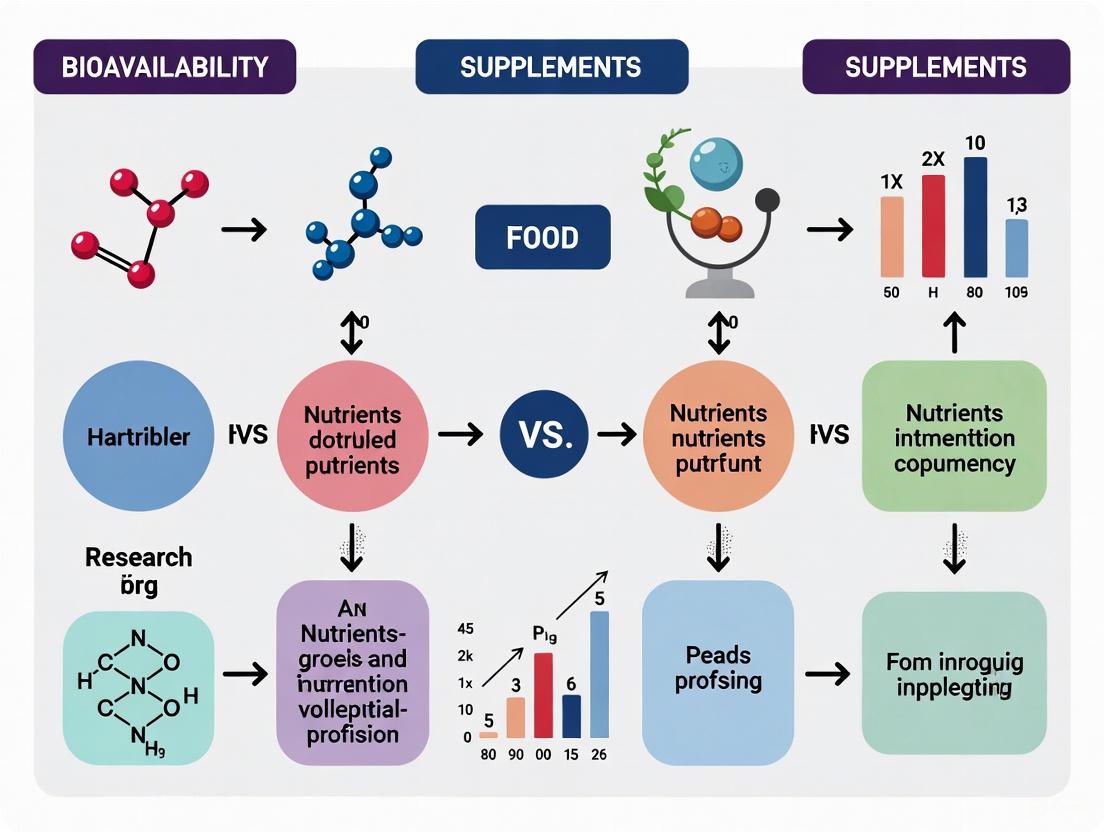
This article provides a comprehensive analysis of the bioavailability of nutrients from food versus supplement sources, tailored for researchers, scientists, and drug development professionals.
Bioavailability in Human Nutrition: A Comparative Analysis of Food vs. Supplement Forms for Research and Development
Abstract
This article provides a comprehensive analysis of the bioavailability of nutrients from food versus supplement sources, tailored for researchers, scientists, and drug development professionals. It explores the foundational principles defining bioavailability and the complex interplay of dietary, host, and matrix factors that influence it. The scope extends to established and emerging methodologies for assessing nutrient absorption, strategies to overcome common bioavailability limitations, and a critical evaluation of clinical evidence comparing different nutrient forms and delivery systems. By integrating insights from recent human trials and technological advances, this review aims to inform the design of more effective nutritional interventions, functional foods, and nutraceutical products.
Defining Bioavailability and the Complex Food-Matrix Effect
In the pursuit of optimal health and effective therapeutics, understanding the journey of bioactive compounds from ingestion to physiological action is paramount. This journey is conceptualized through frameworks that describe bioavailability—the proportion of a nutrient or drug that enters systemic circulation and is utilized for normal physiological functions or storage [1] [2]. For researchers and drug development professionals, the LADME framework provides a foundational model encompassing Liberation, Absorption, Distribution, Metabolism, and Elimination phases [1]. This framework is crucial for comparing the nutritional efficacy of bioactive compounds delivered through different matrices, particularly whole foods versus dietary supplements.
The conceptual understanding of bioavailability bridges pharmacology and nutrition. From a pharmacological perspective, bioavailability represents the rate and extent to which an active compound is absorbed and becomes available at the site of action [1]. From a nutritional standpoint, it refers to the fraction of a nutrient that the body can utilize, making it a matter of nutritional efficacy [1]. This dual perspective is essential when comparing food and supplement sources, as the matrix and delivery system significantly influence the bioavailability and subsequent bioefficacy of bioactive compounds [1] [3] [2].
The LADME Framework: Core Principles and Processes
The LADME framework provides a systematic approach to understanding the complex pathway of bioactive compounds in the body. Each component represents a critical phase in this journey, with specific factors influencing the ultimate bioavailability of the compound.
Liberation and Bioaccessibility
Liberation refers to the release of bioactive compounds from their food or supplement matrix, a process also described as bioaccessibility [1]. This initial phase is influenced by food composition, processing methods, and synergisms or antagonisms between different components [1]. For plant-based foods, the plant cell walls represent a significant barrier to the release of bioactive compounds. Processing techniques such as fermentation can break down these structures, as demonstrated with ferulic acid in wheat, where fermentation prior to baking broke ester links to fiber, subsequently improving bioavailability [1].
Absorption Mechanisms
Absorption encompasses the passage of compounds through the intestinal mucosa into systemic circulation. This process differs significantly between hydrophilic compounds like polyphenols and lipophilic compounds such as fat-soluble vitamins and polyunsaturated fatty acids (PUFAs) [1]. Lipophilic compounds require emulsification by bile and lipolysis by pancreatic enzymes to form micelles before absorption, while hydrophilic compounds may utilize various transport mechanisms [1]. The absorption phase is particularly influenced by factors including solubility, molecular structure, interaction with other dietary components, and the activity of cellular transporters and metabolizing enzymes [1].
Distribution, Metabolism, and Elimination
Following absorption, compounds undergo distribution to various tissues, metabolism into different forms, and eventual elimination from the body. These phases determine not only how much of a compound reaches target tissues but also in what form and for what duration. The LADME framework is visualized below, illustrating the sequential nature of these processes and key factors influencing each stage.
Methodologies for Assessing Bioavailability
Accurate assessment of bioavailability requires sophisticated methodologies that can quantify the complex processes of absorption, distribution, and utilization. These methods range from in vitro simulations to human clinical trials, each with distinct advantages and limitations for researchers.
In Vitro Digestion Models
In vitro techniques using simulated gastrointestinal digestion provide ethical, cost-effective approaches for preliminary bioavailability assessment [4]. These methods accurately imitate digestive conditions including temperature, agitation, pH, and enzyme composition [4]. Advanced in vitro approaches incorporate semi-permeable cellulose membranes with specific pore sizes to mimic human intestinal absorption [4]. These methods are particularly valuable for initial screening of bioavailability from various pharmaceutical and food products, including dietary supplements, before proceeding to more complex and expensive human trials.
Balance Studies and Ileal Digestibility
Balance studies measure the difference between ingestion of a nutrient and its excretion, providing a direct measure of absorption [2]. A related approach, ileal digestibility, measures the difference between the ingested amount and that remaining in ileal contents and is considered a reliable indicator for apparent absorption [2]. These methods are particularly useful for minerals and other nutrients that are not extensively metabolized before excretion.
Pharmacokinetic Approaches in Human Studies
Human studies represent the gold standard for bioavailability assessment, with pharmacokinetic approaches measuring the concentration of compounds and their metabolites in blood or plasma over time [3] [5]. The area under the curve (AUC) of concentration versus time provides a quantitative measure of absorption extent [3]. For nutrients like vitamin D, measurement of specific metabolites such as 25-hydroxyvitamin D (25(OH)D) in serum provides a functional indicator of bioavailability [3]. These approaches are visualized in the following experimental workflow.
The Researcher's Toolkit: Essential Reagents and Materials
Bioavailability research requires specialized reagents and analytical tools to simulate digestion, measure compound release, and quantify absorption. The following table details key research reagents and their applications in bioavailability studies.
Table 1: Essential Research Reagents for Bioavailability Studies
| Reagent/Material | Research Application | Experimental Function |
|---|---|---|
| Pepsin [4] [6] | Simulated gastric digestion | Proteolytic enzyme for stomach phase simulation |
| Pancreatin [4] [6] | Simulated intestinal digestion | Enzyme mixture for intestinal phase digestion |
| Dialysis tubes/membranes [4] [6] | Absorption simulation | Mimics intestinal barrier with selective permeability |
| Bile salts [1] | Lipid digestion studies | Enables emulsification and micelle formation for lipophilic compounds |
| Cell culture models (Caco-2) [4] | Intestinal absorption studies | Human cell line modeling intestinal epithelium transport |
| ICP-OES/GF-AAS [4] [6] | Elemental mineral analysis | Quantifies mineral concentration in bioaccessible fractions |
| ECLIA (Electrochemiluminescence) [3] | Vitamin D metabolite quantification | Measures 25(OH)D levels in serum for bioavailability assessment |
Comparative Bioavailability: Food Versus Supplements
Direct comparisons between food and supplement sources reveal significant differences in bioavailability driven by matrix effects, chemical forms, and interaction with other dietary components. Experimental data across multiple nutrient types demonstrates these critical variations.
Vitamin K (Phylloquinone) Bioavailability
Research comparing phylloquinone absorption from food sources versus supplements revealed striking differences. When human subjects consumed a standard test meal, the absorption of phylloquinone, measured as AUC over a 9-hour period, was significantly higher (P < 0.01) after consumption of a 500-μg phylloquinone tablet (27.55 ± 10.08 nmol/(L · h)) than after ingestion of 495 μg phylloquinone as 150 g of raw spinach (4.79 ± 1.11 nmol/(L · h)) [5]. This nearly 6-fold difference highlights the profound impact of food matrix on bioavailability.
Vitamin D Delivery Systems
A comparative study of vitamin D₃ bioavailability from different oral supplements in laboratory rats demonstrated significant differences based on delivery systems. Animals received microencapsulated, oil-based, or micellized vitamin D₃ for 7 days, with serum 25(OH)D concentrations monitored throughout and after the supplementation period [3]. The results demonstrated that supplement vehicle significantly impacts bioavailability, with microencapsulated and oil-based vitamin D₃ showing superior bioavailability compared to micellized forms [3]. Importantly, the microencapsulated form maintained constant effects for the longest period (up to 14 days), illustrating the importance of both absorption magnitude and duration in bioavailability assessment [3].
Table 2: Vitamin D₃ Bioavailability from Different Delivery Systems
| Delivery System | Relative Bioavailability | Duration of Effect | Key Characteristics |
|---|---|---|---|
| Microencapsulated [3] | Highest | Longest (up to 14 days) | Water-soluble with natural lecithin microcapsules |
| Oil-based [3] | High | Moderate | Traditional lipid delivery system |
| Micellized [3] | Lower | Shorter | Nanodispersed micelles with synthetic surfactant |
Chromium from Dietary Supplements
An in vitro evaluation of chromium bioavailability from dietary supplements demonstrated relative bioavailability ranging between 2.97% and 3.70% across different products [4]. The study revealed that the type of diet, chemical form of the molecule, and pharmaceutical form of preparations all significantly influence chromium bioavailability [4]. This research highlights the complex interplay between supplement formulation and dietary context in determining ultimate bioavailability.
Factors Influencing Bioavailability
Multiple factors influence the bioavailability of nutrients from both food and supplement sources, creating complex interactions that researchers must consider when designing studies or interpreting results.
Dietary and Matrix Effects
The food matrix significantly impacts bioavailability, with plant-based foods often exhibiting reduced micronutrient bioavailability due to entrapment in cellular structures and binding by antagonists such as phytate and fiber [2]. Conversely, certain dietary components can enhance bioavailability—dietary fats significantly improve absorption of fat-soluble vitamins, and multiple vitamins support iron absorption and metabolism [2]. Processing methods also influence bioaccessibility, mainly through changes in plant cell wall structure and properties [1].
Host Factors and Genetic Influences
Individual physiological factors create substantial variation in nutrient bioavailability between subjects. A healthy gastrointestinal microbiota can increase absorption of vitamins and minerals, while dysbiosis may reduce availability [2]. Certain life stages such as pregnancy and lactation are characterized by increased absorptive capacity, while elderly individuals often exhibit reduced ability to absorb certain vitamins [2]. Genetic polymorphisms in metabolic enzymes and transporters further contribute to interindividual variability, with phenoconversion describing the mismatch between genotype-based prediction of drug metabolism and true metabolic capacity due to non-genetic factors [7].
Chemical Form and Pharmaceutical Formulation
The specific chemical form of a nutrient significantly influences its bioavailability. For example, calcifediol is more bioavailable than cholecalciferol, and methylfolate is more bioavailable than folic acid [2]. Pharmaceutical formulation also plays a crucial role, with technologies such as permeation enhancers, lipid-based formulations, nutrient compounding, encapsulation, and phytase application all being employed to increase micronutrient bioavailability [2].
Implications for Research and Development
The conceptual framework from LADME to nutritional efficacy provides critical insights for researchers, product developers, and clinicians seeking to optimize nutrient delivery and physiological outcomes.
Research Design Considerations
Future research should account for the complex interactions between delivery systems, dietary context, and individual physiological factors. The development of predictive equations for estimating nutrient absorption represents a promising approach to addressing the limitations of current assessment methods [8]. A structured framework for developing such equations includes identifying key factors influencing bioavailability, conducting comprehensive literature reviews of high-quality human studies, constructing predictive equations, and validation to potentiate translation [8].
Product Development Applications
Understanding bioavailability frameworks enables the development of more effective nutrient delivery systems. Technologies that enhance bioavailability include microencapsulation, micellization, and lipid-based formulations that protect compounds from degradation and improve absorption [3] [2]. These approaches are particularly valuable for addressing widespread global nutrient deficiencies by maximizing the utilization of supplemented nutrients.
Clinical and Regulatory Implications
From a clinical perspective, recognizing the variable bioavailability between different nutrient forms and delivery systems enables more precise recommendations for both dietary intake and therapeutic supplementation. Regulatory frameworks increasingly acknowledge the importance of bioavailability in establishing nutrient requirements and evaluating health claims, though standardized assessment methods remain an area of ongoing development [2] [8].
Bioavailability is a central concept in nutrition science, critical for understanding the relationship between nutrient intake and physiological efficacy. For researchers and drug development professionals, precise definitions are paramount. The term bioavailability is broadly defined as the proportion of an ingested nutrient that is absorbed, transported to target tissues, and utilized in normal physiological functions or storage [9]. A more mechanistic definition describes it as "the fraction of an ingested nutrient that is released during digestion, absorbed via the gastrointestinal tract, transported and distributed to target cells and tissues, in a form that is available for utilization in metabolic functions or for storage" [9]. This multifaceted process extends beyond mere absorption to include subsequent utilization, making it a crucial parameter for evaluating nutrient sources.
The assessment of bioavailability is methodologically complex. Balance studies measuring the difference between ingestion and excretion are common, as are ileal digestibility measurements [9]. Pharmacokinetic studies, which assess the relative amount of a substance present in circulation from one source compared to another, are frequently employed for dietary supplements [10]. Understanding these concepts is foundational for comparing the bioavailability of nutrients from whole foods versus supplemental forms, a critical consideration in nutritional science and fortification strategy development.
Dietary Factors Influencing Bioavailability
Food Matrix Effects: Whole Foods vs. Isolated Nutrients
The food matrix exerts a profound influence on nutrient bioavailability, creating fundamental differences between whole foods and isolated supplements. Whole foods provide a complex, synergistic blend of vitamins, minerals, fiber, and phytochemicals that work in concert to influence absorption [11]. For instance, in plant-based foods, nutrients are often entrapped in cellular structures or bound by antagonists such as phytate and fiber, which can reduce their bioavailability [9]. Research demonstrates that vitamins in foods originating from animals are generally more bioavailable than those sourced from plants [12].
The physical structure of food directly impacts nutrient release. Studies on carotenoid bioaccessibility in carrots and tomatoes have identified chloroplast structures and cell walls as major barriers; these structural barriers must be disrupted through processing or digestion to increase nutrient accessibility [13]. Similarly, almond cell walls physically encapsulate lipids, protein, and vitamin E, significantly hindering their release during digestion unless the cell walls are thoroughly disrupted [13].
Nutrient-Nutrient Interactions: Synergism and Antagonism
Nutrients rarely act in isolation within the digestive milieu. Their interactions can significantly enhance or inhibit bioavailability through various mechanisms. Dairy foods provide excellent examples of synergistic interactions. Casein and whey proteins, along with phosphopeptides from their enzymatic hydrolysis, sequester calcium, protecting it from precipitation by anions like phosphates in the intestine and enabling passive diffusion [14]. Lactose also enhances calcium absorption, potentially by widening paracellular spaces in the enteric cell lining or through prebiotic effects that maintain low colonic pH [14].
Conversely, antagonistic interactions can reduce bioavailability. Plant-based foods often contain phytates and oxalates that bind minerals like iron, zinc, and calcium, forming insoluble complexes that hinder absorption [9]. The presence of these dietary antagonists is a primary reason for the lower mineral bioavailability from plant sources compared to animal sources. Even within a single food matrix, competing processes can occur. In dairy, sulfur-containing proteins can induce hypercalciuria, potentially creating a negative calcium balance despite adequate intake [14].
Impact of Food Processing and Preparation
Processing methods significantly alter food microstructure and consequently affect nutrient bioavailability. Thermal processing, mechanical disruption, and fermentation can break down cellular barriers and inactivation inhibitors, thereby enhancing the bioavailability of certain nutrients. For example, the fermentation process in kefir increases the nutritional value and bioavailability of its constituents compared to milk [15]. However, processing can also degrade heat-sensitive vitamins, demonstrating that effects are nutrient-specific and process-dependent.
Table 1: Comparative Bioavailability of Vitamins from Animal vs. Plant Foods
| Vitamin | Animal Source Bioavailability | Plant Source Bioavailability | Key Dietary Sources |
|---|---|---|---|
| Vitamin A (Retinol) | 74% [12] | 15.6% (from β-carotene) [12] | Liver, dairy (animal); Carrots, sweet potatoes (plant) |
| Vitamin B12 | 65% [12] | Not significant [12] | Meat, fish, eggs, dairy |
| Riboflavin (B2) | 61% [12] | 65% [12] | Meat, dairy (animal); Spinach, almonds (plant) |
| Thiamin (B1) | 82% [12] | 81% [12] | Pork, trout (animal); Sunflower seeds, black beans (plant) |
| Vitamin C | Not significant | 76% [12] | Citrus fruits, bell peppers, broccoli |
| Vitamin K | Further studies needed [12] | 16.5% [12] | Leafy greens, vegetable oils |
Host Factors Determining Nutrient Utilization
Physiological and Demographic Determinants
Host-related factors introduce significant interindividual variability in nutrient bioavailability. Age profoundly affects absorptive capacity; older adults often experience decreased absorption of vitamin B12 due to reduced gastric intrinsic factor production and lower gastric acidity [9] [16]. Physiological states such as pregnancy and lactation trigger adaptive increases in absorptive efficiency for various nutrients to meet heightened metabolic demands [9]. Conversely, disease states and medications can dramatically alter bioavailability. Certain pharmaceuticals reduce vitamin absorption and status, while conditions like bacterial overgrowth or dysbiosis can reduce the availability of several vitamins through competitive utilization or altered gut environment [9].
Genetic factors, including single-nucleotide polymorphisms (SNPs), contribute to inherent variability in nutrient absorption and metabolism [10]. An individual's current nutrient status also regulates absorption efficiency; deficient states often upregulate absorption mechanisms through homeostatic regulation. For instance, active calcium transport is enhanced by vitamin D at low and moderate calcium intakes, representing a nutrient-nutrient interaction modulated by host status [14].
Gastrointestinal Environment and Microbiota
The gastrointestinal environment serves as the primary interface for nutrient absorption and is thus a critical host factor. Gastric acidity, transit time, and mucosal integrity all influence bioavailability. The gut microbiota represents another crucial variable, capable of both synthesizing certain vitamins (particularly B vitamins and vitamin K) and consuming others [9] [15]. A healthy gastrointestinal microbiota can increase the absorption of vitamins and minerals, while dysbiosis may have the opposite effect [9]. The prebiotic effect of certain dietary components, such as the potential prebiotic activity of microalgae polysaccharides, can indirectly enhance mineral absorption by promoting bacterial production of short-chain fatty acids that lower colonic pH [15] [5].
Comparative Bioavailability: Foods vs. Supplements
Direct comparisons reveal significant differences in bioavailability between food and supplemental nutrient sources. A pivotal study demonstrated that phylloquinone (vitamin K) absorption was substantially higher from a 500-μg supplement tablet (AUC = 27.55 ± 10.08 nmol/(L·h)) than from an equivalent amount of raw spinach (AUC = 4.79 ± 1.11 nmol/(L·h)) [5]. This pattern is not universal, however, as vitamins and minerals added to foods or taken as supplements "generally are at least as bioavailable as those endogenously in foods, and often more so" [9].
The chemical form of nutrients in supplements significantly influences their bioavailability. For example, calcifediol is more bioavailable than cholecalciferol, and methylfolate is more bioavailable than folic acid [9]. Similarly, different mineral chelates exhibit varying bioavailability; magnesium citrate demonstrates higher urinary excretion within 24 hours of a single dose compared to magnesium oxide, though the clinical significance of these pharmacokinetic differences remains unclear [10].
The Food Matrix Advantage and Supplement Limitations
Despite sometimes lower absorption percentages, whole foods offer distinct advantages through their complex matrix. They provide "hundreds of carotenoids, flavonoids, minerals, and antioxidants that aren't in most supplements" [16], which may confer health benefits beyond isolated nutrients. This synergistic combination likely explains why, despite poor absorption, high curcuminoid extracts of turmeric demonstrate clinical efficacy in conditions like ulcerative colitis, osteoarthritis, and depression—a phenomenon termed the "curcumin paradox" [10]. This suggests that local gastrointestinal effects or metabolite activity may contribute to efficacy independent of systemic absorption.
Supplements present challenges including potential overconsumption, variable quality, and the absence of complementary nutrients. They also lack the dietary fiber and other bioactive compounds present in whole foods that contribute to overall health [16] [11]. However, in specific circumstances—such as diagnosed deficiencies, life stages with increased requirements, or limited dietary diversity—supplements can effectively address nutritional gaps with highly bioavailable nutrient forms [9] [16].
Table 2: Experimental Protocols for Bioavailability Assessment
| Method | Key Measurements | Applications | Considerations |
|---|---|---|---|
| Balance Studies | Difference between nutrient ingestion and excretion [9] | Mineral absorption, protein utilization | Accounts for endogenous losses; measures net retention |
| Pharmacokinetic Studies | Area Under the Curve (AUC) of plasma concentration over time [5] [10] | Vitamin absorption, supplement bioavailability | Requires precise blood sampling; measures systemic availability |
| Ileal Digestibility | Difference between ingested amount and ileal contents [9] [15] | Apparent absorption of minerals, proteins | Requires intestinal intubation; avoids colonic microbial interference |
| In Vitro Digestion Models | Nutrient release after simulated gastrointestinal digestion [15] | Rapid screening of food formulations, mineral bioavailability | Cannot fully replicate human physiology; cost-effective for screening |
| Stable Isotope Tracers | Isotopic enrichment in blood, urine, or tissues [14] | Calcium, iron, zinc metabolism | Allows study of specific food sources; requires specialized instrumentation |
Experimental Models and Research Methodologies
In Vivo and In Vitro Assessment Approaches
Bioavailability research employs diverse methodological approaches, each with distinct advantages and limitations. Human studies are considered the gold standard for bioavailability assessment but present ethical, practical, and financial challenges [9]. Stable isotope techniques represent particularly sophisticated approaches, allowing researchers to track specific nutrients without radioactive concerns and precisely measure absorption, retention, and utilization [14]. The choice of biomarker is crucial and varies by nutrient; for instance, serum magnesium may not reflect long-term status as accurately as red blood cell magnesium levels [10].
In vitro digestion models offer a cost-effective alternative for initial screening. These systems simulate human digestive processes, measuring the proportion of nutrients released from the food matrix (bioaccessibility) as an indicator of potential bioavailability [15]. For example, research on kefir enriched with microalgae used in vitro digestion to assess the release of protein, phosphorus, iron, and B vitamins, demonstrating how different algal supplements affect nutrient bioavailability [15]. While in vitro methods cannot fully replicate human physiology, they provide valuable preliminary data and mechanistic insights.
Clinical Efficacy vs. Bioavailability Measurements
A critical consideration in bioavailability research is the distinction between pharmacokinetic measurements and clinical outcomes. Enhanced bioavailability does not invariably translate to superior clinical efficacy. For example, various magnesium forms (aspartate, carbonate, chloride, citrate, glycinate, orotate, and oxide) have demonstrated clinical effectiveness despite differences in absorption kinetics [10]. Similarly, the artificial emulsifier polysorbate 80 complexed with turmeric extract increased plasma curcuminoid concentrations 185-fold yet failed to alter blood lipids, inflammation, or glucose in a clinical trial [10].
These discordant findings highlight the complexity of nutrient action and the limitations of relying solely on bioavailability metrics. Mechanisms such as local gastrointestinal effects, metabolite activity, or tissue-specific uptake may contribute to clinical efficacy independent of systemic concentrations. Therefore, comprehensive assessment requires both pharmacokinetic studies and clinical trials measuring functional endpoints.
Diagram 1: Bioavailability assessment workflow showing the relationship between different methodological approaches, from initial screening to clinical efficacy determination.
Research Reagent Solutions for Bioavailability Studies
Table 3: Essential Research Materials for Bioavailability Investigations
| Reagent/Material | Function/Application | Example Use Case |
|---|---|---|
| Stable Isotope Tracers | Metabolic tracking of specific nutrients without radioactivity | Precise measurement of mineral absorption (e.g., calcium, iron, zinc) [14] |
| In Vitro Digestion Models | Simulated gastrointestinal conditions for bioaccessibility screening | Rapid comparison of nutrient release from different food matrices [15] |
| Cell Culture Models | Investigation of transport mechanisms and cellular uptake | Caco-2 cells for intestinal absorption studies [9] |
| Specific Biomarker Assays | Quantification of nutrient status and functional indicators | Serum 25(OH)D for vitamin D status; RBC magnesium for magnesium status [9] [10] |
| Standard Reference Materials | Method validation and quality control | Certified food and serum samples with known nutrient concentrations |
The bioavailability of nutrients is governed by a complex interplay of dietary factors, host factors, and nutrient interactions. Food matrix effects, nutrient synergisms and antagonisms, processing methods, and host physiology collectively determine the fraction of ingested nutrients that ultimately become available for physiological functions. While supplements can provide highly bioavailable nutrient forms and effectively address specific deficiencies, whole foods offer complementary bioactive compounds and synergistic interactions that cannot be fully replicated in isolated forms.
For researchers and drug development professionals, these principles underscore the importance of considering bioavailability in the design of nutritional interventions and fortified products. A comprehensive understanding of both the pharmacokinetic and functional aspects of nutrient absorption and utilization is essential for developing evidence-based recommendations and products that optimize nutritional status and health outcomes across diverse populations.
The concept of the "food matrix" (FM) has gained significant prominence among nutritionists and researchers who have observed that the behavior of individual food components differs markedly when studied in isolation compared to their presence within complex food structures [17]. The food matrix represents a combined form of nutrient and non-nutrient components that physically or chemically interact with each other, thereby influencing their digestion, release, mass transfer, and stability throughout the gastrointestinal tract [17]. This complex interplay directly governs the bioaccessibility and bioavailability of bioactive compounds—critical factors that determine whether these substances can exert their claimed nutritional benefits [17].
Understanding food matrix effects is particularly crucial when comparing whole foods with supplement forms, as the absorption kinetics, metabolic fate, and ultimate physiological efficacy of bioactive compounds are profoundly shaped by their dietary context. This guide objectively examines how various food matrices either enhance or inhibit the bioaccessibility of key bioactive compounds, providing researchers with experimental data and methodologies to inform future study designs and product development strategies.
Comparative Bioaccessibility Data Across Food Matrices
Table 1: Bioaccessibility Outcomes Across Different Food Matrices and Compound Types
| Bioactive Compound | Food Matrix/Formulation | Bioaccessibility Outcome | Key Findings | Citation |
|---|---|---|---|---|
| Curcuminoids (from turmeric) | Dairy analogue (oat milk) | ↑ 76% AUC, ↑ 105% Cmax vs capsules | Highest bioavailability increase among tested matrices; attributed to lipid suspension | [18] |
| Curcuminoids (from turmeric) | Sports nutrition bar | ↑ 40% AUC, ↑ 74% Cmax vs capsules | Macronutrient interaction enhancing bioavailability | [18] |
| Curcuminoids (from turmeric) | Probiotic drink | ↑ 35% AUC, ↑ 52% Cmax vs capsules | Fermentation-related enhancement | [18] |
| Curcuminoids (from turmeric) | Fruit nectar, pectin gummies | Bioequivalent to capsules | No significant matrix effect observed | [18] |
| Galangin (from Alpinia officinarum) | Dual-coated liposomes | ~74% bioaccessibility | 3-fold increase over free extract (~24%); enhanced stability in GI tract | [19] |
| Galangin (from Alpinia officinarum) | Various dietary models | 17-36% bioaccessibility | Significant matrix-dependent variability | [20] |
| Quercetin | With dietary fats and fiber | ~2-fold increase in bioavailability | Food components facilitating absorption | [21] |
| Quercetin | Lecithin phytosome | 20.1-fold increase vs aglycone | Encapsulation strategy overcoming natural limitations | [21] |
| Phenolic compounds (from broccoli) | Fresh broccoli after digestion | 64.9% loss of phenolic compounds | Substantial degradation during digestion | [22] |
| Phenolic compounds (from broccoli) | Frozen boiled broccoli after digestion | 88% loss of phenolic compounds | Processing exacerbates digestive losses | [22] |
| Hydroxybenzoic acids, dihydrochalcones (from apple) | Semi-dynamic digestion model | Greater extraction vs static model | Improved simulation revealing matrix effects | [23] |
| Flavanols (from apple juice) | Semi-dynamic digestion model | More extensive degradation vs static model | Matrix-devoid forms more vulnerable | [23] |
Table 2: Structural and Compositional Factors Influencing Bioaccessibility
| Factor Category | Specific Characteristic | Impact on Bioaccessibility | Mechanistic Insight |
|---|---|---|---|
| Physical State | Amorphous vs. semicrystalline microparticles | Compound-specific effects | Semicrystalline inulin particles showed higher intestinal release for ellagic acid [24] |
| Compound Solubility | Hydrophilic (gallic acid) vs. hydrophobic (ellagic acid) | Differential release patterns | Gallic acid: rapid gastric release (~100%); Ellagic acid: limited gastric, higher intestinal release [24] |
| Matrix Composition | Carbohydrate- and blend-based matrices | Improved release & antioxidant activity | Enhanced compound liberation from food structure [24] |
| Processing Method | Thermal treatment (broccoli) | Significant phenolic losses | Boiling/steaming reduced phenolic content (503-515 mg GAE/100g) vs fresh (610 mg GAE/100g) [22] |
| Digestion Model | Static vs. semi-dynamic INFOGEST | Variable extraction outcomes | Semi-dynamic model showed greater polyphenol extraction from complex matrices [23] |
Experimental Protocols and Methodologies
INFOGEST In Vitro Digestion Protocol
The internationally harmonized INFOGEST protocol provides a standardized framework for simulating gastrointestinal digestion, enabling reproducible assessment of food matrix effects on bioaccessibility [25]. The method sequentially simulates oral, gastric, and intestinal phases under physiologically relevant conditions [24].
Oral Phase Simulation: Food samples are homogenized with simulated salivary fluid (SSF) containing electrolytes and α-amylase, typically incubated for 2-5 minutes at pH 7.0 [22].
Gastric Phase Simulation: The oral bolus is mixed with simulated gastric fluid (SGF) containing pepsin, with pH adjusted to 3.0 using HCl, then incubated for 2 hours at 37°C under continuous shaking [22]. For fed-state simulations, researchers employ Fed State Simulated Gastric Fluid (FeSSGF) mixed with food matrices like full-fat milk in 1:1 ratio, pH-adjusted to 3.0 [25].
Intestinal Phase Simulation: Gastric chyme is combined with simulated intestinal fluid (SIF) containing pancreatin and bile salts, with pH adjusted to 7.0, followed by incubation for 2 hours at 37°C [22]. Fed-state intestinal conditions utilize Fed State Simulated Intestinal Fluid (FeSSIF) containing bile salts, lecithin, and metabolic components at pH 6.0 [25].
Bioaccessibility Assessment: Following digestion, samples are centrifuged (e.g., 5,000 × g, 30 minutes) to obtain the bioaccessible fraction in the supernatant, which is then analyzed using appropriate analytical techniques [25].
Clinical Trial Protocol for Food Matrix Effects
For human bioavailability studies, randomized, crossover designs are implemented to evaluate food matrix effects:
Study Population: Typically healthy adults (18-45 years) with normal BMI (18.5-24.9 kg/m²) and stable weight [18].
Intervention Design: Participants consume identical doses of bioactive compounds embedded in different food matrices or capsule forms on separate visits, with washout periods of at least one week between interventions [18].
Sample Collection and Analysis: Blood samples are collected at baseline and at multiple timepoints post-consumption (e.g., 0.25, 0.5, 0.75, 1, 1.5, 2, 2.5, 3, 3.5, 4, 6, 8, and 24 hours) [18]. Plasma concentrations of bioactive compounds and their metabolites are quantified using validated LC-MS/MS methods, with pharmacokinetic parameters (AUC, C~max~, T~max~) calculated for each formulation [18].
Mechanisms and Pathways of Food Matrix Effects
The food matrix influences bioaccessibility through multiple interconnected mechanisms that operate throughout the gastrointestinal tract. These pathways determine the ultimate bioavailability of bioactive compounds and can be visualized as follows:
Diagram 1: Key Pathways of Food Matrix Effects on Bioaccessibility and Bioavailability
The diagram illustrates four primary mechanisms through which food matrices modulate bioaccessibility:
Mechanical Processing Effects: The physical structure of food governs the liberation of bioactive compounds during digestion. Cellular matrices (e.g., whole fruits, vegetables) can entrap bioactive compounds, requiring thorough disruption for release. For example, carotenoids demonstrate 5-fold higher bioavailability when administered dissolved in oil compared to their native matrix in raw carrots due to inefficient digestion from intact cellular structures [17]. Processing methods like cooking, freezing, or grinding can disrupt these physical barriers, potentially enhancing bioaccessibility.
Chemical Interaction Effects: Food components can form complexes with bioactive compounds, altering their solubility and stability. Proteins (particularly casein), dietary fiber, and minerals have been shown to form complexes with polyphenols, potentially reducing their bioaccessibility [17] [25]. Conversely, lipids and digestible carbohydrates can enhance the bioavailability of certain flavonoids by facilitating their absorption [17]. These chemical interactions are compound-specific, with some nutrients inhibiting while others promote bioaccessibility.
Microbial Transformation Effects: The gut microbiota metabolizes non-absorbed food components and bioactive compounds, producing metabolites with altered bioavailability and bioactivity. For example, ellagic acid is transformed by colonic microbiota into urolithins, while complex curcuminoids undergo bacterial reduction to dihydrocurcumin and tetrahydrocurcumin [24] [18]. Prebiotic components (e.g., inulin) in food matrices can modulate this microbial metabolism, indirectly influencing bioaccessibility of bioactive compounds [24].
Transport and Uptake Effects: Food matrix components can directly influence intestinal absorption by interacting with epithelial transporters or modifying monolayer permeability. Nutrients have been shown to interact with influx and efflux intestinal transporters, potentially competing with or facilitating bioactive compound absorption [25]. For instance, casein and certain dietary fibers directly affect intestinal monolayer permeability for hydroxytyrosol and tyrosol, independent of their complexation effects in the gastrointestinal lumen [25].
The Scientist's Toolkit: Essential Research Reagents and Materials
Table 3: Essential Reagents for Food Matrix Bioaccessibility Research
| Reagent Category | Specific Examples | Research Application | Functional Role |
|---|---|---|---|
| Digestive Enzymes | Pepsin (porcine gastric mucosa), Pancreatin (porcine pancreas), Lipase | INFOGEST simulation | Catalyze macromolecule hydrolysis under physiological conditions |
| Simulated Fluids | Simulated Salivary Fluid (SSF), Simulated Gastric Fluid (SGF), Simulated Intestinal Fluid (SIF) | In vitro digestion models | Reproduce electrolyte, pH, and biochemical conditions of GI tract |
| Bile Salts | Porcine bile extract, Sodium taurocholate | Intestinal phase simulation | Emulsify lipids, form mixed micelles for hydrophobic compound absorption |
| Cell Culture Models | Caco-2 cell line | Intestinal permeability assessment | Model human intestinal epithelium for absorption studies |
| Encapsulation Materials | Inulin, Chitosan, Sodium alginate, Phospholipids | Bioavailability enhancement | Protect bioactive compounds from degradation, control release profiles |
| Analytical Standards | Phenolic compounds, Carotenoids, Flavonoids, Metabolites | HPLC/LC-MS quantification | Reference compounds for identification and quantification of bioactives |
| Food Matrix Components | Sodium caseinate, Dietary fibers, Sunflower oil, Carbohydrates | Controlled matrix studies | Isolate effects of specific food components on bioaccessibility |
The evidence clearly demonstrates that the food matrix can function as both an enhancer and inhibitor of bioaccessibility, with effects that are compound-specific, matrix-dependent, and processing-contingent. While supplement forms offer standardized dosing, their bioavailability may be limited without the appropriate food matrix to facilitate absorption. Conversely, whole foods provide natural delivery systems but may entrap bioactive compounds, reducing their bioaccessibility.
For researchers and product developers, these findings highlight several key considerations:
Matrix Design Optimization: Intentional food matrix design can significantly enhance bioactive compound delivery. Lipid-containing matrices consistently improve bioavailability of lipophilic compounds like curcuminoids, while encapsulation technologies can overcome inherent stability and solubility limitations [19] [18].
Processing Method Selection: Thermal and mechanical processing strategies should be optimized to maximize bioaccessibility rather than simply maximizing compound concentration in the raw material [22].
Model System Selection: Appropriate in vitro digestion models that accurately simulate physiological conditions are essential for predicting in vivo bioaccessibility [23]. The INFOGEST protocol provides a standardized approach, but researchers should consider when semi-dynamic models might offer advantages over static systems for specific research questions [23].
Future research should focus on elucidating structure-activity relationships between specific matrix architectures and their effects on bioactive compound liberation, and developing novel processing technologies that optimize rather than degrade bioaccessibility. The ultimate goal is the rational design of food matrices and supplement formulations that maximize the delivery of health-promoting bioactive compounds.
Dose-Dependent Absorption and Saturation Kinetics
Dose-dependent absorption, a key aspect of nonlinear pharmacokinetics, occurs when the absorption process of a substance becomes saturated, leading to a disproportionate change in bioavailability as the administered dose increases [26] [27]. This phenomenon is primarily governed by saturation kinetics, where the capacity of absorption mechanisms becomes overwhelmed, transitioning from first-order to zero-order kinetics [26]. Understanding these principles is crucial for comparing the bioavailability of nutrients and pharmaceuticals delivered in different forms, such as foods versus supplements. This guide objectively examines the experimental evidence and methodologies used to study these processes, providing researchers and drug development professionals with a structured comparison of performance across different delivery forms.
Theoretical Foundations of Saturation Kinetics
Basic Kinetic Principles
In pharmacokinetics, substances typically follow first-order kinetics at lower doses, where the rate of absorption and elimination is proportional to their concentration [26]. However, as doses increase, carrier-mediated transport systems, dissolution rates, or metabolic pathways can become saturated, leading to zero-order kinetics where a constant amount is absorbed per unit time regardless of concentration [26] [27]. This transition to saturation kinetics explains why doubling the dose rate might increase the steady-state concentration far more than expected—a critical consideration in dosing regimen design [26].
The physicochemical model for dose-dependent drug absorption utilizes a two-tank perfect-mixing system to simulate gastrointestinal absorption, accounting for drug parameters (pKa, solubility, intrinsic wall permeability) and system parameters (pH profile, volume of intestinal contents, intestinal flow rate) [28]. This model demonstrates that when the dose does not exceed the drug's solubility in the intestinal lumen, the fraction absorbed remains independent of dose, but saturation leads to dose-dependent absorption patterns [28].
Mechanisms Leading to Dose-Dependent Absorption
Several biological mechanisms can exhibit saturation, resulting in nonlinear absorption:
- Carrier-Mediated Transport: Active transport systems for nutrients and some drugs have limited capacity. When these transporters become saturated, absorption efficiency decreases at higher doses [27].
- Solubility Limitations: Poorly soluble compounds may not fully dissolve in gastrointestinal fluids before transit, creating a dissolution rate-limited absorption profile [28].
- Metabolic Enzyme Saturation: Presystemic metabolism in the gut wall or liver can become saturated at higher doses, increasing the fraction that reaches systemic circulation [27].
- Protein Binding Saturation: While primarily affecting distribution, saturation of plasma protein binding can influence clearance and create apparent nonlinearity [26] [27].
Experimental Assessment Methodologies
In Vitro and In Silico Approaches
Researchers employ various models to predict and characterize saturation kinetics before human trials:
Physicochemical Absorption Models: The two-tank perfect-mixing model simulates GI absorption dynamics, allowing researchers to study how drug parameters (pKa, solubility, permeability) and system parameters (pH, volume, flow rate) affect absorption [28]. This model successfully predicted the dose-dependent absorption of chlorothiazide, attributing it to physical characteristics rather than saturable transport mechanisms [28].
Phase Plane Method: This innovative approach analyzes concentration-time data by plotting dC/dt versus C, creating a phase plane plot that reveals absorption kinetics without requiring modeling assumptions or intravenous data [29]. The method can distinguish between first-order, zero-order, and Michaelis-Menten input kinetics through simple slope analysis of the phase plane plot [29].
Diagram 1: The phase plane method workflow for investigating absorption kinetics without intravenous data.
Clinical Assessment Methods
Human studies provide the most definitive evidence of saturation kinetics and bioavailability:
Balance Studies: These measure the difference between nutrient ingestion and excretion, with ileal digestibility (difference between ingested amount and ileal contents) considered a reliable indicator of apparent absorption [9].
Pharmacokinetic Profiling: Serial measurements of plasma and urinary concentrations after different administered doses can reveal nonlinearity. Key indicators include area under the curve (AUC) that changes disproportionately with dose, and alterations in elimination half-life at higher doses [27].
Stable Isotope Tracers: These methods allow precise tracking of specific compounds through absorption, distribution, metabolism, and excretion pathways without radioactive exposure concerns.
Comparative Bioavailability: Key Studies and Data
Vitamin C Bioavailability from Different Forms
A recent randomized crossover trial provides compelling data on how intake form affects vitamin C bioavailability [30]. The study compared three delivery methods: synthetic ascorbic acid powder, raw fruits and vegetables, and fruit/vegetable juice, each providing 101.7 mg of vitamin C.
Table 1: Vitamin C Bioavailability from Different Forms [30]
| Intake Form | Plasma Vitamin C AUC (mg/dL·h) | Peak Plasma Concentration | Urinary Metabolite Changes | Antioxidant Activity (ORAC) |
|---|---|---|---|---|
| Synthetic Powder | Intermediate | Moderate | Decreased choline | Transient elevation |
| Raw Fruits & Vegetables | Lower | Lower | Increased DMG and glycine | No sustained improvement |
| Fruit/Vegetable Juice | 25.3 ± 3.2 (Highest) | Highest | Increased DMG and glycine | No sustained improvement |
The study demonstrated that juice provided the most efficient absorption, with the highest plasma AUC, potentially due to enhanced nutrient release from the matrix during processing [30]. All forms elevated plasma vitamin C levels, but urinary metabolomics revealed distinct metabolic handling, with increased excretion of mannitol, glycine, taurine, dimethylglycine (DMG), and asparagine across groups [30].
Pharmaceutical Case Studies
Chlorothiazide vs. Hydrochlorothiazide: The physicochemical model simulated absorption for both drugs using identical system parameters [28]. Chlorothiazide exhibited dose-dependent absorption attributable to its physical characteristics (lower solubility and pKa), while hydrochlorothiazide showed dose-proportional absorption due to its higher solubility and pKa [28].
Phenytoin and Valproate: These anticonvulsants exemplify saturation kinetics in elimination and protein binding, respectively. Phenytoin transitions from first-order to zero-order elimination as doses increase, while valproate exhibits concentration-dependent protein binding saturation [26].
Table 2: Dose-Dependent Kinetics in Model Compounds
| Compound | Mechanism of Saturation | Observed Kinetic Pattern | Clinical Implications |
|---|---|---|---|
| Chlorothiazide | Solubility-limited absorption | Dose-dependent absorption | Higher doses have disproportionately lower bioavailability |
| Hydrochlorothiazide | No significant saturation | Dose-proportional absorption | Predictable linear kinetics |
| Phenytoin | Metabolism saturation | Zero-order elimination at high doses | Small dose increases cause large concentration changes |
| Valproate | Protein binding saturation | Increased free fraction at high doses | Enhanced effects and toxicity despite small concentration changes |
The Scientist's Toolkit: Key Research Reagents and Materials
Table 3: Essential Research Materials for Saturation Kinetics Studies
| Reagent/Material | Function in Research | Application Examples |
|---|---|---|
| Caco-2 Cell Lines | Model human intestinal absorption | In vitro permeability studies |
| Simulated GI Fluids | Predict dissolution and precipitation | Bio-relevant dissolution testing |
| Stable Isotope Tracers | Track specific compounds in complex systems | Human absorption and metabolism studies |
| ABSOR.B Instrument | Measure absorbance kinetics of reactions | Chemical reaction rate determination [31] |
| Phase Plane Analysis Software | Identify absorption kinetics from plasma data | Discern zero-order vs. first-order input [29] |
| Specific HPLC/MS Assays | Quantify analytes in biological matrices | Plasma and urine concentration measurement |
Experimental Protocols
Randomized Crossover Trial for Nutrient Bioavailability
The vitamin C bioavailability study exemplifies a robust clinical protocol [30]:
Study Design: Twelve healthy adults underwent three 1-day intervention periods in random order, separated by 2-week washout periods.
Interventions:
- Powder: 101.7 mg synthetic ascorbic acid
- Whole Food: 186.8 g raw fruits and vegetables providing 101.7 mg vitamin C
- Juice: 200 mL fruit and vegetable juice providing 101.7 mg vitamin C
Assessments:
- Plasma vitamin C concentrations at multiple time points over 24 hours
- Urinary vitamin C excretion
- Urinary metabolomics using 1H NMR
- Antioxidant activity (ORAC and TRAP assays)
Data Analysis: Calculate AUC for plasma concentrations, statistical comparison of outcomes between groups, and metabolomic pattern analysis [30].
Phase Plane Method for Absorption Kinetics
This computational approach requires only concentration-time data [29]:
- Data Collection: Obtain serial plasma concentration measurements after oral administration.
- Phase Plot Construction: Plot the derivative of concentration with respect to time (dC/dt) against concentration (C).
- Slope Analysis: Perform separate linear regression analyses on the absorption and elimination phases of the phase plane plot.
- Kinetics Discernment: Calculate the ratio of slopes—a value of 1 suggests zero-order input, while other values indicate different kinetic patterns.
- Model Validation: Apply to known datasets to verify method accuracy before analyzing novel compounds.
Dose-dependent absorption and saturation kinetics represent critical considerations in bioavailability research, particularly when comparing food versus supplement forms. The evidence demonstrates that delivery form significantly impacts absorption efficiency, with juiced sources providing superior vitamin C bioavailability compared to whole foods or synthetic forms in some studies [30]. Pharmaceutical examples illustrate how solubility, permeability, and transport mechanisms interact to produce nonlinear kinetics [28] [26].
Researchers should employ appropriate methodologies—including physicochemical models, phase plane analysis, and randomized clinical trials—to characterize these phenomena [28] [30] [29]. Understanding saturation kinetics enables more accurate dosing predictions, explains food-form advantages, and guides the development of optimized delivery systems for both nutrients and pharmaceuticals.
Micronutrient deficiencies represent a pervasive global health challenge, affecting an estimated two billion people worldwide [9]. The bioavailability of a nutrient—defined as the proportion ingested that is absorbed, transported to tissues, and utilized in normal physiological processes—is a critical determinant of its nutritional impact [9] [14]. Despite sufficient intake levels, inadequate bioavailability from dietary sources significantly contributes to the high prevalence of deficiencies, particularly in populations relying predominantly on plant-based diets [32].
The ongoing scientific discourse compares the bioavailability of micronutrients from whole food sources versus isolated supplemental forms. This review synthesizes current evidence to objectively evaluate the performance of these different nutrient delivery systems, providing researchers and drug development professionals with experimental data and methodological frameworks to inform future work in nutritional science and therapeutic development.
Bioavailability Fundamentals: Defining the Concept
Bioavailability encompasses multiple physiological stages, from ingestion to systemic utilization. The European Food Safety Authority (EFSA) conceptually describes it as the "availability of a nutrient to be used by the body," while more mechanistic definitions include the fraction of an ingested nutrient that is released during digestion, absorbed via the gastrointestinal tract, transported to target cells and tissues, and made available for metabolic functions or storage [9].
Several key factors influence micronutrient bioavailability:
- Diet-related factors: Chemical form of the nutrient, food matrix effects, interactions with other dietary components, and food processing/preparation methods [9] [10]
- Host-related factors: Age, physiological state, genetic variability, health status, nutrient status, and gut microbiota composition [9] [10]
- Nutrient-nutrient interactions: Both synergistic and antagonistic relationships affect absorption [33]
The complexity of these interacting factors creates substantial challenges for predicting nutritional outcomes and designing effective interventions.
Bioavailability Pathway
The following diagram illustrates the complete pathway of a micronutrient from consumption to physiological utilization, highlighting key stages where food and supplement sources may differ:
Diagram 1: Complete micronutrient bioavailability pathway with modifying factors.
Comparative Bioavailability: Food Versus Supplements
The debate surrounding whole food versus supplemental nutrient sources involves complex trade-offs between bioavailability, matrix effects, and additional health benefits. The following table summarizes key comparative findings across essential micronutrients:
Table 1: Comparative Bioavailability of Selected Micronutrients from Food vs. Supplemental Sources
| Micronutrient | Food Source Bioavailability | Supplement Source Bioavailability | Key Influencing Factors |
|---|---|---|---|
| Vitamin D | Varies by source; calcifediol more bioavailable than cholecalciferol [9] | Generally high; often more bioavailable than food forms [9] | Chemical form (calcifediol vs. cholecalciferol), fat content of meal [9] |
| Folate | Natural food folates | Synthetic folic acid more bioavailable [9] | Chemical form; methylfolate has enhanced bioavailability [9] |
| Calcium | Dairy: ~40% absorption enhanced by casein, whey proteins, lactose [14] | Varies by salt form (carbonate, citrate, malate) [33] | Vitamin D status, protein content, lactose, phosphorous [14] |
| Iron | Non-heme iron: 5-12% from vegetable diets [32] | Varies by formulation; generally comparable to food | Absorption enhancers (vitamin C), inhibitors (phytate, tannins) [32] |
| Lycopene | Enhanced by processing and dietary fat [34] | Comparable to processed tomato paste when consumed with meals [34] | Food processing, dietary fat, isomerization (cis more bioavailable) [34] |
| Curcumin | Low absorption but potentially effective despite poor bioavailability [10] | Enhanced with bioavailability agents (phosphatidylcholine) [10] | Formulation, presence of absorption enhancers [10] |
| Chromium | Varies by food source | 2.97-3.70% relative bioavailability from supplements [4] | Chemical form (picolinate, chloride, yeast), diet type [4] |
Case Study: The Lycopene Paradox
Tomatoes and tomato-based foods provide an instructive case study in food-versus-supplement comparisons. Lycopene from tomato paste exhibits comparable bioavailability to supplemental lycopene when both are consumed with meals [34]. However, clinical research reveals that for cardiovascular risk factors (with the exception of blood pressure), tomato intake provided more favorable results than lycopene supplementation alone [34].
This suggests that the tomato food matrix delivers additional beneficial components beyond lycopene, including other carotenoids (phytoene, phytofluene, γ-carotene) and nutrients that may exert synergistic effects [34]. The processing of tomatoes enhances lycopene bioavailability by converting trans-lycopene to cis-isomers and releasing lycopene from cellular structures [34].
Case Study: The Curcumin Conundrum
Curcumin from turmeric presents the "curcumin paradox" - it demonstrates clinical efficacy despite poor absorption [10]. High curcuminoid extracts of turmeric have shown effectiveness for conditions including ulcerative colitis, osteoarthritis, and depression despite low systemic bioavailability [10].
Potential explanations include:
- Local gastrointestinal effects mediating gut-systemic interactions
- Metabolites that may be more biologically active than curcumin itself
- Activation of different pathways despite low blood concentrations [10]
This paradox challenges conventional bioavailability paradigms and suggests that enhanced bioavailability does not always equate to improved clinical efficacy.
Methodological Approaches for Bioavailability Assessment
In Vivo Methodologies
Human studies represent the gold standard for bioavailability assessment, with several established approaches:
- Balance Studies: Measure the difference between nutrient ingestion and excretion [9]
- Ileal Digestibility: Determines the difference between ingested amount and that remaining in ileal contents [9]
- Stable Isotope Tracers: Allow precise tracking of specific nutrient forms without disturbing normal physiology [14]
- Pharmacokinetic Studies: Measure blood concentration over time following ingestion [10]
These methods provide the most clinically relevant data but face limitations including high cost, ethical constraints, and practical challenges in implementation [32].
In Vitro Methodologies
In vitro approaches offer cost-effective screening tools for preliminary bioavailability assessment:
Table 2: In Vitro Methods for Assessing Micronutrient Bioavailability
| Method | Principle | Applications | Limitations |
|---|---|---|---|
| Solubility Assays | Measures nutrient release in simulated gastrointestinal fluids [32] | Initial screening of bioaccessibility | Does not account for absorption or metabolism |
| Dialyzability Methods | Uses dialysis membranes to simulate intestinal passage [32] [4] | Iron, mineral bioavailability | Simplified absorption model |
| Caco-2 Cell Models | Human colon adenocarcinoma cell line mimicking intestinal epithelium [32] | Nutrient uptake studies, transport mechanisms | Requires cell culture facilities, specialized expertise |
| INFOGEST Protocol | Standardized simulated gastrointestinal digestion [32] | Bioaccessibility comparison across labs | Does not include absorption component |
The research workflow for bioavailability assessment typically progresses from in vitro screening to human trials, as illustrated below:
Diagram 2: Progressive research workflow for bioavailability assessment.
The Scientist's Toolkit: Key Research Reagents and Materials
Table 3: Essential Research Reagents and Materials for Bioavailability Studies
| Reagent/Material | Function/Application | Examples/Specifications |
|---|---|---|
| Caco-2 Cells | Human epithelial colorectal adenocarcinoma cell line; model for intestinal absorption | ATCC HTB-37; requires specific culture conditions [32] |
| Simulated Gastrointestinal Fluids | Reproduce digestive conditions for in vitro assays | Includes pepsin, pancreatin, bile salts at physiological concentrations [32] [4] |
| Dialysis Membranes | Simulate intestinal absorption in vitro | Cellulose membranes with specific molecular weight cut-offs [4] |
| Stable Isotopes | Trace nutrient absorption without radioactive concerns | ^57Fe, ^44Ca, ^67Zn for mineral studies [14] |
| Chromatography Systems | Separate and quantify nutrient forms | HPLC for carotenoids, vitamins; LC-MS for metabolites [34] |
| Cell Culture Reagents | Maintain and differentiate cell models | DMEM, fetal bovine serum, non-essential amino acids [32] |
Global Perspectives and Research Priorities
Micronutrient deficiencies remain prevalent globally, with approximately half of non-pregnant women aged 15-49 years in high-income countries deficient in at least one micronutrient (iron, zinc, or folate), rising to 69% globally (approximately 1.2 billion women) [9]. An estimated 5 billion people worldwide have inadequate intakes of iodine, vitamin E, or calcium from food, excluding fortification and supplementation [9].
Research priorities in micronutrient bioavailability include:
- Improved dietary assessment methodologies and food composition databases [35]
- Multifactorial mathematical models to predict bioavailability [35]
- High-quality longer-term interventions and more metabolic studies using stable isotopes [35]
- Understanding the impact of polymorphisms/genotype on nutrient requirements and utilization [35]
- Consideration of whole diet effects rather than single nutrient approaches [35]
The comparison between food and supplemental sources of micronutrients reveals a complex landscape without universal superiority of either approach. Key conclusions include:
- Supplemental nutrients often demonstrate comparable or superior bioavailability to food sources [9] [34]
- Whole foods provide additional beneficial components and synergistic effects not present in isolated supplements [34] [14]
- Clinical efficacy does not always correlate directly with bioavailability metrics, as demonstrated by the curcumin paradox [10]
- Food processing and preparation significantly influence micronutrient bioavailability from food sources [34] [32]
- Host factors and dietary context play crucial roles in determining bioavailability outcomes [9] [10]
Future research should focus on developing integrated models that account for the complex interplay between food matrices, host factors, and nutrient forms. Such approaches will enable more personalized and effective strategies for addressing global micronutrient deficiencies through both dietary and supplemental approaches.
Advanced Methodologies for Assessing Nutrient Absorption and Utilization
The comparison of bioavailability between food and supplement forms is a critical area of nutritional and pharmaceutical research. Bioavailability, defined as the proportion of an ingested nutrient that is absorbed, transported to target tissues, and available for physiological functions or storage, varies significantly based on nutrient form, food matrix, and host factors [9]. Researchers employ specific methodological frameworks to quantify these differences accurately, with balance studies, ileal digestibility measurements, and crossover trials representing three fundamental approaches. These methodologies enable scientists to determine how effectively the human body utilizes nutrients from different sources, informing both clinical practice and product development.
Each study design offers unique advantages for investigating distinct phases of nutrient absorption and metabolism. Balance studies provide a comprehensive view of nutrient retention at the whole-body level, while ileal digestibility focuses specifically on absorption at the intestinal level. Crossover trials, meanwhile, facilitate direct comparison of multiple interventions in the same individuals, minimizing inter-subject variability. The strategic application of these designs is exemplified in recent investigations, such as a 2025 randomized crossover trial that compared vitamin C bioavailability from supplements, raw fruits and vegetables, and their juices, demonstrating that juice provided the most efficient absorption with the highest area under the curve (25.3 ± 3.2 mg/dL·h) [30]. This integrated approach exemplifies how these methodologies collectively advance our understanding of bioavailability.
Study Design Frameworks: Principles and Applications
Balance Studies
Conceptual Foundation and Methodology Balance studies operate on a fundamental principle of conservation, measuring the difference between nutrient intake and excretion to determine retention. This approach provides critical data on whole-body nutrient utilization by quantifying the proportion retained for metabolic processes or storage. Participants consume a controlled diet with precisely measured nutrient content, and researchers collect and analyze all excretory products (urine and feces) over a specific period. The difference between intake and excretion represents the amount retained by the body, providing a direct measure of bioavailability for the tested nutrient or compound [9].
The methodological execution of balance studies requires rigorous environmental control to ensure data accuracy. These studies are typically conducted in metabolic research units where researchers can precisely control dietary intake, collect complete excretory output, and minimize external contamination. The duration of balance studies must be sufficient to account for normal daily variations in absorption and excretion while avoiding adaptation effects. For many nutrients, this involves a stabilization period followed by multiple days of data collection. One significant limitation of this approach is that it cannot distinguish between nutrients that are truly absorbed versus those that are modified by gut microbiota, as metabolites may still be excreted through alternative pathways [9].
Applications and Limitations Balance studies are particularly valuable for investigating minerals like calcium, phosphorus, and magnesium, where whole-body retention data directly informs dietary requirements and bioavailability from different food matrices. These studies have revealed how various dietary factors influence mineral absorption; for instance, the presence of phytate in plant-based foods can significantly reduce mineral bioavailability by forming insoluble complexes in the digestive tract [9]. By comparing balance measurements across different dietary interventions, researchers can quantify the anti-nutritional effects of compounds like phytate or the enhancing effects of promoters such as vitamin C on iron absorption.
Despite their utility, balance studies present several methodological challenges. They require considerable participant compliance and are labor-intensive for both subjects and researchers. The controlled feeding conditions, while necessary for precision, may not fully reflect real-world eating patterns. Additionally, this approach assumes that nutrients not excreted have been absorbed and utilized, which may not account for tissue sequestration or alternative metabolic fates. Nevertheless, when properly conducted, balance studies provide invaluable data that forms the foundation for many dietary recommendations and nutritional policies [9].
Ileal Digestibility
Direct Assessment of Intestinal Absorption Ileal digestibility represents a more targeted approach to bioavailability assessment, focusing specifically on the intestinal phase of absorption. This method measures the difference between ingested nutrients and those remaining in ileal contents, typically collected via ileostomies or specialized intubation techniques [9]. By sampling digestive contents at the end of the small intestine, researchers obtain a direct measure of absorption before colonic microbial modification occurs, offering significant advantages for certain research questions. The European Food Safety Authority (EFSA) recognizes ileal digestibility as a reliable indicator for apparent absorption, particularly for protein and amino acids where colonic microbial metabolism can confound results from fecal collection methods [9].
The technical execution of ileal digestibility studies requires specialized approaches for collecting intestinal contents. Human studies typically involve participants with existing ileostomies, allowing direct access to ileal effluent, or utilize multi-lumen tubing techniques that can sample intestinal contents at specific locations. These methodological considerations make ileal digestibility studies more complex and invasive than balance studies, limiting participant numbers but providing superior data quality for understanding intestinal absorption mechanisms. The approach is particularly valuable for studying nutrients like proteins and amino acids, where microbial metabolism in the colon can significantly alter interpretation of results from fecal measurements [9].
Comparative Advantages and Research Applications Ileal digestibility studies offer distinct advantages for investigating how food processing, matrix effects, and digestive physiology influence nutrient absorption. For example, research using this methodology has demonstrated how different protein sources vary in their amino acid bioavailability due to factors like fiber content, anti-nutritional factors, and structural matrix differences. These findings have important implications for nutritional support in clinical populations with increased protein requirements or compromised digestive function. The precision of ileal digestibility data makes it particularly valuable for establishing reference values for protein quality and amino acid requirements [9].
A significant limitation of fecal measurement approaches is that certain species of colonic microbiota can degrade or synthesize vitamins, particularly B vitamins, potentially distorting bioavailability assessments [9]. Ileal digestibility bypasses this confounding factor by measuring nutrient availability before significant colonic modification occurs. This methodological advantage has established ileal digestibility as the gold standard for assessing amino acid bioavailability and has informed regulatory decisions on protein quality assessment methods. The data generated through these studies provides crucial insights into how food processing, preparation methods, and dietary patterns influence the fundamental process of intestinal absorption.
Crossover Trials
Methodological Framework and Controlled Comparisons Crossover trials represent a powerful experimental design for direct comparison of multiple interventions within the same individuals, making them particularly suited for bioavailability research. In this design, each participant receives all experimental treatments in randomized sequence, with adequate washout periods between interventions to eliminate carryover effects. This approach controls for inter-individual variations in absorption and metabolism that could obscure treatment effects in parallel-group designs. The recent vitamin C bioavailability study exemplifies this methodology, employing a randomized crossover design where twelve healthy adults underwent three 1-day trials separated by 2-week washout periods [30].
The statistical efficiency of crossover trials allows for robust conclusions with smaller sample sizes compared to parallel designs, making them particularly valuable for research involving specialized measurements or hard-to-recruit populations. Proper implementation requires careful determination of adequate washout periods based on the pharmacokinetics of the studied nutrient or compound. For example, the vitamin C crossover trial utilized 2-week washout periods based on established vitamin C pharmacokinetics, ensuring that plasma levels returned to baseline between interventions [30]. This methodological rigor ensures that observed differences truly reflect treatment effects rather than residual effects from previous interventions.
Applications in Bioavailability Research Crossover trials have been instrumental in advancing our understanding of how food matrix and processing influence nutrient bioavailability. The 2025 vitamin C study demonstrated the efficacy of this approach, revealing that juice provided the most efficient vitamin C absorption despite containing equivalent vitamin C content to whole fruits and vegetables and supplement powder [30]. This finding has important implications for dietary recommendations and clinical nutrition, suggesting that food processing can enhance rather than diminish bioavailability for certain nutrients. The within-subject comparison design provided the statistical power to detect these meaningful differences that might have been obscured by inter-individual variability in a parallel-group design.
The comprehensive assessment capabilities of crossover trials extend beyond simple absorption metrics to include broader physiological effects. In the vitamin C study, researchers not only measured plasma vitamin C concentrations but also assessed urinary metabolites and antioxidant activity, providing a multidimensional view of how different vitamin C forms influence physiological processes [30]. This integrated approach revealed that urinary metabolites including mannitol, glycine, taurine, dimethylglycine, and asparagine increased following vitamin C consumption, suggesting microbiota-related modulation that varied by delivery form. Such nuanced findings demonstrate the unique capacity of crossover trials to elucidate complex nutrient-host interactions.
Table 1: Key Methodological Characteristics of Bioavailability Study Designs
| Characteristic | Balance Studies | Ileal Digestibility | Crossover Trials |
|---|---|---|---|
| Primary Focus | Whole-body retention | Pre-cecal absorption | Comparative bioavailability between interventions |
| Data Collection | Intake vs. excretion (urine, feces) | Ileal content collection | Repeated measures in same individuals |
| Key Metrics | Net retention | Apparent absorption | Relative absorption efficiency |
| Advantages | Comprehensive utilization data | Avoids colonic microbial interference | Controls for inter-individual variability |
| Limitations | Labor-intensive, artificial conditions | Invasive, requires specialized participants | Requires adequate washout periods |
| Ideal Applications | Mineral metabolism, energy balance | Protein/amino acid bioavailability | Food vs. supplement comparisons |
Experimental Protocols and Methodologies
Vitamin C Bioavailability Crossover Trial
Participant Recruitment and Study Design The 2025 randomized crossover trial investigating vitamin C bioavailability provides a exemplary model of rigorous methodological execution [30]. Researchers recruited twelve healthy adult participants, a sample size sufficient for this efficient design due to within-subject comparisons. The study employed three distinct 1-day interventions separated by 2-week washout periods to ensure complete elimination of the previous intervention's effects. Participants consumed equivalent vitamin C doses (101.7 mg) through three different forms: purified ascorbic acid powder, raw fruits and vegetables (186.8 g total), or fruit and vegetable juice (200 mL). The randomization of intervention sequence controlled for potential order effects, while standardized dietary controls before and during study visits minimized confounding from other nutritional factors.
Sample Collection and Analytical Methods The protocol incorporated comprehensive biological sampling to assess multiple aspects of vitamin C metabolism. Researchers collected blood samples at baseline and multiple timepoints post-consumption (0.5, 1, 2, 3, 4, 6, 8, and 24 hours) to determine plasma vitamin C pharmacokinetics [30]. Total urine output was collected at 2-hour intervals for the first 8 hours, followed by a cumulative 8-24 hour collection to quantify urinary vitamin C excretion. Plasma and urinary vitamin C concentrations were determined using high-performance liquid chromatography (HPLC) with mass spectrometry detection, providing high specificity and sensitivity. Additional analyses included urinary metabolomics via 1H nuclear magnetic resonance (NMR) spectroscopy and assessment of antioxidant capacity using oxygen radical absorbance capacity (ORAC) and total radical-trapping antioxidant parameter (TRAP) assays.
Intervention Preparation and Standardization The experimental interventions were carefully standardized to ensure equivalent vitamin C content while preserving the distinctive characteristics of each delivery form. The raw fruits and vegetables consisted of mandarin oranges (Citrus reticulata), cherry tomatoes (Solanum lycopersicum), and orange bell peppers (Capsicum annuum) in a precise ratio [30]. For the juice intervention, these same ingredients were blended using a low-speed blender juicer immediately before consumption to minimize oxidative degradation, with serving provided within approximately 5 minutes of preparation. The supplement intervention utilized pharmaceutical-grade ascorbic acid powder (≥99% purity). The vitamin C content of all sources was verified using UHPLC-MS/MS analysis following freeze-drying and extraction with 10 mM ammonium acetate and 70% methanol containing 0.1% butylated hydroxytoluene as an antioxidant stabilizer.
Balance Study Implementation
Protocol Framework for Mineral Balance A well-designed balance study for mineral bioavailability assessment typically follows a standardized protocol structure. After an initial adaptation period to the controlled diet, participants enter a balance period ranging from 5-10 days depending on the mineral of interest. During this period, researchers provide all meals with precisely documented nutrient composition, collecting duplicate portions for laboratory analysis to verify actual nutrient content. Complete urine and fecal collections are obtained throughout the balance period, with fecal markers sometimes used to precisely demarcate collection windows. Samples are analyzed using appropriate analytical methods, typically atomic absorption spectroscopy or inductively coupled plasma techniques for minerals.
Data Calculation and Interpretation The fundamental calculation in balance studies is: Balance = Intake - (Fecal Excretion + Urinary Excretion). Positive values indicate net retention, while negative values indicate net loss. For minerals like calcium that undergo significant endogenous secretion into the gastrointestinal tract, researchers may apply correction factors to determine true absorption rather than apparent absorption. The data interpretation must consider numerous factors including nutrient status of participants, adaptation periods, and potential compartmentalization within body pools. Balance studies have been instrumental in establishing dietary requirements for numerous nutrients and identifying factors that enhance or inhibit bioavailability, such as the effect of vitamin C on iron absorption or the inhibitory effect of phytate on zinc bioavailability.
Ileal Digestibility Methodology
Participant Considerations and Sampling Techniques Ileal digestibility studies require specialized participant populations, typically individuals with established ileostomies who have undergone colectomy for non-malignant conditions, allowing collection of ileal effluent without surgical intervention in healthy volunteers [9]. These participants must have normal small intestinal function and adequate hydration status maintained throughout the study. The ileal effluent is collected in bags attached to the stoma, with collections changed frequently to minimize microbial modification. Studies typically include a stabilization period of several days followed by multiple 24-hour collection periods. For studies in healthy participants, intubation methods with specially designed tubes may be used, though this approach is more technically challenging and less frequently employed.
Sample Processing and Analytical Considerations Ileal effluent requires immediate processing upon collection to prevent nutrient degradation or microbial activity. Samples are typically weighed, homogenized, and aliquoted for various analyses, often with portions frozen at -20°C or -70°C for subsequent analysis. For protein and amino acid digestibility studies, the nitrogen and individual amino acid content of both diet and ileal effluent are determined, allowing calculation of digestibility coefficients for each amino acid. The analytical methods must be sufficiently sensitive to detect differences in nutrient composition between intake and effluent, requiring high-precision techniques such as amino acid analysis via HPLC with fluorescence detection after acid hydrolysis.
Comparative Analysis of Key Findings
Table 2: Key Findings from Vitamin C Bioavailability Crossover Trial [30]
| Parameter | Vitamin C Powder | Raw Fruits & Vegetables | Fruit/Vegetable Juice |
|---|---|---|---|
| Plasma Vitamin C AUC (mg/dL·h) | Not specified | Not specified | 25.3 ± 3.2 (Highest) |
| Urinary Vitamin C | Increased | Increased | Increased |
| Key Urinary Metabolite Changes | Significant choline decrease | DMG and glycine increase | DMG and glycine increase |
| Antioxidant Activity | Transient ORAC elevation | Limited sustained improvements | Limited sustained improvements |
| Absorption Efficiency | Efficient | Less efficient than juice | Most efficient |
| Potential Microbiota Effects | Suggested by metabolite changes | Suggested by metabolite changes | Suggested by metabolite changes |
The comparative analysis of bioavailability study methodologies reveals distinct advantages and applications for each approach. Balance studies provide comprehensive data on whole-body nutrient retention but may miss specific absorption mechanisms. Ileal digestibility offers precise absorption data but requires specialized participants. Crossover trials efficiently compare multiple interventions but require careful washout period determination. The integration of these approaches provides the most complete understanding of bioavailability, as demonstrated by recent research that combines pharmacokinetic assessment with metabolomic profiling in a crossover design [30].
The substantive findings from bioavailability research have consistently demonstrated that nutrient form and food matrix significantly influence absorption efficiency. The vitamin C crossover trial revealed that juice provided the most efficient absorption despite equivalent vitamin C content across interventions [30]. This finding challenges simplistic assumptions about "natural" versus "processed" sources and highlights the importance of food structure on nutrient release and absorption. Similarly, ileal digestibility studies have demonstrated how food processing techniques can improve protein and amino acid bioavailability by disrupting structural barriers and inactivating protease inhibitors present in raw plant foods.
The emerging research integrating metabolomic approaches with traditional bioavailability assessment has revealed complex nutrient-host-microbiota interactions that influence physiological effects beyond simple absorption metrics. In the vitamin C study, urinary metabolomics revealed increased excretion of mannitol, glycine, taurine, dimethylglycine, and asparagine following consumption, with distinct patterns between intervention forms [30]. These findings suggest that different vitamin C delivery forms influence microbial metabolism and host methyl group metabolism differently, demonstrating how advanced methodological approaches can reveal previously unrecognized dimensions of nutrient bioavailability.
Research Reagent Solutions Toolkit
Table 3: Essential Research Reagents for Bioavailability Studies
| Reagent/Category | Specific Examples | Research Applications | Function in Experiments |
|---|---|---|---|
| Vitamin Standards | L-ascorbic acid (≥99%, food-grade) [30] | Vitamin C bioavailability studies | Reference compound for quantification and supplementation |
| Stabilizers/Antioxidants | Butylated hydroxytoluene (BHT, ≥99%, HPLC grade) [30] | Sample preparation for vitamin analysis | Prevents oxidative degradation during analysis |
| Isotopic Tracers | Deuterium oxide (D2O, ≥99.9 atom % D, NMR grade) [30] | Metabolic studies, body composition | Enables tracking of metabolic pathways via isotope labeling |
| NMR Standards | 3-(trimethylsilyl)propionic-2,2,3,3-D4 acid sodium salt (TSP, ≥98%) [30] | Metabolomic studies using NMR spectroscopy | Chemical shift reference for NMR spectroscopy quantification |
| Free Radical Generators | 2,2′-azobis(2-methylpropionamidine) dihydrochloride (AAPH, ≥97%) [30] | Antioxidant capacity assays (ORAC) | Generates peroxyl radicals under physiological conditions |
| Antioxidant Standards | Trolox (≥97%, water-soluble vitamin E analog) [30] | Antioxidant capacity calibration | Reference compound for quantifying antioxidant activity |
| Chromatography Solvents | Ammonium acetate (≥98%, HPLC grade), HPLC-grade water [30] | LC-MS/MS analysis | Mobile phase components for chromatographic separation |
| Biological Collection | Histopaque 1077 [30] | Immune cell isolation from blood | Density gradient medium for peripheral blood mononuclear cell isolation |
Experimental Workflow and Signaling Pathways
Vitamin C Absorption and Metabolism Pathway
The experimental workflow for bioavailability studies follows a systematic progression from study design through data interpretation, with crossover trials incorporating repeated intervention cycles separated by adequate washout periods. The vitamin C absorption pathway illustrates how different intake forms undergo distinct processing from matrix release to systemic distribution and eventual excretion, with juice demonstrating enhanced absorption efficiency despite equivalent vitamin C content [30]. The integration of metabolomic approaches reveals previously unrecognized dimensions of nutrient-host interactions, particularly through microbiota modulation evidenced by changes in urinary metabolites including mannitol, glycine, taurine, and dimethylglycine following consumption. These comprehensive methodological approaches provide multidimensional insights into nutrient bioavailability that inform both clinical practice and product development.
Pharmacokinetic profiling is a cornerstone of drug development and nutritional science, providing critical data on the absorption, distribution, metabolism, and excretion of bioactive compounds. As research increasingly focuses on the nuanced relationship between food and supplemental nutrient forms, robust pharmacokinetic metrics—particularly plasma area under the curve (AUC), urinary excretion, and metabolomic profiles—have become indispensable for making valid bioavailability comparisons [8]. These parameters collectively offer a comprehensive picture of how the body handles different compound forms, enabling researchers to move beyond simple content analysis to understanding true biological utilization.
This guide objectively compares experimental approaches for evaluating bioavailability, detailing methodologies that yield reproducible, quantitative data. We focus specifically on protocols for comparing bioactive compounds from supplemental versus food sources, providing researchers with standardized frameworks for generating comparable results across studies. The integration of advanced metabolomic techniques with traditional pharmacokinetic measures now allows for unprecedented insight into the systemic metabolic changes induced by different compound forms, further enriching bioavailability assessment [36] [37] [38].
Core Pharmacokinetic Metrics in Bioavailability Assessment
Plasma Area Under the Curve (AUC)
Plasma AUC provides the most comprehensive single measure of systemic exposure to a compound after administration. It reflects the extent and duration of compound presence in circulation, integrating both absorption and elimination processes. In comparative studies, the relative bioavailability is often expressed as the ratio of AUC values for different forms, with a higher AUC indicating greater overall absorption and systemic availability [39].
For example, in a crossover study comparing novel cannabidiol (CBD) formulations to a reference, the bioavailability-enhanced capsule achieved an AUC~0-72~ of 38.0 h·ng/mL, representing an approximate 3.3-fold increase over the reference capsule (AUC~0-72~ 11.7 h·ng/mL) [39]. This quantitative AUC comparison provides unambiguous evidence of the formulation's superior performance.
Urinary Excretion
Urinary excretion measurements serve as a complementary approach to plasma AUC, particularly for compounds that undergo significant renal elimination. The cumulative amount of parent compound or metabolites excreted in urine correlates with systemic absorption, provided the compound's elimination pathways are well-characterized [40] [38].
This method was effectively employed in a study of different vitamin C formulations, where researchers compared urinary ascorbate excretion after administering various forms. The results demonstrated equivalent bioavailability between synthetic ascorbic acid and natural sources like orange juice and broccoli, based on similar urinary excretion patterns [41]. For compounds extensively metabolized before excretion, urinary data must be interpreted in conjunction with metabolite identification.
Metabolomics in Bioavailability Assessment
Metabolomic profiling extends traditional pharmacokinetics by providing a systems-level view of the metabolic perturbations induced by compound administration. This approach detects global shifts in endogenous metabolites, offering insights into both the fate of the administered compound and its downstream biological effects [36] [37] [38].
In a study of Andrographis paniculata supplementation, pharmacometabolomics revealed that different doses (1000 mg vs. 2000 mg) induced distinct metabolic pathway alterations. The lower dose primarily enhanced steroid hormone biosynthesis, while the higher dose additionally affected biosynthesis of unsaturated fatty acids and amino acid metabolism, demonstrating dose-dependent metabolic effects that would not be captured by standard pharmacokinetic measures alone [38].
Table 1: Key Pharmacokinetic Parameters for Bioavailability Comparison
| Parameter | Definition | Interpretation in Bioavailability | Measurement Techniques |
|---|---|---|---|
| AUC0-t | Area under plasma concentration-time curve from zero to last measured time point | Reflects total systemic exposure; primary indicator of absorption extent | LC-MS/MS, non-compartmental analysis [39] |
| AUC0-∞ | AUC from zero to infinity | Theoretical total exposure with complete elimination; used for bioavailability calculations | Extrapolation from AUC0-t using elimination rate constant [39] |
| Cmax | Maximum observed plasma concentration | Indicates peak systemic availability; influenced by absorption rate | Direct observation from concentration-time data [39] [38] |
| Tmax | Time to reach Cmax | Reflects absorption rate; shorter Tmax> generally indicates faster absorption | Direct observation from concentration-time data [39] [38] |
| Cumulative Urinary Excretion | Total amount of compound/metabolite excreted in urine over collection period | Alternative absorption measure when plasma collection impractical | Summation of amounts from sequential urine collections [40] [41] |
| Metabolic Pathway Alterations | Changes in endogenous metabolite patterns after administration | Reveals systemic biological effects and potential mechanisms of action | Multivariate statistical analysis of metabolomic data [36] [37] [38] |
Experimental Designs for Comparative Bioavailability
Crossover Study Designs
The randomized, single-dose, crossover design represents the gold standard for comparative bioavailability studies. In this approach, each participant receives all treatments in random sequence with adequate washout periods between administrations, typically 14 days or longer depending on the compound's elimination half-life [39]. This design controls for inter-individual variability in absorption and metabolism, enhancing statistical power with smaller sample sizes.
A well-conducted crossover study comparing CBD formulations demonstrated its effectiveness, with 9 subjects completing three treatment periods. The extended 14-day washout ensured no carryover effects between treatments, while randomization prevented sequence bias [39]. Such designs are particularly valuable for comparing food versus supplemental forms, as each participant serves as their own control for genetic and physiological factors affecting compound disposition.
Standardized Dosing and Sample Collection
Standardized dosing conditions are critical for valid comparisons, particularly for compounds whose absorption is influenced by food. Studies may employ fasting conditions to isolate formulation effects or standardized meals to mimic real-world usage [39] [38]. The CBD formulation comparison used a standardized low-fat breakfast (~300-350 kcal, <10 g fat) administered 30 minutes before dosing to minimize the confounding effect of dietary fat while maintaining physiological relevance [39].
Comprehensive sample collection protocols are equally essential. For plasma AUC determination, frequent early sampling captures absorption kinetics, with extended sampling to characterize elimination. A typical protocol includes pre-dose (0 h) and 0.25, 0.5, 1, 1.5, 2, 3, 4, 6, 8, 10, 12, 24, 48, and 72 h post-dose collections [40] [39]. For urinary excretion studies, cumulative collections are typically divided into 0-4, 4-8, 8-12, and 12-24 h intervals to assess elimination kinetics [40].
Diagram 1: Crossover study design workflow for bioavailability comparison. This design controls for inter-individual variability by having each participant receive all treatments in randomized sequence with adequate washout periods.
Analytical Methodologies
LC-MS/MS for Compound Quantification
Liquid chromatography tandem mass spectrometry (LC-MS/MS) represents the current gold standard for precise quantification of compounds and metabolites in biological matrices. Its superior sensitivity, specificity, and wide dynamic range make it ideal for detecting low analyte concentrations in complex samples like plasma and urine [40] [39] [38].
A typical LC-MS/MS method for bioavailability studies employs stable isotope-labeled internal standards to correct for matrix effects and extraction efficiency variations. For example, a Centella asiatica study used glycyrrhizin and glycyrrhetinic acid as internal standards, with chromatographic separation on a Phenomenex Synergi C18 column and detection via multiple reaction monitoring (MRM) in negative electrospray ionization mode [40]. The lower limit of quantification (LLOQ) for CBD analysis reached 0.1 ng/mL, demonstrating the technique's exceptional sensitivity [39].
Untargeted Metabolomics for Global Profiling
Untargeted metabolomics provides a comprehensive analysis of global metabolic changes following compound administration. This approach typically utilizes ultra-high-performance liquid chromatography coupled with ultra-high-resolution mass spectrometry (UHPLC-UHRMS) to detect thousands of metabolites simultaneously [36].
In a kidney cancer metabolomics study, the analytical platform included a vacuum insulated probe heated electrospray ionization (VIP-HESI) source, which enhances ionization stability and sensitivity for detecting low-abundance metabolites [36]. Data processing involves peak detection, alignment, and normalization, followed by multivariate statistical analysis including principal component analysis (PCA) and orthogonal partial least squares-discriminant analysis (OPLS-DA) to identify metabolite patterns distinguishing treatment groups [36] [37] [38].
Table 2: Comparison of Bioavailability Assessment Techniques
| Technique | Key Applications in Bioavailability | Advantages | Limitations | Example Findings |
|---|---|---|---|---|
| LC-MS/MS Quantification | Precise measurement of parent compounds and known metabolites in plasma/urine | High sensitivity and specificity; wide dynamic range; absolute quantification | Targeted approach limited to predefined analytes | CBD C~max~ varied from 2.4 to 14.1 ng/mL across formulations [39] |
| UHPLC-UHRMS Metabolomics | Global profiling of metabolic changes; discovery of novel biomarkers | Untargeted approach captures unexpected metabolic effects; systems-level perspective | Semi-quantitative; requires sophisticated data analysis; metabolite identification challenges | Kidney cancer metabolic signatures revealed disrupted lipid and amino acid pathways [36] |
| NMR Spectroscopy | Global metabolite profiling; structural elucidation | Non-destructive; quantitative; minimal sample preparation | Lower sensitivity than MS; limited dynamic range | Choline increases detected after Centella asiatica administration, suggesting cognitive benefit mechanisms [40] |
| Stable Isotope Tracers | Tracking specific nutrient absorption and metabolic fate | Direct measurement of nutrient utilization; precise metabolic flux analysis | Requires specialized reagents; complex data interpretation | Not specifically covered in results but referenced as advanced method [8] |
Comparative Data: Food vs. Supplemental Forms
Vitamin C Bioavailability Studies
Comparative studies of vitamin C from natural food sources versus synthetic supplements demonstrate the nuanced interpretation required in bioavailability research. Multiple human studies have found no clinically significant differences in the bioavailability of synthetic ascorbic acid versus natural sources like orange juice and broccoli when based on plasma ascorbate levels or urinary excretion [41].
One carefully controlled study of 68 male nonsmokers established equivalent bioavailability of ascorbic acid from cooked broccoli, orange juice, orange slices, and synthetic ascorbic acid tablets [41]. However, formulation factors can influence bioavailability, as demonstrated by a study showing 50% lower absorption from timed-release capsules compared to immediate-release forms based on urinary excretion measurements [41].
Zinc Bioavailability from Different Salts
The chemical form of mineral supplements significantly impacts their absorption, as demonstrated by zinc bioavailability research. A comprehensive review of clinical studies concluded that zinc glycinate and zinc gluconate show superior absorption compared to other forms like zinc oxide [42].
Dietary factors substantially influence zinc bioavailability, with phytate content representing the primary inhibitory factor. Phytate, found in grains, legumes, nuts, and seeds, binds zinc in the gastrointestinal tract to form insoluble complexes that reduce absorption [42]. Conversely, animal-based proteins enhance zinc absorption, illustrating the complex food matrix effects that must be considered when comparing food versus supplemental sources.
The Scientist's Toolkit: Essential Research Reagents and Materials
Table 3: Essential Research Reagents and Materials for Bioavailability Studies
| Item | Function/Application | Example Specifications |
|---|---|---|
| UHPLC-UHRMS System | Untargeted metabolomics; compound identification and quantification | Ultra-high-resolution mass spectrometer with VIP-HESI source; sub-2μm particle columns [36] |
| LC-MS/MS System | Sensitive quantification of specific analytes in biological matrices | Triple quadrupole mass spectrometer with ESI source; C18 reverse-phase columns [40] [39] |
| Stable Isotope-Labeled Internal Standards | Correction for matrix effects and extraction efficiency variation | Deuterated or ^13^C-labeled analogs of target analytes [40] |
| Validated Bioanalytical Methods | Ensuring accuracy, precision, and reproducibility of quantitative analyses | Demonstrated specificity, linearity, accuracy, precision, stability per FDA/EMA guidelines [39] |
| Standard Reference Materials | Quality control and method validation | Certified reference standards for target compounds and metabolites [38] [41] |
| Specialized Collection Tubes | Preservation of sample integrity during collection and storage | K2EDTA tubes for plasma; preservative-containing tubes for urine [40] [38] |
| Multivariate Statistical Software | Analysis of complex metabolomic datasets | PCA, OPLS-DA capabilities; pathway analysis integration [36] [37] |
Integrated Data Analysis and Interpretation
Statistical Approaches for Bioavailability Comparison
Robust statistical analysis is essential for valid bioavailability comparisons. For traditional pharmacokinetic parameters, non-compartmental analysis generates key metrics including AUC, C~max~, and T~max~ [39]. Bioequivalence testing typically employs analysis of variance (ANOVA) on log-transformed parameters with 90% confidence intervals for geometric mean ratios between test and reference products.
For metabolomic data, multivariate statistical methods are required to handle the high-dimensional datasets. Principal component analysis (PCA) provides unsupervised dimensionality reduction to visualize inherent data structure, while orthogonal partial least squares-discriminant analysis (OPLS-DA) offers supervised classification to maximize separation between predefined groups and identify metabolite drivers of differences [36] [37]. Statistical validation through permutation testing and cross-validation prevents overfitting of multivariate models.
Pathway Analysis and Biological Interpretation
The biological interpretation of bioavailability studies extends beyond compound kinetics to encompass systemic effects through metabolic pathway analysis. Tools like MetaboAnalyst facilitate the mapping of significantly altered metabolites to known biochemical pathways, providing mechanistic insights into how different compound forms influence metabolism [38].
In the AP study, pathway analysis revealed that different doses preferentially affected distinct metabolic processes: the 1000 mg dose primarily influenced steroid hormone biosynthesis, while the 2000 mg dose additionally affected biosynthesis of unsaturated fatty acids and amino acid metabolism [38]. Such findings demonstrate how integrated pharmacokinetic-pharmacometabolomic approaches provide a more comprehensive understanding of bioavailability and biological activity.
Diagram 2: Integrated data analysis workflow for bioavailability studies. This approach combines traditional pharmacokinetic parameters with metabolomic pathway analysis for comprehensive biological interpretation.
Comprehensive pharmacokinetic profiling through plasma AUC, urinary excretion, and metabolomics provides the multidimensional data necessary for rigorous bioavailability comparisons between food and supplemental nutrient forms. The experimental approaches detailed in this guide—particularly crossover study designs with standardized protocols, advanced LC-MS/MS quantification, and untargeted metabolomics—enable researchers to generate robust, reproducible data for objective product comparisons.
Future directions in bioavailability research will likely involve greater integration of physiologically based pharmacokinetic (PBPK) modeling with metabolomic data [43], enhanced use of stable isotope tracers to directly track nutrient fate [8], and continued refinement of multi-omics integration strategies to fully elucidate the complex relationships between compound formulation, systemic exposure, and biological effects. Through the systematic application of these sophisticated methodological approaches, researchers can advance our understanding of how nutrient form influences bioavailability and ultimately, physiological efficacy.
The study of nutrient and drug bioavailability—the proportion that reaches systemic circulation and becomes available for physiological functions—is fundamental to both nutritional science and pharmaceutical development [9]. Researchers face the significant challenge of accurately predicting how substances behave during human digestion without relying exclusively on costly, variable, and ethically complex human or animal trials. Within this context, in vitro (laboratory-based) and in silico (computer-simulated) models have emerged as indispensable New Approach Methodologies (NAMs) that provide cost-effective, reproducible, and high-throughput alternatives [44] [45]. These models are particularly crucial for comparing the bioavailability of nutrients from different sources, such as conventional foods versus supplements, allowing scientists to simulate the complex journey of a compound through the gastrointestinal (GI) tract. The evolution of these models from simple static systems to highly sophisticated dynamic and computational platforms has dramatically enhanced their predictive power [46] [47]. This guide provides a comparative analysis of these methodologies, detailing their protocols, applications, and limitations to inform researchers and drug development professionals in selecting the optimal tools for bioavailability prediction.
In Vitro Digestion Models: From Static Simulation to Dynamic Recreation
In vitro digestion models simulate human GI conditions using laboratory equipment, enzymes, and simulated fluids. They range from simple static systems to advanced dynamic models that incorporate physiological parameters like gradual acidification, enzyme secretion, and peristalsis [48] [47].
Standardized Static Protocols: The INFOGEST Framework
The INFOGEST static protocol is a widely adopted harmonized method for simulating digestion in healthy adults. It provides a standardized sequence of oral, gastric, and intestinal phases with fixed pH, incubation times, and enzyme activities [46] [45].
- Key Experimental Protocol: The standard INFOGEST 2.0 protocol involves a sequential three-stage process:
- Oral Phase: The food sample is mixed with simulated salivary fluid (SSF) containing α-amylase and incubated for 2 minutes at pH 7.
- Gastric Phase: The oral bolus is combined with simulated gastric fluid (SGF) and pepsin, and incubated for 2 hours at pH 3.
- Intestinal Phase: The gastric chyme is introduced to simulated intestinal fluid (SIF) containing pancreatin and bile salts, and incubated for 2 hours at pH 7.
- Throughout the process, temperature is maintained at 37°C with constant agitation [46].
- Applications and Limitations: This model is highly valuable for screening digestibility, studying structural changes in food matrices, and measuring the bioaccessibility of nutrients and bioactive compounds—the fraction released from the food matrix and available for intestinal absorption [45] [49]. Its strengths are simplicity, reproducibility, and low cost. However, its main limitation is the inability to replicate the dynamic, time-dependent nature of in vivo digestion, such as changing GI conditions and physical forces, which can lead to discrepancies with human data [47] [45].
Advanced Dynamic and Semi-Dynamic Models
Dynamic models incorporate crucial physiological dynamics to better mimic the in vivo environment. Key features include gradual acidification, continuous or timed addition of enzymes and bile, and controlled gastric emptying [47].
- Key Experimental Protocol - Semi-Dynamic Gastric Phase: A protocol proposed by the INFOGEST network introduces dynamics specifically in the gastric phase while keeping the intestinal phase static. Key steps include:
- Gradual Acidification: The pH is automatically titrated from the initial meal pH down to pH 3.0 over the first hour of the gastric phase and maintained at pH 3.0 for the remaining hour.
- Gradual Enzyme Addition: Simulated gastric fluid containing pepsin is added gradually throughout the gastric phase.
- Gastric Emptying: Multiple, timed removals of a portion of the gastric chyme are performed to simulate transit to the intestine [48].
- Advanced System Examples: More sophisticated systems offer even greater physiological fidelity:
- The TNO Intestinal Model (TIM-1) is a multi-compartmental system (stomach, duodenum, jejunum, ileum) that uses computer-controlled peristaltic valves and water jackets to simulate peristalsis and absorption [44] [47].
- The Human Gastric Simulator (HGS) employs a vertically aligned, flexible stomach compartment periodically squeezed by rollers to mimic antral contraction waves, validating the physical shear forces experienced by food [47].
- Recent innovations include miniaturized "digestion-chip" systems that incorporate key dynamic features like gradual acidification and gastric emptying while using very small volumes of samples and reagents, which is ideal for testing expensive or scarce materials like nanomaterials or new drugs [48].
The following diagram illustrates the core workflow and decision process for selecting and applying these in vitro models in a research setting.
In Silico Models: Computational Prediction of Bioavailability
In silico models use computational simulations to predict the absorption, distribution, metabolism, and excretion (ADME) of compounds, drawing heavily on concepts from pharmacokinetics [44] [50].
Core Approaches and Tools
- Physiologically Based Kinetic (PBK) Models: These models aim to predict the overall internal exposure to a compound by mathematically describing its transit, absorption, and metabolism within a physiologically accurate representation of the human body [44]. A key challenge is linking food properties with enzymatic hydrolysis kinetics and GI transit times.
- Enzymatic Cleavage Prediction: These tools leverage bioinformatics algorithms to simulate the cleavage patterns of digestive proteases (e.g., pepsin, trypsin) based on protein sequence and known enzyme specificity, providing insights into protein digestibility and the release of peptides [44].
- Molecular Docking: This technique predicts the affinity of digested peptides or drug molecules for specific intestinal transporters (e.g., P-glycoprotein), offering insights into their potential for absorption and bioavailability [44].
- Commercial and Open-Access Platforms: The field has seen a proliferation of software tools.
- Commercial platforms like GastroPlus and Simcyp implement advanced mechanistic models (e.g., ACAT, ADAM) that divide the GI tract into a series of compartments to simulate transit and absorption [44] [51].
- Open-access tools like SwissADME and pkCSM have been developed to support academic drug discovery, providing free web-based platforms for predicting key ADME parameters [50].
Key Methodologies and Validation
- The Discrete-Continuous Approach (DCA): A novel modeling approach addresses a key limitation of earlier models by simulating the flow of chyme as a sequence of discrete boluses traveling through the intestine in counter-current to a continuous blood flow. This more realistically represents the effect of peristaltic movements on drug absorption [51].
- Model Validation and AI Integration: The gold standard for validating in silico models is correlation with clinical in vivo plasma concentration profiles [51]. The field is increasingly adopting Artificial Intelligence (AI) and Machine Learning (ML) technologies, including random forests and neural networks, to build more robust predictive models from large chemical and biological datasets [50].
Comparative Analysis: Model Capabilities and Limitations
The choice between in vitro and in silico models depends heavily on the research question, required throughput, and available resources. The table below provides a structured comparison of their core characteristics.
Table 1: Comparative Overview of Digestion and Bioavailability Models
| Feature | In Vitro Static Models (e.g., INFOGEST) | In Vitro Dynamic Models (e.g., TIM-1, HGS) | In Silico Models (e.g., PBK, GastroPlus) |
|---|---|---|---|
| Throughput & Cost | High-throughput, low cost and labour intensity [45] | Low-throughput, high complexity and cost [48] [45] | Very high-throughput, low cost per simulation [44] |
| Physiological Realism | Low; constant conditions, no physical forces [47] [45] | High; dynamic biochemistry, physical forces, and transit [47] | Variable; depends on model complexity and parameters [44] |
| Key Applications | Standardized digestibility, bioaccessibility screening, structural change analysis [45] [49] | Studying digestion kinetics, food disintegration, and complex food-drug interactions [48] [47] | Early-stage prediction of absorption & bioavailability, lead compound optimization [44] [50] |
| Primary Limitations | Poor prediction of in vivo kinetics, oversimplified environment [45] | Complex operation, large reagent volumes, lack of standardized protocols [48] | Limited by model input data; struggles with complex food matrices and protein structures [44] |
| Validation | Correlation with in vivo nutrient release or blood glucose levels [45] | Correlation with human aspiration studies or medical imaging data (MRI) [47] | Correlation with in vivo human plasma concentration profiles [51] |
The Scientist's Toolkit: Essential Research Reagents and Solutions
Successful implementation of digestion and bioavailability models requires a suite of specialized reagents and materials. The following table details key components and their functions in typical experiments.
Table 2: Essential Research Reagents for In Vitro and In Silico Studies
| Reagent / Solution | Function in Experiment | Research Context |
|---|---|---|
| Pepsin | Gastric protease; initiates protein hydrolysis in the stomach by cleaving peptide bonds [44] [49] | Used in simulated gastric fluid (SGF) in both static and dynamic in vitro models. |
| Pancreatin / Trypsin | Pancreatic proteases; continue protein digestion in the small intestine, breaking down polypeptides into smaller peptides [44] [49] | A key component of simulated intestinal fluid (SIF). Critical for predicting protein digestibility and amino acid release. |
| Bile Salts | Biological detergents; emulsify lipids, facilitating their digestion by lipases and promoting micelle formation for absorption [47] [49] | Added to SIF to simulate the critical role of bile in fat digestion and the solubilization of lipophilic compounds. |
| Simulated Gastrointestinal Fluids (SSF, SGF, SIF) | Aqueous solutions with defined electrolytes; provide a physiologically relevant ionic environment and pH for enzymatic activity [46] | The biochemical foundation of all in vitro models. Composition is strictly defined in standardized protocols like INFOGEST. |
| Mucin | Glycoprotein; major component of gastrointestinal mucus, influencing diffusion, adhesion, and transport [49] | Sometimes incorporated in advanced models to better represent the biological barrier at the intestinal epithelium. |
| In Silico Model Parameters (e.g., Permeability, Solubility) | Quantitative descriptors of a compound's physicochemical properties; used as inputs for computational absorption models [50] [51] | Fundamental for in silico predictions. Can be determined experimentally or predicted by other software. |
In vitro and in silico models each offer distinct advantages for simulating digestion and predicting bioavailability. While in vitro models, particularly dynamic systems, provide a tangible, physiologically relevant environment to study complex food matrices and disintegration kinetics, in silico models deliver unparalleled speed and cost-efficiency for high-throughput screening and mechanistic exploration of absorption [44] [45]. The regulatory acceptance of these NAMs is growing, with bodies like EFSA acknowledging their role as complementary tools, though noting they cannot yet fully replace in vitro experiments, especially for complex assessments like the digestibility of full-length proteins [44].
The future of bioavailability prediction lies not in choosing one model over the other, but in their strategic integration. A powerful approach involves using in silico models to guide the design of in vitro experiments, the data from which then feeds back to refine and validate the computational models [52]. Furthermore, the emergence of microphysiological systems (MPS), such as "gut-on-a-chip" technologies, which can be integrated with in silico modeling, represents the next generation of tools designed to more accurately predict human oral bioavailability by combining biological complexity with computational power [52]. For researchers comparing food and supplement forms, this multi-faceted methodology provides the most robust framework for elucidating the fundamental factors governing nutrient release, absorption, and ultimate bioavailability.
A Framework for Developing Predictive Bioavailability Equations
The accurate assessment of nutrient intake is a cornerstone of nutritional science, informing dietary recommendations, public health policy, and product labeling. Historically, these assessments have relied on the estimated total nutrient content in foods and dietary supplements [53]. However, a crucial factor has often been overlooked: bioavailability. Bioavailability refers to the fraction of a substance that is absorbed from the gastrointestinal tract and becomes available for utilization or storage in the body [54]. The adequacy of nutrient intake is therefore dependent not only on the total amount consumed but also on the fraction that is ultimately absorbed and utilized [53]. This gap between intake and absorption necessitates a more sophisticated approach, leading to the development of predictive equations that can estimate the absorption and bioavailability of nutrients from foods and supplements. This guide frames the development of such equations within the broader thesis of comparing bioavailability between food and supplement forms, providing researchers and scientists with a structured framework, experimental protocols, and comparative data.
The Predictive Framework: A Four-Step Approach
A recent perspective article outlines a structured, four-step framework designed to guide researchers in developing robust predictive equations for nutrient bioavailability [53].
Diagram: Framework Workflow for Predictive Equations
Diagram Title: Bioavailability Prediction Framework
The process begins with identifying key factors that influence the bioavailability of the target nutrient or bioactive compound. These factors can include the chemical form of the nutrient (e.g., organic vs. inorganic selenium), the composition of the food matrix (e.g., presence of inhibitors or enhancers), and host-related factors such as age or health status [53] [54].
The second step involves a comprehensive review of high-quality human studies. This systematic gathering of empirical data is essential to inform the mathematical relationships that will form the basis of the predictive model [53].
Using the insights gained, researchers then construct the predictive equations. These are statistical models, often developed using regression analysis, which quantify the relationship between the input factors identified in Step 1 and the resulting bioavailability [53].
The final, critical step is to validate the equation. Validation tests the model's predictive power against new, independent data, ensuring its accuracy and reliability before it can be translated into practical applications such as updating nutrient requirements or refining food labels [53].
Experimental Protocols for Bioavailability Assessment
The data required to build and validate these predictive equations come from carefully controlled experiments. The following are key methodologies used in the field, with a focus on the comparison between food and supplement forms.
In Vitro Digestion Models
In vitro methods simulate human gastrointestinal digestion in a laboratory setting, offering an ethical, cost-effective, and controlled alternative to in vivo studies [54]. A common protocol involves a two-stage digestion process using dialysis tubes.
Diagram: In Vitro Experimental Workflow
Diagram Title: In Vitro Digestion Protocol
Detailed Methodology:
- Sample Preparation: The test material (e.g., a specific food, dietary supplement, or a whole diet ration) is homogenized.
- Gastric Phase: The sample is incubated with a simulated gastric juice (typically containing pepsin) at a low pH (e.g., 2.0) for a set time (e.g., 2 hours) at 37°C with constant agitation to mimic stomach conditions [54].
- Intestinal Phase: The pH is adjusted to neutral, and a simulated intestinal juice (containing pancreatin and bile salts) is added. The mixture is then placed in a dialysis tube with a specific molecular weight cut-off.
- Dialysis: The dialysis tube is immersed in a buffer solution and incubated for several hours (e.g., 2-4 hours) at 37°C. This step simulates the passage of absorbable compounds across the intestinal wall. The fraction that diffuses through the membrane is considered the bioavailable fraction [54].
- Analysis: The dialyzate (the solution outside the tube) is collected, and the concentration of the nutrient of interest is quantified using analytical techniques such as Inductively Coupled Plasma Optical Emission Spectrometry (ICP-OES) for minerals [54].
Stable Isotope Studies
Stable isotope techniques are considered a gold standard for in vivo absorption studies in humans. This method involves administering a nutrient labeled with a non-radioactive stable isotope (e.g., ^67Zn or ^70Zn for zinc) and then tracking its appearance in blood, urine, or feces. The amount of the labeled nutrient absorbed can be precisely calculated, providing highly accurate data for predictive models [53].
Quantitative Data Comparison: Selenium Case Study
The following tables synthesize experimental data from an in vitro study to illustrate how bioavailability varies significantly between different forms of selenium, a critical trace element, and how it is influenced by diet and pharmaceutical form [54]. This quantitative comparison is essential for validating predictive models.
Table 1: Bioavailability of Selenium from Different Chemical Forms (In Vitro Dialysis Model)
| Chemical Form of Selenium | Relative Bioavailability (%) | Notes |
|---|---|---|
| Sodium Selenate (Inorganic) | 66.10 | Highest bioavailability among tested forms [54]. |
| Selenium-enriched Yeast (Organic) | 47.89 | Represents common organic supplement form [54]. |
| L-selenomethionine (Organic) | 45.97 | Pure synthetic organic form [54]. |
| Sodium Selenite (Inorganic) | 19.31 | Lowest bioavailability; highly sensitive to food matrix [54]. |
Table 2: Influence of Diet and Pharmaceutical Form on Selenium Bioavailability
| Influencing Factor | Condition | Impact on Bioavailability |
|---|---|---|
| Diet Type | Basic Diet (moderate protein, high carb/fiber) | Positive influence; enhanced absorption [54]. |
| Standard Diet | Intermediate bioavailability [54]. | |
| High-Residue Diet | Lower bioavailability compared to basic diet [54]. | |
| Pharmaceutical Form | Tablets | Highest bioavailability [54]. |
| Capsules | Intermediate bioavailability [54]. | |
| Coated Tablets | Lowest bioavailability among tested forms [54]. |
The Scientist's Toolkit: Essential Research Reagents & Materials
Building and testing predictive bioavailability equations requires a suite of specialized reagents and instruments. The following table details key items used in the featured in vitro experiments [54].
Table 3: Key Research Reagents and Materials for Bioavailability Studies
| Item | Function in Experiment |
|---|---|
| Simulated Gastric Juice (e.g., Pepsin) | Enzymatically breaks down proteins and simulates the stomach's digestive environment [54]. |
| Simulated Intestinal Juice (e.g., Pancreatin, Bile Salts) | Simulates the small intestine conditions, facilitating the digestion of fats, proteins, and carbohydrates [54]. |
| Cellulose Dialysis Tubes | Acts as a semi-permeable membrane to separate the low-molecular-weight, bioavailable fraction from the larger, undigested food matrix [54]. |
| Inductively Coupled Plasma Optical Emission Spectrometry (ICP-OES) | A highly sensitive analytical instrument used to accurately determine the concentration of specific elements (e.g., Se, Zn, Fe) in the dialyzate and original samples [54]. |
| pH Meter & Buffers | Critical for maintaining and adjusting the specific pH levels required in the gastric and intestinal phases to mimic physiological conditions accurately [54]. |
Visualization of a Predictive Model Pathway
The development of a predictive equation can be conceptualized as a pathway from experimental input to a validated, applicable model. The following diagram illustrates this logical flow, integrating the framework and experimental data.
Diagram: Predictive Model Logic Pathway
Diagram Title: From Data to Predictive Model
Vitamin C (L-ascorbic acid) is an essential water-soluble nutrient that humans must obtain from their diet or supplements due to the evolutionary loss of L-gulonolactone oxidase (GLO), the terminal enzyme in the biosynthetic pathway [55] [56]. Bioavailability—the degree to which a nutrient becomes available to target tissues after administration—is a critical consideration in nutritional science and drug development [41]. This guide objectively compares the bioavailability of vitamin C from various forms, supported by experimental data from clinical trials, to inform researchers, scientists, and drug development professionals.
Comparative Bioavailability of Vitamin C Forms
Quantitative Pharmacokinetic Parameters
Bioavailability is typically assessed through pharmacokinetic parameters such as Area Under the Curve (AUC), which reflects total absorption over time, and Cmax, the peak plasma concentration achieved [55]. The following table summarizes key findings from recent clinical trials.
Table 1: Bioavailability Pharmacokinetics of Different Vitamin C Forms
| Vitamin C Form | Dose (mg) | AUC (Comparative Increase vs. Control) | Cmax (Comparative Increase vs. Control) | Key Findings | Study Reference |
|---|---|---|---|---|---|
| Liposomal Vitamin C | 500 - 1000 | 1.3 to 7.2-fold higher [55] [56] | 1.2 to 5.4-fold higher [55] | 30% increase in AUC and 30% higher sustained levels at 24 hours (C24h) reported in a 2024 trial [56]. | PMC (2025) [55]; Appl. Sci. (2024) [56] |
| Fruit/Vegetable Juice | 101.7 | Highest AUC (25.3 ± 3.2 mg/dL·h) vs. raw and powder forms [57]. | Not Specified | Most efficient absorption in a short-term trial. Urinary metabolite changes suggested microbiota-related modulation [57]. | PMC (2025) [57] |
| Raw Fruits & Vegetables | 101.7 | Lower AUC vs. juice form [57]. | Not Specified | Bioavailable, but absorption less efficient than juiced equivalent. | PMC (2025) [57] |
| Synthetic Ascorbic Acid (Powder/Tablet) | 101.7 - 1000 | Baseline / Control [57] [56] | Baseline / Control [55] | Bioavailability equivalent to natural vitamin C in foods [41]. Efficiently absorbed at low doses (70-90% for 30-180 mg), but absorption declines below 50% at doses >1 g [57] [41]. | PMC (2025) [57]; LPI [41] |
| Calcium Ascorbate (Ester-C) | 250 - 500 | Similar to plain ascorbic acid [41] [58]. | Similar to plain ascorbic acid [41] | Improved tolerability with fewer epigastric adverse events. Some studies show increased concentration in leukocytes, crucial for immune function [58]. | Nutrients (2025) [58]; LPI [41] |
| Slow-Release Ascorbic Acid | 500 | No significant difference in plasma levels vs. plain ascorbic acid after long-term supplementation [41]. | No significant difference vs. plain ascorbic acid [41] | Designed to slow gastric emptying, but clinical evidence for enhanced bioavailability is inconsistent [41]. | LPI [41] |
Bioavailability Assessment Workflow
Clinical trials assessing vitamin C bioavailability follow a standardized workflow involving precise intervention preparation, participant selection, and multi-compartment biological sampling to measure absorption and retention. The following diagram illustrates this process, integrating methodologies from several cited studies [57] [55] [56].
Experimental Protocols and Methodologies
Detailed Clinical Trial Methodology
The following protocol synthesizes elements from high-quality studies, particularly the randomized controlled crossover trial by [57].
- Trial Design: A randomized, controlled, crossover design is the gold standard. Each participant receives all interventions in a randomized sequence, separated by a sufficient washout period (e.g., 2 weeks) to prevent carryover effects [57].
- Participants: Typically involve healthy adult volunteers. Sample sizes in recent trials range from 10 to 27 participants [57] [55] [56]. Baseline vitamin C status should be measured and reported.
- Intervention Preparation:
- Juice/Raw Food: Fresh produce (e.g., mandarin oranges, cherry tomatoes, bell peppers) is washed and prepared. For juice, a low-speed juicer is used immediately before consumption to minimize oxidation. The vitamin C content is precisely quantified via UHPLC-MS [57].
- Liposomal Vitamin C: Prepared using solvent-free methods. An aqueous L-ascorbic acid solution is mixed with phospholipids (e.g., sunflower phosphatidylcholine) and glycerol under reduced pressure to form a liposomal suspension, which is then spray-dried with a carrier (e.g., maltodextrin) to form a stable powder [56].
- Synthetic Control: Pharmaceutical-grade L-ascorbic acid (≥99% purity) administered in water or as a tablet [57] [41].
- Dosing and Sample Collection: Participants fast before consuming a standardized dose (e.g., ~100 mg to 1 g). Blood samples are collected at baseline and at regular intervals (e.g., 1, 2, 4, 6, 8, 12, 24 hours) to measure plasma vitamin C kinetics. Urine is collected over 24 hours to assess excretion and metabolites [57] [56].
- Analytical Techniques:
- Plasma/Serum Vitamin C: Analyzed using high-performance liquid chromatography (HPLC) with UV or electrochemical detection. Concentrations are expressed in μmol/L or μg/mL [57].
- Urinary Metabolites: Characterized using advanced techniques like 1H Nuclear Magnetic Resonance (NMR) spectroscopy to identify changes in metabolites like mannitol, glycine, and taurine, which may indicate microbiota modulation [57].
- Leukocyte Vitamin C: A more complex assay that measures cellular uptake and storage, considered a better marker of tissue status. This is a key differentiator for forms like Ester-C [58].
Pathway of Vitamin C Absorption and Bioavailability Assessment
The bioavailability of vitamin C is determined by its journey through the digestive system, absorption into the bloodstream, and eventual uptake into tissues and cells. Different supplement forms leverage distinct pathways to enhance this process.
The Scientist's Toolkit: Essential Research Reagents and Materials
Successful execution of vitamin C bioavailability trials requires specific reagents, analytical standards, and delivery system components. The following table details essential items as drawn from the experimental sections of the cited research.
Table 2: Key Research Reagents and Materials for Vitamin C Bioavailability Studies
| Reagent/Material | Function/Application | Examples from Literature |
|---|---|---|
| L-Ascorbic Acid (≥99% purity) | The active, biologically available form of vitamin C; used as the reference standard and in synthetic control interventions [57] [56]. | Purchased from suppliers like Sigma-Aldrich [57] or NHU Europe GmbH [56]. |
| Sunflower Phosphatidylcholine | A natural phospholipid used to form the lipid bilayer of liposomes, enabling encapsulation of ascorbic acid [56]. | Sourced from specialized manufacturers like Lipoid GmbH [56]. |
| Maltodextrin | A carbohydrate used as a spray-drying carrier to convert liquid liposomal suspensions into stable powder formulations, improving shelf-life [56]. | Obtained from companies like AGRANA STÄRKE GmbH [56]. |
| Deuterium Oxide (D₂O) | NMR-grade solvent used in 1H NMR spectroscopy for urinary metabolomic profiling to identify vitamin C-induced metabolic changes [57]. | Procured from Sigma-Aldrich as an NMR-grade reagent [57]. |
| UHPLC-MS/MS System | High-resolution analytical platform for precise quantification of vitamin C content in food matrices, juices, and biological samples [57]. | Thermo Scientific Dionex Ultimate 3000 UHPLC system coupled with a mass spectrometer [57]. |
| Sodium Azide (NaN₃) | Preservative used in sample preparation and analysis to prevent microbial growth that could degrade vitamin C [57]. | Analytical grade reagent from Sigma-Aldrich [57]. |
| Caco-2 Cell Line | A human colon adenocarcinoma cell line used in in vitro models to study intestinal absorption and transport mechanisms of different vitamin C formulations [56]. | Used for pre-clinical assessment of permeability and uptake [56]. |
This comparison guide demonstrates that the bioavailability of vitamin C is profoundly influenced by its delivery form. Liposomal vitamin C shows the most significant promise for enhancing bioavailability, with clinical data indicating superior AUC and Cmax compared to non-encapsulated ascorbic acid [55] [56]. The juiced form of fruits and vegetables may offer more efficient short-term absorption than raw produce or synthetic powder [57], while mineral ascorbates like Ester-C provide benefits primarily in the form of improved gastrointestinal tolerability and potential for enhanced leukocyte retention [58]. Synthetic ascorbic acid remains highly bioavailable at nutritional doses and is biochemically equivalent to natural vitamin C [41].
For researchers, the choice of clinical trial design—particularly the use of a randomized crossover methodology with comprehensive biological sampling (plasma, urine, and leukocytes)—is critical for generating robust, comparative data. Future research should focus on establishing standardized protocols for assessing tissue retention and elucidating the biological significance of metabolite changes induced by different vitamin C forms.
Strategies and Innovative Technologies to Overcome Bioavailability Hurdles
The efficacy of a bioactive compound, whether from food or supplement forms, is fundamentally constrained by its bioavailability—the proportion that reaches systemic circulation and the target site to exert its biological effect. Many promising nutraceuticals and pharmaceuticals face challenges due to poor solubility, instability in the gastrointestinal (GI) tract, and inefficient cellular uptake [59]. Advanced delivery systems are engineered to overcome these barriers. Among the most prominent are lipid-based nanocarriers: liposomes, micelles, and phytosomes. This guide provides an objective, data-driven comparison of these systems, focusing on their structural characteristics, experimental performance, and applicability in enhancing bioavailability for research and development.
Structural and Functional Characteristics
The fundamental differences in the architecture of these nanocarriers dictate their functionality, loading capacity, and stability.
- Liposomes are spherical vesicles with a phospholipid bilayer membrane, often incorporating cholesterol to enhance stability [60] [61]. This structure encapsulates an aqueous inner core, allowing for the simultaneous loading of hydrophilic compounds within the core and hydrophobic compounds within the lipid bilayer [62].
- Micelles are typically monolayer aggregates formed by single-chain amphiphilic surfactants in an aqueous solution. They possess a hydrophobic core, suited for carrying poorly water-soluble molecules, surrounded by a hydrophilic exterior [61] [63].
- Phytosomes are advanced complexes where phytoconstituents are chemically bound through hydrogen bonds to the polar heads of phospholipids (like phosphatidylcholine). This creates a stable, amphiphilic complex that is more integral than simple mixtures, leading to enhanced absorption [64] [65].
The following diagram illustrates the structural and functional differences between these systems.
Comparative Experimental Data
A direct comparison of nanocarriers with similar compositions provides critical insights into their performance. The following table summarizes key quantitative data from a comparative study on paclitaxel delivery using micelles, liposomes, and Solid Lipid Nanoparticles (SLNs). SLNs are included as a relevant lipid-based control system [63].
Table 1: Comparative Physicochemical Characteristics and In Vivo Efficacy of Lipid-Based Nanocarriers
| Parameter | Micelles | Liposomes | Solid Lipid Nanoparticles (SLN) |
|---|---|---|---|
| Average Particle Size | 6 - 12 nm | 123.3 ± 5.9 nm | 80.5 ± 5.4 nm |
| Drug Loading Capacity | Lower | Moderate | Highest |
| In Vitro Stability in Biological Media | Prone to disruption | Moderate stability | Least prone to disruption |
| In Vitro Drug Release Rate | Fastest | Moderate | Slowest (sustained release) |
| In Vivo Anti-Tumor Efficacy (Delay in Tumor Growth) | Lower | Moderate | Statistically Significant Highest |
Beyond controlled studies, real-world application data demonstrates the bioavailability enhancement potential of these technologies.
Table 2: Experimental Bioavailability Enhancement of Formulated vs. Unformulated Compounds
| Delivery System | Active Compound | Experimental Findings | Reference Model |
|---|---|---|---|
| Phytosome | Quercetin | Up to 20 times higher plasma levels compared to unformulated quercetin | Human Clinical Study [65] |
| Self-assembling Colloidal System | CoQ10 | Boosted blood levels by over 600% over an unformulated baseline | Human Clinical Study [65] |
| Liposome | Chlorogenic Acid | Enhanced oral bioavailability and in vivo antioxidant activity; promoted liver accumulation | Mouse Model [66] |
Detailed Experimental Protocols
To ensure reproducibility and provide a clear framework for researchers, here are detailed methodologies for preparing and evaluating these nanocarriers.
Preparation of Liposomes/Phytosomes via Thin-Film Hydration
This is a widely used, foundational method for creating lipid vesicles [59] [66].
- Dissolution: Dissolve phospholipids (e.g., phosphatidylcholine), cholesterol (for liposomes), and the hydrophobic active compound in an organic solvent such as chloroform or n-hexane in a round-bottom flask.
- Film Formation: Evaporate the solvent under reduced pressure using a rotary evaporator, forming a thin lipid film on the inner wall of the flask.
- Hydration: Hydrate the dry film with an aqueous buffer (potassium phosphate buffer, 0.1 M, pH 7.4) or a solution containing a hydrophilic active compound. Maintain the temperature above the phase transition temperature (Tt) of the lipids for 30-60 minutes under agitation.
- Size Reduction: The resulting multilamellar vesicles (MLVs) can be processed through sonication or extrusion through polycarbonate membranes to obtain small, unilamellar vesicles (SUVs) with a uniform size distribution.
- Purification: Purify the formed vesicles via dialysis or centrifugation to remove non-encapsulated compounds.
Note: For phytosomes, the protocol often involves a 1:1 (w/w) combination of phosphatidylcholine and the phytoconstituent, with the mixture kept at 60°C for 1 hour under agitation before solvent evaporation to facilitate complex formation [64].
Preparation of LDV-Targeted Micelles
This protocol describes the synthesis of peptide-amphiphile micelles for targeted delivery [63].
- Synthesis of Peptide Amphiphiles: Synthesize LDV peptide amphiphiles (C16-(PEG₂)ₙ-LDV) using standard Fmoc solid-phase peptide synthesis. The LDV tripeptide region binds to α4β1 integrin receptors overexpressed on certain tumor cells.
- Self-Assembly: Dissolve the synthesized peptide amphiphile in an aqueous solution. At a concentration above the critical micelle concentration (CMC), the molecules will spontaneously self-assemble into micelles with the LDV ligand presented on the surface.
- Drug Loading: Load the hydrophobic drug (e.g., paclitaxel) by physical entrapment into the micellar core during the self-assembly process.
- Characterization: Use Transmission Electron Microscopy (TEM) and Dynamic Light Scattering (DLS) to confirm the formation of nanosized micelles (typically 5-20 nm).
In Vitro Blood-Brain Barrier (BBB) Crossing Assay
This protocol is critical for evaluating the potential of nanocarriers to deliver compounds to the brain [64].
- Cell Culture: Seed human cerebral microvascular endothelial cells (hCMEC/D3) onto transwell inserts to create a confluent monolayer that simulates the BBB.
- Nanocarrier Preparation and Labeling: Prepare the nanocarriers (e.g., phytosomes) and label them with a fluorescent dye, such as Coumarin 6 (1% w/w).
- Application: Introduce the fluorescently labeled sample (e.g., at 100 µg/mL in HBSS buffer) into the apical compartment (blood side) of the transwell system. Add buffer to the basal compartment (brain side).
- Incubation and Measurement: Incubate the system for set periods (e.g., 3 and 24 hours). After incubation, measure the fluorescence in the basal compartment (excitation: 457 nm, emission: 501 nm).
- Data Analysis: The amount of fluorescence detected in the basal compartment indicates the proportion of nanocarriers that successfully traversed the endothelial cell layer.
The workflow for this assay is visualized below.
The Scientist's Toolkit: Essential Research Reagents
Successful research and development in this field rely on a set of key materials and reagents.
Table 3: Essential Reagents for Nanocarrier Research
| Reagent / Material | Function / Role | Example Use Case |
|---|---|---|
| Phosphatidylcholine (PC) | Primary phospholipid for forming bilayers in liposomes and phytosomes; provides biocompatibility. | Building block for liposome membrane [60] [66] and core component for phytosome complex formation [64] [65]. |
| Cholesterol | Incorporated into liposomal bilayers to modulate membrane fluidity and enhance in vitro and in vivo stability. | Improves liposome stability in biological fluids [60] [59]. |
| LDV Peptide Amphiphile | A targeting ligand that self-assembles into micelles and directs them to α4β1 integrin receptors on cancer cells. | Used for active targeting in micelle-based drug delivery [63]. |
| DSPE-PEG(2000) | A phospholipid-polymer conjugate used for surface functionalization ("PEGylation") to reduce opsonization and prolong circulation time. | Coated onto phytosomes to avoid opsonization and improve stability in blood [64]. |
| Apolipoprotein E (ApoE) | A functionalization ligand that enables nanoparticles to mimic lipoprotein particles, facilitating uptake across the Blood-Brain Barrier via receptor-mediated endocytosis. | Functionalized onto phytosomes to enhance brain targeting [64]. |
| Trehalose | A cryo-/lyo-protectant used as a stabilizing agent during the spray-drying of nanocarriers to form re-dispersible powders. | Protects micelles, liposomes, and SLNs during spray-drying for long-term storage [67]. |
The efficacy of any bioactive compound—whether a pharmaceutical drug or a nutritional micronutrient—is fundamentally governed by its bioavailability, defined as the proportion of an ingested substance that enters the bloodstream and becomes available for physiological processes or storage [9]. In the pursuit of enhanced bioavailability, novel formulation strategies have emerged as powerful tools to overcome the inherent limitations of conventional delivery systems. Among these, hydrogels, nanoemulsions, and time-release capsules represent three advanced technological fronts.
This guide provides an objective, data-driven comparison of these formulations, contextualized within the critical research theme of comparing the bioavailability of nutrients from food versus supplemental forms. For researchers and drug development professionals, this synthesis of performance data, experimental protocols, and key reagents serves as a primer for informed formulation selection and development.
Formulation Platforms: Mechanisms and Comparative Performance
Each platform employs a distinct physical mechanism to control the release and enhance the stability of its payload, leading to unique performance profiles in terms of release kinetics, encapsulation efficiency, and applicability to different bioactive compounds.
Table 1: Comparative Analysis of Advanced Formulation Platforms
| Formulation Type | Core Structure & Mechanism | Ideal Payload | Key Performance Advantages | Common Synthesis Challenges |
|---|---|---|---|---|
| Hydrogels | 3D hydrophilic polymer network; release via diffusion and swelling [68]. | Proteins, peptides, hydrophilic drugs [69]. | Excellent biocompatibility; tunable mechanical and release properties [70] [68]. | Limited encapsulation efficiency for hydrophobic compounds [71]. |
| Nanoemulsions | Oil-in-water droplets (20-200 nm); enhanced solubility and permeability [72]. | Lipophilic active ingredients (e.g., essential oils, hydrophobic drugs) [71] [72]. | High kinetic stability; optical clarity; enhanced bioavailability of poorly soluble compounds [71] [73] [72]. | Requires high-energy input or specific surfactants for formation; potential stability issues under environmental stress [72]. |
| Time-Release Capsules | Multi-layered polymer shells or matrices; release by pH-dependent dissolution or slow erosion [74] [75]. | Compounds requiring targeted intestinal delivery or sustained systemic release. | Protects APIs from gastric environment; enables delayed or pulsatile release; improves patient compliance [74] [75]. | Sensitive to heat/moisture during manufacturing (e.g., wet granulation) [75]. |
Quantitative Release Kinetics
The release profiles of these systems can be quantitatively modeled and compared, providing critical data for formulation selection.
Table 2: Experimental Release Kinetics Data from Key Studies
| Formulation System | Active Ingredient | Release Model & Parameters | Key Experimental Findings | Source |
|---|---|---|---|---|
| Alginate-Capsule with Nanoemulsion | Ibuprofen (model API) | Tunable, delayed-burst release. Burst time controlled by shell properties. | >80% encapsulation efficiency due to high viscosity of nanoemulsion core. | [71] |
| Hyaluronic Acid (HA) Hydrogel | Bovine Serum Albumin (BSA) | Combined model (diffusion + relaxation). Sustained release over extended period. | Nanoencapsulated BSA (nBSA) showed more sustained release profile than free BSA from the same hydrogel. | [69] |
| HA Hydrogel with Nanoencapsulated BSA | Bovine Serum Albumin (BSA) | A new mathematical model combining release from nanocapsules and hydrogel network. | The hybrid system provided dual control, protecting the protein and extending its release. | [69] |
| Capsule with In-situ pH Modifier | Aneratrigine (Nav1.7 inhibitor) | Enhanced dissolution via pH modulation. | >80% release at 30 minutes (at pH 4.0) vs. 38.7% without an alkalizing agent. | [75] |
Experimental Protocols for Formulation Analysis
For scientists seeking to replicate or adapt these technologies, the following detailed methodologies from key studies are provided.
Protocol 1: Fabrication of Nanoemulsion-Loaded Alginate Capsules
This protocol describes a method to encapsulate nanoemulsions for the controlled delivery of lipophilic active ingredients [71].
- Step 1: Prepare API-loaded Nanoemulsion. Use a low-energy phase inversion method. Dissolve a poorly water-soluble API (e.g., Ibuprofen) in an oil phase (e.g., isopropyl myristate). Slowly drip an aqueous phase containing a thickener (e.g., 25 wt% sucrose solution) into a mixture of the oil phase and surfactants (e.g., Tween 80/Span 80 blend). The sucrose slightly increases viscosity, aiding subsequent capsule formation [71].
- Step 2: Add Cross-linking Agent. Introduce calcium chloride (CaCl₂) into the continuous aqueous phase of the stable nanoemulsion. With non-ionic surfactants, this does not perturb the droplet stability. The resulting nanodroplet size should be ≈50 nm [71].
- Step 3: Form Capsules via Inverse Gelation. Drip the calcium-laden nanoemulsion into a bath of sodium alginate solution (e.g., 1% w/v). Upon contact, calcium ions diffuse out and cross-link the alginate polymers at the interface, forming a thin shell around the droplet, creating a capsule [71].
- Step 4: Characterize Release. Use a USP dissolution apparatus for in vitro release testing. The release of the nanoemulsion can be measured directly via UV-vis spectrometry without an additional extraction step due to the system's properties [71].
Protocol 2: Evaluating Protein Release from a Hydrogel-Nanocapsule Hybrid
This protocol assesses the release kinetics and mechanism of a protein from a composite hydrogel system [69].
- Step 1: Synthesize Modified Hyaluronic Acid (HA). Create thiolated HA (HASH) and methacrylated HA (HAME) from native HA using standard chemical conjugation techniques (e.g., using EDC/NHS chemistry) [69].
- Step 2: Form In-situ Hydrogel. Mix HASH and HAME solutions under near-physiological conditions (e.g., in 0.5 M HEPES buffer, pH 8.0). A Michael-type addition reaction between thiols and methacrylate groups will cause sol-gel transition within ~10 minutes at 37°C [69].
- Step 3: Load Protein. Either encapsulate the native protein (e.g., BSA) or its pre-formed nanocapsules (nBSA) into the HA polymer mixture prior to gelation [69].
- Step 4: In-vitro Release Study. Immerse the formed hydrogel in a release medium (e.g., phosphate buffer saline, pH 7.4) at 37°C under gentle agitation. At predetermined intervals, withdraw samples and analyze the protein concentration using a validated method (e.g., HPLC or UV-vis at 280 nm) [69].
- Step 5: Model Release Kinetics. Fit the cumulative release data to mathematical models (e.g., pseudo-first-order, Higuchi, Korsmeyer-Peppas). For the hybrid nBSA-hydrogel system, a new combined model accounting for release from both the nanocapsules and the hydrogel network may be required [69].
Diagram Title: Nanoemulsion-Loaded Alginate Capsule Fabrication
The Scientist's Toolkit: Essential Research Reagents
Successful development of these advanced formulations relies on a specific set of materials and reagents. The following table details key components, their functions, and relevant examples from the literature.
Table 3: Key Research Reagent Solutions for Novel Formulations
| Reagent Category | Specific Example | Function in Formulation | Research Context / Rationale |
|---|---|---|---|
| Gelling Polymers | Sodium Alginate | Forms hydrogel matrix via ionic crosslinking (e.g., with Ca²⁺). | Biocompatible, nontoxic, and allows gentle encapsulation [71]. |
| Gelling Polymers | Thiolated & Methacrylated Hyaluronic Acid | Forms in-situ hydrogels via Michael-type addition. | Creates biodegradable, biocompatible networks with tunable properties [69]. |
| Surfactants / Emulsifiers | Tween 80 / Span 80 Blends | Stabilizes oil-water interface in nanoemulsions; controls droplet size. | Used in nonionic nanoemulsions; HLB value can be tailored for stability [71] [72]. |
| Oil Phase | Isopropyl Myristate | Solubilizes and carries lipophilic active ingredients. | Used as the oil reservoir for hydrophobic APIs like Ibuprofen [71]. |
| Bioactive Payload | Bovine Serum Albumin (BSA) | Model protein for studying release kinetics and stability. | Well-characterized, allowing for standardized release studies [69]. |
| Alkalizing Agent | Sodium Bicarbonate (NaHCO₃) | Modulates micro-environmental pH in capsules to enhance dissolution. | Improved dissolution of a poorly soluble drug (aneratrigine) in gastric conditions [75]. |
| Cross-linker | Calcium Chloride (CaCl₂) | Ionic cross-linker for polysaccharides like alginate. | Diffuses from the core or bath to instantaneously form hydrogel shells [71]. |
Diagram Title: Functional Roles of Key Research Reagents
Hydrogels, nanoemulsions, and time-release capsules each offer distinct strategies for overcoming bioavailability challenges. The choice of technology is not a matter of superiority but of strategic alignment with the physicochemical properties of the active ingredient and the desired release profile. Hydrogels excel with hydrophilic and delicate macromolecules, nanoemulsions revolutionize the delivery of lipophilic compounds, and advanced capsules provide unparalleled temporal and spatial control.
For researchers comparing food and supplement bioavailability, these formulations provide a continuum of possibilities. They can be designed to mimic the natural release from a food matrix or to surpass it, offering solutions to bridge global nutritional gaps and develop more effective pharmaceuticals. Future advancements will likely involve the intelligent combination of these platforms, such as nanoemulsion-loaded hydrogel capsules, to create multi-stage, responsive delivery systems that push the boundaries of bioavailability even further.
The Role of Food Processing and Mechanical Preparation (e.g., Juicing)
The bioavailability of dietary nutrients, defined as the proportion of a nutrient that is absorbed and becomes available for physiological functions, is critically influenced by its food matrix and the processing methods it undergoes [57]. For researchers and drug development professionals, understanding how mechanical preparation techniques like juicing alter nutrient release and absorption is paramount for developing effective nutritional interventions and nutraceuticals. This guide provides a structured comparison of nutrient bioavailability across different forms—whole foods, juices, and supplements—by synthesizing current experimental data and methodologies relevant to clinical and nutritional science.
The following tables consolidate key experimental findings from clinical and in vitro studies, providing a quantitative basis for comparing the effects of food processing on nutrient bioavailability.
Table 1: Vitamin C Bioavailability from Different Forms (Clinical Trial Data) [57]
| Intake Form | Dose (mg) | Peak Plasma Concentration (mg/dL) | Area Under Curve (AUC; mg/dL·h) | Key Urinary Metabolites Identified |
|---|---|---|---|---|
| Vitamin C Powder | 101.7 | Data not specified | Data not specified | Choline ↓ (p=0.001) |
| Raw Fruits & Vegetables | 101.7 | Data not specified | Data not specified | DMG ↑, Glycine ↑ |
| Fruit/Vegetable Juice | 101.7 | Data not specified | 25.3 ± 3.2 | DMG ↑, Glycine ↑ |
Table 2: Antioxidant and Bioactive Compound Retention in Juicing (In Vitro Data) [76]
| Juicing Method | Ascorbic Acid Content | Total Phenolic Content (TPC) | Total Carotenoid Content | Antioxidant Capacity (FRAP/DPPH) |
|---|---|---|---|---|
| Cold-Pressed Juicing | No significant difference from centrifugal | No significant difference from centrifugal | No significant difference from centrifugal | No significant difference from centrifugal |
| Normal Centrifugal Juicing | No significant difference from cold-pressed | No significant difference from cold-pressed | No significant difference from cold-pressed | No significant difference from cold-pressed |
Table 3: Tomato vs. Lycopene Supplement Effects on CVD Risk Factors (Clinical Trial Synthesis) [34]
| Cardiovascular Endpoint | Tomato-Based Food Efficacy | Lycopene Supplement Efficacy | Notes on Mechanism |
|---|---|---|---|
| Oxidative Stress | Favored | Less effective | Tomato matrix provides synergistic antioxidants |
| Inflammation | Favored | Less effective | Broader anti-inflammatory profile from tomato |
| Endothelial Function | Favored | Less effective | Bioactives beyond lycopene improve FMD |
| Blood Pressure | Effective | Favored | Reason not fully elucidated |
| Lipid Metabolism | Favored | Less effective | Fiber and other components may contribute |
Experimental Protocols and Methodologies
Clinical Trial: Vitamin C Bioavailability
A representative randomized, controlled, crossover trial provides a robust model for comparing the bioavailability of vitamin C from different forms [57].
- Objective: To compare the bioavailability of vitamin C consumed as a supplement (powder), through raw fruits and vegetables, or through fruit and vegetable juice.
- Participants: Twelve healthy adults.
- Study Design: Participants underwent three 1-day intervention trials, each separated by a 2-week washout period to eliminate carryover effects.
- Interventions: Each group consumed a standardized dose of 101.7 mg of vitamin C delivered as:
- Powder: Pure, food-grade ascorbic acid.
- Raw Fruits and Vegetables: A specifically weighed portion (186.8 g) of fresh mandarin oranges, cherry tomatoes, and orange bell peppers.
- Juice: A 200 mL portion extracted from the same fruits and vegetables using a low-speed blender juicer, prepared immediately before consumption to minimize oxidation.
- Bioavailability Assessment:
- Plasma Vitamin C: Blood samples were collected over 24 hours to measure plasma ascorbic acid concentrations and calculate the Area Under the Curve (AUC).
- Urinary Vitamin C & Metabolomics: Urine was collected over 24 hours. Vitamin C concentration and a broad spectrum of metabolites were analyzed using 1H Nuclear Magnetic Resonance (1H NMR) spectroscopy.
- Antioxidant Activity: Plasma samples were assessed using the Oxygen Radical Absorbance Capacity (ORAC) and Total Radical-Trapping Antioxidant Parameter (TRAP) assays.
- Key Findings: Juice provided the highest AUC for plasma vitamin C. Urinary metabolomics revealed distinct changes, such as increased excretion of glycine and dimethylglycine (DMG) after raw and juiced intake, suggesting microbiota-related modulation. Antioxidant activity assays showed only transient improvements [57].
Laboratory Analysis: Optimization of Mechanical Juice Extraction
A study on banana juice extraction exemplifies the methodology for optimizing mechanical processing parameters to maximize yield, a key factor influencing nutrient delivery [77].
- Objective: To identify and optimize critical factors (blending speed, extraction time, stage of ripeness) for juice yield in mechanical pressing.
- Experimental Design: A Box-Behnken design (Response Surface Methodology) with 17 experimental runs was used.
- Independent Variables:
- Blending speed: 1000, 2250, 3500 rpm
- Extraction time: 30, 135, 240 seconds
- Stage of ripeness: 3, 5, 7 (based on a standardized color index)
- Procedure: Bananas were washed, peeled, sliced, and processed to a pulp in a variable-speed blender. The juice was separated from the pulp by hand-squeezing through muslin cloth. Juice yield was calculated as a percentage of the fresh pulp weight.
- Statistical Analysis: A second-order polynomial model was fitted to the data. Analysis of Variance (ANOVA) was used to determine the significance of each factor.
- Key Findings: Stage of ripeness was the most significant factor (p ≤ 0.001). The optimal juice yield (57.5%) was achieved at a blending speed of 2650 rpm, an extraction time of 162 seconds, and a ripeness stage of 5 [77].
Visualization of Experimental Workflows and Bioavailability Pathways
The following diagrams illustrate the core experimental designs and physiological concepts discussed in this guide.
Clinical Trial Workflow for Bioavailability Assessment
Nutrient Bioaccessibility and Bioavailability Pathways
The Scientist's Toolkit: Key Research Reagents and Materials
Table 4: Essential Reagents and Equipment for Bioavailability Research
| Item | Function/Application | Specific Examples from Literature |
|---|---|---|
| UHPLC-MS/MS Systems | High-precision quantification of specific nutrients and metabolites (e.g., ascorbic acid) in biological and food samples. | Thermo Scientific Dionex Ultimate 3000 UHPLC system coupled with a mass spectrometer [57]. |
| 1H NMR Spectroscopy | Untargeted metabolomic analysis for identifying a broad range of metabolites in urine or plasma, revealing systemic physiological responses. | Used to identify urinary metabolites like mannitol, glycine, and taurine [57]. |
| Antioxidant Assay Kits | Quantifying functional antioxidant capacity of samples using standardized chemical assays. | ORAC (Oxygen Radical Absorbance Capacity) and TRAP (Total Radical-Trapping Antioxidant Parameter) assays [57]. |
| Controlled Juicing Equipment | Standardized mechanical preparation of juice samples to ensure reproducibility in studies comparing food forms. | Low-speed blender juicer (e.g., Hurom H410), Variable speed blender (e.g., Blixer 4 V.V.) [57] [77]. |
| Cell Culture Models (Caco-2) | In vitro model of the human intestinal epithelium used for preliminary assessment of nutrient absorption and transport mechanisms. | (Implied in general bioavailability research practices) |
| Certified Reference Standards | Essential for validating the identity and potency of analytes in raw materials and finished products during supplement manufacturing. | Standards for identity and potency testing (e.g., USP standards) [78] [79]. |
Leveraging the Gut Microbiota for Enhanced Nutrient Biotransformation
The classical definition of bioavailability—the proportion of an ingested nutrient that is directly absorbed in the small intestine to enter circulation—requires fundamental reexamination in light of contemporary microbiome science. Emerging research reveals that the gut microbiota functions as an extensive bioreactor, contributing metabolic capabilities far beyond human enzymatic capacity [80]. With its estimated 3 million genes, the gut microbiome expands the host's metabolic repertoire by transforming dietary components and pharmaceuticals into bioactive metabolites that significantly influence human health and disease [81] [80]. This paradigm shift necessitates a new conceptual framework for understanding nutrient biotransformation, one that acknowledges the crucial role of gut microbes in determining the ultimate biological effects of ingested compounds.
The implications of this microbial metabolic activity extend throughout human physiology. Intestinal microbes influence nutrient sensing, gut hormone secretion, neurotransmitter activity, and redox balance, collectively modulating mucosal gene expression and metabolic signaling pathways [82]. These gut-level metabolic interactions subsequently impact extra-intestinal tissues and organs, demonstrating the systemic importance of microbial biotransformation processes [82]. This review explores the mechanisms by which the gut microbiota enhances nutrient bioavailability, compares the biotransformation of food versus supplemental nutrient forms, and provides methodological guidance for researchers investigating this rapidly evolving field.
The Gut Microbiota as a Metabolic Bioreactor
Microbial Enzyme Systems and Their Functions
The gut microbiota possesses a diverse arsenal of enzymes that catalyze biotransformation reactions unavailable to human metabolic pathways. These include β-glucosidase, β-glucuronidase, azoreductase, sulfatase, nitroreductase, and nitrate reductase, among others [80]. Through these enzyme systems, gut microbes perform essential metabolic reactions including hydrolysis, reduction, deacetylation, hydrogenation, hydroxylation, acetylation, and propionylation [80]. This metabolic versatility enables the conversion of parent compounds into metabolites with altered bioavailability and bioactivity.
The specific gut microbes involved in these biotransformations have been increasingly identified. Key bacterial genera including Escherichia, Bifidobacterium, Eubacterium, Lactobacillus, Bacteroides, and Streptococcus participate in the biotransformation of natural products [83]. For example, Escherichia coli HGU-3 produces β-glucuronidase that hydrolyzes the O-glycosidic bond in baicalin to produce baicalein, which demonstrates superior anti-inflammatory and antioxidant effects compared to its precursor [83]. Similarly, Bifidobacterium species express feruloyl esterase that hydrolyzes chlorogenic acid into caffeic acid, enhancing its hepatoprotective effects [83].
Pathways of Microbial Bioavailability Enhancement
Research has identified four primary pathways through which the gut microbiota influences nutrient and drug bioavailability:
- Pathway 1: Direct biotransformation of parent compounds into beneficial metabolites by gut microbiota [80]. This pathway applies to indigestible dietary compounds and herbal medicines, such as polysaccharides, oligosaccharides, saponins, and phenolic compounds, which are transformed into more active compounds [80].
- Pathway 2: Non-parent components trigger the metabolism of parent nutrients by beneficial gut bacteria to produce additional beneficial molecules [80].
- Pathway 3: The gut microbiota is modulated by non-parent molecules to decrease the entry of detrimental metabolites from parent drugs or foods into the bloodstream [80].
- Pathway 4: Specific gut bacteria that transform parent drugs into inactive compounds are inhibited by non-parent molecules to increase drug entry into the circulatory system [80].
These pathways demonstrate the complex interactions between dietary components, gut microbes, and host physiology, highlighting potential intervention strategies for optimizing bioavailability.
Comparative Bioavailability: Food versus Supplemental Forms
Zinc Bioavailability from Different Forms
Zinc provides an instructive case study for comparing the bioavailability of different nutrient forms. The chemical form of zinc significantly influences its absorption and utilization, with organic forms generally demonstrating superior bioavailability compared to inorganic compounds.
Table 1: Comparative Bioavailability of Different Zinc Forms
| Zinc Form | Relative Bioavailability | Absorption Characteristics | Research Findings |
|---|---|---|---|
| Zinc Glycinate | High | Better absorbed than other forms; uses amino acid transporters [84] | Clinical evidence suggests superior absorption [84] |
| Zinc Gluconate | High | Better absorbed than other forms [84] | Clinical evidence suggests superior absorption [84] |
| Zinc Citrate | Moderate | -- | -- |
| Zinc Sulfate | Lower | -- | -- |
| Zinc Oxide | Lowest | -- | -- |
The absorption of these different zinc forms is further influenced by dietary context. Phytate, the storage form of phosphorus in plants, is the main dietary inhibitor of zinc absorption by forming insoluble complexes in the gastrointestinal tract [84] [85]. Conversely, animal-based proteins increase zinc absorption more effectively than plant-based proteins, likely due to the absence of phytates [84]. High-dose iron supplements (≥25 mg) taken with zinc without food can reduce zinc absorption, though this effect is minimized when both are consumed with food [84].
Selenium Bioavailability and Microbial Transformation
Selenium bioavailability provides another compelling example of how chemical speciation and gut microbiota interact to determine nutrient status. Different selenium forms exhibit markedly different bioavailability profiles:
Table 2: Bioavailability of Selenium Forms
| Selenium Form | Relative Bioavailability Range | Key Characteristics | Microbial Interactions |
|---|---|---|---|
| Selenite | 55.5–100% | Significantly increases plasma Se levels (19–530%) and GPx activity (16–300%) [86] | Gut microbiota can metabolize selenite into elemental selenium and other metabolites [86] |
| Selenate | 34.7–94% | Increases plasma Se levels (58–275%) and GPx activity (30–200%) [86] | -- |
| Selenomethionine (SeMet) | 22–330% | Increases plasma Se levels (25–413%) and GPx activity (29–174%) [86] | Gut microbiota can transform SeMet into various metabolites [86] |
The gut microbiota actively participates in selenium metabolism, converting various selenium forms into bioactive metabolites. The non-absorbable selenium fraction that cannot cross the intestinal barrier is utilized by gut microbiota, which can transform semethylselenocysteine and selenocyanate into SeMet [86]. This microbial metabolic activity necessitates a redefinition of selenium bioavailability to include both the portion that enters systemic circulation directly and the portion metabolized by gut microbiota into bioactive compounds [86].
Vitamin C Bioavailability: Natural vs. Synthetic Forms
Contrary to popular belief, scientific evidence indicates that natural and synthetic L-ascorbic acid are chemically identical with no clinically significant differences in biological activity [41]. Human studies have found no differences in bioavailability between synthetic ascorbic acid and vitamin C consumed in cooked broccoli, orange juice, or orange slices [41]. The gastrointestinal absorption of ascorbic acid occurs through both active transport and passive diffusion, with absorption efficiency influenced more by dosage form and accompanying food than by source.
Mineral ascorbates (buffered forms) are often recommended for individuals experiencing gastrointestinal upset from plain ascorbic acid, though little scientific research supports or refutes this claim [41]. The bioavailability of vitamin C from slow-release preparations has yielded conflicting results, with one study finding 50% lower absorption from a timed-release capsule, while other studies detected no significant differences in plasma ascorbate levels between slow-release and plain ascorbic acid [41].
Experimental Models for Assessing Microbial Biotransformation
In Vivo and Clinical Models
The most physiologically relevant assessments of nutrient bioavailability and microbial biotransformation come from in vivo and clinical studies. Several specialized models provide unique insights:
- Germ-free animals: These models allow researchers to quantitatively parse host and microbiome contributions to drug metabolic transformation. Studies using germ-free animals colonized with specific bacterial mutants have revealed that microbiome contributions to certain drug metabolism pathways can exceed 50% [80].
- Ileostomists: Patients with surgically isolated colons serve as ideal models for differentiating absorption in the small versus large intestines. Research with ileostomists has demonstrated that substantial absorption of compounds like chlorogenic acid from coffee occurs primarily in the large intestine, highlighting the role of colonic microbiota in bioavailability [80].
- Balance studies: These investigations measure the difference between nutrient ingestion and excretion, providing direct evidence of absorption and utilization [9].
- Ileal digestibility measurements: This approach measures the difference between ingested amounts and those remaining in ileal contents, considered a reliable indicator for apparent absorption [9].
In Vitro and Ex Vivo Models
In vitro methods provide valuable screening tools with advantages of simplicity, control, cost-effectiveness, and reproducibility [86]. These include:
- Artificial gastrointestinal digestion systems: These simulate human digestion to determine what portion of a compound is liberated from its food matrix during gastrointestinal digestion [86].
- Caco-2 cell monolayers: This human intestinal epithelial cell model assesses nutrient transport across the intestinal epithelium [86].
- Colonic fermentation models: These systems simulate microbial fermentation in the large intestine, allowing researchers to study gut microbial metabolism specifically [86].
- Fecal incubations: Using human fecal samples provides direct ex vivo assessment of microbial metabolic capabilities [81].
- Continuous culture gut models: More complex systems like the Simulator of the Human Intestinal Microbial Ecosystem (SHIME) provide sophisticated models of microbial community dynamics and metabolism [81].
Experimental Models for Bioavailability Research
Molecular and 'Omics Approaches
Advanced molecular techniques provide powerful tools for elucidating microbial contributions to nutrient biotransformation:
- Targeted gene approaches: Primers designed against key metabolic genes in specific pathways (e.g., butyrate production pathways) help enumerate functional groups of bacteria in different cohorts, providing more meaningful data than 16S rRNA gene analysis alone [81].
- Metagenomic screening: Analysis of sequenced bacterial genomes identifies species containing specific metabolic pathways, revealing that production of short-chain fatty acids is not strictly defined by bacterial phylogeny [81].
- Metatranscriptomics: This approach assesses gene expression of microbial communities, providing insights into active metabolic pathways under different nutritional conditions.
- Metabolomics: Comprehensive analysis of microbial metabolites reveals the functional output of microbial communities and their interaction with host metabolism.
The Researcher's Toolkit: Essential Reagents and Models
Table 3: Essential Research Tools for Investigating Microbial Biotransformation
| Tool Category | Specific Examples | Research Applications | Key Considerations |
|---|---|---|---|
| Bacterial Cultures | Escherichia coli HGU-3, Bifidobacterium spp., Eubacterium L-8, Bacteroides sp. 45 [83] | Studying specific biotransformation pathways (e.g., hydrolysis, demethylation) | Genetic and biochemical characteristics well-understood; enables synthesis of natural product derivatives in vitro |
| Cell Models | Caco-2 human intestinal epithelial cells [86] [85] | Assessing intestinal absorption and transport of microbial metabolites | Provides insight into bioaccessibility through enterocytes into bloodstream |
| Enzyme Assays | β-glucosidase, β-glucuronidase, feruloyl esterase, azoreductase activity assays [81] [80] | Quantifying specific microbial enzyme activities | Reveals functional metabolic capabilities of microbial communities |
| Animal Models | Germ-free mice, humanized microbiota mice, conventional rodents [81] [80] | In vivo assessment of host-microbe interactions in nutrient metabolism | Germ-free models allow colonization with specific bacteria to establish causal relationships |
| Analytical Techniques | HPLC-MS, GC-MS, NMR spectroscopy [86] | Identifying and quantifying microbial metabolites | Essential for characterizing novel transformation products and metabolic pathways |
The expanding understanding of gut microbial contributions to nutrient biotransformation has profound implications for nutritional science, pharmaceutical development, and clinical practice. First, it necessitates a fundamental reconsideration of bioavailability concepts to incorporate microbial metabolic contributions. Second, it reveals new opportunities for optimizing nutrient delivery systems by leveraging microbial transformation pathways. Third, it highlights the importance of considering interindividual differences in gut microbiota composition when designing personalized nutrition and medicine approaches.
Future research directions should include more comprehensive mapping of microbial transformation pathways for key nutrients, development of advanced in vitro models that better simulate host-microbe interactions, and clinical studies examining how dietary patterns and specific food components influence microbial metabolic capabilities. The integration of these insights will enable more effective strategies for leveraging the gut microbiota to enhance nutrient bioavailability and optimize human health.
Addressing Stability, Solubility, and Host-Related Absorption Challenges
For researchers and drug development professionals, the journey of an active compound from its administration to its site of action is fraught with obstacles. Bioavailability—the proportion of a nutrient or drug that enters systemic circulation in a form that can be utilized by the body—is influenced by a complex interplay of factors, chief among them being stability, solubility, and host-related absorption [9]. These challenges are universal across therapeutic and nutraceutical development, impacting compounds ranging from small molecule drugs to biologic therapeutics and essential micronutrients. The fundamental challenge lies in ensuring that a compound remains stable during processing and storage, dissolves adequately in biological fluids, and efficiently traverses biological membranes to reach its target site. Even for essential nutrients like vitamins and minerals, the source—whether from whole foods or supplements—can dramatically influence their ultimate bioavailability through these mechanisms [57] [9]. Understanding and addressing these hurdles is therefore critical for formulating effective pharmaceutical and nutraceutical products, as well as for interpreting clinical outcomes based on different delivery forms.
Stability Challenges and Enhancement Strategies
Stability issues pose a significant barrier to efficacy, as active compounds can degrade when exposed to environmental factors such as heat, light, oxygen, and pH changes during processing, storage, and gastrointestinal transit [87]. Vitamins serve as exemplary case studies for these challenges; vitamin C is highly susceptible to heat and oxygen, while fat-soluble vitamins like A and E are vulnerable to oxidative degradation [87]. These stability losses directly reduce the bioaccessible fraction available for absorption.
Encapsulation technologies have emerged as powerful tools to enhance stability by creating a protective barrier between the active compound and its environment. The table below summarizes the effectiveness of different encapsulation systems for various vitamins based on recent research:
Table 1: Effectiveness of Encapsulation Systems for Vitamin Stability
| Vitamin | Encapsulation System | Reported Stability | Key Findings |
|---|---|---|---|
| Vitamin C | Liposomes, Oleogels | >80% | Provided effective barrier against humidity and oxidative degradation [87] |
| Vitamin A | Emulsion-based Systems | >70% | Protected against chemical degradation during storage [87] |
| Vitamin D | Nanoemulsions, Protein-based Carriers | Significant improvement | Proteins like whey and soybean isolates offered protection against environmental stresses [87] |
| Vitamin E | Pickering Emulsions, Solid Lipid Nanoparticles | High retention | β-cyclodextrin based Pickering emulsions showed excellent antioxidation stability [87] |
Beyond individual compounds, the stability of biologic therapeutics presents unique challenges. Proteins and peptides are susceptible to physical degradation (aggregation, unfolding, adsorption) and chemical degradation (hydroxylation, oxidation, deamidation), which can occur during production, delivery, and storage [88]. These processes not only reduce potency but may also increase immunogenicity, presenting additional safety concerns.
Solubility Limitations and Technical Solutions
Solubility is a critical determinant for bioavailability, particularly for oral administration, as a compound must be in solution to cross gastrointestinal membranes. More than 40% of New Chemical Entities (NCEs) developed in the pharmaceutical industry are practically insoluble in water, creating a major formulation challenge [89]. The Biopharmaceutics Classification System (BCS) categorizes drugs based on solubility and permeability characteristics, with Class II (low solubility, high permeability) and Class IV (low solubility, low permeability) compounds presenting the greatest formulation hurdles [89].
Multiple technical approaches have been developed to enhance solubility, each with distinct mechanisms and applications:
Table 2: Techniques for Enhancement of Solubility and Their Applications
| Technique Category | Specific Methods | Mechanism of Action | Research Findings |
|---|---|---|---|
| Physical Modifications | Particle size reduction (micronization, nanosuspension), crystal habit modification (polymorphs, amorphous forms), cocrystallization [89] | Increases surface area to volume ratio; alters crystal energy | Micronization increases dissolution rate but not equilibrium solubility; applied to griseofulvin, progesterone, fenofibrate [89] |
| Chemical Modifications | Salt formation, complexation (e.g., cyclodextrins), derivatization [89] | Alters compound's physicochemical properties | pH change and buffer use can enhance solubility of ionizable compounds; cyclodextrins form inclusion complexes [89] |
| Miscellaneous Methods | Supercritical fluid process, surfactants, cosolvency, hydrotropy [89] | Changes solvation environment | Lipid-based formulations (e.g., nanoemulsions) significantly improve bioaccessibility of lipophilic compounds [87] |
The following diagram illustrates the decision pathway for selecting appropriate solubility enhancement strategies based on compound properties and desired dosage form characteristics:
Diagram 1: Solubility Enhancement Strategy Selection
Host-Related Absorption Barriers and Physiological Factors
Even stable and soluble compounds face significant host-related barriers that limit their systemic absorption. These challenges vary considerably based on the route of administration and the physiological characteristics of the host.
Gastrointestinal Absorption Challenges
For oral administration, the gastrointestinal tract presents multiple barriers. The complex food matrix can entrap nutrients, reducing their bioaccessibility [9]. Plant-based foods often contain natural antagonists such as phytate and fiber that can bind minerals, while the intestinal microbiota can both synthesize and degrade certain vitamins [9]. Host factors including age, genetic variability, physiological state (e.g., pregnancy), and health status further influence absorptive capacity [9]. For instance, elderly individuals often exhibit reduced ability to absorb certain vitamins, while dysbiosis can alter the availability of B vitamins [9].
The presence of other dietary components can significantly modulate absorption. As demonstrated in a study on chromium bioavailability, the type of diet significantly influenced absorption rates, with relative bioavailability ranging between 2.97% and 3.70% depending on dietary composition [4]. Similarly, research on magnesium revealed that bioavailability varied from 48.74% to 52.51% across different diet types, influenced by both the nutritional composition of the diets and the chemical form of magnesium [90].
Pulmonary and Parenteral Absorption Hurdles
For alternative administration routes, distinct absorption barriers emerge. Pulmonary delivery, while attractive for systemic administration of biologics due to its large absorptive surface area and extensive vascularization, faces obstacles including mucociliary clearance, alveolar macrophage phagocytosis, enzymatic metabolism, and limited epithelial permeability [88]. Macromolecules with molecular weight ≤ 25 kDa are rapidly cleared from the lungs, while those ≥ 40 kDa are more slowly endocytosed by macrophages [88]. The respiratory mucus acts as both a physical filter with an average pore size of 340 ± 70 nm and a physicochemical interaction barrier due to its net-negative surface charge and functional groups that can participate in hydrogen bonding [88].
For subcutaneous administration of biologics, limited distribution in tissues presents a key challenge, making understanding of tissue penetration mechanisms and the relationship between tissue concentration and efficacy particularly important [91]. The long half-life of Fc-containing proteins (7-28 days) is attributed to protection from degradation via FcRn binding in endothelial cells, highlighting how specific host mechanisms can be leveraged to improve therapeutic profiles [91].
Comparative Bioavailability: Food vs. Supplement Forms
The debate between food versus supplement sources centers on how the delivery matrix influences bioavailability. A 2025 randomized, controlled, crossover trial directly compared vitamin C bioavailability from supplements, raw fruits/vegetables, and juice using equivalent 101.7 mg doses [57]. The results demonstrated that while all interventions elevated plasma vitamin C levels, juice yielded the highest area under the curve (AUC) at 25.3 ± 3.2 mg/dL·h, suggesting more efficient absorption from this matrix [57]. This enhanced bioavailability from juice may result from mechanical processing breaking down plant cell walls and potentially removing some fiber components that might otherwise slow absorption.
The study also revealed that different forms of vitamin C intake led to distinct changes in urinary metabolites. Notably, raw and juiced vegetable intake increased excretion of dimethylglycine (DMG) and glycine, suggesting microbiota-related modulation [57]. This highlights that the food matrix influences not only absorption kinetics but also subsequent metabolic processing.
For minerals, the chemical form significantly impacts bioavailability. Research on magnesium demonstrates that organic salts like bisglycinate chelates generally show higher bioavailability compared to inorganic oxides [90]. The pharmaceutical form also matters, with capsules often providing better dissolution characteristics than compressed tablets.
Table 3: Comparative Bioavailability of Different Nutrient Forms
| Nutrient | Comparative Forms | Key Bioavailability Findings | Study Details |
|---|---|---|---|
| Vitamin C | Supplement vs. Raw Food vs. Juice | Juice showed highest AUC (25.3 ± 3.2 mg/dL·h); all forms elevated plasma levels [57] | Randomized, controlled, crossover trial with 12 healthy adults [57] |
| Magnesium | Organic vs. Inorganic Salts | Organic salts (bisglycinate, citrate) generally showed higher bioavailability than inorganic oxides [90] | In vitro digestion model with dialysis tubes; 12 products tested [90] |
| Chromium | Different Chemical Forms | Relative bioavailability ranged 2.97-3.70%; influenced by diet type and chemical form [4] | Two-stage in vitro digestion model with cellulose dialysis tubes [4] |
| Encapsulated Vitamins | Various Delivery Systems | Nano-delivery enhanced vitamin D cellular transport 5-fold; spray-dried microcapsules increased vitamin B12 bioavailability 1.5-fold [87] | Review of encapsulation studies from past 5 years [87] |
Experimental Models for Assessing Bioavailability
Evaluating bioavailability requires sophisticated models that simulate human physiology. The choice of model depends on the research question, compound characteristics, and stage of development.
In Vitro Digestion Models
Well-established in vitro digestion models using simulated gastrointestinal fluids and cellulose dialysis tubes with specific molecular weight cut-offs (e.g., 14 kDa) provide a valuable preliminary screening tool [4] [90]. These systems accurately imitate digestive conditions including temperature, agitation, pH, and enzyme composition while avoiding ethical concerns associated with human or animal studies [4]. The relative bioavailability determined through these models for chromium from dietary supplements ranged between 2.97% and 3.70%, highlighting their utility in detecting differences between forms [4].
Human Clinical Trials
Human studies remain the gold standard for bioavailability assessment. Randomized, controlled, crossover trials with appropriate washout periods (e.g., 2 weeks) provide the most reliable data [57]. These studies typically measure plasma concentration-time curves (AUC), urinary excretion patterns, and sometimes specific metabolites to comprehensively assess absorption and utilization [57] [9]. Balance studies that measure the difference between ingestion and excretion, and ileal digestibility measurements are also employed, though the latter is more invasive [9].
The following workflow outlines a comprehensive approach for evaluating nutrient bioavailability from different forms:
Diagram 2: Bioavailability Assessment Workflow
The Scientist's Toolkit: Essential Research Reagents and Materials
The following table details key reagents, materials, and systems used in bioavailability research, as referenced in the studies:
Table 4: Essential Research Reagents and Materials for Bioavailability Studies
| Reagent/Material | Specific Examples | Research Application | Function in Experimentation |
|---|---|---|---|
| Digestive Enzymes | Pepsin, pancreatin [4] [90] | In vitro digestion models | Simulate gastric and intestinal digestion phases |
| Dialysis Membranes | Cellulose dialysis tubes (MWCO 14 kDa) [4] [90] | Bioavailability assessment | Mimic intestinal absorption; separate bioavailable fraction |
| Analytical Standards | Vitamin C (ascorbic acid, ≥99%), Mg and Cr standard solutions [57] [4] [90] | Quantification | Reference standards for calibration and quantification |
| Chromatography Systems | UHPLC systems (e.g., Thermo Scientific Dionex) with C18 columns [57] | Compound separation and analysis | Separate and identify compounds in complex mixtures |
| Spectrometry Systems | ICP-OES, GF-AAS [4] [90] | Elemental analysis | Precisely quantify mineral elements at trace levels |
| Encapsulation Materials | Arabic gum, maltodextrin, whey protein isolates, chitosan, sodium alginate [87] | Delivery system development | Wall materials for protecting and controlling release of actives |
| Mass Spectrometry | LC-MS/MS systems [57] | Metabolite identification and quantification | Detect and identify compounds; enable metabolomic profiling |
| NMR Reagents | Deuterium oxide (D2O), TSP [57] | Metabolomic studies | Solvent and reference standard for NMR spectroscopy |
Addressing stability, solubility, and host-related absorption challenges requires multidisciplinary approaches that integrate formulation science, analytical chemistry, and physiology. The comparative data between food and supplement forms reveals that bioavailability is not intrinsically superior in one form over another, but rather depends on the specific compound, its chemical form, the delivery matrix, and host factors. Mechanical processing (as in juicing) can enhance bioavailability for some compounds by breaking down physical barriers, while encapsulation technologies can protect vulnerable compounds and improve their delivery. The optimal strategy depends on the specific compound, intended dosage form, target population, and desired release profile. For researchers, this underscores the importance of comprehensive bioavailability assessment during product development, utilizing appropriate in vitro and in vivo models that can predict clinical performance. As our understanding of host-microbiota interactions and their impact on nutrient metabolism deepens, new opportunities will emerge to design more effective delivery systems that work in harmony with human physiology.
Evidence-Based Comparison: Clinical Outcomes of Food, Fortified Foods, and Supplements
The bioavailability of vitamin C (L-ascorbic acid) is a critical consideration in nutritional science, public health, and pharmaceutical development. As humans lack the enzyme L-gulonolactone oxidase necessary for endogenous vitamin C synthesis, they are entirely dependent on dietary sources to meet their physiological requirements [57] [92] [93]. While recommended daily intakes typically range from 75-130 mg for healthy adults, the actual efficacy of vitamin C depends not merely on the quantity consumed but on its bioavailability—the fraction that is absorbed, becomes available systemically, and is utilized in physiological processes [93] [94].
The form of vitamin C intake—whether as a purified supplement, whole foods, or processed food forms like juices—may significantly influence its bioavailability through factors such as food matrix effects, presence of other dietary components, and disruption of cellular structures during processing [57] [95]. This review synthesizes evidence from direct comparative studies to evaluate the relative bioavailability of vitamin C from powder supplements, raw fruits and vegetables, and fruit/vegetable juices, providing researchers and drug development professionals with evidence-based insights for product formulation and clinical recommendations.
Experimental Protocols in Key Studies
Randomized Controlled Trial on Bioavailability (2025)
A rigorous randomized, controlled, crossover trial directly compared the bioavailability of vitamin C from three distinct sources: supplemental powder, raw fruits and vegetables, and fruit/vegetable juice [57].
Study Population and Design: Twelve healthy adults participated in three 1-day intervention trials, each separated by a 2-week washout period to eliminate carryover effects. The crossover design ensured each participant served as their own control, enhancing the statistical power to detect differences between interventions [57].
Interventions and Dosing: Each intervention provided 101.7 mg of vitamin C through:
- Powder: Pure ascorbic acid supplement
- Raw Fruits and Vegetables: Consisting of mandarin oranges, cherry tomatoes, and orange bell peppers (total 186.8 g)
- Juice: Freshly prepared juice from the same fruits and vegetables (200 mL) using a low-speed blender juicer, consumed within approximately 5 minutes of preparation to minimize oxidation [57]
Methodological Details: The vitamin C content in all sources was precisely quantified using ultra-high-performance liquid chromatography (UHPLC) coupled with mass spectrometry. Blood samples were collected at multiple time points over 24 hours to determine plasma vitamin C concentrations and calculate area under the curve (AUC) values. Urinary vitamin C excretion and metabolite profiles were analyzed using 1H NMR spectroscopy. Antioxidant activity was assessed via ORAC (oxygen radical absorbance capacity) and TRAP (total radical-trapping antioxidant parameter) assays [57].
Liposomal Vitamin C Bioavailability Study (2024)
While not directly comparing whole foods and juices, a 2024 randomized, double-blind, placebo-controlled crossover study investigated the bioavailability of liposomal versus standard vitamin C formulations, providing insights into how delivery systems affect absorption [96].
Study Population: Twenty-seven healthy participants (19 male, 8 female) aged 36.0 ± 5.1 years received single doses of 500 mg vitamin C as either standard capsules or liposomal capsules (LipoVantage) [96].
Pharmacokinetic Assessment: Blood samples were collected at 11 time points (0, 0.5, 1, 1.5, 2, 3, 4, 6, 8, 12, and 24 hours) and analyzed for plasma and leukocyte vitamin C concentrations. The liposomal structure was confirmed using transmission electron cryomicroscopy (CryoTEM) [96].
Comparative Bioavailability Findings
Pharmacokinetic Parameters
The table below summarizes the key bioavailability parameters from direct comparative studies:
Table 1: Bioavailability Parameters of Different Vitamin C Forms
| Form | Dose (mg) | Peak Plasma Time (Tmax) | Relative Bioavailability | Key Findings |
|---|---|---|---|---|
| Juice | 101.7 | ~2-3 hours | Highest (AUC: 25.3 ± 3.2 mg/dL·h) | Most efficient absorption profile [57] |
| Raw Fruits & Vegetables | 101.7 | ~2-3 hours | Intermediate | Moderate bioavailability [57] |
| Powder (Non-Liposomal) | 101.7 | ~2-3 hours | Lower than juice | Efficient but less than juice form [57] |
| Liposomal Powder | 500 | ~2-3 hours | 21-30% higher than non-liposomal | Enhanced plasma and leukocyte uptake [96] [56] |
Urinary Metabolite and Antioxidant Profiles
Beyond plasma kinetics, the 2025 trial revealed significant differences in urinary metabolites and antioxidant activity:
Table 2: Non-Pharmacokinetic Outcomes of Vitamin C Forms
| Parameter | Juice | Raw Fruits & Vegetables | Powder |
|---|---|---|---|
| Urinary Metabolites | Increased mannitol, glycine, taurine, DMG, asparagine; decreased choline, DMA [57] | Similar to juice pattern | Distinct profile: significant choline decrease [57] |
| Microbiota Modulation | Evidence of microbiota-related changes [57] | Evidence of microbiota-related changes [57] | Limited evidence of microbiota effects |
| Antioxidant Activity | Limited sustained improvement [57] | Limited sustained improvement [57] | Transient ORAC elevation only [57] |
Methodologies and Research Reagents
Analytical Techniques for Vitamin C Quantification
Accurate assessment of vitamin C bioavailability requires sophisticated analytical methods. The following techniques represent current best practices in the field:
Table 3: Essential Research Reagents and Methods for Vitamin C Bioavailability Studies
| Category | Specific Examples | Function/Application |
|---|---|---|
| Chromatography | UHPLC (Thermo Scientific Dionex Ultimate 3000) | Separation and quantification of ascorbic acid [57] |
| Detection Systems | Mass spectrometry, DAD (Diode Array Detector) | Sensitive detection and confirmation of vitamin C [57] |
| Sample Preparation | Metaphosphoric acid, BHT (butylated hydroxytoluene) | Stabilization and prevention of vitamin C degradation [57] |
| Cell Culture Models | Caco-2 human colon adenocarcinoma cells | In vitro assessment of intestinal absorption [56] |
| Microscopy | Cryo-TEM (Transmission Electron Microscopy), SEM (Scanning Electron Microscopy) | Verification of liposomal structure and powder morphology [96] [56] |
| Antioxidant Assays | ORAC, TRAP | Measurement of functional antioxidant capacity [57] |
| Metabolomics | 1H NMR spectroscopy | Comprehensive analysis of urinary metabolites [57] |
Vitamin C Absorption Pathways and Experimental Workflow
The intestinal absorption of vitamin C occurs through multiple specialized transport mechanisms. The following diagram illustrates these pathways and their relationship to the experimental assessment of bioavailability:
Vitamin C Absorption Pathways and Experimental Assessment
Discussion and Research Implications
Mechanistic Insights into Bioavailability Differences
The superior bioavailability observed with juice formulations can be attributed to several factors. Mechanical processing through juicing disrupts plant cell walls, releasing encapsulated vitamin C and reducing the food matrix effect, which may facilitate more efficient absorption in the gastrointestinal tract [57] [95]. Interestingly, despite differences in absorption efficiency, all three forms showed limited sustained antioxidant activity improvements, suggesting that single-dose interventions may not significantly alter systemic antioxidant capacity in well-nourished individuals [57].
The observed changes in urinary metabolites following consumption of different vitamin C forms provide intriguing evidence that the intake form may influence physiological processes beyond mere vitamin C absorption. The increased excretion of glycine, taurine, and dimethylglycine (DMG) after whole food and juice consumption suggests potential modulation of microbial metabolism or one-carbon metabolism pathways [57].
Implications for Research and Product Development
For researchers designing clinical trials involving vitamin C, these findings highlight the importance of standardizing the form of administration and considering participants' baseline vitamin C status, as absorption efficiency is dose-dependent and subject to saturable transport mechanisms [93] [94]. Pharmacokinetic studies demonstrate that intestinal absorption of vitamin C decreases from 70-90% at doses below 180 mg to less than 50% at gram-level doses [57] [93].
For pharmaceutical and nutraceutical development, the enhanced bioavailability of liposomal formulations presents promising opportunities for products requiring efficient systemic delivery [96] [56]. The spray-drying method used to produce liposomal vitamin C in powder form, which avoids organic solvents, represents an advance in stable, scalable production of high-bioavailability formulations [56].
Direct comparative studies demonstrate that the form of vitamin C administration significantly influences its bioavailability, with juice formulations showing the most efficient absorption, followed by raw fruits and vegetables, and conventional powder supplements. However, these differences in pharmacokinetic parameters do not necessarily translate to proportional differences in functional outcomes such as sustained antioxidant activity.
The choice of vitamin C delivery form should be guided by specific research or clinical objectives. For general nutritional purposes, consumption of vitamin C through raw fruits and vegetables provides the additional benefit of dietary fiber and phytonutrients, while juice offers enhanced vitamin C bioavailability. In pharmaceutical contexts where precise dosing and maximal absorption are required, advanced delivery systems such as liposomal encapsulation show significant promise.
Future research should explore the long-term physiological implications of different vitamin C forms, particularly the microbiota-related effects suggested by urinary metabolite changes, and investigate how food matrix components specifically influence vitamin C absorption and metabolism.
The health benefits of dietary polyphenols, including their antioxidant, anti-inflammatory, and cardioprotective properties, are well-documented in scientific literature [97] [98]. However, their therapeutic efficacy is critically dependent on their bioavailability—the proportion that reaches systemic circulation and target sites to exert biological effects [97]. Hydroxytyrosol (HT), a potent phenolic compound predominantly found in olives and extra virgin olive oil (EVOO), serves as an exemplary model for studying the complex interplay between delivery matrix and bioavailability [99] [100]. This review comprehensively compares the bioavailability of polyphenols, with specific emphasis on HT, when administered through natural food matrices versus supplemental forms, providing researchers and drug development professionals with evidence-based insights for product development and clinical study design.
Comparative Bioavailability: Quantitative Analysis
The absorption and metabolism of hydroxytyrosol vary significantly depending on its delivery matrix. The following table summarizes key pharmacokinetic parameters observed in human studies comparing different administration forms.
Table 1: Bioavailability Parameters of Hydroxytyrosol from Different Matrices in Human Studies
| Administration Matrix | Dose (mg) | Cmax (ng/mL) | Tmax (min) | Main Metabolites Identified | Study Details |
|---|---|---|---|---|---|
| Extra Virgin Olive Oil [101] | ~1.38 | 4.4 | ~15 | HT-sulphate, HT-glucuronide | 25 mL intake; highly sensitive analytics (LOD: 0.3 ng/mL) |
| Phenol-Enriched Olive Oil [101] | ~8.3 | Higher than standard VOO | 125 (delayed) | HT-sulphate, HT-glucuronide | 6x higher phenolic content vs. standard VOO |
| Aqueous Food Supplement (IP-1) [100] | 30.6 | Not specified | 30 | Homovanillic acid (HVA), HT-3-O-sulphate, DOPAC | 25 mL of 94% concentrated vegetation water |
| Aqueous Food Supplement (IP-2) [100] | 61.5 | Not specified | 30 | Homovanillic acid (HVA), HT-3-O-sulphate, DOPAC | 25 mL of 30% concentrated vegetation water + grape juice |
| HT-Fortified Olive Oil (Control) [100] | 5.77 | Not specified | 30 | Homovanillic acid (HVA), HT-3-O-sulphate, DOPAC | 20 g of EVOO spiked with HT |
The data indicate that regardless of the matrix, HT is rapidly absorbed and metabolized, with a Tmax typically occurring within 30-60 minutes [99] [100] [101]. The primary metabolites identified in plasma and urine are homovanillic acid (HVA), HT-3-O-sulphate, and 3,4-dihydroxyphenylacetic acid (DOPAC), resulting from phase I/II metabolism involving methylation, sulfation, and glucuronidation [100] [101]. A key finding from olive oil studies is that while phenol-enriched oils can increase the total concentration of circulating metabolites, they may also delay the time to peak concentration, suggesting complex interactions between phenolics and the lipid matrix [101].
Experimental Protocols for Bioavailability Assessment
Standardized methodologies are critical for generating comparable data on polyphenol bioavailability. The following section outlines a representative experimental workflow from a recent human intervention study.
Representative Study Design and Protocol
A randomized, controlled, blinded, cross-over study investigated the bioavailability of HT from olive-derived supplements [99] [100].
Table 2: Key Components of Experimental Protocol for Bioavailability Studies
| Component | Description | Purpose/Rationale |
|---|---|---|
| Study Population | 12 healthy volunteers | Minimizes confounding from health conditions |
| Study Design | Randomized, controlled, blinded, cross-over | Controls for inter-individual variability and order effects |
| Interventions | Two aqueous supplements (IP-1, IP-2) with different HT doses (30.58 mg, 61.48 mg) and HT-fortified olive oil control | Allows for dose-response and matrix effect comparison |
| Sample Collection | Plasma and urine collected at baseline, 0.5, 1, 1.5, 2, 4, and 12 hours post-intake | Captures rapid absorption and elimination kinetics |
| Analytical Method | UHPLC-DAD-MS/MS using pure reference standards | Enables precise identification and quantification of HT and its metabolites |
Experimental Workflow Visualization
The following diagram illustrates the sequential steps involved in a standardized bioavailability study for a compound like HT.
The Scientist's Toolkit: Essential Research Reagents and Materials
The accurate assessment of polyphenol bioavailability relies on specific, high-quality reagents and analytical standards. The table below details essential materials used in the cited research.
Table 3: Essential Research Reagents and Materials for Bioavailability Studies
| Reagent/Material | Function/Purpose | Example from Research |
|---|---|---|
| Authentic Reference Standards | Used for calibration curves and definitive identification of analytes in biological samples via UHPLC-MS/MS. | HT, Oleuropein, HVA, DOPAC, HT-3-O-sulphate, HT-3-O-glucuronide [100]. |
| LC-MS Grade Solvents | Ensure minimal background interference and high signal-to-noise ratio during chromatographic separation and mass spectrometric detection. | Water, acetonitrile, methanol, acetic acid, formic acid [100]. |
| Stabilizing Agents | Added to samples post-collection to prevent oxidative degradation of labile polyphenols and their metabolites. | Citric acid, phosphoric acid, L-ascorbic acid [100]. |
| Characterized Investigational Products | Well-defined test substances (supplements, fortified foods, or natural matrices) with precise quantification of active compounds. | Olive vegetation water supplements (IP-1, IP-2) and HT-fortified EVOO with analytically confirmed HT content [100]. |
| Bio-based Nanocarriers | Advanced delivery systems investigated to overcome inherent poor bioavailability of many polyphenols. | Liposomes, nano-emulsions, solid lipid nanoparticles [97] [98]. |
Molecular Mechanisms and Metabolic Pathways
The bioavailability of hydroxytyrosol is governed by a series of absorption, distribution, metabolism, and excretion (ADME) processes. The following pathway delineates the key metabolic fate of HT after ingestion.
Upon ingestion, HT is rapidly absorbed in the intestine [101]. A critical factor is its extensive first-pass metabolism [101]. Phase I metabolism involves the hydrolysis of secoiridoid derivatives like oleuropein into free HT [101]. This is followed by Phase II metabolism, where enzymes including sulfotransferases (SULTs) and UDP-glucuronosyltransferases (UGTs) create sulfate and glucuronide conjugates, with HT-3-O-sulphate often being the most abundant plasma metabolite [100] [101]. Simultaneously, methylation via catechol-O-methyltransferase (COMT) produces homovanillyl alcohol (HVA), particularly after high doses, while oxidative metabolism leads to DOPAC [100] [101]. These metabolites are then distributed systemically before being rapidly excreted in urine [99].
Implications for Research and Development
The matrix effect has direct consequences for product development and regulatory science. The European Food Safety Authority (EFSA) has authorized a health claim for the protection of LDL cholesterol from oxidative damage specifically for HT and its derivatives when consumed within EVOO [101]. This restriction underscores that the health benefits observed in clinical studies are intrinsically linked to the olive oil matrix, and these effects cannot be automatically assumed for isolated supplements [101]. This presents a significant challenge for nutraceutical development outside the traditional dietary context.
To overcome the limitations of poor bioavailability, rapid metabolism, and low solubility, advanced delivery systems are under active investigation [97] [98]. Liposomal encapsulation, nano-emulsions, and solid lipid nanoparticles have shown promise in protecting polyphenols from degradation, enhancing their solubility, and facilitating controlled release and targeted absorption, thereby improving systemic availability and therapeutic efficacy [97] [98]. Future research should focus on well-designed human studies comparing isodoses of polyphenols from different matrices and exploring innovative formulations that can replicate or even enhance the bioavailability achieved by natural food sources.
Evaluating the Efficacy of Probiotics, Prebiotics, and Postbiotics in Different Formats
The human gut microbiota, an intricate ecosystem of trillions of microorganisms, plays a multifaceted role in regulating intestinal inflammation, maintaining metabolic homeostasis, and ensuring proper immune system function [102]. Disruptions in gut microbiota homeostasis, known as dysbiosis, contribute to various diseases including inflammatory bowel disease, obesity, type 2 diabetes, cardiovascular diseases, and even neurodegenerative disorders [102]. To combat dysbiosis and restore microbial balance, three primary microbiome-targeted interventions have emerged: probiotics, prebiotics, and postbiotics.
Probiotics are defined as "live microorganisms that, when administered in adequate amounts, confer a health benefit on the host" [103]. Prebiotics are "substrates that are selectively utilized by host microorganisms conferring a health benefit" [103], while postbiotics are "preparations of inanimate microorganisms and/or their components that confers a health benefit on the host" [103]. These biotic categories represent distinct but complementary approaches to modulating gut health, each with unique mechanisms of action and efficacy profiles.
The efficacy of these interventions is significantly influenced by their delivery format, which affects stability, bioavailability, and targeted delivery. This review systematically evaluates the efficacy of probiotics, prebiotics, and postbiotics across different delivery formats, with particular emphasis on comparing food versus supplement forms and their implications for bioavailability.
Definitions and Mechanisms of Action
Probiotics
Probiotics are live supplementary organisms that replenish natural gastrointestinal flora and provide health benefits to the host [104]. The most common probiotic species belong to the Lactobacillus and Bifidobacterium genera, though other bacteria and yeasts like Saccharomyces boulardii are also used [104] [105]. To confer health benefits, probiotics must maintain viability through processing, storage, and gastrointestinal transit, with studies suggesting that at least 10^8-10^9 viable cells must reach the intestine [104].
The mechanisms of probiotic action include: competitive inhibition of pathogenic bacteria through adhesion and colonization of binding sites; improvement of intestinal barrier function; immunomodulation; and production of antimicrobial substances [104]. Different strains exhibit specific health effects, necessitating careful selection for targeted applications.
Prebiotics
Prebiotics are typically non-digestible carbohydrates that selectively stimulate the growth and activity of beneficial gut bacteria [102]. Common prebiotics include galacto-oligosaccharides (GOS), fructo-oligosaccharides (FOS), xylooligosaccharides (XOS), and inulin [106]. These compounds resist digestion in the upper gastrointestinal tract and reach the colon intact, where they serve as fermentation substrates for beneficial bacteria.
The primary mechanisms of prebiotic action include: selectively promoting the growth of beneficial bacteria like bifidobacteria and lactobacilli; increasing production of short-chain fatty acids (SCFAs) through bacterial fermentation; enhancing mineral absorption; and modulating immune responses [106]. Emerging research indicates that non-carbohydrate substances such as certain polyphenols may also exhibit prebiotic properties [106].
Postbiotics
Postbiotics represent the newest category among biotic interventions and are defined as preparations of inanimate microorganisms and/or their components that confer health benefits [103]. Postbiotics can include heat-killed probiotics, cell fragments, cell lysates, and cell-free supernatants containing metabolic byproducts [105].
Key advantages of postbiotics include: improved safety profile for immunocompromised individuals; reduced risk of antibiotic resistance gene transfer; enhanced stability during processing and storage; and well-defined mechanisms involving microbial components like cell wall structures, peptidoglycans, teichoic acids, and soluble factors [105] [103]. Their bioactivity is mediated through direct interaction with the host's system, modulation of the gut microbiome, or a combination of both [105].
Table 1: Comparative Characteristics of Biotic Categories
| Parameter | Probiotics | Prebiotics | Postbiotics |
|---|---|---|---|
| Definition | Live microorganisms conferring health benefits | Selectively utilized substrates conferring health benefits | Preparation of inanimate microorganisms and/or their components conferring health benefits |
| Composition | Live bacteria, yeasts | Non-digestible fibers, oligosaccharides | Inactivated cells, cell components, metabolites |
| Viability Requirement | Essential | Not applicable | Not applicable |
| Primary Mechanisms | Competitive exclusion, barrier enhancement, immunomodulation | Selective stimulation of beneficial bacteria, SCFA production | Immunomodulation, barrier reinforcement, antimicrobial activity |
| Stability | Lower (viability concerns) | Higher | Highest |
| Safety Considerations | Caution in immunocompromised hosts | Generally safe | Safest option for vulnerable populations |
Efficacy Across Delivery Formats
Probiotic Delivery Systems
Probiotic delivery formats significantly impact viability, gastrointestinal survival, and ultimate efficacy. These delivery systems can be broadly categorized into conventional pharmaceutical formulations and non-conventional, primarily food-based products [104].
Food-Based Delivery Systems Food matrices serve as the original and most common delivery vehicle for probiotics, with fermented dairy products like yogurt, kefir, and fermented milk representing the majority of commercial probiotic foods [107] [104]. Non-dairy options include fermented vegetables (sauerkraut, kimchi), fermented soy products (tempeh), and fruit/berry juices [108].
The advantages of food-based delivery include: inherent protective effects of food matrices on probiotic survival; enhanced consumer acceptance and compliance; and potential synergistic effects with other food components [107]. However, significant challenges exist, including: variable viability during storage; destructive food processing conditions; and difficulty in standardizing dosage [104]. For instance, the acidity in fruit drinks can adversely affect probiotic viability, while storage temperature fluctuations in yogurt products can reduce live cell counts [108].
Supplement-Based Delivery Systems Supplement formats provide more controlled dosage forms designed to enhance probiotic stability and targeted delivery:
Capsules: Particularly enteric-coated capsules, protect probiotics from gastric acid and bile salts, significantly improving survival through the upper GI tract. Studies demonstrate that enteric-coated capsules provide higher survival rates compared to non-enteric coated capsules [109]. Technologies like DRcaps show dissolution profiles resistant to low pH, protecting probiotic microorganisms during gastrointestinal digestion [108].
Tablets: Provide convenient administration and increased stability but compression during manufacturing can damage cells, leading to viability loss. Chewable tablets offer convenience for pediatric populations but may contain additives detrimental to probiotic survival [109].
Powders: Offer flexible dosing and easier manufacturing but may provide lower stability compared to other formats. One study reported that only one of six powdered probiotic strains exhibited excellent GI survival [109]. Encapsulation techniques using protective materials like maltodextrin and gum arabic can enhance viability in powder formulations [108].
Other Formats: Gummies have high moisture content detrimental to traditional probiotics, so they often contain spore-forming strains instead [109]. Suppositories (vaginal, rectal) enable localized delivery for site-specific conditions [109] [108].
Table 2: Survival and Efficacy of Probiotic Delivery Formats
| Delivery Format | Viability Maintenance | GI Survival | Key Advantages | Major Limitations |
|---|---|---|---|---|
| Dairy Foods | Variable (10^6-10^9 CFU/g) | Moderate | Consumer acceptance, matrix protection | Storage viability loss, refrigeration needs |
| Non-Dairy Foods | Variable (10^6-10^8 CFU/g) | Low to Moderate | Dairy-free options, diverse matrices | Acidic environments challenging |
| Enteric-Coated Capsules | High (>10^9 CFU/capsule) | High | Superior GI protection, standardized dosing | Higher production costs |
| Tablets | Moderate to High (10^8-10^9 CFU/tablet) | Moderate | Stability, convenience | Compression damage, excipient effects |
| Powders | Moderate (10^8-10^10 CFU/dose) | Variable | Dosing flexibility, manufacturing ease | Humidity sensitivity, stability issues |
| Gummies | Low to Moderate | Low to Moderate | Palatability, consumer preference | High moisture content, sugar content |
Prebiotic Delivery Formats
Prebiotics are available in various formats, primarily as functional food ingredients or supplement preparations, with format influencing solubility, stability, and fermentability.
Food Sources Natural food sources rich in prebiotics include: asparagus, garlic, onions, leeks, Jerusalem artichokes, bananas, whole grains, and nuts [110] [106]. The primary advantage of obtaining prebiotics from whole foods is the simultaneous consumption of complementary nutrients and phytochemicals that may synergistically enhance prebiotic effects.
Supplement Forms Prebiotic supplements provide concentrated doses of specific prebiotic compounds:
Galacto-oligosaccharides (GOS): Widely used in infant formula to mimic the bifidogenic effects of human milk oligosaccharides [106]. Clinical studies demonstrate that infant formula supplemented with GOS significantly increases Bifidobacterium abundance and produces fecal patterns similar to breast-fed infants [106].
Fructo-oligosaccharides (FOS) and Inulin: Commonly added to functional foods and available as standalone supplements. Inulin-type fructans promote the growth of Bifidobacteria, Anthobacteria, and lactic acid bacteria (LAB) [106]. Human studies show inulin supplementation increases the relative abundance of Anaerostipes, Faecalibacterium, and Lactobacillus while decreasing Bacteroides [106].
Emerging Prebiotics: Include polysaccharides from microalgae, polyphenols from fruits, and traditional medicinal plants [106]. These often require specialized delivery systems to enhance stability and bioavailability.
Postbiotic Delivery Systems
Postbiotics offer formulation advantages due to their inherent stability, enabling diverse delivery formats:
Food-Based Formats: Include heat-treated fermented foods, pasteurized probiotic products, and foods incorporating bacterial lysates or metabolites [105] [103].
Supplement Formats: Include capsules, tablets, and powders containing characterized inanimate microorganisms or their components [105]. Unlike probiotics, postbiotics don't require viability maintenance, allowing more flexible formulation options and enhanced shelf-life.
The global postbiotic market was estimated at USD 1.6 billion in 2021 and is projected to grow at a CAGR of 6.8% to USD 3 billion within a decade, reflecting increasing commercial application across food, veterinary, pharmaceutical, and cosmetic industries [105].
Comparative Bioavailability: Food vs. Supplement Forms
Bioavailability of biotic interventions depends on multiple factors including gastrointestinal survival, interaction with delivery matrices, and residence time in the gastrointestinal tract.
Probiotic Bioavailability
For probiotics, bioavailability fundamentally depends on viable cell delivery to the intestinal site of action. Comparative studies indicate that supplement forms generally provide superior protection for probiotics during gastrointestinal transit compared to food formats [107] [104]. Enteric-coated capsules specifically demonstrate enhanced ability to protect probiotic microorganisms during gastrointestinal digestion, with one study showing at least 1 log higher survival compared to other formats [108].
However, food matrices may provide complementary benefits. Some studies suggest that food-based delivery enhances adherence and colonization in the gut, potentially through synergistic interactions with food components [107]. Dairy matrices particularly offer protective effects against gastric juice, enhancing probiotic survival [104].
The choice between food and supplement formats should consider the specific application. For general health maintenance, probiotic foods may suffice, while for targeted therapeutic applications, supplements with documented GI protection may be preferable [107].
Prebiotic Bioavailability
Prebiotic bioavailability depends on resistance to digestion, fermentability, and selective stimulation of beneficial bacteria. While food sources provide prebiotics within a natural matrix containing complementary fibers and nutrients, supplements offer standardized dosages and guaranteed potency.
Clinical evidence indicates that both food-derived and supplemental prebiotics effectively modulate gut microbiota, though specific effects vary by prebiotic type and individual microbiota composition [106]. For instance, studies with GOS-supplemented infant formula demonstrate significant increases in Bifidobacterium abundance, producing microbiota profiles similar to breast-fed infants [106].
Postbiotic Bioavailability
Postbiotics offer superior bioavailability characteristics compared to probiotics due to their inherent stability and resistance to environmental factors [105]. Since viability maintenance is not a concern, postbiotics maintain efficacy throughout shelf life and withstand harsh processing conditions that would compromise probiotics [103].
Both food-derived and supplemental postbiotics demonstrate excellent stability, though supplements typically provide more standardized and characterized compositions [105]. The absence of viability requirements also enables more precise dosing and quality control for postbiotic supplements compared to probiotic products.
Experimental Models and Assessment Methodologies
In Vitro Assessment Protocols
Gastrointestinal Survival Assay This protocol evaluates the survival of probiotic formulations through simulated gastrointestinal conditions:
Gastric Phase Simulation: Samples are incubated in simulated gastric juice (pH 2.0-3.0 containing pepsin) for 60-120 minutes at 37°C with continuous agitation [104] [108].
Intestinal Phase Simulation: Samples are transferred to simulated intestinal fluid (pH 6.8-7.2 containing pancreatin and bile salts) and incubated for 2-4 hours at 37°C [108].
Viability Assessment: Viable counts are determined before and after transit using standard plating techniques or flow cytometry. Effective formulations should deliver at least 10^6-10^7 CFU/mL after simulated digestion [104].
Adhesion Assays Evaluate the ability of probiotics to adhere to intestinal epithelial cells using models like Caco-2 cell lines. Methods include:
- Incubation of probiotics with confluent cell monolayers
- Washing to remove non-adherent bacteria
- Lysis of cells and enumeration of adherent bacteria [104]
Prebiotic Fermentation Models In vitro models assess prebiotic fermentability using:
- Batch culture fermentation systems inoculated with fecal microbiota
- Continuous culture systems (e.g., TIM-2) simulating colonic conditions
- Analysis of SCFA production and microbial composition changes [106]
In Vivo Assessment Models
Animal Models Rodent models (mice, rats) are widely used to evaluate biotic efficacy through:
- Disease Models: Including chemically-induced colitis, high-fat-diet-induced obesity, and infection models
- Microbiota Analysis: Fecal and cecal content sampling for 16S rRNA sequencing
- Immunological Assays: Cytokine measurements, flow cytometry of immune cells from Peyer's patches and mesenteric lymph nodes
- Histopathological Examination: Intestinal tissue morphology and inflammation scoring [102]
Human Clinical Trials Gold standard for evaluating biotic efficacy:
- Randomized Controlled Trials (RCTs): Double-blind, placebo-controlled designs
- Dosing Regimens: Typically 10^9-10^11 CFU/day for probiotics; 3-5g/day for prebiotics
- Endpoint Assessments: Microbiota composition (16S rRNA sequencing), SCFA measurements, clinical symptom scores, immune markers [102]
Mechanisms of Action: Signaling Pathways
Probiotic Immune Modulation Pathways
Probiotics exert immunomodulatory effects through several key pathways:
Pattern Recognition Receptor (PRR) Signaling: Probiotic microbial-associated molecular patterns (MAMPs) interact with host PRRs including Toll-like receptors (TLRs) and NOD-like receptors (NLRs), modulating NF-κB and MAPK signaling pathways [102].
Regulatory T-Cell Induction: Specific probiotic strains promote generation of regulatory T-cells through mechanisms involving dendritic cell modulation, enhancing anti-inflammatory cytokine production (IL-10, TGF-β) [102].
Antimicrobial Peptide Production: Probiotics stimulate intestinal epithelial cells to produce antimicrobial peptides (defensins, cathelicidins) through TLR-mediated pathways [104].
Prebiotic Mechanisms
Prebiotics primarily influence host health through:
SCFA-Mediated Pathways: Prebiotic fermentation generates SCFAs (acetate, propionate, butyrate) that activate G-protein-coupled receptors (GPR41, GPR43), inhibit histone deacetylases, and serve as energy sources for colonocytes [106].
Microbial Composition Modulation: Selective stimulation of beneficial bacteria alters overall microbiota structure and function, impacting host metabolism and immunity [106].
Postbiotic Mechanisms
Postbiotics mediate effects through:
Cell Surface Component Interactions: Bacterial cell wall components (peptidoglycan, teichoic acids) interact with immune receptors, modulating inflammatory responses [105] [103].
Soluble Factor Effects: Metabolic byproducts including SCFAs, bacteriocins, and enzymes directly influence host physiology and pathogen inhibition [105].
Essential Research Reagents and Methodologies
Table 3: Essential Research Reagents for Biotic Evaluation
| Reagent Category | Specific Examples | Research Applications | Key Functions |
|---|---|---|---|
| Cell Culture Models | Caco-2, HT-29 cell lines | Adhesion assays, barrier function studies | Simulate intestinal epithelium for mechanistic studies |
| Simulated GI Fluids | Simulated gastric juice (pepsin, pH 2.0-3.0), intestinal fluid (pancreatin, bile salts) | GI survival assays | Evaluate formulation resistance to digestive conditions |
| Microbiological Media | MRS, BHI, selective media | Viability assessment, culture-dependent analysis | Support growth and enumeration of specific microbial strains |
| Molecular Assay Kits | 16S rRNA sequencing kits, qPCR reagents, SCFA analysis kits | Microbiota composition, metabolic activity | Quantify microbial changes and functional outputs |
| Immunoassay Reagents | ELISA kits, flow cytometry antibodies | Immune response evaluation | Measure cytokine production, immune cell populations |
| Encapsulation Materials | Alginate, chitosan, maltodextrin, gum arabic | Formulation improvement | Protect probiotics during processing and GI transit |
The efficacy of probiotics, prebiotics, and postbiotics is intrinsically linked to their delivery formats, which significantly influence stability, bioavailability, and ultimate health benefits. Supplement forms generally provide superior protection and standardized dosing, particularly for probiotics requiring viability maintenance throughout gastrointestinal transit. Food formats offer the advantages of matrix protection, enhanced consumer acceptance, and potential synergistic effects from food components.
Postbiotics represent a promising advancement with superior stability and safety profiles, potentially revolutionizing biotic applications in vulnerable populations and challenging processing conditions. Future research should focus on strain-format synergy, personalized delivery systems based on individual microbiota composition, and standardized efficacy assessment protocols to advance the field of targeted microbial therapeutics.
Regulatory and Validation Perspectives for Health Claims
The substantiation of health claims for foods and dietary supplements represents a critical intersection of nutritional science, analytical methodology, and regulatory compliance. For researchers and drug development professionals, understanding the evidentiary requirements for claiming enhanced bioavailability is paramount, particularly when comparing nutrient forms across different delivery matrices. Bioavailability, defined as the proportion of an ingested nutrient that is absorbed, transported to sites of action, and utilized in normal physiological processes, varies significantly between conventional foods, fortified foods, and dietary supplements [9]. This review examines the current regulatory frameworks governing health claims related to bioavailability and synthesizes experimental approaches for validating comparative absorption studies, providing researchers with methodological guidance for generating credible, regulatory-ready evidence.
Regulatory Frameworks for Health Claims
United States Food and Drug Administration (FDA) Oversight
In the United States, the FDA regulates health claims on foods and dietary supplements under distinct categories with varying levels of premarket approval. The agency recognizes three primary types of claims, each with specific requirements for substantiation [111] [112].
Table 1: FDA Claim Types and Requirements
| Claim Type | Definition | Premarket Approval Required | Evidence Standard |
|---|---|---|---|
| Health Claims | Characterize relationship between substance and disease risk | Yes | Significant Scientific Agreement (SSA) [113] |
| Structure/Function Claims | Describe effect on body's structure/function | No (30-day post-market notification) | Competent and reliable scientific evidence [114] |
| Nutrient Content Claims | Characterize level of nutrient in product | No | Must comply with established definitions [115] |
For health claims, the FDA requires "significant scientific agreement" among qualified experts that the claim is supported by the totality of publicly available scientific evidence [113]. This high standard necessitates robust clinical and experimental data, particularly for claims comparing bioavailability between nutrient forms. The FDA also maintains "disqualifying nutrient levels" for total fat, saturated fat, cholesterol, and sodium; products exceeding these thresholds cannot make health claims regardless of their other nutritional attributes [115].
Federal Trade Commission (FTC) Advertising Oversight
The FTC maintains complementary jurisdiction over advertising claims for health products, holding them to the standard of "competent and reliable scientific evidence" [116]. While the FTC does not pre-approve claims, it evaluates whether advertisers possess adequate substantiation before disseminating claims. The agency considers all express and implied claims conveyed to reasonable consumers, including those suggested by images, product names, or consumer testimonials [116]. For bioavailability comparisons, this means that even implied superiority claims must be backed by rigorous scientific evidence.
Methodological Approaches for Bioavailability Assessment
In Vitro Digestion Models
In vitro digestion simulations provide valuable preliminary data on nutrient release from different matrices. The two-stage in vitro digestion model using cellulose dialysis tubes has emerged as a cost-effective screening tool that approximates gastrointestinal absorption [117]. This method involves simulating gastric and intestinal digestion phases with appropriate enzymes, pH adjustments, and temperature control, followed by measurement of diffusible nutrient fractions.
A recent study evaluating magnesium bioavailability employed this methodology across different dietary contexts, finding that magnesium bioavailability from various diets ranged from 48.74% to 52.51% [117]. The research demonstrated that both nutritional composition of diets and chemical forms of magnesium significantly influenced bioavailability, with supplements typically showing higher bioavailability than food sources due to the absence of matrix entrapment.
Human Clinical Trials
Human randomized controlled trials represent the gold standard for bioavailability assessment, providing direct evidence of absorption and utilization. A recent crossover trial compared vitamin C bioavailability from three delivery forms: pure ascorbic acid powder, raw fruits and vegetables, and fruit/vegetable juice [57]. The study employed comprehensive pharmacokinetic profiling with plasma concentration measurements over 24 hours, urinary excretion analysis, and metabolomic assessments.
Table 2: Vitamin C Bioavailability Comparison Across Delivery Forms
| Delivery Form | Mean AUC (mg/dL·h) | Absorption Characteristics | Key Metabolomic Changes |
|---|---|---|---|
| Supplement Powder | Not specified | Efficient absorption, dose-dependent regulation [57] | Significant decrease in choline (p=0.001) |
| Raw Fruits & Vegetables | Not specified | Matrix-delayed absorption, enhanced metabolite profile | Increased DMG and glycine |
| Fruit/Vegetable Juice | 25.3 ± 3.2 | Most efficient absorption, rapid peak concentration | Increased urinary excretion of mannitol, glycine, taurine |
The trial demonstrated that while juice provided the most efficient absorption based on area under the curve (AUC) measurements, all forms delivered bioavailable vitamin C with distinct metabolic signatures [57]. This highlights the importance of multiple endpoint assessments in bioavailability studies, as absorption efficiency alone may not capture full physiological impact.
Balance Studies and Ileal Digestibility
For minerals and certain vitamins, balance studies measuring the difference between ingestion and excretion provide reliable absorption data [9]. Ileal digestibility methods, which measure the difference between ingested nutrients and those remaining in ileal contents, offer particularly accurate assessment of apparent absorption for nutrients not significantly altered by colonic microbiota [9]. These approaches are especially valuable for iron and zinc bioavailability assessment, where algorithms have been developed that incorporate dietary modifiers like phytate and polyphenols [118].
The Scientist's Toolkit: Key Research Reagents and Materials
Table 3: Essential Research Materials for Bioavailability Studies
| Reagent/Equipment | Application in Bioavailability Research | Specific Examples from Literature |
|---|---|---|
| Cellulose Dialysis Tubes (MWCO: 14 kDa) | Simulate intestinal absorption in vitro models | Magnesium bioavailability studies [117] |
| Digestive Enzymes (Pepsin, Pancreatin) | Simulate gastric and intestinal digestion phases | Standardized in vitro digestion protocols [117] |
| ICP-OES | Precise quantification of mineral elements | Magnesium concentration determination [117] |
| UHPLC-MS/MS Systems | Vitamin separation, identification, and quantification | Vitamin C analysis with C18 columns [57] |
| Stable Isotopes | Trace mineral absorption and metabolism | Not specified in search results but widely used |
| Certified Reference Materials | Quality control and method validation | Trace element determinations [117] |
The validation of health claims regarding comparative bioavailability requires methodologically rigorous approaches that satisfy both scientific and regulatory standards. Researchers must design studies that account for the complex interplay between nutrient forms, food matrices, and host factors, while recognizing that regulatory agencies will evaluate the totality of evidence rather than single studies. The convergence of in vitro screening tools, controlled human trials, and emerging metabolomic approaches provides a robust framework for generating compelling evidence of bioavailability differences. As nutrient delivery systems continue to evolve, maintaining dialogue between research and regulatory communities will ensure that health claims accurately reflect scientific understanding while providing meaningful guidance to consumers.
The comparative bioavailability of nutrients from whole foods versus supplemental forms is a central question in nutritional science. Bioavailability is defined as the proportion of an ingested nutrient that is absorbed, transported to target tissues, and made available for metabolic processes or storage within the body [9]. This concept is fundamental to interpreting clinical data from food trials, as the mere presence of a nutrient in a food does not guarantee its physiological utility. Research consistently demonstrates that multiple factors influence bioavailability, including the food matrix, nutrient-nutrient interactions, and host-related factors such as genetics, age, and gut health [9].
Clinical trials investigating the health effects of foods must therefore account for the complex nature of bioavailability. A fundamental challenge arises from the fact that whole foods provide nutrients within a synergistic matrix of vitamins, minerals, fiber, and phytochemicals that can enhance absorption and metabolic utilization [11]. In contrast, supplements typically provide isolated nutrients in concentrated doses. While this can sometimes enhance bioavailability, it also removes the potential benefits of the natural food matrix [11]. This distinction is critical for researchers interpreting clinical outcomes, as the effect size of a food-based intervention may appear modest when compared to a supplemental form, not because the food is ineffective, but because the bioactive components are delivered within a complex system designed for regulated absorption and utilization.
Key Confounding Variables in Food Trial Research
Methodological and Biological Confounders
The accurate interpretation of food trials requires careful control of several confounding variables that, if unaccounted for, can significantly distort the apparent relationship between dietary intake and health outcomes.
Objective Hunger States: The physiological state of hunger can modulate food cue reactivity and craving. Studies using the Food Craving Inventory (FCI) have demonstrated that objective hunger, measured as hours since last caloric intake (FAST), correlates significantly with increased cravings for sweets (r = 0.381, p = 0.034) and shows a trend for overall cravings [119]. Relying solely on self-reported hunger measures (e.g., visual analog scales) is suboptimal, as they represent the psychological drive to eat, which is distinct from physiological hunger. This confounder can be mitigated by standardizing the fasted state of participants prior to outcome assessments [119].
Menstrual Cycle Phase: In premenopausal women, the phase of the menstrual cycle exerts a salient influence on food cue reactivity and cravings. Neuroimaging studies confirm that food cue reactivity in reward-related brain regions varies across the cycle [119]. Furthermore, specific phases are associated with increased consumption of sweet, carbohydrate, and fatty foods [119]. Failure to control for this variable by scheduling assessments during a standardized phase (e.g., the second half of the follicular phase) introduces significant noise and potential bias into trial results.
Food Matrix and Nutrient Interactions: The food matrix profoundly impacts nutrient bioavailability. Plant-based foods often exhibit reduced micronutrient bioavailability due to entrapment in cellular structures and binding by dietary antagonists such as phytate and fiber [9]. Conversely, the presence of fat enhances the absorption of fat-soluble vitamins, and certain nutrient pairs, like vitamin C and iron, exhibit synergistic absorption [9]. Trials that fail to consider these interactions may misinterpret the efficacy of a food intervention.
The Challenge of Small Effect Sizes
A recurrent issue in nutritional research is the prevalence of small effect sizes, which can lead to underpowered studies and Type II errors (false negatives). This is particularly true for food craving inventories and their relationship to long-term weight outcomes.
Table 1: Exemplary Small Effect Sizes in Food Craving Research
| Association | Effect Size (r) | Variance Explained (R²) | Interpretation |
|---|---|---|---|
| Cravings for Sweets (FCI-S) vs. BMI [119] | 0.13 | 1.7% | Very weak association |
| Cravings for High-Fat Food (FCI-H) vs. BMI [119] | 0.21 | 4.4% | Weak association |
| Cravings for Starchy Food (FCI-St) vs. BMI [119] | 0.15 | 2.3% | Very weak association |
| Overall Cravings (FCI-O) vs. BMI [119] | 0.21 | ~4.4% | Weak association |
As illustrated in Table 1, the variance in Body Mass Index (BMI) explained by food craving subscales is consistently low, often below 5% [119]. This indicates that while statistically significant in large samples, these relationships are not compelling indicators of an enduring propensity for long-term weight gain. This has critical implications for study design: investigating such small effects requires larger sample sizes to achieve adequate statistical power and avoid spurious conclusions [120].
Experimental Protocols for Assessing Bioavailability
Methodologies for Bioavailability Measurement
Several established experimental protocols are used to quantify nutrient bioavailability, each with distinct advantages and limitations.
Balance Studies: This classic approach measures the difference between the amount of a nutrient ingested and the amount excreted. It provides a direct measure of apparent absorption and is a cornerstone of mineral bioavailability research [9].
Ileal Digestibility: Considered a more reliable indicator of absorption than fecal analysis, this method measures the difference between the ingested nutrient and the amount remaining in ileal contents. It avoids the confounding influence of colonic microbiota, which can degrade or synthesize certain vitamins, such as B vitamins [9].
Pharmacokinetic Studies: These studies measure the concentration of a nutrient or its metabolites in the blood over time following ingestion. The area under the curve (AUC) for plasma concentration is a common metric used to compare the relative bioavailability of different nutrient forms, such as synthetic versus natural vitamin C [41].
Protocol for a Comparative Bioavailability Trial
A robust protocol for comparing the bioavailability of a nutrient from a food source versus a supplemental form is outlined below.
Objective: To determine the comparative bioavailability of Vitamin C from raw broccoli versus a synthetic ascorbic acid tablet. Design: A randomized, crossover, single-dose pharmacokinetic study. Participants: Healthy adults (n=20), confirmed non-smokers, with no known gastrointestinal disorders. Control Procedures: Participants are fasted for 8 hours prior to each test visit. Female participants are tested during the second half of the follicular phase (day 10-14) of their menstrual cycle to control for cyclic hormonal influences [119]. Interventions:
- Test Food: 100 mg of vitamin C from raw broccoli, consumed with a standardized low-phytate meal.
- Control Supplement: 100 mg of synthetic ascorbic acid tablet, consumed with the same standardized meal. A washout period of one week separates the two interventions. Outcome Measures: Plasma ascorbic acid concentrations are measured at baseline (0h) and at 0.5, 1, 2, 4, 6, and 8 hours post-consumption. The primary outcome is the AUC for plasma ascorbic acid over the 8-hour period. Secondary outcomes include peak plasma concentration (C~max~) and time to peak concentration (T~max~). Statistical Analysis: Bioequivalence testing is performed to compare the AUC and C~max~ between the two intervention arms.
Quantitative Data on Vitamin Bioavailability
The bioavailability of vitamins varies significantly based on their dietary source. The data below, synthesized from a comprehensive review, highlights the general trend that vitamins from animal-sourced foods are typically more bioavailable than those from plant-sourced foods [12].
Table 2: Comparative Bioavailability of Vitamins from Animal vs. Plant Sources
| Vitamin | Animal Source Bioavailability | Plant Source Bioavailability | Key Examples and Notes |
|---|---|---|---|
| Vitamin A (Retinol) | 74% | Not Applicable | Animal foods are the primary source of preformed retinol. |
| Vitamin A (β-Carotene) | Not Applicable | 15.6% | Plant provitamin A requires conversion to retinol. |
| Thiamin (B1) | 82% | 81% | Bioavailability is similarly high from both sources. |
| Riboflavin (B2) | 61% | 65% | Bioavailability is slightly higher from plant sources. |
| Niacin | 67% | Data Limited | Animal sources provide highly bioavailable niacin. |
| Vitamin B6 | 83% | Data Limited | Animal sources provide highly bioavailable B6. |
| Folate | 67% | Data Limited | Animal sources provide highly bioavailable folate. |
| Vitamin B12 | 65% | Not Applicable | Animal foods are the almost exclusive natural source. |
| Vitamin C | Data Limited | 76% | Plant-based foods are the main natural sources. |
| Biotin | 89% | Data Limited | Animal sources provide highly bioavailable biotin. |
| Pantothenic Acid | 80% | Data Limited | Animal sources provide highly bioavailable pantothenate. |
This quantitative overview underscores a critical principle for researchers: the source of a vitamin is a major determinant of its bioactive potential. For instance, the low bioavailability of provitamin A β-carotene (15.6%) compared to preformed retinol from animals (74%) means that a much higher intake of plant-based carotenoids is required to achieve equivalent vitamin A activity [12]. Similarly, the exclusivity of vitamin B12 in animal foods makes this a crucial variable in studies involving vegetarian or vegan populations.
The Scientist's Toolkit: Research Reagent Solutions
Table 3: Essential Reagents and Materials for Food Bioavailability Research
| Research Reagent / Material | Function and Application |
|---|---|
| Food Craving Inventory (FCI) | A validated 37-item questionnaire to quantify the frequency of cravings for sweets, high-fat, starchy, and fast foods. Used to assess psychological drivers of intake [119]. |
| Bioelectrical Impedance Analyzer | A device used to measure body composition parameters, including body fat percentage and body weight, which can be correlated with dietary intake data [119]. |
| Objective Hunger Measure (FAST) | The variable "hours since last caloric intake" is used as a behaviorally defined, objective measure of homeostatic hunger, superior to self-reported scales for controlling this confounder [119]. |
| Stadiometer | A precision medical device for measuring participant height, essential for the accurate calculation of Body Mass Index (BMI) [119]. |
| Standardized Low-Phytate Meals | Controlled diets used during intervention phases to minimize the impact of dietary antagonists that can bind minerals and drastically reduce their bioavailability [9]. |
| Permeation Enhancers (e.g., Piperine) | Compounds used in experimental formulations to improve nutrient absorption. For example, piperine from black pepper significantly enhances the bioavailability of curcumin from turmeric [121]. |
| Lipid-Based Formulations | Delivery systems used to improve the absorption of fat-soluble vitamins (A, D, E, K) in both research and commercial supplement applications [9]. |
| Phytase Enzymes | Used in vitro or in food processing to break down phytic acid, an antinutrient in plants, thereby increasing the bioavailability of minerals like iron and zinc [9]. |
| Coenzymated B-Vitamins | Activated forms of B-vitamins (e.g., methylcobalamin for B12, pyridoxal 5'-phosphate for B6) used in research to control for genetic variations in nutrient metabolism among participants [121]. |
Interpreting clinical data from food trials demands a rigorous approach to account for significant confounding variables and the inherent challenge of small effect sizes. Researchers must prioritize the control of objective hunger states and menstrual cycle phases in study design and actively consider the profound impact of the food matrix on nutrient bioavailability. Furthermore, the common occurrence of small effect sizes in nutrition research, as exemplified by the weak associations between food cravings and BMI, necessitates careful a priori sample size calculations to ensure studies are adequately powered to detect meaningful effects [120].
Future research should continue to leverage robust experimental protocols, such as pharmacokinetic studies and ileal digestibility measurements, to build a more precise quantitative understanding of how nutrients from different sources are processed by the human body. By adopting these rigorous methodologies and accounting for key confounders, researchers can generate more reliable and interpretable data, ultimately advancing evidence-based dietary recommendations and therapeutic nutritional interventions.
Conclusion
The comparative analysis of nutrient bioavailability reveals a nuanced landscape where neither food nor supplements universally prevail. The optimal source is highly dependent on the specific nutrient, its chemical form, the food matrix, and host factors. While whole foods offer a complex matrix that can modulate absorption, technological advances in supplement delivery systems—such as liposomal encapsulation and micellar formulations—demonstrate a powerful capacity to enhance the bioavailability of poorly absorbed compounds. Future research must focus on well-designed human clinical trials that integrate metabolomics and microbiome analysis to fully elucidate absorption pathways and metabolic fate. For biomedical and clinical research, this implies a shift towards personalized nutrition strategies that combine targeted supplemental forms with whole-food diets, leveraging the strengths of both to effectively address micronutrient deficiencies and support optimal health outcomes.
References
- 1. Bioavailability of bioactive food compounds: a challenging ... [https://pmc.ncbi.nlm.nih.gov/articles/PMC3575927/]
- 2. Micronutrient Bioavailability: Concepts, Influencing Factors, ... [https://www.frontiersin.org/journals/nutrition/articles/10.3389/fnut.2025.1646750/abstract]
- 3. Bioavailability of Different Vitamin D Oral Supplements in ... [https://pmc.ncbi.nlm.nih.gov/articles/PMC6631968/]
- 4. In Vitro Evaluation of Bioavailability of Cr from Daily Food ... [https://pmc.ncbi.nlm.nih.gov/articles/PMC11013223/]
- 5. Comparison of Phylloquinone Bioavailability from Food ... [https://www.sciencedirect.com/science/article/pii/S0022316623020758]
- 6. In Vitro Evaluation of Bioavailability of Cr from Daily Food ... [https://www.mdpi.com/2072-6643/16/7/1022]
- 7. The Influence of Pharmacogenetics on the Clinical ... [https://pmc.ncbi.nlm.nih.gov/articles/PMC8160673/]
- 8. Framework for Developing Prediction Equations ... [https://www.sciencedirect.com/science/article/pii/S2161831325001176]
- 9. Micronutrient bioavailability: concepts, influencing factors, ... [https://www.frontiersin.org/journals/nutrition/articles/10.3389/fnut.2025.1646750/full]
- 10. Bioavailability, Food Supplements, and Clinical Efficacy [https://www.nmi.health/bioavailability-food-supplements-and-clinical-efficacy/]
- 11. Supplements Versus the Real Thing - Purdue Extension [https://extension.purdue.edu/news/county/elkhart/2024/12/supplements-versus-the-real-thing.html]
- 12. Comparative bioavailability of vitamins in human foods ... [https://pubmed.ncbi.nlm.nih.gov/37522617/]
- 13. Nutrient Bioavailability - an overview [https://www.sciencedirect.com/topics/food-science/nutrient-bioavailability]
- 14. Bioavailability of Micronutrients From Nutrient-Dense Whole ... [https://pmc.ncbi.nlm.nih.gov/articles/PMC7393990/]
- 15. In Vitro Analysis and Assessment of the Bioavailability ... [https://www.mdpi.com/2076-3417/15/12/6567]
- 16. Get nutrients from food, not supplements [https://www.health.harvard.edu/press_releases/get-nutrients-from-food-not-supplements]
- 17. The influence of food matrix on the stability and ... [https://www.sciencedirect.com/science/article/abs/pii/S2949824423002021]
- 18. The influence of food matrices on the bioavailability of ... [https://pubs.rsc.org/en/content/articlehtml/2025/fo/d4fo03414g]
- 19. Enhancement of In Vitro Bioaccessibility of Alpinia officinarum ... [https://pmc.ncbi.nlm.nih.gov/articles/PMC12209864/]
- 20. Influence of Diet on the Bioaccessibility of Active ... [https://www.mdpi.com/1420-3049/30/22/4429]
- 21. Improving quercetin bioavailability: A systematic review ... [https://pubmed.ncbi.nlm.nih.gov/40037045/]
- 22. Evaluation of bioaccessibility of bioactive compounds in ... [https://www.nature.com/articles/s41598-025-26034-9]
- 23. Comparative assessment of polyphenol bioaccessibility in ... [https://www.sciencedirect.com/science/article/pii/S0963996925000808]
- 24. Effect of Microparticle Crystallinity and Food Matrix on the ... [https://pmc.ncbi.nlm.nih.gov/articles/PMC12562274/]
- 25. Food (Matrix) Effects on Bioaccessibility and Intestinal ... [https://pmc.ncbi.nlm.nih.gov/articles/PMC7764665/]
- 26. Dose-dependent kinetics – An ABC of PK/PD [https://pressbooks.openeducationalberta.ca/abcofpkpd/chapter/dose-dep/]
- 27. Video: Nonlinear Pharmacokinetics: Overview [https://www.jove.com/science-education/v/16598/nonlinear-pharmacokinetics-overview]
- 28. Physicochemical model for dose-dependent drug absorption [https://pubmed.ncbi.nlm.nih.gov/6548523/]
- 29. Investigation of absorption kinetics by the phase plane ... [https://pubmed.ncbi.nlm.nih.gov/9706059/]
- 30. Comparative Bioavailability of Vitamin C After Short-Term ... [https://pubmed.ncbi.nlm.nih.gov/41228404/]
- 31. understanding absorbance: measuring reaction rates in ... [https://rheolution.com/application-notes/measuring-absorbance-kinetics-and-rate-of-chemical-reactions/]
- 32. A Narrative Review: In-vitro Methods for Assessing Bio- ... [https://www.frontiersin.org/journals/sustainable-food-systems/articles/10.3389/fsufs.2021.727533/full]
- 33. Discussion - Application of Systematic Review Methodology to ... [https://www.ncbi.nlm.nih.gov/books/NBK44077/]
- 34. Whole Food versus Supplement - PubMed Central - NIH [https://pmc.ncbi.nlm.nih.gov/articles/PMC4188219/]
- 35. Micronutrient bioavailability research priorities [https://www.sciencedirect.com/science/article/pii/S0002916523018348]
- 36. Untargeted metabolomic profiling of serum and urine in kidney ... [https://pmc.ncbi.nlm.nih.gov/articles/PMC12213972/]
- 37. Multi-tissue metabolomics analysis reveals susceptible ... [https://www.frontiersin.org/journals/pharmacology/articles/10.3389/fphar.2025.1517446/full]
- 38. Clinical pharmacokinetics and pharmacometabolomics of ... [https://link.springer.com/article/10.1007/s00210-025-04656-0]
- 39. Randomized single-dose crossover comparative ... [https://pmc.ncbi.nlm.nih.gov/articles/PMC12330118/]
- 40. Pharmacokinetics and metabolomics investigation of an ... [https://www.nature.com/articles/s41598-021-86267-2]
- 41. Supplemental Forms | Linus Pauling Institute [https://lpi.oregonstate.edu/mic/vitamins/vitamin-C/supplemental-forms]
- 42. Comparative Absorption and Bioavailability of Various ... [https://www.mdpi.com/2072-6643/16/24/4269]
- 43. Prediction of pharmacokinetic/pharmacodynamic ... [https://www.frontiersin.org/journals/pharmacology/articles/10.3389/fphar.2025.1578117/full]
- 44. In silico analyses as a tool for regulatory assessment of ... [https://www.sciencedirect.com/science/article/abs/pii/S2468111325000325]
- 45. A review of in-vitro digestibility models on diverse foods ... [https://link.springer.com/article/10.1007/s44187-025-00454-y]
- 46. A Review on In Vitro Evaluation of Chemical and Physical ... [https://pmc.ncbi.nlm.nih.gov/articles/PMC12027026/]
- 47. Dynamic Digestion Models: General Introduction - NCBI - NIH [https://www.ncbi.nlm.nih.gov/books/NBK500170/]
- 48. A miniaturised semi-dynamic in-vitro model of human ... [https://www.nature.com/articles/s41598-024-54612-w]
- 49. in Vitro Digestion - an overview [https://www.sciencedirect.com/topics/agricultural-and-biological-sciences/in-vitro-digestion]
- 50. The Trends and Future Prospective of In Silico Models from ... [https://pmc.ncbi.nlm.nih.gov/articles/PMC10675155/]
- 51. In-Silico Prediction of Oral Drug Bioavailability: A multi- ... [https://www.sciencedirect.com/science/article/abs/pii/S1350453321001284]
- 52. MPS and in silico modeling: the next generation of ... [https://www.drugdiscoverynews.com/mps-and-in-silico-modeling-the-next-generation-of-bioavailability-predictions-16513]
- 53. Framework for Developing Prediction Equations ... [https://pubmed.ncbi.nlm.nih.gov/40683371/]
- 54. In Vitro Evaluation of Bioavailability of Se from Daily Food ... [https://www.mdpi.com/2072-6643/15/6/1511]
- 55. Do Liposomal Vitamin C Formulations Have Improved ... [https://pmc.ncbi.nlm.nih.gov/articles/PMC12163105/]
- 56. Bioavailability of Liposomal Vitamin C in Powder Form [https://www.mdpi.com/2076-3417/14/17/7718]
- 57. Comparative Bioavailability of Vitamin C After Short-Term ... [https://pmc.ncbi.nlm.nih.gov/articles/PMC12608462/]
- 58. Enhanced Vitamin C Delivery: A Systematic Literature ... [https://www.mdpi.com/2072-6643/17/2/279]
- 59. Nanovesicles-Mediated Drug Delivery for Oral Bioavailability ... [https://pmc.ncbi.nlm.nih.gov/articles/PMC9574265/]
- 60. A Systematic Review of Advances in Plant-Based ... [https://pmc.ncbi.nlm.nih.gov/articles/PMC12472430/]
- 61. Liposomes versus micelles for suspending hydrophobic ... [https://www.news-medical.net/whitepaper/20250519/Liposomes-versus-micelles-for-suspending-hydrophobic-molecules.aspx]
- 62. Micelle vs Liposome - CD Bioparticles Blog [https://www.cd-bioparticles.net/blog/micelle-vs-liposome/?srsltid=AfmBOoqWa3nKxfoISHItzK6yzbtZZ1dWmHaZc5fimBGBL0bYjw5jkgsq]
- 63. A comparative study on micelles, liposomes and solid lipid ... [https://www.sciencedirect.com/science/article/abs/pii/S0378517322010195]
- 64. Phytosomes-Based Nanocarriers Enhanced with Seaweed ... [https://www.mdpi.com/2673-4591/87/1/75]
- 65. Liposomes, micelles, phytosomes all compete to boost ... [https://www.nutraingredients.com/Article/2020/02/20/Liposomes-micelles-phytosomes-all-compete-to-boost-bioavailability-of-hard-to-absorb-compounds/]
- 66. A Systematic Preparation of Liposomes with Yerba Mate ... [https://www.mdpi.com/2223-7747/14/9/1325]
- 67. Development of Spray-Dried Micelles, Liposomes, and ... [https://pubmed.ncbi.nlm.nih.gov/39861769/]
- 68. Food hydrogels: Experimental and theoretical aspects ... [https://www.sciencedirect.com/science/article/abs/pii/S0924224425003784]
- 69. A comparison study on the release kinetics and ... [https://www.sciencedirect.com/science/article/abs/pii/S0141813020337867]
- 70. Hydrogel-based experimental models of the gastrointestinal tract [https://pmc.ncbi.nlm.nih.gov/articles/PMC12613474/]
- 71. Nanoemulsion‐Loaded Capsules for Controlled Delivery of ... [https://pmc.ncbi.nlm.nih.gov/articles/PMC7578884/]
- 72. Nanoemulsions as advanced delivery systems of bioactive ... [https://www.sciencedirect.com/science/article/abs/pii/S1878818125002154]
- 73. Nanoemulsions and Microemulsions for Intranasal Drug ... [https://pmc.ncbi.nlm.nih.gov/articles/PMC12472731/]
- 74. Next generation capsules: emerging technologies in ... [https://www.sciencedirect.com/science/article/pii/S0928098725002751]
- 75. Enhancing Chemical Stability and Bioavailability of ... [https://pmc.ncbi.nlm.nih.gov/articles/PMC12388960/]
- 76. Effect of cold-pressed and normal centrifugal juicing on ... [https://pmc.ncbi.nlm.nih.gov/articles/PMC6587058/]
- 77. Optimization of process parameters for mechanical ... [https://pmc.ncbi.nlm.nih.gov/articles/PMC6706492/]
- 78. Understanding Supplement Manufacturing Timeframes & ... [https://vitaquest.com/expectations-around-time-for-manufacturing-dietary-supplements/]
- 79. Supplement Manufacturing Process: Step-by-Step Guide [https://www.gracebiotech.com/en/news-detail/supplement-manufacturing-process/]
- 80. Bioavailability Based on the Gut Microbiota: a New ... [https://pmc.ncbi.nlm.nih.gov/articles/PMC7194497/]
- 81. Gut microbiota functions: metabolism of nutrients and other ... [https://pmc.ncbi.nlm.nih.gov/articles/PMC5847071/]
- 82. Mechanisms and implications of the gut microbial ... [https://www.nature.com/articles/s44324-025-00066-1]
- 83. Potential roles of gut microbes in biotransformation ... [https://www.frontiersin.org/journals/microbiology/articles/10.3389/fmicb.2022.956378/full]
- 84. Comparative Absorption and Bioavailability of Various ... [https://pmc.ncbi.nlm.nih.gov/articles/PMC11677333/]
- 85. Dietary Zn—Recent Advances in Studies on Its ... [https://www.mdpi.com/1420-3049/30/13/2742]
- 86. Gut microbiota: a new perspective for bioavailability of ... [https://www.nature.com/articles/s41538-025-00589-3]
- 87. Stability, bioaccessibility and bioavailability of vitamins in ... [https://www.sciencedirect.com/science/article/abs/pii/S0308814625027037]
- 88. Challenges and Strategies to Enhance the Systemic ... [https://pmc.ncbi.nlm.nih.gov/articles/PMC9668393/]
- 89. Drug Solubility: Importance and Enhancement Techniques [https://pmc.ncbi.nlm.nih.gov/articles/PMC3399483/]
- 90. In Vitro Evaluation of Bioavailability of Mg from Daily Food ... [https://pmc.ncbi.nlm.nih.gov/articles/PMC11901550/]
- 91. Challenges and Opportunities in Absorption, Distribution ... [https://pmc.ncbi.nlm.nih.gov/articles/PMC3475845/]
- 92. Vitamin C—Sources, Physiological Role, Kinetics, Deficiency ... [https://pmc.ncbi.nlm.nih.gov/articles/PMC7918462/]
- 93. The Pharmacokinetics of Vitamin C - PMC - PubMed Central [https://pmc.ncbi.nlm.nih.gov/articles/PMC6835439/]
- 94. Vitamin C | Linus Pauling Institute | Oregon State University [https://lpi.oregonstate.edu/mic/vitamins/vitamin-C]
- 95. Vitamin C fortification: need and recent trends in ... [https://www.frontiersin.org/journals/nutrition/articles/10.3389/fnut.2023.1229243/full]
- 96. Liposomal delivery enhances absorption of vitamin C into ... [https://pmc.ncbi.nlm.nih.gov/articles/PMC11519160/]
- 97. Dietary polyphenols and human health: sources, biological ... [https://pmc.ncbi.nlm.nih.gov/articles/PMC12620276/]
- 98. Current Understanding of Polyphenols to Enhance ... [https://pmc.ncbi.nlm.nih.gov/articles/PMC10377558/]
- 99. Oral Bioavailability and Metabolism of Hydroxytyrosol from ... [https://pubmed.ncbi.nlm.nih.gov/36678196/]
- 100. Oral Bioavailability and Metabolism of Hydroxytyrosol from ... [https://pmc.ncbi.nlm.nih.gov/articles/PMC9866489/]
- 101. Hydroxytyrosol Bioavailability: Unraveling Influencing ... [https://www.mdpi.com/2072-6643/17/18/2937]
- 102. Probiotics, prebiotics, and postbiotics in health and disease [https://pmc.ncbi.nlm.nih.gov/articles/PMC10625129/]
- 103. The International Scientific Association of Probiotics and ... [https://www.nature.com/articles/s41575-021-00440-6]
- 104. A Review of the Advancements in Probiotic Delivery [https://pmc.ncbi.nlm.nih.gov/articles/PMC3909163/]
- 105. Postbiotics: an insightful review of the latest category in ... [https://pmc.ncbi.nlm.nih.gov/articles/PMC12317891/]
- 106. The promotion mechanism of prebiotics for probiotics: A review [https://pmc.ncbi.nlm.nih.gov/articles/PMC9581195/]
- 107. The Comparison of Food and Supplement as Probiotic ... [https://pubmed.ncbi.nlm.nih.gov/25117939/]
- 108. Characteristics of Probiotic Preparations and Their Applications [https://pmc.ncbi.nlm.nih.gov/articles/PMC9407510/]
- 109. Probiotic Supplements: Delivery Formats [https://ipa-biotics.org/supplement-formats/]
- 110. Prebiotics versus probiotics: What's the difference? [https://www.mdanderson.org/cancerwise/prebiotics-versus-probiotics-whats-the-difference.h00-159774078.html]
- 111. Label Claims for Food & Dietary Supplements [https://www.fda.gov/food/nutrition-food-labeling-and-critical-foods/label-claims-food-dietary-supplements]
- 112. Claims on Foods and Dietary Supplements - Exponent [https://www.exponent.com/capabilities/claims-foods-and-dietary-supplements]
- 113. Authorized Health Claims That Meet Significant Scientific ... [https://www.fda.gov/food/nutrition-food-labeling-and-critical-foods/authorized-health-claims-meet-significant-scientific-agreement-ssa-standard]
- 114. Current regulatory guidelines and resources to support ... [https://pmc.ncbi.nlm.nih.gov/articles/PMC6513729/]
- 115. 21 CFR 101.14 -- Health claims: general requirements. [https://www.ecfr.gov/current/title-21/chapter-I/subchapter-B/part-101/subpart-A/section-101.14]
- 116. Health Products Compliance Guidance [https://www.ftc.gov/business-guidance/resources/health-products-compliance-guidance]
- 117. In Vitro Evaluation of Bioavailability of Mg from Daily Food ... [https://www.mdpi.com/2072-6643/17/5/748]
- 118. Bioavailability of Nutrients [https://nutritionalassessment.org/bioavailability/index.html]
- 119. The associations of objective, behaviorally measured ... [https://www.nature.com/articles/s41366-025-01925-z]
- 120. Practical Strategies for Sample Size in Multiple Regression [https://pmc.ncbi.nlm.nih.gov/articles/PMC12389515/]
- 121. What are Bioavailable Supplements? A Guide to Better ... [https://countrylifevitamins.com/blogs/blog/bioavailable-supplements-better-absorption?srsltid=AfmBOoqwmn36mG12N-7ZR37Cgar7V5AAYz31EL8HyVt4sm5p1_RbRG6f]