Dietary Displacement in Biomedical Pattern Optimization: From Foundational Mechanisms to Clinical Applications in Drug Development
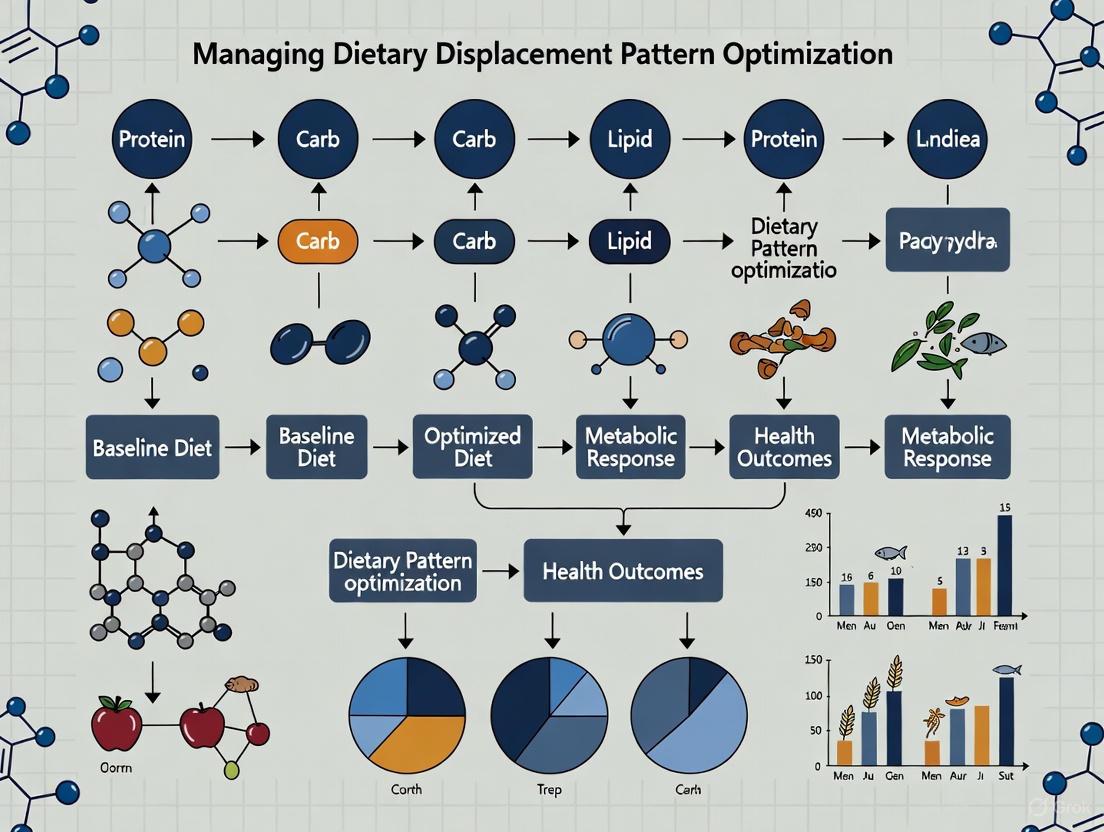
This article explores the critical role of dietary displacement in optimizing nutritional and therapeutic patterns for biomedical applications.
Dietary Displacement in Biomedical Pattern Optimization: From Foundational Mechanisms to Clinical Applications in Drug Development
Abstract
This article explores the critical role of dietary displacement in optimizing nutritional and therapeutic patterns for biomedical applications. We examine the fundamental biobehavioral mechanisms of displacement behavior and its impact on nutritional status, metabolic pathways, and therapeutic outcomes. The content covers advanced optimization methodologies including simulated annealing algorithms and machine learning approaches for dietary pattern refinement. We address troubleshooting strategies for managing negative displacement consequences and validation frameworks using nutritional biomarkers and diet history assessments. For researchers and drug development professionals, this synthesis provides essential insights into how dietary displacement management can enhance clinical trial design, improve patient stratification, and optimize therapeutic efficacy through nutritional pattern optimization.
The Science of Dietary Displacement: Unraveling Biological Mechanisms and Clinical Implications
Troubleshooting Guides and FAQs
Frequently Asked Questions
Q1: In a choice experiment, price promotions consistently override the effects of nutritional labeling. How can this be mitigated in study design? A1: Research confirms that price promotions on unhealthy items can significantly decrease the selection of healthier options, and nutritional labeling alone may not counteract this effect [1]. To mitigate this:
- Stratified Randomization: Ensure your experimental design accounts for price sensitivity. Studies show nearly half of a sample may base choices solely on price, so pre-stratifying participants based on price sensitivity can help isolate the effect of other attributes [2].
- Combination Testing: Actively test the interaction between labels and promotions. Evidence suggests that while Traffic Light Labels (TLS) alone may not significantly impact choice, they can amplify the effect of promotions on healthy products and dampen the effect on unhealthy ones [1]. Design arms that explicitly test these combinations.
Q2: Our data shows participants are making habitual choices, even when their habitual product is unavailable. How can this be accounted for in pattern optimization models? A2: This is a recognized phenomenon where choices align with the characteristics of a habitual product, even when it is not an available option [2].
- Baseline Habit Measurement: Prior to your main experiment, conduct a survey to identify and record participants' habitual product choices and their key attributes (e.g., perceived healthiness, brand, type).
- Latent Class Analysis (LCA): Employ LCA in your data analysis to segment consumers into groups before assessing their choices in your experiment. This can identify distinct cohorts, such as "health-driven" consumers who trade off sustainability for health, or "price-sensitive" consumers [2]. This segmentation allows for more accurate pattern optimization that accounts for pre-existing biases.
Q3: When modeling long-term dietary shifts, how should we model the initial economic and environmental costs versus the long-term benefits? A3: Projections indicate that while long-term benefits of dietary transitions are clear, initial phases can see escalated costs and resource use, especially in emerging economies [3].
- Dynamic Modeling: Move beyond static snapshots and use integrated assessment models (e.g., the MAgPIE model) to project changes over a 50-year horizon [3].
- Phase-Specific Reporting: Clearly differentiate and report results for short-term (e.g., 2030), medium-term (2050), and long-term (2070) scenarios. Your models should highlight that initial increases in water use or decreases in food affordability are often temporary, with significant improvements occurring after the transition period [3].
Common Experimental Challenges and Solutions
| Challenge | Symptom | Solution |
|---|---|---|
| Low Label Comprehension | Participants show no significant response to front-of-pack (FOP) nutritional labels in choice experiments. | Implement a brief information intervention within the experimental protocol to explain the label's meaning and scoring system before choice tasks begin [4]. |
| Limited Generalizability | Findings from a choice experiment are heavily dependent on the single food product category used in the study. | Replicate the experiment across multiple, diverse food categories (e.g., yoghurt, ham sausage, snack bars) to ensure the observed effects on dietary displacement are not product-specific [2] [1] [4]. |
| Consumer Heterogeneity Masking Effects | Aggregate data shows no clear pattern, obscuring distinct subgroup behaviors. | Use Latent Class Analysis (LCA) to segment the consumer sample into groups with similar preferences, revealing trade-offs made by specific cohorts (e.g., health-driven vs. price-driven) [2]. |
Key Experimental Protocols and Data
Protocol 1: Discrete Choice Experiment (DCE) for Nutritional Trade-offs
This methodology is foundational for quantifying how consumers value different attributes of a food product, such as health, sustainability, naturalness, and price, and the trade-offs they make between them [2] [4].
1. Objective: To determine the influence of specific attributes (e.g., sustainability, healthiness, price) on consumer preferences and to identify the presence of dietary displacement.
2. Experimental Workflow:
3. Detailed Methodology:
- Product & Attribute Selection: Select a commercially relevant food product (e.g., yoghurt, ham sausage). Define its key attributes and levels based on the research question. For example:
- Experimental Design: Use a factorial design (e.g., full-factorial, fractional-factorial, or D-efficient) to combine attributes and levels into a set of choice scenarios. Each scenario should present the participant with 2-3 product alternatives and a "none" option.
- Participant Recruitment: Recruit a sufficiently large sample (e.g., N > 600) to allow for robust segmentation analysis. Consider cross-country comparisons to assess cultural differences [2].
- Data Collection: Present participants with a series of choice sets (e.g., 8-12) in an online survey. Randomize the order of choice sets to avoid ordering effects.
- Data Analysis:
- Random Parameter Logit Model: Estimate consumers' preferences and their Willingness to Pay (WTP) for each attribute [4].
- Latent Class Analysis (LCA): Segment consumers into distinct groups based on their preference patterns, identifying those who make specific trade-offs (e.g., trading sustainability for health) [2].
Protocol 2: Randomized Controlled Trial (RCT) on Labeling and Promotions
This protocol tests the causal effects of interventions like FOP labels and price promotions on the healthiness of food choices in a controlled setting [1].
1. Objective: To investigate the individual and combined effects of nutritional labeling and price promotions on food choice.
2. Detailed Methodology:
- Design: A pre-registered, online RCT using a factorial between-subjects design (e.g., 2x3). For example:
- Factor 1 - TLS: Control (no label) vs. TLS present.
- Factor 2 - Promotion: No promotion vs. promotion on healthiest product vs. promotion on unhealthiest product.
- Participants: Randomly assign a large number of participants (e.g., N > 1500) to one of the experimental conditions.
- Task: Present participants with a hypothetical purchase choice among several unbranded products (e.g., four snack bars) of varying healthiness. The products display the interventions relevant to their assigned condition.
- Primary Outcome: The healthiness of the chosen product.
- Analysis: Use logistic regression to analyze the likelihood of choosing the healthiest product based on the experimental conditions and their interaction.
Quantitative Data from Key Studies
Table 1: Consumer Segments and Trade-offs in Food Choice (Yoghurt DCE) Data derived from a latent class analysis of 622 Italian and Danish consumers [2].
| Consumer Segment | Prevalence | Key Characteristics & Trade-offs |
|---|---|---|
| No-Trade-Off Valuers | 48% | Weigh sustainability, healthiness, and naturalness equally without making trade-offs between these attributes. |
| Price-Focused Consumers | 42% | Base decisions solely on price, ignoring sustainability, naturalness, and health attributes. |
| Health-Driven Consumers | 10% | Prioritize health above all, explicitly trading off sustainability and naturalness for perceived health benefits. |
Table 2: Long-Term Projections of Dietary Transition Impacts Modelled data from 2020 to 2070 using the MAgPIE integrated assessment model under four alternative dietary scenarios [3].
| Metric | Baseline (BaU) in 2070 | Healthy US-Style (HUS) in 2070 | EAT-Lancet (EAT) in 2070 | Vegetarian (VEG) in 2070 |
|---|---|---|---|---|
| Global Dietary Quality (AHEI) | 51.57 points | 67.19 points | 75.00 points | 70.97 points |
| Global Water Use | 4998.33 km³ | 4937.68 km³ | 4262.06 km³ | 4289.74 km³ |
| Key Trade-off | N/A | Initial Phase: May increase water use and reduce affordability in some regions. | Initial Phase: Increased food demand can escalate water use and worsen affordability in emerging economies. | Initial Phase: Similar short-term challenges as EAT and HUS diets in developing economies. |
The Scientist's Toolkit: Research Reagent Solutions
Table 3: Essential Materials and Methods for Dietary Displacement Research
| Item | Function/Description | Example Application in Research |
|---|---|---|
| Discrete Choice Experiment (DCE) | A survey-based method to quantify preferences by presenting participants with sets of alternatives described by multiple attributes. | Used to measure trade-offs between sustainability, health, naturalness, and price in yoghurt choices [2]. |
| Randomized Controlled Trial (RCT) | An experimental design where participants are randomly assigned to intervention or control groups to establish causality. | Used to test the causal effect of Traffic Light Labels and price promotions on snack bar choices [1]. |
| Latent Class Analysis (LCA) | A statistical model used to identify unobserved (latent) subgroups within a population that have similar preference structures. | Used to segment consumers into distinct groups (e.g., price-focused, health-driven) based on their choice data [2]. |
| Front-of-Pack (FOP) Labels | Evaluative nutrition labels placed on the front of food packaging (e.g., Health Star Rating, Nutri-Score, Traffic Light). | Investigated as an intervention to steer consumers toward healthier choices and measure WTP for labeled products [1] [4]. |
| Integrated Assessment Model (e.g., MAgPIE) | A computer model that projects long-term environmental and economic impacts of dietary patterns by integrating data from multiple sectors. | Used to project changes in water use, dietary quality, and food affordability from 2020 to 2070 under different global diet scenarios [3]. |
| Alternative Healthy Eating Index (AHEI) | A validated metric designed to assess dietary quality based on foods and nutrients predictive of chronic disease risk. | Used as a key outcome variable to quantify the health impact of different dietary patterns over time [3]. |
Visualizing Dietary Displacement and Consumer Choice
The following diagram maps the core concept of dietary displacement, illustrating the push-and-pull factors that lead to positive and negative nutritional trade-offs.
Troubleshooting Guide: Experimental Challenges in Displacement Behavior Research
Q1: How can I objectively determine if a behavior is a "displacement activity" and not just a normal, context-appropriate behavior?
A1: A core methodological challenge is distinguishing displacement activities from normal behaviors. A robust solution is to use a behavior random permutation model to detect significant biases in behavioral sequences [5].
- Problem: Traditional observation alone cannot confirm the "inappropriateness" of a behavior, which is a key characteristic of displacement activities [5].
- Solution: Implement a computational model that compares observed behavior sequences against randomized distributions. This allows you to identify if the frequency of a specific behavior (e.g., grooming) following a high-conflict or high-stress behavior (e.g., vigilance) is statistically higher than expected by chance [5].
- Protocol:
- Video Record: Capture high-resolution video of subjects in the experimental setting.
- Ethogram: Create a precise ethogram (catalog of defined behaviors) for all observable activities.
- Sequence Logging: Log the exact sequence and timing of all behaviors for each subject.
- Random Permutation: Use statistical software to generate thousands of randomized sequences of the observed behaviors.
- Compare Frequencies: Calculate the frequency of your target sequence (e.g., Vigilance -> Grooming) in the observed data versus the randomized data. A significant positive deviation indicates a potential displacement activity [5].
Q2: What is the best animal model for translational biobehavioral research on complex behaviors, and why?
A2: The pig (Sus scrofa) is an emerging and highly relevant translational model for biobehavioral research, particularly when rodent models show limited translational success [6].
- Problem: Rodent brains are lissencephalic (smooth), have a low white-to-gray matter ratio, and exhibit significant differences in gene expression compared to humans, which can limit the applicability of findings to human conditions [6].
- Solution: The pig brain shares critical similarities with the human brain, including gyrencephalic folding (convoluted surface), comparable gray-to-white matter ratios, and similar patterns of neurodevelopment [6]. Pigs also exhibit complex cognitive behaviors, making them excellent for studying behaviors that have parallels in human neurological and psychiatric disorders [6].
- Protocol for Spatial Memory Assessment in Pigs:
- Apparatus: Use a T-maze or radial arm maze with food rewards [6].
- Habituation: Allow the pig to explore the maze without tasks to reduce novelty stress.
- Training: Train the pig to navigate the maze to locate a food reward. Multiple trials are conducted over days.
- Testing: In the probe trial, remove the reward to assess the animal's reliance on spatial memory.
- Data Collection: Record latency to find the goal, number of errors (wrong arm entries), and path efficiency [6].
Q3: How can I measure and account for stress, a key internal state linked to displacement activities, in my animal subjects?
A3: Stress is a crucial component in displacement activity, but it must be inferred through behavioral and physiological correlates [5].
- Problem: Stress is an internal state that cannot be measured directly without invasive procedures that may confound behavioral results.
- Solution: Use vigilance behavior as a validated, non-invasive proxy for predation risk and stress in ungulates and other species [5]. A significant positive correlation between scan rate (a measure of vigilance) and the rate of the suspected displacement activity (e.g., grooming) provides strong circumstantial evidence for a stress-linked displacement behavior [5].
- Protocol:
- Define Vigilance: Operationally define vigilance for your species (e.g., for ungulates: head raised above the horizontal plane, ears erect, scanning the environment) [5].
- Simultaneous Recording: During behavioral observation, simultaneously record bouts of vigilance and the suspected displacement activity.
- Correlational Analysis: Calculate the scan rate (vigilance bouts per unit time) and the displacement behavior rate. Perform a correlation analysis (e.g., Pearson's correlation) to test for a significant positive relationship [5].
Table 1: Key Experimental Protocols in Displacement Behavior Research
| Experiment Focus | Core Methodology | Key Outcome Measures | Interpretation & Relevance to Displacement |
|---|---|---|---|
| Identifying Displacement Grooming [5] | Behavior random permutation model applied to video-recorded sequences. | Frequency of Grooming-after-Vigilance (VG) vs. Grooming-before-Vigilance (GV); Statistical deviation from random distribution. | A significant bias towards VG sequences indicates grooming is being used as a displacement activity following a stressor. |
| Spatial Memory & Cognition [6] | T-maze or Radial Arm Maze tasks with food reward. | Latency to goal, number of incorrect arm entries, path efficiency in probe trials. | Assesses cognitive function, which can be a metric for the impact of chronic stress or a outcome measure for drug efficacy. |
| Exploratory Behavior in Novel Environments [7] | Analysis of travel paths in a novel open field; tracking software. | Formation of a "home-base," looping paths, perimeter walking, total distance traveled. | Patterns of exploration reveal underlying anxiety and conflict; displacement activities often emerge during pauses in exploration. |
Table 2: Quantitative Findings from Displacement Activity Studies in Ungulates
| Species | Vigilance-Behavior Correlation | VG vs. GV Sequence Frequency | Proposed Displacement Activity | Context |
|---|---|---|---|---|
| Tibetan Antelope (Pantholops hodgsonii) [5] | Significant positive correlation between scan rate and grooming rate. | Grooming after vigilance (VG) was significantly higher than before (GV). | Self-grooming | High predation risk on plateaus; grooming occurs disproportionately after vigilant scanning. |
| Tibetan Gazelle (Procapra picticaudata) [5] | Significant positive correlation between scan rate and grooming rate. | Grooming after vigilance (VG) was significantly higher than before (GV). | Self-grooming | Higher predation risk due to smaller body size; amplified displacement effect compared to antelope. |
Research Reagent Solutions: Essential Materials for Behavioral Research
Table 3: Key Research Reagents and Tools for Biobehavioral Studies
| Item/Tool | Function in Research | Application Example |
|---|---|---|
| High-Definition Video Recording System | Captures continuous, high-quality behavioral data for post-hoc analysis and sequence logging. | Essential for applying the behavior random permutation model [5]. |
| Automated Tracking Software | Provides precise, automated quantification of movement, location, and pathing in a test arena. | Used in spatial navigation tests (mazes) and analysis of exploratory behavior [7] [6]. |
| T-maze / Radial Arm Maze | Standardized apparatus for testing spatial learning, memory, and problem-solving capabilities. | Assessing cognitive function in translational models like pigs [6]. |
| Defined Ethogram | A standardized catalog of behaviors ensures consistent scoring and reliability across different observers. | Critical for all behavioral studies to define states like "vigilance," "grooming," and "feeding" [5]. |
| Radio-Frequency Identification (RFID) | Enables non-invasive, automated monitoring of individual animal activity and resource use in social groups. | Monitoring long-term behavioral patterns and social interactions in group-housed animals [6]. |
Visualizing the Behavioral Analysis Workflow
Diagram 1: Behavior Random Permutation Model Workflow
Diagram 2: Displacement Activity Triggers
Satiety signaling represents a critical regulatory system in human metabolism, governing the transition from eating to the inhibition of further food intake. Within pattern optimization research, understanding these mechanisms is paramount for managing dietary displacement—the unintended substitution of core nutritional elements with less optimal alternatives when implementing dietary changes. The satiety cascade model integrates sensory, cognitive, post-ingestive, and post-absorptive signals to determine the duration between meals and the amount consumed at subsequent meals [8]. When these signals become dysregulated, perhaps through imposed dietary patterns that conflict with physiological cues, it can lead to compensatory eating and undermine the nutritional goals of an optimized diet. This technical guide provides researchers with troubleshooting methodologies to identify and resolve experimental challenges related to satiety signaling and its metabolic consequences.
Core Mechanisms: Satiety, Nutrient Partitioning, and Metabolic Pathways
The Satiety Cascade and Nutrient Signaling
The process of satiation (meal termination) and satiety (inter-meal interval) is governed by a complex network of physiological signals. Satiation is the feeling of fullness that develops during an eating process, while satiety is the inhibition of hunger that occurs after food ingestion [8]. This regulatory system involves:
- Pre-absorptive Signals: Originating from cognitive and sensory experiences with food, including taste, texture, flavor, and aroma.
- Post-absorptive Signals: Involving gastrointestinal satiety signals, gut enzymes, gastric emptying rate, and nutrient absorption.
- Central Integration: The hypothalamus and other brain regions process peripheral signals to ultimately regulate eating behavior.
Two foods with identical nutritional content may exert distinctly different effects on appetite due to variations in how they engage this cascade [8]. In pattern optimization research, the formulation texture, macronutrient composition, and energy density of dietary interventions can significantly influence these pathways, thereby affecting subject compliance and metabolic outcomes.
Nutrient Partitioning and Metabolic Consequences
Nutrient partitioning refers to the directional flux of nutrients toward storage, oxidation, or structural purposes. Optimal partitioning is essential for metabolic health, while dysregulation can lead to adipose tissue accumulation, ectopic fat deposition, and insulin resistance. Diets like the Mediterranean and DASH consistently improve cardiometabolic markers, with research showing the Mediterranean diet can reduce metabolic syndrome prevalence by approximately 52% within six months [9]. The metabolic health of an individual—reflected in stable blood glucose, favorable lipid profiles, and normal blood pressure—is fundamentally determined by the efficiency of nutrient partitioning [9].
Figure 1: The Satiety Signaling Cascade and Metabolic Integration Pathway
Troubleshooting Guide: FAQs for Experimental Challenges
FAQ 1: How do I troubleshoot high inter-individual variability in satiety response measurements?
Problem: Significant variation in subjective satiety scores among participants within the same intervention group, creating statistical noise and obscuring treatment effects.
Root Cause Investigation:
- Check Participant Baseline Characteristics: Ensure proper screening for factors known to influence satiety perception, including genetics, gender, age, nutritional status, gastrointestinal microbiota composition, and individual behavioral responses to foods [8].
- Verify Methodology Consistency: The Visual Analog Scale (VAS) is the most frequently used tool for subjective satiety measurement, but administration must be standardized [8]. Confirm consistent use of either electronic (EARS) or pen-and-paper methods across all participants and timepoints.
- Review Test Meal Controls: For pre-load study designs, ensure absolute consistency in meal presentation, palatability, temperature, and eating environment, as these can introduce significant variance.
Solution Protocol:
- Implement Stratified Randomization: Pre-stratify participants based on potential effect modifiers such as baseline BMI, fasting insulin levels, or genetic markers related to satiety (e.g., FTO gene variants).
- Standardize Pre-Test Conditions: Mandate a standardized meal the evening before testing and require an overnight fast of 10-12 hours with water only. Document compliance.
- Utilize Controlled Electronic Assessment: Implement an Electronic Appetite Rating System (EARS) to minimize administrative error and ensure consistent timing of VAS administration [8]. The standard VAS questions should address: "How hungry do you feel?", "How full do you feel?", "How strong is your desire to eat?", and "How much food do you think you could eat?".
- Include Objective Biomarkers: Correlate subjective measures with objective biomarkers like ghrelin, GLP-1, PYY, leptin, and insulin at fasting and postprandial timepoints to validate subjective findings.
FAQ 2: What could cause unexpected metabolic outcomes despite proper dietary pattern formulation?
Problem: A carefully designed, nutritionally-optimal dietary pattern fails to produce expected improvements in metabolic biomarkers such as insulin sensitivity or lipid profiles.
Root Cause Investigation:
- Verify Dietary Compliance: Use beyond self-reporting. Consider biomarkers (e.g., plasma alkylresorcinols for whole grain intake, plasma carotenoids for fruit/vegetable intake) or urinary nitrogen for protein intake.
- Assess Nutrient Partitioning Efficiency: Evaluate subject characteristics affecting partitioning, including baseline insulin sensitivity (HOMA-IR), visceral adiposity (WC or DEXA), and physical activity levels, as these dramatically influence metabolic response to diet [9].
- Examine Dietary Displacement Effects: The implemented pattern may have inadvertently displaced a key, unaccounted-for food component that supported metabolic health in the habitual diet.
Solution Protocol:
- Conduct Linear Programming Analysis: Use mathematical diet optimization to ensure nutritional adequacy while respecting habitual food intake patterns. This method minimizes deviation from observed diets while meeting all nutritional goals, reducing displacement risks [10].
- Implement Metabolomic Profiling: Apply untargeted metabolomics to identify distinct metabolic phenotypes (metabotypes) that may predict differential responses to dietary interventions [9].
- Analyze Body Composition Shifts: Use DEXA or MRI to track changes in visceral vs. subcutaneous adipose tissue, as their metabolic impacts differ significantly [9]. Metabolically healthy obesity (MHO) phenotypes challenge the BMI-metabolic risk paradigm and must be accounted for.
- Review Macronutrient Ratios: Confirm that the optimized pattern delivers the intended macronutrient distribution. Even with correct foods, slight shifts in processing or preparation can alter bioavailability and metabolic effects.
FAQ 3: Why is subject adherence declining in a long-term dietary pattern intervention?
Problem: Participant compliance wanes over the course of a long-term study, threatening internal validity.
Root Cause Investigation:
- Evaluate Satiety Efficiency: The prescribed dietary pattern may have inadequate satiety potential per calorie, leading to hunger and non-compliance. The Satiety Index developed by Holt et al. compares the satiating efficiency of foods to white bread (score=100) [8].
- Assess Palatability and Food Reward: The diet may be nutritionally optimal but sensorially undesirable or culturally inappropriate, creating hedonic deprivation.
- Identify Practical Barriers: Interview participants about difficulties with food sourcing, preparation time, cost, or family acceptance.
Solution Protocol:
- Optimize for Satiety and Adherence: Use linear programming with dual constraints: (1) achieve nutrient recommendations and (2) minimize deviation from habitual food patterns to enhance cultural acceptability and compliance [10].
- Incorporate Satiety-Enhancing Foods: Formulate patterns to include foods with a high Satiety Index value, typically those high in protein, fiber, and water content.
- Implement Progressive Adaptation: For patterns requiring major shifts (e.g., large increases in vegetables/fruits), structure a step-wise adoption schedule rather than abrupt change, particularly for younger subjects who may require more dramatic modifications [10].
- Provide Tailored Support: Offer counseling, recipes, and resources addressing identified practical barriers. For example, if reducing salt is a challenge (a common issue in optimization [10]), provide specific seasoning alternatives.
Experimental Protocols & Data Presentation
Standard Protocol for Satiety Measurement Using Visual Analog Scale (VAS)
Purpose: To quantitatively assess subjective appetite sensations before and after consumption of a test food or meal.
Materials:
- 100mm or 150mm VAS scales (paper or electronic)
- Test food or meal of standardized composition
- Timer/stopwatch
- Controlled environment free from food cues
Procedure:
- Baseline Assessment (t=0): Immediately before test meal consumption, participants complete VAS ratings for hunger, fullness, desire to eat, and prospective food consumption.
- Test Meal Administration: Provide the test meal under standardized conditions. Participants consume the entire meal within a fixed time (e.g., 15 minutes).
- Postprandial Assessment: Administer VAS at regular intervals (e.g., every 30-60 minutes) for a predetermined period (typically 3-5 hours) or until the next meal request.
- Data Collection: Measure the distance from the left-hand end of the scale to the participant's mark for each question and time point.
Calculation:
The satiety response area under the curve (AUC) can be calculated for each sensation. To compute a Satiety Index relative to a control food (e.g., white bread):
Satiety Index (%) = (Satiety AUC for test food / Satiety AUC for control food) × 100 [8].
Quantitative Data on Dietary Patterns and Metabolic Outcomes
Table 1: Efficacy of Evidence-Based Dietary Patterns on Metabolic Health Parameters
| Dietary Pattern | Primary Metabolic Effects | Quantified Efficacy | Key Mechanisms |
|---|---|---|---|
| Mediterranean | Reduces metabolic syndrome prevalence, improves cardiometabolic markers | ~52% reduction in metabolic syndrome prevalence in 6 months [9] | High mono-unsaturated fats, polyphenols, fiber; anti-inflammatory & antioxidant effects |
| DASH (Dietary Approaches to Stop Hypertension) | Lowers blood pressure, improves lipid profile | Systolic BP reduction: ~5-7 mmHg; LDL-C reduction: ~3-5 mg/dL [9] | Increased potassium, calcium, magnesium; reduced sodium; improved endothelial function |
| Plant-Based (Vegan/Vegetarian) | Lowers BMI, improves insulin sensitivity, reduces inflammation | Associated with lower BMI and improved insulin sensitivity [9] | High fiber, phytochemicals; low saturated fat; modulates gut microbiota |
| Ketogenic | Induces rapid weight loss, improves glycemic control | Body weight reduction: ~12% vs. 4% (control); reduces HbA1c & triglycerides [9] | Metabolic shift to ketosis; enhanced fat oxidation; appetite suppression |
Table 2: Impact of Bioactive Food Components on Metabolic Biomarkers
| Bioactive Compound | Dietary Sources | Primary Metabolic Effects | Quantified Efficacy in Intervention Studies |
|---|---|---|---|
| Polyphenols (e.g., Resveratrol) | Berries, grapes, nuts, red wine | Improves insulin signaling, reduces oxidative stress | HOMA-IR reduction: ~0.5 units; Fasting glucose reduction: ~0.3 mmol/L [9] |
| Omega-3 Fatty Acids (EPA & DHA) | Fatty fish, fish oil, algae | Reduces triglycerides, anti-inflammatory effects | Triglyceride reduction: ~25-30% [9] |
| Probiotics | Yogurt, kefir, fermented foods | Enhances glycemic control, improves gut health | Reductions in HOMA-IR and HbA1c [9] |
| Soluble Fiber | Oats, barley, legumes, psyllium | Modulates glucose absorption, increases satiety | Improves postprandial glycemia, lowers LDL cholesterol |
The Scientist's Toolkit: Research Reagent Solutions
Table 3: Essential Reagents and Tools for Satiety and Metabolic Research
| Item/Category | Specific Examples | Research Application & Function |
|---|---|---|
| Appetite Assessment Tools | Visual Analog Scale (VAS), Electronic Appetite Rating System (EARS) | Quantifies subjective sensations of hunger, fullness, and desire to eat [8] |
| Satiety Hormone Assays | ELISA/Kits for Ghrelin, GLP-1, PYY, Leptin, Insulin | Measures peripheral signals involved in the satiety cascade; correlates subjective with objective measures |
| Bioactive Compounds | Purified polyphenols (e.g., resveratrol), omega-3 concentrates (EPA/DHA), prebiotic fibers | Used in controlled interventions to isolate and quantify effects of specific bioactives on satiety and metabolism [9] |
| Body Composition Analyzers | DEXA, MRI, Bioelectrical Impedance (BIA) | Precisely measures visceral vs. subcutaneous adipose tissue, a key factor in nutrient partitioning and metabolic health [9] |
| Diet Optimization Software | Linear Programming Algorithms (e.g., using R, Python) | Designs nutritionally-adequate dietary patterns that minimize deviation from habitual intake, enhancing compliance [10] |
| Metabolomic Platforms | LC-MS, NMR Spectroscopy | Identifies metabolic phenotypes (metabotypes) and discovers biomarkers of dietary response and intake [9] |
Diagnostic Framework for Pattern Optimization Research
Figure 2: Diagnostic Decision Tree for Pattern Optimization Challenges
Troubleshooting Guide: Common Experimental Challenges in Dietary Pattern Research
FAQ: Addressing Key Methodological Issues
1. How can we accurately measure dietary displacement in a free-living study population?
- Challenge: Differentiating between true nutrient displacement and random variations in habitual diet.
- Solution: Implement a randomized controlled crossover design. Collect multiple non-consecutive 24-hour dietary recalls (including weekend days) during both control and intervention periods. Calculate displacement using the formula: Di = (Hi + Si) - Wi, where Di is the displacement of nutrient i, Hi is intake in the habitual diet, Si is intake from the supplement, and Wi is the observed intake in the supplemented diet. Percentage displacement is calculated as (Di / Si) × 100% [11].
- Protocol Refinement: Use biological markers to check compliance (e.g., erythrocyte membrane concentration of fatty acids for walnut intake) and validate self-reported dietary data [11].
2. What are the primary mechanisms linking ultra-processed food (UPF) consumption to chronic disease?
- Challenge: Isolating the specific pathophysiological drivers from a complex web of dietary factors.
- Solution: Focus research on several key mechanistic pathways identified in the literature:
- Nutrient Imbalances & Overeating: UPFs are often high in energy density, hyper-palatable, and have a soft texture, leading to passive overconsumption [12].
- Oxidative Stress & Inflammation: UPF consumption can increase intake of toxic compounds and harmful additives while reducing health-protective phytochemicals. This can lead to mitochondrial dysfunction, ROS overproduction, and activation of pro-inflammatory pathways like NF-κB [13] [12] [14].
- Gut Microbiome Dysbiosis: Dietary patterns low in fiber and high in additives can negatively alter gut microbiota composition, increasing gut permeability and systemic endotoxemia [15] [16].
3. How do we model an "optimized" dietary pattern for a specific population?
- Challenge: Developing evidence-based, culturally appropriate, and economically feasible food-based dietary recommendations (FBRs).
- Solution: Utilize mathematical optimization techniques, particularly Linear Programming (LP). LP models can design diets that meet nutritional requirements while minimizing cost or adherence to local dietary patterns [17].
- Protocol Outline:
- Define Objective Function: e.g., Minimize deviation from the current habitual diet or minimize diet cost.
- Set Constraints: Apply nutrient requirements based on national guidelines and constraints for food group intake based on cultural acceptability.
- Input Data: Use high-quality, locally relevant food consumption and price data [17].
- Model Validation: Validate the optimized diet pattern with local nutrition experts and through pilot studies.
4. Our clinical data shows high variability in inflammatory biomarkers following a dietary intervention. How can we account for this?
- Challenge: High inter-individual variability in response to dietary changes, often due to stress, baseline microbiota, or metabolic differences.
- Solution: Incorporate measures of psychological stress and HPA-axis function (e.g., cortisol). Stress can activate inflammatory pathways and trigger emotional eating, blunting the efficacy of dietary interventions [16]. Consider stratifying participants based on stress biomarkers or using ecological momentary assessment to track stress and diet in real-time.
Experimental Protocols for Core Investigations
Protocol 1: Quantifying Food and Nutrient Displacement in an Intervention Study
Objective: To determine the extent to which a specific food supplement displaces other foods and nutrients in the habitual diet.
Materials:
- Test supplement (e.g., walnuts, as used in [11])
- Standardized dietary assessment tools (24-hour recall or food record protocols)
- Nutritional analysis software
- Biological sample collection kits for compliance markers (e.g., blood spots)
Methodology:
- Design: Randomized controlled trial with crossover design. Include washout period between phases.
- Intervention: Provide participants with a daily supplement, calculated to represent a specific percentage (e.g., 12%) of their estimated energy needs [11].
- Data Collection: Collect a minimum of seven non-consecutive 24-hour dietary recalls during each study phase (control and supplemented).
- Analysis:
- Calculate mean daily intake of foods and nutrients for each phase.
- Compute expected intake during the supplement phase as (Habitual diet intake + Supplement intake).
- Calculate displacement:
Displacement (D) = (Expected Intake) - (Observed Intake during Supplementation). - Express as percentage:
% Displacement = (D / Nutrient in Supplement) × 100[11].
Protocol 2: Assessing the Impact of a Dietary Pattern on Oxidative Stress Pathways
Objective: To evaluate the effect of a dietary intervention (e.g., low UPF vs. high UPF diet) on markers of oxidative stress and the NRF2 antioxidant pathway.
Materials:
- Cell culture model (e.g., hepatic or endothelial cells) or animal model.
- Assay kits: ROS (DCFDA assay), Lipid Peroxidation (MDA assay), Antioxidant Enzymes (SOD, Catalase, GPx activity).
- Western Blot or ELISA kits for NRF2, KEAP1, HO-1.
- Compounds for testing: Serum from control and intervention subjects, or specific dietary compounds (e.g., sulforaphane, curcumin) [13].
Methodology:
- Intervention: Expose model systems to sera from subjects on different diets or to specific food-derived compounds.
- Oxidative Stress Measurement: Quantify ROS production and lipid peroxidation products.
- NRF2 Pathway Activation: Measure protein expression of NRF2 and its downstream target heme oxygenase-1 (HO-1). Assess KEAP1-NRF2 binding.
- Functional Assay: Evaluate cell viability under oxidative stress (e.g., H₂O₂ challenge) post-intervention.
Data Presentation: Quantitative Findings on Dietary Displacement and Disease Risk
Table 1: Nutrient Displacement Following Walnut Supplementation (≈12% of Energy Intake) [11]
| Nutrient | Baseline Habitual Diet | Walnut-Supplemented Diet (Observed) | Displacement Effect | Interpretation |
|---|---|---|---|---|
| Total Fat | - | Significantly Higher | Partial Displacement | Net increase in total fat intake |
| Total PUFA | - | Significantly Higher | Partial Displacement | Net increase in PUFA intake |
| Dietary Fiber | - | Significantly Higher | Partial Displacement | Net increase in fiber intake |
| Calcium | - | Significantly Higher | Negative Displacement | Diet retained nutrient from both walnut and non-walnut sources |
| Magnesium | - | Significantly Higher | Negative Displacement | Diet retained nutrient from both walnut and non-walnut sources |
Table 2: Chronic Disease Risks Associated with High Consumption of Ultra-Processed Foods (UPFs) [12]
| Health Outcome | Study Type | Pooled Risk Estimate (High vs. Low UPF Intake) | Key Mechanistic Pathways |
|---|---|---|---|
| Overweight/Obesity | Meta-analysis of prospective studies | Increased Risk | Overeating, high energy density, disrupted food matrices |
| Type 2 Diabetes | Meta-analysis of prospective studies | Increased Risk | Nutrient imbalances, dysglycemia, inflammation |
| Cardiovascular Disease | Meta-analysis of prospective studies | Increased Risk | Dyslipidemia, oxidative stress, endothelial dysfunction |
| All-Cause Mortality | Meta-analysis of prospective studies | Increased Risk | Multi-organ system dysfunction |
Signaling Pathways and Experimental Workflows
Diagram 1: Pathophysiological Pathways Linking Diet to Chronic Disease. This diagram illustrates the key mechanistic pathways through which ultra-processed foods (red) and healthy dietary patterns (green) influence the development of chronic diseases via oxidative stress, inflammation, and gut-brain axis disruption [15] [13] [12].
Diagram 2: Experimental Workflow for Dietary Displacement & Pattern Optimization Research. This flowchart outlines a standardized protocol for investigating dietary displacement and developing optimized dietary patterns, integrating methodologies from clinical and public health nutrition research [17] [11].
The Scientist's Toolkit: Research Reagent Solutions
Table 3: Essential Materials and Reagents for Investigating Diet-Disease Pathways
| Item | Function/Application | Example in Context |
|---|---|---|
| NRF2 Activators | Investigate antioxidant defense mechanisms. Used to test if boosting NRF2 can counteract diet-induced oxidative stress. | Sulforaphane, Curcumin, Quercetin, Resveratrol [13]. |
| Oxidative Stress Assay Kits | Quantify reactive oxygen species (ROS) and oxidative damage in cell cultures, animal tissues, or human serum/plasma. | DCFDA for ROS, Thiobarbituric Acid Reactive Substances (TBARS) for lipid peroxidation (e.g., MDA) [13] [14]. |
| Inflammation Panel Assays | Measure concentrations of key cytokines and inflammatory mediators. | ELISA/Multiplex kits for TNF-α, IL-6, IL-1β, CRP to assess systemic inflammation [12] [16]. |
| Mathematical Optimization Software | Formulate least-cost or culturally-optimized diets that meet nutritional requirements for Food-Based Dietary Guidelines (FBDGs). | Linear Programming (LP) solvers (e.g., in SAS, R, Python) for diet modeling [17]. |
| Metabolomics Platforms | Identify and quantify small-molecule metabolites to discover objective biomarkers of dietary intake and metabolic health. | LC-MS/MS or NMR-based profiling to link dietary patterns to metabolic signatures and disease risk [18]. |
Dietary displacement refers to the phenomenon where the introduction or increased consumption of certain foods leads to the reduction or replacement of other foods within an eating pattern. Understanding these effects is crucial for developing effective nutritional interventions, especially in the context of managing obesity and chronic diseases. Negative dietary displacement occurs when unhealthy, nutrient-poor foods displace healthy, nutrient-dense options, potentially leading to rebound overeating, atrocious nutrient intake, and increased body fat. Conversely, positive dietary displacement occurs when sufficient intake of nutritious foods leaves little room for non-nutritious options, promoting satiety after meals and stellar nutrient intake [19].
Within pattern optimization research, dietary pattern analysis has emerged as a essential methodology that considers the complex interrelationships between different foods or nutrients as a whole. This approach reflects individuals' actual dietary habits and provides more comprehensive information about how multiple nutrients interact to influence health outcomes compared to studying single nutrients in isolation [20].
Core Analytical Frameworks for Quantifying Displacement
Investigator-Driven Methods (A Priori Approaches)
Investigator-driven methods define dietary patterns based on existing nutritional knowledge or dietary recommendations. These include dietary quality scores and indexes that measure adherence to established dietary guidelines:
- Healthy Eating Index (HEI): Assesses alignment with national dietary guidelines
- Alternative Healthy Eating Index (AHEI): Focuses on foods and nutrients predictive of chronic disease risk
- Mediterranean Diet Scores: Measure adherence to traditional Mediterranean eating patterns
- DASH Diet Scores: Evaluate conformity to Dietary Approaches to Stop Hypertension patterns
- Plant-Based Diet Indexes: Include the total Plant-based Diet Index (PDI), Healthy Plant-based Diet Index (hPDI), and Unhealthy Plant-based Diet Index (uPDI) [20]
These scoring systems typically assign points based on consumption levels of recommended foods, with total scores indicating overall dietary quality. Research has demonstrated that higher scores on indices such as the HEI, AHEI, Alternative Mediterranean Diet, and DASH are negatively correlated with risk of death from cardiovascular disease, cancer, and all-cause mortality [20].
Data-Driven Methods (A Posteriori Approaches)
Data-driven methods use statistical techniques to derive dietary patterns directly from population consumption data:
Principal Component Analysis (PCA) and Factor Analysis: These are the most commonly used methods that identify patterns based on the correlation between food groups, creating new composite variables that explain maximum variance in consumption patterns [20].
Cluster Analysis: Groups individuals into distinct clusters based on similar dietary patterns, allowing researchers to identify population subgroups with characteristic consumption patterns [20].
Finite Mixture Models (FMM): A model-based clustering approach that provides probabilistic assignment to dietary pattern clusters [20].
Treelet Transform (TT): Combines PCA and clustering algorithms in a one-step process to identify dietary patterns [20].
Hybrid and Emerging Methodologies
Reduced Rank Regression (RRR): Identifies dietary patterns that maximally explain variation in specific response variables, such as biomarkers or health outcomes [20].
Linear Programming: A mathematical optimization approach used to translate nutrient-based recommendations into realistic food combinations while incorporating local and culture-specific foods. This method minimizes deviations between observed and optimized food intake patterns while meeting nutritional recommendations [21].
Compositional Data Analysis (CODA): Accounts for the compositional nature of dietary data (where intake components sum to a total) by transforming dietary intake into log-ratios [20].
Data Mining and Machine Learning: Applies algorithms to identify complex patterns in dietary data that may not be captured by traditional methods [20].
Experimental Protocols for Displacement Assessment
Protocol 1: Linear Programming for Dietary Pattern Optimization
Purpose: To design optimal food intake patterns that achieve nutritional goals while minimizing deviation from habitual diets.
Methodology:
- Collect detailed dietary intake data using weighted dietary records over multiple non-consecutive days (e.g., 16 days total across different seasons) [21].
- Categorize all food items into nutritionally meaningful groups and subgroups (e.g., whole grains, refined grains, vegetables, fruits, dairy products, meat alternatives) [21].
- Establish nutrient profiles for each food subgroup based on standard food composition tables.
- Define constraints based on:
- Dietary Reference Intakes (DRIs) for multiple nutrients
- Energy requirements equal to estimated needs
- Typical consumption ranges (5th to 95th percentiles) for each food group [21]
- Apply linear programming to minimize the objective function representing differences between observed and optimized food intake patterns.
- Validate optimized patterns for feasibility and cultural acceptability.
Key Parameters:
- Decision variables: amounts of each food group
- Constraints: nutritional requirements, energy limits, food group consumption ranges
- Objective function: minimize deviation from current intake [21]
Protocol 2: Statistical Derivation of Dietary Patterns via PCA
Purpose: To identify underlying dietary patterns from consumption data without pre-defined nutritional hypotheses.
Methodology:
- Collect dietary intake data via food frequency questionnaires, 24-hour recalls, or food records.
- Aggregate individual food items into meaningful food groups based on nutritional similarity and culinary use.
- Pre-group food items before calculating principal components through optimal weighted linear combination of food groups based on their correlation.
- Determine the number of components to retain using:
- Eigenvalue greater than one criterion
- Scree plot analysis
- Interpretable variance percentage (typically >70-80% of cumulative variance) [20]
- Interpret patterns by examining factor loadings (correlation coefficients between food groups and components).
- Name patterns based on food groups with the highest factor loadings.
Validation Steps:
- Internal validation through split-sample techniques
- External validation against health outcomes
- Assessment of reproducibility over time [20]
Troubleshooting Guides: Common Methodological Challenges
FAQ 1: How do I address multicollinearity when including multiple food items in regression models?
Issue: High correlation between dietary components makes it difficult to estimate independent effects of individual foods.
Solutions:
- Use dietary pattern methods instead of single-nutrient approaches
- Apply dimensionality reduction techniques (PCA, factor analysis) before modeling
- Utilize regularization methods (LASSO, ridge regression) that handle correlated predictors [20]
- Consider compositional data approaches that account for the inherent correlation structure of dietary data [20]
Preventive Measures:
- Group similar foods into meaningful categories before analysis
- Ensure adequate sample size for the number of dietary variables included
- Prioritize theoretically meaningful food groupings over statistical convenience
FAQ 2: What strategies can improve the cross-cultural validity of dietary assessment tools?
Issue: Measurement instruments developed for specific populations may not adequately capture dietary patterns in different cultural contexts.
Solutions:
- Conduct thorough cross-cultural adaptation including forward and backward translation
- Validate instruments in the specific population of interest before use
- Incorporate locally relevant foods and eating practices in assessment tools
- Establish population-specific cut-off scores when necessary [22]
- Use mixed-methods approaches combining quantitative and qualitative assessment
Validation Steps:
- Assess construct validity against health outcomes or biomarkers
- Evaluate measurement invariance across cultural groups
- Test reliability through test-retest or internal consistency measures [22]
FAQ 3: How can I distinguish true displacement effects from general dietary changes?
Issue: Isolating specific displacement effects from overall dietary pattern shifts.
Solutions:
- Implement controlled intervention studies with specific dietary targets
- Use mathematical modeling approaches (e.g., linear programming) to simulate displacement scenarios [21]
- Apply compositional data analysis to account for the closed nature of dietary data [20]
- Collect detailed temporal data to establish causality in displacement relationships
Analytical Approaches:
- Time-series analysis of dietary changes
- Path analysis to model direct and indirect displacement pathways
- Counterfactual modeling comparing observed patterns to what would have occurred without intervention
Visualization of Analytical Workflows
Dietary Pattern Analysis Decision Framework
Dietary Displacement Assessment Workflow
Research Reagent Solutions: Essential Methodological Tools
Table 1: Key Analytical Tools for Dietary Displacement Research
| Tool Category | Specific Methods/Software | Primary Application | Key Considerations |
|---|---|---|---|
| Statistical Packages | SAS, R, STATA, SPSS | Implementation of various dietary pattern analyses | R offers extensive specialized packages; SAS widely used in epidemiology; consider learning curve and customization needs [20] |
| Dietary Pattern Packages | R packages: FactoMineR, ade4, compositions |
PCA, factor analysis, compositional data analysis | Specialized packages streamline implementation but require programming proficiency [20] |
| Linear Programming Software | MATLAB, Python with SciPy, specialized nutrition software | Diet optimization modeling | Requires mathematical formulation skills; Python offers flexibility for complex constraints [21] |
| Dietary Assessment Platforms | ASA24, Food Frequency Questionnaire platforms | Standardized dietary data collection | Ensure cultural adaptation and validation for target population [22] |
| Data Visualization Tools | ggplot2 (R), Tableau, Python matplotlib | Pattern visualization and result communication | Critical for interpreting complex dietary patterns and communicating findings [20] |
Quantitative Data Tables for Displacement Analysis
Table 2: Comparison of Major Dietary Pattern Analysis Methods
| Method Category | Key Features | Strengths | Limitations | Ideal Use Cases |
|---|---|---|---|---|
| A Priori (Investigator-Driven) | Based on predefined nutritional knowledge | Easy interpretation, aligns with guidelines, facilitates comparisons | Subjectivity in construction, may miss culturally-specific patterns | Evaluating adherence to dietary guidelines, population surveillance [20] |
| A Posteriori (Data-Driven) | Derived empirically from consumption data | Reflects actual eating patterns, identifies population-specific patterns | Statistical artifacts, sample dependence, interpretation challenges | Exploratory analysis, identifying cultural dietary patterns [20] |
| Hybrid Methods | Incorporates both dietary data and health responses | Enhanced predictive validity for specific outcomes | Complex interpretation, may overfit to specific outcomes | Research targeting specific health conditions or biomarkers [20] |
| Optimization Approaches | Mathematical programming to meet nutritional goals | Identifies feasible dietary changes, theoretically optimal patterns | May suggest impractical patterns, depends on constraint specification | Designing dietary interventions, policy planning [21] |
Table 3: Macronutrient Considerations in Dietary Displacement
| Macronutrient | Displacement Dynamics | Assessment Considerations | Health Implications |
|---|---|---|---|
| Proteins | Displacement of plant/animal sources; amino acid profile changes | Assess protein quality and amino acid balance; RDA (0.8 g/kg) is minimal, optimal may be higher (1.2 g/kg) [23] | Preservation of lean mass, satiety effects, negligible kidney risk in healthy individuals [23] |
| Carbohydrates | Quality displacement (whole vs. refined grains); fiber content changes | Measure glycemic impact, fiber subtypes, whole food sources | Blood glucose regulation, gut health, nutrient density of carbohydrate sources [23] |
| Lipids | Fatty acid profile changes; saturated/unsaturated balance | Assess essential fatty acids, omega-3:omega-6 ratio, trans fats | Cardiovascular health, fat-soluble vitamin absorption, inflammation modulation [23] |
Advanced Methodological Considerations
Addressing Methodological Complexity in Displacement Research
Each methodological approach for quantifying dietary displacement effects presents unique advantages and limitations. Selection of the most appropriate method depends primarily on the research question, available data, and specific objectives. As an evolving field, there is continuing need for methodological refinement and validation of emerging approaches [20].
Future methodological development should focus on:
- Improving reproducibility and validity of dietary pattern analyses
- Establishing cross-cultural validity of assessment tools [22]
- Developing standardized protocols for displacement quantification
- Integrating multiple methodological approaches for comprehensive assessment
- Advancing statistical methods to establish causal relationships in displacement effects
The complexity of dietary behavior necessitates sophisticated analytical approaches that can capture the multidimensional nature of eating patterns and their displacement dynamics. By applying appropriate methodological frameworks and validation strategies, researchers can generate robust evidence to inform clinical practice and public health policy aimed at optimizing dietary patterns for improved health outcomes.
Advanced Optimization Methodologies: Computational Approaches for Dietary Pattern Refinement
Frequently Asked Questions (FAQs) and Troubleshooting
This section addresses common theoretical and practical challenges researchers face when implementing ODR systems.
FAQ 1: What is the core optimization challenge in managing dietary displacement? Dietary displacement occurs when increasing the intake of one food group reduces the consumption of others due to limits in total caloric intake or food volume capacity [24]. The core optimization challenge is the interdependency between food and nutrient components within a diet score. For instance, increasing a "total vegetable" component might inadvertently reduce the overall Healthy Eating Index-2015 (HEI2015) score because it can affect other derived components like saturated fat, sodium, fatty acids, and sugars [24]. This trade-off makes score optimization non-trivial.
FAQ 2: Why use Simulated Annealing (SA) for ODR instead of other optimization algorithms? SA is a classical optimization method inspired by metallurgy that is particularly effective for complex, multimodal optimization landscapes [24]. It helps find a global minimum (or maximum) by occasionally accepting worse solutions to escape local minima. Starting with a high "temperature" for greater solution space exploration, it gradually "cools," becoming more selective. This balance between exploration and exploitation is ideal for navigating the intricate dependencies within dietary pattern optimization [24].
FAQ 3: How does ODR ensure recommendations are practical and adhere to an individual's eating habits? To ensure practicality, the ODR approach incorporates several constraints [24]:
- Food Pool Limitation: The algorithm draws food items from a real-world dataset (e.g., a Diet-Microbiome Association study) to ensure recommendations are based on actual foods.
- Eating Occasion Structure: Food items are limited to a reasonable range for each of eight eating occasions (breakfast, brunch, lunch, etc.).
- Dietary Pattern Consistency: The algorithm requires that at least half of the recommended food items match those in the individual's original diet, preserving personal and cultural dietary habits.
FAQ 4: A key macronutrient in my model is consistently being displaced to suboptimal levels. How can I adjust the constraints? Chronic displacement of a macronutrient in a calorie-appropriate diet can lead to nutrient deficiencies [23]. To address this:
- Review Target Function: Check if your diet score adequately penalizes deficiencies in the essential macronutrient.
- Adjust Boundaries: Relax the constraints on food groups rich in the deficient macronutrient. For example, if protein is deficient, ensure the algorithm is not overly restrictive of legumes, lean meats, or dairy.
- Consider Essential Needs: Remember that while carbohydrates are not technically "essential," lipids are, as they provide essential fatty acids and enable the absorption of fat-soluble vitamins [23]. Their displacement can have direct health consequences.
Experimental Protocols and Methodologies
This section details the core methodology for implementing an ODR system.
Protocol: Formalizing the Diet Recommendation Problem
The first step is to mathematically define the optimization problem [24].
- Define the Food Intake Profile: Represent an individual's diet as a food intake profile, denoted as
f = (f1, f2, …, fN), where eachfrepresents a food item consumed. This data can be collected from dietary assessment tools like ASA24 (Automated Self-Administered 24-hour recall). - Compute the Nutrient Profile: Using a food composition database (e.g., USDA's FNDDS, Harvard's database), convert the food profile
finto a nutrient profileq = (q1, q2, …, qM). - Formalize the Diet Score: Express the target diet score
Sas a function of its food profile. A diet score is typically the sum of itsncomponents:S = ∑ Ci(f), whereCi(f)is the score of the i-th component, often a function of food intake.
Objective: The goal of the ODR is to maximize (or minimize) the diet score S by recommending an optimal food profile f_optimal [24].
Protocol: Optimization via Simulated Annealing
The following workflow implements the SA algorithm for ODR.
Key Constraints in the ODR Model
The SA algorithm operates within a set of constraints to ensure realistic and personalized recommendations. The key constraints and their typical implementations are summarized below.
Table: Key Operational Constraints in ODR Implementation
| Constraint Category | Implementation Purpose | Example in ODR Model |
|---|---|---|
| Dietary Displacement | Model the trade-off where increasing one food item necessitates decreasing others to stay within total caloric or volume limits [24]. | The algorithm modifies the food profile f by swapping or adjusting portion sizes of food items. |
| Component Interdependency | Account for the fact that changing a food item affects multiple components of the target diet score [24]. | The evaluation of S = ∑ Ci(f) automatically captures this when a food profile f is perturbed. |
| Practicality & Personalization | Ensure the recommended diet is practical and retains the user's original dietary pattern [24]. | At least 50% of the original food items must be retained in the recommended profile. |
| Meal Structure | Organize recommendations into a logical daily meal plan. | Food items are assigned to one of eight eating occasions (breakfast, lunch, etc.) [24]. |
The Scientist's Toolkit: Research Reagent Solutions
This section lists essential "reagents" or resources required to conduct ODR research.
Table: Essential Resources for ODR Implementation
| Item Name | Function in ODR Research | Key Considerations |
|---|---|---|
| Dietary Assessment Data | Serves as the input food profile f. Provides real-world consumption data for optimization [24]. |
Common sources: 24-hour recalls (e.g., ASA24), food frequency questionnaires (FFQs), or dietary records from studies like DMAS [24] [20]. |
| Food Composition Database | Converts food intake profiles f into nutrient profiles q. Essential for calculating diet score components that rely on nutrients [24]. |
Examples: USDA's Food and Nutrient Database for Dietary Studies (FNDDS), the Harvard food composition database, or the Danish Frida database [24]. |
| Diet Score Algorithms | The target function S for optimization. Quantifies adherence to a specific dietary pattern or guideline [24] [20]. |
Common scores: Healthy Eating Index (HEI), Alternative Healthy Eating Index (AHEI), Mediterranean Diet Score (MDS), and Dietary Inflammatory Index (DII) [24]. |
| Optimization Software | The computational engine that executes the Simulated Annealing algorithm. | Can be implemented in programming languages like R or Python using optimization libraries (e.g., scipy.optimize in Python). |
| Computational Resources | Hardware to run potentially long optimization processes, especially with large datasets or complex score functions. | Standard desktop computers are often sufficient, but cloud computing may be needed for highly complex models or large-scale simulations. |
Visualization: The Dietary Displacement Challenge
The following diagram illustrates the core problem of dietary displacement and component interdependency that ODR aims to solve.
This technical support center provides troubleshooting and methodological guidance for researchers applying Simulated Annealing (SA) to optimize nutritional patterns, with a specific focus on managing dietary displacement. Dietary displacement here refers to the complex challenge of shifting individual diets from sub-optimal to healthier patterns while respecting a multifaceted web of personal constraints, including health conditions, dietary restrictions, cultural preferences, and socioeconomic limitations [25] [26]. Simulated Annealing is a probabilistic optimization technique inspired by the physical process of annealing in metallurgy, where a material is heated and slowly cooled to minimize its defects and achieve a low-energy state [27] [28]. Its ability to escape local optima makes it particularly suited for navigating the complex, multi-modal solution spaces common in personalized nutrition [29]. The following guides and FAQs address specific issues you might encounter during your experiments.
Frequently Asked Questions (FAQs) and Troubleshooting
Q1: My Simulated Annealing algorithm converges to a suboptimal meal plan too quickly. How can I improve its exploration of the solution space?
This is a classic sign of premature convergence, often linked to an overly aggressive cooling schedule or insufficient exploration at each temperature [27].
- Problem: The algorithm is getting trapped in a local optimum, likely a meal plan that is good for one set of criteria (e.g., cost) but poor for others (e.g., nutritional adequacy).
- Solutions:
- Adjust the Cooling Schedule: The cooling schedule is critical. If the temperature decreases too rapidly, the algorithm will lose its ability to make "uphill" moves and explore. Use a slower cooling schedule, such as one where the temperature is reduced multiplicatively by a factor of 0.95 or higher after each epoch, rather than 0.8 or 0.9 [30]. A logarithmic cooling schedule guarantees convergence but may be slow in practice [31] [28].
- Increase the Initial Temperature: Start with a higher initial temperature. A good rule of thumb is to choose an initial temperature that results in a high probability (e.g., 0.8) of accepting worse solutions at the start of the run [30].
- Tune the Neighborhood Search: Ensure your method for generating neighboring meal plans is effective. For a combinatorial problem like meal planning, this could involve swapping food items, altering portion sizes, or replacing a meal component. The perturbations should be small enough to refine a solution but large enough to explore new regions of the solution space [29] [30].
Q2: How can I handle the numerous constraints (e.g., budget, allergies, nutrients) in a nutritional optimization problem using SA?
Simulated Annealing can handle constraints through a penalization strategy incorporated into the objective function [28].
- Problem: The algorithm generates meal plans that are optimal for cost or taste but violate key constraints like calorie limits or allergen restrictions.
- Solution: Reformulate your objective function to include penalty terms for constraint violations.
- Objective Function with Penalties:
E(S) = Cost(S) + Σ [Weight_i * Penalty_i(S)] - Here,
E(S)is the total "energy" or cost of solutionS(the meal plan).Cost(S)is the primary objective (e.g., minimizing deviation from nutritional targets).Penalty_i(S)is a function that returns a high value if constraintiis violated (e.g., a binary penalty for containing an allergen, or a linear penalty for exceeding a calorie budget).Weight_iis a parameter that controls the severity of each penalty [32]. - Troubleshooting Tip: If the algorithm consistently produces infeasible solutions, the penalty weights are too low. If it fails to find a good solution even when feasible, the penalties may be dominating the objective function too strongly. A careful tuning of these weights is essential [32].
- Objective Function with Penalties:
Q3: The computation time for my SA experiment is excessively long. What strategies can I use to improve its efficiency?
SA can be computationally intensive, but several strategies can improve performance without significantly sacrificing solution quality [27].
- Problem: A single run of the algorithm takes too long, hindering experimental progress.
- Solutions:
- Use an Adaptive or Variant Algorithm: Consider implementing a variant of SA designed for faster convergence. Fast Simulated Annealing (FSA) uses a cooling schedule that is inversely proportional to time, leading to quicker convergence than classical SA [29]. Alternatively, Adaptive Simulated Annealing (ASA) automatically tunes its parameters based on the algorithm's progress [29].
- Optimize the Cost Function Evaluation: In nutritional optimization, the most computationally expensive part is often calculating the nutrient profile of a meal plan. Cache results for frequently evaluated meal combinations or use approximate, faster calculations during the early, high-temperature stages of the algorithm.
- Implement a Hybrid Approach: For the specific problem of inconsistent pairwise comparisons in Analytic Hierarchy Process (AHP) for criteria weighting, a hybrid Particle Swarm Optimization–Simulated Annealing (PSO-SA) algorithm has been shown to be efficient. PSO performs a broad global search, and SA then refines the solution with its local search precision, striking a balance between speed and accuracy [25] [26].
Experimental Protocols and Workflows
Protocol 1: Basic Simulated Annealing for Nutritional Pattern Optimization
This protocol outlines the core steps for implementing a standard SA algorithm to find an optimal nutritional plan, framing it within the challenge of dietary displacement.
1. Problem Definition:
- Goal: Find a meal plan
Sthat minimizes an objective functionE(S). - Objective Function: Typically,
E(S)could be the weighted sum of squared differences between the meal plan's nutritional content and the target nutritional goals, plus any penalty terms for constraint violations [25]. - Solution Representation: A solution
Scan be represented as a vector of food items and their respective quantities.
2. Algorithm Initialization [30]:
- Initial Solution (
S0): Can be generated randomly or by using a heuristic (e.g., a standard, non-optimized meal plan). - Initial Temperature (
T0): Choose a temperature high enough that almost all neighbor solutions are accepted. A common method is to calculate the average increase in cost over a series of random moves and setT0to achieve a target initial acceptance probability. - Cooling Schedule: Define a function to reduce the temperature. A geometric schedule is common:
T_{k+1} = α * T_k, whereαis the cooling rate (e.g., 0.95). - Stopping Criterion: Define the termination condition, such as a final temperature, a maximum number of iterations, or no improvement in the best solution for a fixed number of iterations.
3. Main Loop: The following workflow details the iterative process of the Simulated Annealing algorithm.
```dot
Technical Support Center: Troubleshooting Guides and FAQs
This technical support center is designed for researchers working at the intersection of machine learning and nutritional science, specifically within the context of managing dietary displacement in pattern optimization research. Below are solutions to common technical challenges encountered when developing predictive dietary models.
Frequently Asked Questions
Q1: My model for predicting food processing levels (e.g., NOVA classification) shows high performance on training data but poor generalization to new food items. What steps should I take?
A1: This is typically caused by overfitting or non-representative training data. We recommend the following protocol:
- Feature Analysis: Re-evaluate your feature set. Studies have successfully used nutrient profiles of 13 to 102 nutrients. If you started with a large panel (e.g., 102 nutrients), try coarse-graining to a more robust subset (e.g., 13 key nutrients) to reduce noise [33].
- Model Strategy: Experiment with different algorithms. Gradient Boosting, Random Forest, and LGBM Classifier have demonstrated state-of-the-art performance (F1-scores >0.92) for this task. Ensure you are using Stratified K-Fold cross-validation combined with techniques like SMOTE to handle class imbalance and prevent overfitting [33].
- Data Augmentation: Incorporate NLP-based features. Use pre-trained word embeddings on text data like food descriptions, categories, and ingredients to capture semantic relationships that pure nutrient data might miss, improving model robustness [33].
Q2: When implementing a personalized nutrition recommender system, how can I accurately interpret unstructured dietary constraints from users?
A2: Natural Language Processing (NLP) is key to solving this. Implement the following:
- Model Selection: Leverage a locally deployed Large Language Model (LLM), such as Mistral 7B, to interpret free-text input. This approach has achieved 91% accuracy in converting user constraints into structured filtering parameters, balancing performance with data privacy [34].
- Structured Output: Design the LLM to output a structured JSON object containing extracted parameters (e.g.,
{"allergens": ["nuts"], "preferences": ["vegetarian"], "restrictions": ["low-sodium"]}). This output can then be seamlessly fed into a rule-based filtering system for meal retrieval [34].
Q3: What is the most effective way to validate an image-based dietary assessment system in a real-world setting?
A3: Validation must be rigorous and multi-faceted. Adopt this methodology:
- Benchmark Datasets: Train and test your Convolutional Neural Networks (CNNs) or Vision Transformers on diverse, publicly available food image datasets. Top-1 classification accuracy should consistently exceed 85%, with state-of-the-art models reaching over 90% [35] [36].
- Error Analysis: Go beyond overall accuracy. Perform detailed error analysis on portion size estimation, which is often the primary source of inaccuracy. The use of depth sensors (RGB-D) or multi-level attention networks can improve portion estimation, with reported mean absolute error for calorie estimation around 15% [36].
- Real-World Testing: Conduct usability tests with a pilot group (e.g., n=5-10 participants) to assess practicality and user satisfaction, ensuring the system works outside of controlled lab conditions [34].
Q4: In dietary pattern analysis, how can I model the complex, synergistic effects of multiple foods on a metabolic risk factor, rather than just isolated effects?
A4: Move beyond traditional statistical methods to network analysis or structural equation modeling (SEM).
- Network Analysis: Use Gaussian Graphical Models (GGMs) with regularization (e.g., graphical LASSO) to map conditional dependencies between foods. This reveals the web of co-consumption patterns and how foods collectively influence health outcomes. Be sure to address non-normal data, a common pitfall, using nonparametric extensions or log-transformations [37].
- Mediation Analysis with SEM: Implement Exploratory Structural Equation Models (ESEM) to disentangle direct and indirect effects. For example, you can model how a "Snacks and Meat" dietary pattern affects triglycerides both directly and indirectly through obesity as a mediator. This provides a more complete picture of the underlying biological pathways [38].
Q5: How can I optimize a food intake pattern to meet numerous nutritional goals simultaneously without being computationally prohibitive?
A5: Linear Programming (LP) optimization models are explicitly designed for this purpose.
- Objective Function: Define your goal, typically to minimize the deviation between an observed diet and an optimized diet that meets all constraints [10].
- Nutritional Constraints: Input the nutritional goals as constraints (e.g., Dietary Reference Intakes for 28+ nutrients, with energy intake set to the estimated requirement) [10].
- Food-Based Constraints: Set upper and lower bounds for each food group based on typical consumption (e.g., between the 5th and 95th percentile of observed intake) to ensure the pattern remains realistic and acceptable [10]. This method has been successfully used to design culturally-specific food patterns that achieve complex nutritional goals.
Table 1: Performance Metrics of ML Models for Food Processing Prediction
Table based on a study classifying foods into NOVA categories using nutrient profiles [33].
| Number of Nutrients | Best Performing Model | F1-Score | MCC | Key Nutritional Features |
|---|---|---|---|---|
| 102 | LGBM Classifier | 0.9411 | 0.8691 | Full nutrient panel, including flavonoids |
| 65 | Random Forest | 0.9345 | 0.8543 | Coarse-grained panel (excluding flavonoids) |
| 13 | Gradient Boosting | 0.9284 | 0.8425 | FDA 13-nutrient panel; energy density as a proxy for food matrix degradation |
Table 2: AI Modalities for Dietary Assessment
Synthesis of AI techniques for measuring food and nutrient intake [36].
| Input Data Type | Common AI Models | Example Application/Task | Reported Performance |
|---|---|---|---|
| Food Images | CNN (e.g., YOLOv8), Vision Transformers | Food item detection and classification | 74% to 99.85% accuracy [35] [36] |
| Wearable Sensor Data (Sound, Jaw Motion) | Support Vector Machines (SVM), Deep Learning | Detecting chewing events and food intake | Up to 94% accuracy [36] |
| Text (Dietary Descriptions) | NLP Models (LLMs, Word Embeddings) | Interpreting dietary constraints, predicting processing level | 91% accuracy for constraint interpretation [34] |
| Multi-Modal Data (e.g., Image + Text) | Hybrid AI Models | Holistic dietary assessment and nutrient estimation | Calorie estimation error as low as 10-15% MAE [36] |
The Scientist's Toolkit: Research Reagent Solutions
| Resource / Tool | Function / Application | Example / Specification |
|---|---|---|
| Curated Food Datasets | Provides structured data linking foods, nutrients, and classifications for model training. | FNDDS (Food and Nutrient Database for Dietary Studies) paired with NOVA processing levels [33]. |
| Pre-trained Language Models | Understanding unstructured dietary data (e.g., recipes, constraints); creating word embeddings. | Mistral 7B (for local deployment) [34]; BERT-like models for semantic analysis of food descriptions [33]. |
| Optimization Software & Libraries | Solving linear programming problems to design optimal dietary patterns under multiple constraints. | Solvers like Gurobi or Cplex; Python libraries such as PuLP and SciPy [10]. |
| Network Analysis Tools | Modeling complex, synergistic relationships between dietary components (foods/nutrients). | R packages like qgraph for Gaussian Graphical Models (GGMs) and lavaan for Structural Equation Modeling [37] [38]. |
Experimental Workflow Visualization
Predictive Dietary Modeling Workflow
Dietary Pattern Effect Analysis
What are the USDA Dietary Patterns and how are they used in research?
The USDA Dietary Patterns provide a flexible, science-based framework for designing healthy diets. They are developed using food pattern modeling, a methodology that translates nutritional science and dietary recommendations into practical food intake guidance [39] [40].
Researchers use these patterns to:
- Assess Nutritional Adequacy: Determine if a set of food choices meets nutrient needs [40].
- Evaluate Dietary Changes: Understand the nutritional impact of increasing, decreasing, or replacing certain foods or food groups [40].
- Inform Public Policy: Provide a evidence-based foundation for dietary guidelines and public health decisions [39] [41].
The USDA has developed three core patterns [39]:
- The Healthy U.S.-Style Dietary Pattern: Reflects the core elements of healthy eating for the general U.S. population.
- The Healthy Mediterranean-Style Dietary Pattern: A variation that incorporates characteristics of Mediterranean-style diets.
- The Healthy Vegetarian Dietary Pattern: A variation that describes healthy vegetarian and vegan options.
These patterns are detailed in the Dietary Guidelines for Americans, 2020-2025 and are designed to be tailored to personal preferences, cultural traditions, and budgetary considerations [39].
How does food pattern modeling work and what are its key methodological steps?
Food pattern modeling is a mathematical approach used to illustrate how changes to the amounts or types of foods in a diet affect the achievement of nutrient goals [40]. It is a core scientific method used by Dietary Guidelines Advisory Committees [39].
The following diagram outlines the logical workflow for conducting a food pattern modeling analysis:
Key Methodological Concepts:
- Linear Programming: A mathematical optimization technique used to design a food intake pattern that meets all nutritional goals while deviating as little as possible from existing diets or defined constraints [21] [41]. The objective is often to minimize the difference between observed and optimized diets [21].
- Nutritional Adequacy: The primary goal is to meet the Dietary Reference Intakes (DRIs) for a wide array of nutrients while keeping total energy intake aligned with estimated requirements [21].
- Dietary Constraints: Models incorporate real-world limits, such as the typical consumption ranges of various food groups (e.g., using the 5th and 95th percentiles of intake as lower and upper bounds) [21].
Frequently Asked Questions for Researchers
Q1: What are the most common statistical methods used in dietary pattern analysis? Dietary pattern analysis methods are broadly categorized as follows [20]:
- Investigator-Driven (A Priori) Methods: Use predefined scores (e.g., Healthy Eating Index) to assess adherence to dietary guidelines.
- Data-Driven (A Posteriori) Methods: Use statistical techniques like Principal Component Analysis (PCA) or clustering to derive patterns from population intake data.
- Hybrid Methods: Methods like Reduced Rank Regression (RRR) incorporate both dietary intake and health outcome data.
- Modeling and Optimization Methods: This category includes food pattern modeling and linear programming, which are used to design optimal dietary patterns based on constraints and objectives [21] [20].
Q2: How can I model the effect of replacing one food with another? Food substitution models are a specific type of analysis in nutritional epidemiology. They are used to identify the optimal food composition of the diet by modeling the health and nutrient consequences of replacing one food or food group with another [42]. This is directly applicable to studying "dietary displacement"—understanding the impact when a new food or ingredient displaces another in the diet.
Q3: Where can I find the specific data and nutrient profiles used in USDA modeling? The USDA provides extensive supplementary reports and data supplements alongside the Scientific Report of the Dietary Guidelines Advisory Committee. These include detailed Food Pattern Modeling (FPM) Reports, Data Supplements in Excel format, and the analytic protocols (FPM Protocols) that were followed [40]. These are essential resources for replicating or building upon the official models.
Troubleshooting Common Experimental Challenges
| Challenge | Question to Investigate | Potential Solution / Action |
|---|---|---|
| Model Infeasibility | Can no pattern be found that meets all constraints? | Relax tolerance for certain hard-to-achieve nutrient goals (e.g., sodium) or adjust upper/lower bounds for food groups [21] [41]. |
| Unrealistic Output | Does the model recommend implausible food amounts? | Review and adjust the constraints on food group intake to better reflect actual consumption patterns [21]. |
| Nutrient Shortfalls | Which nutrients are most difficult to fulfill? | Focus on increasing food groups rich in the problematic nutrient (e.g., greens for potassium) or evaluate the need for fortification [21]. |
| Addressing Contaminants | How to balance nutrition and food safety? | Integrate exposure to food contaminants as an additional constraint in the optimization model to manage potential trade-offs [41]. |
The Scientist's Toolkit: Key Reagents for Food Pattern Modeling
| Research 'Reagent' (Component) | Function in the 'Experiment' |
|---|---|
| Food Consumption Data | Serves as the baseline observed intake and provides realistic bounds for food group quantities in the model (e.g., from NHANES) [21]. |
| Nutrient Composition Database | Provides the nutrient profiles for each food group, which are the fundamental inputs for calculating the nutrient content of any proposed diet pattern [21]. |
| Dietary Reference Intakes (DRIs) | Acts as the target constraints that the optimized dietary pattern must meet to be considered nutritionally adequate [21]. |
| Linear Programming Software | The computational engine that performs the optimization calculation (e.g., using solvers in R, Python, or specialized optimization software) [21]. |
| Food Categorization System | A defined schema for grouping individual foods into meaningful categories (e.g., "whole grains," "red & orange vegetables") for analysis and modeling [21] [41]. |
The "one-size-fits-all" approach to nutritional recommendations shows limited efficacy due to significant interindividual variability in responses to food [43]. Personalized nutrition (PN) has emerged as a promising alternative, using genetic, phenotypic, metabolic, and behavioral information to deliver tailored dietary advice that is more beneficial than generic recommendations [43]. This technical support center provides troubleshooting guidance for researchers developing personalization frameworks that account for this multidimensional variability, with particular emphasis on managing dietary displacement in pattern optimization research.
The fundamental premise of personalization frameworks rests on addressing the large intraindividual and interindividual variability observed in health responses to food, which are associated with multiple factors including genetics, metabolism, microbiome composition, and behavioral traits [44]. Research indicates that 5-10% of genomic regions regulating blood and urine metabolite levels also play a role in body mass index (BMI) and mental traits, highlighting the genetic overlap between metabolic pathways and broader health outcomes [45].
Core Personalization Frameworks: Technical Specifications
Adaptive Personalized Nutrition Advice Systems (APNAS)
The Adaptive Personalized Nutrition Advice Systems (APNAS) framework represents a comprehensive approach extending beyond current PN models by creating systems tailored to the type and timing of personalized advice for individual needs, capacities, and receptivity in real-life food environments [43]. This framework encompasses three critical dimensions:
- Goal Personalization: Incorporates individual goal preferences beyond biomedical targets, including sustainable food choices [43]
- Behavior Change Processes: Provides in situ, "just-in-time" information in real-life environments that accounts for individual capacities and constraints [43]
- Participatory Dialogue: Facilitates continuous interaction between individuals and experts when setting goals and deriving adaptation measures [43]
Table 1: Comparison of Major Personalization Frameworks
| Framework | Primary Inputs | Personalization Output | Evidence Level |
|---|---|---|---|
| APNAS [43] | Genetic, metabolic, behavioral, environmental | Dynamic, adaptive advice timed to individual receptivity | Conceptual framework with preliminary validation |
| Metabotype Framework [46] | Triacylglycerol, HDL-C, total cholesterol, glucose | Food-based messages via decision tree algorithms | RCT demonstrating improved dietary quality and metabolic health |
| Multilevel Biomarker Approach [44] | Glucose, triglycerides, microbiome, health history | Personalized food scores via mobile application | RCT showing significant triglyceride reduction |
| Genetic Risk Score (GRS) [47] | 18 SNPs associated with obesity and cardiometabolic traits | Risk stratification for targeted interventions | Observational study (n=4,279) |
Metabotype-Based Personalization
The metabotype framework classifies individuals into distinct metabolic phenotypes using key biomarkers including triacylglycerol, HDL-C, total cholesterol, and glucose [46]. This approach enables the delivery of targeted dietary advice through decision tree algorithms that incorporate both metabotype characteristics and individual parameters such as BMI, waist circumference, and blood pressure [46].
Frequently Asked Questions: Technical Troubleshooting
Q1: What are the most significant challenges in validating personalization frameworks against standard dietary advice?
A1: The most significant validation challenges include:
- High Interindividual Variability: Even with identical advice, nutrient intake patterns show high variability (CV = 248-262%) at study endpoints [44]
- Adherence Measurement: Self-reported adherence metrics may not accurately reflect true compliance; objective biomarkers are needed but costly
- Control Group Contamination: Participants in control groups may seek personalized advice elsewhere, diluting between-group differences
- Multidimensional Outcomes: No single biomarker captures overall health improvement, requiring multiple endpoint measures
Q2: How can researchers account for behavioral variability in personalization framework design?
A2: Key strategies include:
- Behavioral Economic Principles: Incorporate concepts like delay discounting and reinforcing value to maximize adherence to diet and activity protocols [48]
- Just-in-Time Adaptation: Provide real-time support in natural eating environments rather than relying solely on clinic-based advice [43]
- Metabolic-Behavioral Integration: Address genetic correlations between behavioral stress responses and physiological traits documented in model organisms [49]
- Dynamic Feedback: Use regular monitoring of resting metabolic rate changes during weight loss to adjust calorie prescriptions [48]
Q3: What methodologies effectively address dietary displacement in pattern optimization?
A3: Effective methodologies include:
- Multi-Level Biomarker Integration: Combine glucose, triglyceride, and microbiome data to predict individual responses to specific foods [44]
- Metabolic Flexibility Assessment: Measure respiratory quotient to guide macronutrient composition for optimal fat loss [48]
- Habituation Monitoring: Track physiological stress response decline with repeated exposure to identify adaptive patterns [49]
- Dietary Pattern Analysis: Use tools like Alternate Mediterranean Diet Score (AMED) and Alternative Healthy Eating Index (AHEI) to quantify dietary quality changes [46]
Q4: What are the practical considerations for implementing genetic risk scores in personalization frameworks?
A4: Implementation considerations include:
- SNP Selection: Prioritize variants with established gene-diet interactions (e.g., MC4R, FTO, PPARG) that provide actionable insights [47]
- Effect Size Awareness: Recognize that even significant GRS may have modest predictive power (AUC = 0.515 for BMI) compared to traditional risk factors [47]
- Population Specificity: Validate GRS in target populations, as evidenced by the Greek population study showing higher odds of overweight/obesity (OR = 1.23) in intermediate/high-GRS groups [47]
- Integration with Other Data: Combine GRS with phenotypic and metabolic data for enhanced prediction accuracy
Experimental Protocols & Methodologies
Multilevel Personalized Nutrition Trial Protocol
Based on the ZOE METHOD study [44], this protocol provides a framework for evaluating personalized nutrition interventions:
Table 2: Key Research Reagent Solutions for Personalization Studies
| Reagent/Material | Specifications | Primary Function | Technical Notes |
|---|---|---|---|
| AbsoluteIDQ p180 Kit | Biocrates Life Sciences | Targeted metabolomic analysis of 188 metabolites | Enables quantification of amino acids, biogenic amines, lipids |
| TaqMan Custom OpenArray | Applied Biosystems | Genotyping of obesity-associated SNPs | Custom panels for 18+ SNPs with gene-diet interactions |
| Electrochemical Sensors | Continuous glucose monitors | Real-time postprandial glucose monitoring | Captures interindividual variability in metabolic responses |
| Lithium Heparin Tubes | Standard clinical collection | Plasma separation for clinical chemistry | Enables assessment of lipid profiles, glucose, insulin |
| Colorimetric Assays | Sigma-Aldrich | Quantification of total cholesterol, LDL-C, HDL-C, triglycerides | Standardized clinical chemistry parameters |
| Sciex QTRAP 6500+ | LC-MS/MS system | High-resolution metabolomic profiling | Coupled with UHPLC for precise metabolite quantification |
Week 0-2: Baseline Assessment Phase
- Collect fasting blood samples for clinical chemistry (lipid profile, glucose, insulin)
- Perform metabolomic profiling using targeted LC-MS/MS platforms (e.g., AbsoluteIDQ p180 kit)
- Assess genotype for relevant SNPs using TaqMan assays
- Measure anthropometrics (weight, height, waist circumference, blood pressure)
- Conduct dietary assessment using 4-day food diaries
- Analyze gut microbiome composition (16S rRNA sequencing or shotgun metagenomics)
Week 3-18: Intervention Phase
- Randomize participants to personalized vs. control groups
- For personalized group: Generate individualized food scores based on biomarker integration
- For control group: Provide standard dietary guidelines (e.g., USDA Guidelines for Americans)
- Implement mobile health platform for advice delivery and monitoring
- Collect continuous glucose data in subset of participants
- Conduct mid-point assessments (Week 4) for intervention adjustment
Week 19-20: Endpoint Assessment
- Repeat all baseline assessments under identical conditions
- Calculate dietary quality scores (HEI, AMED, AHEI)
- Analyze changes in primary outcomes (LDL-C, triglycerides) and secondary outcomes (weight, waist circumference, HbA1c)
- Perform statistical analysis using intention-to-treat and per-protocol approaches
Metabolic Testing Protocol for Behavioral Weight Management
This protocol integrates metabolic measures into behavioral weight loss programs [48]:
Resting Metabolic Rate (RMR) Assessment
- Measurement: Use indirect calorimetry after 12-hour overnight fast
- Timing: 30-minute measurement in thermoneutral, quiet environment
- Application: Set initial calorie targets for weight loss (typically RMR × activity factor - 500 kcal/day)
Thermic Effect of Food (TEF) Evaluation
- Measurement: Assess metabolic rate over 2-5 hours after standardized meal consumption
- Stimulus: Fixed macronutrient composition meals (varying protein, carbohydrate, fat ratios)
- Application: Guide macronutrient distribution to maximize energy expenditure
Respiratory Quotient (RQ) Measurement
- Measurement: Calculate CO2 production/O2 consumption ratio during fasted state
- Interpretation: Higher RQ indicates greater carbohydrate oxidation; lower RQ indicates greater fat oxidation
- Application: Personalize macronutrient composition to optimize fat loss
Quantitative Outcomes: Efficacy Evidence
Table 3: Comparative Efficacy of Personalization Approaches on Health Parameters
| Health Parameter | Personalized Nutrition | Standard Advice | Between-Group Difference | Significance |
|---|---|---|---|---|
| Triglycerides | -0.21 mmol/L [44] | -0.07 mmol/L [44] | -0.13 mmol/L [44] | P = 0.016 [44] |
| Body Weight | Significant reduction [44] | Lesser reduction [44] | -2.46 kg [44] | P < 0.05 [44] |
| Waist Circumference | Significant reduction [44] | Lesser reduction [44] | -2.35 cm [44] | P < 0.05 [44] |
| LDL-C | -0.01 mmol/L [44] | +0.04 mmol/L [44] | -0.04 mmol/L [44] | NS [44] |
| Diet Quality (HEI) | Significant improvement [44] | Lesser improvement [44] | +7.08 points [44] | P < 0.05 [44] |
| HbA1c | Significant reduction [44] | Lesser reduction [44] | -0.05% [44] | P < 0.05 [44] |
Advanced Technical Considerations
Genetic Integration of Behavioral and Physiological Traits
Research in model organisms demonstrates that behavioral and physiological stress response traits show significant genetic integration, with heritable components and genetic correlation structure [49]. This has important implications for personalization frameworks:
- Pleiotropic Effects: Single genetic variants may influence both behavioral tendencies and physiological responses
- Artificial Selection Potential: Selective breeding for behavioral traits can produce correlated changes in physiological stress responses [49]
- Constraint on Evolution: Genetic integration may constrain independent evolution of behavioral and physiological components [49]
Temporal Dynamics in Personalization
Effective personalization requires accounting for dynamic changes over time:
- Metabolic Adaptation: Resting metabolic rate decreases disproportionately to weight loss during intervention [48]
- Habituation Effects: Physiological stress responses decline with repeated exposure to standardized stressors [49]
- Adherence Patterns: Self-reported adherence shows different trajectories across individuals and intervention components [44]
Addressing Health Inequality Concerns
Current PN approaches primarily target socially privileged groups, potentially widening health disparities [43]. Technical solutions include:
- Adaptive Interface Design: Develop systems accessible across literacy and technology proficiency levels
- Resource-Aware Recommendations: Generate advice accounting for economic constraints and food environment limitations [43]
- Community-Level Personalization: Create frameworks applicable at group or population levels while maintaining individual relevance
Managing Displacement Challenges: Strategies for Overcoming Optimization Barriers
Technical Support Center
Troubleshooting Guides & FAQs
This section addresses common methodological challenges in dietary pattern optimization research, focusing on the management of negative displacement—the unintended deterioration in one dietary objective when optimizing for another.
FAQ 1: Why does my optimized sustainable diet model show unacceptable deviations from baseline cultural consumption patterns?
- Problem: Your multi-objective optimization (MOO) model generates a nutritionally adequate and environmentally friendly diet, but it is culturally unacceptable to the target population because it introduces unfamiliar foods or eliminates staples [50].
- Solution: Integrate a cultural acceptability constraint into your MOO model. This is typically done by limiting the deviation of any food group quantity in the optimized diet from its quantity in the observed baseline diet. This ensures the solution remains within a culturally plausible range [50]. For example, you might constrain the model so that no food group changes by more than ±30% from the population's current intake.
- Protocol:
- Define Baseline Diet: Use dietary survey data (e.g., 24-hour recalls, food frequency questionnaires) to establish a baseline consumption pattern for your target population [51].
- Set Deviation Limits: Decide on a maximum allowable deviation (e.g., absolute amount or percentage) for each food group or key food item.
- Implement Constraint: Formulate this as a constraint in your optimization algorithm:
|X_optimized - X_baseline| ≤ d, wheredis the maximum allowed deviation. - Re-run Optimization: Solve the MOO problem with this new constraint to find a Pareto-optimal solution that balances health, environment, and cultural acceptability [50].
FAQ 2: How can I prevent nutrient deficiencies when optimizing diets for environmental impact?
- Problem: When minimizing environmental impact (e.g., greenhouse gas emissions) is the primary goal, the model may propose diets that are deficient in essential micronutrients commonly found in animal-source foods, such as vitamin B12, iron, or calcium [50].
- Solution: Implement strict nutritional adequacy constraints based on national or international dietary reference intakes (DRIs). The model must treat these as non-negotiable constraints [52] [50].
- Protocol:
- Define Nutrient Constraints: Identify a full set of essential nutrients and set the lower and upper bounds for each based on DRIs.
- Include All Food Sources: Ensure your food composition database includes plant-based sources of critical nutrients (e.g., legumes for iron and zinc, fortified foods for B12).
- Model Validation: Always run a nutrient gap analysis on the proposed optimized diets. If deficiencies persist, consider:
- Tightening the nutrient constraints.
- Expanding the list of available foods in the model to include more nutrient-dense options.
- Explicitly modeling the inclusion of fortified foods or supplements as a variable [50].
FAQ 3: My optimized diet is theoretically sound but impractical for the target population. What went wrong?
- Problem: The optimized diet is not adopted because it fails to account for critical real-world factors like cost, local food availability, or food preparation time [50].
- Solution: Expand your MOO framework to include affordability and accessibility as explicit objectives or constraints.
- Protocol:
- Incorporate Cost Data: Integrate local food price data into the model. A core objective can be to minimize total diet cost [50].
- Assess Availability: Define a list of available foods based on local market surveys or food system data. The model should only be allowed to select from these foods.
- Multi-Objective Balance: Formally optimize for multiple objectives simultaneously. The trade-offs between these objectives can be visualized on a Pareto front, allowing researchers and policymakers to see, for example, how much cost increases for a unit decrease in environmental impact [50].
Experimental Protocols for Key Methodologies
Protocol 1: Designing a Sustainable Diet using Multi-Objective Optimization (MOO)
This protocol is central to proactively managing displacement in diet design [50].
- Objective Function Formulation: Define the mathematical functions to be optimized. Common objectives include:
- Minimize Environmental Impact (f₁):
f₁ = ∑ (EF_i * X_i)whereEF_iis the environmental footprint (e.g., CO₂e) of foodi, andX_iis the amount consumed. - Minimize Cost (f₂):
f₂ = ∑ (Cost_i * X_i). - Maximize Healthfulness (f₃):
f₃ = -∑ (NQS_i * X_i)whereNQS_iis a nutrient quality score. - Minimize Deviation from Baseline Diet (f₄):
f₄ = ∑ |X_i - B_i|whereB_iis the baseline consumption of foodi[50].
- Minimize Environmental Impact (f₁):
- Constraint Definition: Establish the hard boundaries of the model.
- Nutritional Constraints:
∑ (Nutrient_ij * X_i) ≥ RDA_jfor each essential nutrientj[50]. - Energy Constraint:
∑ (Energy_i * X_i) = Total Energy Target. - Cultural Acceptability Constraints:
L_i ≤ X_i ≤ U_iwhereL_iandU_iare the lower and upper bounds for food groupibased on baseline consumption [50].
- Nutritional Constraints:
- Model Solving: Use an MOO algorithm (e.g., NSGA-II, MOEA/D) to generate the set of non-dominated solutions, known as the Pareto front [50].
- Solution Selection: Use multi-criteria decision-making (MCDM) methods to select the most appropriate solution from the Pareto front based on the priorities of policymakers or the target community [50].
Protocol 2: Characterizing Dietary Patterns using Novel Data-Driven Methods
This protocol helps in understanding existing dietary patterns before intervention, identifying potential points of displacement [51].
- Data Collection: Gather high-quality dietary intake data. Methods can include 24-hour dietary recalls, food diaries, or food frequency questionnaires [51].
- Data Preprocessing: Clean the data, aggregate food items into meaningful food groups, and energy-adjust the intake values if necessary.
- Model Application: Apply a novel data-driven method to identify latent dietary patterns.
- Latent Class Analysis (LCA): A model-based approach that identifies unobserved subgroups (classes) of individuals with similar dietary patterns [51].
- Machine Learning (e.g., Random Forests): Can be used to identify complex, non-linear interactions between foods and predict health outcomes based on dietary patterns [51].
- Least Absolute Shrinkage and Selection Operator (LASSO): A regularization technique that performs variable selection to identify the most predictive food items within a pattern [51].
- Pattern Interpretation: Interpret the resulting patterns by examining the foods that contribute most to each pattern or class. These patterns can then be used as inputs or benchmarks for optimization models.
Table 1: Potential Environmental Impact of Dietary Shifts
| Dietary Shift Scenario | Estimated Annual GHG Emissions Reduction by 2050 (GtCO₂e) |
|---|---|
| Transition to Low-Meat Diet | 0.7 – 7.3 [50] |
| Transition to Vegetarian Diet | 4.3 – 6.4 [50] |
| Transition to Vegan Diet | 7.8 – 8.0 [50] |
Table 2: Key Considerations for Managing Negative Displacement in Diet Optimization
| Dimension of Displacement | Potential Negative Outcome | Mitigation Strategy in MOO |
|---|---|---|
| Nutritional Adequacy | Deficiencies in Vitamin B12, Iron, Calcium [50] | Implement strict lower-bound constraints for all essential nutrients based on DRIs [52]. |
| Cultural Acceptability | Low adoption due to unfamiliar foods [50] | Constrain the deviation of food groups from the population's baseline intake [50]. |
| Economic Accessibility | The optimized diet is unaffordable for the target population [50] | Include diet cost as an objective function to be minimized [50]. |
| Environmental Impact | Lower footprint but higher cost or reduced acceptability [50] | Treat environmental impact as one objective among several, visualized on a Pareto front for transparent trade-off analysis [50]. |
The Scientist's Toolkit: Research Reagent Solutions
Table 3: Essential Materials for Dietary Pattern Optimization Research
| Item | Function / Explanation |
|---|---|
| Food Composition Database | Provides the nutrient profile for each food item; essential for evaluating the nutritional adequacy of optimized diets. |
| Environmental Impact Database | Contains data on the environmental footprints (e.g., GHG emissions, water use, land use) of food items; a core input for sustainability objectives [50]. |
| Dietary Intake Survey Data | Serves as the baseline for understanding current consumption patterns and for defining cultural acceptability constraints [51]. |
| Multi-Objective Optimization Software | Computational tools (e.g., Python with libraries like Platypus, PyGMO, or commercial solvers) used to solve the MOO problem and generate the Pareto front [50]. |
| Food Price Data | Local, timely cost information is critical for modeling the affordability objective or constraint, ensuring the diet is economically viable [50]. |
Workflow Visualization
Diagram 1: Dietary pattern optimization workflow
Diagram 2: Multi-objective trade-off visualization
Frequently Asked Questions (FAQs)
FAQ 1: What are the core nutritional mechanisms that drive satiety, and how are they quantified for research purposes? Satiety is governed by an integrated response to a food's nutritional and physical properties. The primary quantifiable mechanisms are:
- Nutrient Density: The concentration of beneficial nutrients (e.g., protein, fiber, vitamins, minerals) per calorie is a key driver. Foods with a higher nutrient density are more effective at satisfying the body's nutritional needs, thereby reducing overall energy intake [53] [54].
- Macronutrient Composition: Protein exhibits the strongest satiety effect per calorie, a phenomenon known as protein leverage [53] [55]. Dietary fiber contributes to fullness by adding bulk and slowing digestion [55] [56].
- Energy Density: This refers to the number of calories per gram of food. Low-energy-dense foods (high in water and fiber) promote satiation by increasing gastric distension and the volume of food consumed without a corresponding increase in calories [57] [58] [56].
- Satiety Index Scores: These are quantitative measures used to compare the satiating power of different foods. The original Satiety Index from 1995 scored foods against white bread, with foods like potatoes and lean meat scoring highly [53]. Modern algorithms generate scores (e.g., 0-100) based on a food's protein percentage, fiber content, energy density, and hedonic factors [55].
FAQ 2: How can food volume be manipulated to enhance satiety without increasing caloric load in a clinical setting? Food volume can be strategically increased to trigger earlier satiation signals. Key methodologies include:
- Formulation with Water and Air: Incorporating water or air ("aeration") into food matrices increases volume and can enhance feelings of fullness without altering the calorie content. A study demonstrated that a 600mL milk shake incorporating air led to a 12% reduction in subsequent energy intake compared to a 300mL isoenergetic shake [59] [56].
- Focus on Low-Energy-Dense Ingredients: Designing foods or meals around high-volume, low-calorie ingredients, primarily non-starchy vegetables (e.g., leafy greens, broccoli, zucchini) and certain fruits, allows for large portion sizes that promote gastric distension and visual satisfaction, aiding in calorie reduction [57] [58].
FAQ 3: What is the relationship between nutrient-density prioritization and the management of dietary displacement in nutritional pattern optimization? Prioritizing nutrient-dense, high-satiety foods is a proactive strategy for managing dietary displacement. This approach leverages the concept of "food competition" within a dietary pattern.
- Mechanism: By formulating diets or food products to be rich in protein, fiber, and essential micronutrients, they provide greater satiety per calorie [53]. This heightened and prolonged fullness naturally displaces the desire and physical capacity for subsequent consumption of ultra-processed, energy-dense, and nutrient-poor foods [60] [58].
- Research Implication: In pattern optimization, the goal is to design a dietary regimen where high-satiety foods form the core, creating a "nutrient shield" that minimizes involuntary deviations and reduces the risk of overconsumption of low-quality foods, thereby improving adherence to targeted nutritional patterns [53] [55].
FAQ 4: What are common confounding variables when measuring satiety in human trials, and how can they be controlled? Several factors can confound satiety measurements, requiring strict protocol design:
- Palatability and Hedonics: Hyper-palatable foods (high in fat, sugar, salt) can override physiological satiety signals and promote overconsumption [55] [61]. Control by: Matching palatability of test meals where possible, using blinding, and including the "hedonic factor" as a covariate in statistical models.
- Subject Expectations and Cognitive Bias: A subject's beliefs about a food's "healthiness" or "filling power" can influence their reported satiety. Control by: Using single-blind or double-blind designs and placebo-controlled interventions where feasible.
- Environmental Cues: External factors like portion size, plate size, and social setting can influence intake independently of satiety. Control by: Conducting studies in controlled laboratory settings (e.g., metabolic wards) and standardizing all environmental variables [60].
- Short-Term vs. Long-Term Satiety: A food that induces strong satiety over 3 hours may not suppress long-term (24-hour) energy intake. Control by: Extending measurement periods to assess compensation at subsequent meals and conducting longer-term (weeks to months) free-living studies with dietary intake monitoring [53] [56].
Troubleshooting Guides
Issue 1: Low Participant Adherence to High-Satiety Diet Protocols Problem: Study participants report difficulty adhering to a diet formulated for high satiety, citing lack of variety, poor taste, or excessive fullness. Solution:
- Optimize Food Matrix and Palatability: Work with food scientists to integrate high-satiety ingredients into familiar and enjoyable food formats. A moderate average Satiety Score (e.g., 40-60) is often more sustainable than a very high one (>70) which can lead to monotony [55].
- Incorporate Flexibility: Allow for some dietary choices within the prescribed nutrient parameters. The "Food Optimising" model, which includes "Free Foods," "Healthy Extras," and controlled "Syns," is an example of a flexible framework that supports long-term adherence [58].
- Provide Sensory Variety: Ensure the meal plan includes a wide range of textures, flavors, and colors to prevent sensory-specific satiety and boredom.
Issue 2: Inconsistent Satiety Response to a Test Food Across a Study Cohort Problem: A food product demonstrating high satiety in a pilot study produces highly variable and inconsistent results in a larger, more diverse cohort. Solution:
- Stratify Randomization and Analysis: Pre-stratify participants based on potential effect modifiers such as BMI, baseline protein intake, sex, and insulin sensitivity. Analyze data for subgroup effects.
- Verify Compliance and Standardization: Ensure participants are consuming the test product as directed and that any required pre-meal fasting is adhered to. Use laboratory-based meals for critical phases of the trial to maximize control.
- Refine the Satiety Metric: Use a multi-dimensional assessment of satiety instead of a single VAS (Visual Analogue Scale) score. Combine measures of satiation (meal termination), satiety (fullness after eating), and subsequent ad libitum energy intake to get a comprehensive picture [60] [56] [61].
Issue 3: Failure to Achieve Significant Dietary Displacement in a Pattern Optimization Study Problem: Despite a successful increase in the intake of target nutrient-dense foods, there is no statistically significant reduction in the intake of non-target, energy-dense, nutrient-poor foods. Solution:
- Re-evaluate the Satiety "Dose": The satiety signal from the intervention may be insufficient. Increase the protein percentage or fiber content of the key intervention foods. Research indicates protein has a leverage effect on total calorie intake [53].
- Address Hedonic Competition: The available non-target foods may be hyper-palatable. In a controlled setting, limit the availability of these foods to strengthen the displacement effect. In free-living studies, incorporate behavioral counseling to manage environmental triggers [60].
- Extend the Study Duration: Dietary displacement is a behavioral outcome that may require time to establish. Short-term studies may not capture the long-term adaptation to a sustained high-satiety diet.
Quantitative Data Tables
Table 1: Satiety Index Scores of Common Foods (based on Holt et al., 1995)
This table displays the Satiety Index of common foods, where white bread is set as a baseline of 100%. Foods scoring higher are more satiating per 239-calorie portion [53].
| Food Item | Satiety Index Score (%) | Key Satiety-Linked Properties |
|---|---|---|
| Potato, boiled (no salt/oil) | 323% | Very high in water, volume, and resistant starch |
| Fish | 225% | High protein content |
| Oatmeal / Porridge | 209% | High in fiber and water, viscous texture |
| Oranges | 202% | High in water and fiber volume |
| Apples | 197% | High in water and fiber volume |
| Whole-Wheat Pasta | 188% | Higher fiber than refined pasta |
| Beef Steak | 176% | High protein content |
| Baked Beans | 168% | High in protein and fiber |
| White Bread (Baseline) | 100% | (Arbitrary baseline) |
| Croissants | 47% | High energy density, fat-carb combo |
| Cake | 65% | High energy density, fat-carb combo |
| Doughnuts | 68% | High energy density, fat-carb combo |
Table 2: Energy Density and Volume of Representative Foods
This table illustrates how the macronutrient composition and water content directly influence a food's energy density and typical satiety classification [57] [56].
| Food Item | Serving Size (Volume) | Calories (kcal) | Energy Density (cal/g) | Satiety Classification |
|---|---|---|---|---|
| Spinach (raw) | 1 cup (30g) | 7 | 0.23 | Very High |
| Broccoli (raw) | 1 cup (91g) | 31 | 0.34 | Very High |
| Apple (raw) | 1 cup (125g) | 65 | 0.52 | High |
| White Rice (cooked) | 1 cup (186g) | 242 | 1.30 | Moderate |
| Lean Chicken Breast | 3 oz (85g) | ~140 | ~1.65 | High (due to protein) |
| Avocado | 1 cup (230g) | 368 | 1.60 | Moderate (high fat, high fiber) |
| Cheddar Cheese | 1 oz (28g) | ~110 | ~4.00 | Low |
| Olive Oil | 1 cup (216g) | 1910 | 8.84 | Very Low |
| Potato Chips | 1 oz (28g) | ~150 | ~5.36 | Very Low |
Experimental Protocols
Protocol 1: Preload/Test Meal Design for Assessing Acute Satiety
Objective: To evaluate the effect of a specific food or ingredient (the "preload") on short-term satiety and subsequent energy intake. Methodology:
- Design: Randomized, single-blind, crossover design.
- Preload Administration: Participants consume a fixed-calorie preload beverage or food after an overnight fast. The preloads are isoenergetic but vary in the variable of interest (e.g., protein dose, fiber type, volume via aeration [59]).
- Satiety Measurement: Subjective appetite sensations (hunger, fullness, desire to eat) are recorded using validated Visual Analogue Scales (VAS) at baseline and at regular intervals (e.g., every 15-30 minutes) for a set period (e.g., 3-4 hours).
- Ad Libitum Test Meal: After the measurement period, participants are presented with a standardized buffet-style meal and instructed to eat until "comfortably full." The total energy and macronutrient intake from this meal are precisely measured.
- Data Analysis: Compare VAS area-under-the-curve (AUC) and energy intake at the test meal between the different preload conditions.
Protocol 2: Free-Living Dietary Intake Study for Long-Term Satiety
Objective: To assess the impact of a high-satiety dietary pattern on ad libitum energy intake, dietary displacement, and weight management over weeks or months. Methodology:
- Design: Randomized controlled trial (RCT) with parallel groups.
- Intervention: One group follows a diet optimized for high satiety (e.g., high protein %, low energy density). The control group follows an isoenergetic or a standard diet matched for macronutrients but not satiety factors.
- Intake Monitoring: Participants use digital food diaries or apps to log all food and beverage intake. Apps that provide a "Satiety Score" can be used to monitor adherence to the intervention's nutritional principles [55].
- Outcome Measures:
- Primary: Change in daily energy intake.
- Secondary: Changes in body weight; reported hunger levels; displacement of specific food categories (e.g., reduction in ultra-processed food intake); changes in nutrient density of the overall diet [58].
- Statistical Analysis: Use linear mixed models to analyze changes in energy intake and body weight over time, adjusting for covariates like physical activity.
Conceptual Diagrams
Diagram 1: Integrated Satiety Signaling Pathway
Diagram 2: Dietary Displacement via Nutrient Density
Research Reagent Solutions: Key Materials for Satiety Studies
| Research Reagent / Material | Function in Satiety Research | Example Application / Notes |
|---|---|---|
| Isoenergetic Preloads | To isolate the effect of a specific nutrient or property (e.g., protein, fiber, volume) on satiety, independent of calorie content. | Preloads can be liquid shakes, bars, or solid meals. A key study used yogurt-based shakes of different volumes (300mL vs. 600mL) by incorporating air [59]. |
| Visual Analogue Scales (VAS) | Validated psychometric tool for quantifying subjective appetite sensations (hunger, fullness, prospective consumption). | Typically 100mm lines anchored with statements like "Not at all hungry" to "Extremely hungry." Data is collected electronically or on paper at fixed intervals. |
| Indirect Calorimetry | To measure metabolic rate and substrate utilization, which can be influenced by diet composition (e.g., higher protein intake increases thermogenesis). | Provides objective physiological data correlating with subjective satiety reports. |
| Body Composition Monitors (e.g., DXA, BIA) | To track changes in fat mass and fat-free mass during longer-term studies, which are key outcomes of successful satiety-based weight management. | |
| Digital Food Diary Apps with Nutrient Analysis | For accurate, real-time tracking of ad libitum food intake in free-living conditions. Some apps incorporate Satiety Index Scores [55]. | Allows for analysis of total energy intake, macronutrient distribution, and dietary pattern changes, crucial for measuring dietary displacement. |
| Standardized Ad Libitum Test Meals | A controlled method to measure subsequent energy intake following a preload or intervention. | Often a pasta-based buffet, sandwiches, or a variety of foods presented in excess. Food intake is weighed precisely before and after the meal. |
In the field of pattern optimization research, particularly in managing dietary displacement, understanding contextual triggers is paramount. The interplay between stress, environmental cues, and behavioral reinforcement creates a complex framework that significantly influences eating behaviors and decision-making processes. Research demonstrates that environmental stimuli and stress physiology can activate powerful neurobiological pathways that override homeostatic regulation, leading to maladaptive eating patterns [16] [62]. This technical support document provides experimental methodologies and troubleshooting guidance for researchers investigating these mechanisms, with particular relevance to drug development professionals seeking to understand behavioral components of metabolic disorders and eating pathologies.
The reinforcer pathology model offers a valuable framework for characterizing overconsumption, positing that steep delay discounting (preference for immediate rewards) and demand inelasticity (persistent consumption despite increasing cost) are key behavioral processes in maladaptive eating patterns [63]. This model, originally applied to substance abuse, has demonstrated significant utility in understanding food motivation and provides measurable endpoints for intervention studies.
Core Mechanisms and Signaling Pathways
Neurobiological Pathways of Contextual Triggers
The biological response to contextual triggers involves integrated signaling systems that regulate stress response, reward processing, and motivational behavior. The diagram below illustrates the primary neurobiological pathways through which stress and environmental cues influence eating behavior:
Pathway Key Mechanisms:
HPA Axis Activation: Stress triggers hypothalamic-pituitary-adrenal (HPA) axis activation, resulting in elevated cortisol secretion that increases appetite, particularly for energy-dense foods [16]. Chronic stress leads to HPA-axis dysregulation, creating a physiological feedback loop wherein stress fuels hedonic eating.
Mesolimbic Pathway Modulation: Both stress and food cues activate dopamine signaling in the mesolimbic system, reinforcing compulsive eating as a temporary relief mechanism [16] [64]. This neuroendocrine shift disrupts metabolic regulation and perpetuates emotional dysregulation.
Memory System Engagement: Environmental cues associated with previous drug or food consumption activate memory processing systems, strengthening the conditioned response and making behavioral change more difficult [64]. This creates a "double whammy" effect where classic stimulus-response mechanisms are reinforced by memory effects.
Behavioral Economic Framework
The reinforcer pathology model provides a behavioral economic framework for understanding how contextual triggers influence decision-making processes related to food consumption:
Key Behavioral Processes:
Delay Discounting (DD): Refers to the decrease in value of a reinforcer as the delay to its receipt increases. Individuals with obesity and binge-eating disorder show steeper discounting of both food and monetary rewards [63] [65].
Demand Inelasticity: Describes consumption that is resistant to increasing costs (monetary or effort-based). Those with obesity show less sensitivity to increases in effort for food compared to lean controls [63].
Experimental Protocols and Methodologies
Standardized Laboratory Paradigms for Trigger Assessment
Protocol 1: Guided Imagery Stress Induction with Cue Reactivity
Purpose: To examine the multiplicative effects of stress and environmental cues on food motivation [66].
Materials:
- Personalized guided imagery scripts (stressful vs. neutral scenarios)
- Standardized food cues (visual, olfactory, or actual food items)
- Physiological monitoring equipment (heart rate, cortisol measurement)
- Subjective craving and affect scales (VAS)
- Behavioral economic task measures
Procedure:
- Participant Screening: Recruit participants who endorse liking of high-fat, high-sugar (HFHS) snacks but deny eating pathology (N=133 as reference) [66].
- Baseline Assessment: Collect baseline measures of craving, affect, and relative reinforcing value of food (RRVfood).
- Mood Induction: Randomize participants to Stress or Neutral condition using personalized guided imagery:
- Develop personalized stress scripts based on individual participant interviews
- Use standardized neutral scripts for control condition
- Confirm induction efficacy with positive and negative affect scales
- Cue Exposure: Expose participants to either Food or Neutral cues:
- Food cues: Present preferred HFHS foods visually and olfactorily
- Neutral cues: Present non-food office items
- Post-Exposure Measurement: Assess craving, RRVfood, and affect immediately following cue exposure.
- Ad Libitum Consumption: Measure latency to first bite and total calories consumed in a taste test.
Troubleshooting:
- If stress induction fails, verify script personalization and use physiological measures (heart rate, cortisol) as objective indicators.
- Control for time since last meal (standardize at 2 hours pre-test).
- Counterbalance conditions to avoid order effects.
Protocol 2: Food Cue Conditioning and Reinforcer Pathology Assessment
Purpose: To evaluate how conditioned food cues affect delay discounting and economic demand for food [63].
Materials:
- Distinct environmental contexts (different testing chambers)
- Highly palatable food reinforcers (e.g., Oreo cookies, M&M candies)
- Operant conditioning chambers (for animal studies) or computerized tasks (for humans)
- Progressive ratio schedule software
- Delay discounting assessment tools
Procedure:
- Subject Assignment: Divide subjects (rats or humans) into binge-eating prone (BEP) and binge-eating resistant (BER) groups based on preliminary screening.
- Pre-Conditioning Baseline: Assess baseline delay discounting and demand elasticity.
- Conditioning Phase:
- Pair distinct environmental cues (CS) with palatable food access (US)
- Conduct multiple conditioning sessions over 1-2 weeks
- Control groups receive unpaired presentations
- Post-Conditioning Testing: Assess delay discounting and demand elasticity in drug-free state:
- Compare performance in cue-present vs. cue-absent contexts
- Measure breakpoint on progressive ratio schedules
- Calculate demand intensity and inelasticity
- Data Analysis: Compare pre-post changes in BEP vs. BER groups.
Troubleshooting:
- If conditioning is unsuccessful, verify contingency awareness in human participants or increase conditioning sessions.
- For animal studies, ensure consistent cue-reward pairings in controlled environment.
- Use within-subject designs where possible to increase statistical power.
Behavioral Economic Measures
Relative Reinforcing Value of Food (RRVfood):
- Measurement: Concurrent schedules paradigm pitting food against alternative reinforcers (typically money) [66] [65].
- Quantification: Crossover point where preference shifts from food to alternative reinforcer.
- Utility: Provides objective measure of food motivation beyond self-report.
Delay Discounting Task:
- Measurement: Series of choices between smaller immediate and larger delayed rewards.
- Analysis: Area under the curve (AUC) or hyperbolic discounting parameter (k).
- Application: Indicator of impulsivity in food decision-making.
Technical Support: Troubleshooting Guides and FAQs
FAQ 1: Experimental Implementation Challenges
Q: Our stress induction procedure is producing inconsistent results across participants. How can we improve reliability?
A: Implement multiple validation checks:
- Use personalized guided imagery rather than generic stress tasks [66].
- Include physiological measures (heart rate variability, salivary cortisol) to objectively verify stress response alongside self-report.
- Conduct manipulation checks after induction using the Positive and Negative Affect Schedule (PANAS).
- Standardize time of day for testing to control for circadian cortisol variations.
Q: We're having difficulty establishing significant cue reactivity in our normal-weight participants. What modifications can we make?
A: Consider these adjustments:
- Enhance cue salience by using multiple sensory modalities (visual, olfactory) simultaneously [63].
- Implement conditioning procedures rather than relying on pre-existing associations.
- Stratify participants by eating phenotypes rather than BMI alone - even normal-weight individuals can show high food cue reactivity.
- Extend deprivation period to 3-4 hours (ethically permissible) to enhance motivational state.
Q: Our behavioral economic measures show high within-subject variability. How can we improve stability?
A: Address these methodological factors:
- Ensure sufficient task practice before baseline measurements.
- Use computerized adaptive algorithms that adjust based on previous responses.
- Implement consistency checks within the task to identify random responding.
- Consider multiple brief assessments across sessions rather than single prolonged measurements.
FAQ 2: Data Interpretation and Analysis
Q: How do we distinguish between stress-induced hyperphagia and cue-induced eating in our data?
A: Implement factorial designs that permit separation of these effects:
- Use a 2 (Stress: present/absent) × 2 (Cue: present/absent) design as in [66].
- Analyze interaction effects - stress may potentiate cue reactivity rather than directly increase eating.
- Examine temporal patterns - stress effects may be immediate while cue effects persist longer.
- Measure different behavioral outcomes - stress may increase intake volume while cues decrease latency to eat.
Q: What are the most sensitive behavioral economic indices for detecting reinforcer pathology in dietary displacement?
A: Based on current research [63] [65]:
- Demand intensity (consumption at minimal cost) - sensitive to general motivation.
- Omax (maximum expenditure) - indicates peak resource allocation.
- Elasticity (α parameter) - measures sensitivity to increasing cost.
- Delay discounting rate (k value) - quantifies preference for immediate gratification.
Research Reagent Solutions: Essential Materials and Tools
Table: Key Research Reagents for Contextual Trigger Studies
| Reagent/Tool | Primary Function | Application Notes | Example Citations |
|---|---|---|---|
| Personalized Guided Imagery Scripts | Stress induction | Must be developed individually for each participant; higher efficacy than generic stressors | [66] |
| Standardized Food Cues | Cue reactivity assessment | Use visually appealing, culturally relevant HFHS foods; control olfactory properties | [66] [63] |
| Progressive Ratio Schedules | Reinforcer efficacy measurement | Breakpoint indicates motivational strength; can use operant chambers or computerized tasks | [63] [65] |
| Behavioral Economic Choice Tasks | Relative reinforcing value | Concurrent schedules pitting food against alternative reinforcers (e.g., money) | [66] [65] |
| Salivary Cortisol Assays | HPA axis activation biomarker | Diurnal variation requires careful timing; acute stress response measured 20-30 min post-stressor | [16] |
| fMRI/Neuroimaging Protocols | Neural circuitry mapping | Focus on mesolimbic pathway, prefrontal cortex, and memory systems activation | [62] [64] |
Data Synthesis and Analysis Framework
Quantitative Comparison of Contextual Trigger Effects
Table: Comparative Effects of Stress and Environmental Cues on Eating Behavior
| Parameter | Stress Alone | Cues Alone | Stress + Cues | Measurement Method |
|---|---|---|---|---|
| Subjective Craving | Variable effect [66] | Significant increase [66] | No potentiation (additive only) [66] | Visual Analog Scale (VAS) |
| Relative Reinforcing Value (RRVfood) | No significant change [66] | Significant increase [66] | No interaction effect [66] | Behavioral Choice Task |
| Caloric Consumption | Inconsistent findings across studies [16] [66] | Reliable increase [63] | Limited research on interaction | Ad libitum intake measurement |
| Delay Discounting | Steepens discounting [63] | Steepens discounting [63] | Potentiation effect suspected | Choice task (immediate vs. delayed rewards) |
| Demand Inelasticity | Increases inelasticity [63] | Increases inelasticity [63] | Possible synergistic effect | Behavioral Economic Purchase Task |
| Neurobiological Response | HPA axis activation; dopamine release [16] | Mesolimbic activation; memory system engagement [64] | Combined pathway activation | fMRI; cortisol measurement |
Integrated Experimental Workflow
For comprehensive assessment of contextual triggers in dietary displacement research, the following integrated workflow is recommended:
The systematic investigation of contextual triggers - stress, environmental cues, and their interaction with behavioral reinforcement mechanisms - provides critical insights for managing dietary displacement in pattern optimization research. The experimental protocols and troubleshooting guidance presented here offer standardized methodologies for researchers examining these complex relationships.
For drug development professionals, these behavioral paradigms present valuable tools for:
- Target Identification: Uncovering specific neurobehavioral mechanisms amenable to pharmacological intervention.
- Endpoint Validation: Establishing sensitive behavioral markers for clinical trials.
- Personalized Approaches: Identifying patient subgroups most likely to respond to specific interventions based on their trigger sensitivity profiles.
Future research directions should focus on developing integrated models that account for individual differences in stress responsiveness, cue reactivity, and behavioral economic decision-making to advance personalized interventions for maladaptive eating patterns.
Within nutritional epidemiology, the optimization of dietary patterns is a cornerstone of chronic disease prevention. However, a significant translational challenge arises from metabolic adaptation—a physiological response to caloric restriction and weight loss wherein the body reduces energy expenditure and increases hunger signals to defend baseline body weight [67] [68]. This phenomenon is a primary driver of the weight loss plateaus frequently encountered in both clinical practice and research settings, undermining the long-term efficacy of dietary interventions [68] [69]. Metabolic adaptation manifests through two primary, interconnected mechanisms:
- Reduced Energy Expenditure: A decline in Resting Metabolic Rate (RMR) greater than what would be predicted from the loss of fat-free mass (FFM) alone, a process known as adaptive thermogenesis [67] [68]. This reduction can be substantial, with studies noting a decrease in total energy expenditure of approximately 500 kcal/day [67].
- Hormonal Repositioning for Weight Regain: A persistent hormonal shift that promotes positive energy balance. This includes a significant decrease in satiety hormones such as leptin, GLP-1, PYY, and amylin, coupled with an increase in the hunger hormone ghrelin [68] [70]. These adaptations can persist for at least a year, creating a powerful biological force that facilitates weight regain [70].
Consequently, static dietary patterns become inadequate over time. This technical support center provides a framework for researchers to diagnose, troubleshoot, and overcome these physiological barriers through dynamic pattern adjustment, ensuring that interventions remain effective throughout the course of a study and in clinical application.
Core Concepts & Quantitative Foundations
A precise understanding of the quantitative shifts in metabolism and hormones is essential for designing interventions that can anticipate and counter metabolic adaptation.
Table 1: Quantitative Changes in Energy Expenditure Post-Weight Loss
| Component of Expenditure | Magnitude of Change | Context & Notes | Primary Source |
|---|---|---|---|
| Total Energy Expenditure | ↓ ~500 kcal/day | Observed in response to caloric restriction and weight loss. | [67] |
| Resting Metabolic Rate (RMR) | Reduction greater than predicted from FFM loss | Referred to as Adaptive Thermogenesis. | [68] |
| Ketogenic Metabolic Advantage | ↑ ~100-300 kcal/day | Context-dependent; more consistently observed in longer trials and weight-maintenance phases. | [67] |
Table 2: Hormonal Adaptations to Caloric Restriction and Weight Loss
| Hormone | Change | Physiological Effect | Primary Source |
|---|---|---|---|
| Leptin | Decrease | Promotes hunger and reduces energy expenditure. | [68] [70] |
| Ghrelin | Increase | Stimulates appetite (the "hunger hormone"). | [68] [70] |
| GLP-1, PYY, Amylin, CCK | Decrease | Reduces satiety signals, leading to increased appetite. | [68] [70] |
| Neuropeptide Y | Increase | Potent appetite stimulation and decreased energy expenditure. | [68] |
Diagram: Integrated Signaling Pathway of Metabolic Adaptation to Weight Loss. This diagram illustrates the coordinated hormonal and metabolic responses to caloric restriction that collectively promote weight regain.
Experimental Protocols for Measuring Metabolic Adaptation
Accurately measuring metabolic adaptation in a research setting requires careful methodology to distinguish true adaptive thermogenesis from simple mass-dependent changes in metabolism.
Protocol: Measuring Resting Metabolic Rate (RMR) and Calculating Metabolic Adaptation
This protocol is adapted from a 16-week weight-loss clinical trial and provides a framework for quantifying metabolic adaptation [71].
Objective: To determine the component of RMR reduction that is not attributable to the loss of Fat-Free Mass (FFM).
Materials & Setup:
- Participants: Adults with overweight or obesity.
- Design: A longitudinal intervention with baseline (Week 0) and follow-up measurements (e.g., Weeks 4, 8, 12, 16).
- Key Equipment:
- Bioelectrical Impedance Analysis (BIA) or DEXA: For measuring body composition (Fat Mass and FFM).
- Indirect Calorimeter: The gold standard for measuring RMR. If unavailable, validated prediction equations can be used, though with caution.
Procedure:
- Baseline Assessment (Week 0):
- Measure body weight and height.
- Assess body composition via BIA to determine FFM.
- Measure RMR via indirect calorimetry after an overnight fast.
- Intervention Period:
- Implement a controlled dietary intervention. The cited study used a diet with target energy intake calculated as
(RMR_predicted × 1.25) - 500 kcaland a high protein intake of ~2.0 g/kg FFM to help preserve FFM [71].
- Implement a controlled dietary intervention. The cited study used a diet with target energy intake calculated as
- Follow-Up Assessments (e.g., Weeks 4, 8, 12, 16):
- Repeat all measurements from Step 1 at each time point under identical conditions.
- Data Processing and Analysis:
- Calculate Absolute RMR Change:
RMR_absolute_change = RMR_follow-up - RMR_baseline - Calculate Adjusted RMR (aRMR): This metric accounts for changes in FFM and is calculated as
aRMR = RMR (kcal) / FFM (kg)[71]. - Statistical Modeling: Use a linear mixed model to evaluate absolute changes in RMR and aRMR over time. The model should be adjusted for covariates such as age, sex, physical activity, sleep hours, dietary intake, and baseline FFM and Fat Mass [71].
- Interpretation: A statistically significant decrease in aRMR indicates the presence of metabolic adaptation—a reduction in metabolic rate per unit of metabolically active tissue.
- Calculate Absolute RMR Change:
Diagram: Experimental Workflow for Measuring Metabolic Adaptation. This workflow outlines the longitudinal process from baseline assessment to statistical confirmation of metabolic adaptation.
The Scientist's Toolkit: Key Reagents & Materials
Table 3: Essential Research Reagents and Equipment for Metabolic Studies
| Item | Specification / Function | Application in Research |
|---|---|---|
| Indirect Calorimeter | Gold-standard device for measuring Resting Metabolic Rate (RMR) via oxygen consumption and CO2 production. | Critical for obtaining the primary outcome variable (RMR) without relying on error-prone prediction equations. |
| Body Composition Analyzer | Bioelectrical Impedance Analysis (BIA) or Dual-Energy X-ray Absorptiometry (DEXA) to measure Fat-Free Mass (FFM) and Fat Mass. | Provides essential covariate data (FFM) for calculating adjusted RMR (aRMR) and distinguishing mass-dependent from mass-independent metabolic changes. |
| Validated Prediction Equations | e.g., Katch-McArdle (RMR = 370 + (21.6 * LBM_kg)). Used when direct calorimetry is unavailable. |
Allows for estimation of RMR, but researchers must be aware that results can vary significantly between equations, impacting MA findings [71]. |
| Linear Programming Models | Mathematical optimization models used to design food intake patterns that meet a full set of nutritional goals with minimal deviation from habitual diet. | Useful in the design phase of dietary interventions to create theoretically optimal and culturally-specific dietary patterns for testing [10]. |
| High-Quality Protein Source | e.g., Commercial meal replacement powders or whole food sources. Used to achieve high protein intake targets (~2.0 g/kg FFM). | A key intervention tool for preserving FFM during weight loss, which in turn helps mitigate the reduction in RMR [71]. |
Troubleshooting Guides & FAQs for Researchers
FAQ 1: Our dietary intervention successfully induced weight loss, but participants are now hitting a plateau around week 12. How can we determine if metabolic adaptation is the cause?
Diagnosis Guide:
- Step 1 - Verify Energy Balance: Re-assess energy intake and expenditure. Use 3-day dietary recalls and activity monitors (e.g., wearable devices) to confirm that the energy deficit is being maintained. Adherence often wanes over time [69].
- Step 2 - Analyze Body Composition: Check if the rate of FFM loss has accelerated. A disproportionate loss of FFM can drive RMR down and contribute to a plateau [68] [71].
- Step 3 - Calculate Metabolic Adaptation: If you have longitudinal RMR and FFM data, calculate the aRMR (RMR/FFM) as per the protocol in Section 3.1. A significant decrease indicates adaptive thermogenesis is at play [71].
- Step 4 - Consider Hormonal Factors: If feasible, measure fasting leptin, ghrelin, or GLP-1 levels. A hormonal profile favoring increased hunger and reduced satiety supports the diagnosis of metabolic adaptation [70].
FAQ 2: We have confirmed metabolic adaptation in our cohort. What dynamic dietary adjustments can we implement to counter it and overcome the plateau?
Solution Framework: Dynamic Dietary Pattern Adjustment
- Strategy 1: Increase Protein Intake. Elevate protein to at least 1.2-2.0 g/kg of current body weight or per kg of FFM. This strategy has been shown to reduce the weight loss-induced decline in FFM by approximately 45%, thereby supporting RMR and enhancing satiety [71] [72].
- Strategy 2: Implement a Dynamic Ketogenic–Mediterranean Protocol (AKMP). Consider a biomarker-guided approach that integrates nutritional ketosis with a Mediterranean dietary pattern. This hybrid model aims to leverage a potential metabolic advantage (higher energy expenditure, particularly in insulin-resistant states) while improving dietary adherence and recalibrating hunger–satiety signaling [67].
- Strategy 3: Employ Controlled Diet RefeeDs or Diet Breaks. Strategically intersperse periods of eucaloric (weight-maintenance) intake within the overall hypocaloric diet. This can temporarily mitigate the hormonal and metabolic adaptations by increasing leptin levels and energy expenditure, helping to preserve the long-term energy deficit [72].
- Strategy 4: Recalculate Energy Needs. Weight loss leads to a lower Total Daily Energy Expenditure (TDEE). Recalculate the participant's energy requirements based on their new body weight and body composition to ensure a continued, appropriate energy deficit [68] [69].
FAQ 3: How can we design a dietary intervention from the outset to be more resilient to metabolic adaptation?
Preventive Study Design Protocol:
- Power Calculations: Ensure the study is powered to detect changes in RMR and body composition, not just body weight.
- Progressive Protein Provision: Structure the intervention diet to automatically increase the proportional intake of protein as the study progresses and weight is lost, to defend FFM.
- Integrated Physical Activity Prescription: Mandate a combination of resistance training (to preserve FFM) and aerobic exercise (to increase total energy flux). This helps maintain a higher TDEE and can offset the drop in RMR [68].
- Plan for Adaptive Re-Feeding: Pre-define timepoints (e.g., at 5% or 10% weight loss milestones) where short-term eucaloric diet breaks are implemented based on the study protocol, rather than in response to a plateau.
Troubleshooting Guides and FAQs
Frequently Asked Questions (FAQs)
Q1: What is the primary rationale for combining nutritional, behavioral, and pharmacological approaches in managing dietary displacement? Combining these approaches addresses the multifactorial nature of dietary behaviors and weight management. Pharmacological agents can produce significant physiological changes, while behavioral strategies support long-term habit formation and adherence. Nutrition is the foundational component that ensures dietary adequacy and prevents nutrient deficiencies during therapy, thereby optimizing overall outcomes and sustaining results [73] [74].
Q2: A common challenge is the disproportionate loss of lean muscle mass during major weight loss therapies. How can this be mitigated? Mitigation requires a multi-pronged approach:
- Adequate Protein Intake: Ensure protein intake of 1.2 to 2.0 grams per kilogram of reference weight to support nitrogen balance and muscle synthesis [73].
- Resistance Training: Incorporate regular resistance exercise to stimulate muscle protein retention [73].
- Dietary Pattern Selection: Consider a well-formulated low-carbohydrate or ketogenic dietary pattern, which may be beneficial for preserving lean mass during caloric restriction [73].
Q3: Patients on GLP-1 receptor agonists often report gastrointestinal (GI) side effects that disrupt nutritional intake. What are the management strategies? Nutritional management is critical for tolerability and adherence.
- Initiation and Titration: Start with a low-fat, bland diet when initiating therapy or increasing doses to minimize GI distress.
- Meal Pattern: Advise small, frequent meals instead of large ones.
- Hydration: Ensure adequate fluid intake to prevent dehydration, which can exacerbate side effects [74].
Q4: How can we address the high interpersonal variability in response to nutritional interventions? Personalized nutrition is key. This involves tailoring interventions based on an individual's:
- Genetic Makeup: Genetic variation can modify responses to nutrients; for example, heritability of post-prandial blood glucose is around 48% [75].
- Metabolic Profile: Use machine learning algorithms that integrate data from continuous glucose monitors, dietary habits, and physical activity to predict individual post-meal triglyceride and glycemic responses [75].
- Gut Microbiome: Individual microbiome compositions significantly influence postprandial glucose responses, and modulating the microbiome can improve outcomes [75].
Q5: What are the best practices for maintaining weight loss after discontinuing a pharmacological intervention like a GLP-1 receptor agonist? Weight regain is common after cessation. Prevention strategies include:
- Transition to a Sustainable Dietary Pattern: Implement a structured, well-formulated nutritional plan, such as a carbohydrate-restricted diet, that can maintain weight loss after the drug is discontinued [73].
- Continued Behavioral Support: Maintain engagement with dietary counseling and behavioral therapy to reinforce habits [74].
- Physical Activity: Sustain a physically active lifestyle, including both aerobic and resistance training [74].
Troubleshooting Common Experimental and Clinical Challenges
Challenge 1: High Attrition and Low Adherence in Behavioral Nutrition Trials
- Problem: Studies, particularly those involving participants with mobility-impairing conditions, are often characterized by high dropout rates and short-term follow-up, limiting the validity of findings [76].
- Solution:
- Employ Behavioral Techniques: Systematically integrate evidence-based behavior change techniques (BCTs) such as self-monitoring, goal setting, and action planning [76] [77].
- Use Engaging Delivery Formats: Implement group medical visits (GMV), telehealth platforms, and digital tools to provide continuous support and improve engagement [74].
- Tailor Interventions: Ensure interventions are personalized and account for individual preferences, physical limitations, and social determinants of health [75] [76].
Challenge 2: Inadequate Reporting of Intervention Content and Linkage to Theory
- Problem: Many interventions are "theory-inspired" rather than "theory-based," with inadequate specification of the links between behavioral theory and the intervention components, leading to inconsistent results [77].
- Solution:
- Apply a Taxonomy: Use a standardized taxonomy, such as the Coventry Aberdeen LOndon – REfined (CALO-RE) taxonomy, to define and report the BCTs used in the intervention [76].
- Explicitly Map Components: Clearly describe how each intervention component is designed to alter a specific theoretical determinant of behavior (e.g., using persuasive communication to change attitudes) [77].
Challenge 3: Capturing Complex, Real-World Dietary Intake Accurately
- Problem: Traditional dietary assessments like 24-hour recalls and food frequency questionnaires are prone to bias and inaccuracies, hindering robust pattern optimization research [75].
- Solution:
- Leverage Technology: Utilize wearable devices, phone applications, and sensor-based technologies to register detailed food intake in real-time [75] [78].
- Incorporate Biomarkers: Strengthen evidence by using objective biomarkers of intake, such as metabolomic and microbiome profiles ("metabotype"), to complement self-reported data [75].
Table 1: Efficacy and Considerations of Major Weight Loss Interventions
| Intervention Approach | Average Weight Loss (Range) | Key Nutritional Considerations | Primary Challenges |
|---|---|---|---|
| GLP-1 Receptor Agonists [73] [74] | 15% - 25% (trials); modestly lower in real-world | High protein intake (1.2-2.0 g/kg); manage GI side effects; prevent micronutrient deficiencies | Disproportionate lean mass loss (up to 39% of total loss); high cost; weight regain post-cessation |
| Bariatric Surgery [73] | ~18% at 1 yr; ~22% at 20 yrs | Lifelong micronutrient supplementation; adequate protein; manage food intolerances | Surgical risks; long-term complications (e.g., anemia, osteoporosis); not suitable for all obesity classes |
| Very Low-Calorie/Ketogenic Diets [73] | Comparable to pharmacotherapy | Achieve euketonemia (0.5-5 mM); maintain protein intake; nutrient-dense food choices | Long-term sustainability; potential for nutrient deficiencies without careful planning |
| Diet & Exercise (Lifestyle) [73] | Generally <10% with exercise alone | Foundation for all other therapies; focus on sustainable patterns | Compensatory responses (e.g., increased intake) limit weight loss; weak effect from exercise alone |
Table 2: Key Behavior Change Techniques (BCTs) for Nutritional Adherence [76] [77]
| Behavior Change Technique (BCT) | Function in Intervention | Example Application |
|---|---|---|
| Self-Monitoring | Increases awareness of behavior and progress | Using a digital app to track daily food intake and weight. |
| Goal Setting | Provides a clear target to strive for | Setting a specific goal to consume 5 servings of vegetables daily. |
| Action Planning | Links intention to a concrete plan | Planning to eat a protein-rich breakfast within one hour of waking. |
| Prompting Social Support | Leverages social environment for motivation | Involving a family member in meal preparation or as a check-in partner. |
| Instruction on How to Perform Behavior | Provides necessary knowledge for change | Educating on how to read food labels to identify added sugars. |
Experimental Protocols
Protocol 1: Comprehensive Nutritional Assessment for Baseline Characterization
Purpose: To systematically evaluate the nutritional status of research participants at baseline, identifying risks and informing personalized intervention plans [78].
Methodology:
- Clinical History:
- Record chief complaints, constitutional symptoms (fatigue, fever), and changes in weight.
- Conduct a detailed dietary history, including meal frequency, portion sizes, restrictive diets, food allergies, and factors affecting intake (e.g., poor dentition, dysphagia).
- Document past and current medical/surgical history, medications, and social habits (smoking, alcohol) [78].
- Dietary Assessment:
- Method: Utilize the 24-hour recall method combined with a food frequency questionnaire (FFQ).
- Administration: Conduct by a trained registered dietitian-nutritionist (RDN). Use aids such as nutrition analysis software or phone apps for accuracy [78].
- Data: Record current nutrient, fluid, and supplement intake.
- Physical Examination:
- Assess general condition and vital signs.
- Measure height and weight to calculate Body Mass Index (BMI).
- Conduct a systemic examination looking for signs of nutrient deficiencies (e.g., pallor, bleeding gums, rashes, edema) [78].
- Body Composition Analysis:
- Method: Use Dual-Energy X-ray Absorptiometry (DXA) or Bioelectrical Impedance Analysis (BIA).
- Measures: Quantify fat mass, lean body mass (LBM), and bone mineral density to establish a baseline and monitor changes during intervention [74].
Protocol 2: Implementing a Personalized Nutrition Intervention Using Machine Learning
Purpose: To develop and test a personalized dietary plan that minimizes postprandial glycemic excursions based on individual characteristics [75].
Methodology:
- Participant Characterization:
- Collect baseline data including: Gut microbiome composition (via stool sample sequencing), HbA1c, continuous glucose monitoring (CGM) data, and self-reported dietary habits [75].
- Model Development and Prediction:
- Input the characterized data into a machine learning algorithm.
- The algorithm, trained on a large dataset of meal responses, will predict the individual's postprandial glycemic and triglyceride responses to specific meals [75].
- Intervention:
- Generate a personalized diet for each participant based on the algorithm's predictions, designed to avoid blood glucose spikes.
- Provide participants with structured meals and dietary advice aligned with their personalized plan.
- Outcome Measurement:
- Primary Outcome: Change in postprandial glucose levels measured by CGM.
- Secondary Outcomes: Changes in body weight, HbA1c, and fasting triglycerides.
- Follow-up: Assess long-term adherence and metabolic improvements over a 6-month period [75].
Conceptual Diagrams
Gut-Brain Axis in Dietary Intake
Multi-Modal Therapy Integration
The Scientist's Toolkit: Research Reagent Solutions
Table 3: Essential Research Materials and Tools for Investigating Adjunctive Therapies
| Tool / Reagent | Function / Application | Specific Examples / Notes |
|---|---|---|
| Dual-Energy X-ray Absorptiometry (DXA) | Gold-standard for measuring body composition (fat mass, lean mass, bone density) to monitor therapy-induced changes. | Critical for quantifying lean mass loss during GLP-1 therapy or very low-calorie diets [73] [74]. |
| Continuous Glucose Monitor (CGM) | Provides real-time, interstitial fluid glucose data to assess glycemic variability and response to meals. | Used as an input for machine learning algorithms in personalized nutrition studies [75]. |
| Machine Learning Algorithms | Analyzes complex datasets (microbiome, diet, activity) to predict individual responses and generate personalized plans. | Algorithms like those used in the PREDICT-1 study can predict postprandial glycemic (r=0.77) and triglyceride (r=0.47) responses [75]. |
| 16S rRNA / Shotgun Metagenomic Sequencing | Characterizes the composition and functional potential of the gut microbiome. | Used to investigate the gut-brain axis and inter-individual variability in dietary responses [75] [79]. |
| Validated Behavior Change Taxonomies | Provides a standardized framework for defining, implementing, and reporting active ingredients in behavioral interventions. | The CALO-RE taxonomy defines 40 techniques (e.g., goal setting, self-monitoring) to improve reproducibility [76]. |
| Metabolomics Platforms | Identifies and quantifies small-molecule metabolites in bio-fluids, serving as objective biomarkers of dietary intake and metabolic status. | "Nutri-metabolomics" reveals the real effects of compounds eaten and their impact on physiology [75]. |
Validation Frameworks and Comparative Analysis: Assessing Optimization Efficacy Across Populations
Frequently Asked Questions (FAQs)
Q1: What is the critical first step in validating a dietary biomarker? A clearly defined Context of Use (COU) is the essential first step. The COU is a concise description of the biomarker's specified purpose, including its category (e.g., diagnostic, monitoring) and its intended application in research or clinical practice. The COU dictates the entire study design, including the statistical analysis plan, choice of study populations, and the acceptable variance when measuring the biomarker. Studies that only propose to evaluate group differences without a COU are considered a lower programmatic priority [80].
Q2: How does the validation process differ between analytical and clinical validation?
- Analytical Validation establishes that the technical performance of the test method is acceptable. It evaluates the assay's sensitivity, specificity, accuracy, and precision using a specified technical protocol. This validates the test's technical performance but not its usefulness [80] [81].
- Clinical Validation establishes that the test, tool, or instrument acceptably identifies, measures, or predicts the concept of interest (e.g., actual food intake). The appropriate approach depends on the proposed Context of Use [80].
Q3: What are the common phases in a dietary biomarker validation pipeline? Large-scale consortia like the Dietary Biomarkers Development Consortium (DBDC) often employ a multi-phase approach [82] [83]:
- Phase 1: Discovery & Pharmacokinetics. Controlled feeding trials with prespecified food amounts are used to identify candidate compounds via metabolomic profiling of blood and urine. This phase characterizes pharmacokinetic parameters.
- Phase 2: Evaluation in Complex Diets. The ability of candidate biomarkers to detect intake of the target food is evaluated using controlled feeding studies of various dietary patterns.
- Phase 3: Real-World Validation. The validity of candidate biomarkers to predict consumption is evaluated in independent observational settings with free-living populations.
Q4: My biomarker shows promise but is novel. What validation pathway should I follow? For novel biomarkers without an existing predicate, a more rigorous pathway is required, often involving an interventional clinical performance evaluation study to generate sufficient evidence on safety and effectiveness. This type of study is typically necessary to support a regulatory application for market approval [81].
Q5: Why is network analysis sometimes preferred over traditional methods for studying dietary patterns? Traditional methods like Principal Component Analysis (PCA) or composite scores often reduce diet to composite scores and may overlook complex interactions and synergies between different dietary components. Network analysis (e.g., Gaussian Graphical Models) explicitly maps the web of interactions and conditional dependencies between individual foods, capturing the complex nature of diet as an exposure. This is a superior, bottom-up alternative to knowledge-based prescriptive models [37].
Troubleshooting Common Experimental Issues
Issue: High Variability in Biomarker Readings in an Observational Cohort
- Potential Cause: Uncontrolled dietary intake in free-living participants and confounding from intercorrelated foods.
- Solution: Implement controlled feeding studies initially to establish a clear dose-response relationship. The Dietary Biomarkers Development Consortium uses this to characterize pharmacokinetic parameters and establish baseline metabolite patterns associated with specific foods [83]. Furthermore, ensure your statistical models adjust for key confounders like total energy intake, BMI, age, and socioeconomic status, as these can significantly influence metabolic risk factors [38].
Issue: Candidate Biomarker Lacks Specificity for Target Food
- Potential Cause: The biomarker may be influenced by other foods or endogenous metabolic processes.
- Solution: Conduct specificity testing within complex dietary patterns. Phase 2 of the DBDC framework is designed for this purpose—evaluating the ability of candidate biomarkers to identify individuals eating the biomarker-associated foods amidst various dietary backgrounds [82]. Using a panel of biomarkers (a biomarker signature) instead of a single compound can also improve specificity [80] [81].
Issue: Inconsistent Pre-analytical Sample Handling
- Potential Cause: Lack of standardized protocols for sample collection, processing, and storage, leading to analyte degradation.
- Solution: Develop and adhere to a rigorous Standard Operating Procedure (SOP). Practical considerations for validation include detailed planning for sample collection, storage, and stability. This is a critical part of analytical validation to understand and reduce sources of variability before interpreting clinical results [80] [81].
Issue: Statistical Model Fails to Account for Dietary Complexity
- Potential Cause: Over-reliance on traditional linear models that cannot handle the non-linear, interactive nature of dietary intake.
- Solution: Consider advanced modeling techniques. Exploratory Structural Equation Modeling (ESEM) can model direct, indirect (e.g., through obesity), and total effects of dietary patterns on health outcomes. This approach uses latent variables to represent dietary patterns and can incorporate mediators and confounders, providing a more nuanced view of diet-disease relationships [38].
Table 1: Key Research Reagent Solutions for Dietary Biomarker Studies
| Reagent / Material | Function in Experiment |
|---|---|
| Liquid Chromatography-Mass Spectrometry (LC-MS) | Primary analytical platform for untargeted metabolomic profiling of blood and urine specimens to discover candidate biomarker compounds [82] [83]. |
| Enzyme-Linked Immunosorbent Assay (ELISA) | Method for quantifying specific, known protein biomarkers (e.g., prealbumin) in serum or plasma [84]. |
| Food Frequency Questionnaire (FFQ) | Self-report tool to estimate habitual dietary intake in free-living populations; used for correlating with biomarker levels and for participant characterization [82] [38]. |
| Stable Isotope Tracers | Can be incorporated into test foods to provide an unequivocal link between the consumed food and its metabolites, though not explicitly mentioned in results, is a common technique in the field. |
| Standardized Food Specimens | Well-characterized food samples used in feeding trials to ensure consistency in the dietary exposure being studied [83]. |
Table 2: Performance Metrics of Selected Nutritional Status Biomarkers
Data adapted from a study on prealbumin in children with appetite loss and iron deficiency [84].
| Biomarker | Clinical Context | Correlation with Other Indices | Diagnostic Accuracy (AUC) | Key Strength |
|---|---|---|---|---|
| Prealbumin | Appetite loss & Iron deficiency | Strong positive correlation with PNI (r=0.489); Strong negative correlation with CONUT score (r=-0.546) | 0.911 for appetite loss; 0.892 for iron deficiency | Sensitive to recent dietary protein intake; short half-life reflects acute changes. |
| CONUT Score | General nutritional status | Incorporates albumin, lymphocyte count, and cholesterol. | Not the primary focus of analysis | Combines multiple parameters for a composite assessment. |
| Prognostic Nutritional Index (PNI) | General nutritional status | Calculated from albumin and lymphocyte count. | Not the primary focus of analysis | Simple composite score. |
Detailed Protocol: Controlled Feeding Trial for Biomarker Discovery (Phase 1)
This protocol is modeled on the approach of the Dietary Biomarkers Development Consortium [82] [83].
- Participant Recruitment: Enroll healthy participants. Apply strict inclusion/exclusion criteria to minimize confounding from diseases, infections, or use of supplements.
- Baseline Sampling: Collect fasted blood and urine samples to establish baseline metabolomic profiles.
- Controlled Administration: Administer a single test food or a defined diet in prespecified amounts. The food should be characterized for its nutritional and phytochemical composition.
- Pharmacokinetic Sampling: Collect serial blood and urine samples over a defined period (e.g., 24 hours) to characterize the postprandial kinetics of potential biomarker metabolites.
- Metabolomic Profiling: Analyze all biospecimens using LC-MS and other platforms (e.g., HILIC) to generate high-dimensional metabolomic data.
- Data Analysis: Use high-dimensional bioinformatics to identify metabolites that show a significant time- and dose-response to the test food intake. These become candidate biomarkers for downstream validation.
Workflow Visualization
Dietary Biomarker Validation Pipeline
Modeling Diet's Effect on Health
The diet history is a comprehensive dietary assessment method designed to capture an individual's habitual intake, food-related behaviors, and attitudes. This deep-dive approach, often administered by a trained professional such as a Registered Dietitian Nutritionist (RDN), aims to produce a more complete description of food intake than food records, single 24-hour recalls, or food frequency questionnaires (FFQs) [85] [86]. In the context of managing dietary displacement in pattern optimization research, understanding the nuanced capabilities and limitations of this tool is paramount for accurately interpreting data on how changes in one dietary component affect overall nutritional intake.
Quantitative Reliability of Diet History Assessment
Table 1: Reliability Metrics of Diet History and Related Methods
| Assessment Method | Nutrient/Food Group | Reliability Metric | Value | Context/Study |
|---|---|---|---|---|
| Diet History Questionnaire (DHQ) III vs II | % Energy from Carbohydrates | Intraclass Correlation Coefficient (ICC) | 0.88 (0.80-0.93) | Preconception cohort, highest reliability [87] |
| Diet History Questionnaire (DHQ) III vs II | Cholesterol | Intraclass Correlation Coefficient (ICC) | 0.88 (0.80-0.93) | Preconception cohort, highest reliability [87] |
| Diet History Questionnaire (DHQ) III vs II | % Energy from Protein | Intraclass Correlation Coefficient (ICC) | 0.56 (0.34-0.72) | Preconception cohort, lowest reliability [87] |
| Diet History Questionnaire (DHQ) III vs II | Vitamin D | Intraclass Correlation Coefficient (ICC) | 0.56 (0.34-0.72) | Preconception cohort, lowest reliability [87] |
| Omani FFQ (OFFQ) - Frequency | Various Food Groups | Weighted Kappa (KW) | 0.38 - 0.60 | Test-retest, "fair to moderate" agreement [88] |
| Omani FFQ (OFFQ) - Portion Size | Various Food Groups | Weighted Kappa (KW) | 0.26 - 0.58 | Test-retest [88] |
| Omani FFQ (OFFQ) - Frequency | Various Food Groups | Intraclass Correlation Coefficient (ICC) | 0.57 - 0.80 | Test-retest, "moderate to good" reliability [88] |
| Diet History vs. Biomarkers | Dietary Cholesterol vs. Serum Triglycerides | Simple Kappa (K) | 0.56 | Moderate agreement in eating disorder pilot study [85] [86] |
| Diet History vs. Biomarkers | Dietary Iron vs. Total Iron-Binding Capacity | Weighted Kappa (K) | 0.68 | Moderate-good agreement in eating disorder pilot study [86] |
Troubleshooting Common Methodological Biases
Table 2: Common Biases and Mitigation Strategies in Diet History Assessment
| Bias/Challenge | Description | Affected Populations | Mitigation Strategies |
|---|---|---|---|
| Recall Bias | Reliance on participant memory for past consumption, leading to inaccuracies. | Universal, but exacerbated in cognitive impairment. | Use of multiple passes and prompts; cross-reference with short-term records if available. [89] [85] |
| Social Desirability Bias | Tendency to report intake perceived as more socially acceptable. | Common in eating disorders, obesity. | Neutral, non-judgmental interviewing; build rapport; emphasize data confidentiality. [85] [86] |
| Interviewer Bias | Interviewer's expectations or probing style influences participant responses. | Universal. | Standardized protocols; rigorous, consistent training for all interviewers. [85] [86] |
| Portion Size Conceptualization | Difficulty in accurately estimating and describing serve sizes. | Universal. | Use of photographic aids, food models, household measures; practice exercises with participants. [89] |
| Altered Cognitive Function | Starvation or mental illness impacts memory and concentration. | Eating Disorders (e.g., Anorexia Nervosa). | Schedule assessment when energy intake is more stable; patience; involve support persons if consented. [85] [86] |
| Complex Disordered Behaviors | Under-reporting of binge foods, over-reporting of "safe" foods; omission of compensatory behaviors. | Bulimia Nervosa, Binge-Eating Disorder. | Targeted, sensitive questioning about all behavior patterns; clarify that goal is accurate picture, not "perfect" intake. [86] |
Frequently Asked Questions (FAQs)
Q: How does the diet history method differ from a Food Frequency Questionnaire (FFQ)?
- A: An FFQ is a closed-ended survey using a predefined list of foods and standard frequency responses to estimate usual intake over a long period. It is self-administered and cost-effective for large studies [89]. In contrast, the diet history is an open-ended, interviewer-administered method that gathers detailed qualitative and quantitative data on habitual intake, food preparation, and eating behaviors, providing a more comprehensive and nuanced picture [85] [86].
Q: The diet history relies on memory, which is known to be fallible. Why is it still used in sensitive contexts like eating disorder research?
- A: Despite its reliance on memory, the diet history's open-ended format and the clinical rapport built by a trained interviewer allow for the uncovering of complex dietary patterns, rituals, and behaviors that are central to eating disorders. This includes missed meals, periods of restriction, binge episodes, and specific food fears, which a structured FFQ might miss [85] [86]. Its utility is supported by pilot studies showing moderate agreement with certain nutritional biomarkers [86].
Q: We are seeing implausible energy intake reports in our dataset. How should we handle this?
- A: Implausible reports are a known issue in self-reported dietary data. Strategies include:
- Using Biomarkers: Where possible, compare against objective measures like doubly labeled water for energy or serum levels for specific nutrients (e.g., lipids, iron) [85] [86].
- Statistical Adjustment: Employ energy adjustment models or use statistical methods to identify and account for implausible reporters based on calculated energy requirements [90].
- Contextual Analysis: Review the interview context. High social desirability bias or cognitive impairment at the time of assessment can be key factors [85].
- A: Implausible reports are a known issue in self-reported dietary data. Strategies include:
Experimental Protocols for Specific Populations
Protocol 1: Diet History Administration in Eating Disorders
Objective: To accurately assess habitual dietary intake, identify disordered eating behaviors, and evaluate nutritional status in individuals with eating disorders.
Materials: Standardized diet history protocol, portion size estimation aids (photo atlas, food models), private room for interview, nutritional analysis software, data collection form for biomarkers.
Workflow:
Key Considerations:
- Training: The interviewer (preferably an RDN) must be highly trained not only in the method but also in the psychology of eating disorders to build trust and minimize distress [86].
- Targeted Questioning: Crucially probe for dietary supplement use, as this significantly impacts nutrient correlations with biomarkers (e.g., iron) [85] [86].
- Triangulation: Correlate reported intakes with biochemical markers (e.g., dietary iron vs. TIBC, dietary cholesterol vs. serum triglycerides) to validate findings and identify potential under- or over-reporting [86].
Protocol 2: Cross-Cultural Adaptation of a Food Frequency Questionnaire (FFQ)
Objective: To develop and validate a culturally specific FFQ for a new population, enabling large-scale epidemiological research on dietary patterns and health.
Materials: Existing FFQ (e.g., NCI's DHQ II), cultural food lists, local recipes, market access, food composition tables, translation services, statistical software for reliability analysis.
Workflow:
Key Considerations:
- Cultural Relevance: Adaptation must go beyond translation to include culturally important foods, preparation methods, and typical portion sizes [88].
- Reliability Testing: Assess both internal consistency (Cronbach's α) and test-retest reliability (ICCs, Weighted Kappa) to ensure the tool produces stable and consistent results over time [88].
- Validation: The developed FFQ should subsequently undergo validity testing against a reference method like multiple 24-hour dietary recalls or biomarkers [88].
The Scientist's Toolkit: Research Reagent Solutions
Table 3: Essential Tools for Dietary Pattern Assessment and Validation
| Tool / Reagent | Function / Application | Example / Specification |
|---|---|---|
| Standardized Diet History Protocol | Provides a structured yet flexible framework for conducting interviews, ensuring consistency and comparability across participants and studies. | Burke Diet History [85] [86] |
| Portion Size Estimation Aids | Helps participants conceptualize and report the volume or weight of consumed foods more accurately. | Food photographs, 3D food models, standard household utensils (cups, spoons) [89] |
| Nutritional Biomarkers | Objective measures used to validate self-reported dietary intake data for specific nutrients. | Serum triglycerides (for dietary cholesterol), Total Iron-Binding Capacity - TIBC (for dietary iron), Red cell folate [85] [86] |
| Food Composition Database | Converts reported food consumption into estimated nutrient intakes. Must be culturally appropriate. | USDA Food and Nutrient Database for Dietary Studies (FNDDS), Omani food composition tables [90] [88] |
| Food Pattern Equivalents Database | Converts reported foods and beverages into intake of standardized food groups to assess compliance with dietary guidelines. | USDA Food Pattern Equivalents Database (FPED) [90] |
| Statistical Analysis Software | For calculating reliability metrics, performing energy adjustment, and analyzing usual intake distributions. | STATA, R, SAS (used for ICC, Kappa, Bland-Altman, Spearman's correlation) [87] [86] [88] |
| Culturally Adapted FFQ | A population-specific tool for assessing habitual diet in large-scale studies where detailed interviews are not feasible. | Omani Food Frequency Questionnaire (OFFQ), adapted from NCI's DHQ II [88] |
Frequently Asked Questions (FAQs)
FAQ 1: What is the core challenge of dietary displacement when optimizing diet scores? Dietary displacement refers to the phenomenon where increasing the intake of one food group to improve a diet score can inadvertently reduce the intake of other beneficial food groups due to limits in total caloric intake or stomach capacity. This presents a significant optimization challenge because diet scores are multi-component metrics; improving one component can negatively impact another. For instance, increasing "total vegetables" to improve a HEI-2015 score might simultaneously increase sodium intake (if the vegetables are canned or prepared with salt), which is a component that should be moderated, thereby creating a trade-off that complicates the optimization process [24].
FAQ 2: How do interdependencies between components within a single diet score affect optimization? Many diet scores contain inherent interdependencies between their food and nutrient components. This is distinct from simple displacement. For example, in the HEI-2015, four components (saturated fat, sodium, fatty acids, and sugars) are derived from the amounts of other foods consumed. Therefore, algorithmically increasing the serving of a food to improve its specific component score might automatically and adversely affect the scores of these derived nutrient components. This creates a complex, non-linear relationship that renders simple, sequential optimization strategies ineffective [24].
FAQ 3: Which diet scores have the strongest evidence base for predicting health outcomes? Extensive observational research has consistently linked higher scores on several indices to improved health outcomes. The Dietary Patterns Methods Project (DPMP), a large-scale standardized analysis, found that higher scores on the HEI-2010, AHEI-2010, aMED, and DASH were all significantly associated with a 11–28% reduced risk of mortality from all causes, cardiovascular disease, and cancer [91]. Systematic reviews also provide compelling evidence that higher Mediterranean Diet Scores are associated with a lower risk of depression [92] and colorectal cancer [93].
FAQ 4: My optimization algorithm is failing to converge. What could be the issue? Failure to converge can often be attributed to the complex trade-offs and interdependencies mentioned in FAQ 1 and 2. Standard linear optimization techniques may struggle with the non-linear nature of these diet score functions. A potential solution is to employ global optimization algorithms like Simulated Annealing (SA), which are specifically designed to handle complex, multimodal optimization landscapes. SA can escape local minima by occasionally accepting worse solutions during the search process, making it more robust for this problem domain [24].
FAQ 5: How can I ensure my optimized dietary pattern is practical and acceptable to a human subject? A purely mathematical optimum may suggest a diet that is unpalatable or radically different from an individual's habitual intake. To enhance practicality, impose constraints on the optimization model. These can include:
- Limiting the number of food items per eating occasion.
- Requiring a minimum proportion (e.g., 50%) of the original diet's food items to be retained in the optimized diet.
- Respecting cultural or personal food preferences by setting upper and lower bounds on specific food groups [24]. This ensures the recommended diet remains recognizable and feasible for the individual.
Troubleshooting Guides
Problem Description: Your algorithm successfully increases the intake of a targeted food group (e.g., fruits), but the overall diet score decreases instead of improving.
Diagnosis and Resolution: This is a classic symptom of interdependency and displacement. Follow this diagnostic workflow:
Diagnostic Steps:
- Check for Interdependencies: Analyze the change in all other score components, especially moderation components like saturated fat, sodium, and added sugars. Increasing a healthy food that contains or is prepared with these components can cause their values to exceed optimal limits [24].
- Check for Displacement: Analyze if the increase in the target food group caused a decrease in other high-scoring food groups. For example, adding more fruit might have displaced whole grain intake due to caloric or volume constraints [21].
- Algorithm Adjustment: If interdependencies are the cause, switch from a greedy or linear algorithm to one that can handle multi-component trade-offs globally, such as Simulated Annealing [24].
- Constraint Review: If displacement is the cause, review and adjust the constraints in your model to protect the intake of key healthy food groups from being displaced below a certain threshold [21].
Issue: Handling Continuous vs. Categorical Components in a Single Score
Problem Description: Many diet scores, like the HEI, contain components that are scored on a continuous scale (e.g., fruits) alongside components that are binary (e.g., alcohol in aMED) or have thresholds. This mix of component types makes it difficult to define a single, smooth optimization function.
Diagnosis and Resolution:
- Diagnosis: The optimization algorithm may get "stuck" at a threshold because it does not receive a gradient signal for the binary component. A small change in intake results in no score change until a specific threshold is crossed.
- Solution: Reformulate the problem for the algorithm. For components with a proportional scoring system (e.g., intake between min and max is scored proportionally), the algorithm can leverage a continuous gradient. For binary components, you may need to implement a penalty or reward system that is activated when the threshold is crossed, or use optimization methods that are effective for problems with both continuous and integer variables.
The Scientist's Toolkit: Research Reagent Solutions
Table 1: Essential Computational and Data Resources for Dietary Pattern Optimization Research
| Research Reagent / Solution | Function in Dietary Score Optimization |
|---|---|
| Simulated Annealing (SA) Algorithm | A global optimization algorithm ideal for navigating complex, non-linear diet score functions and escaping local minima. It is a core method for solving the diet recommendation optimization problem [24]. |
| Linear Programming (LP) | A mathematical approach used to achieve a specific goal (e.g., meet nutrient requirements) while respecting multiple linear constraints (e.g., food group limits). It is well-suited for designing nutritionally-optimal food patterns from a fixed list of foods [21]. |
| MyPyramid Equivalents Database (MPED) | A standardized food grouping system that converts reported food intake into nutritionally meaningful guidance-based food groups (e.g., cup and ounce equivalents). It is critical for the consistent calculation of dietary index scores across different studies [91]. |
| Food Composition Database | A database (e.g., USDA's FNDDS, Harvard's database) that provides the nutrient profile for individual foods. It is essential for converting an optimized food profile into a nutrient profile to calculate the final diet score and check constraints [24]. |
| 24-Hour Dietary Recall Data | Detailed dietary intake data, often collected via tools like ASA24, serves as the foundational input (the "observed food profile") from which optimization algorithms can generate personalized recommendations [24]. |
Experimental Protocols & Workflows
Core Protocol: Optimization-Based Dietary Recommendation (ODR) using Simulated Annealing
This protocol outlines the method for generating personalized dietary recommendations to maximize a target diet score [24].
Objective: To find an optimal daily food intake profile ( f{opt} ) that maximizes a given diet score ( S ), where ( S = \sum{i=1}^{n} Ci(f) ), with ( Ci ) representing each component of the diet score.
Materials:
- Initial dietary data from 24-hour recalls or food frequency questionnaires (FFQ).
- A food composition database.
- Computational environment with resources from Table 1.
Procedure:
- Formalize the Problem: Define the diet score ( S ) as the objective function to be maximized. The decision variables are the gram amounts of each food item in the diet.
- Define Constraints: Implement the following constraints to ensure practicality:
- Total Food Amount: Limit the total gram weight of the daily diet to be close to the subject's baseline (e.g., ~3000g) [24].
- Food Retention: Require that at least 50% of the recommended food items match those in the subject's original diet to maintain dietary pattern consistency [24].
- Eating Occasion Limits: Limit the number of unique food items per eating occasion (e.g., breakfast, lunch, dinner) to a reasonable number.
- Initialize Algorithm: Start the Simulated Annealing algorithm with an initial "temperature" parameter set high to allow for broad exploration of the solution space.
- Iterate and Evaluate: Generate a new candidate food profile by randomly modifying the current one (e.g., adding, removing, or swapping a food item). Calculate the new diet score ( S_{new} ).
- Accept or Reject: Always accept the new profile if ( S{new} > S{current} ). If ( S{new} \leq S{current} ), accept it with a probability based on the current temperature (higher temperature = higher acceptance probability). This allows the algorithm to escape local optima.
- Cool Down: Gradually reduce the temperature according to a cooling schedule (e.g., geometric cooling). This makes the algorithm more selective, converging towards a global optimum over many iterations.
- Terminate: Stop when a predetermined number of iterations is reached, or the temperature cools below a threshold. The best-performing food profile encountered is the final recommendation.
Key Quantitative Data for Diet Score Comparison
Table 2: Comparative Analysis of Major Dietary Scores in Health Outcomes Research
| Diet Score | Full Name & Primary Purpose | Key Health Outcomes (Highest vs. Lowest Quintile/Category) | Core Optimization Challenge |
|---|---|---|---|
| HEI | Healthy Eating Index: Measures adherence to a specific country's dietary guidelines (e.g., Dietary Guidelines for Americans) [20]. | 11-28% reduced risk of all-cause, CVD, and cancer mortality [91]. 20-56% lower colorectal cancer risk [93]. | Interdependency between food group "adequacy" components and nutrient "moderation" components (e.g., sat. fat, sodium) [24]. |
| AHEI | Alternative Healthy Eating Index: Tailored to reflect foods/nutrients associated with lower chronic disease risk [20]. | 11-28% reduced risk of all-cause, CVD, and cancer mortality (DPMP) [91]. Associated with lower depression risk [92]. | Similar to HEI, with a focus on disease-specific targets. |
| MDS / aMED | Mediterranean Diet Score (and Alternate): Quantifies adherence to the traditional Mediterranean dietary pattern [24] [93]. | 8-54% lower colorectal cancer risk [93]. ~33% lower risk of incident depression [92]. | Generally fewer nutrient-based interdependencies, but displacement of non-Mediterranean foods is a key concern. |
| DII | Dietary Inflammatory Index: Assesses the inflammatory potential of an individual's overall diet [93]. | More pro-inflammatory scores linked to 12-65% higher colorectal cancer risk [93]. Lower DII associated with 24% lower depression incidence [92]. | Optimization requires simultaneous management of 45+ pro- and anti-inflammatory food parameters, creating a high-dimensional problem [24]. |
| DASH | Dietary Approaches to Stop Hypertension: Patterns designed to prevent and treat hypertension [91]. | 11-28% reduced risk of all-cause, CVD, and cancer mortality (DPMP) [91]. | Focuses on nutrients like sodium, potassium, and fiber, creating tight constraints around multiple, often competing, food sources. |
Frequently Asked Questions (FAQs) on Cross-Population Dietary Pattern Validation
FAQ 1: What are the primary sources of variability that can challenge the cross-population validation of a dietary pattern?
The major sources of variability can be categorized into four key areas [94] [95]:
- Age and Physiological State: Nutrient requirements and consumption patterns vary significantly across the lifespan. For instance, females of reproductive age and children are at higher risk of not meeting micronutrient requirements in plant-based dietary models due to their needs relative to energy consumption [96].
- Sex and Biological Sex Differences: Genetic predispositions to obesity and responses to diet can exhibit sex-specific effects. For example, variants in genes such as ANK4 (ankyrin 1) can lead to divergent dietary responses between males and females [95].
- Cultural and Regional Background: Deeply ingrained traditional eating habits can dominate. Studies in China found the obesity incidence was twice as high among individuals consuming Western diets compared to those following traditional Chinese eating patterns, and protective effects were associated with traditional southern Chinese diets [95].
- Pathophysiological Conditions: Existing metabolic states, such as obesity or hypertension, can alter how a dietary pattern is manifested and its subsequent health effects. Research in Indonesia showed a traditional dietary pattern was associated with lower odds for hypertension, while both traditional and modern patterns were associated with higher odds of obesity, suggesting both patterns might be energy-dense [94].
FAQ 2: Our derived dietary pattern is strongly associated with a health outcome in one population but fails in another. What are the key methodological points to check?
When a pattern does not replicate, investigate these common methodological pitfalls:
- Instrument Equivalence: Verify that the dietary assessment tool (e.g., Food Frequency Questionnaire, 24-hour recall) is equally valid and captures the same food constructs in both populations. A tool developed for one culture may miss culturally-specific foods in another [97].
- Pattern Transferability vs. Local Derivation: Determine if you are applying a pre-defined pattern (e.g., Mediterranean Diet Score) or deriving patterns anew from local data. The former may not be relevant; the latter is often more valid but requires sufficient local dietary intake data [20].
- Contextual Confounding: Check for effect modification by non-dietary factors. The relationship between a dietary pattern and a health outcome can be confounded or modified by variables such as physical activity levels, sleep quality, smoking status, and environmental exposures that differ between populations [94] [95].
- Genetic Effect Modification: Consider that gene-diet interactions (GxE) may differ. A dietary pattern detrimental in one genetically distinct sub-population may be neutral in another due to differences in genetic susceptibility, such as polymorphisms in the FADS1 gene cluster which modify fatty acid metabolism efficiency [95].
FAQ 3: How can we account for sex and gender in the design and analysis of dietary pattern studies?
Incorporating sex and gender requires careful consideration of terminology and biology [98] [99]:
- Terminology and Concepts: Precisely define and report "sex" (a biological classification based on physiological attributes) and "gender" (a socially constructed concept). In preclinical and animal research, the correct term is "sex-related variation" [98].
- Beyond Binary Comparison: Move beyond simply comparing males and females. Adopt a "sex contextualist approach" that considers the specific biological mechanisms (e.g., hormones, body composition) that may drive any observed differences, rather than attributing them to the category of sex itself [99].
- Operationalize Sex: In experimental protocols, define and report the specific variables used to distinguish sexes (e.g., chromosomal complement, hormone concentrations). This increases reproducibility and moves beyond sex as a simple binary category [98].
- Analyze and Present Data Separately: Routinely analyze data from all sexes separately and present the results for each group, rather than only reporting a combined analysis or a single p-value for interaction [98].
FAQ 4: What emerging technologies can improve the accuracy of dietary intake data across diverse populations?
Novel technologies are helping to overcome the limitations of self-reported data:
- AI-Enabled Wearable Cameras: Passive wearable cameras (e.g., egocentric cameras) can automatically capture food-eating episodes. AI pipelines like EgoDiet can then identify foods and estimate portion sizes with a lower error rate compared to traditional 24-hour dietary recalls, minimizing user burden and recall bias [97].
- Data-Driven Temporal Dietary Pattern (TDP) Analysis: Advanced analytical techniques like dynamic time warping (DTW) and kernel k-means clustering can identify patterns based on the timing and energy distribution of meals over 24 hours, which have been validated to associate with health outcomes like BMI and waist circumference [100].
Experimental Protocols for Key Methodologies
Protocol: Deriving Dietary Patterns using Factor Analysis
This protocol is based on methodologies used in large-scale population studies such as the Indonesian Family Life Survey [94].
1. Objective: To aggregate a large number of individual food items into a smaller set of coherent dietary patterns that explain the maximum variation in dietary intake within a study population.
2. Materials & Reagents:
- Dietary intake data (e.g., from Food Frequency Questionnaires, 24-hour recalls).
- Statistical software (e.g., SAS, R, STATA).
3. Step-by-Step Procedure:
- Step 1: Data Pre-processing. Pre-group individual food items into logically similar food groups (e.g., "fast foods," "sweet snacks," "vegetables," "fish") to reduce complexity and mitigate multicollinearity [94] [20].
- Step 2: Factor Extraction. Use a statistical procedure (e.g.,
proc factorin SAS) with orthogonal rotation (like varimax) to extract initial factors. The number of factors to retain is determined by considering multiple criteria [94] [20]:- Eigenvalues greater than one.
- The scree plot, which visually displays the eigenvalues of each factor.
- The interpretability of the factors.
- Step 3: Interpret Factors. Examine the factor loadings, which are correlation coefficients between food groups and the derived factors. Food groups with absolute factor loadings above a pre-defined threshold (e.g., ≥0.3) are considered to contribute significantly to that pattern. Name each dietary pattern based on the high-loading food groups (e.g., "Modern Pattern," "Traditional Pattern") [94].
- Step 4: Calculate Factor Scores. Derive a factor score for each participant and for each dietary pattern. This is typically done by summing the mean frequency of consumption of each food item, weighted by its derived factor loadings. These scores represent an individual's adherence to each pattern [94].
4. Troubleshooting:
- Problem: Low communalities for certain food groups.
- Solution: The chosen factor model may not be a good fit for that variable. Consider removing the food group or exploring different rotation methods.
- Problem: Derived patterns are not interpretable.
- Solution: Re-evaluate the food grouping schema and the number of factors retained. Slight adjustments can greatly improve interpretability.
Protocol: Validating a Dietary Pattern against a Health Outcome using Multivariate Logistic Regression
This protocol outlines how to test the association between a derived dietary pattern and a binary health outcome [94].
1. Objective: To assess the relationship between adherence to a dietary pattern (exposure) and the odds of having a health condition (outcome), while controlling for potential confounding variables.
2. Materials & Reagents:
- Dataset containing dietary pattern scores, health outcome status, and covariate data.
- Statistical software (e.g., SAS, R, STATA).
3. Step-by-Step Procedure:
- Step 1: Define Exposure and Outcome.
- Exposure: Divide the dietary pattern factor scores into age- and gender-specific quintiles (Q1-Q5), where Q1 represents the lowest consumption and Q5 the highest [94].
- Outcome: Define a binary health outcome variable (e.g., Hypertension: Yes/No, based on clinical cut-offs like systolic BP ≥140 mm Hg and/or diastolic BP ≥90 mm Hg) [94].
- Step 2: Select Covariates. Identify potential confounders based on the scientific literature. Common covariates include [94]:
- Sociodemographics: Age, gender, urban-rural location, education level, employment status.
- Behavioral factors: Smoking status, physical activity level (categorized as low, medium, high using MET values), sleep quality (using a validated scale like PROMIS).
- Step 3: Perform Regression Analysis. Conduct multivariate logistic regression with the health outcome as the dependent variable and the dietary pattern quintiles as the independent variable, including all selected covariates in the model.
- Step 4: Interpret Results. The model will output Odds Ratios (OR) and 95% Confidence Intervals (CI) for each quintile, with the lowest quintile (Q1) as the reference group. A significant P-trend across quintiles should also be reported. For example: "The traditional pattern revealed lower odds for hypertension among those in the highest quintile compared with the lowest quintile (OR: 0.84; 95% CI: 0.74, 0.95; P-trend < 0.05)" [94].
4. Troubleshooting:
- Problem: Wide confidence intervals for the Odds Ratios.
- Solution: This often indicates low statistical power. Increase sample size if possible, or check for small cell counts in categorical variables.
- Problem: A covariable is also a potential mediator.
- Solution: Use causal inference methods or carefully interpret the results, as adjusting for a mediator can introduce bias.
| Method | Category | Brief Description | Key Advantage | Key Limitation |
|---|---|---|---|---|
| Dietary Quality Scores (e.g., HEI, DASH) | Investigator-driven | Scores adherence to pre-defined dietary guidelines based on nutritional knowledge. | Easy to compute, understand, and compare across studies. | Subjective construction; does not capture overall correlation between foods. |
| Principal Component Analysis (PCA) / Factor Analysis (FA) | Data-driven | Reduces many food variables into a few patterns that explain maximum variance/covariance. | Objectively describes predominant patterns existing in the population. | Results can be sensitive to input variables and subjective naming of patterns. |
| Cluster Analysis | Data-driven | Classifies individuals into mutually exclusive groups with similar dietary intake. | Identifies distinct sub-populations with specific dietary habits. | Results can be unstable and sensitive to the algorithm and distance measures used. |
| Reduced Rank Regression (RRR) | Hybrid | Derives patterns that explain maximum variation in both food intake and pre-selected health responses. | Maximizes the prediction of specific health outcomes. | Patterns are specific to the chosen health response and may not represent overall diet. |
| Compositional Data Analysis (CODA) | Compositional | Treats dietary data as relative proportions, analyzing log-ratios between components. | Correctly accounts for the closed nature of dietary data (e.g., total energy intake). | Complex interpretation of log-ratio coordinates. |
Table 2: Common Challenges in Cross-Population Validation and Potential Solutions
| Challenge Category | Specific Challenge | Potential Solution / Mitigation Strategy |
|---|---|---|
| Age & Physiology | Higher micronutrient needs in specific life stages (e.g., pregnancy, childhood) in plant-based models [96]. | Use diet optimization modeling to ensure nutrient adequacy; consider fortification or supplementation strategies. |
| Sex & Biology | Sex-specific genetic effects (e.g., ANK4) modifying response to diet [95]. | Pre-specify sex-stratified analysis plans; move beyond simple binary comparisons to investigate hormonal or physiological mechanisms [98] [99]. |
| Culture & Region | Dominance of traditional dietary patterns that are protective (e.g., Southern Chinese diet) [95]. | Derive patterns locally using data-driven methods rather than imposing external patterns; use FFQs validated for the specific cultural context. |
| Pathophysiology | Energy density of both "healthy" and "unhealthy" patterns leading to obesity [94]. | Account for energy intake and physical activity levels as key covariates; consider the nutritional composition beyond just the pattern. |
| Methodology | Inaccurate self-reported dietary data [97]. | Employ objective measures like AI-enabled wearable cameras to capture passive dietary data and improve accuracy. |
Research Reagent Solutions
Table 3: Essential Tools for Dietary Pattern and Cross-Population Research
| Item / Reagent | Function / Application in Research | Key Considerations |
|---|---|---|
| 24-Hour Dietary Recall | A structured interview to quantitatively detail all foods and beverages consumed in the previous 24-hour period. | Use multiple non-consecutive days to estimate usual intake. The USDA Automated Multiple-Pass Method is a standard for minimizing recall error [100]. |
| Food Frequency Questionnaire (FFQ) | A checklist of foods and beverages with frequency response options to assess habitual diet over a longer period (e.g., past year). | Must be validated and calibrated for the specific population under study, as food lists can be culturally specific [94]. |
| Wearable Egocentric Camera (e.g., eButton, AIM) | A passive, first-person-view camera that automatically captures images of daily activities, including food consumption. | Addresses limitations of self-report. Crucial for deploying population-level dietary assessments in LMICs and for validating other methods [97]. |
| Dynamic Time Warping (DTW) Algorithm | A distance-based clustering algorithm used to identify Temporal Dietary Patterns (TDPs) by aligning and comparing time-series energy intake data [100]. | Effectively accounts for variations in the timing of eating events between individuals, capturing a key behavioral aspect of diet. |
| Diet Optimization Models | Mathematical programming models that construct diets meeting predefined nutritional, environmental, and acceptability constraints. | Useful for modeling sustainable diets that meet micronutrient requirements, especially for at-risk groups like women and children [96]. |
Visualization of Methodologies and Relationships
Diagram 1: Workflow for Cross-Population Dietary Pattern Validation
Troubleshooting Common Experimental Challenges
FAQ: In our longitudinal dietary study, we are observing high participant attrition. What strategies can improve retention?
High attrition is a common threat to longitudinal study validity [101]. Implement a multi-faceted retention strategy:
- Unique Participant Tracking: Use a system with unique participant IDs from the first interaction to automatically connect an individual's data across all time points, eliminating manual matching and preventing duplicate records [102].
- Build Feedback Loops: Treat surveys as relationship-building exercises, not just data extraction. Use regular, non-burdensome communication to maintain engagement [102].
- Minimize Participant Burden: Select adherence monitoring technologies that are unobtrusive and user-friendly. For example, electronic pill bottles or smart packaging can provide objective data without requiring daily manual entries from participants [103] [104].
FAQ: How can we reliably measure adherence to a prescribed dietary pattern in a long-term study, beyond self-reporting?
Self-reporting of adherence (e.g., food diaries) is subjective and can be inaccurate [103] [104]. A multi-method approach is recommended:
- Objective Monitoring Technologies: Utilize electronic monitoring devices tailored to the intervention. For pill-based supplements, Electronic Pill Bottles (e.g., MEMS) record the date and time of opening [103] [104].
- Biological Markers: Measure relevant biomarkers (e.g., drug levels in blood, specific nutrient metabolites) to objectively confirm adherence. However, note that this can be expensive and only provides a snapshot of recent adherence [104].
- Mathematical Optimization for Diet Modeling: Use linear programming (LP) to model and define the optimal dietary pattern. This method can help establish clear, quantifiable adherence targets based on nutritional constraints and local food availability, moving beyond subjective assessment [105].
FAQ: Our analysis shows a weak correlation between adherence and health outcomes. What could be causing this, and how can we fix it?
A weak correlation can stem from methodological issues.
- Inaccurate Adherence Measurement: If adherence is measured via poor methods (e.g., self-report, which has a 27% accuracy rating), the data will not robustly correlate with outcomes. Prioritize objective measures like electronic monitoring (97% accuracy) to ensure data quality [104].
- Insufficient Longitudinal Data Analysis: Avoid analyzing data as isolated snapshots. Use statistical methods designed for longitudinal data, such as Mixed-Effect Regression Models (MRM), which focus on individual change over time and account for missing data points and unequal intervals between measurements [101].
- Consider Lagged Effects: The relationship between dietary change and health outcomes may not be immediate. Ensure your study timeline is long enough to capture the biological effects of sustained adherence [106] [107].
Detailed Experimental Protocols for Key Methodologies
Protocol for Implementing a Longitudinal Panel Study on Dietary Adherence
This protocol is designed to track the same individuals over time to measure individual-level change, making it ideal for assessing the sustainability of dietary interventions [101] [102].
- Objective: To assess the sustainability of a dietary intervention and its correlation with specific health outcomes over a 12-month period.
- Timeline and Key Metrics: The table below outlines the data collection schedule.
| Time Point | Primary Data Collection Activities | Key Adherence & Outcome Metrics |
|---|---|---|
| Baseline (Intake) | Enroll participants; collect demographics, baseline health metrics, initial PROMs/PREMs. | Establish baseline diet, health status, and expectations. |
| Midpoint (e.g., Month 6) | Administer follow-up surveys; collect interim health data; check in on adherence challenges. | Change in dietary pattern adherence from baseline; interim PROMs. |
| Exit (e.g., Month 12) | Administer final surveys; collect final health outcome data; conduct exit interviews. | Final adherence levels; primary health outcomes (e.g., BMI, blood lipids). |
| Follow-up (e.g., Month 18) | Administer follow-up surveys to assess sustainability of practices and outcomes. | Long-term adherence and sustained health outcomes. |
- Procedure:
- Participant Registration: Generate a unique ID for each participant upon enrollment using a system that supports longitudinal linking (e.g., a "Contacts" object in specialized software) [102].
- Survey Design and Administration:
- Create surveys with a core set of questions repeated at every time point to measure change (e.g., confidence in maintaining the diet, key PROMs).
- Include time-specific questions (e.g., "What is your biggest challenge right now?" at midpoint) [102].
- Distribute surveys digitally (email/SMS) using the participant's unique link to ensure data is automatically connected to their record [102] [107].
- Adherence Monitoring: Employ the chosen objective measures (e.g., electronic dietary monitoring tools, biomarker tests) according to a fixed schedule.
- Data Analysis: Use appropriate longitudinal statistical models (e.g., MRM, GEE) that can handle linked data and missing values to analyze the relationship between adherence trajectories and health outcomes [101].
Protocol for Assessing Adherence Using Patient-Reported Outcome Measures (PROMs)
PROMs provide crucial Real-World Evidence (RWE) on outcomes that matter to patients and can be used to monitor adherence to lifestyle recommendations [107].
- Objective: To longitudinally monitor patients' adherence to prescribed dietary self-care behaviors and correlate this adherence with disease-specific outcomes.
- Materials:
- Validated PROM questionnaire (e.g., for heart failure, the Self-Care Heart Failure Index (SCHFI); for dietary studies, a relevant diet adherence scale).
- Digital platform for survey administration (e.g., SMS/email with links to online surveys) [107].
- Procedure:
- Enrollment: Enroll participants during a clinical visit or index event.
- Baseline Data Collection: Send the first questionnaire to establish a baseline.
- Longitudinal Follow-up: Send follow-up questionnaires at pre-defined intervals (e.g., 1, 7, and 12 months after the initial event) [107].
- Data Integration: Link PROMs data with clinical data from electronic health records (EHR) for a comprehensive analysis.
- Analysis:
- Quantitative: Calculate change scores for outcomes and adherence between time points. Use regression models to identify if improvements in self-care adherence (e.g., SCHFI Maintenance scores) predict positive outcome changes (e.g., KCCQ-12 scores) [107].
- Qualitative: Thematically analyze free-text responses from PROMs to understand barriers and facilitators to adherence, providing context for the quantitative results [107].
Visualizing Workflows and Pathways
Longitudinal Study Implementation Workflow
Adherence Monitoring Data Pathway
The Scientist's Toolkit: Research Reagent Solutions
Table: Essential Materials and Tools for Longitudinal Efficacy Research
| Item/Tool Name | Function in Research | Key Characteristics & Considerations |
|---|---|---|
| Electronic Pill Bottles (e.g., MEMS) | Objective monitoring of medication/supplement adherence. Records date/time of bottle opening. | High accuracy (~97%); provides rich timestamped data; considered a gold standard [103] [104]. |
| Linear Programming (LP) Software | Mathematical optimization of dietary patterns to define adherence targets and model cost-nutrition trade-offs. | Creates evidence-based, context-specific food baskets; requires high-quality input data on food composition and cost [105]. |
| Patient-Reported Outcome (PRO) Platforms | Digital collection of patient-reported health status and experiences directly from participants. | Provides Real-World Evidence (RWE); critical for capturing outcomes that matter to patients and assessing self-care adherence [107]. |
| Mixed-Effect Regression Model (MRM) | A statistical method for analyzing longitudinal data, accounting for within-individual correlation over time. | Handles missing data and unequal time intervals; ideal for modeling individual change trajectories [101]. |
| Unique Participant ID System | A foundational tracking system to reliably link all data from a single participant across multiple time points. | Prevents data fragmentation and duplicate records; essential for accurate calculation of individual-level change [102]. |
Conclusion
Effective management of dietary displacement represents a critical frontier in nutritional pattern optimization with profound implications for biomedical research and therapeutic development. The integration of computational optimization methods with robust validation frameworks enables researchers to navigate the complex trade-offs inherent in dietary modifications. As we advance, the synergy between nutritional science and drug development will be essential—optimized dietary patterns can enhance therapeutic efficacy, mitigate adverse effects, and improve clinical trial outcomes through better patient stratification and adherence. Future research must prioritize personalized displacement management strategies that account for individual variability in metabolism, behavior, and genetic predisposition. Furthermore, the development of standardized displacement metrics and validation protocols will facilitate more effective translation of nutritional optimization principles into clinical practice and pharmaceutical development pipelines, ultimately bridging the gap between nutritional science and therapeutic innovation.
References
- 1. Stop, think, buy: An online randomised controlled ... [https://www.sciencedirect.com/science/article/pii/S0195666325001588]
- 2. Dietary dilemmas: Navigating trade-offs in food choice for ... [https://www.sciencedirect.com/science/article/pii/S0950329325000722]
- 3. Transitioning to healthy and sustainable diets has higher ... [https://pmc.ncbi.nlm.nih.gov/articles/PMC12033226/]
- 4. Consumer preferences for evaluative front-of-package ... [https://www.frontiersin.org/journals/nutrition/articles/10.3389/fnut.2025.1563341/full]
- 5. Using a behavior random permutation model to identify ... [https://pmc.ncbi.nlm.nih.gov/articles/PMC10120960/]
- 6. The Pig as a Translational Animal Model for Biobehavioral ... [https://www.mdpi.com/2227-9059/11/8/2165]
- 7. Of mice and men: Building blocks in cognitive mapping [https://www.sciencedirect.com/science/article/abs/pii/S0149763414002371]
- 8. Insights into the constellating drivers of satiety impacting ... [https://pmc.ncbi.nlm.nih.gov/articles/PMC9549911/]
- 9. Dietary Modulation of Metabolic Health: From Bioactive ... [https://pmc.ncbi.nlm.nih.gov/articles/PMC12471629/]
- 10. Designing optimal food intake patterns to achieve nutritional ... [https://nutritionj.biomedcentral.com/articles/10.1186/s12937-015-0047-7]
- 11. Food and Nutrient Displacement by Walnut ... [https://pmc.ncbi.nlm.nih.gov/articles/PMC8912605/]
- 12. Ultra-processed foods and human health: the main thesis ... [https://www.sciencedirect.com/science/article/abs/pii/S014067362501565X]
- 13. Editorial: The role of oxidative stress in metabolic and ... [https://pmc.ncbi.nlm.nih.gov/articles/PMC10882066/]
- 14. Oxidative stress and inflammation in the pathogenesis of ... [https://www.sciencedirect.com/science/article/pii/S2211383524004040]
- 15. The Role of Nutrition in Chronic Disease - PMC [https://pmc.ncbi.nlm.nih.gov/articles/PMC9921002/]
- 16. Restoring a Healthy Relationship with Food by Decoupling ... [https://pmc.ncbi.nlm.nih.gov/articles/PMC12348343/]
- 17. Relevance of Mathematical Optimization as a Tool for Diet ... [https://www.sciencedirect.com/science/article/pii/S2161831325001164]
- 18. The Importance of Healthy Dietary Patterns in Chronic Disease Prevention - PMC [https://pmc.ncbi.nlm.nih.gov/articles/PMC6328339/]
- 19. Here's why you're always hungry. (Hint: It's got absolutely ... [https://www.precisionnutrition.com/all-about-dietary-displacement]
- 20. A review of statistical methods for dietary pattern analysis [https://nutritionj.biomedcentral.com/articles/10.1186/s12937-021-00692-7]
- 21. Designing optimal food intake patterns to achieve nutritional ... [https://pmc.ncbi.nlm.nih.gov/articles/PMC4470056/]
- 22. Mental health screening and assessment tools for forcibly ... [https://pmc.ncbi.nlm.nih.gov/articles/PMC9542271/]
- 23. Nutrition: Macronutrient Intake, Imbalances, and Interventions [https://www.ncbi.nlm.nih.gov/books/NBK594226/]
- 24. Optimization-based dietary recommendations for healthy ... [https://pmc.ncbi.nlm.nih.gov/articles/PMC12560084/]
- 25. Optimizing Nutritional Decisions: A Particle Swarm ... [https://pmc.ncbi.nlm.nih.gov/articles/PMC11434635/]
- 26. Optimizing Nutritional Decisions: A Particle Swarm ... [https://www.mdpi.com/2072-6643/16/18/3117]
- 27. What is Simulated Annealing [https://www.geeksforgeeks.org/artificial-intelligence/what-is-simulated-annealing/]
- 28. Simulated annealing [https://en.wikipedia.org/wiki/Simulated_annealing]
- 29. Simulated Annealing : Methods and Real-World Applications [https://sites.gatech.edu/omscs7641/2024/02/19/simulated-annealing-methods-and-real-world-applications/]
- 30. Chapter 4 - Integrating Components into the Algorithm [https://algorithmafternoon.com/books/simulated_annealing/chapter04/]
- 31. Simulated Annealing and its problems to color graphs [https://link.springer.com/chapter/10.1007/3-540-61680-2_52]
- 32. An efficient simulated annealing algorithm for design ... [https://www.sciencedirect.com/science/article/abs/pii/S0045794908000448]
- 33. Machine learning and natural language processing models ... [https://www.sciencedirect.com/science/article/abs/pii/S0889157525007537]
- 34. An Integrated AI Framework for Personalized Nutrition ... [https://www.mdpi.com/2076-3417/15/17/9283]
- 35. Artificial intelligence in personalized nutrition and food ... [https://www.frontiersin.org/journals/nutrition/articles/10.3389/fnut.2025.1636980/full]
- 36. Artificial Intelligence Applications to Measure Food and ... [https://www.jmir.org/2024/1/e54557/]
- 37. Unveiling Dietary Complexity: A Scoping Review and ... [https://pmc.ncbi.nlm.nih.gov/articles/PMC12567371/]
- 38. Analysis of dietary pattern effects on metabolic risk factors ... [https://www.frontiersin.org/journals/nutrition/articles/10.3389/fnut.2025.1540919/full]
- 39. USDA Dietary Patterns [https://www.fns.usda.gov/cnpp/usda-dietary-patterns]
- 40. Food Pattern Modeling for the 2025 Advisory Committee ... [https://www.dietaryguidelines.gov/2025-advisory-committee-report/food-pattern-modeling]
- 41. Perspective: Modeling Healthy Eating Patterns for Food ... [https://www.sciencedirect.com/science/article/pii/S216183132200120X]
- 42. Food substitution models for nutritional epidemiology [https://www.sciencedirect.com/science/article/pii/S0002916522005895]
- 43. Perspective: A Conceptual Framework for Adaptive ... [https://pmc.ncbi.nlm.nih.gov/articles/PMC10509404/]
- 44. Effects of a personalized nutrition program on ... [https://www.nature.com/articles/s41591-024-02951-6]
- 45. The role of genetic variation of human metabolism for BMI ... [https://pmc.ncbi.nlm.nih.gov/articles/PMC6001916/]
- 46. Distinct patterns of personalised dietary advice delivered ... [https://www.frontiersin.org/journals/nutrition/articles/10.3389/fnut.2023.1282741/full]
- 47. Genetic Variants in Metabolic Pathways and Their Role ... [https://www.mdpi.com/2227-9059/13/8/1791]
- 48. Using Metabolic Testing to Personalize Behavioral Obesity ... [https://pmc.ncbi.nlm.nih.gov/articles/PMC11894463/]
- 49. Genetic integration of behavioural and endocrine components ... [https://pmc.ncbi.nlm.nih.gov/articles/PMC8837200/]
- 50. Sustainable diets, from design to implementation by multi- ... [https://www.frontiersin.org/journals/sustainable-food-systems/articles/10.3389/fsufs.2025.1629739/full]
- 51. Advances in methods for characterizing dietary patterns [https://pmc.ncbi.nlm.nih.gov/articles/PMC11213084/]
- 52. Vegetarian Dietary Patterns for Adults: A Position Paper of ... [https://www.sciencedirect.com/science/article/abs/pii/S2212267225000425]
- 53. Satiety Index: The Secret to Long-lasting Fullness [https://optimisingnutrition.com/satiety-index/]
- 54. Concept of a nutritious food: toward a nutrient density score [https://www.sciencedirect.com/science/article/pii/S0002916523296306]
- 55. Higher-satiety eating: What satiety means & how to get started [https://www.hava.co/satiety/beginners-guide]
- 56. The science of energy density and satiety - Diet Doctor [https://www.dietdoctor.com/satiety/energy-density]
- 57. Eating 101: The Beginner's Guide - Stephanie Kay Volume Nutrition [https://kaynutrition.com/volume-eating/]
- 58. Lifelong healthy eating – Food Optimising [https://www.slimmingworld.co.uk/health/how-sw-works/food-optimising.aspx]
- 59. Increasing the volume of a food by incorporating air affects satiety in... [https://pubmed.ncbi.nlm.nih.gov/10919928/]
- 60. Successful Development of Satiety Enhancing Food Products [https://pmc.ncbi.nlm.nih.gov/articles/PMC3662086/]
- 61. sciencedirect.com/ science /article/pii/S0924224414002386 [https://www.sciencedirect.com/science/article/pii/S0924224414002386]
- 62. Role of cues and contexts on drug-seeking behaviour - PMC [https://pmc.ncbi.nlm.nih.gov/articles/PMC4209936/]
- 63. Food Cue Reactivity Meets the Reinforcer Pathology Model [https://link.springer.com/article/10.1007/s40614-024-00409-1]
- 64. Why environmental cues make drug addiction extra hard to ... [https://www.sciencedaily.com/releases/2019/02/190227124848.htm]
- 65. Food Reinforcement and Eating: A Multilevel Analysis - PMC [https://pmc.ncbi.nlm.nih.gov/articles/PMC2219695/]
- 66. Stress, cues, and eating behavior. Using drug addiction ... [https://www.sciencedirect.com/science/article/pii/S019566631500272X]
- 67. Beyond GLP-1 Agonists: An Adaptive Ketogenic ... [https://pmc.ncbi.nlm.nih.gov/articles/PMC12389659/]
- 68. Management of Weight Loss Plateau - StatPearls - NCBI - NIH [https://www.ncbi.nlm.nih.gov/books/NBK576400/]
- 69. Getting past a weight-loss plateau [https://www.mayoclinic.org/healthy-lifestyle/weight-loss/in-depth/weight-loss-plateau/art-20044615]
- 70. Metabolic Adaptation [https://www.rethinkobesity.com/obesity-disease/metabolic-adaptation.html]
- 71. a secondary analysis based on a weight-loss clinical trial [https://www.frontiersin.org/journals/nutrition/articles/10.3389/fnut.2025.1543263/full]
- 72. Metabolic Adaptations to Weight Loss: A Brief Review [https://pubmed.ncbi.nlm.nih.gov/33677461/]
- 73. Nutritional Considerations During Major Weight Loss Therapy [https://pmc.ncbi.nlm.nih.gov/articles/PMC11327213/]
- 74. Nutritional priorities to support GLP-1 therapy for obesity [https://www.sciencedirect.com/science/article/pii/S0002916525002400]
- 75. Goals in Nutrition Science 2020-2025 - PMC - PubMed Central [https://pmc.ncbi.nlm.nih.gov/articles/PMC7923694/]
- 76. A systematic review of behavioral techniques used in ... [https://pmc.ncbi.nlm.nih.gov/articles/PMC4321818/]
- 77. DEBATE: Do interventions based on behavioral theory work in ... [https://ijbnpa.biomedcentral.com/articles/10.1186/s12966-019-0795-4]
- 78. Nutritional Assessment - StatPearls - NCBI Bookshelf - NIH [https://www.ncbi.nlm.nih.gov/books/NBK580496/]
- 79. Nutrition and Dietary Patterns: Effects on Brain Function [https://www.mdpi.com/2072-6643/17/7/1169]
- 80. Biomarker Program FAQs [https://www.ninds.nih.gov/current-research/focus-tools-topics/biomarkers-research/biomarker-program-faqs]
- 81. A Guide to Biomarker Validation [https://sonraianalytics.com/a-guide-to-biomarker-validation/]
- 82. The Dietary Biomarkers Development Consortium: An ... [https://www.sciencedirect.com/science/article/pii/S2475299125028951]
- 83. The Dietary Biomarkers Development Consortium [https://pmc.ncbi.nlm.nih.gov/articles/PMC12242990/]
- 84. The relationship between nutritional status and prealbumin ... [https://www.frontiersin.org/journals/nutrition/articles/10.3389/fnut.2025.1647870/full]
- 85. Dietary assessment methodologies in eating disorders [https://pmc.ncbi.nlm.nih.gov/articles/PMC12482415/]
- 86. Dietary assessment methodologies in eating disorders: a pilot comparative validation study exploring the diet history method | Journal of Eating Disorders [https://link.springer.com/article/10.1186/s40337-025-01392-x]
- 87. Agreement between the National Cancer Institute's Diet History Questionnaire II and III in a preconception cohort - PubMed [https://pubmed.ncbi.nlm.nih.gov/39004601/]
- 88. Development, Validity, and Reliability of a Food Frequency Questionnaire for Omani Adults [https://www.mdpi.com/2072-6643/17/13/2220]
- 89. Dietary assessment methods in epidemiologic studies - PMC [https://pmc.ncbi.nlm.nih.gov/articles/PMC4154347/]
- 90. Data Analysis for the 2025 Guidelines Committee Report [https://www.dietaryguidelines.gov/2025-advisory-committee-report/data-analysis]
- 91. The Dietary Patterns Methods Project: Synthesis of ... [https://pmc.ncbi.nlm.nih.gov/articles/PMC4336525/]
- 92. Healthy dietary indices and risk of depressive outcomes [https://pmc.ncbi.nlm.nih.gov/articles/PMC6755986/]
- 93. Index-Based Dietary Patterns and Colorectal Cancer Risk [https://www.sciencedirect.com/science/article/pii/S2161831323001230]
- 94. A Cross-Sectional Assessment of Dietary Patterns and ... [https://pmc.ncbi.nlm.nih.gov/articles/PMC9233620/]
- 95. Research progress on the mechanistic impact of single ... [https://www.frontiersin.org/journals/nutrition/articles/10.3389/fnut.2025.1603038/full]
- 96. outcomes of dietary modelling studies using diet optimization [https://pmc.ncbi.nlm.nih.gov/articles/PMC11321105/]
- 97. AI-enabled wearable cameras for assisting dietary ... [https://www.nature.com/articles/s41746-024-01346-8]
- 98. Navigating the paradigm shift of sex inclusive preclinical ... [https://pmc.ncbi.nlm.nih.gov/articles/PMC12041288/]
- 99. Considering hormones as sex- and gender-related factors ... [https://www.sciencedirect.com/science/article/abs/pii/S0018506X2300140X]
- 100. The Discovery of Data-Driven Temporal Dietary Patterns ... [https://www.mdpi.com/2072-6643/14/17/3483]
- 101. Longitudinal studies - PMC - PubMed Central - NIH [https://pmc.ncbi.nlm.nih.gov/articles/PMC4669300/]
- 102. Longitudinal Study Design: How to Track Real Change ... [https://www.sopact.com/use-case/longitudinal-design]
- 103. Technologies for Medication Adherence Monitoring and ... [https://pmc.ncbi.nlm.nih.gov/articles/PMC8949687/]
- 104. AARDEX Group: The Future of Medication Adherence Solutions [https://aardexgroup.com/]
- 105. Relevance of Mathematical Optimization as a Tool for Diet ... [https://pmc.ncbi.nlm.nih.gov/articles/PMC12335993/]
- 106. A Longitudinal Study Based on Electronic Medical Records [https://pmc.ncbi.nlm.nih.gov/articles/PMC12163864/]
- 107. A longitudinal assessment of chronic care pathways in real-life [https://pmc.ncbi.nlm.nih.gov/articles/PMC9463807/]