Dietary Patterns and Lipid Profiles: A Comparative Analysis for Cardiovascular Risk Management and Precision Nutrition
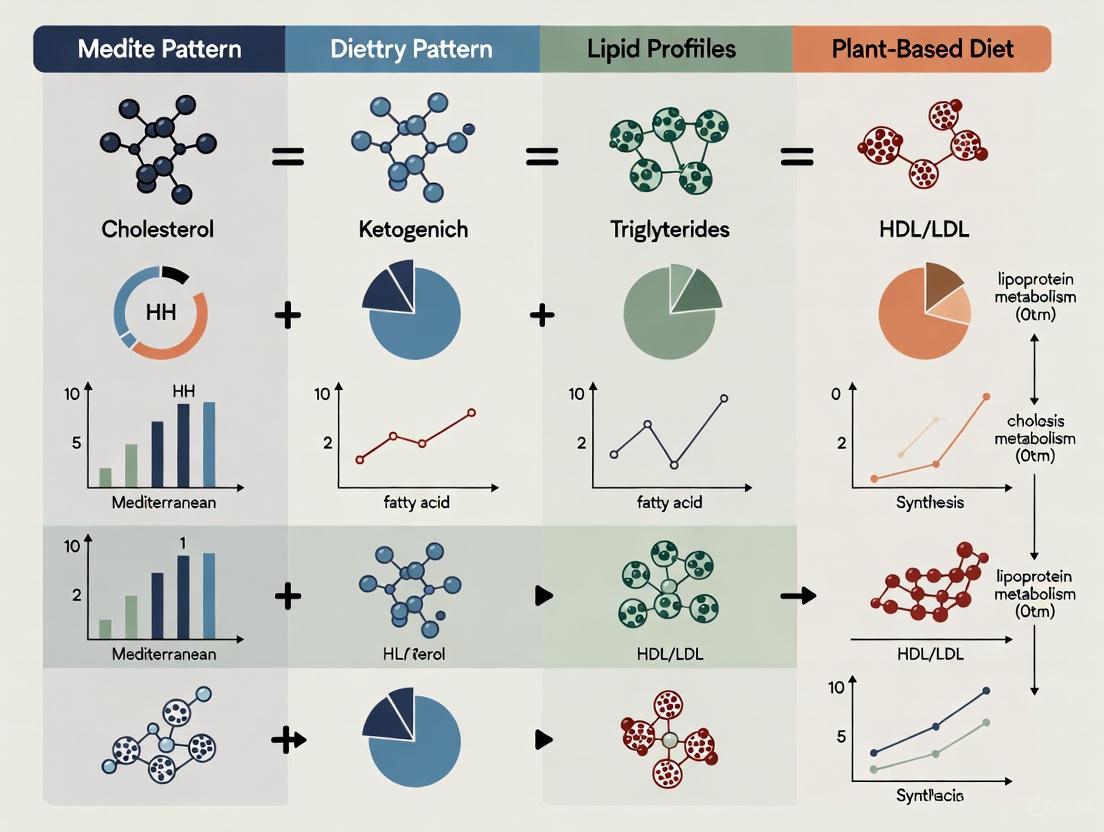
This comprehensive review synthesizes current evidence from randomized controlled trials, meta-analyses, and cohort studies to evaluate the comparative effects of major dietary patterns on lipid profiles and cardiovascular risk.
Dietary Patterns and Lipid Profiles: A Comparative Analysis for Cardiovascular Risk Management and Precision Nutrition
Abstract
This comprehensive review synthesizes current evidence from randomized controlled trials, meta-analyses, and cohort studies to evaluate the comparative effects of major dietary patterns on lipid profiles and cardiovascular risk. Targeting researchers, scientists, and drug development professionals, the analysis examines foundational mechanisms of diet-lipid interactions, methodological approaches for assessing lipidomic responses, strategies for optimizing dietary efficacy, and validation through direct comparative studies. Evidence demonstrates that ketogenic, Mediterranean, DASH, and vegan diets exert distinct effects on lipid parameters, with significant implications for personalized nutrition strategies and the development of targeted lipid-management therapies. Emerging lipidomics research further reveals how dietary fat quality influences specific lipid metabolites, offering novel biomarkers for precision nutrition and cardiovascular risk prediction.
Fundamental Mechanisms: How Dietary Patterns Influence Lipid Metabolism and Cardiovascular Risk
Lipid profiling represents a cornerstone of cardiovascular risk assessment, with core parameters including triglycerides (TG), low-density lipoprotein cholesterol (LDL-C), high-density lipoprotein cholesterol (HDL-C), and total cholesterol (TC) providing critical insights into atherogenic burden and metabolic health. Accurate measurement and interpretation of these parameters are fundamental for both clinical management and pharmaceutical development. In recent years, comparative studies have revealed significant limitations in traditional estimation methods alongside emerging evidence supporting novel composite ratios and alternative lipid markers [1] [2]. Within nutritional science research, understanding how dietary patterns modulate these lipid parameters is essential for evaluating therapeutic interventions. This guide provides a systematic comparison of core lipid parameters, their measurement methodologies, and performance characteristics based on contemporary experimental evidence to inform research and development activities.
Comparative Analysis of Core Lipid Parameters
Physiological Roles and Atherogenicity
Table 1: Core Lipid Parameters: Physiological Functions and Pathological Significance
| Parameter | Primary Physiological Function | Atherogenic Potential | Clinical Utility |
|---|---|---|---|
| LDL-C | Transports cholesterol to peripheral tissues | High - Directly contributes to plaque formation | Primary treatment target per major guidelines |
| HDL-C | Reverse cholesterol transport (removes excess cholesterol from arteries) | Anti-atherogenic (protective effect) | Inverse association with CVD risk; therapeutic raising challenging |
| TG | Energy storage and transport | Indirect - TG-rich lipoprotein remnants are atherogenic | Secondary target; elevated levels indicate increased cardiometabolic risk |
| TC | Composite measure of all cholesterol in lipoproteins | Moderate - Composite marker | Screening and general risk assessment |
| Non-HDL-C | Sum of all atherogenic lipoproteins (LDL, VLDL, IDL, Lp(a)) | High - Comprehensive atherogenic burden | Superior to LDL-C in diabetes, high TG, and obesity [2] |
| Remnant Cholesterol | Cholesterol content of TG-rich lipoproteins (VLDL, IDL remnants) | High - Directly atherogenic | Emerging marker; calculated as TC - LDL-C - HDL-C |
The pathophysiological mechanisms linking lipid parameters to cardiovascular disease involve complex metabolic pathways. LDL particles infiltrate and become trapped in the arterial intima, where they undergo oxidation, triggering chronic inflammation, foam cell formation, and the development of atherosclerotic plaques [3]. HDL-C participates in reverse cholesterol transport, removing excess cholesterol from peripheral tissues and arterial walls for return to the liver [3]. Triglyceride-rich lipoproteins contribute to atherosclerosis both directly via remnant particle deposition in arterial walls and indirectly through associated pro-inflammatory states and generation of atherogenic small, dense LDL particles [2].
Analytical Performance of LDL-C Estimation Methods
Table 2: Performance Characteristics of LDL-C Estimation Equations vs. Direct Measurement
| Estimation Method | Bias Range (%) | Optimal TG Range (mg/dL) | Key Limitations | Advantages |
|---|---|---|---|---|
| Friedewald (FW) | -7.4% to -4.9% | <400 | Requires fasting; inaccurate at low LDL-C and high TG | Widely adopted; simple calculation |
| Sampson (SN) | -7.4% to -4.9% | <400 (extends to 800) | Complex calculation; fixed factors | Better accuracy at high TG than FW |
| Martin-Hopkins (MH) | -7.4% to -4.9% | <400 (extends to 800) | Requires specialized table | Patient-specific adjustment |
| Vujovic | ±5% (minimal bias) | Across all TG levels | Less validation in diverse populations | Superior accuracy; minimal bias across TG levels [1] |
| de Cordova | Minimal underestimation | Stable across strata including borderline hypertriglyceridemia | Limited population validation | Cost-effective; stable across TG ranges [4] |
Direct measurement of LDL-C remains the reference method, utilizing homogeneous enzymatic assays on automated platforms like Roche Cobas and Abbott Alinity, with analytical measurement ranges of 3.87–549 mg/dL and 1–800 mg/dL, respectively [1]. These direct assays demonstrate excellent precision, with within-laboratory imprecision of <2.5% CV for Roche and <1.6% CV for Abbott [1]. Beta-quantification (ultracentrifugation) remains the reference method but is impractical for routine use due to cost, time, and technical requirements [1].
Experimental Protocols for Lipid Assessment
Standardized Lipid Profile Assessment Protocol
The following methodology is derived from contemporary large-scale lipid studies [1] [5]:
Sample Collection and Processing:
- Collect venous blood samples after a 12-hour fasting period
- Use serum separator tubes; process samples within 2 hours of collection
- Centrifuge at 2000-3000 × g for 15 minutes at 4°C
- Analyze immediately or store at -80°C for batch analysis
Analytical Measurement:
- Platform: Automated clinical chemistry analyzers (e.g., Abbott Alinity, Roche Cobas)
- Assay Principle: Homogeneous enzymatic colorimetric methods
- Quality Control: Implement three levels of commercial controls daily
- Standardization: Calibrate against reference methods traceable to CDC standardization programs
Measured Parameters:
- Total Cholesterol: Cholesterol oxidase-peroxidase method
- HDL-C: Homogeneous direct immunoinhibition method
- Triglycerides: Enzymatic hydrolysis with lipase followed by glycerol phosphate oxidase reaction
- Direct LDL-C: Selective detergent-based homogeneous assay
Calculated Parameters:
- Non-HDL-C = TC - HDL-C
- Remnant Cholesterol = TC - LDL-C - HDL-C
- TG/HDL-C Ratio = TG (mg/dL) / HDL-C (mg/dL)
Protocol for Comparative Equation Validation
For studies evaluating LDL-C estimation equations against direct measurement [1]:
Inclusion Criteria:
- Adult participants (≥18 years) with complete lipid profiles
- TG levels stratified: <150, 150-399, ≥400 mg/dL
- LDL-C ranges covering low (<70), intermediate (70-189), and high (≥190) mg/dL
Statistical Analysis:
- Calculate percentage difference: %Delta = 100 × (Calculated LDL-C - dLDL-C)/dLDL-C
- Define performance thresholds: good (±5%), moderate (±10%), low (±20%), unacceptable (>±20%)
- Assess classification accuracy across clinical decision thresholds (<40, 40-54, 55-69, 70-99, 100-129, 130-159, 160-189, ≥190 mg/dL)
- Evaluate categorical agreement rates using Cohen's kappa statistic
Metabolic Pathways and Research Workflows
Diagram 1: Integrated Lipid Metabolism and Research Assessment Pathway
Research Reagent Solutions and Essential Materials
Table 3: Essential Research Materials for Lipid Profiling Studies
| Category | Specific Products/Platforms | Research Application | Performance Characteristics |
|---|---|---|---|
| Automated Chemistry Analyzers | Roche Cobas series, Abbott Alinity | High-throughput clinical lipid testing | CV <2.5%; AMR: 3.87-549 mg/dL (Roche) [1] |
| Direct LDL-C Assays | Roche Direct LDL-C assay, Abbott Liquid Selective Detergent LDL-C assay | Reference standard for equation validation | Standardized against beta-quantification [1] |
| Quality Control Materials | Bio-Rad Liquichek Lipid Control, Siemens Lipid Control | Daily quality assurance | Three-level controls covering clinical range |
| Standardized Calibrators | CDC-standardized reference materials | Assay calibration | Traceable to international reference methods |
| Data Analysis Software | MedCalc Statistical Software, R Programming Environment | Statistical comparison of equations | Supports Bland-Altman, ROC analysis, concordance testing [1] |
Emerging Lipid Ratios and Novel Biomarkers
Beyond traditional parameters, research increasingly focuses on composite ratios and novel biomarkers that may offer superior predictive value. The TG/HDL-C ratio has emerged as a significant marker of metabolic dysfunction, demonstrating strong association with metabolic dysfunction-associated steatotic liver disease (MASLD) in NHANES data (AUC = 0.732), outperforming TG (AUC = 0.713) or HDL-C (AUC = 0.313) alone [6]. This ratio reflects underlying insulin resistance and impaired reverse cholesterol transport capacity.
The tyglyceride-glucose (TyG) index and its related parameters (TyG-BMI, TyG-WC, TyG-WHtR) serve as surrogate markers of insulin resistance and have demonstrated significant mediating roles in the relationship between dietary antioxidant intake and cardiovascular mortality in hypertensive elderly populations [7]. Research indicates these indices can mediate up to 34.3% of the protective effect of high dietary antioxidant intake on mortality risk [7].
For diabetic populations, non-HDL-C has demonstrated superior predictive value for ASCVD risk compared to remnant cholesterol, with higher AUC (0.78 vs. 0.62) and stronger associations with inflammatory markers (hs-CRP, resistin) in T2DM patients [2]. This parameter provides a more comprehensive assessment of atherogenic lipoprotein burden without requiring additional testing beyond standard lipid profiles.
Accurate assessment of core lipid parameters remains fundamental to cardiovascular risk stratification and intervention studies. While LDL-C persists as the primary therapeutic target, evidence supports the complementary value of non-HDL-C, especially in populations with diabetes or metabolic syndrome. Among estimation methods, the Vujovic equation demonstrates superior accuracy compared to traditional approaches, though Friedewald remains acceptable for many clinical scenarios with appropriate recognition of its limitations. Emerging composite ratios like TG/HDL-C and TyG indices provide additional insights into metabolic health beyond conventional parameters. For nutritional research and pharmaceutical development, selection of lipid assessment methodologies should align with specific population characteristics and research objectives, with direct measurement preferred when precision at low LDL-C levels is required.
Lipid homeostasis, the complex biological process of maintaining a stable internal lipid environment, is a critical determinant of cardiovascular and metabolic health. Central to this regulation are the dietary macronutrients—saturated fatty acids (SFA), monounsaturated fatty acids (MUFA), polyunsaturated fatty acids (PUFA), and carbohydrates—whose relative proportions in the diet exert distinct and clinically significant effects on lipid metabolism. For decades, nutritional science has sought to elucidate the comparative impacts of these macronutrients to inform evidence-based dietary recommendations. While general guidelines often recommend replacing SFA with unsaturated fats, the specific effects on diverse lipid parameters and underlying mechanisms require systematic comparison to guide targeted interventions for researchers and clinicians. This review synthesizes evidence from randomized controlled trials, meta-analyses, and cohort studies to provide a comprehensive comparison of how SFA, MUFA, PUFA, and carbohydrates influence lipid homeostasis, with particular focus on lipid fractions, inflammatory pathways, and mortality outcomes.
Comparative Analysis of Macronutrient Effects on Lipid Parameters
Isocaloric Replacement Effects on Circulating Lipids
The most precise understanding of macronutrient effects comes from isocaloric replacement studies, which isolate the specific impact of substituting one macronutrient for another while maintaining constant energy intake. A comprehensive meta-analysis of 102 randomized controlled feeding trials provides robust quantitative estimates of these effects [8].
Table 1: Isocaloric Macronutrient Replacement Effects on Lipid Parameters (5% Energy Replacement)
| Macronutrient Replacement | LDL-C (%) | HDL-C (%) | Triglycerides (%) | Total:HDL Ratio | ApoB (%) |
|---|---|---|---|---|---|
| CHO for SFA | -7.0 | -7.2 | +11.2 | -0.8 | -5.1 |
| MUFA for SFA | -6.3 | -4.3 | -3.5 | -4.1 | -4.9 |
| PUFA for SFA | -8.9 | -2.9 | -4.1 | -7.2 | -7.4 |
| PUFA for CHO | -5.2 | +4.8 | -13.8 | -8.1 | -4.1 |
Data adapted from Imamura et al. (2016) [8] and Berglund et al. (2000) [9]. Values represent percentage change from baseline for a 5% energy replacement.
Replacing SFA with carbohydrates produces a paradoxical effect: while LDL cholesterol decreases beneficially (-7.0%), this is accompanied by an unfavorably greater reduction in HDL cholesterol (-7.2%) and a substantial increase in triglycerides (+11.2%) [8] [9]. In contrast, replacing SFA with MUFA or PUFA provides more comprehensive lipid improvements, with PUFA demonstrating the most favorable overall lipid profile, particularly for LDL reduction (-8.9%) and total:HDL cholesterol ratio improvement (-7.2%) [8].
The DELTA trials provided further mechanistic insights, demonstrating that reducing SFA intake from 16% to 5% of energy while increasing carbohydrate proportionally resulted in significant increases in lipoprotein(a) [Lp(a)] concentrations by 11-20% [10]. This finding is clinically relevant given Lp(a)'s established role as an independent cardiovascular risk factor.
Effects on Lipidomic Profiles and Inflammatory Pathways
Beyond conventional lipid parameters, macronutrient composition significantly influences the plasma lipidome—the complete profile of lipid species in circulation—which may mediate disease risk through inflammatory pathways.
Table 2: Macronutrient Effects on Specific Lipidomic Species and Inflammatory Mediators
| Macronutrient Pattern | Associated Lipidomic Changes | Inflammatory Mediators |
|---|---|---|
| High PUFA Intake | ↑ Phosphatidylcholines with long-chain PUFAs [11] [12] | ↓ Neutrophil percentage-to-albumin ratio (NPAR) [13] |
| High SFA Intake | ↑ Triacylglycerol species with higher carbon atoms/double bonds [10] | ↑ NPAR (9.8% mediation of mortality risk) [13] |
| High MUFA Intake | ↑ Lysophosphatidylcholines (LPC) [12] | Moderate effect on inflammatory pathways |
| Animal Protein Pattern | ↑ Glycerophospholipids, NAPE lipids [11] | Inflammatory response varies by food source |
Recent prospective cohort data from NHANES (2007-2018) revealed that the proportional composition of fatty acids within total fat intake significantly influences all-cause mortality risk, partially mediated by the neutrophil percentage-to-albumin ratio (NPAR)—an emerging inflammatory biomarker [13]. The SFA/total fat ratio demonstrated a hazard ratio of 1.23 for mortality in the highest tertile, while the PUFA/total fat ratio showed a protective association (HR = 0.86). NPAR mediated 9.8% and 11.8% of the effects of SFA/total fat and PUFA/total fat ratios on mortality risk, respectively, suggesting inflammatory pathways partially explain these associations [13].
Integration with Dietary Patterns and Mortality Outcomes
Network meta-analyses of dietary patterns provide complementary evidence on how macronutrient combinations influence cardiovascular risk factors. A 2025 analysis of 21 randomized controlled trials found that specific dietary patterns excel in distinct risk domains: ketogenic and high-protein diets show superior efficacy for weight reduction (-10.5 kg and -4.49 kg, respectively), while the DASH diet most effectively lowers systolic blood pressure (-7.81 mmHg) [14].
The critical importance of macronutrient proportionality is further highlighted by mortality data. A prospective cohort study of 21,823 participants found that the ratio of specific fatty acids to total fat intake—rather than their absolute intake—was significantly associated with all-cause mortality [13]. This suggests that the relative balance of macronutrients may be more important than absolute restrictions, shifting the paradigm from isolated nutrient reduction to optimized macronutrient ratios.
Methodological Approaches in Macronutrient Research
Controlled Feeding Trial Protocols
The most rigorous evidence for macronutrient effects comes from randomized controlled feeding trials, which utilize standardized protocols to ensure precise dietary control:
Dietary Intervention Design: The DELTA trials employed a crossover design where participants consumed each experimental diet for 7-8 weeks with 4-6 week washout periods [10]. Diets were designed using the average American diet (AAD) as baseline (37% fat, 16% SFA, 14% MUFA, 7% PUFA), with isocaloric replacements creating comparison diets: Step-1 Diet (30% fat, 9% SFA), Low-Saturated-Fat Diet (26% fat, 5% SFA), and MUFA diet (37% fat, 8% SFA, 22% MUFA) [10].
Diet Delivery and Compliance: Research metabolic kitchens prepared all foods, with participants consuming one daily meal on-site and receiving packaged meals for off-site consumption. Compliance was monitored through urinary electrolytes, body weight maintenance, and returned uneaten food [10].
Blood Collection and Processing: Standardized phlebotomy protocols included 12-14 hour fasts before blood collection. Samples were processed immediately, with plasma and serum stored at -80°C until batch analysis to minimize assay variability [10].
Lipidomic Profiling Methodologies
Advanced lipidomics approaches provide comprehensive characterization of lipid species:
Sample Preparation: Plasma/serum samples undergo protein precipitation using cold methanol or chloroform:methanol mixtures. Liquid-liquid extraction separates lipids from hydrophilic compounds, with quality control pools created from aliquots of all samples [10] [12].
Lipid Separation and Detection: Ultra-high-performance liquid chromatography (UHPLC) coupled to mass spectrometry (MS) enables high-resolution lipid separation. Reverse-phase chromatography separates lipids by hydrophobicity, while hydrophilic interaction liquid chromatography (HILIC) separates by lipid class [11] [12].
Data Processing: Untargeted processing detects all ionizable features, with targeted integration focusing on predefined lipid species. Bioinformatics pipelines include peak alignment, missing value imputation, and batch effect correction [11] [12].
Statistical Approaches for Macronutrient Effects
Multiple-Treatment Meta-Regression: The meta-analysis by Imamura et al. utilized multiple-treatment meta-regression to estimate dose-response effects of isocaloric replacements between SFA, MUFA, PUFA, and carbohydrate, adjusted for protein, trans fat, and dietary fiber [8].
Mediation Analysis: Recent studies employ causal mediation analysis to quantify the proportion of effect mediated by specific pathways. For example, NPAR mediated approximately 10% of the effect of SFA/total fat ratio on mortality risk, calculated using the proportion-mediated method from Cox models [13].
Network Meta-Analysis: This approach enables simultaneous comparison of multiple dietary patterns by combining direct and indirect evidence, with ranking performed using Surface Under the Cumulative Ranking Curve (SUCRA) values [14].
The Researcher's Toolkit: Essential Methodologies and Reagents
Table 3: Essential Research Reagents and Platforms for Macronutrient-Lipid Studies
| Category | Specific Tool/Platform | Research Application | Key Features |
|---|---|---|---|
| Lipid Profiling | NMR Spectroscopy (Nightingale Health) [15] [16] | High-throughput quantification of lipoprotein subclasses | Simultaneous measurement of 200+ biomarkers including fatty acid ratios |
| Targeted Lipidomics | UHPLC-MS [10] [12] | Precise quantification of specific lipid classes and species | High sensitivity for low-abundance lipid mediators and oxidized lipids |
| Dietary Control | Metabolic Kitchen Systems [10] | Precise diet delivery in feeding trials | Standardized recipes, nutrient database integration, portion control |
| Inflammatory Biomarkers | Neutrophil Percentage-to-Albumin Ratio (NPAR) [13] | Assessment of inflammatory status | Integrates nutritional and inflammatory pathways; automated calculation |
| Statistical Analysis | R packages (metafor, JAGS) [14] | Network meta-analysis and Bayesian modeling | Flexible framework for complex dose-response and mediation models |
The comparative effects of SFA, MUFA, PUFA, and carbohydrates on lipid homeostasis reveal a complex landscape with clear clinical implications. The evidence consistently demonstrates that PUFA provides the most favorable overall lipid profile when replacing either SFA or carbohydrates, with beneficial effects on LDL cholesterol, triglyceride levels, and the total:HDL cholesterol ratio. Importantly, the proportional balance of macronutrients within the total diet appears more critical than absolute intake of any single nutrient, with higher SFA proportions associated with increased mortality risk partially mediated through inflammatory pathways. These findings support dietary guidance that emphasizes replacing SFA with PUFA rather than carbohydrates, which produces mixed effects despite reducing LDL cholesterol. For researchers and clinicians, these results highlight the importance of considering comprehensive lipid parameters—including lipidomic profiles and inflammatory biomarkers—when evaluating macronutrient effects and designing targeted interventions for cardiovascular risk reduction.
Lipids are structurally diverse biomolecules with critical roles in cellular function, energy storage, and signaling. The human lipidome—a dynamic and complex subset of the metabolome—is significantly influenced by dietary intake, making diet one of the most potent and modifiable determinants of lipid composition in plasma, serum, and lipoprotein fractions [17]. Whereas conventional lipid profiling measures traditional parameters like LDL-C and HDL-C, advanced lipidomics now enables comprehensive characterization of numerous distinct lipid species, revealing mechanistic links between lipid metabolism and diseases such as cardiovascular disease (CVD) and type 2 diabetes (T2D) [17] [18]. This objective guide compares major dietary patterns within the context of a broader thesis on their comparative effects on lipid profiles, synthesizing current experimental data to inform researchers, scientists, and drug development professionals. Specifically, we examine the Mediterranean, DASH, Ketogenic, Vegan, Low-Fat, and Low-Carbohydrate approaches, focusing on their impacts on lipidomic profiles through evidence from controlled trials, omics technologies, and clinical endpoints.
Comparative Analysis of Dietary Patterns: Mechanisms and Lipidomic Impacts
Mediterranean Diet
Core Definition and Mechanism: Characterized by high intake of olive oil (primary source of MUFAs), nuts, fruits, vegetables, legumes, and whole grains with moderate fish and wine consumption. Its effects are mediated through anti-inflammatory and antioxidant properties of bioactive compounds (e.g., polyphenols), high supply of MUFAs and omega-3 PUFAs, and improvement of lipoprotein composition and function [12] [19].
Key Lipidomic Findings: The PREDIMED trial, a primary prevention RCT, demonstrated that a Mediterranean diet supplemented with nuts or extra-virgin olive oil induced modest but significant changes in the lipid profile. Specifically, the olive oil supplementation group showed greater increases in lipids with longer mean acyl chain length, while the nut supplementation group significantly altered cholesteryl ester concentrations compared to a control low-fat diet [12]. A lipidomics-based multilipid score (MLS) reflecting better dietary fat quality (replacement of SFAs with UFAs) was associated with substantial CVD risk reduction (−32%) and T2D risk reduction (−26%) in observational cohorts [19]. Furthermore, in the PREDIMED trial, participants with unfavorable pre-intervention lipidomic scores (suggestive of disturbed lipid metabolism) derived significantly greater benefit from Mediterranean diet intervention in diabetes prevention, highlighting its potential for precision nutrition [19].
Dietary Approaches to Stop Hypertension (DASH)
Core Definition and Mechanism: Emphasizes fruits, vegetables, low-fat dairy products, whole grains, poultry, fish, and nuts while limiting red meat, sweets, and sugar-sweetened beverages. It is rich in fiber, potassium, calcium, magnesium, and protein while low in saturated fat, total fat, and cholesterol. The DASH diet improves lipid profiles primarily through reduced hepatic synthesis of cholesterol and fatty acids and enhanced clearance of atherogenic lipoproteins.
Key Lipidomic Findings: While traditional lipid measures show the DASH diet significantly lowers total cholesterol, LDL-C, and non-HDL-C compared to typical Western diets, emerging lipidomic data provide deeper insights. Studies associate the DASH pattern with favorable modifications in phospholipid and sphingolipid species, including reductions in pro-inflammatory and pro-apoptotic ceramides (Cers) and increases in antioxidative plasmalogens [20]. These changes reflect improved membrane integrity and signaling. The DASH diet's impact on the lipidome is often intertwined with its blood pressure-lowering effects, as shared pathways involving renal lipid handling and vascular endothelial function are modulated.
Ketogenic and Low-Carbohydrate Diets
Core Definition and Mechanism: These diets severely restrict carbohydrate intake (typically to <50 g/day for ketogenic, or <26% of total energy for low-carb) and replace it with fat, leading to increased fatty acid oxidation and hepatic production of ketone bodies. The primary metabolic shift involves transitioning from glucose to fat as the dominant fuel source, impacting lipid energy substrate utilization and storage.
Key Lipidomic Findings: The lipidomic response to these diets is complex and highly dependent on the quality of dietary fats consumed. A crossover randomized trial in individuals with type 1 diabetes following a low-carbohydrate diet revealed distinct elevations in sphingomyelins (SMs) and phosphatidylcholines (PCs) [12]. When these diets are high in saturated fats, they can increase atherogenic lipid species, including certain triacylglycerols (TAGs) and ceramides. However, when unsaturated fats are emphasized, some studies show favorable lipidomic changes, including reductions in specific ceramide species associated with insulin resistance [20]. This underscores a critical principle: the food matrix and fat quality are as important as macronutrient distribution in determining the ultimate impact on the lipidome [17] [19].
Vegan and Vegetarian Diets
Core Definition and Mechanism: Vegan diets exclude all animal products, while vegetarian diets may include some (e.g., dairy, eggs). These diets are typically high in fiber, plant sterols/stanols, and polyunsaturated fats while being low in saturated fat and dietary cholesterol. Their mechanisms of action include inhibition of intestinal cholesterol absorption via plant sterols and modulation of gut microbiota-derived lipid metabolites.
Key Lipidomic Findings: Lipidomic studies reveal that plant-based diets consistently reduce cholesterol esters (CEs) and specific sphingolipid classes linked to cardiometabolic risk [17]. A key finding is that healthy plant-based diets (rich in fruits, vegetables, whole grains) are associated with a lipidomic profile distinct from unhealthy plant-based diets (rich in refined grains, sugar-sweetened beverages). The former is characterized by higher levels of ether-linked phospholipids (with potential antioxidant functions) and lower levels of pro-inflammatory lysophosphatidylcholines (LPCs) and ceramides, even after adjusting for traditional lipid measures [17] [12].
Low-Fat Diets
Core Definition and Mechanism: Traditionally defined as deriving ≤30% of total energy from fat. The mechanism for lipid improvement primarily involves reduced availability of dietary fatty acids for hepatic synthesis and assembly of TAGs and VLDL, coupled with upregulated LDL receptor activity.
Key Lipidomic Findings: While effective for reducing total TAGs and LDL-C at a population level, lipidomics reveals significant heterogeneity in individual responses. The lipid-lowering effects are most pronounced for glycerolipids (TAGs, DAGs) and specific sphingolipid species [17]. However, a critical insight from lipidomics is that low-fat, high-carbohydrate diets may, in some individuals, increase the production of palmitate-containing lipid species through de novo lipogenesis, particularly if the carbohydrates are refined [17]. This can lead to an unfavorable shift in the lipidome, including increases in certain ceramides, underscoring the importance of carbohydrate quality within a low-fat dietary framework.
Table 1: Comparative Impacts of Dietary Patterns on Key Lipidomic Species and Disease Risk
| Dietary Pattern | Key Lipid Species Modulated | Reported Cardiometabolic Risk Association | Primary Proposed Mechanism |
|---|---|---|---|
| Mediterranean | ↓ Ceramides, ↑ Ether-linked phospholipids, ↑ Long-chain PUFAs in CEs | CVD: ↓32% [19]; T2D: ↓26% [19] | Anti-inflammatory & antioxidant effects; improved lipoprotein composition |
| DASH | ↓ Ceramides, ↓ Diacylglycerols (DAGs), ↑ Plasmalogens | Favorable changes in traditional lipids (LDL-C, HDL-C) | Reduced hepatic cholesterol synthesis; enhanced lipoprotein clearance |
| Ketogenic/Low-Carb | ↑ Sphingomyelins (SMs), ↑ Phosphatidylcholines (PCs); effect on Ceramides depends on fat quality | Mixed; dependent on dietary fat source and individual metabolic health | Shift to fat as primary fuel; altered fatty acid oxidation & ketone production |
| Vegan/Vegetarian | ↓ Cholesterol Esters (CEs), ↓ Specific Sphingolipids, ↓ LPCs | Associated with lower CVD risk in observational studies | Inhibition of cholesterol absorption; modulation of gut microbiota |
| Low-Fat | ↓ Glycerolipids (TAGs, DAGs); potential ↑ in some Ceramides if carbs are refined | Effective for population-level LDL-C & TAG reduction | Reduced substrate for lipid assembly; upregulated LDL receptor activity |
Experimental Protocols and Methodologies in Nutritional Lipidomics
Core Analytical Workflow
The standard pipeline for investigating diet-lipidome interactions involves sequential steps from sample collection to data interpretation, with rigorous control at each stage.
- Study Design and Participant Recruitment: Controlled feeding trials (e.g., DIVAS, PREDIMED) provide the highest level of evidence by precisely controlling dietary exposure. Cross-sectional and prospective cohort studies (e.g., EPIC-Potsdam, NHS) offer real-world data and long-term disease endpoint assessment [19] [12]. Key inclusion criteria often involve specific health statuses (e.g., healthy, at-risk, or diagnosed with T2D/CVD) and age ranges.
- Dietary Intervention and Assessment: In RCTs, isoenergetic diets are typically provided, with macronutrient targets strictly defined. For example, the DIVAS trial had a control diet (17% energy from SFA) and intervention diets (9% energy from SFA, replaced with UFAs) [19]. Dietary adherence is monitored via food records, biomarkers, or returned food items.
- Biological Sample Collection: Fasting blood samples are standard. Plasma and serum are most common, but specific lipoprotein fractions (VLDL, LDL, HDL) isolated via ultracentrifugation or other techniques provide deeper compartment-specific insights [17] [18].
- Lipid Extraction: The Folch or Bligh & Dyer methods are commonly used to comprehensively isolate lipids from biological matrices.
- Lipid Separation and Analysis: Ultra-high-performance liquid chromatography (UHPLC) coupled to mass spectrometry (MS) is the workhorse of modern lipidomics. UHPLC separates complex lipid mixtures, which are then ionized and detected by MS [12] [18].
- Data Processing and Statistical Analysis: Raw MS data are processed using bioinformatics platforms (e.g., LipidSearch, XCMS) for peak identification, alignment, and quantification. Multivariate statistics and pathway analysis are used to identify diet-induced lipid signatures.
Key Reagents and Research Solutions
Table 2: Essential Research Reagent Solutions for Nutritional Lipidomics
| Research Reagent / Solution | Critical Function in Experimental Protocol |
|---|---|
| Internal Standards (Stable Isotope-Labeled Lipids) | Enables precise quantification by correcting for analyte loss during extraction and MS ionization variability; crucial for accuracy [18]. |
| Lipid Extraction Solvents (Chloroform, Methanol) | Used in classic Folch or Bligh & Dyer methods to efficiently partition lipids away from proteins and other cellular components [18]. |
| UHPLC Columns (C18, C8, Silica) | Separate complex lipid extracts by class and molecular species based on hydrophobicity or polarity prior to MS injection [18]. |
| Mass Spectrometry Instrumentation | The core analytical platform for identifying and quantifying thousands of lipid species based on mass-to-charge ratio (m/z) and fragmentation patterns [12] [18]. |
| Bioinformatics Software Suites | Processes raw, high-volume MS data; performs peak picking, lipid identification, and statistical analysis to define diet-responsive lipid signatures [17] [18]. |
The following diagram illustrates the typical workflow for a nutritional lipidomics study, from initial design to final interpretation.
Diagram 1: Nutritional Lipidomics Workflow. This flowchart outlines the standard experimental pipeline for studying diet-lipidome interactions, highlighting key stages from controlled intervention to data interpretation.
Molecular Mechanisms and Pathway Analysis
Key Pathways Modulated by Dietary Patterns
Dietary patterns exert their effects on the lipidome by modulating specific metabolic pathways. The following diagram synthesizes the primary molecular pathways through which the discussed diets influence lipid metabolism and cardiometabolic risk.
Diagram 2: Pathways of Dietary Impact on Lipid Metabolism. This diagram summarizes the core metabolic pathways through which different dietary patterns influence the lipidome and subsequent cardiometabolic risk.
From Lipidomics to Precision Nutrition
A pivotal finding from recent research is that individuals with baseline lipidomic profiles indicative of disturbed metabolism may derive disproportionate benefit from targeted dietary interventions. In the PREDIMED trial, for example, the Mediterranean diet intervention primarily reduced diabetes incidence among participants who had an unfavorable pre-intervention lipidomic score (rMLS) [19]. This score, derived from a controlled trial (DIVAS), summarized the effect of replacing SFAs with UFAs on 45 lipid metabolites, primarily in ceramide and cholesterol ester classes [19]. This illustrates a pathway from precise dietary manipulation to lipidomic biomarker discovery and, finally, to stratified dietary prevention, forming a core concept for precision nutrition and drug development targeting lipid metabolism.
The Scientist's Toolkit: Key Reagent Solutions
This section details essential reagents, materials, and bioinformatics resources critical for conducting rigorous nutritional lipidomics research.
Table 3: Key Reagent Solutions for Nutritional Lipidomics Research
| Category / Item | Specifications & Selection Criteria | Primary Research Function |
|---|---|---|
| Quantitative Lipid Standards | Stable isotope-labeled (e.g., 13C, 2H) for each major lipid class (e.g., PC-d7, Cer d18:1/17:0). Must cover diverse classes (glycerolipids, phospholipids, sphingolipids). | Absolute quantification of lipid species; corrects for matrix effects and analytical variability [18]. |
| Chromatography Columns | UHPLC columns: C18 for reverse-phase separation, silica for normal-phase. Sub-2µm particle size for high resolution. | High-resolution separation of complex lipid mixtures by hydrophobicity or lipid class prior to MS detection [18]. |
| Mass Spectrometry Platforms | High-resolution (HRMS) Orbitrap or Q-TOF for discovery; triple quadrupole (QqQ) for targeted quantification. | Unbiased identification and precise, sensitive quantification of hundreds to thousands of lipid species [12] [18]. |
| Lipidomics Databases | LIPID MAPS (http://www.lipidmaps.org/), LipidHome, LipidBlast. | Structural database for lipid identification; pathway analysis and functional annotation of lipidomic data [18]. |
| Lipoprotein Isolation Kits | Ultracentrifugation kits (density gradient) or affinity-based kits for HDL, LDL, VLDL isolation. | Enables compartment-specific lipidomic analysis, crucial for understanding lipid transport and function [17]. |
This objective comparison demonstrates that distinct dietary patterns induce unique and measurable shifts in the human lipidome, extending far beyond conventional lipid panels. The Mediterranean diet, with its high unsaturated fat content, consistently shows beneficial effects on ceramides and phospholipids, linked to significant cardiometabolic risk reduction. The efficacy of Low-Carbohydrate/Ketogenic diets appears highly contingent on dietary fat quality, while Vegan and Low-Fat diets effectively modulate specific lipid classes like cholesterol esters and glycerolipids. The convergence of controlled dietary interventions, advanced lipidomics analytics, and bioinformatics is now enabling the development of multilipid scores that reflect dietary fat quality and predict disease risk [19]. The critical next steps for the field involve standardizing lipidomic methodologies, expanding the mapping of lipid species into specific lipoprotein fractions, and validating these lipid signatures in larger, diverse populations. This will firmly establish the role of nutritional lipidomics in guiding precision nutrition and developing targeted therapies for lipid-related disorders.
Cholesterol homeostasis is a complex biological process fundamental to cellular structure, steroid hormone production, and systemic metabolic health. This equilibrium is maintained through the precise coordination of three primary pathways: hepatic lipogenesis (cholesterol synthesis), LDL receptor activity (cholesterol uptake), and intestinal cholesterol absorption. Dysregulation within these interconnected pathways contributes significantly to dyslipidemia, atherosclerosis, and other cardiometabolic diseases [21] [22].
Understanding the comparative roles and regulatory mechanisms of these pathways provides a critical foundation for developing targeted dietary and therapeutic interventions. This guide offers a systematic comparison of these core biological pathways, supported by experimental data and methodologies relevant to researchers and drug development professionals. The content is framed within a broader thesis on how different dietary patterns distinctly influence these pathways to modulate overall lipid profiles.
Pathway Comparison Tables
Core Pathway Characteristics and Regulatory Mechanisms
Table 1: Key features, regulatory nodes, and experimental assessment methods for the three primary cholesterol pathways.
| Feature | Hepatic Lipogenesis (De Novo Synthesis) | LDL Receptor Activity (Cellular Uptake) | Intestinal Cholesterol Absorption |
|---|---|---|---|
| Primary Location | Liver cytoplasm & ER (80%), extrahepatic tissues [21] | Liver hepatocytes (70% clearance), peripheral cells [23] [24] | Duodenum & proximal jejunum enterocytes [21] |
| Key Regulatory Molecules | SREBP-2, SCAP, INSIG, HMGCR (rate-limiting), SQLE [21] [25] [22] | SREBP-2, PCSK9 (post-translational), IDOL [23] [22] [24] | NPC1L1 (uptake), ACAT2 (esterification), ABCG5/G8 (efflux) [21] |
| Primary Regulatory Mechanism | Transcriptional feedback via intracellular cholesterol levels [22] | Transcriptional & post-translational regulation (LDLR recycling & degradation) [23] [22] | Membrane transport & endocytic recycling modulated by luminal cholesterol [21] |
| Key Experimental Readouts | HMGCR activity, [14C]-Acetate incorporation into sterols, SREBP-2 nuclear localization [21] | LDL binding/internalization assays, cell surface LDLR quantification, plasma LDL-C levels [23] [26] | Fecal sterol balance, plasma campesterol levels, C14-cholesterol tracer absorption [21] |
| Response to Dietary Cholesterol | Down-regulated | Down-regulated via increased hepatic cholesterol | Up-regulated via increased luminal substrate |
Quantitative Impact of Dietary Patterns and Pharmacologic Interventions
Table 2: Comparative effects of interventions on pathway-specific biomarkers and overall lipid profiles. Data synthesized from clinical and preclinical studies.
| Intervention / Pattern | Effect on Hepatic Lipogenesis | Effect on LDL Receptor Activity | Effect on Cholesterol Absorption | Net Effect on Plasma LDL-C |
|---|---|---|---|---|
| High-Saturated Fat Diet | ↑ HMGCR activity & synthesis [22] | ↓ LDLR expression (hepatic cholesterol ↑) [22] | Variable | ↑↑ (Significant Increase) [22] |
| High-Dietary Cholesterol | ↓↓ (Strong suppression) [21] | ↓ LDLR expression & activity [22] [24] | ↑ Absorption efficiency [21] | ↑ (Moderate Increase) |
| Statin Therapy (HMGCR Inhibitors) | ↓↓ (Direct inhibition) [21] [24] | ↑↑ LDLR expression (compensatory) [23] [24] | ↑ (Compensatory increase) | ↓↓ (30-50% Reduction) [24] |
| Ezetimibe (NPC1L1 Inhibitor) | ↑ (Compensatory increase) [21] | ↑ LDLR expression (hepatic cholesterol ↓) [21] | ↓↓ (Direct inhibition) [21] | ↓ (15-20% Reduction) [21] |
| PCSK9 Inhibitors | No direct effect | ↑↑ LDLR availability (prevents degradation) [21] [24] | No direct effect | ↓↓ (50-60% Reduction) [21] [24] |
| Mediterranean Diet | ↓ SREBP-2 processing [21] | ↑ LDLR activity | Modest ↓ in absorption | ↓ (Moderate Reduction) |
Experimental Protocols for Pathway Analysis
Protocol 1: Assessing Hepatic Lipogenesis In Vitro
Objective: To quantify the rate of de novo cholesterol synthesis in cultured hepatocytes (e.g., HepG2 cells) in response to a dietary fatty acid intervention [21] [26].
Methodology:
- Cell Treatment: Culture hepatocytes in standard medium. Treat experimental groups with a physiological concentration (e.g., 200 µM) of a fatty acid (e.g., palmitate or oleate) for 24-48 hours. Include a control group with a vehicle (e.g., BSA).
- Radioisotope Labeling: Pulse cells with [14C]-acetate (2 µCi/mL) for the final 4-6 hours of treatment. [14C]-acetate is incorporated into the acetyl-CoA precursor pool for the mevalonate pathway.
- Lipid Extraction: Wash cells and lyse. Perform lipid extraction using a chloroform:methanol (2:1 v/v) mixture.
- Separation and Quantification: Separate neutral lipids by thin-layer chromatography (TLC) using a hexane:diethyl ether:acetic acid (70:30:1) solvent system. Identify the cholesterol band against a known standard via iodine vapor.
- Data Analysis: Scrape the cholesterol band and measure incorporated radioactivity by scintillation counting. Normalize counts to total cellular protein content. A significant increase in [14C]-cholesterol in the palmitate-treated group indicates upregulated hepatic lipogenesis.
Protocol 2: Evaluating LDL Receptor Activity and Expression
Objective: To measure the functional activity and protein levels of the LDL receptor in human hepatocytes under conditions of PCSK9 modulation [23] [22] [26].
Methodology:
- Cell Model and Treatment: Use a relevant cell line (e.g., Huh7 or primary human hepatocytes). Treat cells with a PCSK9 inhibitor (e.g., 10 µg/mL alirocumab) or a vehicle control for 24 hours.
- LDL Uptake Assay (Functional Activity):
- Obtain or fluorescently label LDL (e.g., with Dil dye).
- Incubate treated cells with Dil-LDL (5-10 µg/mL) for 2-4 hours at 37°C.
- Terminate uptake by placing cells on ice and washing extensively.
- Analyze fluorescence intensity via flow cytometry. Increased fluorescence in the inhibitor-treated group indicates enhanced LDL particle uptake via increased LDLR activity.
- Western Blot Analysis (Protein Expression):
- Lyse treated cells and quantify total protein.
- Separate proteins by SDS-PAGE and transfer to a PVDF membrane.
- Immunoblot with antibodies against LDLR and a loading control (e.g., β-Actin).
- Use an anti-PCSK9 antibody to confirm a reduction in PCSK9 levels. Densitometric analysis will show increased LDLR protein in PCSK9 inhibitor-treated cells due to reduced degradation.
Protocol 3: Measuring Cholesterol Absorption Efficiency
Objective: To determine the efficiency of intestinal cholesterol absorption in a preclinical model using a dual-isotope method [21].
Methodology:
- Animal Model and Dosing: Use mice (e.g., C57BL/6) maintained on a defined diet. After a brief fast, administer an oral gavage containing a mixture of [14C]-cholesterol (to trace absorption) and [3H]-sitostanol (a non-absorbable sterol to correct for non-absorbed fraction and gastric emptying).
- Sample Collection: At 72 hours post-gavage, collect blood via cardiac puncture and harvest the entire liver.
- Sample Processing and Analysis: Digest aliquots of plasma and liver in tissue solubilizer.
- Scintillation Counting: Count 14C and 3H radioactivity in each sample using a dual-channel scintillation counter.
- Calculation: The percentage of cholesterol absorbed is calculated using the formula:
- % Absorption = [ (14C/3H) in plasma or liver / (14C/3H) in the administered dose ] × 100 This method provides a highly accurate measure of net cholesterol absorption, accounting for inter-animal variability.
Pathway Diagrams
Cholesterol Homeostasis Regulatory Network
Diagram 1: Integrated regulation of cholesterol homeostasis. The diagram illustrates the core regulatory feedback where intracellular cholesterol suppresses its own synthesis (via SREBP2/HMGCR) and uptake (via LDLR/PCSK9). Intestinal absorption (via NPC1L1) provides an external input. The pathways are interconnected, as dietary cholesterol absorbed intestinally can influence hepatic synthesis and LDLR expression.
LDL Receptor Regulatory Cycle
Diagram 2: LDL receptor lifecycle and regulation. The pathway shows LDLR transcription controlled by SREBP-2, its trafficking to the cell surface for LDL binding, and subsequent endocytosis. The key regulatory node is PCSK9, which binds the LDLR and directs it to lysosomal degradation instead of recycling, thereby controlling cholesterol uptake.
The Scientist's Toolkit: Research Reagent Solutions
Table 3: Essential research tools for studying cholesterol homeostasis pathways.
| Reagent / Tool | Primary Function / Target | Research Application |
|---|---|---|
| [14C]-Acetate / [3H]-Water | Precursor for de novo sterol synthesis | Radiolabeling to quantify cholesterol synthesis rates in vitro and in vivo [21]. |
| Dil-LDL / Fluorescent LDL | Visualizing LDL particles | Tracking LDL binding, internalization, and intracellular trafficking via fluorescence microscopy or flow cytometry [26]. |
| Recombinant Human PCSK9 | Ligand for LDLR | To induce LDLR degradation in cell culture models and study PCSK9-LDLR interaction [23] [22]. |
| SREBP-2 Antibodies | Detecting SREBP-2 forms (precursor/mature) | Western blotting to assess SREBP-2 activation and nuclear translocation [22]. |
| GW3965 (LXR Agonist) | Activates Liver X Receptors (LXR) | To induce expression of cholesterol efflux transporters (ABCA1/ABCG1) and study reverse cholesterol transport [21]. |
| MβCD-Cholesterol Complex | Water-soluble cholesterol donor | To load cells with cholesterol in culture, bypassing the LDLR pathway [26]. |
| Ezetimibe | Inhibits NPC1L1 transporter | To block intestinal cholesterol absorption in preclinical models and validate NPC1L1 function [21]. |
| Simvastatin / Atorvastatin | Inhibits HMGCR | To suppress de novo cholesterol synthesis and study compensatory mechanisms in pathway regulation [21] [24]. |
Epidemiological research has progressively shifted from examining single nutrients to evaluating comprehensive dietary patterns, providing a more holistic understanding of how diet influences cardiovascular health. This approach acknowledges that individuals consume complex combinations of foods and nutrients that interact synergistically to modulate lipid metabolism and cardiovascular disease (CVD) risk. Large-scale population studies and advanced statistical methodologies have enabled researchers to identify distinct dietary patterns and quantify their association with dyslipidemias and cardiovascular outcomes. The global burden of dyslipidemia remains substantial, with recent meta-analyses indicating a prevalence of 28.8% for hypertriglyceridemia, 24.1% for hypercholesterolemia, 38.4% for low HDL-C, and 18.93% for high LDL-C in the general adult population [27]. This article provides a systematic comparison of major dietary patterns based on epidemiological evidence, detailing their effects on lipid profiles and CVD incidence within the context of advancing lipid management research.
Global Epidemiology of Dyslipidemias
Understanding the global distribution of dyslipidemias provides crucial context for evaluating the potential impact of dietary interventions. A comprehensive systematic review and meta-analysis of 206 studies published between 2000 and 2025 revealed significant geographical and sex-based variations in dyslipidemia prevalence. The analysis documented an ongoing epidemiological transition, with a progressive increase in hypertriglyceridemia and low high-density lipoprotein cholesterol (HDL-C) levels, alongside a decrease in hypercholesterolemia and elevated low-density lipoprotein cholesterol (LDL-C) [27].
Significant sex differences exist in the dyslipidemia landscape. Men present a higher prevalence of hypertriglyceridemia (33.8% vs. 24.5% in women), while women show a greater frequency of low HDL-C (40.5% vs. 34.1% in men) [27]. Regionally, the highest prevalences of low HDL-C and mixed dyslipidemia patterns are observed in the Middle East and Latin America, suggesting potential interactions between genetic predispositions, dietary habits, and other lifestyle factors across different populations [27]. These epidemiological patterns underscore the importance of dietary interventions tailored to specific dyslipidemia profiles and regional contexts.
Comparative Analysis of Dietary Patterns
Methodological Framework for Dietary Pattern Analysis
Epidemiological studies evaluating dietary patterns employ standardized methodologies to ensure valid comparisons. Common approaches include:
- Dietary Indices: Validated scoring systems such as the Alternative Healthy Eating Index (AHEI), Dietary Approaches to Stop Hypertension (DASH) score, Dietary Inflammatory Index (DII), Healthy Eating Index-2020 (HEI-2020), and alternative Mediterranean Diet Score (aMED) [28].
- Population Selection: Large, representative cohorts like the National Health and Nutrition Examination Survey (NHANES), which includes participants with comprehensive dietary assessments and clinical outcomes [28].
- Statistical Analysis: Multivariable Cox regression models adjusted for covariates including age, race/ethnicity, gender, socioeconomic status, body mass index, waist circumference, lipid levels, renal function, diabetes status, smoking, and alcohol consumption [28].
- Outcome Measures: All-cause and cardiovascular mortality, changes in specific lipid parameters (LDL-C, HDL-C, triglycerides, total cholesterol), and other cardiometabolic risk factors [28] [29].
Major Dietary Patterns and Their Cardiovascular Effects
Table 1: Comparative Effects of Dietary Patterns on Cardiovascular Risk Factors
| Dietary Pattern | Primary Lipid Effects | Blood Pressure Impact | Weight/Body Composition | Overall CVD Risk Reduction |
|---|---|---|---|---|
| Mediterranean | Improved HDL-C, reduced triglycerides [29] | Moderate reduction [29] | Mild to moderate weight benefit [30] | Significant risk reduction [28] |
| DASH | Mild improvement in total cholesterol, LDL-C [29] | Strong reduction (SBP: -5.99 mmHg) [29] | Moderate weight benefit [30] | Significant risk reduction (HR: 0.73) [28] |
| Ketogenic | Substantial triglyceride reduction [29] | Strong reduction (DBP: -9.40 mmHg) [29] | Superior weight reduction (-10.5 kg) [30] | Limited long-term evidence |
| Vegetarian/Vegan | HDL-C improvement [29] | Mild reduction [29] | Significant weight reduction [29] | Moderate risk reduction |
| Low-Carbohydrate | HDL-C improvement (4.26 mg/dL) [30] | Moderate reduction [30] | Waist circumference reduction (-5.13 cm) [30] | Moderate risk reduction |
| Low-Fat | HDL-C improvement (2.35 mg/dL) [30] | Mild reduction [30] | Moderate weight benefit [30] | Moderate risk reduction |
Table 2: Mortality Risk Reduction Associated with Dietary Patterns in CVD Patients
| Dietary Pattern | Hazard Ratio (Highest vs. Lowest Tertile) | 95% Confidence Interval | P-value |
|---|---|---|---|
| AHEI | 0.59 | Not specified | <0.05 |
| DASH | 0.73 | Not specified | <0.05 |
| HEI-2020 | 0.65 | Not specified | <0.05 |
| aMED | 0.75 | Not specified | <0.05 |
| DII | 1.58 | 1.21-2.06 | <0.001 |
The data presented in Table 2 comes from a study of 9,101 adults with CVD from NHANES 2005-2018, with a median follow-up of 7 years recording 1,225 deaths [28]. The results demonstrate that higher adherence to healthier dietary patterns (AHEI, DASH, HEI-2020, aMED) significantly reduces all-cause mortality risk, while pro-inflammatory diets (higher DII scores) substantially increase mortality risk [28].
Network meta-analyses of randomized controlled trials provide direct comparisons between dietary patterns. For patients with metabolic syndrome, the vegan diet ranks highest for reducing waist circumference and increasing HDL-C levels, while the ketogenic diet shows superior efficacy for lowering blood pressure and triglycerides, and the Mediterranean diet excels at regulating fasting blood glucose [29]. This evidence supports personalized dietary recommendations based on specific dyslipidemia patterns and comorbidities.
Experimental Protocols in Dietary Pattern Research
Standardized Methodologies for Dietary Assessment
Epidemiological studies linking dietary habits to lipid profiles employ rigorous experimental protocols:
- Dietary Assessment: 24-hour dietary recalls administered by trained interviewers using standardized protocols, such as the USDA Automated Multiple-Pass Method in NHANES [28].
- Dietary Pattern Calculation: Computation of dietary index scores using established algorithms. For example, the AHEI comprises 11 components scored 0-10 (total 0-110), while the DASH diet includes 8 components scored 1-5 (total 8-40) [28].
- Clinical Measurements: Standardized lipid profiling including triglycerides, total cholesterol, HDL-C, and calculated LDL-C using established enzymatic methods [27].
- Covariate Assessment: Comprehensive assessment of potential confounders including demographic factors, anthropometrics (BMI, waist circumference), medical history, smoking status, and physical activity levels [28].
- Outcome Ascertainment: Mortality surveillance through linkage to national death indices with cause-of-death determination by trained nosologists [28].
Statistical Analysis Framework
Advanced statistical methods are employed to ensure robust findings:
- Survival Analysis: Kaplan-Meier curves and weighted Cox proportional hazards models to examine associations between dietary patterns and mortality [28].
- Dose-Response Relationships: Restricted cubic spline analyses to evaluate linear and non-linear relationships between dietary indices and outcomes [28].
- Predictive Performance: Time-dependent receiver operating characteristic (Time-ROC) curves to assess the predictive capacity of dietary indices over time [28].
- Network Meta-Analysis: Integration of direct and indirect evidence using random-effects models within a frequentist framework, with treatment effects ranked using Surface Under the Cumulative Ranking Curve (SUCRA) scores [30] [29].
Pathway Diagrams and Conceptual Frameworks
Diagram 1: Mechanistic pathways linking dietary patterns to lipid metabolism and CVD outcomes. Different diets influence specific lipid parameters through distinct biological mechanisms, ultimately affecting cardiovascular risk.
Diagram 2: Epidemiological research workflow for studying dietary patterns and lipid profiles. The sequential process ensures standardized assessment of exposures, outcomes, and potential confounders.
Table 3: Essential Resources for Dietary Pattern and Lipid Research
| Resource Category | Specific Tool/Method | Research Application | Key Features |
|---|---|---|---|
| Dietary Assessment Tools | 24-hour Dietary Recall | Dietary pattern evaluation in NHANES | Standardized data collection across populations |
| Food Frequency Questionnaires (FFQ) | Large-scale epidemiological studies | Captures usual dietary intake over extended periods | |
| Dietary Pattern Indices | Alternative Healthy Eating Index (AHEI) | Diet quality assessment and CVD risk | 11-component score (0-110) based on clinical evidence |
| Dietary Approaches to Stop Hypertension (DASH) | Hypertension and lipid management | 8-component score emphasizing specific food groups | |
| Dietary Inflammatory Index (DII) | Inflammatory potential of diets | Scores range from -8.87 (anti-inflammatory) to +7.98 (pro-inflammatory) | |
| Mediterranean Diet Score (aMED) | Assessment of Mediterranean diet adherence | 9-point scale evaluating key Mediterranean diet components | |
| Laboratory Methods | Standardized Lipid Profiling | Dyslipidemia classification | Enzymatic methods for TG, TC, HDL-C; calculated LDL-C |
| Statistical Approaches | Network Meta-Analysis | Comparative effectiveness of multiple interventions | Integrates direct and indirect evidence; ranks interventions via SUCRA |
| Cox Proportional Hazards Models | Mortality risk assessment | Models time-to-event data with covariate adjustment | |
| Restricted Cubic Splines | Dose-response relationships | Evaluates linear and non-linear associations |
Epidemiological evidence consistently demonstrates that specific dietary patterns significantly influence lipid profiles and cardiovascular disease incidence. The Mediterranean, DASH, ketogenic, vegetarian, and low-carbohydrate diets each exhibit distinct effects on lipid metabolism, with varying efficacies for improving specific cardiovascular risk parameters. The growing body of evidence supports a personalized approach to dietary recommendations based on an individual's specific dyslipidemia pattern, metabolic profile, and cardiovascular risk factors. Future research should focus on long-term comparative effectiveness studies, mechanistic investigations into the pathways linking dietary components to lipid metabolism, and the development of more precise dietary guidance tailored to individual characteristics and genetic predispositions. This evolving evidence base provides researchers, clinicians, and drug development professionals with critical insights for designing targeted interventions to address the global burden of dyslipidemia and cardiovascular disease.
Research Methodologies and Clinical Applications: From Lipidomics to Personalized Dietary Interventions
Lipidomics, the large-scale study of pathways and networks of cellular lipids, has become an indispensable tool for understanding the complex relationships between diet, lipid metabolism, and health outcomes [31]. In dietary intervention studies, advanced lipid profiling enables researchers to move beyond traditional lipid panels to characterize hundreds of individual lipid species, providing unprecedented insights into how dietary patterns influence lipid metabolic pathways [32] [33]. The field relies primarily on two powerful analytical techniques: nuclear magnetic resonance (NMR) spectroscopy and mass spectrometry (MS). While MS-based methods offer exceptional sensitivity, NMR provides unparalleled structural information and quantitative precision [34]. Rather than competing methodologies, these techniques are fundamentally complementary, and their integrated application offers the most comprehensive approach for lipid analysis in nutritional research [35] [36].
The importance of lipidomics in nutritional science stems from the crucial roles lipids play in human health—as structural components of cellular membranes, energy storage molecules, and signaling mediators [32]. Alterations in lipid metabolism are implicated in various diseases, including cardiovascular disorders, diabetes, and cancer [37] [31]. Dietary intervention studies utilizing advanced lipid profiling can identify subtle changes in lipid species composition in response to specific dietary patterns, providing biomarkers for nutritional status and potential targets for preventive approaches to metabolic diseases [33] [38].
Technical Principles: How NMR and MS Work in Lipid Analysis
Nuclear Magnetic Resonance (NMR) Spectroscopy
NMR spectroscopy exploits the magnetic properties of certain atomic nuclei, primarily hydrogen-1 (¹H), carbon-13 (¹³C), and phosphorus-31 (³¹P). When placed in a strong magnetic field, these nuclei absorb and re-emit electromagnetic radiation at frequencies characteristic of their molecular environment [34]. In lipidomics, ¹H-NMR is particularly valuable for identifying different types of fatty acyl chains and head groups, while ³¹P-NMR is highly specific for phospholipid analysis [34]. A key advantage of NMR is its ability to provide simultaneous quantification of diverse lipid classes, including triglycerides, phospholipids, and cholesterol, without requiring extensive sample preparation or derivatization [33] [38].
The quantitative nature of NMR stems from the direct proportionality between signal intensity and the number of nuclei generating the signal [34]. This allows absolute quantification of lipid concentrations when appropriate standards are used. Recent technological advances, including the development of higher field magnets and cryogenic probes, have significantly improved NMR sensitivity and resolution, making it increasingly valuable for lipidomics applications [38] [34].
Mass Spectrometry (MS) Platforms
Mass spectrometry measures the mass-to-charge ratio of ionized molecules and fragments, providing detailed information about molecular weight and structure. Several MS platforms are employed in lipidomics, each with distinct advantages. Gas chromatography-MS (GC-MS) is ideal for analyzing volatile lipids, particularly fatty acids, which typically require chemical derivatization to increase volatility and stability [32] [31]. Liquid chromatography-MS (LC-MS) enables separation and identification of more complex lipids, including phospholipids, sphingolipids, and glycerolipids, without derivatization [39] [31]. Direct infusion-MS (DI-MS) allows high-throughput analysis without chromatographic separation but provides less detailed structural information [31].
The exceptional sensitivity of MS enables detection of lipids at very low concentrations (picomolar to nanomolar range), making it possible to identify and quantify hundreds of lipid species from minimal sample volumes [36] [31]. Tandem MS (MS/MS) provides additional structural information through controlled fragmentation of selected ions, allowing researchers to characterize complex lipid structures and identify novel lipid species [39].
Comparative Analysis: NMR vs. MS in Lipid Profiling
Table 1: Technical comparison of NMR and MS platforms for lipid profiling in dietary studies
| Parameter | NMR Spectroscopy | Mass Spectrometry |
|---|---|---|
| Sensitivity | Low to moderate (μM-mM) | High (pM-nM) |
| Sample Preparation | Minimal; no derivatization | Often extensive; may require derivatization (GC-MS) |
| Destructive to Sample | No | Yes |
| Analytical Reproducibility | High | Moderate (subject to matrix effects) |
| Quantitative Capability | Excellent (absolute quantification) | Good (often requires internal standards) |
| Structural Information | Excellent (molecular moieties, dynamics) | Moderate (molecular weight, fragmentation patterns) |
| Throughput | High (minimal sample preparation) | Variable (depends on chromatographic separation) |
| Key Applications in Lipidomics | Simultaneous quantification of lipid classes, lipoprotein profiling, metabolic flux analysis | Comprehensive lipid species identification, targeted quantification of low-abundance lipids, spatial mapping |
The complementary nature of NMR and MS is clearly demonstrated in their application to dietary studies. A recent investigation comparing lipid profiles in animal and plant-based milks utilized both techniques to gain comprehensive insights [32]. NMR analysis provided rapid screening and quantification of major lipid classes, revealing two main clustering patterns: cow/almond/cashew versus goat/soy/coconut milks [32]. Subsequent GC-MS analysis identified specific fatty acids present across all milk types, while also detecting unique fatty acids (19:0 and 20:4) exclusive to dairy milk [32]. LC-MS further complemented these findings by identifying mono- and diacylglycerols and several lysophospholipids across different milk varieties [32]. This multi-platform approach provided a more complete lipid characterization than any single technique could achieve.
Similarly, in a study of extra virgin olive oils, NMR spectroscopy enabled rapid quantification of fatty acid compositions, facilitating the development of a nutritional index based on saturated fat content and the balance between monounsaturated and polyunsaturated fatty acids [33]. This application highlights NMR's strength in high-throughput nutritional quality assessment, where its minimal sample preparation requirements and excellent reproducibility are particularly advantageous.
Experimental Protocols for Dietary Lipidomics
Sample Preparation and Lipid Extraction
Proper sample preparation is critical for reliable lipidomic analysis across both NMR and MS platforms. The modified Folch method is widely used for comprehensive lipid extraction [32]. This protocol involves:
- Homogenization: Mix 1.0 mL of sample (e.g., milk, plasma) with 1.5 mL of methanol and 5.0 mL of methyl-tert-butyl ether (MTBE) [32].
- Vortexing: Agitate the mixture for 30 seconds at room temperature using a vortex mixer [32].
- Phase Separation: Add 750 μL of water and vortex for two minutes, then centrifuge at 4000 rpm for 15 minutes [32].
- Lipid Collection: Carefully remove the top organic layer containing the extracted lipids into a pre-weighed tube [32].
- Second Extraction: Repeat the extraction process to maximize lipid recovery [32].
- Solvent Evaporation: Dry the combined organic layers under a gentle stream of nitrogen in a water bath at 40°C until constant dry weight is achieved [32].
- Storage: Store dried lipid extracts at -20°C until analysis [32].
For specific applications such as sphingolipid analysis, more specialized extraction may be required. The LC-MS/MS protocol for sphingolipid analysis described by Ohta et al. demonstrates how comprehensive profiling requires tailored approaches [39]. Their method simultaneously detects sphingosine-1-phosphate (S1P), sphingosine, dihydroS1P, dihydroSph, ceramide-1-phosphate, hexosylceramide, lactosylceramide, and multiple ceramide species across diverse biological samples including serum, cerebrospinal fluid, and cell lysates [39].
NMR Data Acquisition Parameters
For NMR-based lipidomic analysis, the following standardized protocol ensures reproducible results:
- Sample Preparation: Dissolve dried lipid extracts in 600 μL of deuterated chloroform containing 0.03% tetramethylsilane as an internal reference standard [37].
- Instrument Setup: Utilize a 500-600 MHz NMR spectrometer equipped with an inverse triple resonance probe and automated sample changer [32] [37].
- Data Acquisition:
- Spectral Processing:
- Apply manual phasing and baseline correction
- Reference spectra to TMS at 0.00 ppm
- Use binning algorithms (e.g., 0.001 ppm bins) for multivariate statistical analysis [37]
Two-dimensional NMR experiments such as ¹H-¹³C Heteronuclear Single Quantum Coherence (HSQC) and Heteronuclear Multiple Bond Correlation (HMBC) can provide additional structural information for complex lipid mixtures [37] [34].
MS Data Acquisition Parameters
For comprehensive lipid profiling via LC-MS, the following protocol has been successfully applied in nutritional studies:
- Chromatographic Separation:
- Column: Acquity UPLC BEH C18 (100 mm × 2.1 mm; 1.7 μm)
- Mobile phase A: Water-acetonitrile (60:40, v/v) with 10 mmol/L ammonium formate and 0.1% formic acid
- Mobile phase B: Isopropanol-acetonitrile (90:10, v/v) with 10 mmol/L ammonium formate and 0.1% formic acid
- Gradient program: 40-99% B over 18 minutes
- Flow rate: 0.40 mL/min
- Column temperature: 55°C [37]
- Mass Spectrometry:
For targeted analysis of specific lipid classes, multiple reaction monitoring (MRM) can be employed to enhance sensitivity and specificity [39]. Normal-phase LC separation is particularly effective for class-based separation of complex lipid mixtures [39].
Table 2: Research reagent solutions for advanced lipid profiling
| Reagent/Category | Specific Examples | Function in Lipid Analysis |
|---|---|---|
| Deuterated Solvents | CDCl₃, D₂O, CD₃OD | NMR solvent providing lock signal; maintains sample integrity |
| Internal Standards | TMS, DSS, sodium trimethylsilylpropanesulfonate | Chemical shift referencing in NMR; quantification in MS |
| Lipid Extraction Solvents | MTBE, chloroform, methanol, isopropanol | Lipid extraction from biological matrices |
| Chromatography Columns | C18, HILIC, normal-phase | Separation of complex lipid mixtures prior to detection |
| Ionization Additives | Ammonium formate, formic acid, ammonium hydroxide | Enhance ionization efficiency in MS-based methods |
| Derivatization Reagents | MSTFA, TMCS, NH₄I | Increase volatility and stability for GC-MS analysis |
| Quality Control Materials | Commercial human plasma/pooled samples | Monitor instrument performance and analytical reproducibility |
Data Analysis and Integration in Dietary Studies
Multivariate Statistical Analysis
Both NMR and MS lipidomic data require sophisticated statistical approaches to extract meaningful biological information. Principal Component Analysis (PCA) is commonly employed as an unsupervised method to identify natural clustering patterns in lipid profiles [32] [37]. For dietary studies, PCA can reveal how different dietary interventions influence overall lipid metabolism patterns. Partial Least Squares-Discriminant Analysis (PLS-DA) represents a supervised approach that maximizes separation between pre-defined groups (e.g., control vs. intervention) and identifies lipid species most responsible for these differences [37].
The integration of NMR and MS data presents both challenges and opportunities. Multiblock PCA (MB-PCA) provides a statistical framework for analyzing data from multiple analytical platforms within a single model, allowing researchers to identify key differences between experimental groups irrespective of the analytical method [35]. This approach was successfully applied in a study of Chlamydomonas reinhardtii, where NMR and GC-MS datasets were combined to provide enhanced coverage of central carbon metabolism pathways informing on fatty acid and complex lipid synthesis [35].
Pathway Analysis and Biological Interpretation
Advanced lipid profiling generates data that can be mapped onto biochemical pathways to understand the metabolic implications of dietary interventions. For example, a study investigating osteosarcoma compared lipid profiles between patients and healthy controls using both NMR and LC-MS techniques [37]. The integrated analysis revealed elevated glycerophosphocholine and glycerophospholipid levels in osteosarcoma patients, with further increases in cholesterol, choline, polyunsaturated fatty acids, and glycerols in metastatic cases [37]. While this example comes from clinical research, similar approaches can be applied to nutritional studies to understand how dietary patterns influence specific lipid metabolic pathways.
Diagram: Lipidomics workflow in dietary studies:
Applications in Dietary Intervention Research
Advanced lipid profiling has been successfully applied to various nutritional research areas. In studies comparing different dietary fat sources, NMR and MS have revealed distinct effects on lipid metabolism beyond conventional lipid parameters. For example, research on extra virgin olive oils used NMR spectroscopy to develop a Fatty Acid-based Nutrition Index (FNI) that differentiates oils based on their saturated fat content and balance between monounsaturated and polyunsaturated fats [33]. This approach identified three main nutritional profiles among EVOOs, enabling more informed consumer choices and targeted dietary recommendations [33].
In epidemiological studies, quantitative NMR metabolomics has been applied to identify metabolites and lipoprotein subclasses associated with intermediate phenotypes of chronic diseases. The Nagahama Study systematically investigated associations between NMR-measured lipid parameters and 944 phenotypes in healthy individuals, identifying specific lipid biomarkers associated with body mass index, fatness, and cholesterol metabolism [38]. Such findings provide valuable insights for developing targeted nutritional interventions to modify disease risk.
Diagram: Lipid metabolism pathways in health and disease:
The future of advanced lipid profiling in dietary intervention studies will likely see increased integration of NMR and MS platforms, leveraging their complementary strengths to provide unprecedented insights into lipid metabolism. Technological advancements continue to improve the sensitivity, resolution, and throughput of both techniques. For NMR, the development of higher field magnets, cryogenic probes, and microcoil technology addresses traditional limitations in sensitivity [34]. For MS, improvements in ionization efficiency, mass accuracy, and fragmentation techniques enhance lipid identification and quantification [39] [31].
The field is also moving toward standardized protocols and quality control procedures to ensure data reproducibility across different laboratories [38]. The implementation of robotic sample preparation systems and automated data processing pipelines increases throughput and reduces analytical variability [38]. Additionally, the development of comprehensive lipid databases and bioinformatics tools facilitates more accurate lipid identification and pathway analysis [31].
In conclusion, NMR spectroscopy and mass spectrometry represent complementary pillars of advanced lipid profiling in dietary intervention research. NMR offers excellent quantitative capability, minimal sample preparation, and high reproducibility, making it ideal for rapid screening and absolute quantification of major lipid classes [33] [38]. MS provides superior sensitivity and the ability to identify and quantify hundreds of individual lipid species, including low-abundance signaling molecules [39] [31]. The integrated application of both techniques, coupled with sophisticated data analysis and pathway mapping, provides the most comprehensive approach for understanding how dietary patterns influence lipid metabolism and related health outcomes. As these technologies continue to evolve, they will undoubtedly yield new biomarkers of nutritional status and deeper insights into the complex relationships between diet, lipids, and human health.
Randomized Controlled Trials (RCTs) represent the gold standard study design in biomedical research for establishing causal relationships between interventions and health outcomes [40]. In the specific field of dietary pattern research, RCTs provide critical evidence for understanding how comprehensive dietary approaches—such as the Mediterranean, DASH, vegetarian, and ketogenic diets—influence lipid profiles and other cardiovascular risk factors. The fundamental principle of randomization enables researchers to distribute confounding factors equally across intervention and control groups, thereby reducing bias and strengthening causal inference regarding diet-disease relationships [41] [40].
The investigation of dietary patterns rather than single nutrients represents a significant evolution in nutritional science, reflecting the understanding that foods and nutrients are consumed in complex combinations with interactive and synergistic effects [16] [29]. This shift necessitates sophisticated methodological approaches, with RCTs playing a pivotal role in generating high-quality evidence to inform dietary guidelines and clinical practice for lipid management [42] [14]. This article examines the strengths and limitations of RCT designs within this specific research context, focusing on their application to comparing the effects of dietary patterns on lipid profiles.
Methodological Approaches to Dietary Pattern RCTs
Fundamental Design Configurations
Dietary pattern RCTs employ several distinct design configurations, each with specific advantages for addressing different research questions:
Parallel-group designs: The most common approach, where participants are randomly assigned to one of two or more dietary interventions for the duration of the study [40]. This design was effectively used in the HINTreat trial, which compared intensive lifestyle treatment to usual care in hypertensive patients [42] [43].
Crossover designs: Participants receive multiple dietary interventions in sequential order with washout periods between interventions, allowing each participant to serve as their own control [40]. This design enhances statistical power but requires careful consideration of carryover effects.
Factorial designs: Enable simultaneous testing of two or more dietary interventions, also allowing investigation of potential interactions between different dietary components [40].
Cluster-randomized designs: Entire groups (e.g., communities, clinics) are randomized to different dietary interventions rather than individuals, reducing contamination between study arms [41].
Key Methodological Components
Robust dietary pattern RCTs incorporate several critical methodological components to ensure validity and reliability:
Randomization procedures: Adequate sequence generation and allocation concealment prevent selection bias and ensure group comparability for both known and unknown confounding factors [40].
Blinding techniques: While complete blinding is often challenging in dietary interventions, outcome assessors and laboratory personnel should be blinded to group assignment to minimize detection bias [41] [40].
Adherence assessment: Comprehensive monitoring through repeated 24-hour dietary recalls, food frequency questionnaires, food diaries, or biological biomarkers ensures participants are complying with assigned dietary patterns [42] [41].
Standardized outcome measurement: Lipid profiles (total cholesterol, LDL-C, HDL-C, triglycerides) should be analyzed using standardized laboratory methods with rigorous quality control [42] [14].
Strengths of RCT Designs in Dietary Pattern Research
Causal Inference and Bias Reduction
The primary strength of RCTs in dietary pattern research lies in their ability to establish causal relationships between dietary interventions and changes in lipid profiles. Through random allocation, RCTs minimize confounding—a significant limitation of observational studies—by evenly distributing both known and unknown confounding factors across intervention groups [40]. This design feature was crucial in the HINTreat trial, which demonstrated that an anti-inflammatory dietary pattern directly improved lipid profiles in hypertensive patients, with significant reductions in total cholesterol (-35.4 mg/dL), LDL-C (-27.5 mg/dL), and triglycerides (-21.4 mg/dL) [42] [43].
RCTs also reduce selection bias through investigator-controlled allocation to study conditions, preventing self-selection into specific dietary patterns that could distort outcome measurements [41]. The prospective nature of RCTs ensures that exposure (dietary pattern) precedes outcome (lipid profile changes), establishing appropriate temporal sequence for causal inference [40].
Standardized Interventions and Precision Measurement
RCTs facilitate highly standardized interventions with exact and prescriptive protocols that maximize internal validity [41] [40]. This standardization is particularly valuable in dietary pattern research, where consistent implementation of complex dietary interventions across participants is methodologically challenging. For example, in the DG3D trial comparing three USDA dietary patterns, standardized dietary protocols ensured that each participant within a study arm received identical dietary guidance, enabling valid comparisons between patterns [44].
The structured framework of RCTs also supports precise outcome measurement through protocol-specified timing, methods, and quality control procedures. This precision was evident in network meta-analyses of dietary pattern RCTs, where standardized lipid measurements enabled valid cross-trial comparisons and quantitative synthesis of effect estimates [29] [14].
Table 1: Key Strengths of RCT Designs in Dietary Pattern Research
| Strength Category | Specific Advantage | Research Example |
|---|---|---|
| Causal Inference | Random allocation minimizes confounding | HINTreat trial demonstrating causal effects of Mediterranean diet on lipid profiles [42] |
| Bias Reduction | Investigator-controlled allocation prevents self-selection | DG3D trial randomizing participants to one of three USDA dietary patterns [44] |
| Standardization | Protocol-specified interventions ensure consistency | PREDIMED trial using standardized protocols for Mediterranean diet implementation [41] |
| Outcome Measurement | Systematic timing and methods enhance validity | Network meta-analyses using standardized lipid measurements [29] [14] |
| Statistical Power | Controlled conditions reduce variability | mHealth trial detecting significant lifestyle improvements [45] |
Limitations and Methodological Challenges
Practical Implementation Constraints
Despite their methodological advantages, dietary pattern RCTs face significant practical constraints that can limit their implementation and validity:
Generalizability limitations: RCTs typically study homogeneous populations meeting strict inclusion criteria, potentially limiting applicability to broader populations with diverse cultural backgrounds, food environments, and metabolic characteristics [41]. This limitation was highlighted in a qualitative study of African American adults participating in a dietary RCT, where participants identified needs for cultural adaptations to enhance relevance and adoption of USDA dietary patterns [44].
High resource demands: Comprehensive dietary pattern RCTs require substantial financial resources, specialized personnel (dietitians, behavioral counselors), and infrastructure for dietary monitoring and outcome assessment [41] [40]. These demands often result in relatively small sample sizes and short durations that may not capture long-term sustainability of dietary changes or chronic disease endpoints.
Adherence challenges: Maintaining participant adherence to assigned dietary patterns over extended periods represents a fundamental challenge, with declining adherence potentially attenuating true effect sizes [41]. As noted in methodological reviews, "obtaining adherence to a request or demand to change one's entire diet is difficult and therefore neither feasible except under exceptional conditions nor readily translatable to public health practice" [41].
Methodological Complexity in Dietary Interventions
Dietary pattern RCTs encounter unique methodological complexities not present in pharmaceutical trials:
Blinding difficulties: Unlike placebo-controlled drug trials, participants and interventionists cannot be blinded to dietary assignments, potentially introducing performance bias and expectancy effects [41] [40]. While some aspects can be masked (e.g., providing similar-looking foods), the fundamental dietary approach is necessarily apparent to both participants and researchers.
Complexity of dietary patterns: Multi-component dietary interventions make it difficult to isolate active ingredients responsible for observed effects on lipid profiles [41]. As Schwartz and Lellouch noted, explanatory trials with narrow focus may produce results irrelevant to real-world needs, where dietary changes occur as complex patterns rather than isolated modifications [41].
Appropriate control groups: Defining ethically and methodologically sound control conditions presents challenges, with usual care potentially representing heterogeneous dietary practices and attention control groups raising ethical concerns about withholding potentially beneficial dietary information [41] [14].
Table 2: Key Limitations of RCT Designs in Dietary Pattern Research
| Limitation Category | Specific Challenge | Research Example |
|---|---|---|
| Generalizability | Homogeneous study populations limit applicability | Cultural relevance challenges identified in African American participants [44] |
| Resource Demands | High costs limit sample sizes and duration | Typical dietary RCTs with samples of 10-50 participants [14] |
| Adherence Issues | Declining compliance over time attenuates effects | Post-hoc analyses accounting for incomplete adherence [41] |
| Blinding Difficulties | Impossible to blind participants to dietary assignment | Necessity of unblinded explanatory trials [41] [40] |
| Intervention Complexity | Multi-component diets obscure active ingredients | Difficulty attributing effects in whole-diet approaches [41] |
Experimental Protocols in Dietary Pattern RCTs
Protocol Implementation in Recent Trials
Recent high-quality dietary pattern RCTs demonstrate sophisticated methodological approaches to address the unique challenges of nutrition research:
The HINTreat Trial Protocol [42] [43]: This randomized, single-blind, parallel clinical study investigated the effects of intensive lifestyle treatment on lipid profiles in patients with stage 1 hypertension. The protocol featured:
- Participant selection: Newly diagnosed hypertensive patients (n=91) excluding those on lipid-lowering medications
- Intervention groups: Intensive lifestyle treatment (ILT) with anti-inflammatory dietary guidance versus usual care (UC)
- Dietary assessment: Repeated 24-hour dietary recalls with calculation of Mediterranean Diet, DASH, and Dietary Inflammatory Index scores
- Outcome measurements: Fasting blood samples for lipid profiling (TC, TG, HDL-C, LDL-C) and ambulatory blood pressure monitoring
- Statistical analysis: Multiple regression models examining associations between dietary pattern adherence and lipid changes
The DG3D Trial Protocol [44]: This 12-week randomized controlled feeding trial compared three USDA dietary patterns among African American adults:
- Participant criteria: Self-identified African American adults with BMI 25-49.9 kg/m² and ≥3 type 2 diabetes risk factors
- Dietary patterns: Healthy U.S.-Style, Mediterranean-Style, and Vegetarian eating patterns as defined by USDA
- Intervention components: Weekly nutrition classes, cooking demonstrations, behavioral strategies from Diabetes Prevention Program
- Adherence support: MyPlate app for tracking food goals, weekly food samples
- Outcome measures: Diet quality (Healthy Eating Index), weight, HbA1c, blood pressure
Innovative Methodological Adaptations
Contemporary dietary pattern RCTs have developed methodological innovations to enhance validity and feasibility:
mHealth integration: The recent nursing student trial implemented mobile health technology for real-time monitoring and feedback, demonstrating significantly improved lifestyle outcomes compared to traditional face-to-face interventions [45].
Hybrid design approaches: Some trials incorporate elements of both explanatory and pragmatic designs, balancing internal validity with real-world applicability [41]. These may include run-in periods to identify likely adherent participants while maintaining intention-to-treat principles in primary analyses.
Cultural adaptations: Increasing recognition of the need for cultural tailoring within standardized protocols, as identified in the DG3D trial focus groups where participants recommended adaptations to enhance cultural relevance of USDA dietary patterns [44].
Visualizing RCT Implementation Challenges
The following diagram illustrates the sequential challenges in implementing dietary pattern RCTs and methodological responses to address these challenges:
RCT Implementation Challenges and Solutions - This diagram maps common methodological challenges in dietary pattern RCTs (red) against evidence-based solutions (green) documented in recent literature.
Essential Research Reagents and Tools
Table 3: Essential Methodological Tools for Dietary Pattern RCTs
| Tool Category | Specific Tool/Technique | Research Application |
|---|---|---|
| Dietary Assessment | 24-hour dietary recalls [42] | Repeated assessments to measure compliance with assigned dietary patterns |
| Food Frequency Questionnaire (FFQ) [16] | Baseline habitual intake and periodic monitoring during trial | |
| Dietary pattern indices (MedDiet, DASH, DII) [42] | Quantifying adherence to specific dietary patterns | |
| Laboratory Biomarkers | Standard lipid profiling (TC, TG, HDL-C, LDL-C) [42] [14] | Primary outcome measures for lipid metabolism effects |
| Targeted NMR spectroscopy [16] | Comprehensive lipoprotein subclass analysis | |
| HbA1c and fasting glucose [44] [29] | Glycemic control parameters as secondary outcomes | |
| Adherence Monitoring | MyPlate app and tracking tools [44] | Digital monitoring of dietary intake and goal achievement |
| Behavioral adherence scales [44] | Self-reported compliance with dietary recommendations | |
| Biological compliance biomarkers [46] | Objective validation of dietary pattern adherence | |
| Statistical Analysis | Network meta-analysis methods [29] [14] | Comparing multiple dietary patterns across trials |
| Multiple regression modeling [42] | Adjusting for covariates in diet-lipid relationships | |
| SUCRA ranking and surface analysis [14] | Hierarchical efficacy ranking of different dietary patterns |
RCT designs provide indispensable methodological strengths for establishing causal effects of dietary patterns on lipid profiles, primarily through randomization that minimizes confounding and bias. However, significant limitations including generalizability constraints, resource intensiveness, and adherence challenges necessitate careful interpretation and contextualization of findings. The evolving methodology of dietary pattern RCTs—incorporating mHealth technologies, cultural adaptations, and sophisticated statistical approaches—continues to enhance their validity and applicability. For researchers investigating lipid profile responses to dietary patterns, optimal RCT design requires balancing methodological rigor with pragmatic considerations, often through hybrid explanatory-pragmatic approaches that maintain scientific integrity while acknowledging real-world implementation factors. Future methodological innovations should focus on enhancing long-term adherence measurement, incorporating diverse populations, and developing standardized approaches for comparing complex dietary patterns through network meta-analyses and other advanced statistical techniques.
Network meta-analysis (NMA), also known as mixed treatment comparison, is an advanced statistical methodology that extends conventional pairwise meta-analysis by simultaneously synthesizing evidence on multiple interventions in a single, integrated analysis [47] [48]. This approach is particularly valuable in evidence-based medicine, where clinicians, patients, and policymakers often need to choose among several competing interventions for a given condition, despite the absence of comprehensive head-to-head randomized controlled trials (RCTs) comparing all options directly [47]. By integrating both direct evidence (from studies comparing interventions head-to-head) and indirect evidence (estimated through a common comparator), NMA enables a comprehensive comparison of all relevant interventions, even those never directly compared in clinical trials [48].
The fundamental principle underlying NMA is the ability to estimate indirect comparisons mathematically. For example, if RCTs exist comparing Intervention A versus Intervention B, and other RCTs exist comparing Intervention A versus Intervention C, then the relative effect of B versus C can be indirectly estimated through their common comparator A [48]. This estimation preserves the within-trial randomization and is represented as: Effect˅BC = Effect˅AC - Effect˅AB [48]. As the number of interventions grows, these connections form an evidence network, allowing for simultaneous inference regarding all treatments and facilitating ranking to identify the most effective options [47].
Theoretical Framework and Key Assumptions
Foundational Concepts and Terminology
The validity of any NMA rests upon several key concepts and assumptions. Transitivity is the core clinical and methodological assumption requiring that the different sets of studies included in the analysis are similar, on average, in all important factors that may affect the relative effects [48]. This means that population characteristics, intervention definitions, outcome measurements, and study methodologies should be sufficiently similar across the different direct comparisons forming the network [48]. Statistically, transitivity manifests as coherence (or consistency), which occurs when the direct and indirect evidence for a particular comparison agree within statistical uncertainty [48]. When direct and indirect evidence disagree significantly, this "incoherence" suggests a violation of the transitivity assumption and threatens the validity of the NMA results [48].
A network of interventions is typically represented visually through a network diagram (or graph), where nodes (circles) represent the interventions, and lines connecting them represent the available direct comparisons [47] [48]. The geometry of this network—including its density, the presence of closed loops, and the distribution of evidence—can significantly impact the reliability and interpretation of the NMA findings [47] [49]. Empirical research has demonstrated that in many published NMAs, a substantial proportion of the information (approximately 67% on average) comes from indirect evidence, with paths of length 2 (indirect paths with one intermediate treatment) contributing 47% and paths of length 3 contributing 20% of the total information [49].
Statistical Models and Evolution of Methods
The methodological development of NMA has evolved significantly over recent decades. Early approaches included the adjusted indirect treatment comparison method proposed by Bucher et al., which was limited to simple indirect comparisons of three treatments using two-arm trials [47]. This was subsequently expanded by Lumley, who developed NMA to incorporate multiple common comparators, and further refined by Lu and Ades, who introduced mixed treatment comparisons (MTC) that simultaneously combine direct and indirect evidence within a unified model, typically implemented using Bayesian frameworks with Markov Chain Monte Carlo (MCMC) sampling [47].
Modern NMA can be conducted using either frequentist or Bayesian statistical frameworks [47]. The Bayesian approach is particularly popular as it naturally accommodates the complex hierarchical structure of the data and provides intuitive probabilistic outputs, including ranking probabilities and SUCRA values (Surface Under the Cumulative Ranking Curve), which quantify the likelihood that each intervention is the most effective, second most effective, etc. [14] [50]. However, NMA implementation faces several methodological challenges, including handling within-study correlations among treatment comparisons in multi-arm trials, accounting for heterogeneity across studies, and ensuring adequate model fit while avoiding overparameterization [51].
Application in Comparative Efficacy of Dietary Interventions
Comparative Effect of Dietary Patterns on Cardiovascular Risk Factors
A recent NMA published in Scientific Reports evaluated the comparative effectiveness of eight dietary patterns on cardiovascular risk markers, including body composition, lipid profiles, glycemic markers, and blood pressure [14]. This analysis included 21 randomized controlled trials with 1,663 participants, comparing low-fat (LFD), Mediterranean (MED), ketogenic (KD), low-carbohydrate (LCD), high-protein (HPD), vegetarian, intermittent fasting (IF), and DASH diets against control diets (CD) [14]. The researchers employed a random-effects model using Bayesian framework with MCMC sampling and ranked dietary efficacy using SUCRA scores [14].
Table 1: Comparative Efficacy of Dietary Patterns on Cardiovascular Risk Factors [14]
| Outcome | Most Effective Diet | Mean Difference (95% CI) | SUCRA Score | Second Most Effective Diet | Mean Difference (95% CI) | SUCRA Score |
|---|---|---|---|---|---|---|
| Weight Reduction | Ketogenic | -10.5 kg (-18.0 to -3.05) | 99 | High-Protein | -4.49 kg (-9.55 to 0.35) | 71 |
| Waist Circumference | Ketogenic | -11.0 cm (-17.5 to -4.54) | 100 | Low-Carbohydrate | -5.13 cm (-8.83 to -1.44) | 77 |
| Systolic Blood Pressure | DASH | -7.81 mmHg (-14.2 to -0.46) | 89 | Intermittent Fasting | -5.98 mmHg (-10.4 to -0.35) | 76 |
| HDL-C Increase | Low-Carbohydrate | 4.26 mg/dL (2.46 to 6.49) | 98 | Low-Fat | 2.35 mg/dL (0.21 to 4.40) | 78 |
The analysis revealed distinct diet-specific cardioprotective effects: ketogenic and high-protein diets excelled in weight management, DASH and intermittent fasting in blood pressure control, and carbohydrate-restricted diets in lipid modulation [14]. These findings support personalized dietary strategies for targeted cardiovascular disease risk factor management based on individual patient profiles and primary therapeutic goals.
Comparative Effect of Nutraceuticals on Lipid Profile
Another NMA investigated the comparative efficacy of various nutraceuticals on lipid profiles in adults, addressing a critical clinical challenge where patients cannot tolerate first-line statin therapy due to side effects [52]. This comprehensive analysis included 131 randomized trials with 13,062 participants, evaluating artichoke, berberine, bergamot, garlic, green tea extract, plant sterols/stanols, policosanols, red yeast rice (RYR), silymarin, and spirulina [52].
Table 2: Efficacy of Nutraceuticals on LDL-C and Total Cholesterol Reduction [52]
| Nutraceutical | LDL-C Reduction (mmol/l) | LDL-C Reduction (mg/dL) | Total Cholesterol Reduction (mmol/l) | Total Cholesterol Reduction (mg/dL) |
|---|---|---|---|---|
| Bergamot | -1.21 | -46.8 | -1.75 | -67.7 |
| Red Yeast Rice | -0.94 | -36.4 | -1.27 | -49.1 |
| Plant Sterols/Stanols | -0.57 | -22.0 | -0.83 | -32.1 |
| Berberine | -0.49 | -18.9 | -0.71 | -27.5 |
| Garlic | -0.36 | -13.9 | -0.52 | -20.1 |
| Green Tea Extract | -0.32 | -12.4 | -0.47 | -18.2 |
| Artichoke | -0.31 | -12.0 | -0.45 | -17.4 |
| Spirulina | -0.26 | -10.1 | -0.38 | -14.7 |
| Silymarin | -0.22 | -8.5 | -0.32 | -12.4 |
| Policosanols | No significant effect | No significant effect | No significant effect | No significant effect |
The analysis demonstrated that all nutraceuticals except policosanols were more effective than placebo in lowering LDL-C and total cholesterol, with bergamot and red yeast rice emerging as the most effective approaches [52]. The authors noted, however, that evidence for bergamot was based on relatively small study groups and may require further investigation [52].
Dietary Approaches for Glycemic Control in Type 2 Diabetes
A 2024 NMA specifically focused on patients with type 2 diabetes mellitus and overweight or obesity compared the effectiveness of eight dietary approaches on glycemic control and weight loss [50]. This analysis included 31 trials involving 3,096 participants, comparing Mediterranean, moderate-carbohydrate, low-carbohydrate, vegetarian, low-glycaemic index/load, low-fat, high-protein, and control diets [50].
The results demonstrated that for glycemic control, measured by HbA1c reduction, the Mediterranean diet ranked highest (SUCRA: 88.15%), followed by the moderate-carbohydrate diet (SUCRA: 83.3%) and low-carbohydrate diet (SUCRA: 55.7%) [50]. For anthropometric measurements (weight loss), the low-carbohydrate diet ranked first (SUCRA: 74.6%), followed by the moderate-carbohydrate diet (SUCRA: 68.7%) and vegetarian diet (SUCRA: 57%) [50]. The authors noted that while the Mediterranean diet was most effective for improving glycemic control, differences between dietary patterns for anthropometric measurements were generally small and often trivial [50].
Methodological Protocols for Network Meta-Analysis
Standardized Experimental Workflow
The following diagram illustrates the systematic workflow for conducting a network meta-analysis, from protocol development through to result interpretation:
Detailed Methodological Components
Systematic Literature Search and Study Selection: A comprehensive search strategy across multiple electronic databases (e.g., PubMed, Web of Science, Embase, Cochrane Library) is developed using a combination of Medical Subject Headings (MeSH) terms and free-text terms relevant to the interventions and outcomes of interest [14]. The search should cover all articles published up to the date of the search, with predefined inclusion and exclusion criteria. For dietary intervention NMAs, typical inclusion criteria encompass RCTs involving specific dietary patterns, participants aged 18 or older, no non-dietary co-interventions, and reporting of relevant outcomes (e.g., lipid profiles, glycemic markers, blood pressure) with corresponding measures of variance [14] [50].
Data Collection and Risk of Bias Assessment: Data extraction typically includes first author, publication year, study design, population characteristics (sample size, gender, mean age, baseline BMI), intervention duration, and outcome data [14]. The risk of bias for included studies is evaluated using standardized tools such as the Cochrane Risk of Bias Tool 2, with studies classified as high risk if any domain is rated as high [14]. This assessment is typically conducted by two independent reviewers, with disagreements resolved by consensus or third-party adjudication [14].
Statistical Analysis and Model Implementation: For continuous outcomes, mean differences (MD) are commonly used as effect size measures [14]. A random-effects model is typically employed to account for expected methodological heterogeneity across studies [14]. The statistical analysis often follows a Bayesian framework implemented using specialized software (e.g., JAGS package in R) with Markov Chain Monte Carlo (MCMC) sampling for model estimation [14]. Key outputs include relative effect estimates with 95% confidence intervals for all possible pairwise comparisons and ranking metrics (SUCRA values) for each intervention [14] [50].
Assessment of Transitivity, Coherence, and Confidence in Evidence: The validity of NMA depends on careful assessment of the transitivity assumption by comparing the distribution of potential effect modifiers across treatment comparisons [48]. Statistical coherence between direct and indirect evidence is evaluated using specific tests (e.g., node-splitting) [48]. Finally, confidence in the evidence is graded using frameworks like CINeMA (Confidence in Network Meta-Analysis), which considers within-study bias, reporting bias, indirectness, imprecision, heterogeneity, and incoherence [50] [48].
Research Reagent Solutions and Essential Materials
Table 3: Essential Methodological Tools for Network Meta-Analysis
| Tool Category | Specific Solution/Software | Primary Function | Key Features |
|---|---|---|---|
| Statistical Software | R (with packages: netmeta, gemtc, BUGSnet) | Frequentist NMA implementation | Open-source, comprehensive statistical capabilities, frequentist framework [47] [53] |
| Statistical Software | JAGS (Just Another Gibbs Sampler) | Bayesian modeling with MCMC | Flexible Bayesian analysis, cross-platform compatibility [14] |
| Statistical Software | WinBUGS/OpenBUGS | Bayesian hierarchical modeling | Specialized for Bayesian analysis using MCMC, implements complex random-effects models [53] |
| Reporting Framework | PRISMA-NMA (Preferred Reporting Items for Systematic Reviews and Meta-Analyses extension for NMA) | Standardized reporting | Ensures transparent and complete reporting of NMA methods and findings [14] |
| Quality Assessment Tool | Cochrane Risk of Bias Tool 2 (RoB 2) | Methodological quality assessment | Evaluates risk of bias in randomized trials across multiple domains [14] |
| Confidence Assessment | CINeMA (Confidence in Network Meta-Analysis) | Confidence rating for NMA evidence | Systematically evaluates confidence in treatment estimates from NMA [50] |
| Data Visualization | Network Diagrams | Evidence structure visualization | Graphical representation of interventions (nodes) and comparisons (edges) [48] |
| Ranking Metric | SUCRA (Surface Under the Cumulative Ranking Curve) | Treatment hierarchy quantification | Provides numerical ranking (0-100%) of interventions based on performance [14] [50] |
Network Geometry and Evidence Flow in Dietary Interventions
The following diagram illustrates a typical evidence network for dietary interventions, showing how direct and indirect comparisons are connected:
In this network representation, the solid lines represent direct comparisons supported by head-to-head randomized trials, while dashed lines indicate comparisons for which only indirect evidence exists. The size of nodes can be proportional to the number of participants randomized to each intervention, and the thickness of lines can reflect the number of trials contributing to each direct comparison [48]. The control diet serves as a central comparator, connected to all active interventions, enabling both direct estimates (when solid lines connect to control) and indirect estimates (when dashed lines connect interventions through the control or other intermediate interventions) [48]. This network structure permits simultaneous comparison of all dietary patterns, even for those never directly compared in head-to-head trials (e.g., Mediterranean vs. DASH diet), through the mathematical combination of direct and indirect evidence [48].
Network meta-analysis represents a powerful methodological advancement in evidence synthesis, enabling comprehensive comparison of multiple interventions by integrating both direct and indirect evidence within a unified analytical framework. In the context of dietary patterns and their effects on cardiovascular risk factors, NMA has provided valuable insights for evidence-based clinical decision-making, demonstrating distinct efficacy profiles for different dietary approaches: ketogenic and high-protein diets for weight management; DASH and intermittent fasting for blood pressure control; and carbohydrate-modified diets for lipid modulation. For researchers undertaking NMA, rigorous methodology—including systematic literature search, assessment of transitivity and coherence, appropriate statistical modeling, and systematic confidence evaluation—is essential to produce valid, reliable, and clinically useful results. As methodological developments continue to address challenges such as handling within-study correlations and visualizing complex component networks, NMA will remain an indispensable tool for comparative effectiveness research and evidence-based healthcare decision-making.
The assessment of dietary fat quality has evolved from relying solely on self-reported intake data to utilizing objective, blood-based biomarkers. Multilipid scoring systems represent a breakthrough in nutritional epidemiology and preventive cardiology, offering a high-resolution tool to quantify the biological impact of fat consumption. These systems leverage lipidomics—the large-scale study of lipid molecules—to capture the complex interplay between diet and metabolism. Framed within the broader thesis of comparing dietary patterns and their effects on lipid profiles, these scores provide a quantifiable metric to move beyond generic dietary recommendations toward precision nutrition. They are founded on the principle that the quality of dietary fats, particularly the balance between saturated (SFA) and unsaturated fatty acids (UFA), induces a distinct and measurable signature in the circulating lipidome, which in turn informs cardiometabolic risk [19] [54]. This guide objectively compares the performance of the emerging multilipid scores, detailing their experimental foundations and their application in evaluating the health effects of different dietary patterns.
Comparative Analysis of Multilipid Scoring Systems
The following section provides a detailed, data-driven comparison of the two primary multilipid scoring systems documented in the recent literature. The table below summarizes their core characteristics, developmental evidence, and performance metrics, offering a direct comparison for researchers.
Table 1: Comparison of Developed Multilipid Scoring Systems
| Feature | Multilipid Score (MLS) & Reduced MLS (rMLS) | Lipidomic Fat Quality (LFQ) Score |
|---|---|---|
| Core Concept | A score summarizing the combined effect of replacing dietary SFA with UFA on 45 specific lipid metabolite concentrations [19]. | A score based on the sum of beneficial and detrimental red blood cell (RBC) fatty acid biomarkers, reflecting long-term dietary fat quality [55]. |
| Originating Study | Constructed from lipidomics data of the DIVAS randomized controlled trial (RCT) [19]. | Developed from a nested case-control study within the EPIC-Spain cohort [55]. |
| Lipidomics Platform | Absolute concentrations of 987 molecular lipid species, summarized into 111 lipid class-specific fatty acids [19]. | Fatty acid profile of red blood cells (RBCs), analyzing nine predefined fatty acid metrics [55]. |
| Key Lipid Components | Summarizes changes in 45 lipids, primarily Ceramides (n=18), Cholesterol Esters (n=6), Phosphatidylcholines (n=6), Diglycerides (n=5) [19]. | Combines 5 beneficial FAs (C15:0+C17:0, C18:2n-6, C18:3n-3, C20:5n-3, C22:6n-3) and 3 detrimental FAs (C16:0, C16:1n-7, C18:0) [55]. |
| Health Outcome Validation | In EPIC-Potsdam, a higher MLS was associated with a -32% (95% CI: -21 to -42%) reduction in CVD incidence and a -26% (95% CI: -15 to -35%) reduction in T2D incidence [19]. | In EPIC-Spain, each 1-unit increase in LFQ score was associated with an Odds Ratio (OR) for ischemic stroke of 0.86 (95% CI: 0.77–0.95) [55]. |
| Performance in Independent Cohorts | rMLS changes over 10 years in the Nurses’ Health Study were associated with lower subsequent T2D risk (OR per SD: 0.76; 95% CI: 0.59–0.98) [19]. | Validated in the Framingham Offspring Study; Hazard Ratio (HR) for ischemic stroke per 1-unit increase was 0.83 (95% CI: 0.70–0.99) [55]. |
| Application in Precision Nutrition | In the PREDIMED trial, a Mediterranean diet intervention primarily reduced diabetes incidence among participants with unfavorable pre-intervention rMLS levels [19]. | The score identifies individuals with low lipidomic fat quality who are at higher risk for ischemic stroke, enabling targeted dietary intervention [55]. |
Experimental Protocols for MLS Development and Validation
The development of the Multilipid Score (MLS) serves as a paradigm for the rigorous creation and validation of a lipidomic biomarker. The following details the key experimental workflow.
Dietary Intervention and Lipidomics Profiling (DIVAS Trial)
- Study Design: The MLS was derived from the Dietary Intervention and VAScular function (DIVAS) trial, a 16-week randomized controlled feeding study [19].
- Intervention Diets: The trial comprised a control diet high in saturated fatty acids (SFA-rich; 17% of total energy) and two intervention diets where 8% of energy from SFA was replaced with unsaturated fatty acids (UFA-rich; 9% SFA, 23% UFA). Diets were isoenergetic and tightly controlled for other macronutrients [19].
- Sample Collection and Lipidomics: In a random sample of 113 participants, fasting blood samples were collected pre- and post-intervention. The absolute concentrations of 987 molecular lipid species were measured using high-throughput lipidomics. These were then summarized into 111 lipid class-specific fatty acid concentrations (e.g., C16:0 in phosphatidylcholine) for analysis [19].
- Statistical Analysis: The researchers identified lipid metabolites that were significantly altered by the UFA-rich diet compared to the SFA-rich diet, using a false discovery rate (FDR) of < 0.05. This yielded 45 class-specific fatty acids that were consistently reduced by the dietary substitution. The MLS was constructed as a weighted sum of these 45 lipid metabolites, summarizing the aggregate lipidomic response to improved dietary fat quality [19].
Epidemiological Validation and Score Refinement
- Validation in EPIC-Potsdam: The association between the newly constructed MLS and long-term health outcomes was tested in the independent, prospective EPIC-Potsdam cohort. A higher MLS, reflecting a lipidomic profile associated with better dietary fat quality, was prospectively linked to a significantly lower risk of incident cardiovascular disease and type 2 diabetes over the follow-up period [19].
- Creation of a Simplified Score (rMLS): To enhance utility across different lipidomics platforms, a reduced MLS (rMLS) was developed using a subset of 42 lower-resolution lipid variables that were available on both the original and the Broad Institute platforms. The rMLS was strongly correlated with the full MLS, demonstrating that a simplified version retained predictive power [19].
- Temporal and Trial Validation: The rMLS was further validated by showing that an increase in the score over a 10-year period (suggesting improved dietary fat quality) was associated with lower subsequent diabetes risk in the Nurses’ Health Study. Furthermore, its utility for precision nutrition was demonstrated in the PREDIMED trial, where individuals with an unfavorable rMLS at baseline derived the most benefit from a Mediterranean diet intervention [19].
Figure 1: Workflow for the development and validation of the Multilipid Score (MLS), showing the progression from controlled feeding trial to epidemiological and clinical application.
The Scientist's Toolkit: Essential Reagents and Materials
The following table details key research reagents and solutions essential for conducting lipidomics analyses and developing multilipid scores.
Table 2: Key Research Reagent Solutions for Lipidomics Studies
| Reagent/Material | Function in Experiment | Specific Example from Literature |
|---|---|---|
| Internal Standards (IS) | Correct for variability in sample preparation and instrument analysis; enable absolute quantification [55]. | 1,2-dinonadecanoyl-sn-glycero-3-phosphocholine was used as an internal standard for the analysis of red blood cell fatty acids in the LFQ score study [55]. |
| ApoB-Depleted Serum | Isolate the HDL-containing fraction of serum for functional assays, such as measuring cholesterol efflux capacity (CEC) [56]. | Used in cell-based CEC assays, a key initial step in measuring reverse cholesterol transport (RCT) [56]. |
| Standardized Lipidomics Kits | Provide pre-defined panels and protocols for high-throughput, consistent measurement of lipid species across large cohort studies. | The platform comparison in the MLS/rMLS development involved mapping data to a standardized panel of lipid variables available at the Broad Institute [19]. |
| Cell Lines for Functional Assays | Serve as a standardized model system to measure the functional capacity of lipoproteins, such as cholesterol efflux. | Mouse macrophage J774 cells, Raw 264.7 cells, or human Thp-1 cells are commonly used in CEC assays to evaluate HDL function [56]. |
Integration with Dietary Pattern Research
Multilipid scores provide a novel, biological lens through which to compare and understand the effects of different dietary patterns on lipid metabolism and cardiometabolic health. Network meta-analyses of various diets provide context for the clinical implications of these lipidomic changes.
- Mechanistic Link to Health Outcomes: Diets rich in unsaturated fats, such as the Mediterranean diet, consistently show cardioprotective effects [57]. The MLS offers a mechanistic explanation by quantifying how this dietary pattern induces a favorable shift in the lipidome, including reductions in pro-inflammatory and atherogenic lipid species like ceramides, which is associated with a significantly lower risk of cardiovascular disease and type 2 diabetes [19] [54].
- Informing Comparative Diet Efficacy: Network meta-analyses rank dietary patterns for their efficacy on specific risk factors. For instance, the ketogenic and high-protein diets excel in weight reduction, while the DASH diet is superior for blood pressure control [14]. Carbohydrate-restricted diets like the ketogenic diet can raise HDL-C but may also increase LDL-C due to higher saturated fat intake, a trade-off that could be precisely monitored using multilipid scores to assess individual atherogenic risk [14] [29].
- Precision Nutrition Application: The predictive power of multilipid scores for intervention success represents the core of precision nutrition. The finding from the PREDIMED trial that participants with an unfavorable baseline rMLS benefited most from a Mediterranean diet intervention demonstrates that these scores can identify individuals with disturbed lipid metabolism who are most likely to gain from targeted dietary therapy [19].
Figure 2: Conceptual framework linking dietary fat quality to health outcomes through a measurable lipidomic signature and multilipid score, illustrating the pathway from diet to physiological mechanisms.
Multilipid scoring systems, such as the MLS and LFQ score, represent a significant advancement in nutritional science, translating complex lipidomic data into actionable biomarkers. The experimental data confirms that these scores are not merely reflective of diet but are robustly associated with hard clinical endpoints like cardiovascular disease, diabetes, and stroke. When integrated with research on dietary patterns, these tools move the field toward a future where dietary recommendations can be tailored to an individual's metabolic phenotype, ultimately enabling more effective prevention of cardiometabolic diseases. Future research directions include validating these scores in more diverse populations, expanding the range of dietary patterns studied, and bridging the gap from research to clinical application [54].
Precision nutrition represents a transformative approach that transcends generic dietary guidelines by providing individualized strategies based on genetic, metabolic, and environmental variability [58]. Within this paradigm, lipidomics—the comprehensive analysis of lipid species in biological systems—has emerged as a powerful tool for stratifying patients according to their physiological responses to dietary interventions. The human lipidome consists of thousands of structurally distinct lipid molecules that play essential roles in cellular function, energy storage, and signaling, and it is profoundly influenced by both endogenous factors (genetics, age, sex) and exogenous factors (diet, lifestyle) [17]. Unlike traditional lipid profiling that measures basic cholesterol and triglyceride levels, lipidomics enables detailed characterization of lipid species, revealing mechanistic links between lipid metabolism and diseases such as cardiovascular disease (CVD), metabolic syndrome, and inflammatory disorders [17].
Current cardiometabolic disease prevention guidelines universally recommend increasing dietary unsaturated fat intake while reducing saturated fats. However, individual responses to these dietary modifications exhibit significant variability, creating a critical need for stratification methods that can predict which patients will benefit most from specific interventions [19]. Research now indicates that lipid profiles can predict disease onset 3-5 years earlier than genetic markers alone, making them particularly valuable for early intervention strategies [59]. This review examines the current evidence for using lipidomic profiling to stratify patients based on their responses to dietary interventions, with a focus on comparative effects of different dietary patterns on lipid profiles and the practical application of these approaches in research and clinical settings.
Methodological Framework: Lipidomics in Nutritional Research
Analytical Approaches for Lipidomic Profiling
The successful implementation of lipidomics in precision nutrition requires sophisticated analytical methodologies capable of detecting and quantifying hundreds of lipid species simultaneously. The predominant technology for comprehensive lipid profiling is mass spectrometry, often coupled with liquid chromatography (LC-MS/MS) or ultra-high-performance liquid chromatography (UHPLC/MS) for enhanced separation capabilities [12] [60]. These platforms can identify and quantify diverse lipid classes including glycerolipids, glycerophospholipids, sphingolipids, and sterol lipids with high sensitivity and specificity.
The standard workflow for lipidomic analysis in nutritional studies typically involves several critical steps. First, biological samples (plasma, serum, or tissue) are collected under standardized conditions, typically requiring fasting samples collected in specialized tubes that prevent lipid oxidation [59]. Following lipid extraction using organic solvents, samples undergo analysis via LC-MS/MS or UHPLC/MS systems, which separate lipid molecules based on their chemical properties before detection and quantification [12]. The resulting raw data then undergoes processing that includes peak identification, alignment, and normalization, often using specialized bioinformatics pipelines [61]. Advanced computational approaches, including machine learning algorithms, are increasingly employed to identify lipid patterns predictive of dietary responsiveness [58].
Key Lipid Classes in Nutritional Stratification
While lipidomics encompasses hundreds of molecular species, several lipid classes have demonstrated particular utility for stratifying patients according to their dietary responses:
- Phospholipids: These form the structural foundation of all cell membranes and determine cellular function through effects on membrane fluidity and receptor activity. Their composition directly impacts how cells respond to hormones, neurotransmitters, and medications [59].
- Sphingolipids (particularly ceramides): These function as powerful signaling molecules that regulate inflammation, cell death, and metabolic processes. Elevated ceramide levels strongly predict cardiovascular events and correlate with insulin resistance [59].
- Triacylglycerols (TGs): Beyond their role in energy storage, the fatty acid composition of TGs provides insights into dietary fat absorption and metabolism [17].
- Cholesterol esters (CEs): These reflect cholesterol transport and storage dynamics, with specific CE species associated with cardiovascular risk [17].
Table 1: Key Lipid Classes with Stratification Potential in Precision Nutrition
| Lipid Category | Examples | Biological Roles | Response to Dietary Interventions |
|---|---|---|---|
| Glycerophospholipids | Phosphatidylcholines (PCs), Phosphatidylethanolamines (PEs), Lysophosphatidylcholines (LPCs) | Cell membrane structure, signaling molecules | Modified by dietary fat quality; associated with CVD risk |
| Sphingolipids | Ceramides (Cers), Sphingomyelins (SMs) | Cell signaling, inflammation, apoptosis | Reduced by Mediterranean diet; linked to insulin resistance |
| Glycerolipids | Triacylglycerols (TGs), Diacylglycerols (DGs) | Energy storage, signaling | Composition altered by dietary fatty acids; responsive to low-carb diets |
| Sterol Lipids | Cholesterol Esters (CEs) | Cholesterol transport, storage | Modulated by dietary cholesterol and fiber intake |
Stratification Approaches: Lipidomic Responses to Dietary Patterns
Dietary Fat Quality and the Multilipid Score
Recent research has demonstrated that the effects of dietary fat quality on the lipidome can contribute to a more precise understanding and prediction of the health outcomes of specific dietary fat modifications [19]. A landmark study published in Nature Medicine in 2024 introduced a multilipid score (MLS) constructed from lipidomics data from a randomized controlled dietary intervention trial [19]. This score summarizes the effects of replacing saturated fat with unsaturated fat on 45 lipid metabolite concentrations.
In the DIVAS trial—a 16-week randomized controlled trial that served as the basis for the MLS—participants were assigned to one of three isoenergetic diets providing 36% of total energy from fats: (1) an SFA-rich diet (17% total energy from SFAs, 15% from UFAs), (2) a MUFA-rich diet (9% SFAs, 19% MUFAs, 4% PUFAs), or (3) a mixed UFA-rich diet (9% SFAs, 13% MUFAs, 10% PUFAs) [19]. Lipidomic profiling of 987 molecular lipid species revealed that the UFA-rich diets primarily reduced lipid metabolites with medium- or long-chain fatty acid residuals containing no or few unsaturations. The most significantly affected lipid metabolites belonged to the classes of ceramides (18 species), cholesterol esters (6 species), phosphatidylcholines (6 species), and diglycerides (5 species) [19].
When applied to the EPIC-Potsdam cohort, a difference in the MLS reflecting better dietary fat quality was associated with a significant reduction in the incidence of cardiovascular disease (-32%; 95% CI: -21% to -42%) and type 2 diabetes (-26%; 95% CI: -15% to -35%) [19]. Furthermore, in the PREDIMED trial, an olive oil-rich Mediterranean diet intervention primarily reduced diabetes incidence among participants with unfavorable preintervention MLS levels, suggesting that individuals with disturbed lipid metabolism before intervention derive particular benefit from this dietary approach [19].
Table 2: Lipidomic Responses to Dietary Fat Modifications in the DIVAS Trial
| Lipid Class | Specific Lipid Species Affected | Change with SFA→UFA Replacement | Potential Clinical Relevance |
|---|---|---|---|
| Ceramides | 18 species including hexosylceramides, lactosylceramides | Significant reduction | Improved insulin sensitivity, reduced cardiovascular risk |
| Cholesterol Esters | 6 species including CE(16:0), CE(18:0) | Significant reduction | Improved cholesterol metabolism |
| Phosphatidylcholines | 6 species including PC(16:018:1), PC(18:018:1) | Significant reduction | Modulation of membrane fluidity, signaling |
| Diacylglycerols | 5 species including DG(16:018:1), DG(18:118:2) | Significant reduction | Improved insulin signaling |
| Triacylglycerols | 2 species including TG(16:018:118:1) | Significant reduction | Favorable change in lipid storage |
Mediterranean and Plant-Based Dietary Patterns
The Mediterranean diet, rich in plant-based unsaturated fats, has demonstrated significant modulatory effects on the lipidome, with particular benefits for specific patient subgroups. In a cross-sectional study of 396 participants from a Mediterranean area, including individuals with type 1 diabetes (T1D), type 2 diabetes (T2D), and non-diabetic individuals, lipidomic profiling revealed distinct associations between dietary patterns and lipid species [12]. Across all subjects, acylcarnitines (AcCa) and triglycerides (TG) displayed negative associations with the alternate Healthy Eating Index (aHEI), indicating a link between lipidomic profiles and dietary habits [12].
Notably, the interaction analysis between diabetes status and dietary quality revealed that certain lysophosphatidylcholines (LPC) showed similar associations with aHEI in non-diabetic individuals and T2D subjects, while an opposite direction was observed in T1D subjects [12]. This finding highlights the importance of considering underlying metabolic conditions when stratifying patients for nutritional interventions.
A sub-study of the PREDIMED trial further demonstrated that a Mediterranean diet supplemented with nuts induced modest but significant changes in the lipid profile of individuals with T2D, particularly affecting cholesteryl ester concentrations [12]. Additionally, the Mediterranean diet supplemented with olive oil showed greater increases in lipids with longer mean acyl chain length compared to the control group, contrasting with lipids with shorter acyl chain length [12]. These findings suggest that specific lipidomic changes may mediate the known cardiovascular benefits of Mediterranean diets.
Low-Carbohydrate and Glycemic Control Diets
Dietary approaches that modify carbohydrate content and quality also exert distinct effects on the lipidome, with variability in individual responses. In a crossover randomized trial involving individuals with T1D following a low-carbohydrate diet, researchers observed elevations in sphingomyelins (SMs) and phosphatidylcholines (PCs) [12]. Additionally, a controlled feeding study in healthy subjects receiving low or high-glycemic load diets demonstrated a relative shift in lipid species, although the overall lipid pool remained stable [12].
For individuals with T2D, a 12-week low-energy meal-replacement plan resulted in the normalization of 12 lipid species (comprising 8 sphingolipids and 4 ceramides) that were initially dysregulated compared to healthy controls [12]. This suggests that ceramides and sphingolipids may serve as sensitive biomarkers for monitoring metabolic improvement in response to dietary interventions in T2D.
Experimental Protocols and Research Methodologies
Core Lipidomics Protocol for Dietary Intervention Studies
The following experimental protocol summarizes the methodology used in the DIVAS trial, which serves as a model for implementing lipidomics in dietary intervention studies [19]:
Study Design: A 16-week randomized controlled parallel-group design with three isoenergetic intervention diets.
Participant Selection: Include strict inclusion/exclusion criteria, with participants free from major metabolic diseases and not taking medications affecting lipid metabolism.
Dietary Intervention:
- Prepare all meals in a metabolic kitchen using standardized recipes
- Provide 36% of total energy from fat across all diets
- Control non-fat macronutrient intake and omega-3 PUFA intake uniformly across groups
- Use detailed dietary assessments to verify compliance
Sample Collection:
- Collect fasting blood samples at baseline and post-intervention
- Use standardized collection tubes that prevent lipid oxidation
- Process samples within 2 hours of collection
- Store plasma aliquots at -80°C until analysis
Lipidomic Analysis:
- Extract lipids using liquid-liquid extraction with methyl-tert-butyl ether/methanol
- Analyze using LC-MS/MS with quality control pools
- Quantify 987 molecular lipid species across 16 lipid classes
- Summarize absolute levels of 28 specific fatty acids in 16 lipid classes
Data Processing:
- Perform peak identification and integration using specialized software
- Apply quality control filters to remove unreliable measurements
- Normalize data using internal standards
- Conduct statistical analysis with correction for multiple testing
The Scientist's Toolkit: Essential Research Reagents and Solutions
Table 3: Essential Research Reagents for Lipidomics in Precision Nutrition Studies
| Reagent/Category | Specific Examples | Function/Application |
|---|---|---|
| Chromatography Systems | UHPLC, LC-MS/MS | Separation of complex lipid mixtures prior to detection |
| Mass Spectrometers | Q-TOF, Triple Quadrupole MS | Detection and quantification of lipid species |
| Lipid Extraction Solvents | Methyl-tert-butyl ether, Methanol, Chloroform | Liquid-liquid extraction of lipids from biological samples |
| Internal Standards | Stable isotope-labeled lipid standards | Quantification normalization and quality control |
| Quality Control Materials | Pooled plasma samples, Quality control pools | Monitoring analytical performance across batches |
| Data Processing Software | LipidSearch, MS-DIAL, LIMS | Peak identification, alignment, and quantification |
Visualization of Lipidomic Stratification Workflow
The following diagram illustrates the complete workflow for stratifying patients based on lipidomic responses to dietary interventions, from initial assessment to personalized recommendations:
Stratification Workflow in Nutritional Lipidomics: This diagram illustrates the sequential process from initial patient assessment through lipidomic profiling to stratified dietary recommendations.
Implications and Future Directions
The integration of lipidomics into precision nutrition represents a paradigm shift in nutritional science, moving beyond one-size-fits-all dietary recommendations toward stratified approaches based on individual metabolic phenotypes. The evidence reviewed demonstrates that lipidomic profiling can effectively identify patient subgroups most likely to benefit from specific dietary interventions, particularly modifications to dietary fat quality and patterns [19] [12]. The multilipid score derived from the DIVAS trial represents a significant advance in quantifying individual responses to dietary fat modifications, with validated associations for cardiovascular disease and type 2 diabetes risk reduction [19].
Future research directions should focus on expanding the diversity of populations studied, as current research predominantly focuses on European populations [58]. Additionally, the integration of lipidomics with other omics technologies—including genomics, proteomics, and metagenomics—will enable more comprehensive physiological understanding and more precise stratification approaches [61] [58]. The successful implementation of precision nutrition will require systems-level understanding of human physiological networks, their plasticity, variations in response to dietary exposures, and the ability to classify population subgroups based on their nutritional needs [61].
From a clinical translation perspective, key challenges include standardizing lipidomic methodologies across laboratories, reducing the cost of omics analysis, and addressing ethical concerns related to data privacy and interpretation [61]. The development of simplified lipid panels that capture key lipid markers with clinical relevance will be essential for broader implementation in healthcare settings [59]. As these technological and methodological advances continue, lipidomic stratification promises to play an increasingly important role in personalizing dietary interventions for improved cardiometabolic health outcomes.
Challenges and Optimization Strategies: Addressing Variability in Dietary Intervention Outcomes
Interindividual variability in lipid responses to dietary intake presents a significant challenge and opportunity in nutritional science and preventive cardiology. While population-level studies provide general dietary guidelines, individual responses to the same diet can vary dramatically, influenced by a complex interplay of genetic architecture and metabolic factors. Understanding this variability is crucial for developing personalized nutrition strategies that move beyond a one-size-fits-all approach. The emerging field of nutrigenetics has identified specific genetic polymorphisms that modulate changes in circulating lipid concentrations following dietary interventions [62]. Simultaneously, research has revealed that metabolic factors, including gut microbiota composition and enzymatic activity, further contribute to this heterogeneous response. This review synthesizes current evidence on the key genetic and metabolic determinants of lipid response variability, providing researchers and clinicians with a framework for understanding the biological underpinnings of personalized nutrition and its application in targeted cardiovascular disease prevention.
Key Genetic Polymorphisms Modulating Lipid Responses
Cholesterol Transport and Metabolism Genes
Table 1: Key Genetic Polymorphisms in Cholesterol Transport and Metabolism
| Gene | Polymorphism | Biological Function | Diet-Lipid Interaction | Research Findings |
|---|---|---|---|---|
| ABCA1 | rs2066714 | Cholesterol efflux to apoA-I forming nascent HDL | SFA-rich diets [63] | Significant effect on LDL-C concentrations in multivariate models [63] |
| ABCA1 | rs2230806 (R219K) | Cellular cholesterol removal | High-carbohydrate/low-fat diets [62] | Lower LDL-C/HDL-C ratio after high-CHO diet in A allele males and GG genotype females [62] |
| APOE | ε2, ε3, ε4 isoforms | Lipoprotein remnant clearance | Dietary fatty acid composition [63] [64] | Consistent significant effects on LDL-C concentrations across diets [63] [64] |
| NPC1L1 | rs2072183 (L272L) | Intestinal cholesterol absorption | Plant sterol supplementation [62] | CC genotype showed increased TC & LDL-C vs. G allele carriers after PS consumption [62] |
| ABCG5/G8 | Multiple SNPs | Hepatobiliary and transintestinal cholesterol excretion | Cholesterol and plant sterol intake [62] | Associated with intestinal cholesterol absorption efficiency [62] |
| PLIN1 | rs1052700 | Lipid droplet stabilization and lipolysis regulation | HIIT and hypocaloric diet [65] | TT genotype associated with greater fat mass reduction (-5.1 kg vs. -1.8 kg in AA) [65] |
Genes encoding proteins involved in cholesterol transport pathways demonstrate significant diet-gene interactions. The ATP-binding cassette subfamily A member 1 (ABCA1) gene, which facilitates cellular cholesterol efflux to apolipoprotein A-I forming nascent HDL particles, contains several polymorphisms that modify lipid responses to dietary changes. In a randomized crossover trial, rs2066714 in ABCA1 exhibited consistent effects on LDL cholesterol concentrations when combined with other SNPs in multivariate models [63]. Similarly, the rs2230806 (R219K) polymorphism showed sex-specific responses to high-carbohydrate/low-fat diets, with male carriers of the A allele and females with the GG genotype displaying more favorable LDL-C/HDL-C ratios following dietary challenges [62].
Apolipoprotein E (APOE) genotypes represent one of the most consistently validated genetic modifiers of lipid responses to dietary intake. The APOE ε2, ε3, and ε4 isoforms significantly modulate LDL cholesterol responses to changes in dietary fatty acid composition [63] [64]. In a multicenter randomized crossover trial examining responses to five different isoenergetic diets, APOE isoforms were among the few genetic markers that exhibited consistent significant effects on LDL cholesterol concentrations across multiple dietary conditions [63]. The mechanism underlying this association involves the central role of apoE in lipoprotein remnant clearance, with isoforms differentially binding to hepatic receptors and affecting circulating lipid levels.
The Niemann-Pick C1-Like 1 (NPC1L1) protein, the molecular target of ezetimibe, mediates intestinal cholesterol absorption through clathrin-mediated endocytosis. A randomized crossover supplementation study investigating plant sterol consumption identified that the rs2072183 (L272L) synonymous polymorphism in NPC1L1 modified LDL cholesterol responses, with CC genotype carriers experiencing increases in LDL-C compared to reductions in G allele carriers following plant sterol intervention [62]. This finding highlights how genetic variation in cholesterol absorption pathways can significantly modify responses to functional food components designed to modulate lipid metabolism.
Lipoprotein Metabolism and Adipose Tissue Regulation
Table 2: Genetic Polymorphisms in Lipolysis and Adipose Tissue Regulation
| Gene | Polymorphism | Biological Function | Intervention Context | Research Findings |
|---|---|---|---|---|
| LPL | rs283 | Hydrolysis of TG-rich lipoproteins | Exercise interventions [65] | GG genotype associated with improved lipid profile and greater fat mass reduction |
| ADRB3 | rs4994 (Trp64Arg) | Catecholamine-stimulated lipolysis | Resting metabolic rate [65] | Arg64 allele associated with reduced fatty acid oxidation at rest and during exercise |
| PLIN1 | rs2304795 | Coating of intracellular lipid droplets | HIIT and dietary restriction [65] | Studied for association with fat mass response |
Beyond cholesterol transport, polymorphisms in genes regulating lipoprotein lipolysis and adipose tissue metabolism significantly contribute to interindividual variability in lipid responses. Lipoprotein lipase (LPL) serves as the rate-limiting enzyme for the hydrolysis of triglyceride-rich lipoproteins, releasing free fatty acids for tissue uptake or storage. The rs283 polymorphism in LPL has been associated with differential lipid responses to exercise interventions, with the GG genotype linked to more substantial improvements in lipid profiles and greater fat mass reduction in response to supervised physical activity programs [65].
Perilipin 1 (PLIN1), encoded by the PLIN1 gene, coats intracellular lipid droplets and regulates access of lipases to stored triglycerides, thereby controlling the rate of basal and stimulated lipolysis. The rs1052700 polymorphism in PLIN1 has demonstrated significant associations with differential fat mass reduction in response to combined high-intensity interval training (HIIT) and hypocaloric diet interventions. Overweight/obese women carrying the TT genotype experienced substantially greater reductions in absolute fat mass (-5.1 ± 1.8 kg) compared to those with AA (-1.8 ± 1.4 kg) or AT (-2.1 ± 2.3 kg) genotypes following a 12-week intervention [65]. This striking genotype-dependent response highlights the importance of considering genetic background when prescribing lifestyle interventions for weight management and lipid optimization.
The β3-adrenergic receptor (ADRB3), predominantly expressed in adipose tissue, mediates catecholamine-stimulated lipolysis and thermogenesis. The rs4994 (Trp64Arg) polymorphism has been extensively studied for its potential role in obesity predisposition and metabolic efficiency. Research in healthy young Japanese men revealed that carriers of the Arg64 allele exhibit reduced fatty acid oxidation both at rest and during acute physical exercise [65]. This metabolic phenotype may contribute to the observed tendency toward abdominal obesity, insulin resistance, and differential lipid responses to lifestyle interventions in carriers of this genetic variant.
Methodological Approaches for Investigating Diet-Gene Interactions
Clinical Trial Designs for Nutrigenetic Research
Robust investigation of gene-diet interactions requires carefully controlled dietary intervention studies with standardized protocols. The multicenter randomized crossover trial design has emerged as a particularly powerful approach for examining interindividual variability in lipid responses. One such trial exposed 92 participants with elevated waist circumference and low HDL cholesterol to five isoenergetic diets for 4-week periods each in random order: diets rich in saturated fatty acids (SFAs) from cheese, SFAs from butter, monounsaturated fatty acids (MUFAs), n-6 polyunsaturated fatty acids (PUFAs), and a higher-carbohydrate diet [63] [64]. This within-subject design controls for between-subject variability, allowing more precise quantification of individual responses to specific dietary manipulations.
Dietary standardization is critical in nutrigenetic trials. In the aforementioned study, all diets were isoenergetic and carefully controlled for nutrient composition, with strict supervision of meal provision and compliance monitoring [63] [64]. Such rigorous control minimizes confounding from non-dietary factors and ensures that observed response variations genuinely reflect genetic influences rather than dietary non-adherence.
Genetic Analysis and Statistical Approaches
Initial nutrigenetic studies typically employed candidate gene approaches, focusing on polymorphisms in biologically plausible genes involved in lipid metabolism, transport, and regulation. These studies typically genotype 20-30 candidate SNPs using techniques such as TaqMan assays, PCR-RFLP, or sequencing [63] [62] [65]. The selection of candidate genes is based on prior knowledge of their roles in lipid metabolic pathways, including cholesterol absorption (NPC1L1), efflux (ABCA1), excretion (ABCG5/G8), lipoprotein processing (LPL, APOE), and intracellular lipid metabolism (PLIN1).
Statistical analysis typically progresses from univariate assessments of individual SNP effects to multivariate modeling that captures the combined influence of multiple genetic variants. Partial least squares regression has been successfully employed to generate models incorporating multiple SNPs, explaining 16.0-33.6% of the interindividual variability in LDL cholesterol response and 17.5-32.0% of the variability in triglyceride response to dietary interventions [63] [64]. This approach substantially improves upon the limited variance explained by individual SNPs analyzed in isolation.
Figure 1: Experimental Workflow for Nutrigenetic Lipid Studies
Metabolic Factors Contributing to Response Variability
Gut Microbiota Metabolism of Bioactive Compounds
The gut microbiota serves as a crucial metabolic organ that significantly contributes to interindividual variability in responses to dietary bioactive compounds. Particularly noteworthy is the microbial metabolism of soy isoflavones, where specific gut bacteria convert the precursor daidzein to the microbial metabolite equol. Only 20-30% of Western populations and 50-60% of Asian populations harbor the bacterial consortia necessary for this conversion [66]. This metabolic phenotype has significant implications for lipid metabolism, as evidenced by a prospective study demonstrating that equol producers had significantly lower triglyceride levels and reduced carotid intima-media thickness compared to non-producers, despite similar soy isoflavone intakes [66].
Beyond isoflavone metabolism, the gut microbiota extensively metabolizes various other plant-food bioactive compounds, including lignans and ellagitannins, generating bioactive metabolites with potential lipid-modulating effects [66]. The composition and metabolic capacity of an individual's gut microbiota are influenced by numerous factors including diet, antibiotics, age, and host genetics, creating an additional layer of complexity in understanding lipid response variability.
Bioavailability and Tissue Distribution Determinants
Interindividual differences in the absorption, metabolism, and tissue distribution of dietary bioactive compounds significantly contribute to variable lipid responses. Genetic polymorphisms in metabolic enzymes can substantially modify the bioavailability of lipid-active compounds. A well-characterized example involves caffeine metabolism by cytochrome P450 1A2 (CYP1A2) in the liver, where individuals carrying the CYP1A2*1F allele exhibit slower caffeine clearance compared to those with the wild-type allele [66]. This metabolic difference may modify the cardiovascular benefits associated with coffee consumption.
Sex-specific differences in the metabolism of bioactive compounds further contribute to response variability. Research has identified sex differences in the glucuronidation of resveratrol, a polyphenol present in grapes and wine, potentially explained by sex-specific uridine 5′-diphospho–glucuronosyltransferase isoenzyme expression profiles regulated by sex hormones [66]. Such physiological differences highlight the importance of considering sex as a biological variable in nutrigenetic studies and personalized nutrition recommendations.
Research Reagent Solutions for Nutrigenetic Studies
Table 3: Essential Research Reagents and Platforms
| Research Tool | Specific Application | Key Features | Representative Use |
|---|---|---|---|
| Targeted NMR Spectroscopy | Quantitative lipoprotein subclass analysis | Simultaneous measurement of 129 lipid-related metabolites [16] | China Kadoorie Biobank quantifying lipoprotein subclasses [16] |
| Commercial SNP Genotyping Assays | Candidate SNP genotyping | Low-cost, easy-to-implement (TaqMan, PCR-RFLP) [62] | Genotyping 22 candidate SNPs in lipid metabolism genes [63] |
| Automated Biochemical Analyzers | Standard lipid panel assessment | High-throughput measurement of TC, LDL-C, HDL-C, TG | BioMajesty JCA-BM6010/C used in clinical studies [67] |
| Body Composition Analyzers | Adiposity and metabolic health assessment | Multi-frequency bioelectrical impedance analysis | Tanita TBF-300GS for fat mass measurement [65] |
| Standardized Food Frequency Questionnaires | Habitual dietary intake assessment | Validated for specific populations | 12-item FFQ in China Kadoorie Biobank [16] |
Targeted nuclear magnetic resonance (NMR) spectroscopy platforms enable comprehensive lipidomic profiling beyond standard clinical lipid panels. Advanced NMR systems, such as those utilized in the China Kadoorie Biobank, can simultaneously quantify 129 lipid-related metabolites, including lipoprotein subclasses of different densities and sizes, fatty acids, and ketone bodies [16]. This detailed lipid phenotyping provides superior resolution for detecting subtle diet-induced changes in lipoprotein metabolism that may be missed by conventional lipid panels.
Validated dietary assessment tools are fundamental for accurately capturing habitual food intake in observational studies and monitoring compliance in intervention trials. The food frequency questionnaire (FFQ) used in the China Kadoorie Biobank underwent rigorous validation demonstrating weighted kappa statistics of 0.62-0.90 for food frequency assessment and 0.60-0.86 for consumption amount validation [16]. Such validation is essential for ensuring that reported diet-gene interactions reflect true biological relationships rather than measurement error.
Figure 2: Biological Pathways of Gene-Diet Interactions on Lipid Metabolism
The investigation of interindividual variability in lipid responses has progressed substantially from single-nutrient, single-polymorphism approaches to integrated models that incorporate multiple genetic and metabolic determinants. Combinations of polymorphisms in genes involved in cholesterol absorption, transport, and metabolism collectively explain a significant proportion (16-34%) of variability in LDL cholesterol and triglyceride responses to dietary interventions [63] [64]. Beyond genetic factors, metabolic processes including gut microbiota composition and activity, hepatic enzyme polymorphisms, and sex-specific metabolic differences further contribute to heterogeneous lipid responses. This accumulating evidence supports a transition toward personalized nutrition approaches that consider both genetic background and metabolic characteristics for optimized cardiovascular disease prevention. Future research should focus on validating combined genetic risk scores in diverse populations, elucidating the molecular mechanisms underlying observed gene-diet interactions, and developing practical implementation frameworks for translating nutrigenetic knowledge into clinical practice.
Within nutritional science, particularly in research investigating the comparative effects of dietary patterns on lipid profiles, dietary adherence presents a formidable challenge. The validity of findings linking diet to cardiometabolic health biomarkers, including detailed lipoprotein particle subclasses, depends entirely on participants' consistent adherence to intervention protocols over time. Long-term dietary intervention trials are plagued by high attrition rates and declining compliance, which threaten statistical power and introduce bias [68]. Understanding these adherence challenges is thus not merely a methodological concern but a fundamental prerequisite for generating reliable evidence on how dietary patterns modulate lipid metabolism and influence disease risk. This guide examines the adherence challenges encountered across different dietary intervention models and compares the efficacy of strategies designed to mitigate them.
Comparative Analysis of Adherence Challenges Across Intervention Types
The design and execution of a dietary intervention significantly influence the adherence burden placed on participants and, consequently, the trial's ultimate success. The table below systematically compares the adherence challenges and outcomes associated with three common intervention approaches.
Table 1: Adherence Challenges and Outcomes in Different Dietary Intervention Models
| Intervention Characteristic | Traditional Clinical Trial (e.g., Dairy Intervention) | Digital Dietary Intervention | Observational Diet Score Study |
|---|---|---|---|
| Primary Adherence Challenge | Maintaining prescribed food intake against habitual patterns [68] | Sustaining user engagement with the digital platform over time [69] | Accurate self-reporting of dietary intake without direct supervision [16] |
| Reported Attrition/Adherence Rate | 49.3% attrition over 12 months [68] | 63% to 85.5% adherence with specific BCTs [69] | Relies on statistical power from large sample sizes (e.g., n=4,778) [16] |
| Key Contributing Factors to Non-Adherence | Inability to comply with protocol (27.0%), health problems/medication changes (24.3%), excessive time commitment (10.8%) [68] | Varies with BCTs employed; engagement often declines without novel features [69] | Measurement error in Food Frequency Questionnaires (FFQs); participant recall bias [16] |
| Impact on Lipid/Lipoprotein Data | High attrition risks biasing lipid profile outcomes and reduces power to detect significant effects [68] | Enables frequent monitoring but may not capture actual food consumption for precise lipid correlations [69] | Allows for large-scale lipoprotein subclass analysis via NMR but links diet to lipids through association, not causation [16] [70] |
Experimental Protocols for Monitoring and Enhancing Adherence
Protocol for a Traditional Clinic-Based Dietary Intervention
The following detailed methodology is adapted from a 12-month, randomized, crossover dairy intervention trial designed to assess impacts on cardiometabolic health [68].
- Participant Recruitment and Screening: Overweight or obese adults with habitually low dairy consumption (<2 servings/day) were recruited via local newspaper advertisements, university noticeboards, and a local television segment. Eligibility was determined through an information session and pre-study screening that included health measures (height, weight, blood pressure) and dietary questionnaires to confirm habitual intake and exclude those with allergies, intolerances, or conditions that could confound outcomes [68].
- Intervention Design: A two-way crossover design was employed. Participants were randomized to either a High-Dairy (HD: 4 servings reduced-fat dairy/day) or a Low-Dairy (LD: 1 serving/day) diet for 6 months before switching to the alternate diet. The crossover design controls for individual differences, reducing the required sample size due to increased statistical power [68].
- Dietary Provision and Compliance Monitoring: During the HD phase, participants visited the research centre weekly or fortnightly to collect 28 servings of dairy (reduced-fat milk, yogurt, custard). Compliance was measured via daily dairy logs. During the LD phase, participants maintained their usual diet while limiting dairy, with no food provision [68].
- Adherence Support Strategies: Participants received verbal and written instructions on serving sizes. Fortnightly weight measurements were taken; if weight gain occurred, participants were offered nutritional counselling to assist with incorporating dairy by substituting other foods, not to enforce a specific diet. Reminder letters and phone calls preceded all assessment visits [68].
- Outcome Assessment: Fasting clinic assessments occurred at baseline, 6, and 12 months. These included anthropometry, dual-energy X-ray absorptiometry (DXA) for body fat, blood pressure, blood sampling for lipid profiles and other biochemistry, and a cognitive test battery [68].
Protocol for a Digital Dietary Intervention
This protocol synthesizes methodologies from a systematic review of internet-based interventions promoting healthy eating in adolescents, which identified key effective Behavior Change Techniques (BCTs) [69].
- Platform and Recruitment: Interventions are delivered via smartphone apps or web platforms. Participants (e.g., adolescents aged 12-18) are typically recruited for randomized clinical trials and do not require frequent clinic visits, reducing the time-commitment barrier [69].
- Core Behavior Change Techniques (BCTs): The most effective BCTs for adherence and engagement are systematically integrated into the platform [69]:
- Goal Setting (n=14 studies): Allowing users to set personalized dietary goals.
- Self-Monitoring (n=12 studies): Providing a digital interface (e.g., a diary) to log daily food and beverage consumption.
- Feedback on Behavior (n=14 studies): The platform provides automated feedback based on logged data, often comparing progress to set goals.
- Prompts/Cues (n=13 studies): The system sends push notifications or reminders to log food or to make healthy choices.
- Social Support (n=14 studies): Incorporating elements like peer communities, leaderboards, or sharing achievements.
- Enhancement Strategies: Some interventions employed personalized feedback (n=9) for more tailored guidance or gamification (n=1), using game-like elements to boost engagement, though this requires further study [69].
- Outcome Measurement: Dietary habits are assessed through pre- and post-intervention surveys or in-app tracking of target foods (e.g., fruit/vegetable consumption, sugar-sweetened beverages). Engagement is measured via platform usage metrics (e.g., log-in frequency, feature use) [69].
Visualizing the Adherence Research Workflow and Lipid Pathways
The following diagram illustrates the logical workflow for designing a dietary intervention with a focus on adherence strategies and the subsequent pathway to lipid profile outcomes.
Adherence and Lipid Research Workflow
The Scientist's Toolkit: Key Reagents and Materials for Dietary Adherence and Lipid Research
Successful execution of dietary intervention studies requires a specific set of tools and reagents to accurately monitor adherence and measure downstream effects on lipid metabolism.
Table 2: Essential Research Reagents and Materials for Dietary Adherence and Lipid Studies
| Tool/Reagent | Primary Function | Application Example |
|---|---|---|
| Food Frequency Questionnaire (FFQ) | Assesses habitual intake of major food groups over a defined period (e.g., past 12 months) [16]. | Used in large observational cohorts (e.g., China Kadoorie Biobank) to derive data-driven dietary patterns and link them to health outcomes [16]. |
| Weighed Food Records / Dietary Logs | Provides a detailed, quantitative account of all foods and beverages consumed by a participant over a short period (e.g., 3 days) [68]. | Served as a primary compliance check in the dairy intervention trial; participants recorded daily dairy consumption [68]. |
| Targeted NMR Spectroscopy | Quantifies a wide range of lipid-related metabolites, including lipoprotein particle subclasses (e.g., large VLDL, small LDL) and fatty acids, beyond standard lipid panels [16] [70]. | Used to explore the biological mechanism linking the "newly affluent southern" dietary pattern to obesity risk via altered lipid profiles [16]. |
| Behavior Change Technique (BCT) Taxonomy | A standardized classification of active ingredients (e.g., self-monitoring, goal setting) used to change behavior within interventions [69]. | Informs the design of digital dietary interventions to enhance user adherence and engagement; its use is linked to higher adherence rates (63-85.5%) [69]. |
| DASH Diet Score Algorithm | A standardized metric to quantify adherence to the Dietary Approaches to Stop Hypertension (DASH) dietary pattern based on intake of target nutrients [71]. | Employed in population surveys to investigate the relationship between nutrition label use and adherence to a high-quality dietary pattern [71]. |
The challenge of dietary adherence is a central and persistent factor in nutrition research that directly impacts the quality of evidence generated on diet-lipid relationships. As comparative analysis shows, while traditional clinical trials struggle with high participant burden and attrition, digital and observational methods present their own sets of constraints regarding engagement and accurate measurement. The choice of intervention model must therefore be aligned with the research question, with adherence strategies proactively integrated from the design phase. Employing a standardized toolkit of BCTs, robust dietary assessment methods, and advanced lipid phenotyping technologies like NMR spectroscopy provides the best foundation for producing reliable, translatable evidence on how dietary patterns influence cardiometabolic health.
In the investigation of comparative effects of dietary patterns on lipid profiles, a primary challenge lies in isolating the intervention's effect from other powerful, modifiable factors. Weight loss, physical activity, and concurrent pharmacological therapies are not merely secondary considerations; they are potent confounders that can significantly alter lipid metabolism and obscure the true relationship between a dietary intervention and its intended outcome. Failure to adequately account for these variables in study design and statistical analysis compromises the validity of research findings and hinders the development of evidence-based dietary recommendations. This guide examines the mechanisms through which these factors influence lipid profiles and provides methodological frameworks for controlling their confounding effects in nutritional research.
The Interplay of Major Confounders and Lipid Metabolism
Biological Mechanisms of Confounding
The physiological interplay between weight change, physical activity, and lipid metabolism creates a complex system that researchers must disentangle. Weight reduction, particularly from fat mass, directly impacts lipid homeostasis by reducing the flux of free fatty acids to the liver, subsequently decreasing the production and secretion of very-low-density lipoprotein (VLDL) particles [72]. This process underlies the consistent findings that weight loss is associated with significant decreases in triglycerides (TG), total cholesterol (TC), and low-density lipoprotein cholesterol (LDL-C), while the effect on high-density lipoprotein cholesterol (HDL-C) is more variable and may depend on whether weight loss is actively ongoing or stabilized [72]. Separately, physical exercise exerts its own distinct effects on lipid metabolism, primarily through increased lipoprotein lipase activity that enhances clearance of TG-rich lipoproteins, and through reverse cholesterol transport mechanisms that may elevate HDL-C levels [73]. These parallel pathways create a situation where observed lipid changes in dietary studies may be misattributed unless these factors are carefully measured and controlled.
Table 1: Direct Effects of Major Confounders on Lipid Parameters
| Confounding Factor | Triglycerides | LDL-C | HDL-C | Total Cholesterol | Key Mechanisms |
|---|---|---|---|---|---|
| Weight Loss | Decrease (r=0.32) [72] | Decrease (r=0.29) [72] | Variable (increase when stabilized) [72] | Decrease (r=0.32) [72] | Reduced hepatic VLDL production; enhanced clearance |
| Aerobic Exercise | Decrease (SMD = -0.54) [74] | Decrease (SMD = -0.42) [74] | Increase (SMD = 0.33) [74] | Decrease (SMD = -0.24) [74] | Increased lipoprotein lipase activity; reverse cholesterol transport |
| Pharmacotherapy (e.g., Liraglutide) | Context-dependent reduction [75] | Context-dependent reduction [75] | Context-dependent increase [75] | Context-dependent reduction [75] | Appetite suppression; enhanced adherence to lifestyle interventions |
Magnitude of Confounding Effects
The magnitude of these confounding effects is not merely statistically significant but clinically relevant. Meta-analytic data demonstrate that aerobic exercise alone produces substantial improvements in the lipid profile of overweight and obese individuals, with standardized mean differences of -0.54 for TG, -0.42 for LDL-C, and 0.33 for HDL-C [74]. Similarly, weight reduction through dietary means shows correlation coefficients of approximately 0.3 for improvements in TG, LDL-C, and total cholesterol, translating to meaningful clinical benefits [72]. The practical implication for dietary research is that uncontrolled variations in physical activity or weight change between study groups could easily produce lipid changes comparable to or greater than those attributable to the dietary intervention itself, potentially leading to type I errors (false positives) or type II errors (masked true effects).
Diagram Title: Pathways Through Which Major Factors Confound Diet-Lipid Relationships
Methodological Approaches for Controlling Confounders
Study Design Considerations
Robust study design provides the first line of defense against confounding in dietary research. Randomized controlled trials (RCTs) represent the gold standard, where randomization theoretically balances both known and unknown confounders across intervention groups [75]. However, even in RCTs, post-randomization factors such as differential weight loss, physical activity adoption, or medication use can introduce confounding. Study protocols should explicitly standardize and document these variables across study arms. For physical activity, this may involve requiring stable activity levels prior to enrollment, providing identical physical activity recommendations to all participants, or deliberately designing trials that isolate dietary effects through controlled feeding studies. For weight loss confounding, one approach is to enroll weight-stable participants, though this limits generalizability to actively losing populations. Alternatively, studies can be designed to achieve identical weight loss across comparison groups, thereby isolating the specific dietary pattern effect [76].
Table 2: Experimental Protocols for Controlling Major Confounders in Dietary Studies
| Protocol Component | Weight Loss Control | Physical Activity Control | Pharmacological Therapy Control |
|---|---|---|---|
| Participant Screening | Weight-stable criteria (e.g., <5% change past 3-6 months) | Stable exercise habits; use of physical activity questionnaires | Document current medications; exclude those on lipid-altering drugs |
| Study Design | Weight maintenance phase prior to dietary randomization; paired-weight design | All participants receive same activity prescription; conduct controlled feeding studies | Placebo-controlled design; stratification by medication use |
| Monitoring Methods | Regular weight measurements (weekly/biweekly); body composition analysis | Accelerometers; exercise logs; heart rate monitoring | Pill counts; medication diaries; plasma drug levels |
| Statistical Control | Include as covariate in models; stratify analysis by weight change categories | Include as continuous or categorical covariate in multivariate models | Sensitivity analyses excluding medication users; subgroup analysis |
Statistical Analysis and Estimands
Modern statistical approaches offer sophisticated methods for handling confounding factors that cannot be fully eliminated through design alone. The estimand framework, recently emphasized in regulatory guidelines, provides a structured approach to defining how intercurrent events (such as initiation of lipid-lowering medication or discontinuation of the dietary intervention) are handled in the analysis [75]. This framework requires pre-specifying how events like weight loss interventions outside the protocol, medication changes, or non-adherence will be accounted for statistically. Common approaches include treatment policy strategies (where data are analyzed regardless of intercurrent events), hypothetical strategies (estimating what would have occurred in the absence of the intercurrent event), and principal stratification (analyzing subsets of participants defined by their response post-randomization) [75]. Additionally, mixed models for repeated measures (MMRM) that incorporate time-varying covariates for weight change and physical activity can provide more robust estimates of dietary effects than simple baseline-adjusted models, particularly when these factors change differentially between study arms during follow-up.
Research Reagent Solutions: Methodological Toolkit
Table 3: Essential Methodological Tools for Controlling Confounders in Diet-Lipid Research
| Tool Category | Specific Instrument/Technique | Research Function | Key Considerations |
|---|---|---|---|
| Weight Assessment | Dual-energy X-ray absorptiometry (DXA) | Quantifies fat mass vs. lean mass changes | Differentiates metabolic effects of fat loss from lean tissue loss |
| Physical Activity Monitoring | Triaxial accelerometers (e.g., ActiGraph) | Objective measurement of activity volume and intensity | Overcomes recall bias; provides dose-response data |
| Dietary Adherence | Biomarkers (e.g., plasma phospholipid fatty acids, urinary sodium) | Objective verification of dietary compliance | Complements self-reported intake data |
| Lipid Profiling | Nuclear Magnetic Resonance (NMR) spectroscopy | Quantifies lipoprotein subclasses (large HDL, small LDL) | Provides superior granularity vs. standard lipid panels |
| Medication Monitoring | Liquid chromatography-mass spectrometry | Detects undisclosed medication use | Identifies protocol violations affecting lipid outcomes |
Case Studies and Data Integration
Comparative Effectiveness Research
Direct comparisons between diet-only, exercise-only, and combined interventions reveal the critical importance of accounting for these confounders. Meta-analyses of behavioral weight management programs demonstrate that while diet-only and combined diet-plus-exercise interventions produce similar short-term weight loss (3-6 months), combined interventions yield significantly greater weight reduction at 12 months (-1.72 kg, 95% CI -2.80 to -0.64) compared to diet-alone approaches [76]. More strikingly, combined programs produce substantially greater weight loss than physical activity-alone interventions at both short-term (-5.33 kg, 95% CI -7.61 to -3.04) and long-term (-6.29 kg, 95% CI -7.33 to -5.25) timepoints [76]. These findings have profound implications for dietary research: studies comparing different dietary patterns that fail to control for concomitant changes in physical activity may inadvertently attribute the synergistic effects of combined lifestyle change to the dietary intervention alone.
Analytical Approaches in Large Cohort Studies
Observational research on dietary patterns and lipid profiles faces particular challenges in confounding control. Successful approaches in large cohorts have employed techniques such as reduced rank regression to derive dietary patterns that explain maximum variation in specific response variables (e.g., blood lipids) while controlling for energy intake, BMI, and other lifestyle factors [77]. For instance, the Lifelines cohort study identified blood lipids-related dietary patterns characterized by high intake of sugary beverages and added sugar with low intake of vegetables, fruits, tea, and nuts/seeds [77]. These patterns were significantly associated with incident type 2 diabetes even after adjustment for BMI, waist-hip ratio, and other confounders, though residual confounding remains a concern. Other sophisticated approaches include the use of Mendelian randomization to minimize confounding, and mediation analysis to quantify the proportion of the total diet-lipid relationship that operates through specific pathways like weight change.
Diagram Title: Comprehensive Workflow for Confounder Management Across Study Phases
The valid assessment of dietary effects on lipid profiles requires rigorous attention to three potent confounding factors: weight loss, physical activity, and pharmacological therapies. The research evidence consistently demonstrates that these factors exert substantial, independent effects on lipid metabolism that can easily be misattributed to dietary interventions if not properly controlled. Successful investigation in this field demands a methodological triad: thoughtful study design that anticipates and minimizes confounding; comprehensive measurement of potential confounders throughout the study period; and sophisticated statistical approaches that appropriately account for these variables in the analysis. The estimand framework provides particularly valuable structure for pre-specifying how intercurrent events will be handled, enhancing the transparency and interpretability of study findings. As dietary pattern research evolves to include more nuanced questions about optimal eating for cardiometabolic health, maintaining methodological rigor in addressing these fundamental confounding factors will remain essential for generating reliable, actionable evidence.
The relationship between dietary patterns and lipid profiles is a cornerstone of nutritional epidemiology and cardiovascular disease prevention. However, the field is often characterized by seemingly contradictory findings from different studies, creating challenges for researchers and clinicians aiming to establish consensus guidelines. These inconsistencies frequently stem from methodological variations in study design, population characteristics, intervention protocols, and biochemical analyses. This guide objectively compares the effects of major dietary patterns on lipid profiles by synthesizing data from recent high-quality studies and network meta-analyses, providing a framework for reconciling disparate results through standardized experimental approaches. By examining quantitative outcomes across standardized parameters, we can identify the specific lipid modifications induced by each dietary pattern and clarify the biological mechanisms underlying these changes.
Comparative Effectiveness of Dietary Patterns on Lipid Profiles
Quantitative Synthesis of Dietary Impacts
Table 1: Comparative Effects of Dietary Patterns on Lipid Parameters and Cardiovascular Risk Factors
| Dietary Pattern | Total Cholesterol | LDL-C | HDL-C | Triglycerides | Weight/BMI | Systolic BP | Diastolic BP |
|---|---|---|---|---|---|---|---|
| Ketogenic Diet | Variable [14] | Variable [14] | Variable [14] | Significant reduction [29] | -10.5 kg [14] | -11.0 mmHg [29] | -9.40 mmHg [29] |
| DASH Diet | Beneficial effect [29] | Beneficial effect [29] | Beneficial effect [29] | Not specified | Not specified | -7.81 mmHg [14] | Not specified |
| Vegetarian/Vegan | 162.4 mg/dL [78] | 98.5 mg/dL [78] | 52.3 mg/dL [78] | 102.6 mg/dL [78] | -12.00 cm WC [29] | Not specified | Not specified |
| Mediterranean | Beneficial effect [29] | Beneficial effect [29] | Beneficial effect [29] | Not specified | Not specified | Not specified | Not specified |
| Low-Carbohydrate | Not specified | Not specified | +4.26 mg/dL [14] | Not specified | -5.13 cm WC [14] | Not specified | Not specified |
| Low-Fat | Not specified | Not specified | +2.35 mg/dL [14] | Not specified | Not specified | Not specified | Not specified |
| High-Protein | Not specified | Not specified | Not specified | Not specified | -4.49 kg [14] | Not specified | Not specified |
| Newly Affluent Southern | Not specified | Not specified | Not specified | Not specified | Increased obesity risk [16] | Not specified | Not specified |
Note: WC = Waist Circumference; BP = Blood Pressure; Blank cells indicate parameters not specifically reported in the cited studies
Table 2: Diet-Specific Efficacy Ranking for Cardiovascular Risk Factors (SUCRA Scores)
| Dietary Pattern | Weight Reduction | Waist Circumference | SBP Reduction | HDL-C Improvement |
|---|---|---|---|---|
| Ketogenic | 99 [14] | 100 [14] | Not specified | Not specified |
| High-Protein | 71 [14] | Not specified | Not specified | Not specified |
| Low-Carbohydrate | Not specified | 77 [14] | Not specified | 98 [14] |
| DASH | Not specified | Not specified | 89 [14] | Not specified |
| Intermittent Fasting | Not specified | Not specified | 76 [14] | Not specified |
| Low-Fat | Not specified | Not specified | Not specified | 78 [14] |
Note: SUCRA (Surface Under the Cumulative Ranking Curve) values range from 0-100%, with higher values indicating better performance [14]
Key Inconsistencies and Potential Resolutions
The comparative data reveals several areas where dietary pattern research shows conflicting results:
Ketogenic diets demonstrate superior efficacy for weight reduction and blood pressure control [14] [29] but show variable effects on cholesterol subfractions, with some studies indicating potential unfavorable LDL-C modifications [14]. This inconsistency may relate to differences in the specific composition of ketogenic diets (saturated vs. unsaturated fat sources) across studies.
Vegetarian diets consistently show favorable lipid profiles compared to non-vegetarian patterns [78], with significantly lower total cholesterol (162.4 vs. 193.6 mg/dL), LDL-C (98.5 vs. 121.7 mg/dL), and triglycerides (102.6 vs. 138.9 mg/dL), alongside higher HDL-C (52.3 vs. 46.1 mg/dL) [78]. However, the magnitude of effect varies based on specific vegetarian pattern implementation.
Low-carbohydrate and low-fat diets both improve HDL-C but through potentially different mechanistic pathways [14], with low-carbohydrate approaches showing superior efficacy (SUCRA 98 vs. 78) [14].
These discrepancies highlight the need for standardized methodologies and reporting in nutritional studies to enable valid cross-trial comparisons.
Experimental Protocols and Methodological Standards
Core Methodological Framework
Table 3: Standardized Experimental Protocols for Diet-Lipid Research
| Methodological Component | Standardized Protocol | Purpose | Sources |
|---|---|---|---|
| Dietary Assessment | 12-item Food Frequency Questionnaire (FFQ) with frequency conversion (0, 0.5, 2, 5, 7 days/week); validated picture booklet for portion sizes | To capture habitual food consumption while minimizing recall bias | [16] |
| Lipid Profiling | Targeted NMR spectroscopy quantifying 129 lipid-related metabolites including lipoprotein subclasses, fatty acids, and ketone bodies | To comprehensively characterize lipid metabolism beyond standard clinical panels | [16] |
| Anthropometric Measurements | Weight (TBF-300GS Body Composition Analyser), height (stadiometer), waist/hip circumference (soft tape); all measurements accurate to 0.1 cm/kg | To obtain precise body composition metrics with standardized instrumentation | [16] |
| Study Design | Randomized controlled trials (RCTs) with appropriate control groups; duration typically 12+ weeks | To establish causal relationships while controlling for confounding variables | [14] [29] |
| Blood Collection & Analysis | Fasting venous blood (10-12 hour fast); enzymatic colorimetric methods on automated biochemistry analyzers | To ensure standardized pre-analytical conditions and analytical precision | [78] |
| Statistical Analysis | Random-effects models for meta-analyses; Bayesian network meta-analysis with MCMC sampling; SUCRA ranking | To quantitatively synthesize evidence across multiple studies with appropriate heterogeneity accounting | [14] |
Variations in experimental protocols contribute significantly to contradictory findings in diet-lipid research:
Assessment methodology differences: Studies using brief FFQs [16] may capture different dietary exposures than those employing detailed dietary records, leading to classification variability.
Lipid measurement technology: Traditional biochemical approaches measuring basic lipid panels [78] yield different information than advanced NMR spectroscopy quantifying 129 metabolites [16], creating apparent inconsistencies that actually reflect different aspects of lipid metabolism.
Population characteristics: Studies conducted in different regions (e.g., Europe vs. Asia) may show varying effect sizes due to genetic backgrounds, baseline diets, or lifestyle factors [16] [14].
Intervention duration: Short-term trials may capture initial adaptive responses that differ from long-term equilibrium states, particularly for ketogenic diets [14].
Biological Pathways and Mechanistic Insights
Visualizing Diet-Lipid Pathways
The following diagram illustrates the key biological pathways through which major dietary patterns influence lipid metabolism and cardiovascular risk factors:
Diet-Lipid Pathway Map: This diagram visualizes the primary biological mechanisms through which different dietary patterns influence lipid profiles and cardiovascular risk factors, highlighting both beneficial (green) and potentially adverse (red) effects.
Key Pathway Interpretations
The pathway diagram illustrates several important biological relationships that help explain inconsistent findings:
Carbohydrate-restricted diets (ketogenic, low-carbohydrate) primarily reduce triglycerides and increase HDL-C through carbohydrate restriction and weight loss pathways [14], but may adversely affect LDL-C depending on saturated fat content.
Plant-based diets (vegetarian, Mediterranean, DASH) consistently improve LDL-C and total cholesterol through multiple mechanisms including increased fiber, unsaturated fats, and phytochemicals [29] [78].
Blood pressure improvements are most strongly associated with DASH and ketogenic diets [14] [29], but through different primary mechanisms (specific nutrient composition vs. weight loss).
These distinct mechanistic pathways explain why different dietary patterns show variable effects on specific lipid parameters, contributing to apparent contradictions in the literature when studies focus on limited outcome measures.
Research Reagent Solutions and Methodological Toolkit
Table 4: Essential Research Reagents and Methodological Tools for Diet-Lipid Studies
| Tool Category | Specific Tool/Reagent | Application in Diet-Lipid Research | Key Features |
|---|---|---|---|
| Dietary Assessment Tools | 12-item FFQ with picture booklet [16] | Standardized assessment of habitual food intake | Validated weighted Kappa: 0.60-0.90; enables frequency and portion size estimation |
| Lipid Profiling Platforms | Targeted NMR Spectroscopy [16] | Comprehensive lipid metabolite quantification | Simultaneous measurement of 129 metabolites; lipoprotein subclass discrimination |
| Automated Biochemical Analyzers | Enzymatic colorimetric systems (e.g., Roche/Hitachi Cobas) [78] | Standard lipid panel analysis | High-throughput measurement of TC, TG, LDL-C, HDL-C with precision |
| Anthropometric Equipment | TBF-300GS Body Composition Analyzer [16] | Precise weight and body composition measurement | Accuracy to 0.1 kg; integrated body composition analysis |
| Statistical Analysis Packages | R with JAGS package (Bayesian NMA) [14] | Network meta-analysis and effect size estimation | MCMC sampling for comparative effectiveness ranking; SUCRA calculations |
| Literature Management | EndNote software [14] [29] | Systematic review organization | Duplicate identification; collaborative screening |
Resolving inconsistencies in diet-lipid relationship studies requires methodological standardization across several domains: (1) consistent use of advanced lipid profiling technologies like NMR spectroscopy [16]; (2) implementation of validated dietary assessment tools with portion size estimation [16]; (3) appropriate statistical approaches for evidence synthesis including network meta-analysis [14] [29]; and (4) clear reporting of dietary pattern composition to enable valid cross-study comparisons. The comparative data presented in this analysis demonstrates that while dietary patterns exert distinct effects on lipid metabolism, many apparent contradictions reflect methodological variations rather than truly conflicting biological responses. Future research should prioritize standardized protocols and comprehensive lipid phenotyping to advance our understanding of diet-lipid relationships and support evidence-based dietary recommendations for cardiovascular risk reduction.
Dyslipidemia, a major risk factor for atherosclerotic cardiovascular disease (ASCVD), is not a monolithic disorder but encompasses distinct phenotypes requiring tailored nutritional interventions [79]. The two most prevalent dyslipidemia phenotypes are (1) elevated low-density lipoprotein cholesterol (LDL-C) and (2) atherogenic dyslipidemia, characterized by elevated triglycerides (TG), increased small, dense LDL (sdLDL) particles, and reduced high-density lipoprotein cholesterol (HDL-C) [80]. Management of these phenotypes forms the first line of therapy, yet conventional dietary guidelines often fail to distinguish between their distinct pathophysiologies and optimal nutritional corrections [80] [79]. This review synthesizes current evidence to establish a framework for matching dietary patterns to specific dyslipidemia phenotypes, providing researchers and clinicians with a precision nutrition toolkit for lipid management.
Dietary Pattern Efficacy: Comparative Quantitative Analysis
LDL-Cholesterol Reduction
For the phenotype of isolated LDL-C elevation, plant-predominant dietary patterns that are low in saturated fat and high in fiber yield the most significant benefits [81]. The cornerstone of dietary management involves reducing saturated fatty acids (SFA) to <7% of total daily calories and eliminating industrial trans-fats [81] [79]. Replacing SFA with polyunsaturated fatty acids (PUFA) produces the most substantial LDL-C reduction, followed by monounsaturated fatty acids (MUFA) and high-quality carbohydrates [82] [79].
Table 1: LDL-C Reduction by Dietary Pattern
| Dietary Pattern | Approximate LDL-C Reduction | Key Mechanistic Actions |
|---|---|---|
| Portfolio Diet | Up to 35% [81] | Combines multiple cholesterol-lowering foods: plant sterols/stanols, viscous fiber, soy protein, nuts [81] |
| Vegetarian/Vegan | 13-23 mg/dL [81] | Eliminates animal-based SFA; increases fiber and plant protein intake |
| DASH Diet | ~11 mg/dL [81] | Emphasizes fruits, vegetables, whole grains, low-fat dairy; limits SFA and sugar |
| Mediterranean Diet | Variable; significant non-lipid benefits [81] | High intake of olive oil (MUFA), fruits, vegetables, nuts; moderate fish/dairy |
The Portfolio diet demonstrates the most potent LDL-lowering effect, achieving reductions comparable to first-generation statins through a combination of plant sterols/stanols (∼2 g/day), viscous fiber (∼10 g/day from oats, barley, psyllium), soy protein (∼25 g/day), and nuts (∼42 g/day) [81]. This synergistic approach leverages multiple pathways: plant sterols compete with cholesterol for micellar solubilization, viscous fiber binds bile acids in the intestine, and soy protein may upregulate hepatic LDL receptors [81] [79].
Atherogenic Dyslipidemia Management
In contrast to isolated LDL-C elevation, atherogenic dyslipidemia management requires a fundamentally different nutritional approach focused on carbohydrate modification rather than saturated fat restriction [80]. This phenotype is strongly associated with insulin resistance, excess adiposity, and metabolic syndrome [80].
Table 2: Impact of Macronutrient Manipulation on Atherogenic Dyslipidemia Components
| Dietary Intervention | TG | sdLDL | HDL-C | Key Mechanistic Actions |
|---|---|---|---|---|
| Carbohydrate Restriction | ↓↓ [80] | ↓↓ [80] | ↑ [80] | Reduces hepatic DNL & VLDL production; enhances clearance |
| SFA Restriction | [80] | [80] | [80] | Primarily reduces large, buoyant LDL particles |
| SFA → PUFA/MUFA | /↓ [80] | ↓ (slight) [80] | ↑ [80] | Increases LDL receptor activity |
| SFA → Refined Carbohydrates | ↑↑ [80] | ↑↑ [80] | ↓ [80] | Promotes hepatic lipogenesis & VLDL secretion |
| Added Sugar/Fructose Restriction | ↓↓ [80] [82] | ↓↓ [80] | ↑ [80] | Reduces substrate for DNL & VLDL-TG synthesis |
The most effective dietary approach for atherogenic dyslipidemia involves reducing carbohydrate intake, particularly processed grains and added sugars, rather than focusing primarily on limiting saturated fat [80]. This is because dietary SFA primarily increases larger, cholesterol-rich LDL particles with little effect on sdLDL, whereas refined carbohydrates and fructose promote VLDL overproduction and drive the lipoprotein remodeling cascade that generates sdLDL particles [80].
Experimental Models and Methodologies
Dietary Intervention Study Designs
Randomized controlled trials (RCTs) and controlled feeding studies form the foundation of evidence for dietary impacts on lipid phenotypes. Well-designed protocols typically include:
- Run-in Period: 1-2 weeks of baseline diet stabilization with collection of fasting blood lipids (LDL-C, TG, HDL-C) and often advanced lipoprotein profiling (sdLDL, apoB) [80] [79].
- Isocaloric Diet Phase: 3-6 weeks of controlled feeding where specific macronutrients are exchanged while maintaining weight stability (e.g., replacing 5-10% of energy from SFA with PUFA or carbohydrates) [80] [82]. This isolates the effect of dietary composition independent of weight loss.
- Weight Loss Phase: Subsequent ad libitum or energy-restricted period to assess combined effects of dietary composition and weight reduction, particularly important for TG lowering where 5-10% weight loss can reduce TG by ~20% [79].
- Endpoint Analysis: Comprehensive lipid/lipoprotein assessment, often including LDL particle size and density profiling via gradient gel electrophoresis or nuclear magnetic resonance spectroscopy [80].
Pathway Analysis: Dietary Modulation of Lipoprotein Metabolism
The differential effects of dietary patterns on lipid phenotypes can be visualized through their impacts on distinct metabolic pathways.
Diagram 1: Dietary Pathways in Dyslipidemia
This pathway visualization illustrates the mechanistic separation between dietary influences on LDL-C versus atherogenic dyslipidemia, explaining why nutritional interventions must be phenotype-specific.
The Research Toolkit: Analytical Frameworks and Reagents
Essential Research Reagent Solutions
Table 3: Key Reagents for Investigating Dietary Effects on Lipoprotein Metabolism
| Research Reagent / Assay | Application in Dietary Studies | Functional Role |
|---|---|---|
| Ion Mobility-Mass Spectrometry (IM-MS) | Resolves lipid isomers and low-abundance species; measures collision cross-section (CCS) values for structural identification [83]. | Enables high-resolution separation of sdLDL subfractions and detailed structural lipidomics. |
| Apolipoprotein B (apoB) | Quantifies total atherogenic particle number; superior to LDL-C for risk assessment in atherogenic dyslipidemia [80]. | Direct measure of LDL particle concentration independent of cholesterol content. |
| Lipoprotein Lipase Activity Assays | Evaluates TG-rich lipoprotein clearance capacity; central to atherogenic dyslipidemia pathophysiology [80]. | Measures postprandial lipid metabolism and response to dietary interventions. |
| Fatty Acid Oxidation Probes | Assesses mitochondrial function; associated with both increased adiposity and atherogenic dyslipidemia [80]. | Investigates fundamental metabolic defects linking lipid and carbohydrate metabolism. |
| Cholesteryl Ester Transfer Protein (CETP) Activity Kits | Quantifies lipid exchange between lipoproteins; key enzyme in sdLDL generation pathway [80]. | Measures activity central to the lipoprotein remodeling cascade in high-TG states. |
Comparative Experimental Workflow
A standardized experimental approach enables valid comparisons across dietary intervention studies.
Diagram 2: Dietary Study Workflow
Current evidence supports a paradigm shift from one-size-fits-all dietary recommendations to phenotype-specific optimization frameworks. For elevated LDL-C, plant-based patterns low in saturated fat (Portfolio, DASH, vegan) are most effective, primarily through LDL receptor-mediated mechanisms. Conversely, for atherogenic dyslipidemia, carbohydrate modification strategies that reduce refined carbohydrates and added sugars yield superior outcomes for TG and sdLDL reduction, operating through hepatic de novo lipogenesis and VLDL assembly pathways. Future research should focus on refining these frameworks through advanced lipidomics, genetic stratification, and long-term outcomes data to further personalize dietary interventions for dyslipidemia management.
Evidence Synthesis and Comparative Efficacy: Validating Dietary Patterns Through Direct Comparison
Cardiovascular disease (CVD) remains a predominant contributor to global morbidity and mortality, with modifiable risk factors including dyslipidemia representing critical intervention targets [84]. Dietary modification serves as a core strategy for managing lipid-related cardiovascular risk factors, yet the comparative effectiveness of various dietary patterns remains uncertain for clinical and research decision-making [84]. Network meta-analysis (NMA) has emerged as a powerful statistical methodology that enables simultaneous comparison of multiple interventions by integrating direct and indirect evidence, thereby providing a hierarchical ranking of treatments through metrics such as the Surface Under the Cumulative Ranking Curve (SUCRA) [85]. This quantitative review synthesizes current evidence from NMAs to evaluate the comparative efficacy of major dietary patterns on specific lipid parameters, providing researchers and clinicians with evidence-based hierarchy for dietary recommendations targeting dyslipidemia.
Methodology
Search Strategy and Study Selection
The foundational NMAs referenced in this review employed systematic literature searches across major electronic databases including PubMed, EMBASE, Cochrane Library, Web of Science, and specialized regional databases [86] [84]. Search strategies incorporated Medical Subject Headings (MeSH) and free-text terms related to dietary patterns ("ketogenic diet," "Mediterranean diet," "DASH diet," "vegetarian diet," "low-fat diet," "low-carbohydrate diet") and cardiovascular risk factors ("lipids," "cholesterol," "triglycerides," "cardiovascular diseases") [84]. The population of interest included adults aged 18 years or older, with no restrictions regarding nationality, race, gender, or disease duration [86]. The search period extended from database inception through April-June 2024, ensuring comprehensive coverage of the available literature [86] [84].
Eligibility Criteria and Data Extraction
Included studies were randomized controlled trials (RCTs) that compared one of the predefined dietary patterns against control diets or other active interventions [86] [84]. Control diets typically represented "usual diet" patterns or typical national diets without specific modifications [86]. Primary outcomes of interest included changes in lipid parameters: triglycerides (TG), total cholesterol (TC), high-density lipoprotein cholesterol (HDL-C), and low-density lipoprotein cholesterol (LDL-C) [84]. Secondary outcomes encompassed other cardiometabolic parameters such as body composition and blood pressure [84]. Standardized data extraction forms captured first author, publication year, study design, population characteristics, intervention details, duration, and outcome data [84].
Statistical Analysis and Quality Assessment
NMA procedures followed PRISMA extension statements for reporting systematic reviews incorporating network meta-analyses [84]. Bayesian or frequentist random-effects models were employed to account for expected methodological heterogeneity across studies [84]. Effect sizes were expressed as mean differences (MD) with 95% confidence intervals (CI) for continuous outcomes [84]. The Surface Under the Cumulative Ranking Curve (SUCRA) values were calculated to rank the interventions for each outcome; SUCRA values range from 0% to 100%, with higher values indicating better performance [84]. Transitivity and consistency assumptions were evaluated statistically, and risk of bias was assessed using modified Cochrane Risk of Bias tools [84].
Comparative Efficacy of Dietary Patterns on Lipid Parameters
SUCRA Rankings for Major Lipid Parameters
Table 1: SUCRA Rankings of Dietary Patterns for Lipid Parameters
| Dietary Pattern | Triglycerides (TG) | HDL-C | LDL-C | Total Cholesterol (TC) |
|---|---|---|---|---|
| Ketogenic Diet | 94% [84] | 65% [84] | 58% [84] | 62% [84] |
| Low-Carbohydrate Diet | 82% [84] | 98% [84] | 72% [84] | 75% [84] |
| Low-Fat Diet | 68% [84] | 78% [84] | 85% [84] | 81% [84] |
| Mediterranean Diet | 76% [84] | 71% [84] | 69% [84] | 67% [84] |
| DASH Diet | 55% [84] | 52% [84] | 64% [84] | 59% [84] |
| Vegetarian Diet | 49% [84] | 61% [84] | 55% [84] | 53% [84] |
The ketogenic diet demonstrated superior efficacy for triglyceride reduction (SUCRA 94%), characterized by very low carbohydrate intake (typically 5-10% of total energy) with replacement by dietary fat and adequate protein [86] [84]. The metabolic state of nutritional ketosis appears to drive enhanced lipid utilization and reduced hepatic very-low-density lipoprotein (VLDL) production. Low-carbohydrate diets showed exceptional performance for increasing HDL-C (SUCRA 98%), potentially through mechanisms involving reduced carbohydrate-induced suppression of HDL production and clearance [84]. Conversely, low-fat diets ranked highest for LDL-C reduction (SUCRA 85%), consistent with their historical recommendation for cholesterol management through restricted dietary fat intake (typically <30% of total energy) [84].
Comparative Effects on Other Cardiometabolic Parameters
Table 2: Effects of Dietary Patterns on Additional Cardiometabolic Markers
| Dietary Pattern | Weight Reduction (SUCRA) | Systolic BP (SUCRA) | Diastolic BP (SUCRA) | Fasting Glucose (SUCRA) |
|---|---|---|---|---|
| Ketogenic Diet | 99% [84] | 92% [86] [84] | 96% [86] [84] | 84% [84] |
| DASH Diet | 45% [84] | 89% [86] [84] | 74% [86] [84] | 52% [84] |
| Vegan Diet | 78% [86] | 61% [86] | 58% [86] | 66% [86] |
| Mediterranean Diet | 63% [84] | 71% [84] | 65% [84] | 88% [86] |
| Low-Carbohydrate Diet | 77% [84] | 68% [84] | 62% [84] | 79% [84] |
Beyond lipid parameters, dietary patterns demonstrated distinct effect profiles across cardiometabolic outcomes. Ketogenic diets showed remarkable efficacy for weight reduction (SUCRA 99%) and blood pressure control, potentially mediated through enhanced natriuresis, reduced insulin levels, and improved fluid balance [84]. The Mediterranean diet excelled in fasting glucose regulation (SUCRA 88%), likely attributable to its high content of monounsaturated fats, polyphenols, and fiber that improve insulin sensitivity [86]. The DASH diet maintained strong performance for systolic blood pressure reduction (SUCRA 89%), consistent with its original design for hypertension management through emphasis on fruits, vegetables, low-fat dairy, and reduced sodium [86] [84].
Research Reagent Solutions for Lipid Assessment
Table 3: Essential Research Reagents and Methodologies for Lipid Profiling
| Reagent/Methodology | Primary Function | Application in Dietary Studies |
|---|---|---|
| Targeted NMR Spectroscopy | Simultaneous quantification of multiple lipid metabolites | High-throughput analysis of 129+ lipid-related metabolites including lipoprotein subclasses [16] |
| Enzymatic Colorimetric Assays | Quantification of standard lipid parameters | Measurement of TG, TC, HDL-C, and LDL-C in clinical settings [84] |
| Ultracentrifugation Methods | Physical separation of lipoprotein classes | Isolation of VLDL, LDL, HDL subfractions for compositional analysis [16] |
| Mass Spectrometry-Based Lipidomics | Comprehensive lipid species identification and quantification | Discovery-oriented analysis of lipid molecular species and signaling mediators [16] |
| Automated Hematology Analyzers | Complete blood count and basic clinical chemistry | Assessment of inflammatory markers and basic metabolic panels [84] |
Targeted nuclear magnetic resonance (NMR) spectroscopy has emerged as a particularly valuable methodology for nutritional studies, enabling comprehensive quantification of lipoprotein subclasses (large HDL, small LDL, etc.), fatty acids, and ketone bodies without physical separation [16]. This high-throughput approach facilitates the detection of subtle lipid profile modifications induced by dietary interventions that may be missed by conventional lipid panels. The Brainshake laboratory platform, utilized in major nutritional cohort studies, exemplifies the application of this technology for quantifying 129 lipid-related metabolites simultaneously [16].
Experimental Workflow for Dietary Intervention Studies
Diagram 1: Experimental workflow for dietary intervention studies contributing to network meta-analysis
The standardized experimental workflow begins with rigorous participant recruitment and screening, typically focusing on adults with specific cardiometabolic risk factors but without advanced disease states that might confound dietary effects [86] [84]. Following randomization, comprehensive baseline assessments establish pretreatment status for all outcome variables [84]. During the intervention phase, dietary protocols are implemented with various adherence monitoring methods, including food diaries, biomarker validation (e.g., ketone measurement for ketogenic diets, fatty acid profiles for Mediterranean diets), and periodic dietary recalls [86]. Endpoint assessments employ standardized biochemical, anthropometric, and clinical measurements to ensure consistency across studies for NMA inclusion [84]. The integration of individual study results into NMA models enables both direct and indirect comparison of dietary efficacy, with SUCRA values providing a quantitative hierarchy for clinical decision-making [85].
Biological Pathways Linking Dietary Patterns to Lipid Metabolism
Diagram 2: Biological pathways mediating dietary effects on lipid metabolism
Distinct dietary patterns influence lipid metabolism through multiple interconnected biological pathways. Carbohydrate restriction, fundamental to ketogenic and low-carbohydrate diets, reduces hepatic insulin signaling, decreasing de novo lipogenesis and VLDL assembly while promoting fatty acid oxidation and ketogenesis [84]. Dietary fat modification—specifically the replacement of saturated fatty acids with monounsaturated or polyunsaturated fats as in Mediterranean diets—influences membrane fluidity, receptor function, and lipoprotein composition [84]. Soluble fiber intake, prominent in vegetarian and DASH diets, enhances bile acid excretion and upregulates hepatic LDL receptor activity, thereby increasing cholesterol clearance [86]. These mechanisms collectively modulate VLDL production rates, LDL receptor expression, HDL maturation, and triglyceride-rich lipoprotein (TRL) catabolism, ultimately determining the fasting and postprandial lipid profile observed in response to specific dietary interventions.
This network meta-analysis of SUCRA rankings demonstrates that dietary patterns exert distinct, hierarchical effects on specific lipid parameters, supporting a precision nutrition approach for managing dyslipidemia. Ketogenic and low-carbohydrate diets show superior efficacy for triglyceride reduction and HDL-C elevation, respectively, while low-fat diets excel in LDL-C reduction. The Mediterranean diet demonstrates balanced efficacy across multiple lipid parameters and exceptional performance in glycemic control. These findings underscore the importance of tailoring dietary recommendations to individual lipid profiles and cardiometabolic risk factors. Future research should focus on long-term comparative effectiveness, interindividual variability in response, and the integration of emerging lipid subspecies and genetic markers to further personalize dietary interventions for optimal cardiovascular risk reduction.
Lipid profile management, particularly the modulation of triglycerides (TG) and high-density lipoprotein cholesterol (HDL-C), is a cornerstone of cardiovascular disease (CVD) prevention. Dietary patterns serve as a primary intervention, with the ketogenic diet (KD) and Mediterranean diet (MD) representing two prominent yet physiologically contrasting approaches. The KD, very high in fat and very low in carbohydrates, aims to induce ketosis, while the MD emphasizes unsaturated fats, fruits, vegetables, and whole grains [86] [87]. Framed within a broader thesis on comparative dietary effects on lipid metabolism, this review synthesizes current evidence from randomized controlled trials (RCTs) and meta-analyses to objectively evaluate the efficacy of these diets on TG and HDL-C, providing researchers and drug development professionals with a detailed analysis of outcomes, methodologies, and underlying mechanisms.
Quantitative Outcomes Comparison
Network meta-analyses of RCTs provide high-level evidence for ranking the efficacy of various dietary interventions. The following tables summarize the comparative effects of KD and MD on TG reduction and HDL-C modulation against other common dietary patterns.
Table 1: Comparative Effects of Dietary Patterns on Triglyceride (TG) Reduction Based on Network Meta-Analysis
| Dietary Pattern | Effect on TG (Mean Difference vs. Control) | SUCRA Score (%) | Ranking |
|---|---|---|---|
| Ketogenic (KD) | Significant reduction | 99 | 1 |
| Low-Carbohydrate (LCD) | Significant reduction | 98 | 2 |
| Mediterranean (MD) | Significant reduction | Not specified | Not top rank |
| High-Protein (HPD) | Moderate reduction | 71 | 4 |
| Low-Fat (LFD) | Moderate reduction | 78 | 3 |
| DASH | Not specified | Not specified | Not top rank |
| Vegetarian | Not specified | Not specified | Not top rank |
| Intermittent Fasting (IF) | Not specified | Not specified | Not specified |
Table 2: Comparative Effects of Dietary Patterns on HDL-C Modulation Based on Network Meta-Analysis
| Dietary Pattern | Effect on HDL-C (Mean Difference vs. Control) | SUCRA Score (%) | Ranking |
|---|---|---|---|
| Vegan | Greatest increase | Highest ranking | 1 |
| Low-Carbohydrate (LCD) | MD 4.26 mg/dL, 95% CI 2.46–6.49 | 98 | 2 |
| Low-Fat (LFD) | MD 2.35 mg/dL, 95% CI 0.21–4.40 | 78 | 3 |
| Mediterranean (MD) | Increase [87] | Not specified | Not top rank |
| Ketogenic (KD) | Not top ranking | Not specified | Not top rank |
| High-Protein (HPD) | Not specified | Not specified | Not specified |
| DASH | Not specified | Not specified | Not specified |
Summary of Comparative Efficacy: The KD demonstrates superior efficacy for TG reduction, ranking highest among dietary patterns [86] [14]. In contrast, the MD does not rank highest for TG reduction but is consistently associated with improved lipid profiles, including lowering TG and raising HDL-C [87] [88]. For HDL-C modulation, the KD is not a top-ranked diet, while the MD shows a beneficial effect, though vegan and low-carbohydrate diets may be more effective for this specific lipid parameter [86] [14].
Detailed Analysis of Key Comparative Studies
Head-to-Head RCT: The Keto–Salt Pilot Study
A pivotal 2025 pilot study directly compared the effects of a hypocaloric, high-protein KD versus a hypocaloric, low-sodium, high-potassium MD in overweight patients with high-normal blood pressure or grade I hypertension.
Experimental Protocol:
- Study Design: Prospective, observational, bicentric, open-label, non-controlled pilot study.
- Participants: 26 non-diabetic adults (KD: n=15; MD: n=11) with BMI >27 kg/m² and low-to-moderate cardiovascular risk.
- Intervention: Both groups followed a 1300 ± 100 kcal/day diet for 3 months. The KD comprised 10-15% carbohydrates (<50 g/day), 55-60% fat, and 25-30% protein (≥1.2 g/kg ideal body weight/day). The MD comprised 40-50% carbohydrates (≥50 g/day), 35% fat, and was low in sodium and high in potassium [89] [90].
- Outcome Measures: Anthropometrics, body composition (BIA), lipid profiles, and 24-hour ambulatory blood pressure monitoring (ABPM) were assessed at baseline and 3 months.
Results and Data Interpretation:
- Weight and Body Composition: Both groups exhibited substantial and comparable reductions in body weight, waist circumference, and fat mass (FM), with an increase in fat-free mass (FFM) [89].
- Lipid Profiles: Both diets significantly improved blood lipid levels and insulin concentrations. The study reported no significant between-group differences in lipid outcomes at the 3-month follow-up, suggesting that under hypocaloric conditions, both diets can confer similar short-term metabolic benefits, with weight and FM loss being key drivers [89] [90].
Insights from Animal and Mechanistic Studies
While human RCTs show short-term parity, mechanistic studies reveal potential long-term distinctions.
KD and Fatty Liver Risk: A long-term mouse study found that despite preventing weight gain, a classic KD led to severe metabolic complications, including fatty liver disease and impaired blood sugar regulation. Mice on the KD developed significant hepatic fat accumulation and exhibited skewed carbohydrate metabolism, with blood glucose spiking dangerously upon carbohydrate challenge due to cellular stress in pancreatic insulin-producing cells [91].
KD and LDL Particle Phenotype: A 2025 human study investigated the "lean mass hyper-responder" phenotype, where KD can elevate LDL-C. It found that individuals with enhanced ketogenesis had a more favorable LDL profile despite higher total LDL-C. This was characterized by significantly larger LDL particle size, a lower proportion of small dense LDL particles, and a reduced oxidized LDL to LDL-C ratio. Small dense LDL particles are more atherogenic because they are more susceptible to oxidation and penetrate the arterial wall more easily [92]. This suggests that the cardiovascular risk of elevated LDL-C on a KD may be modulated by a less atherogenic particle profile.
MD and Systemic Benefits: The MD's benefits on lipid profiles are linked to multiple mechanisms. It has been shown to improve vascular health, reduce total cholesterol and LDL-C, lower specific ceramides (lipid molecules linked to insulin resistance and cardiometabolic risk), and reduce serum inflammatory adipokines [88]. Its anti-inflammatory and antioxidant properties, driven by unsaturated fats, polyphenols, and fiber, contribute to improved systemic metabolism [87].
Biological Mechanisms and Pathways
The distinct effects of the KD and MD on lipid profiles can be understood through their differential impacts on fundamental metabolic pathways.
Diagram: Metabolic Pathways of KD and MD in Lipid Modulation - The diagram contrasts the primary metabolic routes through which the Ketogenic Diet (KD) and Mediterranean Diet (MD) influence lipid profiles. The KD's emphasis on fat mobilization and ketosis powerfully drives triglyceride reduction, while the MD's diverse nutrient portfolio works through anti-inflammatory and hepatic mechanisms to improve the overall lipid and vascular environment.
Experimental Protocols and Methodologies
To ensure reproducibility and critical appraisal, this section details the core methodologies from the cited key studies.
Network Meta-Analysis (NMA) Protocol [86] [14]:
- Literature Search: Comprehensive searches were performed in major electronic databases (e.g., PubMed, Cochrane Library, Embase, Web of Science) from inception up to April-June 2024.
- Inclusion Criteria: RCTs involving adults diagnosed with metabolic syndrome or cardiovascular risk factors, comparing specified dietary patterns (KD, MD, etc.) against a control diet.
- Data Extraction & Analysis: Two independent reviewers extracted data on population, intervention, and outcomes (TG, HDL-C, etc.). A Bayesian random-effects NMA was performed using Stata 16.0 or R with JAGS package. Interventions were ranked using the Surface Under the Cumulative Ranking Curve (SUCRA).
- Risk of Bias: Assessed using the Cochrane Risk of Bias Tool 2.
Head-to-Head RCT Protocol [89] [90]:
- Participants: 26 non-diabetic adults with BMI >27 kg/m² and high-normal BP or grade I hypertension.
- Dietary Intervention: A 3-month hypocaloric dietary intervention. The KD was high-protein, while the MD was low-sodium, high-potassium. Diets were isocaloric.
- Key Measurements:
- Ambulatory BP Monitoring (ABPM): Using Spacelabs devices. Measurements were taken at 15-min intervals during the day and 20-min at night.
- Body Composition: Assessed via Bioelectrical Impedance Analysis (BIA).
- Blood Analysis: Standard assays for lipid profiles (TG, HDL-C, LDL-C, TC), insulin, and other metabolic biomarkers.
The Scientist's Toolkit: Research Reagent Solutions
Table 3: Essential Reagents and Materials for Dietary Lipid Profile Research
| Tool / Reagent | Function / Application | Example Use in Cited Studies |
|---|---|---|
| Enzymatic Colorimetric Assays | Quantitative measurement of plasma/serum TG, HDL-C, LDL-C, and TC. | Standard lipid profile analysis in all human trials [86] [89]. |
| β-hydroxybutyrate (βHB) Assay | Quantifies blood ketone levels to confirm ketogenic state and assess ketogenic capacity. | Used to stratify patients based on ketogenic capacity [92]. |
| Ambulatory BP Monitor (ABPM) | Provides 24-hour blood pressure profile, capturing daytime, night-time, and mean BP. | Used in the Keto-Salt study to accurately measure dietary impact on BP [89] [90]. |
| Bioelectrical Impedance Analysis (BIA) | Estimates body composition (fat mass, fat-free mass, total body water). | Tracking changes in body composition beyond simple weight measurement [89]. |
| Nuclear Magnetic Resonance (NMR) Spectroscopy | Detailed lipoprotein subclass analysis (LDL particle size, number) and metabolomics. | Used to analyze brain and serum metabolites in microbiota studies and to measure LDL particle size [92] [93]. |
| Enzyme-Linked Immunosorbent Assay (ELISA) | Measures specific protein biomarkers (e.g., adipokines like adiponectin/resistin, oxidized LDL). | Analyzing inflammatory adipokines and ceramides in MD studies [88]. |
The comparative analysis reveals a nuanced efficacy profile for the ketogenic and Mediterranean diets concerning TG and HDL-C modulation. The ketogenic diet demonstrates superior potency for triglyceride reduction, ranking highest in network meta-analyses. However, its potential to raise LDL-C and associated long-term metabolic risks, such as fatty liver disease and impaired glucose regulation observed in animal models, warrant careful consideration. The Mediterranean diet provides a more balanced and sustainable cardiometabolic benefit, effectively lowering triglycerides while also raising HDL-C, improving LDL quality, reducing inflammation, and enhancing vascular health. For researchers and clinicians, the choice of dietary intervention should be guided by the specific lipid target and the patient's overall metabolic phenotype. Short-term, a well-formulated KD may be highly effective for rapid TG lowering, while the MD offers a robust, multi-system approach for long-term cardiovascular risk management. Future research should prioritize long-term, well-controlled RCTs with detailed lipoprotein subclass analysis to further elucidate the distinct mechanistic pathways of these dietary patterns.
Atherosclerotic cardiovascular disease (ASCVD) remains a leading cause of global mortality, with elevated low-density lipoprotein cholesterol (LDL-C) recognized as a causal risk factor [81]. Dietary modification serves as a cornerstone for managing blood cholesterol, with plant-predominant dietary patterns like the DASH (Dietary Approaches to Stop Hypertension) and vegan diets representing promising non-pharmacological approaches [81] [94]. This guide provides a comparative analysis of the efficacy of these two dietary patterns for LDL-C and total cholesterol management, synthesizing evidence from randomized controlled trials, meta-analyses, and mechanistic studies to inform research and clinical practice.
Quantitative Efficacy Comparison
Table 1: Comparative Effects of DASH and Vegan Diets on Lipid Parameters
| Lipid Parameter | DASH Diet | Vegan Diet | Notes |
|---|---|---|---|
| LDL-C Reduction | -5.33 to -6.39 mg/dL [95] [96] | -13.9 mg/dL [97] | Vegan diet demonstrates significantly greater LDL-C reduction |
| Total Cholesterol Reduction | -5.05 to -5.79 mg/dL [95] [96] | -0.42 mmol/L (≈ -16.24 mg/dL) [94] | Consistent TC reduction with both diets, greater magnitude with vegan diet |
| VLDL-C Reduction | -3.26 mg/dL [95] | Not consistently reported | Effect observed specifically with DASH diet |
| Triglycerides | -5.54 mg/dL [96] | No significant effect [94] | DASH shows modest TG reduction; vegan diet typically neutral |
| HDL-C | No significant effect [95] [96] | No significant effect [94] | Neither diet consistently improves HDL-C levels |
Contextual Factors Influencing Efficacy
Table 2: Factors Modifying Dietary Efficacy on Lipid Parameters
| Factor | Impact on DASH Diet | Impact on Vegan Diet |
|---|---|---|
| Duration | Greater LDL-C reductions in interventions ≤8 weeks [95] | Sustained effects observed in 8-16 week trials [97] [98] |
| Population | Effective in overweight/obesity and hypertriglyceridemia (TG ≥150 mg/dL) [99] | Pronounced effects in metabolic syndrome and type 2 diabetes [94] |
| Diet Quality | Standard DASH pattern effective; lower saturated fat key [81] | Low-fat vegan variants most effective for LDL-C [98] |
| Genetic Factors | Proteomic biomarkers identify differential response [100] | Twin studies show efficacy independent of genetics [97] |
Experimental Protocols and Methodologies
DASH Diet Trial Designs
The foundational DASH and DASH-Sodium trials employed rigorously controlled feeding studies with the following key methodological elements:
- Design: Multi-center, randomized, controlled parallel and crossover designs [100]
- Participants: Adults with blood pressure in pre-hypertensive range (120-159/80-95 mmHg) [100]
- Intervention Structure:
- Dietary Composition:
- Adherence Monitoring: Daily food diaries, urinary biomarker measurement (urea nitrogen, electrolytes) [100]
- Weight Maintenance: Daily weight monitoring with caloric adjustment [100]
Recent DASH4D variants for type 2 diabetes modified the protocol with lower carbohydrate content and higher unsaturated fats, while reducing potassium for kidney disease safety [101]. This adaptation demonstrated significant glucose control benefits alongside lipid improvements.
Vegan Diet Trial Designs
Contemporary vegan diet trials emphasize real-world applicability with different methodological approaches:
- Design: Randomized clinical trials with parallel or crossover designs [97] [98]
- Duration: Typically 8-16 week interventions [97] [98]
- Intervention Models:
- Dietary Composition:
- Control Groups: Healthy omnivorous diets matched for vegetable, fruit, and whole grain content [97]
- Adherence Monitoring: 24-hour dietary recalls, food logging applications [97]
The twin study design implemented by Stanford researchers provided unique control for genetic confounding, randomizing identical twins to vegan or omnivorous diets [97].
Mechanistic Insights
Proteomic Biomarkers and Signaling Pathways
Recent proteomic analyses from the DASH trials have identified specific serum proteins associated with LDL-C and non-HDL-C reduction in response to the DASH diet [100]. These proteins offer insights into potential mechanistic pathways.
Table 3: Serum Proteins Associated with DASH Diet LDL-C Reduction
| Protein | Association with DASH Diet | Relationship to Lipoproteins |
|---|---|---|
| CTHRC1 (Collagen triple helix repeat-containing protein 1) | Higher in DASH vs. control diets [100] | Inverse association with LDL-C in DASH group [100] |
| MSTN (Myostatin/Growth differentiation factor 8) | Differential association by diet [100] | Inverse association with LDL-C in DASH group [100] |
| PHYHIPL (Phytanoyl-CoA hydroxylase-interacting protein-like) | Higher in DASH vs. control diets [100] | Inverse association with non-HDL-C in DASH group [100] |
The following diagram illustrates the proposed mechanistic pathway through which the DASH diet influences lipoprotein metabolism:
Proposed Biological Mechanisms
The DASH and vegan diets influence lipid metabolism through multiple interconnected mechanisms:
- Saturated Fat Reduction: Both diets substantially reduce saturated fat intake, decreasing hepatic cholesterol synthesis and LDL receptor downregulation [81]
- Dietary Fiber Enhancement: Soluble fiber from fruits, vegetables, and whole grains binds bile acids, increasing hepatic cholesterol clearance [81]
- Microbiome Modulation: Plant-based patterns increase short-chain fatty acid production, influencing hepatic cholesterol synthesis [94]
- Inflammatory Pathway Modulation: Reduced inflammatory signaling may decrease hepatic VLDL production [100]
Research Toolkit: Essential Materials and Methods
Table 4: Essential Research Reagents and Methodologies for Dietary Lipid Studies
| Tool Category | Specific Items | Research Application |
|---|---|---|
| Dietary Assessment | 24-hour dietary recalls (Nutrition Data System for Research) [97] | Quantifies nutrient intake and adherence |
| Food frequency questionnaires | Assesses habitual dietary patterns | |
| Biomarker Analysis | Standard lipid panels (LDL-C, HDL-C, TG, TC) [95] [97] | Primary efficacy endpoints |
| SOMAmer proteomic arrays (>7,000 proteins) [100] | Mechanistic pathway discovery | |
| Urinary electrolytes and urea nitrogen [100] | Objective adherence monitoring | |
| Meal Provision | Research kitchen facilities [100] | Standardized meal preparation |
| 7-day rotating menus [100] | Maintains dietary diversity while controlling composition | |
| Statistical Analysis | Random-effects models for meta-analyses [95] | Accounts for between-study heterogeneity |
| Meta-regression and sensitivity analyses [95] | Explores sources of heterogeneity |
The evidence from controlled trials and meta-analyses indicates that both DASH and vegan diets effectively improve atherogenic lipid profiles, with vegan diets demonstrating superior efficacy for LDL-C reduction (-13.9 mg/dL vs. -5.33 to -6.39 mg/dL) [95] [96] [97]. The DASH diet offers a more moderate dietary modification with documented cardiovascular benefits, while vegan diets provide more substantial lipid improvements but require greater dietary restructuring [81] [94] [97].
The choice between these dietary approaches should consider individual patient factors, including baseline lipid status, cardiometabolic risk profile, and dietary adherence likelihood. Future research should focus on personalized nutrition approaches using proteomic and genetic biomarkers to match individuals with optimal dietary patterns for lipid management [100].
The comparative effects of low-fat (LF) and low-carbohydrate (LC) dietary patterns on cardiovascular health extend beyond conventional lipid panels, specifically influencing low-density lipoprotein (LDL) particle subfractions—emerging risk factors with significant implications for atherosclerotic cardiovascular disease (ASCVD). While traditional assessments measure total LDL cholesterol concentration, advanced lipid testing reveals that LDL particles vary in size, density, and atherogenic potential. Small, dense LDL particles are more readily oxidized, exhibit prolonged circulation time, and demonstrate increased arterial wall penetrability, rendering them more atherogenic than their large, buoyant counterparts [102]. This scientific review synthesizes current evidence from randomized controlled trials and meta-analyses to objectively compare how LF and LC dietary interventions differentially modulate these clinically relevant lipoprotein parameters, providing researchers and drug development professionals with mechanistic insights and quantitative outcomes for informing future therapeutic strategies.
Quantitative Data Comparison: Low-Fat vs. Low-Carbohydrate Diets
Table 1: Effects on LDL Particle Characteristics and Conventional Lipid Markers
| Lipid Parameter | Low-Carbohydrate Diet Impact | Low-Fat Diet Impact | Comparative Significance | Primary Supporting Evidence |
|---|---|---|---|---|
| LDL Peak Particle Size | ↑ IncreaseSMD = 0.50 (95% CI: 0.15, 0.86) [102] | - | Favors LC | Meta-analysis of 38 RCTs (n=1,785) [102] |
| LDL Particle Number (LDL-P) | ↓ DecreaseSMD = -0.24 (95% CI: -0.43, -0.06) [102] | - | Favors LC | Meta-analysis of 38 RCTs [102] |
| Small, Dense LDL (sdLDL) | ↓↓ Substantial Reduction (-78%) [103] | - | Favors LC | RCT, 6-month intervention (n=59 LC) [103] |
| Large, Buoyant LDL | ↑↑ Increase (+54%) [103] | - | Favors LC | RCT, 6-month intervention (n=59 LC) [103] |
| Total LDL Cholesterol | No significant change [103] [104] | ↓ Decrease [104] | - | Conflicting outcomes; context-dependent |
| HDL Cholesterol | ↑ IncreaseParticle Size: +5% [103] | ↓ Decrease (in high-GI variant) [104] | Favors LC | Consistent benefit from LC diets [103] [105] |
| Triglycerides (TG) | ↓↓ Greater Reduction [105] | ↓ Reduction [104] | Favors LC | Consistent finding across multiple studies [105] [106] |
Table 2: Effects on Overall Metabolic and Weight Management Parameters
| Metabolic Parameter | Low-Carbohydrate Diet Impact | Low-Fat Diet Impact | Comparative Significance | Primary Supporting Evidence |
|---|---|---|---|---|
| Weight Loss | -6.0 kg at 12 months [106] | -5.3 kg at 12 months [106] | Not statistically significant | 12-month RCT (n=609) [106] |
| Caloric Intake | Higher intake in short-term [107] | Lower by 550-700 kcal/day [107] | Favors LF for intake reduction | 4-week crossover study (n=20) [107] |
| Glycemic Control | Greater improvements in HbA1c, fasting glucose [105] | Moderate improvements | Favors LC, especially for T2DM | Systematic Review of 7 RCTs [105] |
| Body Fat Reduction | Modest reduction [107] | Significant reduction [107] | Favors LF in one study | 4-week crossover study (n=20) [107] |
Detailed Experimental Protocols and Methodologies
Nuclear Magnetic Resonance (NMR) Spectroscopy for Lipoprotein Analysis
The gold standard for quantifying lipoprotein particle size and concentration, utilized in several key studies [103] [102], involves NMR spectroscopy. The experimental workflow for this methodology can be summarized as follows:
Protocol Details: Following an overnight fast (typically 10-12 hours), venous blood is collected from participants into EDTA-containing vacuum tubes. Plasma is separated via centrifugation at 2,500-3,000 rpm for 15-20 minutes at 4°C. The resulting serum or plasma aliquot is transferred to a standardized NMR tube and analyzed using a 400 MHz NMR spectrometer (e.g., Bruker AVANCE III) calibrated with a proprietary lipoprotein profile standard. The NMR signal emitted by the terminal methyl groups within lipoprotein particles is captured. The amplitude of the signal is proportional to particle concentration, while the distinctive spectral signature correlates with particle size diameter. A proprietary line-shape fitting algorithm (e.g., LipoProfile by LabCorp) deconvolutes the composite NMR signal to quantify the concentrations of VLDL, LDL, and HDL subfractions, reporting particle diameter in nanometers (nm) and concentration in nanomoles per liter (nmol/L) [103].
Randomized Controlled Trial (RCT) Design for Dietary Comparison
A pivotal study by Westman et al. (2006) provides a robust experimental model for comparing LF and LC diets [103]. The methodology is outlined below:
Protocol Details: This 6-month, outpatient, parallel-group RCT recruited overweight or obese (BMI ≥25) adult volunteers with hyperlipidemia. Participants were randomized to either a Low-Carbohydrate Ketogenic Diet (LCKD) group (initial carb restriction to ≤20g/day, liberalizing to ≤50g/day) or a Low-Fat Diet (LFD) group (calorie reduction, <30% calories from fat). The LCKD group received nutritional supplements, including fish, borage, and flaxseed oil. Outcome assessments, including fasting serum lipoprotein subclasses via NMR, body weight, and standard lipid panels, were conducted at baseline and the 6-month endpoint. Statistical analyses compared within-group changes from baseline and between-group differences using intention-to-treat analysis [103].
Mechanistic Pathways and Physiological Implications
The differential effects of LF and LC diets on lipid particle subfractions are mediated through distinct metabolic pathways. The following diagram illustrates the primary mechanisms involved:
Pathway Elucidation: Low-carbohydrate diets exert their effects primarily through reduced hepatic very-low-density lipoprotein (VLDL) secretion and enhanced fatty acid oxidation. Carbohydrate restriction lowers insulin levels, decreasing the stimulation of hepatic lipogenesis and the production of large VLDL particles. As these VLDL particles are catabolized in the circulation, they generate LDL particles. With fewer, larger VLDL particles serving as precursors, the resulting LDL particles are more likely to be large and buoyant rather than small and dense. This metabolic shift is clinically significant because large, buoyant LDL particles are less atherogenic, which may lower cardiovascular risk independent of total LDL-C concentration [103] [102]. Conversely, low-fat diets primarily reduce the substrate availability for lipoprotein assembly, leading to lower overall LDL cholesterol concentrations. However, very-high-carbohydrate, low-fat diets may potentially promote the formation of atherogenic small, dense LDL particles in insulin-resistant individuals, a phenomenon attributed to increased hepatic lipase activity and lipid peroxidation associated with higher carbohydrate intake, particularly from refined sources [104].
The Scientist's Toolkit: Key Research Reagent Solutions
Table 3: Essential Reagents and Materials for Dietary Lipid Research
| Research Tool / Reagent | Specific Function / Application | Exemplar Use in Cited Studies |
|---|---|---|
| Nuclear Magnetic Resonance (NMR) Analyzer | Quantifies lipoprotein particle size (nm) and concentration (nmol/L) via spectral deconvolution. | Primary endpoint measurement in Westman et al. and Liu et al. meta-analysis [103] [102]. |
| Enzymatic Colorimetric Assay Kits | Measures plasma/serum concentrations of TC, TG, HDL-C, and calculated LDL-C. | Standard lipid panel assessment in all cited clinical trials [103] [105] [104]. |
| Gas Chromatography-Mass Spectrometry (GC-MS) | Profiles fatty acid composition and validates dietary compliance via biomarker analysis. | Used for detailed lipid molecular species analysis in metabolomic studies of dietary interventions. |
| Standardized Dietary Assessment Software | Quantifies nutrient intake and adherence (e.g., 24-hour recalls, food frequency questionnaires). | 24-h dietary recalls twice weekly in Kripp et al. study [104]. |
| ApoB/ApoA1 Immunoassay Kits | Measures apolipoprotein levels, a strong indicator of LDL particle concentration and CVD risk. | Apolipoprotein B (ApoB) measured as a key outcome in Liu et al. meta-analysis [108]. |
| Graded Exercise Test Equipment | Standardizes and monitors physical activity levels to control for confounding in exercise studies. | Prescribed individual training zones in Kripp et al. based on VO2 peak tests [104]. |
Cardiovascular disease (CVD) remains the predominant contributor to global morbidity and mortality, accounting for approximately 20.5 million fatalities globally in 2021 [109]. Dietary patterns represent a crucial modifiable risk factor, with research increasingly focusing on their holistic effects on cardiovascular health rather than isolated nutrients. This review synthesizes current evidence on the comparative effectiveness of major dietary patterns for reducing cardiovascular events and modulating associated risk factors. Understanding these long-term outcomes is essential for researchers, scientists, and drug development professionals seeking to contextualize therapeutic interventions within broader nutritional frameworks. The complex interplay between dietary components, lipid metabolism, inflammatory pathways, and cardiovascular pathophysiology requires systematic evaluation to guide future research and clinical applications.
Comparative Effectiveness of Dietary Patterns on Cardiovascular Risk Factors
Quantitative Synthesis of Dietary Pattern Efficacy
Network meta-analyses of randomized controlled trials (RCTs) provide robust evidence for the differential effects of dietary patterns on cardiovascular risk factors. The summarized data below reflect findings from multiple systematic reviews and meta-analyses.
Table 1: Comparative Effects of Dietary Patterns on Cardiovascular Risk Factors (6-12 Month Outcomes)
| Dietary Pattern | Body Weight Change (kg) | SBP Reduction (mmHg) | LDL-C Change (mg/dL) | HDL-C Change (mg/dL) | HbA1c Change (%) |
|---|---|---|---|---|---|
| Mediterranean | -2.0 to -4.2 [110] [111] | -1.2 to -2.5 [111] | -3.1 to -5.8 [111] | +1.1 to +2.3 [111] | -0.4 to -1.0 [110] |
| Low-Fat | -1.8 to -3.5 [14] [57] | -0.8 to -2.1 [57] | -4.2 to -7.1 [14] | +2.35 [14] | -0.2 to -0.5 [110] |
| DASH | -1.5 to -3.1 [14] | -7.81 [14] | -3.5 to -6.2 [109] | +0.8 to +1.9 [14] | -0.3 to -0.6 [112] |
| Ketogenic | -10.5 [14] | -3.5 to -5.1 [14] | +0.9 to +3.2* [14] | +1.8 to +3.5 [14] | -0.7 to -1.2 [14] |
| Low-Carbohydrate | -4.8 [110] | -2.8 to -4.3 [14] | -2.1 to -4.0 [14] | +4.26 [14] | -0.6 to -0.9 [110] |
| Moderate Carbohydrate | -4.6 [111] | -7.0 [111] | -1.8 to -3.9 [111] | +1.5 to +2.7 [111] | -0.4 to -0.7 [111] |
Note: Some studies reported potential LDL-C elevations with ketogenic diets [14]. Values represent ranges from multiple meta-analyses where available.
Long-Term Cardiovascular Event Reduction
The ultimate measure of dietary pattern effectiveness lies in hard cardiovascular endpoint reduction. Evidence from systematic reviews demonstrates significant long-term benefits:
Table 2: Dietary Pattern Effects on Cardiovascular Mortality and Events
| Dietary Pattern | All-Cause Mortality Risk Reduction | Cardiovascular Mortality Risk Reduction | Myocardial Infarction Risk Reduction | Stroke Risk Reduction |
|---|---|---|---|---|
| Mediterranean | 1.7% ARR [57] | 1.3% ARR [57] | 1.7% ARR [57] | 0.7% ARR [57] |
| Low-Fat | 0.9% ARR [57] | 0.6% ARR [57] | 0.7% ARR [57] | 0.4% ARR [57] |
| DASH | HR: 0.73 (highest vs. lowest tertile) [112] | - | - | - |
| AHEI | HR: 0.59 (highest vs. lowest tertile) [112] | - | - | - |
| aMED | HR: 0.75 (highest vs. lowest tertile) [112] | - | - | - |
ARR = Absolute Risk Reduction; HR = Hazard Ratio; AHEI = Alternative Healthy Eating Index; aMED = Alternative Mediterranean Diet Score
Mediterranean dietary programs demonstrated superiority to minimal interventions for reducing multiple cardiovascular endpoints, with the largest treatment effects observed in randomized trials providing food provisions (e.g., extra virgin olive oil, mixed nuts) among Mediterranean populations [57]. The low-fat dietary pattern also showed significant benefits for all-cause mortality and myocardial infarction risk reduction across Mediterranean, North American, and Northern European regions [57].
Methodological Approaches for Dietary Pattern Assessment
Experimental Protocols and Assessment Methodologies
Systematic reviews and meta-analyses included in this comparison employed rigorous methodological approaches:
Search Strategy and Study Selection: Comprehensive literature searches were conducted across multiple electronic databases (PubMed, Web of Science, Embase, Cochrane Library, SCOPUS) from inception through 2023-2024 [14] [110] [111]. Search strategies incorporated Medical Subject Headings (MeSH) and free-text terms related to dietary patterns and cardiovascular outcomes. The PRISMA (Preferred Reporting Items for Systematic Reviews and Meta-Analyses) guidelines were typically followed, with prospective registration in PROSPERO for many analyses [14] [111].
Inclusion Criteria: RCTs involving adults with established CVD or CVD risk factors were generally included, with interventions focusing on entire dietary patterns rather than isolated nutrients [110] [111]. Eligible studies reported changes in cardiovascular risk factors (body weight, blood pressure, lipid profiles, glycemic markers) and/or hard cardiovascular events.
Data Extraction and Quality Assessment: Standardized data extraction forms collected information on study design, population characteristics, intervention details, comparator diets, and outcomes [14] [113]. Risk of bias assessment typically utilized the Cochrane Risk of Bias Tool 2 [14] [111], with studies classified as high risk if any domain was rated as high.
Statistical Synthesis: Bayesian network meta-analyses were employed to compare multiple dietary patterns simultaneously, even in the absence of direct head-to-head trials [14] [110] [111]. Random-effects models accounted for expected methodological heterogeneity, with effect sizes expressed as mean differences (MD) or standardized mean differences (SMD) for continuous outcomes and hazard ratios (HR) for mortality outcomes. Ranking methodologies included Surface Under the Cumulative Ranking Curve (SUCRA) values [14].
Dietary Pattern Categorization: Interventions were classified into predefined dietary patterns:
- Mediterranean: Rich in whole grains, vegetables, fruits, fish, lean meat, and plant-based oils [111]
- Low-fat: ≤30% of total energy intake from fat [111]
- Low-carbohydrate: <20% of energy from carbohydrates [14]
- Moderate carbohydrate: 30-60% of energy from carbohydrates [111]
- DASH: Emphasizes fruits, vegetables, whole grains, low-fat dairy, with sodium restriction [112]
- Ketogenic: Very low carbohydrate (≤50 g/day), high fat (70-80% of calories) [109]
Dietary Pattern Assessment Methods
The scientific evaluation of dietary patterns employs either index-based (a priori) or data-driven (a posteriori) methods [113]:
Index-Based Methods: These investigator-driven approaches measure adherence to predefined dietary patterns based on existing knowledge of diet-health relationships. Common indices include:
- Alternative Healthy Eating Index (AHEI)
- Dietary Approaches to Stop Hypertension (DASH) score
- Healthy Eating Index-2020 (HEI-2020)
- Alternative Mediterranean Diet Score (aMED)
- Dietary Inflammatory Index (DII)
Data-Driven Methods: These statistical approaches derive patterns directly from dietary intake data:
- Factor Analysis/Principal Component Analysis (FA/PCA)
- Reduced Rank Regression (RRR)
- Cluster Analysis (CA)
Standardized approaches for applying these methods have been developed through initiatives like the Dietary Patterns Methods Project, facilitating comparable evidence synthesis [113].
Biological Mechanisms Linking Dietary Patterns to Cardiovascular Outcomes
Anti-Inflammatory Pathways
Chronic inflammation significantly influences CVD pathogenesis through multiple pathways. Anti-inflammatory dietary patterns modulate inflammatory mediators and metabolic factors:
The Mediterranean, DASH, Nordic, and ketogenic diets demonstrate anti-inflammatory properties through distinct yet complementary mechanisms [109]. Mediterranean diet components, particularly extra-virgin olive oil, suppress the NF-κB signaling pathway, reducing secretion of pro-inflammatory cytokines including TNF-α and IL-6 [109]. The ketogenic diet induces ketosis, producing beta-hydroxybutyrate which inhibits the NLRP3 inflammasome [109]. Additionally, dietary fiber from fruits and vegetables enhances production of anti-inflammatory short-chain fatty acids, while omega-3 polyunsaturated fatty acids from fish modulate eicosanoid and resolving production [109].
Lipid Metabolism and Atherosclerotic Pathways
Different dietary patterns influence lipid profiles through varied mechanisms:
Lipid metabolism represents a crucial pathway through which dietary patterns influence cardiovascular risk. Low-carbohydrate and low-fat diets optimally increase HDL-C levels, while Mediterranean diets rich in monounsaturated fats favorably modulate LDL particle characteristics [14] [16]. The accumulation of lipoproteins, particularly oxidized LDL, in the subendothelial region initiates atherosclerotic processes as these modified lipoproteins are taken up by macrophages, leading to foam cell formation and plaque development [109]. Different dietary patterns influence these pathways through distinct mechanisms, with Mediterranean and low-fat diets demonstrating particular efficacy for lipid modulation.
Table 3: Essential Research Reagents and Methodological Tools for Dietary Patterns Research
| Tool Category | Specific Instrument | Application in Dietary Patterns Research |
|---|---|---|
| Dietary Assessment Tools | 12-item Food Frequency Questionnaire (FFQ) [16] | Rapid assessment of habitual food consumption in large cohorts |
| 24-hour dietary recalls [16] | Detailed quantification of recent nutrient intake | |
| Food diaries/records (≥2 days) [113] | Comprehensive documentation of dietary intake | |
| Laboratory Assays | Targeted NMR spectroscopy [16] | Quantification of 129 lipid-related metabolites including lipoprotein subclasses |
| High-sensitivity C-reactive protein (hs-CRP) ELISA [109] | Assessment of systemic inflammatory status | |
| Standard lipid panels (TG, TC, HDL-C, LDL-C) [14] | Evaluation of conventional lipid risk factors | |
| Statistical Packages | R packages (metafor, gemtc) [14] [111] | Performance of network meta-analyses and Bayesian hierarchical modeling |
| STATA [109] | Conducting meta-regression and sensitivity analyses | |
| REDCap electronic data capture [113] | Systematic management of extracted study data | |
| Quality Assessment Instruments | Cochrane Risk of Bias Tool 2 [14] [111] | Methodological quality evaluation of randomized trials |
| PRISMA extension for NMA [14] | Standardized reporting of systematic reviews incorporating network meta-analyses | |
| Dietary Pattern Indices | Dietary Inflammatory Index (DII) [112] [109] | Quantification of dietary inflammatory potential |
| Alternative Healthy Eating Index (AHEI) [112] | Assessment of overall diet quality based on chronic disease risk | |
| Mediterranean Diet Scores (aMED) [112] | Evaluation of adherence to Mediterranean dietary patterns |
The comparative effectiveness of dietary patterns for cardiovascular risk reduction demonstrates distinct, pattern-specific benefits. Ketogenic and high-protein diets excel in weight management, DASH and Mediterranean diets in blood pressure control, and carbohydrate-restricted diets in lipid modulation, particularly HDL-C elevation [14]. For long-term cardiovascular event reduction, Mediterranean and low-fat dietary patterns demonstrate significant advantages for reducing all-cause mortality, cardiovascular mortality, myocardial infarction, and stroke [57]. The biological mechanisms underpinning these benefits involve complex interactions between anti-inflammatory pathways, lipid metabolism modulation, and endothelial protection. Future research should prioritize standardized methodological approaches for dietary pattern assessment, direct head-to-head comparisons of major dietary patterns, and exploration of nutrigenomic interactions to enable personalized nutrition strategies for cardiovascular risk reduction.
Conclusion
The comparative analysis of dietary patterns reveals distinct lipid-modifying properties that support targeted, personalized approaches to cardiovascular risk management. Ketogenic diets demonstrate superior efficacy for triglyceride reduction and weight management, while Mediterranean and DASH patterns provide broader cardioprotective benefits through LDL-C reduction and blood pressure control. Vegan diets excel in improving HDL-C profiles, and low-carbohydrate approaches show particular promise for addressing atherogenic dyslipidemia. Critical research gaps remain in understanding the genetic and metabolic determinants of interindividual variability in lipid responses to dietary interventions. Future directions should prioritize the integration of lipidomics biomarkers into clinical practice, the development of precision nutrition algorithms based on multilipid signatures, and the design of targeted dietary therapies for specific dyslipidemia phenotypes. These advancements will enable more effective, evidence-based dietary recommendations and inform the development of novel lipid-modifying therapeutic strategies.
References
- 1. Comparative Evaluation of 24 LDL-C Estimation Equations ... [https://pmc.ncbi.nlm.nih.gov/articles/PMC12468580/]
- 2. Non-high-density lipoprotein cholesterol predicts ... [https://www.frontiersin.org/journals/cardiovascular-medicine/articles/10.3389/fcvm.2025.1551203/full]
- 3. Nutrition and Lifestyle Interventions in Managing Dyslipidemia ... [https://pmc.ncbi.nlm.nih.gov/articles/PMC11902110/]
- 4. Comparative validation of low-density lipoprotein ... [https://www.sciencedirect.com/science/article/pii/S2352551725000575]
- 5. Lipid profile and the variables associated with control of ... [https://pmc.ncbi.nlm.nih.gov/articles/PMC12482036/]
- 6. Triglycerides/high-density lipoprotein-cholesterol ratio ... [https://pmc.ncbi.nlm.nih.gov/articles/PMC12037621/]
- 7. Mediating role of triglyceride glucose-related index in the ... [https://www.frontiersin.org/journals/nutrition/articles/10.3389/fnut.2025.1574876/full]
- 8. Effects of Saturated Fat, Polyunsaturated ... - PubMed Central [https://pmc.ncbi.nlm.nih.gov/articles/PMC4951141/]
- 9. Comparison of monounsaturated fat with carbohydrates as ... [https://www.sciencedirect.com/science/article/pii/S0002916523125615]
- 10. Lipoprotein(a) Lipidome: Responses to Reduced Dietary ... [https://www.mdpi.com/2072-6643/17/19/3113]
- 11. Diet Patterns Are Associated with Circulating Metabolites ... [https://www.sciencedirect.com/science/article/pii/S0022316623086170]
- 12. The Lipidomic Profile Is Associated with the Dietary Pattern ... [https://www.mdpi.com/2072-6643/16/12/1805]
- 13. Association between saturated and polyunsaturated fatty acid ... [https://lipidworld.biomedcentral.com/articles/10.1186/s12944-025-02592-9]
- 14. Comparative effect of dietary patterns on selected ... [https://www.nature.com/articles/s41598-025-13596-x]
- 15. The polyunsaturated-to-monounsaturated fatty acid ratio ... [https://pmc.ncbi.nlm.nih.gov/articles/PMC12523121/]
- 16. Association of Dietary Patterns, Circulating Lipid Profile, and ... [https://pmc.ncbi.nlm.nih.gov/articles/PMC7615725/]
- 17. Impact of Dietary Interventions on the Human Plasma and ... [https://pmc.ncbi.nlm.nih.gov/articles/PMC12471598/]
- 18. Nutritional Lipidomics: Molecular Metabolism, Analytics, and ... [https://pmc.ncbi.nlm.nih.gov/articles/PMC3806310/]
- 19. Lipidome changes due to improved dietary fat quality ... [https://www.nature.com/articles/s41591-024-03124-1]
- 20. Lipids dysregulation in diseases: core concepts, targets and ... [https://lipidworld.biomedcentral.com/articles/10.1186/s12944-024-02425-1]
- 21. Cholesterol metabolism: molecular mechanisms, biological ... [https://pmc.ncbi.nlm.nih.gov/articles/PMC12508344/]
- 22. Dysregulation of the Low-Density Lipoprotein Receptor Pathway Is Involved in Lipid Disorder-Mediated Organ Injury [https://www.ijbs.com/v12p0569.htm]
- 23. LDL receptor - Wikipedia [https://en.wikipedia.org/wiki/LDL_receptor]
- 24. Biochemistry, LDL Cholesterol - StatPearls - NCBI Bookshelf [https://www.ncbi.nlm.nih.gov/books/NBK519561/]
- 25. Cholesterol metabolism on stem cell fate determination [https://stemcellres.biomedcentral.com/articles/10.1186/s13287-025-04687-7]
- 26. Cholesterol metabolic reprogramming drives the onset of ... [https://www.frontiersin.org/journals/cell-and-developmental-biology/articles/10.3389/fcell.2025.1585521/full]
- 27. Global prevalence of dyslipidemias in the general adult ... [https://pmc.ncbi.nlm.nih.gov/articles/PMC12379389/]
- 28. Impact of dietary patterns on the survival outcomes ... [https://www.frontiersin.org/journals/nutrition/articles/10.3389/fnut.2025.1535174/full]
- 29. Network meta-analysis of the effects of different dietary ... [https://www.frontiersin.org/journals/nutrition/articles/10.3389/fnut.2025.1634545/full]
- 30. Comparative effect of dietary patterns on selected ... [https://pubmed.ncbi.nlm.nih.gov/40770255/]
- 31. Mass Spectrometry-based Lipidomics and Its Application to ... [https://pmc.ncbi.nlm.nih.gov/articles/PMC4390758/]
- 32. 1H-NMR Lipidomics, Comparing Fatty Acids and Lipids in ... [https://pmc.ncbi.nlm.nih.gov/articles/PMC11857238/]
- 33. NMR spectroscopy-derived index for the nutritional ... [https://www.sciencedirect.com/science/article/pii/S030881462501492X]
- 34. Applications of nuclear magnetic resonance in lipid analyses [https://www.sciencedirect.com/science/article/abs/pii/S016378271730036X]
- 35. Combining Mass Spectrometry and NMR Improves Metabolite ... [https://pmc.ncbi.nlm.nih.gov/articles/PMC6668615/]
- 36. MS vs. NMR: Which One Is a Better Pick for Bio-fluids ... [https://www.nanalysis.com/nmready-blog/2020/1/2/ms-vs-nmr-which-one-is-a-better-pick-for-bio-fluids-analysis]
- 37. Lipidomics by Nuclear Magnetic Resonance Spectroscopy ... [https://pmc.ncbi.nlm.nih.gov/articles/PMC11356186/]
- 38. Quantitative 1H-NMR spectroscopy identifies metabolites ... [https://www.nature.com/articles/s41598-025-12305-y]
- 39. Development of an advanced liquid chromatography ... [https://www.nature.com/articles/s41598-024-56321-w]
- 40. Perspective: Design and Conduct of Human Nutrition ... [https://www.sciencedirect.com/science/article/pii/S2161831322003623]
- 41. Perspective: Randomized Controlled Trials Are Not a ... [https://pmc.ncbi.nlm.nih.gov/articles/PMC4863268/]
- 42. Impact of Dietary Patterns on the Lipidemic Profile and the ... [https://pmc.ncbi.nlm.nih.gov/articles/PMC12389368/]
- 43. Impact of Dietary Patterns on the Lipidemic Profile and ... [https://www.mdpi.com/2072-6643/17/16/2632]
- 44. Perceptions of the Three Dietary Patterns of the 2020 ... [https://www.mdpi.com/2072-6643/17/21/3453]
- 45. A randomized controlled trial of the effectiveness ... [https://www.nature.com/articles/s41598-024-80982-2]
- 46. Effects of Dietary Plant-Derived Low-Ratio Linoleic Acid/ ... [https://www.mdpi.com/2304-8158/12/16/3005]
- 47. Network meta-analysis: a technique to gather evidence ... [https://pmc.ncbi.nlm.nih.gov/articles/PMC5386629/]
- 48. Chapter 11: Undertaking network meta-analyses [https://www.cochrane.org/authors/handbooks-and-manuals/handbook/current/chapter-11]
- 49. In network meta-analysis, most of the information comes ... [https://www.sciencedirect.com/science/article/pii/S0895435619310169]
- 50. A network meta-analysis of the comparative efficacy ... [https://pubs.rsc.org/en/content/articlelanding/2024/fo/d4fo00337c]
- 51. Network meta-analysis made simple: a composite ... [https://pmc.ncbi.nlm.nih.gov/articles/PMC11213057/]
- 52. A network meta-analysis on the comparative effect of ... [https://pubmed.ncbi.nlm.nih.gov/35988871/]
- 53. Data visualisation approaches for component network ... [https://pmc.ncbi.nlm.nih.gov/articles/PMC10502971/]
- 54. Review article Recent advances in precision nutrition and ... [https://www.sciencedirect.com/science/article/pii/S1885585724002792]
- 55. Development of a blood-based lipidomic fat quality score ... [https://pmc.ncbi.nlm.nih.gov/articles/PMC12408540/]
- 56. Reverse cholesterol transport: current assay methods ... [https://www.frontiersin.org/journals/cardiovascular-medicine/articles/10.3389/fcvm.2025.1608384/full]
- 57. Medical Nutrition Therapy (MNT) Evidence Update: ... [https://www.sciencedirect.com/science/article/pii/S2161831325000353]
- 58. Precision nutrition and nutrients: making the promise a reality [https://www.frontiersin.org/journals/nutrition/articles/10.3389/fnut.2025.1553149/full]
- 59. Up-to-Date Look at Lipids Role in Precision Health (2025) [https://www.laboratoriosrubio.com/en/lipidomics-precision-health/]
- 60. Comparison of lipid profiles and nutritional quality of 11 red ... [https://www.sciencedirect.com/science/article/pii/S2590157525005851]
- 61. Precision nutrition: Is tailor‑made dietary intervention a ... [https://www.spandidos-publications.com/10.3892/br.2025.1964]
- 62. Common Genetic Variations Involved in the Inter-Individual ... [https://www.mdpi.com/2072-6643/13/2/695]
- 63. A combination of single nucleotide polymorphisms is ... [https://pubmed.ncbi.nlm.nih.gov/33871574/]
- 64. A combination of single nucleotide polymorphisms is ... [https://www.sciencedirect.com/science/article/pii/S0002916522003719]
- 65. Effects of Four Lipid Metabolism-Related Polymorphisms ... [https://www.frontiersin.org/journals/physiology/articles/10.3389/fphys.2021.712787/full]
- 66. Interindividual Variability in Biomarkers of Cardiometabolic ... [https://pmc.ncbi.nlm.nih.gov/articles/PMC5502866/]
- 67. Association between Selected Dietary Habits and Lipid ... [https://www.mdpi.com/1660-4601/17/20/7605]
- 68. Long-term dietary intervention trials - PubMed Central - NIH [https://pmc.ncbi.nlm.nih.gov/articles/PMC3453508/]
- 69. Digital dietary interventions for healthy adolescents [https://pubmed.ncbi.nlm.nih.gov/39827503/]
- 70. Comparing dietary score associations with lipoprotein ... [https://www.sciencedirect.com/science/article/pii/S0261561421002922]
- 71. Nutrition Facts Label Use and Adherence to the DASH ... [https://www.cdc.gov/pcd/issues/2025/24_0426.htm]
- 72. Effects of weight reduction on blood lipids and lipoproteins [https://www.sciencedirect.com/science/article/pii/S0002916523313352]
- 73. Exercise and lipids - PMC [https://pmc.ncbi.nlm.nih.gov/articles/PMC11019314/]
- 74. Effects of Aerobic Exercise on Blood Lipids in People with ... [https://pmc.ncbi.nlm.nih.gov/articles/PMC11856645/]
- 75. Estimating and reporting treatment effects in clinical trials ... [https://www.nature.com/articles/s41366-020-00733-x]
- 76. Diet or Exercise Interventions vs Combined Behavioral ... [https://www.sciencedirect.com/science/article/pii/S2212267214010557]
- 77. Blood lipids-related dietary patterns derived from reduced ... [https://www.sciencedirect.com/science/article/pii/S0261561421002399]
- 78. Comparative Analysis of Serum Lipid Profile in Vegetarians ... [https://www.healthcare-bulletin.co.uk/article/comparative-analysis-of-serum-lipid-profile-in-vegetarians-and-non-vegetarians-3483/]
- 79. Dietary management of dyslipidemia and the impact ... [https://www.sciencedirect.com/science/article/abs/pii/S0033062022001153]
- 80. Dietary Management of Atherogenic Dyslipidemia - PMC [https://pmc.ncbi.nlm.nih.gov/articles/PMC12436519/]
- 81. Prioritizing Health | Dietary Approaches For Elevated LDL-C [https://www.acc.org/Latest-in-Cardiology/Articles/2025/07/01/01/Prioritizing-Health-Dietary-Approaches-For-Elevated-LDL-C]
- 82. The Effect of Diet on Cardiovascular Disease and Lipid ... - NCBI [https://www.ncbi.nlm.nih.gov/books/NBK570127/]
- 83. Enhancing Lipidomics With High-Resolution Ion Mobility ... [https://pmc.ncbi.nlm.nih.gov/articles/PMC12445972/]
- 84. Comparative effect of dietary patterns on selected ... [https://pmc.ncbi.nlm.nih.gov/articles/PMC12328653/]
- 85. Understanding Network Meta‐Analysis: A Practical ... [https://pmc.ncbi.nlm.nih.gov/articles/PMC12271649/]
- 86. Network meta-analysis of the effects of different dietary ... [https://pmc.ncbi.nlm.nih.gov/articles/PMC12585985/]
- 87. Effects of the Mediterranean Diet on the Components ... [https://www.mdpi.com/2072-6643/17/2/358]
- 88. Mediterranean diet effects on vascular health and serum ... [https://www.2minutemedicine.com/mediterranean-diet-effects-on-vascular-health-and-serum-levels-of-adipokines-and-ceramides/]
- 89. Low-Calorie, High-Protein Ketogenic Diet ... - PubMed Central [https://pmc.ncbi.nlm.nih.gov/articles/PMC12114320/]
- 90. Low-Calorie, High-Protein Ketogenic Diet Versus ... [https://www.mdpi.com/2072-6643/17/10/1739]
- 91. New Study in Mice Reveals Long-Term Metabolic Risks ... [https://healthcare.utah.edu/newsroom/news/2025/10/new-study-mice-reveals-long-term-metabolic-risks-of-ketogenic-diet]
- 92. The Impact of Ketogenic Capacity on Lipid Profile in ... [https://pmc.ncbi.nlm.nih.gov/articles/PMC12429389/]
- 93. Ketogenic diet is less effective in ameliorating depression ... [https://www.sciencedirect.com/science/article/pii/S088915912500409X]
- 94. Systematic review and meta-analyses of vegan diets ... [https://www.sciencedirect.com/science/article/pii/S0924224425003632]
- 95. Effect of Dietary Approaches to Stop Hypertension (DASH ... [https://pubmed.ncbi.nlm.nih.gov/40268568/]
- 96. The Efficacy of Dietary Approaches to Stop Hypertension ( DASH )... [https://pubmed.ncbi.nlm.nih.gov/37415367/]
- 97. Cardiometabolic Effects of Omnivorous vs Vegan Diets in ... [https://pmc.ncbi.nlm.nih.gov/articles/PMC10690456/]
- 98. Vegan diet beats Mediterranean for weight loss even with ... [https://www.sciencedaily.com/releases/2025/11/251124094317.htm]
- 99. Effect of Dietary Approaches to Stop Hypertension (DASH ... [https://www.sciencedirect.com/science/article/abs/pii/S093947532500211X]
- 100. Serum proteins associated with LDL - C and non-HDL-C reduction in... [https://pubs.rsc.org/en/content/articlehtml/2025/fo/d5fo02593a]
- 101. DASH Diet Modified for Diabetes Lowers Blood Sugar ... [https://publichealth.jhu.edu/2025/dash-diet-modified-for-diabetes-lowers-blood-sugar-levels-in-clinical-trial-of-adults-with-type-2-diabetes]
- 102. Effect of carbohydrate-restricted dietary interventions on ... [https://www.sciencedirect.com/science/article/pii/S0002916522004749]
- 103. Effect of a low-carbohydrate, ketogenic diet program ... [https://pubmed.ncbi.nlm.nih.gov/16297472/]
- 104. A low-carbohydrate, high-fat diet leads to unfavorable ... [https://www.frontiersin.org/journals/nutrition/articles/10.3389/fnut.2024.1473747/full]
- 105. Efficacy of Low-Carbohydrate Diets Versus Low-Fat Diets ... [https://pmc.ncbi.nlm.nih.gov/articles/PMC11797075/]
- 106. 低脂VS低醣飲食哪種瘦得更多? [https://www.tci-gene.com/en/blogs/nutritionist-topics/179715]
- 107. 低脂高碳水VS高脂低碳水饮食,谁更胜一筹? [https://news.bioon.com/article/3bf8e10517d0.html]
- 108. Evaluating the differential benefits of varying carbohydrate ... [https://pubs.rsc.org/en/content/articlehtml/2025/fo/d4fo05125d]
- 109. Impact of anti-inflammatory diets on cardiovascular disease ... [https://pmc.ncbi.nlm.nih.gov/articles/PMC11965126/]
- 110. Effect of dietary patterns on cardiovascular risk factors in ... [https://www.sciencedirect.com/science/article/pii/S016882272201021X]
- 111. Diet in secondary prevention: the effect of dietary patterns on ... [https://nutritionj.biomedcentral.com/articles/10.1186/s12937-024-00922-8]
- 112. Impact of dietary patterns on the survival outcomes ... [https://pmc.ncbi.nlm.nih.gov/articles/PMC12343251/]
- 113. A Systematic Review of the Methods Used to Assess and ... [https://www.frontiersin.org/journals/nutrition/articles/10.3389/fnut.2022.892351/full]