Engineering Functional Food Matrices with Bioactive Compounds: From Molecular Design to Clinical Translation
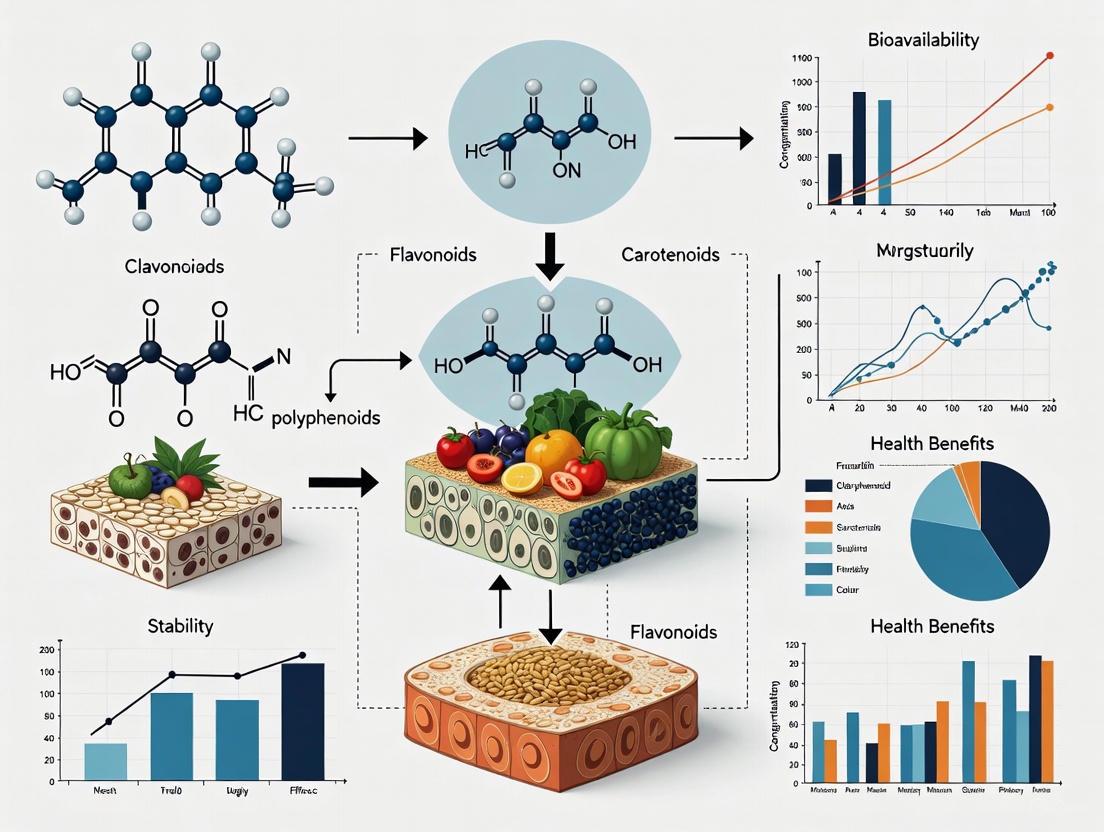
This article provides a comprehensive resource for researchers and drug development professionals on the integration of bioactive compounds into functional food matrices.
Engineering Functional Food Matrices with Bioactive Compounds: From Molecular Design to Clinical Translation
Abstract
This article provides a comprehensive resource for researchers and drug development professionals on the integration of bioactive compounds into functional food matrices. It covers the foundational science of key bioactive classes (polyphenols, carotenoids, omega-3s, probiotics) and their health mechanisms, including antioxidant, anti-inflammatory, and gut-modulating effects. The scope extends to advanced extraction, isolation, and characterization techniques, alongside innovative encapsulation and food matrix engineering strategies to enhance stability and bioavailability. It further addresses critical challenges in optimization, scaling, and regulatory compliance, and details robust validation methodologies from in vitro models to clinical trials. By synthesizing current research and technological advances, this review aims to bridge the gap between food science and pharmaceutical development for creating efficacious, evidence-based functional foods.
Bioactive Compounds Unveiled: Sources, Classifications, and Mechanisms of Action
Bioactive compounds (BCs) are natural or synthetic substances with the capacity to interact with one or more components of living tissues, exerting a wide range of beneficial effects that extend beyond basic nutrition [1]. While not considered essential nutrients like vitamins or minerals, these compounds exert regulatory effects on physiological processes and contribute significantly to improved health outcomes [2]. The concept of food has fundamentally evolved from simply providing energy and basic nutrients to serving as a proactive factor in promoting health and preventing chronic diseases, positioning bioactive compounds at the forefront of functional food development and nutritional therapeutics [2].
The growing scientific interest in bioactive compounds is driven by converging trends: consumer demand for "clean label" products containing natural ingredients, public health initiatives focused on preventive nutrition, and substantial evidence supporting their therapeutic potential against chronic diseases [1] [2] [3]. This paradigm shift has transformed how researchers, food scientists, and drug development professionals approach the isolation, characterization, and application of these compounds in functional food matrices and therapeutic formulations.
Bioactive compounds in functional foods constitute a broad and chemically diverse group of natural substances derived from plant, animal, and microbial sources. Table 1 provides a comprehensive overview of major bioactive compound classes, their natural sources, and key health benefits.
Table 1: Major Classes of Bioactive Compounds, Sources, and Health Benefits
| Compound Class | Examples | Major Food Sources | Key Health Benefits |
|---|---|---|---|
| Polyphenols | Flavonoids, Phenolic Acids, Lignans, Stilbenes | Berries, apples, onions, green tea, coffee, whole grains, flaxseeds, red wine | Antioxidant, anti-inflammatory, cardiovascular protection, neuroprotection [4] |
| Carotenoids | Beta-carotene, Lutein | Carrots, sweet potatoes, spinach, mangoes, kale, corn | Provitamin A activity, vision support, immune function, skin health [4] |
| Bioactive Peptides | Lactoferrin, Casein-derived peptides | Dairy products, meat, fish | Antihypertensive, antimicrobial, immunomodulatory, mineral-binding [2] |
| Organosulfur Compounds | Allicin, Glucosinolates | Garlic, onions, cruciferous vegetables | Antioxidant, anti-inflammatory, detoxification support [2] |
| Dietary Fibers | Resistant starch, Insoluble fiber | Whole grains, green banana, pineapple, legumes | Gut health promotion, microbiota modulation, bowel regularity [5] |
Agro-food waste has emerged as a particularly valuable and sustainable source of bioactive compounds. Recent studies reveal that numerous food wastes, particularly fruit and vegetable byproducts, contain high concentrations of valuable compounds that can be extracted and reintroduced into the food chain [1]. The transition to a circular economy model emphasizes the valorization of these waste streams, transforming them from environmental challenges into valuable resources for functional food development [1].
Analytical Framework: Isolation and Characterization Protocols
Extraction Methodologies
The initial critical step in bioactive compound analysis is extraction, which must be carefully optimized to preserve compound integrity while maximizing yield. The selection of solvent system largely depends on the specific nature of the bioactive compound being targeted [6].
Protocol 3.1.1: Conventional Solvent Extraction
- Sample Preparation: Pre-wash plant materials, freeze-dry, and grind to obtain a homogeneous sample [6].
- Solvent Selection: For hydrophilic compounds, use polar solvents (methanol, ethanol, ethyl-acetate). For lipophilic compounds, use dichloromethane or dichloromethane/methanol (1:1 ratio) [6].
- Extraction Technique:
- Solvent Removal: Concentrate extracts under reduced pressure using rotary evaporation.
Protocol 3.1.2: Advanced Green Extraction Technologies
- Microwave-Assisted Extraction (MAE): Combine plant material with solvent in specialized microwave vessels. Apply controlled microwave energy (typically 500-1000W) with temperature monitoring [1] [2].
- Ultrasound-Assisted Extraction (UAE): Suspend sample in appropriate solvent. Apply ultrasonic waves (20-40 kHz) for 15-60 minutes with temperature control [1] [2].
- Supercritical Fluid Extraction (SFE): Utilize CO₂ as supercritical fluid. Set parameters: pressure (150-450 bar), temperature (40-80°C), and modifier concentration (0-20% ethanol) [6] [1].
Separation and Characterization Techniques
Following extraction, sophisticated chromatographic and spectroscopic methods are employed for separation and identification of target compounds.
Protocol 3.2.1: Thin-Layer Chromatography (TLC) and Bioautography
- TLC Plate Preparation: Use silica gel GF254 plates (0.25 mm thickness for analytical, 1 mm for preparative) [6].
- Sample Application: Apply test solutions as discrete spots 1.5 cm from bottom edge.
- Chromatographic Development: Develop in appropriate solvent system in saturated chamber until solvent front reaches 0.5-1 cm from top.
- Visualization: Examine under UV light (254 nm and 365 nm) and spray with specific detection reagents [6].
- Bioautography (for antimicrobial screening):
- Direct Bioautography: Apply microbial suspension directly to developed TLC plate and incubate [6].
- Agar Overlay: Apply seeded agar medium directly onto TLC plate, incubate, and visualize inhibition zones [6].
- Inhibition Zone Analysis: Scrape active zones from preparative TLC for further purification.
Protocol 3.2.2: High-Performance Liquid Chromatography (HPLC/UPLC) Analysis
- Instrument Setup: Utilize C18 reverse-phase column (e.g., 2.1 × 100 mm, 1.7 μm for UPLC). Mobile phase: gradient of water (0.1% formic acid) and acetonitrile/methanol [7].
- Detection: Employ diode array detector (DAD) scanning 200-600 nm and mass spectrometric detection [7].
- Quantification: Use external standard method with calibration curves of reference compounds [7].
Protocol 3.2.3: Mass Spectrometric Characterization
- UPLC-QTOF-MS Analysis:
- Data Processing: Use software (e.g., UNIFI, Waters) for compound identification by comparing exact mass, isotopic pattern, and fragmentation spectra with databases [7].
Diagram 1: Comprehensive workflow for bioactive compound analysis from extraction to application.
The Scientist's Toolkit: Essential Research Reagents and Materials
Successful research on bioactive compounds requires specific reagents, reference standards, and specialized materials. Table 2 details essential research reagent solutions for experimental work in this field.
Table 2: Essential Research Reagents and Materials for Bioactive Compound Research
| Reagent/Material | Specifications | Application/Function |
|---|---|---|
| Chromatography Columns | C18 reverse-phase (2.1 × 100 mm, 1.7 μm) | UPLC separation of complex extracts [7] |
| Reference Standards | ≥95% purity (e.g., quercetin-3-O-α-l-rhamnoside, amentoflavone) | Method validation and compound quantification [7] |
| Mass Spectrometry Solvents | LC-MS grade water, acetonitrile, methanol | Mobile phase preparation for MS compatibility [7] |
| TLC Plates | Silica gel GF254, 0.25 mm (analytical), 1 mm (preparative) | Initial screening and bioautography [6] |
| Cell Culture Media | Mueller-Hinton agar, RPMI-1640 | Antimicrobial and cytotoxicity assays [7] |
| Encapsulation Polymers | Sodium alginate, chitosan, gum Arabic | Nano/microencapsulation for stability and bioavailability [8] |
| Solvents for Extraction | HPLC grade methanol, ethanol, dichloromethane | Compound extraction with minimal interference [6] |
Functionalization Strategies: Enhancing Bioavailability and Stability
A significant challenge in utilizing bioactive compounds is their limited bioavailability, chemical instability, and susceptibility to gastrointestinal degradation. Advanced functionalization strategies have been developed to overcome these limitations.
Nanoencapsulation Protocols
Protocol 5.1.1: Ionic Gelation for Polysaccharide-Based Nanoparticles
- Polymer Solution: Dissolve chitosan (1.0-2.0 mg/mL) in aqueous acetic acid (1% v/v) [8].
- Bioactive Loading: Incorporate bioactive compound (0.1-0.5 mg/mL) into polymer solution under magnetic stirring.
- Cross-linking: Add tripolyphosphate solution (0.5-1.0 mg/mL) dropwise using a syringe pump (flow rate 0.5 mL/min).
- Nanoparticle Formation: Stir for 60 minutes at room temperature to allow nanoparticle formation.
- Purification: Centrifuge at 12,000 × g for 30 minutes and resuspend in buffer [8].
Protocol 5.1.2: Spray Drying Encapsulation
- Wall Material Preparation: Prepare wall material solution (10-20% w/v maltodextrin/gum Arabic blend) [8].
- Core Material Addition: Add bioactive compound to wall material solution (core-to-wall ratio 1:4).
- Homogenization: Homogenize mixture at 10,000 rpm for 5 minutes.
- Spray Drying Parameters: Inlet temperature 160-180°C, outlet temperature 80-90°C, feed flow rate 5 mL/min [8].
- Product Collection: Collect encapsulated powder from cyclone separator and store in desiccator.
Diagram 2: Encapsulation strategies for enhancing bioactive compound performance in food matrices.
Application Notes: Incorporating Bioactive Compounds into Food Matrices
Successfully incorporating bioactive compounds into food products requires careful consideration of matrix compatibility, stability during processing, and maintaining bioactivity throughout shelf life.
Food Matrix Integration Protocol
Protocol 6.1.1: Evaluation of Matrix-Effect Interactions
- Compatibility Screening:
- Test bioactive incorporation in various matrices (dairy, bakery, beverage) at target concentration.
- Monitor for precipitation, phase separation, or color changes.
- Processing Stability:
- Subject fortified products to typical processing conditions (heat, shear, pH changes).
- Sample at intervals for bioactive compound quantification via HPLC.
- Shelf-Life Monitoring:
Functional Validation in Model Systems
Protocol 6.2.1: In Vitro Bioaccessibility Assessment
- Simulated Gastrointestinal Digestion:
- Oral Phase: Incubate with simulated salivary fluid (2 min, pH 6.8).
- Gastric Phase: Add simulated gastric fluid with pepsin (2 h, pH 2.0, 37°C).
- Intestinal Phase: Add simulated intestinal fluid with pancreatin and bile (2 h, pH 7.0, 37°C) [5].
- Bioaccessibility Calculation:
- Centrifuge intestinal digest at 12,000 × g for 60 min.
- Quantify bioactive in supernatant (micellar fraction).
- Calculate bioaccessibility = (Csupernatant/Cinitial) × 100.
Concluding Remarks: Translational Perspectives for Research and Development
The field of bioactive compounds continues to evolve with significant implications for functional food development, nutritional science, and preventive medicine. The successful translation of research findings into practical applications requires interdisciplinary collaboration between food scientists, nutritionists, engineers, and healthcare professionals [2].
Future perspectives in the field include personalized nutrition approaches based on individual metabolic responses, AI-guided formulation to optimize synergistic interactions between bioactive compounds and food matrices, and omics-integrated validation to provide comprehensive understanding of mechanisms of action [2]. Continued advances in green extraction technologies, encapsulation delivery systems, and targeted release mechanisms will further enhance the efficacy and application scope of bioactive compounds in promoting human health and preventing chronic diseases [1] [8] [2].
As research progresses, standardization of analytical methods, clarification of regulatory frameworks, and comprehensive safety assessments will be crucial for building consumer confidence and realizing the full potential of bioactive compounds in the global food and health sectors [1] [4].
Application Note
This document provides a scientific overview of the major classes of bioactive compounds, detailing their natural sources, health benefits, and essential protocols for their isolation and analysis. It is structured to support research on the incorporation of these compounds into functional food matrices.
Bioactive compounds are dietary components that influence physiological or cellular activities in the organisms that consume them, conferring health benefits beyond basic nutrition. Their strategic incorporation into food matrices is a core focus in the development of functional foods aimed at preventing chronic diseases and promoting health. Key challenges in this field include ensuring the stability, bioavailability, and efficacy of these compounds within complex food systems. This note synthesizes current information on five major classes of bioactives—polyphenols, carotenoids, omega-3 fatty acids, probiotics, and prebiotics—to provide a foundational resource for research and development.
The following table summarizes the natural origins and primary documented health benefits of the major bioactive classes, which is critical for target-oriented research and development.
Table 1: Natural Sources and Key Health Benefits of Major Bioactive Compounds
| Bioactive Class | Major Natural Sources | Key Health Benefits | References |
|---|---|---|---|
| Polyphenols | Fruits (berries, apples, grapes), vegetables (spinach, onions, kale), green tea, coffee, whole grains. | Potent antioxidant and anti-inflammatory activities; cardiovascular protection; neuroprotection; potential anticancer properties. | [2] [4] |
| Carotenoids (e.g., β-carotene, lutein, lycopene) | Carrots, sweet potatoes, tomatoes, bell peppers, leafy greens (kale, spinach), corn, egg yolk. | Provitamin A activity (β-carotene); antioxidant properties; support for vision and eye health (lutein); immune function. | [9] [4] |
| Omega-3 Fatty Acids (e.g., ALA, EPA, DHA) | Chia seeds, flax seeds, linseeds, sesame seeds, fish oil, fatty fish. | Support cardiovascular health; anti-inflammatory effects; crucial for brain function and neuroprotection; modulate liver diseases. | [10] |
| Probiotics (e.g., Lactobacillus, Bifidobacterium, S. boulardii) | Fermented foods (yogurt, kefir, cheese); also found in non-dairy fermented foods and as supplements. | Modulate gut microbiota; enhance immune response; improve digestive health; prevent/treat gastrointestinal infections. | [11] [12] |
| Prebiotics (e.g., Inulin, FOS, Resistant Starch) | Root and tuber crops (chicory, cassava, sweet potato, yam), whole grains, legumes. | Selectively stimulate growth of beneficial gut bacteria (e.g., Bifidobacterium, Lactobacillus); production of beneficial SCFAs; improve gut barrier function. | [13] |
Experimental Protocols for Isolation and Analysis
Protocol: Extraction and HPLC Analysis of Carotenoids from Plant Matrices
Objective: To efficiently extract and accurately quantify major carotenoids (e.g., β-carotene, lutein, lycopene) from plant-based food samples.
Principle: Carotenoids are lipophilic pigments. This protocol uses an organic solvent system for extraction, followed by separation and quantification via High-Performance Liquid Chromatography (HPLC) with UV-Vis detection, which is considered the gold standard for carotenoid analysis [9].
Materials and Reagents:
- Samples: Fresh or freeze-dried plant tissue (e.g., carrot, spinach).
- Extraction Solvents: Acetone, Methanol, Hexane (HPLC grade).
- Quenching Agent: Saturated NaCl solution.
- HPLC Mobile Phase: Acetonitrile (ACN), Methanol (MeOH), Methyl tert-butyl ether (MTBE).
- HPLC System: Equipped with a UV-Vis Diode Array Detector (DAD).
- Analytical Column: Reversed-phase C18 or C30 column (e.g., YMC C30, 250 mm x 4.6 mm, 5 μm) [9].
Procedure:
- Sample Preparation: Homogenize the plant sample under dim light to prevent photodegradation. Precisely weigh ~1 g of homogenate.
- Extraction:
- Add 10 mL of acetone:methanol (1:1, v/v) mixture to the sample in a centrifuge tube.
- Vortex vigorously for 2 minutes, then sonicate in a water bath for 15 minutes.
- Centrifuge at 5,000 x g for 10 minutes at 4°C.
- Transfer the supernatant to a separating funnel.
- Repeat the extraction until the pellet becomes colorless.
- Partitioning:
- Add an equal volume of hexane and 10 mL of saturated NaCl solution to the combined supernatants in the separating funnel.
- Gently shake and allow phases to separate. Collect the upper organic layer containing the carotenoids.
- Evaporate the organic phase to dryness under a stream of nitrogen gas.
- HPLC Analysis:
- Reconstitution: Redissolve the dry extract in 1 mL of the HPLC mobile phase, filter through a 0.22 μm PTFE syringe filter, and transfer to an HPLC vial.
- Chromatographic Conditions:
- Mobile Phase: A: ACN/MeOH (90:10, v/v), B: MTBE.
- Gradient: 0-5 min: 0% B; 5-40 min: 0-100% B; 40-45 min: 100% B.
- Flow Rate: 1.0 mL/min.
- Column Temperature: 25°C.
- Injection Volume: 20 μL.
- Detection: Monitor absorbance at 450 nm.
- Identification and Quantification: Identify carotenoids by comparing retention times and spectral data with authentic standards. Quantify using external calibration curves.
Protocol: Viability Assessment of Probiotics in a Food Matrix
Objective: To determine the survival and viability of probiotic strains incorporated into a functional food product (e.g., yogurt or a plant-based beverage) over time and under simulated gastrointestinal conditions.
Principle: Probiotic efficacy requires a sufficient number of viable cells to reach the intestines. This protocol involves plating serial dilutions of the sample on selective media to count colony-forming units (CFUs), the standard method for assessing viability [11].
Materials and Reagents:
- Samples: Probiotic-fortified food product.
- Growth Media: de Man, Rogosa and Sharpe (MRS) agar for lactobacilli; MRS agar supplemented with 0.05% L-cysteine for bifidobacteria.
- Diluent: Maximum Recovery Diluent (MRD) or sterile Peptone Water.
- Simulated Gastric Juice (SGJ): 0.3% (w/v) pepsin in sterile saline, pH adjusted to 2.0-3.0 with HCl.
- Simulated Intestinal Juice (SIJ): 0.1% (w/v) pancreatin in sterile saline, pH adjusted to 7.0-7.4 with NaHCO₃.
- Equipment: Anaerobic jar system, incubator, water bath, colony counter.
Procedure:
- Sample Homogenization: Aseptically weigh 10 g of the probiotic food product into 90 mL of sterile diluent and homogenize in a stomacher or by vortexing.
- Viability in Product (at time T):
- Prepare serial ten-fold dilutions of the homogenate.
- Spread plate 100 μL of appropriate dilutions (e.g., 10⁻⁶ to 10⁻⁸) onto duplicate plates of the selective agar.
- Incubate plates anaerobically at 37°C for 48-72 hours.
- Count colonies and calculate CFU/g of the original product.
- In Vitro Gastrointestinal Stress Tolerance:
- Gastric Phase: Mix 1 mL of the initial homogenate with 9 mL of pre-warmed SGJ. Incubate at 37°C in a shaking water bath (100 rpm) for 90 minutes.
- Intestinal Phase: Adjust the pH of the gastric digestate to 7.0 using sterile 1M NaHCO₃. Add an equal volume of pre-warmed SIJ and incubate for a further 120-180 minutes under the same conditions.
- Viability Assessment: After the intestinal phase, perform serial dilution and plate counting as in Step 2 to determine the survival rate.
- Data Analysis: Calculate the log reduction in viable count using the formula: Log (N₀/N), where N₀ is the initial count and N is the count after stress.
Visualization of Workflows and Mechanisms
Carotenoid Analysis Workflow
The following diagram illustrates the key steps involved in the extraction and analysis of carotenoids from a food matrix, as detailed in the protocol above.
Gut Microbiota Modulation by Pre/Probiotics
This diagram outlines the conceptual pathway through which prebiotics and probiotics exert their beneficial effects on gut health.
The Scientist's Toolkit: Research Reagent Solutions
Table 2: Essential Reagents and Materials for Bioactive Compound Research
| Item | Function/Application | Example/Note |
|---|---|---|
| C30 HPLC Column | High-resolution separation of carotenoid isomers and similar compounds. | Superior to C18 for separating geometric isomers [9]. |
| MRS Agar | Selective cultivation and enumeration of lactic acid bacteria and bifidobacteria. | Supplement with L-cysteine for improved growth of Bifidobacterium [11]. |
| Simulated Gastrointestinal Fluids | In vitro assessment of probiotic survival and bioactive compound bioavailability. | Contains pepsin (gastric) and pancreatin (intestinal) enzymes [11]. |
| Green Extraction Solvents | Sustainable extraction of bioactive compounds (e.g., polyphenols, carotenoids). | Ethyl acetate as a potential alternative to MTBE and ACN [2] [9]. |
| Encapsulation Materials (e.g., chitosan, maltodextrin) | Microencapsulation to enhance stability and bioavailability of sensitive bioactives like β-carotene and probiotics. | Protects against oxidation and gastrointestinal degradation [14] [15] [10]. |
The incorporation of bioactive compounds into food matrices represents a frontier in nutritional science and preventive medicine. These compounds, which include polyphenols, anthocyanins, and dietary fibers, exert significant health benefits primarily through three interconnected molecular pathways: antioxidant activities, anti-inflammatory effects, and modulation of the gut microbiota. Understanding these mechanisms provides a scientific foundation for developing functional foods with targeted health benefits.
Bioactive compounds from food by-products, such as grape pomace, olive leaves, and fruit peels, are enriched in polyphenols, dietary fibers, vitamins, and polyunsaturated fatty acids that would otherwise be wasted [16]. These components function synergistically to mitigate oxidative stress and inflammation, which are fundamental processes in the pathogenesis of numerous chronic diseases. The molecular interplay between these pathways creates a network of protection that maintains cellular homeostasis and promotes systemic health [16] [17].
Molecular Mechanisms of Action
Antioxidant Signaling Pathways
Bioactive compounds combat oxidative stress through direct free radical scavenging and by activating the body's endogenous antioxidant defense system, primarily mediated by the Nrf2 pathway.
Nrf2-Keap1-ARE Activation: Under basal conditions, Nrf2 is sequestered in the cytoplasm by its inhibitor, Keap1. Reactive oxygen species (ROS) or bioactive compounds (such as falcarindiol from carrots) facilitate the dissociation of Keap1 from Nrf2 [16] [18]. This allows Nrf2 to translocate to the nucleus, where it binds to the Antioxidant Response Element (ARE), initiating the transcription of antioxidant enzymes including superoxide dismutase (SOD), catalase (CAT), glutathione peroxidase (GPX), and heme oxygenase-1 (HO-1) [16] [19]. This pathway is a crucial mechanism for cellular defense against oxidative damage.
Direct ROS Scavenging: Compounds like anthocyanins, vitamin C, and vitamin E directly neutralize reactive oxygen and nitrogen species through electron transfer, thereby preventing lipid peroxidation, protein damage, and DNA strand breaks [19] [17] [20]. The malondialdehyde (MDA) level is a key marker of lipid peroxidation and oxidative damage.
The following diagram illustrates the Nrf2 antioxidant signaling pathway:
Table 1: Key Antioxidant Enzymes and Their Functions
| Enzyme | Function | Inducing Bioactive Compounds |
|---|---|---|
| Superoxide Dismutase (SOD) | Catalyzes the dismutation of superoxide radical (O₂•⁻) into oxygen and hydrogen peroxide [16] | Grape pomace polyphenols, anthocyanins [16] [20] |
| Catalase (CAT) | Converts hydrogen peroxide (H₂O₂) into water and oxygen, preventing hydroxyl radical formation via Fenton reaction [16] [19] | Flavonoids, resveratrol [16] |
| Glutathione Peroxidase (GPX) | Reduces lipid hydroperoxides and hydrogen peroxide to their corresponding alcohols/water, using glutathione [16] | Quercetin, ferulic acid [16] |
| Heme Oxygenase-1 (HO-1) | Catalyzes heme degradation, producing antioxidants biliverdin and bilirubin [18] | Falcarinol, sulforaphane [18] |
Anti-inflammatory Signaling Pathways
Bioactive compounds target central inflammatory signaling hubs, predominantly the NF-kβ pathway, to reduce the expression of pro-inflammatory mediators.
NF-kβ Pathway Inhibition: Inactive NF-kβ is localized in the cytoplasm bound to its inhibitor, IκB. Pro-inflammatory stimuli trigger IκB phosphorylation and degradation, releasing NF-kβ. The free NF-kβ translocates to the nucleus and promotes the transcription of genes encoding pro-inflammatory cytokines (IL-1β, IL-6, TNF-α), chemokines (IL-8), and enzymes (COX-2, iNOS) [16] [17]. Bioactive compounds from grape leaves, spices, and herbs can block IκB degradation or NF-kβ nuclear translocation, thereby suppressing this inflammatory cascade [16] [18] [17].
Inflammasome and Pro-inflammatory Enzyme Inhibition: Compounds such as resveratrol and curcumin can inhibit the NLRP3 inflammasome and enzymes like cyclooxygenase-2 (COX-2) and inducible nitric oxide synthase (iNOS), reducing the production of IL-1β, prostaglandins, and nitric oxide [17] [20].
The diagram below illustrates the NF-kβ inflammatory pathway and its inhibition by bioactive compounds:
Table 2: Anti-inflammatory Effects of Bioactive Compounds on Key Mediators
| Inflammatory Mediator | Function | Effect of Bioactive Compounds |
|---|---|---|
| TNF-α | A potent pro-inflammatory cytokine; regulates immune cells, can induce fever and apoptosis [16] | Grape leaf extract reduced levels; anthocyanins downregulate expression [16] [20] |
| IL-6 | Multifunctional cytokine involved in acute phase response and chronic inflammation [16] [21] | Grape pomace and Mediterranean diet significantly reduce IL-6 levels [16] [21] |
| IL-1β | Key pyrogen; central mediator of fever and chronic inflammatory diseases [16] | Grape pomace reduces IL-1β in colitis models [16] |
| COX-2 | Inducible enzyme synthesizing prostaglandins in inflammation and pain [17] | Resveratrol and flavonoids inhibit COX-2 expression and activity [17] |
| C-Reactive Protein (CRP) | Acute-phase protein; systemic marker of inflammation [21] | Mediterranean diet shows prominent reduction in CRP levels [21] |
Gut Microbiota Modulation
The gut microbiota serves as a key metabolic organ that interacts extensively with dietary bioactive compounds. This interaction is bidirectional: the microbiota transforms these compounds into bioactive metabolites, and the compounds, in turn, modulate the microbial ecosystem.
Microbial Metabolism of Bioactives: Many polyphenols and dietary fibers are not fully absorbed in the small intestine and reach the colon, where gut bacteria (e.g., Bifidobacterium, Lactobacillus) metabolize them. This process releases absorbable metabolites (e.g., simple phenolics) and generates short-chain fatty acids (SCFAs) like acetate, propionate, and butyrate from fermented fibers [16] [22] [23].
Microbiota-Mediated Health Effects: SCFAs are not merely waste products; they exert profound health benefits. Butyrate serves as the primary energy source for colonocytes, enhances gut barrier integrity, and possesses anti-inflammatory properties, partly by inhibiting histone deacetylases (HDACs) [22] [20]. Furthermore, a balanced microbiota prevents the overgrowth of pathogenic bacteria, reduces endotoxemia (e.g., by decreasing LPS), and supports immune function [16] [22].
The following diagram summarizes the interaction between bioactive compounds and the gut microbiota:
Table 3: Impact of Bioactive Compounds on Gut Microbiota Composition and Activity
| Bioactive Compound/Food | Microbiota Modulation | Resulting Metabolic Output/Effect |
|---|---|---|
| Grape Pomace (Polyphenols & Fiber) | Increases Bifidobacterium, Faecalibacterium, Prevotella; Reduces Escherichia coli and Actinobacteria [16] | Increased SCFA production; Expansion of beneficial bacteria; Reduction in pathogen biofilms [16] |
| Wholemeal Rye Bread (Fiber) | Enriches Lactobacillus (up to 99%) and Bifidobacterium (up to 31%) [23] | Significant increase in SCFAs; Decrease in proteolytic activity (ammonium ions) [23] |
| Anthocyanins | Modulated by microbiota; metabolism enhances bioactivity [20] | Microbial metabolites of anthocyanins contribute to antioxidant and anti-inflammatory effects [20] |
| Plant Sterols (PS-WRB) | Prebiotic effect from fiber; specific metabolism of β-sitosterol to sitostenone [23] | Combines hypocholesterolemic effect of PS with prebiotic benefits of fiber [23] |
Experimental Protocols
Protocol 1: In Vitro Assessment of Pro- and Antioxidant Capacity in Food Digesta
This protocol, adapted from [19], evaluates both the antioxidant and pro-oxidant potential of food components and matrices after simulated gastrointestinal digestion, providing a physiologically relevant assessment.
1. Principle: Food items undergo simulated gastrointestinal digestion using the INFOGEST model. The resulting digesta is analyzed using a combination of assays to measure antioxidant capacity (via electron and hydrogen atom transfer mechanisms) and pro-oxidant potential (via lipid oxidation products) [19].
2. Reagents and Equipment:
- Food Items/Matrices: Test compounds (e.g., vitamins, polyphenols) and complex foods (e.g., sausage, white chocolate, fruit juices) [19].
- Digestive Enzymes: Pepsin, pancreatin, porcine bile extract [19].
- Antioxidant Assay Reagents: FRAP (Ferric Reducing Antioxidant Power), DPPH (1,1-Diphenyl-2-picrylhydrazyl), ABTS (2,2'-Azino-bis(3-ethylbenzothiazoline-6-sulfonic acid)) reagents [19] [20].
- Pro-oxidant Assay Reagents: Reagents for measuring malondialdehyde (MDA) and peroxides (e.g., thiobarbituric acid for MDA) [19].
- Equipment: Water bath or incubator (37°C), centrifuge, spectrophotometer or plate reader.
3. Procedure: A. Simulated Gastrointestinal Digestion (INFOGEST model): i. Oral Phase: Mix the food sample with simulated salivary fluid (SSF) and incubate for 2 minutes. ii. Gastric Phase: Adjust the pH to 3.0, add simulated gastric fluid (SGF) containing pepsin, and incubate for 2 hours at 37°C with constant agitation. iii. Intestinal Phase: Adjust the pH to 7.0, add simulated intestinal fluid (SIF) containing pancreatin and bile salts, and incubate for a further 2 hours at 37°C with agitation. iv. Termination & Collection: Stop the reaction (e.g., by cooling on ice). Centrifuge the digesta (e.g., 10,000 × g, 10 minutes) and collect the supernatant for analysis [19].
B. Antioxidant Capacity Measurements: i. FRAP Assay: Mix the digested supernatant with the FRAP reagent (acetate buffer, TPTZ, FeCl₃) and incubate. Measure the absorbance at 593 nm. Results are expressed as mg/L Vitamin C equivalents [19] [20]. ii. DPPH/ABTS Radical Scavenging Assay: Mix the supernatant with the DPPH or ABTS radical solution. After incubation, measure the decrease in absorbance at 517 nm (DPPH) or 734 nm (ABTS). Calculate the percentage of radical scavenging activity [19] [20].
C. Pro-oxidant Potential Measurements: i. Malondialdehyde (MDA) Assay: React the digested supernatant with thiobarbituric acid (TBA). Heat the mixture and measure the pink chromogen formed at 532-535 nm. Calculate the MDA concentration using a standard curve [19]. ii. Peroxide Value: Determine the peroxide content, often via iodometric titration or other colorimetric methods, to assess primary lipid oxidation products [19].
4. Data Analysis:
- Calculate the mean and standard deviation for all measurements.
- Develop an anti-pro-oxidant score by combining the results from all five assays (FRAP, DPPH, ABTS, MDA, Peroxide) to provide a holistic view of the oxidative properties of the food digesta [19].
- Correlate the results from different assays; antioxidant assays often correlate well with each other [19].
Protocol 2: In Vivo Evaluation of Anti-inflammatory and Gut Microbiota Modulating Effects in Rodent Models
This protocol describes a method to investigate the systemic effects of bioactive compounds or enriched food matrices in a live animal model, focusing on inflammation and gut microbiota changes.
1. Principle: Rodents (e.g., mice) are fed a specific diet supplemented with the test bioactive compound or extract. Inflammatory status is assessed through tissue analysis and biomarker measurement, while gut microbiota composition is analyzed from fecal samples via 16S rRNA sequencing [16] [20].
2. Reagents and Equipment:
- Animals: Specific pathogen-free (SPF) mice/rats (e.g., C57BL/6 mice).
- Diets: Control diet and experimental diet supplemented with the test compound (e.g., grape pomace, anthocyanin extract).
- Inducing Agent (if modeling disease): Lipopolysaccharide (LPS) for sepsis, dextran sodium sulfate (DSS) for colitis [16] [18].
- ELISA Kits: For cytokines (TNF-α, IL-6, IL-1β, IL-10).
- RNA Extraction & qPCR Kits: For gene expression analysis of Nrf2, NF-kβ target genes, etc.
- Equipment for Fecal Collection: Sterile tubes.
- 16S rRNA Sequencing Service/Platform.
3. Procedure: A. Animal Grouping and Dosing: i. Acclimate animals for 1 week. ii. Randomly assign them to groups (e.g., Control, Model/Disease, Treatment). iii. Administer the test compound via oral gavage or mixed into the diet for a predetermined period (e.g., 3-8 weeks). The dose should be physiologically relevant [16] [18].
B. Sample Collection: i. Fecal Samples: Collect fresh fecal pellets at baseline and at the end of the intervention. Immediately freeze in sterile tubes at -80°C for microbiota analysis. ii. Blood Serum/Plasma: At sacrifice, collect blood via cardiac puncture. Separate serum/plasma by centrifugation and store at -80°C for ELISA. iii. Tissue Samples: Collect target tissues (e.g., colon, liver, adipose). Snap-freeze a portion in liquid N₂ for molecular analysis and preserve another portion in formalin for histology.
C. Analysis of Inflammatory Markers: i. Cytokine Measurement: Use commercial ELISA kits to quantify pro-inflammatory (TNF-α, IL-6, IL-1β) and anti-inflammatory (IL-10) cytokines in serum or tissue homogenates according to the manufacturer's instructions [16] [21]. ii. Gene Expression Analysis (qPCR): Extract RNA from tissues, synthesize cDNA, and perform qPCR for genes of interest (e.g., iNOS, COX-2, TNF-α, IL-6, Nrf2, HO-1) [16] [20].
D. Analysis of Gut Microbiota: i. DNA Extraction and 16S rRNA Sequencing: Extract microbial DNA from fecal samples. Amplify the V3-V4 hypervariable region of the 16S rRNA gene and perform sequencing on an Illumina platform [16] [23]. ii. Bioinformatic Analysis: Process sequences to identify Operational Taxonomic Units (OTUs) and perform statistical analyses (alpha-diversity, beta-diversity) to determine differences in microbial community structure between groups [23]. iii. SCFA Measurement (Optional): Analyze SCFA content (acetate, propionate, butyrate) in fecal or cecal content using gas chromatography (GC) [23].
4. Data Analysis:
- Compare cytokine levels and gene expression between groups using appropriate statistical tests (e.g., t-test, ANOVA).
- For microbiota data, use PERMANOVA to test for significant differences in community composition and LEfSe to identify specific taxa that are enriched in different groups [23].
The Scientist's Toolkit: Key Research Reagent Solutions
Table 4: Essential Reagents and Kits for Investigating Bioactive Compound Pathways
| Reagent/Kits | Function/Application | Example Use in Protocols |
|---|---|---|
| INFOGEST Digestion Model Components (Pepsin, Pancreatin, Bile Salts) | Standardized simulated gastrointestinal digestion for food matrices [19] | Protocol 1: In vitro digestion of food items to study bioaccessibility and digesta reactivity [19] |
| Antioxidant Capacity Assay Kits (FRAP, DPPH, ABTS) | Quantify the electron-donating and radical-scavenging capacity of food digesta or extracts [19] [20] | Protocol 1: Measure the antioxidant potential remaining after digestion [19] |
| Lipid Oxidation Assay Kits (Malondialdehyde/MDA Assay) | Measure the end-products of lipid peroxidation as a marker of pro-oxidant activity [19] | Protocol 1: Assess the potential of food digesta to induce oxidative damage [19] |
| Enzyme-Linked Immunosorbent Assay (ELISA) Kits for Cytokines (TNF-α, IL-6, IL-1β, IL-10) | Precisely quantify protein levels of key inflammatory cytokines in serum, plasma, or tissue culture supernatants [16] [21] | Protocol 2: Evaluate the systemic anti-inflammatory effect of a treatment in vivo [16] |
| 16S rRNA Gene Sequencing Kits & Services | Profile the composition and relative abundance of bacterial taxa in complex communities (e.g., gut microbiota) [16] [23] | Protocol 2: Analyze the impact of a bioactive compound on the gut microbiota structure [23] |
| qPCR Reagents & Primers (for Nrf2, NF-kβ target genes, inflammatory markers) | Quantify the expression levels of genes involved in antioxidant and inflammatory pathways [16] [20] | Protocol 2: Investigate the molecular mechanisms of action in tissue samples [16] |
Application Notes
This document provides a structured overview of bioactive compounds, detailing their health benefits across key disease areas, their mechanisms of action, and standardized experimental protocols for research. This information is intended to guide scientists in the incorporation and evaluation of bioactives within functional food matrices.
Bioactive compounds, including polyphenols, alkaloids, and carotenoids, offer a multi-targeted approach to preventing and managing chronic diseases. Their mechanisms often involve modulating oxidative stress, inflammation, and key cellular signaling pathways. The following tables summarize the quantitative evidence and primary mechanisms for cardiovascular, metabolic, and neuroprotective applications.
Table 1: Bioactive Compounds in Cardiovascular Disease (CVD) Prevention
| Bioactive Compound | Primary Sources | Key Effects & Mechanisms | Quantitative Outcomes |
|---|---|---|---|
| Active Peptides | Legumes (e.g., beans, lentils) | Antihypertensive (ACE inhibition), anticoagulant, lipid-lowering [24] | Significant reduction in systolic and diastolic blood pressure in clinical trials [24] |
| Flavonoids | Fruits, vegetables, tea, cocoa | Antioxidant, anti-inflammatory, improves endothelial function, modulates LDL oxidation [25] | Epidemiological studies link high intake to a reduced risk of CVD mortality [25] |
| Saponins & Isoflavones | Legumes (e.g., soy) | Lipid regulation, enhances endothelial function, modulates TLR4/NF-κB signaling [24] | Clinical studies show reductions in total and LDL cholesterol [24] |
| GABA & Monacolin K | Fermented foods (e.g., red yeast rice) | Antihypertensive, lipid-lowering (statin-like effect) [26] | Fermentation can enhance the yield of these cardioprotective metabolites [26] |
Table 2: Bioactive Compounds in Metabolic Disease Management
| Bioactive Compound | Primary Sources | Key Effects & Mechanisms | Quantitative Outcomes |
|---|---|---|---|
| Berberine | Various plants (e.g., goldenseal) | AMPK activation; inhibits adipogenesis (PPARγ, C/EBPα); improves insulin sensitivity [27] | Meta-analysis: Significantly lowers triglycerides, fasting glucose, waist circumference [28] |
| EGCG (Epigallocatechin-3-gallate) | Green tea | Suppresses adipogenesis; stimulates thermogenesis (UCP1 upregulation); inhibits lipogenic enzymes [27] | Clinical data: 4-5% reduction in body fat [27] |
| Resveratrol | Grapes, berries | Activates SIRT1; inhibits PPARγ; enhances insulin sensitivity [27] | Shows promise in managing diabetes and metabolic syndrome [29] |
| Fucoxanthin | Brown seaweed | Stimulates thermogenesis (UCP1); promotes fatty acid oxidation [27] | Preclinical studies show significant reduction in adipose tissue weight [27] |
Table 3: Bioactive Compounds in Neuroprotection
| Bioactive Compound | Primary Sources | Key Effects & Mechanisms | Quantitative Outcomes |
|---|---|---|---|
| Curcumin | Turmeric | Antioxidant, anti-inflammatory; anti-amyloidogenic; modulates PI3K/Akt and Nrf2 pathways [30] | Preclinical models show mitigation of neuronal damage and improved cognitive function [30] |
| Flavonoids | Fruits, vegetables, medicinal plants | Acetylcholinesterase (AChE) inhibition; antioxidant; modulates MAPK and NF-κB pathways [31] | In vitro and in silico studies confirm AChE inhibition, relevant for Alzheimer's disease [31] |
| Urolithin A | Gut metabolite of ellagitannins | Activates AMPK/CREB/BDNF pathway; neurotrophic and antidepressant-like effects [31] | In vivo studies show mitigation of stress-induced neuronal damage and neuroinflammation [31] |
| Ginsenosides | Ginseng | Mitochondrial protection; anti-apoptotic; modulates NF-κB and Nrf2/ARE pathways [30] | Preclinical evidence demonstrates broad-spectrum neuroprotective properties [30] |
Experimental Protocols
Protocol 1: In Vitro Assessment of Anti-Adipogenic Activity
This protocol is used to evaluate the potential of bioactive compounds to inhibit the formation of new fat cells, a key mechanism in managing obesity [27].
Materials:
- 3T3-L1 mouse preadipocyte cell line
- Standard adipogenic differentiation cocktail: Insulin, dexamethasone, 3-isobutyl-1-methylxanthine (IBMX)
- Test compound (e.g., purified bioactive or food extract)
- Oil Red O stain for lipid droplet visualization
- Lysis buffer (e.g., isopropanol) for dye extraction
- MTT reagent for cytotoxicity assessment
Procedure:
- Cell Culture & Differentiation: Maintain 3T3-L1 preadipocytes in growth media until confluent. Induce differentiation (Day 0) by replacing media with differentiation cocktail. After 48-72 hours, replace with media containing only insulin for the remainder of the experiment [29].
- Compound Treatment: Add the test compound at various non-cytotoxic concentrations (determined by MTT assay) at the onset of differentiation (Day 0).
- Staining & Quantification: On Day 7-10 post-differentiation, wash cells and fix with formalin. Stain intracellular lipid droplets with Oil Red O solution. Extract the stain with isopropanol and measure absorbance at 510-520 nm to quantify lipid accumulation relative to untreated differentiated controls.
- Western Blot Analysis: Harvest cells and analyze lysates via Western blot for key adipogenic markers (e.g., PPARγ, C/EBPα, FABP4) to confirm mechanistic action [29].
Protocol 2: Clinical Assessment of Muscle Damage and Inflammation Recovery
This protocol outlines a method for evaluating the efficacy of bioactive compounds in reducing exercise-induced skeletal muscle damage and inflammation in human subjects [32].
Materials:
- Standardized supplement: e.g., oat avenanthramides (AVA) or extra virgin olive oil oleocanthal (OCT).
- Venous blood collection kits
- ELISA kits for biomarkers: Creatine Kinase (CK), Interleukin-6 (IL-6), Granulocyte Colony-Stimulating Factor (G-CSF)
- Flow cytometer for Neutrophil Respiratory Burst (NRB) analysis
- Pain rating scale (e.g., Visual Analogue Scale)
Procedure:
- Study Design: Employ a randomized, double-blind, placebo-controlled crossover design. Include a washout period between trial arms.
- Supplementation & Exercise: Administer the bioactive supplement or placebo daily for a set period (e.g., 1-2 weeks) prior to a standardized eccentric exercise bout (e.g., downhill running).
- Biomarker Sampling: Collect blood samples at baseline (pre-exercise) and at 0, 24, 48, and 72 hours post-exercise.
- Analysis:
- Quantify plasma CK levels as a marker of muscle damage.
- Assess inflammatory markers (IL-6, G-CSF) and anti-inflammatory markers (e.g., IL-1Ra) via ELISA.
- Analyze NRB using flow cytometry as a measure of oxidative stress.
- Record muscle soreness using a pain rating scale at each time point [32].
- Data Interpretation: Compare the time-course and peak levels of all biomarkers and soreness ratings between the bioactive and placebo groups.
Protocol 3: In Vitro Assessment of Acetylcholinesterase (AChE) Inhibition
This protocol is used to screen bioactive compounds, particularly flavonoids, for their potential to improve cholinergic function, which is critical in neurodegenerative diseases like Alzheimer's [31].
Materials:
- Purified Acetylcholinesterase (AChE) enzyme
- Test compound (e.g., flavonoid extract or pure compound)
- Substrate: Acetylthiocholine iodide (ATCI)
- Colorimetric reagent: 5,5'-Dithio-bis-(2-nitrobenzoic acid) (DTNB)
- Positive control: e.g., Galantamine
- Microplate reader
Procedure:
- Reaction Mixture: In a microplate well, combine the test compound at various concentrations with AChE enzyme in a suitable buffer (e.g., Tris-HCl, pH 8.0).
- Incubation: Pre-incubate the mixture for 15 minutes at 37°C.
- Reaction Initiation: Add the substrate (ATCI) and the chromogenic agent (DTNB) to start the reaction.
- Kinetic Measurement: Immediately monitor the formation of the yellow 5-thio-2-nitrobenzoate anion at 412 nm for 10-15 minutes.
- Calculation: Calculate the percentage of enzyme inhibition using the reaction rates. Determine the half-maximal inhibitory concentration (IC50) values by analyzing a range of compound concentrations.
Pathway and Mechanism Visualizations
Bioactive Compound Neuroprotective Pathways
Anti-Obesity Mechanism of Action
Experimental Workflow for Bioactivity Assessment
The Scientist's Toolkit: Research Reagent Solutions
Table 4: Essential Reagents and Kits for Bioactive Compound Research
| Research Tool | Function & Application | Example Use-Case |
|---|---|---|
| 3T3-L1 Pre-adipocyte Cell Line | In vitro model for studying adipocyte differentiation and screening compounds for anti-obesity potential [27] [29]. | Protocol 1: Assessing inhibition of lipid accumulation by berberine or EGCG. |
| Acetylcholinesterase (AChE) Enzyme Kit | Colorimetric assay to measure AChE inhibition, a key target for Alzheimer's disease therapeutics [31]. | Protocol 3: Screening flavonoid-rich extracts for neuroprotective potential. |
| ELISA Kits for Cytokines (e.g., IL-6, IL-1Ra) | Quantify specific protein biomarkers of inflammation in cell culture supernatants or biological fluids [32]. | Protocol 2: Measuring anti-inflammatory effects of avenanthramides post-exercise. |
| Oil Red O Stain | Stains neutral lipids and triglycerides; used to visualize and quantify lipid droplet content in adipocytes [29]. | Protocol 1: Quantifying the extent of anti-adipogenic activity in differentiated 3T3-L1 cells. |
| Creatine Kinase (CK) Assay Kit | Enzymatic assay to measure CK activity in plasma/serum as a reliable marker of muscle damage [32]. | Protocol 2: Evaluating the protective effect of oleocanthal on skeletal muscle integrity. |
The Functional Food Matrix (FM) is defined as the intricate relationship between the nutrient and non-nutrient components in food, including their molecular relationships and structural organization [33]. Moving beyond a simple nutrient-based perspective, the FM concept recognizes that a food's health potential is defined by both its structural complexity and its nutritional composition [34]. This holistic view acknowledges that the physiological effects of a food cannot be predicted solely by analyzing its individual components, as the interactions between these components within the matrix significantly influence nutrient bioavailability, metabolic responses, and ultimately, human health [33] [34].
Contemporary food science has shifted from reductionist approaches toward this integrated FM concept, driven by evidence that identical nutrient compositions embedded in different matrices exert different health effects [34]. For instance, the degree of food processing dramatically alters matrix structure, with studies demonstrating that ultra-processed foods (UPFs) are consistently less satiating and more hyperglycemic than their minimally-processed counterparts, even when nutritional profiles appear similar [34]. Understanding and manipulating the FM therefore presents unprecedented opportunities for designing specialized foods for specific populations and health outcomes [35].
Key Interactions Within the Food Matrix
Food matrices comprise dynamic systems where components interact through various mechanisms. These interactions, which occur at molecular, physical, and structural levels, ultimately govern the functional properties and health impacts of foods [33].
Table 1: Classification and Impact of Major Food Matrix Interactions
| Interaction Type | Components Involved | Technological & Health Impacts |
|---|---|---|
| Binary Interactions | Starch-lipids, proteins-phenols [33] | Reduced starch digestibility; altered protein functionality; modified bioavailability [36] [33] |
| Ternary Interactions | Starch-lipid-protein, fiber-mineral-phytate [33] | Further modulation of starch bioavailability; mineral absorption; controlled release during digestion [33] |
| Quaternary Interactions | Multiple macrocomponents with minor elements [33] | Determines overall glycemic response; sensory properties; shelf stability [33] [34] |
| Matrix-Encapsulant | Wall materials-bioactives-food components [35] [37] | Protection of sensitive compounds; controlled release in gut; masked undesirable flavors [35] [37] |
These interactions explain why the same bioactive compound can yield different health outcomes when delivered in different food systems. For example, polyphenols from fruit incorporated into yogurt may interact with dairy proteins and fats, which can affect both the physicochemical properties of the yogurt and the bioavailability of the polyphenols [36]. Similarly, the formation of complexes between starch and lipids during processing can create resistant starch, reducing the Inherent Glycemic Potential (IGP) [33].
Quantitative Assessment of Matrix Effects
Measuring the Glycemic Impact
The Inherent Glycemic Potential (IGP) is a crucial parameter for assessing how a food matrix intrinsically influences glucose release [33]. Unlike traditional glycemic indices, IGP aims to capture the combined effect of a food's composition, structure, and the interactions between its components.
Table 2: In-Vitro Methods for Assessing Starch Digestibility and Glycemic Potential
| Method | Key Equation | Procedure Overview | Benefits | Limitations |
|---|---|---|---|---|
| Englyst Method [33] | RDS = (G20 - FG) * 0.9SDS = (G120 - G20) * 0.9RS = TS - RDS - SDS |
- Oral: Simulated with mincers.- Gastric: No pepsin.- Intestinal: Pancreatin/AMG at pH 5.2; measures glucose at 20 & 120 min. | Quantifies RDS, SDS, RS types (RS1, RS2, RS3) [33] | No gastric proteolysis; complex procedure [33] |
| Goñi's Method [33] | C = C∞ (1 - e^(-kt))(First-order kinetics model) |
- Oral: Homogenization.- Gastric: Pepsin at pH 1.5.- Intestinal: α-amylase at pH 6.9; aliquots taken every 30 min for 3h. | Simpler than Englyst; provides hydrolysis kinetics [33] | Less differentiation of RS types [33] |
Abbreviations: RDS: Rapidly Digestible Starch; SDS: Slowly Digestible Starch; RS: Resistant Starch; FG: Free Glucose; TS: Total Starch; G20/G120: Glucose at 20/120 minutes; C: Hydrolyzed starch concentration; C∞: Equilibrium concentration; k: Kinetic constant.
Linking Processing Degree to Food Properties
Quantitative studies have established clear relationships between the degree of food processing, matrix structure, and health potential. Analysis of 139 solid foods revealed that, compared to ultra-processed foods (UPFs), minimally-processed foods are significantly less hyperglycemic, more satiating, have higher water activity, shorter shelf life, and require higher energy to break down, indicating a more robust structure [34]. Data mining suggests that a LIM score ≥ 8 per 100 kcal and number of ingredients/additives > 4 are relevant, though not sufficient, quantitative rules for classifying a food as ultra-processed [34].
Experimental Protocols for Food Matrix Research
Objective: To determine the kinetic parameters of starch hydrolysis and classify starch fractions in a food matrix.
Reagents & Equipment:
- Phosphate buffer (0.2 M, pH 6.9)
- Pancreatic α-amylase solution
- Amyloglucosidase (AMG)
- Pepsin solution in HCl-KCl buffer (pH 1.5)
- Tris-Maleate buffer (pH 6.9)
- Water bath with shaking capability
- Centrifuge
- Glucose assay kit (e.g., GOPOD)
Procedure:
- Sample Preparation: Homogenize the food sample to a consistent particle size. Record the initial moisture and total starch content.
- Oral Phase Simulation (Optional): Further homogenize the sample to simulate mastication.
- Gastric Phase: Suspend the sample in the pepsin-HCl solution. Incubate at 40°C for 60 minutes in a shaking water bath to simulate proteolysis.
- Intestinal Phase:
- Neutralize the gastric digest and adjust to pH 6.9 using Tris-Maleate buffer.
- Add a defined concentration of pancreatic α-amylase to initiate hydrolysis.
- Incubate at 37°C with constant shaking.
- Withdraw 1 mL aliquots at 0, 30, 60, 90, 120, and 180 minutes.
- Glucose Measurement:
- Immediately transfer each aliquot to a tube and immerse in a boiling water bath for 5 minutes to inactivate enzymes.
- Centrifuge to obtain a clear supernatant.
- Digest the supernatant with AMG at 60°C to convert hydrolyzed starch to glucose.
- Quantify the glucose content using a standard assay (e.g., GOPOD).
- Data Analysis:
- Calculate the percentage of starch hydrolyzed at each time point.
- Plot hydrolysis percentage (C) versus time (t).
- Fit the data to a first-order kinetic model:
C = C∞ (1 - e^(-kt)), whereC∞is the equilibrium concentration andkis the kinetic constant. - Calculate Rapidly Digestible Starch (RDS), Slowly Digestible Starch (SDS), and Resistant Starch (RS) based on the hydrolysis curves.
Objective: To quantify the mechanical and structural properties of solid foods, which are linked to satiety and digestion kinetics.
Reagents & Equipment:
- Universal Testing Machine (e.g., Instron)
- Compression cell and shear blade
- Software for data acquisition (e.g., Bluehill)
Procedure:
- Sample Preparation: Cut the ready-to-eat food into standardized parallelepipeds (e.g., 1.0 cm width, 2.0 cm thickness). For heterogeneous foods, increase the number of replicates (n=15-20).
- Compression Test (Simulates Molar Action):
- Place the sample on the fixed lower part of the compression cell.
- Set the movable upper part to descend at a constant rate (e.g., 50 mm/min).
- Record the force required to compress the sample until fracture or a defined deformation (e.g., 80%).
- From the force-deformation curve, extract parameters: Maximum Force (F_max), Stress at 20% and 80% compression, and Energy at Break (area under the curve).
- Shear Test (Simulates Incisor Action):
- Use a shear blade attached to the testing machine.
- Apply a shearing force to the sample at a constant speed.
- Record the Maximum Shear Force required to cut through the material.
- Data Interpretation:
- Correlate textural parameters with the degree of processing and sensory data. Minimally-processed foods typically exhibit higher energy at break and complex fracture patterns, while UPFs often have lower maximum stress and a more homogeneous texture [34].
The Scientist's Toolkit: Research Reagent Solutions
Table 3: Essential Reagents and Materials for Food Matrix Research
| Reagent/Material | Function & Application | Research Context |
|---|---|---|
| Pancreatic α-Amylase | Simulates carbohydrate digestion in the small intestine; used in in-vitro digestibility models. | Key enzyme for assessing starch hydrolysis kinetics and calculating IGP [33]. |
| Amyloglucosidase (AMG) | Converts hydrolyzed starch fragments (maltose, dextrins) to glucose for quantification. | Essential for accurate measurement of glucose release in Englyst and Goñi methods [33]. |
| Encapsulation Wall Materials (e.g., Sodium Alginate, Gum Arabic, Chitosan) | Form protective matrices around bioactive compounds to enhance stability and control release. | Used to study and improve the stability of bioactives like polyphenols in fortified foods [8] [37]. |
| Pepsin | Simulates proteolytic digestion in the gastric phase; breaks down food structures and protein-based microcapsules. | Critical for a physiologically relevant in-vitro gastrointestinal model [33]. |
| Specific Probiotic Strains (e.g., Lactobacillus, Bifidobacterium) | Live microorganisms conferring health benefits; used to develop probiotic-fermented foods. | Studied for producing bioactive peptides in dairy matrices and for their viability in fruit-enriched yogurts [36]. |
| Biopolymer Gels (e.g., Whey Protein Isolates, Pectin) | Used as model food matrices or encapsulation materials to study controlled release mechanisms. | Enable research on how matrix properties affect the stability and bioavailability of encapsulated compounds [36] [35]. |
Advanced Applications: Encapsulation and Targeted Delivery
Encapsulation technologies are powerful tools for engineering functional food matrices. They protect sensitive bioactive compounds (e.g., polyphenols, omega-3s, probiotics) from degradation during processing and storage, and can control their release in the gastrointestinal tract [35] [37]. The choice of encapsulation method and wall material is critical and depends on the desired functionality within the final food matrix.
The success of encapsulation is not solely dependent on protecting the bioactive during storage. Once incorporated into a food, the entire product undergoes structural reorganization during digestion, which impacts the release profile and bioavailability of the fortified compound [35]. This highlights the necessity of studying the encapsulated bioactive not in isolation, but within the context of the complete, dynamic food matrix.
From Extraction to Integration: Advanced Techniques for Incorporating Bioactives into Food
The incorporation of bioactive compounds into food matrices represents a frontier in functional food development, with profound implications for human health. The efficacy of such fortification is fundamentally dependent on the initial extraction process, which determines the yield, stability, and bioactivity of the target phytochemicals. Conventional extraction methods often involve high temperatures, prolonged extraction times, and large volumes of organic solvents, which can degrade thermolabile compounds and introduce undesirable residues. In response, modern green extraction technologies—including ultrasound-assisted extraction (UAE), microwave-assisted extraction (MAE), and supercritical fluid extraction (SFE)—have emerged as efficient, sustainable alternatives. These methods, especially when coupled with green solvents, enhance extraction efficiency while aligning with the principles of green chemistry and circular bioeconomy. This document provides detailed application notes and standardized protocols for these techniques, contextualized within a research framework aimed at enriching food matrices with bioactive compounds for enhanced nutritional and therapeutic outcomes [38] [39] [40].
Comparative Performance of Modern Extraction Techniques
The selection of an appropriate extraction method is critical for optimizing the recovery of bioactive compounds from plant materials. The following table summarizes the key operational parameters, advantages, and ideal applications for the three primary modern extraction techniques, based on current research findings.
Table 1: Comparative analysis of modern extraction techniques for bioactive compounds.
| Extraction Technique | Key Operational Parameters | Representative Bioactive Yield (vs. Conventional) | Primary Advantages | Ideal Applications |
|---|---|---|---|---|
| Ultrasound-Assisted Extraction (UAE) | Frequency: 20–100 kHz; Temperature: 20–60°C; Time: 5–30 min [41] [42] | Total Phenols: 243.94 mg GAE/g (vs. 80.43 mg GAE/g in Tamus communis) [41] | Rapid extraction; enhanced yield of phenolics; low thermal degradation [41] [42] | Extracting thermolabile flavonoids and phenolic acids for antioxidant-rich ingredients. |
| Microwave-Assisted Extraction (MAE) | Power: 300–600 W; Time: 10–20 min; Solvent: Water, Ethanol, NADES [43] [44] | Polyphenols: 21.76 mg GAE/g from mandarin peel; high tangeretin & nobiletin yield [44] | Reduced extraction time & solvent use; high selectivity [43] [44] | Efficient recovery of polyphenols and carotenoids from fruit peels and agricultural by-products. |
| Supercritical Fluid Extraction (SFE) | Pressure: 100–400 bar; Temperature: 40–70°C; Co-solvent: Ethanol (1–10%) [45] | Selective isolation of essential oils, antioxidants, and non-polar compounds [45] | Solvent-free (CO₂); high purity extracts; preserves heat-sensitive compounds [45] | Production of high-value, solvent-free extracts for pharmaceuticals and functional foods. |
Detailed Experimental Protocols
Protocol 1: Ultrasound-Assisted Extraction (UAE) of Phenolics fromTamus communisFruits
This protocol is adapted from a study demonstrating superior recovery of phenolic compounds using UAE, resulting in enhanced anti-tyrosinase and anti-inflammatory activities compared to conventional methods [41].
- Objective: To efficiently extract phenolic compounds, particularly flavonoids and phenolic acids, from Tamus communis fruits using ultrasound.
- Research Reagent Solutions:
- Plant Material: Dried and powdered Tamus communis fruits.
- Extraction Solvent: Aqueous ethanol (e.g., 50–80% ethanol in water).
- Equipment: Ultrasonic bath or probe sonicator (frequency range 20–40 kHz), centrifuge, rotary evaporator.
- Procedure:
- Preparation: Weigh 5 g of dried plant powder into an extraction vessel.
- Solvent Addition: Add 100 mL of aqueous ethanol solvent (sample-to-solvent ratio of 1:20).
- Sonication: Subject the mixture to ultrasound irradiation for 15–30 minutes at a controlled temperature (e.g., 40°C). For a probe system, set the amplitude appropriately.
- Separation: Centrifuge the sonicated mixture at 5000 rpm for 10 minutes to separate the solid residue.
- Concentration: Collect the supernatant and concentrate under reduced pressure at ≤40°C using a rotary evaporator.
- Analysis: Reconstitute the dried extract for analysis of total phenols, flavonoids, and antioxidant activity (e.g., DPPH, ABTS assays).
- Notes: The significant increase in tyrosinase inhibition (65.61% for UAE vs. 21.78% for conventional) highlights the technique's ability to preserve bioactivity [41].
Protocol 2: Microwave-Assisted Extraction (MAE) of Polyphenols and Carotenoids from Mandarin Peel
This protocol utilizes a closed-vessel MAE system for the efficient and simultaneous recovery of polyphenols and carotenoids, representing a scalable biorefinery approach [44].
- Objective: To extract polyphenols and carotenoids from mandarin peel using optimized MAE conditions with green solvents.
- Research Reagent Solutions:
- Plant Material: Dried, powdered mandarin peel (Citrus unshiu Marc.).
- Extraction Solvent: Ethanol-water mixture (e.g., 70–80% ethanol).
- Equipment: Closed-vessel microwave extraction system, centrifuge, rotary evaporator.
- Procedure:
- Preparation: Weigh 1 g of mandarin peel powder into the microwave vessel.
- Solvent Addition: Add solvent at a ratio of 1:10 to 1:15 (w/v).
- Microwave Irradiation: Set the microwave power to 300–500 W and irradiate for 10–15 minutes.
- Cooling and Separation: Allow the vessel to cool, then centrifuge the mixture to separate the extract.
- Concentration: Concentrate the supernatant under vacuum.
- Analysis: Analyze for total polyphenols, specific flavonoids (nobiletin, tangeretin), carotenoid content (β-carotene), and antioxidant capacity (DPPH, ABTS) [44].
- Notes: MAE significantly reduces extraction time and energy consumption compared to conventional solvent extraction while achieving high yields of bioactive compounds like nobiletin and β-carotene [44].
Protocol 3: Supercritical Fluid Extraction (SFE) with CO₂ and Co-solvents
This protocol outlines the use of supercritical CO₂ for the solvent-free extraction of non-polar bioactive compounds, with the option to enhance polarity range using ethanol as a co-solvent [45].
- Objective: To extract lipophilic bioactive compounds from plant matrices using supercritical CO₂.
- Research Reagent Solutions:
- Plant Material: Dried, coarsely ground plant matter (e.g., herbs, seeds).
- Solvent: Food-grade carbon dioxide (CO₂).
- Co-solvent: Anhydrous ethanol (typically 1–10% of total solvent volume).
- Equipment: SFE system comprising CO₂ pump, co-solvent pump, extraction vessel, pressure and temperature controllers, and separator.
- Procedure:
- Loading: Pack the extraction vessel tightly with the plant material.
- Pressurization and Heating: Pressurize the system to the desired pressure (e.g., 250–350 bar) and heat to the target temperature (e.g., 40–60°C) to achieve supercritical conditions for CO₂.
- Dynamic Extraction: Pass the supercritical CO₂ through the plant material at a constant flow rate. If using a co-solvent, pump ethanol into the CO₂ stream at the predetermined ratio.
- Collection: The extract-laden solvent passes into a separator where pressure is reduced, causing CO₂ to gasify and leaving the bioactive extract in the collection vessel.
- Analysis: The residue-free extract can be analyzed by GC-MS or HPLC for target compounds.
- Notes: The selectivity of the extraction can be fine-tuned by adjusting pressure and temperature. The addition of a co-solvent like ethanol is crucial for improving the yield of more polar compounds, such as certain polyphenols [45].
Workflow and Pathway Visualizations
Decision Pathway for Extraction Method Selection
The following diagram outlines a logical workflow for selecting the most appropriate modern extraction method based on the physicochemical properties of the target bioactive compound and the research objectives.
Integrated Biorefinery Workflow for Agri-Food Waste Valorization
This diagram illustrates a sequential, multi-step biorefinery approach for the comprehensive valorization of agri-food waste, such as citrus peel, using a combination of modern extraction techniques to recover different classes of bioactives.
The Scientist's Toolkit: Essential Research Reagents and Materials
The successful implementation of modern extraction protocols requires specific reagents and equipment. The following table lists key solutions and their functions.
Table 2: Key research reagent solutions for modern extraction techniques.
| Item Name | Function/Application | Technical Notes |
|---|---|---|
| Natural Deep Eutectic Solvents (NADES) | Green solvents for MAE and UAE, composed of natural primary metabolites (e.g., Choline Chloride:Lactic Acid) [43] [38]. | Offer low toxicity and high biodegradability; can be tailored for selective extraction of specific bioactive classes. |
| Food-Grade Carbon Dioxide (CO₂) | The primary solvent for Supercritical Fluid Extraction (SFE) [45]. | Non-toxic, non-flammable, and easily removed from the final extract, yielding a solvent-free product. |
| Ethanol-Water Mixtures | Versatile, green solvents for UAE and MAE, effective for extracting a wide range of polyphenols and carotenoids [41] [44]. | Concentration is critical; 70-80% ethanol is often optimal for phenolic compounds. |
| Closed-Vessel Microwave System | Equipment for MAE enabling controlled temperature and pressure, preventing solvent loss [44]. | Superior to household microwaves for reproducibility, safety, and efficiency, facilitating method scale-up. |
| Ultrasonic Probe System | Equipment for UAE that delivers high-intensity ultrasound directly into the sample mixture [41] [42]. | Generally more efficient for disrupting tough plant cell walls compared to ultrasonic baths. |
| High-Pressure Pumps & Vessels | Core components of an SFE system designed to contain and handle supercritical CO₂ [45]. | Require specialized design to withstand operational pressures (e.g., 100-400 bar). |
The integration of bioactive compounds into food matrices represents a frontier in the development of functional foods, which provide health benefits beyond basic nutrition [4]. These bioactive compounds—including polyphenols, carotenoids, and alkaloids—exhibit diverse therapeutic effects such as antioxidant, anti-inflammatory, and gut-modulating activities [4]. However, their precise incorporation and efficacy depend on rigorous analytical characterization to ensure stability, bioavailability, and functionality within complex food systems [46]. Hyphenated techniques, which combine separation technologies with spectroscopic detection, have emerged as indispensable tools for this purpose [47] [48]. By exploiting the complementary advantages of chromatography and spectroscopy, these methods provide comprehensive structural information crucial for identifying unknown compounds in complex natural product extracts or fractions [47] [49]. This application note details the operational principles, methodologies, and practical applications of key hyphenated techniques—particularly HPLC-DAD-MS and LC-NMR—within the context of bioactive compound research for functional food development.
Hyphenated Techniques: Principles and Relevance
Core Concepts and Definitions
Hyphenated techniques are developed from the coupling of a separation technique with an online spectroscopic detection technology [47]. The term "hyphenation" was introduced by Hirschfeld to refer to the online combination of a separation technique and one or more spectroscopic detection techniques [47]. This approach synergistically exploits the advantages of both methodologies: chromatography produces pure or nearly pure fractions of chemical components in a mixture, while spectroscopy provides selective information for identification using standards or library spectra [47]. In recent years, hyphenated techniques have received ever-increasing attention as principal means to solve complex analytical problems in natural product research [47].
The power of combining separation technologies with spectroscopic techniques has been demonstrated for both quantitative and qualitative analysis of unknown compounds in complex matrices such as natural product extracts [47]. To obtain structural information leading to the identification of compounds in a crude sample, high-performance separation techniques like liquid chromatography (LC), gas chromatography (GC), or capillary electrophoresis (CE) are linked to spectroscopic detection methods including Fourier-transform infrared (FTIR), photodiode array (PDA) UV-vis absorbance, mass spectrometry (MS), and nuclear magnetic resonance (NMR) spectroscopy [47].
Techniques for Bioactive Compound Analysis
Table 1: Common Hyphenated Techniques in Bioactive Compound Research
| Technique | Separation Method | Detection Method | Key Applications in Food Research |
|---|---|---|---|
| HPLC-DAD-MS | High-Performance Liquid Chromatography | Diode Array Detection & Mass Spectrometry | Simultaneous quantification and identification of phenolic compounds, methylxanthines in beverages [50] |
| LC-NMR | Liquid Chromatography | Nuclear Magnetic Resonance | Structural elucidation of isomeric compounds; identification of unknown metabolites [49] [51] |
| GC-MS | Gas Chromatography | Mass Spectrometry | Analysis of volatile compounds, fatty acids, essential oils [47] |
| LC-FTIR | Liquid Chromatography | Fourier-Transform Infrared Spectroscopy | Functional group identification; structural confirmation [47] |
| CE-MS | Capillary Electrophoresis | Mass Spectrometry | Analysis of polar ionic compounds; chiral separations [47] |
The remarkable improvements in hyphenated analytical methods over the last two decades have significantly broadened their applications in analyzing natural products and functional foods [47]. These techniques find particular utility in pre-isolation analyses of crude extracts, isolation and online detection of natural products, chemotaxonomic studies, chemical fingerprinting, quality control of herbal products, dereplication of natural products, and metabolomic studies [47]. For functional food research, this translates to capabilities for verifying bioactive compound integrity after incorporation into food matrices, monitoring stability during storage, and confirming bioavailability in simulated digestion models [4] [46].
HPLC-DAD-MS Analysis: Protocols and Applications
Operational Principles and Instrumentation
HPLC-DAD-MS combines the separation power of high-performance liquid chromatography with the detection capabilities of diode array detection and mass spectrometry [52]. This hyphenated technique provides complementary data: HPLC separates complex mixtures, DAD offers UV-Vis spectra for preliminary compound classification, and MS provides molecular weight and fragmentation information [47] [52]. The physical connection of HPLC and MS has increased the capability of solving structural problems of complex natural products [47].
A typical HPLC-DAD-MS system consists of an autosampler, HPLC pump, chromatographic column, DAD detector, and mass spectrometer with appropriate ionization source [53] [52]. The remarkable aspect of this hyphenation is the ability to obtain multiple dimensions of information from a single analysis—chromatographic retention time, UV-Vis spectrum, and mass spectrum—which collectively enable comprehensive compound characterization [52].
Experimental Protocol: Analysis of Bioactive Compounds in Plant Extracts
Protocol Title: HPLC-DAD-MS Analysis of Polyphenols and Methylxanthines in Green Tea Extract
Objective: To simultaneously separate, quantify, and identify phenolic compounds and methylxanthines in green tea extracts for quality assessment and functional food formulation.
Materials and Reagents:
- Mobile Phase A: Water with 0.1% formic acid
- Mobile Phase B: Acetonitrile with 0.1% formic acid
- Reference Standards: Gallic acid, catechins (C, EC, EGCG, GCG), methylxanthines (caffeine, theobromine, theophylline)
- Columns: C18 reverse phase column (e.g., Agilent Zorbax Eclipse Plus C18, 4.6 × 150 mm, 5 μm)
- Samples: Green tea extracts, functional beverage formulations
Instrumentation Parameters [53] [50]:
- HPLC System: Agilent 6120 series or equivalent
- Injection Volume: 10 μL
- Flow Rate: 1.0 mL/min
- Column Temperature: 25°C
- Gradient Program: Linear gradient from 10% to 90% B over 28 minutes
- DAD Detection: 200-400 nm range, specific monitoring at 270-280 nm
- MS Conditions: Positive electrospray ionization; mass range: 100-2000 m/z; fragmentor voltage: optimized for each compound class
Procedure:
- Sample Preparation: Accurately weigh 1.0 g of green tea leaves and extract with 10 mL of 70% methanol using ultrasonic bath for 30 minutes. Filter through 0.45 μm membrane filter before injection.
- System Equilibration: Equilibrate the column with initial mobile phase composition (10% B) for at least 15 minutes until stable baseline is achieved.
- Calibration Standards: Prepare reference standard solutions at concentrations of 0.1, 0.5, 1, 5, 10, 25, and 50 μg/mL for each analyte.
- Sample Analysis: Inject samples and standards following the established gradient elution program.
- Data Acquisition: Collect simultaneous DAD (200-400 nm) and MS (full scan and targeted MS/MS) data.
- Data Analysis: Identify compounds by comparing retention times, UV spectra, and mass spectra with standards. Quantify using calibration curves.
Table 2: HPLC-DAD-MS Analytical Characteristics for Green Tea Compounds [50]
| Compound | Retention Time (min) | λmax (nm) | [M+H]+ (m/z) | Characteristic Fragments | LOD (μg/mL) | LOQ (μg/mL) |
|---|---|---|---|---|---|---|
| Gallic acid | 5.2 | 271 | 171 | 125, 153 | 0.02 | 0.07 |
| (+)-Catechin | 12.5 | 279 | 291 | 139, 165 | 0.05 | 0.15 |
| (-)-Epigallocatechin-3-gallate | 18.3 | 275 | 459 | 139, 169, 307 | 0.03 | 0.10 |
| Caffeine | 20.1 | 273 | 195 | 138, 110 | 0.04 | 0.12 |
| Theobromine | 15.7 | 273 | 181 | 138, 123 | 0.06 | 0.18 |
Applications in Functional Food Research: This protocol enables comprehensive profiling of bioactive compounds in plant materials destined for functional food enrichment [50]. The method has been successfully applied to analyze 60 green tea samples from different geographical origins, demonstrating significant compositional variations that impact quality and bioactivity [50]. Such applications are crucial for standardizing raw materials used in functional food production and ensuring consistent efficacy in final products.
LC-NMR Analysis: Protocols and Applications
Operational Principles and Instrumentation
LC-NMR combines the outstanding separation power of liquid chromatography with the superior structural elucidating capability of nuclear magnetic resonance spectroscopy [51]. NMR stands out as a detector for LC by providing maximum structural information about plant-originated extracts, particularly in distinguishing isomeric (same molecular formula) and/or isobaric (same molecular weight) compounds that are challenging for other detection methods [49] [51]. This technique has evolved from an academic curiosity to a robust analytical tool through technical improvements in sensitivity and solvent handling [51].
The fundamental components of an LC-NMR system include the isolation zone (chromatographic column), interface zone, and detection zone (NMR probe) [51]. The HPLC is directly connected to the NMR under a computer-controlled data acquisition system with automated harmonization of operations. A sensitive detector such as UV and/or MS is typically coupled in parallel with a proper splitting ratio to guide NMR measurements [51].
Operational Modes of LC-NMR
LC-NMR experiments can be performed in several operational modes designed to address the inherent sensitivity challenges of NMR detection:
Continuous-Flow Mode: The outlet of the LC detector is connected directly to the NMR probe, and spectra are acquired continuously as compounds elute. This mode maintains separation resolution but suffers from poor sensitivity due to short exposure times in the detection cell [51].
Stop-Flow Mode: The chromatographic flow is stopped when peaks of interest reach the NMR detection cell, allowing extended acquisition times for improved signal-to-noise ratio. This approach provides better sensitivity but requires adequate separation between peaks [51].
Loop-Storage Mode: Eluted peaks are collected in sample storage loops or solid-phase extraction (SPE) cartridges during the initial separation. After completion of the chromatographic run, each stored peak is transferred to the NMR for analysis. This approach, particularly LC-SPE-NMR, allows for efficient use of deuterated solvents and extended measurement times [49] [51].
Experimental Protocol: Structural Elucidation of Unknown Bioactives
Protocol Title: LC-SPE-NMR Analysis of Bioactive Compounds from Functional Food Sources
Objective: To isolate and elucidate structures of unknown bioactive compounds from complex food matrices without preliminary purification.
Materials and Reagents:
- Deuterated Solvents: CD3OD, D2O for NMR analysis
- HPLC Solvents: Methanol, acetonitrile, water (HPLC grade)
- SPE Cartridges: Suitable for trapping target compound classes (e.g., C18 for phenolic compounds)
- Columns: Analytical or capillary LC columns compatible with the sample matrix
Instrumentation Parameters [49] [51]:
- LC System: Standard HPLC system with binary or quaternary pump
- NMR Spectrometer: High-field NMR (≥500 MHz) equipped with cryoprobe or microprobe for enhanced sensitivity
- SPE Interface: Automated fraction collection system capable of trapping multiple peaks
- MS Detector: Coupled in parallel for initial screening and molecular weight determination
Procedure:
- Sample Preparation: Extract the food matrix using appropriate solvents (e.g., methanol, ethanol, or hydroalcoholic mixtures). Concentrate and reconstitute in mobile phase for LC analysis.
- LC Separation: Develop and optimize separation conditions using UV and MS detection. Typical conditions: C18 column, gradient elution with water-acetonitrile or water-methanol, flow rate 0.5-1.0 mL/min.
- Peak Trapping: Based on UV/MS response, direct peaks of interest to SPE cartridges for trapping. Use non-deuterated solvents for the separation to reduce costs.
- Cartridge Drying: After trapping, dry SPE cartridges with nitrogen gas to remove residual solvents.
- Elution to NMR: Elute trapped compounds directly into the NMR flow cell using minimal volume (50-100 μL) of appropriate deuterated solvent.
- NMR Acquisition: Acquire 1D and 2D NMR experiments (¹H, ¹³C, COSY, HSQC, HMBC) as needed for structural elucidation.
- Data Integration: Correlate MS data (molecular weight, fragmentation pattern) with NMR data (structural fragments, connectivity) for complete structure determination.
Applications in Functional Food Research: LC-NMR techniques have been successfully applied to identify various bioactive compounds directly from complex matrices, including anthocyanins in berries, isoflavonoids in legumes, and terpenoids in spices [49] [51]. This approach is particularly valuable for characterizing novel or unexpected compounds that appear during food processing or storage, enabling researchers to understand structural changes that may impact bioactivity.
Integrated Workflows and Complementary Techniques
Synergistic Combination of LC-MS and LC-NMR
In many applications, LC-MS and LC-NMR are used in a complementary fashion rather than as a fully integrated system [49] [54]. LC-MS serves as an initial dereplication step for chemical profiling of complex extracts, with compounds tentatively identified based on molecular weight and fragmentation information [49]. LC-NMR is then employed for detailed structural investigation of compounds presenting original structural features [49]. This synergistic approach maximizes the strengths of each technique while mitigating their individual limitations.
The integration of LC-MS and NMR faces several technical challenges, primarily stemming from the inherently low sensitivity of NMR compared to MS [54]. While MS detection limits are in the femtomole range for analytes with high ionization efficiency, NMR typically requires microgram quantities of material for comprehensive analysis [54]. This sensitivity discrepancy necessitates careful experimental design, often incorporating pre-concentration steps or specialized NMR probes (cryoprobes, microprobes) to enhance detection [54] [51].
Workflow Diagram: Integrated Approach for Bioactive Compound Characterization
Figure 1: Integrated workflow for comprehensive characterization of bioactive compounds using hyphenated techniques.
Research Reagent Solutions
Table 3: Essential Research Reagents and Materials for Hyphenated Techniques
| Category | Specific Items | Function | Application Notes |
|---|---|---|---|
| Chromatography | C18 Reverse Phase Columns | Separation of compound mixtures | Various dimensions (analytical, capillary) for different sample loads [53] [50] |
| Mobile Phase Modifiers (Formic acid, TFA) | Improve peak shape and ionization | Concentration typically 0.05-0.1% in mobile phase [53] [52] | |
| Mass Spectrometry | Reference Mass Compounds | Calibration and mass accuracy | ESI Tuning Mix for positive/negative mode [53] |
| Ionization Sources (ESI, APCI) | Sample ionization for MS detection | ESI preferred for polar compounds; APCI for less polar compounds [47] | |
| NMR Spectroscopy | Deuterated Solvents (CD3OD, D2O) | Lock signal and solvent for NMR | Required for LC-NMR; cost considerations for online vs. offline use [54] [51] |
| NMR Reference Standards (TMS, DSS) | Chemical shift referencing | Added in small quantities for precise chemical shift determination [54] | |
| Sample Preparation | Solid-Phase Extraction (SPE) Cartridges | Pre-concentration and cleanup | Various chemistries (C18, ion exchange) for different compound classes [51] |
| Membrane Filters (0.45 μm, 0.22 μm) | Sample clarification | Remove particulates that could damage instrumentation [50] |
Comparative Analysis of Techniques
Table 4: Performance Comparison of Hyphenated Techniques for Bioactive Compound Analysis
| Parameter | HPLC-DAD-MS | LC-NMR | GC-MS | LC-MS-MS |
|---|---|---|---|---|
| Sensitivity | High (ng-pg) [52] | Low (μg) [54] | High (pg) [47] | Very High (pg-fg) [47] |
| Structural Information | Moderate (MW, fragments) [47] | High (complete structure) [49] | Moderate (MW, fragments) [47] | Moderate (MW, fragments) [47] |
| Isomer Differentiation | Limited [49] | Excellent [49] | Limited | Limited |
| Quantitation Capability | Excellent [50] | Good (inherently quantitative) [54] | Excellent | Excellent |
| Sample Throughput | High | Low to Moderate [51] | High | High |
| Technical Complexity | Moderate | High [54] | Moderate | Moderate to High |
| Solvent Considerations | Reversed-phase solvents | Deuterated solvents preferred [54] | Carrier gases | Reversed-phase solvents |
| Optimal Application | Routine quantification and identification | Unknown structure elucidation [49] | Volatile compound analysis | Trace analysis and confirmation |
Hyphenated techniques represent powerful approaches for the comprehensive characterization of bioactive compounds in functional food research. HPLC-DAD-MS provides robust capabilities for simultaneous quantification and identification of known compounds, while LC-NMR offers unparalleled structural elucidation power for unknown substances. The complementary nature of these techniques enables researchers to address complex analytical challenges throughout the functional food development pipeline—from raw material standardization to stability assessment and bioavailability studies.
As functional foods continue to gain importance in preventive healthcare, the role of advanced analytical techniques in ensuring their efficacy and safety will only increase. Future developments in hyphenated technologies, particularly improvements in NMR sensitivity and the integration of artificial intelligence for data analysis, promise to further enhance our ability to characterize complex bioactive compounds in food matrices. By providing detailed protocols and application notes, this document serves as a foundation for implementing these powerful analytical tools in functional food research and development.
The effective incorporation of bioactive compounds—such as essential oils, polyphenols, carotenoids, and omega-3 fatty acids—into food matrices presents a significant challenge for food scientists and developers. These compounds are often chemically unstable, susceptible to degradation under environmental factors like heat, light, and oxygen, and may possess undesirable sensory attributes that limit their direct application [37]. Furthermore, many bioactive compounds exhibit poor solubility and low bioavailability within the gastrointestinal tract, substantially reducing their anticipated health benefits [55]. Encapsulation technologies have emerged as powerful strategies to overcome these limitations by protecting sensitive bioactives, controlling their release, and masking off-flavors [56]. This article details the practical application and protocols for three advanced delivery systems—nanoemulsions, liposomes, and biopolymer-based systems—within the context of incorporating bioactive compounds into functional foods. These systems provide a crucial technological bridge, enhancing the stability, efficacy, and consumer acceptability of health-promoting ingredients in fortified food products.
Nanoemulsions: Formulation and Application
Nanoemulsions are colloidal dispersion systems consisting of two immiscible liquids, typically oil and water, stabilized by an emulsifier, with droplet sizes ranging from 20 to 200 nm [57] [58]. Their small droplet size confers exceptional physical stability against gravitational separation and droplet aggregation, high surface area for improved bioactivity, and optical transparency suitable for clear food and beverage applications [57].
Table 1: Key Characteristics and Food Applications of Nanoemulsions
| Characteristic | Typical Range/Value | Impact on Food Application | Example Bioactives Delivered |
|---|---|---|---|
| Droplet Size | 20–200 nm [57] | Prevents creaming/sedimentation; optical clarity; enhanced penetration | Essential oils, fat-soluble vitamins, carotenoids |
| Zeta Potential | > ±30 mV (indicates stability) [57] | Prevents droplet aggregation via electrostatic repulsion | Polyphenols, antimicrobial agents |
| Encapsulation Efficiency | Varies with method and compound; often high for lipophilics [58] | Determines cost-effectiveness and loading capacity | Omega-3 fatty acids, curcumin, resveratrol |
| Primary Application | Delivery of lipophilic compounds, edible coatings, natural preservatives [57] [59] | Extends shelf-life, enhances bioavailability, enables fortification | Clove oil, lemongrass oil, citral [57] |
Experimental Protocol: High-Pressure Homogenization for Essential Oil Nanoemulsion
This protocol outlines the preparation of an antimicrobial essential oil (e.g., clove or lemongrass oil) nanoemulsion for application as an edible coating on food products [57].
Research Reagent Solutions:
- Oil Phase: Clove Essential Oil (contains eugenol, the active antimicrobial compound).
- Aqueous Phase: Deionized Water (continuous phase for O/W emulsion).
- Emulsifier: Tween 80 or Food-Grade Lecithin (reduces interfacial tension, stabilizes droplets).
- Co-surfactant (optional): Glycerol (can modify viscosity and stability).
Methodology:
- Coarse Emulsion Preparation: Dissolve the selected emulsifier (e.g., 5% w/w Tween 80) in the deionized water (aqueous phase) under magnetic stirring. Slowly add the essential oil (e.g., 5% w/w) to the aqueous phase and mix vigorously using a high-shear mixer (e.g., Ultra-Turrax) at 10,000 rpm for 3-5 minutes to form a coarse emulsion.
- High-Pressure Homogenization: Pass the coarse emulsion through a high-pressure homogenizer. Optimize the process parameters: a pressure of 100-150 MPa for 3-5 cycles. Maintain the emulsion temperature below 30°C using a cooling jacket to protect the heat-labile essential oils.
- Characterization and Quality Control:
- Droplet Size and Polydispersity Index (PDI): Analyze the final nanoemulsion using dynamic light scattering (DLS). Target a Z-average diameter below 200 nm and a PDI below 0.25 to indicate a narrow size distribution [57].
- Zeta Potential: Measure via electrophoretic light scattering. A value exceeding ±30 mV suggests good electrostatic stability [57].
- Physical Stability: Monitor the nanoemulsion over 30 days of storage at 4°C and 25°C for any visual signs of phase separation, creaming, or coalescence.
Diagram 1: Nanoemulsion formulation workflow.
Liposomes: Versatile Amphiphilic Carriers
Liposomes are spherical vesicles comprising one or more phospholipid bilayers enclosing an aqueous core, allowing for the simultaneous encapsulation of hydrophilic (in the core) and hydrophobic (within the bilayer) compounds [60] [61]. Their biocompatibility and structural similarity to biological membranes make them particularly suitable for nutrient delivery.
Table 2: Liposome Structural Classification and Characteristics
| Liposome Type | Abbreviation | Size Range | Lamellarity | Key Characteristics |
|---|---|---|---|---|
| Small Unilamellar Vesicles | SUVs | 20–100 nm [60] | Single bilayer | High tissue penetration, suitable for targeted delivery |
| Large Unilamellar Vesicles | LUVs | 200–500 nm [60] | Single bilayer | Balanced encapsulation capacity and stability |
| Multilamellar Vesicles | MLVs | > 500 nm | Multiple concentric bilayers | High encapsulation efficiency for hydrophobic compounds, sustained release [60] |
Experimental Protocol: Thin-Film Hydration for Liposome Preparation
The Bangham method (thin-film hydration) is a conventional and widely used technique for preparing multilamellar vesicles (MLVs) on a laboratory scale [60].
Research Reagent Solutions:
- Phospholipids: Soybean or egg phosphatidylcholine (a GRAS-status, natural phospholipid) [60].
- Solvent: Chloroform (volatile organic solvent for lipid dissolution).
- Aqueous Phase: Phosphate Buffered Saline (PBS, pH 7.4) or deionized water for hydration.
- Bioactive Compound: A model compound like Vitamin C (hydrophilic, for aqueous core) or Curcumin (hydrophobic, for lipid bilayer) [60].
Methodology:
- Lipid Film Formation: Dissolve the phospholipid (e.g., 100 mg) and any lipophilic bioactive in a round-bottom flask using chloroform. Evaporate the solvent under reduced pressure using a rotary evaporator (e.g., at 40°C) to form a thin, uniform lipid film on the inner wall of the flask.
- Hydration: Add the hydration medium (e.g., PBS containing any hydrophilic bioactive) to the flask. Rotate the flask above the lipid transition temperature (e.g., 50-60°C for soy PC) for 30-60 minutes to hydrate the lipid film and form multilamellar vesicles (MLVs). The resulting suspension will often be heterogeneous.
- Size Reduction (Downsizing): To obtain smaller, unilamellar vesicles (SUVs/LUVs), subject the MLV suspension to sonication using a probe sonicator on ice (to prevent overheating) for 10-30 minutes, or extrude it through polycarbonate membranes with defined pore sizes (e.g., 100 nm or 200 nm) using a mini-extruder for 10-20 passes.
- Characterization and Quality Control:
- Size and PDI: Analyze by DLS.
- Encapsulation Efficiency (EE): Separate unencapsulated bioactives via dialysis or ultracentrifugation. Calculate EE% = (Amount of encapsulated bioactive / Total amount of bioactive added) × 100.
- Stability: Monitor liposome suspension for size change or precipitation over time. Conversion to a powdered form via freeze-drying with cryoprotectants (e.g., trehalose) is often necessary for long-term storage [60].
Biopolymer-Based Delivery Systems
Biopolymer-based systems utilize natural polymers like proteins and polysaccharides (e.g., whey protein, chitosan, alginate, starch) to form hydrogel networks, complex coacervates, or electrospun fibers for encapsulation [62] [37]. These systems are highly valued for their biocompatibility, biodegradability, and potential for targeted release in response to specific environmental triggers like pH or enzymes [62].
Experimental Protocol: Complex Coacervation for Probiotic Encapsulation
Complex coacervation involves the electrostatic interaction between oppositely charged biopolymers (e.g., a protein and a polysaccharide) to form a dense wall material around the core bioactive, such as probiotics [62] [37]. Composite systems, like polysaccharide-protein complexes, address the limitations of single-polysaccharide systems, such as excessive porosity and poor mechanical strength [62].
Research Reagent Solutions:
- Cationic Biopolymer: Chitosan (dissolved in dilute acetic acid).
- Anionic Biopolymer: Sodium Alginate (dissolved in deionized water).
- Core Material: Probiotic Bacteria (e.g., Lactobacillus strain, centrifuged and re-suspended in sterile saline).
- Cross-linking Solution: Calcium Chloride (CaCl₂) solution.
Methodology:
- Polymer and Probiotic Preparation: Dissolve chitosan (0.5-1% w/v) in 1% acetic acid and adjust the pH to ~6.0. Dissolve sodium alginate (1-2% w/v) in deionized water. Harvest probiotics by centrifugation and re-suspend in the sterile sodium alginate solution.
- Coacervation: Add the probiotic-alginate mixture dropwise into the chitosan solution under gentle magnetic stirring. The positively charged chitosan and negatively charged alginate will form a complex coacervate, depositing around the probiotic cells to form microparticles. Stir for 20-30 minutes for complete reaction.
- Cross-linking (Optional but Recommended): To enhance mechanical strength, collect the particles and immerse them in a CaCl₂ solution (e.g., 0.1 M) for 10-15 minutes, which ionically cross-links the alginate.
- Characterization and Quality Control:
- Particle Size and Morphology: Analyze using optical microscopy or laser diffraction. Observe surface morphology using Scanning Electron Microscopy (SEM).
- Encapsulation Efficiency (EE): Determine by plate counting. EE% = (Number of encapsulated viable cells / Total number of viable cells added) × 100.
- Viability under Simulated GI Conditions: Incubate particles in simulated gastric fluid (pH 2.0, with pepsin) followed by simulated intestinal fluid (pH 7.0, with pancreatin and bile salts). Plate count at intervals to assess the protective effect of the biopolymer matrix [62].
Diagram 2: Biopolymer encapsulation of probiotics.
The Scientist's Toolkit: Essential Research Reagents
Table 3: Key Reagents for Encapsulation Research
| Reagent Category | Specific Examples | Primary Function in Encapsulation |
|---|---|---|
| Lipids & Emulsifiers | Soy Lecithin, Tween 80, Phosphatidylcholine [57] [60] | Stabilize oil-water interfaces; form phospholipid bilayers in liposomes. |
| Natural Polymers | Chitosan, Sodium Alginate, Gum Arabic, Whey Protein [62] [56] | Form gel networks and wall matrices for entrapment and controlled release. |
| Bioactive Compounds | Curcumin, Resveratrol, Vitamin C, Omega-3 Fats, Probiotics [60] [37] [56] | Model compounds for testing encapsulation efficiency, stability, and release. |
| Solvents & Buffers | Chloroform, PBS (Phosphate Buffered Saline), Ethanol [60] | Dissolve lipids; provide a stable aqueous medium for hydration and reaction. |
| Stabilizers & Cryoprotectants | Trehalose, Sucrose [60] | Protect vesicle and particle integrity during storage and freeze-drying. |
Nanoemulsions, liposomes, and biopolymer-based systems each offer distinct mechanisms for overcoming the critical barriers to the successful incorporation of bioactive compounds into functional foods. The protocols and data summarized herein provide a foundational toolkit for researchers to select, optimize, and characterize these advanced delivery systems. The ongoing evolution of these technologies—focusing on enhanced stability, targeted release, and the use of food-grade, sustainable materials—continues to drive innovation in the development of effective health-promoting foods, aligning with growing consumer demand for clean-label and functional products. Future research will likely focus on hybrid systems that combine the advantages of multiple technologies to achieve superior functionality and efficacy.
The rational design of food matrices for the controlled release of bioactive compounds represents a frontier in food science and nutrition. This approach leverages the structural and functional properties of food-grade biopolymers—proteins, polysaccharides, and lipids—to create delivery systems that protect sensitive bioactives and control their release kinetics within the gastrointestinal tract [63] [8]. The principles of soft matter physics provide a fundamental framework for understanding how these complex materials behave, enabling the precise engineering of hierarchical structures from molecular to macroscopic scales [64]. By designing matrices that respond to specific physiological triggers (e.g., pH, enzymes, or transit time), researchers can enhance the stability, bioavailability, and efficacy of bioactive compounds, paving the way for the next generation of functional foods and clinical nutrition products [8] [5].
Fundamental Principles of Soft Matter in Food Matrices
Food biopolymers constitute a distinct class of soft matter, characterized by their structural organization at mesoscopic scales (nanometers to micrometers) and their high susceptibility to deformation by thermal fluctuations or weak external forces [64]. The engineering of controlled release systems is governed by several key physical principles:
- Thermodynamics and Molecular Interactions: The stability and interactions within soft matter systems, such as emulsions, foams, and gels, are governed by thermodynamic parameters including free energy, enthalpy, and entropy. These determine the spontaneous assembly and stability of delivery structures [64].
- Phase Transitions: Critical phenomena such as gelation, crystallization, and glass transitions describe changes in material state under varying conditions of temperature, pressure, or concentration. Understanding these transitions is vital for manipulating texture and controlling release profiles [64].
- Viscoelastic Properties: Food biopolymers often exhibit dual solid-like and liquid-like characteristics depending on observation timescales and applied stresses. This viscoelasticity, quantified through parameters like storage and loss moduli, directly influences how matrices deform and release encapsulated compounds during processing and digestion [64].
Material Properties and Selection Guidelines
Protein-Based Systems
Proteins serve as versatile building blocks for controlled release systems through their capacity for self-assembly and network formation [64].
- Whey Proteins: β-lactoglobulin and α-lactalbumin can form three-dimensional gel networks through controlled denaturation and cross-linking. The resulting viscoelastic properties emerge from the collective organization of individual protein molecules, creating matrices responsive to pH and ionic strength [64].
- Caseins: These naturally self-assemble into micellar structures, making them effective for encapsulating hydrophobic bioactives. Their amphiphilic nature and loose structure facilitate gastric digestion and controlled release [64].
- Zein: A major by-product of corn starch processing, this prolamin protein is inexpensive and widely available. Its unique self-assembly characteristics and functional tunability allow for excellent performance in loading and transporting bioactive substances [65].
- Plant Proteins: Soybean protein isolate (SPI) serves as a natural emulsifier capable of forming stable nanoemulsions for embedding systems, providing an alternative to synthetic emulsifiers [66].
Polysaccharide-Based Systems
Polysaccharides contribute diverse functional properties to delivery systems based on their monomeric composition, linkage patterns, and molecular weight.
- Starch and Derivatives: Upon gelatinization, starch transforms from granular particles into a continuous viscoelastic matrix exhibiting characteristic soft matter properties including shear-thinning behavior and yield stress. Modified starches and resistant starch variants (e.g., RS3 from Canna edulis) demonstrate enzyme resistance and controlled fermentability in the colon [64] [5].
- Dietary Fibers: Upcycled fruit fibers from green banana (GBP) and pineapple (PFP) show source-specific fermentation profiles in the colon, improving bowel regularity and increasing beneficial taxa while enabling targeted release of associated bioactives [5].
- Gums and Hydrocolloids: Sodium alginate, gum Arabic, chitosan, cellulose, pectin, and xanthan gum serve as effective wall materials for encapsulation, offering varying properties for gel formation, pH responsiveness, and mucoadhesion [8].
Lipid-Based Systems
Lipids provide unique advantages for encapsulating hydrophobic bioactives and modulating their release kinetics.
- Phospholipids: Form liposomes and bilayer structures that can encapsulate both hydrophilic and hydrophobic compounds, with release profiles dependent on membrane composition and fluidity [67].
- Triglycerides: Solid lipid nanoparticles and nanoemulsions provide protection against oxidation and controlled release through crystalline structure manipulation [8].
- Natural Waxes and Oils: Components like beeswax and vegetable oils serve as effective barrier materials in encapsulation systems, controlling water migration and oxygen permeability [66].
Table 1: Key Characteristics of Biopolymer Classes for Controlled Release Applications
| Biopolymer Class | Representative Examples | Key Functional Properties | Release Mechanisms |
|---|---|---|---|
| Proteins | Whey proteins, caseins, zein, soybean protein isolate | Gelation, emulsification, self-assembly, film formation | pH-dependent swelling, enzymatic degradation, diffusion control |
| Polysaccharides | Starch, alginate, chitosan, pectin, gum Arabic | Viscosity enhancement, gelation, pH responsiveness, mucoadhesion | Swelling, erosion, microbial fermentation, ionotropic gelation |
| Lipids | Phospholipids, triglycerides, waxes, essential oils | Emulsification, membrane formation, barrier properties | Diffusion, melting, enzymatic lipolysis |
Encapsulation Technologies and Delivery Systems
Encapsulation technologies provide the methodological foundation for incorporating bioactive compounds into engineered food matrices, with technique selection depending on the nature of the bioactive and the desired release profile [66].
Classification of Encapsulation Techniques
Encapsulation processes can be broadly categorized based on the state of the core material and the processing methodology:
- Solid Core Materials: Technologies include spray-drying, spray-cooling-drying, fluidized bed, extrusion, and electrostatic spinning. These methods are particularly suitable for creating stable, free-flowing powders with good dissolution properties [66].
- Liquid Core Materials: Applicable techniques include emulsion-based methods (O/W, W/O, multiple emulsions), complex coacervation, liposome encapsulation, and nanoencapsulation technologies [66].
- Gaseous Core Materials: Supercritical impinging stream technology can be employed for specialized applications [66].
Table 2: Comparison of Major Encapsulation Technologies
| Technology | Particle Size (µm) | Maximum Encapsulation Rate | Advantages | Limitations |
|---|---|---|---|---|
| Spray-Drying | 1-50 | <40% | Short process time, good solubility, low cost, easy operation | Uneven particle size, potential surface oxidation |
| Spray-Freezing | 20-200 | 10-20% | Minimal core material damage | Requires crushing/sieving, high equipment requirements |
| Extrusion | 200-2000 | 6-20% | Simple operation, high survival for probiotics | Large particle size, limited applications |
| Fluidized Bed | >100 | 60-90% | High encapsulation efficiency, uniform coating | Agglomeration issues, not suitable for heat-sensitive materials |
| Complex Coacervation | 5-200 | 70-90% | High encapsulation efficiency, controlled release | Complex process, limited wall materials |
Advanced and Emerging Systems
Recent technological advances have expanded the toolbox of delivery systems available for food applications:
- Nanoemulsions: Stable systems can be created using natural emulsifiers like tea saponin, which provides excellent centrifugal stability, storage stability, and oxidative stability through strong electrostatic repulsion generated by its molecular structure [65].
- Zein-Based Nanoparticles: The unique self-assembly characteristics of zein allow for the construction of various solid nano-delivery systems that enhance the chemical stability and bioavailability of encapsulated compounds like lutein [65].
- Liposomes: These spherical vesicles consisting of one or more phospholipid bilayers can encapsulate both hydrophilic and hydrophobic compounds, serving as effective delivery systems for food ingredients and nutraceuticals [67].
- Edible Films and Coatings: Biopolymer-based edible packaging infused with natural antimicrobials or bioactive compounds can provide controlled release while enhancing food preservation [68].
Experimental Protocols
Protocol 1: Preparation of Zein-Lutein Nanoparticles
This protocol outlines the preparation of solid nano-delivery systems for improved stability and bioavailability of lutein, a carotenoid with antioxidant and vision protection properties but poor chemical stability [65].
Materials:
- Zein (corn protein)
- Lutein standard
- Food-grade ethanol
- Phosphate buffer saline (PBS, pH 7.4)
- Rotary evaporator
- Ultrasonic homogenizer
- Dynamic light scattering (DLS) instrument
- Scanning electron microscope (SEM)
Procedure:
- Dissolve zein in 70% ethanol solution (v/v) at a concentration of 5 mg/mL under gentle stirring.
- Add lutein at a zein:lutein mass ratio of 5:1 and continue stirring until complete dissolution.
- Slowly add the zein-lutein solution to phosphate buffer saline (pH 7.4) under continuous sonication using an ultrasonic homogenizer (200 W, 5 min, pulse mode 5 s on/5 s off).
- Immediately transfer the suspension to a rotary evaporator to remove organic solvent (40°C, 100 rpm, 20 min).
- Centrifuge the resulting nanoparticles at 5,000 × g for 10 min to remove large aggregates.
- Resuspend the pellet in deionized water and lyophilize for 48 h to obtain dry nanoparticles.
- Characterize particle size, polydispersity index, and zeta potential using DLS.
- Examine morphology using SEM.
- Determine encapsulation efficiency by measuring free lutein in the supernatant after centrifugation using HPLC.
Quality Control Parameters:
- Target particle size: 100-200 nm
- Polydispersity index: <0.3
- Encapsulation efficiency: >80%
- Zeta potential: |±30| mV for stability
Protocol 2: Formation of Tea Saponin-Stabilized Nanoemulsions for Essential Oil Delivery
This protocol describes the creation of a stable nanoemulsion system for oregano essential oil (OEO) using tea saponin as a natural emulsifier, providing superior stability compared to synthetic alternatives [65].
Materials:
- Oregano essential oil
- Tea saponin (TS)
- Soybean protein isolate (SPI)
- Soy lecithin (SL)
- Tween 80 (for comparison)
- High-pressure homogenizer
- Zeta potential analyzer
Procedure:
- Prepare aqueous phase by dissolving tea saponin in distilled water (2% w/w) with continuous stirring at 40°C for 2 h.
- Mix oregano essential oil with the aqueous phase at oil:water ratio of 1:9 (v/v).
- Pre-homogenize the mixture using a high-shear mixer at 10,000 rpm for 3 min to form coarse emulsion.
- Process the coarse emulsion through a high-pressure homogenizer at 100 MPa for 3 cycles while maintaining temperature at 25°C.
- Characterize the nanoemulsion for droplet size, size distribution, and zeta potential.
- Evaluate encapsulation efficiency by measuring surface and total OEO content.
- Compare with control emulsions stabilized with SPI (1%), SL (4%), and Tween 80 (4%) under identical conditions.
Stability Assessment:
- Centrifugal stability: Centrifuge at 5,000 rpm for 15 min, observe phase separation
- Storage stability: Monitor particle size and distribution over 30 days at 4°C, 25°C, and 40°C
- Oxidative stability: Measure peroxide value and thiobarbituric acid reactive substances (TBARS) weekly
Protocol 3: In Vitro Assessment of Bioaccessibility and Controlled Release
This protocol describes a standardized method to evaluate the release profile and bioaccessibility of bioactive compounds from engineered matrices under simulated gastrointestinal conditions [8] [5].
Materials:
- Simulated gastric fluid (SGF): 0.32% pepsin in 0.1 M HCl, pH 2.0
- Simulated intestinal fluid (SIF): 1% pancreatin, 1.5% bile salts in 0.1 M NaHCO₃, pH 7.0
- Dialysis membranes (MWCO 12-14 kDa)
- Water bath with shaking capability
- HPLC system with appropriate detection methods
Procedure:
- Weigh equivalent of 50 mg bioactive compound from each delivery system.
- Gastric Phase: Incubate samples in 20 mL SGF at 37°C with continuous shaking (100 rpm) for 60 min.
- Collect 1 mL aliquots at 0, 15, 30, and 60 min for release analysis.
- Intestinal Phase: Adjust pH to 7.0 with 1 M NaHCO₃, add 20 mL SIF, and continue incubation for 120 min.
- Collect 1 mL aliquots at 30, 60, 90, and 120 min for release analysis.
- Filter all samples through 0.45 μm membrane filters before analysis.
- Analyze bioactive compound concentration using validated HPLC methods.
- Calculate bioaccessibility as percentage of compound released after intestinal phase compared to total content.
Data Analysis:
- Fit release data to mathematical models (zero-order, first-order, Higuchi, Korsmeyer-Peppas)
- Determine release mechanism based on model parameters
- Compare T₅₀ (time for 50% release) between formulations
The Scientist's Toolkit: Essential Research Reagents and Materials
Table 3: Essential Research Reagents for Controlled Release System Development
| Reagent/Material | Function/Application | Key Characteristics | Representative Examples |
|---|---|---|---|
| Zein | Protein-based nanoparticle formation | Self-assembly properties, biocompatibility, GRAS status | Encapsulation of lutein and other hydrophobic bioactives [65] |
| Tea Saponin | Natural emulsifier for nanoemulsions | Strong electrostatic repulsion, antioxidant properties | Stabilization of oregano essential oil nanoemulsions [65] |
| Sodium Alginate | Ionic gelation encapsulation | pH responsiveness, mild gelation conditions | Bead formation for probiotic protection [8] |
| Chitosan | Mucoadhesive delivery systems | Cationic polysaccharide, bioadhesion properties | Targeted intestinal delivery systems [8] |
| Resistant Starch (RS3) | Colon-targeted delivery | Enzyme resistance, fermentability by gut microbiota | Controlled release of bioactives in large intestine [5] |
| Liposomes | Versatile encapsulation vehicle | Amphiphilic structure, biocompatibility | Co-encapsulation of hydrophilic/hydrophobic compounds [67] |
| Soybean Protein Isolate | Plant-based emulsifier | Natural alternative to synthetic emulsifiers | Formation of O/W emulsions for bioactive delivery [66] |
Analytical Methods for System Characterization
Rigorous characterization of engineered food matrices is essential for understanding structure-function relationships and predicting performance.
- Particle Size and Morphology: Dynamic light scattering (DLS) for size distribution, scanning electron microscopy (SEM) for surface morphology, and transmission electron microscopy (TEM) for internal structure [65] [69].
- Molecular Interactions: Fourier-transform infrared spectroscopy (FTIR) for chemical structure, nuclear magnetic resonance (NMR) for molecular dynamics, and X-ray diffraction (XRD) for crystallinity [69].
- Release Kinetics: In vitro digestion models coupled with HPLC/UV-Vis spectrometry for quantifying release profiles under simulated gastrointestinal conditions [8] [5].
- Stability Assessment: Accelerated stability testing under varying temperature and humidity conditions, oxidative stability indices (peroxide value, TBARS), and mechanical property evaluation [66].
The engineering of food matrices for controlled release represents a rapidly advancing field that integrates principles from soft matter physics, materials science, and gastrointestinal physiology. By strategically selecting and combining proteins, polysaccharides, and lipids, researchers can design sophisticated delivery systems that overcome the limitations of conventional fortification approaches. The continued development of these technologies holds significant promise for enhancing the efficacy of bioactive compounds, reducing required dosages through improved bioavailability, and creating personalized nutrition solutions tailored to specific physiological needs and health conditions.
Future research directions should focus on expanding the toolbox of food-grade materials with precisely controlled properties, developing more sophisticated triggered-release systems that respond to specific physiological signals, and establishing standardized protocols for evaluating performance in both in vitro and in vivo settings. As characterization techniques continue to advance, particularly in the realm of real-time monitoring of release behavior, our ability to design and optimize controlled release matrices will further accelerate, ultimately bridging the gap between scientific innovation and practical applications in functional foods and clinical nutrition.
The integration of bioactive compounds into food matrices represents a frontier in nutritional science and food technology, aiming to enhance human health beyond basic nutrition. These compounds, which include polyphenols, carotenoids, bioactive peptides, and probiotics, exhibit demonstrated therapeutic effects through mechanisms such as antioxidant activity, anti-inflammatory responses, and gut microbiota modulation [4]. However, a significant challenge in developing effective functional foods lies in maintaining the stability and bioavailability of these bioactive compounds during processing, storage, and digestion. This article details specific application case studies and experimental protocols for incorporating bioactives into four key product categories: fortified beverages, dairy products, snacks, and 3D-printed foods, providing a practical framework for researchers and product developers.
Case Study 1: Fortified Beverages
Application Note
Fortified beverages rank among the fastest-growing segments in the functional food industry. These products are designed to deliver bioactive ingredients such as phenolic compounds, vitamins, amino acids, peptides, and unsaturated fatty acids in a convenient liquid format [70]. Recent research focuses on overcoming challenges related to the stability of active compounds in aqueous environments and their bioavailability upon consumption. Advanced technologies like encapsulation, emulsion, and high-pressure homogenization are being employed to strengthen ingredient stability and positively influence consumer perception [70]. The primary categories driving market growth include pre- and pro-biotic drinks, beauty beverages, and cognitive and immune system enhancers.
Experimental Protocol: Emulsion-Based Stabilization of Bioactives in Beverages
Objective: To improve the stability and bioavailability of lipid-soluble bioactive compounds (e.g., carotenoids) in a fortified water-based beverage.
Materials:
- Bioactive Compound: Beta-carotene or lutein.
- Emulsifiers: Gum Arabic, modified starch.
- Equipment: High-pressure homogenizer, high-shear mixer, particle size analyzer, spectrophotometer.
Methodology:
- Preparation of Oil Phase: Dissolve the lipid-soluble bioactive compound (0.1-0.5% w/w) in a suitable food-grade oil (e.g., medium-chain triglyceride oil) at 5% w/w of the total emulsion.
- Preparation of Aqueous Phase: Dissolve the emulsifier (2-5% w/w) in purified water under constant stirring at 60°C.
- Pre-emulsification: Slowly add the oil phase to the aqueous phase while using a high-shear mixer (10,000 rpm for 5 minutes) to form a coarse emulsion.
- Homogenization: Pass the coarse emulsion through a high-pressure homogenizer at 150-200 MPa for 2-3 cycles. Maintain the temperature below 40°C using a cooling jacket.
- Characterization: Analyze the emulsion for particle size (target: <500 nm for improved stability) using a particle size analyzer and determine the encapsulation efficiency via spectrophotometry after centrifugation.
- Stability Testing: Store the fortified emulsion at 4°C and 25°C for 30 days. Monitor phase separation, particle size change, and degradation of the bioactive compound at regular intervals.
Case Study 2: Dairy Products
Application Note
Dairy products serve as an excellent matrix for probiotics and bioactive peptides. Buffalo milk has emerged as a particularly promising substrate due to its distinctive nutritional profile, characterized by higher levels of fat, vitamin A, and biotin compared to cow milk [71]. Its diverse native microbial community, rich in lactic acid bacteria (LAB), provides a compatible environment for probiotic cultures. Fermentation of milk by these microorganisms enhances nutritional properties and generates bioactive peptides with antihypertensive, antioxidant, and immunomodulatory activities [71] [72]. Beta-casein is the primary precursor for these peptides, with over 3,200 distinct dairy-derived peptides identified in recent research [72].
Experimental Protocol: Development of a Synbiotic Buffalo Milk Yogurt
Objective: To formulate a synbiotic yogurt from buffalo milk, incorporating a specific probiotic strain and a prebiotic fiber, and to monitor the viability of probiotics and the generation of bioactive peptides during fermentation and storage.
Materials:
- Milk Matrix: Raw or pasteurized buffalo milk.
- Probiotic Strain: Lactobacillus acidophilus (e.g., NCFM).
- Prebiotic: Inulin or Fructo-oligosaccharides (FOS).
- Starter Culture: Standard yogurt cultures (Streptococcus thermophilus and Lactobacillus delbrueckii subsp. bulgaricus).
Methodology:
- Milk Standardization: Standardize buffalo milk to 4% fat content. Add 2% w/w prebiotic (inulin/FOS) and 12% w/w skim milk powder to increase solid content.
- Heat Treatment: Pasteurize at 85°C for 30 minutes, then cool to inoculation temperature (42°C).
- Inoculation and Fermentation: Inoculate with starter cultures (0.02% w/w) and L. acidophilus (10^6 CFU/mL). Incubate at 42°C until pH 4.6 is achieved.
- Storage and Analysis: Refrigerate the yogurt at 4°C for 21 days.
- Viability Counts: Enumerate probiotic viability weekly using MRS agar under anaerobic conditions.
- Bioactive Peptide Analysis: Analyze peptide profiles using HPLC-MS/MS at days 1, 7, 14, and 21. Sample preparation includes peptide extraction using centrifugation and solid-phase extraction.
- ACE Inhibitory Activity: Assess the angiotensin-converting enzyme (ACE) inhibitory activity of extracted peptides using a spectrophotometric assay as a marker for antihypertensive potential.
Table 1: Key Bioactive Peptides in Dairy and Their Sources
| Bioactive Peptide | Precursor Protein | Reported Bioactivity | Major Dairy Source |
|---|---|---|---|
| Val-Pro-Pro (VPP) | β-casein | Antihypertensive (ACE inhibitory) | Fermented Milk, Cheese |
| Ile-Pro-Pro (IPP) | β-casein | Antihypertensive (ACE inhibitory) | Fermented Milk, Cheese |
| β-Lactorphin | β-Lactoglobulin | Antioxidant, ACE inhibitory | Whey Protein Hydrolysate |
| αs1-Casein Exorphin | αs1-Casein | Opioid agonist | Cow's Milk |
| Casocidin-I | αs2-Casein | Antimicrobial | Human & Bovine Milk |
Case Study 3: Functional Snacks
Application Note
The snack industry is evolving to meet consumer demand for health-conscious and sustainable options. A key innovation involves using fruit pomace, a by-product of juice production, as a structuring agent and source of dietary fiber and polyphenols [73]. Freeze-drying is a preferred processing method for creating porous, low-water-activity snacks that achieve high retention of heat-sensitive bioactive compounds. Studies have shown that incorporating blackcurrant pomace powder (BP) into snack formulations can significantly enhance textural properties such as hardness and crispiness, while simultaneously infusing the product with polyphenols that boost antioxidant activity [73]. This approach addresses both the management of food processing by-products and the development of functional foods.
Experimental Protocol: Formulation of Freeze-Dried Snacks with Blackcurrant Pomace
Objective: To develop multicomponent freeze-dried snacks fortified with blackcurrant pomace powder and to evaluate its impact on physicochemical and functional properties compared to traditional pectin-structured snacks.
Materials:
- Base Ingredients: Carrot puree, orange juice concentrate, ginger.
- Structuring Agents: Blackcurrant pomace powder (BP), low-methoxyl pectin (LMP).
- Cross-linking Ion Source: Calcium lactate.
- Equipment: Freeze-dryer, texture analyzer, spectrophotometer.
Methodology:
- Formulation: Prepare control snacks with 0.5% LMP. Prepare test snacks with varying concentrations of BP (1%, 3%, 5%) and calcium lactate (0%, 0.01%, 0.05%).
- Slurry Preparation: Hydrate the BP or LMP in a calcium lactate solution at 85°C for 1 minute. Blend this mixture with the base ingredients (carrot, orange, ginger) in a knife mill at 4500 rpm for 1 minute.
- Molding and Freezing: Pour the slurry into silicone molds and freeze at -40°C for 4 hours.
- Freeze-Drying: Lyophilize the frozen samples using a shelf temperature of 30°C and a pressure of 0.063 kPa for 48 hours.
- Analysis:
- Texture Profile Analysis (TPA): Measure hardness and crispiness.
- Total Phenolic Content (TPC): Determine using the Folin-Ciocalteu method.
- Antioxidant Activity: Assess using DPPH or ABTS radical scavenging assays.
- Color Measurement: Analyze using a colorimeter (L, a, b* scale).
- Hygroscopicity: Measure weight gain after exposure to 75% relative humidity for 72 hours.
Table 2: Physicochemical Properties of Snacks with Blackcurrant Pomace (BP) vs. Pectin (LMP)
| Formulation | Total Phenolic Content (mg GAE/g) | Antioxidant Activity (% DPPH Inhibition) | Hardness (N) | Hygroscopicity (g water/100 g solids) |
|---|---|---|---|---|
| Control (0.5% LMP) | 1.5 | 45% | 25.1 | 8.5 |
| 1% BP | 3.2 | 58% | 28.5 | 7.8 |
| 3% BP | 5.8 | 72% | 35.2 | 6.9 |
| 5% BP | 8.1 | 85% | 41.0 | 5.5 |
Case Study 4: 3D-Printed Foods
Application Note
Three-dimensional (3D) food printing is a groundbreaking technology for creating customized food products with precise control over visual characteristics, nutritional content, and texture [74]. A major application is the encapsulation and targeted delivery of bioactive compounds [75]. This technology allows for the creation of 3D matrices that protect bioactives from degradation during storage, enhance their bioavailability, and enable controlled release in the gastrointestinal tract [75]. For instance, research has demonstrated that incorporating riboflavin-loaded whey protein isolate (WPI) nanostructures into carrot-based printing "inks" can significantly increase the vitamin's bioaccessibility (+23.1%) after in vitro digestion [76].
Experimental Protocol: 3D Printing of a Functional Snack with Encapsulated Bioactives
Objective: To design and fabricate a functional food product via extrusion-based 3D printing that incorporates encapsulated bioactive compounds for improved stability and delivery.
Materials:
- Food Ink: Carrot puree, hydrocolloid (e.g., xanthan gum).
- Bioactive Carrier: Whey Protein Isolate (WPI) nanostructures loaded with a model bioactive (e.g., riboflavin or a polyphenol).
- Equipment: Extrusion-based 3D food printer (e.g., Fab@Home variant), rheometer.
Methodology:
- Preparation of Loaded Nanostructures: Prepare WPI nanostructures and load them with the bioactive compound using methods such as gelation and desolvation. Determine loading efficiency (e.g., 59.2% for riboflavin [76]).
- Ink Formulation & Rheology: Mix carrot puree with 1% xanthan gum (w/w) as a stabilizer. Incorporate the bioactive-loaded WPI nanostructures at 5% w/w of the ink. Characterize the rheological properties (viscosity, yield stress) of the ink to ensure it is suitable for extrusion.
- 3D Printing Process:
- CAD Design: Create a 3D model (e.g., a simple 20x20x10 mm cube with 30% infill) using CAD software.
- Slicing: Convert the model into G-code instructions specifying print path, layer height (e.g., 0.8 mm), and printing speed.
- Printing: Load the ink into the printer's cartridge and execute the print at room temperature.
- Post-processing & Analysis:
- Shape Stability: Measure dimensional accuracy and sagging after printing.
- In Vitro Digestion: Subject the printed structure to a static in vitro digestion model (simulated salivary, gastric, and intestinal fluids). Analyze the bioaccessibility of the bioactive compound in the intestinal phase and compare it to a non-encapsulated control.
The Scientist's Toolkit: Essential Research Reagents and Materials
Table 3: Key Reagents and Materials for Bioactive Food Development
| Reagent/Material | Function/Application | Example Use Case |
|---|---|---|
| Whey Protein Isolate (WPI) | Nanostructure formation for bioactive encapsulation; improves bioaccessibility. | 3D printing ink for riboflavin delivery [76]. |
| Blackcurrant Pomace Powder (BP) | Provides dietary fiber, polyphenols, and acts as a natural structuring agent. | Functional freeze-dried snacks [73]. |
| Low-Methoxyl Pectin (LMP) | Gelling agent that forms thermoreversible gels with calcium ions. | Control structuring agent in snack formulations [73]. |
| Calcium Lactate | Source of Ca²⁺ ions for cross-linking pectin or alginate, enhancing gel strength. | Structuring agent in freeze-dried gels and encapsulation [73]. |
| Inulin / FOS | Prebiotic fiber that stimulates the growth of beneficial gut bacteria. | Synbiotic dairy product development [71]. |
| Gum Arabic | Natural emulsifier used to stabilize oil-in-water emulsions for beverage fortification. | Encapsulation and stabilization of lipid-soluble bioactives [8] [70]. |
| Lactic Acid Bacteria (LAB) | Probiotic microorganisms used for fermentation; generate bioactive peptides. | Yogurt, kefir, and fermented dairy products [71] [72]. |
Overcoming Formulation Hurdles: Stability, Bioavailability, and Process Optimization
Application Note
This application note outlines the primary stability challenges for bioactive compounds in functional foods and provides validated protocols to mitigate degradation from light, oxygen, and pH during processing and storage. The information is intended to support researchers and scientists in developing effective stabilization strategies within the broader context of incorporating bioactive compounds into food matrices.
Quantitative Stability Profiles of Bioactive Compounds
The stability of key bioactive compounds is significantly influenced by processing and storage conditions. The following table summarizes the impact of different stabilization techniques on phytochemical content.
Table 1: Impact of Processing Methods and Storage on Bioactive Compound Stability
| Bioactive Compound | Processing Method | Key Stability Findings | Quantitative Change | Reference |
|---|---|---|---|---|
| Vitamin C & Sulforaphane | High-Pressure Processing (HPP) | Better preservation compared to pasteurization | Higher concentrations retained | [77] |
| Chlorogenic Acid, Carotenoids, Catechins | Pasteurization | Higher concentrations post-processing | Higher concentrations retained | [77] |
| Anthocyanins | High-Pressure Processing (HPP) | Minimal to no negative effect on content | No significant reduction | [77] |
| Vitamin C | High-Pressure Processing (HPP) | No significant negative impact on content | No significant reduction | [77] |
| Aflatoxin B1 | Pulsed Light (PL) | Degradation in groundnut oilcake | 81% degradation from initial levels | [78] |
| Total Aflatoxins | Pulsed Light (PL) | Degradation in groundnut oilcake | 75% degradation from initial levels | [78] |
Core Stabilization Strategies and Mechanisms
2.1 Encapsulation for Enhanced Stability Encapsulation is a cornerstone technology for protecting sensitive bioactives. It involves coating compounds within a protective matrix, enhancing their stability against environmental stressors.
Table 2: Common Polymers and Techniques for Encapsulation of Bioactives
| Encapsulation Component | Example | Function & Characteristics | Application Notes |
|---|---|---|---|
| Polymer (Carrier) | Sodium Alginate, Chitosan, Gum Arabic, Cellulose | Forms a protective matrix; shields core from oxygen, light, and moisture; controls release rate. | Biocompatibility and GRAS status are critical. Polymer selection impacts encapsulation efficiency and release profile. [8] |
| Technique | Spray-drying, Freeze-drying, Extrusion, Coacervation | Method determines particle size, encapsulation efficiency, and stability of the final product. | Choice depends on the bioactive's thermal sensitivity, desired particle size, and cost. [8] |
| Target | Polyphenols, Carotenoids, Omega-3 fatty acids | Protects compounds prone to oxidation (e.g., lipids) and chemical degradation (e.g., anthocyanins). | Widely used to enhance bioavailability and shelf-life in functional foods and supplements. [8] [4] |
2.2 Advanced and Intelligent Packaging Solutions Intelligent packaging systems actively monitor or interact with the food product to preserve quality and indicate freshness.
- Oxygen Management: Modified Atmosphere Packaging (MAP) replaces air inside a package with a protective gas mixture, typically high in CO₂ and low in O₂, to inhibit microbial growth and oxidation. The inclusion of oxygen absorbers or scavengers further removes residual oxygen, extending shelf-life and preserving color, texture, and aroma. [79] [80]
- pH-Responsive Freshness Indicators: These indicators, often based on non-toxic, natural colorants like anthocyanins (from Aronia) or curcumin, change color in response to pH shifts caused by microbial metabolites (e.g., ammonia, amines) in packaged food. This provides a visual, real-time assessment of food freshness to consumers. [81] [82]
Experimental Protocols
Protocol 1: Assessing the Efficacy of High-Pressure Processing (HPP) vs. Pasteurization on Phytochemical Stability
This protocol is designed to quantitatively compare the retention of key bioactive compounds in a complex food matrix after HPP and thermal pasteurization.
1.1 Scope and Application This method applies to fruit and vegetable blends, juices, and similar liquid food matrices. It is suitable for analyzing a wide range of phytochemicals, including vitamin C, anthocyanins, carotenoids, and catechins.
1.2 Experimental Workflow
1.3 Materials and Reagents
- Test Matrix: Complex blend of phytochemical-rich fruits and vegetables (e.g., apples, blueberries, broccoli, carrots). [77]
- High-Pressure Processing (HPP) Unit: Capable of applying pressures ≥ 500 MPa.
- Pasteurization Equipment: Water bath or heat exchanger for precise temperature control.
- HPLC System with UV-Vis/PDA and/or Mass Spectrometry detectors.
- Analytical Standards: Pure compounds for quantification (e.g., Vitamin C, cyanidin-3-glucoside, beta-carotene, chlorogenic acid).
- Solvents: HPLC-grade methanol, acetonitrile, water, and acids (e.g., formic acid).
1.4 Step-by-Step Procedure
- Sample Preparation: Prepare a homogenous blend from selected fruits and vegetables. Divide the blend into multiple 100 mL aliquots in sterile, sealable containers. [77]
- Application of Treatments:
- HPP Treatment: Process sample aliquots at a predefined pressure (e.g., 500-600 MPa) and hold time (e.g., 3-5 minutes) at refrigerated temperatures.
- Pasteurization Treatment: Heat sample aliquots to a target temperature (e.g., 70-95 °C) for a specified time (e.g., 15-30 seconds to several minutes).
- Control: Retain one set of aliquots without any processing treatment.
- Phytochemical Extraction: Immediately after processing, homogenize samples with an appropriate solvent (e.g., acidified methanol for anthocyanins, hexane for carotenoids) to extract target compounds. Centrifuge and filter the extracts prior to analysis.
- Chromatographic Analysis: Inject the filtered extracts into the HPLC system. Use calibrated standard curves to quantify the concentration of each target phytochemical. [77]
- Stability During Storage: Store processed and control samples under defined conditions (e.g., -18°C, 4°C). Repeat the extraction and analysis at predetermined time points (e.g., immediately, 1 month, 6 months) to monitor degradation kinetics.
Protocol 2: Development and Validation of a pH-Sensitive Intelligent Film
This protocol details the preparation and application of a biodegradable, pH-responsive film for real-time freshness monitoring.
2.1 Scope and Application This method is for creating intelligent packaging films that can visually indicate the freshness of protein-rich foods (e.g., fish, poultry, pork) by detecting pH changes from spoilage metabolites.
2.2 Film Function and Indicator Mechanism
2.3 Materials and Reagents
- Polymer Matrix: Cassava starch, Polyvinyl Alcohol (PVA). [82]
- Natural Colorant: Anthocyanin extract (e.g., from Aronia melanocarpa, blackberry, blueberry), Curcumin. [81] [82]
- Solvent: Distilled water.
- Glycerol (as a plasticizer).
- Casting Equipment: Petri dishes or level casting surface.
- Spectrophotometer or Colorimeter for measuring color changes.
2.4 Step-by-Step Procedure
- Film-Forming Solution Preparation:
- Dissolve cassava starch and PVA in distilled water at a optimal determined ratio (e.g., 3:7 starch/PVA) under heating and constant stirring until fully dissolved. [82]
- Add glycerol as a plasticizer.
- Allow the solution to cool to room temperature.
- Incorporation of pH-Sensitive Colorant:
- Add a precise amount of natural anthocyanin extract (e.g., 1 g per hg of total polymer mass) to the cooled film-forming solution. [82]
- Stir gently to achieve a homogenous mixture without introducing air bubbles.
- Film Casting and Drying:
- Pour the final solution onto a level Petri dish or casting surface.
- Dry in an oven or under controlled temperature and humidity conditions until a freestanding film is formed.
- Film Characterization:
- pH Sensitivity Test: Cut small pieces of the film and expose them to buffer solutions of varying pH (2-12). Document the color changes visually and measure using a colorimeter. [81] [82]
- Physical Properties: Assess mechanical strength (Tensile Strength, Elongation at Break) and barrier properties (UV-Vis spectroscopy).
- Application for Freshness Monitoring:
- Attach a strip of the film inside a package containing a test food (e.g., milk, fish fillet). [82]
- Monitor the color change of the film over time and correlate it with standard spoilage indicators like Total Volatile Basic Nitrogen (TVBN) or microbial counts.
The Scientist's Toolkit: Research Reagent Solutions
Table 3: Essential Materials for Bioactive Stabilization and Monitoring Research
| Research Reagent / Material | Function / Application | Key Considerations |
|---|---|---|
| Sodium Alginate & Chitosan | Natural polymers for encapsulation; protect bioactives from oxygen and light. [8] | Biocompatibility; gel-forming properties; ability to control release kinetics. |
| Anthocyanin Extract (e.g., Aronia) | pH-sensitive natural colorant for intelligent freshness indicators. [82] | Sourced from agricultural waste; provides distinct color shifts across pH ranges. |
| High-Pressure Processing (HPP) Unit | Non-thermal processing to maximize retention of heat-labile compounds like Vitamin C. [77] | Preserves sensory and nutritional properties without using heat. |
| Pulsed Light (PL) Sterilization Device | Non-thermal technology for microbial inactivation and mycotoxin degradation. [78] | Effective for surface decontamination; preserves nutritional quality of heat-sensitive powders. |
| Oxygen Scavengers / Absorbers | Active packaging components that remove residual O₂ from headspace. [79] | Critical for controlling oxidative degradation of lipids and pigments in packaged foods. |
The efficacy of bioactive compounds in functional foods and pharmaceuticals is fundamentally constrained by their bioavailability, which is predominantly limited by two major barriers: poor aqueous solubility and gastrointestinal (GI) degradation [83] [84]. A significant proportion of new active pharmaceutical ingredients (APIs) and food-derived bioactives face development challenges due to these limitations [83]. For oral delivery, a compound must exist in a soluble state at the site of absorption and survive the harsh environment of the GI tract, including enzymatic degradation and varying pH conditions [83] [85]. The Biopharmaceutics Classification System (BCS) categorizes compounds based on solubility and permeability, with Class II (low solubility, high permeability) and Class IV (low solubility, low permeability) drugs presenting the most significant formulation challenges [83]. This article provides detailed application notes and experimental protocols for advanced strategies to enhance bioavailability, framed within the context of incorporating bioactive compounds into food matrices.
Key Challenges and Fundamental Principles
Solubility and Dissolution Limitations
Solubility is the primary determinant of bioavailability for poorly soluble compounds. The low water solubility of pharmacoactive molecules and bioactive food components limits their pharmacological potential and nutritional benefits [83]. According to drug discovery screening programs, approximately 40% of new chemical entities (NCEs) and 70% of novel medications present low aqueous solubility, creating significant hurdles at the formulation and development stages [83]. Dissolution rate, which is the speed at which a compound enters into solution, becomes especially critical when dissolution time is limited by gastrointestinal transit [83].
Gastrointestinal Degradation and Absorption Barriers
The gastrointestinal environment presents multiple obstacles to bioactive compound stability and absorption. Compounds face degradation from stomach acid, digestive enzymes, and microbial metabolism before reaching systemic circulation [84] [85]. Furthermore, the GI tract has physical and biological barriers, including the mucosal layer, epithelial cell membranes, and efflux transporters, which limit compound absorption [85]. Transit time varies significantly throughout the GI tract, with rapid esophageal transit (<1 minute), gastric residence (1-4 hours), small intestinal transit (1-6 hours), and colonic transit (1-3 days), creating a narrow window for absorption for many compounds [85].
Food Matrix Effects
The presence of food can dramatically alter drug bioavailability through multiple mechanisms. Food components may complex with bioactives, alter GI transit time, modify gastric pH, stimulate bile flow, or change hepatic and splanchnic blood flow [86]. While some compounds like propranolol and ketoconazole show improved absorption with food, others such as levothyroxine and ciprofloxacin demonstrate 40-50% reduced bioavailability when administered post-meal [86]. Understanding these interactions is crucial when designing delivery systems for bioactive compounds in functional foods.
Strategic Approaches and Experimental Data
Bioavailability Enhancement Techniques: Comparative Analysis
Table 1: Strategic Approaches to Enhance Bioavailability of Poorly Soluble Compounds
| Strategy | Mechanism of Action | Typical Applications | Efficiency/Improvement |
|---|---|---|---|
| Solid Dispersion | Creates amorphous state with higher energy and solubility | BCS Class II & IV drugs, polyphenols | Increases solubility of rebamipide via complexation with counter ions [83] |
| Particle Size Reduction (Nanonization) | Increases surface area to volume ratio for enhanced dissolution | Quercetin, other hydrophobic flavonoids | Nanoparticles via high-pressure homogenization and bead milling [83] |
| Lipid-Based Delivery Systems | Enhances solubility in lipid phases and promotes lymphatic transport | Lipophilic bioactives, omega-3 fatty acids | Self-nanoemulsifying drug delivery systems (SNEDDS) [83] [86] |
| Cyclodextrin Complexation | Forms inclusion complexes with hydrophobic moieties | Vitamin D, fatty acids, essential oils | Molecular inclusion protects against degradation [56] |
| Spray Drying Microencapsulation | Encapsulates compounds in protective matrix | Ellagic acid, gallic acid, heat-sensitive compounds | Encapsulation efficiency up to 90% for phenolic compounds [87] |
| Maillard Conjugates | Covalent protein-polysaccharide complexes enhance solubility | Plant proteins (pea, rice, soy), emulsifier systems | Increases pea protein solubility from 19.50% to 51.95% [88] |
Quantitative Assessment of Bioavailability Enhancement
Table 2: Performance Metrics of Various Bioavailability Enhancement Technologies
| Technology | Compound Tested | Solubility Enhancement | Bioavailability Improvement | Key Excipients/Polymers |
|---|---|---|---|---|
| Solid Dispersion | Verapamil | Not specified | Commercial success (ISOPTIN-SRE) | HPC/HPMC [83] |
| Solid Dispersion | Itraconazole | Not specified | Commercial success (Sporanox) | HPMC [83] |
| Solid Dispersion | Tacrolimus | Not specified | Commercial success (PROGRAF) | HPMC [83] |
| Nanonization | Quercetin | Significant increase | Enhanced pharmacological effects | No excipients specified [83] |
| Microwave Maillard Conjugation | Pea Protein Isolate (PPI) | 19.50% to 51.95% | Improved emulsifying properties | Carboxymethyl Chitosan (CMCS) [88] |
| Spray-Dried Microparticles | Ellagic Acid | Controlled release in GI tract | Improved bioaccessibility | Inulin (semicrystalline vs amorphous) [87] |
| Glycosylation | Egg White Protein | Not specified | Improved gel strength and water-holding capacity | Galactomannan [89] |
Experimental Protocols
Protocol 1: Microwave-Assisted Maillard Conjugation for Solubility Enhancement
Application: Enhancing solubility and functional properties of plant proteins for bioactive compound delivery.
Principle: Microwave heating facilitates rapid Maillard reaction between proteins and polysaccharides, creating conjugates with improved solubility and emulsifying properties through covalent bonding and structural modification [88].
Materials:
- Pea Protein Isolate (PPI) (purity ≥80%)
- Carboxymethyl Chitosan (CMCS) (deacetylation >90%, substitution ≥90%)
- Phosphate buffer (0.01 M, pH 7.0)
- Microwave reactor with magnetic stirring and temperature monitoring
Procedure:
- Prepare PPI solution (2% w/v) in phosphate buffer and stir for 2 hours at room temperature for complete hydration.
- Prepare CMCS solution (2% w/v) in distilled water.
- Mix PPI and CMCS solutions at mass ratio of 10:1 (PPI:CMCS) in a microwave-compatible vessel.
- Place the mixture in the microwave reactor equipped with magnetic stirring and PT100 temperature sensor.
- Set microwave parameters: heating temperature 85°C, heating time 30 minutes, power setting 500W.
- Initiate reaction with continuous magnetic stirring (500 rpm) to ensure homogeneous heating.
- Monitor temperature throughout the process, maintaining 85±2°C.
- After reaction, immediately cool the conjugates in an ice bath to terminate the reaction.
- Dialyze the conjugates against distilled water for 24 hours using a 12-14 kDa molecular weight cutoff membrane to remove unreacted reagents.
- Lyophilize the purified conjugates for 48 hours and store at -20°C until use.
Characterization:
- Determine grafting degree using O-phthaldialdehyde method
- Measure browning intensity by absorbance at 294nm and 420nm
- Analyze structural changes by Fourier Transform Infrared Spectroscopy (FTIR)
- Confirm conjugation by SDS-PAGE electrophoresis
- Evaluate solubility at various pH values (3.0, 5.0, 7.0)
Diagram: Microwave Maillard Conjugation Workflow
Protocol 2: Spray-Drying Microencapsulation of Phenolic Compounds
Application: Protection of sensitive phenolic compounds (gallic acid, ellagic acid) from GI degradation and enhanced delivery.
Principle: Microencapsulation within inulin matrix protects phenolic compounds from degradation, controls release profile in GI tract, and enhances bioaccessibility. Physical state (amorphous vs semicrystalline) of inulin influences release kinetics [87].
Materials:
- Ellagic acid (EA) or Gallic acid (GA) (≥98% purity)
- Inulin Orafti HP (DP ≥ 23)
- Ethanol (analytical grade)
- HPLC-grade solvents (methanol, acetonitrile)
- Spray dryer with nozzle atomization
Procedure: A. Preparation of Infeed Dispersion:
- Disperse inulin (15% w/w) in distilled water and heat to 90°C with continuous stirring (500 rpm) until complete dissolution.
- Cool the solution to 20°C at controlled rate of 1.4°C/min using jacketed beaker with recirculating bath.
- For amorphous microparticles: Add EA or GA (0.150g) to inulin dispersion with minimal ethanol (6.8%).
- For semicrystalline microparticles: Add EA or GA (0.150g) dispersed in higher ethanol concentration (36.5%).
- Stir the final dispersion for 30 minutes at 20°C.
B. Spray-Drying Process:
- For amorphous microparticles: Use inlet air temperature of 148°C, feed rate 1 mL/min, airflow 600 L/h, atomization pressure 20 psi.
- For semicrystalline microparticles: Use inlet air temperature of 114°C, maintaining other parameters constant.
- Maintain infeed temperature at 20°C throughout the process.
- Collect microparticles in amber containers and store at -20°C protected from light.
Characterization:
- Determine encapsulation efficiency by HPLC analysis
- Analyze crystallinity index by X-ray diffraction
- Evaluate morphology by scanning electron microscopy
- Assess in vitro release profile using INFOGEST simulated GI model
- Measure antioxidant activity (DPPH, ABTS assays) during digestion
Diagram: Microencapsulation Process Flow
Protocol 3: In Vitro Bioaccessibility Assessment Using INFOGEST Model
Application: Standardized evaluation of bioactive compound stability, release profile, and bioaccessibility during gastrointestinal transit.
Principle: Simulates human physiological conditions through sequential oral, gastric, and intestinal phases to predict compound behavior without human trials [87].
Materials:
- Simulated salivary fluid (SSF), gastric fluid (SGF), intestinal fluid (SIF)
- Digestive enzymes: pepsin, pancreatin, lipase
- Bile extract
- pH meter and adjustment solutions (HCl, NaOH)
- Incubator/shaker maintaining 37°C
- Centrifuge and filtration units
Procedure: A. Oral Phase:
- Mix 5 mL of sample with 4 mL of SSF.
- Add 1 mL of α-amylase solution (1500 U/mL) and 25 μL of 0.3 M CaCl₂.
- Adjust pH to 7.0 and incubate for 2 minutes at 37°C with continuous agitation.
B. Gastric Phase:
- Mix oral bolus with 8 mL of SGF.
- Add 1 mL of pepsin solution (25000 U/mL) and 5 μL of 0.3 M CaCl₂.
- Adjust pH to 3.0 and incubate for 2 hours at 37°C with continuous agitation.
C. Intestinal Phase:
- Mix gastric chyme with 16 mL of SIF.
- Add 4 mL of pancreatin solution (800 U/mL based on trypsin activity), 2 mL of bile extract (160 mM), and 40 μL of 0.3 M CaCl₂.
- Adjust pH to 7.0 and incubate for 2 hours at 37°C with continuous agitation.
Sample Analysis:
- Collect aliquots at end of each phase and immediately cool on ice.
- Centrifuge at 10,000 × g for 60 minutes at 4°C.
- Filter supernatant through 0.45μm membrane.
- Analyze bioactive compound concentration by HPLC.
- Calculate bioaccessibility = (Concentration in soluble fraction / Total initial concentration) × 100.
The Scientist's Toolkit: Essential Research Reagents and Materials
Table 3: Key Research Reagent Solutions for Bioavailability Enhancement Studies
| Reagent/Material | Function/Application | Key Characteristics | Example Use Cases |
|---|---|---|---|
| Hydroxypropyl Methylcellulose (HPMC) | Polymer for solid dispersions and amorphous stabilization | Hydrophilic polymer, gel-forming capacity | Verapamil (ISOPTIN-SRE), Tacrolimus (PROGRAF) [83] |
| Carboxymethyl Chitosan (CMCS) | Polysaccharide for Maillard conjugation | Water-soluble, anionic, antioxidant activity | Pea protein solubility enhancement [88] |
| Inulin Orafti HP | Encapsulating matrix for spray-drying | Prebiotic, moderate water solubility, tunable crystallinity | Ellagic acid and gallic acid microparticles [87] |
| Polyvinylpyrrolidone (PVP) | Amorphous solid dispersion polymer | Hydrophilic, good drug-polymer miscibility | Nabilone (Cesamet), Ritonavir (NORVIR) [83] |
| Sodium Trimetaphosphate (STMP) | Phosphorylating agent for protein modification | Introduces phosphate groups, enhances electronegativity | Perilla protein solubility enhancement (to 92.87%) [89] |
| Tetra-butyl Phosphonium Hydroxide (TBPOH) | Counter ion for complexation with acidic drugs | Enhances solubility through ion pairing | Rebamipide solubility enhancement [83] |
The strategic enhancement of bioavailability for poorly soluble compounds requires a multifaceted approach addressing both solubility limitations and GI stability challenges. The protocols presented here provide robust methodologies for developing effective delivery systems for bioactive compounds. Future directions in this field include the development of "smart" food systems that respond to environmental cues such as pH, temperature, or enzymes for targeted release [90], increased application of artificial intelligence for predicting optimal modification sites and formulation parameters [89], and personalized nutrition approaches through precision matrix engineering tailored to individual digestive patterns and nutritional needs [84]. As the functional food industry continues to evolve, these bioavailability enhancement strategies will play an increasingly crucial role in bridging the gap between bioactive compound efficacy in laboratory settings and their demonstrated health benefits in human applications.
The integration of bioactive compounds into food matrices presents a significant challenge for food scientists and drug development professionals. The process requires balancing multiple, often competing, objectives such as maximizing bioaccessibility and stability, ensuring sensory acceptability, and maintaining cost-effectiveness. Traditional single-variable optimization approaches are inadequate for capturing the complex, non-linear interactions between formulation parameters and final product qualities. This application note details the synergy of Response Surface Methodology (RSM), Artificial Neural Networks (ANNs), and other AI-driven approaches for the multi-objective optimization of functional food formulations, providing a structured framework for researchers in this field.
Core Methodologies and AI Synergy
Response Surface Methodology (RSM)
RSM is a collection of statistical and mathematical techniques used to develop, improve, and optimize processes where multiple variables influence a performance metric or quality characteristic of a product [91] [92]. It is particularly useful for modeling linear and quadratic relationships, building a predictive model from a limited set of designed experiments. In the context of bioactive formulation, RSM helps in establishing a quantitative relationship between critical process parameters (CPPs) and critical quality attributes (CQAs), such as the impact of plasticizer concentration on the moisture content of a biopolymer film [93].
Artificial Neural Networks (ANNs)
ANNs are computational models inspired by biological neural networks. They are universal function approximators capable of learning complex, non-linear patterns from data. A study optimizing cellulose acetate films for food packaging demonstrated that ANN models offered an excellent fit to film characteristics (R²: 0.981–0.999), outperforming other modeling techniques [93]. Their ability to model highly complex systems makes them superior to RSM for processes with intricate parameter interactions.
The Hybrid AI-Driven Formulation Workflow
The combination of RSM and ANNs leverages the strengths of both methods. A typical workflow begins with an RSM-designed experiment to efficiently explore the experimental space and generate high-quality data. This data is then used to train a more powerful ANN model, which can capture deeper, non-linear relationships. Finally, optimization algorithms, such as Genetic Algorithms (GA) or VIKOR, are applied to the ANN model to identify the optimal compromise between multiple objectives [91] [92] [94].
Figure 1: AI-Driven Formulation Workflow. This diagram outlines the hybrid approach integrating RSM for experimental design and ANNs for predictive modeling, culminating in multi-objective optimization.
Application in Food and Pharmaceutical Sciences
Optimization of Bioactive-Loaded Biopolymer Films
A prime application is the development of food packaging films enriched with bioactive compounds. Lindsey et al. prepared 176 cellulose acetate bioplastic films with varying concentrations of polyethylene glycol (PEG, plasticizer), malic acid (MA, crosslinker), and hexadecanoic acid (HAD, hydrophobicity modifier) [93]. The objectives were to minimize Thickness (TH), Moisture Content (MC), and Water Absorbency (WA), while maximizing Transparency (TP). A hyperparameter-optimized ANN model was developed to predict these film properties, which subsequently drove a composite desirability-based multi-objective optimization. The study identified an optimal blend containing 299.78 mg g⁻¹ PEG, 7.51 mg g⁻¹ MA, and 44.00 mg g⁻¹ HAD [93].
Table 1: Multi-Objective Optimization Results for Cellulose Acetate Films [93]
| Objective | Target | Predicted Optimal Value |
|---|---|---|
| Thickness (TH) | Minimize | 0.06 mm |
| Moisture Content (MC) | Minimize | 0.05 % |
| Water Absorbency (WA) | Minimize | Below detection limit |
| Transparency (TP) | Maximize | 42.83 % |
| PEG Concentration | - | 299.78 mg g⁻¹ |
| Malic Acid Concentration | - | 7.51 mg g⁻¹ |
| Hexadecanoic Acid Concentration | - | 44.00 mg g⁻¹ |
Enhancing Bioaccessibility of Bioactive Compounds
A critical challenge is ensuring that bioactive compounds survive digestion and become bioaccessible. Research on ready-to-eat broccoli demonstrated that thermal processing and storage significantly impact bioactive compounds. For instance, phenol content in fresh broccoli (610 mg GAE/100 g) decreased after boiling and freezing to 368 mg GAE/100 g [95]. Furthermore, in vitro gastrointestinal digestion caused substantial additional losses, with phenolic compound recovery after digestion ranging from 12% to 35.1% of the original content, depending on the processing method [95]. These findings underscore the necessity of using bioaccessibility as a critical objective in optimization, rather than relying solely on initial composition data.
Formulation of Biodiesel and Nanoparticle Drug Delivery
The principles of RSM-ANN optimization are universally applicable. In energy research, an ANN model outperformed RSM in predicting the performance and emission characteristics of a diesel engine running on Tectona Grandis biodiesel with Elaeocarpus Ganitrus additive, leading to a highly desirable optimal blend (desirability = 0.9282) [92]. Similarly, in pharmaceutical sciences, AI is revolutionizing nanoparticle-based drug delivery by tackling design, synthesis, and optimization challenges, moving beyond traditional trial-and-error methods to optimize drug encapsulation and release kinetics [96] [97].
Detailed Experimental Protocols
Protocol 1: Formulation and Multi-Objective Optimization of Bioactive-Loaded Biopolymer Films
This protocol is adapted from the methodology for cellulose acetate films [93].
4.1.1 Research Reagent Solutions
Table 2: Key Reagents for Biopolymer Film Formulation [93]
| Reagent | Function | Example Source |
|---|---|---|
| Cellulose Acetate | Biopolymer matrix (base material) | Loba Chemie Pvt. Ltd. |
| Polyethylene Glycol (PEG) 400 | Plasticizer (improves flexibility) | Sigma-Aldrich Chemicals |
| Malic Acid | Crosslinking agent (enhances mechanical strength) | Loba Chemie Pvt. Ltd. |
| Hexadecanoic Acid | Hydrophobicity modifier (reduces water absorbency) | Extract and purify from natural sources |
| Acetone / Ethyl Acetate | Solvent system | Spectrum Reagents / Nice Chemicals |
4.1.2 Step-by-Step Procedure
- Experimental Design: Use RSM (e.g., a Central Composite Design or Box-Behnken) to define the experimental space for the concentrations of PEG, malic acid, and hexadecanoic acid.
- Film Preparation: a. Dissolve cellulose acetate in the solvent system (e.g., acetone/ethyl acetate mixture) under magnetic stirring. b. Add the specified amounts of PEG, malic acid, and hexadecanoic acid according to the experimental design to the polymer solution. Stir until homogenous. c. Cast the solution onto level Petri dishes and allow the solvent to evaporate under controlled conditions (e.g., in a fume hood at room temperature). d. Peel the dried films and condition them in a controlled humidity chamber before testing.
- Quality Attribute Characterization: a. Thickness (TH): Measure using a digital micrometer at several random locations. b. Moisture Content (MC): Determine by weighing samples before and after drying in an oven until constant weight. c. Water Absorbency (WA): Measure the weight gain after immersing film samples in deionized water for a specified time. d. Transparency (TP): Analyze using a UV-Vis spectrophotometer, calculating transparency based on absorbance at 600 nm and film thickness.
- Modeling and Optimization: a. Build an ANN model using the formulation compositions as inputs and the measured TH, MC, WA, and TP as outputs. Use Bayesian optimization to tune ANN hyperparameters. b. Develop an RSM model for the same data for comparison. c. Employ a multi-objective optimization algorithm (e.g., Genetic Algorithm or Desirability Function) on the validated ANN model to find the formulation that best satisfies all target objectives simultaneously.
- Validation: Prepare films at the predicted optimal formulation and verify that the measured quality attributes match the model's predictions.
Protocol 2: Assessing Bioaccessibility of Bioactives Using In Vitro Digestion
This protocol is based on the evaluation of bioactive compounds in broccoli [95] and standardized INFOGEST methods.
4.2.1 Research Reagent Solutions
Table 3: Key Reagents for In Vitro Gastrointestinal Digestion [95]
| Reagent | Function | Example Source |
|---|---|---|
| Simulated Gastric Juice | Mimics stomach environment (low pH, pepsin) | Prepare with NaCl, KCl, NaHCO₃, Pepsin; pH 2.5 |
| Simulated Intestinal Fluid | Mimics small intestine (pancreatin, bile salts) | Prepare with NaCl, KCl, NaHCO₃, Pancreatin, Bile salts; pH 8.0 |
| Pepsin | Gastric digestive enzyme | Sigma Aldrich |
| Pancreatin | Mixture of pancreatic enzymes | Sigma Aldrich |
| Bovine Bile Salts | Emulsifies fats | Sigma Aldrich |
4.2.2 Step-by-Step Procedure
- Sample Preparation: Subject the food matrix (e.g., broccoli, a formulated functional food) to the intended processing and storage conditions (e.g., steaming, boiling, refrigeration, freezing).
- Gastric Phase: a. Homogenize a representative sample (e.g., 10 g) with distilled water. b. Adjust the pH to 2.5 ± 0.2 using HCl. c. Add pepsin (e.g., 3 g/L final concentration). d. Incubate the mixture at 37°C for 1.5-2 hours in a shaking water bath (e.g., 100 rpm).
- Intestinal Phase: a. Terminate the gastric phase by cooling the sample in an ice bath. b. Adjust the pH to 8.0 ± 0.2 using NaHCO₃ or NaOH. c. Add pancreatin and bile salts (e.g., 1 g/L and 1.5 g/L final concentration, respectively). d. Incubate the mixture at 37°C for 2 hours in a shaking water bath.
- Sample Collection and Analysis: a. Stop the reaction by immediate cooling. b. Centrifuge the digestate (e.g., at 4°C, 10,000 g) to separate the bioaccessible fraction (supernatant). c. Analyze the supernatant for target bioactive compounds (e.g., total phenols, flavonoids, vitamin C) using spectrophotometric or HPLC methods. Compare these values to the undigested sample to calculate bioaccessibility.
Figure 2: In Vitro Gastrointestinal Digestion Protocol. A standardized workflow for assessing the bioaccessibility of bioactive compounds from a food matrix [95].
The Scientist's Toolkit: Research Reagent Solutions
Table 4: Essential Toolkit for AI-Driven Formulation Research
| Category / Tool | Specific Example | Key Function in RSM-ANN Workflow |
|---|---|---|
| Experimental Design Software | Design-Expert Software, JMP | Creates an efficient experimental design (e.g., RSM) to explore the formulation space with minimal experimental runs. |
| AI/ML Modeling Platforms | Python (scikit-learn, TensorFlow, PyTorch), MATLAB | Builds, trains, and validates predictive ANN models for complex, non-linear relationships between inputs and outputs. |
| Multi-Objective Optimization Algorithms | Genetic Algorithm (GA), VIKOR, Desirability Function | Identifies the optimal compromise solution that best satisfies all conflicting objectives using the predictive model. |
| Explainable AI (XAI) Tools | SHAP (Shapley Additive exPlanations), LIME (Local Interpretable Model-agnostic Explanations) | Interprets "black-box" ANN models, providing insights into which input variables most influence the predictions [93]. |
| In Vitro Digestion Models | INFOGEST static protocol, Dynamic GI models | Provides critical bioaccessibility data, a key performance metric for bioactive compound formulations [95]. |
The application of a hybrid RSM-ANN framework for multi-objective optimization represents a paradigm shift in the formulation of foods and pharmaceuticals enriched with bioactive compounds. This approach moves beyond empirical methods, enabling the efficient and data-driven development of products that optimally balance efficacy, stability, and sensory properties. By leveraging the predictive power of ANNs and robust optimization algorithms, researchers can accelerate innovation and deliver more effective and reliable functional products to the market.
Within the broader research on incorporating bioactive compounds into food matrices, a central challenge persists: the successful alignment of proven health benefits with consumer expectations for palatability and clean-label products. Bioactive compounds, including polyphenols, carotenoids, and omega-3 fatty acids, are known for their antioxidant, anti-inflammatory, and cardioprotective effects [4]. However, their integration into food systems is often hampered by inherent sensitivities, such as instability during processing, undesirable sensory attributes (bitterness, astringency), and limited bioavailability [37]. Concurrently, the market landscape is evolving, with nearly half of U.S. adults now identified as "bioactivists"—proactive, health-conscious consumers who seek products with scientifically backed benefits and transparent labeling [98]. This application note provides detailed protocols and frameworks for researchers and product developers to navigate these complexities, ensuring that functional food innovations achieve both physiological efficacy and market success.
Key Bioactive Compounds & inherent Sensory Challenges
The successful formulation of functional foods requires a deep understanding of the specific sensory challenges associated with different classes of bioactive compounds. The table below summarizes major bioactives and common hurdles encountered during product development.
Table 1: Common Bioactive Compounds and Associated Sensory & Stability Challenges
| Bioactive Compound Class | Key Sources | Therapeutic Potentials | Common Sensory & Stability Challenges |
|---|---|---|---|
| Polyphenols [4] | Berries, apples, green tea, cocoa, coffee [4] | Antioxidant, anti-inflammatory, cardiovascular protection [4] | Bitterness, astringency, susceptibility to oxidation and degradation during processing [37] |
| Carotenoids [4] | Carrots, tomatoes, pumpkins, leafy greens [4] | Vision health, immune support, antioxidant activity [4] | Lipophilic nature, prone to oxidation and isomerization, leading to color loss and off-flavors [37] |
| Omega-3 Fatty Acids [4] | Fish oils, algae, flaxseed, chia seeds [4] | Cardiovascular and cognitive health [4] | High susceptibility to oxidation, resulting in rancid odors and flavors (fishy off-notes) [37] |
| Probiotics [4] | Yogurt, kefir, fermented foods [4] | Gut microbiome modulation, immune support [4] | Viability loss during processing and storage, potential for off-flavors from metabolic activity [4] |
| Glucosinolates [99] | Broccoli, cauliflower by-products [99] | Anticancer, cardiovascular activities [99] | Pungency and sharp, sulfurous notes that can be perceived as unpleasant [99] |
Experimental Protocols for Sensory & Consumer Acceptance Analysis
Protocol 1: Rapid Descriptive Profiling using CATA (Check-All-That-Apply)
This protocol is designed for the efficient sensory characterization of new functional food prototypes, such as those incorporating fungal biomass or fortified with plant-based bioactives [100].
1. Objective: To obtain a rapid sensory profile of a functional food product and identify potential drivers of liking or disliking. 2. Materials:
- Test Products: A minimum of 2 and a maximum of 6 prototypes (e.g., with varying levels or types of bioactive encapsulation).
- Sensory Panel: A minimum of 60 participants, not trained but regular consumers of the product category. For more nuanced profiling, a panel with gastronomic training (n=100+) is recommended [100].
- Environment: Standard sensory booths with controlled lighting and temperature, or immersive virtual reality (VR) environments to enhance ecological validity [101].
- Software: Data collection software (e.g., Compusense, RedJade) or online survey tools. 3. Procedure:
- Sample Preparation: Serve samples (coded with 3-digit random numbers) in a randomized and balanced order to mitigate carry-over effects.
- Attribute Generation: Pre-defined list of sensory attributes (e.g., "bitterness," "grainy," "meaty texture," "umami," "off-flavor") is provided to panelists [100].
- Evaluation: For each sample, panelists check all attributes they perceive.
- Hedonic Rating: Immediately after the CATA task, panelists rate their overall liking on a 9-point hedonic scale (1="dislike extremely" to 9="like extremely") [100]. 4. Data Analysis:
- CATA Data: Analyze the frequency of selection for each attribute per sample using Chi-square or Correspondence Analysis to create a sensory map.
- Hedonic Data: Perform ANOVA on liking scores to determine significant differences between prototypes.
- Linking Data: Use regression techniques (e.g., Penalty Lift Analysis) to identify which attributes drive liking ("umami," "chewy") and which drive disliking ("bitterness," "off-flavor") [100].
Protocol 2: Biometric and Digital Sensory Analysis
This protocol leverages advanced digital tools to capture objective and unconscious consumer responses, providing a deeper layer of insight beyond self-reported data [101].
1. Objective: To objectively assess the sensory properties of functional foods and correlate them with implicit emotional responses. 2. Materials:
- Electronic Nose (E-Nose): Device with an array of chemical sensors for volatile compound detection.
- Electronic Tongue (E-Tongue): Device with electrochemical sensors for taste analysis (e.g., umami, bitterness, sourness).
- Facial Expression Analysis Software: Such as FaceReader, to automatically code facial expressions into basic emotions (e.g., happy, sad, disgusted) [101].
- Eye-Tracking Glasses: To monitor visual attention towards product labeling or packaging. 3. Procedure:
- Instrumental Analysis:
- Aroma: Present a homogenized sample to the E-Nose. Record the sensor array's response pattern, which serves as a unique "aroma fingerprint."
- Taste: Fill the E-Tongue sensors with a liquid sample or suspension. Measure the potentiometric response to quantify basic tastes.
- Consumer Testing:
- Setup: Equip participants with eye-tracking glasses and position them in front of a camera running FaceReader software.
- Task: Present the product and/or its packaging. Record facial expressions and eye movements while the participant observes, tastes, and evaluates the product. 4. Data Analysis:
- Instrumental Data: Use multivariate statistical analysis (e.g., Principal Component Analysis - PCA) to differentiate samples based on E-Nose and E-Tongue data.
- Biometric Data: Correlate the intensity of specific emotions (e.g., "disgust" from FaceReader) with the presence of specific off-flavors detected by the E-Tongue. Analyze gaze plots to understand which product information (e.g., "clean-label" claims) captures attention.
Formulation Strategies for Enhanced Palatability & Stability
Application Note: Microencapsulation of Bioactive Compounds
Principle: Microencapsulation involves entrapping sensitive bioactive compounds within a coating material (wall matrix) to shield them from environmental stressors, mask undesirable tastes, and control their release [37].
Detailed Protocol: Spray-Drying Encapsulation of Polyphenol-Rich Extract
1. Objective: To produce stable, taste-masked microcapsules from a polyphenol-rich fruit extract for incorporation into a functional beverage powder. 2. Research Reagent Solutions: Table 2: Essential Materials for Microencapsulation
| Reagent/Material | Function/Explanation | Example |
|---|---|---|
| Bioactive Compound | The core material to be protected. | Spray-dried fruit extract standardized to 20% polyphenols. |
| Wall Material | Forms a protective matrix around the core. | Maltodextrin (carrier), Gum Arabic (emulsifier/stabilizer) [37]. |
| Solvent | Dissolves or disperses the core and wall materials for atomization. | Deionized Water. |
| Antioxidant (optional) | Provides additional oxidative stability during processing. | Ascorbic Acid (0.01% w/w). |
3. Procedure:
- Emulsion/Feed Preparation:
- Dissolve the wall materials (e.g., 30% Maltodextrin and 10% Gum Arabic w/w of total solids) in deionized water at 50°C under constant stirring.
- Disperse the polyphenol extract (10% of total solids) into the wall material solution. Homogenize the mixture at 10,000 rpm for 5 minutes to form a coarse emulsion.
- For a fine, stable emulsion, pass the mixture through a high-pressure homogenizer (e.g., 50 MPa for 3 cycles).
- Spray-Drying Process:
- Feed the emulsion into a laboratory-scale spray dryer (e.g., Buchi B-290).
- Set the inlet temperature to 180°C and the outlet temperature to 90°C to prevent thermal degradation of polyphenols.
- Maintain a feed flow rate of 5 mL/min and an atomization air flow of 600 L/h.
- Collect the dried powder from the cyclone separator and store in moisture-proof, light-resistant containers. 4. Quality Control:
- Encapsulation Efficiency (EE): Determine by measuring surface polyphenols (washed with organic solvent) and total polyphenols, then calculate: EE (%) = [(Total polyphenols - Surface polyphenols) / Total polyphenols] * 100. Target >90% [37].
- Particle Size Analysis: Use laser diffraction. Target D50 between 10-100 µm.
- Stability Testing: Store powder at 40°C and 75% relative humidity for 30 days. Monitor polyphenol retention and peroxide value (for oils) at regular intervals.
The following workflow diagram illustrates the microencapsulation process and its role in product development.
Advanced Analytical and Consumer Insight Tools
The Scientist's Toolkit: Key Reagents and Technologies
Table 3: Essential Research Toolkit for Bioactive Food Development
| Tool/Technology | Category | Function/Application in Research |
|---|---|---|
| Maltodextrin / Gum Arabic [37] | Wall Material | Creates a protective, spray-dryable matrix for encapsulating hydrophilic bioactives, improving stability and masking taste. |
| Electronic Tongue (E-Tongue) [101] | Digital Sensor | Objectively quantifies basic tastes (bitterness, umami) and tracks taste-masking efficacy without human bias. |
| FaceReader Software [101] | Biometric Tool | Captures implicit emotional responses to product tasting (e.g., disgust at bitterness, joy at sweetness), providing unbiased consumer data. |
| Virtual Reality (VR) Setup [101] | Sensory Context Tool | Creates immersive environments (e.g., a virtual café) for consumer testing, enhancing ecological validity of hedonic scores. |
| AI/ML Predictive Models [4] [101] | Data Analysis | Analyzes complex datasets (sensory, formulation, consumer) to predict optimal bioactive levels and ingredient interactions. |
| Plant Cell Culture Bioactives [102] | Novel Ingredient Source | Provides a consistent, potent, and sustainable source of bioactive compounds (e.g., rosmarinic acid for preservation). |
| Ultrasound-Assisted Extractor [99] | Green Extraction | Efficiently recovers bioactives from plant-based by-products (e.g., pomace, peels) for sustainable sourcing. |
Application Note: Integrating AI and VR in Consumer Testing
Workflow for Advanced Consumer Insight Generation:
The integration of Artificial Intelligence (AI) and Virtual Reality (VR) transforms traditional sensory evaluation by providing deeper, more predictive insights into consumer behavior in contexts that mimic real life [101].
Protocol:
- VR Environment Creation: Develop a 3D virtual supermarket or restaurant using platforms like Unity or Blender [101].
- Consumer Study: Recruit participants who wear VR headsets and are immersed in the virtual environment. They are asked to interact with and evaluate functional food prototypes.
- Biometric Data Capture: During the VR session, use integrated tools like FaceReader and eye-tracking to capture unconscious emotional and attentional responses.
- AI Data Integration & Modeling: Aggregate data from VR interactions, biometrics, and explicit hedonic ratings. Use machine learning models (e.g., Random Forest, Support Vector Machines) to identify which combination of sensory attributes, emotional responses, and contextual factors best predicts overall consumer acceptance [101].
The following diagram visualizes this multi-modal data integration process.
Successfully incorporating bioactive compounds into food matrices demands a meticulously integrated strategy that spans sensory science, food technology, and consumer psychology. By adopting the detailed protocols for sensory profiling, leveraging advanced encapsulation techniques to mitigate sensory defects, and utilizing cutting-edge digital tools for profound consumer insight, researchers can significantly enhance the likelihood of developing functional foods that are not only health-promoting but also highly palatable and desirable to the modern "bioactivist" consumer. This multidisciplinary approach is paramount for bridging the gap between scientific innovation and widespread market acceptance in the evolving functional food landscape.
The successful incorporation of bioactive compounds—such as polyphenols, carotenoids, omega-3 fatty acids, and bioactive peptides—into food matrices represents a significant frontier in nutritional science and functional food development [4] [46]. These compounds demonstrate diverse therapeutic properties, including antioxidant, anti-inflammatory, and cardioprotective effects [4]. However, their inherent chemical instability, sensitivity to processing conditions, and low bioavailability present substantial challenges for industrial-scale application [37]. While laboratory research frequently demonstrates compelling proof-of-concept, the transition to commercially viable manufacturing requires careful consideration of scalability, cost-effectiveness, and regulatory compliance [8] [37]. This application note outlines practical strategies and protocols to bridge this critical gap, enabling the successful translation of bioactive encapsulation technologies from bench to market.
Comparative Analysis of Encapsulation Techniques for Scale-Up
The selection of an appropriate encapsulation technique is paramount, balancing protection efficacy with scalability and cost. The following table summarizes key characteristics of prevalent methods.
Table 1: Comparison of Encapsulation Techniques for Industrial Production
| Technique | Common Bioactives | Scalability & Cost | Key Challenges in Scale-Up | Industrial Applications |
|---|---|---|---|---|
| Spray-Drying [37] | Polyphenols, Flavors, Oils | High scalability; Low operational cost | Heat degradation; Limited load capacity; Powder agglomeration | Fortified beverage powders; Instant functional foods |
| Freeze-Drying [8] [37] | Probiotics, Heat-sensitive peptides | Medium scalability; High operational cost | High energy consumption; Long process time; High capital investment | High-value probiotics; Specialty supplements |
| Coacervation [37] | Omega-3s, Essential Oils | Medium scalability; Medium cost | Complex process control; Sensitivity to pH/ionic strength | Controlled-release supplements; Flavor delivery |
| Extrusion [8] | Probiotics, Volatiles | High scalability; Low cost | Relatively large particle size; Limited matrix materials | Cereals; Confectionery with probiotics |
| Electrospinning/ Spraying [37] [103] | Antioxidants, Antimicrobials | Low/Medium scalability; Medium cost | Low production throughput; Nozzle clogging | Active packaging films; Specialty coatings |
Advanced and hybrid techniques like nanoencapsulation offer enhanced stability and bioavailability. Their applicability is detailed below.
Table 2: Advanced Nanocarrier Systems for Bioactive Delivery
| Nanocarrier System | Typical Wall Materials | Preparation Methods | Key Advantages | Bioavailability Impact |
|---|---|---|---|---|
| Nanoemulsions [103] | Lecithin, Tween, Gum Arabic | High-pressure homogenization, Ultrasonication | High clarity; Enhanced kinetic stability | Improves solubility of lipophilic compounds [103] |
| Nanoliposomes [103] | Phospholipids, Cholesterol | Thin-film hydration, Microfluidization | Encapsulates both hydrophilic & lipophilic compounds | Protects from GI degradation; Promotes cellular uptake |
| Solid Lipid Nanoparticles (SLNs) [103] | Tristearin, Cetyl palmitate | Hot homogenization, Ultra-sonication | Controlled release; High encapsulation efficiency | Enhances intestinal absorption |
| Biopolymeric Nanoparticles [8] [103] | Chitosan, Zein, Sodium Alginate | Ionic gelation, Solvent displacement | Biodegradable; Tunable surface properties | Mucoadhesion potential (e.g., Chitosan) |
| Nanofibers [103] | Gelatin, PVA, PLA | Electrospinning | Very high surface-to-volume ratio | Rapid dissolution and release |
Experimental Protocols for Process Optimization and Scale-Up
Protocol: Scale-Up of Spray Drying for Polyphenol-Rich Extracts
Objective: To translate a lab-scale spray-drying process for a polyphenol extract to a pilot or industrial scale, maximizing yield and bioactive retention.
Materials:
- Bioactive: Standardized fruit/vegetable extract (e.g., grape seed, green tea)
- Wall Materials: Maltodextrin (DE 10-20), Gum Arabic, modified starch
- Equipment: Lab-scale spray dryer (e.g., Buchi B-290), Pilot-scale spray dryer, High-shear mixer, HPLC system for analysis
Method:
- Feed Formulation Optimization:
- Prepare a core-to-wall material ratio of 1:4 (e.g., 20g extract, 80g wall material).
- Dissolve wall materials in deionized water at 40-50°C under constant stirring (500 rpm) to form a 30-40% total solids solution.
- Add the bioactive extract to the carrier solution and homogenize using a high-shear mixer at 10,000 rpm for 5 minutes to ensure a uniform feed.
Lab-Scale Parameter Screening:
- Use a lab-scale spray dryer with a 0.7 mm nozzle.
- Systematically vary inlet temperature (140-180°C), feed flow rate (5-10 mL/min), and aspirator setting (100%) using a Design of Experiments (DoE) approach.
- Collect powders and analyze for:
- Encapsulation Efficiency (EE): Measure surface vs. total polyphenol content [37].
- Moisture Content: Use a moisture analyzer.
- Particle Size Distribution: Laser diffraction.
- Yield: Calculate as (mass of powder collected / total solids in feed) * 100.
Pilot-Scale Translation:
- Based on lab-scale results, select optimal parameters.
- Scale up by maintaining similar atomizer wheel speed (for rotary) or nozzle pressure (for nozzle) and outlet temperature rather than direct parameter copying.
- Increase feed flow rate proportionally to the evaporative capacity of the larger dryer.
- Execute multiple pilot runs (n≥3) to assess reproducibility.
Product Quality Assessment:
- Analyze pilot-scale powders for EE, moisture, yield, and particle size as before.
- Perform accelerated stability testing (e.g., 37°C/75% RH for 4 weeks) to determine shelf-life.
- Validate bioactive retention and antioxidant activity using ORAC or DPPH assays [104].
Protocol: Pilot-Scale Production of Antioxidant Packaging Films
Objective: To manufacture edible, antioxidant packaging films incorporated with encapsulated bioactive compounds on a pilot scale.
Materials:
- Biopolymers: Chitosan, Sodium Alginate, Starch, Gelatin
- Bioactives: Encapsulated essential oils (e.g., thyme, oregano), polyphenol-rich nanoemulsions
- Plasticizers: Glycerol, Sorbitol
- Equipment: Pilot-scale film casting machine, High-shear mixer, Ultrasonicator, Tensile tester, Permeability analyzer
Method:
- Casting Solution Preparation:
- Dissolve 2-4% (w/v) of the selected biopolymer in an appropriate solvent (e.g., 1% acetic acid for chitosan) with constant stirring.
- Add plasticizer (20-30% w/w of polymer) and homogenize.
- Incorporate the encapsulated bioactive (e.g., 5-15% w/w of polymer) using a high-shear mixer followed by sonication to ensure uniform dispersion and avoid agglomeration.
Film Casting and Drying:
- Lab-Scale: Pour solution onto leveled Petri dishes, dry in a controlled environment (25°C, 50% RH) for 24-48 hours.
- Pilot-Scale: Use a continuous film casting machine. Adjust key parameters:
- Doctor Blade Height: Controls wet film thickness (typically 0.5-1 mm).
- Drying Conveyor Speed and Temperature: Optimize (e.g., 40-50°C) to prevent blistering and ensure uniform drying.
Film Characterization:
- Mechanical Properties: Measure tensile strength (TS) and elongation at break (EAB) according to ASTM D882.
- Barrier Properties: Determine water vapor permeability (WVP) and oxygen permeability.
- Antioxidant Activity: Assess using DPPH radical scavenging assay on film extracts [104] [105].
- Microstructure: Use Scanning Electron Microscopy (SEM) to examine film homogeneity and bioactive dispersion.
Visualizing the Scale-Up Workflow and Decision Pathway
The following diagrams outline the critical path from laboratory development to industrial manufacturing and the logic for selecting appropriate scaling strategies.
Figure 1: A staged pathway for scaling encapsulation technologies, ensuring critical development milestones are met before progressing to the next phase.
Figure 2: A decision tree to guide the selection of an encapsulation technique based on key bioactive properties and production requirements.
The Scientist's Toolkit: Research Reagent Solutions
Table 3: Essential Materials for Encapsulation and Functional Food Development
| Category/Reagent | Function/Description | Example Applications |
|---|---|---|
| Wall Materials | ||
| Maltodextrin | Low-cost carbohydrate carrier; good emulsification stability at low DE. | Spray-drying of oils, flavors, and polyphenols [37]. |
| Gum Arabic | Natural emulsifier and film-former; excellent oxidative stability. | Encapsulation of sensitive citrus oils and flavors [8]. |
| Chitosan | Cationic biopolymer; mucoadhesive, antimicrobial. | Nanoencapsulation for enhanced bioavailability; active packaging films [105]. |
| Whey Protein Isolate | Film-forming, emulsifying, and gelation properties. | Microgels for controlled release; carrier for probiotics [104]. |
| Process Aids | ||
| Alcalase / Neutrase | Food-grade proteolytic enzymes. | Generation of bioactive peptides from protein-rich by-products [106]. |
| Glycerol | Humectant and plasticizer. | Prevents brittleness in edible films and encapsulates [104]. |
| Analytical Tools | ||
| DPPH / ABTS Reagents | Measures free radical scavenging activity (antioxidant capacity). | Quantifying efficacy of encapsulated antioxidants in vitro [104]. |
| ORAC Assay Kit | Measures antioxidant activity against peroxyl radicals. | More biologically relevant assessment of antioxidant capacity. |
| Simulated Gastrointestinal Fluids | Predicts bioactive stability and release under digestive conditions. | In-vitro assessment of bioavailability and controlled release performance [103]. |
Evaluating Efficacy and Safety: Analytical, Preclinical, and Clinical Validation Frameworks
The incorporation of bioactive compounds into food matrices represents a promising frontier for developing functional foods. A critical step in this process is the rigorous assessment of both the efficacy (bioactivity) and safety (toxicity) of these compounds. This assessment relies on a complementary suite of in vitro (outside a living organism) and in vivo (within a living organism) models [107]. In vitro studies provide controlled, cost-effective screening for mechanisms of action and initial toxicity, while in vivo studies offer unparalleled physiological relevance for validating efficacy and identifying systemic effects in a whole organism [108]. This document provides detailed application notes and protocols for these essential screening models, framed within the context of bioactive food compound research.
Key Differences and Complementary Nature ofIn VitroandIn VivoModels
A fundamental understanding of the strengths and limitations of each model is essential for designing a robust research pipeline. The two approaches are not mutually exclusive but are highly complementary [107]. In vitro models are ideal for high-throughput preliminary screening to prioritize lead compounds, while in vivo models are crucial for subsequent validation and comprehensive safety assessment.
Table 1: Comparative Analysis of In Vitro and In Vivo Models
| Aspect | In Vitro Models | In Vivo Models |
|---|---|---|
| Definition | Studies conducted outside a living organism (e.g., in petri dishes or test tubes) [107] | Studies conducted within a whole, living organism (e.g., rodents, dogs, humans) [107] |
| Physiological Relevance | Lower; lacks systemic interactions between organ systems [108] | High; captures complex whole-body responses and interactions [107] [108] |
| Control of Variables | High; allows for isolation and manipulation of specific factors [107] | Lower; influenced by complex internal and external variables [108] |
| Throughput & Speed | High throughput; faster results, ideal for early-stage screening [107] [108] | Lower throughput; longer duration due to animal husbandry and ethical oversight [108] |
| Cost | Generally lower cost [108] | High cost due to animal maintenance and extensive monitoring [108] |
| Ethical Considerations | Lower; does not involve live animal testing [108] | Significant ethical concerns; strictly regulated via the 3Rs principle (Replace, Reduce, Refine) [107] [108] |
| Primary Applications | - Early-stage bioactivity and toxicity screening- Mechanistic studies- High-throughput compound screening [109] [108] | - Validation of in vitro findings- Pharmacokinetics/Pharmacodynamics (PK/PD)- Chronic toxicity and systemic side effects- Disease modeling [108] |
The following workflow outlines a typical integrated strategy for bioactivity and toxicity screening:
3In VitroBioactivity and Toxicity Assessment Protocols
In vitro models serve as the first experimental line for establishing a compound's potential.
1In VitroBioactivity Assessment
3.1.1 Protocol: Osteogenic Differentiation Assay for Bone Health Bioactives
This protocol is adapted from studies on polylactic acid/hydroxyapatite composites for bone regeneration [110] [111].
- Objective: To assess the osteoinductive potential of a bioactive compound by measuring its ability to promote osteogenic differentiation of human Mesenchymal Stromal Cells (hMSCs).
- Materials:
- Test Substance: Bioactive compound (e.g., extracted from food waste [1]).
- Cells: Human Mesenchymal Stromal Cells (hMSCs).
- Culture Media: Growth medium (control) and osteogenic medium (containing dexamethasone, ascorbic acid, and β-glycerophosphate).
- Assay Kits: Alkaline Phosphatase (ALP) activity assay kit (e.g., colorimetric based on p-nitrophenyl phosphate).
- Equipment: Cell culture incubator (37°C, 5% CO₂), sterile tissue culture plates, microplate reader.
- Methodology:
- Cell Seeding: Seed hMSCs at a predetermined density (e.g., 10,000 cells/cm²) in culture plates.
- Treatment: After 24 hours, replace the medium with the following:
- Group 1 (Negative Control): Growth medium only.
- Group 2 (Positive Control): Osteogenic medium only.
- Group 3 (Test Group): Osteogenic medium supplemented with the bioactive compound.
- Culture: Culture the cells for 7-14 days, refreshing the media every 2-3 days.
- Analysis (Alkaline Phosphatase Activity):
- At the end of the culture period, lyse the cells with a suitable buffer (e.g., Triton X-100).
- Centrifuge the lysates and collect the supernatant.
- Incubate the supernatant with the pNPP substrate solution according to the kit manufacturer's instructions.
- Measure the absorbance at 405 nm using a microplate reader.
- Normalize ALP activity to total protein content (e.g., via a BCA protein assay).
- Data Interpretation: A statistically significant increase in ALP activity in the test group compared to the positive control indicates enhanced osteogenic differentiation, suggesting the compound has osteoinductive bioactivity [110] [111].
3.1.2 Protocol: Antimicrobial Activity Screening for Food Preservation Bioactives
This protocol is common in screening natural antimicrobials for food applications [109].
- Objective: To determine the minimum inhibitory concentration (MIC) of a bioactive compound against a target foodborne pathogen.
- Materials:
- Test Substance: Bioactive antimicrobial compound.
- Microorganisms: Target pathogens (e.g., Listeria monocytogenes, Escherichia coli).
- Media: Mueller-Hinton Broth (MHB).
- Equipment: Sterile 96-well microtiter plates, multichannel pipette, microplate shaker/incubator.
- Methodology (Broth Microdilution):
- Inoculum Preparation: Adjust the turbidity of a fresh bacterial culture to a 0.5 McFarland standard, then dilute in MHB to achieve a final concentration of ~5 × 10⁵ CFU/mL in the assay.
- Compound Serial Dilution: Perform a two-fold serial dilution of the bioactive compound in MHB across the rows of the 96-well plate.
- Inoculation: Add the prepared bacterial inoculum to each well containing the diluted compound.
- Controls: Include a growth control (broth + inoculum, no compound) and a sterility control (broth only).
- Incubation: Cover the plate and incubate at 37°C for 16-20 hours.
- Endpoint Determination: The MIC is the lowest concentration of the compound that completely inhibits visible growth. For increased accuracy, add a resazurin indicator; a color change from blue to pink indicates bacterial growth [109].
- Data Interpretation: A low MIC value indicates high potency of the compound against the tested microorganism, supporting its potential as a natural food preservative [109].
2In VitroToxicity Screening
3.2.1 Protocol: Cytotoxicity Assay
- Objective: To assess the baseline cytotoxicity of a bioactive compound on mammalian cells.
- Materials: Test substance, cell line (e.g., L929 fibroblast cells [112]), cell culture media, 96-well plate, cytotoxicity assay kit (e.g., MTT, resazurin).
- Methodology:
- Seed cells in a 96-well plate and allow to adhere.
- Treat cells with a range of concentrations of the bioactive compound.
- Incubate for 24-48 hours.
- Add MTT or resazurin reagent and incubate per kit instructions.
- Measure absorbance (MTT) or fluorescence (resazurin). Cell viability is expressed as a percentage of the untreated control.
- Data Interpretation: A dose-dependent reduction in cell viability indicates cytotoxicity. The IC₅₀ (concentration that inhibits 50% of cell growth) can be calculated.
4In VivoBioactivity and Toxicity Assessment Protocols
In vivo models are essential for confirming bioactivity and safety in a physiologically relevant context.
1In VivoBioactivity Assessment
4.1.1 Protocol: Heterotopic Bone Formation Model for Osteoinductive Compounds
This protocol is based on a study demonstrating osteoinduction by a PLA/HA composite in a canine model [110] [111].
- Objective: To evaluate the osteoinductive potential of a bioactive compound/ material by implanting it in a non-bony site and assessing bone formation.
- Animal Model: Large animals (e.g., dogs, sheep) or rodents (e.g., mice, rats). The choice depends on the required model stringency and regulatory path.
- Test Article Preparation: The bioactive compound may be incorporated into a carrier matrix (e.g., a polymer scaffold) to create an implant.
- Methodology:
- Implantation: Under general anesthesia and aseptic conditions, implant the test article and a control (carrier matrix only) intramuscularly or subcutaneously.
- Observation Period: A sufficient period is allowed for bone formation to occur (e.g., 12 weeks in dogs [110]).
- Explanation and Analysis: After euthanasia, the implants are harvested and analyzed.
- Histological Analysis: Tissues are fixed, decalcified, sectioned, and stained (e.g., with Hematoxylin and Eosin (H&E)) to identify newly formed bone, osteoblasts, and osteocytes within the implant [110] [111].
- Immunohistochemical Analysis: Staining for specific bone markers (e.g., Osteocalcin, Bone Morphogenetic Proteins (BMPs)) can provide further evidence of osteogenic activity [112].
- Data Interpretation: The presence of mature, woven bone within the implant at the heterotopic site confirms the material's osteoinductive bioactivity.
2In VivoToxicity Assessment
4.2.1 Protocol: Sub-Chronic Oral Toxicity Study
- Objective: To identify potential toxic effects after repeated administration of a bioactive compound over a defined period (e.g., 28 or 90 days).
- Animal Model: Typically rodents (rats).
- Methodology:
- Grouping: Animals are randomly assigned to a control group (vehicle only) and several treatment groups receiving different doses of the bioactive compound.
- Dosing: The compound is administered daily via oral gavage.
- Clinical Observations: Animals are monitored daily for mortality, moribundity, clinical signs of toxicity, and changes in body weight and food/water consumption.
- Terminal Procedures: At the end of the study, blood is collected for hematological and clinical chemistry analysis. Key organs (e.g., liver, kidneys, heart, spleen) are weighed and preserved for histopathological examination.
- Data Interpretation: The No-Observed-Adverse-Effect-Level (NOAEL) is determined, which is the highest dose at which no toxic effects are observed. This is a critical datum for estimating safe human exposure levels.
Advanced and Integrated Screening Methodologies
1In SilicoToxicity Prediction
Computational methods are increasingly used for early-stage toxicity screening, reducing reliance on animal testing.
- Objective: To predict the potential toxicity of bioactive compounds using computational models.
- Approaches:
- Top-Down Approaches: Use existing knowledge or databases to predict toxicity.
- Quantitative Structure-Activity Relationship (QSAR): Correlates molecular descriptors of a compound with its biological activity or toxicity [113].
- Machine Learning (ML) Models: Algorithms like Support Vector Machines (SVM) and Random Forest are trained on large chemical datasets to classify compounds as toxic or non-toxic [109] [113].
- Bottom-Up Approaches: Focus on understanding underlying molecular mechanisms.
- Molecular Docking: Predicts how a bioactive compound interacts with a specific protein target (e.g., a receptor involved in a toxicity pathway) [113].
- Physiologically Based Pharmacokinetic (PBPK) Modeling: Simulates the Absorption, Distribution, Metabolism, and Excretion (ADME) of a compound in the body to predict tissue-specific exposure and potential toxicity [113].
- Top-Down Approaches: Use existing knowledge or databases to predict toxicity.
The relationship between these computational strategies is summarized below:
The Role of Encapsulation in Bioactivity Assessment
When incorporating bioactives into food matrices, encapsulation is often critical for stability and targeted release, which directly impacts efficacy assessment [56]. Testing should compare encapsulated vs. non-encapsulated compounds to determine if the delivery system enhances bioactivity or protects the compound during gastrointestinal transit in vitro.
The Scientist's Toolkit: Essential Research Reagents and Materials
Table 2: Key Research Reagent Solutions for Bioactivity Assessment
| Reagent / Material | Function / Application |
|---|---|
| Human Mesenchymal Stromal Cells (hMSCs) | Primary cell model for assessing osteogenic and other differentiation pathways in bioactivity studies [110] [111]. |
| Cell Culture Media (Osteogenic, Standard) | Supports cell growth and, when supplemented, induces specific differentiation for functional assays [110]. |
| Alkaline Phosphatase (ALP) Assay Kit | Quantifies ALP activity, a key early marker of osteogenic differentiation, using colorimetric or fluorescent methods [110] [111]. |
| Resazurin Sodium Salt | A redox indicator used for both cytotoxicity assays (measuring cell viability) and antimicrobial susceptibility testing (visualizing microbial growth) [109]. |
| Simulated Body Fluid (SBF) | An acellular solution with ion concentrations similar to human blood plasma, used to study the bioactivity and biodegradation of materials by monitoring apatite formation on surfaces [110] [111]. |
| Matrices for Encapsulation (e.g., Chitosan, Sodium Alginate, Gum Arabic) | Biopolymers used to encapsulate bioactive compounds, protecting them from degradation and controlling their release in food matrices and during digestion [56]. |
| Animal Models (e.g., Canine, Rodent) | Essential for in vivo validation of efficacy (e.g., heterotopic bone formation model) and safety (e.g., sub-chronic toxicity studies) [110] [108]. |
Bioavailability is defined as the extent and rate at which the active drug ingredient or active moiety from the drug product is absorbed and becomes available at the site of drug action [114]. In the context of functional food development, this concept extends to bioactive food compounds—extranutritional constituents that typically occur in small quantities in foods and exert beneficial physiological effects [18]. The absorption and metabolism of these compounds are critically influenced by their food matrix, defined as the complex assembly of various constituents including lipids, proteins, fibers, and other micronutrients in a food item [115] [46].
Understanding the interplay between food matrices and bioactive compounds represents a fundamental challenge in nutritional science and drug development. This application note provides detailed methodologies and protocols for assessing how different food delivery systems affect the bioavailability and pharmacokinetics of bioactive compounds, with specific reference to a clinical trial investigating curcuminoid absorption from a dried colloidal turmeric suspension in various food formats [115] [116].
Theoretical Framework and Key Concepts
Fundamental Bioequivalence Assumption
The assessment of bioavailability for generic approval operates under the Fundamental Bioequivalence Assumption, which states that "if two drug products are shown to be bioequivalent, it is assumed that they will generally reach the same therapeutic effect or they are therapeutically equivalent" [114]. This principle extends to food-based bioactive compounds, where different delivery formats must demonstrate comparable absorption profiles to be considered functionally equivalent.
Bioavailability Definition and Regulatory Standards
Bioavailability encompasses both the extent (total amount absorbed) and rate (speed of absorption) at which an active compound becomes available at its site of action [114]. Regulatory agencies typically employ the 80/125 rule for establishing bioequivalence, where two products are considered equivalent if the 90% confidence interval of the ratio of geometric means of primary pharmacokinetic parameters falls within 80% and 125% after log-transformation [114].
For food-based bioactive compounds, additional factors must be considered, including:
- Release from the food matrix during digestion
- Interaction with other food components (lipids, proteins, fibers)
- Modification by gastrointestinal environment (pH, enzymes, microbiota)
- Metabolic transformations during first-pass metabolism [117] [46]
Experimental Protocol: Clinical Trial on Food Matrix Effects
Study Design and Population
Protocol Title: Randomized, Crossover, Clinical Trial Investigating Food Matrix Effects on Curcuminoid Bioavailability [115]
Objective: To assess the effect of different food matrices on the absorption of curcuminoids from a highly bioavailable turmeric formulation.
Ethics Approval: Committee of Protection of Persons (Comité de protection des personnes Sud-Ouest et Outre-mer I; reference number 1-21-061) and French National Agency for Medicines and Health Products Safety (Agence nationale de sécurité du médicament et des produits de santé; reference number 2021-A00317-34) [115].
Inclusion Criteria:
- Participants aged 18-45 years
- Body mass index between 18.5 and 24.9 kg m−2
- Stable weight within three kilograms in the last three months
- Normal routine blood chemistry values
- Female participants using effective contraception or surgically sterile [115]
Study Design:
- Randomized, crossover, open-label design
- Six experimental visits with wash-out periods of at least one week
- Standardized meals provided the evening before and during each experimental session
- Fasting state upon arrival for each visit [115]
Table 1: Investigational Products and Composition
| Product Code | Food Matrix | Description | Dosage Form |
|---|---|---|---|
| Caps | Capsule (reference) | Reference format | Capsule |
| RTD | Ready to drink | 300 mg TF dispersed in 60 mL mango fruit nectar | Liquid |
| SBar | Sports nutrition bar | 32 g bar containing 300 mg TF | Solid food |
| DA | Dairy analogue | 300 mg TF dispersed in 240 mL oat milk | Liquid emulsion |
| Gum | Gummies | 10 g pectin gummies containing 300 mg TF | Gel-based |
| Prob | Probiotic drink | 300 mg TF dispersed in 100 g plain Actimel | Fermented liquid |
Pharmacokinetic Sampling Protocol
Blood Collection Timeline:
- Baseline (10 minutes before TF consumption)
- 0.25, 0.5, 0.75, 1, 1.5, 2, 2.5, 3, 3.5, 4, 6, 8, and 24 hours after consumption [115]
Sample Processing:
- Collect blood samples in appropriate anticoagulant tubes
- Centrifuge at specified g-force and duration to obtain plasma
- Aliquot plasma samples and store at -80°C until analysis
- Avoid repeated freeze-thaw cycles [115]
Analytical Methodology
Curcuminoid Quantification:
- Employ high-performance liquid chromatography (HPLC) with ultraviolet or mass spectrometric detection
- Quantify curcumin, demethoxycurcumin (DMC), and bisdemethoxycurcumin (BDMC)
- Measure both free and conjugated (glucuronidated and sulfated) metabolites [115]
Pharmacokinetic Parameters:
- AUC24 h: Area under the plasma concentration-time curve from 0 to 24 hours
- Cmax: Maximum observed plasma concentration
- Tmax: Time to reach Cmax
- t1/2: Elimination half-life [115] [114]
Results and Data Analysis
Quantitative Bioavailability Findings
Table 2: Relative Bioavailability of Curcuminoids from Different Food Matrices
| Food Matrix | Dose-Normalized AUC24h | Change vs. Capsule | p-value | Dose-Normalized Cmax | Change vs. Capsule | p-value |
|---|---|---|---|---|---|---|
| Capsule (Reference) | 1.00 (reference) | - | - | 1.00 (reference) | - | - |
| Dairy Analogue (Oat Milk) | 1.76 | +76% | <0.0001 | 2.05 | +105% | <0.0001 |
| Sports Nutrition Bar | 1.40 | +40% | 0.0112 | 1.74 | +74% | <0.0001 |
| Probiotic Drink | 1.35 | +35% | 0.0318 | 1.52 | +52% | <0.0001 |
| Ready-to-Drink Nectar | Bioequivalent | - | NS | Bioequivalent | - | NS |
| Pectin Gummies | Bioequivalent | - | NS | Bioequivalent | - | NS |
Key Findings:
- No negative food matrix effects were observed for any formulation
- Matrices containing lipids (dairy analogue, sports nutrition bar) significantly enhanced bioavailability
- The dairy analogue (oat milk) showed the most pronounced enhancement effect
- Ready-to-drink and gummy formulations demonstrated bioequivalence to capsules
- The distribution of curcuminoid metabolites was similar across all matrices [115] [116]
Mechanistic Insights
The enhanced bioavailability observed with lipid-containing matrices can be attributed to several factors:
- Lipid-assisted solubilization of hydrophobic curcuminoids
- Stimulation of bile secretion and formation of mixed micelles
- Prolonged gastrointestinal transit time allowing for more complete absorption
- Potential interaction with polar lipids that facilitate transmembrane transport [115]
Visualization of Experimental Workflows
Clinical Study Design and Pharmacokinetic Analysis
Diagram 1: Clinical trial workflow from participant screening to bioavailability assessment.
In Vitro Digestion Model for Bioavailability Screening
Diagram 2: In vitro digestion model coupled with dialysis and cellular assays.
The Scientist's Toolkit: Research Reagent Solutions
Table 3: Essential Materials for Bioavailability Assessment Studies
| Category | Specific Reagents/ Materials | Function/Application | Example Sources/Formats |
|---|---|---|---|
| Bioactive Formulation | Dried colloidal turmeric suspension | Highly bioavailable curcuminoid source | Turmipure Gold (Givaudan) [115] |
| Food Matrices | Oat milk, fruit nectar, sports bars, gummies, probiotic drinks | Delivery systems for bioavailability testing | Commercially available products [115] |
| Digestive Enzymes | Pepsin, pancreatin | Simulation of gastrointestinal digestion | Sigma-Aldrich [117] |
| Dialyzers | Cellulose dialysis tubes (MWCO 14 kDa) | Simulation of intestinal absorption | Sigma-Aldrich [117] |
| Analytical Standards | Curcumin, DMC, BDMC, metabolite standards | Quantification and identification | Commercial reference standards [115] |
| Cell Cultures | Caco-2 cell line | Intestinal absorption models | ATCC [118] |
| Analytical Instrumentation | HPLC-PDA-ESI-MS3, ICP-OES | Quantification of compounds and elements | Various manufacturers [115] [117] |
Advanced Methodologies and Emerging Technologies
Artificial Intelligence in Bioavailability Prediction
Recent advances in artificial intelligence (AI) have transformed bioavailability research through:
- Machine learning models that predict absorption based on molecular descriptors
- Deep learning networks that simulate drug-target interactions and dissolution dynamics
- Natural language processing for mining existing bioavailability data
- Computer vision for analyzing structural features related to absorption [119]
AI approaches are particularly valuable for:
- Screening large compound libraries before experimental testing
- Optimizing delivery systems for enhanced bioavailability
- Predicting inter-individual variability in absorption
- Reducing reliance on costly in vivo trials [119]
In Vitro Digestion Models
Well-established in vitro digestion protocols provide a cost-effective screening tool before human trials:
- Two-stage digestion models (gastric + intestinal phases)
- Incorporation of dialysis membranes to simulate absorption
- Use of cultured cell lines (e.g., Caco-2) to model intestinal epithelium
- Application to various bioactive compounds (carotenoids, minerals, polyphenols) [117] [118]
These models have demonstrated particular utility in studying mineral bioavailability, with reported magnesium bioavailability ranging from 48.74% to 52.51% across different diets [117].
The systematic investigation of food matrix effects on bioactive compound bioavailability represents a critical frontier in functional food development and pharmaceutical sciences. The protocols and data presented herein demonstrate that strategic formulation of bioactive compounds within specific food matrices can significantly enhance their absorption and utilization without modifying the active compounds themselves.
Key implications for future research include:
- Strategic selection of delivery matrices based on their composition (particularly lipid content)
- Importance of standardized protocols for comparative bioavailability assessment
- Integration of in vitro screening models to reduce costly human trials
- Application of emerging AI technologies to predict and optimize bioavailability
- Consideration of inter-individual factors (genetics, microbiome, physiological status) that modulate absorption [115] [119]
These approaches enable researchers and product developers to maximize the health benefits of bioactive compounds through intelligent formulation strategies, ultimately bridging the gap between nutritional content and physiological impact.
In the field of functional food science, the discovery of novel bioactive compounds from natural sources is paramount for developing foods that offer health benefits beyond basic nutrition. However, the traditional process of isolating and identifying these compounds is notoriously time-consuming and labor-intensive, often taking skilled workers several months to characterize a single novel compound from a complex mixture [120]. The challenge is further compounded by the need to avoid redundant rediscovery of known compounds, a process termed "dereplication." High-throughput screening (HTS) and advanced dereplication techniques have emerged as transformative approaches to accelerate this discovery pipeline, enabling researchers to rapidly identify novel bioactives while efficiently recognizing and setting aside known substances [121] [120]. Within the context of incorporating bioactive compounds into food matrices, these methodologies provide the necessary framework for systematic characterization of promising candidates from complex food and plant extracts, ensuring that subsequent incorporation into functional foods is based on sound scientific evidence of both efficacy and novelty.
Theoretical Background
The Dereplication Concept in Food Science
Dereplication represents a crucial strategy in natural product research, defined as the process of quickly identifying known compounds in complex mixtures before engaging in lengthy isolation procedures. In food science, this approach is particularly valuable when working with complex foodstuff compositions, where the loss of potential candidates during traditional extraction, separation, and purification represents a significant bottleneck for discovery efficiency [120]. The primary objective is to prioritize novel bioactive compounds for further investigation while minimizing resource expenditure on the re-isolation of known entities. Modern dereplication leverages sophisticated analytical technologies, including liquid chromatography-electrospray-tandem mass spectrometry (LC-ESI-MS/MS) and nuclear magnetic resonance (NMR) spectroscopy, combined with bioactivity screening to achieve this goal [121] [122].
Quantitative High-Throughput Screening (qHTS)
A significant advancement in screening technology, quantitative HTS (qHTS) performs multiple-concentration experiments simultaneously for thousands of chemicals, generating concentration-response data that provides more reliable activity assessment than traditional single-concentration HTS [123]. This approach offers lower false-positive and false-negative rates, making it particularly valuable for establishing reliable predictors of compound activity in complex food matrices. In qHTS, the Hill equation (HEQN) is commonly used to model concentration-response relationships, providing parameters such as AC50 (concentration for half-maximal response) and Emax (maximal response) that help prioritize compounds based on potency and efficacy [123]. However, parameter estimates can be highly variable if the experimental design does not adequately define the concentration-response range, emphasizing the need for proper study design and replication.
Application Notes: Integrated Dereplication Workflows
LC-ESI-MS/MS Based Dereplication Protocol
A recently developed protocol for rapid dereplication of common phytochemicals utilizes an in-house mass spectral library approach for 31 frequently occurring natural products from different classes [121]. This methodology employs a pooling strategy based on log P values and exact masses to minimize co-elution and the presence of isomers in the same analysis pool. MS/MS features of each compound are acquired using [M + H]+ and/or [M + Na]+ adducts across a range of collision energies (10, 20, 30, 40 eV, and 25.5-62 eV as average collision energy) [121]. The constructed library includes compound names, molecular formulae, exact masses with <5 ppm error, and MS/MS features, creating a powerful tool for rapid identification of biologically valuable compounds in herbal formulations and food samples. The developed MS/MS library has been successfully applied to the dereplication and validation of 31 compounds in 15 different food and plant sample extracts, demonstrating its practical utility in food bioactive discovery [121] [124].
Multimodal Antioxidant Screening Approach
An innovative integrated workflow combining online DPPH (2,2-diphenyl-1-picrylhydrazyl) assisted screening with high-resolution mass spectrometry (HRMS/MS) and 13C NMR-based chemical profiling has been developed specifically for identifying free-radical scavenging compounds in complex natural extracts [122]. This approach was successfully applied to a supercritical CO2 extract of Makwaen pepper (Zanthoxylum myriacanthum) by-product, leading to the identification of 50 active compounds, including flavonoids, caffeic and quinic acid esters, phloroglucinols, and lignans [122]. Ten of these compounds were reported for the first time in the Zanthoxylum genus, highlighting the power of this approach in discovering novel bioactives. The methodology employs a comprehensive offline centrifugal partition chromatography (CPC) and high-performance liquid chromatography (HPLC) coupling to fractionate the extract, enhancing sensitivity and facilitating structure elucidation. The CATHEDRAL annotation tool is used to classify compounds based on annotation confidence levels, integrating data from both HRMS/MS and NMR workflows [122].
In Silico Dereplication Strategies
The application of bioinformatics and computing technology has revolutionized dereplication approaches, liberating researchers from heavy laboratory work through virtual screening strategies [120]. Computational tools now enable the prediction of functional and bioactive compounds in foods with remarkable efficiency. For bioactive peptides, in silico procedures can identify numerous candidate peptides within a week, compared to the several months required for traditional isolation approaches [120]. This methodology typically involves using online databases such as BLAST, PDB, CAZyDB, and BioPEP, combined with docking tools including GOLD, Discovery Studio, AutoDock, SwissDock, BSP-SLIM, and 1-CLICK DOCKING [120]. Recent advances in protein structure prediction, particularly through tools like AlphaFold 2 which achieves more than 90% accuracy, have further enhanced these in silico approaches, enabling more precise predictions of bioactivity and structure-activity relationships [120].
Experimental Protocols
Protocol 1: Construction of Tandem Mass Spectral Library for Dereplication
Principle: This protocol creates a standardized MS/MS library for rapid identification of common bioactive compounds in plant and food extracts using liquid chromatography-electrospray ionization-tandem mass spectrometry (LC-ESI-MS/MS).
Materials and Reagents:
- Standard compounds (31 natural products covering flavonoids, triterpenes, etc.)
- LC-MS grade solvents: methanol, acetonitrile, water
- Formic acid (MS grade)
- Pooling solutions based on log P values
Procedure:
- Standard Preparation and Pooling:
- Prepare individual stock solutions of all 31 standard compounds.
- Group standards into two different pools based on their log P values and exact masses to minimize co-elution and presence of isomers in the same pool.
- Final concentration of each standard in the pool: 1 μg/mL in methanol.
LC-ESI-MS/MS Analysis:
- Chromatography Conditions:
- Column: C18 reversed-phase (2.1 × 100 mm, 1.8 μm)
- Mobile Phase: A: 0.1% formic acid in water; B: 0.1% formic acid in acetonitrile
- Gradient: 5% B to 95% B over 25 minutes
- Flow rate: 0.3 mL/min
- Column temperature: 40°C
- Mass Spectrometry Parameters:
- Ionization mode: Positive electrospray ionization (ESI+)
- Mass range: m/z 100-1500
- Collision energies: 10, 20, 30, and 40 eV as individual energies, plus 25.5-62 eV range as average collision energy
- Adducts monitored: [M + H]+ and/or [M + Na]+
- Chromatography Conditions:
Library Construction:
- Compile the following data for each compound:
- Compound name and class
- Molecular formula and exact mass (<5 ppm error)
- Retention time
- MS/MS spectra at all collision energies
- Submit complete dataset to MetaboLights online database (Reference: MTBLS9587)
- Compile the following data for each compound:
Validation:
- Apply the developed library to 15 different food and plant sample extracts.
- Confirm identification by comparison with standard compounds.
- Validate method accuracy through spike-recovery experiments [121] [124].
Protocol 2: Integrated Online DPPH-assisted Multimodal Dereplication
Principle: This protocol combines online antioxidant activity screening with HRMS/MS and 13C NMR for comprehensive identification of radical-scavenging compounds in complex mixtures.
Materials and Reagents:
- DPPH radical solution (0.2 mM in methanol)
- Supercritical CO2 extract of plant material
- Centrifugal partition chromatography (CPC) system
- HPLC system with DPPH reaction coil
- HRMS/MS and NMR instrumentation
Procedure:
- Sample Preparation and Fractionation:
- Perform comprehensive offline CPC fractionation of the supercritical CO2 extract.
- Combine CPC fractions with HPLC for enhanced separation.
- Concentrate fractions under nitrogen stream.
Online DPPH Screening:
- Set up HPLC-DPPH system with post-column reaction coil.
- Mix column effluent continuously with DPPH solution (0.2 mM) in a reaction coil (10 m × 0.25 mm i.d.).
- Monitor absorbance at 517 nm for DPPH radical scavenging activity.
- Collect active fractions for further analysis.
HRMS/MS Analysis:
- Analyze active fractions using high-resolution mass spectrometry.
- Conditions:
- Ionization: ESI positive and negative modes
- Resolution: >50,000 full width at half maximum
- Mass accuracy: <5 ppm
- Data-dependent MS/MS acquisition for top 5 ions
13C NMR Profiling:
- Perform 13C NMR analysis of active fractions.
- Use CATHEDRAL annotation tool for compound classification.
- Integrate HRMS/MS and NMR data for confidence-ranked annotations.
Data Integration and Compound Identification:
- Combine data from DPPH screening, HRMS/MS, and 13C NMR.
- Assign confidence levels to compound identifications (Level 1: confirmed structure; Level 2: probable structure; Level 3: tentative candidate) [122].
Data Presentation and Analysis
Quantitative HTS Parameter Estimation
Table 1: Impact of Sample Size on Parameter Estimation in Simulated qHTS Datasets
| True AC50 (μM) | True Emax (%) | Sample Size (n) | Mean [95% CI] for AC50 Estimates | Mean [95% CI] for Emax Estimates |
|---|---|---|---|---|
| 0.001 | 25 | 1 | 7.92e-05 [4.26e-13, 1.47e+04] | 1.51e+03 [-2.85e+03, 3.1e+03] |
| 0.001 | 25 | 3 | 4.70e-05 [9.12e-11, 2.42e+01] | 30.23 [-94.07, 154.52] |
| 0.001 | 25 | 5 | 7.24e-05 [1.13e-09, 4.63] | 26.08 [-16.82, 68.98] |
| 0.001 | 50 | 1 | 6.18e-05 [4.69e-10, 8.14] | 50.21 [45.77, 54.74] |
| 0.001 | 50 | 3 | 1.74e-04 [5.59e-08, 0.54] | 50.03 [44.90, 55.17] |
| 0.001 | 50 | 5 | 2.91e-04 [5.84e-07, 0.15] | 50.05 [47.54, 52.57] |
| 0.1 | 25 | 1 | 0.09 [1.82e-05, 418.28] | 97.14 [-157.31, 223.48] |
| 0.1 | 25 | 3 | 0.10 [0.03, 0.39] | 25.53 [5.71, 45.25] |
| 0.1 | 25 | 5 | 0.10 [0.05, 0.20] | 24.78 [-4.71, 54.26] |
| 0.1 | 50 | 1 | 0.10 [0.04, 0.23] | 50.64 [12.29, 88.99] |
| 0.1 | 50 | 3 | 0.10 [0.06, 0.16] | 50.07 [46.44, 53.71] |
| 0.1 | 50 | 5 | 0.10 [0.07, 0.14] | 50.03 [48.13, 51.92] |
The data demonstrate that parameter estimates from qHTS experiments show substantial improvement in precision with increased sample size, particularly for compounds with low efficacy (Emax = 25%) or when the tested concentration range fails to adequately define the asymptotes of the concentration-response curve [123]. This has important implications for screening bioactive compounds from food matrices, where precise potency estimation is crucial for determining appropriate incorporation levels.
Bioactive Compound Classes Identifiable Through Dereplication
Table 2: Major Classes of Bioactive Compounds in Food and Plant Matrices Amenable to Dereplication
| Compound Class | Representative Compounds | Bioactivities | Common Food Sources | Key MS/MS Fragments |
|---|---|---|---|---|
| Flavonoids | Quercetin, Kaempferol, Catechin | Antioxidant, Anti-inflammatory, Antihypertensive | Berries, Tea, Cocoa, Citrus | Retro-Diels-Alder fragments, [M+H-120]+, [M+H-152]+ |
| Phenolic Acids | Caffeic acid, Chlorogenic acid, Ellagic acid | Antioxidant, Antimicrobial, Neuroprotective | Coffee, Whole grains, Nuts, Berries | [M+H-H2O]+, [M+H-CO2]+, quinic acid moiety fragments |
| Alkaloids | Caffeine, Theobromine, Capsaicin | Stimulant, Vasodilator, Analgesic | Coffee, Tea, Cocoa, Spices | [M+H-CH3]+, [M+H-HCN]+, heterocyclic ring fragments |
| Triterpenoids | Ursolic acid, Oleanolic acid, Amyrins | Anti-inflammatory, Hepatoprotective, Anticancer | Apple peel, Olive, Rosemary, Licorice | [M+H-H2O]+, [M+H-COOH]+, characteristic ring cleavages |
| Peptides | Carnosine, Glutathione, Bioactive hydrolysates | Antihypertensive, Antioxidant, Immunomodulatory | Meat, Fish, Dairy, Legumes | y- and b-ions from backbone cleavage, [M+2H]2+ |
This compilation represents common bioactive compound classes targeted in dereplication studies, with their characteristic fragmentation patterns enabling rapid identification in complex mixtures [121] [120]. The bioactivities listed underscore the potential health benefits these compounds may impart when incorporated into functional food matrices.
Workflow Visualization
Diagram 1: Integrated Dereplication Workflow - This flowchart illustrates the comprehensive strategy for identifying novel bioactives from natural sources, combining bioactivity screening with analytical techniques to avoid redundant compound isolation.
Diagram 2: MS/MS Dereplication Logic - This diagram outlines the decision process for compound identification using tandem mass spectrometry, culminating in confidence-ranked annotations to prioritize novel discoveries.
The Scientist's Toolkit
Table 3: Essential Research Reagent Solutions for Bioactive Compound Dereplication
| Reagent/Resource | Function/Application | Key Features/Specifications | Representative Examples |
|---|---|---|---|
| LC-ESI-MS/MS System | High-resolution separation and structural characterization of compounds in complex mixtures | High mass accuracy (<5 ppm), MS/MS capability, electrospray ionization | Identification of 31 natural products in 15 food/plant extracts [121] |
| DPPH Radical Solution | Online antioxidant activity screening for radical-scavenging compounds | 0.2 mM concentration in methanol, monitoring at 517 nm | Integrated workflow for Makwaen pepper by-product extract [122] |
| 13C NMR Spectroscopy | Structural elucidation and confirmation of compound identity | Carbon skeleton analysis, stereochemical information | CATHEDRAL annotation tool for confidence ranking [122] |
| In-house Spectral Library | Rapid dereplication of known compounds using reference data | Contains MS/MS spectra at multiple collision energies, retention times | Library of 31 commonly occurring natural products [121] |
| Bioinformatics Databases | In silico prediction and virtual screening of bioactive compounds | Compound databases, molecular docking tools, structure prediction | BLAST, PDB, CAZyDB, BioPEP, AlphaFold [120] |
| Centrifugal Partition Chromatography | Offline fractionation of complex extracts prior to analysis | Support-free separation, high recovery of activity | Enhanced sensitivity in Makwaen pepper analysis [122] |
The integration of high-throughput screening with advanced dereplication strategies represents a paradigm shift in the discovery of bioactive compounds for functional food applications. The methodologies outlined in this application note—ranging from LC-ESI-MS/MS library screening and multimodal antioxidant profiling to in silico prediction—provide powerful tools for accelerating the identification of novel bioactives while efficiently recognizing known compounds. For researchers focused on incorporating bioactive compounds into food matrices, these approaches offer a systematic framework for prioritizing the most promising candidates based on both efficacy and novelty. As these technologies continue to evolve, particularly with advances in computational prediction and automated screening platforms, the efficiency of discovering and validating new bioactive compounds from complex food and plant matrices will further increase, supporting the development of next-generation functional foods with scientifically validated health benefits.
The integration of bioactive compounds—such as polyphenols, carotenoids, and omega-3 fatty acids—into functional food matrices represents a frontier in nutritional science for preventing chronic diseases and promoting human health [4]. These compounds exhibit therapeutic effects through mechanisms including antioxidant activity, anti-inflammatory responses, and modulation of gut microbiota [4]. However, translating these mechanistic insights into authorized health claims requires a rigorous, evidence-based pathway centered on robust clinical evidence and systematic methodology [125]. The efficacy of a bioactive compound is not guaranteed; it depends critically on its bioavailability, which is influenced by the food matrix, processing methods, and individual host factors like gut microbiota composition [5] [125]. This document outlines detailed application notes and protocols for designing, analyzing, and interpreting human trial data, particularly meta-analyses, to substantiate health claims for functional foods enriched with bioactive compounds, providing a standardized framework for researchers and drug development professionals.
Experimental Protocols: Methodologies for Systematic Reviews and Meta-Analyses
PRISMA Guidelines for Reporting Systematic Reviews and Meta-Analyses
The Preferred Reporting Items for Systematic reviews and Meta-Analyses (PRISMA) guidelines are the international standard for ensuring the transparency and completeness of systematic review reporting [126]. Adherence to these guidelines is critical for the credibility of a review intended for health claim substantiation.
- Protocol Registration: Before commencing a review, register the study protocol on a publicly accessible platform such as the Open Science Framework (OSF) or PROSPERO [126]. The protocol should detail the objectives, search strategy, eligibility criteria, data extraction methods, and planned synthesis approaches.
- Eligibility Criteria (PICOS Framework): Define the review's scope using the PICOS framework:
- Population: Specify the target population (e.g., adults with pre-hypertension, individuals with coronary heart disease).
- Intervention: Define the bioactive compound and its delivery matrix (e.g., omega-3 fatty acids in fortified dairy products, polyphenols from a specific plant extract).
- Comparator: State the control (e.g., placebo, low-dose intervention, standard diet).
- Outcomes: Identify primary and secondary outcomes (e.g., reduction in systolic blood pressure, major cardiovascular events, changes in inflammatory biomarkers).
- Study Design: Specify eligible designs (e.g., randomized controlled trials-RCTs).
- Systematic Search Strategy: Execute a comprehensive, multi-database search (e.g., PubMed, Scopus, Web of Science, Cochrane Central) from inception to the present. The search should use a combination of controlled vocabulary (e.g., MeSH terms) and keywords related to the bioactive compound, food matrix, and relevant health outcomes. There should be no language restrictions, and the reference lists of included studies and relevant review articles should be scanned for additional records.
- Study Selection Process: The screening of titles, abstracts, and full-text articles should be conducted by at least two independent reviewers. Discrepancies are resolved through discussion or by a third reviewer. This process is best visualized using a PRISMA flow diagram.
- Data Extraction and Management: Data should be extracted independently by two reviewers using a standardized, pre-piloted form. Key data to extract includes:
- Study characteristics (author, year, location, design, duration).
- Participant demographics and baseline characteristics.
- Details of the intervention and control (dose, form, matrix, bioavailability considerations).
- Outcome data for each study arm (mean, standard deviation, number of participants for continuous outcomes; event counts for dichotomous outcomes).
- Risk of Bias Assessment: The methodological quality of included studies must be assessed using validated tools. For RCTs, the Cochrane Risk of Bias (RoB 2.0) tool is recommended. This evaluates bias arising from the randomization process, deviations from intended interventions, missing outcome data, outcome measurement, and selection of reported results.
Protocol for Network Meta-Analysis (NMA)
Network Meta-Analysis allows for the comparative effectiveness assessment of multiple interventions, even when they have not been directly compared in head-to-head trials [126]. This is particularly useful for ranking the efficacy of different bioactive compounds or different food matrices delivering the same compound.
- Objective: To compare and rank the efficacy of multiple interventions (e.g., Omega-3s from fish oil, krill oil, and algae oil) for a specific health outcome.
- Inclusion Criteria: Follow the standard systematic review protocol but include studies that compare any of the interventions of interest, either directly or indirectly via a common comparator (e.g., placebo).
- Network Geometry: Before analysis, map the network of evidence to ensure it is connected and to visualize the available direct comparisons. The size of the nodes should be proportional to the number of participants, and the thickness of the edges should be proportional to the number of studies for each direct comparison.
- Statistical Analysis:
- Consistency Assumption: Evaluate the statistical agreement between direct and indirect evidence. Inconsistency can be assessed using node-splitting or design-by-treatment interaction models.
- Model Implementation: Use a frequentist or Bayesian framework to perform the NMA. Report the relative effects between all interventions and present results as summary effect sizes (e.g., mean differences, odds ratios) with 95% confidence or credible intervals.
- Ranking of Treatments: Report the probability of each treatment being the best, second best, etc., using surface under the cumulative ranking curve (SUCRA) values.
- Reporting: Adhere to the PRISMA extension for Network Meta-Analyses (PRISMA-NMA), which is currently under updates to reflect methodological advances [126].
The following workflow diagram outlines the core steps for conducting a systematic review and meta-analysis, from protocol development to evidence interpretation.
Quantitative Data Synthesis: Summarizing Clinical Evidence for Bioactive Compounds
Meta-analyses provide the highest level of evidence by quantitatively synthesizing results from multiple clinical trials. The following tables summarize key quantitative findings from recent meta-analyses on major classes of bioactive compounds, providing a template for evidence presentation.
Table 1: Quantitative Evidence from Meta-Analyses on Key Bioactive Compounds
| Bioactive Compound | Key Health Outcome | Daily Dosage Range | Summary Effect Size (95% CI) | Clinical Significance | References |
|---|---|---|---|---|---|
| Omega-3 Fatty Acids | Major Cardiovascular Events (in CHD patients) | 0.8 - 1.2 g/day | Significant Risk Reduction | ~25-30% reduction in risk of heart attack and cardiovascular death | [4] |
| Polyphenols (Flavonoids) | Muscle Mass (in sarcopenic individuals) | 300 - 600 mg/day (Nutritional); 500 - 1000 mg/day (Pharmacological) | Significant Improvement | Clinically relevant improvement in muscle mass | [4] |
| Lutein (Carotenoid) | Eye Health / AMD Protection | 1 - 3 mg/day (Nutritional); 10 - 20 mg/day (Pharmacological) | Positive Association | Protects against age-related macular degeneration and reduces eye strain | [4] |
| Probiotics | Irritable Bowel Syndrome (IBS) | Strain & Product Dependent | Symptom Improvement | Meta-analyses show therapeutic and preventive benefits for IBS, allergic rhinitis, and pediatric atopic dermatitis | [4] |
Table 2: Comparative Bioavailability & Dosing of Polyphenol Subclasses
| Polyphenol Subclass | Examples | Major Food Sources | Daily Intake Threshold (mg/day) | Pharmacological Doses in Trials (mg/day) | References |
|---|---|---|---|---|---|
| Flavonoids | Quercetin, Catechins, Anthocyanins | Berries, apples, onions, green tea, cocoa, citrus fruits | 300 - 600 | 500 - 1000 | [4] |
| Phenolic Acids | Caffeic acid, Ferulic acid, Gallic acid | Coffee, whole grains, berries, spices, olive oil | 200 - 500 | 100 - 250 | [4] |
| Stilbenes | Resveratrol, Pterostilbene | Red wine, grapes, peanuts, blueberries | ~1 | 150 - 500 | [4] |
| Lignans | Secoisolariciresinol, Matairesinol | Flaxseeds, sesame seeds, whole grains, legumes | ~1 | 50 - 600 | [4] |
Data Analysis and Visualization Workflow
Once data is extracted, a rigorous analytical pipeline is required to transform raw study results into a synthesized evidence base. This involves data preparation, statistical analysis, and careful visualization.
Data Preparation and Transformation: This first stage involves processing raw extracted data into a consistent, analyzable format.
- Data Validation: Check for completeness and consistency against the original publications.
- Data Editing & Coding: Standardize outcome measures and intervention names. Code categorical variables for analysis.
- Data Transformation: Convert effect estimates to a consistent scale if necessary (e.g., standardizing mean differences, calculating log odds ratios).
Statistical Analysis and Modeling: The core of the meta-analysis.
- Effect Size Calculation: Calculate study-level effect sizes (e.g., Hedges' g for continuous outcomes, risk ratios for dichotomous outcomes).
- Heterogeneity Assessment: Quantify between-study variance using the I² statistic and Cochran's Q test. I² values of 25%, 50%, and 75% are typically interpreted as low, moderate, and high heterogeneity, respectively.
- Model Selection: Choose a fixed-effect model if heterogeneity is low, or a random-effects model (more common) to account for variability beyond sampling error.
- Sensitivity and Subgroup Analyses: Test the robustness of findings by sequentially removing studies or conducting subgroup analyses (e.g., by dose, food matrix, or population risk level).
- Publication Bias Assessment: Use funnel plots, Egger's regression test, or trim-and-fill methods to assess potential bias from unpublished studies.
The following diagram illustrates the key stages of the quantitative data analysis workflow.
The Scientist's Toolkit: Essential Reagents and Research Solutions
Successful research into bioactive compounds requires specialized tools for data analysis, visualization, and ensuring methodological rigor. The following table details key resources for conducting high-quality meta-analyses and related research.
Table 3: Essential Research Tools for Quantitative Data Analysis and Visualization
| Tool / Resource Name | Primary Function | Application in Health Claim Substantiation |
|---|---|---|
| PRISMA Guidelines & Extensions | Reporting Framework | Provides a checklist to ensure transparent and complete reporting of systematic reviews, network meta-analyses, and scoping reviews [126]. |
| Displayr / Q Research Software | Quantitative Data Analysis | Cloud-based and desktop software built for survey and clinical trial data analysis; automates crosstabs, statistical testing, and creates dashboards for complex datasets [127]. |
| Cochrane Risk of Bias (RoB 2.0) Tool | Methodological Quality Assessment | Standardized tool for critically appraising the internal validity of randomized controlled trials included in a meta-analysis. |
| ColorBrewer / Viz Palette | Data Visualization Color Selection | Online tools for selecting accessible, colorblind-safe color palettes (sequential, diverging, qualitative) for charts and graphs, ensuring clear communication of findings [128] [129]. |
| R / Python (metafor, meta packages) | Statistical Computing and Meta-analysis | Open-source programming environments with extensive packages for performing complex meta-analyses, network meta-analyses, and generating high-quality, reproducible plots. |
| Coblis Color Blindness Simulator | Accessibility Check | Tool to simulate how data visualizations appear to users with various forms of color vision deficiency, ensuring accessibility of published figures [128] [129]. |
Application Notes & Protocols Thesis Context: Advancing the Incorporation of Bioactive Compounds into Food Matrices
The effective incorporation of bioactive compounds (e.g., vitamins, probiotics, polyphenols, omega-3 fatty acids) into food matrices presents a significant challenge for food scientists. These sensitive bioactives often face degradation during food processing, storage, and transit through the gastrointestinal tract (GIT), compromising their bioavailability and intended health benefits [130]. Encapsulation technology provides a robust strategy to overcome these hurdles by entrapping active ingredients within carrier materials, or matrices, to protect them from environmental stressors, control their release, and mask undesirable tastes [66]. The global food encapsulation market, projected to reach USD 84.80 billion by 2034, reflects the critical importance and rapid adoption of these technologies [131]. This document provides a structured framework for researchers to evaluate and select optimal encapsulation matrices, featuring standardized protocols for comparative performance analysis.
Classification and Characteristics of Encapsulation Matrices
Encapsulation matrices are broadly categorized based on their origin and chemical nature. The selection of a matrix is paramount, as it directly influences the encapsulation efficiency, stability, and release profile of the core bioactive material [132] [66].
2.1 Natural Biopolymers are favored for their biocompatibility, biodegradability, and alignment with clean-label trends.
- Chitosan: A polycationic polymer known for its antimicrobial activity and mucoadhesiveness, which can enhance retention in the GIT. A key limitation is its solubility in acidic environments, leading to potential premature release [133].
- Alginate: A polyanionic polymer that forms gels in the presence of divalent cations like calcium. It is stable in acidic stomach conditions but dissolves in the alkaline intestine, making it ideal for colon-targeted delivery [133].
- Pectin: An anionic polysaccharide widely used as a gelling and stabilizing agent. Its stability can be modulated based on its degree of esterification, offering flexibility in designing release profiles [133].
- Proteins and Carbohydrates: Whey proteins, gelatins (including fish gelatin [134]), and carbohydrates like maltodextrin and gum Arabic are extensively used for their emulsifying and film-forming properties [132] [135].
2.2 Synthetic Polymers, such as polyvinyl alcohol (PVA) and poly(lactic-co-glycolic acid) (PLGA), offer superior control over mechanical properties and degradation rates but face regulatory and consumer acceptance hurdles in food applications [132].
2.3 Lipid-Based Matrices, including fats, waxes, and emulsifiers, are projected to hold a dominant market share (27%) due to their superior barrier properties against oxygen and their ability to enhance the bioavailability of lipophilic bioactives [136].
Table 1: Comparative Analysis of Common Encapsulation Matrices
| Matrix Type | Key Material Examples | Core Advantages | Major Limitations | Ideal for Bioactives |
|---|---|---|---|---|
| Polysaccharide | Alginate, Chitosan, Pectin, Maltodextrin, Gum Arabic | Biocompatible, biodegradable, often low-cost, responsive to pH/enzymes [133] [135] | Often hydrophilic, limited barrier to moisture, may require cross-linkers | Probiotics, Flavors, Water-soluble vitamins [133] [134] |
| Protein-Based | Whey Protein, Gelatin, Fish Gelatin, Zein | Excellent emulsification, good film-forming, digestible | Sensitive to denaturation by heat/pH, potential for allergenicity | Omega-3s, Oil-soluble vitamins, Polyphenols [132] [134] |
| Lipid-Based | Fats, Waxes, Phospholipids (Liposomes) | Superior protection from oxidation, enhances bioavailability of lipophilic compounds, controlled release [136] | Low melting point, potential for off-flavors, limited for hydrophilic compounds | Omega-3s, Vitamins A/D/E/K, Carotenoids [130] [136] |
| Synthetic Polymer | Polyvinyl Alcohol (PVA), Polyethylene Glycol (PEG) | Highly tunable degradation & release kinetics, strong mechanical properties | Regulatory and consumer perception challenges, not "clean-label" | High-value, sensitive nutraceuticals [132] |
Quantitative Performance Metrics for Matrix Evaluation
A rigorous comparison of encapsulation systems requires quantification of key performance indicators (KPIs). The following metrics, derived from recent literature, provide a standard for evaluation.
Table 2: Key Performance Indicators for Encapsulation Matrix Evaluation
| Performance Metric | Definition & Significance | Exemplary Data from Literature | Citation |
|---|---|---|---|
| Encapsulation Efficiency (EE) | Percentage of the initial bioactive successfully incorporated into the matrix. Critical for cost-effectiveness. | Spray Drying: < 40%Complex Coacervation: 70-90%Fluidized Bed: 60-90% | [66] |
| Viability/Stability Enhancement | Improvement in bioactive survival under stress (e.g., heat, storage). | Alginate/Fish Gelatin encapsulation increased L. acidophilus viability in bread by 2.49-3.07 log CFU/g during baking/storage. | [134] |
| Bioaccessibility (FB) | Fraction of bioactive released from the food matrix into digestive fluids. A prerequisite for bioavailability. | Nanoencapsulation can significantly enhance the bioaccessibility of polyphenols compared to non-encapsulated forms. | [4] [130] |
| Shelf-Life Extension | Ability to maintain bioactive potency and functionality over storage time. | Microencapsulation of flavors and probiotics helps maintain stability and viability over extended shelf life. | [131] [66] |
| Particle Size | Influences stability, dispersibility, and sensory properties in food. Nano-scale offers higher surface area for absorption. | Microencapsulation: 1-2000 µmNanoencapsulation: Nanoscale (1-100 nm) | [131] [66] |
Experimental Protocols for Comparative Analysis
The following protocols are designed for the systematic, head-to-head evaluation of different encapsulation matrices for a given bioactive.
Protocol 4.1: Emulsion-Ionic Gelation for Biopolymer Microbead Formation
This protocol is adapted from methods used to encapsulate probiotics in alginate-based systems [134].
4.1.1 Research Reagent Solutions
Table 3: Essential Reagents for Biopolymer Encapsulation
| Reagent / Material | Function / Rationale | Exemplary Supplier / Note |
|---|---|---|
| Sodium Alginate (2% w/v) | Primary anionic gel-forming polymer. | Sigma-Aldrich, Food Grade |
| Chitosan (1% w/v in weak acid) | Cationic coating polymer; enhances stability & mucoadhesion. | Sigma-Aldrich, Medium Molecular Weight |
| Calcium Chloride (0.1 M) | Cross-linking agent for alginate gelation. | VWR, Analytical Grade |
| Bioactive Core Material (e.g., L. acidophilus suspension, oil-soluble vitamin blend) | The active ingredient to be encapsulated. | Prepare fresh; concentration must be standardized. |
| Tween 80 & Rapeseed Oil | Emulsion system components for forming uniform beads. | Fisher Scientific |
4.1.2 Step-by-Step Workflow
- Solution Preparation: Dissolve sodium alginate (2% w/v) in deionized water under mild heating and stirring. Sterilize by autoclaving (121°C, 15 min). Prepare sterile CaCl₂ solution (0.1 M) and chitosan solution (1% w/v in 1% acetic acid).
- Bioactive Incorporation: Gently mix the bioactive (e.g., 10 mL of probiotic suspension) with 40 mL of the sterile alginate solution under aseptic conditions.
- Emulsion Formation: Add the alginate-bioactive mixture dropwise into 200 mL of rapeseed oil containing 0.5% Tween 80. Stir at 750 rpm for 20 min to form a water-in-oil emulsion.
- Ionotropic Gelation: Using a syringe pump or manual dropper, add 80 mL of the 0.1 M CaCl₂ solution to the emulsion under constant stirring (100 rpm) to harden the beads. Continue stirring for 30 min.
- Bead Recovery & Washing: Allow beads to settle. Decant the oil phase. Centrifuge the beads at 400 x g for 5 min. Wash twice with sterile peptone water or saline solution.
- Polyelectrolyte Coating (Optional): For coated beads, resuspend the alginate beads in the chitosan solution and stir gently for 30 min. Recover by centrifugation.
- Drying: Lyophilize the beads for 24-48 hours and store in sealed containers at 4°C.
Encapsulation Workflow: Emulsion-Gelation
Protocol 4.2: In-Vitro Stability and Bioaccessibility Assessment
This protocol simulates the gastrointestinal journey to evaluate matrix performance [130].
4.2.1 Simulated Digestive Fluids
- Simulated Gastric Fluid (SGF): 0.32% Pepsin in 0.1 M HCl, pH 2.0.
- Simulated Intestinal Fluid (SIF): 1% Pancreatin in 0.1 M KH₂PO₄, pH 7.0.
4.2.2 Step-by-Step Workflow
- Gastric Phase: Incubate a known quantity of encapsulated bioactive (e.g., 1 g) in 10 mL SGF at 37°C with constant shaking (100 rpm) for 120 minutes.
- Sampling (T=0, 60, 120 min): At each time point, withdraw 1 mL of the mixture. Immediately neutralize with 0.1 M NaOH to halt enzymatic activity. Analyze for bioactive content (e.g., by HPLC for polyphenols, plate counting for probiotics) to determine stability and release.
- Intestinal Phase: After 120 min, adjust the pH of the remaining mixture to 7.0 using 1 M NaOH. Add an equal volume of SIF. Continue incubation at 37°C for a further 180 minutes.
- Sampling (T=180, 240, 300 min): Withdraw samples and analyze as in Step 2.
- Data Analysis: Calculate the bioaccessibility (FB) as: FB = (Amount of bioactive released in SIF / Total amount encapsulated) × 100 [130].
In-Vitro Bioaccessibility Assay
Case Study in Application: Encapsulated Probiotics in Bread
5.1 Objective: To compare the viability of free vs. alginate/fish gelatin-encapsulated Lactobacillus acidophilus LA-5 during the baking process and subsequent storage of bread [134].
5.2 Methodology:
- Encapsulation: Probiotics were encapsulated using the emulsion-ionotropic gelation method (Protocol 4.1) with a sodium alginate matrix, followed by coating with fish gelatin at concentrations of 0.5%, 1.5%, and 3%.
- Application: Encapsulated and free (control) probiotics were incorporated into bread dough. The dough was baked at 175°C for 6 minutes and stored at room temperature for 7 days.
- Analysis: Viable cell counts (log CFU/g) were performed on the dough, freshly baked bread, and bread throughout the storage period.
5.3 Results and Conclusion: The alginate/fish gelatin (1.5% and 3%) encapsulation significantly enhanced probiotic viability. Compared to the free bacteria control, encapsulation resulted in an increase of up to 2.49 log CFU/g after baking and 3.07 log CFU/g during storage. Furthermore, the encapsulated probiotics acted as a bread enhancer, reducing the staling rate by up to 31.7% [134]. This case study demonstrates a successful dual-functionality encapsulation system that protects the bioactive and improves the technological quality of the food matrix.
The selection of an encapsulation matrix is a multi-parameter decision that must balance the physicochemical properties of the bioactive, the processing conditions of the food, and the desired release profile in the GIT. As evidenced, natural biopolymers like alginate, chitosan, and pectin, often used in combination, offer a powerful toolkit for developing effective delivery systems [133] [134]. Future research must bridge the gap between in-vitro performance and confirmed in-vivo efficacy, leveraging insights from pharmaceutical sciences [130]. The integration of advanced technologies like nanoencapsulation, AI-driven formulation predictive modeling, and novel biodegradable materials will further propel the functional food frontier, enabling the precise and effective delivery of health-promoting bioactives [131] [4].
Conclusion
The successful incorporation of bioactive compounds into food matrices represents a convergence of food science, material engineering, and pharmacology, offering a powerful, non-pharmacological approach to health promotion and disease prevention. Key takeaways include the critical role of encapsulation and matrix engineering in overcoming stability and bioavailability barriers, the necessity of robust validation from in vitro to clinical settings, and the transformative potential of AI and multi-objective optimization in formulation design. Future directions should focus on personalized nutrition through nutrigenomics, the development of smarter responsive delivery systems, and strengthening the clinical evidence base to support specific health claims. For biomedical and clinical research, this field opens avenues for dietary interventions as adjuncts or alternatives to traditional pharmaceuticals, particularly in managing chronic diseases, necessitating deeper exploration of gut-brain axis modulation, immune support, and long-term safety profiles.
References
- 1. Natural Bioactive Compounds from Food Waste: Toxicity and ... [https://pmc.ncbi.nlm.nih.gov/articles/PMC8304211/]
- 2. Natural sources of bioactive compounds: recent advances ... [https://www.sciencedirect.com/science/article/abs/pii/S096399692502191X]
- 3. Applications of Plant Bioactive Compounds as Replacers ... [https://www.mdpi.com/2304-8158/13/1/47]
- 4. Functional Foods Enriched With Bioactive Compounds [https://pmc.ncbi.nlm.nih.gov/articles/PMC12501769/]
- 5. Editorial: From nutrients, food matrices, bioactive ... [https://www.frontiersin.org/journals/nutrition/articles/10.3389/fnut.2025.1738451/full]
- 6. Extraction, Isolation and Characterization of Bioactive ... [https://pmc.ncbi.nlm.nih.gov/articles/PMC3218439/]
- 7. Qualitative and Quantitative Analysis of the Major Bioactive ... [https://pmc.ncbi.nlm.nih.gov/articles/PMC10180426/]
- 8. Bioactive compound encapsulation [https://www.sciencedirect.com/science/article/pii/S2590157524008411]
- 9. A Comprehensive Review of Analytical Approaches for ... [https://www.mdpi.com/2076-3417/15/7/3506]
- 10. A Comprehensive Review on Nutritional Traits, Extraction ... [https://pmc.ncbi.nlm.nih.gov/articles/PMC12477334/]
- 11. Application of Probiotics in Foods: A Comprehensive Review ... [https://pmc.ncbi.nlm.nih.gov/articles/PMC12428681/]
- 12. Probiotic Potential of Traditional and Emerging Microbial ... [https://www.mdpi.com/2076-2607/13/11/2521]
- 13. Functional Food Applications of Root and Tuber-Based ... [https://www.foodandnutritionjournal.org/vol13nospl-issue-phytonutrients-2025/functional-food-applications-of-root-and-tuber-based-prebiotics-in-gut-microbiota-management-a-review/]
- 14. Exploring the future of probiotics with innovations in ... [https://www.sciencedirect.com/science/article/pii/S2212429225012052]
- 15. Advances in microencapsulation of β-carotene innovating ... [https://www.maxapress.com/article/doi/10.48130/fmr-0025-0005]
- 16. Special Focus on Antioxidant and Anti-Inflammatory ... [https://pmc.ncbi.nlm.nih.gov/articles/PMC11273986/]
- 17. Overview of anti-inflammatory diets and their promising effects ... [https://pmc.ncbi.nlm.nih.gov/articles/PMC11576095/]
- 18. Bioactive Compounds of Food: Their Role in the Prevention ... [https://pmc.ncbi.nlm.nih.gov/articles/PMC6432691/]
- 19. Pro- and Antioxidant Effect of Food Items and Matrices ... [https://pmc.ncbi.nlm.nih.gov/articles/PMC10137800/]
- 20. Antitumor, anti-inflammatory, and antioxidant activities of ... [https://www.sciencedirect.com/science/article/pii/S1756464625003688]
- 21. Effects of Dietary Patterns on Biomarkers of Inflammation ... [https://www.sciencedirect.com/science/article/pii/S2161831322005312]
- 22. Modulation of the Gut Microbiota by Nutrition and Its ... [https://pmc.ncbi.nlm.nih.gov/articles/PMC10816208/]
- 23. Modulation of microbiota composition and markers of gut ... [https://www.sciencedirect.com/science/article/pii/S0963996924016417]
- 24. A review of the role of bioactive components in legumes ... [https://pubmed.ncbi.nlm.nih.gov/39785824/]
- 25. Bioactive Compounds and Nanodelivery Perspectives for ... [https://www.mdpi.com/2076-3417/11/22/11031]
- 26. Turning by-products into health: fermentation-driven ... [https://www.sciencedirect.com/science/article/pii/S2212429225011551]
- 27. Metabolic regulation of obesity by naturally occurring ... [https://pmc.ncbi.nlm.nih.gov/articles/PMC12463599/]
- 28. Editorial: The influence of bioactive compounds on ... [https://www.frontiersin.org/journals/nutrition/articles/10.3389/fnut.2025.1703963/full]
- 29. Exploring Plant-Based Bioactive Compounds for Metabolic ... [https://www.mdpi.com/journal/pharmaceuticals/special_issues/Y1Q28XVR7H]
- 30. Decoding natural products for neuroprotection: Pathway ... [https://www.sciencedirect.com/science/article/pii/S1674638425000942]
- 31. Role of Bioactive Compounds in Neuroprotection and ... [https://pmc.ncbi.nlm.nih.gov/articles/PMC12525605/]
- 32. Plant-based Bioactive Compounds Protecting Skeletal Muscle ... [https://scholarlycommons.pacific.edu/rcs/2025/events/53/]
- 33. with a tailored glycemic response based on Functional ... foods food [https://pmc.ncbi.nlm.nih.gov/articles/PMC11637215/]
- 34. Beyond nutrient-based food indices: a data mining approach to search... [https://pubs.rsc.org/en/content/articlehtml/2018/fo/c7fo01423f]
- 35. Delivery of encapsulated bioactive compounds within food ... [https://pubmed.ncbi.nlm.nih.gov/38821104/]
- 36. Frontiers | Editorial: Enhancing Functional Dairy Foods : Bioactive... [https://www.frontiersin.org/journals/food-science-and-technology/articles/10.3389/frfst.2025.1685154/abstract]
- 37. Innovative Microencapsulation Techniques of Bioactive ... [https://www.mdpi.com/2076-3417/15/22/11908]
- 38. Green solvent extraction and eco-friendly novel techniques ... [https://www.sciencedirect.com/science/article/pii/S2772502225007395]
- 39. A review of modern and conventional extraction techniques ... [https://www.sciencedirect.com/science/article/pii/S2468227623000443]
- 40. Green Extraction of Bioactive Compounds from Plant ... [https://www.mdpi.com/2223-7747/14/23/3597]
- 41. Exploring the Impact of Ultrasound-Assisted Extraction on the ... [https://pmc.ncbi.nlm.nih.gov/articles/PMC12472744/]
- 42. Ultrasound in the Food Industry: Mechanisms and ... [https://www.mdpi.com/2304-8158/14/12/2057]
- 43. Microwave-assisted extraction of bioactive compounds ... [https://www.nature.com/articles/s41598-025-09855-6]
- 44. Microwave-Assisted Extraction of Bioactive Compounds from ... [https://pmc.ncbi.nlm.nih.gov/articles/PMC12189523/]
- 45. Supercritical Extraction Techniques for Obtaining ... [https://www.mdpi.com/2304-8158/13/11/1713]
- 46. Bioactive Compounds in Foods: New and Novel Sources ... [https://www.mdpi.com/2304-8158/14/9/1617]
- 47. Introduction to hyphenated techniques and their ... [https://pmc.ncbi.nlm.nih.gov/articles/PMC3658024/]
- 48. Hyphenated Techniques for the Analysis of Food ... [https://www.mdpi.com/journal/foods/special_issues/Hyphenated_Techniques_food_analysis]
- 49. Application of LC–MS and LC–NMR Techniques for ... [https://www.sciencedirect.com/science/article/pii/B9780123979223000022#!]
- 50. HPLC-DAD method for simultaneous determination of ... [https://www.sciencedirect.com/science/article/pii/S2405844024118506]
- 51. LC–NMR for Natural Product Analysis: A Journey from an ... [https://www.mdpi.com/2413-4155/3/1/6]
- 52. HPLC-DAD-MS(n) analysis and HPLC quantitation of ... [https://pubmed.ncbi.nlm.nih.gov/21477963/]
- 53. HPLC-DAD-MS analysis [https://bio-protocol.org/exchange/minidetail?id=3805233&type=30]
- 54. The integration of LC-MS and NMR for the analysis of low ... [https://pmc.ncbi.nlm.nih.gov/articles/PMC6339611/]
- 55. Current status and future prospects of bioactive molecules delivered ... [https://pubs.rsc.org/en/content/articlelanding/2023/fb/d3fb00015j]
- 56. : Characteristics, Bioactive in... compound encapsulation applications [https://pmc.ncbi.nlm.nih.gov/articles/PMC11584689/]
- 57. Nanoemulsions as advanced delivery systems of bioactive ... [https://www.sciencedirect.com/science/article/abs/pii/S1878818125002154]
- 58. Recent advances in employing nanoemulsions in food ... [https://oiccpress.com/ijnd/article/view/17246]
- 59. The Current Status, Hotspots, and Development Trends of ... [https://pmc.ncbi.nlm.nih.gov/articles/PMC11910037/]
- 60. Food-Grade Liposome-Loaded Delivery Systems [https://pmc.ncbi.nlm.nih.gov/articles/PMC12428440/]
- 61. Liposome Technology in Food Science: Structure ... [https://www.sciencedirect.com/science/article/pii/S2772566925003398]
- 62. Advances in polysaccharide-based biopolymers for ... [https://www.sciencedirect.com/science/article/pii/S2665927125002175]
- 63. Bioactive Compounds in Foods: New and Novel Sources ... [https://pmc.ncbi.nlm.nih.gov/articles/PMC12071708/]
- 64. Applications of soft matter physics in food science: from molecular... [https://pubs.rsc.org/en/content/articlehtml/2025/fb/d5fb00172b]
- 65. Encapsulation Technologies and Delivery Systems for ... [https://www.mdpi.com/journal/foods/special_issues/P962M3471D]
- 66. The application of encapsulation technology in the food ... [https://pmc.ncbi.nlm.nih.gov/articles/PMC10907187/]
- 67. Encapsulation Technologies and Delivery Systems for ... [https://www.sciencedirect.com/book/9780857091246/encapsulation-technologies-and-delivery-systems-for-food-ingredients-and-nutraceuticals]
- 68. Recent Insights into the Research of (Bio)Active Additives ... [https://www.mdpi.com/2073-4360/17/23/3139]
- 69. Recent Advances in the Characterization of Food Biomacromolecules... [https://pubmed.ncbi.nlm.nih.gov/40590027/]
- 70. Trends in functional beverages : Functional ingredients, processing... [https://pubmed.ncbi.nlm.nih.gov/37316029/]
- 71. Probiotic Dairy Innovations: Exploring Buffalo Milk Potential for ... [https://pmc.ncbi.nlm.nih.gov/articles/PMC12294744/]
- 72. Bioactive Peptides from Dairy Products: A Systematic ... [https://www.mdpi.com/2624-862X/6/6/65]
- 73. Development and physicochemical characteristics of multicomponent... [https://link.springer.com/article/10.1007/s13197-023-05906-w]
- 74. Frontiers | Emerging advancements in 3 D food printing [https://www.frontiersin.org/journals/food-science-and-technology/articles/10.3389/frfst.2025.1607449/full]
- 75. Designing future foods : Harnessing 3 technology to... D food printing [https://pubmed.ncbi.nlm.nih.gov/37882785/]
- 76. Development of 3 - D incorporating riboflavin-loaded whey... printed foods [https://pubs.rsc.org/EN/content/articlelanding/2025/fo/d4fo05102e]
- 77. Impact of Processing Method and Storage Time on ... [https://pmc.ncbi.nlm.nih.gov/articles/PMC10295423/]
- 78. Evaluation of pulsed light (PL) on degradation kinetics ... [https://pmc.ncbi.nlm.nih.gov/articles/PMC12166839/]
- 79. Maximizing Quality with Oxygen in Food Production - Ramdon [https://ramdon.com/oxygen-in-food-production/]
- 80. Effects of carbon dioxide and oxygen on the growth rate ... [https://www.sciencedirect.com/science/article/abs/pii/S074000202300076X]
- 81. Recent Advances in pH-Responsive Freshness Indicators ... [https://pmc.ncbi.nlm.nih.gov/articles/PMC9265506/]
- 82. Preparation and characterization of pH-sensitive intelligent ... [https://www.sciencedirect.com/science/article/pii/S0023643824000975]
- 83. Bioavailability Enhancement Techniques for Poorly Aqueous ... [https://pmc.ncbi.nlm.nih.gov/articles/PMC9495787/]
- 84. Precision nutrition based on food-derived delivery systems ... [https://www.sciencedirect.com/science/article/pii/S2590157525008405]
- 85. Foundations of gastrointestinal-based drug delivery and future ... [https://pmc.ncbi.nlm.nih.gov/articles/PMC12053541/]
- 86. An overview on developing the formulation to keep away ... [https://www.sciencedirect.com/science/article/pii/S2949829525000555]
- 87. Effect of Microparticle Crystallinity and Food Matrix on the ... [https://pmc.ncbi.nlm.nih.gov/articles/PMC12562274/]
- 88. Improved solubility and emulsifying properties of pea ... [https://www.sciencedirect.com/science/article/abs/pii/S0260877425003000]
- 89. Recent Advances, Challenges, and Functional ... [https://pmc.ncbi.nlm.nih.gov/articles/PMC12385948/]
- 90. Advances in Food Matrix Engineering for Optimized ... [https://foodjournal.researchfloor.org/advances-in-food-matrix-engineering-for-optimized-rheological-sensory-and-nutrient-delivery-properties/]
- 91. An artificial intelligence strategy for multi-objective ... [https://www.sciencedirect.com/science/article/abs/pii/S0360544225003093]
- 92. Artificial intelligence based prediction and multi-objective ... [https://www.nature.com/articles/s41598-025-87640-1]
- 93. Machine learning driven multi-objective optimization of ... [https://www.sciencedirect.com/science/article/abs/pii/S0308814625033916]
- 94. Multi-objective optimization of speed frame parameters for ... [https://pmc.ncbi.nlm.nih.gov/articles/PMC12575616/]
- 95. Evaluation of bioaccessibility of bioactive compounds in ... [https://www.nature.com/articles/s41598-025-26034-9]
- 96. Artificial Intelligence (AI) Applications in Drug Discovery and ... [https://pmc.ncbi.nlm.nih.gov/articles/PMC11510778/]
- 97. Unlocking the Potential of AI for Transformative Drug Delivery [https://www.sciencedirect.com/science/article/pii/S2468451125000509]
- 98. Health-conscious consumers create new growth pathways ... [https://www.foodnavigator-usa.com/Article/2025/09/17/health-conscious-consumers-create-new-growth-pathways-for-brands/]
- 99. Exploring Bioactive Compounds from Fruit and Vegetable ... [https://pmc.ncbi.nlm.nih.gov/articles/PMC12650967/]
- 100. Sensorial and chemical characterization of a new food ... [https://www.sciencedirect.com/science/article/pii/S2666833525001893]
- 101. Innovative Approaches in Sensory Food Science [https://www.mdpi.com/2076-3417/15/8/4538]
- 102. IFT First 2025 Highlights: Sustainable Ingredients & ... [https://www.ayanabio.com/ift-first-2025-sustainable-bioactive-ingredients/]
- 103. Nanotechnology for encapsulation of bioactive components [https://link.springer.com/article/10.1007/s44187-025-00386-7]
- 104. Antioxidant packaging films: application for sustainable food ... [https://pmc.ncbi.nlm.nih.gov/articles/PMC12547824/]
- 105. Emerging Trends in Active Packaging for Food: A Six-Year ... [https://www.mdpi.com/2304-8158/14/15/2713]
- 106. Bioprocessing of food industry surplus to obtain novel ... [https://www.sciencedirect.com/science/article/pii/S2666833525002400]
- 107. In Vitro vs In Vivo: Complete Comparison + Selection Guide [https://www.assaygenie.com/in-vitro-vs-in-vivo-complete-comparison-selection-guide-research-methods/?srsltid=AfmBOooSs_2eq0GWMEp33OwMwpfNJPXdIzoMx0-ha1tC_qHynav6qmcM]
- 108. In Vivo vs. In Vitro Models: Key Differences and ... [https://liveonbiolabs.com/in-vivo-vs-in-vitro-models/]
- 109. Harnessing AI for enhanced screening of antimicrobial ... [https://www.sciencedirect.com/science/article/abs/pii/S0924224425000238]
- 110. In vitro and in vivo bioactivity assessment of a polylactic ... [https://pubmed.ncbi.nlm.nih.gov/24441389/]
- 111. In vitro and in vivo bioactivity assessment of a polylactic ... [https://pmc.ncbi.nlm.nih.gov/articles/PMC3961484/]
- 112. In vitro and in vivo evaluation of the surface bioactivity ... [https://www.sciencedirect.com/science/article/pii/S0142961208009289]
- 113. Computational approaches to predict the toxicity of ... [https://pmc.ncbi.nlm.nih.gov/articles/PMC11811359/]
- 114. Bioavailability and Bioequivalence in Drug Development [https://pmc.ncbi.nlm.nih.gov/articles/PMC4157693/]
- 115. The influence of food matrices on the bioavailability of ... [https://pubs.rsc.org/en/content/articlehtml/2025/fo/d4fo03414g]
- 116. The influence of food matrices on the bioavailability ... [https://pubmed.ncbi.nlm.nih.gov/39792007/]
- 117. In Vitro Evaluation of Bioavailability of Mg from Daily Food ... [https://pmc.ncbi.nlm.nih.gov/articles/PMC11901550/]
- 118. Quantitative analysis, in vitro assessment of bioavailability ... [https://www.sciencedirect.com/science/article/pii/S0889157510001298]
- 119. Artificial intelligence-enhanced bioavailability studies [https://www.sciencedirect.com/science/article/abs/pii/S0924224425003395]
- 120. The screening and prediction of functional/bioactive ... [https://pmc.ncbi.nlm.nih.gov/articles/PMC10171524/]
- 121. Rapid Dereplication of Bioactive Compounds in Plant and ... [https://pubmed.ncbi.nlm.nih.gov/40873593/]
- 122. Integrated online DPPH-assisted multimodal dereplication ... [https://www.sciencedirect.com/science/article/pii/S0021967325005187]
- 123. Quantitative high-throughput screening data analysis [https://pmc.ncbi.nlm.nih.gov/articles/PMC4375054/]
- 124. Rapid Dereplication of Bioactive Compounds in Plant and Food ... [https://www.semanticscholar.org/paper/Rapid-Dereplication-of-Bioactive-Compounds-in-Plant-Akhtar-Khadim/beddae59f73e4a355ceea8971c35c7f61cc27e77]
- 125. Bioactive Compounds and Functional Foods in Human ... [https://www.mdpi.com/2072-6643/17/22/3586]
- 126. Update to the PRISMA guidelines for network meta ... [https://pubmed.ncbi.nlm.nih.gov/39829235/]
- 127. 8 Best Research Analysis Tools for Quantitative Data in 2025 [https://www.displayr.com/best-survey-analysis-tools/]
- 128. How to choose colors for data visualizations [https://www.atlassian.com/data/charts/how-to-choose-colors-data-visualization]
- 129. Data Visualization: Design Considerations [https://guides.lib.berkeley.edu/data-visualization/design]
- 130. Delivery of bioactives in food for optimal efficacy [https://www.sciencedirect.com/science/article/abs/pii/S0924224418307532]
- 131. Food Encapsulation Advanced Technologies Market Size ... [https://finance.yahoo.com/news/food-encapsulation-advanced-technologies-market-141500914.html]
- 132. Polymer-based encapsulation in food products [https://www.sciencedirect.com/science/article/pii/S277256692400003X]
- 133. The Use of Chitosan, Alginate, and Pectin in ... [https://pmc.ncbi.nlm.nih.gov/articles/PMC6918388/]
- 134. Alginate/Fish Gelatin-Encapsulated Lactobacillus acidophilus [https://www.mdpi.com/2304-8158/10/9/2215]
- 135. Food Encapsulation Market Size, Share & Analysis, 2025- ... [https://www.coherentmarketinsights.com/market-insight/food-encapsulation-market-3673]
- 136. Food Encapsulation Market Size & Forecast 2025 to 2035 [https://www.futuremarketinsights.com/reports/food-encapsulation-market]