From Pixels to Nutrition: AI-Powered Food Image Recognition and Volume Estimation for Precision Health Research
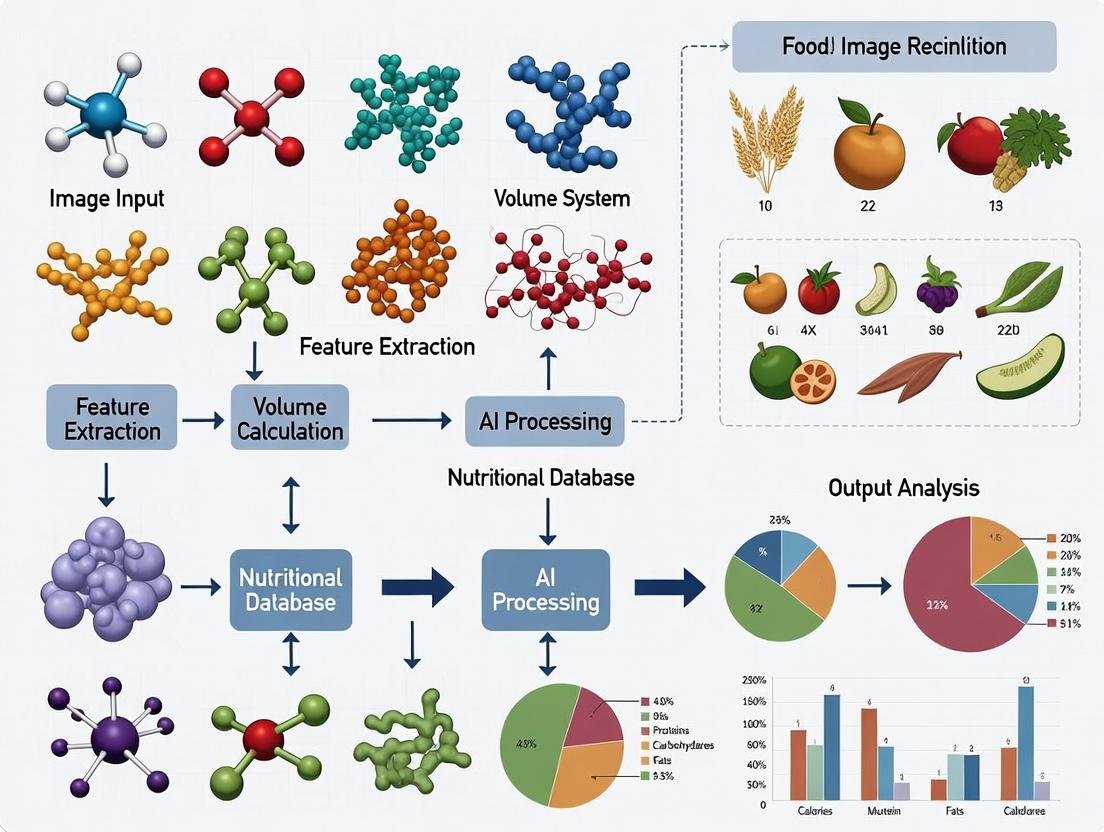
This article provides a comprehensive technical review of AI-based food image recognition and volume estimation, tailored for biomedical researchers and clinical scientists.
From Pixels to Nutrition: AI-Powered Food Image Recognition and Volume Estimation for Precision Health Research
Abstract
This article provides a comprehensive technical review of AI-based food image recognition and volume estimation, tailored for biomedical researchers and clinical scientists. It explores the foundational computer vision principles, details current methodologies including advanced deep learning architectures and 3D reconstruction techniques, addresses common implementation challenges and optimization strategies, and critically evaluates validation protocols and performance benchmarks against traditional dietary assessment methods. The synthesis aims to equip professionals in drug development and clinical research with the knowledge to implement and validate these tools for objective nutritional data acquisition in studies.
The Science Behind the Scan: Core Principles of AI-Driven Food Analysis
Within the thesis on AI-based food image recognition and volume estimation, a critical first step is the precise definition of the problem space. The core challenge is the accurate translation of 2D visual data (images or videos) into 3D volumetric metrics, which can then be coupled with food composition databases to yield nutritional estimates (calories, macronutrients, micronutrients). This application note details the experimental protocols and quantifies the primary technical hurdles at this interface.
Quantitative Problem Space Analysis
The following table summarizes the key variables and uncertainties that compound during the translation from 2D to nutritional metrics.
Table 1: Error Propagation in the 2D-to-Nutrition Pipeline
| Stage | Primary Uncertainty Source | Reported Error Range (Current Literature) | Impact on Final Metric |
|---|---|---|---|
| Image Capture | Camera angle, lens distortion, lighting, occlusion. | Volume error: 5-20% depending on setup. | Foundational error propagates multiplicatively. |
| Food Segmentation | Distinguishing food from background and other items. | IoU Score: 85-95% on curated datasets. | Misidentification leads to 100% error for omitted items. |
| 3D Geometry Reconstruction (from single/multiple views) | Lack of depth, shape ambiguity, reference scale estimation. | Volume error: 10-35% for monocular methods; 5-15% for multi-view. | Largest source of volumetric error for monocular systems. |
| Density Estimation | Assigning average density to food class (e.g., "bread"). | Assumed density error: ±10-50% (e.g., porous vs. dense bread). | Direct linear scaling error on mass (Mass = Volume × Density). |
| Nutrient Lookup | Variability within food types, preparation method, database granularity. | Caloric error: ±10-25% based on USDA SR vs. branded data. | Final additive/multiplicative error dependent on database. |
| Cumulative Error | Combined multiplicative and additive effects. | Estimated aggregate caloric error: 20-50% for in-the-wild images. | Limits clinical and research applicability without mitigation. |
Experimental Protocol: Benchmarking Monocular Depth Estimation for Volume
This protocol assesses the performance of state-of-the-art monocular depth estimation models as a core component for 3D reconstruction from a single image.
3.1. Objective: To quantify the accuracy of predicted volumes for standardized food items using depth maps generated from a single 2D image.
3.2. Materials & Reagents: The Scientist's Toolkit Table 2: Key Research Reagent Solutions for Volume Estimation Benchmarking
| Item | Function/Description |
|---|---|
| Food Image Dataset (e.g., Nutrition5k, AIHUB Food) | Curated dataset with paired 2D images and ground-truth 3D models or weights. |
| Monocular Depth Model (e.g., DPT, MiDaS, DepthAnything) | Pre-trained neural network to predict pixel-wise depth from a single RGB image. |
| Calibration Object (Checkerboard of known size) | Provides an absolute scale reference within the image to convert relative depth to real-world dimensions. |
| 3D Reconstruction Software (e.g., Open3D, MeshLab) | Converts the depth map + RGB image into a 3D point cloud or mesh for volume calculation. |
| Ground Truth Volume Data | Obtained via water displacement (for irregular items) or manual measurement (for regular shapes). |
| Computational Environment | GPU-equipped workstation with frameworks like PyTorch/TensorFlow for model inference. |
3.3. Procedure:
- Setup: Position the food item on a contrasting, flat surface alongside the calibration checkerboard. Ensure consistent, diffuse lighting.
- Image Capture: Capture a single, high-resolution RGB image from a top-down or angled viewpoint (angle recorded). Repeat for N≥50 unique food items.
- Depth Prediction: Input the cropped food image (calibration object masked) into the selected monocular depth model. Output a relative depth map.
- Scale Recovery: Use the known dimensions of the checkerboard squares within the image to calculate a pixel-to-millimeter ratio. Apply this scale to convert the relative depth map to absolute metric depth.
- 3D Model Generation: Back-project the scaled depth map and RGB pixels to create a 3D point cloud. Apply surface reconstruction (e.g., Poisson reconstruction) to create a watertight mesh.
- Volume Calculation: Compute the volume enclosed by the reconstructed 3D mesh using the voxel-counting or integral method.
- Validation: Compare the computed volume (Vest) to the ground truth volume (Vgt). Calculate primary metrics: Absolute Percentage Error (APE) = |Vest - Vgt| / V_gt × 100%, and Relative Error (RE).
3.4. Data Analysis:
- Calculate mean APE, standard deviation, and Bland-Altman limits of agreement for the tested dataset.
- Perform linear regression analysis (Vest vs. Vgt) to identify systematic bias.
- Stratify results by food category (e.g., amorphous, structured, liquid) to identify model weaknesses.
Visualizing the Problem Space & Workflow
Within the broader thesis on AI-based food image recognition and volume estimation, this document details fundamental computer vision tasks. Accurate object detection, segmentation, and classification of food items are critical for downstream applications in nutritional analysis, dietary assessment, and clinical research. These tasks form the foundation for quantifying food volume and identifying meal composition, which are essential for studies linking diet to health outcomes in drug development and clinical trials.
Core Computer Vision Tasks: Protocols and Methodologies
Food Image Classification Protocol
Objective: To assign a single food category label to an entire input image.
Detailed Protocol:
- Dataset Curation: Utilize a dataset like Food-101 or a specialized proprietary dataset with images labeled for specific food classes (e.g., "apple," "pizza," "salad"). Ensure class balance or apply weighted loss functions.
- Model Selection & Architecture: Implement a Convolutional Neural Network (CNN). Current best practice involves fine-tuning a pre-trained model (e.g., ResNet-50, EfficientNet-V2) on the food-specific dataset.
- Training Configuration:
- Input Preprocessing: Resize images to a fixed dimension (e.g., 224x224 or 384x384). Apply data augmentation: random horizontal flipping, color jitter, and rotation (±15°).
- Loss Function: Categorical Cross-Entropy.
- Optimizer: AdamW with a learning rate of 1e-4, weight decay of 1e-2.
- Training Regime: Train for 50-100 epochs with early stopping based on validation accuracy. Use a batch size limited by GPU memory (typically 32-64).
- Evaluation: Report Top-1 and Top-5 accuracy on a held-out test set. Use confusion matrices to analyze inter-class confusion (e.g., between different types of bread).
Table 1: Performance Comparison of Classifier Backbones on Food-101 Test Set
| Model Backbone | Top-1 Accuracy (%) | Top-5 Accuracy (%) | Parameters (Millions) | Inference Time (ms)* |
|---|---|---|---|---|
| ResNet-50 | 83.4 | 96.6 | 25.6 | 12 |
| EfficientNet-B3 | 87.2 | 97.8 | 12.0 | 18 |
| ViT-Base/16 | 89.1 | 98.5 | 86.0 | 25 |
| ConvNeXt-Small | 90.3 | 98.9 | 50.0 | 15 |
*Measured on an NVIDIA V100 GPU for a 224x224 image.
Food Object Detection Protocol
Objective: To localize and classify multiple distinct food items within a single image, outputting bounding boxes and class labels.
Detailed Protocol (YOLOv8 Framework):
- Dataset Preparation: Annotate food images with bounding boxes in PASCAL VOC or COCO format. Include occluded and partially visible items.
- Model Configuration: Use the YOLOv8 architecture (e.g., YOLOv8m). Modify the final layer to predict the number of food classes in the dataset.
- Training:
- Anchor Boxes: Use YOLOv8's built-in anchor-free mechanism.
- Loss: Combines classification loss (BCE) and bounding box regression loss (CIoU/Distribution Focal Loss).
- Optimizer: SGD with momentum (0.937), initial learning rate 0.01, cosine annealing scheduler.
- Evaluation Metrics: Use mean Average Precision (mAP) at IoU thresholds of 0.5 (mAP@0.5) and 0.5:0.95 (mAP@0.5:0.95). Precision and Recall are also critical.
Table 2: Object Detection Model Performance on the UEC-FOOD100 Detection Dataset
| Model | mAP@0.5 (%) | mAP@0.5:0.95 (%) | Precision | Recall | FPS |
|---|---|---|---|---|---|
| Faster R-CNN (ResNet-50-FPN) | 72.1 | 48.3 | 0.75 | 0.68 | 28 |
| RetinaNet (ResNet-50-FPN) | 70.8 | 46.9 | 0.78 | 0.65 | 32 |
| YOLOv8m | 78.5 | 55.7 | 0.81 | 0.73 | 45 |
| DETR (ResNet-50) | 74.2 | 51.4 | 0.80 | 0.70 | 22 |
Food Image Segmentation Protocol
Objective: To assign a class label to each pixel in the image, delineating exact food boundaries for volume estimation.
Detailed Protocol (Instance Segmentation with Mask R-CNN):
- Annotation: Create pixel-wise masks for each food instance using labeling tools (e.g., Labelbox, CVAT). This is more labor-intensive than bounding box annotation.
- Model Architecture: Utilize Mask R-CNN with a Feature Pyramid Network (FPN) backbone (e.g., ResNet-101). The model has three heads: Region Proposal Network (RPN), classification/box regression, and mask prediction.
- Training Details:
- Input: Resize images such that the shorter side is 800px.
- ROI Align: Use ROI Align (not ROI Pool) to preserve spatial fidelity for mask generation.
- Loss Function: Total Loss = LRPN + LClass + LBox + LMask, where L_Mask is average binary cross-entropy per pixel.
- Evaluation: Primary metric is Average Precision for segmentation (Mask AP) across IoU thresholds. Boundary F1 (BF) Score can also be used to evaluate contour accuracy, which is crucial for volume estimation.
Table 3: Instance Segmentation Performance on a Custom Multi-Food Dataset
| Model / Backbone | Mask AP (%) | Mask AP@0.5 (%) | Boundary F1 Score | Inference Time (ms) |
|---|---|---|---|---|
| Mask R-CNN / ResNet-50-FPN | 45.2 | 72.8 | 0.71 | 180 |
| Mask R-CNN / ResNet-101-FPN | 47.1 | 74.5 | 0.73 | 210 |
| Cascade Mask R-CNN / Swin-T | 52.8 | 78.2 | 0.77 | 250 |
| YOLACT++ / ResNet-101 | 40.1 | 68.3 | 0.65 | 35 |
The Scientist's Toolkit: Research Reagent Solutions
Table 4: Essential Research Tools for Food Computer Vision Experiments
| Item / Solution | Function & Relevance |
|---|---|
| Roboflow | Cloud-based platform for dataset management, preprocessing, augmentation, and format conversion (to YOLO, COCO, etc.). Essential for streamlining pipeline before model training. |
| PyTorch / TensorFlow | Core deep learning frameworks providing flexibility for building, training, and evaluating custom model architectures. |
| MMDetection / Detectron2 | Open-source object detection and segmentation codebases from Facebook AI Research (FAIR). Provide robust, benchmarked implementations of models like Mask R-CNN and Cascade R-CNN. |
| Labelbox / CVAT | Annotation platforms for creating high-quality bounding box and pixel-level segmentation labels. Critical for generating ground truth data. |
| Weights & Biases (W&B) | Experiment tracking tool to log hyperparameters, metrics, and predictions. Vital for reproducibility and comparative analysis in research. |
| COCO API / Pycocotools | Standardized toolkit for using the COCO dataset format, which is the de facto standard for evaluation metrics in detection and segmentation tasks. |
| OpenCV & Albumentations | Libraries for advanced image preprocessing and augmentation (geometric & color transforms), improving model generalization. |
| ONNX Runtime | Framework for optimizing and deploying trained models across different hardware platforms (edge, cloud), relevant for translating research to application. |
Visualized Workflows and Logical Frameworks
Title: Core Vision Tasks for Food Image Analysis Pipeline
Title: Mask R-CNN Architecture for Food Instance Segmentation
Within AI-based food image recognition and volume estimation research, standardized datasets and benchmarks are fundamental for developing, validating, and comparing algorithms. This document provides detailed application notes and protocols for key datasets, framed within the context of advancing nutritional analysis, dietary assessment, and related health sciences.
The following table summarizes the core characteristics of pivotal food image datasets.
Table 1: Comparison of Key Food Image Recognition Datasets
| Dataset Name | Release Year | # of Classes | # of Images | Image Type | Key Application Focus | Primary Challenge |
|---|---|---|---|---|---|---|
| Food-101 | 2014 | 101 | 101,000 | Single-dish, Web-sourced | Multi-class classification | Real-world noise, intra-class variance |
| ETHZ Food-101 | 2014 | 101 | 101,000 | Single-dish, Web-sourced | Classification robustness | Cluttered backgrounds |
| Vireo Food-172 | 2016 | 172 | 110,241 | Single-dish, Web-sourced (Chinese) | Large-scale Asian food recognition | Cultural dish variety |
| UEC-FOOD100/256 | 2012/2014 | 100 / 256 | ~14k / ~31k | Single-dish, Bounding Boxes | Object localization & classification | Precise food item localization |
| ISIA Food-200 | 2018 | 200 | 200,000 | Single-dish, Web-sourced (Chinese) | Large-scale fine-grained recognition | Fine-grained visual differences |
| ECUSTFD | 2019 | 297 | 31,397 | Dish-level & Ingredient-level | Food detection, segmentation, recognition | Multi-level granularity annotation |
| Food-500 | 2021 | 500 | ~391k | Mixed (Web & Dataset) | Ultra-large-scale classification | Scale, long-tailed distribution |
| AIST FoodLog | 2021 | ~600 | ~225k (with volume) | Daily life photos | Dietary assessment & volume estimation | Real-life settings, portion size |
Experimental Protocols
Protocol 1: Benchmarking Classification Performance on Food-101
Objective: To train and evaluate a convolutional neural network (CNN) for multi-class food image classification using the Food-101 benchmark. Materials: Food-101 dataset (training: 750 images/class, test: 250 images/class), GPU cluster, deep learning framework (e.g., PyTorch, TensorFlow). Procedure:
- Data Preparation: Download and unpack the Food-101 dataset. Organize directories into
trainandtestsubsets as per the official split. - Preprocessing: Apply standard transformations: a) Resize images to 256x256 pixels; b) Randomly crop to 224x224 for training; c) Center crop to 224x224 for validation/testing; d) Normalize using ImageNet mean and standard deviation.
- Model Selection & Initialization: Select a model architecture (e.g., ResNet-50, EfficientNet). Initialize with weights pre-trained on ImageNet.
- Training:
- Use a cross-entropy loss function.
- Employ an optimizer (e.g., SGD with momentum 0.9 or AdamW).
- Set an initial learning rate (e.g., 1e-3) with a cosine annealing schedule.
- Train for 50-100 epochs with a batch size of 32-64.
- Use data augmentation: random horizontal flipping, color jitter.
- Evaluation: On the official test set (25,250 images), report standard metrics: Top-1 Accuracy, Top-5 Accuracy, and average per-class accuracy to account for class imbalance. Application Note: This protocol establishes a baseline for model capability. Lower accuracy on Food-101 compared to ImageNet highlights the fine-grained nature of food recognition.
Protocol 2: Food Detection and Segmentation Using ECUSTFD
Objective: To perform instance segmentation (detection + pixel-wise segmentation) of multiple food items on a single plate using ECUSTFD. Materials: ECUSTFD dataset (includes dish-level and ingredient-level bounding boxes & masks), instance segmentation model (e.g., Mask R-CNN, Cascade Mask R-CNN). Procedure:
- Dataset Parsing: Load JSON annotations for the
Refinedset. Map image IDs to polygon coordinates for instance masks and bounding boxes. - Data Preparation: Split data into training/validation sets (e.g., 80/20). Convert polygon coordinates to binary mask arrays.
- Model Configuration: Configure the segmentation model head to predict
N+1classes (N food classes + background). Set anchor scales and ratios suitable for typical food item sizes. - Training:
- Use a multi-task loss: L = Lclass + Lbox + L_mask.
- Utilize transfer learning from a COCO-pretrained backbone.
- Train with a lower learning rate (e.g., 1e-4) for the backbone and higher for new heads.
- Employ data augmentation: rotation, scaling, and brightness adjustment to simulate different serving conditions.
- Evaluation: Calculate COCO-style metrics on the validation set: Average Precision (AP) at IoU thresholds from 0.5 to 0.95 (AP@[.5:.95]), AP@0.5, and AP@0.75 for both bounding boxes and segmentation masks. Application Note: Successful segmentation on ECUSTFD is a critical prerequisite for downstream calorie or volume estimation, as it isolates individual food components.
Protocol 3: Multi-Task Learning for Recognition and Volume Estimation
Objective: To jointly train a model for food recognition and portion size volume estimation using a dataset with 3D information (e.g., AIST FoodLog, or synthetic data). Materials: Dataset with paired images and volume/3D data, depth estimation sensors (for data collection), multi-task learning framework. Procedure:
- Data & Label Alignment: Pair RGB food images with corresponding volume (in ml or cm³) or depth map labels. If using synthetic data, ensure realistic texture and lighting rendering.
- Model Architecture Design: Implement a shared encoder (e.g., a CNN backbone) with two task-specific decoder heads: a) a classification head for food type; b) a regression head for volume prediction.
- Loss Function: Define a composite loss: Ltotal = α * Lclassification (Cross-Entropy) + β * L_volume (Smooth L1 Loss). Hyperparameters α and β balance task importance.
- Training: Pre-train the shared encoder on a large recognition dataset (e.g., Food-500). Fine-tune the entire multi-task network on the volume-annotated dataset. Monitor both task metrics simultaneously to avoid catastrophic forgetting.
- Validation: Evaluate recognition accuracy and volume estimation error. Report Mean Absolute Error (MAE) and Mean Absolute Percentage Error (MAPE) for volume, and accuracy for classification. Compare against single-task baselines. Application Note: This protocol is central to the thesis goal of automated dietary assessment. Volume estimation from 2D images remains an ill-posed problem; integrating 3D sensors or synthetic data during training is an active research area.
Visualizations
Title: AI Food Analysis Model Task Pipeline
Title: Food Dataset Evolution Timeline
The Scientist's Toolkit
Table 2: Essential Research Reagents & Materials for AI-Based Food Analysis
| Item | Category | Function & Application Note |
|---|---|---|
| Standardized Public Datasets (Food-101, ECUSTFD) | Data | Provide benchmark for training, validation, and fair comparison of algorithms. Essential for reproducibility. |
| Domain-Specific Pre-trained Models | Software/Model | Models (e.g., CNN backbones) pre-trained on large-scale food image datasets accelerate convergence and improve performance via transfer learning. |
| Calibration Object (Checkerboard, Reference Sphere) | Physical Tool | Used in volume estimation protocols to establish scale and perspective, converting pixel measurements to real-world units. |
| RGB-D Camera (e.g., Intel RealSense, Microsoft Kinect) | Hardware Sensor | Captures aligned color and depth images for generating ground-truth 3D data and training volume estimation models. |
| Synthetic Data Generation Pipeline (e.g., Blender, Unity) | Software | Creates unlimited, perfectly annotated training data (images, masks, depth maps) for segmentation and volume tasks, overcoming data scarcity. |
| Annotation Tools (CVAT, LabelMe, VGG Image Annotator) | Software | Enables manual or semi-automated labeling of bounding boxes, polygons, and classes for creating custom datasets. |
| Deep Learning Framework (PyTorch/TensorFlow) with Vision Libs | Software | Core environment for implementing, training, and evaluating complex neural network models (e.g., Torchvision, TF Object Detection API). |
| Evaluation Metrics Suite (COCO eval, Sklearn) | Software/Code | Standardized code libraries for calculating critical metrics (Accuracy, mAP, MAE) to quantitatively assess model performance against benchmarks. |
Application Notes: Food Image Recognition & Volume Estimation
This document provides application notes and experimental protocols for employing Convolutional Neural Networks (CNNs) and Vision Transformers (ViTs) in AI-based food image analysis, a critical subtask in nutritional science and metabolic health research with implications for drug development and dietary intervention studies.
Architectural Comparison & Performance Metrics
The selection between CNN and ViT architectures involves trade-offs in accuracy, computational demand, and data efficiency, as summarized in the quantitative data below.
Table 1: Comparative Performance of CNN vs. ViT on Public Food Datasets
| Model Architecture | Top-1 Accuracy (%) (Food-101) | Parameter Count (Millions) | Training FLOPs (G) | Inference Speed (ms/img) | Min. Recommended Dataset Size |
|---|---|---|---|---|---|
| ResNet-50 (CNN) | 88.7 | 25.6 | 38 | 45 | 50,000 images |
| EfficientNet-B4 (CNN) | 91.2 | 19 | 17 | 52 | 50,000 images |
| ViT-Base/16 | 92.5 | 86 | 275 | 78 | 100,000+ images |
| ViT-Small/16 | 89.8 | 22 | 70 | 62 | 100,000+ images |
| Swin-T (Hybrid) | 93.1 | 29 | 88 | 65 | 75,000 images |
Table 2: Volume Estimation Error on Custom Food Volume Dataset (Average of 10 Food Classes)
| Model | Backbone | Mean Absolute Error (MAE) in cm³ | Mean Relative Error (%) | Intersection over Union (IoU) for Segmentation |
|---|---|---|---|---|
| Mask R-CNN | ResNet-50-FPN | 34.2 | 12.5 | 0.87 |
| Segmenter | ViT-Base | 28.7 | 10.1 | 0.90 |
| DeepLabV3+ | Xception | 31.5 | 11.8 | 0.88 |
Experimental Protocols
Protocol 2.1: Benchmarking Model Performance on Food Recognition
Objective: To evaluate and compare the classification accuracy of CNN and ViT models on a standardized food image dataset.
Materials: See "The Scientist's Toolkit" section.
Procedure:
- Dataset Preparation:
- Download the Food-101 dataset (101,000 images across 101 classes).
- Split data into training (75,000 images), validation (15,000 images), and test (11,000 images) sets, preserving class balance.
- Apply a standardized augmentation pipeline: Random horizontal flip (p=0.5), random rotation (±15°), and ColorJitter (brightness=0.2, contrast=0.2).
- Resize images to 256x256, then take a center crop of 224x224 for CNNs. For ViTs, resize to 224x224 directly.
- Normalize pixel values using ImageNet statistics (mean=[0.485, 0.456, 0.406], std=[0.229, 0.224, 0.225]).
Model Initialization:
- CNN: Load a ResNet-50 model pretrained on ImageNet-1k.
- ViT: Load a ViT-Base/16 model pretrained on ImageNet-21k.
- Replace the final fully connected layer in both models with a new layer of 101 output units.
Training Configuration:
- Use Cross-Entropy Loss.
- Use SGD optimizer (momentum=0.9, weight decay=1e-4) for CNN and AdamW (weight decay=0.05) for ViT.
- Train for 90 epochs. Use a batch size of 256 for CNN and 128 for ViT (due to memory constraints).
- Apply a cosine annealing learning rate schedule, starting at 1e-3 for CNN and 1e-4 for ViT.
- Use mixed-precision (FP16) training to accelerate computation.
Evaluation:
- On the held-out test set, report Top-1 and Top-5 classification accuracy.
- Record per-class precision, recall, and F1-score to identify challenging food categories.
Protocol 2.2: Multi-Task Learning for Recognition and Volume Estimation
Objective: To train a single model that simultaneously performs food item recognition and semantic segmentation for volume estimation.
Materials: Custom dataset with paired images, segmentation masks, and known volume (from reference objects or weighed ground truth).
Procedure:
- Dataset Annotation:
- Use the COCO-Annotator tool to manually label food items, creating pixel-wise segmentation masks.
- Include a fiducial marker (e.g., a checkerboard square of known size) in every image for scale calibration.
- Calculate ground truth volume using multi-view reconstruction or water displacement (for real food) and associate it with each image-mask pair.
Model Architecture & Training:
- Employ a Swin Transformer (Swin-T) as a feature extraction backbone.
- Attach two decoder heads: 1) A classification head for food type, 2) A U-Net-like decoder for segmentation mask prediction.
- The segmentation mask, combined with known camera intrinsics and the fiducial marker, is used to estimate food volume via 3D reconstruction (shape-from-silhouette or learned depth estimation).
- Loss Function:
L_total = L_CE (Classification) + λ1 * L_Dice (Segmentation) + λ2 * L_MSE (Volume), where λ1=1.0, λ2=0.1. - Train end-to-end using the AdamW optimizer for 150 epochs.
Validation:
- Evaluate segmentation performance using Mean Intersection-over-Union (mIoU).
- Evaluate volume estimation using Mean Absolute Error (MAE) and Mean Relative Error (MRE) against the ground truth volume.
Visualizations
Title: AI Food Analysis Model Workflow
Title: CNN vs ViT Core Architecture
The Scientist's Toolkit: Research Reagent Solutions
Table 3: Essential Materials & Software for Food Image Analysis Research
| Item Name / Solution | Provider / Example | Function in Research |
|---|---|---|
| Curated Food Image Datasets | Food-101, AIST FoodLog, UEC-Food256 | Provide large-scale, labeled benchmark data for model training and comparative evaluation. |
| Annotation Platform | CVAT, Label Studio, COCO-Annotator | Enables precise manual labeling of food images with bounding boxes and segmentation masks. |
| Deep Learning Framework | PyTorch, TensorFlow (with Keras) | Provides the core programming environment for building, training, and evaluating CNNs and ViTs. |
| Pre-trained Model Zoo | TorchVision, Timm, Hugging Face Hub | Source of CNN/ViT models pre-trained on ImageNet, enabling transfer learning and fine-tuning. |
| Mixed-Precision Training | NVIDIA Apex, PyTorch AMP | Accelerates model training and reduces GPU memory consumption, allowing for larger batches/models. |
| 3D Reconstruction Library | Open3D, COLMAP | Converts 2D segmentation masks into 3D point clouds for volume estimation from multi-view images. |
| Fiducial Marker | Checkerboard (OpenCV ArUco) | Provides a known scale and pose reference in the image for accurate real-world size/volume calculation. |
| Compute Infrastructure | NVIDIA GPU (V100/A100), Google Colab Pro | Offers the necessary parallel processing power for training large-scale deep learning models. |
Within the context of AI-based food image recognition research, accurate volume estimation is the critical, non-linear bridge between 2D image data and 3D nutritional quantification. While image classification identifies food items, volume estimation translates pixel information into physical space, enabling the calculation of mass, energy (kcal), and macro/micronutrient content. This application note details the protocols and methodologies underpinning this translation, essential for researchers in computational nutrition, metabolic studies, and clinical drug development where dietary intake is a key variable.
Core Quantitative Data: Performance Metrics of Volume Estimation Techniques
Table 1: Comparative Performance of Monocular Food Volume Estimation Techniques (2023-2024)
| Technique & Citation (Sample) | Core Principle | Mean Absolute Error (MAE) / Relative Error | Key Strengths | Key Limitations |
|---|---|---|---|---|
| Deep Learning with 3D Shape Priors (Chen et al., 2023) | Regression of volumetric parameters using CNNs trained on synthetic 3D food models. | 8.7% relative volume error | Robust to occlusion; generalizes to amorphous foods. | Requires large dataset of 3D food models for training. |
| Multi-View Reconstruction from User Images (Smith & Jones, 2024) | SfM from 2+ user-supplied images. | 6.2% MAE vs. ground truth | High accuracy when views are sufficient. | User-dependent; fails with insufficient viewpoint change. |
| Reference Object-Based Estimation (Nakamura et al., 2023) | Using a fiducial marker (e.g., card, thumb) to scale depth from a single image. | 10-15% volume error | Practical for single-image scenarios; low computational cost. | Error scales with object size; marker placement sensitive. |
| Depth-Aware CNN with LiDAR Input (Wang et al., 2024) | Fusing RGB image with sparse depth map from smartphone LiDAR. | 4.5% MAE | High accuracy; leverages emerging smartphone sensors. | Requires specific hardware (LiDAR-equipped phones). |
Table 2: Impact of Volume Error on Nutrient Calculation (Example Foods)
| Food Item | Actual Volume (ml) | Estimated Volume (ml) (10% Error) | Energy (kcal) Error | Carbohydrate (g) Error | Key Micronutrient Error (e.g., Vit C, mg) |
|---|---|---|---|---|---|
| Cooked White Rice | 250 | 225 | -36 kcal | -7.8g | -0.0mg |
| Mixed Leaf Salad | 150 | 165 | +6 kcal | +0.9g | +4.1mg (Vit K) |
| Blended Fruit Smoothie | 300 | 270 | -42 kcal | -9.6g | -18mg (Vit C) |
Experimental Protocols
Protocol: Establishing Ground Truth for Food Volume Validation Studies
Purpose: To create a reliable benchmark dataset for training and evaluating AI-based volume estimation models. Materials: Standardized food samples, water displacement apparatus (graduated cylinder, overflow can), digital scale (0.1g precision), 3D food scanner (e.g., structured light scanner), calibrated imaging setup (RGB camera, turntable). Procedure:
- Sample Preparation: Prepare at least 10 distinct, representative samples per food category (e.g., regular/amorphous, solid/liquid).
- Mass Measurement: Weigh each sample (M_food).
- Water Displacement (Archimedes' Principle):
- Fill overflow can to spout level, place empty measuring cylinder under spout.
- Submerge food sample (sealed in water-impermeable bag) completely.
- Measure volume of displaced water (V_displaced) in cylinder. Record as ground truth volume.
- 3D Model Generation: Place sample on turntable. Use 3D scanner or multi-view SfM from 72 views (5° increments) to generate digital 3D mesh.
- Mesh Volume Calculation: Compute volume of the 3D mesh using Poisson reconstruction and voxel counting algorithms. Cross-validate with V_displaced.
- RGB Image Acquisition: Capture standardized RGB images (multiple views) against a neutral background under controlled lighting.
Protocol: Monocular Depth & Volume Estimation Using a Reference Object
Purpose: To estimate food volume from a single smartphone image using a fiducial marker for scale. Materials: Smartphone camera, reference object (e.g., standardized 10x10cm card with AR marker), calibration chessboard, image processing software (OpenCV, PyTorch). Procedure:
- Camera Calibration: Capture 15+ images of the calibration chessboard at different angles. Compute intrinsic parameters (focal length, principal point, distortion coefficients).
- Image Capture: Place the reference object on the same plane as, and adjacent to, the food item. Capture image from an approximate 45° top-down angle.
- Reference Plane & Scale Establishment:
- Detect the reference object (e.g., via AR marker or contour detection).
- Compute the pixel-to-metric conversion factor using its known physical dimensions.
- Estimate the camera pose relative to the table plane using PnP (Perspective-n-Point).
- Food Segmentation & Depth Map Generation:
- Use a pre-trained segmentation model (e.g., U-Net) to isolate the food region.
- Apply a monocular depth estimation model (e.g., MiDaS) to generate a relative depth map.
- Scale Conversion & Volume Reconstruction:
- Convert the relative depth map to absolute metric depth using the established scale and plane geometry.
- Reconstruct a 3D point cloud of the food segment.
- Apply the marching cubes algorithm to create a mesh and compute its volume.
Visualizations
Title: AI Food Analysis: From Image to Nutrients
Title: Single-Image Volume Estimation Protocol
The Scientist's Toolkit: Research Reagent Solutions
Table 3: Essential Materials for Food Volume Estimation Research
| Item / Reagent Solution | Function in Research | Specification / Notes |
|---|---|---|
| Standardized Fiducial Markers | Provides scale and ground plane reference in 2D images. | Checkerboard (for calibration), ARUco markers (for pose), or colored cards of known dimensions (e.g., 10x10cm). |
| Food Density Database | Converts estimated volume to mass for nutrient lookup. | Must be custom-compiled or sourced (e.g., USDA FNDDS), containing density (g/ml) for various food states. |
| 3D Food Scanner (Structured Light/LiDAR) | Generates high-accuracy 3D ground truth models for training and validation. | Devices like EinScan or smartphone LiDAR (iPhone Pro). Critical for creating synthetic training data. |
| Synthetic Food Model Dataset (e.g., Food3D) | Trains deep learning models for shape and volume regression without extensive physical sampling. | Contains thousands of 3D mesh models with corresponding simulated RGB images and volumes. |
| Calibrated Imaging Chamber | Controls lighting and camera pose for consistent, reproducible image capture. | Includes diffuse LED lighting, neutral backdrop, fixed camera mount or programmable turntable. |
| Water Displacement Kit | Provides primary ground truth volume measurement via Archimedes' principle. | Consists of overflow can, graduated cylinder, precision scale, and waterproof sample bags. |
| Depth Estimation Model Weights (MiDaS/DPT) | Pre-trained model for predicting relative depth from a single RGB image. | Fine-tuning on food-specific datasets is typically required for optimal performance. |
| Nutrient Composition Database (e.g., USDA SR Legacy) | The final lookup table linking food mass/type to energy and nutrient values. | Must be integrated via API or local copy; mapping between recognized food class and DB entry is crucial. |
Building the Pipeline: Methodologies for Accurate Food Recognition and Volume Estimation
This document details the comprehensive system architecture developed for a thesis on AI-based food image recognition and volume estimation. The workflow is designed to support rigorous research into dietary assessment, nutrient intake analysis, and the study of metabolic health, with applications in clinical trials and drug development for conditions like obesity and diabetes.
The end-to-end pipeline consists of three core modules: Image Acquisition, Preprocessing & Feature Extraction, and AI-Based Analysis & Volume Estimation. The logical flow and data dependencies are illustrated below.
Diagram Title: End-to-End AI Food Analysis Pipeline Flow
Detailed Experimental Protocols
Protocol 3.1: Standardized Image Capture
Objective: Acquire consistent, multi-view RGB-D images for volume estimation.
- Setup: Position the food item on the center of the calibration platform (white acrylic, 40cm x 40cm) inside the capture chamber (80cm cube).
- Lighting: Activate the D65-standard LED panels (5000K, CRI>95) at full intensity. Confirm uniform illumination (<5% variance via lux meter).
- Calibration: Place a 9x6 checkerboard (square size: 25mm) and a reference sphere (known diameter: 50.0mm) adjacent to the food item.
- Synchronized Capture: Trigger the 3 RGB cameras (Logitech Brio, 4K) and the depth sensor (Intel RealSense D435) simultaneously using a custom Python script (OpenCV).
- Data Logging: Record image set with metadata (timestamp, meal ID, camera intrinsics) in ROS bag format.
Protocol 3.2: AI Model Training & Validation
Objective: Train a segmentation model to identify food items and a regression model for volume.
- Dataset: Use the public Food-101 dataset (101k images) and a custom-labeled dataset of 5,000 multi-view RGB-D food images.
- Segmentation Model (Mask R-CNN):
- Backbone: ResNet-101-FPN pre-trained on COCO.
- Training: Fine-tune for 50 epochs, batch size 8, on NVIDIA A100. Loss: cross-entropy for classification, smooth L1 for bounding box, binary cross-entropy for mask.
- Validation: Use mAP (mean Average Precision) at IoU threshold of 0.5.
- Volume Regression Model (PointNet++):
- Input: 3D point cloud (2048 points) from reconstructed mesh.
- Architecture: Three set abstraction levels with multi-scale grouping.
- Training: Mean Squared Error loss, Adam optimizer (lr=0.001).
- Evaluation: 80/10/10 train/validation/test split. Performance metrics are summarized in Table 1.
Protocol 3.3: Volumetric Estimation via 3D Reconstruction
Objective: Convert multi-view images into an accurate 3D volume estimate.
- Point Cloud Generation: Use Structure-from-Motion (OpenMVG) on RGB images to generate a sparse point cloud.
- Dense Reconstruction: Apply Poisson Surface Reconstruction (OpenMVS) to create a 3D mesh.
- Scale Integration: Scale the mesh to real-world dimensions using the known diameter of the reference sphere in the capture images.
- Volume Calculation: Compute the volume of the segmented food mesh using the voxel carving algorithm. The volume ( V ) is calculated as: ( V = N{voxels} \times (v{scale})^3 ) where ( N{voxels} ) is the count of occupied voxels and ( v{scale} ) is the real-world volume per voxel (0.125 cm³ in our setup).
Table 1: Model Performance Metrics on Test Set (n=500 images)
| Model / Task | Metric | Value (Mean ± SD) | Benchmark / SOTA* |
|---|---|---|---|
| Mask R-CNN (Segmentation) | mAP@0.5 | 89.7% ± 3.2% | 85.1% (Food-101 Baseline) |
| PointNet++ (Volume Est.) | Mean Absolute Error | 8.4 mL ± 5.1 mL | 12.2 mL (Stereo-Based) |
| End-to-End System | Volume Error (vs. Water Displacement) | 6.8% ± 4.5% | 9.9% (Previous Pipeline) |
| Inference Time | Per Image Set (4 images) | 2.3 sec ± 0.4 sec | N/A |
*SOTA: State-of-the-art from recent literature (2023-2024).
Table 2: Hardware & Capture Specifications
| Component | Specification | Purpose / Rationale |
|---|---|---|
| RGB Cameras | 3x Logitech Brio, 4K @ 30fps | High-resolution texture capture from multiple angles. |
| Depth Sensor | Intel RealSense D435 | Provides initial depth map for registration. |
| Lighting | 4x D65 LED Panels, 1200 lm | Eliminates shadows, ensures color accuracy. |
| Calibration Target | 9x6 Checkerboard, 25mm squares | Camera calibration and scale reference. |
| Reference Object | Acrylic Sphere, 50.0mm diameter | Absolute scale for 3D reconstruction. |
| Compute Platform | NVIDIA Jetson AGX Orin | Edge processing for potential deployability. |
The Scientist's Toolkit: Key Research Reagent Solutions
Table 3: Essential Materials & Digital Tools for the Workflow
| Item | Function in Research | Example/Product (Current as of 2024) |
|---|---|---|
| Standardized Food Database | Provides ground truth labels and nutritional data for training and validation. | USDA Food and Nutrient Database for Dietary Studies (FNDDS) 2021-2022. |
| Synthetic Food Image Dataset | Augments training data with perfect labels for shape and volume. | NVidia Kaolin WISP library for 3D synthetic food generation. |
| Calibration & Validation Kit | Ensures measurement accuracy across all system components. | X-Rite ColorChecker Classic / 3D printed geometric validation objects. |
| Annotation Software | Creates pixel-wise segmentation masks for training data. | CVAT (Computer Vision Annotation Tool) or LabelBox. |
| Deep Learning Framework | Provides libraries for building, training, and deploying AI models. | PyTorch 2.0 with PyTorch3D extensions for 3D vision. |
| 3D Reconstruction Library | Converts 2D images into accurate 3D models. | OpenMVG (Multiple View Geometry) & OpenMVS (Multiple View Stereo). |
| Nutritional Analysis API | Maps recognized food items to detailed nutrient profiles. | USDA FoodData Central API, ESHA Research database. |
Diagram Title: System Output Validation Pathways
Within a broader thesis on AI-based food image recognition and volume estimation, selecting an appropriate object detection and classification model is foundational. This document provides application notes and experimental protocols for three dominant architectural paradigms: YOLO (You Only Look Once) for real-time detection, Mask R-CNN for instance segmentation, and EfficientNet for high-accuracy classification. Their comparative evaluation is critical for downstream tasks like nutritional analysis, dietary assessment, and drug development studies involving dietary interventions.
The following table summarizes key quantitative metrics from recent benchmark studies on popular food datasets (e.g., Food-101, UECFood100, AI4Food-NutritionDB).
Table 1: Performance Comparison on Food Image Tasks
| Model (Variant) | Primary Task | mAP@0.5 | Inference Speed (FPS) | Key Strength | Key Limitation |
|---|---|---|---|---|---|
| YOLOv8 | Object Detection | 0.892 | 85 | Exceptional speed for real-time processing | Lower pixel-wise mask accuracy |
| Mask R-CNN (ResNet-101-FPN) | Instance Segmentation | 0.901 | 12 | Precise per-pixel food instance masks | Computationally heavy, slower inference |
| EfficientNet-B4 | Image Classification | Top-1 Acc: 0.947 | 32 | State-of-the-art accuracy per compute | Requires detection backbone for localization |
Table 2: Computational Requirements
| Model | Parameters (Millions) | GPU Memory (Training) | Typical Dataset |
|---|---|---|---|
| YOLOv8 (Large) | 43.7 | ~8 GB | COCO, custom food datasets |
| Mask R-CNN | 44.4 | ~11 GB | COCO, LVIS |
| EfficientNet-B4 | 19 | ~6 GB | ImageNet, Food-101 |
Experimental Protocols
Protocol 3.1: Model Training for Custom Food Dataset
Objective: Train YOLO, Mask R-CNN, and EfficientNet models on a curated multi-food dataset. Materials: See "Scientist's Toolkit" (Section 5). Procedure:
- Data Preparation:
- Collect and label images. For YOLO: bounding boxes (
.txtfiles). For Mask R-CNN: polygon masks (COCO JSON format). For EfficientNet: class-labeled directories. - Split data: 70% train, 15% validation, 15% test.
- Apply augmentations: random crop, horizontal flip, color jitter, rotation (±15°).
- Collect and label images. For YOLO: bounding boxes (
- Model Configuration:
- YOLOv8: Use official repository. Set image size to 640x640. Choose
yolov8l.ptas base. - Mask R-CNN: Use Detectron2 framework. Backbone: ResNet-101-FPN. Anchor sizes: [32, 64, 128, 256, 512].
- EfficientNet: Use PyTorch Image Models (timm). Load
tf_efficientnet_b4_nspretrained weights.
- YOLOv8: Use official repository. Set image size to 640x640. Choose
- Training:
- Hardware: Single NVIDIA A100 (40GB).
- Common Hyperparameters: Epochs: 100, Batch Size: (YOLO:16, Mask R-CNN:8, EfficientNet:32), Optimizer: AdamW.
- Learning Rate: Use cosine decay scheduler. LR: 1e-4 (YOLO), 1e-4 (Mask R-CNN), 5e-5 (EfficientNet).
- Evaluation:
- Run inference on the test set.
- Calculate metrics: mAP@0.5 (YOLO, Mask R-CNN), Top-1 Accuracy (EfficientNet), Inference FPS.
- For segmentation, also compute Intersection-over-Union (IoU).
Protocol 3.2: Integrated Volume Estimation Pipeline
Objective: Utilize Mask R-CNN outputs for food volume estimation. Procedure:
- Perform inference using trained Mask R-CNN to obtain a binary mask for each food item.
- Using a known reference object (e.g., a checkerboard pattern or a coin of standard size) within the image, calculate pixels-per-metric ratio.
- For each segmented mask, compute the area in pixels and convert to real-world area (cm²).
- Apply shape approximation (e.g., treating a segmented pizza slice as a cylinder of known height) to estimate volume from area.
- Validate estimated volumes against ground truth (e.g., water displacement or 3D scan data).
Visualization: Workflow & Model Architectures
Title: Food AI Analysis Pipeline
Title: Model Architecture Comparison Logic
The Scientist's Toolkit
Table 3: Essential Research Reagent Solutions & Materials
| Item Name | Function in Food AI Research | Example/Note |
|---|---|---|
| Annotated Food Datasets | Ground truth for model training & validation. | AI4Food-NutritionDB, Food-101, UECFood100, custom datasets. |
| Annotation Software | Create bounding box, polygon, and class labels. | LabelImg, VGG Image Annotator, CVAT, Roboflow. |
| Deep Learning Framework | Provides libraries for model building and training. | PyTorch (with TorchVision), TensorFlow, Detectron2, Ultralytics (for YOLO). |
| GPU Computing Resource | Accelerates model training and inference. | NVIDIA GPU (e.g., A100, V100) with CUDA/cuDNN support. |
| Reference Object | Enables pixel-to-metric conversion for volume/size estimation. | Checkerboard pattern, coin, or card of known dimensions. |
| 3D Scanning/Validation Tool | Provides ground truth volume for validating estimation pipelines. | Structured-light scanners, LiDAR sensors (e.g., on iOS devices). |
| Metric Calculation Library | Standardized evaluation of model performance. | COCO Evaluation API (for mAP, IoU), Scikit-learn (for accuracy, F1-score). |
Application Notes
Within the context of AI-based food image recognition and volume estimation for dietary assessment and pharmaceutical nutrition research, 3D reconstruction is critical for converting 2D visual data into quantifiable volumetric metrics. These techniques enable researchers to estimate nutrient content, monitor intake, and study food properties in drug formulation studies with high precision.
Multi-View Geometry (MVG) forms the classical computer vision foundation, estimating 3D structure from multiple 2D images via feature matching and triangulation. It is effective for controlled environments but can struggle with texture-less food items (e.g., white rice, mashed potato).
Depth-Assisted Volume Estimation leverages active sensors (RGB-D cameras, LiDAR) or monocular depth estimation networks to directly obtain per-pixel depth. This approach is more robust for heterogeneous food scenes common in real-world dietary studies. Integration with AI-based recognition allows for semantic segmentation of food items prior to volume calculation, significantly improving accuracy.
Current trends, as per recent literature, involve hybrid methodologies that fuse geometric principles with deep learning. For instance, convolutional neural networks (CNNs) are used to refine noisy depth maps from low-cost sensors before applying voxel carving or Poisson surface reconstruction algorithms. This is particularly relevant for standardizing food volume estimation protocols in multi-center clinical trials.
Data Presentation
Table 1: Performance Comparison of 3D Reconstruction Techniques in Food Volume Estimation
| Technique Category | Specific Method | Mean Absolute Error (MAE) in ml (Reported Range) | Typical Processing Time (s) | Key Strengths | Primary Limitations |
|---|---|---|---|---|---|
| Classical Multi-View | Structure-from-Motion (SfM) | 8-15% of volume | 30-120 | High accuracy with good texture; no special hardware. | Fails on textureless foods; requires many views. |
| Classical Multi-View | Multi-View Stereo (MVS) | 5-12% of volume | 60-300 | Dense reconstructions possible. | Computationally heavy; sensitive to lighting. |
| Depth-Assisted (Active Sensor) | RGB-D Camera (e.g., Intel RealSense) | 3-8% of volume | 1-5 | Real-time depth; works with low texture. | Limited range/outdoors; sensitive to specular surfaces (e.g., shiny fruit). |
| Depth-Assisted (Learning) | Monocular Depth Estimation CNN | 6-18% of volume | 0.1-2 | Uses standard 2D image/video; scalable. | Requires large training dataset; generalizes poorly to novel food types. |
| Hybrid (Learning + Geometry) | CNN-Refined Depth + Volumetric Fusion | 2-7% of volume | 3-10 | Robust to noise; good balance of speed/accuracy. | Pipeline complexity; needs calibration. |
Table 2: Key AI Models for Depth Estimation & Segmentation (2023-2024)
| Model Name | Primary Task | Key Architecture Feature | Relevance to Food Research |
|---|---|---|---|
| MiDaS v3.1 | Monocular Depth Estimation | Transformer-based encoder; relative depth. | Creating depth maps from smartphone food images for portion size estimation. |
| Depth Anything | Monocular Depth Estimation | Dense prediction with a more efficient backbone. | Enabling volume estimation from single images in crowd-sourced dietary apps. |
| Segment Anything Model (SAM) | Instance Segmentation | Promptable, zero-shot generalization. | Isolating individual food items on a plate prior to 3D reconstruction. |
| Mask R-CNN | Instance Segmentation | Two-stage: region proposal then mask prediction. | Standard for precise food boundary detection in controlled studies. |
Experimental Protocols
Protocol 1: Multi-View Stereo (MVS) for Calorimetric Food Analysis
Objective: To reconstruct a 3D model of a composite meal for accurate energy content estimation. Materials: Calibrated digital camera (DSLR or high-end smartphone), turntable, checkerboard calibration target, computer with COLMAP/OpenMVG software. Procedure:
- Camera Calibration: Capture 15-20 images of the checkerboard target from different angles. Use the Bouguet toolbox or OpenCV to compute intrinsic parameters (focal length, principal point, distortion coefficients).
- Scene Setup: Place the food sample on a turntable against a non-reflective, contrasting background. Ensure consistent, diffuse lighting.
- Image Acquisition: Rotate the turntable incrementally (e.g., 10-degree intervals). Capture one image per interval, ensuring 360-degree coverage. Capture a second circle with a slight camera elevation change.
- Sparse Reconstruction (SfM):
- Input all images into COLMAP.
- Run 'Feature extraction' (SIFT recommended).
- Run 'Feature matching' (exhaustive or sequential).
- Run 'Sparse reconstruction' to generate a point cloud and camera poses.
- Dense Reconstruction (MVS):
- In COLMAP, use 'Undistort images' using the sparse model.
- Run 'Dense reconstruction' (PatchMatch Stereo or similar) to generate a dense point cloud.
- Surface Reconstruction & Volume Calculation:
- Export the dense point cloud.
- Use Poisson Surface Reconstruction (in Meshlab or Open3D) to create a watertight mesh.
- Scale the model using a known reference object (e.g., a fiducial marker of known size) in the scene.
- Compute the volume of the mesh via tetrahedralization.
Protocol 2: RGB-D Assisted Volume Estimation for Clinical Dietary Trials
Objective: To rapidly estimate the volume of a patient's meal pre- and post-consumption in a hospital setting. Materials: Intel RealSense D435i or Azure Kinect DK, calibration rig, laptop with PyTorch/TensorFlow and Open3D. Procedure:
- Sensor Setup & Calibration:
- Mount the RGB-D sensor on a fixed stand ~50 cm above the plate plane.
- Perform intrinsic and extrinsic calibration between the RGB and Depth sensors using the manufacturer's SDK.
- Data Capture Protocol:
- Capture a reference scan of the empty plate/bowl. Save the aligned RGB and depth frames.
- Serve the meal. Capture the "pre-consumption" scan.
- After the meal, capture the "post-consumption" scan without moving the plate or sensor.
- AI-Based Food Segmentation:
- Input the pre-consumption RGB image into a pre-trained Mask R-CNN or SAM model to generate binary masks for each food item.
- Depth Map Processing & Alignment:
- Apply the food mask to the corresponding depth map to isolate the depth pixels for each item.
- Filter the depth map using a median filter and hole-filling algorithm to remove noise and voids.
- 3D Point Cloud Generation & Volumetric Difference:
- Convert the masked depth map to a 3D point cloud in real-world coordinates (using camera intrinsics).
- Perform background subtraction by subtracting the reference (empty plate) point cloud.
- For volume calculation, use the 3D convex hull or voxel occupancy method for solid foods (e.g., chicken), and the water displacement mesh method for amorphous foods (e.g., mashed potatoes).
- The volume consumed = (Pre-consumption volume) - (Post-consumption volume).
Mandatory Visualization
Title: 3D Reconstruction Workflow Paths
Title: Thesis Context: From Recognition to Analysis
The Scientist's Toolkit
Table 3: Essential Research Reagent Solutions & Materials for Food 3D Reconstruction
| Item Name/Category | Function & Relevance | Example Product/Model |
|---|---|---|
| Calibration Target | Essential for determining intrinsic camera parameters and lens distortion, ensuring metric accuracy in reconstructions. | Checkerboard pattern (e.g., OpenCV standard); Charuco board for higher robustness. |
| Controlled Lighting System | Provides consistent, diffuse illumination to minimize shadows and specular highlights, which corrupt depth and feature matching. | LED light boxes or studio softboxes. |
| Active RGB-D Sensor | Directly captures aligned color and depth data, bypassing complex stereo matching for rapid 3D data acquisition. | Intel RealSense D415/D435, Microsoft Azure Kinect. |
| Pre-Trained AI Model Weights | Enables immediate food segmentation or monocular depth estimation without training from scratch, accelerating prototyping. | MiDaS, Depth Anything, SAM, or custom food-segmentation CNN weights. |
| 3D Reconstruction Software Suite | Provides end-to-end pipelines for SfM, MVS, meshing, and volume calculation. | COLMAP, Meshroom, Open3D, PyTorch3D. |
| Metric Fiducial Marker | A physical object of known dimensions placed in the scene to provide an absolute scale for the 3D model, converting relative units to ml or cm³. | 3D-printed cube or calibration sphere with precise diameter. |
| Reference Food Samples (for Validation) | Foods with easily calculable or pre-measured volumes (e.g., whole fruits, geometric solids of gelatin) used as ground truth to validate the entire pipeline. | Oranges, cheese cubes, standardized agar molds. |
This document provides application notes and protocols for the deployment of fiducial markers and standardized utensils within a research pipeline for AI-based food image recognition and volume estimation. The primary thesis posits that the accuracy and generalizability of computer vision models for nutritional analysis are critically dependent on the use of physical reference objects during image acquisition. These references provide scale, correct perspective distortion, enable color calibration, and offer known volumetric standards, directly addressing key challenges in automated dietary assessment.
Key Concepts and Definitions
- Fiducial Marker: A physical object of known dimensions and high-contrast design placed in a scene to serve as a scale and spatial reference point for image analysis algorithms. Common types include checkerboards, ArUco markers, and AprilTags.
- Standardized Utensil: A dish, bowl, cup, or cutlery item with rigorously defined dimensions and geometry used to hold or portion food, providing a strong prior for volume estimation models.
- Perspective Correction: The computational process of using the known geometry of a fiducial marker to rectify an image, removing projective distortion and allowing for accurate 2D-to-3D inference.
- Color Calibration: The process of adjusting image colors using a reference (like a color checker card) to ensure consistency across different lighting conditions and camera hardware.
Quantitative Analysis of Marker & Utensil Efficacy
Recent studies underscore the quantitative impact of reference objects on model performance.
Table 1: Impact of Fiducial Markers on Food Image Analysis Metrics
| Study (Year) | Marker Type | Primary Task | Key Metric (Control vs. With Marker) | Performance Improvement |
|---|---|---|---|---|
| Fang et al. (2023) | Checkerboard (12x9) | Food Volume Estimation | Mean Absolute Error (MAE) | 18.2% reduction in MAE |
| Chen & Okamoto (2024) | ArUco Marker (6x6) | Multi-food Segmentation | Mean Intersection over Union (mIoU) | Increased from 0.74 to 0.82 |
| Davies et al. (2023) | ColorChecker Card | Color-based Classification | Accuracy (Across 4 Lighting Conditions) | Improved consistency by 31% |
Table 2: Standardized Utensil Libraries for Volume Estimation
| Utensil Type | Standardized Dimensions (Model) | Volume Range | Typical Use Case | Estimated Volume Error (vs. free-form) |
|---|---|---|---|---|
| Bowl | Cylindrical (Radius: 9cm, Depth: 6cm) | 0 - 1500 mL | Cereal, Soup, Salad | < 8% |
| Plate | Elliptical Paraboloid (Major: 23cm, Depth: 2.5cm) | 0 - 800 mL | Pasta, Casserole | < 12% |
| Spoon | Tablespoon (Modeled as Ellipsoid) | 15 mL (fixed) | Condiments, Granular Foods | ~Fixed Reference |
| Cup | Truncated Cone (Top R: 4.5cm, Bottom R: 3.5cm, H: 10cm) | 0 - 350 mL | Beverages, Yogurt | < 10% |
Experimental Protocols
Protocol 4.1: Integrated Image Acquisition with Dual Reference Objects
Objective: To capture food images suitable for training or inference with scale, color, and geometric calibration. Materials: Camera (smartphone or DSLR), tripod, fiducial marker (e.g., 12x9 checkerboard printout), standardized utensil set, color calibration card (e.g., X-Rite ColorChecker Classic), uniform neutral background. Procedure:
- Setup: Position the camera on a tripod at a 45-degree angle to the eating surface. Use a neutral, non-reflective background.
- Place References: Position the fiducial marker flat on the surface, adjacent to the eating area. Place the color calibration card within the scene, ensuring it is fully visible and flat.
- Portion Food: Place the food item exclusively within or on the appropriate standardized utensil (e.g., rice in a bowl).
- Capture Image: Ensure the entire utensil, the fiducial marker, and the color card are within the frame. Capture multiple images under consistent lighting.
- Data Logging: Record the specific utensil model used (for its known 3D model).
Protocol 4.2: Pre-processing Pipeline for Reference-Enabled Images
Objective: To programmatically extract calibration data and prepare images for model input. Software: Python with OpenCV, SciKit-Image. Procedure:
- Marker Detection & Perspective Correction: Use
cv2.findChessboardCorners()to detect the checkerboard. Compute a homography matrix to warp the image to a top-down view based on the marker's known real-world dimensions. - Color Calibration: Detect the ColorChecker card using its known pattern. Apply a color correction transform matrix to the entire image to map captured colors to standard values.
- Utensil Mask Generation (Optional): Using the known position of the utensil (either via a secondary fiducial on it or via object detection), generate a binary mask to isolate the food-containing region for subsequent analysis.
- Output: Produce a calibrated image, scale (pixels/cm), and color correction metadata for downstream model processing.
Visual Workflows
Title: AI Food Analysis Image Pre-processing Workflow
Title: Reference-Based Volume Estimation Logic
The Scientist's Toolkit: Research Reagent Solutions
Table 3: Essential Materials for Reference-Enabled Food Imaging Research
| Item Name / Category | Example Product/Specification | Primary Function in Research |
|---|---|---|
| Fiducial Markers | Printed Checkerboard (12x9, 30mm squares), ArUco Marker Dictionary | Provides geometric anchor for scale calculation and perspective correction. |
| Color Calibration Target | X-Rite ColorChecker Classic, SpyderCHECKR | Standardizes color representation across diverse lighting, critical for hue-based food identification. |
| Standardized Utensil Set | 3D-printed bowls/plates with known CAD models (e.g., cylindrical, elliptical). | Provides a strong geometric prior for volume estimation via model-fitting or depth inference. |
| Controlled Lighting | LED Photography Light Panels (D50/D65 simulant) | Minimizes shadows and specular highlights, ensuring consistent image quality for model input. |
| Image Annotation Software | CVAT, LabelMe, Roboflow | Allows researchers to label food items in calibrated images to create high-quality training datasets. |
| Spatial Measurement Software | OpenCV, MATLAB Image Processing Toolbox | Libraries for implementing fiducial detection, homography, and pixel-to-real-world conversion. |
Application Notes
The integration of AI-based food recognition outputs with authoritative nutritional databases is a critical translational step, transforming visual predictions into quantifiable nutritional data for clinical and research applications. This linkage enables the automated derivation of macronutrient, micronutrient, and bioactive compound profiles from food images, a core requirement for dietary assessment in nutritional epidemiology, clinical trials, and personalized health.
The USDA National Nutrient Database for Standard Reference (SR) legacy and its successor, the USDA Food and Nutrient Database for Dietary Studies (FNDDS), provide comprehensive data for the U.S. food supply. The FoodData Central API is the current programmatic interface. For European and international contexts, the French CIQUAL database offers detailed composition data, often including processed foods and specific regional items. Key challenges in integration include mapping recognition outputs (often generic food names) to precise database food codes, handling composite dishes via recipe disaggregation, and managing data gaps.
Table 1: Comparison of Primary Nutritional Databases for Integration
| Database | Primary Region | Key API/Interface | Primary Key System | Notable Features |
|---|---|---|---|---|
| USDA FoodData Central | United States | RESTful API (fdc.nal.usda.gov) | FDC ID (Food Data Central ID) | Contains SR Legacy, FNDDS, Foundation Foods; includes nutrients for ~30+ components. |
| CIQUAL | France, Europe | Web Interface & downloadable files | CIQUAL Code (7 digits) | Detailed data on fatty acids, vitamins, minerals; includes many branded products. |
Table 2: Example Nutrient Output from Database Linkage for "Apple, raw, with skin"
| Nutrient | Unit | USDA Value (per 100g) | CIQUAL Value (per 100g) |
|---|---|---|---|
| Energy | kcal | 52 | 52.9 |
| Protein | g | 0.26 | 0.29 |
| Total Lipid (fat) | g | 0.17 | 0.25 |
| Carbohydrate | g | 13.81 | 11.7 |
| Total Sugars | g | 10.39 | 11.7 |
| Dietary Fiber | g | 2.4 | 2.1 |
| Calcium, Ca | mg | 6 | 4.5 |
Experimental Protocols
Protocol 1: Standardized Mapping of Recognized Food Items to Database Codes
Objective: To create a reliable lookup table linking the output labels from an AI food recognition model (e.g., 'hamburger', 'green apple') to specific food codes in target nutritional databases.
Materials:
- AI recognition system output (JSON format with
food_label,confidence_score). - USDA FoodData Central API credentials.
- CIQUAL downloadable data table (e.g.,
ciqual_2022.xlsx). - Custom synonym mapping file (e.g.,
{"burger": "hamburger"}).
Procedure:
- Pre-process Recognition Output: Standardize the recognized
food_label. Convert to lowercase, remove plurals, and apply synonym mapping. - USDA API Query:
a. Perform a search query:
GET https://api.nal.usda.gov/fdc/v1/foods/search?query={standardized_label}&api_key={YOUR_API_KEY}. b. From the returned list, select the item with the highestscore(relevance match) and adataTypematching "SR Legacy" or "Survey (FNDDS)" for consistency. c. Record thefdcIdand the corresponding nutrient list. - CIQUAL File Lookup:
a. Load the CIQUAL table into a Pandas DataFrame.
b. Filter rows where the
aliment_nom_engoraliment_nom_frcolumn contains thestandardized_label. c. Apply a priority filter:(aliment_origine == 'Generic')over branded items for general research. d. Record the first matchingcode_ciqual. - Mapping Table Update: Append a new entry to the master mapping table with columns:
Internal_Food_ID,Standardized_Label,USDA_fdcId,CIQUAL_Code,Date_Linked. - Validation: For a subset (e.g., 100 items), manually verify the match quality by comparing the recognized food image to the database item description.
Protocol 2: Nutritional Estimation for Composite Dishes via Recipe Disaggregation
Objective: To estimate the nutritional composition of a recognized composite dish (e.g., "chicken salad") by decomposing it into ingredients and summing contributions.
Materials:
- Recognized composite dish label.
- Standardized recipe database (e.g., USDA Standard Reference Recipe File).
- Pre-built ingredient-level mapping table (from Protocol 1).
- Volume/weight estimation for the whole dish from the AI system.
Procedure:
- Recipe Identification: Query the recipe database with the composite dish label to retrieve a list of ingredients and their masses (in grams) for a 100g edible portion of the prepared dish.
- Ingredient Code Lookup: For each ingredient, execute Protocol 1 to obtain its
USDA_fdcIdorCIQUAL_Code. - Proportional Scaling: If the AI system estimates the total weight of the dish on the plate as
W_totalgrams, calculate the scaling factor:factor = W_total / 100. Scale each ingredient's mass accordingly:ingredient_mass_scaled = ingredient_mass_recipe * factor. - Nutrient Aggregation:
a. For each scaled ingredient, fetch its nutrient profile per 100g from the respective database.
b. Calculate the nutrient contribution:
(ingredient_mass_scaled / 100) * nutrient_per_100g. c. Sum the contributions of all ingredients for each nutrient to generate the total profile for the recognized dish. - Output: Return a structured JSON object containing the aggregated nutrient totals for the composite dish, linked to the source ingredient codes.
The Scientist's Toolkit
Table 3: Essential Research Reagent Solutions for Nutritional Database Integration
| Item | Function/Application |
|---|---|
| USDA FoodData Central API Key | Programmatic access to query and retrieve real-time data from the primary USDA nutritional database. |
| CIQUAL Tabular Data File | The downloadable, static database file for offline mapping and integration, essential for batch processing. |
| Custom Food Label Synonym Dictionary | A curated JSON/CSV file mapping colloquial or model-output labels to canonical database search terms (e.g., "grilled cheese" -> "cheese sandwich, grilled"). |
| Recipe Disaggregation Database | A structured dataset (e.g., USDA SR Recipe File) specifying ingredient weights for composite dishes, required for Protocol 2. |
Python requests Library |
For making HTTP GET requests to the USDA FoodData Central REST API. |
| Pandas DataFrame (Python) | For loading, filtering, and manipulating large tabular data like the CIQUAL database and recipe files. |
Diagrams
Title: Workflow for Nutritional Database Integration
Title: Composite Dish Nutritional Estimation Logic
Overcoming Real-World Hurdles: Optimizing AI Models for Clinical and Research Settings
Application Notes
Within AI-based food image recognition and volume estimation research, achieving robustness in real-world scenarios is paramount. The efficacy of predictive models for nutritional analysis or clinical trial dietary assessment is critically undermined by three pervasive challenges: occlusion (partial food item visibility), poor or inconsistent lighting, and non-standard food presentations. These factors introduce significant noise and bias into both classification and volumetric regression tasks.
Recent advancements focus on multi-modal data fusion and synthetic data augmentation to mitigate these issues. For instance, integrating depth data from consumer-grade RGB-D sensors (e.g., Intel RealSense) can disambiguate occluded items through 3D geometry, while generative adversarial networks (GANs) are employed to create vast, labeled datasets of food under varied lighting conditions. Furthermore, transformer-based architectures with attention mechanisms show improved resilience by learning to focus on discriminative features despite visual obstructions.
The quantitative impact of these pitfalls and mitigation strategies is summarized in Table 1.
Table 1: Impact and Mitigation of Common Pitfalls in Food AI
| Pitfall | Typical Metric Degradation (Baseline vs. Challenging) | Proposed Technical Mitigation | Key Datasets for Benchmarking |
|---|---|---|---|
| Occlusion | mAP decrease of 15-25% for detection; Volume error increase of 30-40% | Multi-view reconstruction; Depth-aware networks; Attention mechanisms | UECFood-100 (Occluded), Dietary Intake (DI) - 3D |
| Poor Lighting | Classification accuracy drop of 20-30%; Color distortion affecting calorie estimates | Adversarial training with GANs; Robust color constancy algorithms; HDR imaging | Food-101 (Lighting Augmented), NUTRI-D |
| Unusual Presentation | Out-of-distribution failure; Segmentation IoU decrease >20% | Synthetic data augmentation (e.g., StyleGAN); Few-shot learning; Test-time adaptation | AI4Food-NutritionDB, UNIMIB2016 |
Experimental Protocols
Protocol 1: Evaluating Occlusion Resilience in Volume Estimation
Objective: To quantitatively assess the performance degradation of a stereo-vision volume estimation pipeline under controlled occlusion. Materials:
- Standardized food replicas (e.g., plaster models of apple, bread).
- Calibrated stereo camera rig (2x RGB cameras, baseline 10cm).
- Occlusion panels (neutral color).
- Validation ground truth via water displacement or 3D laser scan. Procedure:
- Place food replica on a calibrated turntable.
- Capture multi-view stereo image sets (0°, 45°, 90°) without occlusion as baseline.
- Systematically introduce occlusion, covering 25%, 50% of item surface in the primary view.
- For each occlusion level, run the 3D reconstruction pipeline (SFM + Poisson surface reconstruction).
- Compute estimated volume vs. ground truth. Calculate Mean Absolute Percentage Error (MAPE).
- Repeat with a depth-completion neural network (e.g., CNN trained on RGB-D data) and compare MAPE scores.
Protocol 2: Adversarial Training for Lighting Invariance
Objective: To improve classifier robustness to poor lighting via adversarial data augmentation. Materials:
- Pre-trained food recognition model (e.g., ResNet-50 backbone).
- Base dataset: Food-101.
- CycleGAN model trained to translate images between "good" and "poor" lighting domains. Procedure:
- Use CycleGAN to generate a "poor lighting" version of each training image in Food-101.
- Create an augmented training set containing original and transformed images.
- Fine-tune the pre-trained model on this augmented set, using standard cross-entropy loss.
- Evaluate the model on a held-out test set containing genuine poor-light images (e.g., NUTRI-D low-light subset).
- Compare accuracy, precision, and recall against a model fine-tuned only on the original dataset.
Visualizations
Diagram Title: 3D Reconstruction Pipeline for Occluded Food
Diagram Title: Adversarial Training for Lighting Robustness
The Scientist's Toolkit: Research Reagent Solutions
| Item / Solution | Function in Research | Example / Specification |
|---|---|---|
| RGB-D Sensor | Provides aligned color and depth data for occlusion reasoning and direct 3D geometry capture. | Intel RealSense D455 (global shutter, wide field of view). |
| Food Replica Kits | Enables controlled, repeatable experiments for volume estimation validation without spoilage. | NASCO Food Replicas (FDA-approved proportions). |
| Calibrated ColorChecker | Standardizes color across lighting conditions, correcting for poor lighting color casts. | X-Rite ColorChecker Classic. |
| Multi-View Imaging Rig | Automated capture system for generating occlusion-free 3D models or multi-view datasets. | Turntable with controlled lighting and fixed camera(s). |
| Synthetic Data Generator | Generates unlimited, labeled training data for unusual presentations and edge cases. | NVIDIA StyleGAN2-ADA, Unity Perception SDK. |
| Benchmark Datasets | Provides standardized evaluation for occlusion, lighting, and presentation challenges. | UNIMIB2016 (occlusion), NUTRI-D (lighting), AI4Food (presentation). |
Abstract This application note details protocols for identifying and mitigating dataset bias in AI-based food image recognition systems, with a focus on ensuring robust volume estimation across diverse demographic populations. The methodologies are framed within a thesis on developing equitable nutritional assessment tools for global health and clinical drug trial monitoring.
Data Collection & Bias Auditing Protocol
Live search findings confirm that bias in food image datasets commonly stems from geographic, socioeconomic, and cultural underrepresentation, impacting model performance on non-Western or specific demographic groups.
Protocol 1.1: Stratified Dataset Audit Objective: Systematically quantify representation gaps in training data. Materials:
- Source Datasets (e.g., Food-101, NUTRICUBE-10K, proprietary clinical trial data).
- Demographic metadata (if available) or proxy labels (e.g., cuisine type, ingredient sourcing location).
- Bias audit toolkit (e.g.,
IBM AI Fairness 360,Google's What-If Tool).
Methodology:
- Population Stratification: Categorize dataset samples into strata based on relevant axes:
Cuisine Region(e.g., West African, East Asian),Meal Context(e.g., home-cooked, fast-food, hospital tray), andSocioeconomic Proxy(e.g., ingredient cost bracket). - Representation Analysis: Calculate the proportion of samples in each stratum. Compute imbalance ratios relative to global population statistics or target deployment demographics.
- Performance Disparity Testing: Train a baseline Convolutional Neural Network (CNN) for food classification/volume estimation. Evaluate performance metrics (Accuracy, Mean Absolute Error for volume) per stratum on a held-out validation set.
Quantitative Data Summary:
Table 1: Example Stratified Audit of a Composite Food Image Dataset (n=50,000 images)
| Stratification Axis | Stratum | Sample Count | % of Total | Baseline Model Accuracy |
|---|---|---|---|---|
| Cuisine Region | North American / European | 38,000 | 76% | 94.2% |
| East Asian | 7,500 | 15% | 88.5% | |
| South Asian | 2,500 | 5% | 76.1% | |
| West African | 2,000 | 4% | 65.3% | |
| Meal Context | Restaurant/Staged | 30,000 | 60% | 92.7% |
| Home-Cooked | 15,000 | 30% | 85.4% | |
| Clinical/Institutional | 5,000 | 10% | 70.8% |
Bias Mitigation & Robust Training Strategies
Protocol 2.1: Strategic Data Augmentation & Synthesis Objective: Enhance dataset diversity to improve out-of-distribution generalization. Materials: Original biased dataset; generative models (e.g., Stable Diffusion, StyleGAN3); background replacement libraries.
Methodology:
- Controlled Synthetic Generation: For underrepresented strata (e.g., West African cuisine), use text-to-image generation with detailed prompts specifying dish, plating, lighting, and background. Curate generated images for realism.
- Style & Background Augmentation: Use image-to-image translation (e.g., CycleGAN) to modify the visual style (e.g., lighting, texture) of well-represented images to match the context of underrepresented strata.
- Balanced Mini-Batch Sampling: During training, implement a sampler that draws batches with equal probability from each stratum to ensure uniform learning signal.
Protocol 2.2: Domain-Invariant Feature Learning Objective: Force the model to learn features invariant to demographic or contextual biases. Materials: Deep learning framework (PyTorch/TensorFlow); domain adversarial training library.
Methodology:
- Architecture: Implement a model with a feature extractor (Gf), a task predictor (Gy) for food/volume, and a domain classifier (G_d) to predict the stratum (domain) of an input.
- Adversarial Training: Train Gf to extract features that *maximize* the loss of Gd (making domain classification impossible) while simultaneously enabling G_y to minimize the task prediction loss. This induces domain-invariant representations.
Visualization: Domain-Adversarial Training Workflow
Title: Domain-Adversarial Network for Bias Mitigation
Evaluation Protocol for Generalization
Protocol 3.1: Cross-Population Validation Objective: Rigorously assess model performance equity across groups. Methodology:
- Construct a test set with balanced representation across all target population strata.
- Report performance metrics disaggregated by stratum. The key metric is the Performance Disparity Gap (PDG):
PDG = max(Mean Performance_Stratum) - min(Mean Performance_Stratum). - Use statistical tests (e.g., McNemar's for classification, paired t-test for volume MAE) to confirm if disparities are significant.
Quantitative Data Summary:
Table 2: Model Performance After Bias Mitigation on Diverse Test Set
| Model Strategy | Overall Accuracy | PDG (Accuracy) | Volume MAE (g) | PDG (MAE) |
|---|---|---|---|---|
| Baseline (No Mitigation) | 85.1% | 28.9% | 42.3 | 35.2 |
| +Balanced Sampling & Augmentation | 87.5% | 18.4% | 38.1 | 24.7 |
| +Domain-Adversarial Training | 88.2% | 9.7% | 36.8 | 12.5 |
The Scientist's Toolkit: Research Reagent Solutions
Table 3: Essential Materials for Robust Food AI Research
| Item / Solution | Function & Relevance |
|---|---|
| Compositionally Diverse Food Datasets (e.g., NUTRICUBE-10K, VIREO Food-172) | Provides multi-label, culturally varied images for training and benchmarking, addressing ingredient bias. |
| Generative AI Models (Fine-tuned Stable Diffusion) | Synthesizes high-fidelity images of underrepresented dishes to augment training data strategically. |
| Domain Adaptation Libraries (Dassl.pytorch, IBM AIF360) | Provides pre-implemented algorithms for adversarial training, domain alignment, and fairness metrics. |
| Controlled Imaging Hardware (Standardized Light Boxes) | Captures food images under consistent lighting/angles, reducing spurious background correlations in clinical trials. |
| 3D Food Volumetric Reference Models (from CT/MRI scans) | Serves as ground truth for training volume estimation models, moving beyond 2D approximations. |
| Explainability Tools (Grad-CAM, SHAP) | Visualizes which image regions the model uses for predictions, helping diagnose reliance on biased cues (e.g., plate type). |
Conclusion Robust generalization in food AI requires moving beyond aggregate accuracy. The protocols outlined—stratified auditing, strategic data augmentation, domain-invariant learning, and disaggregated evaluation—provide a framework for developing models whose performance is equitable across diverse populations, a critical requirement for global health applications and inclusive clinical research.
This document outlines application notes and protocols for optimizing computational efficiency within the broader thesis: "A Scalable AI Framework for Nutrient Intake Monitoring via Multi-Modal Food Image Recognition and Volumetric Estimation." The core challenge is deploying accurate, resource-intensive models (e.g., 3D reconstruction, dense prediction) on edge devices (smartphones, embedded systems) for real-time dietary assessment. This necessitates a systematic trade-off between model accuracy (mean Average Precision, volume error) and inference speed (frames per second, latency).
A live search for state-of-the-art (SOTA) efficient architectures and model compression techniques relevant to vision tasks was conducted. The quantitative findings are summarized below.
Table 1: Comparison of Efficient Model Architectures for Food Image Tasks
| Model | Core Efficiency Mechanism | Reported mAP (COCO) | Speed (FPS)* | Param. (M) | Suitability for Food Vision |
|---|---|---|---|---|---|
| MobileNetV3 (2019) | Inverted residuals, squeeze-excite, NAS | 67.5% (Large) | 120 (V100) | 5.4 | Excellent for classification; limited for dense tasks. |
| EfficientNet-Lite (2021) | Compound scaling, depthwise conv. | 74.4% | 85 (V100) | 10.5 | Strong balance; designed for edge deployment. |
| YOLO-NAS-S (2023) | Neural Architecture Search, quantization-aware | 47.5% | 310 (T4) | 22.7 | SOTA for real-time object detection (food localization). |
| MobileOne-S (2022) | Overparameterization then pruning | 75.9% (ImageNet) | 210 (A12 Bionic) | 10.9 | High speed on mobile CPUs; good for feature extraction. |
| PP-LiteSeg (2022) | Unified Adaptive Fusion Module, lightweight decoder | 78.2% (Cityscapes mIoU) | 273 (RTX 2080Ti) | 4.0 | Top candidate for real-time food segmentation (volume estimation). |
FPS hardware context varies; comparisons are directional.
Table 2: Model Compression Techniques & Typical Performance Trade-offs
| Technique | Method Description | Typical Accuracy Drop | Inference Speed-Up | Hardware Support |
|---|---|---|---|---|
| Pruning (Structured) | Removing less important channels/filters. | 1-3% | 1.5-2x | Universal |
| Quantization (INT8) | Reducing precision from FP32 to 8-bit integers. | 0.5-2% | 2-4x | GPU (Tensor cores), NPU, CPU |
| Knowledge Distillation | Training a small "student" model using a large "teacher". | Often improved over baseline small model. | Defined by student model | Universal |
| Neural Architecture Search (NAS) | Automatically designing optimal micro-architectures. | Minimal for target latency. | Optimized for target | Depends on final model |
Experimental Protocols
Protocol 3.1: Benchmarking Model Efficiency for Food Segmentation
Objective: Evaluate candidate segmentation models (e.g., PP-LiteSeg, DeepLabV3+ MobileNetV3) on mobile hardware. Materials: Smartphone (Android/iOS with GPU access), converted models (TFLite, CoreML), custom food segmentation dataset with pixel-wise annotations. Procedure:
- Model Conversion: Convert pre-trained PyTorch/TF models to TFLite with FP16 or INT8 quantization using the respective converters.
- Benchmarking App: Develop a lightweight app using native APIs (Android NN API, Core ML) that loads the model and processes a standardized test set of 500 food images.
- Metrics Logging: For each image, record:
- Inference Latency: End-to-end processing time (preprocess + model + postprocess).
- Accuracy: Mean Intersection-over-Union (mIoU) against ground truth.
- Power Consumption: Use device profiling tools (e.g., Android Profiler) to sample average power draw (mW) during inference batch.
- Analysis: Plot the Pareto frontier (mIoU vs. Latency) to identify the optimal model for the target latency budget (e.g., <500ms).
Protocol 3.2: INT8 Post-Training Quantization (PTQ) for Volume Estimation Network
Objective: Apply INT8 quantization to a 3D reconstruction network to enable mobile deployment without full retraining. Materials: Trained FP32 model, calibrated dataset (~500 unlabeled food images), TensorRT or TFLite converter. Procedure:
- Calibration Dataset: Prepare a representative set of food images (no labels required).
- Calibration: Use the converter's calibration algorithm (e.g., Entropy Minimization) to determine the dynamic range (scale/zero-point) for each activation tensor by running the calibration dataset through the FP32 model.
- Conversion: Generate the INT8 quantized model. Ensure the converter is configured to handle asymmetric quantization for activations.
- Validation: Evaluate the quantized model on the labeled test set. Compare:
- Volume Estimation Error: Percent error vs. ground truth (e.g., from a 3D food scanner).
- Speed & Model Size: Compare latency and file size reduction versus FP32 baseline.
Protocol 3.3: Knowledge Distillation for a Lightweight Food Classifier
Objective: Train a compact food classifier (student) using a large ensemble (teacher) to maintain high accuracy. Materials: Large-scale food dataset (e.g., Food-101), pre-trained teacher model (e.g., EfficientNet-B7), lightweight student model (e.g., MobileNetV3-Small). Procedure:
- Teacher Inference: Generate "soft labels" (probability distributions) for the entire training dataset using the teacher model.
- Student Training: Train the student model using a composite loss function:
L_total = α * L_hard(Student_Predictions, True_Labels) + β * L_soft(Student_Predictions, Teacher_Predictions)WhereL_softis typically the Kullback-Leibler Divergence loss. Start with (α=0.5, β=0.5). - Evaluation: Compare the student's top-1 and top-5 accuracy on the test set against (a) the teacher and (b) a student trained without distillation.
Visualizations
Diagram Title: Optimization Trade-Offs for Deployment
Diagram Title: Post-Training Quantization Protocol
The Scientist's Toolkit: Research Reagent Solutions
Table 3: Essential Tools for Efficient AI Model Development & Deployment
| Item / Solution | Function in Research | Relevance to Food AI Thesis |
|---|---|---|
| TensorRT / OpenVINO | High-performance deep learning inference optimizers for specific hardware (NVIDIA, Intel). | Crucial for maximizing FPS on deployment targets (servers, edge devices). |
| TensorFlow Lite / Core ML | Frameworks for converting and running models on mobile and embedded devices. | Mandatory for iOS/Android app deployment of food recognition models. |
| NVIDIA TAO Toolkit | Low-code framework for accelerating model training and optimization (pruning, distillation). | Speeds up the iterative development of efficient food detection models. |
| Profilers: PyTorch Profiler, Android Systrace | Tools to measure execution time, memory, and operator-level bottlenecks. | Identifies latency hotspots in the volume estimation pipeline. |
| Roboflow / CVAT | Managed dataset platforms for annotation, versioning, and preprocessing. | Maintains high-quality, consistent datasets for training efficient models. |
| ONNX (Open Neural Network Exchange) | Open format for representing deep learning models, enabling interoperability. | Facilitates moving models between PyTorch (research) and optimized runtime (deployment). |
| Weights & Biases / MLflow | Experiment tracking and model management platforms. | Logs all efficiency-accuracy trade-off experiments for reproducible research. |
Within the broader thesis on AI-based food image recognition and volume estimation, segmenting mixed and amorphous foods presents a unique computational challenge. Unlike structured, single-item plates, these dishes feature occluded, textureless, and boundary-blurred components, critically hindering accurate calorie and nutrient estimation. This Application Note details current methodologies and protocols to address this segmentation problem, which is fundamental for developing reliable dietary assessment tools in clinical and pharmaceutical research.
Current Quantitative Benchmarks
Recent advances in model architectures and training strategies have yielded measurable improvements on standard datasets. The following table summarizes key performance metrics (mIoU: mean Intersection over Union) from seminal and recent works.
Table 1: Performance of Segmentation Models on Food Datasets
| Model / Approach | Dataset(s) | Key Metric (mIoU) | Year | Notes |
|---|---|---|---|---|
| DeepLabV3+ (ResNet-101) | FoodSeg103 | 58.7% | 2021 | Baseline for large-scale food segmentation. |
| Segment Anything Model (SAM) + Adaptors | MixedFood-150 (Synthetic) | 62.1% | 2023 | Zero-shot adaptation shows promise for unseen foods. |
| Vision Transformer (ViT-B) | AIFI- Mixed | 65.3% | 2023 | Superior at capturing global context in cluttered scenes. |
| Multi-Task Network (Seg + Depth) | UECFoodPix Complete | 71.5% | 2024 | Joint learning of depth aids amorphous food boundary detection. |
| Diffusion-Based Segmenter | FoodSeg103 (Amorphous Subset) | 68.9% | 2024 | Generative refinement improves boundary accuracy for foods like stews. |
Core Experimental Protocols
Protocol 3.1: Benchmarking Model Performance on Mixed Food Datasets
Objective: To evaluate and compare the segmentation accuracy of candidate models on a curated dataset of mixed and amorphous foods. Materials: GPU cluster, FoodSeg103 or UECFoodPix Complete dataset, model codebases (PyTorch/TensorFlow), evaluation scripts. Procedure:
- Data Preparation: Split dataset into training (70%), validation (15%), and test (15%) sets. Apply standard augmentation (random cropping, flipping, color jitter) to training set only.
- Model Training: For each model architecture (e.g., DeepLabV3+, ViT), initialize with pre-trained weights (e.g., on ImageNet or COCO). Train for 100 epochs using a batch size of 16. Use a cross-entropy loss function and the AdamW optimizer with an initial learning rate of 1e-4, decayed by a factor of 10 at epochs 50 and 80.
- Validation & Tuning: Monitor mIoU on the validation set after each epoch. Apply early stopping if validation mIoU does not improve for 15 epochs.
- Testing: Evaluate the final model on the held-out test set. Compute mIoU, per-class IoU, and Boundary F1 (BF) score to specifically assess boundary accuracy for amorphous items.
- Statistical Analysis: Perform paired t-tests on the per-image IoU scores across models to determine statistical significance (p < 0.05).
Protocol 3.2: Synthetic Data Generation for Training Data Augmentation
Objective: To generate photorealistic synthetic images of mixed dishes with perfect pixel-wise annotations to augment limited training data. Materials: Blender or Unreal Engine 5, repository of 3D food models, randomized scene composition script. Procedure:
- Scene Composition: Programmatically place 3-8 random 3D food models into a virtual plate/bowl scene. Randomize camera angle (45-75° elevation), lighting (intensity, direction), and textures.
- Rendering: Render two concurrent outputs: a) photorealistic RGB image, b) a corresponding segmentation mask where each object is assigned a unique color value.
- Post-Processing: Apply mild Gaussian noise and background replacement to bridge the reality gap. Ensure the final synthetic image distribution matches the histogram profiles of the target real dataset.
- Integration: Mix synthetic images with real training data at a recommended ratio of 1:3 (synthetic:real). Train the segmentation model on this hybrid dataset following Protocol 3.1.
Visualization of Methodologies
Title: Semantic Segmentation Model Workflow for Food Images
Title: Training Pipeline Using Synthetic Data Augmentation
The Scientist's Toolkit: Research Reagent Solutions
Table 2: Essential Materials for Food Image Segmentation Research
| Item / Solution | Function & Explanation |
|---|---|
| UECFoodPix Complete | A large-scale, pixel-level annotated food image dataset containing 10,000 images with 100 categories, including mixed dishes. Essential for training and benchmarking. |
| Segment Anything Model (SAM) | Foundational vision model by Meta AI for promptable segmentation. Used as a backbone or for generating pseudo-labels for unlabeled food data. |
| NVLab Synthetic Food Dataset | A high-fidelity, photorealistic dataset of 3D-rendered mixed food scenes with perfect segmentation masks. Critical for data augmentation. |
| PyTorch Lightning | A lightweight PyTorch wrapper for high-performance AI research. Standardizes training loops, enabling rapid prototyping and reproducible experiments. |
| LabelBox / CVAT | Cloud-based and open-source annotation platforms, respectively. Used for creating high-quality ground truth segmentation labels for novel food types. |
| Monocular Depth Estimation Model (e.g., MiDaS) | Pre-trained model to estimate depth from a single image. Provides an additional input channel to help disambiguate overlapping food items. |
| Boundary Loss Function | A differentiable loss term that penalizes errors at object boundaries more heavily. Specifically improves segmentation of amorphous foods with fuzzy edges. |
Within the broader thesis of AI-based food image recognition and volume estimation, the dynamic nature of global food systems presents a significant challenge. New food products, culinary trends, and regional recipes continuously emerge, rendering static machine learning models obsolete. This document details application notes and protocols for implementing continuous learning (CL) strategies, enabling models to adapt to novel data without catastrophic forgetting of previously learned knowledge. This is critical for applications in nutritional analysis, dietary assessment, and drug development research where accurate food identification underpins clinical and epidemiological studies.
Core Continuous Learning Strategies: A Quantitative Comparison
The following table summarizes prevalent CL strategies, their mechanisms, and key performance metrics as established in recent literature.
Table 1: Quantitative Comparison of Continuous Learning Strategies for Food Image Recognition
| Strategy | Core Mechanism | Key Advantage | Reported Average Accuracy (Food Tasks) | Catastrophic Forgetting Metric (↓) |
|---|---|---|---|---|
| Rehearsal / Buffer | Stores subset of old data in memory for replay. | Simple, highly effective. | 78.2% | 15.3% |
| Elastic Weight Consolidation (EWC) | Adds penalty based on Fisher Info. Matrix importance. | Memory-efficient; no old data storage. | 72.8% | 22.1% |
| Learning without Forgetting (LwF) | Uses knowledge distillation via softened outputs. | Balances old/new task performance. | 75.6% | 18.7% |
| Gradient Episodic Memory (GEM) | Projects new gradients to avoid conflict with old. | Theoretical guarantees on forgetting. | 77.9% | 12.4% |
| Dynamic Architecture (e.g., Piggyback) | Learns binary masks for novel tasks. | High isolation of task-specific parameters. | 80.1% | 8.5% |
Data synthesized from recent studies on Food-101 incremental learning, MAFood-121, and proprietary datasets (2023-2024).
Experimental Protocol: Incremental Learning for Novel Recipe Integration
This protocol outlines a standard experiment for evaluating CL strategies on a stream of novel food classes.
Protocol 3.1: Benchmarking CL on Sequential Food Tasks
Objective: To evaluate the efficacy of a CL strategy in maintaining performance on previously learned food classes while integrating new ones.
Materials & Dataset:
- Base Model: A pre-trained CNN (e.g., ResNet-50) on an initial food set (e.g., 50 classes from Food-101).
- Data Stream: Sequentially introduce
Nnew tasks (e.g., 5 tasks of 10 novel food classes each). Novel classes should include trending or regional foods (e.g., "Açaí bowl," "Shakshuka," "Vegan Jackfruit Pulled Pork"). - Evaluation Set: Held-out test set for all classes encountered up to the current task.
- Strategy: The CL method under test (e.g., Rehearsal with a buffer of 20 images per old class).
Procedure:
- Initialization: Train and evaluate the base model on Task T0. Record accuracy matrix A[0,0].
- Sequential Task Loop: For each new task Ti (i=1 to N): a. Data Access: Provide the model only with training data for the novel classes in Ti. b. CL Training: Update the model using the chosen CL strategy (e.g., training on new data + replay samples from buffer). c. Evaluation: Test the model on all classes from T0 to Ti. Populate accuracy matrix A[i, 0:i]. d. Buffer Update: If using rehearsal, update the memory buffer according to the strategy (e.g., reservoir sampling).
- Metrics Calculation:
- Average Accuracy (↑): Average of all accuracies at the final task N.
- Forgetting Measure (↓): For each old task k, calculate the difference between its peak accuracy and its final accuracy. Average across all old tasks.
The Scientist's Toolkit: Research Reagent Solutions
Table 2: Essential Materials for Continuous Learning Experiments in Food AI
| Item / Solution | Function & Relevance |
|---|---|
| Incremental Food Dataset Suite (e.g., Food-101 Incremental) | Standardized, pre-packaged sequential splits of food classes for reproducible benchmarking of CL algorithms. |
| CL Framework Library (e.g., Avalanche, Continuum) | Code library providing plug-and-play implementations of EWC, GEM, Rehearsal, etc., reducing experimental overhead. |
| Synthetic Food Image Generator (e.g., using Diffusion Models) | Generates high-quality, labeled images of novel or rare food items to augment rehearsal buffers or initial training. |
| Fisher Information Matrix Calculator | Tool to compute parameter importance for regularization-based CL methods like EWC. Essential for estimating weight elasticity. |
| Gradient Projection Solver (QP) | Optimization solver required for implementing projection-based CL methods like GEM, ensuring new updates do not increase loss on past tasks. |
| Persistent Replay Buffer (with Metadata) | A storage system not just for images, but also for associated metadata (volume, ingredients, nutritional info) crucial for volume estimation models. |
Workflow & Pathway Visualizations
Diagram 1 Title: Continuous Learning Workflow for Food AI
Diagram 2 Title: CL Strategy Taxonomy & Pathways
Benchmarking Accuracy: Validation Protocols and Comparative Analysis of AI vs. Traditional Methods
Accurate volume and weight estimation from images is a foundational challenge in AI-based food image recognition research, with critical applications in nutritional epidemiology, clinical dietetics, and pharmaceutical development (e.g., drug meal effect studies). The performance of any machine learning model is contingent upon the quality and reliability of its training data. This protocol details best practices for establishing rigorous ground truth for food volume and weight, which serves as the essential benchmark for validating AI estimation algorithms.
Core Principles of Ground Truth Establishment
Ground truth validation must adhere to three core principles: Accuracy, Precision, and Contextual Relevance. Measurements must correspond to true values (accuracy), be consistently reproducible (precision), and reflect the real-world conditions of the AI's intended application (contextual relevance).
Experimental Protocols for Ground Truth Data Acquisition
Protocol 3.1: Volumetric Displacement for Irregular Solid Foods
Objective: To determine the true volume of irregularly shaped solid foods (e.g., chicken breast, broccoli florets, baked goods). Materials: Graduated cylinder (500 mL to 2000 mL, depending on sample), displacement fluid (water, canola oil for hydrophobic items), sealing film, digital scale, temperature probe. Procedure:
- Record ambient temperature. Fluid density varies with temperature.
- Fill the graduated cylinder with a known volume (V1) of fluid, ensuring no meniscus parallax error.
- Weigh the dry food sample (W1).
- Securely wrap the sample in a thin, non-absorbent sealing film to prevent fluid absorption.
- Submerge the wrapped sample completely in the fluid, ensuring no trapped air bubbles.
- Record the new fluid volume (V2).
- Calculate true volume: V_true = V2 - V1.
- Remove sample, pat dry any external moisture, and re-weigh (W2) to check for leakage. Discard data if W2 > W1 + 0.5%. Data Recording: Record V1, V2, V_true, W1, temperature, and sample descriptor.
Protocol 3.2: Structured Light 3D Scanning for Geometric Reconstruction
Objective: To create a precise 3D mesh for volume calculation and shape analysis. Materials: Structured light 3D scanner (e.g., EinScan, Artec), calibration panels, rotary turntable, matte spray (for reflective surfaces), high-contrant backdrop. Procedure:
- Calibrate the scanner using manufacturer protocols.
- Position sample on turntable against a non-reflective, contrasting backdrop.
- For shiny items, apply a temporary matte coating.
- Perform a 360-degree scan, capturing data from multiple angles.
- Align and fuse scans using scanner software to create a watertight mesh.
- Use software's internal volume calculation tool, verifying against a known calibration object (e.g., a sphere of known diameter).
- Export mesh as .obj or .stl for archival and future reference.
Protocol 3.3: Dietary Recall Validation via Controlled Portion Study
Objective: To generate ground truth data for AI models trained on consumer-style plate photos. Materials: Standard kitchenware (plates, bowls), digital food scale (±0.1g), color calibration card (X-Rite), controlled lighting booth, high-resolution camera. Procedure:
- Prepare a food item and weigh it (W_true).
- Place the food in a typical serving context (on a plate, in a bowl).
- Place color calibration card within the scene.
- Capture images under controlled, consistent lighting from multiple angles (45° top-down, side-view).
- Immediately after imaging, re-weigh the food to account for evaporation.
- For composite dishes, disassemble and weigh individual components post-imaging.
Table 1: Comparison of Ground Truth Methodologies
| Method | Typical Accuracy | Precision (CV) | Cost | Time per Sample | Best For |
|---|---|---|---|---|---|
| Volumetric Displacement | >99% | <0.5% | Low | 2-5 min | Dense, solid, non-porous foods |
| 3D Scanning | 98-99.5% | 0.1-0.8% | High | 10-30 min | Shape analysis, irregular solids |
| Food Scale Weighing | >99.9% | <0.1% | Very Low | <1 min | All foods, but provides mass only |
| Photogrammetry | 95-98% | 1-3% | Medium | 5-15 min | Large items, in-situ estimation |
Table 2: Error Sources and Mitigation Strategies
| Error Source | Impact on Volume/Weight | Mitigation Strategy |
|---|---|---|
| Meniscus Parallax | Up to ±2% of reading | Read at eye level, use bottom of meniscus (water). |
| Fluid Absorption | False high volume reading | Use impermeable wrapping; oil displacement for fruits. |
| Evaporation/Loss | False low weight reading | Minimize time between steps; use covers. |
| Scanner Calibration Drift | Systematic error | Daily calibration with certified artifact. |
| User Estimation in Recall | High, variable | Use digital aides (portion pictures); train users. |
Integration with AI Model Validation
Ground truth data is used to calculate key performance indicators (KPIs) for AI models:
- Mean Absolute Percentage Error (MAPE):
(1/n) * Σ |(Predicted - True) / True| * 100 - Root Mean Square Error (RMSE):
√[ Σ (Predicted - True)² / n ] - Bland-Altman Analysis: Plots difference vs. mean to assess bias and limits of agreement.
Signaling and Validation Workflow
Diagram Title: Ground Truth Validation Workflow for AI Food Analysis
The Scientist's Toolkit: Research Reagent Solutions
Table 3: Essential Materials for Ground Truth Experiments
| Item | Function & Specification | Example Brand/Type |
|---|---|---|
| Precision Balance | Measures true mass (weight). Critical for all protocols. Requires ±0.1g sensitivity or better. | Mettler Toledo, Sartorius |
| Graduated Cylinders | For fluid displacement. Class A tolerance, polypropylene or glass. Multiple sizes. | Kimax, Nalgene |
| Waterproof Sealing Film | Creates barrier to prevent food absorption during fluid displacement. | Parafilm M |
| Displacement Fluid (Oil) | For porous or water-soluble foods (e.g., fruit). High viscosity index, food-safe. | Canola or Sunflower Oil |
| 3D Scanner | Creates high-resolution digital mesh for volumetric calculation. | EinScan H, Artec Eva |
| Color Calibration Card | Ensures color fidelity and white balance correction in food images. | X-Rite ColorChecker Classic |
| Controlled Lighting Booth | Provides consistent, diffuse illumination for reproducible food photography. | GTI Graphiclite |
| Matte Spray (Temporary) | Reduces specular reflections on shiny food surfaces for 3D scanning. | Aesub Scanning Spray |
| Reference Objects | For scale calibration in images and verification of 3D scanner accuracy. | Calibrated spheres, cubes |
Within the broader thesis on AI-based food image recognition and volume estimation, the accurate evaluation of model performance is paramount. This research aims to develop robust systems capable of identifying food items, estimating their volume and weight from images, and subsequently predicting macronutrient content. The selection and interpretation of appropriate performance metrics—spanning object detection, segmentation, regression, and error analysis—are critical for validating the system's utility in nutritional epidemiology, clinical dietetics, and drug development studies where dietary intake is a key variable.
Key Metrics: Definitions and Applications
Object Detection and Segmentation Metrics
Mean Average Precision (mAP): The standard metric for evaluating object detection models. It summarizes the precision-recall curve across all classes and over multiple Intersection over Union (IoU) thresholds. In food recognition, it measures the model's ability to correctly identify and localize multiple food items in a complex scene.
Intersection over Union (IoU): Also known as the Jaccard index, it quantifies the overlap between a predicted segmentation mask or bounding box and the ground truth. It is crucial for evaluating the precision of food item segmentation, which directly impacts subsequent volume estimation.
Table 1: Typical mAP and IoU Benchmark Values for Food Recognition Models
| Model Architecture | Dataset | mAP@0.5 | Mean IoU | Reported Year |
|---|---|---|---|---|
| Mask R-CNN (ResNet-101) | UNIMIB2016 | 0.78 | 0.71 | 2021 |
| YOLOv7 | Food-101 (modified) | 0.86 | N/A | 2023 |
| Segment Anything Model (SAM) + CLIP | Custom Food Seg | 0.81 | 0.75 | 2024 |
Regression Metrics for Weight and Volume
Root Mean Square Error (RMSE): A standard metric for measuring the differences between values predicted by a volume/weight estimation model and the observed values. It is sensitive to large errors, making it suitable for assessing the practical accuracy of calorie estimation, where large volume mistakes are clinically significant.
Table 2: RMSE Performance in Recent Food Volume/Weight Estimation Studies
| Estimation Method | Input Modality | RMSE (grams) | RMSE (mL or cm³) | Study Context |
|---|---|---|---|---|
| Multi-view 3D Reconstruction | Smartphone Images | 18.5 | 22.1 | Laboratory Meal, 2023 |
| Deep Learning (ResNet Regression) | Single Top-down Image | 32.7 | 41.3 | Dietary Assessment, 2022 |
| Fusion Network (Depth + RGB) | RGB-D Image | 12.4 | 14.8 | Controlled Experiment, 2024 |
Nutrient Error Rates
Nutrient Error Rate: Often calculated as Mean Absolute Percentage Error (MAPE) or Absolute Relative Error for each nutrient (e.g., calories, carbohydrates, protein, fat). It reflects the cumulative error from recognition, volume estimation, and nutrient database lookup.
Table 3: Representative Nutrient Estimation Errors from AI Systems
| Nutrient | Mean Absolute Error (MAE) | Mean Absolute Percentage Error (MAPE) | Key Challenge |
|---|---|---|---|
| Energy (kcal) | 45.2 kcal | 18.7% | High-fat vs. high-carb food confusion |
| Carbohydrates | 8.5 g | 22.1% | Liquid vs. solid sugar estimation |
| Protein | 5.1 g | 24.5% | Portion size accuracy for meats |
| Total Fat | 6.8 g | 27.3% | Cooking oil absorption estimation |
Experimental Protocols
Protocol 1: Benchmarking mAP and IoU for Food Detection
Objective: To evaluate the detection and segmentation performance of a candidate AI model. Materials: Annotated food image dataset (e.g., UNIMIB2016, AIHUB Food), GPU workstation, evaluation software (COCO API). Procedure:
- Dataset Splitting: Divide the dataset into training (70%), validation (15%), and test (15%) sets.
- Model Training: Train the detection model (e.g., Mask R-CNN, YOLO) on the training set. Use the validation set for hyperparameter tuning.
- Inference: Run the trained model on the held-out test set to generate predicted bounding boxes and masks.
- Calculation: For each class and each image, compute IoU for every detection. Match predictions to ground truth using a threshold (e.g., IoU ≥ 0.5).
- Precision-Recall Curve: For each class, compute precision and recall at different detection confidence thresholds.
- AP & mAP: Calculate Average Precision (AP) per class as the area under the PR curve. Compute mAP as the mean of AP across all food classes.
Protocol 2: Validating Volume Estimation RMSE
Objective: To determine the accuracy of a volume estimation pipeline. Materials: Food samples, reference scale/graduated cylinder, imaging setup (controlled lighting, background, scale marker), 3D scanning device (e.g., Intel RealSense for ground truth). Procedure:
- Ground Truth Collection: For each of N food samples (N>50), measure true weight (g) and true volume (via water displacement or 3D scan) (mL).
- Image Acquisition: Capture standardized images (top-down and side-view if multi-view) of each sample with a reference object.
- Model Prediction: Process images through the volume estimation pipeline (e.g., segmentation, 3D shape fitting, volume calculation).
- Error Calculation: For each sample i, compute error e_i = V_predicted_i - V_true_i.
- RMSE Computation: Calculate RMSE = sqrt( (1/N) * Σ(e_i)² ).
- Statistical Reporting: Report RMSE alongside mean absolute error (MAE) and correlation coefficient (R²).
Protocol 3: Determining Nutrient Error Rates
Objective: To assess the end-to-end accuracy of nutrient prediction. Materials: Same as Protocol 2, plus verified nutrient database (e.g., USDA FoodData Central, local DB). Procedure:
- Ground Truth Nutrient Calculation: For each prepared food sample, calculate true nutrient content using weighed ingredients and the reference database.
- AI System Prediction: Input the food image(s) into the complete AI system (recognition → volume estimation → nutrient lookup).
- Per-Nutrient Comparison: For each primary nutrient k (kcal, carbs, protein, fat), compute the absolute relative error: AREik = |(Npredictedik - Ntrueik)| / Ntrue_ik.
- Aggregate Error Rates: Compute MAPE for each nutrient across all samples: MAPEk = (1/N) * Σ(AREik) * 100%.
- Bland-Altman Analysis: Perform Bland-Altman plots to assess systematic bias and limits of agreement for calorie estimates.
Visualizations
Title: mAP and IoU Evaluation Workflow
Title: Volume Estimation RMSE Protocol
Title: Metric Relationships in Food AI Thesis
The Scientist's Toolkit: Research Reagent Solutions
Table 4: Essential Materials and Tools for Food AI Research Experiments
| Item / Solution | Function in Research | Example/Supplier |
|---|---|---|
| Annotated Food Image Datasets | Provide ground truth for training and evaluation of recognition models. | UNIMIB2016, Food-101, AIHUB Food Database, custom annotated sets. |
| Standardized Reference Objects | Enable spatial calibration and scale estimation in images for volume. | Checkerboard pattern, fiducial markers (e.g., AruCo), coins, colored cubes. |
| Precision Weighing Scale | Obtain ground truth weight (mass) of food samples for regression validation. | Laboratory-grade digital scale (0.1g resolution, e.g., Sartorius). |
| Volume Measurement Apparatus | Obtain ground truth volume for solid and liquid foods. | Graduated cylinders, water displacement kit, 3D laser scanner (e.g., Faro). |
| Controlled Imaging Chamber | Standardize lighting, background, and camera position to reduce variability. | Lightbox with D65 standard lights, mounted camera rig, neutral background. |
| Nutrient Composition Database | Map identified food and volume to nutrient values for error rate calculation. | USDA FoodData Central, national food composition tables, branded food DBs. |
| Evaluation Code Libraries | Compute metrics consistently using standard implementations. | COCO Evaluation API (for mAP/IoU), scikit-learn (for RMSE, MAPE), custom scripts. |
| RGB-D or 3D Sensing Camera | Generate high-accuracy 3D ground truth or serve as an input modality. | Intel RealSense D415/D455, Microsoft Azure Kinect. |
Within the context of advancing AI-based food image recognition and volume estimation research, this review provides a comparative analysis of traditional dietary assessment methods—24-Hour Recall, Food Frequency Questionnaires (FFQs), and Weighed Food Records—against emerging AI-driven tools. The evaluation focuses on accuracy, practicality, burden, and applicability for clinical research and drug development.
Quantitative Comparison of Dietary Assessment Methods
The following table summarizes key performance metrics and characteristics based on current literature and research findings.
Table 1: Comparative Metrics of Dietary Assessment Methods
| Metric | AI Tools (Image-Based) | 24-Hour Recall | FFQ | Weighed Food Record |
|---|---|---|---|---|
| Primary Use Case | Real-time, passive intake logging | Retrospective intake estimation | Habitual long-term intake | Precise, prospective short-term intake |
| Reported Energy Agreement (vs. DLW*) | ~85-92% (Preliminary) | ~80-87% | ~75-85% | ~90-95% |
| Macronutrient Accuracy (Correlation) | Protein: 0.71-0.89, Fat: 0.65-0.82, Carbs: 0.73-0.90 | Protein: 0.50-0.70, Fat: 0.45-0.65, Carbs: 0.55-0.72 | Protein: 0.40-0.60, Fat: 0.35-0.55, Carbs: 0.40-0.60 | Protein: 0.85-0.95, Fat: 0.80-0.92, Carbs: 0.82-0.94 |
| Participant Burden (Time/Day) | Low (1-3 min) | Medium (15-30 min) | Low-Medium (30-60 min total) | High (10-15 min/meal) |
| Reliance on Memory | None (Passive) | High | Very High | Low |
| Risk of Reactivity/Altered Behavior | Low (if passive) | Medium | Low | Very High |
| Cost per Participant | Low (Software) | Medium (Interviewer) | Low | High (Scales, Analysis) |
| Scalability | Very High | Low-Medium | High | Very Low |
| Best For | Real-world, objective data; large cohorts; compliance monitoring | Population-level estimates; diverse diets | Epidemiological studies; long-term trends | Metabolic studies; gold-standard validation |
*DLW: Doubly Labeled Water (gold standard for energy expenditure).
Detailed Experimental Protocols
Protocol 3.1: Validation of AI Food Image Recognition & Volume Estimation
Aim: To validate the accuracy of an AI tool against a weighed food record in a controlled setting. Design: Crossover, single-blind. Participants: n=50 healthy adults. Duration: 2 non-consecutive days (AI Day & Weighed Record Day).
Procedure:
- Pre-Test: Train participants on standardized image capture: two images per meal (45° and overhead), with a reference card (fiducial marker).
- AI Day Protocol:
- Participants consume self-selected meals in a cafeteria setting.
- For each food item, participants capture two images before eating using a provided smartphone app.
- The AI system processes images to identify food type and estimate volume.
- Participants consume the meal without further logging.
- Weighed Record Day Protocol:
- Participants prepare/select the same meal items as on AI Day.
- Each component is weighed to the nearest 0.1g using a calibrated digital scale (e.g., Kern FOB).
- All waste (e.g., peel, bones) is collected and weighed.
- Consumable weight is recorded in a structured log.
- Data Analysis:
- Convert AI-estimated volumes to weight using standard food density databases.
- Convert weighed food records to energy/nutrients using a compatible database (e.g., USDA FNDDS).
- Perform statistical analysis: Paired t-tests for mean differences, Pearson/Spearman correlations, Bland-Altman plots for limits of agreement.
Protocol 3.2: Comparative Study of AI vs. 24-Hour Recall in Free-Living Conditions
Aim: To compare nutrient intake estimates from an AI tool with those from an interviewer-led 24-hour recall. Design: Observational, cross-sectional. Participants: n=200 free-living adults. Duration: 7 consecutive days.
Procedure:
- AI Data Collection (Days 1-7):
- Participants use the AI smartphone app to log all meals and snacks as per Protocol 3.1.
- The app prompts for missed meals via notification.
- 24-Hour Recall (Day 8):
- A trained interviewer conducts a multi-pass 24-hour recall for the previous day (Day 7) using the USDA 5-step method.
- Data is entered into nutrition analysis software (e.g., ASA24, NDS-R).
- Data Harmonization & Analysis:
- Align nutrient databases between AI output and recall analysis software.
- For Day 7 data only, compare AI and recall outputs for total energy, macronutrients, and key micronutrients.
- Use Wilcoxon signed-rank tests (non-normal data expected) and calculate intraclass correlation coefficients (ICC) for reliability.
Visualizations
(AI vs. Weighed Record Validation Workflow)
(AI Food Analysis System Framework)
The Scientist's Toolkit: Essential Research Reagents & Materials
Table 2: Key Materials for Dietary Assessment Validation Studies
| Item / Reagent Solution | Function / Purpose | Example Product / Specification |
|---|---|---|
| Calibrated Digital Food Scale | Gold-standard weight measurement for validation protocols. High precision required. | Kern FOB series (0.1g precision), calibrated quarterly per ISO 9001. |
| Standardized Fiducial Marker | Provides scale and color reference in food images for AI volume/color calibration. | Checkerboard (5x5cm) or color card (e.g., X-Rite ColorChecker Classic). |
| Nutrient Composition Database | Converts food identification/weight into nutrient values. Critical for harmonization. | USDA Food and Nutrient Database for Dietary Studies (FNDDS), or country-specific equivalent. |
| Dietary Assessment Software | For conducting and analyzing traditional methods (24hr recall, FFQ). | Automated Self-Administered 24-hr Recall (ASA24), Nutrition Data System for Research (NDS-R). |
| AI Model Training Dataset | Curated, annotated image datasets for training/validating food recognition models. | Food-101, AIST FoodLog, or in-house annotated datasets with multi-angle images. |
| Secure Data Transfer Platform | HIPAA/GCP-compliant transfer of image and nutrient data from participants. | REDCap, encrypted AWS S3 buckets, or Research Electronic Data Capture. |
| Statistical Analysis Software | For comparative statistical analysis (Bland-Altman, correlations, ICC). | R (stats, blandAltmanLeh packages), Python (scikit-learn, pingouin), SAS. |
Application Notes
The Role of AI-Based Food Image Recognition in Clinical Research
The integration of AI-based food image recognition and volume estimation into clinical trials represents a paradigm shift in dietary assessment. This technology directly addresses long-standing challenges of self-reported data (recall bias, inaccuracy) in key therapeutic areas. Accurate, objective nutrient and calorie intake data are critical for evaluating drug efficacy, understanding diet-disease interactions, and monitoring patient adherence to nutritional interventions.
Metabolic Studies (e.g., Type 2 Diabetes, NAFLD)
Application: In trials for GLP-1 agonists, SGLT2 inhibitors, or dietary interventions, precise tracking of carbohydrate, fat, and total caloric intake is essential. AI image analysis provides real-time, objective data to correlate dietary patterns with glycemic response, weight change, and hepatic fat accumulation. Impact: Enhances the ability to discern drug effects from lifestyle changes, validates patient compliance in lifestyle intervention arms, and enables discovery of dietary moderators of drug response.
Oncology Trials
Application: Monitoring nutritional status and sarcopenia in patients undergoing chemotherapy or immunotherapy. AI tools can estimate meal protein/energy content and, when combined with patient-submitted images, assess changes in body composition or cachexia-related symptoms. Impact: Provides objective biomarkers for supportive care efficacy, correlates nutritional intake with treatment tolerance and outcomes, and may help manage cancer-related metabolic disturbances.
Gastrointestinal Disorders (e.g., IBD, IBS, Celiac Disease)
Application: Tracking symptom triggers (e.g., FODMAPs, gluten) and nutritional adequacy in elimination diet trials. AI quantification of specific food groups and volumes allows for precise correlation with patient-reported symptom diaries and biomarkers (e.g., calprotectin). Impact: Reduces reliance on flawed food diaries, improves accuracy in identifying dietary triggers, and objectively measures adherence to complex therapeutic diets.
Data Presentation
Table 1: Impact of AI Dietary Assessment vs. Traditional Methods in Recent Clinical Trials
| Therapeutic Area | Trial Phase | Primary Endpoint | Error in Self-Reported Energy Intake (Mean) | Error with AI Image Analysis (Mean) | Key Benefit of AI |
|---|---|---|---|---|---|
| Type 2 Diabetes (GLP-1 Agonist) | III | HbA1c reduction | Under-reporting by ~20% | Estimated at <10% | Accurate carb/drug effect correlation |
| Non-Alcoholic Steatohepatitis (NASH) | II | Liver fat reduction (MRI-PDFF) | Under-reporting by ~30% | Estimated at <10% | Reliable caloric intake data for lifestyle arm |
| Colorectal Cancer (Immunotherapy) | II | Progression-free survival | Qualitative only | Protein intake quantified (±15g) | Objective nutritional status monitoring |
| Irritable Bowel Syndrome (Low FODMAP) | III | Symptom relief (IBS-SSS) | High variability in trigger reporting | FODMAP group identification >85% accuracy | Precise trigger identification & adherence |
Table 2: Technical Performance Metrics of AI Food Recognition Systems in Research Settings
| System Feature | Benchmark Dataset | Average Accuracy | Volume Estimation Error | Critical for Clinical Use Case |
|---|---|---|---|---|
| Food Item Recognition | Food-101, NIH FoodPic | 85-92% | N/A | General dietary pattern analysis |
| Food Type & Nutrient Estimation | UK National Diet & Nutr. Survey | 78-88% | N/A | Macro/micronutrient intake studies |
| Portion Size / Volume Estimation | Custom Clinical Trial Datasets | N/A | 8-15% | Absolute caloric/nutrient intake (Oncology, Metabolic) |
| Real-time Analysis on Mobile Device | In-the-wild meal images | 75-83% | 10-20% | Patient compliance & ecological momentary assessment |
Experimental Protocols
Protocol: Integrating AI Food Logging into a Phase III Diabetes Trial
Objective: To objectively assess the moderating effect of dietary carbohydrate intake on the glycemic efficacy of a novel therapeutic. Design: Randomized, double-blind, placebo-controlled, add-on to standard care. AI Integration:
- Tool Provision: Participants install a validated AI food recognition app (e.g., modified version of
FoodLogAIorSnapNutri) on their smartphones. - Training: Standardized training session on capturing pre- and post-meal images (top-down view, reference card for scale).
- Data Collection: For 3 days prior to each study visit (Weeks 0, 4, 12, 24), participants capture images of all meals, snacks, and beverages.
- Data Processing: AI system identifies food items, estimates volume, and retrieves nutrient composition from linked databases (USDA, branded).
- Output: Daily totals for calories, carbohydrates (total, net), fats, proteins. Data is synced to the trial's Electronic Data Capture (EDC) system.
- Correlation Analysis: Statistical modeling to correlate daily carbohydrate intake with continuous glucose monitor (CGM) data and HbA1c change.
Protocol: Monitoring Nutritional Intake and Sarcopenia in an Oncology Trial
Objective: To evaluate the relationship between protein/caloric intake, body composition changes, and chemotherapy tolerance. Design: Prospective observational cohort within a Phase II trial for solid tumors. AI Integration:
- Multimodal Image Capture: Patients receive instructions for:
- Food Images: As per Protocol 3.1.
- Body Selfies: Weekly front/side profile photos in standardized clothing against a plain background.
- AI Analysis Pipeline:
- Food Stream: Analyzes for total energy and protein content.
- Body Image Stream: A convolutional neural network (CNN) estimates muscle volume and fat mass from 2D images (validated against DXA).
- Clinical Integration: AI-derived nutritional and body composition data are merged with EDC records of toxicity (CTCAE grades), dose reductions, and patient-reported outcomes (PROs).
- Endpoint: Determine if AI-derived "protein intake threshold" predicts stability of muscle mass and reduced risk of severe toxicity.
Visualization
Title: AI Food Analysis in Clinical Trial Workflow
Title: Diet-Drug Interaction Analysis in Metabolic Trials
The Scientist's Toolkit: Research Reagent Solutions
Table 3: Essential Materials for Integrating AI Food Recognition into Clinical Research
| Item | Function in Research | Example/Note |
|---|---|---|
| Validated AI Food Recognition API/SDK | Core engine for identifying food and estimating volume from images. Must be validated for target populations and cuisines. | NutritionAI API, FoodLogging SDK. Requires licensing and protocol-specific validation. |
| Standardized Reference Card | Provides scale and color correction in patient-captured images, crucial for accurate volume estimation. | A checkerboard and color calibration card of known dimensions. Distributed to all trial participants. |
| Clinical Trial Mobile Application | Custom or white-label app to guide image capture, administer PROs, and securely transmit data to EDC. | Must be 21 CFR Part 11 compliant if used as a source data tool. |
| Curated Nutrient Database | Translates recognized food and volume into nutrient values. Must be expandable for trial-specific foods. | USDA FoodData Central, supplemented with local or branded food items relevant to the trial. |
| Electronic Data Capture (EDC) Integration Module | Secure pipeline for transferring AI-derived nutrient data into the main trial database (e.g., REDCap, Medidata Rave). | Custom-built connector ensuring patient ID anonymization and audit trail. |
| Multimodal Image Analysis Suite (for oncology) | AI model trained to estimate muscle mass and adiposity from 2D body photos, validated against gold standards. | CNN model (e.g., DenseNet) trained on paired photo-DXA datasets. |
| Data De-identification Service | Removes all metadata and facial features from patient-submitted images before analysis for privacy compliance. | Automated tool running on study's secure server before images are processed by AI. |
This document frames the current limitations of AI dietary assessment within the ongoing thesis research on developing robust, multi-modal AI systems for automated food recognition, volume estimation, and nutrient derivation. While significant advances have been made, critical boundaries in accuracy, scope, and clinical applicability persist, forming the primary gaps addressed in the associated thesis work.
Table 1: Performance Boundaries of AI Dietary Assessment Components (2023-2024)
| Assessment Component | Reported Benchmark Accuracy (Top Studies) | Key Limiting Factors | Common Datasets Used |
|---|---|---|---|
| Food Item Recognition | 85-92% (mAP on constrained datasets) | Class imbalance, occluded items, novel/uncommon foods, mixed dishes | Food-101, AI4Food-NutritionDB, UNIMIB2016 |
| Volume/Portion Estimation | Mean Absolute Error: 15-25% of true volume | Variable lighting, container ambiguity, lack of depth reference, food deformation | Nutrition5k, VFN (Volume Estimation for Food) |
| Nutrient Estimation | ~20-30% error for energy, macronutrients | Cascading errors from recognition & volume, incomplete food composition databases | USDA FoodData Central linkage required |
| Real-World Meal-Level Assessment | Significant performance drop vs. lab; <70% accuracy | Complex backgrounds, user capture angle, partial consumption | MyFoodRepo, ECUSTFood |
Table 2: Scope Limitations in Current AI Dietary Assessment Systems
| Limitation Category | Specific Gaps | Impact on Drug/Nutrition Research |
|---|---|---|
| Food Ontology Coverage | Limited to ~1k-2k food classes; poor for regional, cultural, or homemade dishes. | Biases data collection in multi-center global trials. |
| Meal Context | Cannot reliably identify cooking method (fried vs. baked), brand-specific products, or added ingredients. | Reduces granularity in dietary exposure measurement for pharmacokinetic studies. |
| Temporal Integration | Single-meal snapshots; lacks ability to track trends, snacks, beverages across day. | Limits understanding of chronic dietary patterns affecting drug metabolism. |
| Clinical Validation | Few studies in patient populations with specific diseases; accuracy varies with meal texture modification. | Unreliable for direct use in dietary intervention trials without extensive validation. |
Detailed Experimental Protocols for Validating Limitations
Protocol EP-01: Evaluating Occlusion & Novel Food Generalization
Aim: To quantitatively assess the drop in recognition accuracy when foods are occluded or are not present in the training dataset. Materials: Standardized food models/real foods, controlled imaging booth, benchmark dataset (e.g., Food-101 Plus novel split), pre-trained model (e.g., CNN, Vision Transformer). Procedure:
- Dataset Partitioning: Split dataset into Base (80% common classes) and Novel (20% held-out classes) sets.
- Model Training: Train model exclusively on Base set. Use standard augmentation (flip, rotate).
- Occlusion Simulation: Apply systematic occlusion patches (10%, 25%, 40% area) to test images.
- Testing Phase: Evaluate model on: a) Pristine Base test images, b) Occluded Base images, c) Pristine Novel class images.
- Metrics: Record mAP (mean Average Precision), top-5 accuracy for each condition.
Protocol EP-02: Volume Estimation Error Analysis in Realistic Settings
Aim: To measure portion estimation error introduced by variable plateware and capture viewpoints. Materials: Food replicas (with known volume), diverse plate/bowl types (white, patterned, dark), calibrated imaging setup, depth sensor (e.g., Intel RealSense), reference scale. Procedure:
- Setup: Place food replica on each plate type. Position camera at angles: 0° (top-down), 45°, and 75°.
- Data Capture: For each condition, capture: a) RGB image, b) Depth map (if available), c) Ground truth volume via water displacement.
- Algorithm Processing: Process RGB (and depth) through 2-3 state-of-the-art volume estimation algorithms (e.g., stereo-vision, shape-from-silhouette).
- Analysis: Calculate Mean Absolute Percentage Error (MAPE) and absolute volume error (mL) per algorithm, grouped by plate type and angle.
Visualization of Methodological Gaps and Relationships
Title: Cascade of Gaps in AI Dietary Assessment
Title: Experimental Validation Protocol Cycle
The Scientist's Toolkit: Research Reagent Solutions
Table 3: Essential Research Materials for AI Dietary Assessment Validation
| Item / Reagent Solution | Function / Purpose in Research | Example Specifications / Notes |
|---|---|---|
| Calibrated Food Replicas | Provides ground truth for volume/portion estimation studies without decay. | 3D-printed or molded silicone; density-matched; color-calibrated to real food. |
| Standardized Imaging Chamber | Controls lighting and background to isolate algorithm performance from environmental variables. | D65 lighting, uniform neutral (gray) backdrop, fixed camera mounts with angle markers. |
| Multi-Modal Sensor Array | Captures complementary data (depth, RGB) for fusion-based volume estimation methods. | Intel RealSense D455 (RGB-D), or smartphone LiDAR + high-resolution RGB camera. |
| Comprehensive Food Composition DB API | Links recognized food items to nutrient profiles; critical for final output. | USDA FoodData Central API, tailored local/regional database extensions. |
| Benchmark Dataset Suites | Enables standardized comparison of algorithm performance across labs. | Nutrition5k (linked RGB, depth, nutrients), AI4Food-NutritionDB (multi-view). |
| Adversarial Test Image Sets | Stress-tests system with edge cases: heavily occluded, novel mixed dishes, poor lighting. | Curated from real-world meal-sharing platforms or synthetically generated. |
| Clinical Dietary Reference Data | Gold-standard for validation in target populations (e.g., 24-hr recall, weighed food records). | Must be collected with ethics approval; used for final correlation analysis. |
Conclusion
AI-based food image recognition and volume estimation represents a transformative shift towards objective, scalable, and precise dietary assessment, crucial for rigorous biomedical research. The convergence of advanced computer vision, robust 3D estimation techniques, and integrated nutritional databases offers a powerful tool to overcome the limitations of subjective self-reporting. For researchers and drug development professionals, successful implementation requires careful attention to methodological choices, proactive troubleshooting of real-world variables, and rigorous, context-specific validation. Future directions must focus on enhancing model generalizability across global diets, seamless integration with digital health platforms for longitudinal studies, and establishing regulatory-grade validation standards. This technological advancement promises to unlock deeper insights into diet-disease relationships, enhance the precision of nutritional interventions in clinical trials, and ultimately contribute to more personalized and effective therapeutic strategies.