Functional Foods in Chronic Disease Prevention: Mechanisms, Clinical Evidence, and Future Research Directions
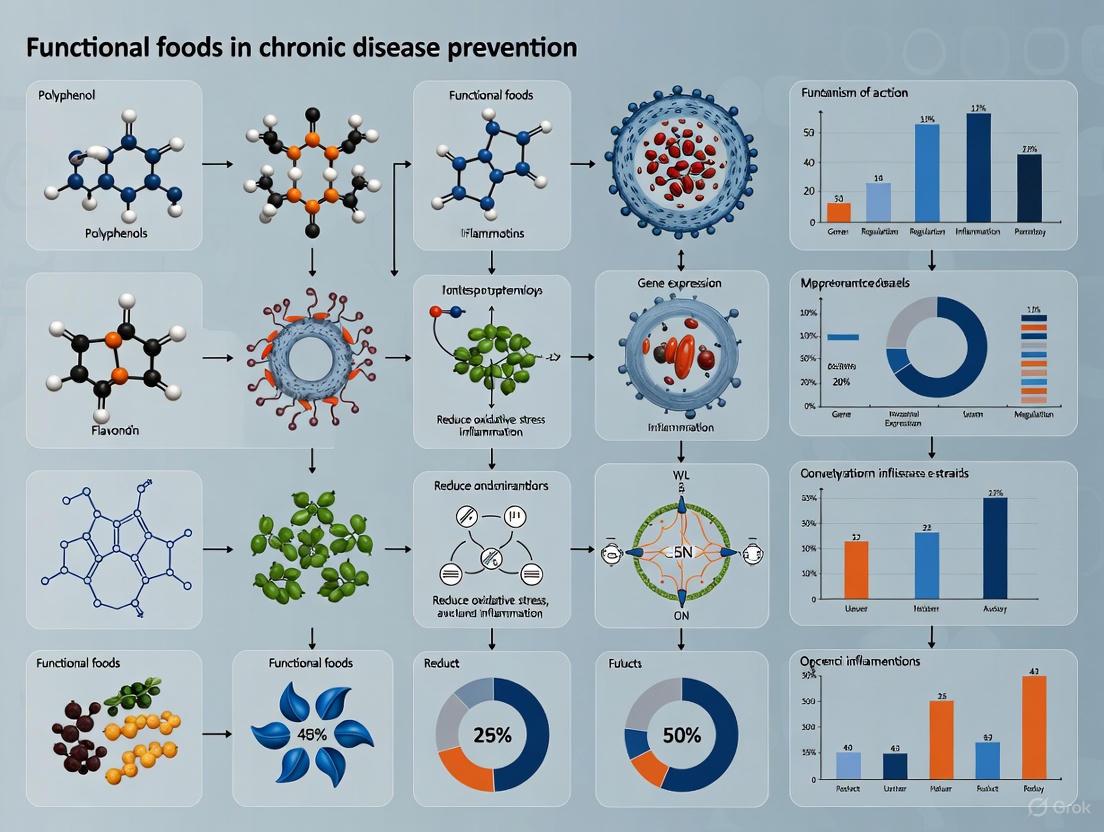
This article provides a comprehensive analysis of the role of functional foods in preventing and managing chronic diseases, tailored for researchers, scientists, and drug development professionals.
Functional Foods in Chronic Disease Prevention: Mechanisms, Clinical Evidence, and Future Research Directions
Abstract
This article provides a comprehensive analysis of the role of functional foods in preventing and managing chronic diseases, tailored for researchers, scientists, and drug development professionals. It explores the scientific foundations, from defining functional foods and their key bioactive compounds (e.g., polyphenols, probiotics, omega-3 fatty acids) to their molecular mechanisms of action, including anti-inflammatory, antioxidant, and immunomodulatory pathways. The content delves into methodological approaches for evaluating efficacy, such as clinical trial design and challenges, and applications in specific conditions like cardiovascular disease, diabetes, and cancer. It further addresses critical hurdles in the field, including bioavailability issues, regulatory landscapes, and the necessity for robust clinical evidence. Finally, the article synthesizes validation strategies and comparative effectiveness against conventional therapies, concluding with future directions in nutrigenomics, personalized nutrition, and the integration of AI and advanced delivery systems for targeted nutritional interventions.
Defining Functional Foods and Their Core Bioactive Mechanisms in Disease Pathways
The escalating global burden of chronic diseases has catalyzed a paradigm shift in nutritional science, moving from a focus on basic sustenance to the strategic use of diet for disease prevention and health optimization. This evolution has blurred the traditional boundaries between food and medicine, giving rise to the distinct categories of nutraceuticals and functional foods. These products occupy a unique position in the healthcare continuum, situated "beyond the diet, but before the drugs," and represent a promising toolbox for preventing and managing pathological conditions [1]. The growing "food as medicine" paradigm reflects a broader transformation in both scientific and public discourse, where food is increasingly recognized not merely as a source of energy but as a vehicle for targeted physiological interventions [2]. For researchers and drug development professionals, understanding the precise definitions, biological mechanisms, evidence base, and regulatory landscape governing these products is fundamental to harnessing their potential in chronic disease prevention research.
This technical guide provides a comprehensive framework for scientific audiences, delineating the core characteristics of nutraceuticals and functional foods within the context of chronic disease research. It examines their mechanisms of action, evaluates methodological approaches for evidence generation, and explores the evolving frontier of personalized nutrition. The integration of these products into mainstream healthcare requires a rigorous, evidence-based approach that transcends traditional disciplinary silos, encompassing biochemistry, clinical medicine, regulatory science, and public health [2].
Definitions and Regulatory Classifications
Conceptual Distinctions and Terminology
Despite their common goal of delivering health benefits beyond basic nutrition, nutraceuticals and functional foods represent distinct concepts, a distinction crucial for precise scientific communication and regulatory compliance.
The term "nutraceutical," a portmanteau of "nutrient" and "pharmaceutical," was originally coined by Stephen DeFelice, who defined it as a "food or part of a food that provides medical or health benefits, including the prevention and/or treatment of a disease" [1]. This concept positions nutraceuticals in a space between conventional food and pharmaceutical drugs. Nutraceuticals are typically delivered in a non-food matrix, such as capsules, tablets, or powders, and provide a concentrated form of a biologically active component [1]. In contrast, functional foods are generally consumed as part of a normal diet and deliver their active ingredients within the food matrix itself [1]. They can be either naturally occurring whole foods (e.g., fruits, vegetables, nuts, fish) or foods that have been intentionally modified through enrichment, fortification, or enhancement of beneficial components [3] [2].
Table 1: Comparative Definitions of Nutraceuticals and Related Products
| Term | Definition | Key Characteristics | Source |
|---|---|---|---|
| Nutraceutical | A food or part of a food that provides medical or health benefits, including disease prevention/treatment. | Concentrated bioactive, often in non-food matrix (e.g., pill, powder); positioned between food and drugs. | [1] |
| Functional Food | Food consumed as part of a normal diet that delivers one or more active ingredients with physiological effects within the food matrix. | Bioactive compounds delivered via food; can be natural or modified (fortified). | [1] [2] |
| Dietary Supplement (USA) | A product intended to supplement the diet containing dietary ingredients like vitamins, minerals, herbs, or amino acids. | Regulated as a category of food, not drugs. "Dietary ingredient" definition is broad. | [1] [4] |
| Food Supplement (EU) | Foodstuffs intended to supplement normal diet; concentrated sources of nutrients or other substances with nutritional/physiological effect. | Sold in dose form (capsules, tablets, etc.). | [1] [4] |
Global Regulatory Frameworks
A significant challenge in the field is the lack of a universally accepted definition and a harmonized regulatory framework for nutraceuticals. This regulatory patchwork creates complexities for research, product development, and global market access [1] [4].
- United States: The Food and Drug Administration (FDA) does not formally recognize "nutraceuticals" as a distinct regulatory category. Instead, such products are typically regulated under the Dietary Supplement Health and Education Act (DSHEA) of 1994 as "dietary supplements" [1] [4]. The FDA mandates that these products must be safe and that any health claims made on labels must be substantiated, though the evidentiary standard differs from that required for pharmaceuticals.
- European Union: The European Food Safety Authority (EFSA) does not use the term "nutraceutical" but regulates them under specific directives for food supplements (Directive 2002/46/EC) and for foods making health claims (Regulation (EC) No. 1924/2006) [4]. EFSA plays a critical role in scientifically evaluating health claims to ensure they are substantiated.
- India: The Food Safety and Standards Authority of India (FSSAI) defines "nutraceuticals" explicitly as "a food or part of a food that provides medical or health benefits, including the prevention and treatment of disease." These products must contain ingredients listed in official schedules and their nutrient levels must not exceed the Recommended Dietary Allowances (RDA) [4].
- Japan: A pioneer in this field, Japan established the concept of Foods for Specified Health Uses (FOSHU), which are functional foods with approved health claims based on scientific documentation submitted to the regulatory authority [3].
Table 2: Key Regional Regulatory Bodies and Approaches
| Region | Regulatory Body | Primary Classification | Basis for Health Claims |
|---|---|---|---|
| United States | Food and Drug Administration (FDA) | Dietary Supplements (DSHEA) | Substantiation required; structure/function claims common. |
| European Union | European Food Safety Authority (EFSA) | Food Supplements / Functional Foods | Scientific assessment of health claims is mandatory. |
| India | Food Safety & Standards Authority of India (FSSAI) | Nutraceuticals | Defined in law; ingredients must align with scheduled lists. |
| Japan | Ministry of Health, Labour and Welfare (MHLW) | FOSHU (Foods for Specified Health Uses) | Government-approved based on submitted evidence. |
Mechanisms of Action in Chronic Disease Prevention
The therapeutic potential of nutraceuticals and functional foods in chronic diseases is rooted in their ability to modulate key biological pathways and processes. Chronic conditions such as cardiovascular disease, diabetes, cancer, and neurodegenerative disorders share common underlying mechanisms, including oxidative stress, chronic inflammation, and metabolic dysregulation [2]. Bioactive compounds from food sources can directly interact with these pathways.
Key Signaling Pathways and Molecular Targets
The following diagram illustrates the primary molecular pathways through which key bioactive compounds in functional foods and nutraceuticals exert their effects to prevent or mitigate chronic diseases.
The diagram above shows how bioactive compounds target core aging and disease processes. For example, sulforaphane from cruciferous vegetables is a potent activator of the Nrf2-ARE pathway, a key regulator of cellular antioxidant response [3]. This enhances the expression of detoxifying and antioxidant enzymes, protecting cells from oxidative stress, a common contributor to cancer, neurodegenerative diseases, and cardiovascular disease [3] [2]. Similarly, compounds like curcumin (from turmeric) and flavonoids (found in fruits, tea) can inhibit the NF-κB pathway, a primary regulator of inflammation, thereby reducing the production of pro-inflammatory cytokines and mitigating the "inflammaging" process [3] [2].
The Gut Microbiome as a Mediator of Health Effects
A pivotal mechanism of action for many functional foods, particularly those containing dietary fiber, prebiotics, and polyphenols, is the modulation of the gut microbiota. Prebiotics, such as inulin and oligofructose, are selectively fermented by beneficial gut bacteria, leading to the production of short-chain fatty acids (SCFAs) like butyrate, acetate, and propionate [3]. These SCFAs have local and systemic effects: they enhance the integrity of the colonic epithelium, reduce inflammation, and upon entering the bloodstream, can influence satiety and immune function [3]. A study on a traditional Chinese herbal formula (LGS) for alcoholic liver disease demonstrated that its effect was mediated through activation of the SCFAs/GPR43/GLP-1 pathway, underscoring the critical role of the gut-liver axis [5].
Research Methodologies and Evidence Generation
Biomarkers in Nutritional Research
A major challenge in nutritional science is the accurate assessment of intake and physiological effects. Self-reported dietary data is prone to measurement errors and recall bias [6]. The use of biomarkers provides an objective tool to overcome these limitations. Nutritional biomarkers can be categorized as:
- Biomarkers of Exposure: Objective indicators of food intake. For example, alkylresorcinols in plasma are a biomarker for whole-grain consumption [6].
- Biomarkers of Effect: Indicate a biological response to a dietary intervention (e.g., changes in oxidative stress markers, inflammatory cytokines).
- Biomarkers of Health/Disease State: Reflect the overall health status or risk of disease [6].
Table 3: Select Biomarkers of Food Intake for Validating Consumption of Functional Foods
| Proposed Biomarker | Sample Type | Associated Food Intake | References |
|---|---|---|---|
| Alkylresorcinols | Plasma | Whole-grain food consumption | [6] |
| Proline Betaine | Urine | Citrus exposure | [6] |
| S-allylcysteine (SAC) | Plasma | Garlic intake | [6] |
| Daidzein, Genistein | Urine/Plasma | Soy or soy-based products | [6] |
| Lycopene | Plasma | Tomato and tomato-based products | [3] [6] |
| n-3 fatty acids (EPA, DHA) | Blood (Erythrocytes) | Fatty fish, Omega-3 supplements | [6] |
Experimental Models and Clinical Trial Design
Robust evidence generation for nutraceuticals requires a multi-phased approach, similar to pharmaceutical development, progressing from preclinical models to human clinical trials.
- Preclinical Studies (in vitro and in vivo): These studies are essential for identifying bioactive compounds, elucidating their mechanisms of action, and establishing preliminary safety profiles. In vitro models (e.g., cell cultures of cancer, endothelial, or immune cells) are used to study specific molecular interactions, such as the inhibition of carcinogen activation or the modulation of enzyme activity [3]. In vivo animal models (e.g., mice or rats fed a high-fat diet to induce obesity or hyperlipidemia) allow researchers to investigate the complex physiological effects of an intervention. For instance, black chokeberry was shown to ameliorate hyperuricemia in mice, and D-psicose reduced lipid accumulation in a mouse model of liver steatosis [5].
- Clinical Trials in Humans: Human studies are the cornerstone of evidence-based practice. Key considerations for clinical trials on nutraceuticals and functional foods include:
- Intervention Specificity: Precisely characterizing the composition, dosage, and matrix of the test material.
- Outcome Selection: Using a combination of clinical endpoint biomarkers (e.g., LDL cholesterol, HbA1c, inflammatory markers) and validated biomarkers of exposure.
- Population Selection: Defining the target population (e.g., pre-diabetic, hypercholesterolemic) and considering factors like genetics, baseline microbiome, and lifestyle.
- Study Design: Preferring randomized controlled trials (RCTs) and, where feasible, crossover designs to control for inter-individual variability. Meta-analyses of multiple RCTs then provide the highest level of evidence, as seen in studies on polyphenol-rich seeds for coronary heart disease and apple cider vinegar for glycemic control [5].
The following diagram outlines a generalized workflow for the pre-clinical and clinical validation of a functional food or nutraceutical.
The Scientist's Toolkit: Essential Research Reagents and Materials
Table 4: Key Reagents and Materials for Investigating Functional Foods and Nutraceuticals
| Item / Reagent Category | Function / Application | Specific Examples |
|---|---|---|
| Bioactive Compound Standards | Serve as reference materials for quantifying compound presence in products and biological samples; essential for assay calibration. | Curcumin, Resveratrol, Quercetin, Lycopene, Epigallocatechin gallate (EGCG), Sulforaphane. |
| Cell Culture Models | In vitro systems for high-throughput screening of bioactivity and initial mechanistic studies. | Human cancer cell lines (e.g., Caco-2, HepG2), primary endothelial cells, immune cells (e.g., macrophages). |
| Animal Disease Models | In vivo systems for studying physiological efficacy, bioavailability, and safety in a whole organism. | High-Fat Diet (HFD) induced obesity mice, hyperlipidemic rats (e.g., by oxonic acid), genetically modified models. |
| ELISA / Multiplex Assay Kits | Quantify biomarkers of effect and disease state in biological fluids and tissue homogenates. | Kits for cytokines (TNF-α, IL-6), metabolic hormones (insulin, GLP-1), oxidative stress markers (MDA, 8-OHdG). |
| -Omics Technologies | Enable global, unbiased profiling for biomarker discovery and deep mechanistic insight. | Transcriptomics (RNA-seq), Metabolomics (LC/MS, GC/MS), Microbiome analysis (16S rRNA sequencing). |
| Chromatography Systems (HPLC, LC-MS) | Separate, identify, and quantify bioactive compounds and their metabolites in complex mixtures (food, plasma, urine). | Used for pharmacokinetic studies and validating biomarkers of exposure (e.g., measuring alkylresorcinols, lycopene). |
Challenges and Future Directions in Research
Despite the promising potential, the field of nutraceuticals and functional foods faces several significant challenges that must be addressed to fully integrate them into chronic disease prevention strategies.
- Standardization and Bioavailability: A major hurdle is the inconsistent composition and potency of bioactive compounds in natural products, which can be influenced by growing conditions, processing, and storage [7]. Furthermore, many bioactive compounds suffer from low bioavailability, limiting their therapeutic potential [7] [1]. Research into innovative drug delivery systems, such as nanotechnology and encapsulation, is actively working to improve the stability, absorption, and targeted delivery of these compounds [7].
- Regulatory Hurdles and Claim Substantiation: The lack of a globally harmonized regulatory framework creates market confusion and can hinder innovation. Furthermore, the substantiation of health claims remains a complex issue. Robust, well-designed clinical trials are often needed to move beyond preliminary or structure/function claims to approved disease risk reduction claims [1] [2].
- Interindividual Variability and Personalized Nutrition: The growing field of personalized nutrition recognizes that individuals can respond differently to the same dietary intervention due to factors like genetics, gut microbiota composition, age, and metabolic health [6] [2]. The future of nutraceutical research lies in moving from a one-size-fits-all approach to targeted strategies. Advances in nutrigenomics and the use of multi-omics platforms will enable a deeper understanding of these interactions, paving the way for tailored nutritional recommendations to maximize health benefits for specific sub-populations [6] [2].
Nutraceuticals and functional foods represent a compelling and dynamic frontier in the fight against chronic diseases. For the research and drug development community, a rigorous, science-driven approach is paramount. This entails precise definitions, a deep understanding of molecular mechanisms, the application of robust methodological tools including objective biomarkers, and well-designed clinical trials to build an irrefutable evidence base. While challenges related to standardization, bioavailability, and regulation persist, they are addressable through interdisciplinary collaboration and scientific innovation. As research progresses, particularly in the realms of personalized nutrition and the gut-brain-axis, the potential of these products to contribute to a prevention-oriented healthcare paradigm is immense. Their role in promoting healthy aging and reducing the global burden of chronic disease is likely to expand significantly, solidifying their position at the critical interface between nutrition and pharmaceuticals.
Functional foods have garnered significant scientific and public health interest due to their potential to confer physiological benefits beyond basic nutritional value, positioning them as promising components in the prevention and management of chronic diseases [2]. International bodies such as the European Food Safety Authority (EFSA) and the U.S. Food and Drug Administration (FDA) define functional foods as those containing bioactive components that may contribute to combating the rising global burden of non-communicable diseases (NCDs), including cardiovascular diseases, type 2 diabetes, obesity, and certain cancers [2]. The evolving paradigm of "food as medicine" reflects a broader shift in nutritional science toward proactive, health-oriented dietary strategies.
Among the myriad of bioactive compounds, probiotics, prebiotics, polyphenols, and omega-3 fatty acids have demonstrated particular promise through extensive clinical investigation. These compounds exert their benefits through multiple mechanisms, including modulating gut microbiota, reducing inflammation, mitigating oxidative stress, and improving metabolic parameters [8] [9] [10]. This whitepaper provides a comprehensive technical overview of these key bioactive compounds, emphasizing their roles in chronic disease prevention, summarizing clinical evidence in structured tables, detailing experimental methodologies, and visualizing their mechanistic pathways for a research-focused audience.
Compound-Specific Mechanisms and Health Benefits
Probiotics
Probiotics are live microorganisms that, when administered in adequate amounts, confer health benefits on the host [8]. Strains belonging to the genera Bifidobacterium and Lactobacillus are the most widely used probiotic bacteria [8].
Mechanisms of Action: Probiotics enhance gut barrier function, competitively exclude pathogens, and modulate the immune system [8]. They have been shown to reduce pro-inflammatory cytokines such as IL-6, IL-8, and TNF-α while upregulating anti-inflammatory cytokines like IL-10 [8]. Furthermore, they contribute to the production of antimicrobial peptides and influence gut-brain axis communication [9].
Key Health Benefits: Clinical trials demonstrate probiotic efficacy in managing gastrointestinal disorders, reducing the incidence and duration of antibiotic-associated diarrhea, and alleviating symptoms of irritable bowel syndrome (IBS) [8] [10]. Meta-analyses also support their use in managing allergic rhinitis and pediatric atopic dermatitis [10].
Prebiotics
Prebiotics are indigestible food components, typically dietary fibers, that selectively stimulate the growth and/or activity of beneficial microorganisms in the colon [8] [9]. Common examples include inulin, fructooligosaccharides (FOS), and galactooligosaccharides (GOS).
Mechanisms of Action: Prebiotics resist digestion in the upper gastrointestinal tract and are fermented by colonic microbiota, primarily increasing populations of Bifidobacterium and Faecalibacterium prausnitzii [8]. This fermentation produces short-chain fatty acids (SCFAs) like acetate, propionate, and butyrate, which lower colonic pH, inhibit pathogenic bacteria, and provide energy for colonocytes [9].
Key Health Benefits: Prebiotic consumption improves bowel regularity, enhances mineral absorption (particularly calcium), and helps regulate blood glucose and insulin levels [8] [9]. They exhibit synergistic effects when combined with probiotics (as synbiotics), enhancing survival and colonization of beneficial bacteria [9].
Polyphenols
Polyphenols represent one of the most prevalent classes of bioactive metabolites in plants, encompassing flavonoids, phenolic acids, lignans, and stilbenes [10]. They are found in fruits, vegetables, tea, coffee, and whole grains.
Mechanisms of Action: Polyphenols primarily function as potent antioxidants, donating electrons to neutralize free radicals and reduce oxidative stress [11] [10]. They also modulate enzyme activity, gene expression, and cell signaling pathways, including those involved in inflammation (e.g., NF-κB), and can alter gut microbiota composition [11] [10].
Key Health Benefits: Epidemiological and clinical studies associate polyphenol intake with reduced risk of cardiovascular disease, neurodegenerative disorders, and certain cancers [10]. A recent meta-analysis indicated that polyphenols can significantly improve muscle mass in sarcopenic individuals, highlighting their therapeutic potential for age-related conditions [10].
Omega-3 Fatty Acids
Omega-3 polyunsaturated fatty acids (PUFAs), primarily eicosapentaenoic acid (EPA) and docosahexaenoic acid (DHA), are essential fats with critical roles in human physiology. They are predominantly sourced from fatty fish and certain algae and nuts.
Mechanisms of Action: Omega-3 PUFAs are incorporated into cell membranes, improving fluidity and influencing cell signaling [10]. They serve as precursors to specialized pro-resolving mediators (SPMs) that actively resolve inflammation [2]. Additionally, they can modulate gene expression via nuclear receptors such as PPARs and reduce the production of pro-inflammatory eicosanoids from omega-6 fatty acids [2].
Key Health Benefits: Supplementation with omega-3 fatty acids (0.8–1.2 g/day) significantly reduces the risk of major cardiovascular events, heart attacks, and cardiovascular death, particularly in patients with established coronary heart disease [10]. They also support cognitive function, fetal development, and mental health [2].
Table 1: Bioactive Compound Dosages and Clinical Outcomes
| Compound | Examples | Daily Intake Threshold | Pharmacological Doses | Key Clinical Outcomes | References |
|---|---|---|---|---|---|
| Polyphenols | Quercetin, Catechins, Resveratrol | 300-600 mg (Flavonoids) | 500-1000 mg (Flavonoids) | Cardiovascular protection, anti-inflammatory, improved muscle mass in sarcopenia | [10] |
| Omega-3 Fatty Acids | EPA, DHA | 250-500 mg (combined) | 800-1200 mg (combined) | 13-15% reduction in cardiovascular events; reduced triglycerides | [10] |
| Probiotics | Lactobacillus, Bifidobacterium | 10^9 - 10^10 CFU | 10^10 - 10^11 CFU | Reduced IBS symptoms, managed antibiotic-associated diarrhea | [8] [10] |
| Prebiotics | Inulin, FOS, GOS | 2-10 g | 10-15 g | Improved gut microbiota composition, enhanced mineral absorption | [8] |
Table 2: Natural Sources and Key Health Benefits of Bioactive Compounds
| Bioactive Compound | Major Food Sources | Key Health Benefits | Primary Mechanisms |
|---|---|---|---|
| Probiotics | Yogurt, kefir, kimchi, sauerkraut | GI health, immune modulation, reduced inflammation | Gut microbiota modulation, enhanced barrier function, cytokine regulation |
| Prebiotics | Chicory root, garlic, onions, asparagus | Improved bowel regularity, metabolic health | SCFA production, selective stimulation of beneficial bacteria |
| Polyphenols | Berries, green tea, dark chocolate, red wine | Antioxidant, anti-cancer, cardioprotective, neuroprotective | Free radical scavenging, enzyme inhibition, anti-inflammatory signaling |
| Omega-3 Fatty Acids | Fatty fish, flaxseeds, walnuts, chia seeds | Cardioprotective, anti-inflammatory, brain health | Cell membrane incorporation, pro-resolving mediator synthesis |
Experimental Protocols for Efficacy Assessment
Clinical Trial Design for Functional Foods
Evaluating functional foods in clinical trials involves unique complexities compared to pharmaceutical trials, including significant confounding variables from dietary habits and lifestyle factors [8].
Key Methodological Considerations:
- Study Population: Recruit subjects based on specific health criteria (e.g., diagnosed with IBS for probiotic trials, hyperlipidemic for omega-3 studies). Exclude individuals with conditions or medications that could interfere.
- Blinding and Randomization: Implement double-blind, placebo-controlled, randomized designs. Use matched placebos for sensory characteristics (taste, texture) [8].
- Dosage and Duration: Establish doses based on prior preclinical and clinical data. Intervention durations typically range from 3 weeks to 6 months, depending on the primary outcome [8] [11].
- Dietary Control: Standardize or meticulously record background diet using food diaries or 24-hour recalls to control for confounding nutrient intakes [8].
- Compliance Monitoring: Use capsule counts for supplements, and for food-based interventions, consider biomarkers (e.g., plasma polyphenol levels, omega-3 index).
Primary Outcome Measures:
- Blood Biomarkers: Lipid profile (LDL-C, HDL-C, triglycerides), inflammatory markers (CRP, TNF-α, IL-6), oxidative stress markers (MDA, SOD), glucose, and insulin [2].
- Gut Microbiota Analysis: Fecal samples analyzed via 16S rRNA sequencing to assess shifts in microbial diversity and abundance [8] [9].
- Functional Gastrointestinal Symptoms: Validated questionnaires for IBS (e.g., IBS-SSS) and bowel habit diaries [8].
In Vitro Assessment of Bioactivity
Protocol for Antioxidant Capacity Assay (e.g., for Polyphenols):
- Compound Extraction: Dissolve or extract the bioactive compound in a suitable solvent (e.g., methanol, aqueous buffer).
- DPPH Assay:
- Prepare a 0.1 mM solution of DPPH (2,2-diphenyl-1-picrylhydrazyl) in methanol.
- Mix equal volumes (e.g., 1 mL each) of the test compound solution and the DPPH solution.
- Incubate the mixture in the dark at room temperature for 30 minutes.
- Measure the absorbance at 517 nm using a spectrophotometer.
- Calculate the percentage of DPPH scavenging activity compared to a control [10].
- ORAC Assay: Measure the oxidative degradation of a fluorescent probe (e.g., fluorescein) in the presence of an peroxyl radical generator (e.g., AAPH). The area under the fluorescence decay curve is compared to a standard (e.g., Trolox) to quantify antioxidant capacity [10].
Mechanistic Pathways and Workflows
Diagram Title: Core Mechanisms of Bioactive Compounds in Disease Prevention
The Scientist's Toolkit: Research Reagent Solutions
Table 3: Essential Reagents and Materials for Bioactive Compound Research
| Research Tool | Specific Examples & Catalog Considerations | Primary Function in Research |
|---|---|---|
| Probiotic Strains | Lactobacillus acidophilus (NCFM), Bifidobacterium longum (BB536), L. rhamnosus (GG). Source from recognized culture collections (e.g., ATCC, DSMZ). | In vitro and in vivo studies on gut health, immunomodulation, and pathogen inhibition. |
| Prebiotic Substrates | Inulin (from chicory, DP 2-60), Fructo-oligosaccharides (FOS), Galacto-oligosaccharides (GOS). High-purity (>95%) grades for consistent results. | Fermentation studies, synbiotic formulation, and selective stimulation of beneficial bacteria. |
| Polyphenol Standards | Quercetin, (-)-Epigallocatechin gallate (EGCG), Resveratrol, Cyanidin-3-glucoside. Analytical standards for HPLC/LC-MS quantification. | Quantification in foods and biosamples, calibration for antioxidant assays (ORAC, DPPH). |
| Omega-3 Concentrates | Ethyl ester or triglyceride forms of EPA/DHA. Pharmaceutical-grade concentrates for clinical trials. | Intervention studies on inflammation, lipid metabolism, and cognitive function. |
| Cell-Based Assay Kits | Caco-2 cell lines (gut barrier model), LPS for inflammation induction, TEER measurement equipment, ELISA kits for cytokines (TNF-α, IL-6, IL-10). | Mechanistic studies on barrier integrity, immune response, and anti-inflammatory effects. |
| Microbiota Analysis | DNA extraction kits (e.g., QIAamp PowerFecal Pro), 16S rRNA gene primers (V3-V4 region), sequencing platforms (Illumina MiSeq). | Compositional and functional analysis of gut microbial communities in response to interventions. |
Probiotics, prebiotics, polyphenols, and omega-3 fatty acids represent four cornerstone classes of bioactive compounds with robust mechanistic pathways and compelling clinical evidence supporting their role in functional foods for chronic disease prevention. Their ability to modulate gut microbiota, reduce inflammation and oxidative stress, and improve metabolic parameters underscores the potential of targeted dietary strategies in public health.
Future research should focus on elucidating dose-response relationships, understanding synergistic effects between different bioactives, and leveraging emerging technologies like artificial intelligence and nutrigenomics to develop personalized nutrition approaches [2] [10]. Overcoming challenges related to bioactive stability, bioavailability, and ensuring scientific validity of health claims will be crucial for translating this research into effective, evidence-based functional foods that contribute to a healthier society.
Within the framework of chronic disease prevention, targeting the interconnected biological processes of oxidative stress, inflammation, and cellular senescence presents a transformative strategic approach. This whitepaper provides an in-depth technical guide to the core molecular targets within these pathways, contextualized for research on functional foods. A comprehensive understanding of these mechanisms is paramount for developing scientifically-grounded nutritional interventions aimed at extending healthspan and mitigating the burden of age-related chronic diseases [12]. The global acceleration of aging populations underscores the urgency of this research; by 2050, individuals over 65 are projected to represent 16% of the global population, making the extension of "healthspan"—the period of life free from disease—a primary objective for modern medicine [12]. This document delineates the molecular machinery driving these processes, details experimental methodologies for their investigation, and explores their modulation through functional foods, thereby offering a roadmap for researchers and drug development professionals in the field of nutritional science.
Molecular Mechanisms and Key Targets
Oxidative Stress and Redox Signaling
Oxidative stress (OS) arises from a dysregulated accumulation of reactive oxygen species (ROS), disrupting redox homeostasis and triggering pathophysiological changes across multiple organ systems [13]. While excessive ROS causes damage, at physiological levels, they act as crucial signaling molecules regulating proliferation, differentiation, and immune response [13]. The core molecular apparatus involves a balance between ROS generation and a sophisticated antioxidant defense system.
- Primary Antioxidant Enzymes: The frontline cellular defense comprises enzymes like Superoxide Dismutase (SOD), which catalyzes the conversion of superoxide anion into hydrogen peroxide; Catalase (CAT), which breaks down hydrogen peroxide to water and oxygen; and the Glutathione (GSH) and Thioredoxin (Trx) systems, which are powerful cellular disulfide reductases [13] [14]. The glutathione system, inclusive of glutathione peroxidase (GPX) and glutathione reductase (GR), is the most abundant cellular thiol antioxidant system [14].
- Key Regulatory Pathways: The Transcription Factor Nrf2 (Nuclear Factor Erythroid 2–Related Factor 2) is a master regulator of the antioxidant response. It controls the expression of over 250 genes involved in redox balance and detoxification, including those for GSH synthesis [13] [14]. The MAPK signaling pathways (e.g., ERK, p38, JNK) are also activated by ROS and influence cell survival, inflammation, and senescence decisions [13] [15].
Inflammatory Signaling Networks
Chronic, low-grade inflammation is a seminal driver of pathology in numerous chronic diseases. The inflammatory response is coordinated by intricate signaling networks that activate key transcription factors [16].
- NF-κB Pathway: A primary signaling hub for inflammation, NF-κB is typically sequestered in the cytoplasm by inhibitory IκB proteins. In response to stimuli like cytokines or pathogens, IκB is degraded, allowing NF-κB to translocate to the nucleus and induce the expression of pro-inflammatory mediators such as COX-2, iNOS, and cytokines (e.g., TNF-α, IL-1, IL-6) [16] [17].
- JAK-STAT Pathway: Cytokines binding to their receptors activate Janus kinases (JAKs), which phosphorylate and activate Signal Transducers and Activators of Transcription (STATs). STAT dimers then translocate to the nucleus to modulate the expression of genes involved in immune and inflammatory responses [17]. Different STATs have specific roles; for instance, STAT3 mediates IL-6 signaling, while STAT4 and STAT6 are involved in autoimmune and allergic responses, respectively [17].
- Inflammasome Activation: Multi-protein complexes, most notably the NLRP3 Inflammasome, can be activated by ROS and other damage signals. Their activation leads to the cleavage and secretion of potent pro-inflammatory cytokines like IL-1β and IL-18, bridging oxidative stress to inflammation [13] [16].
Cellular Senescence
Cellular senescence is an irreversible state of cell cycle arrest triggered by various stressors, including DNA damage, telomere shortening, and oxidative stress [18] [15]. While acting as a tumor-suppressive mechanism, the accumulation of senescent cells with age drives pathology through the Senescence-Associated Secretory Phenotype (SASP)—a secretome of pro-inflammatory cytokines, chemokines, and proteases that disrupts tissue structure and function [18] [15].
- Core Senescence Machinery: The p53-p21 and p16-RB tumor suppressor pathways are the central regulators of senescence execution. Stress signals like DNA damage stabilize p53, leading to p21 upregulation and cell cycle arrest. Similarly, p16 inhibits CDK4/6, preventing the phosphorylation of RB and causing G1 phase arrest [15].
- mTOR Signaling: The mTOR pathway is a critical regulator of growth and metabolism and a potent inhibitor of autophagy. Hyperactivation of mTOR impairs autophagic flux, contributing to the accumulation of damaged proteins and organelles, a feature common in neurodegenerative diseases like Alzheimer's and Parkinson's [18]. Inhibition of mTOR with compounds like rapamycin promotes autophagy and can alleviate senescence-related pathology in models.
Table 1: Core Molecular Targets and Their Functions
| Process | Key Molecular Target | Primary Function | Therapeutic Goal |
|---|---|---|---|
| Oxidative Stress | Nrf2 | Master regulator of antioxidant gene expression | Activate to enhance endogenous defense [13] |
| SOD, CAT, GSH | Enzymatic antioxidants that neutralize ROS | Boost activity to mitigate oxidative damage [13] [14] | |
| Inflammation | NF-κB | Central pro-inflammatory transcription factor | Inhibit to reduce cytokine production [16] [17] |
| NLRP3 Inflammasome | Caspase-1 activator for IL-1β/IL-18 maturation | Inhibit to suppress sterile inflammation [13] | |
| JAK-STAT | Signaling module for cytokine responses | Inhibit to modulate immune cell communication [17] | |
| Cellular Senescence | p53-p21 / p16-RB | Executors of cell cycle arrest | Transiently inhibit to clear senescent cells [15] |
| mTOR | Integrator of nutrient signals, inhibits autophagy | Inhibit to promote autophagy & mitigate senescence [18] | |
| SASP Factors (e.g., IL-6, MMPs) | Pro-inflammatory secretome of senescent cells | Suppress to limit paracrine damage [18] [15] |
Experimental Protocols for Mechanistic Investigation
Assessing Oxidative Stress Parameters
Objective: To quantify the levels of reactive oxygen species (ROS) and the activity of key antioxidant enzymes in cell culture models treated with bioactive food compounds. Workflow:
- Cell Culture & Treatment: Utilize relevant cell lines (e.g., primary fibroblasts, neuronal SH-SY5Y, hepatic HepG2). Seed cells in 6-well plates and treat with a range of concentrations of the bioactive compound (e.g., curcumin, sulforaphane) for predetermined times (e.g., 24h). Include a positive control for oxidative stress (e.g., 100-500 µM H₂O₂ for 2-6h) [13].
- ROS Measurement (DCFDA Assay):
- Harvest cells and incubate with 10 µM 2',7'-Dichlorofluorescin diacetate (DCFDA) in serum-free media for 30-45 minutes at 37°C.
- Wash cells with PBS and analyze fluorescence intensity using a flow cytometer or fluorescence plate reader (Ex/Em: 485/535 nm). Express results as percentage change relative to untreated controls [13] [14].
- Antioxidant Enzyme Activity Assays:
- SOD Activity: Use a commercial kit based on the inhibition of the reduction of a tetrazolium salt (e.g., WST-1) by superoxide anion generated by xanthine oxidase. One unit of SOD is defined as the amount that inhibits the reduction rate by 50%.
- CAT Activity: Monitor the decomposition of H₂O₂ directly by measuring the decrease in absorbance at 240 nm over time.
- GSH/GSSG Ratio: Use a fluorometric kit that utilizes o-phthalaldehyde (OPT) to differentiate between reduced glutathione (GSH) and oxidized glutathione (GSSG). A high GSH/GSSG ratio indicates a reduced cellular state [14].
Evaluating Senescent Cell Burden and SASP
Objective: To identify and quantify senescent cells and their secretory profile in vitro and in vivo following intervention with senolytic or senostatic candidates. Workflow:
- Induction of Senescence: Induce senescence in cells (e.g., IMR-90 fibroblasts) by exposure to 100-200 µM H₂O₂ for 2 hours, serial passaging until replicative exhaustion, or treatment with 10 Gy ionizing radiation. Allow senescence to establish for 5-7 days post-insult [18] [15].
- Senescence Markers Staining:
- SA-β-Gal Staining: The most widely used biomarker. Fix cells and incubate with the X-Gal substrate solution at pH 6.0 overnight at 37°C (non-hypoxic conditions). Senescent cells stain blue. Quantify by counting positive cells in at least three random fields per sample [18].
- Immunofluorescence for p16 and p21: Fix, permeabilize, and block cells. Incubate with primary antibodies against p16INK4a (e.g., mouse monoclonal, 1:100) and p21WAF1/Cip1 (e.g., rabbit polyclonal, 1:200), followed by appropriate fluorescently-labeled secondary antibodies. Counterstain nuclei with DAPI and visualize via fluorescence microscopy [15].
- SASP Analysis:
- Conditioned Media Collection: Culture senescent cells in serum-free media for 24-48 hours. Collect the conditioned media, centrifuge to remove debris, and store at -80°C.
- Cytokine Profiling: Quantify SASP factors (e.g., IL-6, IL-1β, IL-8, MMP-3) using a multiplex bead-based immunoassay (e.g., Luminex) or specific ELISAs, following manufacturer protocols [15].
The following diagram illustrates the logical workflow and key assessment endpoints for these experimental protocols.
Signaling Pathway Diagrams
Nrf2 Antioxidant Response Pathway
The Nrf2-ARE pathway is a primary cellular defense mechanism against oxidative stress and electrophilic toxicants. Under basal conditions, Nrf2 is bound to its negative regulator, Keap1, in the cytoplasm and targeted for proteasomal degradation. Upon oxidative stress or exposure to electrophiles, this interaction is disrupted, allowing Nrf2 to stabilize, translocate to the nucleus, heterodimerize with small Maf proteins, and bind to the Antioxidant Response Element (ARE). This transactivates genes encoding a network of cytoprotective proteins, including antioxidant enzymes, Phase II detoxification enzymes, and drug transporters [13] [14].
Cellular Senescence Core Pathways
Cellular senescence can be triggered by diverse stressors, including telomere shortening (replicative senescence), DNA damage, oxidative stress, and oncogene activation. These stimuli converge on two main tumor suppressor pathways: the p53-p21 and p16-RB axes. Activation of these pathways leads to irreversible cell cycle arrest. Senescent cells subsequently develop the Senescence-Associated Secretory Phenotype (SASP), characterized by the secretion of pro-inflammatory cytokines, chemokines, and growth factors, which drives chronic inflammation and tissue dysfunction [18] [15].
The Scientist's Toolkit: Research Reagent Solutions
Table 2: Essential Reagents for Investigating Target Pathways
| Reagent / Assay | Primary Function / Target | Example Application in Research |
|---|---|---|
| DCFDA / H2DCFDA | Fluorescent probe for detecting intracellular ROS (H₂O₂, peroxides) [13] [14] | Quantifying general oxidative stress in cell cultures after treatment with pro-oxidants or antioxidants. |
| Anti-p16 & Anti-p21 Antibodies | Immunodetection of key cyclin-dependent kinase inhibitors [18] [15] | Immunofluorescence or Western Blot to confirm senescence induction in cellular models. |
| SA-β-Gal Staining Kit | Histochemical detection of lysosomal β-galactosidase activity at pH 6.0 [18] | Identifying senescent cells in vitro (cell culture) and in situ (tissue sections). |
| Luminex xMAP Technology | Multiplexed, bead-based immunoassay for quantifying soluble analytes [15] | Profiling the complex mixture of cytokines and chemokines in SASP or inflammatory conditioned media. |
| Nrf2 Activators (e.g., Sulforaphane) | Induces Nrf2 dissociation from Keap1 and translocation to nucleus [13] [3] | Used as a positive control to study the Nrf2-ARE pathway and upregulation of antioxidant genes. |
| mTOR Inhibitors (e.g., Rapamycin) | Specifically inhibits mTORC1, inducing autophagy and exerting senomorphic effects [18] | Testing the role of mTOR-driven synthesis and autophagy in senescence and protein aggregation diseases. |
| Senolytics (e.g., Dasatinib + Quercetin) | Selective induction of apoptosis in senescent cells by targeting pro-survival pathways (SCAPs) [18] [15] | Clearing senescent cells in vitro and in vivo to establish causal roles of senescence in disease models. |
Application in Functional Foods Research
The molecular targets described above provide a scientific basis for the efficacy of functional foods and their bioactive constituents. A growing body of preclinical and clinical evidence demonstrates that specific compounds can modulate these pathways, thereby counteracting oxidative stress, inflammation, and cellular senescence [3] [12] [19].
- Polyphenols: Compounds like curcumin (turmeric) and resveratrol (grapes, pomegranates) exhibit potent antioxidant and anti-inflammatory properties. They can activate Nrf2 and inhibit NF-κB signaling, thereby enhancing cellular defense and reducing inflammation [3]. Quercetin (apples), besides its antioxidant activity, has demonstrated senolytic properties, selectively eliminating senescent cells, especially when combined with dasatinib [18] [12].
- Sulforaphane: Found abundantly in cruciferous vegetables like broccoli, sulforaphane is a well-characterized potent activator of the Nrf2-ARE pathway. It promotes the expression of Phase II detoxification and antioxidant enzymes, offering protection against carcinogens and oxidative damage [3].
- Epigallocatechin Gallate (EGCG): A major catechin in green tea, EGCG has widespread pharmacological properties, including anti-inflammatory and autophagy-modulating effects, which are relevant in cancer and neurodegenerative contexts [3].
- Dietary Patterns: The Mediterranean Diet, rich in fruits, vegetables, nuts, and olive oil, provides a synergistic combination of these bioactive compounds. Adherence to this diet has been correlated with improved brain health, reduced systemic inflammation, and deceleration of aging, likely through the combined modulation of the oxidative, inflammatory, and senescence pathways discussed herein [12].
The intricate interplay between oxidative stress, inflammation, and cellular senescence forms a core axis of aging and chronic disease pathogenesis. Targeting the key molecular players within these processes—Nrf2, NF-κB, p53/p16, and mTOR—offers a robust scientific foundation for the development of preventive and therapeutic strategies. Functional foods, enriched with bioactive compounds capable of modulating these targets, represent a promising, multilayered approach to public health. For researchers and drug development professionals, leveraging the experimental tools and mechanistic insights outlined in this whitepaper is essential for validating the efficacy of nutraceuticals, designing targeted functional foods, and translating these findings into clinical applications that can ultimately extend healthspan and reduce the global burden of chronic age-related diseases.
The gut-microbiota-brain axis (GMBA) represents one of the most dynamic interfaces in nutritional neuroscience, serving as a critical communication pathway linking dietary intake, microbial metabolism, and brain function. This technical review examines the mechanistic role of functional foods in modulating epigenetic regulation through this complex axis, with specific implications for chronic disease prevention. We synthesize emerging evidence demonstrating how bioactive food components influence DNA methylation, histone modifications, and non-coding RNA expression via microbiota-derived metabolites, ultimately reprogramming host gene expression and disease susceptibility. For research scientists and drug development professionals, this review provides a comprehensive analysis of current experimental methodologies, key signaling pathways, and essential research tools for investigating nutri-epigenetic mechanisms within the GMBA framework.
The gut-microbiota-brain axis constitutes a sophisticated, bidirectional communication network integrating neural, endocrine, immune, and metabolic signaling pathways between the gastrointestinal tract and central nervous system [20] [21]. Within this framework, the gut microbiota—comprising approximately 100 trillion microorganisms—functions as a active transducer of dietary signals, converting nutritional inputs into biologically active metabolites that systemically influence host physiology [22] [21]. The genetic capacity of this microbial ecosystem exceeds the human genome by approximately 150-fold, positioning it as a powerful intermediary in nutrition-host interactions [21].
Functional foods, defined as foods containing bioactive components that confer physiological benefits beyond basic nutrition, represent a promising therapeutic avenue for modulating GMBA communication [23] [2]. International regulatory bodies including EFSA and FDA recognize their potential in preventing and managing chronic non-communicable diseases through targeted biological mechanisms [2]. Crucially, many bioactive compounds within functional foods exert their effects not only directly but indirectly through microbiota-mediated biotransformation, producing metabolites with enhanced bioactivity and bioavailability [22].
Epigenetic regulation provides the molecular framework through which diet-induced microbial metabolites exert lasting effects on gene expression without altering DNA sequences [24]. The three primary epigenetic mechanisms—DNA methylation, histone modifications, and non-coding RNA-associated gene silencing—respond dynamically to environmental influences, including nutritional factors [24]. Recent advances demonstrate that microbiota-derived metabolites such as short-chain fatty acids (SCFAs), indoles, and bile acid derivatives function as epigenetic modifiers, creating a direct pathway by which functional foods can reprogram host gene expression and influence disease trajectories [20] [22].
Within the context of chronic disease prevention, understanding the precise mechanisms through which functional foods modulate the GMBA via epigenetic regulation represents a frontier in nutritional science and preventive medicine [2]. This review systematically examines these mechanisms, experimental approaches for their investigation, and translationally relevant findings for researchers and drug development professionals.
Mechanistic Foundations: Microbial Metabolites as Epigenetic Regulators
The molecular mechanisms through which gut microbiota influence host epigenetics involve several classes of microbial metabolites that directly modulate epigenetic enzymes or serve as essential co-factors in epigenetic reactions. The table below summarizes the key metabolite classes, their dietary sources, and primary epigenetic mechanisms.
Table 1: Microbial Metabolites with Epigenetic Regulatory Functions
| Metabolite Class | Primary Dietary Precursors | Producing Bacteria | Epigenetic Mechanisms | Biological Effects |
|---|---|---|---|---|
| Short-chain fatty acids (SCFAs) | Dietary fiber, resistant starch | Faecalibacterium, Eubacterium, Ruminococcus | HDAC inhibition, GPCR signaling [21] | Enhanced blood-brain barrier integrity, microglial maturation, reduced neuroinflammation [22] [21] |
| Polyphenol metabolites | Polyphenol-rich foods (berries, tea, cocoa) | Lactobacillus, Bifidobacterium | DNMT modulation, histone acetylation [25] | Antioxidant, anti-inflammatory, neuroprotective effects [22] |
| Bile acid derivatives | Dietary cholesterol | Bacteroides, Clostridium | FXR, TGR5 receptor signaling [22] | Regulation of neuroinflammation, mitochondrial function, BDNF-CREB signaling [22] |
| Indoles and tryptophan metabolites | Dietary tryptophan (protein) | Bacteroides, Bifidobacterium | AHR receptor activation [26] | Serotonin synthesis, neurogenesis, blood-brain barrier integrity [26] [22] |
Short-Chain Fatty Acids (SCFAs) and HDAC Inhibition
Short-chain fatty acids—primarily acetate, propionate, and butyrate—are the most extensively studied microbial metabolites with epigenetic activity [21]. Produced through bacterial fermentation of indigestible carbohydrates, SCFAs circulate systemically and readily cross the blood-brain barrier, with measured concentrations in human cerebrospinal fluid ranging from 0-171 mM for acetate, 0-6 mM for propionate, and 0-2.8 mM for butyrate [21].
The primary epigenetic mechanism of SCFAs involves histone deacetylase (HDAC) inhibition, particularly by butyrate, which increases histone acetylation and subsequently alters gene expression in both peripheral tissues and the central nervous system [22] [21]. Butyrate's HDAC inhibitory activity enhances synaptic plasticity, supports blood-brain barrier function through tight junction protein upregulation, and promotes microglial maturation [22] [21]. Additionally, SCFAs activate G protein-coupled receptors (FFAR2/FFAR3), initiating signaling cascades that influence neuroimmune function and inflammatory responses [21].
Food-Derived DNMT Modulators
Beyond microbial metabolites, numerous bioactive food compounds directly influence DNA methylation by modulating DNA methyltransferase (DNMT) activity [25]. A comprehensive systematic review identified several food-derived DNMT modulators with significant potential for healthy aging and chronic disease prevention [25].
Table 2: Food-Derived Compounds with DNMT Modulatory Activity
| Bioactive Compound | Dietary Sources | Epigenetic Mechanism | Research Evidence |
|---|---|---|---|
| Epigallocatechin-3-gallate (EGCG) | Green tea | DNMT inhibition [25] | Experimental and clinical studies |
| Curcumin | Turmeric | DNMT modulation [25] | Experimental and clinical studies |
| Genistein | Soy | DNMT inhibition [25] | Experimental and clinical studies |
| Resveratrol | Red wine, grapes | DNMT modulation [25] | Experimental and clinical studies |
| Sulforaphane | Broccoli, cruciferous vegetables | DNMT inhibition [25] | Experimental and clinical studies |
| Folate | Leafy greens, legumes | Methyl donor for DNA methylation [24] | Clinical studies |
These compounds function as "natural epigenetic switches," reversibly modifying DNA methylation patterns to influence gene expression networks involved in inflammation, oxidative stress response, and cellular aging [25]. The bidirectional nature of these modifications highlights the potential for nutritional interventions to dynamically reprogram disease-associated epigenetic marks.
Experimental Approaches and Methodologies
Investigating the complex interactions between functional foods, gut microbiota, and epigenetic regulation requires integrated experimental approaches spanning nutritional science, microbiology, and epigenomics. Below, we outline key methodological frameworks and their applications in GMBA research.
Epigenome-Wide Association Studies (EWAS) in Nutritional Research
Epigenome-wide association studies (EWAS) have emerged as a powerful discovery platform for identifying DNA methylation patterns associated with dietary exposures [27]. Modern array-based technologies, particularly the Illumina Infinium HumanMethylation450K and MethylationEPIC BeadChips, enable simultaneous profiling of over 850,000 CpG sites, providing comprehensive coverage of the methylome [27].
A recent scoping review of nutritional EWAS identified consistent associations between dietary factors and methylation at nine CpG sites in genes including AHRR, CPT1A, and FADS2, with fatty acid consumption and specific dietary patterns showing particularly strong epigenetic signatures [27]. These studies typically employ robust statistical models adjusting for age, sex, smoking status, white blood cell composition, and technical covariates to control for potential confounding [27].
Diagram 1: EWAS Workflow for Nutritional Epigenetics
Integrated Multi-Omics Approaches
Integrated multi-omics frameworks provide a comprehensive systems biology approach to unravel the complex relationships between diet, gut microbiota, and host epigenetics [27] [22]. This strategy combines data from multiple molecular profiling platforms:
- Metabolomics: High-resolution mass spectrometry and NMR spectroscopy characterize the fecal and serum metabolome, identifying microbial metabolites correlated with dietary patterns [27]
- Microbiome sequencing: 16S rRNA and shotgun metagenomic sequencing assess microbial community structure and functional potential [20] [22]
- Epigenomic profiling: DNA methylation arrays or bisulfite sequencing capture genome-wide methylation patterns [27]
- Transcriptomics: RNA sequencing evaluates gene expression changes in target tissues [24]
The correlation between self-reported dietary intake and metabolomic data is typically modest (r = 0.3-0.4), highlighting the value of objective biomarkers such as urinary proline betaine for citrus fruit intake or chlorophyll-derived metabolites for leafy green vegetable consumption [27]. Mediation analyses can then determine whether microbial metabolites statistically mediate the relationship between dietary exposures and epigenetic changes, establishing potential mechanistic pathways [27].
Fecal Microbiota Transplantation (FMT) Protocols
Fecal microbiota transplantation provides a direct experimental approach for establishing causal relationships between gut microbiota composition, functional food interventions, and epigenetic outcomes [20]. Standardized FMT protocols have been adapted for nutritional neuroscience research:
Donor Selection and Screening: Healthy donors following specific dietary patterns (e.g., Mediterranean diet) or patients with documented conditions provide fecal material. Comprehensive screening excludes pathogens and ensures metabolic health [20].
Sample Preparation: Fresh stool is homogenized in sterile saline solution (typically 1:5 w/v ratio) and filtered to remove particulate matter. For long-term storage, material is frozen at -80°C with cryoprotectants [20].
Recipient Preparation: Animal models (typically germ-free or antibiotic-treated mice) receive antibiotic cocktails for 3-5 days to deplete endogenous microbiota before FMT [20].
Transplantation Procedure: Recipients receive FMT via oral gavage (100-200μL for mice) or colonoscopy injection daily for 5-7 days. Subsequent functional food interventions are introduced after confirmed engraftment [20].
Outcome Assessment: Epigenetic changes in target tissues (colon, liver, brain), microbial composition (16S sequencing), metabolite profiling (SCFAs, bile acids), and phenotypic outcomes (behavior, metabolism) are assessed post-intervention [20].
Animal studies using this approach have demonstrated that transplantation of microbiota from patients with anorexia nervosa to germ-free mice results in reduced weight gain compared to mice receiving microbiota from healthy controls, establishing a causal role for gut microbes in weight regulation [20].
Signaling Pathways in the Gut-Microbiota-Brain Axis
The GMBA comprises multiple interconnected signaling pathways through which microbial metabolites influence brain function and epigenetic regulation. The following diagram illustrates the primary communication routes.
Diagram 2: GMBA Signaling Pathways
The SCFAs-Microglia Pathway
The SCFAs-microglia pathway represents a particularly well-characterized communication route within the GMBA [21]. Butyrate and other SCFAs directly influence microglial homeostasis through multiple mechanisms:
- HDAC inhibition: Butyrate increases histone acetylation in microglia, promoting a homeostatic phenotype and enhancing phagocytic activity [21]
- Receptor-mediated signaling: SCFAs activate FFAR2 and FFAR3 on microglia, though receptor expression appears context-dependent and potentially regulated by sustained SCFA exposure [21]
- Metabolic reprogramming: SCFAs influence microglial energy metabolism, supporting their surveillance functions [21]
This pathway demonstrates robust epigenetic regulation of brain immune cells by microbiota-derived metabolites, with implications for neurodegenerative conditions including Alzheimer's disease, Parkinson's disease, and autism spectrum disorders [21].
Neuroendocrine and Immune Signaling
Beyond direct epigenetic mechanisms, functional foods influence brain function through microbiota-modulated neuroendocrine and immune signaling:
- HPA axis regulation: Chronic psychological stress activates the hypothalamic-pituitary-adrenal axis, elevating cortisol levels and disrupting gut barrier function. The resulting microbial translocation promotes systemic inflammation that can exacerbate neurological conditions [28]. Probiotic and prebiotic interventions can dampen HPA responsiveness and restore homeostasis [26].
- Neurotransmitter synthesis: Gut microbes significantly influence serotonin production, with approximately 95% synthesized in intestinal enterochromaffin cells through microbial-dependent mechanisms [22]. Specific strains including Lactobacillus and Bacillus species contribute to GABA and serotonin synthesis, directly impacting mood and cognition [26] [22].
- Immune activation: Microbiota dysbiosis can compromise intestinal barrier integrity, permitting translocation of lipopolysaccharides (LPS) that trigger systemic inflammation via TLR4-MyD88-NF-κB signaling, ultimately increasing blood-brain barrier permeability and promoting neuroinflammation [22] [28].
The Scientist's Toolkit: Research Reagent Solutions
Investigating epigenetic regulation within the GMBA requires specialized research tools and reagents. The following table details essential materials for experimental workflows in this field.
Table 3: Essential Research Reagents for GMBA-Epigenetics Investigations
| Reagent Category | Specific Examples | Research Application | Technical Considerations |
|---|---|---|---|
| DNA Methylation Analysis | Illumina MethylationEPIC BeadChip, EZ-96 DNA Methylation Kit | Genome-wide methylation profiling, targeted methylation analysis | Covers >850,000 CpG sites; bisulfite conversion efficiency critical [27] |
| Histone Modification Analysis | HDAC Activity Assay Kit, Histone Extraction Kit, acetylated histone antibodies | Quantifying HDAC inhibition, histone modification profiling | SCFAs particularly butyrate are potent HDAC inhibitors [21] |
| Microbiome Profiling | 16S rRNA primers (V3-V4), MOBIO PowerSoil DNA Isolation Kit, ZymoBIOMICS Microbial Standards | Microbial community analysis, DNA extraction standardization | Shotgun metagenomics provides functional insights beyond 16S [20] |
| SCFA Measurement | GC-MS systems, SCFA standards (acetate, propionate, butyrate) | Quantifying SCFA concentrations in feces, serum, brain | Physiological ratios: acetate>propionate>butyrate; fecal vs. systemic levels differ [21] |
| Gnotobiotic Models | Germ-free mice, antibiotic cocktails (ampicillin, neomycin, vancomycin) | Establishing causal microbiota roles | Antibiotic depletion followed by FMT enables colonization studies [20] |
| Gut Barrier Function | FITC-dextran, ELISA for zonulin, lipopolysaccharide (LPS) | Intestinal permeability assessment, microbial translocation | LPS triggers TLR4-mediated neuroinflammation [22] [28] |
Research Gaps and Future Directions
Despite significant advances in understanding the GMBA, several research challenges remain. Longitudinal studies with repeated omics measurements are needed to establish temporal relationships between dietary interventions, microbial shifts, and epigenetic changes [27]. The field also suffers from insufficient ethnic diversity in study populations, limiting generalizability of findings [27]. Furthermore, causal pathways in human studies remain difficult to establish, requiring innovative experimental designs and statistical approaches [27].
Future research directions should prioritize:
- Personalized nutrition approaches: Accounting for individual variability in microbiota composition that influences phytochemical biotransformation efficiency [22]
- Advanced multi-omics integration: Combining epigenomics, metabolomics, and metagenomics with machine learning to identify predictive biomarkers [27] [2]
- Microbiota-targeted interventions: Developing specific probiotic strains and prebiotic formulations designed to produce epigenetic-active metabolites [26] [2]
- Human trials with epigenetic endpoints: Conducting randomized controlled trials specifically designed with epigenetic outcomes as primary endpoints [24]
The gut-microbiota-brain axis represents a fundamental interface through which functional foods influence epigenetic regulation and brain health. Microbial metabolites, particularly SCFAs, function as key epigenetic modifiers that translate dietary signals into stable gene expression changes. Integrated experimental approaches combining EWAS, metabolomics, and microbial sequencing provide powerful tools for deciphering these complex interactions. As research advances, targeted nutritional interventions based on individual microbiota composition hold significant promise for preventing and managing chronic neurological and metabolic diseases through epigenetic mechanisms. For drug development professionals, understanding these pathways offers opportunities for novel therapeutic approaches that leverage dietary components and microbial metabolites to modulate disease-associated epigenetic patterns.
This whitepaper provides a technical examination of the systemic effects of functional food bioactive compounds, focusing on their anti-inflammatory, antioxidant, and immunomodulatory mechanisms. Within the framework of chronic disease prevention, we synthesize evidence from recent preclinical and clinical studies (2015-2025) to elucidate how specific nutrients modulate key signaling pathways, influence immune function, and reduce oxidative stress. The analysis includes standardized quantitative data on bioactive compounds, detailed experimental methodologies for assessing inflammatory and immune responses, and visualizations of critical molecular pathways. This resource aims to support researchers and drug development professionals in advancing the scientific foundation for functional food applications in public health and therapeutic strategies.
The rising global burden of non-communicable diseases (NCDs)—including cardiovascular diseases, type 2 diabetes, and certain cancers—has intensified scientific interest in dietary strategies for disease prevention [2]. Functional foods, defined as foods containing bioactive components that confer physiological benefits beyond basic nutrition, represent a promising approach to modulating physiological functions and reducing disease risk [2]. The paradigm of "food as medicine" reflects a significant shift in nutritional science toward proactive, health-oriented dietary strategies.
Chronic diseases are fundamentally linked to aging processes, particularly cellular senescence, oxidative stress, and chronic low-grade inflammation known as "inflammaging" [2] [29]. These processes create a pathological foundation for NCD development and progression. Bioactive compounds in functional foods—including vitamins, minerals, polyphenols, omega-3 fatty acids, and probiotics—can modulate key molecular pathways such as sirtuins, mTOR, AMPK, and Nrf2, thereby influencing inflammation, oxidative stress, and immune responses [2]. This whitepaper examines the anti-inflammatory, antioxidant, and immunomodulatory actions of these bioactive compounds, providing researchers with technical details, experimental protocols, and mechanistic insights to support future investigations into functional foods for chronic disease prevention.
Anti-inflammatory Actions of Bioactive Compounds
Mechanisms and Pathways
Chronic, low-grade inflammation is a central pathological process in many NCDs. Functional food compounds modulate inflammation primarily through the inhibition of the nuclear factor kappa B (NF-κB) signaling pathway, which serves as a master regulator of inflammatory gene expression. Bioactive compounds can block the activation of NF-κB, thereby reducing the production of pro-inflammatory cytokines such as tumor necrosis factor-alpha (TNF-α), interleukin-6 (IL-6), and interleukin-1 beta (IL-1β) [30]. Omega-3 fatty acids, specifically eicosapentaenoic acid (EPA) and docosahexaenoic acid (DHA), exert anti-inflammatory effects by serving as precursors to specialized pro-resolving mediators (SPMs)—including resolvins and protectins—that actively promote the resolution of inflammation [30].
Polyphenols, such as flavonoids from berries, tea, and olive oil, modulate the mitogen-activated protein kinase (MAPK) pathway and enhance the activity of nuclear factor erythroid 2-related factor 2 (Nrf2), a transcription factor that activates antioxidant response elements [30]. Probiotics and prebiotics influence inflammation through the gut-immune axis by altering gut microbiota composition, stimulating short-chain fatty acid (SCFA) production, and promoting regulatory T cell (Treg) activation, which enhances immune tolerance and reduces systemic inflammation [30].
Figure 1: Anti-inflammatory Signaling Pathways. This diagram illustrates the mechanisms by which bioactive food compounds inhibit pro-inflammatory pathways and promote inflammation resolution through multiple molecular targets.
Quantitative Evidence and Clinical Biomarkers
Recent large-scale studies have provided quantitative evidence supporting the anti-inflammatory potential of specific dietary patterns. The empirical Anti-inflammatory Diet Index (eADI) developed in 2025 identified 17 food groups (11 anti-inflammatory, 6 pro-inflammatory) significantly correlated with inflammatory biomarkers [31]. Each 4.5-point increment in the eADI-17 score was associated with significantly lower concentrations of inflammatory biomarkers: 12% lower for high-sensitivity C-reactive protein (hsCRP), 6% lower for IL-6, 8% lower for TNF-R1, and 9% lower for TNF-R2 [31].
Table 1: Anti-inflammatory Diet Index (eADI) Food Groups and Biomarker Correlations
| Food Group | Effect Direction | Correlation with hsCRP | Correlation with IL-6 |
|---|---|---|---|
| Whole grains | Anti-inflammatory | -0.17 | -0.23 |
| Fatty fish | Anti-inflammatory | -0.17 | -0.23 |
| Leafy green vegetables | Anti-inflammatory | -0.17 | -0.23 |
| Berries | Anti-inflammatory | -0.17 | -0.23 |
| Nuts | Anti-inflammatory | -0.17 | -0.23 |
| Olive oil | Anti-inflammatory | -0.17 | -0.23 |
| Processed meats | Pro-inflammatory | 0.17 | 0.23 |
| Sugar-sweetened beverages | Pro-inflammatory | 0.17 | 0.23 |
| Refined grains | Pro-inflammatory | 0.17 | 0.23 |
Data derived from the development and validation of the eADI-17 in a cross-sectional study of 4,432 men [31]. Spearman correlation coefficients are shown for selected biomarkers.
The Mediterranean diet, rich in fruits, vegetables, fatty fish, and whole grains, has demonstrated significant reductions in systemic inflammation biomarkers, including C-reactive protein (CRP) and interleukin-6 (IL-6) [32]. Clinical trials report that this dietary pattern can decrease CRP levels by approximately 20% and IL-6 by 15% in individuals with metabolic syndrome [32].
Antioxidant Actions and Oxidative Stress Modulation
Mechanisms of Antioxidant Protection
Antioxidants in functional foods neutralize reactive oxygen species (ROS) and mitigate oxidative stress, a key pathophysiological mechanism in chronic diseases. These compounds employ diverse protective mechanisms: vitamin C (ascorbic acid) is a water-soluble antioxidant that scavenges free radicals in aqueous cellular environments and regenerates other antioxidants, including vitamin E [33]. Vitamin E, a fat-soluble antioxidant, integrates into cell membranes and protects against lipid peroxidation, a destructive process that damages cellular and organelle membranes [33].
Minerals such as selenium and zinc serve as essential cofactors for endogenous antioxidant enzymes. Selenium is a core component of glutathione peroxidase, one of the most potent antioxidant enzymes produced by the body, while zinc inhibits NADPH oxidase-induced ROS production and preserves redox equilibrium [33] [29]. Phytochemicals, particularly polyphenols like flavonoids and carotenoids, represent the most diverse class of antioxidants. These compounds often act synergistically, combining direct free radical scavenging with anti-inflammatory activities that enhance cellular protection [33]. Carotenoids also demonstrate photoprotective effects by quenching singlet oxygen species and supporting collagen biosynthesis [33].
Figure 2: Antioxidant Defense Mechanisms. This diagram illustrates how different classes of dietary antioxidants work through complementary mechanisms to neutralize oxidative stress and protect cellular components from damage.
Quantitative Assessment of Antioxidant Capacity
The antioxidant capacity of foods can be quantitatively measured using various assays, with the Ferric Reducing Antioxidant Power (FRAP) assay providing values in mmol per 100 g. Research has identified specific foods with exceptionally high antioxidant capacity, led by spices and herbs.
Table 2: Antioxidant Capacity of Selected Foods (FRAP Assay)
| Food Item | Antioxidant Capacity (mmol/100 g) | Primary Antioxidant Compounds |
|---|---|---|
| Clove, ground | 465.32 | Phenolic compounds (eugenol) |
| Amla, dried | 261.53 | Vitamin C, flavonoids |
| Peppermint, dried | 160.82 | Flavonoids, phenolic acids |
| Cinnamon, ground | 139.89 | Polyphenols, cinnamaldehyde |
| Oregano, dried | 96.64 | Phenolic acids, flavonoids |
| Walnut, with pellicle | 33.29 | Vitamin E, polyphenols |
| Cocoa powder | 13.74 | Flavonoids, proanthocyanidins |
| Blueberries | 9.24 | Anthocyanins, vitamin C |
| Blackcurrant, fresh | 8.15 | Anthocyanins, vitamin C |
| Raspberry, fresh | 4.20 | Ellagitannins, vitamin C |
Data adapted from composite dietary antioxidant analysis [33]. The FRAP assay measures the ferric reducing ability of foods, with higher values indicating greater antioxidant potential.
Epidemiological studies using the Composite Dietary Antioxidant Index (CDAI) have demonstrated that individuals with higher overall antioxidant intake exhibit a markedly lower prevalence of cardiovascular disease, reinforcing the benefits of diverse antioxidant-rich foods [33]. Longitudinal data show that greater dietary antioxidant intake from whole foods, rather than supplements, is associated with reduced cardiovascular and cancer risk [33].
Immunomodulatory Actions of Functional Food Components
Mechanisms of Immune Regulation
Functional food components modulate both innate and adaptive immunity through multiple mechanisms. Vitamin D has garnered significant attention for its multifaceted immunomodulatory effects. Upon activation to calcitriol, it binds to the vitamin D receptor (VDR) expressed on immune cells, downregulating pro-inflammatory cytokines while enhancing anti-inflammatory cytokines like IL-10 [30]. Vitamin D also promotes the differentiation and function of regulatory T cells (Tregs), facilitating immune tolerance [30] [29].
Zinc is essential for the development and functioning of immune cells, supporting intracellular nucleotide pools, prostaglandin synthesis, and cytokine production [34] [29]. Zinc deficiency slows development, activation and maturation of lymphocytes and impairs the phagocytic capacity of macrophages [34]. Selenium affects the humoral and cellular immune response by interacting with non-specific macrophages as well as T and B lymphocytes, influencing the balance between Th1 and Th2 responses [34].
Probiotics significantly impact the gut-immune axis, which comprises 75% of the lymphoid cells of the entire immune system [34]. Strains of Lactobacillus and Bifidobacterium stimulate secretion of IFN-γ and IL-12 by Th1 lymphocytes, enhance NK cell activity, and promote production of anti-inflammatory cytokines TGF-β and IL-10 [34]. These mechanisms collectively enhance mucosal immunity and promote systemic immune homeostasis.
Clinical Evidence and Quantitative Outcomes
Clinical studies demonstrate that functional ingredients support immune function via multiple pathways, with benefits including reduced risk of respiratory infections and enhanced vaccine responses [30]. A 2021 survey-based study of 120 individuals found that natural nutrient consumption (vitamin C, iron, selenium, omega-3 fatty acids) from whole foods positively affected immunity, evidenced by lower incidences and milder courses of infection [34].
Vitamin D supplementation has been correlated with sporadic incidence of viral infections, with meta-analyses showing that correcting deficiencies may reduce the frequency and severity of respiratory infections [30]. In aging populations, micronutrient supplementation has shown potential to counteract immunosenescence by restoring cellular homeostasis and reducing inflammation [29].
Table 3: Immunomodulatory Effects of Selected Micronutrients
| Micronutrient | Key Immune Functions | Target Cells | Clinical Outcomes |
|---|---|---|---|
| Vitamin D | Promotes Treg differentiation; Downregulates pro-inflammatory cytokines; Enhances macrophage function | Macrophages, Dendritic cells, T cells | Reduced respiratory infection risk; Enhanced vaccine response |
| Vitamin C | Supports neutrophil chemotaxis and phagocytosis; Enhances lymphocyte proliferation; Regenerates other antioxidants | Neutrophils, Lymphocytes | Reduced duration and severity of upper respiratory infections |
| Zinc | Essential for T cell development and activation; Cofactor for thymulin; Protects against oxidative stress | T cells, Macrophages, NK cells | Reduced susceptibility to respiratory and digestive infections |
| Selenium | Component of glutathione peroxidase; Influences Th1/Th2 balance; Enhances NK cell activity | B cells, T cells, Macrophages | Improved immune response to pathogens |
Data synthesized from multiple studies on immunonutrition [30] [34] [29].
Experimental Protocols for Research Applications
Protocol 1: Assessing Anti-inflammatory Effects of Dietary Patterns
Objective: To evaluate the anti-inflammatory potential of a dietary pattern using multiple inflammatory biomarkers.
Methodology Overview: This protocol follows the approach used in developing the empirical Anti-inflammatory Diet Index (eADI) [31].
Study Population: Recruit a sufficient sample size (e.g., n > 4,000) with diverse demographic characteristics. Exclude participants with hsCRP > 20 mg/L (indicating acute inflammation), those with missing biomarker data, and those with implausible energy intake reports.
Dietary Assessment: Administer a validated food frequency questionnaire (FFQ) with approximately 145 food items. Collect data on consumption frequency using predefined categories (never/seldom to ≥3 times per day). Calculate total energy intake using established food composition databases.
Biomarker Measurement: Collect fasting blood samples. Analyze using:
- hsCRP: Immunonephelometric assay
- IL-6, TNF-R1, TNF-R2: Proteomic panels (e.g., Olink Proteomics)
- Process samples according to standardized protocols (light-protected, specific centrifugation conditions, storage at -80°C)
Statistical Analysis: Randomly split the sample into discovery and replication groups. Use 10-fold feature selection with Lasso regression to identify food groups most correlated with inflammatory biomarkers. Construct an index based on summed scores of consumption tertiles. Validate in the replication group using multivariable-adjusted linear regression models controlling for age, BMI, physical activity, smoking status, and medication use.
Protocol 2: Evaluating Antioxidant Capacity of Food Compounds
Objective: To quantify the antioxidant capacity of food compounds and assess their effects on oxidative stress markers.
Methodology Overview: This protocol incorporates standardized assays for antioxidant assessment [33].
Sample Preparation: Prepare food samples in various forms (fresh, dried, powdered) using standardized methods. For plant materials, preserve samples at -80°C until analysis to prevent degradation.
Antioxidant Capacity Assays:
- FRAP Assay: Measure ferric reducing ability following established protocols. Express results as mmol/100 g.
- ORAC Assay: Determine oxygen radical absorbance capacity as an alternative measure.
- Cell-based Assays: Evaluate protection against oxidative stress in cell cultures (e.g., Caco-2, HepG2) exposed to pro-oxidants.
In vivo Assessment: In intervention studies, measure biomarkers of oxidative stress including:
- Plasma lipid peroxides (MDA-TBARS)
- Oxidized LDL
- DNA damage markers (8-OHdG)
- Endogenous antioxidant enzymes (superoxide dismutase, glutathione peroxidase)
Statistical Analysis: Perform correlation analysis between antioxidant capacity assays and clinical biomarkers. Use linear regression models to adjust for potential confounders.
Research Reagent Solutions
Table 4: Essential Research Reagents for Immunonutrition Studies
| Reagent/Material | Function/Application | Example Specifications |
|---|---|---|
| High-Sensitivity CRP Assay | Quantifies low-grade inflammation | Immunonephelometric assay, detection limit <0.1 mg/L |
| Cytokine Panels | Multiplex analysis of inflammatory mediators | Proximity extension assay (Olink), Luminex xMAP technology |
| Vitamin D ELISA Kits | Measures 25-hydroxyvitamin D status | Competitive ELISA, serum/plasma samples |
| FRAP Assay Reagents | Determines total antioxidant capacity | TPTZ solution, acetate buffer, FeCl₃·6H₂O solution |
| Cell Culture Models | In vitro assessment of immune modulation | Human peripheral blood mononuclear cells (PBMCs), THP-1 macrophage line |
| DNA/RNA Isolation Kits | Molecular analysis of gene expression | Column-based purification, RNase-free conditions |
| Flow Cytometry Antibodies | Immune cell phenotyping | Fluorochrome-conjugated antibodies for T cell subsets (CD3, CD4, CD8, Treg markers) |
| Mass Spectrometry Systems | Quantification of micronutrients and metabolites | LC-MS/MS for vitamin and mineral analysis |
This technical examination demonstrates that functional food components exert significant systemic effects through anti-inflammatory, antioxidant, and immunomodulatory mechanisms. The evidence synthesized from recent clinical and preclinical studies supports the role of these bioactive compounds in modulating key molecular pathways involved in chronic disease pathogenesis. Quantitative data presented in structured tables provide researchers with reference values for designing future studies, while detailed experimental protocols offer methodological frameworks for investigating functional food effects. The signaling pathway visualizations elucidate complex mechanistic relationships, enhancing understanding of how dietary components influence physiological processes at the molecular level. As research in this field advances, incorporating emerging technologies such as multi-omics approaches, artificial intelligence, and personalized nutrition paradigms will further refine our understanding of functional foods' potential in chronic disease prevention strategies.
From Bench to Bedside: Research Methods and Clinical Applications for Specific Diseases
Clinical trials serve as the cornerstone for meticulously assessing the efficacy and health benefits that functional foods offer [8]. Unlike pharmaceutical trials, which primarily target disease treatment, functional food trials are predominantly focused on health promotion and disease prevention [8]. This distinction is critical, as it influences every aspect of trial design, from protocol development to endpoint selection, within the broader thesis of chronic disease prevention. Functional foods are defined as foods or food components that provide an additional physiological benefit that may reduce the risk of disease or promote health, according to the Food and Drug Administration (FDA) [8]. The evaluation of food products for health-related claims requires considerable sophistication, as these products are susceptible to numerous confounding variables, such as diverse dietary habits and lifestyle factors, which can significantly influence observed treatment effects [8]. Well-designed trials for functional foods can yield essential insights into their potential to enhance health outcomes, prevent various ailments, and improve quality of life, thereby contributing significantly to public health strategies [8].
Key Considerations in Trial Design
Designing a clinical trial for functional foods involves navigating unique complexities. The following table summarizes the primary challenges and corresponding methodological considerations:
Table 1: Key Challenges and Methodological Considerations in Functional Food Trials
| Challenge | Impact on Trial Design | Proposed Mitigation Strategy |
|---|---|---|
| High Presence of Confounding Variables (diet, lifestyle) [8] | Can obscure the true effect of the intervention. | Implement rigorous screening, use a control group, and collect detailed baseline dietary data. |
| Small Treatment Effects [8] | Requires large sample sizes to achieve statistical power. | Conduct power analysis during planning phase; consider multi-center trials. |
| Interpretation Bias [8] | May lead to overestimation of benefits. | Pre-register trial protocol and statistical analysis plan; use blinded endpoint adjudication. |
| Diverse Global Regulations [8] | Affects the acceptability of health claims. | Understand target market regulatory landscape (e.g., FDA, EMA) early in design process [8]. |
| Consumer Acceptance Factors [35] | Influences recruitment, adherence, and real-world applicability. | Consider product characteristics like taste and familiarity during intervention design. |
Overcoming these challenges requires robust study designs. The subsequent workflow outlines the standard lifecycle of a clinical trial, adapted for the specific context of functional foods.
Figure 1: Clinical Trial Workflow for Functional Foods
Endpoint Selection and Bioactive Compounds
Endpoint selection is guided by the bioactive compounds under investigation and their hypothesized mechanisms of action. Common bioactive compounds and their associated primary endpoints for chronic disease prevention are summarized below.
Table 2: Bioactive Compounds, Health Targets, and Primary Endpoints
| Bioactive Compound | Relevant Functional Food | Chronic Disease Target | Exemplary Primary Endpoint |
|---|---|---|---|
| Probiotics (e.g., Lactobacillus, Bifidobacterium) [8] | Fermented dairy products (yogurt, kefir) | Gastrointestinal disorders [8] | Reduction in symptom severity score (e.g., IBS-SSS) |
| Prebiotics (e.g., inulin) [8] | Fortified cereals, certain vegetables | Gut health modulation, Metabolic syndrome [8] | Change in specific gut microbiota (e.g., Bifidobacterium) counts [8] |
| Polyphenols (e.g., curcumin, resveratrol) [36] | Turmeric, berries, red grapes | Cancer, Inflammation [36] | Change in inflammatory biomarkers (e.g., IL-6, TNF-α) [36] |
| Omega-3 Fatty Acids [8] | Fatty fish, flaxseeds, walnuts | Cardiovascular Disease [8] [37] | Change in blood pressure or triglyceride levels |
| Phytosterols [36] | Fortified margarines, nuts | Hypercholesterolemia | Reduction in LDL-C levels |
The anticancer mechanisms of functional food ingredients, such as polyphenols, provide a clear example of how mechanistic understanding informs endpoint selection. These compounds can operate through multiple pathways to prevent or slow carcinogenesis.
Figure 2: Anticancer Mechanisms of Functional Food Ingredients
Experimental Protocols and Methodologies
Clinical Trial for Gastrointestinal Health
This protocol outlines a study design for investigating the effects of a synbiotic (combination of probiotic and prebiotic) product on gut health.
- Objective: To evaluate the efficacy of a synbiotic fermented milk product containing specific Lactic Acid Bacteria (LAB) and an inulin-based prebiotic on improving bowel habits and balancing colonic microflora [8].
- Study Design: Randomized, double-blind, placebo-controlled, parallel-group trial.
- Participants:
- Inclusion: Adults (18-65 years) with mild, self-reported constipation.
- Exclusion: Individuals with known lactose intolerance, inflammatory bowel disease, or recent use of antibiotics or probiotics.
- Intervention:
- Active Group: Receives 200 mL of the synbiotic fermented milk product daily, containing a defined dose of LAB (e.g., ≥ 1x10^9 CFU) and inulin (e.g., 5g).
- Control Group: Receives 200 mL of a matched placebo product (without added probiotics/prebiotics) daily.
- Duration: 8-week intervention period.
- Key Endpoints:
- Primary: Change in weekly spontaneous bowel movements.
- Secondary: Change in abundance of target gut bacteria (e.g., Bifidobacterium, Faecalibacterium prausnitzii) via fecal sample analysis [8]; changes in gastrointestinal symptom rating scale (GSRS) score.
- Data Collection:
- Baseline & Week 8: Fecal samples, GSRS questionnaire, 3-day dietary record.
- Weekly: Bowel habit diary.
Preclinical to Clinical Translation for Cancer
This methodology describes the pathway from laboratory research to clinical application of functional food ingredients in cancer prevention, as highlighted in recent research [36].
- In Vitro Studies:
- Purpose: To identify bioactive compounds and elucidate initial mechanisms of action.
- Cell Lines: Use established human cancer cell lines relevant to the target cancer (e.g., Caco-2 for colon cancer, MCF-7 for breast cancer).
- Assays:
- MTT/XTT Assay: To measure cell viability and proliferation inhibition.
- Annexin V/PI Staining & Flow Cytometry: To quantify apoptosis induction [36].
- Western Blotting: To analyze protein expression related to apoptosis (e.g., Bax, Bcl-2, cleaved caspases) and signaling pathways (e.g., NF-κB, PI3K/Akt/mTOR) [36].
- ROS Detection Kits: To measure the antioxidant effect using fluorescent probes.
- In Vivo Studies:
- Purpose: To validate efficacy and safety in a living organism.
- Animal Model: Typically immunodeficient mice xenografted with human cancer cells.
- Intervention: The bioactive compound is administered via diet or gavage at various doses.
- Endpoint Measurements: Tumor volume/weight, immunohistochemical analysis of tumor tissues for proliferation (Ki-67) and apoptosis (TUNEL) markers, and biomarker analysis from blood/tissue samples.
- Clinical Trial Correlates:
- Endpoints: The mechanisms uncovered preclinically directly inform clinical endpoint selection. For example, an ingredient shown to inhibit the NF-κB pathway and reduce IL-6 in mice would warrant measurement of serum IL-6 levels in human trials [36].
The Scientist's Toolkit: Research Reagent Solutions
The following table details essential materials and reagents used in the experimental protocols for functional food research, from basic science to clinical application.
Table 3: Essential Research Reagents for Functional Food Studies
| Reagent / Material | Function / Application | Example in Context |
|---|---|---|
| Cell Culture Media & Reagents | Supports the growth and maintenance of human cancer cell lines for in vitro efficacy testing. | RPMI-1640 or DMEM media, fetal bovine serum (FBS), trypsin-EDTA [36]. |
| MTT/XTT Assay Kit | Colorimetric method to quantify cell viability and proliferation in response to bioactive compounds. | Used in in vitro studies to determine the IC50 of a polyphenol extract [36]. |
| Apoptosis Detection Kit (Annexin V/FITC-PI) | Distinguishes between early/late apoptotic and necrotic cells via flow cytometry. | Critical for demonstrating the pro-apoptotic effect of a functional ingredient like curcumin [36]. |
| ELISA Kits | Measures concentrations of specific proteins or cytokines in cell supernatants, serum, or plasma. | Used to quantify changes in inflammatory biomarkers (e.g., IL-6, TNF-α) in clinical trials [36]. |
| DNA/RNA Extraction Kits & qPCR Reagents | Extracts and quantifies nucleic acids for gene expression analysis, including microbiome sequencing. | Used to analyze gene expression in cell lines or to profile gut microbiota from participant stool samples [8]. |
| Specific Antibodies (for Western Blot, IHC) | Detects and visualizes specific proteins of interest in cell lysates or tissue sections. | Antibodies against Bax, Bcl-2, and cleaved Caspase-3 to confirm apoptosis pathways [36]. |
The rigorous design of clinical trials for functional foods, with careful attention to protocol development and endpoint selection, is paramount for validating their role in chronic disease prevention. This process must account for the unique challenges these products present, including confounding variables and modest effect sizes. By grounding clinical trials in a solid understanding of bioactive mechanisms and selecting endpoints that are both clinically meaningful and biologically relevant, researchers can generate the high-quality evidence needed to support valid health claims. This, in turn, informs public health policy and empowers consumers to make evidence-based dietary choices, ultimately realizing the potential of functional foods to enhance population health and reduce the burden of chronic disease.
Cardiovascular disease (CVD) remains the leading cause of mortality worldwide, with elevated low-density lipoprotein cholesterol (LDL-C) and hypertension representing major, modifiable risk factors [38] [39]. Beyond conventional pharmaceutical interventions, functional foods and nutraceuticals offer significant potential for cardiovascular risk reduction through dietary means [40] [41]. This whitepaper provides an in-depth technical examination of the evidence-based efficacy, mechanisms of action, and practical applications of functional foods within a comprehensive CVD prevention strategy, contextualized within the broader thesis of their role in chronic disease prevention research.
The progressive understanding of atherosclerosis has firmly established LDL-C as a primary etiological agent, with any reduction in serum LDL-C concentrations corresponding to a decreased CVD risk [40]. Similarly, dietary patterns significantly influence blood pressure regulation through multiple physiological pathways [39]. Functional foods represent a bridge between conventional dietary strategies and pharmaceutical interventions, operating on the principle that specific bioactive compounds can modulate distinct aspects of cholesterol metabolism, blood pressure regulation, and vascular health [38] [42].
Lipid Management with Functional Foods
Key Bioactive Components and Mechanisms
Cholesterol-lowering functional foods operate through several distinct physiological mechanisms: inhibiting intestinal cholesterol absorption, suppressing endogenous cholesterol synthesis, enhancing LDL receptor activity, or promoting fecal excretion of bile acids and neutral sterols [38] [40].
Table 1: Functional Food Bioactives for Lipid Management
| Bioactive Compound | Primary Mechanism | Typical LDL-C Reduction | Effective Daily Dose |
|---|---|---|---|
| Plant sterols/stanols | Competes with cholesterol for intestinal absorption | 7-10% | 1.5-3.0 g [40] |
| Viscous fibers (β-glucan, psyllium) | Bile acid binding, increased viscosity | 5-7% | 5-10 g [38] [40] |
| Red yeast rice | HMG-CoA reductase inhibition | 15-25% | 10-20 mg monacolin K [40] |
| Soy protein | Enhanced LDL receptor activity | 3-5% | 25-50 g [38] |
| Berberine | PCSK9 inhibition, LDL receptor upregulation | 15-20% | 500-1000 mg [40] |
| Black cumin (Nigella sativa) | Multiple mechanisms including adipogenesis inhibition | Significant reduction (specific percentage not provided) | 5 g [43] |
Plant sterols and stanols structurally resemble cholesterol and compete for incorporation into mixed micelles in the intestinal lumen, effectively reducing cholesterol absorption by approximately 30-50% [40]. This leads to upregulation of hepatic LDL receptors and increased clearance of circulating LDL particles. Viscous soluble fibers, such as oat β-glucan and psyllium, form a gel matrix in the small intestine that entrap bile acids and dietary cholesterol, promoting their fecal excretion [38]. Red yeast rice contains monacolin K, a natural statin analog that inhibits HMG-CoA reductase, the rate-limiting enzyme in cholesterol synthesis [40]. Berberine exhibits a unique dual mechanism, upregulating hepatic LDL receptor expression while simultaneously inhibiting PCSK9, a protein that promotes LDL receptor degradation [40].
Recent clinical research on black cumin (Nigella sativa) demonstrates its promising lipid-modifying effects. A 2025 clinical trial found that participants consuming 5g of black cumin seed powder daily for 8 weeks showed significant reductions in triglycerides, LDL cholesterol, and total cholesterol, alongside increased HDL cholesterol [43]. Cellular experiments revealed that black cumin seed extract inhibits adipogenesis by blocking fat droplet accumulation and differentiation processes [43].
Diagram 1: Mechanisms of Cholesterol-Lowering Functional Foods. This diagram illustrates the primary physiological targets and mechanisms of action for key bioactive compounds in functional foods, including inhibition of cholesterol absorption, bile acid sequestration, cholesterol synthesis inhibition, and LDL receptor upregulation.
Synergistic Combinations and Clinical Efficacy
Research demonstrates that combining multiple cholesterol-lowering functional foods produces additive or synergistic effects. The landmark dietary portfolio study by Jenkins et al. demonstrated that a combination of plant sterols, viscous fibers, soy protein, and nuts reduced LDL-C by approximately 30%, comparable to starting statin therapy [38]. This synergistic approach forms the basis for emerging functional food formulations.
The Spanish Society of Arteriosclerosis has identified specific clinical scenarios where functional foods and nutraceuticals offer particular utility: (1) statin-intolerant patients, (2) "à la carte" hypolipidemic treatment in primary prevention, (3) long-term cardiovascular prevention in individuals without indication for lipid-lowering drugs, and (4) patients with optimized lipid-lowering treatment who do not achieve therapeutic objectives [40].
Blood Pressure Control with Functional Foods
Dietary Components and Physiological Mechanisms
Hypertension affects approximately 50% of the global adult population, with projections suggesting an increase to 60% by 2025 [39]. Functional foods influence blood pressure through multiple pathways: modulating the renin-angiotensin-aldosterone system (RAAS), improving endothelial function through increased nitric oxide bioavailability, regulating sodium-potassium balance, and reducing oxidative stress and inflammation [39].
Table 2: Functional Food Bioactives for Blood Pressure Management
| Bioactive Component | Primary Mechanism | Typical SBP Reduction | Food Sources |
|---|---|---|---|
| Potassium | Counteracts sodium, vasodilation | 4-5 mmHg | Bananas, leafy greens, potatoes [39] |
| Omega-3 fatty acids | Improved endothelial function, reduced inflammation | 2-3 mmHg | Fatty fish, flaxseeds, walnuts [39] [37] |
| Flavonoids | Antioxidant, increased nitric oxide bioavailability | 3-4 mmHg | Berries, tea, cocoa, citrus [39] |
| Garlic organosulfur compounds | RAAS modulation, hydrogen sulfide production | 5-8 mmHg | Garlic, onions [39] |
| Bioactive peptides | ACE inhibition | 3-5 mmHg | Fermented dairy, fish [39] |
Potassium plays a vital role in blood pressure regulation by promoting sodium excretion and facilitating vasodilation [39]. Flavonoids and other polyphenols enhance endothelial function by increasing nitric oxide bioavailability and reducing oxidative stress [39]. Bioactive peptides derived from food proteins, particularly those from fermented dairy and fish, act as natural angiotensin-converting enzyme (ACE) inhibitors [39].
The Mediterranean diet exemplifies a comprehensive dietary pattern that effectively lowers blood pressure and cardiovascular risk. This pattern emphasizes fruits, vegetables, whole grains, legumes, nuts, olive oil, and moderate fish consumption, providing a synergistic combination of potassium, fiber, antioxidants, and healthy fats [39]. Clinical trials have demonstrated that high adherence to the Mediterranean diet improves endothelial function and slows atherosclerosis progression [41].
Diagram 2: Blood Pressure Regulation Pathways by Functional Foods. This diagram illustrates the primary physiological mechanisms through which functional food components influence blood pressure, including RAAS modulation, endothelial function improvement, sodium-potassium balance regulation, oxidative stress reduction, and sympathetic nervous system modulation.
Experimental Methodologies and Research Protocols
Clinical Trial Design for Functional Foods
Clinical trials for functional foods share common features with pharmaceutical trials but face unique methodological challenges [8]. Key considerations include accounting for dietary background, managing confounding variables, ensuring proper blinding when possible, and selecting appropriate endpoints and biomarkers.
Table 3: Research Reagent Solutions for Functional Food Studies
| Reagent/Category | Function/Application | Examples/Specifications |
|---|---|---|
| PDEN Isolation Kits | Extraction of plant-derived exosome-like nanoparticles | Ultracentrifugation, size-exclusion chromatography, immunoaffinity capture [44] |
| Cholesterol Absorption Markers | Quantifying intestinal cholesterol uptake | Plasma campesterol:lathosterol ratio, stable isotope tracers [38] |
| Endothelial Function Assays | Assessment of vascular health | Flow-mediated dilation, pulse wave velocity, peripheral arterial tonometry [41] |
| Gut Microbiota Profiling | Analysis of microbiome composition and function | 16S rRNA sequencing, metagenomics, short-chain fatty acid measurement [8] |
| Lipidomics Platforms | Comprehensive lipid profiling | LC-MS/MS for lipid species, oxylipins, specialized pro-resolving mediators [38] |
| In Vitro Digestion Models | Simulating gastrointestinal digestion | INFOGEST protocol, Caco-2 cell uptake assays, bioaccessibility assessment [8] |
Well-designed functional food trials typically employ randomized, controlled, parallel-group or crossover designs with appropriate washout periods. Studies should be sufficiently powered to detect clinically relevant differences in primary endpoints, which may include LDL-C reduction, blood pressure lowering, or other surrogate markers of cardiovascular risk [8]. The use of run-in periods to stabilize dietary patterns and standardize background diet can reduce variability and enhance study power.
Advanced Analytical Approaches
Emerging technologies are enhancing the study of functional foods. Plant-derived exosome-like nanoparticles (PDENs) represent a novel area of research, with specific isolation and characterization methodologies including ultracentrifugation, size-based isolation techniques, immunoaffinity capture, and precipitation methods [44]. Characterization typically involves dynamic light scattering (DLS), nanoparticle tracking analysis (NTA), transmission electron microscopy (TEM), and Western blot for specific markers [44].
The proposed Cholesterol-Lowering Capacity Index (CLCI) represents an innovative approach to quantify and communicate the efficacy of functional foods. This scoring system, analogous to the glycemic index, integrates evidence-based potency of ingredients, effective dosing, and synergistic interactions into a single metric [38] [45]. The CLCI has potential applications in food labeling, clinical guidance, and dietary planning.
Diagram 3: Clinical Trial Workflow for Functional Foods. This diagram outlines the key methodological phases in conducting clinical research on functional foods, from initial study design through participant recruitment, intervention implementation, endpoint assessment, and final data analysis.
The field of functional foods for cardiovascular prevention continues to evolve with several promising research directions. Personalized nutrition approaches that consider genetic polymorphisms, gut microbiota composition, and metabolic phenotypes may enhance individual responses to functional food interventions [38]. Next-generation functional foods are being designed with enhanced bioavailability through novel processing techniques and targeted delivery systems [44].
Long-term outcome studies, though challenging to conduct, are needed to establish the cardiovascular event reduction benefits of specific functional foods and combinations [40]. Additionally, research on the economic impact and cost-effectiveness of functional food interventions will be crucial for healthcare policy decisions [42].
From a research perspective, standardization of extraction methods, bioactive compound quantification, and clinical trial methodologies will strengthen the evidence base [8] [44]. The development of validated biomarkers of intake and effect will facilitate more precise research on food-disease relationships.
In conclusion, functional foods represent a scientifically grounded approach for lipid management and blood pressure control within comprehensive cardiovascular prevention strategies. Their mechanisms of action are increasingly elucidated, their efficacy demonstrated in clinical trials, and their integration into dietary patterns offers a practical means to reduce cardiovascular risk at both individual and population levels. Future research should focus on optimizing synergistic combinations, personalization approaches, and demonstrating long-term clinical benefits.
Metabolic Syndrome (MetS) represents a cluster of metabolic abnormalities—including central obesity, hypertension, dyslipidemia, and hyperglycemia—that collectively increase the risk for type 2 diabetes (T2D) and cardiovascular diseases (CVD) [46] [47]. The pathogenesis of both MetS and T2D involves complex interactions between genetic predisposition, insulin resistance, and β-cell dysfunction, often triggered by lifestyle factors such as excessive caloric intake and physical inactivity [46] [48] [47]. Within the broader thesis exploring the role of functional foods in chronic disease prevention, this review examines how specific bioactive food components can target the fundamental pathophysiological pathways of MetS and T2D. Functional foods, defined as foods that provide health benefits beyond basic nutrition, contain bioactive compounds that can modulate inflammation, improve insulin sensitivity, and enhance metabolic homeostasis [49] [50] [37]. This technical guide synthesizes current evidence on the mechanisms through which functional foods improve glycemic control and insulin sensitivity, providing researchers and drug development professionals with experimental methodologies and conceptual frameworks for advancing this promising field.
Pathophysiological Framework of Metabolic Syndrome and Type 2 Diabetes
Core Pathophysiological Mechanisms
The progression from metabolic syndrome to type 2 diabetes is characterized by two central pathophysiological defects: insulin resistance in peripheral tissues and progressive dysfunction of pancreatic β-cells [48] [47]. Insulin resistance manifests as diminished responsiveness of insulin-sensitive tissues—primarily liver, muscle, and adipose tissue—to normal circulating levels of insulin. This impaired insulin signaling leads to reduced glucose uptake in muscle, unrestrained hepatic gluconeogenesis, and increased lipolysis in adipose tissue [47]. The resultant hyperglycemia and elevated free fatty acids (FFAs) create a detrimental cycle that further exacerbates insulin resistance and promotes inflammation through the activation of stress pathways [46] [48].
Visceral adipose tissue plays a particularly crucial role in the pathogenesis of MetS through its endocrine functions. Expanded visceral fat mass increases the secretion of pro-inflammatory adipokines (e.g., leptin, resistin) while reducing anti-inflammatory adipokines like adiponectin [46] [47]. This altered secretory profile promotes chronic low-grade inflammation and systemic insulin resistance. Additionally, visceral adiposity directly contributes to hepatic insulin resistance through portal delivery of excess FFAs, which interfere with hepatic insulin signaling and promote gluconeogenesis [47].
Table 1: Key Pathophysiological Pathways in Metabolic Syndrome and Type 2 Diabetes
| Pathophysiological Pathway | Key Mediators | Metabolic Consequences |
|---|---|---|
| Insulin Signaling Dysregulation | IRS-1, PI3K/Akt, GLUT4 | Reduced glucose uptake, increased hepatic glucose production |
| Adipose Tissue Dysfunction | Leptin, Adiponectin, FFAs | Chronic inflammation, ectopic lipid deposition |
| β-Cell Dysfunction | Glucotoxicity, Lipotoxicity | Impaired insulin secretion, β-cell apoptosis |
| Neurohormonal Activation | Renin-Angiotensin System | Hypertension, sodium retention |
| Gut Microbiota Alterations | SCFAs, Bile Acids, TMAO | Altered glucose metabolism, inflammation |
Molecular Pathways in Insulin Resistance and β-Cell Dysfunction
At the molecular level, insulin resistance involves defects in the insulin signaling cascade. Under normal physiological conditions, insulin binding to its receptor activates intrinsic tyrosine kinase activity, leading to phosphorylation of insulin receptor substrates (IRS) and subsequent activation of the PI3K/Akt pathway [48]. This signaling cascade promotes GLUT4 translocation to the cell membrane for glucose uptake and inhibits key gluconeogenic enzymes in the liver. In insulin-resistant states, this pathway is impaired through several mechanisms, including serine phosphorylation of IRS-1 (which inhibits its function), reduced PI3K activation, and diminished GLUT4 translocation [48].
Pancreatic β-cell dysfunction evolves through multiple mechanisms, including glucotoxicity (chronic hyperglycemia-induced damage), lipotoxicity (FFA-induced impairment), oxidative stress, and endoplasmic reticulum (ER) stress [48]. The inability of β-cells to compensate for insulin resistance by increasing insulin secretion marks the transition from metabolic syndrome to overt type 2 diabetes. Emerging evidence also highlights the role of epigenetic modifications, including DNA methylation and microRNA expression, in regulating both insulin sensitivity and β-cell function [51]. For instance, miR-29 family members are upregulated in insulin resistance, while miR-184-3p and miR-200c are implicated in β-cell dysfunction through regulation of transcription factors like ETV5 [51].
Diagram 1: Insulin Signaling Pathway and Functional Food Intervention Targets. The diagram illustrates the core insulin signaling cascade and key points where functional food components (polyphenols, fiber, omega-3 fatty acids) can counteract inhibitory factors (FFAs, inflammation, oxidative stress) that impair insulin sensitivity.
Functional Foods in Metabolic Regulation: Mechanisms and Evidence
Whole Grains and Dietary Fiber
Whole grains represent a cornerstone of functional food approaches to MetS and T2D management. Unlike refined carbohydrates, whole grains contain an array of bioactive compounds—including soluble and insoluble fibers, β-glucans, phenolic acids, and tocopherols—that collectively improve glycemic control through multiple mechanisms [50]. The high fiber content in whole grains slows carbohydrate digestion and absorption, attenuating postprandial blood glucose spikes. Additionally, colonic fermentation of soluble fibers produces short-chain fatty acids (SCFAs) like propionate and butyrate, which enhance insulin sensitivity and stimulate glucagon-like peptide-1 (GLP-1) secretion [50].
Specific whole grains demonstrate distinct metabolic benefits. Oats and barley are particularly rich in β-glucan, a soluble fiber that forms viscous solutions in the gut, delaying gastric emptying and glucose absorption [50]. Regular consumption of oat products has been shown to improve glycemic, insulinemic, and lipidemic responses in diabetic patients. Similarly, rye products contain unique bioactive compounds (phenolic acids, tannins, benzoic acid derivatives) that stimulate insulin secretion with efficacy comparable to some anti-diabetic medications [50]. Whole wheat and brown rice provide magnesium, a critical cofactor for enzymes involved in glucose metabolism and insulin secretion, while their phenolic compounds mitigate oxidative stress associated with hyperglycemia [50].
Table 2: Functional Food Components and Their Mechanisms of Action in Metabolic Syndrome
| Functional Food Category | Bioactive Components | Primary Mechanisms of Action | Evidence Level |
|---|---|---|---|
| Whole Grains | β-glucan, phenolic acids, magnesium, tocopherols | Slows carbohydrate absorption, SCFA production, insulin sensitization | Multiple RCTs [50] |
| Nuts and Seeds | Omega-3 fatty acids, polyphenols, fiber, magnesium | Anti-inflammatory, improved lipid profiles, reduced insulin resistance | Cross-sectional & RCTs [49] [37] |
| Legumes | Resistant starch, soluble fiber, phytochemicals | Prebiotic effects, SCFA production, delayed glucose absorption | RCTs & Meta-analyses [50] [52] |
| Polyphenol-Rich Fruits | Anthocyanins, flavonols, proanthocyanidins | Antioxidant, anti-inflammatory, enhanced insulin signaling | Animal studies & limited RCTs [49] [50] |
| Fermented Foods | Probiotics, bioactive peptides, SCFAs | Gut microbiota modulation, intestinal barrier integrity, GLP-1 secretion | RCTs & Meta-analyses [37] [51] |
Plant-Based Bioactive Compounds
Plant-based functional foods contain diverse phytochemicals that target specific pathophysiological pathways in MetS and T2D. Polyphenol-rich seeds (e.g., flaxseed, almonds, Brazil nuts) demonstrate beneficial effects on lipid profiles and inflammatory parameters in patients with coronary heart disease [49]. These effects are mediated through multiple mechanisms, including modulation of lipid metabolism, reduction of oxidative stress, and inhibition of pro-inflammatory signaling pathways.
Apple cider vinegar has shown promise in improving glycemic control through dose-dependent reductions in fasting glucose and HbA1c levels, potentially by enhancing insulin sensitivity and stimulating insulin secretion [49]. Similarly, cranberry-derived proanthocyanidins exhibit potential in preventing and treating urinary tract infections, which represent a common comorbidity in diabetic patients [49]. Black chokeberry (Aronia melanocarpa) has demonstrated beneficial effects on hyperuricemia in animal models, comparable to the pharmaceutical allopurinol [49].
Emerging research on traditional herbal formulations, such as the Chinese herbal formula Liuweizhiji Gegen-Sangshen Beverage, suggests mechanisms involving activation of the SCFAs/GPR43/GLP-1 pathway, which reduces liver damage in alcoholic liver disease—a common comorbidity in MetS [49]. These plant-based compounds frequently exert beneficial effects on the gut microbiome, which serves as a key interface between dietary components and host metabolism.
Gut Microbiota Modulation through Functional Foods
The gut microbiome represents a critical mediator between functional food consumption and metabolic health. Dietary components that influence gut microbial composition—including prebiotics, probiotics, and polyphenols—can significantly impact host metabolism through multiple pathways [49] [51]. Prebiotic fibers (e.g., inulin, resistant starch) serve as substrates for beneficial gut bacteria, increasing their abundance and stimulating production of SCFAs that enhance insulin sensitivity and reduce inflammation [50].
Probiotic supplementation with specific bacterial strains can improve glucose metabolism and insulin sensitivity in individuals with MetS and T2D [37] [51]. A cross-sectional study among Bangladeshi adults found that daily consumption of probiotics was associated with significantly lower odds of multimorbid conditions (OR = 0.55) [37]. The mechanisms underlying these benefits include restoration of gut barrier function, reduction of endotoxin translocation, modulation of bile acid metabolism, and production of bioactive metabolites that influence host metabolism [51].
Postbiotics—bioactive compounds produced by microbial fermentation—represent a promising area of functional food research. Hawthorn postbiotic probiotics have been shown to regulate intestinal water and sodium metabolism, maintain intestinal barrier integrity, promote epithelial cell proliferation, reduce inflammatory responses, and improve SCFA metabolism [49]. Similarly, milk-based postbiotics from Lactobacillus plantarum demonstrate potential in reducing gliadin peptide-induced inflammation in intestinal organoids from patients with celiac disease [49].
Experimental Models and Methodologies
In Vitro and Animal Models
Research on functional foods and their bioactive components employs a range of experimental models to elucidate mechanisms of action. In vitro systems allow for precise investigation of molecular pathways without the complexity of whole organisms. Common approaches include:
- Cell culture models: Insulin-responsive cell lines (e.g., L6 myotubes, 3T3-L1 adipocytes, HepG2 hepatocytes) to assess glucose uptake, insulin signaling, and inflammatory responses [49] [50].
- Intestinal organoids: Three-dimensional structures derived from intestinal stem cells that model gut barrier function and nutrient absorption [49].
- Pancreatic β-cell lines: Used to study insulin secretion, β-cell proliferation, and protection against glucolipotoxicity [48].
Animal models of metabolic disease provide systems for evaluating metabolic effects in a whole-organism context. Commonly used models include:
- High-fat diet (HFD)-fed mice: Develop obesity, insulin resistance, and dyslipidemia resembling human MetS [49].
- Genetic models: db/db mice, ob/ob mice, and ZDF rats that develop progressive obesity and diabetes due to leptin signaling defects [49] [48].
- Hyperuricemic models: Induced by oxonic acid to study effects on purine metabolism [49].
Recent studies have utilized these models to demonstrate the efficacy of various functional food components. For instance, Polygonatum sibiricum insoluble dietary fiber (PIDF) and the natural disaccharide trehalose reduced hyperlipidemia and body weight while improving carbohydrate metabolism in HFD-fed mice [49]. Similarly, D-psicose (a low-calorie sucrose substitute) reduced lipid accumulation, inflammation, and oxidative stress parameters in a mouse model of liver steatosis [49].
Diagram 2: Experimental Workflow for Functional Food Research. The diagram outlines a comprehensive approach to studying functional foods, integrating in vitro, animal, and human studies with molecular analyses to elucidate mechanisms of action.
Human Study Methodologies
Human studies on functional foods and metabolic health employ various designs, each with distinct advantages and limitations:
Randomized Controlled Trials (RCTs) represent the gold standard for establishing efficacy. Key methodological considerations include:
- Participant selection: Individuals with MetS, prediabetes, or early T2D based on standardized criteria (e.g., ATP III, IDF) [46] [47].
- Intervention design: Controlled administration of specific functional foods or extracts with appropriate matching placebos.
- Outcome measures: Primary endpoints typically include glycemic parameters (fasting glucose, HbA1c, HOMA-IR), lipid profiles, and inflammatory markers [50] [37].
- Duration: Typically 8-12 weeks minimum to assess meaningful metabolic changes.
Cross-sectional studies examine associations between habitual functional food consumption and health outcomes in population samples. The Bangladeshi study on functional food consumption exemplifies this approach, with detailed assessment of consumption frequency and multivariate adjustment for potential confounders [37].
Metabolic phenotyping in human studies increasingly incorporates advanced technologies:
- Hyperinsulinemic-euglycemic clamps: The gold standard for assessing insulin sensitivity [47].
- Continuous glucose monitoring (CGM): Provides detailed glycemic patterns [53].
- Body composition analysis: DEXA or MRI to assess fat distribution.
- Omics technologies: Genomics, metabolomics, and microbiome analysis to identify biomarkers and mechanisms [51].
Research Reagent Solutions and Methodological Tools
Table 3: Essential Research Reagents and Methodological Tools for Functional Food Studies
| Category | Specific Reagents/Tools | Application in Functional Food Research |
|---|---|---|
| Cell Culture Models | L6 myotubes, 3T3-L1 adipocytes, HepG2 hepatocytes, intestinal organoids | Assessment of glucose uptake, adipogenesis, hepatic glucose production, gut barrier function |
| Animal Models | High-fat diet fed mice, db/db mice, ob/ob mice, ZDF rats | Evaluation of metabolic effects in whole organisms with defined pathophysiology |
| Molecular Analysis | Insulin ELISA, phospho-specific antibodies for insulin signaling proteins, qPCR for gene expression | Quantification of insulin levels, assessment of insulin pathway activation, gene expression profiling |
| Metabolic Assessment | CLAMS metabolic cages, oral glucose tolerance test (OGTT), insulin tolerance test (ITT) | Comprehensive energy expenditure measurement, glucose homeostasis evaluation, insulin sensitivity assessment |
| Microbiome Analysis | 16S rRNA sequencing, metagenomics, short-chain fatty acid (SCFA) quantification | Characterization of microbial community structure, functional potential, and metabolic output |
| Omics Technologies | RNA-seq for transcriptomics, LC-MS for metabolomics, GWAS for genetic associations | Unbiased discovery of molecular mechanisms, biomarker identification, genetic determinants of response |
The integration of functional foods into the management of metabolic syndrome and type 2 diabetes represents a promising approach that targets fundamental pathophysiological processes, including insulin resistance, β-cell dysfunction, and chronic inflammation. The evidence base supporting specific functional foods—including whole grains, nuts, legumes, polyphenol-rich fruits, and fermented foods—has expanded considerably, with mechanistic insights revealing effects on insulin signaling, gut microbiome composition, and metabolic homeostasis [50] [37] [51]. The American Diabetes Association's latest Standards of Care emphasize nutrition therapy that includes many of these functional foods, particularly recommending plant-based eating patterns and whole foods over processed alternatives [53].
Future research directions should focus on several key areas. First, precision nutrition approaches that account for individual variability in genetics, microbiome composition, and metabolic phenotype will be essential for optimizing functional food recommendations [51]. Second, greater emphasis on the synergistic effects of food combinations within dietary patterns, rather than isolated nutrients, will provide more clinically relevant insights. Third, advanced omics technologies and artificial intelligence applications will enable deeper understanding of the complex interactions between dietary components and biological systems [51]. Finally, translation of basic research findings into practical dietary interventions that are culturally appropriate, accessible, and sustainable remains a critical challenge for the field.
For researchers and drug development professionals, functional foods offer not only preventive approaches but also opportunities for developing targeted nutraceuticals and food-based interventions that can complement pharmaceutical management of metabolic diseases. By continuing to elucidate the molecular mechanisms through which bioactive food components influence metabolic pathways, the scientific community can advance evidence-based recommendations that leverage diet as a fundamental tool for metabolic health.
Within the broader context of functional foods for chronic disease prevention, dietary strategies present a promising, non-pharmacological approach to mitigating the global burden of neurodegenerative diseases. Alzheimer's disease (AD) and related dementias constitute a significant public health challenge, with heritability estimated at up to 80% and APOE4 genotype conferring up to a 12-fold increased risk in homozygous individuals [54]. Research indicates that up to 45% of dementia cases may be preventable through modifiable risk factors, with nutrition playing a central role [55]. This whitepaper synthesizes current evidence on dietary patterns, their neuroprotective mechanisms, and practical implementation strategies for researchers and clinicians, positioning nutritional interventions as a cornerstone of preventive neurobiology.
Neuroprotective Dietary Patterns: Evidence and Efficacy
Mediterranean and MIND Diets
The Mediterranean diet (MeDi) and MIND (Mediterranean-DASH Intervention for Neurodegenerative Delay) diet represent the most extensively studied dietary patterns for cognitive protection. MeDi is characterized by high consumption of fruits, vegetables, whole grains, legumes, nuts, fish, and olive oil, with low intake of red and processed meats [54] [56]. The MIND diet incorporates the principles of MeDi with the DASH (Dietary Approaches to Stop Hypertension) diet, specifically emphasizing neuroprotective foods such as green leafy vegetables and berries [57].
A 2025 meta-analysis of 23 studies confirmed that adherence to MeDi is associated with an 11-30% reduction in the risk of age-related cognitive disorders, with pooled hazard ratios of 0.82 for cognitive impairment, 0.89 for dementia, and 0.70 for Alzheimer's disease [58]. A 5-year prospective cohort study comparing both diets found that while both provided significant neuroprotection, the MIND diet demonstrated a slightly stronger association with cognitive preservation [59].
Table 1: Efficacy of Dietary Patterns for Cognitive Protection
| Dietary Pattern | Risk Reduction | Key Components | Proposed Mechanisms |
|---|---|---|---|
| Mediterranean | 30-40% lower AD risk [59] | Fruits, vegetables, whole grains, fish, olive oil, nuts | Reduced oxidative stress & neuroinflammation, enhanced synaptic plasticity, gut microbiota modulation [55] [59] |
| MIND | 0.89 HR for dementia [58] | Green leafy vegetables, berries, nuts, whole grains, limited red meat | Reduced Aβ accumulation, increased BDNF, antioxidant effects [57] [59] |
| Multi-Ingredient Intervention | SMD=2.03 vs. other interventions [60] | Combined nutraceuticals (omega-3, polyphenols, B vitamins) | Synergistic reduction of inflammation & oxidative stress [60] |
Gene-Diet Interactions: APOE4 Considerations
The neuroprotective effects of dietary patterns exhibit significant interaction with genetic risk profiles. Research indicates the protective effect of MeDi is strongest in high-risk groups carrying two copies of the APOE4 gene variant [54]. A Mass General Brigham study following 5,700 participants for 34 years found that closely following MeDi lowered dementia risk by 35% in people with two APOE4 alleles [56].
APOE4 carriers appear to have distinctive metabolic profiles that respond dramatically to healthy nutrients in MeDi [56]. The improvement in metabolic function through diet may partially explain the substantial risk reduction observed. This gene-diet interaction underscores the potential for personalized nutritional approaches based on genetic profiles [55].
Biological Mechanisms of Neuroprotection
Metabolic and Inflammatory Pathways
Nutritional interventions influence brain health through multiple interconnected biological pathways. Omega-3 polyunsaturated fatty acids (PUFAs) modulate immune responses, mitigate neuroinflammation, improve endothelial dysfunction, and maintain blood-brain barrier integrity [55]. B vitamins (folate, B12, B6) participate in one-carbon metabolism and homocysteine re-methylation; disruption of these processes can alter neurotransmitter production and promote hyperphosphorylation of tau [55].
Polyphenols from plant-based foods exhibit antioxidant and anti-inflammatory properties, modulate amyloid-beta aggregation, and promote neurogenesis [55]. The food-gut-brain axis represents another crucial mechanism, where dietary components modulate microbiota composition, subsequently affecting cognitive function via inflammatory and neurotransmission pathways [55].
Table 2: Key Nutrients and Their Neuroprotective Mechanisms
| Nutrient | Dietary Sources | Biological Mechanisms | Evidence Level |
|---|---|---|---|
| Omega-3 PUFAs | Fatty fish (salmon, mackerel), walnuts, flaxseeds | Anti-inflammatory, blood-brain barrier integrity, neurogenesis promotion [55] | RCTs showing cognitive benefit [55] |
| Polyphenols | Berries, dark leafy greens, nuts, olive oil | Antioxidant, anti-inflammatory, amyloid-beta modulation, gut microbiota modulation [55] [57] | Epidemiological & human trials [55] |
| B Vitamins | Leafy greens, legumes, whole grains, eggs | Homocysteine regulation, methylation processes, neurotransmitter production [55] | RCTs showing reduced brain atrophy in MCI [55] |
| Choline | Eggs, poultry, fish, broccoli, cauliflower | Acetylcholine production, hepatoprotection, anti-inflammatory [61] | Emerging human studies [61] |
The Food-Gut-Brain Axis
The food-gut-brain axis has emerged as a critical pathway through which nutrition influences neurodegeneration. Dietary components significantly modulate gut microbiota composition and function, subsequently affecting brain health through multiple mechanisms:
Gut-derived metabolites such as trimethylamine N-oxide (TMAO) have complex relationships with AD pathology, with elevated levels correlating with increased AD risk in some studies [55]. However, TMAO originates from both healthy (fish, eggs, whole grains) and unhealthy dietary components, making its interpretation as a disease biomarker controversial [55]. Bile acids can cross the blood-brain barrier and influence brain function, representing another pathway through which gut metabolism affects neurodegeneration [55].
Biomarkers and Assessment Methodologies
Core Biomarker Panels
Contemporary research utilizes multi-modal biomarker panels to assess intervention efficacy:
- Neuropathological Biomarkers: Amyloid-beta (Aβ42/40 ratio), tau protein (total and phosphorylated), neurofilament light chain (NfL) [59]
- Inflammatory Markers: C-reactive protein (CRP), interleukin-6 (IL-6), tumor necrosis factor-alpha (TNF-α) [59] [60]
- Metabolic Nutrients: Polyphenols, omega-3 fatty acids, B vitamins, choline [55] [59] [61]
- Neuroimaging Parameters: Hippocampal volume, cortical thickness [59]
Recent evidence indicates that neurofilament light chain (NfL) serves as a sensitive early marker of neuronal injury. Elevated NfL has been identified in young adults with obesity and low choline levels, suggesting that metabolic stress may trigger early neuronal damage decades before clinical symptoms emerge [61].
Dietary Assessment Methodologies
Accurate dietary assessment is methodologically challenging but essential for establishing robust diet-disease relationships:
- Food Frequency Questionnaires (FFQ): Assess long-term dietary patterns (typically over 12 months) [59]
- 24-Hour Dietary Recall: Multiple recalls across different seasons to reduce intra-individual variability [59]
- Diet Adherence Screens: Mediterranean Diet Adherence Screener (MEDAS), MIND Diet Score [59]
- Biomarker Validation: Blood and tissue levels of nutrients (e.g., plasma omega-3, serum polyphenols) [55]
Experimental Protocols and Research Workflows
Clinical Trial Design for Nutritional Interventions
The 5-year prospective cohort study by Mass General Brigham, Harvard T.H. Chan School of Public Health, and the Broad Institute exemplifies rigorous nutritional neuroscience research [54] [59]. The protocol incorporated:
Participant Selection:
- 1,500 participants (750 healthy controls, 750 AD patients)
- Age range: 50-75 years
- Exclusion criteria: History of stroke, severe psychiatric illness, non-compliance with dietary tracking [59]
Intervention Protocol:
- Dietary adherence assessment every 6 months using MEDAS and MIND Diet Score
- Cognitive function testing (MMSE, MoCA) at baseline and regular intervals
- Biomarker analysis (blood and CSF) for Aβ42/40, tau, NfL, inflammatory markers
- Neuroimaging (MRI) for hippocampal volume and cortical thickness [59]
The Scientist's Toolkit: Research Reagent Solutions
Table 3: Essential Research Reagents for Nutritional Neuroscience
| Reagent/Assay | Manufacturer/Catalog | Biological Target | Research Application |
|---|---|---|---|
| Human Aβ42/40 ELISA | Thermo Fisher Scientific (KHB3481) | Amyloid-beta plaques | Quantifying Alzheimer's pathology [59] |
| Human Tau ELISA | R&D Systems (DTA00) | Neurofibrillary tangles | Assessing tau pathology [59] |
| Neurofilament Light Chain ELISA | Peninsula Laboratories (42-1001) | Axonal damage | Neuronal injury biomarker [59] [61] |
| Inflammatory Cytokine Panels | eBioscience/Thermo Fisher | CRP, IL-6, TNF-α | Neuroinflammation monitoring [59] [60] |
| APOE Genotyping Assay | PCR-based methods | APOE ε4 allele | Genetic risk stratification [54] [59] |
| Mass Spectrometry Platforms | Various vendors | Polyphenols, omega-3, B vitamins | Nutritional biomarker quantification [55] |
Emerging Research Directions
Early-Life Interventions and Nutrient Deficiencies
Emerging evidence suggests that neurodegenerative processes begin much earlier than previously recognized. A 2025 study identified that young adults with obesity showed elevated NfL, inflammation, and liver strain markers coupled with low choline levels [61]. This same pattern of low choline and high NfL was observed in older adults with cognitive impairment, suggesting a potential continuum of risk beginning in early adulthood.
Choline deficiency is particularly concerning given its essential roles in acetylcholine production, cell membrane integrity, and liver function [61]. National nutrition surveys indicate many Americans, especially teenagers and young adults, do not meet recommended choline intake [61].
Multi-Domain Interventions and Precision Nutrition
The Finnish Geriatric Intervention Study to Prevent Cognitive Impairment and Disability (FINGER) model demonstrates the efficacy of combining dietary modifications with other lifestyle interventions [55]. Future directions include:
- Personalized Nutrition: APOE genotype-specific dietary recommendations [55]
- Multi-Ingredient Interventions: Synergistic combinations of neuroprotective nutrients [60]
- Microbiome-Targeted Approaches: Prebiotics and probiotics to modulate gut-brain axis [55]
- Nutrient-Pharmaceutical Combinations: GLP-1 agonists with targeted nutrient support [61]
Dietary strategies represent a compelling component of the functional foods paradigm for chronic disease prevention, offering viable pathways to reduce the global burden of neurodegenerative diseases. The Mediterranean and MIND diets demonstrate significant neuroprotective effects, with emerging evidence supporting multi-ingredient interventions and personalized nutrition based on genetic risk profiles. Future research should prioritize standardized methodologies, early intervention timing, and integration of multi-omics approaches to advance nutritional neuroscience and develop effective, targeted prevention strategies for cognitive decline and Alzheimer's disease.
The rising global burden of cancer, with an estimated 20 million new cases and 9.7 million deaths reported in 2022, underscores the urgent need for effective prevention strategies alongside therapeutic advances [62]. Modern oncological therapy continues to face significant challenges, including treatment resistance and toxic side effects, driving the search for alternative and complementary approaches [62]. Within the framework of functional foods—defined as foods that provide physiological benefits beyond basic nutrition—phytochemicals have emerged as potent candidates for cancer chemoprevention [3] [2]. These biologically active, non-nutritive plant compounds are increasingly recognized for their ability to modulate cellular processes involved in carcinogenesis, positioning them as critical components in the "food as medicine" paradigm for chronic disease prevention [2].
Chemoprevention, defined as the use of natural, synthetic, or biologic agents to reverse, suppress, or prevent carcinogenic progression, represents a promising approach to cancer control [63]. Population studies indicate that appropriate lifestyle modifications, including diet, could prevent more than two-thirds of human cancers, with diet alone responsible for an average of 35% of cancer mortality [63]. This positions phytochemical-rich functional foods as accessible, cost-effective tools for public health strategies aimed at reducing cancer incidence at the population level.
Mechanisms of Action: Molecular Targets of Dietary Phytochemicals
Phytochemicals exert their chemopreventive effects through multiple interconnected mechanisms that target various stages of carcinogenesis. These compounds are broadly classified into five major groups: phenolics, carotenoids, organosulfur compounds, nitrogen-containing compounds, and alkaloids, each with distinct biological activities [63]. The multifaceted nature of phytochemical action allows them to simultaneously modulate different signaling pathways dysregulated in cancer, providing a polypharmacological approach to chemoprevention.
Primary Anticancer Mechanisms
- Induction of Apoptosis: Phytochemicals can activate both intrinsic and extrinsic apoptotic pathways by modulating Bcl-2 family proteins, suppressing anti-apoptotic factors, and activating caspase cascades [62] [64]. For example, berberine, a well-studied alkaloid, induces apoptosis through free radical scavenging and mitochondrial disruption [62].
- Cell Cycle Arrest: Many phytochemicals can halt uncontrolled proliferation by arresting the cell cycle at specific checkpoints (e.g., G1/S or G2/M), preventing the division of damaged cells [64]. Honokiol and magnolol, lignans derived from Magnolia species, demonstrate this capability in head and neck squamous cell carcinoma models [62].
- Inhibition of Angiogenesis: By suppressing pro-angiogenic factors like VEGF, phytochemicals can starve tumors of essential nutrients and oxygen, limiting their growth and metastatic potential [62] [64].
- Modulation of Detoxification Enzymes: Several phytochemicals, particularly those in cruciferous vegetables like sulforaphane, activate the Nrf2-ARE pathway, enhancing the expression of phase II detoxification enzymes that neutralize carcinogens [3] [65].
- Anti-inflammatory Effects: Chronic inflammation is a known cancer driver. Phytochemicals such as flavonoids inhibit key inflammatory pathways, including NF-κB and MAPK signaling, thereby reducing the production of pro-inflammatory cytokines [63].
- Epigenetic Modulation: Compounds like withaferin A from Ashwagandha can reverse adverse epigenetic modifications, including DNA methylation and histone acetylation patterns, that contribute to oncogene activation and tumor suppressor silencing [62] [64].
Table 1: Key Phytochemical Classes and Their Molecular Targets in Cancer Chemoprevention
| Phytochemical Class | Representative Compounds | Primary Mechanisms | Molecular Targets |
|---|---|---|---|
| Alkaloids | Berberine, Vinblastine, Camptothecin | Apoptosis induction, Cell cycle arrest, Free radical scavenging | Bcl-2 family, Caspases, Topoisomerase I [62] |
| Polyphenols | Resveratrol, Genistein, Quercetin, Epigallocatechin | Anti-inflammatory, Antioxidant, Epigenetic modulation | NF-κB, Nrf2, DNA methyltransferases [3] [63] |
| Carotenoids | Lycopene, β-carotene | Antioxidant, Cell proliferation inhibition, DNA protection | ROS, Growth factor signaling [3] [63] |
| Organosulfur Compounds | Sulforaphane | Detoxification enzyme induction, Carcinogen inactivation | Nrf2-ARE pathway, Phase I/II enzymes [3] |
| Lignans | Honokiol, Magnolol | Apoptosis regulation, Cell cycle control | BIRC5, CDKN1A [62] |
Experimental Evidence: Preclinical and Clinical Findings
In Vitro and Animal Model Studies
Substantial preclinical evidence supports the anticancer potential of various phytochemicals across different cancer types. In cervical cancer models, cacalol acetate—a sesquiterpene derivative from Psacalium decompositum—demonstrated cytotoxic, antiproliferative, proapoptotic, and antimigratory effects against HeLa cells [62]. For triple-negative breast cancer (TNBC), an aggressive subtype with limited treatment options, aqueous extracts of Tulbaghia violacea suppressed metastasis by altering genes related to angiogenesis and proliferation, while inhibiting Wnt, Notch, and PI3K pathways [62].
Marine-derived phytochemicals have also shown promising results. Extracellular polysaccharides (EPS) from a Bulgarian strain of the green microalga Coelastrella sp. BGV exhibited selective anticancer activity against cervical and breast cancer cells by inducing apoptosis and cell cycle arrest, while showing no cytotoxicity toward normal cell lines (BALB/3T3 and HaCaT) [62]. This selective toxicity is particularly valuable for developing treatments with reduced side effects.
Clinical and Epidemiological Evidence
While preclinical results are compelling, clinical evidence remains more limited. Epidemiological studies generally report advantageous associations between phytochemical consumption and reduced cancer risk. For instance, the EPIC study provided nuanced insights, indicating a modest risk reduction associated with increased fruit and vegetable intake [65]. However, these observational findings have not always been replicated in interventional clinical trials.
Human studies on phytochemical benefits remain in the minority compared to available cell line and animal model research. As summarized in the search results, participant numbers in key phytochemical clinical trials vary significantly: beta-carotenoid studies have involved approximately 3,778,821 case participants, flavonoids 556,799, phytosterols 162,617, phenolic acids 11,327, and stilbenes 930 [63]. The disparity between extensive epidemiological evidence and limited clinical trial success highlights the complexity of translating phytochemical research into effective clinical interventions.
Table 2: Efficacy of Selected Phytochemicals in Various Cancer Models
| Phytochemical | Source | Experimental Model | Reported Efficacy | Proposed Mechanism |
|---|---|---|---|---|
| Withaferin A | Ashwagandha (Withania somnifera) | Breast cancer (ER/PR-positive & TNBC) [62] | High efficacy in preclinical models | Apoptosis induction, Pathway modulation |
| Berberine | Berberis species | HaCaT, A375, Caco-2 cell lines [62] | Extracts show greater cytotoxicity than pure compound | Free radical scavenging, Apoptosis |
| Honokiol/Magnolol | Magnolia species | Head and neck squamous cell carcinoma [62] | Effective against cisplatin-resistant cells | Cell cycle regulation, Apoptosis |
| Sulforaphane | Cruciferous vegetables | Colorectal cancer cells [3] | Inhibition of indoleamine 2,3-dioxygenase | Nrf2-ARE pathway activation |
| Tulbaghia violacea extract | Wild garlic | TNBC cell lines (MDA-MB-231) [62] | Reduced adhesion, invasion, migration | Altered gene expression, Pathway inhibition |
Experimental Design and Methodologies
Standardized Testing Protocols
Robust experimental methodologies are essential for evaluating the chemopreventive potential of phytochemicals. The following protocols represent standardized approaches used in the field:
In Vitro Cytotoxicity Assessment (MTT/XTT Assay)
- Objective: Quantify compound cytotoxicity and determine IC₅₀ values.
- Procedure: Seed cancer cell lines (e.g., MCF-7, HeLa, A375) in 96-well plates (5,000-10,000 cells/well). After 24h incubation, treat with phytochemical serial dilutions (typically 0.1-100 μM) for 24-72h. Add MTT reagent (0.5 mg/mL) for 4h, then dissolve formed formazan crystals in DMSO. Measure absorbance at 570 nm using a microplate reader. Calculate viability percentage relative to untreated controls [62] [63].
Apoptosis Detection (Annexin V/PI Flow Cytometry)
- Objective: Differentiate between apoptotic and necrotic cell populations.
- Procedure: Harvest phytochemical-treated cells, wash with PBS, and resuspend in binding buffer. Stain with Annexin V-FITC and propidium iodide (PI) for 15-20 minutes in darkness. Analyze using flow cytometry within 1h. Quadrant analysis distinguishes viable (Annexin V⁻/PI⁻), early apoptotic (Annexin V⁺/PI⁻), late apoptotic (Annexin V⁺/PI⁺), and necrotic (Annexin V⁻/PI⁺) populations [62] [64].
Cell Cycle Analysis (PI Staining and Flow Cytometry)
- Objective: Identify phytochemical-induced cell cycle arrest phases.
- Procedure: Fix cells in 70% ethanol at -20°C for 2h. Treat with RNase A (100 μg/mL) at 37°C for 30min, then stain with PI (50 μg/mL) for 30min in darkness. Analyze DNA content via flow cytometry. Determine percentage of cells in G0/G1, S, and G2/M phases using appropriate software [62].
Western Blot Analysis for Pathway Modulation
- Objective: Detect changes in protein expression of key signaling pathway components.
- Procedure: Extract total protein from treated cells using RIPA buffer with protease inhibitors. Separate proteins by SDS-PAGE and transfer to PVDF membranes. Block with 5% non-fat milk, then incubate with primary antibodies (e.g., against Bcl-2, Bax, p53, PARP, NF-κB) overnight at 4°C. After secondary antibody incubation, detect signals using enhanced chemiluminescence substrate. Normalize to housekeeping proteins (β-actin, GAPDH) [62] [63].
Wound Healing/Migration Assay
- Objective: Evaluate phytochemical effects on cancer cell migration capacity.
- Procedure: Create a confluent cell monolayer in 6-well plates. Scratch with a sterile pipette tip to create a "wound." Wash to remove debris and add fresh medium with phytochemical. Capture images at 0, 24, and 48h at same locations. Measure wound area closure using image analysis software (e.g., ImageJ) [62].
In Vivo Methodologies
For translational research, animal models provide critical insight into phytochemical efficacy and toxicity:
- Xenograft Models: Immunodeficient mice subcutaneously implanted with human cancer cells. Monitor tumor volume weekly after phytochemical administration (oral gavage or intraperitoneal injection). Calculate tumor volume using formula: V = (length × width²)/2 [62] [63].
- Chemoprevention Models: Genetically engineered or carcinogen-induced cancer models treated with phytochemicals in diet or drinking water. Evaluate tumor incidence, multiplicity, and latency compared to control groups [63] [64].
Signaling Pathway Visualization
The following diagrams illustrate key molecular pathways modulated by phytochemicals in cancer chemoprevention, created using Graphviz DOT language with the specified color palette.
Nrf2-Mediated Oxidative Stress Response
Apoptosis Induction Pathways
The Scientist's Toolkit: Essential Research Reagents
Table 3: Key Research Reagents for Phytochemical Cancer Studies
| Reagent/Cell Line | Application in Phytochemical Research | Experimental Context |
|---|---|---|
| MCF-7 Cell Line | Hormone-responsive breast cancer model | Studying phytochemical effects on ER+ breast cancer [62] |
| MDA-MB-231 Cell Line | Triple-negative breast cancer model | Evaluating efficacy against aggressive breast cancer subtype [62] |
| HeLa Cell Line | Cervical cancer model | Testing cytotoxic and antiproliferative effects [62] |
| A375 Cell Line | Melanoma model | Assessing activity against skin cancer [62] |
| Caco-2 Cell Line | Colorectal adenocarcinoma model | Studying bioavailability and intestinal effects [62] |
| Annexin V-FITC/PI Kit | Apoptosis detection | Differentiating apoptotic vs. necrotic cell death [62] |
| MTT/Tetrazolium Salts | Cell viability/cytotoxicity assessment | Quantifying phytochemical toxicity and IC₅₀ determination [62] |
| RIPA Buffer with Protease Inhibitors | Protein extraction | Preparing samples for Western blot analysis of signaling pathways [63] |
| Primary Antibodies (Bcl-2, Bax, p53) | Protein detection | Evaluating expression of apoptosis-related proteins [62] |
Challenges and Future Perspectives
Despite promising preclinical evidence, several challenges impede the clinical translation of phytochemicals for cancer chemoprevention. Low bioavailability remains a significant hurdle, as many compounds undergo extensive metabolism before reaching target tissues [63] [65]. The concept of "synergistic effects"—using combinations of chemopreventive agents to enhance efficacy—faces practical challenges in standardization and dosing [65].
Future research directions should focus on innovative delivery systems (e.g., nanoparticles, phospholipid complexes) to improve phytochemical bioavailability [64]. Additionally, personalized nutrition approaches that account for genetic polymorphisms in phytochemical metabolism may optimize individual responses [2]. The integration of artificial intelligence and microbiome research presents exciting opportunities to identify novel phytochemical-gut microbiota interactions that influence their chemopreventive efficacy [2].
While phytochemicals hold immense promise in cancer chemoprevention, bridging the gap between preclinical evidence and clinical application requires multidisciplinary collaboration among nutrition scientists, clinical researchers, and public health professionals. Through continued mechanistic research and well-designed clinical trials, phytochemical-rich functional foods may eventually become cornerstone components of evidence-based cancer prevention strategies.
Overcoming Hurdles: Bioavailability, Regulatory Gaps, and Standardization Challenges
The efficacy of any bioactive compound, whether a pharmaceutical agent or a functional food component, is fundamentally constrained by its bioavailability—the proportion that reaches systemic circulation intact and becomes available at the intended site of action. Poor bioavailability remains a significant bottleneck in nutritional science and therapeutic development, particularly for many promising bioactive compounds found in functional foods, such as polyphenols, carotenoids, and omega-3 fatty acids [2]. These compounds frequently suffer from low aqueous solubility, instability in the gastrointestinal environment, and extensive pre-systemic metabolism, severely limiting their therapeutic potential for preventing and managing chronic diseases [2] [23].
Nanotechnology offers a powerful toolkit to overcome these barriers. By engineering materials at the nanometer scale (typically 1-1000 nm), scientists can create advanced delivery systems that enhance the solubility, stability, and targeted delivery of bioactive agents [66] [67]. The application of nanocarriers in the realm of functional foods represents a paradigm shift from traditional dietary approaches toward engineered, evidence-based nutritional interventions. This convergence of food science and nanotechnology enables the precise design of delivery systems that can improve the bioavailability of protective compounds, thereby amplifying their role in combating chronic conditions such as cardiovascular disease, cancer, and neurodegenerative disorders [2] [23].
A diverse array of nanoscale delivery platforms has been developed to address the distinct physicochemical challenges associated with different bioactive compounds. These systems enhance bioavailability through various mechanisms, including encapsulation to protect against degradation, surface functionalization to facilitate targeted delivery, and size-controlled release kinetics to prolong therapeutic exposure [66] [67].
Table 1: Nanocarrier Platforms for Bioavailability Enhancement
| Nanocarrier Type | Key Composition | Mechanism of Action | Advantages for Bioavailability |
|---|---|---|---|
| Liposomes [68] | Phospholipids, cholesterol | Form lipid bilayers encapsulating hydrophilic/hydrophobic compounds | Biocompatible; protects labile compounds; enhances cellular uptake |
| Polymeric Nanoparticles [66] | PLGA, Chitosan, Albumin | Biodegradable polymer matrix for controlled release | Sustained release kinetics; high encapsulation efficiency |
| Solid Lipid Nanoparticles (SLNs) [66] [69] | Solid lipid core, surfactants | Solid matrix solubilizing lipophilic compounds | Improved stability; high payload for lipophilic bioactives |
| Nanoemulsions [67] | Oil, water, emulsifiers | Thermodynamically stable dispersion of oil in water | Ease of production; enhances solubility of lipophilic compounds |
| Micelles [68] | Amphiphilic block copolymers | Core-shell structure with hydrophobic core | High drug loading; small size for tissue penetration |
| Dendrimers [68] | Branched polymers | Hyperbranched structure with multifunctional surface | Precise control over structure; multifunctional surface for targeting |
The selection of an appropriate nanocarrier depends on the specific physicochemical properties of the bioactive compound, the intended biological target, and the desired release profile. For instance, liposomes and SLNs are particularly effective for delivering lipophilic compounds like curcumin or cannabinoids, while polymeric nanoparticles offer superior control over the release kinetics of compounds with narrow therapeutic windows [66] [67]. The development of hybrid nanocarriers, which combine elements of different systems, represents a frontier in creating increasingly sophisticated delivery platforms with enhanced functionality and specificity [66].
Quantitative Analysis of Nanocarrier Performance
Evaluating the success of nanotechnology-based delivery systems requires rigorous quantitative assessment across multiple parameters. Key performance metrics include encapsulation efficiency, which determines the economic viability of the formulation; drug loading capacity, which influences the required dosage; and release profiles, which dictate the pharmacokinetic behavior in vivo [66] [67].
Table 2: Experimental Performance Metrics of Selected Nanocarrier Systems
| Nanocarrier System | Encapsulated Bioactive | Encapsulation Efficiency | Key Bioavailability Outcomes | Reference |
|---|---|---|---|---|
| Silk Fibroin Particles (SFPs) | Curcumin (CUR) & 5-Fluorouracil (5-FU) | CUR: 37%5-FU: 82% | Sustained release over 72 hours; Enhanced tumor necrosis in breast cancer model | [66] |
| Chitosan-coated Lipid Microvesicles | Diclofenac (DCF) | Not Specified | Superior anti-inflammatory and antioxidant effects vs. free DCF in rat model | [66] |
| Carbon Support Composites | Cannabidiol (CBD) | Optimized loading: 27 mg/g | Targeted delivery to different digestive tract compartments over 18 hours | [66] |
| Hyaluronic Acid Nanoparticles (LicpHA) | Rutin | Not Specified | Significant reduction in endothelial cell death and inflammation markers (p < 0.001) | [66] |
| Mesoporous Silica Nanoparticles (MSNs) | Chlorambucil (CLB) | Not Specified | Significantly higher cytotoxicity and cancer cell selectivity vs. free CLB | [66] |
These quantitative assessments demonstrate that nanocarrier systems consistently outperform conventional delivery methods across multiple parameters. The enhanced performance is attributed to several nanoscale phenomena, including increased surface area-to-volume ratios that improve dissolution rates, protective encapsulation that minimizes degradation, and functionalized surfaces that can be engineered for targeted delivery to specific tissues or cell types [66] [67]. Furthermore, many nanocarriers exhibit the Enhanced Permeability and Retention (EPR) effect, allowing passive accumulation in diseased tissues with leaky vasculature, such as tumors or sites of inflammation [68].
Experimental Protocols for Nanocarrier Development and Evaluation
The development and evaluation of effective nanocarrier systems follow methodical experimental workflows. Below are detailed protocols for key processes in nanocarrier development, from formulation to efficacy assessment.
This protocol outlines the preparation of protein-based nanoparticles for co-delivery of antibiotic and anticancer agents.
Step 1: Solution Preparation
- Prepare a 10% w/v solution of Bovine Serum Albumin (BSA) in deionized water.
- Prepare a separate clarithromycin (CLA) solution in a suitable organic solvent (e.g., ethanol or DMSO).
Step 2: Nanoparticle Formation
- Add the CLA solution dropwise to the BSA solution under constant magnetic stirring (500-1000 rpm).
- Maintain the reaction mixture at room temperature for 1 hour to allow for nanoparticle self-assembly.
Step 3: Cross-linking and Purification
- Add a cross-linking agent (e.g., glutaraldehyde) at a controlled rate to stabilize the formed nanoparticles.
- Continue stirring for 12 hours to ensure complete cross-linking.
- Purify the resulting CLA-BSA NPs by centrifugation at 15,000 rpm for 30 minutes.
- Wash the pellet three times with deionized water to remove unencapsulated CLA and free BSA.
Step 4: Characterization
- Determine particle size and zeta potential using dynamic light scattering.
- Analyze drug-polymer interactions via Fourier-Transform Infrared Spectroscopy (FTIR).
- Evaluate surface morphology using Scanning Electron Microscopy (SEM).
This protocol describes the formulation of lipid-based, polymer-coated vesicles for anti-inflammatory drug delivery.
Step 1: Lipid Film Formation
- Dissolve phospholipids and cholesterol in chloroform in a round-bottom flask.
- Remove the organic solvent using a rotary evaporator to form a thin, uniform lipid film.
Step 2: Hydration and Size Reduction
- Hydrate the lipid film with an aqueous solution of diclofenac sodium.
- Vortex the mixture vigorously for 5-10 minutes to form multilamellar vesicles.
- Sonicate the suspension using a probe sonicator for 10-15 minutes to reduce vesicle size.
Step 3: Chitosan Coating
- Add chitosan solution (0.5% w/v in acetic acid) dropwise to the vesicle suspension.
- Incubate the mixture for 2 hours with continuous stirring to allow for electrostatic coating.
Step 4: In Vivo Evaluation
- Utilize a cotton pellet granuloma model in rats (n=5 per group).
- Administer formulations intraperitoneally for 7 days.
- Measure granuloma mass, body weight gain, and serum inflammatory markers.
- Assess antioxidant enzyme activity in liver tissue homogenates.
This protocol employs modern microfluidic technology for precise control over nanoparticle synthesis.
Step 1: Silk Fibroin Solution Preparation
- Extract silk fibroin from Bombyx mori cocoons using established methods.
- Prepare a 5% w/v aqueous silk fibroin solution.
Step 2: Microfluidic Assembly
- Use a swirl mixer device with two inlet channels.
- Introduce silk fibroin solution through one inlet and a desolvating agent (e.g., polyethylene glycol) through the second inlet.
- Control flow rates precisely using syringe pumps to ensure turbulent mixing.
Step 3: Drug Loading and Recovery
- For drug loading, add curcumin or 5-fluorouracil to the silk fibroin solution prior to mixing.
- Collect the resulting SFPs and recover by centrifugation at 12,000 rpm for 20 minutes.
- Wash twice with deionized water and lyophilize for long-term storage.
Step 4: In Vitro and In Vivo Testing
- Conduct drug release studies in PBS (pH 7.4) over 72 hours.
- Evaluate cytotoxicity against breast cancer cell lines (e.g., MCF-7) and cell cycle arrest.
- Assess in vivo tumor targeting efficiency and necrosis induction in a xenograft model.
The following workflow diagram illustrates the generalized experimental pathway from nanocarrier formulation to preclinical validation:
Diagram 1: Experimental workflow for nanocarrier development.
The Scientist's Toolkit: Essential Research Reagents and Materials
Successful development and evaluation of nanocarrier systems requires specific reagents, materials, and instrumentation. The following table catalogs essential components of the nanotechnology research toolkit for bioavailability enhancement.
Table 3: Essential Research Reagents and Materials for Nanocarrier Development
| Category/Item | Specific Examples | Primary Function in Research |
|---|---|---|
| Polymeric Materials | PLGA, Chitosan, Polyethylene Glycol (PEG), Poly(lactic-co-glycolic acid) | Form biodegradable nanoparticle matrix; provide stealth properties to avoid immune detection |
| Lipids | Phosphatidylcholine, Cholesterol, Solid lipids (e.g., Glyceryl behenate) | Construct liposomal bilayers or solid lipid nanoparticle cores for encapsulating bioactives |
| Surfactants | Poloxamers, Polysorbate 80, Sodium cholate | Stabilize nanoemulsions and prevent nanoparticle aggregation |
| Cross-linkers | Glutaraldehyde, Genipin, Tripolyphosphate (TPP) | Stabilize polymeric or protein-based nanoparticles through chemical or ionic cross-linking |
| Characterization Instruments | Dynamic Light Scattering (DLS), Scanning Electron Microscope (SEM) | Measure particle size, distribution, and zeta potential; visualize surface morphology |
| Analytical Instruments | HPLC, UV-Vis Spectrophotometer, FTIR | Quantify drug loading and encapsulation efficiency; analyze chemical interactions |
| Cell Culture Models | Caco-2, HepG2, A549 cancer cells, primary fibroblasts | Assess cytotoxicity, cellular uptake, and permeability in validated in vitro systems |
| Animal Models | Rat cotton pellet granuloma, mouse xenograft models | Evaluate anti-inflammatory activity, biodistribution, and in vivo efficacy |
The selection of appropriate materials and models is critical for generating reproducible, clinically relevant data. Biocompatible polymers like PLGA and chitosan are widely used due to their established safety profiles and controllable degradation kinetics [66]. Similarly, natural lipids such as phosphatidylcholine offer excellent biocompatibility for lipid-based systems. The combination of characterization techniques provides complementary data on particle properties, while relevant biological models enable predictive assessment of performance before clinical translation [66] [68].
Integration with Functional Foods for Chronic Disease Prevention
The application of nanotechnology to functional foods represents a transformative approach to chronic disease prevention. Bioactive food components with documented health benefits—such as curcumin (anti-inflammatory), resveratrol (cardioprotective), omega-3 fatty acids (lipid-modulating), and flavonoids (antioxidant)—often demonstrate limited efficacy in their native form due to the very bioavailability challenges that nanocarriers are designed to overcome [2] [23].
Research demonstrates that nano-encapsulation can significantly enhance the therapeutic potential of food-derived bioactives. For instance, curcumin encapsulated in magnetic silk fibroin particles showed enhanced cytotoxicity against cancer cells and increased tumor necrosis in vivo compared to free curcumin [66]. Similarly, rutin loaded in hyaluronic acid-based nanoparticles provided significant protection against endothelial damage caused by anthracycline therapies, reducing inflammatory markers to a greater extent than the free compound [66]. These examples illustrate how nanotechnology can amplify the intrinsic health benefits of food-derived compounds, making them more effective for preventing and managing chronic diseases.
The following diagram illustrates the multifaceted role of nano-enhanced functional foods in targeting the molecular pathways of chronic diseases:
Diagram 2: Mechanism of nano-enhanced functional foods in chronic disease prevention.
This integrated approach enables functional foods to operate at the molecular level, influencing key pathways implicated in chronic disease pathogenesis, including inflammatory cascades, oxidative stress responses, and metabolic regulation [2] [23]. By improving the delivery efficiency of protective bioactives, nanotechnology bridges the gap between nutritional intake and measurable physiological benefits, offering a powerful strategy for evidence-based, personalized nutrition in chronic disease prevention.
Nanotechnology-based delivery systems represent a groundbreaking approach to overcoming the persistent challenge of low bioavailability that has limited the efficacy of many functional food components and therapeutic agents. Through sophisticated engineering of liposomes, polymeric nanoparticles, lipid-based systems, and other nanocarriers, researchers can now enhance the solubility, stability, and targeted delivery of bioactive compounds with unprecedented precision [66] [67]. The integration of these advanced delivery platforms with functional foods creates exciting opportunities to amplify their role in preventing and managing chronic diseases.
Future advancements in this field will likely focus on multifunctional nanocarriers that combine targeting, imaging, and therapeutic capabilities; stimuli-responsive systems that release their payload in response to specific biological triggers; and personalized nutrition approaches enabled by nutrigenomics [66] [2]. As the nanotechnology drug delivery market continues its rapid growth—projected to reach USD 200.77 billion by 2032—increased investment and regulatory clarity will further accelerate innovation [70]. The convergence of nanotechnology with functional food science holds exceptional promise for developing more effective, targeted, and evidence-based strategies for chronic disease prevention, ultimately transforming the paradigm from "food as energy" to "food as precision medicine."
Navigating Global Regulatory Frameworks and Health Claim Approvals (EFSA, FDA)
In the evolving paradigm of "food as medicine," functional foods have garnered significant scientific interest for their potential in preventing chronic non-communicable diseases such as cardiovascular disease, type 2 diabetes, and certain cancers [71]. For researchers and drug development professionals, navigating the regulatory landscapes governing health claims is crucial for translating scientific evidence into authorized communications. The European Food Safety Authority (EFSA) and the U.S. Food and Drug Administration (FDA) represent two distinct regulatory frameworks with specialized approaches to substantiating health claims. EFSA operates with a strictly science-based advisory function, providing non-binding advice to EU risk managers, while the FDA functions as an integrated regulatory authority with both risk assessment and management responsibilities [72]. This whitepaper provides a comprehensive technical guide to the approval processes, evidence requirements, and strategic considerations for health claim approvals within these frameworks, contextualized within chronic disease prevention research.
EFSA Health Claim Evaluation Framework
Regulatory Foundation and Claim Typology
The EU health claims framework operates under Regulation (EC) No 1924/2006, which establishes harmonized rules for using nutrition and health claims on foods [73]. EFSA's role involves verifying the scientific substantiation of submitted claims, which serves as the basis for authorization decisions by the European Commission and Member States [73]. The regulation categorizes health claims into distinct legal pathways:
- Article 13.1 Claims: General function claims referring to growth, development, body functions, and psychological/behavioral functions, based on generally accepted scientific evidence [73].
- Article 13.5 Claims: New function claims for specific products based on newly developed scientific evidence with potential for proprietary data protection [73].
- Article 14 Claims: Disease risk reduction claims and claims referring to child development and health [73].
Evidence Requirements and Biological Relevance
EFSA's evaluation extends beyond statistical significance to assess biological relevance – whether observed changes are genuinely meaningful for human health [74]. This framework requires demonstration of:
- Meaningful Effect Size: Changes must be physiologically consequential, not merely statistically significant. For example, a 1% LDL-C reduction may be statistically significant but only a 10-15% reduction is considered biologically meaningful for cardiovascular risk reduction [74].
- Dose-Response Relationship: Evidence that higher intake produces stronger or sustained effects, supporting causality and informing realistic serving sizes [74].
- Population Relevance: Results must be relevant to healthy or at-risk groups, not diseased populations, as EFSA authorizes claims for the general population [74].
- Mechanistic Plausibility: Clear biological explanations linking ingredients to effects, aligning with known physiological pathways [74].
Table 1: Common Pitfalls in EFSA Health Claim Applications
| Pitfall Category | Specific Deficiencies | EFSA Response |
|---|---|---|
| Effect Size | Tiny effect sizes statistically significant only due to large sample sizes | Rejection due to lack of biological relevance |
| Study Duration | Short-term trials where effects may be transient | Insufficient evidence of sustained benefit |
| Endpoint Selection | Use of non-validated biomarkers; surrogate endpoints without established health relevance | Rejection due to inadequate substantiation |
| Dose-Response | Testing only one dose or impractical extreme doses | Inability to establish causality or appropriate conditions of use |
| Reproducibility | Single study without independent replication | Insufficient evidence for generalizable claim |
A 2025 study analyzing protein supplements in the EU market revealed that approximately 40% of products carried unauthorized health claims, with the most frequent non-compliant claims referring to protein's ability to aid post-workout recovery (11% of products) [75]. This highlights both the challenges in meeting EFSA's evidence standards and the enforcement gaps in the current system.
Experimental Design for EFSA Applications
Research protocols targeting EFSA approval must incorporate these critical design elements:
- Pre-definition of Biological Relevance: Establish thresholds for meaningful effect sizes during protocol development, aligned with EFSA's recognized biomarkers and clinical cut-offs [74].
- Dose-Response Arm: Include multiple dose levels to demonstrate response gradients and identify thresholds for efficacy [74].
- Validated Biomarkers: Utilize endpoints previously recognized by EFSA, such as LDL-C for cardiovascular risk or HbA1c for glucose control, avoiding non-validated surrogates [74].
- Adequate Study Duration: Ensure intervention periods are sufficient for stabilization of measured effects (typically weeks to months depending on the outcome) [74].
- Multi-center Replication: Design studies across multiple centers or populations to demonstrate consistency and generalizability [74].
FDA Health Claim Regulatory Framework
Updated "Healthy" Nutrient Content Claim
In December 2024, the FDA issued a final rule updating the "healthy" nutrient content claim to align with current nutrition science and the Dietary Guidelines for Americans [76] [77]. The updated criteria, effective February 25, 2028 (with voluntary compliance starting April 28, 2025), establish a dual requirement system:
- Food Group Equivalents: Products must contain a specified amount from at least one recommended food group or subgroup (fruits, vegetables, grains, dairy, protein foods) [77].
- Nutrient Limits: Products must adhere to specific limits for added sugars, saturated fat, and sodium, varying by food category [77].
The updated rule eliminates previous restrictions on total fat and cholesterol while adding limits on added sugars, reflecting evolving nutritional science [78]. Notably, the rule now excludes inherent saturated fat in nuts, seeds, soy products, and seafood from saturated fat limitations [78].
Table 2: FDA "Healthy" Claim Criteria for Individual Food Products
| Food Category | Minimum Food Group Equivalent | Added Sugars Limit | Sodium Limit | Saturated Fat Limit |
|---|---|---|---|---|
| Grains | 3/4 oz whole-grain equivalent | 10% DV (5g) | 10% DV (230mg) | 5% DV (1g) |
| Dairy | 2/3 cup equivalent | 5% DV (2.5g) | 10% DV (230mg) | 10% DV (2g) |
| Vegetables | 1/2 cup equivalent | 2% DV (1g) | 10% DV (230mg) | 5% DV (1g) |
| Fruits | 1/2 cup equivalent | 2% DV (1g) | 10% DV (230mg) | 5% DV (1g) |
| Protein Foods | 1-1.5 oz equivalent (varies by type) | 2% DV (1g) | 10% DV (230mg) | 5-10% DV (1-2g) |
| Oils | 100% oil (N/A) | 0% DV | 0% DV | 20% of total fat |
Qualified Health Claims vs. Authorized Health Claims
The FDA distinguishes between two primary health claim pathways:
- Authorized Health Claims: Claims based on significant scientific agreement requiring rigorous substantiation similar to EFSA standards [71].
- Qualified Health Claims: Claims where the evidence is supportive but not conclusive, requiring qualifying language to prevent consumer misinformation [71].
The FDA's approach reflects its broader commitment to reducing diet-related chronic diseases and advancing health equity through evidence-based food labeling [77].
Comparative Analysis: EFSA vs. FDA Approaches
Regulatory Philosophies and Methodological Requirements
While both agencies require robust scientific substantiation, their methodological approaches differ significantly:
- Evidence Standards: EFSA emphasizes biological relevance beyond statistical significance, while FDA focuses on alignment with Dietary Guidelines for Americans and nutrient profiling [74] [77].
- Claim Specificity: EFSA typically authorizes claims for specific substances (e.g., "protein contributes to muscle mass increase"), while FDA's updated "healthy" criteria evaluate overall product composition [73] [77].
- Novelty Assessment: EFSA has specific pathways for claims based on newly developed scientific evidence (Article 13.5), while FDA maintains more integrated procedures for innovative claims [73] [78].
Implementation Timelines and Compliance Considerations
The FDA has established clear timelines for implementing its updated "healthy" claim, with a three-year transition period for manufacturers [76]. In contrast, EFSA's evaluation process operates continuously, with the European Commission and Member States progressively adopting authorized claims based on EFSA's opinions [73]. Recent discussions in EU Claims Working Groups have focused on finalizing regulations for specific claims, such as establishing precise conditions of use for green kiwifruit and normal defecation claims [79].
Experimental Protocols for Health Claim Substantiation
Clinical Trial Design Framework
Robust study design is fundamental for successful health claim approval. The following protocol framework addresses both EFSA and FDA requirements:
- Population Selection: Recruit appropriate subpopulations (healthy, at-risk) rather than diseased cohorts, with sufficient sample size to detect biologically relevant effects [74].
- Intervention Design: Include multiple dose arms to establish dose-response relationships, using physiologically relevant doses achievable through normal consumption [74].
- Control Groups: Implement appropriate control interventions accounting for potential placebo effects and normal physiological variations [74].
- Duration Determination: Base study duration on stabilization kinetics of target biomarkers, typically ranging from 4 weeks for basic metabolic parameters to 6 months for body composition changes [74].
- Endpoint Selection: Prioritize biomarkers recognized by regulatory authorities (e.g., LDL cholesterol, glycemic parameters, inflammatory markers) with established relevance to health outcomes [74].
Statistical Analysis Plan
Beyond conventional significance testing (p<0.05), analysis plans must include:
- Pre-specified Minimal Important Difference: Define biologically relevant effect sizes before study initiation, with statistical powering to detect these differences [74].
- Confidence Interval Reporting: Present effect sizes with confidence intervals to communicate precision and clinical relevance [74].
- Multiple Comparison Adjustments: Account for multiple endpoint testing to control false discovery rates [74].
- Subgroup Analyses: Pre-specify relevant subgroup analyses (e.g., by baseline status, genotype, microbiome composition) to identify potential effect modifiers [74].
The following workflow diagram illustrates the integrated experimental approach for regulatory studies:
Integrated Experimental Workflow for Regulatory Studies
The Scientist's Toolkit: Essential Research Reagents and Materials
Table 3: Essential Research Materials for Health Claim Substantiation Studies
| Research Tool Category | Specific Examples | Function in Health Claim Research |
|---|---|---|
| Validated Biomarker Assays | LDL-C direct assays, HbA1c HPLC, inflammatory cytokine panels, oxidative stress markers | Quantification of biologically relevant endpoints recognized by regulatory authorities |
| Dietary Assessment Tools | Validated FFQs, 24-hour recall protocols, dietary records, biomarkers of compliance | Accurate measurement of dietary intake and intervention compliance |
| Reference Materials | Certified nutrient standards, isotopic labels, metabolite standards | Analytical quality control and quantification of bioactive compounds |
| Omics Technologies | Targeted metabolomics, 16S rRNA sequencing, transcriptomic arrays | Mechanistic insights and identification of response biomarkers |
| Cell Culture Systems | Primary cell cultures, co-culture models, gut microbiome simulators | Preliminary mechanistic studies and dose-range finding |
| Stable Isotope Tracers | 13C-labeled compounds, deuterated metabolites, 15N-amino acids | Tracking nutrient metabolism, bioavailability, and kinetic studies |
Navigating the global regulatory frameworks for health claims requires sophisticated understanding of both scientific evidence standards and procedural requirements. For researchers focused on chronic disease prevention, successful regulatory strategy involves:
- Early Regulatory Engagement: Consulting regulatory guidance during research planning rather than after study completion [74].
- Evidence Integration: Building comprehensive dossiers that combine epidemiological data, mechanistic studies, and high-quality human trials [74].
- Global Harmonization Considerations: Designing studies that address requirements across multiple jurisdictions while recognizing regional distinctions in evidence standards [73] [77].
The evolving regulatory landscapes for both EFSA and FDA reflect advancing nutritional science and increasing emphasis on chronic disease prevention through dietary interventions. For the research community, mastering these frameworks is essential for translating scientific discoveries into authorized health claims that can genuinely impact public health.
The efficacy of functional foods in chronic disease prevention is fundamentally dependent on the consistent quality, standardization, and potency of their bioactive compounds. Unlike pharmaceutical drugs, functional foods are complex matrices derived from biological sources, introducing significant variability that challenges reproducibility and scientific validation. The inherent heterogeneity of raw materials, combined with intricate extraction and manufacturing processes, creates substantial obstacles in delivering standardized doses of active ingredients. These challenges directly impact the reliability of clinical research and the translational potential of functional foods for preventing conditions such as cardiovascular disease, type 2 diabetes, and cancer [71] [80].
The growing paradigm of "food as medicine" necessitates pharmaceutical-grade rigor in quality control to establish credible scientific evidence for health claims. Bioactive compounds in functional foods—including probiotics, polyphenols, omega-3 fatty acids, and plant sterols—exhibit varying stability, bioavailability, and potency based on their source, processing methods, and formulation. This technical guide examines the multifaceted challenges in functional food standardization, presents advanced methodological approaches for quality assurance, and provides researchers with practical tools for ensuring potency consistency in chronic disease prevention research [71] [81].
Key Challenges in Product Quality and Standardization
Multiple factors contribute to the inconsistent composition of functional foods, beginning with raw materials and extending through processing, storage, and final formulation. Understanding these sources of variability is essential for developing effective standardization protocols.
- Raw Material Heterogeneity: Natural variations in bioactive compound content occur due to genetic differences, growing conditions (soil, climate, agricultural practices), harvest timing, and post-harvest handling. For example, polyphenol concentrations in plants can vary significantly based on these factors, directly impacting the bioactivity of the final product [71].
- Processing-Induced Variability: Extraction methods, temperature exposure, and manufacturing techniques can alter bioactive compound integrity. High-temperature processing may degrade heat-sensitive compounds, while extraction efficiency affects yield and purity. The potency of natural extracts may fluctuate depending on harvest conditions, creating challenges for consistent dosing [82].
- Stability and Degradation Issues: Many bioactive compounds are susceptible to degradation during storage due to oxidation, light exposure, or moisture. This is particularly problematic for ingredients like probiotics, where maintaining viable cell counts throughout the product's shelf life is challenging. Stability issues can lead to significant discrepancies between labeled and actual potency at the time of consumption [81].
Analytical and Methodological Challenges
Accurately quantifying bioactive compounds presents significant technical hurdles that complicate standardization efforts across research studies and product batches.
- Complex Food Matrices: Bioactive compounds often interact with other food components, affecting their extraction, detection, and bioavailability. The presence of macronutrients like fats and proteins can interfere with analytical methods, leading to inaccurate potency measurements [80].
- Limited Reference Materials: The absence of certified reference materials for many bioactive compounds hampers method validation and cross-laboratory comparability. This is particularly evident in the analysis of novel functional ingredients where standardized protocols are lacking [83].
- Bioavailability Considerations: Simply quantifying the presence of a compound does not guarantee biological activity. Factors such as solubility, release from the food matrix, and metabolic transformation significantly influence efficacy yet are rarely accounted for in standard quality control measures [71].
Table 1: Major Challenges in Functional Food Standardization
| Challenge Category | Specific Issues | Impact on Research |
|---|---|---|
| Raw Material Sourcing | Genetic variations, seasonal changes, geographical origin | Inconsistent starting material composition |
| Processing Variables | Extraction efficiency, thermal degradation, formulation interactions | Altered bioactive compound profile and potency |
| Analytical Limitations | Matrix interference, method variability, lack of validated protocols | Inaccurate potency assessment and dose-response data |
| Stability Concerns | Oxidation, moisture sensitivity, shelf-life degradation | Discrepancy between labeled and actual potency |
Technological Solutions and Quality Control Frameworks
Advanced Manufacturing and Stabilization Technologies
The convergence of pharmaceutical and nutraceutical manufacturing approaches offers promising solutions to standardization challenges through technological innovation and enhanced quality control systems.
- Pharma-Grade Production Standards: Applying pharmaceutical Good Manufacturing Practices (GMP) to functional food production ensures stricter quality control, batch consistency, and documentation. Companies are increasingly adopting pharmaceutical excipient technology like Lubrizol's Carbopol polymers for controlled release and taste masking, enhancing both efficacy and consumer compliance [81].
- Stabilization Technologies: Advanced delivery systems including encapsulation, emulsion technologies, and protective coatings help maintain bioactive compound integrity throughout shelf life. For example, Sirio Pharma has developed specialized gummy and fizzy formats that address the stability challenges of high-dose minerals like magnesium, which typically cause texture and degradation issues in conventional formulations [81].
- Novel Extraction and Purification Methods: Technologies such as supercritical fluid extraction, membrane separation, and chromatographic purification enable higher yields of bioactive compounds with greater consistency and reduced solvent residues compared to conventional methods [82].
Analytical and Bioinformatics Approaches
Cutting-edge analytical technologies coupled with computational methods are revolutionizing quality assessment and standardization in functional food research.
- Metabolomic Profiling: Advanced metabolomics enables comprehensive characterization of bioactive compounds and detection of subtle variations between batches. The Dietary Biomarkers Development Consortium (DBDC) employs controlled feeding trials coupled with metabolomic analysis of blood and urine to identify biomarker patterns that objectively reflect dietary exposures and bioactive compound bioavailability [84].
- Stability-Indicating Methods: Implementing analytical techniques that can detect degradation products and quantify intact bioactive compounds provides a more comprehensive assessment of product quality throughout shelf life. These methods are essential for establishing scientifically justified expiration dating [81].
- AI and Machine Learning Applications: Predictive modeling using artificial intelligence can identify critical process parameters affecting potency consistency and optimize manufacturing conditions. Machine learning algorithms also help analyze complex datasets from omics technologies to identify patterns correlating with product quality and bioactivity [82] [71].
Table 2: Technological Solutions for Standardization Challenges
| Technology Category | Specific Applications | Benefits |
|---|---|---|
| Advanced Extraction | Supercritical CO₂ extraction, membrane separation, ultrasonic-assisted extraction | Higher purity, preservation of bioactive compounds, batch-to-batch consistency |
| Stabilization Systems | Microencapsulation, liposomal delivery, edible films, controlled-release polymers | Enhanced shelf-life, improved bioavailability, taste masking |
| Analytical Platforms | HPLC-MS/MS, NMR spectroscopy, bioassays, stability-indicating methods | Comprehensive characterization, detection of degradation, potency verification |
| Computational Tools | AI-based process optimization, machine learning for quality prediction, multivariate analysis | Identification of critical parameters, real-time quality monitoring, pattern recognition |
Experimental Methodologies for Standardization and Potency Assessment
Biomarker Discovery and Validation Protocols
The development of objective biomarkers for dietary intake represents a transformative approach to addressing the limitations of self-reported data in functional food research. The Dietary Biomarkers Development Consortium (DBDC) has established a rigorous three-phase methodology for biomarker discovery and validation [84].
Phase 1: Discovery and Pharmacokinetic Characterization Controlled feeding trials administer test foods in prespecified amounts to healthy participants under standardized conditions. Blood and urine specimens are collected at predetermined timepoints and analyzed using untargeted metabolomics via ultra-high-performance liquid chromatography coupled with mass spectrometry (UHPLC-MS). Candidate biomarkers are identified based on dose-response relationships and pharmacokinetic parameters including Tmax, Cmax, and elimination half-life [84].
Phase 2: Specificity and Sensitivity Assessment Candidate biomarkers from Phase 1 are evaluated in controlled feeding studies of various dietary patterns to assess their ability to accurately identify consumption of the target food or bioactive compound amidst background dietary noise. Specificity, sensitivity, and predictive values are calculated using receiver operating characteristic (ROC) analysis [84].
Phase 3: Validation in Observational Settings The validity of candidate biomarkers for predicting recent and habitual consumption is assessed in independent observational cohorts. Biomarker performance is compared against traditional dietary assessment tools including 24-hour recalls and food frequency questionnaires, with calibration factors developed to improve accuracy [84].
Biomarker Validation Workflow
Stability and Potency Testing Protocols
Robust stability testing is essential for establishing shelf-life claims and ensuring potency consistency throughout a product's lifespan. The following methodological framework adapts pharmaceutical stability testing principles to functional foods.
Forced Degradation Studies Functional food formulations are subjected to accelerated stability testing under stressed conditions (elevated temperature, humidity, light exposure) to identify degradation pathways and products. Samples are analyzed at predetermined timepoints using stability-indicating methods that can separate and quantify intact bioactive compounds and their degradation products. Kinetic modeling is applied to predict shelf-life under normal storage conditions [81] [80].
Bioactivity Preservation Assessment Potency is evaluated not only through chemical quantification but also via functional bioassays relevant to the claimed health benefits. For example:
- Antioxidant Capacity: ORAC, FRAP, or cellular antioxidant activity assays
- Anti-inflammatory Effects: Inhibition of pro-inflammatory cytokine production in cell models
- Enzyme Inhibition: Relevant to targeted physiological pathways (e.g., ACE inhibition for blood pressure, α-amylase inhibition for blood glucose) Bioactivity is measured initially and throughout stability testing to establish correlations between chemical composition and functional potency [80].
Matrix Effect Evaluation The impact of food components on bioactive compound stability and bioavailability is assessed using simulated gastrointestinal digestion models (INFOGEST protocol) coupled with bioaccessibility measurements. This approach provides critical data on how the food matrix affects the release and potential absorption of bioactive compounds [71].
Research Reagent Solutions for Quality Assessment
A standardized toolkit of research reagents and reference materials is essential for ensuring consistency and comparability across functional food studies. The following table details essential materials for quality assessment and their specific applications in standardization research.
Table 3: Essential Research Reagents for Functional Food Quality Assessment
| Reagent Category | Specific Examples | Research Application | Technical Considerations |
|---|---|---|---|
| Certified Reference Materials | NIST Standard Reference Materials, USP Reference Standards, Phytochemical standards | Method validation, instrument calibration, quality control | Purity certification, stability data, storage requirements |
| Bioanalytical Kits | Antioxidant capacity assays (ORAC, FRAP), cytokine detection kits, enzyme activity assays | Functional potency assessment, bioactivity verification | Standard curve range, interference potential, reproducibility |
| Chromatographic Standards | Stable isotope-labeled internal standards, metabolite standards, degradation markers | Quantitative analysis, method development, matrix effect compensation | Extraction efficiency, chromatographic separation, detection sensitivity |
| Cell-Based Assay Systems | Caco-2 intestinal models, HepG2 liver cells, macrophage reporter systems | Bioavailability prediction, anti-inflammatory assessment, safety screening | Culture conditions, passage number, relevance to human physiology |
| Microbiological Media | MRS broth for lactobacilli, M17 for streptococci, selective media for pathogen testing | Probiotic viability, microbial contamination assessment | Selectivity, recovery efficiency, incubation conditions |
The successful integration of functional foods into chronic disease prevention strategies requires overcoming significant standardization and potency consistency challenges. Implementing robust quality control frameworks, advanced analytical methodologies, and pharma-grade manufacturing standards is essential for generating reliable scientific evidence and achieving reproducible health outcomes. The ongoing development of objective biomarkers through initiatives like the Dietary Biomarkers Development Consortium will significantly enhance our ability to accurately assess bioactive compound exposure and bioavailability in intervention studies [84].
Future directions in functional food standardization will increasingly leverage artificial intelligence for quality prediction, personalized nutrition approaches based on individual metabolic responses, and innovative delivery systems that enhance stability and bioavailability. By addressing these standardization challenges through multidisciplinary collaboration between food scientists, analytical chemists, clinical researchers, and regulatory experts, functional foods can fulfill their potential as effective components of chronic disease prevention strategies, ultimately contributing to improved public health outcomes [71] [81] [80].
The integration of functional foods into chronic disease prevention strategies represents a paradigm shift in modern public health. However, the translational potential of these bioactive compounds remains limited by significant evidence gaps, methodological complexities in trial design, and insufficient rigor in evaluating efficacy and safety. This whitepaper examines the critical role of rigorous clinical trials in bridging this evidence gap, addressing the unique challenges in functional food research, and providing detailed methodological frameworks for generating high-quality evidence. Through systematic analysis of trial design considerations, endpoint selection, and emerging technologies, we demonstrate how robust clinical research methodologies can transform functional foods from promising concepts into evidence-based solutions for chronic disease prevention, ultimately supporting their integration into mainstream healthcare and dietary guidance.
The global burden of chronic non-communicable diseases—including cardiovascular diseases, type 2 diabetes, obesity, and certain cancers—has catalyzed intense scientific interest in functional foods as potential preventive strategies [2]. These foods, which contain bioactive components that confer physiological benefits beyond basic nutrition, operate at the intersection of nutrition science, preventive medicine, and public health policy [8]. The "food as medicine" paradigm has gained substantial traction, reflecting a broader shift from reactive treatment to proactive health optimization through dietary modification [2]. However, despite promising mechanistic data from preclinical studies and considerable commercial proliferation, a significant evidence gap persists between theoretical health benefits and demonstrated efficacy in human populations.
This evidence gap stems from multiple interconnected challenges. First, functional foods are susceptible to numerous confounding variables that complicate study designs and may influence observed treatment effects [8]. Unlike pharmaceutical compounds, food components interact with complex dietary patterns, lifestyle factors, and individual biological variability, creating substantial methodological challenges for establishing clear cause-effect relationships. Second, data reported by clinical trials conducted for functional foods may be subject to interpretation bias, and the mean treatment effects for most clinical outcomes are typically small and often non-significant [8]. Third, the regulatory landscape for health claims remains fragmented globally, creating inconsistencies in evidence requirements and further complicating the translation of research findings into validated health benefits [8] [2].
Rigorous clinical trials serve as the cornerstone for addressing this evidence gap by providing a systematic framework for evaluating the efficacy, safety, and practical implementation of functional foods in chronic disease prevention [8]. This whitepaper examines the critical components of such trials, provides detailed methodological guidance, and explores emerging innovations that promise to enhance the quality and applicability of functional food research.
Clinical Trials as the Gold Standard for Evidence Generation
The Role of Randomized Controlled Trials
Randomized controlled trials (RCTs) represent the gold standard for clinical investigation because randomization balances both known and unobserved participant characteristics between groups, allowing attribution of differences in outcome to the intervention being studied [85]. This design element is particularly crucial for functional food research, where numerous confounding factors—including dietary habits, lifestyle variables, and genetic predispositions—can obscure true treatment effects. In an RCT, participants are randomly assigned to either the intervention or comparator group, with concealment of allocation ensuring no prior knowledge of group assignment during recruitment [85]. When properly designed and executed, RCTs provide the most trustworthy information for establishing causal relationships between functional food consumption and health outcomes.
The advantages of RCTs are particularly relevant to functional food research. Proper randomization "washes out" population bias, blinding techniques minimize measurement bias, and results can be analyzed with well-established statistical tools [86]. Additionally, the populations of participating individuals are clearly identified, enhancing the interpretability of findings [86]. However, RCTs also present significant disadvantages, including substantial expense in terms of time and money, potential volunteer biases that may limit generalizability, and challenges with participant retention throughout the trial period [85] [86].
Systematic Reviews and Meta-Analyses
Systematic reviews and meta-analyses (SRMAs) represent a higher-order evidence synthesis methodology that builds upon individual RCTs. A well-conducted systematic review is an original, reproducible scientific work that answers a focused research question through comprehensive literature search, evidence evaluation, and data distillation [87]. When clinical heterogeneity between studies is minimal, meta-analysis employs statistical techniques to pool data from multiple studies, generating quantitative summary effect estimates with greater precision than individual trials [87] [88].
SRMAs offer several distinct advantages for functional food research. By combining multiple RCTs, they provide larger sample sizes and greater statistical power to detect clinically meaningful effects [87]. They also improve external validity by incorporating trials with diverse populations and enable examination of between-study subgroups for factors that may influence treatment effects [87]. Some methodologists consider findings from a well-conducted SRMA of RCTs to represent the highest level of evidence, particularly for informing clinical practice guidelines and public health recommendations [87].
However, SRMAs have limitations that researchers must acknowledge. Their quality is entirely dependent on the included studies, and publication bias—where studies with significant or positive results are more likely to be published—can skew findings [88]. Additionally, clinical and methodological heterogeneity between studies can complicate interpretation, and meta-analyses on the same topic may sometimes reach disparate conclusions due to differences in inclusion criteria or analytical methods [87].
Table 1: Comparison of Evidence Generation Methodologies
| Methodology | Key Features | Advantages | Limitations | Application in Functional Food Research |
|---|---|---|---|---|
| Randomized Controlled Trials (RCTs) | Prospective design with random assignment to intervention or control groups; can be blinded | Establishes causality; minimizes confounding; high internal validity | Expensive and time-consuming; potential generalizability issues; volunteer biases | Gold standard for establishing efficacy of specific functional food components |
| Systematic Reviews & Meta-Analyses (SRMAs) | Comprehensive synthesis of multiple studies using predefined protocols; quantitative pooling of data | Increased statistical power; enhanced external validity; highest level of evidence when well-conducted | Dependent on quality of included studies; potential publication bias; possible heterogeneity | Synthesizing evidence across multiple studies to establish consistent effects and inform guidelines |
| Pragmatic Clinical Trials (PCTs) | Conducted in real-world settings with heterogeneous populations; outcomes relevant to routine practice | High external validity; assesses effectiveness (not just efficacy); informs practical implementation | More confounding variables; challenging endpoint ascertainment; requires larger sample sizes | Evaluating how functional foods work in real-world settings and diverse populations |
Methodological Complexities in Functional Food Trials
Endpoint Selection and Validation
Endpoint selection represents a critical methodological consideration in functional food trials. The term "outcome" typically refers to the measured variable (e.g., peak volume of oxygen or PROMIS Fatigue score), while an "endpoint" refers to the analyzed parameter (e.g., change from baseline at 6 weeks in mean PROMIS Fatigue score) [89]. In pragmatic trials, which are increasingly important for assessing real-world effectiveness, endpoints must be available as part of routine care, typically through electronic health records (EHR) or claims data [89].
Some endpoints are objectively defined and easily captured in EHR systems, including acute myocardial infarction, bone fractures, or hospitalizations [89]. However, many outcomes relevant to functional food research—such as subtle improvements in quality of life, reductions in low-grade inflammation, or changes in functional status—are not routinely recorded as part of healthcare delivery [89]. For these outcomes, additional measurement strategies must be implemented, potentially making trials "less pragmatic" but necessary for comprehensive efficacy assessment.
Composite endpoints, which combine multiple distinct component endpoints into a single measure, offer both advantages and challenges for functional food research [90]. They typically increase overall event rates and enhance statistical power, potentially allowing for smaller sample sizes, reduced costs, and shorter trial durations [90]. However, they introduce interpretation complexities, particularly when component endpoints vary in clinical importance or frequency [90]. For instance, a composite endpoint combining mortality (high importance but low frequency) with symptom improvement (lower importance but higher frequency) can be misleading if the overall effect is driven primarily by the less important component [90].
Table 2: Endpoint Considerations in Functional Food Trials
| Endpoint Type | Definition | Examples in Functional Food Research | Methodological Considerations |
|---|---|---|---|
| Clinical Endpoints | Direct measures of how patients feel, function, or survive | Cardiovascular events, diabetes diagnosis, cancer incidence | Often require large sample sizes and long follow-up; high clinical relevance |
| Surrogate Endpoints | Biomarkers intended to predict clinical benefit | LDL cholesterol, HbA1c, inflammatory markers (CRP), blood pressure | Smaller, shorter trials; must validate correlation with clinical outcomes |
| Patient-Reported Outcomes (PROs) | Reported directly by patients without interpretation | Quality of life measures, symptom diaries, functional status assessments | Subjective but capture patient perspective; require validated instruments |
| Composite Endpoints | Combinations of multiple component endpoints | Major Adverse Cardiac Events (MACE): CV death, MI, stroke | Increase event rates but complicate interpretation; components should be of similar importance |
Addressing Confounding and Bias
Functional food trials face unique challenges regarding confounding variables that can bias results. Unlike pharmaceutical trials, where study products are administered in controlled doses independently of dietary habits, functional foods often interact with background diet, lifestyle factors, and individual metabolic variations [8]. These interactions introduce confounding that can obscure true treatment effects if not adequately addressed in trial design and analysis.
Several strategies can mitigate these challenges. Randomization remains the primary method for balancing both known and unknown confounders between treatment groups [85]. Stratified randomization can ensure balance for specific known confounders (e.g., BMI, baseline disease status). Blinding procedures, though challenging with food-based interventions, can minimize measurement bias when feasible [86]. For example, matched placebos with similar sensory characteristics can maintain participant blinding in supplementation trials.
Statistical methods also play a crucial role in addressing residual confounding. Covariate adjustment in analysis models can account for imbalanced prognostic factors. Prespecified subgroup analyses can identify heterogeneous treatment effects across different population segments. Sensitivity analyses can assess the robustness of findings to different assumptions about missing data or unmeasured confounding.
Experimental Protocols for Key Functional Food Categories
Probiotics Clinical Trial Protocol
Background and Rationale: Probiotics are live microorganisms that confer health benefits when administered in adequate amounts [8]. Strains from genera Bifidobacterium and Lactobacillus are most widely used, with research suggesting benefits for gastrointestinal health, immune function, and metabolic parameters [8].
Detailed Methodology:
- Strain Selection and Characterization: Select well-characterized probiotic strains with documented safety profiles and previous evidence of efficacy for the target condition. Conduct preliminary in vitro or animal studies to confirm mechanism of action.
- Formulation and Delivery System: Develop gastro-resistant capsules or other delivery systems that protect probiotics from gastric acid, as dissolving probiotic capsules in artificial gastric acid significantly increases GI transit time and viability [8]. Consider using transglutaminase-based capsules that effectively encapsulate probiotics and preserve viability under simulated GI conditions [8].
- Dosage and Administration: Determine adequate dosage based on previous studies, typically ranging from 10^9 to 10^11 colony-forming units (CFUs) daily. Administer once or twice daily with meals to enhance survival through the gastric environment.
- Comparator Selection: Use matched placebo identical in appearance, taste, and packaging. For food-based delivery (e.g., yogurts, fermented beverages), ensure the control product is identical except for the absence of active probiotic strains.
- Outcome Assessment: Include both primary outcomes specific to the target condition (e.g., IBS symptom severity score for irritable bowel syndrome) and secondary outcomes exploring mechanisms (e.g., inflammatory markers, microbiome composition). Assess outcomes at baseline, during intervention, and after discontinuation to evaluate persistence of effects.
- Microbiome Analysis: Collect stool samples at multiple time points for 16S rRNA sequencing or shotgun metagenomics to assess changes in microbial composition and function.
- Compliance Monitoring: Use daily diaries, product counts, and electronic monitoring when possible. Consider measuring fecal recovery of the administered strains in a subset of participants to confirm colonization.
Statistical Considerations: Pre-specify primary outcomes and analysis plan. Plan for intention-to-treat analysis including all randomized participants. Account for multiple comparisons when assessing multiple outcomes. Include sample size calculation based on the primary outcome with adequate power (typically 80-90%).
Plant-Based Bioactive Compounds Trial Protocol
Background and Rationale: Plant-based functional foods contain bioactive compounds such as polyphenols, flavonoids, and dietary fibers that may modulate glycemic response, oxidative stress, and inflammatory pathways [91]. These compounds represent promising approaches for preventing and managing chronic metabolic diseases.
Detailed Methodology:
- Intervention Development: Select plant compounds with strong mechanistic rationale (e.g., polyphenols for antioxidant effects, soluble fibers for glycemic control). Standardize raw materials for bioactive compound content to ensure consistent dosing.
- Dose-Finding Phase: For novel interventions, include a dose-ranging phase to establish optimal dosing. Consider using adaptive trial designs that allow modification of dosing arms based on interim analyses.
- Dietary Control: Implement appropriate dietary control measures to minimize background variation. Options include providing all meals, using controlled dietary run-in periods, implementing dietary counseling with compliance monitoring, or collecting detailed dietary records for covariance adjustment.
- Outcome Measures: Select outcomes relevant to the target mechanism and chronic disease pathway. For glycemic control trials, include continuous glucose monitoring, oral glucose tolerance tests, or HbA1c measurements. For oxidative stress, measure biomarkers such as F2-isoprostanes, oxidized LDL, or antioxidant enzyme activities.
- Pharmacokinetic Assessment: In subset analyses, measure bioactive compound metabolites in blood or urine to assess bioavailability and compliance, and explore relationship between metabolite levels and clinical effects.
- Safety Monitoring: Establish safety monitoring protocols with particular attention to gastrointestinal effects, potential interactions with medications, and any previously reported adverse effects of the intervention.
Statistical Considerations: Pre-specify primary and secondary outcomes with appropriate adjustment for multiple testing. Consider mixed-effects models to account for repeated measures. Plan subgroup analyses based on relevant baseline characteristics (e.g., microbiome composition, genetic polymorphisms, metabolic phenotype).
Visualizing Research Frameworks and Pathways
Functional Food Clinical Trial Workflow
Figure 1: Sequential workflow for functional food clinical trials from conceptualization through interpretation, highlighting key methodological stages including randomization, intervention allocation, outcome assessment, and data analysis.
Evidence Synthesis Methodology
Figure 2: Systematic review and meta-analysis methodology flowchart demonstrating the sequential process from protocol development through evidence synthesis and quality assessment using established frameworks like GRADE.
The Scientist's Toolkit: Research Reagent Solutions
Table 3: Essential Research Materials and Reagents for Functional Food Clinical Trials
| Reagent/Material | Function/Application | Technical Specifications | Considerations for Functional Food Research |
|---|---|---|---|
| Gastro-Resistant Encapsulation Systems | Protect bioactive compounds from gastric degradation; ensure delivery to target site | Transglutaminase-based capsules; pH-dependent release formulations | Critical for probiotics and enzymes; must preserve viability through GI transit [8] |
| Placebo/Control Formulations | Serve as comparators for active interventions; maintain blinding | Matched for appearance, taste, texture; inert ingredients | Challenging for food-based interventions; may require specialized food manufacturing |
| Biomarker Assay Kits | Quantify biochemical outcomes (inflammatory markers, oxidative stress, metabolic parameters) | Validated ELISA, HPLC, or mass spectrometry-based kits | Select biomarkers with established relevance to both mechanism and clinical endpoints |
| DNA/RNA Extraction Kits | Isolate genetic material for microbiome and nutrigenomic analyses | Protocols optimized for different sample types (stool, blood, tissue) | Standardized collection and storage critical for microbiome studies [8] |
| Metabolomics Platforms | Comprehensive analysis of metabolic profiles in biofluids | LC-MS, GC-MS platforms with validated protocols | Can elucidate mechanisms and identify response biomarkers |
| Dietary Assessment Tools | Quantify background diet and compliance | Validated FFQs, 24-hour recalls, food diaries; digital photography | Essential for controlling confounding from background diet |
| Cell Culture Models | Preliminary screening of bioactivity and mechanisms | Intestinal cell lines (Caco-2), hepatocytes, adipocytes | Provide mechanistic insights but cannot replace human trials |
Emerging Innovations and Future Directions
Precision Nutrition and Personalized Approaches
The future of functional food research lies in advancing beyond one-size-fits-all approaches toward precision nutrition strategies that account for individual variability in response. Nutrigenomics research explores how genetic variations influence responses to dietary components, potentially enabling targeted interventions based on genetic profiles [2]. Similarly, microbiome profiling may identify microbial signatures that predict response to specific functional foods, particularly probiotics and prebiotics [8]. These approaches require innovative trial designs that incorporate deep phenotyping, genomic characterization, and machine learning algorithms to identify response subgroups.
Advanced Biomolecular Characterization
Initiatives like the Periodic Table of Food Initiative (PTFI) are revolutionizing functional food research by creating comprehensive databases of food biomolecular composition [92]. This advanced characterization moves beyond traditional nutrient profiles to encompass the full complexity of food components, enabling researchers to identify novel bioactive compounds, understand synergistic interactions, and develop more targeted and effective functional food products [92]. The integration of these comprehensive food composition databases with clinical outcomes data represents a powerful approach for accelerating discovery and validation of functional food effects.
Innovative Trial Designs
Adaptive trial designs that allow modification based on interim results offer efficient approaches for dose-finding and population enrichment in functional food research. Platform trials that evaluate multiple interventions within a shared infrastructure can accelerate comparative effectiveness research. Additionally, n-of-1 trials and single-case experimental designs provide methodologies for evaluating individual responses, particularly valuable in the context of personalized nutrition approaches.
Rigorous clinical trials represent an indispensable component in bridging the evidence gap between theoretical health benefits of functional foods and their validated role in chronic disease prevention. The methodological complexities inherent in functional food research—including confounding variables, endpoint selection challenges, and individual response heterogeneity—demand sophisticated trial designs, precise methodological execution, and comprehensive evidence synthesis. By adhering to gold-standard methodologies including randomized controlled trials and systematic reviews, implementing detailed experimental protocols for specific functional food categories, leveraging emerging technologies for biomolecular characterization and personalization, and maintaining rigorous standards throughout the research process, the scientific community can generate the high-quality evidence necessary to validate functional foods as effective components of chronic disease prevention strategies. This evidence-based approach will ultimately support the responsible integration of functional foods into dietary guidelines, clinical practice, and public health initiatives, realizing their potential to enhance population health and reduce the global burden of chronic disease.
The community of microorganisms inhabiting the gut, collectively known as the gut microbiota, has emerged as a crucial player in orchestrating multifaceted interactions with various organs beyond the gut itself. Through intricate communication with endocrine, humoral, immunological, metabolic, and neural pathways, the gut microbiota exerts a profound influence on fundamental physiological processes and an individual's susceptibility to various diseases [93]. This intricate community, teeming with trillions of microorganisms, harbors over 100 bacterial species, which possess about 150 times more genes than the human genome [93]. Of note, the microbiota composition has revealed high variability across individuals, making it challenging to establish a definitive definition of a "normal" microbiota [93].
The concept of personalized nutrition arises from the understanding that universal dietary recommendations yield variable outcomes due to inter-individual differences. While host genetics, lifestyle, and environmental factors contribute to this variability, the gut microbiota represents a fundamentally important and modifiable factor influencing how individuals respond to specific foods and dietary patterns [93]. The composition of an individual's gut microbiome is a dynamic ecosystem that undergoes continuous shifts throughout life, influenced by a myriad of factors including environmental cues and host-specific characteristics such as genetics and age [93]. Determinants such as diet, physiological status, exercise, drugs, systemic disorders, and infections can also bring about changes in its composition [93].
Table 1: Key Gut Microbiota Phyla and Their Characteristics
| Phylum | Relative Abundance | Key Genera | Functional Significance |
|---|---|---|---|
| Bacillota (Firmicutes) | Predominant | Clostridium, Enterococcus, Lactobacillus, Ruminococcus | Short-chain fatty acid production; energy harvest |
| Bacteroidota (Bacteroidetes) | Predominant | Bacteroides, Prevotella | Polysaccharide degradation; vitamin synthesis |
| Actinomycetota (Actinobacteria) | Common | Bifidobacterium | Immunomodulation; pathogen inhibition |
| Pseudomonadota (Proteobacteria) | Minor | Escherichia, Salmonella | Often contains opportunistic pathogens |
| Verrucomicrobiota (Verrucomicrobia) | Minor | Akkermansia | Mucin degradation; gut barrier integrity |
| Fusobacteriota (Fusobacteria) | Rare | Fusobacterium | Association with inflammatory conditions |
Scientific Rationale: Microbiota Variability and Differential Responses to Nutritional Interventions
Enterotype Classification and Metabolic Capabilities
Research has revealed that individuals can be broadly categorized into different microbial enterotypes based on their dominant bacterial genera. The two most studied enterotypes are the Prevotella-rich (P) and Bacteroides-rich (B) clusters, which exhibit distinct metabolic capabilities and respond differently to dietary interventions [94]. Cluster P individuals typically demonstrate higher richness and evenness indexes as measured by Chao1 and Gini indexes respectively, along with greater phylogenetic diversity according to Faith's phylogenetic diversity index compared to cluster B individuals [94].
These enterotypes represent distinct ecological configurations of microbial communities that influence the metabolic processing of dietary components. For instance, Prevotella species possess enhanced capabilities for breaking down complex plant polysaccharides and fiber, while Bacteroides species are efficient at metabolizing a broader range of dietary substrates, including host-derived glycans [94]. This functional specialization explains why individuals with different enterotypes may experience varying health outcomes from identical dietary interventions.
Microbiota-Associated Chronic Disease Risk
The gut microbiota plays a crucial role in maintaining overall health by orchestrating a symphony of essential functions from maintaining intestinal integrity to generating mucus, promoting regeneration of the intestinal epithelium, fermenting food and producing bioactive metabolites, synthesizing vitamins, stimulating the immune response, and defending against pathogens [93]. Population-based studies have demonstrated the association of gut dysbiosis with a variety of human diseases, including inflammatory, metabolic, cardiovascular, hepatic, neurological, urinary, respiratory, and skin conditions, and several types of cancer [93].
The causal connection between dietary changes and therapeutic benefits observed in various clinical settings is increasingly recognized by the scientific community. However, comprehension of the underlying mechanisms by which the gut microbial community exerts its positive or detrimental effects remains largely undetermined [93]. Understanding the factors that influence gut microbiome composition is crucial for developing strategies to promote a healthy and diverse gut microbiota, which can contribute to overall wellbeing and protect against various health issues [93].
Experimental Evidence: Differential Responses to Dietary Interventions
Key Study: Resistant Starch Intervention Based on Baseline Microbiota
A pivotal double-blind, randomized, placebo-controlled pilot trial investigated the effects of resistant starch (RS)-rich unripe banana flour (UBF) and inulin on gut microbiota and intestinal function in 48 healthy adults [94]. Participants consumed maltodextrin (control), inulin, or UBF three times weekly for six weeks. Microbiota composition and function were analyzed using 16S rRNA gene sequencing and PICRUSt, alongside fecal short-chain fatty acids, blood biochemistry, and gastrointestinal parameters.
The researchers observed two distinct microbiota clusters at baseline—Prevotella-rich (P) and Bacteroides-rich (B)—with dramatically different responses to the interventions [94]. Only cluster P subjects consuming UBF showed significant global microbiota shifts (weighted Unifrac Beta diversity, PERMANOVA p = 0.007) and major functional changes (533 KEGG orthologs, FDR < 0.05). Inulin produced modest modulation (19 KOs) on cluster P, and no significant effects were observed on cluster B [94]. This demonstrated that RS-rich UBF modulated gut microbiota in a composition-dependent manner, supporting the potential of microbiota-based stratification to improve dietary fiber interventions.
Table 2: Differential Response to Fiber Intervention by Microbiota Enterotype
| Intervention | Cluster P Response | Cluster B Response | Statistical Significance |
|---|---|---|---|
| RS-rich UBF | Significant global microbiota shifts (PERMANOVA p = 0.007); 533 KEGG orthologs changed (FDR < 0.05) | No significant effects observed | p = 0.007 for weighted Unifrac Beta diversity in P only |
| Inulin | Modest functional changes (19 KOs) | No significant effects observed | Limited impact compared to UBF in P |
| Maltodextrin (Control) | No significant changes | No significant changes | As expected for placebo |
Population Study on Functional Foods and Chronic Disease
A cross-sectional study conducted on 966 people in Bangladesh provided further evidence supporting the association between functional food consumption and chronic disease risk [37]. The study revealed that specific functional foods were associated with reduced odds of chronic diseases and multimorbid conditions, with varying effectiveness depending on consumption frequency.
Binary logistic regression showed that respondents who consumed nuts weekly (OR = 0.58); natural products monthly (OR = 0.48); honey weekly (OR = 0.50), and eggs occasionally (OR = 0.29) had lower odds of chronic diseases [37]. Furthermore, people who consumed probiotics daily (OR = 0.55) and monthly (OR = 0.39); prebiotics daily (OR = 0.19) and weekly (OR = 0.33); seeds monthly (OR = 0.51); tea and coffee daily (OR = 0.49), and black cumin daily (OR = 0.33) had lower odds of multimorbid conditions [37]. These results demonstrate the potential of targeted functional food consumption to reduce chronic disease risk, likely through modulation of the gut microbiota and its metabolic outputs.
Methodological Approaches for Microbiota-Based Personalized Nutrition
Experimental Protocol: Microbiota Response Assessment to Dietary Fiber
Objective: To evaluate the effect of a dietary fiber intervention on gut microbiota composition and function based on baseline enterotype.
Study Design: Double-blind, randomized, placebo-controlled, parallel-group trial.
Participants:
- 48 healthy adults (as per inclusion/exclusion criteria)
- Stratified by baseline microbiota enterotype (Prevotella-rich vs. Bacteroides-rich)
Intervention Groups:
- Experimental Group 1: Resistant starch-rich unripe banana flour (UBF), 3 times/week
- Experimental Group 2: Inulin, 3 times/week
- Control Group: Maltodextrin placebo, 3 times/week
Duration: 6 weeks
Primary Outcomes:
- Microbiota composition changes (16S rRNA gene sequencing)
- Beta diversity (weighted Unifrac distance)
- Functional changes (PICRUSt for KEGG ortholog prediction)
Secondary Outcomes:
- Fecal short-chain fatty acid concentrations
- Gastrointestinal symptoms rating scale (GSRS)
- Bristol Stool Scale
- Blood biochemistry parameters
Analytical Methods:
- DNA extraction from fecal samples
- 16S rRNA gene amplification and sequencing (V3-V4 region)
- Bioinformatic processing (QIIME2, DADA2 for OTU picking)
- Taxonomic assignment (Silva database)
- Phylogenetic diversity analysis (Faith's PD)
- Beta diversity metrics (Weighted Unifrac, PERMANOVA)
- PICRUSt for metagenomic prediction
- Statistical analysis (R software, Wilcoxon rank-sum, FDR correction)
Conceptual Framework for Personalized Nutrition Based on Gut Microbiota
The Scientist's Toolkit: Essential Research Reagents and Methodologies
Table 3: Essential Research Reagents and Analytical Tools for Microbiota Studies
| Category | Specific Reagents/Tools | Function/Application | Technical Notes |
|---|---|---|---|
| DNA Extraction | QIAamp PowerFecal Pro DNA Kit, MoBio PowerSoil Kit | Microbial DNA isolation from fecal samples | Critical for removing PCR inhibitors; ensure reproducible yield |
| Sequencing | 16S rRNA primers (V3-V4: 341F/806R), Illumina MiSeq | Taxonomic profiling of microbiota | Target hypervariable regions provide optimal resolution |
| Bioinformatics | QIIME2, DADA2, SILVA database, Greengenes | Processing sequencing data; taxonomic assignment | DADA2 provides superior OTU/ASV resolution over traditional pipelines |
| Functional Prediction | PICRUSt2, KEGG, MetaCyc | Predicting metagenomic functional content | Limited by reference database completeness; validated for core functions |
| Metabolite Analysis | GC-MS, LC-MS, SCFA standards | Quantifying microbial metabolites (SCFAs, etc.) | Derivatization improves SCFA detection sensitivity |
| Culture Media | YCFA, M2GSC, BHI with supplements | Culturing fastidious gut anaerobes | Reducing agents essential for obligate anaerobe viability |
| Cell Lines | Caco-2, HT-29, intestinal organoids | Host-microbe interaction studies | Primary organoids better preserve in vivo characteristics |
| Animal Models | Germ-free, gnotobiotic mice, humanized microbiota | Mechanistic studies in controlled systems | Human microbiota transplantation enables human-relevant findings |
Implications for Chronic Disease Prevention and Future Directions
The integration of gut microbiota profiling into nutritional science represents a paradigm shift in chronic disease prevention strategies. Cardiovascular diseases are currently the leading cause of death worldwide, and their prevention is a key element of health promotion strategies [49]. Research has demonstrated the beneficial effects of consuming polyphenol-rich seeds (e.g., Brazil nuts, almonds, and flaxseed) on lipid profiles and inflammatory parameters in patients with coronary heart disease (CHD) [49]. Similarly, meta-analyses have shown that apple cider vinegar reduces fasting glucose and HbA1c levels and improves insulin secretion in a dose-dependent manner in patients with type 2 diabetes [49].
The 21st century has brought about a pandemic of obesity and related complications, driving research into nutritional interventions for various metabolic disorders [49]. Studies have demonstrated the beneficial effect of black chokeberry on hyperuricemia in mice, while other research has suggested the potential of Polygonatum sibiricum insoluble dietary fiber and the natural disaccharide trehalose to reduce hyperlipidemia, body weight, and improve carbohydrate metabolism [49]. As one of the consequences of the obesity pandemic is an increasing frequency of steatotic liver disease, research on nutraceuticals in treating liver diseases has gained importance [49].
Future research directions should focus on several key areas: (1) developing standardized protocols for microbiota assessment in clinical settings; (2) establishing causal relationships between specific microbiota configurations and health outcomes through mechanistic studies; (3) validating personalized nutrition algorithms in large-scale randomized controlled trials; and (4) integrating multi-omics data (genomics, metabolomics, proteomics) to refine predictive models. Additionally, addressing the ethical implications of personalized nutrition and ensuring equitable access to these advanced dietary approaches will be crucial for public health implementation.
The gut microbiome is a dynamic ecosystem that undergoes continuous shifts throughout life, influenced by a myriad of factors including environmental cues and host-specific characteristics [93]. As such, personalized nutrition strategies must account for this temporal variability and incorporate longitudinal monitoring to adapt dietary recommendations as an individual's microbiota evolves. Only through such comprehensive, dynamic approaches can we fully realize the potential of personalized nutrition for chronic disease prevention and health promotion.
Evaluating Efficacy: Clinical Evidence, Synergistic Effects, and Health Economic Impact
The burgeoning field of functional foods represents a paradigm shift in nutritional science, positioning certain foods as strategic elements in chronic disease prevention. Functional foods provide health benefits that extend beyond basic nutrition, playing potentially significant roles in preventing and managing conditions such as cardiovascular disease, type 2 diabetes, and certain cancers [23] [2]. As scientific and commercial interest grows, the need for robust, critical appraisal of the evidence supporting health claims becomes paramount. Meta-analyses and systematic reviews provide the methodological rigor required for this appraisal, offering a structured framework to synthesize disparate studies into reliable, evidence-based conclusions. These formal synthesis methodologies are indispensable for validating the role of functional foods in public health strategies and for guiding regulatory decisions, clinical practice, and future research directions [7] [2].
Within the context of a broader thesis on functional foods, this document serves as a technical guide for researchers, scientists, and drug development professionals. It details the core principles and procedures for conducting high-quality evidence syntheses specifically tailored to interrogate the health claims associated with functional foods and their bioactive compounds. The subsequent sections will explore the foundational principles of systematic reviews, detail the data extraction process, explain synthesis methodologies, and demonstrate the application of these reviews in validating functional food efficacy, thereby bridging the gap between nutritional science and evidence-based medicine.
Foundational Principles of Systematic Reviews
A systematic review is a research methodology that aims to comprehensively identify, appraise, and synthesize all relevant studies on a particular, clearly formulated question [95]. The process is defined by its systematic and explicit nature, which minimizes bias and provides a reliable basis for decision-making. This is in stark contrast to a traditional narrative review, which is often descriptive and may not feature a comprehensive search or a formal risk-of-bias assessment. The core strength of a systematic review lies in its transparent and reproducible protocol, which is established before the research begins.
The initial and most critical step in a systematic review is defining the research question. A well-constructed question typically utilizes frameworks like PICO (Population, Intervention, Comparator, Outcome), which provides a structured approach to defining the key components of the review [96]. For research on functional foods in chronic disease prevention, a PICO question might be framed as follows:
- Population: Adults at high risk for cardiovascular disease.
- Intervention: Diets supplemented with plant sterol-fortified foods.
- Comparator: Diets with a placebo or no intervention.
- Outcome: Change in LDL cholesterol levels.
Following the development of the research question, a detailed search strategy is designed and executed across multiple electronic databases such as PubMed, Scopus, and Web of Science to identify all potentially relevant studies [2]. This search must be thorough and documented meticulously, often incorporating grey literature to mitigate publication bias—the tendency for studies with positive or significant results to be published more frequently than those with null or negative results [95]. The retrieved records are then screened against pre-defined eligibility criteria in a multi-stage process (title/abstract, then full-text) to select the final set of included studies, a process greatly aided by collaboration and specialized software [95].
Data Extraction: Methodologies for Precision and Consistency
Data extraction is the process of systematically capturing relevant information from the included studies into a structured format. This phase is foundational to the synthesis and is expected to take a significant amount of time, often requiring approximately 88 hours for a full review [95]. Accuracy and consistency at this stage are critical, as errors can compromise the entire synthesis. It is strongly recommended that at least two reviewers independently extract data from each study, with a process in place to resolve any discrepancies through consensus or a third reviewer [95].
Developing a Data Extraction Form
The first step is to create a tailored data extraction form, which acts as a template for collecting information from every included study [96]. The specific data fields will vary by review but generally encompass several key categories, as shown in Table 1.
Table 1: Standard Data Extraction Fields for Functional Food Systematic Reviews
| Category | Data Fields | Description and Examples |
|---|---|---|
| Identification | Author, Year, Citation, Funding Sources | Basic bibliographic information and potential conflicts of interest. |
| Study Methodology | Study Design (e.g., RCT), Duration, Country, Setting | Key elements that define the study's structure and context. |
| Participant Characteristics | Sample Size (N), Age, Sex, Health Status, Disease Risk | Demographics and baseline characteristics of the study population. |
| Intervention Details | Type of Functional Food, Bioactive Compound, Dosage, Frequency | Specifics of the intervention (e.g., Lactobacillus probiotic strain, 5g/day of beta-glucan). |
| Comparator | Placebo, Active Control, or Standard Diet | Details of the control group used for comparison. |
| Outcomes & Results | Primary & Secondary Outcomes, Effect Sizes, Confidence Intervals, Statistical Significance | Quantitative and qualitative results for each measured outcome (e.g., mean change in HbA1c). |
| Study Quality | Risk of Bias Assessment, Source of Funding | Indicators of the study's internal validity and potential for bias. |
Piloting and Execution
Before full-scale extraction, the form should be piloted on a small sample of studies (e.g., 2-3) and refined as needed to ensure it captures all necessary information clearly and unambiguously [96] [95]. Tools for extraction can range from spreadsheets (e.g., Microsoft Excel) and survey software (e.g., Qualtrics) to specialized systematic review platforms (e.g., Covidence, RevMan) [96]. The final extracted data is typically compiled into structured evidence tables, which provide a transparent and accessible overview of the included studies for readers [95]. The workflow for this data-centric phase is illustrated in Figure 1.
Figure 1: Data Extraction Workflow. This diagram outlines the sequential steps for planning, testing, and executing the data extraction process in a systematic review, highlighting the critical steps of piloting and dual extraction.
Data Synthesis and Meta-Analysis in Functional Food Research
Once data extraction is complete, the next step is to synthesize the findings. The choice of synthesis method depends on the nature and homogeneity of the collected data. A qualitative (narrative) synthesis is employed when studies are too heterogeneous in design, population, or outcomes to combine statistically. This approach involves describing findings, identifying patterns and themes, and explaining consistencies and conflicts across studies [95].
When studies are sufficiently similar in design, population, interventions, and outcomes, a quantitative synthesis, or meta-analysis, can be performed. This statistical technique pools the results of individual studies to generate a single summary estimate of the effect, which increases the overall statistical power and precision for estimating the true effect of an intervention [95]. For example, a meta-analysis of trials investigating the impact of omega-3 fatty acids on triglyceride levels would calculate a pooled effect size, such as a weighted mean difference, along with its 95% confidence interval [23] [2].
The process of a meta-analysis is methodical, as shown in Figure 2. It begins with determining the appropriateness of pooling data, followed by selecting a statistical model, calculating effect sizes, and finally, assessing the robustness and potential biases of the findings.
Figure 2: Meta-Analysis Process Flow. This chart visualizes the key steps in conducting a meta-analysis, from initial assessment of study similarity to the final interpretation of statistical results and bias.
Quantitative Data and Outcome Presentation
The results of a meta-analysis are typically presented in a forest plot, which visually displays the effect size and confidence interval for each individual study alongside the pooled estimate. Interpretation of the meta-analysis must also consider statistical heterogeneity—the degree of variation in effects between studies—which is commonly measured by the I² statistic. An I² value greater than 50% may indicate substantial heterogeneity that warrants exploration through subgroup or sensitivity analyses [95]. Furthermore, the potential for publication bias must be assessed, both visually using funnel plots and statistically using tests like Egger's test [95]. Table 2 provides an illustrative example of how synthesized quantitative data from a functional food meta-analysis might be summarized.
Table 2: Illustrative Meta-Analysis Summary: Functional Food Interventions on Cardiometabolic Risk Factors
| Functional Food Category | Bioactive Compound | Primary Outcome | Number of Studies (Participants) | Pooled Effect Size (95% CI) | I² (Heterogeneity) |
|---|---|---|---|---|---|
| Fermented Foods | Probiotics (e.g., Lactobacillus) | LDL Cholesterol (mmol/L) | 12 (1,050) | -0.21 (-0.35, -0.07) | 45% |
| Whole Grains | Soluble Fiber (e.g., Beta-Glucan) | Fasting Glucose (mg/dL) | 8 (650) | -2.50 (-4.10, -0.90) | 30% |
| Fortified Spreads | Plant Sterols/Stanols | Systolic BP (mmHg) | 15 (1,200) | -1.80 (-3.20, -0.40) | 60% |
| Fatty Fish/Oils | Omega-3 Fatty Acids | Triglycerides (mg/dL) | 20 (2,500) | -15.30 (-20.10, -10.50) | 25% |
| Berries & Cocoa | Flavonoids/Polyphenols | HOMA-IR | 10 (800) | -0.35 (-0.55, -0.15) | 55% |
Note: This table is for illustrative purposes only. CI = Confidence Interval; BP = Blood Pressure; HOMA-IR = Homeostatic Model Assessment of Insulin Resistance.
Application to Functional Foods for Chronic Disease Prevention
Systematic reviews and meta-analyses are powerful tools for validating and quantifying the health benefits of functional foods. They provide the highest level of evidence to support the role of specific bioactive compounds in modulating biological pathways associated with chronic diseases, such as inflammation, oxidative stress, and gut microbiota composition [2]. For instance, evidence syntheses have demonstrated that probiotics and prebiotics can positively modulate the gut microbiome, leading to improvements in metabolic endpoints [2], while polyphenols and flavonoids contribute to reducing oxidative stress and inflammation [23] [2]. Furthermore, omega-3 fatty acids have been consistently shown to play a role in cardiometabolic regulation [2].
However, these reviews also critically highlight the challenges and limitations within the field. A recurring finding is the inconsistency in the composition and potency of bioactive compounds across studies, which complicates comparison and generalization [7]. There is also a noted lack of robust clinical trial evidence for many functional food products, with calls for more long-term, high-quality interventions [7] [2]. Finally, the low bioavailability of many plant-based bioactive compounds presents a significant obstacle to their efficacy, pointing to the need for innovative delivery systems like nanotechnology and encapsulation to enhance their stability and absorption [7].
To conduct this rigorous research, scientists rely on a suite of specialized tools and reagents. Table 3 details key components of the researcher's toolkit for investigating functional foods.
Table 3: Research Reagent Solutions for Functional Food Experiments
| Reagent / Material | Function in Research |
|---|---|
| Standardized Bioactive Extracts (e.g., Curcumin, Resveratrol) | Provides a consistent and quantifiable dose of a specific phytochemical for intervention studies, ensuring reproducibility across experiments [23] [2]. |
| Encapsulation Delivery Systems (e.g., Liposomes, Nanoemulsions) | Enhances the stability and bioavailability of sensitive bioactive compounds during in vitro and in vivo studies, mimicking advanced food delivery methods [7]. |
| Gut Microbiome Models (e.g., SHIME, Batch Fecal Fermentation) | Simulates the human intestinal environment to study the prebiotic effects of functional compounds and their microbial metabolites in a controlled setting [2]. |
| Cell-Based Assay Kits (e.g., for Oxidative Stress, Inflammation) | Allows for the high-throughput screening of bioactive compounds for mechanisms of action, such as antioxidant (Nrf2 pathway) or anti-inflammatory (NF-κB pathway) activity [2]. |
| Placebo/Control Food Formulations | Serves as an indistinguishable comparator without the active ingredient, which is critical for blinding participants and ensuring the validity of randomized controlled trials (RCTs) [2]. |
In the evolving landscape of chronic disease prevention, functional foods represent a promising frontier. However, their integration into mainstream healthcare and public health policy must be guided by unequivocal, high-quality evidence. Meta-analyses and systematic reviews provide the methodological foundation for generating this evidence, offering a rigorous, transparent, and reproducible framework for synthesizing research findings. By adhering to the detailed processes of protocol development, comprehensive search, data extraction, and statistical synthesis outlined in this guide, researchers can produce reliable conclusions regarding the efficacy and safety of functional foods. This, in turn, informs regulatory frameworks, shapes public health recommendations, and directs future scientific inquiry. As the field advances with innovations in personalized nutrition and nutrigenomics, the role of rigorous evidence synthesis will only become more critical in separating genuine health-promoting foods from mere speculation, ultimately fulfilling the potential of "food as medicine" [2].
The escalating global burden of non-communicable diseases (NCDs) has intensified the search for effective prevention and management strategies, prompting a critical examination of the roles played by conventional pharmaceuticals and the emerging category of functional foods [2]. This analysis is situated within a broader thesis on the role of functional foods in chronic disease prevention research, a field gaining significant traction as healthcare systems grapple with the limitations of a predominantly treatment-oriented model [97]. Functional foods, defined as foods or food components that provide health benefits beyond basic nutrition, represent a paradigm shift toward proactive health optimization [2] [8]. They contain bioactive compounds—such as probiotics, prebiotics, omega-3 fatty acids, and polyphenols—that can modulate physiological functions and contribute to reducing disease risk [2] [98]. Conversely, conventional pharmaceuticals are synthetic or purified substances designed primarily to diagnose, cure, mitigate, treat, or prevent disease through potent, targeted biochemical interactions [99]. The distinction between these categories is increasingly blurred, with products like cholesterol-lowering margarines embodying characteristics of both food and medicine [100]. For researchers and drug development professionals, understanding the comparative effectiveness, safety profiles, mechanistic actions, and associated research methodologies of these two approaches is fundamental to advancing public health and developing novel therapeutic strategies. This review provides a comprehensive technical comparison, framed within the context of chronic disease prevention, to elucidate the potential for a more integrated, holistic healthcare approach.
Mechanisms of Action: A Comparative Analysis
The fundamental distinction between functional foods and conventional pharmaceuticals lies in their respective mechanisms of action, which directly influences their effectiveness, safety, and appropriate applications in clinical practice and public health.
Mechanistic Pathways of Conventional Pharmaceuticals
Conventional pharmaceuticals typically exhibit a monotarget approach. They are designed to interact with high affinity and specificity at a single molecular target, such as a receptor, enzyme, or ion channel, to produce a rapid and potent therapeutic effect [99]. This paradigm is characterized by:
- High Potency and Specificity: Drugs are engineered for strong binding to a specific target to alter a defined pathological pathway dramatically.
- Rapid Onset of Action: The concentrated, targeted interaction typically results in swift physiological changes.
- Primarily Symptom- or Disease-Centric: The goal is often to manage the symptoms of an established disease or to eradicate a pathogen.
This monotarget approach, while effective for acute intervention, often fails to address the multifactorial nature of many chronic diseases and can lead to side effects when the drug's action disrupts non-pathological physiological pathways [97].
Mechanistic Pathways of Functional Foods
In contrast, functional foods operate through a multi-target or systems-level approach [2] [98]. Their bioactive components exert subtle, pleiotropic effects across multiple, interconnected physiological systems. Key mechanisms include:
- Modulation of Gut Microbiota: Probiotics (e.g., Lactobacillus, Bifidobacterium) and prebiotics (e.g., inulin) enhance the population of beneficial gut bacteria, which in turn produce metabolites like short-chain fatty acids that influence systemic inflammation, immune function, and energy metabolism [8] [98].
- Antioxidant and Anti-inflammatory Activities: Bioactive compounds such as polyphenols, flavonoids, and carotenes scavenge free radicals and inhibit pro-inflammatory signaling pathways (e.g., NF-κB), thereby reducing oxidative stress and chronic low-grade inflammation ("inflammaging"), which are foundational to many NCDs [2] [23].
- Epigenetic and Nutrigenomic Regulation: Nutrients and bioactives can influence gene expression by modulating epigenetic marks (e.g., DNA methylation, histone modification) and interacting with nutrient-sensing pathways like sirtuins, mTOR, and AMPK, thereby shaping long-term health trajectories and disease risk [2].
The following diagram illustrates the core mechanistic differences between these two approaches, highlighting the multi-system influence of functional foods versus the targeted pathway of pharmaceuticals.
Clinical Evidence and Health Outcomes
The evidence base supporting functional foods and pharmaceuticals varies significantly in scope, quality, and primary outcomes of interest. Pharmaceuticals are validated through rigorous, controlled trials for treating manifest disease, whereas functional foods are investigated for their potential in long-term risk reduction and health promotion.
Table 1: Comparative Clinical Evidence for Select Health Conditions
| Health Condition | Conventional Pharmaceuticals | Functional Food / Bioactive Component | Key Clinical Outcomes & Effect Size |
|---|---|---|---|
| Cardiovascular Disease | Statins (e.g., Atorvastatin): HMG-CoA reductase inhibitors [101] | Plant sterols/stanols (e.g., in margarine); Omega-3 PUFAs (EPA/DHA) [102] [100] | Pharmaceuticals: 20-50% reduction in LDL-C [101]. Functional Foods: 5-15% reduction in LDL-C with plant stanols; ~30% CVD risk reduction with Mediterranean diet [102] [100]. |
| Type 2 Diabetes | Metformin: decreases hepatic gluconeogenesis [23] | Dietary fibers; polyphenols; Mediterranean diet pattern [2] [23] | Pharmaceuticals: Significant improvement in glycemic control (HbA1c). Functional Foods: Moderate improvement in insulin sensitivity; reduced relative risk with dietary patterns [2]. |
| Depression | SSRIs/SNRIs (e.g., Sertraline): increase synaptic monoamines [97] | Omega-3 fatty acids; B vitamins; probiotic strains (Lactobacillus, Bifidobacterium) [2] [97] | Pharmaceuticals: Apparent efficacy potentially inflated by publication bias; ~40-50% true response rate [97]. Functional Foods: Modest improvement in symptoms via gut-brain axis modulation, reduced inflammation [2] [8]. |
| Gastrointestinal Disorders | Proton-pump inhibitors (e.g., Omeprazole); Antispasmodics [103] | Probiotics (e.g., Bifidobacterium infantis); Prebiotics (e.g., Inulin) [8] | Pharmaceuticals: Symptom suppression, potential long-term side effects. Functional Foods: Reduced pro-inflammatory cytokines (IL-6, IL-8, TNF-α); upregulation of anti-inflammatory IL-10; improved gut barrier function [8]. |
Experimental Protocols for Evaluating Functional Foods
For researchers investigating functional foods, clinical trial design must account for significant complexities not always present in pharmaceutical trials.
Protocol 1: Randomized Controlled Trial (RCT) for a Probiotic Functional Food
- Objective: To evaluate the efficacy of a specific probiotic strain on immune markers in healthy adults.
- Design: Randomized, double-blind, placebo-controlled, parallel-group study.
- Participants: 150 healthy adults aged 30-60. Exclusion criteria include antibiotic use 8 weeks prior, chronic GI disease, and immunosuppression.
- Intervention: Group 1 receives a fermented milk product containing ≥10^9 CFU/day of the target probiotic strain (e.g., Lactobacillus casei Shirota). Group 2 receives an identical placebo product without live cultures. Duration: 12 weeks.
- Primary Outcome: Change from baseline in secretory IgA (sIgA) concentration in saliva.
- Secondary Outcomes: Changes in plasma inflammatory markers (e.g., IL-6, TNF-α), gut microbiota composition (16S rRNA sequencing), and incidence/frequency of common infectious symptoms (diary) [8].
Protocol 2: Crossover Study on a Prebiotic Fiber
- Objective: To assess the impact of an inulin-based prebiotic on gut microbiota composition and short-chain fatty acid (SCFA) production.
- Design: Randomized, placebo-controlled, crossover study with a 4-week washout period.
- Participants: 80 adults with low habitual fiber intake (<15g/day).
- Intervention: Participants are randomized to first receive either 10g/day of inulin or a maltodextrin placebo, mixed with food or drink, for 6 weeks. After the washout period, they cross over to the alternate intervention.
- Outcome Measures: Primary: Fecal abundance of Bifidobacterium and Faecalibacterium prausnitzii (qPCR). Secondary: Fecal SCFA concentrations (GC-MS), stool frequency/consistency (Bristol Stool Chart) [8].
Safety and Regulatory Frameworks
The safety profiles and regulatory oversight of functional foods and pharmaceuticals are fundamentally different, reflecting their respective risk-benefit paradigms.
Table 2: Comparative Analysis of Safety and Regulatory Landscapes
| Aspect | Conventional Pharmaceuticals | Functional Foods & Nutraceuticals |
|---|---|---|
| Pre-Market Approval | Mandatory. Requires extensive pre-clinical and clinical trials (Phase I-III) to prove safety and efficacy [99]. | Not required in many jurisdictions (e.g., U.S. under DSHEA 1994). Often regulated as foods or dietary supplements [102] [103]. |
| Safety Evidence | Substantial, controlled safety data required before market entry. Post-marketing surveillance (Phase IV) is mandatory [99]. | Limited pre-market safety data. Heavy reliance on post-market monitoring and historical use. Safety not guaranteed [102] [100]. |
| Risk Profile | Higher risk of severe, acute adverse drug reactions (ADRs). Properly prescribed medications are a leading cause of mortality [97]. | Generally considered lower acute risk. Concerns include unknown long-term effects, contamination, adulteration, and drug-supplement interactions [103] [100]. |
| Regulatory Oversight | Strict, centralized oversight by agencies like FDA (U.S.) and EMA (Europe) [99]. | Fragmented, varying globally. In the U.S., FDA regulates with a post-market approach. "Generally Recognized as Safe" (GRAS) status for ingredients [102] [100]. |
| Health Claims | Must be proven through clinical trials. Claims are specific (e.g., "treats," "prevents"). | Structure/function claims allowed (e.g., "supports immune health"). Cannot claim to diagnose, treat, cure, or prevent disease without FDA approval [102] [8]. |
The pharmacovigilance systems for pharmaceuticals are evolving toward predictive analytics using AI and real-world data from electronic health records and wearables to identify safety signals more efficiently [99]. In contrast, the regulatory framework for functional foods is internationally disparate, with regions like China, the EU, and Japan maintaining distinct definitional and approval pathways, creating challenges for global trade and consumer information [102].
Research Methodologies and Challenges
Evaluating functional foods in clinical research presents unique methodological challenges that distinguish it from pharmaceutical drug development.
Key Challenges in Functional Food Clinical Trials
- Confounding Variables: Unlike pharmaceutical trials with a single active ingredient, functional food studies are highly susceptible to confounding from participants' background diets, lifestyle habits, and genetic predispositions. Controlling for these variables requires sophisticated dietary assessment and statistical adjustment [8].
- Placebo Design: Creating a truly blind placebo for a functional food (e.g., a fermented drink, a specific type of fat) is often difficult due to taste, texture, and appearance, potentially unblinding participants and introducing bias [8].
- Bioactive Variability: The bioactive component concentration in plant-based functional foods can vary due to growing conditions, harvest time, and food processing, leading to inconsistent dosing across studies [98].
- Modest and Slow-Onset Effects: The health effects of functional foods are often subtle, long-term, and multi-factorial, requiring large sample sizes and long study durations to detect statistically significant changes, in contrast to the more potent, acute effects of drugs [8].
- Blurred Lines with Pharmaceuticals: The development of products like stanol-ester margarines, which have a drug-like mechanism, creates regulatory and research ambiguities, challenging the traditional food-drug distinction [100].
The Scientist's Toolkit: Essential Research Reagents and Materials
Table 3: Key Reagents and Materials for Functional Food Research
| Reagent / Material | Function in Research | Example Application |
|---|---|---|
| Simulated Gastric & Intestinal Fluids | To test the stability and survival of bioactive compounds (e.g., probiotics) through the gastrointestinal tract in vitro. | Assessing probiotic viability under simulated GI conditions to predict in vivo efficacy [8]. |
| Cell Culture Models (e.g., Caco-2, HT-29) | To study bioaccessibility, intestinal absorption, and mechanisms of action of bioactives at the cellular level. | Investigating the anti-inflammatory effects of a polyphenol extract on intestinal epithelial cells [2]. |
| 16S rRNA Sequencing Kits | To characterize and quantify changes in gut microbiota composition in response to an intervention. | Analyzing fecal samples to determine the impact of a prebiotic on the abundance of Bifidobacterium species [8]. |
| ELISA Kits for Cytokines & Biomarkers | To quantitatively measure concentrations of specific inflammatory markers, hormones, or other biomarkers in serum, plasma, or tissue samples. | Measuring changes in IL-6, TNF-α, or CRP levels to quantify the anti-inflammatory effect of an intervention [8]. |
| Gas Chromatography-Mass Spectrometry (GC-MS) | To identify and quantify metabolites, particularly short-chain fatty acids (SCFAs) produced by gut microbiota. | Profiling fecal SCFA concentrations (acetate, propionate, butyrate) after a dietary fiber intervention [8]. |
The following diagram outlines a generalized experimental workflow for evaluating a functional food, from initial in vitro studies to a definitive clinical trial.
Future Directions and Integrated Perspectives
The future of managing chronic diseases lies not in choosing between functional foods and pharmaceuticals, but in strategically integrating them. Key emerging trends include:
- Personalized Nutrition and Nutrigenomics: Research is increasingly focused on understanding how individual genetic makeup, microbiome composition, and lifestyle influence responses to specific functional foods [2] [98]. This will enable tailored dietary recommendations for precise disease prevention.
- Advanced Postbiotics and Defined Bioactives: Moving beyond live probiotics, research into postbiotics (inanimate microorganisms and/or their components) and purified bioactive compounds offers the potential for more standardized, potent, and safe interventions with clear mechanisms of action [8].
- AI and Big Data in Research: Artificial intelligence is revolutionizing both fields—from predicting drug safety signals via pharmacovigilance databases to analyzing complex dietary patterns and their health outcomes in large cohorts, uncovering novel associations and therapeutic targets [99].
- Regulatory Harmonization and Innovation: There is an urgent need for internationally harmonized regulatory frameworks for functional foods to ensure safety, efficacy, and transparent labeling, which will foster consumer trust and global innovation [102].
In conclusion, functional foods and conventional pharmaceuticals are complementary tools in the arsenal against chronic disease. Pharmaceuticals provide essential, high-intensity intervention for established disease, while functional foods offer a foundational strategy for systemic health promotion and risk reduction. A future vision of healthcare involves a more seamless integration of dietary and lifestyle-based approaches with conventional medicine, leveraging the strengths of each to improve public health outcomes. For researchers, this entails embracing interdisciplinary collaboration and developing more sophisticated methodologies to validate the role of food as a powerful, safe, and sustainable form of medicine.
The integration of functional foods and nutraceuticals into therapeutic regimens represents a paradigm shift in chronic disease management. This whitepaper examines the scientific basis for using bioactive food components as adjuvants to conventional pharmacotherapy, focusing on synergistic mechanisms, clinical evidence, and practical methodologies. Within the broader context of chronic disease prevention, this approach aims to enhance drug efficacy, mitigate side effects, and improve patient outcomes through targeted, multi-pathway interventions. This document provides a technical resource for researchers and drug development professionals, complete with experimental data, protocols, and visualizations of key mechanistic pathways.
Functional foods are defined as dietary compounds that provide health benefits beyond basic nutrition due to the presence of crucial bioactive compounds such as polyphenols, carotenoids, omega-3 fatty acids, probiotics, and prebiotics [10]. The adjuvant concept posits that these bioactives can complement pharmaceutical actions through synergistic interactions, where the combined effect exceeds the sum of individual effects, or additive effects, where the combined impact equals the sum [104]. This is distinct from antagonism, where a bioactive compound might counteract a drug's effect, a critical consideration for therapeutic safety [104]. The rationale for this approach is rooted in the multi-factorial nature of chronic diseases—such as cardiovascular disease, diabetes, and cancer—which involve complex, interconnected biological pathways often requiring multi-targeted intervention strategies [7]. The growing body of preclinical and clinical evidence suggests that a strategic combination of functional foods and drugs can modulate these pathways more comprehensively than mono-therapeutic approaches, offering a promising frontier in personalized and precision medicine [7] [36].
Key Bioactive Compounds and Their Synergistic Mechanisms
Bioactive compounds from functional foods exert their effects through diverse mechanisms. The table below summarizes the major classes, their sources, and key synergistic actions with drug therapies.
Table 1: Key Bioactive Compounds, Their Sources, and Synergistic Mechanisms
| Bioactive Compound | Major Food Sources | Key Synergistic Mechanisms with Drugs | Clinical Evidence & Dosing |
|---|---|---|---|
| Polyphenols (e.g., Curcumin, Resveratrol, EGCG) | Berries, green tea, cocoa, red wine, turmeric [10] [105] | - Epigenetic modulation: DNA demethylation of tumor suppressor genes, histone modification [105] [36].- Anti-inflammatory: Inhibition of NF-κB and pro-inflammatory cytokine production [106] [36].- Sensitization of cancer cells to chemotherapeutic agents (e.g., oxaliplatin, cisplatin) via microRNA regulation [105]. | - Curcumin: Doses of 0.8–1.2 g/day show chemosensitizing effects in preclinical models [105]. |
| Omega-3 Fatty Acids (EPA & DHA) | Fatty fish, algae oils, flaxseeds [10] | - Precursors to Specialized Pro-resolving Mediators (SPMs): Actively resolve inflammation and reduce systemic inflammation [106].- Cardioprotection: Significant reduction in major cardiovascular events, especially in patients with coronary heart disease [10]. | - Cardiovascular disease: Supplementation of 0.8–1.2 g/day significantly reduces risk of major cardiovascular events [10]. |
| Probiotics & Prebiotics | Yogurt, kefir, fermented foods, chicory root, onions [7] [10] | - Gut Microbiome Modulation: Alter gut microbiota composition, stimulate SCFA production, and promote regulatory T cell (Treg) activation [106].- Gut-Immune Axis: Enhance mucosal immunity and immune tolerance, reducing infection risk [106]. | - Meta-analyses support efficacy in conditions like IBS, allergic rhinitis, and pediatric atopic dermatitis [10]. |
| Carotenoids (e.g., Beta-carotene, Lutein) | Carrots, sweet potatoes, spinach, kale [10] [107] | - Antioxidant Activity: Scavenge free radicals, protecting against oxidative DNA damage [107] [36].- Provitamin A Activity: Support immune function and vision [10]. | - Beta-carotene: Daily intake of 2-7 mg for general health; 15-30 mg for pharmacological effects [10]. |
These compounds target key signaling cascades implicated in chronic diseases, including the Wnt/β-catenin, PI3K/Akt, NF-κB, and TGF-β pathways [105] [36]. For instance, the combined application of curcumin and the chemotherapeutic agent oxaliplatin can upregulate tumor-suppressive miR-34a while downregulating oncogenic miR-27a, leading to enhanced apoptosis and reduced chemoresistance [105].
Visualizing Core Signaling Pathways and Workflows
NF-κB Pathway Inhibition by Bioactive Compounds
The following diagram illustrates a key mechanism where functional food components synergize with drugs by inhibiting the NF-κB pathway, a central regulator of inflammation and cell survival.
Diagram 1: NF-κB pathway inhibition. Bioactive compounds like curcumin and resveratrol inhibit the IKK complex, preventing IκB degradation and subsequent NF-κB-driven transcription of pro-inflammatory and pro-survival genes [106] [36].
Experimental Workflow for Synergy Screening
A standardized methodology is crucial for identifying and validating synergistic interactions. The following workflow outlines a systematic approach for screening functional food bioactives alongside drugs.
Diagram 2: Experimental workflow for synergy screening. This pipeline progresses from high-throughput in vitro screening to mechanistic studies and clinical validation, ensuring robust evidence generation [105] [104].
Detailed Experimental Protocol: Assessing Synergy In Vitro
This protocol details the methodology for evaluating the synergistic effects of a bioactive compound (e.g., curcumin) with a chemotherapeutic drug (e.g., oxaliplatin) in colorectal cancer (CRC) cell lines, based on established research [105].
Objective: To determine the synergistic potential of Curcumin (CUR) and Oxaliplatin (OXA) in inhibiting the proliferation of HT-29 colorectal cancer cells and to investigate the role of microRNA-34a in the mechanism of action.
Materials and Reagents: Table 2: Research Reagent Solutions for Synergy Assays
| Reagent / Material | Function / Explanation | Example Vendor / Source |
|---|---|---|
| HT-29 Human Colorectal Adenocarcinoma Cells | A well-characterized in vitro model for colorectal cancer research. | ATCC |
| Curcumin (CUR) | The primary bioactive curcuminoid from turmeric, tested as the synergistic adjuvant. | Sigma-Aldrich |
| Oxaliplatin (OXA) | A platinum-based chemotherapeutic drug; the standard-of-care agent. | Pharmacy-grade |
| CellTiter-Glo Luminescent Cell Viability Assay | Quantifies ATP levels to determine the number of viable cells in culture. | Promega |
| TRIzol Reagent | For the simultaneous isolation of high-quality RNA, DNA, and proteins from cell samples. | Thermo Fisher Scientific |
| miR-34a mimic and inhibitor | Synthetic molecules to overexpress or silence miR-34a for functional genetic studies. | Dharmacon |
Methodology:
- Cell Culture and Treatment: Maintain HT-29 cells in McCoy's 5A medium. Seed cells in 96-well plates for viability assays and 6-well plates for molecular analysis.
- Combination Treatment:
- Prepare a range of concentrations for OXA (e.g., 0.1, 1, 10, 100 µM) and CUR (e.g., 5, 10, 20, 40 µM) alone and in combination.
- Use a constant ratio design (e.g., 1:1 OXA:CUR based on their individual IC50 values).
- Treat cells for 48-72 hours.
- Cell Viability Assessment: Perform the CellTiter-Glo assay according to the manufacturer's instructions. Measure luminescence to determine the percentage of cell growth inhibition for each treatment.
- Synergy Calculation: Analyze dose-response data using software such as CompuSyn. Calculate the Combination Index (CI):
- CI < 1 indicates synergy
- CI = 1 indicates an additive effect
- CI > 1 indicates antagonism
- Mechanistic Analysis (miRNA Quantification):
- Extract total RNA from treated cells using TRIzol.
- Synthesize cDNA and perform quantitative RT-PCR (qRT-PCR) to quantify the expression levels of miR-34a and its target genes (e.g., SIRT1).
- Functional Validation: Transfect HT-29 cells with an miR-34a inhibitor prior to combination treatment to confirm its role in the observed synergy by assessing potential reduction in sensitization.
Challenges and Future Perspectives in Translational Research
Despite the promising evidence, several challenges impede the clinical translation of functional food-drug synergies.
- Bioavailability and Delivery: Many bioactive compounds, such as curcumin, suffer from poor solubility, chemical instability, and low systemic bioavailability [7] [105]. Innovative delivery systems, including nanoencapsulation, liposomal carriers, and biopolymer-based nanoparticles, are being developed to enhance stability, protect compounds from degradation, and improve targeted delivery [7] [10] [36].
- Robust Clinical Evidence: There is a pressing need for more large-scale, randomized, placebo-controlled clinical trials to move beyond preclinical promise to proven clinical efficacy [7] [36]. Current evidence is often limited to in vitro and animal models.
- Regulatory and Standardization Hurdles: The field faces inconsistent composition of bioactive compounds, regulatory concerns, and a lack of universal quality control standards [7]. This creates ambiguity in health claims and product efficacy.
- Personalized Nutrition: The future lies in precision nutrition, where interventions are tailored based on an individual's genetics, gut microbiota composition, and metabolic phenotype [7] [106]. Multi-omics approaches (genomics, metabolomics, microbiomics) are key to identifying biomarkers that predict response to specific functional food-drug combinations.
The strategic use of functional foods as adjuvants to drug therapies offers a compelling, multi-targeted approach to managing chronic diseases. By leveraging synergistic mechanisms—such as epigenetic modulation, anti-inflammatory signaling, and gut microbiome regulation—bioactive compounds can enhance the efficacy of conventional drugs while potentially reducing their side effects. Overcoming the challenges of bioavailability, clinical validation, and standardization is paramount. Future research, guided by robust experimental protocols and powered by precision nutrition paradigms, will be critical to fully integrate these synergistic strategies into mainstream clinical practice, ultimately leading to more effective and personalized therapeutic interventions.
Epidemiological studies, particularly cross-sectional designs, serve as a fundamental pillar in establishing population-level evidence for the role of functional foods in chronic disease prevention. These observational approaches provide crucial insights into dietary patterns and health correlations that form the foundation for more targeted clinical trials and mechanistic studies. Within the broader thesis on functional foods in chronic disease prevention research, cross-sectional studies offer a unique vantage point for understanding real-world consumption patterns and their association with health outcomes across diverse populations [8]. As the paradigm of "food as medicine" gains traction in nutritional science, these studies provide the initial evidence necessary to identify promising functional food components and prioritize them for further investigation [2] [71].
The value of cross-sectional research lies in its ability to examine the relationship between functional food consumption and health status at a specific point in time, offering a snapshot of population-level correlations that can inform public health strategies and clinical practice. Unlike randomized controlled trials that operate under controlled conditions, cross-sectional studies capture data in real-world settings, reflecting how functional foods are actually consumed and their potential association with health outcomes in free-living populations [37]. This methodological approach is particularly valuable for generating hypotheses about the protective effects of functional foods against chronic diseases and identifying subpopulations that might benefit most from targeted dietary interventions.
Conceptual Foundations of Cross-Sectional Studies
Definition and Core Characteristics
Cross-sectional studies are a type of observational research design in which data are collected from many different individuals at a single point in time [108]. In this approach, researchers observe variables without influencing them, providing a "snapshot" of the population's characteristics and outcomes at a specific moment. The fundamental purpose of cross-sectional designs is to determine the prevalence of a disease, phenomena, or opinion in a population, as represented by a study sample [109]. Prevalence is defined as the proportion of people in a population who have an attribute or condition at a specific time point, regardless of when the attribute or condition first developed [109].
In the context of functional food research, cross-sectional studies typically measure both exposure (consumption of specific functional foods) and outcome (health status or disease presence) simultaneously. This simultaneous measurement distinguishes cross-sectional designs from longitudinal approaches that follow participants over time. Each study participant's evaluation is completed at one time-point with no follow-ups, making this design relatively efficient for establishing initial correlations between dietary factors and health outcomes [109].
Cross-Sectional vs. Longitudinal Research Designs
Understanding the distinction between cross-sectional and longitudinal designs is crucial for selecting appropriate methodological approaches in functional food research. The table below summarizes the key differences between these two observational study designs:
Table 1: Comparison of Cross-Sectional and Longitudinal Study Designs
| Characteristic | Cross-Sectional Study | Longitudinal Study |
|---|---|---|
| Timeframe | Observations at a single point in time | Repeated observations over an extended period |
| Participant Groups | Observes different groups (a "cross-section") in the population | Observes the same group multiple times |
| Data Collection | One-time measurement of exposure and outcome | Multiple measurements of exposure and outcome over time |
| Primary Strengths | Provides snapshot of society at a given point; cost-effective; efficient for establishing correlations | Follows changes in participants over time; better for establishing temporal sequences |
| Limitations | Cannot establish causality; vulnerable to temporal ambiguity | More expensive and time-consuming; subject to participant attrition |
Cross-sectional studies are particularly valuable in functional food research for establishing preliminary correlations and identifying patterns that merit further investigation through longitudinal or experimental designs. Their ability to efficiently capture data from large, diverse populations makes them ideal for generating hypotheses about potential relationships between functional food consumption and health outcomes [108].
Methodological Framework for Cross-Sectional Studies in Functional Food Research
Study Design and Sampling Strategies
Implementing a robust cross-sectional study requires careful attention to sampling methods and participant selection. The sampling approach must ensure representativeness of the target population while accounting for practical constraints. In functional food research, sample size calculation typically follows established epidemiological formulas. As demonstrated in a recent study on functional food consumption in Bangladesh, the sample size can be determined using the formula: n = z² × p × (1-p) / d², where z = 1.96 (95% confidence level), p = prevalence estimate, and d = precision limit or proportion of sampling error (typically 5%) [37]. Using a conservative prevalence assumption of 50% when no prior data exists ensures statistical robustness across various prevalence situations [37].
Participant selection should follow clearly defined eligibility criteria tailored to the research objectives. For functional food studies, common inclusion criteria may encompass: (i) being an adult (age ≥ 18 years), (ii) not maintaining any special diet for disease prevention or management, (iii) absence of physical and mental abnormalities that could affect dietary patterns, and (iv) for women, not being pregnant or lactating at the time of data collection [37]. These criteria help minimize confounding factors that could distort the relationship between functional food consumption and health outcomes.
Data Collection Methods and Instruments
Cross-sectional studies in functional food research typically employ structured questionnaires to collect data on sociodemographic variables, lifestyle characteristics, functional food consumption patterns, and health outcomes [37]. These instruments should be developed through rigorous processes including expert review by public health nutrition specialists and clinical dietitians, followed by pilot testing with small samples to refine questions and eliminate irrelevant or repeated items [37]. Translation into participants' native language may be necessary to ensure comprehension and data quality.
Data collection often involves face-to-face interviews conducted by trained personnel with backgrounds in nutrition and dietetics [37]. This approach enhances data quality through direct interaction with participants and allows for clarification of questions. Anthropometric measurements (height and weight) may be collected through self-report or direct measurement using standardized equipment like scale stadiometers and digital weight balances [37]. Verification of health conditions through prescription reviews and medical reports by qualified healthcare professionals adds rigor to outcome assessment.
Diagram 1: Cross-Sectional Study Workflow
Outcome and Exposure Variables
In cross-sectional studies examining functional foods and chronic diseases, key outcome variables typically include specific health conditions such as hypertension, heart disease, hypocalcemia, dementia, anemia, and chronic obesity [37]. Multimorbidity, defined as the presence of two or more concurrent chronic conditions, represents another important outcome variable that reflects overall disease burden [37]. The operational definition of these outcomes must be clearly specified, often involving specific diagnostic criteria, medication use, or clinical measurements.
Exposure variables focus on functional food consumption patterns, typically categorized by frequency (e.g., daily, weekly, monthly, occasionally) and type (e.g., probiotics, prebiotics, nuts, seeds, honey, tea, coffee) [37]. Covariates including sociodemographic factors (age, sex, education, income, residence), lifestyle characteristics, and family history of chronic diseases are essential for adjusted analyses that account for potential confounding.
Analytical Approaches in Cross-Sectional Functional Food Research
Prevalence Measures and Association Metrics
The analytical foundation of cross-sectional studies rests on prevalence calculations and measures of association. Prevalence is calculated as the number of participants with the condition at the time point divided by the total number of participants in the sample, typically expressed as a percentage [109]. Understanding disease prevalence helps contextualize the burden of chronic conditions within a population and informs healthcare planning and resource allocation.
Beyond descriptive prevalence measures, analytic cross-sectional studies employ statistical approaches to examine associations between exposures (functional food consumption) and outcomes (chronic diseases). The two primary metrics for quantifying these associations are:
Prevalence Odds Ratio (POR): Calculated similarly to the odds ratio (ad/bc), the POR represents the odds that an outcome happens with a specific exposure compared to the odds of the outcome happening in the absence of the exposure [109]. Interpretation follows standard odds ratio guidelines: POR = 1 indicates the exposure did not affect the odds of the outcome; POR > 1 suggests the exposure is associated with higher odds of the outcome; POR < 1 indicates the exposure is associated with lower odds of the outcome [109].
Prevalence Ratio (PR) or Risk Ratio: Calculated as [a/(a + b)] / [c/(c + d)], the PR provides information about the relative risk of the outcome in exposed versus unexposed groups [109]. Interpretation guidelines include: PR = 1 indicates the exposure did not affect risk; PR > 1 suggests the exposure is harmful to the exposed group; PR < 1 indicates the exposure may be protective for the exposed group [109].
Table 2: Analytical Measures in Cross-Sectional Studies of Functional Foods and Chronic Diseases
| Analytical Measure | Calculation Formula | Interpretation | Example from Functional Food Research |
|---|---|---|---|
| Prevalence | (Number with condition / Total sample) × 100 | Proportion of population with condition at specific time | 18.2% prevalence of obesity among study participants [109] |
| Prevalence Odds Ratio (POR) | ad / bc | Odds of outcome in exposed vs. unexposed | POR = 2.4: Obese participants had 2.4x higher odds of sedentary behavior [109] |
| Prevalence Ratio (PR) | [a/(a+b)] / [c/(c+d)] | Relative risk of outcome in exposed vs. unexposed | PR = 2.07: Higher prevalence ratio for sedentary behavior in obese participants [109] |
| Excess Prevalence/Risk Difference | a/(a+b) - c/(c+d) | Absolute difference in prevalence between groups | 11.9% excess prevalence of sedentary behavior in obese participants [109] |
Statistical Modeling and Confounding Control
Advanced analytical approaches in cross-sectional functional food research often employ multivariate regression models to account for potential confounding variables. Binary logistic regression is commonly used to examine associations between functional food consumption and dichotomous outcomes (e.g., presence or absence of chronic disease) while controlling for covariates such as age, sex, education, income, and other lifestyle factors [37]. These models generate adjusted odds ratios that provide more valid estimates of the independent association between functional food exposure and health outcomes.
Statistical analysis should also include calculation of confidence intervals around point estimates to convey precision and uncertainty. For example, a 95% confidence interval for an odds ratio can be calculated using the formula: e^[ln(OR) ± 1.96 × sqrt(1/a + 1/b + 1/c + 1/d)] [109]. The interpretation of statistical significance typically relies on p-values < 0.05, though effect sizes and clinical relevance should also be considered in result interpretation.
Applications in Functional Food and Chronic Disease Research
Examining Specific Functional Food-Disease Relationships
Cross-sectional studies have provided valuable evidence regarding associations between various functional foods and chronic disease prevalence. Recent research has demonstrated significant correlations between specific functional food consumption patterns and reduced odds of chronic conditions and multimorbidity. The table below summarizes key findings from a recent cross-sectional study investigating these relationships:
Table 3: Functional Food Consumption and Associations with Chronic Disease Outcomes
| Functional Food Category | Consumption Frequency | Outcome Measure | Adjusted Odds Ratio (OR) | Protective Effect Interpretation |
|---|---|---|---|---|
| Nuts | Weekly | Chronic Diseases | OR = 0.58 | 42% lower odds of chronic diseases |
| Natural Products | Monthly | Chronic Diseases | OR = 0.48 | 52% lower odds of chronic diseases |
| Honey | Weekly | Chronic Diseases | OR = 0.50 | 50% lower odds of chronic diseases |
| Eggs | Occasionally | Chronic Diseases | OR = 0.29 | 71% lower odds of chronic diseases |
| Probiotics | Daily | Multimorbidity | OR = 0.55 | 45% lower odds of multimorbidity |
| Probiotics | Monthly | Multimorbidity | OR = 0.39 | 61% lower odds of multimorbidity |
| Prebiotics | Daily | Multimorbidity | OR = 0.19 | 81% lower odds of multimorbidity |
| Prebiotics | Weekly | Multimorbidity | OR = 0.33 | 67% lower odds of multimorbidity |
| Seeds | Monthly | Multimorbidity | OR = 0.51 | 49% lower odds of multimorbidity |
| Tea and Coffee | Daily | Multimorbidity | OR = 0.49 | 51% lower odds of multimorbidity |
| Black Cumin | Daily | Multimorbidity | OR = 0.33 | 67% lower odds of multimorbidity |
These findings illustrate the potential protective associations between regular functional food consumption and chronic disease outcomes. The observed inverse relationships (OR < 1) suggest that higher consumption of these functional foods correlates with lower prevalence of chronic conditions and multimorbidity, even after adjusting for potential confounding factors [37].
Mechanistic Insights from Population-Based Findings
Cross-sectional findings gain scientific credibility when supported by plausible biological mechanisms identified through experimental studies. The inverse association between probiotic consumption and multimorbidity, for instance, aligns with established research showing that probiotics can reduce pro-inflammatory cytokines such as IL-6, IL-8, and tumor necrosis factor-alpha (TNF-α) while upregulating anti-inflammatory cytokines such as IL-10, thereby attenuating mucosal damage and improving gut microbiota composition [8]. Similarly, the protective association observed with prebiotic consumption is mechanistically supported by research demonstrating that prebiotics like inulin selectively affect gut microbiota such as Bifidobacterium adolescentis and Faecalibacterium prausnitzii, promoting a healthier gut environment [8].
The observed benefits of nuts and seeds align with their rich content of omega-3 fatty acids, which have demonstrated cardioprotective effects through multiple pathways including inflammation reduction, improved lipid profiles, and enhanced endothelial function [8] [2]. The strong protective association for black cumin consumption corresponds with its known high concentration of thymoquinone, a compound with potent antioxidant and anti-inflammatory properties documented in preclinical studies [8].
Diagram 2: Functional Food Mechanisms and Health Outcomes
Methodological Considerations and Limitations
Causal Inference Challenges
A fundamental limitation of cross-sectional studies in functional food research is the inability to establish definitive causal relationships due to temporal ambiguity. The simultaneous measurement of exposure and outcome makes it impossible to determine whether functional food consumption preceded disease development or vice versa [109] [108]. For example, when examining the association between obesity and sedentary behavior among HIV patients, determining which variable represents the cause versus effect presents a significant challenge—did participants become obese due to sedentary behavior, or were they inactive because of obesity? [109] This limitation necessitates cautious interpretation of cross-sectional findings as correlational rather than causal.
The appropriate labeling of dependent and independent variables in cross-sectional analyses often "depends on the cause-and-effect hypotheses of the investigator" or biological plausibility rather than on the study design itself [109]. This inherent methodological constraint underscores the importance of positioning cross-sectional studies as hypothesis-generating rather than hypothesis-testing in the hierarchy of functional food evidence.
Measurement and Confounding Issues
Cross-sectional studies in nutritional epidemiology face several methodological challenges related to measurement accuracy and confounding control. Assessment of functional food consumption typically relies on self-reported dietary recall, which is subject to various biases including recall error, social desirability bias, and measurement imprecision [37]. The categorization of consumption frequency (e.g., daily, weekly, monthly) may lack granularity to detect dose-response relationships, and variations in serving sizes are often not captured.
Residual confounding represents another significant limitation, as unmeasured or imperfectly measured variables related to socioeconomic status, health consciousness, overall dietary patterns, and genetic predispositions may distort observed associations between functional foods and health outcomes [37] [108]. While statistical adjustment can mitigate some confounding, the non-random distribution of functional food consumption across population subgroups introduces potential selection bias that cannot be fully eliminated in the analysis phase.
Research Reagents and Methodological Tools
Table 4: Essential Research Reagents and Methodological Tools for Cross-Sectional Functional Food Studies
| Research Tool Category | Specific Examples | Function in Research | Technical Considerations |
|---|---|---|---|
| Dietary Assessment Instruments | Structured food frequency questionnaires (FFQs), 24-hour dietary recalls, food consumption inventories | Quantify frequency and types of functional foods consumed | Require validation for specific populations; should capture seasonal variations |
| Anthropometric Equipment | Digital weight balances, scale stadiometers, waist circumference tapes | Objectively measure body composition indicators | Standardized measurement protocols essential for reliability |
| Biological Sample Collection Kits | Blood collection tubes, DNA extraction kits, fecal sample containers | Enable biomarker analysis and mechanistic sub-studies | Proper storage conditions critical for sample integrity |
| Data Collection Platforms | Electronic data capture systems, tablet-based survey applications, REDCap | Streamline data collection and management | Should include quality control features and audit trails |
| Statistical Analysis Software | R, SPSS, Stata, SAS | Perform prevalence calculations and association analyses | Requires appropriate accounting for complex survey design when applicable |
The selection and implementation of these research tools should align with the specific objectives of the cross-sectional study and the resources available. Validation of dietary assessment instruments for the target population is particularly important, as food frequency questionnaires developed for one cultural context may not adequately capture functional food consumption patterns in another [37]. Similarly, training of data collectors in standardized measurement techniques ensures consistency and reliability across study sites.
Cross-sectional studies provide an essential methodological approach for establishing population-level correlations between functional food consumption and chronic disease outcomes. While limited in their capacity to demonstrate causality, these studies generate valuable hypotheses, identify promising functional food components for further investigation, and offer insights into real-world consumption patterns and their health associations. The integration of cross-sectional findings with evidence from mechanistic studies and clinical trials creates a comprehensive evidence base to guide public health recommendations regarding functional foods in chronic disease prevention.
As functional food research evolves, methodological advancements in cross-sectional study design—including more precise dietary assessment tools, incorporation of biomarker data, and sophisticated approaches to confounding control—will further enhance the validity and utility of this research approach. When appropriately designed and interpreted, cross-sectional studies make valuable contributions to understanding the potential role of functional foods in promoting population health and reducing the burden of chronic diseases.
Assessing Public Health Impact and Cost-Effectiveness in Chronic Disease Management
Chronic diseases are a leading cause of global mortality and impose a significant economic burden on healthcare systems [49] [110]. The paradigm of "Food is Medicine" has gained traction, positioning functional foods and nutraceuticals as strategic tools for preventing and managing chronic conditions [111] [2]. This whitepaper provides a technical guide for researchers and drug development professionals on assessing the public health impact and cost-effectiveness of functional food-based interventions. It synthesizes current evidence, methodologies, and analytical frameworks to support evidence-based policy and research prioritization.
Quantitative Evidence of Public Health Impact
Table 1: Documented Public Health Benefits of Functional Food Interventions
| Intervention | Health Outcome | Study Type | Key Quantitative Findings |
|---|---|---|---|
| Medically Tailored Meals (MTMs) | Hospitalizations, Healthcare Costs | National Simulation Model [111] | Averted 1.6 million hospitalizations; net savings of $13.6 billion in first year. |
| Produce Prescriptions | Cardiovascular Events, Quality of Life | Microsimulation Study (Diabetes & Food Insecurity) [111] | Averted 292,000 cardiovascular events; added 260,000 quality-adjusted life years (QALYs); highly cost-effective ($18,100/QALY). |
| Polyphenol-Rich Seeds (e.g., Brazil nuts, almonds) | Lipid Profiles, Inflammation | Meta-Analysis (CHD Patients) [49] [5] | Improved lipid profiles; reduced inflammatory parameters. |
| Apple Cider Vinegar | Glycemic Control | Meta-Analysis (Type 2 Diabetes) [49] [5] | Reduced fasting glucose and HbA1c; dose-dependent improvement in insulin secretion. |
| Probiotics & Prebiotics | Multimorbidity Risk | Cross-Sectional Study (Bangladeshi Adults) [37] | Daily probiotics (OR = 0.55) and prebiotics (OR = 0.19) associated with lower multimorbidity odds. |
Table 2: Health and Economic Impacts of Select Functional Foods
| Functional Food | Bioactive Compound | Target Condition | Clinical Evidence | Estimated Cost-Effectiveness |
|---|---|---|---|---|
| Cranberry Derivatives | Proanthocyanidins (PACs) | Urinary Tract Infections | Meta-analysis (60-year data) [49] | Cost-saving due to reduced antibiotic use. |
| Black Chokeberry (Aronia melanocarpa) | Polyphenols | Hyperuricemia | Mouse model (comparable to allopurinol) [49] | Potential for reduced pharmaceutical costs. |
| Tomato | Lycopene | Cancer, Hyperlipidemia | Preclinical & Clinical Studies [3] | Low-cost intervention for lipid management. |
| Turmeric | Curcumin | Inflammation, Cancer | Preclinical Models [3] | High accessibility; low-cost anti-inflammatory. |
Methodologies for Assessing Efficacy and Public Health Impact
Dietary Assessment Methods
Accurate measurement of dietary intake is critical for evaluating functional food efficacy. Below are standard methodologies:
- 24-Hour Dietary Recall (24HR):
- Protocol: Participants report all foods/beverages consumed in the preceding 24 hours. Multiple non-consecutive recalls account for day-to-day variation.
- Tools: Automated Self-Administered 24HR (ASA-24) reduces interviewer burden.
- Advantages: Captures detailed, recent intake; suitable for literate and illiterate populations.
- Limitations: Relies on memory; requires multiple administrations to estimate habitual intake [112].
Food Frequency Questionnaires (FFQs):
- Protocol: Surveys query frequency of consuming specific foods over a defined period (e.g., past year). Semi-quantitative FFQs include portion size estimates.
- Applications: Ideal for large epidemiological studies to rank individuals by nutrient exposure.
- Limitations: Less precise for absolute intake; participant burden may be high [112].
Food Records:
- Protocol: Participants weigh or estimate and record all consumed items over 3–4 days.
- Advantages: High detail and accuracy for short-term intake.
- Limitations: Reactivity (participants may alter diet); requires high participant motivation and literacy [112].
System Dynamics Modeling for Public Health Impact
System dynamics models simulate the long-term effects of interventions on chronic disease prevalence and costs.
- Model Components:
- Stocks: Cumulative variables (e.g., population with diabetes).
- Flows: Rates of change (e.g., incidence, mortality).
- Feedback Loops: Reinforcing (e.g., obesity leading to more diabetes) and balancing (e.g., mortality reducing population).
- Application:
- Upstream Prevention: Simulates lifestyle interventions (e.g., functional food adoption) to reduce disease incidence.
- Downstream Prevention: Models clinical interventions to manage complications and reduce healthcare utilization [110].
The FAR2CT Formula for Efficacy Evaluation
The FAR2CT (Fahrul–Antonello–Raymond Assessment for Clinical Translation) scoring system standardizes efficacy assessment for functional foods:
- Formula:
E = 0.4P + 0.35R + 0.25CWhere:- P = Bioactive Potential: Concentration and bioavailability of active compounds.
- R = Preclinical Response: Efficacy in cell/animal models.
- C = Clinical Relevance: Human trial outcomes.
- Adjustment Factors: Safety (S), Study Quality (Q), and Scalability (G) adjust the final score [113].
Experimental Protocols for Key Functional Food Studies
Protocol 1: Assessing Glycemic Control with Apple Cider Vinegar
- Objective: Evaluate dose-dependent effects on fasting glucose and HbA1c in type 2 diabetes patients.
- Design: Randomized controlled trial (RCT) with parallel arms.
- Intervention:
- Group 1: Low-dose vinegar (e.g., 15 mL/day).
- Group 2: High-dose vinegar (e.g., 30 mL/day).
- Control: Placebo.
- Duration: 12 weeks.
- Endpoint Measurements: Fasting glucose, HbA1c, insulin sensitivity (HOMA-IR) [49] [5].
Protocol 2: Evaluating Lipid Modulation with Polyphenol-Rich Seeds
- Objective: Determine effects on lipid profiles in coronary heart disease (CHD) patients.
- Design: Meta-analysis of RCTs.
- Intervention: Daily consumption of mixed nuts (Brazil nuts, almonds, flaxseed).
- Outcomes: LDL-C, HDL-C, triglycerides, inflammatory markers (e.g., CRP).
- Data Synthesis: Fixed-effects models to pool effect sizes [49].
Protocol 3: Gut Microbiome Modulation with Prebiotics/Probiotics
- Objective: Investigate impact on multimorbidity risk via gut microbiota.
- Design: Cross-sectional study with dietary recall.
- Intervention:
- Probiotics: Fermented foods (e.g., yogurt).
- Prebiotics: Dietary fiber (e.g., oligofructose).
- Outcomes: Gut microbiota diversity, short-chain fatty acid (SCFA) production, multimorbidity odds ratios [37] [3].
The Scientist's Toolkit: Research Reagent Solutions
Table 3: Essential Reagents and Materials for Functional Food Research
| Reagent/Material | Function | Example Application |
|---|---|---|
| Lycopene Standard | Quantification of bioactive compound | HPLC analysis of tomato-based products [3]. |
| Short-Chain Fatty Acid (SCFA) Assay Kits | Measure gut microbiota metabolites (e.g., butyrate) | Evaluate prebiotic efficacy in vitro or in vivo [3]. |
| ELISA Kits for Inflammatory Markers | Quantify cytokines (e.g., IL-6, TNF-α) | Assess anti-inflammatory effects of curcumin or polyphenols [3]. |
| Cell-Based Models (e.g., Caco-2, HepG2) | Study absorption and cytotoxicity | Investigate bioavailability and safety of bioactive compounds [3] [23]. |
| Animal Models (e.g., HFD Mice, Zucker Rats) | Model human metabolic diseases | Evaluate functional food efficacy in obesity, diabetes, or NAFLD [49] [3]. |
Integrating functional foods into chronic disease management requires robust evidence of efficacy and cost-effectiveness. System dynamics modeling, standardized assessment tools like the FAR2CT formula, and rigorous dietary assessment methods are critical for translating preclinical findings into public health gains. Future research should prioritize high-quality RCTs, biomarker validation, and policy-oriented analyses to maximize the impact of functional foods on global health.
Conclusion
Functional foods represent a promising, evidence-based frontier in the proactive prevention and management of chronic diseases, offering a complementary strategy to conventional pharmaceuticals. The synthesis of research reveals a solid foundation of molecular mechanisms, a growing body of clinical evidence supporting their efficacy for conditions like cardiovascular disease and diabetes, and significant potential for personalized health solutions. However, the field must overcome critical challenges related to bioavailability, standardized clinical validation, and complex regulatory pathways to fully integrate these interventions into mainstream healthcare. Future directions for biomedical and clinical research should prioritize large-scale, rigorous clinical trials, the application of nutrigenomics and AI for personalized nutrition plans, and the development of innovative delivery systems to enhance bioactive compound efficacy. Ultimately, a collaborative, interdisciplinary effort among nutrition scientists, clinical researchers, and policymakers is essential to translate the potential of functional foods into tangible public health outcomes and advanced therapeutic strategies.
References
- 1. Nutraceuticals: opening the debate for a regulatory ... [https://pmc.ncbi.nlm.nih.gov/articles/PMC5867125/]
- 2. Functional Foods in Modern Nutrition Science [https://www.mdpi.com/2072-6643/17/13/2153]
- 3. Functional foods and their impact on health - PMC [https://pmc.ncbi.nlm.nih.gov/articles/PMC9998796/]
- 4. Nutraceuticals traditional practices, regulatory guidelines ... [https://link.springer.com/article/10.1007/s44187-025-00437-z]
- 5. Editorial: Nutraceuticals and functional foods in chronic ... [https://pmc.ncbi.nlm.nih.gov/articles/PMC12580802/]
- 6. Biomarkers of Nutrition and Health: New Tools for New ... [https://pmc.ncbi.nlm.nih.gov/articles/PMC6567133/]
- 7. Nutraceuticals and Functional Foods in Chronic Disease ... [https://www.frontiersin.org/research-topics/66288/nutraceuticals-and-functional-foods-in-chronic-disease-prevention-and-treatment/magazine]
- 8. Functional Foods in Clinical Trials and Future Research ... [https://pmc.ncbi.nlm.nih.gov/articles/PMC12346611/]
- 9. Unveiling the role of functional foods with emphasis on ... [https://www.sciencedirect.com/science/article/pii/S1756464624003396]
- 10. Functional Foods Enriched With Bioactive Compounds [https://pmc.ncbi.nlm.nih.gov/articles/PMC12501769/]
- 11. The Role of Bioactive Compounds in Human Health and ... [https://pmc.ncbi.nlm.nih.gov/articles/PMC11990537/]
- 12. The Role of Nutraceuticals and Functional Foods in Mitigating ... [https://pmc.ncbi.nlm.nih.gov/articles/PMC12157746/]
- 13. Oxidative Stress: Signaling Pathways, Biological Functions, and Disease - PMC [https://pmc.ncbi.nlm.nih.gov/articles/PMC12209598/]
- 14. Molecular pathways associated with oxidative stress and their potential applications in radiotherapy (Review) - PMC [https://pmc.ncbi.nlm.nih.gov/articles/PMC8989428/]
- 15. Hallmarks of cellular senescence: biology, mechanisms, ... [https://www.nature.com/articles/s12276-025-01480-7]
- 16. Decoding inflammatory signaling networks [http://www.sciencedirect.com/science/article/pii/S2543106425000146]
- 17. Current and Future molecular mechanism in Inflammation ... [https://pmc.ncbi.nlm.nih.gov/articles/PMC7338710/]
- 18. Current aspects of targeting cellular senescence for the ... [https://pmc.ncbi.nlm.nih.gov/articles/PMC12507758/]
- 19. Functional foods to counterbalance low-grade ... [https://www.sciencedirect.com/science/article/pii/S2214799322000960]
- 20. Exploring the Link Between the Gut Microbiota and Epigenetic ... [https://pmc.ncbi.nlm.nih.gov/articles/PMC12370852/]
- 21. Elucidating the specific mechanisms of the gut-brain axis [https://jneuroinflammation.biomedcentral.com/articles/10.1186/s12974-025-03454-y]
- 22. Promoting cognitive health through the nexus of gut ... [https://www.frontiersin.org/journals/nutrition/articles/10.3389/fnut.2025.1636131/full]
- 23. Functional Foods for Chronic Disease Prevention [https://link.springer.com/rwe/10.1007/978-981-96-8622-3_20]
- 24. Epigenetic modulation by life–style: advances in diet ... [https://www.frontiersin.org/journals/nutrition/articles/10.3389/fnut.2025.1632999/full]
- 25. compounds in certain foods modulate gene expression [https://www.unipd.it/news/unipd-research-compounds-certain-foods-modulate-gene-expression]
- 26. Decoding the gut-brain axis in depression [https://www.sciencedirect.com/science/article/pii/S1756464625003718]
- 27. A Scoping Review of Epigenetic Signatures of Diet and ... [https://pmc.ncbi.nlm.nih.gov/articles/PMC12204033/]
- 28. Linking Psychological Stress to Epigenetic Regulation via ... [https://www.mdpi.com/2673-4389/5/3/43]
- 29. Micro nutrients as immunomodulators in the ageing population [https://immunityageing.biomedcentral.com/articles/10.1186/s12979-024-00492-7]
- 30. Functional Food Ingredients Enhancing Immune Health [https://pmc.ncbi.nlm.nih.gov/articles/PMC12428461/]
- 31. Development of empirical anti-inflammatory diet index [https://pmc.ncbi.nlm.nih.gov/articles/PMC12183828/]
- 32. Should You Follow an Anti-Inflammatory Diet? [https://health.clevelandclinic.org/anti-inflammatory-diet]
- 33. Best Antioxidant for Health and Longevity Foods [https://www.news-medical.net/health/Best-Antioxidant-Foods-for-Health-and-Longevity.aspx]
- 34. Potential Immunomodulatory Effects from Consumption of ... [https://pmc.ncbi.nlm.nih.gov/articles/PMC8065427/]
- 35. Consumer Acceptance toward Functional Foods [https://pmc.ncbi.nlm.nih.gov/articles/PMC8835010/]
- 36. From laboratory to clinic: opportunities and challenges of ... [https://www.frontiersin.org/journals/nutrition/articles/10.3389/fnut.2025.1627949/full]
- 37. The use of functional foods and its association to chronic ... [https://www.nature.com/articles/s41598-025-07435-2]
- 38. Functional Foods for Cholesterol Management: A Review ... [https://pmc.ncbi.nlm.nih.gov/articles/PMC12389712/]
- 39. Effects of dietary approaches to prevent hypertension and ... [https://link.springer.com/article/10.1007/s44187-025-00278-w]
- 40. Functional foods and nutraceuticals in the treatment of ... [https://www.sciencedirect.com/science/article/abs/pii/S252991232300058X]
- 41. Functional Foods and Nutraceuticals to Reduce the Risk of ... [https://www.mdpi.com/2072-6643/16/18/3152]
- 42. The position of functional foods and supplements with a ... [https://www.sciencedirect.com/science/article/pii/S0021915020303865]
- 43. Daily black cumin intake improves blood lipids and ... [https://www.news-medical.net/news/20251118/Daily-black-cumin-intake-improves-blood-lipids-and-reduces-obesity-risk.aspx]
- 44. Advancing functional foods: a systematic analysis of plant- ... [https://www.frontiersin.org/journals/nutrition/articles/10.3389/fnut.2025.1544746/full]
- 45. Functional Foods for Cholesterol Management: A Review ... [https://pubmed.ncbi.nlm.nih.gov/40871675/]
- 46. Metabolic syndrome: pathophysiology, management, and ... [https://pmc.ncbi.nlm.nih.gov/articles/PMC5933580/]
- 47. Metabolic Syndrome: Updates on Pathophysiology and ... [https://www.mdpi.com/1422-0067/23/2/786]
- 48. Type 2 diabetes mellitus in adults: pathogenesis, ... [https://www.nature.com/articles/s41392-024-01951-9]
- 49. Editorial: Nutraceuticals and functional foods in chronic ... [https://www.frontiersin.org/journals/nutrition/articles/10.3389/fnut.2025.1706190/full]
- 50. Functional foods-based diet as a novel dietary approach ... [https://pmc.ncbi.nlm.nih.gov/articles/PMC4058731/]
- 51. The research progress and future directions in the ... [https://pmc.ncbi.nlm.nih.gov/articles/PMC11919862/]
- 52. Foods To Eat on an Insulin Resistance Diet [https://health.clevelandclinic.org/insulin-resistance-diet]
- 53. The American Diabetes Association Releases Standards of ... [https://diabetes.org/newsroom/press-releases/american-diabetes-association-releases-standards-care-diabetes-2025]
- 54. Mediterranean diet offsets genetic risk for dementia, study ... [https://news.harvard.edu/gazette/story/2025/08/mediterranean-diet-offsets-genetic-risk-for-dementia-study-finds/]
- 55. Consensus statement on exploring the Nexus between ... [https://pmc.ncbi.nlm.nih.gov/articles/PMC12291389/]
- 56. Mediterranean diet lowers risk of dementia by 35 ... - CNN [https://www.cnn.com/2025/08/25/health/mediterranean-diet-dementia-apoe4-wellness]
- 57. Feeding the mind: simple nutrition strategies to support ... [https://fixel.ufhealth.org/2025/06/30/feeding-the-mind-simple-nutrition-strategies-to-support-alzheimers-care/]
- 58. The role of the Mediterranean diet in reducing the risk ... [https://pubmed.ncbi.nlm.nih.gov/39797935/]
- 59. The long-term neuroprotective effect of MIND and ... [https://www.nature.com/articles/s41598-025-17055-5]
- 60. Nutritional interventions for preventing cognitive decline in ... [https://www.sciencedirect.com/science/article/pii/S2405457725001317]
- 61. A common nutrient deficiency may be silently harming ... [https://www.sciencedaily.com/releases/2025/11/251127010319.htm]
- 62. Editorial for Special Issue “Phytochemicals in Cancer ... [https://www.mdpi.com/1467-3045/47/4/289]
- 63. Phytochemicals in Cancer Treatment and Cancer Prevention ... [https://pmc.ncbi.nlm.nih.gov/articles/PMC10144429/]
- 64. Harnessing Dietary Phytochemicals to Modulate Signaling ... [https://pubmed.ncbi.nlm.nih.gov/40528707/]
- 65. Reassessing the role of phytochemicals in cancer ... [https://www.sciencedirect.com/science/article/pii/S0006295224001485]
- 66. Advances in Nanotechnology-Based Drug Delivery Systems [https://pmc.ncbi.nlm.nih.gov/articles/PMC12389492/]
- 67. Advances in nanoparticles in targeted drug delivery–A review [https://www.sciencedirect.com/science/article/pii/S2666845925001163]
- 68. Targeted therapy in chronic diseases using nanomaterial ... [https://pmc.ncbi.nlm.nih.gov/articles/PMC6799838/]
- 69. From pathophysiology to engineered drug delivery systems [https://www.sciencedirect.com/science/article/pii/S2590006425005460]
- 70. Nanotechnology Drug Delivery Market Projected to Reach ... [https://www.globenewswire.com/news-release/2025/11/26/3195125/0/en/Nanotechnology-Drug-Delivery-Market-Projected-to-Reach-USD-200-77-Billion-by-2032-Owing-to-Prevalence-of-Chronic-Diseases-Advances-in-Nanomedicine-SNS-Insider.html]
- 71. Functional Foods in Modern Nutrition Science - PubMed Central [https://pmc.ncbi.nlm.nih.gov/articles/PMC12251440/]
- 72. Nutrition | EFSA - European Union [https://www.efsa.europa.eu/en/topics/topic/nutrition]
- 73. | Health | claims EFSA European Food Safety Authority [https://www.efsa.europa.eu/en/topics/topic/health-claims]
- 74. Beyond P-Values: How EFSA assesses biological relevance in... [https://www.nutritionaloutlook.com/view/beyond-p-values-how-efsa-assesses-biological-relevance-in-nutraceutical-trials]
- 75. Study flags widespread misuse of health on EU protein products claims [https://www.nutraingredients.com/Article/2025/06/10/study-flags-widespread-misuse-of-health-claims-on-eu-protein-products/]
- 76. FDA Finalizes Updated “Healthy” Nutrient Content Claim [https://www.fda.gov/food/hfp-constituent-updates/fda-finalizes-updated-healthy-nutrient-content-claim]
- 77. Use of the "Healthy" Claim on Food Labeling [https://www.fda.gov/food/nutrition-food-labeling-and-critical-foods/use-healthy-claim-food-labeling]
- 78. FDA Final Rule Updates the “Healthy” Nutrient Content Claim [https://www.fdli.org/2025/05/fda-final-rule-updates-the-healthy-nutrient-content-claim/]
- 79. Pending EU Health Authorisation Decisions Discussed by EC... Claims [https://www.easglobal.com/post/pending-eu-health-claims-authorisation-decisions-discussed-by-ec-and-member-states]
- 80. Functional Foods in Clinical Trials and Future Research ... [https://www.mdpi.com/2304-8158/14/15/2675]
- 81. CPHI 2025: Redefining nutraceuticals with new delivery ... [https://www.nutritioninsight.com/news/cphi-2025-pharma-nutraceuticals-delivery-format-quality.html]
- 82. How Functional Ingredients Works — In One Simple Flow ( Food ) 2025 [https://www.linkedin.com/pulse/how-functional-food-ingredients-works-one-simple-bt8ze]
- 83. Forty-eighth session of the FAO/WHO Codex Alimentarius ... [https://www.who.int/news-room/events/detail/2025/11/10/default-calendar/48th-session-of-the-fao-who-codex-alimentarius-commission-adopts-new-standards]
- 84. The Dietary Biomarkers Development Consortium: An ... [https://www.sciencedirect.com/science/article/pii/S2475299125028951]
- 85. Randomised controlled trials—the gold standard for ... [https://pmc.ncbi.nlm.nih.gov/articles/PMC6235704/]
- 86. Study Design 101: Randomized Controlled Trial [https://guides.himmelfarb.gwu.edu/studydesign101/randomized-controlled-trial]
- 87. Randomized Controlled Trials Versus Systematic Reviews ... [https://pmc.ncbi.nlm.nih.gov/articles/PMC8654119/]
- 88. Systematic review and meta-analysis in clinical trials [https://www.sciencedirect.com/science/article/pii/S1357303925000775]
- 89. Choosing and Specifying Endpoints and Outcomes [https://rethinkingclinicaltrials.org/chapters/design/choosing-specifying-end-points-outcomes/choosing-and-specifying-endpoints-and-outcomes-introduction/]
- 90. Understanding the Use of Composite Endpoints in Clinical ... [https://pmc.ncbi.nlm.nih.gov/articles/PMC6040910/]
- 91. Innovative Functional Foods for Chronic Disease Prevention [https://www.mdpi.com/journal/foods/special_issues/JT26YO4PZY]
- 92. New data challenge could reimagine future food and ... [https://newsroom.heart.org/news/new-data-challenge-could-reimagine-future-food-and-nutrition-facts]
- 93. Editorial: Personalized nutrition and gut microbiota [https://www.frontiersin.org/journals/nutrition/articles/10.3389/fnut.2024.1375157/full]
- 94. Baseline intestinal microbiota composition influences ... [https://www.nature.com/articles/s41522-025-00817-4]
- 95. Step Five: Data Extraction & Synthesis - Systematic Reviews [https://libguides.unthsc.edu/systematic-reviews/step-five]
- 96. Data Extraction - Evidence Synthesis - LibGuides at Ohio ... [https://hslguides.osu.edu/c.php?g=997383&p=7219141]
- 97. Why Conventional Medicine Causes So Many Problems [https://www.nbihealth.com/why-conventional-medicine-causes-so-many-problems/]
- 98. A review on the influence of nutraceuticals and functional ... [https://www.sciencedirect.com/science/article/pii/S2772753X2400145X]
- 99. New Drug Safety & Pharmacovigilance: What's Changing in ... [https://www.uspharmareview.com/new-drugs/new-drug-safety-pharmacovigilance-what-s-changing-in-2025]
- 100. blurring the distinction between food and medicine [https://www.sjweh.fi/article/528]
- 101. NIOSH List of Hazardous Drugs in Healthcare Settings, 2024 [https://www.cdc.gov/niosh/docs/2025-103/default.html]
- 102. Management, Safety, and Efficacy Evaluation of Nutraceutical ... [https://pmc.ncbi.nlm.nih.gov/articles/PMC12232238/]
- 103. Current Issues Regarding Complementary and Alternative ... [https://pmc.ncbi.nlm.nih.gov/articles/PMC2935644/]
- 104. Synergy, Additive Effects, and Antagonism of Drugs with ... [https://www.mdpi.com/2813-2998/4/1/4]
- 105. Synergistic power of functional foods and exercise in ... [https://pmc.ncbi.nlm.nih.gov/articles/PMC12442559/]
- 106. Functional Food Ingredients Enhancing Immune Health [https://www.mdpi.com/1422-0067/26/17/8408]
- 107. Synergistic effects produced by certain antioxidants in ... [https://www.frontiersin.org/journals/nutrition/articles/10.3389/fnut.2025.1558597/full]
- 108. Cross-Sectional Study | Definition, Uses & Examples [https://www.scribbr.com/methodology/cross-sectional-study/]
- 109. Overview: Cross-Sectional Studies - PMC [https://pmc.ncbi.nlm.nih.gov/articles/PMC9536510/]
- 110. Applications of System Dynamics Models in Chronic ... [https://pmc.ncbi.nlm.nih.gov/articles/PMC8718124/]
- 111. New Report Shows Food is Medicine Interventions Would ... [http://tuftsfoodismedicine.org/new-report-shows-food-is-medicine-interventions-would-save-u-s-lives-and-billions-of-dollars/]
- 112. Overview of Dietary Assessment Methods for Measuring ... [https://pmc.ncbi.nlm.nih.gov/articles/PMC8338737/]
- 113. A novel scoring system for evaluating functional food ... [https://www.sciencedirect.com/science/article/pii/S1756464625004244?dgcid=rss_sd_all]