GC-IMS vs. LC-MS: Choosing the Optimal Technique for Non-Volatile Food Compound Analysis
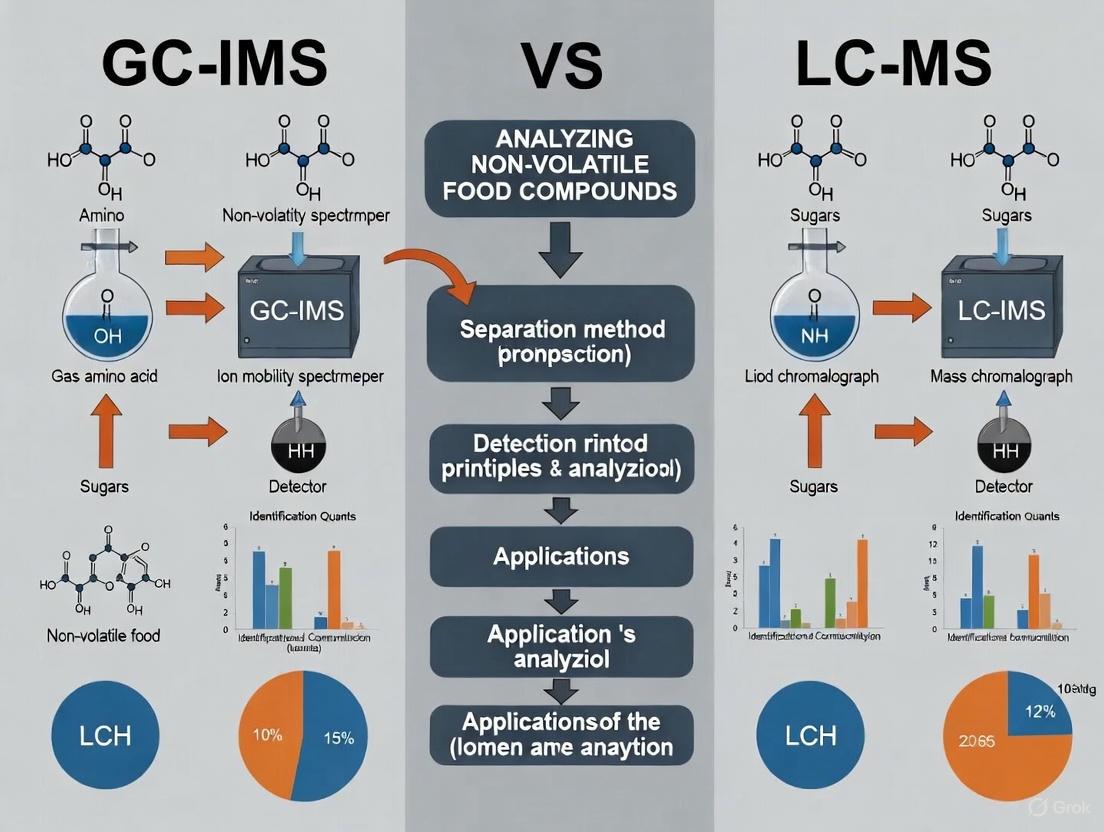
This article provides a comprehensive comparison of Gas Chromatography-Ion Mobility Spectrometry (GC-IMS) and Liquid Chromatography-Mass Spectrometry (LC-MS) for the analysis of non-volatile compounds in food.
GC-IMS vs. LC-MS: Choosing the Optimal Technique for Non-Volatile Food Compound Analysis
Abstract
This article provides a comprehensive comparison of Gas Chromatography-Ion Mobility Spectrometry (GC-IMS) and Liquid Chromatography-Mass Spectrometry (LC-MS) for the analysis of non-volatile compounds in food. Aimed at researchers and scientists in food safety and development, we explore the fundamental principles, operational mechanisms, and ideal application domains for each technique. The content covers methodological workflows, real-world applications from recent studies, strategies for troubleshooting and optimization, and a direct comparative analysis of performance metrics including sensitivity, linear range, and matrix effects. The goal is to equip professionals with the knowledge to select the most appropriate analytical method for their specific food analysis challenges, from ensuring regulatory compliance to optimizing product flavor and quality.
Core Principles: Understanding GC-IMS and LC-MS Technologies
Fundamental Operating Principles of GC-IMS and LC-MS
Chromatography coupled with mass spectrometry represents a cornerstone of modern analytical chemistry, enabling the precise separation, identification, and quantification of chemical compounds within complex mixtures. Gas Chromatography-Ion Mobility Spectrometry (GC-IMS) and Liquid Chromatography-Mass Spectrometry (LC-MS) are two powerful platforms that serve complementary roles in analytical laboratories. While both techniques aim to separate and identify components in a sample, they achieve this through fundamentally different physical and chemical principles, making each suitable for distinct classes of analytes and applications.
GC-IMS combines the separation power of gas chromatography with the rapid detection capability of ion mobility spectrometry, creating a two-dimensional separation technique particularly effective for volatile organic compounds. In contrast, LC-MS couples liquid chromatography's ability to separate dissolved analytes with the sophisticated detection of mass spectrometry, making it indispensable for non-volatile, thermally labile, and higher molecular weight compounds. The selection between these platforms depends critically on the chemical properties of the target analytes, required sensitivity, and the specific analytical question being addressed. This guide provides a detailed comparison of their fundamental operating principles, technical capabilities, and practical applications in food analysis research.
Fundamental Operating Principles and Instrumentation
Gas Chromatography-Ion Mobility Spectrometry (GC-IMS) operates on a sequential separation principle where compounds are first separated by gas chromatography before undergoing a second separation dimension via ion mobility spectrometry. The process begins with sample vaporization, where the analytical sample is heated and introduced into the GC system using an inert carrier gas such as helium or nitrogen [1] [2]. Within the GC column, separation occurs based on two primary factors: the compound's volatility and its interaction with the stationary phase coating the column interior. As compounds elute from the GC column at different retention times, they immediately enter the IMS detection chamber.
In the IMS stage, molecules are ionized, typically using a radioactive source such as Tritium (³H) or Nickel-63 (⁶³Ni), which produces beta particles that ionize the carrier gas molecules. These ionized carrier gas molecules then transfer charge to analyte molecules through chemical ionization processes. Once ionized, the molecules are driven through a drift tube by a weak electric field under atmospheric pressure. During their drift, ions collide with neutral drift gas molecules (often purified air or nitrogen), separating based on their size, shape, and charge [3]. Compact ions experience fewer collisions and reach the detector faster than larger, more bulky ions with identical mass-to-charge ratios. The output is a drift time measurement that provides a collision cross-section (CCS) value, serving as a characteristic identifier for each compound.
Liquid Chromatography-Mass Spectrometry (LC-MS) employs a liquid mobile phase to separate compounds followed by mass spectrometric detection. The process begins with sample dissolution in an appropriate solvent, which is then pumped at high pressure through an LC column containing a stationary phase. Separation occurs based on differential partitioning between the mobile and stationary phases, influenced by analytes' polarity, size, and specific chemical interactions [4] [1]. Critical LC parameters include column chemistry (e.g., C18 reverse-phase), mobile phase composition (gradient or isocratic), flow rate, and column temperature.
Following chromatographic separation, analytes enter the mass spectrometer through an interface that must efficiently transfer them from atmospheric pressure liquid phase to the high vacuum gas phase required for mass analysis. Electrospray ionization (ESI) is the most prevalent technique for this transition, where the LC effluent is nebulized into a fine spray of charged droplets under application of a high voltage [3]. As solvent evaporates, charged analyte molecules are released into the gas phase. Other ionization techniques like atmospheric pressure chemical ionization (APCI) or atmospheric pressure photoionization (APPI) may be employed for less polar compounds.
The mass analyzer then separates ions based on their mass-to-charge ratio (m/z). Several mass analyzer types are utilized in LC-MS systems, including quadrupole, time-of-flight (TOF), Orbitrap, and ion trap instruments, each offering different trade-offs in mass accuracy, resolution, dynamic range, and acquisition speed [5] [6]. Tandem mass spectrometry (MS/MS) adds further analytical power by fragmenting selected ions and analyzing the product ions, providing structural information for compound identification.
Table 1: Fundamental Operating Principles Comparison
| Parameter | GC-IMS | LC-MS |
|---|---|---|
| Separation Principle | Volatility & interaction with GC stationary phase | Polarity, size & chemical interactions |
| Mobile Phase | Inert gas (He, N₂) | Liquid solvents (methanol, acetonitrile, water) |
| Sample State | Volatile, thermally stable | Non-volatile, thermally labile |
| Ionization Method | Chemical ionization (radioactive source) | Electrospray ionization (ESI), APCI, APPI |
| Separation Dimension | Size, shape & charge (collision cross-section) | Mass-to-charge ratio (m/z) |
| Operating Pressure | Atmospheric pressure in IMS | High vacuum in mass analyzer |
| Detection Method | Drift time measurement | Mass-to-charge ratio measurement |
Technical Comparison and Performance Data
Analytical Capabilities and Limitations
The analytical capabilities of GC-IMS and LC-MS differ significantly due to their fundamental operating principles. GC-IMS excels in analyzing volatile organic compounds without requiring extensive sample preparation, offering rapid analysis times (typically seconds to minutes), high sensitivity (often parts-per-billion or better), and the ability to operate at atmospheric pressure, which simplifies instrument design [7]. The technique provides two-dimensional separation (retention time and drift time) that enhances peak capacity and helps resolve complex mixtures. However, GC-IMS is generally limited to volatile compounds or those that can be made volatile through derivatization, and the ionization process can be affected by moisture and competing compounds.
LC-MS demonstrates superior versatility in analyzing a broad spectrum of compounds, from small molecules to large proteins, with exceptional sensitivity and specificity. Modern LC-MS systems can achieve detection limits in the parts-per-trillion range, high mass accuracy (<1 ppm with high-resolution instruments), and the ability to provide structural information through MS/MS fragmentation [4] [8]. The technique's main limitations include higher instrument cost, more complex operation, potential for ion suppression effects in complex matrices, and the requirement for skilled operators. Additionally, LC-MS methods typically require more development time for method optimization compared to GC-IMS.
Quantitative Performance Characteristics
When evaluating quantitative performance, both techniques offer distinct advantages depending on the application requirements. GC-IMS provides excellent reproducibility for volatile compound analysis with a linear dynamic range typically spanning 2-3 orders of magnitude, making it suitable for flavor and fragrance analysis where relative abundance patterns are often more important than absolute quantification [7]. The technique's rapid analysis speed enables high-throughput screening applications.
LC-MS systems generally offer wider linear dynamic ranges (4-6 orders of magnitude) and superior quantitative precision, particularly when using triple quadrupole instruments in selected reaction monitoring (SRM) mode [4] [8]. This makes LC-MS the preferred technique for applications requiring precise quantification, such as pharmacokinetic studies, residue testing, and biomarker validation. The ability to use stable isotope-labeled internal standards in LC-MS further enhances quantitative accuracy by compensating for matrix effects and sample preparation variations.
Table 2: Performance Characteristics Comparison
| Performance Characteristic | GC-IMS | LC-MS |
|---|---|---|
| Detection Limit | Parts-per-billion (ppb) to parts-per-trillion (ppt) | Parts-per-trillion (ppt) to parts-per-quadrillion (ppq) |
| Linear Dynamic Range | 2-3 orders of magnitude | 4-6 orders of magnitude |
| Mass Accuracy | Not applicable (measures drift time) | <1 ppm (high-resolution instruments) |
| Analysis Speed | Seconds to minutes | Minutes to tens of minutes |
| Sample Throughput | High | Moderate to high |
| Molecular Size Range | Typically <500 Da | Essentially unlimited (small molecules to proteins) |
| Quantitative Precision | Moderate (RSD 5-15%) | High (RSD 1-5%) |
Experimental Protocols and Applications
Representative Experimental Workflows
GC-IMS Protocol for Food Volatile Profiling (adapted from cigar tobacco analysis [7]):
- Sample Preparation: Homogenize 0.5 g of sample and place it in a 20 mL headspace vial. For solid samples, grinding to increase surface area improves volatile release.
- Headspace Incubation: Incubate the sample at 80°C for 30 minutes with agitation at 500 rpm to achieve equilibrium between the sample and headspace.
- GC Separation: Inject 500 µL of headspace gas in splitless mode onto a TG-WAX capillary column (or similar polar stationary phase). Maintain the column at 60°C using nitrogen carrier gas with a programmed flow rate.
- IMS Detection: Transfer eluting compounds to the IMS drift tube maintained at 45°C. Apply a uniform electric field (200-500 V/cm) across the drift region filled with purified air or nitrogen drift gas.
- Data Acquisition: Record ion currents at the Faraday detector with data collection typically lasting 20-35 minutes total run time.
- Data Analysis: Process 2D data (retention time vs. drift time) using specialized software to identify compounds based on retention index and reduced mobility values referenced to standards.
LC-MS Protocol for Non-Volatile Compound Analysis (adapted from honey authentication research [8]):
- Sample Extraction: Weigh 200 mg of sample into a 1.5 mL microcentrifuge tube. Add 10 µL of internal standard solution (e.g., L-2-chlorophenylalanine at 10 ppm) and 1000 µL of extraction solvent (methanol:acetonitrile:water, 2:2:1 v/v/v).
- Extraction Procedure: Vortex mix for 1 minute, then ultrasonicate for 30 minutes at room temperature. Centrifuge at 12,000 rpm for 5 minutes at 4°C to pellet insoluble material.
- Sample Concentration: Transfer supernatant and concentrate by vacuum centrifugation for 4 hours. Reconstitute the dried extract in 200 µL of 50% methanol solution.
- LC Separation: Inject filtrate onto appropriate LC column (e.g., C18 reverse-phase for non-polar compounds or HILIC for polar compounds). Use gradient elution with mobile phases A (water with 0.1% formic acid) and B (acetonitrile with 0.1% formic acid) at flow rates of 0.2-0.4 mL/min.
- MS Detection: Ionize eluting compounds using electrospray ionization in positive or negative mode. Analyze using high-resolution mass spectrometry (e.g., Q-Exactive Orbitrap) with full scan data acquisition (m/z 100-1500) at resolution ≥70,000.
- Data Processing: Process raw data using software platforms (e.g., XCMS, Compound Discoverer) for peak picking, alignment, and compound identification against databases.
Application in Food Compound Analysis
The application strengths of GC-IMS and LC-MS in food analysis reflect their fundamental technical differences. GC-IMS finds particular utility in food quality control and authenticity assessment through volatile compound profiling. Representative applications include monitoring flavor and aroma compounds in beverages, detecting spoilage or oxidation volatiles in fats and oils, authenticating essential oils, and characterizing fermentation products in dairy and baked goods [7]. The technique's speed and sensitivity make it ideal for high-throughput screening applications where volatile patterns serve as fingerprints for origin, processing, or adulteration.
LC-MS has become indispensable for analyzing non-volatile food components and contaminants, including pesticides, veterinary drug residues, mycotoxins, natural toxins, food additives, and processing contaminants [4] [8]. Its application in foodomics—the comprehensive study of food constituents through omics approaches—has revolutionized understanding of how food composition impacts human health. LC-MS enables simultaneous determination of multiple analyte classes in a single analysis, provides structural elucidation for unknown compounds, and delivers the sensitivity required for regulatory compliance monitoring at strict maximum residue limits.
Diagram: Comparative experimental workflows for GC-IMS and LC-MS analyses
Research Reagent Solutions and Essential Materials
Successful implementation of GC-IMS and LC-MS methodologies requires specific reagents, solvents, and consumables optimized for each technique. The following table details essential materials and their functions in analytical workflows.
Table 3: Essential Research Reagents and Materials
| Item | Function | GC-IMS Application | LC-MS Application |
|---|---|---|---|
| Carrier/ Mobile Phase | Transport medium for analyte separation | High-purity nitrogen or helium | HPLC-grade water, methanol, acetonitrile with modifiers (formic acid, ammonium acetate) |
| Internal Standards | Quantification reference & quality control | Deuterated volatile compounds | Stable isotope-labeled analogs of target analytes |
| Extraction Solvents | Compound isolation from matrix | Not typically used (headspace analysis) | Methanol, acetonitrile, ethyl acetate, dichloromethane |
| Derivatization Reagents | Enhance volatility/ionization | Not always required | Sometimes used to improve ionization efficiency |
| Quality Control Materials | Method validation & performance verification | Certified reference materials for volatile compounds | Certified reference materials for target analytes |
| LC Columns | Chromatographic separation | Not applicable | C18, HILIC, phenyl, cyano stationary phases |
| GC Columns | Chromatographic separation | TG-WAX, DB-5, similar stationary phases | Not applicable |
| Syringe Filters | Sample clarification | Not typically used | 0.22 µm or 0.45 µm PTFE, nylon, or PES membranes |
| Vials/Containers | Sample storage & introduction | Headspace vials with crimp caps | LC vials with inserts |
GC-IMS and LC-MS represent complementary analytical platforms with distinct operating principles, capabilities, and application domains. GC-IMS provides rapid, sensitive analysis of volatile compounds with relatively simple operation and lower operating costs, making it ideal for flavor, fragrance, and volatile profiling applications. LC-MS offers unparalleled versatility in analyzing non-volatile and thermally labile compounds across an extensive molecular weight range, with superior quantitative capabilities and compound identification power through high-resolution mass measurement and MS/MS fragmentation.
The selection between these techniques should be guided by the specific analytical requirements, including target analyte properties, required sensitivity and specificity, sample throughput needs, and available resources. In many modern laboratories, both techniques coexist as complementary tools within comprehensive analytical workflows, each contributing unique information about sample composition. Ongoing technological advancements continue to enhance the performance, accessibility, and application range of both platforms, further solidifying their essential roles in food analysis, environmental monitoring, pharmaceutical research, and clinical diagnostics.
The choice between Gas Chromatography-Ion Mobility Spectrometry (GC-IMS) and Liquid Chromatography-Mass Spectrometry (LC-MS) represents a critical methodological crossroads in food compound analysis. These platforms differ fundamentally in their operational principles and, consequently, in their suitability for analyzing different classes of chemical compounds. The core distinction lies in their handling of compound volatility and thermal stability, which directly dictates their application scope within food research [9] [10]. GC-IMS requires that analytes be volatile and thermally stable enough to be vaporized without decomposition for analysis. In contrast, LC-MS separates compounds in a liquid phase at room temperature, making it uniquely suited for non-volatile and thermally labile molecules that would degrade under GC conditions [10]. This guide provides a detailed, evidence-based comparison of these techniques, framing their performance within the context of modern food safety and exposomics research, where comprehensive detection of contaminants is paramount [9].
Fundamental Principles and Technical Comparison
Operational Workflows and Underlying Mechanisms
The analytical journey of a compound differs significantly between GC-IMS and LC-MS. The following diagram illustrates the core steps and critical decision points in each workflow, highlighting the fundamental differences that determine analyte suitability.
The fundamental technical differences between these platforms create a natural division in their application domains. GC-IMS relies on the vaporization of samples, a process that inherently restricts its use to compounds that can withstand the required heating without decomposing. Following vaporization, separation occurs in a gaseous mobile phase, and ionization is typically achieved using a radioactive source like Tritium or Nickel-63, which produces reactant ions that subsequently ionize the analyte molecules. The final separation in the drift tube is based on the ion's size, shape, and charge as it moves through a buffer gas under an electric field [9].
Conversely, LC-MS operates with a liquid mobile phase, completely circumventing the need for volatilization. The ionization process occurs at atmospheric pressure through techniques like Electrospray Ionization (ESI) or Atmospheric Pressure Chemical Ionization (APCI), which are exceptionally gentle and effective for a wide range of molecules, including large, polar, and thermally sensitive ones [11] [10]. The mass analyzer then separates ions based on their mass-to-charge ratio (m/z), providing high specificity and the capability for structural elucidation through tandem mass spectrometry (MS/MS) [11].
Direct Performance Comparison
The technical distinctions outlined above translate into clear, practical differences in performance, as summarized in the table below.
Table 1: Direct Technical Comparison of GC-IMS and LC-MS Platforms
| Performance Characteristic | GC-IMS | LC-MS |
|---|---|---|
| Ideal Analyte Properties | Volatile, thermally stable, low to medium molecular weight [9]. | Non-volatile, thermally labile, polar, high molecular weight [10]. |
| Sample Introduction | Requires vaporization (high temperature) [9]. | Dissolution in liquid solvent (ambient temperature) [10]. |
| Separation Mechanism | Gas chromatography (volatility) + Ion mobility (size/charge) [9]. | Liquid chromatography (polarity) + Mass spectrometry (m/z) [11]. |
| Common Ionization Sources | Radioactive β⁻ source (e.g., Tritium, Ni-63) [9]. | Electrospray Ionization (ESI), Atmospheric Pressure Chemical Ionization (APCI) [11] [10]. |
| Typical Analysis Speed | Very fast separation (seconds to minutes) [9]. | Slower separation (minutes to tens of minutes) [11]. |
| Inherent Strengths | High-speed analysis, portability for field use, sensitive to trace volatiles. | Exceptional molecular specificity and wide dynamic range. |
| Key Weaknesses | Limited to volatile compounds; may require derivatization; lower peak capacity than LC-MS. | Susceptible to matrix effects (ion suppression); complex data interpretation; higher instrumentation cost. |
Experimental Data and Application Protocols
Quantitative Performance in Food Analysis
Experimental data from food analysis applications underscores the practical implications of the fundamental differences between these techniques. The following table compiles representative performance metrics for each platform when analyzing different classes of food compounds.
Table 2: Experimental Performance Data for Food Compound Analysis
| Analyte Class | Platform | Example Compounds | Reported Limits of Detection (LOD) | Key Applications in Food |
|---|---|---|---|---|
| Pesticides | LC-MS/MS [10] | Polar pesticides, carbamates, metabolites | Low to sub-ppb (μg/kg) levels [10] | Multiresidue analysis in fruits, vegetables, grains [10] |
| Veterinary Drugs | LC-MS/MS [11] | Antibiotics, tranquilizers | Not specified in search results | Monitoring residues in meat, milk, honey [9] [11] |
| Mycotoxins | LC-HRMS [9] | Aflatoxins, ochratoxin A | Not specified in search results | Screening in cereals, nuts, spices [9] |
| Volatile Flavors/Aromas | GC-IMS [9] | Esters, aldehydes, terpenes | Not specified in search results | Food authenticity, flavor profiling, spoilage detection [9] |
| Elemental Species | GC-ICP-MS [12] | Organotin, methylmercury, selenomethionine | Attogram (10⁻¹⁸) to femtogram (10⁻¹⁵) levels [12] | Speciation analysis in seafood, supplements [13] [12] |
Detailed Methodological Protocols
Protocol 1: LC-MS/MS for Multiresidue Pesticide Analysis
This protocol is widely used for monitoring polar pesticide residues in food commodities and exemplifies a bottom-up exposomics approach by characterizing the external food exposome [9] [10].
Sample Preparation (QuEChERSER Mega-Method):
- Extraction: Homogenize 10 g of sample with 10 mL acetonitrile in a centrifuge tube. Add a salt mixture (e.g., 4 g MgSO₄, 1 g NaCl, 0.5 g disodium hydrogen citrate sesquihydrate, 1 g trisodium citrate dihydrate) and shake vigorously. Centrifuge to separate phases [9].
- Clean-up: Transfer an aliquot of the extract to a dispersive-SPE (d-SPE) tube containing sorbents like primary secondary amine (PSA), C18, and MgSO₄. Shake and centrifuge. The purified extract is diluted and injected into the LC-MS/MS system [9] [10].
LC Separation:
- Technique: Ultra-High-Performance Liquid Chromatography (UHPLC).
- Column: C18 reversed-phase column (e.g., 100 mm x 2.1 mm, 1.7-1.8 μm particle size).
- Mobile Phase: (A) Water and (B) Methanol or Acetonitrile, both with additives like 0.1% formic acid or 5 mM ammonium formate.
- Gradient: Typically from 5-95% B over 10-20 minutes to separate compounds of varying polarity [10].
MS Analysis:
- Ionization: Electrospray Ionization (ESI), predominantly in positive mode.
- Mass Analyzer: Triple quadrupole (QqQ) operating in Multiple Reaction Monitoring (MRM) mode.
- Data Acquisition: For each target pesticide, two specific precursor ion → product ion transitions are monitored for high-confidence identification and quantification [10].
Protocol 2: GC-ICP-MS for Elemental Speciation
This protocol demonstrates a highly specialized application of GC for analyzing volatile organometallic compounds, crucial for assessing the toxicity of elements like mercury and tin in food [13] [12] [14].
Sample Preparation (Derivatization):
- Extraction: For methylmercury in fish, the sample is typically digested with an acid (e.g., HCl) and then extracted into an organic solvent like toluene.
- Derivatization: The extract is treated with a tetraalkylborate reagent (e.g., sodium tetraethylborate) in an aqueous buffer. This reaction converts ionic organometallic species (e.g., MeHg⁺) into volatile, GC-amenable derivatives (e.g., MeHgEt) [12].
GC Separation:
- Technique: Capillary Gas Chromatography.
- Column: Non-polar or mid-polar capillary column (e.g., DB-5, 30 m x 0.25 mm i.d., 0.25 μm film thickness).
- Carrier Gas: Helium.
- Temperature Program: Ramped from a low initial temperature (e.g., 50°C) to a high final temperature (e.g., 280°C) to separate the derivatized species [13] [12].
ICP-MS Detection:
- Interface: The GC effluent is directly transferred to the ICP torch via a heated transfer line.
- Detection: The ICP-MS is tuned for the specific target element (e.g., Hg, Sn, Se). The detection limits are exceptionally low (attogram to femtogram levels) due to the high ionization efficiency and the absence of a liquid solvent [12] [14].
The Scientist's Toolkit: Essential Research Reagents and Materials
Successful implementation of the protocols above requires specific reagents and materials. The following table details key solutions for food exposome analysis.
Table 3: Essential Reagents and Materials for Food Exposome Analysis
| Item Name | Function/Application | Key Characteristics |
|---|---|---|
| QuEChERSER Kits | Sample preparation for multi-class contaminant analysis [9]. | Pre-weighed salt and sorbent kits for efficient extraction and clean-up. |
| Deep Eutectic Solvents (DES) | Green, sustainable extraction solvents [9] [15]. | Biodegradable, low toxicity, tunable extraction properties. |
| UHPLC C18 Columns | High-resolution chromatographic separation for LC-MS [16] [10]. | Sub-2μm particles for high efficiency and fast analysis. |
| Tetraalkylborate Reagents | Derivatization for GC-based speciation analysis [12]. | Converts non-volatile metal species into volatile derivatives. |
| ESI & APCI Reagents | Mobile phase additives for LC-MS ionization [11] [10]. | Volatile acids (formic, acetic) and buffers (ammonium formate/acetate). |
| Isotope-Labeled Internal Standards | Accurate quantification in mass spectrometry [12]. | Corrects for matrix effects and recovery losses; essential for IDA. |
Integrated Workflow for Food Exposomics
Modern exposomics research often requires integrating multiple analytical strategies to comprehensively characterize exposure from source to biological outcome. The following diagram maps how GC- and LC-based platforms fit into a holistic "meet-in-the-middle" workflow, connecting external exposure sources with internal biological effects.
This workflow demonstrates the complementary nature of analytical techniques. The Bottom-Up Approach starts with the analysis of food sources using both GC-IMS (for volatile compounds) and LC-MS (for non-volatile residues and contaminants) to characterize the external exposome and identify potential exposure sources [9]. Simultaneously, the Top-Down Approach analyzes biological samples from individuals using primarily LC-HRMS to measure the internal exposome, including biomarkers of effect that reflect early biological responses [9] [17]. These two streams of data are integrated in "Meet-in-the-Middle" Approaches, which identify intermediate biomarkers that are causally linked to both exposure and health outcomes. This integration strengthens causal inference and helps validate the mechanistic links outlined in Adverse Outcome Pathways (AOPs), providing a systems-level understanding of how chemicals in food impact health [9].
The selection between GC-IMS and LC-MS is not a matter of one technique being superior to the other, but rather a strategic decision based on the physicochemical properties of the target analytes and the specific research questions at hand. GC-IMS excels in the rapid, sensitive analysis of volatile, thermally stable compounds, finding its niche in flavor profiling, authenticity, and spoilage studies. LC-MS is the undisputed platform for non-volatile, thermally labile, and polar compounds, making it indispensable for multiresidue analysis of pesticides, veterinary drugs, mycotoxins, and other contaminants in food. As the field of food exposomics advances, the trend is not toward the dominance of a single platform, but toward the development of high-throughput, multi-platform approaches [9]. The integration of data from GC-HRMS, LC-HRMS, and IMS within a holistic framework provides the most comprehensive picture of the food exposome, enabling researchers to trace contaminants from the food supply into the human body and link these exposures to biological effects, ultimately supporting better public health interventions and personalized healthcare strategies [9] [17].
The analysis of food compounds, particularly non-volatile substances, is fundamental to ensuring food safety, authenticity, and quality. Within this field, Gas Chromatography coupled to Ion Mobility Spectrometry (GC-IMS) and Liquid Chromatography-Mass Spectrometry (LC-MS) represent two powerful but fundamentally different analytical approaches [18] [11]. GC-IMS is a highly sensitive technique that excels in the separation and detection of volatile organic compounds (VOCs), and is renowned for its robustness and ease of use [19]. In contrast, LC-MS has become a cornerstone technique for the analysis of non-volatile and thermally labile compounds, offering high sensitivity, selectivity, and the ability to provide structural information on a wide range of molecules [11] [20]. The core distinction lies in the analytes they are best suited to investigate: GC-IMS focuses on volatile aroma and flavor profiles, while LC-MS targets a broader spectrum of non-volatile compounds such as lipids, pigments, proteins, and residues. This guide provides a detailed, objective comparison of these two technologies, focusing on their principles, performance, and application in food analysis to help researchers select the appropriate tool for their specific analytical challenges.
Fundamental Principles and Instrumentation
Gas Chromatography-Ion Mobility Spectrometry (GC-IMS)
GC-IMS is a two-dimensional technique that combines the separation power of Gas Chromatography with the sensitive, fast detection of Ion Mobility Spectrometry. The process begins with the sample being vaporized and introduced into the GC system. Volatile compounds are separated as they travel through a capillary column based on their partitioning between a gaseous mobile phase and a stationary liquid phase, which is influenced by the compounds' boiling points and polarities [21] [19]. The separated analytes then enter the IMS detector, where they are ionized, typically by a radioactive source such as Tritium (³H) or Nickel-63 (⁶³Ni), which generates reactant ions in a drift gas [19]. The resulting ionized molecules are driven by an electric field through a drift tube filled with a counter-flowing inert drift gas (often nitrogen). Separation in the IMS dimension occurs based on the ion's collision cross section (CCS), which is a measure of its size, shape, and charge as it collides with the drift gas molecules [18] [19]. Ions with larger CCS values experience more collisions and take longer to reach the detector, resulting in a longer drift time. The final output is a two-dimensional plot with GC retention time on one axis and IMS drift time on the other, allowing for highly resolved analysis of complex volatile mixtures.
Liquid Chromatography-Mass Spectrometry (LC-MS)
LC-MS couples the superior separation capabilities of Liquid Chromatography for non-volatile and thermally unstable compounds with the powerful detection and identification capabilities of Mass Spectrometry. In the LC stage, the sample is dissolved in a liquid solvent and separated based on the differential distribution of analytes between a liquid mobile phase and a stationary phase packed inside a column [22]. The separation mechanism can be reversed-phase, normal-phase, or ion-exchange, among others, providing great flexibility. After separation, the analytes are introduced into the mass spectrometer, which requires an interface to remove the solvent and ionize the molecules. Common ionization techniques include Electrospray Ionization (ESI) and Atmospheric Pressure Chemical Ionization (APCI), which are suitable for a wide range of compounds, from small molecules to large biomolecules [11] [20]. The ionized molecules are then analyzed in the mass spectrometer based on their mass-to-charge ratio (m/z). Modern LC-MS systems employ various mass analyzers—such as quadrupoles (Q), time-of-flight (ToF), Orbitrap, and ion traps—often in hybrid configurations (e.g., Q-TOF, Q-Orbitrap) to provide high resolution, accurate mass measurement, and tandem MS (MS/MS) capabilities for structural elucidation [11] [20]. The evolution from High-Performance Liquid Chromatography (HPLC) to Ultra-High-Performance Liquid Chromatography (UHPLC) has further enhanced performance through the use of sub-2 µm particles and systems capable of withstanding pressures up to 1,500 bar, resulting in faster analysis and higher resolution [22].
Table 1: Core Principles and Separation Mechanisms
| Feature | GC-IMS | LC-MS |
|---|---|---|
| Primary Separation Mechanism | Partitioning between gas mobile phase and liquid stationary phase [21] | Partitioning between liquid mobile phase and solid stationary phase [22] |
| Detection Principle | Ion mobility (Collision Cross Section, CCS) in a drift gas under electric field [18] [19] | Mass-to-charge ratio (m/z) in a high vacuum under electric/magnetic fields [11] [20] |
| Key Measured Parameter | Drift time (converted to reduced mobility, K₀, or CCS) [18] | Mass-to-charge ratio (m/z) and signal intensity [20] |
| Ionization Method | Atmospheric pressure chemical ionization (e.g., β-emitter like Tritium) [19] | Electrospray Ionization (ESI), Atmospheric Pressure Chemical Ionization (APCI) [11] [20] |
| Typical Analyte State | Volatile, thermally stable | Non-volatile, semi-volatile, thermally labile |
Figure 1: GC-IMS Analytical Workflow. The process involves headspace sampling, GC separation, ionization, IMS drift separation, and detection to produce a 2D data output.
Figure 2: LC-MS Analytical Workflow. The process involves liquid sample injection, LC separation, ionization, mass analysis, and detection to produce retention time and m/z data.
Performance Comparison and Experimental Data
Quantitative Performance Metrics
The performance characteristics of GC-IMS and LC-MS differ significantly, reflecting their distinct technological foundations and application domains. GC-IMS operates at atmospheric pressure, contributing to its simpler design and lower operational costs, while LC-MS requires high vacuum systems, adding to its complexity and expense [19]. In terms of sensitivity, GC-IMS is capable of detecting compounds at parts-per-billion (ppb) to parts-per-trillion (ppt) levels, making it exceptionally suited for trace volatile analysis [19]. LC-MS also offers high sensitivity, often reaching picogram (pg) to femtogram (fg) levels, which is essential for quantifying trace-level contaminants or biomarkers in complex matrices [11]. The dynamic range of GC-IMS can be limited for some compounds due to the formation of dimers and clusters at higher concentrations, whereas LC-MS, particularly with APCI, can achieve a wide dynamic range spanning 4-5 orders of magnitude [19] [20]. A key advantage of LC-MS is its superior compound identification power, enabled by high-resolution accurate mass (HRAM) measurements and tandem MS, which provides detailed structural information [11]. GC-IMS identification is based on retention time and a compound's collision cross section (CCS), and while CCS is a reproducible identifier, it provides less structural detail than a mass spectrum [18]. Commercial databases for GC-IMS are also less established compared to the extensive mass spectral libraries available for LC-MS [19].
Table 2: Performance Characteristics and Typical Metrics
| Performance Metric | GC-IMS | LC-MS |
|---|---|---|
| Sensitivity | ppb to ppt levels [19] | pg to fg levels [11] |
| Analysis Speed | Seconds to minutes for IMS separation [19] | Minutes to tens of minutes (faster with UHPLC) [22] |
| Operational Pressure | Atmospheric pressure [19] | High pressure (up to 1500 bar for UHPLC) [22] |
| Dynamic Range | Can be limited by clustering [19] | Wide (4-5 orders of magnitude) [20] |
| Identification Power | Retention index and CCS; limited fragmentation [18] | Accurate mass, isotopic patterns, MS/MS fragmentation [11] [20] |
| Key Qualitative Output | Reduced ion mobility (K₀) / Collision Cross Section (CCS) [18] | Accurate mass, fragment mass spectrum, molecular formula [11] |
Application-Based Performance in Food Analysis
Experimental data from food analysis research highlights the complementary nature of these techniques. In a study on jujube leaf tea processing, GC-IMS and LC-MS were used in parallel to profile volatile and non-volatile metabolites, respectively. LC-MS successfully identified 468 non-volatile metabolites, including lipids, amino acids, and flavonoids, which significantly increased after processing [23]. Conversely, GC-IMS detected 52 volatile metabolites, revealing that aldehydes and ketones increased while some esters decreased, with the flavor profile shifting from eugenol in fresh leaves to (E)-2-Hexenal in the processed tea [23]. This demonstrates LC-MS's depth in profiling nutritive non-volatiles and GC-IMS's strength in tracking aroma-relevant volatiles.
In kimchi fermentation research, an integrated approach using LC-MS/MS and GC-IMS enabled stage-specific quality assessment. LC-MS/MS effectively quantified non-volatile markers like lactic acid, citric acid, and malic acid, which decreased sharply by week 2, clearly defining the initial fermentation stage [24]. However, non-volatile analysis was limited in differentiating later stages. Here, GC-IMS complemented by tracking volatile compounds such as 1-hexanol and 2,3-pentanedione, which remained stable during the optimal ripening period (weeks 2-4) and shifted significantly upon over-ripening (after week 6) [24]. This synergy provided a more complete picture of the fermentation process than either technique alone.
Table 3: Application Overview in Food Analysis
| Application Area | GC-IMS (Typical Analytes) | LC-MS (Typical Analytes) |
|---|---|---|
| Food Authentication/Adulteration | VOC fingerprints, aroma profiles [18] [19] | Triacylglycerol profiles, pigment patterns, polyphenols [20] |
| Process Control | Monitoring fermentation VOCs (alcohols, aldehydes, ketones) [23] [24] | Organic acids, amino acids, sugars, bioactive compounds [24] [11] |
| Safety & Contaminant Analysis | Off-odors, microbial spoilage VOCs [19] | Pesticide residues, veterinary drugs, mycotoxins [11] [20] |
| Flavor & Aroma Research | Key odorants, essential oils [23] [19] | Taste-active compounds, precursors to flavors [24] |
Experimental Protocols
Representative GC-IMS Protocol for Fermentation Monitoring
The following protocol, adapted from kimchi fermentation studies, outlines the typical steps for using GC-IMS to monitor volatile compounds during a fermentation process [24].
1. Sample Preparation:
- Homogenization: The food sample (e.g., kimchi) is homogenized to ensure a representative aliquot.
- Headspace Vial Incubation: A precise weight (e.g., 2.0 g) of the homogenized sample is placed into a headspace vial. The vial is sealed immediately with a crimp cap.
- Incubation: The sealed vial is incubated in a thermostatting block or autosampler oven. The incubation temperature and time must be rigorously controlled. For kimchi analysis, a temperature of 30 °C is recommended to avoid distortion of the VOC profile, as elevated temperatures can release non-representative volatiles [24].
- Equilibration: The sample is typically equilibrated for 10-15 minutes at the set temperature to allow the volatile compounds to partition into the headspace.
2. GC-IMS Analysis:
- Injection: A defined volume (e.g., 500 µL) of the headspace is automatically injected into the GC-IMS system via a heated syringe.
- GC Separation:
- Column: A moderately polar capillary column (e.g., DB-624, VOCOL, or similar).
- Carrier Gas: High-purity nitrogen or helium.
- Oven Program: The GC oven temperature is ramped. An example program is: hold at 40°C for 2 minutes, ramp to 100°C at 5°C/min, then ramp to 240°C at 20°C/min, and hold for 2 minutes [24].
- IMS Detection:
- Drift Tube: Temperature typically set between 30-50°C.
- Drift Gas: High-purity nitrogen, set to a specific flow rate.
- Electric Field: A constant, uniform electric field is applied along the drift tube (e.g., 400 V/cm).
3. Data Processing:
- Peak Picking and Alignment: Software is used to pick peaks from the 2D chromatogram (retention time vs. drift time) and align them across multiple samples.
- Library Matching: Peaks are tentatively identified by matching their retention time and CCS (or reduced mobility K₀) against a reference library, if available.
- Statistical Analysis: The resulting peak volume or intensity table is subjected to statistical analysis (e.g., PCA, OPLS-DA) to identify VOCs that differentiate sample groups.
Representative LC-MS/MS Protocol for Non-Volatile Metabolite Profiling
This protocol for analyzing non-volatile compounds in plant materials like jujube leaves is based on published methodologies [23] [11].
1. Sample Preparation and Extraction:
- Lyophilization and Grinding: The sample is flash-frozen with liquid nitrogen and freeze-dried. The dried material is then ground into a fine, homogeneous powder.
- Weighing: A precise amount (e.g., 50 mg ± 0.1 mg) of the powdered sample is weighed into a microcentrifuge tube.
- Extraction: A suitable extraction solvent (e.g., 400 µL of methanol:water = 4:1, v/v) containing an internal standard (e.g., 0.02 mg/mL L-2-chlorophenylalanine) is added to the tube.
- Homogenization: The mixture is homogenized using a ball mill or vortex mixer.
- Sonication and Centrifugation: The sample is subjected to low-temperature ultrasonic extraction for 30 minutes, then incubated at -20°C for 30 minutes. It is then centrifuged at high speed (e.g., 13,000 g at 4°C for 15 minutes) to pellet insoluble debris.
- Supernatant Collection: The supernatant is carefully transferred to an LC vial for analysis. A quality control (QC) sample is prepared by pooling aliquots from all samples.
2. LC-MS/MS Analysis:
- LC System: UHPLC system is preferred for its high resolution and speed.
- Column: A reversed-phase column (e.g., ACQUITY UPLC HSS T3, 100 mm × 2.1 mm, 1.8 µm) is maintained at a constant temperature (e.g., 40°C).
- Mobile Phase: Typically a binary gradient of water (A) and acetonitrile (B), both modified with 0.1% formic acid.
- Gradient Program: An example gradient for metabolomics is: 0-2 min, 2% B; 2-15 min, 2% to 100% B; 15-17 min, 100% B; 17-17.1 min, 100% to 2% B; 17.1-20 min, 2% B for re-equilibration [23].
- Injection Volume: 1-5 µL.
- MS Detection:
- Ionization: Electrospray Ionization (ESI) in both positive and negative ion modes.
- Mass Analyzer: A high-resolution mass spectrometer like a Q-Orbitrap or Q-TOF.
- Acquisition Mode: Full-scan MS (e.g., m/z 70-1050) at high resolution (e.g., 70,000 FWHM) for untargeted profiling, followed by data-dependent MS/MS scans for compound identification.
3. Data Processing:
- Peak Detection and Alignment: Software is used for peak picking, deisotoping, and alignment across all samples.
- Compound Identification: Metabolites are identified by matching accurate mass and MS/MS spectra against commercial and public databases (e.g., HMDB, MassBank).
- Multivariate Statistics: The processed data matrix is analyzed using PCA and OPLS-DA to identify significant metabolites.
The Scientist's Toolkit: Essential Research Reagents and Materials
Table 4: Key Reagents and Consumables for Chromatography Analysis
| Item | Function/Purpose | Example from Literature |
|---|---|---|
| Tritium (³H) Ionization Source | Beta emitter used in GC-IMS to ionize analyte molecules via reactant ion formation in the drift gas [19]. | Used in commercially available benchtop GC-IMS systems for food flavor analysis [19]. |
| High-Purity Nitrogen Gas | Serves as the drift gas in IMS, separating ions based on collisions; also used as a carrier or make-up gas in GC [19]. | Standard drift and carrier gas for GC-IMS operation [19]. |
| Solid-Phase Microextraction (SPME) Fiber | A sample preparation tool for extracting and concentrating volatile compounds from headspace or liquid samples prior to GC analysis [19]. | Used for VOC profiling from complex sample matrices in combination with GC-IMS [19]. |
| UHPLC Column (e.g., C18, 1.8 µm) | The stationary phase for separating non-volatile compounds. Sub-2 µm particles provide high efficiency and resolution under high pressure [22]. | ACQUITY UPLC HSS T3 column used for separating non-volatile metabolites from jujube leaf tea [23]. |
| Mass Spectrometry Internal Standards (Isotope-Labeled) | Compounds with stable isotope labels (e.g., ¹³C, ²H) used to correct for analyte loss during preparation and ion suppression/enhancement in the MS source [20]. | L-2-chlorophenylalanine used as an internal standard in LC-MS-based metabolomics of jujube leaves [23]. |
GC-IMS and LC-MS are powerful yet distinct analytical techniques that serve different, often complementary, purposes in food analysis. GC-IMS excels in the rapid, sensitive analysis of volatile compounds, making it an ideal tool for aroma profiling, fermentation monitoring, and non-targeted fingerprinting with minimal sample preparation [23] [24] [19]. Its operational simplicity and lack of requirement for a high vacuum make it robust and relatively easy to maintain. LC-MS, on the other hand, is the undisputed gold standard for the analysis of non-volatile and thermally labile compounds, providing unparalleled selectivity, sensitivity, and the ability to confidently identify and quantify a vast range of analytes, from pesticides and veterinary drugs to lipids and metabolites [11] [20]. The choice between these two technologies is not a matter of superiority but of application. For research focused on odor, flavor, or rapid process monitoring of volatiles, GC-IMS is an excellent choice. For comprehensive analysis of food composition, safety contaminants, nutritive non-volatiles, and in-depth metabolomic studies, LC-MS is the more appropriate and powerful tool. As demonstrated in several studies, an integrated approach that leverages the strengths of both platforms can provide the most holistic understanding of food quality and chemistry [23] [24].
The Role of Ion Mobility Spectrometry as an Additional Separation Dimension
The analysis of non-volatile compounds in food presents significant challenges due to the complexity of matrices and the presence of isobaric and isomeric substances that are difficult to separate and identify. Traditional analytical techniques such as liquid chromatography-mass spectrometry (LC-MS) and gas chromatography-mass spectrometry (GC-MS) have been the gold standard in food analysis, yet they face limitations in separating compounds with similar structural characteristics. In recent years, ion mobility spectrometry (IMS) has emerged as a powerful technology that adds a new separation dimension to these conventional methods. IMS separates ionized molecules in the gas phase based on their size, shape, and charge under the influence of an electric field, providing an additional molecular descriptor—the collision cross section (CCS)—which represents the averaged momentum transfer impact area of the ion [25] [18].
The integration of IMS into established chromatographic and spectrometric workflows creates a multidimensional separation platform that significantly enhances peak capacity, selectivity, and confidence in compound identification. This technical guide provides a comprehensive comparison of two prominent hyphenated techniques: gas chromatography-ion mobility spectrometry (GC-IMS) and liquid chromatography-mass spectrometry (LC-MS), with a specific focus on their application for non-volatile food compound analysis. By examining instrumental principles, performance characteristics, and practical applications through recent experimental studies, this article aims to equip researchers and analysts with the data necessary to select appropriate methodologies for their specific food analysis challenges.
Fundamental Principles: IMS as a Complementary Separation Technique
Ion mobility spectrometry operates on the principle of separating ionized molecules in the gas phase as they drift through a buffer gas under the influence of an electric field. The drift time required for ions to traverse the mobility cell is directly related to their rotationally averaged collision cross section (CCS), a molecular parameter that provides valuable information about the three-dimensional structure of ions [25] [18]. The reduced mobility (K₀), normalized to standard temperature and pressure conditions, allows for comparison between different experimental setups and is calculated according to the following equation:
K₀ = K × (p/p₀) × (T₀/T)
Where K is the measured mobility, p is pressure, T is temperature, and the subscript 0 denotes standard conditions [25].
Several IMS technologies are commercially available, each with distinct operational principles and applications. Drift Tube IMS (DTIMS) and Travelling Wave IMS (TWIMS) are time-dispersive techniques, while High-Field Asymmetric Waveform IMS (FAIMS) and Differential IMS (DIMS) represent space-dispersive technologies. Trapped IMS (TIMS) employs a trapping mechanism where ions are held in place against a gas flow by an electric field and released based on their mobility [18]. The CCS values obtained through IMS provide complementary information to mass-to-charge ratio (m/z) and retention time, enabling more confident compound identification, particularly for isobaric and isomeric compounds that are challenging to distinguish using conventional LC-MS or GC-MS alone [25].
Table 1: Comparison of Major IMS Technologies
| IMS Technology | Separation Principle | CCS Measurement | Key Advantages |
|---|---|---|---|
| Drift Tube IMS (DTIMS) | Constant electric field in drift tube | Direct measurement | Primary method for CCS determination |
| Travelling Wave IMS (TWIMS) | Moving potential waves | Requires calibration | High resolution capabilities |
| Field Asymmetric IMS (FAIMS) | Asymmetric waveform at high field | Not applicable | High sensitivity for specific compound classes |
| Trapped IMS (TIMS) | Electric field + gas flow counterbalance | Requires calibration | Compact design, high resolution |
When hyphenated with separation techniques like GC or LC and detection systems like MS, IMS adds a valuable separation dimension that occurs between the chromatographic separation (typically requiring seconds to minutes) and mass spectrometric detection (occurring in microseconds). This orthogonal separation approach significantly increases the peak capacity of analytical methods, enabling more effective analysis of complex food matrices where compounds of interest are often present at trace levels amidst numerous interfering components [25] [18].
Figure 1: Analytical Workflow with IMS as an Additional Separation Dimension
Comparative Analysis: GC-IMS versus LC-MS for Food Compound Analysis
Technical Principles and Instrumentation
GC-IMS combines the separation power of gas chromatography with the fast response and high sensitivity of ion mobility spectrometry. In this configuration, GC first separates volatile and semi-volatile compounds based on their partitioning between a stationary phase and carrier gas, followed by IMS separation based on ion mobility in the gas phase. The technique is particularly well-suited for volatile organic compound (VOC) analysis and requires minimal sample preparation, often employing simple headspace injection [26] [27]. GC-IMS operates at atmospheric pressure, uses nitrogen as drift gas, and offers advantages in terms of portability, speed, and cost-effectiveness compared to GC-MS. Recent technological advances have enabled the development of miniaturized GC-IMS systems suitable for on-site analysis and process monitoring [27].
In contrast, LC-MS combines liquid chromatography's separation of compounds dissolved in liquid solvent with mass spectrometry's detection based on mass-to-charge ratio. LC is ideal for non-volatile, thermally labile, and high molecular weight compounds that are not amenable to GC analysis. The hyphenation with IMS typically occurs between LC and MS, creating LC-IMS-MS workflows that provide three separation dimensions: retention time, collision cross section, and mass-to-charge ratio [25] [18]. This configuration is particularly powerful for complex mixture analysis as it provides multiple orthogonal parameters for compound identification. The CCS values obtained through LC-IMS-MS serve as additional molecular descriptors that are highly reproducible across laboratories and instruments, facilitating the creation of CCS databases for compound identification [25].
Performance Comparison in Food Analysis Applications
Experimental studies directly comparing GC-IMS and LC-MS for food analysis reveal distinct performance characteristics and complementary applications. A comprehensive study on cigar tobacco leaves from different regions employed both techniques to characterize volatile and non-volatile compounds. GC-IMS analysis identified 109 volatile compounds, including 26 esters, 17 aldehydes, 14 alcohols, 14 ketones, and various other compounds, and successfully differentiated tobacco samples based on geographical origin using specific marker compounds [26] [7]. Meanwhile, LC-MS analysis provided comprehensive coverage of non-volatile metabolites and enabled the identification of key metabolic pathways, including amino acid metabolism, nucleotide metabolism, and glyoxylate and dicarboxylate metabolism, which contribute to flavor formation in tobacco leaves [26].
Similarly, a study on jujube leaves processed into tea utilized GC-IMS, GC-MS, and LC-MS to comprehensively analyze metabolic changes. LC-MS identified 468 non-volatile metabolites, while GC-IMS and GC-MS detected 52 and 24 volatile metabolites, respectively. The integration of these techniques revealed that amino acids and lipids were closely linked to the formation of volatile metabolites, providing insights into the biochemical transformations occurring during tea processing [23].
Table 2: Performance Comparison of GC-IMS and LC-MS in Food Analysis Applications
| Parameter | GC-IMS | LC-MS |
|---|---|---|
| Optimal Compound Classes | Volatile and semi-volatile compounds | Non-volatile, thermally labile, polar compounds |
| Separation Dimensions | Retention time + Collision cross section | Retention time + Mass-to-charge ratio (+ Collision cross section with IMS) |
| Detection Limits | ppt to ppb range for many VOCs | ppb to ppt range for most analytes |
| Analysis Time | Fast (minutes), real-time capability possible | Moderate to long (typically 10-60 minutes) |
| Sample Preparation | Minimal (often headspace injection) | Typically required (extraction, purification) |
| Identification Power | Moderate (library matching for known compounds) | High (exact mass, fragmentation patterns) |
| Quantitation Capability | Good linear range for targeted compounds | Excellent sensitivity and dynamic range |
| Portability | Miniaturized systems available for on-site analysis | Laboratory-based systems |
Analytical Workflows and Methodologies
The experimental workflows for GC-IMS and LC-MS analyses differ significantly in sample preparation, separation mechanisms, and detection schemes. The following diagram illustrates the generalized workflows for both techniques, highlighting key steps where IMS enhances separation capabilities.
Figure 2: Comparative Workflows of GC-IMS and LC-IMS-MS Techniques
Experimental Protocols for Food Analysis
GC-IMS Protocol for Volatile Compound Analysis
Based on the cigar tobacco study [26] [7], the standard GC-IMS protocol involves:
Sample Preparation:
- Grind samples into powder using liquid nitrogen
- Weigh 0.5 g of sample into a 20 mL headspace vial
- Seal vial and incubate at 80°C with 500 rpm agitation for 30 minutes
GC-IMS Parameters:
- GC Column: TG-WAX (or similar weakly polar column)
- Injection Temperature: 85°C
- Carrier Gas: High-purity nitrogen (≥99.999%)
- Injection Volume: 500 µL in splitless mode
- Column Temperature: 60°C (isothermal)
- Analysis Time: 35 minutes
- IMS Drift Tube Temperature: 45°C
- Drift Gas: Nitrogen
Data Analysis:
- Use proprietary software (e.g., LAV from G.A.S. or similar)
- Generate topographic plots (retention time vs. drift time vs. intensity)
- Perform library matching against commercial or in-house databases
- Apply multivariate statistical analysis (PCA, OPLS-DA) for sample differentiation
LC-MS Protocol for Non-Volatile Compound Analysis
The non-targeted metabolomics protocol from the same study [26] [7] includes:
Sample Preparation:
- Grind samples (200 mg) under liquid nitrogen
- Add 10 µL internal standard (e.g., L-2-chlorophenylalanine at 10 ppm)
- Extract with 1000 µL extraction solution (methanol/acetonitrile/water, 2:2:1)
- Vortex for 1 minute, ultrasonicate for 30 minutes
- Centrifuge at 12,000 rpm for 5 minutes at 4°C
- Collect supernatant and concentrate by vacuum centrifugation
- Reconstitute in 200 µL of 50% methanol solution
- Filter through membrane before LC-MS analysis
LC-MS Parameters:
- LC System: HPLC or UHPLC with C18 column
- Mobile Phase: Water with 0.1% formic acid (A) and acetonitrile with 0.1% formic acid (B)
- Gradient Elution: Typically 5-95% B over 20-30 minutes
- Flow Rate: 0.3-0.4 mL/min
- Column Temperature: 40°C
- Injection Volume: 2-5 µL
- Mass Spectrometer: High-resolution instrument (Orbitrap, Q-TOF)
- Ionization: ESI in positive and negative modes
- Mass Range: Typically 50-1500 m/z
Data Processing:
- Use software such as XCMS, MS-DIAL, or proprietary platforms
- Perform peak picking, alignment, and normalization
- Identify compounds using databases (HMDB, KEGG, MassBank)
- Conduct pathway analysis (KEGG, MetaboAnalyst)
Essential Research Reagents and Materials
Successful implementation of GC-IMS and LC-MS methods requires specific reagents, standards, and materials optimized for each technique. The following table summarizes key research solutions and their applications in food compound analysis.
Table 3: Essential Research Reagent Solutions for IMS-Based Food Analysis
| Reagent/Material | Function/Application | GC-IMS | LC-MS |
|---|---|---|---|
| Internal Standards | Quantitation and quality control | Deuterated VOCs, 1,3-dichlorobenzene | L-2-chlorophenylalanine, stable isotope-labeled compounds |
| Extraction Solvents | Compound extraction from food matrices | Often not required (headspace) | Methanol, acetonitrile, water mixtures (typically 2:2:1) |
| Mobile Phase Additives | LC separation and ionization enhancement | Not applicable | Formic acid, ammonium acetate, ammonium formate |
| Derivatization Reagents | Enhancing volatility or detectability | Sometimes used for less volatile compounds | Sometimes used for specific compound classes |
| Quality Control Materials | System suitability and performance verification | Standard mixtures of known VOCs | Quality control samples from pooled extracts |
| Calibration Compounds | CCS value determination and system calibration | Ketones (e.g., 2-butanone, 2-pentanone) | Tunable calibration mixtures (e.g., Agilent Tuning Mix) |
| Drift Gases | IMS separation medium | Nitrogen (high purity) | Nitrogen or carbon dioxide (high purity) |
Analytical Applications in Food Research
Food Authentication and Origin Verification
The combination of chromatographic separation with IMS detection has proven particularly valuable for food authentication and origin verification. In the cigar tobacco study [26] [7], GC-IMS successfully differentiated leaves from ten different geographical regions in Yunnan, China, based on their volatile profiles. Specific marker compounds included 2,3-diethyl-6-methylpyrazine and phenylacetaldehyde in BS-Y1-1 samples, 3-methyl-1-pentanol in PE-Y2 samples, and butan-2-one in WS-Y38 samples. Similarly, LC-MS analysis provided complementary information on non-volatile metabolites that contributed to regional differentiation through distinct metabolic pathways.
A study on Auricularia auricula mushrooms from different regions [28] employed UPLC-MS/MS and GC-IMS to establish metabolite fingerprints that enabled clear geographical discrimination. The GC-IMS analysis revealed 64 volatile compounds, including acids, alcohols, aldehydes, esters, and ketones, with distinct abundance patterns between samples from Heilongjiang and Shaanxi provinces. The LC-MS analysis identified 881 metabolites, with 39 showing significant differences between regions. Multivariate statistical analysis (PCA and OPLS-DA) successfully differentiated samples based on their geographical origin, demonstrating the power of combining volatile and non-volatile compound analysis for authentication purposes.
Process Monitoring and Quality Control
IMS-based techniques have shown significant utility in monitoring food processing and quality control. The jujube leaf tea study [23] comprehensively analyzed metabolic changes during tea processing using LC-MS, GC-IMS, and GC-MS. LC-MS identified 468 non-volatile metabolites, with 109 showing significant changes after processing. Most lipids and lipid-like molecules, organic acids, amino acids, and flavonoids increased significantly after processing. GC-IMS and GC-MS analysis revealed that the contents of aldehydes and ketones were significantly increased, while esters and partial alcohols decreased after processing into jujube leaf tea. The main flavor substances shifted from eugenol in fresh jujube leaves to (E)-2-hexenal in jujube leaf tea. The integrated approach demonstrated that amino acids and lipids were closely linked to the formation of volatile metabolites during processing.
Another study on Gastrodia elata processing [29] used LC-MS and GC-IMS to evaluate the impact of different processing methods on quality. The analysis identified 62 intrinsic components, predominantly amino acids, with 20 classified as differential compounds, while 95 volatile components (primarily alcohols, aldehydes, and esters) were detected, with 31 being differential VOCs. The combination of analytical techniques with multidimensional bionic technology (E-nose, E-tongue) and chemometric models provided a comprehensive quality assessment framework.
Food Safety and Contaminant Screening
IMS technologies have gained importance in food safety applications, particularly for the detection of contaminants and adulterants in complex food matrices. The hyperspectral separation capability of IMS enables better detection of target compounds amidst chemical noise, improving sensitivity and selectivity [25] [18]. LC-IMS-MS methods have been developed for various food toxicants, including pesticides, veterinary drugs, mycotoxins, and environmental contaminants. The additional CCS dimension provides an extra identification point that increases confidence in compound annotation, particularly for non-targeted screening approaches [30].
The creation of dedicated spectral libraries that include CCS values, such as the WFSR Food Safety Mass Spectral Library [30], represents a significant advancement in food safety analysis. This manually curated open-access library contains 1001 food toxicants and 6993 spectra across multiple collision energies, providing a valuable resource for compound identification. The inclusion of CCS values in such libraries enhances identification confidence and facilitates the development of targeted screening methods for multiple contaminants in a single analysis.
Ion mobility spectrometry provides a valuable additional separation dimension that significantly enhances the analytical capabilities of both GC- and LC-based methods for food compound analysis. The experimental data and comparative assessment presented in this guide demonstrate that GC-IMS and LC-MS offer complementary rather than competing capabilities, with each technique excelling in specific application domains.
GC-IMS provides distinct advantages for volatile compound analysis with its minimal sample preparation requirements, rapid analysis times, and potential for portability. The technique has proven highly effective for geographical origin verification, process monitoring, and flavor profiling applications. Meanwhile, LC-MS remains the gold standard for comprehensive non-volatile compound analysis, offering superior identification power through exact mass measurement and fragmentation patterns. The integration of IMS into LC-MS workflows further enhances performance by providing additional separation of isobaric and isomeric compounds, increasing peak capacity, and supplying CCS values as additional molecular descriptors for identification confidence.
The selection between these techniques should be guided by the specific analytical requirements, including the target compound classes, required sensitivity and specificity, sample throughput needs, and available resources. For comprehensive food characterization, the combined application of both techniques provides the most complete picture of food composition, encompassing both volatile and non-volatile compounds. As IMS technology continues to evolve with improvements in resolution, sensitivity, and database availability, its integration into routine food analysis workflows is expected to expand, further strengthening analytical capabilities in food authentication, quality control, and safety assessment.
Practical Workflows and Food Analysis Applications
The accurate analysis of non-volatile compounds in food matrices presents significant challenges for researchers and analytical scientists. Complex biological samples contain numerous interfering substances that can compromise detection sensitivity and analytical accuracy. Effective sample preparation is therefore a critical prerequisite for reliable results in food safety, quality control, and regulatory compliance. This guide objectively compares three prominent sample preparation strategies—QuEChERS, Solid-Phase Microextraction (SPME), and Derivatization—within the specific context of methodological selection for gas chromatography-ion mobility spectrometry (GC-IMS) versus liquid chromatography-mass spectrometry (LC-MS) platforms. Each technique offers distinct mechanisms of action, with varying compatibility for different analyte classes, matrix types, and analytical instrumentation. The following sections provide detailed performance comparisons, experimental protocols, and practical guidance to inform method selection for non-volatile food compound analysis, supported by quantitative experimental data from recent scientific studies.
Technical Comparison of Sample Preparation Methods
The selection of an appropriate sample preparation strategy depends on multiple factors, including target analyte characteristics, sample matrix composition, and the chosen analytical instrumentation. The following comparison examines the fundamental principles, strengths, and limitations of QuEChERS, SPME, and Derivatization techniques to provide a foundation for informed methodological selection.
Table 1: Fundamental Characteristics of Sample Preparation Techniques
| Characteristic | QuEChERS | SPME | Derivatization |
|---|---|---|---|
| Principle | Liquid-liquid extraction & dispersive SPE | Partitioning between sample & coated fiber | Chemical modification of analytes |
| Primary Use | Multi-residue pesticide extraction | Extraction & concentration of volatiles | Improving volatility/detectability |
| Sample Throughput | High | Medium | Low to Medium |
| Solvent Consumption | Moderate | Solvent-free | Variable |
| Automation Potential | Moderate | High | Moderate |
QuEChERS (Quick, Easy, Cheap, Effective, Rugged, and Safe) was originally developed for multi-residue pesticide analysis in high-water-content matrices but has since been successfully adapted to a wide range of sample types, including low-moisture and high-fat commodities [31] [32]. The method involves simultaneous extraction and partitioning using acetonitrile and salt solutions, followed by a cleanup step using dispersive solid-phase extraction (d-SPE) to remove various matrix interferences. Its flexibility allows researchers to modify parameters such as solvent composition, salt buffers, and d-SPE sorbents to optimize performance for specific sample matrices [32].
SPME is a non-exhaustive extraction technique that integrates sampling, extraction, and concentration into a single step. Analytes partition from the sample matrix to a coated fiber, which is then transferred to the analytical instrument for desorption and analysis [33]. Recent advancements have introduced alternative geometries, including thin-film SPME (TF-SPME), which provides a larger surface area for extraction, significantly enhancing sensitivity for a wider range of analytes, particularly polar compounds [33]. The technique is especially valuable for extracting volatile and semi-volatile compounds, with the extraction mode (direct immersion or headspace) selectable based on analyte properties.
Derivatization involves chemically modifying target analytes to alter their physical and chemical properties, making them more amenable to chromatographic analysis. This process is particularly crucial for GC-based analysis of non-volatile compounds, such as fatty acids and biogenic amines, which lack sufficient volatility or thermal stability [34] [35]. Derivatization can significantly enhance detection sensitivity by introducing functional groups with superior spectroscopic or mass spectrometric properties. The selection of an appropriate derivatizing agent is critical, as it directly impacts reaction efficiency, derivative stability, and overall analytical performance [35].
Performance Data and Comparative Analysis
Independent studies have systematically evaluated the performance characteristics of these sample preparation methods across different food matrices and analyte classes. The following quantitative data provides objective comparison metrics to guide method selection.
Recovery and Efficiency Metrics
Recovery rates represent one of the most critical parameters for evaluating extraction efficiency. A comprehensive study comparing QuEChERS to traditional liquid-liquid extraction (LLE) for pesticide analysis in spinach, rice, and mandarins demonstrated the clear superiority of the QuEChERS approach, with average recoveries of 101.3–105.8% compared to 62.6–85.5% for LLE [31]. Furthermore, the QuEChERS method exhibited more consistent performance across different matrices, with over 95% of pesticide components falling within the acceptable 70–120% recovery range.
Table 2: Comparative Performance Data for Sample Preparation Methods
| Method | Analytes | Matrix | Recovery Range | Key Advantage | Reference |
|---|---|---|---|---|---|
| QuEChERS (AOAC) | 40 Pesticides | Celery, Spinach | 85-115% | Higher response for most pesticides | [32] |
| QuEChERS (EN) | 40 Pesticides | Avocado, Orange | 80-110% | Effective for acidic compounds | [32] |
| TF-SPME (HLB) | 11 Odorants | Food & Beverages | Significantly higher than fiber SPME/SBSE | Superior for polar compounds | [33] |
| Derivatization (TMS-DM) | Fatty Acids | Bakery Products | 90-106% | Higher recovery for unsaturated FAs | [34] |
| Derivatization (Dansyl) | Biogenic Amines | Sausage & Cheese | Wide linear range, high sensitivity | Excellent derivative stability | [35] |
Similar advantages were observed for QuEChERS in the analysis of antibiotics in fish tissue and fish feed, where the original QuEChERS method employing Enhanced Matrix Removal (EMR)-lipid sorbent achieved superior recoveries (70–110% in fish tissue, 69–119% in feed) for most analytes compared to the AOAC 2007.01 method using Z-Sep+ [36]. The method also demonstrated lower uncertainties (<18.4%) and met validation criteria for precision (<19.7%) and linearity (R² > 0.9899) [36].
For SPME techniques, a comparative study evaluating different formats revealed that the novel TF-SPME devices with hydrophilic-lipophilic balance (HLB) particles consistently outperformed both traditional SPME fibers and stir bar sorptive extraction (SBSE) across all 11 food odorants tested [33]. This performance advantage was particularly pronounced for polar compounds such as acetic acid, butanoic acid, and 2,3-butanedione, with TF-SPME being the only method capable of detecting methional in the standard mixture [33].
In derivatization applications, method selection significantly impacts accuracy and precision. For fatty acid analysis in bakery products, the base-catalyzed (trimethylsilyl)diazomethane (TMS-DM) method demonstrated higher recovery values with less variation (90–106%) compared to the traditional KOCH₃/HCl method (84–112%) [34]. Similarly, for biogenic amine analysis in sausage and cheese, dansyl chloride derivatization provided superior derivative stability, sensitivity, and accuracy compared to benzoyl chloride, 9-fluorenylmethoxycarbonyl chloride, and dabsyl chloride approaches [35].
Matrix Effects and Cleanup Efficiency
Matrix effects represent a significant challenge in food analysis, particularly when employing mass spectrometric detection. Both QuEChERS and LLE methods demonstrate a tendency for ion suppression across various matrices, necessitating the use of matrix-matched calibration for accurate quantification [31]. The effectiveness of the cleanup step in QuEChERS protocols varies considerably based on the selected d-SPE sorbents. For high-water, low-lipid matrices like celery, a simple combination of magnesium sulfate and primary secondary amine (PSA) sorbent often suffices. In contrast, high-fat matrices like avocado require additional sorbents such as C18 for effective lipid removal [32].
The evolution of SPME sorbent chemistries has progressively improved matrix tolerance. Traditional polydimethylsiloxane (PDMS) coatings exhibit strong affinity for non-polar compounds but limited efficiency for polar analytes. The introduction of HLB particles in TF-SPME devices has significantly enhanced the extraction capability for a wide polarity range without requiring derivatization or salting-out strategies [33]. This advancement is particularly valuable for complex food matrices containing diverse analyte classes.
Detailed Experimental Protocols
QuEChERS Method for Multi-Residue Analysis
The standard QuEChERS procedure comprises two main stages: extraction and cleanup. The following protocol is adapted from the EN 15662 method, suitable for a wide range of pesticide residues in various food matrices [32].
Sample Preparation: Homogenize a representative sample. For high-water-content matrices (e.g., fruits, vegetables), use 10–15 g of sample. For low-moisture samples (e.g., grains, spices), reduce sample mass to 5 g and add 10 mL of water to ensure proper partitioning [32].
Extraction: Place the prepared sample in a 50-mL centrifuge tube. Add 10 mL of acetonitrile (1% acetic acid for acidic compounds) and shake vigorously for 1 minute. Add extraction salts (4 g MgSO₄, 1 g NaCl, 1 g sodium citrate, 0.5 g disodium hydrogen citrate sesquihydrate for EN method) and shake immediately and vigorously for another minute to prevent salt clumping. Centrifuge at >3000 RCF for 5 minutes.
Cleanup: Transfer 1 mL of the supernatant (acetonitrile layer) to a d-SPE tube containing 150 mg MgSO₄, 25 mg PSA, and 25 mg C18 (adjust sorbent proportions based on matrix interference). Shake for 30 seconds and centrifuge at >3000 RCF for 5 minutes. Filter the supernatant through a 0.2-μm syringe filter prior to LC-MS analysis [32].
Method Selection: The choice between unbuffered, AOAC (pH ~4.75), and EN (pH 5.0–5.5) salt formulations should be based on target analyte stability. AOAC salts generally provide higher responses for most pesticides in commodities like celery, spinach, and avocado [32].
Thin-Film SPME for Odorant Analysis
TF-SPME provides enhanced extraction efficiency due to its larger surface area compared to traditional fibers. This protocol is optimized for food odorants but can be adapted for other volatile/semi-volatile compounds [33].
Device Conditioning: Condition the HLB/PDMS TF-SPME device in the GC injection port according to manufacturer's specifications (typically 270°C for 60 minutes) before initial use.
Extraction: Place the TF-SPME device directly into the liquid sample (direct immersion mode). For solid samples, employ headspace mode or add appropriate solvents to create a slurry. Extract for 30–60 minutes with constant agitation to maximize analyte transfer. For quantitative analysis, maintain consistent extraction time, temperature, and agitation across all samples.
Desorption and Analysis: Remove the device from the sample, rinse briefly with deionized water, and gently dry with a lint-free tissue. Place the TF-SPME device in the thermal desorption unit of the GC system. Desorb at 250°C for 5–10 minutes with a desorption gas flow of 1–5 mL/min, transferring analytes directly to the GC column.
Derivatization Protocol for Fatty Acid Analysis
This protocol utilizes (trimethylsilyl)diazomethane (TMS-DM) for the methylation of fatty acids in bakery products and other food fats, providing superior recovery and precision for unsaturated fatty acids [34].
Lipid Extraction: Weigh 10 g of homogenized sample into a cellulose extraction cartridge. Extract lipids using a Soxhlet apparatus with 150 mL of n-hexane containing 50 ppm butylated hydroxytoluene (BHT) for 3 hours. Dry the extract over anhydrous sodium sulfate, filter, and evaporate under reduced pressure at 40°C. Weigh the extracted lipid for quantification.
Saponification: Transfer 0.15 g of extracted lipid to a screw-cap test tube. Add 1 mL of internal standard solution (C15:0 in methanol, 2 mg/mL). Evaporate to dryness under a gentle nitrogen stream. Add 2 mL of 0.5 N methanolic potassium hydroxide (KOH) solution. Heat at 80°C for 10 minutes with occasional shaking to hydrolyze triglycerides.
Methylation: Cool the sample to room temperature. Add 3 mL of 2 M TMS-DM in n-hexane. Allow the derivatization to proceed for 30 minutes at room temperature with occasional shaking. Add 1 mL of 0.1 M acetic acid in n-hexane to stop the reaction. Centrifuge at 2000 RCF for 5 minutes. Collect the upper hexane layer containing the fatty acid methyl esters (FAMEs) for GC-FID or GC-MS analysis [34].
Workflow Integration with Analytical Instrumentation
The compatibility of sample preparation methods with subsequent analytical platforms significantly impacts method performance and practicality. The following workflow diagrams illustrate the integration of each sample preparation strategy with GC-IMS and LC-MS instrumentation.
Figure 1: Workflow Integration of Sample Preparation with Analytical Platforms
LC-MS Integration: QuEChERS demonstrates exceptional compatibility with LC-MS platforms, particularly for the analysis of non-volatile, thermally labile pesticides, antibiotics, and other chemical residues in food matrices [31] [36] [37]. The aqueous-acetonitrile extracts produced by QuEChERS are directly compatible with reversed-phase LC separations, while the effective cleanup reduces matrix-induced ion suppression, a common challenge in LC-MS analysis [31]. This combination provides robust quantitative performance for multi-residue analysis in complex food matrices.
GC-IMS/GC-MS Integration: Both SPME and derivatization techniques interface effectively with gas chromatography systems, including GC-IMS and GC-MS. SPME provides direct extraction and introduction of volatile compounds to GC systems, with TF-SPME significantly expanding the range of extractable analytes to include more polar compounds [33]. Derivatization serves as a prerequisite for GC analysis of non-volatile compounds such as fatty acids and biogenic amines, enhancing their volatility and thermal stability [34] [35]. The combination of derivatization with GC analysis enables the determination of compound classes that would otherwise be inaccessible to gas chromatographic techniques.
Essential Research Reagent Solutions
Successful implementation of these sample preparation methods requires specific reagents and materials optimized for each technique. The following table details essential solutions and their functions.
Table 3: Essential Research Reagents for Sample Preparation Methods
| Method | Reagent/Material | Function | Application Notes | Reference |
|---|---|---|---|---|
| QuEChERS | MgSO₄, NaCl | Salt mixture; induces phase separation | Anhydrous MgSO₄ critical for water removal | [31] [32] |
| QuEChERS | PSA sorbent | Removes fatty acids, sugars, organic acids | Essential for high-sugar matrices | [32] |
| QuEChERS | C18 sorbent | Removes non-polar interferences (lipids) | Critical for high-fat matrices (avocado, fish) | [36] [32] |
| SPME | HLB/PDMS TF-SPME | Extraction device; balances polarity coverage | Superior to fibers for polar analytes | [33] |
| Derivatization | TMS-DM | Methylating agent for carboxylic acids | Safer alternative to diazomethane | [34] |
| Derivatization | Dansyl Chloride | Derivatizing agent for amines | Superior stability for biogenic amines | [35] |
QuEChERS Reagents: The selection of appropriate d-SPE sorbents is matrix-dependent. Primary secondary amine (PSA) sorbent effectively removes fatty acids, sugars, and other polar organic acids from fruit and vegetable extracts [32]. For high-fat matrices like avocado, fish, and dairy products, C18 sorbent is essential for lipid removal [36]. Zirconia-based sorbents (Z-Sep, Z-Sep+) provide alternative cleanup options for challenging matrices, while Enhanced Matrix Removal (EMR)-lipid sorbents offer more selective lipid removal without significant analyte loss [36].
SPME Devices: The selection of SPME device geometry and coating material significantly impacts extraction efficiency. Traditional fiber configurations with PDMS, PDMS/DVB, or CAR/PDMS coatings remain effective for many volatile compounds [33]. However, TF-SPME devices with HLB/PDMS coatings provide superior performance for a wider polarity range of analytes, particularly beneficial for complex food odorant profiles [33]. The larger surface area of TF-SPME devices enhances extraction capacity and sensitivity compared to conventional fibers.
Derivatization Reagents: Reagent selection depends on target analyte functional groups and the intended analytical improvement. For fatty acid analysis, TMS-DM provides a safe, efficient methylating agent with superior recovery of unsaturated fatty acids compared to traditional KOCH₃/HCl methods [34]. For biogenic amine analysis, dansyl chloride offers excellent derivative stability at room temperature, making it ideal for batch processing in HPLC analysis [35]. The stability of derivatives is a critical consideration for high-throughput applications where samples may remain in autosamplers for extended periods.
QuEChERS, SPME, and derivatization each offer distinct advantages for sample preparation in food analysis. QuEChERS provides high throughput and excellent recovery for multi-residue analysis of pesticides and pharmaceuticals, with particular compatibility for LC-MS platforms. SPME, especially in its thin-film format, delivers superior sensitivity for volatile and semi-volatile compounds, interfacing ideally with GC-based analysis. Derivatization remains essential for analyzing non-volatile compounds by GC, with reagent selection critically impacting method accuracy and precision. Method selection should be guided by target analyte properties, matrix composition, and the chosen analytical instrumentation, with the understanding that these techniques can serve as complementary rather than mutually exclusive approaches in the analytical laboratory.
Flavor profiling is a critical aspect of food science, essential for understanding consumer acceptance, ensuring product quality, and guiding product development. The complex and dynamic nature of food aromas, comprised of hundreds of volatile organic compounds (VOCs), presents a significant analytical challenge. For researchers and scientists, selecting the appropriate instrumentation is paramount. Gas Chromatography coupled with Ion Mobility Spectrometry (GC-IMS) has emerged as a powerful technique specifically for volatile compound analysis, offering distinct advantages and limitations when compared to Liquid Chromatography-Mass Spectrometry (LC-MS), which is often the tool of choice for non-volatile compounds. This guide provides an objective comparison of their performance, supported by experimental data and detailed methodologies, to inform analytical decisions in research and development.
Instrument Principle and Comparison
To understand their respective applications, it is crucial to grasp the core principles of each technique.
GC-IMS combines the high separation power of gas chromatography with the fast response and high sensitivity of ion mobility spectrometry. After GC separation, volatile compounds are ionized (typically at atmospheric pressure) and introduced into a drift tube. Within this tube, ions are separated based on their collision cross section (CCS)—a parameter related to their size, shape, and charge—as they move under an electric field through a neutral drift gas. The result is a two-dimensional spectrum (GC retention time vs. IMS drift time) that provides a highly specific fingerprint for volatile compounds. [38] [39] [18]
LC-MS, in contrast, is designed for the analysis of non-volatile or semi-volatile compounds. Separation occurs in a liquid phase via LC, followed by ionization (e.g., Electrospray Ionization) under vacuum and detection by a mass spectrometer, which separates ions by their mass-to-charge ratio (m/z). High-resolution mass spectrometry (HRMS) provides accurate mass measurements, enabling confident compound identification. [30]
The table below summarizes the core characteristics of each technique.
Table 1: Fundamental Comparison of GC-IMS and LC-MS
| Feature | GC-IMS | LC-MS |
|---|---|---|
| Analytical Principle | Separation by volatility (GC) and ion mobility/CCS (IMS) | Separation by polarity (LC) and mass/charge (MS) |
| Optimal Analyte Type | Volatile and semi-volatile organic compounds | Non-volatile and thermally labile compounds |
| Key Identification Parameter | Retention Index (RI), Drift Time, Collision Cross Section (CCS) | Retention Time, Accurate Mass, MS/MS Fragmentation Pattern |
| Sensitivity | High (ppbv levels) | Very High (ppb to sub-ppb levels) |
| Analysis Speed | Fast (minutes for IMS separation) | Moderate to Slow |
| Orthogonal Information | CCS value, complementary to RI | MS/MS spectra, complementary to RT |
| Typical Workflow | Often untargeted fingerprinting | Targeted, suspect, and untargeted screening |
Performance Comparison and Experimental Data
The choice between GC-IMS and LC-MS is primarily dictated by the chemical nature of the analytes of interest. The following performance comparison is grounded in recent application studies.
Flavor Profiling with GC-IMS: Key Applications
GC-IMS excels in the rapid, high-sensitivity analysis of VOCs, making it ideal for food flavor analysis, classification, and process monitoring. [38] Its strength lies in providing a clear visual fingerprint of a sample's volatile profile.
- Differentiating Regional Food Characteristics: A study on Hulatang, a traditional Chinese soup, used HS-GC-IMS to characterize the flavor profiles of samples from two regions. The technique identified 75 signal peaks and successfully differentiated the samples based on their distinct volatile compositions, such as higher ethers in Xiaoyaozhen Hulatang and more terpenes in Beiwudu Hulatang. Orthogonal partial least squares-discriminant analysis (OPLS-DA) of the GC-IMS data identified 20 potential aroma markers. [40]
- Elucidating Flavor Formation Pathways: Research on Skipjack tuna oil employed an "integrative flavoromics" approach with GC-IMS and GC-MS to study fishy odor formation. GC-IMS was pivotal in revealing that thermal induction had a more pronounced impact on flavor dynamics than oxidative pathways. It specifically identified higher concentrations of key fishy odor markers like 1-octen-3-ol and 2-ethylfuran in the high-temperature thermal group. [41]
- Monitoring Processing Effects: A study on Pixian broad bean paste (PBBP) utilized GC-IMS to analyze the impact of stir-frying temperature (80–140 °C) on volatile compounds. The technique identified 70 aroma compounds and showed that the content of aldehydes, alcohols, and ketones significantly increased with rising temperature, providing a scientific basis for process optimization. [42]
The LC-MS Approach to Non-Volatile Compounds
LC-MS is the gold standard for analyzing a wide range of non-volatile food toxicants and bioactive compounds, including pesticides, veterinary drugs, natural toxins, and metabolites. [30] [18] Its power lies in its versatility, high selectivity, and ability to perform confident identifications.
- Comprehensive Food Safety Screening: Researchers at Wageningen Food Safety Research developed an open-access LC-HRMS/MS spectral library containing 1,001 food toxicants and 6,993 spectra. This library enables comprehensive screening using targeted, suspect, and untargeted workflows, leveraging accurate mass and MS/MS spectra for high-confidence identification, a capability crucial for regulatory analysis. [30]
- Complementary Role in Flavoromics: While not for volatiles, LC-MS plays a vital role in analyzing non-volatile taste compounds. In the PBBP study, ultra-performance liquid chromatography-mass spectrometry (UPLC-MS) was used in parallel with GC-IMS to identify 61 discrete peptides and other non-volatile compounds, providing a holistic view of the flavor profile. [42]
The table below quantifies the performance of both techniques based on specific experimental data.
Table 2: Experimental Performance Data from Food Analysis Studies
| Application / Metric | GC-IMS Experimental Data | LC-MS Experimental Data |
|---|---|---|
| Compound Identification | 49 VOCs identified in Hulatang (e.g., terpenes, aldehydes) [40] | 1,001 food toxicants in a dedicated HRMS/MS library [30] |
| Sensitivity | Capable of detecting trace levels (ppbv) of VOCs [38] | Detects trace levels (low ppb or sub-ppb) of contaminants [30] |
| Discriminatory Power | OPLS-DA successfully classified Hulatang by region using 20 markers [40] | High confidence ID via accurate mass and MS/MS spectral matching [30] |
| Process Monitoring | Tracked increase of aldehydes & alcohols in PBBP with temperature [42] | Quantifies changes in non-volatiles (e.g., chlorogenic acids in coffee) [43] |
| Throughput & Speed | Fast analysis (minutes); suitable for high-throughput fingerprinting [38] | Analysis times can be longer, but enables multi-class screening in one run [30] |
Detailed Experimental Protocols
For scientists seeking to implement these techniques, the following are generalized experimental protocols derived from the cited research.
Typical GC-IMS Protocol for Food Aroma Profiling
This protocol is adapted from methodologies used for Hulatang and broad bean paste analysis. [42] [40]
- Sample Preparation: Homogenize the food sample. Precisely weigh 2.0 g of the sample into a 20 mL headspace vial.
- Headspace Incubation: Incubate the vial in an autosampler at 60°C for 15 minutes with agitation (e.g., 500 rpm) to release VOCs into the headspace.
- GC-IMS Analysis:
- Injection: Automatically inject 500 µL of the headspace gas using a heated syringe (85°C).
- Chromatographic Separation: Use a mid-polarity column (e.g., MXT-WAX, 15 m length). Maintain the column at a constant temperature (e.g., 60°C). Employ a programmed nitrogen carrier gas flow, starting at 2 mL/min and ramping to 150 mL/min over the run.
- IMS Detection: The GC eluent enters the IMS ionization chamber (operated in positive mode). Use high-purity nitrogen as the drift gas at a set flow rate (e.g., 150 mL/min). The drift tube temperature is typically maintained at 45°C.
- Data Processing: Use proprietary software (e.g., LAV) to generate topographic plots and VOC fingerprints. Identify compounds by matching against commercial GC-IMS libraries (containing retention index and drift time data). Perform statistical analysis (e.g., PCA, OPLS-DA) for sample differentiation.
GC-IMS Analytical Workflow
Typical LC-HRMS/MS Protocol for Non-Targeted Screening
This protocol is based on the workflow for building and using the WFSR Food Safety Mass Spectral Library. [30]
- Sample Preparation: Extract the food matrix using a generic, non-selective protocol (e.g., QuEChERS) to maximize the range of analytes recovered.
- Liquid Chromatography: Separate the extract using a reverse-phase C18 column. A binary mobile phase gradient (e.g., water and methanol, both with modifiers like formic acid) is used to elute compounds based on polarity over a 10-20 minute run.
- High-Resolution Mass Spectrometry:
- Ionization: The LC eluent is ionized via electrospray ionization (ESI), typically in both positive and negative modes.
- MS Analysis: Use a Q-TOF or Orbitrap mass spectrometer. Data is acquired in data-dependent acquisition (DDA) mode: a full-scan MS1 survey (for accurate mass) is followed by MS/MS scans on the most intense precursors. Spectra are acquired at multiple collision energies to generate information-rich fragmentation patterns.
- Data Processing and Annotation: Process the raw data using software tools. For compound annotation, experimental MS/MS spectra are matched against reference spectral libraries (e.g., the WFSR library, GNPS). Confirmation is achieved by comparing the accurate mass, isotopic pattern, and retention time (when a standard is available).
LC-HRMS/MS Analytical Workflow
The Scientist's Toolkit: Essential Research Reagents and Materials
The following table lists key consumables and reagents essential for conducting analyses with these techniques, as derived from the experimental protocols.
Table 3: Essential Research Reagents and Materials
| Item | Function / Description | Example from Research |
|---|---|---|
| Headspace Vials (20 mL) | Contain the sample for controlled heating and vapor accumulation. | Used for incubating Hulatang samples prior to GC-IMS injection. [40] |
| MXT-WAX or Similar GC Column | A mid-polarity stationary phase for separating a wide range of volatile compounds. | Employed for separating terpenes, aldehydes, and ketones. [40] |
| n-Ketones C4-C9 | External standards for calculating the retention index (RI), a key identification parameter. | Used to calibrate and calculate RI for VOCs in GC-IMS. [40] |
| High-Purity Nitrogen Gas | Serves as both the carrier gas (GC) and drift gas (IMS); purity is critical for sensitivity. | Standard consumable for all GC-IMS operation. [39] [40] |
| Solvents (HPLC/MS Grade) | High-purity solvents for mobile phase preparation and sample extraction in LC-MS. | Essential for achieving low background noise and high sensitivity in LC-HRMS. [30] |
| LC Columns (e.g., C18) | The stationary phase for separating compounds by polarity in the liquid phase. | Standard for reverse-phase separation of non-volatile toxicants. [30] |
| Analytical Reference Standards | Pure compounds used for targeted method development, quantification, and confirmation. | Critical for building and validating the WFSR LC-HRMS/MS library. [30] |
GC-IMS and LC-MS are highly complementary, not competing, technologies. Their application is decisively dictated by the analytical question.
- GC-IMS is the superior tool for rapid, sensitive, and high-throughput profiling of volatile aromas. Its strength lies in its ability to provide intuitive 2D fingerprints for easy sample differentiation and monitoring dynamic changes in flavor during processing and storage. It is less suited for the definitive identification of completely unknown volatiles without a comprehensive library.
- LC-MS remains the undisputed champion for the targeted, suspect, and untargeted analysis of non-volatile compounds, including contaminants, toxins, and nutrients. Its unparalleled identification power through accurate mass and MS/MS spectra makes it indispensable for food safety and metabolomics studies. It is not designed for analyzing the volatile compounds that constitute aroma.
For a holistic understanding of food flavor—encompassing both volatile aromas and non-volatile taste compounds—an integrated "flavoromics" approach, utilizing both GC-IMS and LC-MS, represents the most powerful strategy for modern food research and development. [42] [44]
The monitoring of chemical contaminants, including pesticide and veterinary drug residues, is a cornerstone of global food safety. These substances pose a potential hazard to human health, creating an ever-increasing demand for analytical methods that can reliably detect and quantify them at trace levels in complex food matrices [4]. Liquid Chromatography-Mass Spectrometry (LC-MS) has emerged as a powerful and versatile technique to meet this challenge. Its ability to analyze a broad spectrum of compounds, from polar pesticides to thermally labile veterinary drugs, has made it a mainstay in food testing laboratories [45] [46]. This guide provides an objective comparison of LC-MS performance against alternative techniques, specifically Gas Chromatography-Mass Spectrometry (GC-MS) and Gas Chromatography-Ion Mobility Spectrometry (GC-IMS), within the context of analyzing non-volatile food compounds. We summarize key experimental data, detail standardized protocols, and outline essential research tools to inform method selection and application.
Technique Comparison: LC-MS vs. GC-MS vs. GC-IMS
Selecting the appropriate analytical technique depends on the physicochemical properties of the target analytes and the specific requirements of the analysis. The table below provides a structured comparison of LC-MS, GC-MS, and GC-IMS.
Table 1: Comparison of Analytical Techniques for Contaminant and Residue Analysis
| Feature | Liquid Chromatography-Mass Spectrometry (LC-MS) | Gas Chromatography-Mass Spectrometry (GC-MS) | Gas Chromatography-Ion Mobility Spectrometry (GC-IMS) |
|---|---|---|---|
| Best For | Non-volatile, thermally labile, polar, and high molecular weight compounds [47] [48]. | Volatile, thermally stable, and semi-volatile compounds [47] [48]. | Volatile Organic Compounds (VOCs); highly effective for classification and fingerprinting [19]. |
| Typical Analytes | Veterinary drugs (antibiotics, sulfonamides), pesticides (herbicides, polar), mycotoxins [45] [49] [46]. | Volatile pesticides, aromatic hydrocarbons, residual solvents, flavor and fragrance compounds [47] [48]. | Food flavor profiling, process monitoring, quality control based on VOC patterns [19]. |
| Sample Preparation | Filtration, solid-phase extraction (SPE), dilution [47] [49]. Often simpler for biological matrices. | Often requires derivatization for non-volatile compounds; headspace sampling for volatiles [47] [48]. | Minimal for headspace analysis; often uses Solid-Phase Microextraction (SPME) [19]. |
| Ionization Source | Electrospray Ionization (ESI), Atmospheric Pressure Chemical Ionization (APCI) [48]. | Electron Impact (EI), Chemical Ionization (CI) [48]. | Beta emitters (e.g., Tritium), Corona Discharge, Photoionization [19]. |
| Key Advantage | Unparalleled versatility for a wide range of compounds without derivatization [48]. | High resolution and established, extensive spectral libraries [47] [48]. | High sensitivity (ppbv-pptv), portability, robustness, and fast analysis [19]. |
| Key Limitation | Higher instrument and operational costs; more complex maintenance [47] [48]. | Limited to volatile/derivatizable compounds; complex sample prep for non-volatiles [48]. | Primarily for volatile compounds; limited identification capability for unknowns without standards [19]. |
Experimental Protocols for Multiclass Residue Analysis by LC-MS
The following section details a validated experimental protocol for the simultaneous determination of multiple classes of contaminants in a complex food matrix, using bovine milk as an example [49].
Sample Preparation and Extraction Workflow
The sample preparation is a critical step to isolate analytes from the matrix and reduce interference. The QuEChERS (Quick, Easy, Cheap, Effective, Rugged, and Safe) approach is widely adopted for multiclass residue analysis.
Figure 1: Sample preparation workflow for multiclass residue analysis in milk using a modified QuEChERS method [49].
Instrumental Analysis: UHPLC-QTrap-MS Conditions
A advanced instrumental setup is required for the simultaneous screening and confirmation of hundreds of analytes. The following parameters are derived from a method analyzing 209 targeted contaminants [49].
Chromatography:
- System: Ultra-High-Performance Liquid Chromatography (UHPLC).
- Column: ZORBAX RRHD Eclipse Plus C18 (3.0 mm × 150 mm, 1.8 μm).
- Mobile Phase: A: Water, B: Methanol (both contain 5 mmol/L ammonium formate and 0.1% formic acid).
- Gradient: Starts at 2% B, ramping to 100% B over 22 minutes.
- Flow Rate: 0.4 mL/min.
- Temperature: 40 °C.
- Injection Volume: 2 μL.
Mass Spectrometry:
- System: Hybrid Quadrupole-Linear Ion Trap Mass Spectrometer (QTrAP).
- Ionization: Electrospray Ionization (ESI), positive and negative modes.
- Scan Mode: Multiple Reaction Monitoring (MRM) for quantification, with Information-Dependent Acquisition (IDA) triggering Enhanced Product Ion (EPI) scans for confirmatory spectra [49].
- Source Parameters: Temperature: 500 °C; Curtain Gas: 30 psi; Ion Source Gases 1 & 2: 55 and 50 psi, respectively.
Performance Data and Key Findings from LC-MS Applications
The efficacy of LC-MS methods is demonstrated by their validation data and performance in monitoring real-world samples. The table below summarizes quantitative performance data for the analysis of veterinary drugs, mycotoxins, and pesticides in food matrices.
Table 2: Quantitative Performance Data of LC-MS/MS Methods for Food Contaminants
| Matrix | Analytes Quantified | Sample Preparation | Limits of Quantification (LOQ) | Recovery Range | Key Findings | Citation |
|---|---|---|---|---|---|---|
| Bovine Milk | 209 contaminants (veterinary drugs, mycotoxins, pesticides) | Modified QuEChERS (d-SPE with C18) | 0.05–5 μg/kg | 51.20–129.76% | Cloxacillin, aflatoxin M1, and certain pesticides detected in market samples; method suitable for MRL compliance. | [49] |
| Bovine Urine | 72 residues (veterinary drugs, pesticides, mycotoxins) | SPE with enzymatic hydrolysis | 0.05–7.52 μg/L | 71.0–117.0% | Sensitive and reliable method validated according to EU guidelines (2021/808/EC) for routine monitoring. | [50] |
| Various Food | Mycotoxins (Aflatoxins, Ochratoxin A, etc.) | QuEChERS | 0.01–2.4 μg/kg | 78–108% | LC-MS/MS is the most widely used technique for accurate mycotoxin quantification in grains and complex food. | [46] |
The Scientist's Toolkit: Essential Research Reagents and Materials
A successful LC-MS analysis relies on high-quality reagents and consumables. The following table lists key materials used in the featured experiments.
Table 3: Essential Research Reagent Solutions for LC-MS Analysis of Contaminants
| Item | Function / Purpose | Example from Protocol |
|---|---|---|
| Acetonitrile (ACN) / Methanol | LC-MS grade solvents used in extraction and as the mobile phase to minimize background interference. | ACN with 2% formic acid used for protein precipitation and analyte extraction [49] [50]. |
| Formic Acid (FA) / Ammonium Formate | Mobile phase additives that improve chromatographic separation and enhance analyte ionization in the MS source. | 0.1% FA and 5 mmol/L NH4FA in mobile phase [49]. |
| d-SPE Sorbents (C18, PSA, EMR-Lipid) | Used in the cleanup step to remove matrix interferents like lipids, fatty acids, and pigments from the sample extract. | 50 mg C18 used for dispersive-SPE cleanup of milk extracts [49]. |
| Solid-Phase Extraction (SPE) Cartridges | For more complex matrices, provide selective extraction and cleanup of analytes. | OASIS HLB cartridges used for urine sample cleanup [50]. |
| Stable Isotope-Labeled Internal Standards | Correct for matrix effects and losses during sample preparation, improving quantitative accuracy and precision. | Used extensively for quantifying 72 residues in urine to facilitate effective quantification [50]. |
LC-MS stands as an indispensable technology for the comprehensive monitoring of pesticides and veterinary drugs in food. Its primary strength lies in its unmatched versatility for analyzing a wide range of non-volatile and polar compounds that are challenging for GC-based techniques [48]. While GC-MS remains the gold standard for volatile organics and GC-IMS offers rapid, sensitive fingerprinting of VOCs [19], LC-MS, particularly when coupled with advanced mass analyzers like QTrap or Orbitrap, provides the sensitivity, selectivity, and confirmatory power required for modern food safety laboratories. The continuous development of multiclass, multi-residue methods ensures that LC-MS will remain at the forefront of efforts to ensure food safety and protect public health.
Flavor quality is a paramount determinant in the consumer acceptance and commercial success of beverages, with coconut water being a prominent example of a natural product where aroma and taste are critical. The unique aroma of aromatic coconut water is the product of a complex interplay of various volatile and non-volatile metabolites [51]. However, this flavor profile is susceptible to deterioration during post-harvest handling and storage, leading to significant quality degradation. Investigating this deterioration requires a comprehensive analytical strategy capable of capturing the full spectrum of chemical changes.
This case study is situated within a broader thesis comparing Gas Chromatography-Ion Mobility Spectrometry (GC-IMS) and Liquid Chromatography-Mass Spectrometry (LC-MS) for the analysis of non-volatile and volatile compounds in food. GC-IMS is recognized for its high sensitivity, rapid analysis, and operational simplicity at atmospheric pressure, making it exceptionally suitable for profiling volatile organic compounds (VOCs) that contribute directly to aroma [52]. In contrast, LC-MS, particularly when coupled with tandem mass spectrometry (LC-MS/MS) or time-of-flight (TOF) analyzers, provides high-resolution separation and quantification of a wider range of non-volatile metabolites, offering deeper insights into the underlying biochemical pathways that drive flavor changes [53] [54]. The integration of these complementary techniques provides a more holistic view of the molecular events behind flavor deterioration.
This study focuses on the application of a multi-analytical approach, including GC-IMS, comprehensive two-dimensional Gas Chromatography–Olfactometry–Time-of-Flight Mass Spectrometry (GC×GC-O-TOF-MS), and LC-MS, to diagnose flavor deterioration in coconut water. We objectively compare the performance of these platforms, detail the experimental protocols, and present the resulting data to elucidate the metabolic pathways involved in flavor degradation.
Analytical Platform Comparison: GC-IMS vs. LC-MS for Flavor Analysis
The choice of analytical platform fundamentally shapes the type of data acquired in flavor research. The table below provides a structured comparison of GC-IMS and LC-MS, highlighting their respective strengths and limitations in the context of analyzing compounds relevant to coconut water flavor.
Table 1: Comparison of GC-IMS and LC-MS Platforms for Flavor Compound Analysis
| Feature | GC-IMS | LC-MS/MS |
|---|---|---|
| Primary Application | Analysis of volatile organic compounds (VOCs) and aroma profiling [52] [51] | Analysis of non-volatile metabolites, including amino acids, lipids, and sugars [54] [55] |
| Separation Mechanism | Gas chromatography coupled with ion mobility (drift time) [56] [52] | Liquid chromatography coupled with mass-to-charge ratio [53] |
| Ionization Source | Tritium or other portable sources, operates at atmospheric pressure [52] | Electrospray Ionization (ESI) or Atmospheric Pressure Chemical Ionization (APCI), requires vacuum [53] |
| Detection | Drift time for isomeric separation, fast response [56] | Mass spectrometry, offers high sensitivity and selectivity for quantitative analysis [53] [57] |
| Key Strengths | High sensitivity for trace VOCs, simple operation, fast analysis, good for isomeric compounds [52] | Broad coverage of metabolites, high resolution, quantitative accuracy, enables pathway analysis [53] [54] |
| Inherent Limitations | Limited compound identification relies on dedicated libraries; primarily for volatile ions [56] [51] | Less sensitive to lower-level volatile compounds; requires more extensive sample preparation [56] |
Application in Coconut Water Flavor Deterioration
Key Aroma Compounds and Deterioration Indicators
A comparative study of aromatic coconut water varieties (Thailand Aromatic Green Dwarf and Wenye No. 4) utilized GC×GC-O-TOF-MS to identify key aroma compounds. These compounds are critical markers for quality, and their alteration signifies flavor deterioration [51].
Table 2: Key Aroma Compounds in Aromatic Coconut Water and Their Sensory Properties
| Compound | Aroma Description | Significance in Flavor Deterioration |
|---|---|---|
| 2-Acetyl-1-pyrroline (2-AP) | "Pandan-like" or "popcorn-like" creamy aroma [51] | Loss or reduction leads to diminished characteristic aroma. |
| Acetoin | Buttery, creamy notes [51] | Changes in concentration can alter the creamy profile. |
| 1-Nonanal & Octanal | Aldehydic, fatty, citrus notes [51] | Increase can indicate lipid oxidation, leading to off-flavors. |
| Ethyl Octanoate & Ethyl Caproate | Fruity, wine-like notes [51] | Decrease results in loss of fruity complexity. |
| Isovaleraldehyde | - | Can be a product of amino acid degradation, contributing to off-flavors. |
Flavor deterioration manifests as a loss of these desirable aroma notes and/or the emergence of off-flavors. This can be driven by several processes, including:
- Lipid Oxidation: Generates aldehydes like nonanal and octanal, which at high concentrations can impart stale, fatty off-notes [51].
- Amino Acid Degradation: Can lead to the formation of compounds like isovaleraldehyde, altering the flavor balance [51].
- Enzymatic Activity: Endogenous enzymes in the coconut water can break down key aroma compounds or their precursors over time [54].
Experimental Protocols for Comprehensive Flavor Analysis
1. Sample Preparation for Coconut Water
- Materials: Fresh aromatic coconut water (e.g., Thailand Aromatic Green Dwarf).
- Handling: Samples should be aliquoted and stored under different conditions (e.g., 4°C, 25°C) over time to simulate and accelerate deterioration.
- Volatile Extraction: For GC-IMS and GC×GC-O-TOF-MS, use Headspace Solid-Phase Microextraction (HS-SPME). A specific volume of coconut water is placed in a vial, often with the addition of internal standards (e.g., 1,3-dichlorobenzene), and incubated at a controlled temperature (e.g., 60°C) to allow volatiles to partition into the headspace [51].
- Non-Volatile Extraction: For LC-MS, proteins and other macromolecules are typically precipitated using cold methanol or a methanol:chloroform solvent system. The supernatant is then dried and reconstituted in a solvent compatible with the LC-MS mobile phase [54] [55].
2. Instrumental Analysis Conditions
- GC-IMS Protocol:
- Instrument: FlavourSpec or equivalent.
- Column: Weak or medium-polarity column (e.g., MXT-5, 15 m length).
- Conditions: Injection volume of 500 μL, column temperature 60°C, carrier gas (N₂) flow rate with a gradient program (e.g., from 2 mL/min to 100 mL/min over 20 minutes). IMS detector temperature at 45°C [56] [52].
- GC×GC-O-TOF-MS Protocol:
- Instrument: Comprehensive two-dimensional GC system with a TOF-MS detector and an olfactometry port.
- Columns: A combination of a non-polar first-dimension column and a polar second-dimension column.
- Conditions: Similar HS-SPME injection, with a thermal modulator transferring effluents from the first to the second column. This provides superior separation power for complex aroma mixtures [51].
- LC-MS/MS Protocol:
- Instrument: UHPLC system coupled with a tandem mass spectrometer (e.g., Q-TOF or triple quadrupole).
- Column: Reversed-phase C18 column.
- Conditions: Mobile phase gradient of water and acetonitrile, both with 0.1% formic acid. MS detection in both positive and negative ionization modes to maximize metabolite coverage [54] [55].
3. Data Processing and Integration
- GC-IMS/GC-MS Data: Use built-in libraries (NIST, IMS) and specialized software (e.g., LAV) for VOC identification and to generate fingerprinting profiles. Statistical analysis like PCA and PLS-DA is applied to distinguish samples based on their volatile profiles [56] [52].
- LC-MS Data: Process raw data using metabolomics software (e.g., XCMS, Progenesis QI) for peak picking, alignment, and compound identification against metabolic databases (e.g., KEGG, HMDB). Pathway analysis is then performed to identify enriched metabolic pathways [54] [55].
- Sensory Correlation: Key volatile compounds identified instrumentally are correlated with sensory properties using statistical models like Partial Least Squares (PLS) regression [51].
The following diagram illustrates the integrated experimental workflow from sample preparation to data integration.
The Scientist's Toolkit: Essential Research Reagents and Materials
Successful execution of these analytical protocols requires a suite of specific reagents and materials. The table below details key items and their functions in the context of flavor analysis.
Table 3: Key Research Reagent Solutions for Flavor Metabolomics
| Reagent / Material | Function / Application |
|---|---|
| Methanol, Acetonitrile (LC-MS Grade) | Protein precipitation and extraction of non-volatile metabolites for LC-MS analysis; component of mobile phases [54] [55]. |
| Formic Acid (LC-MS Grade) | Mobile phase additive in LC-MS to improve chromatographic separation and ionization efficiency [55]. |
| Internal Standards (e.g., 2-Chloro-L-phenylalanine, Adonitol) | Added to samples prior to extraction to monitor and correct for variability in sample preparation and instrument performance [56] [55]. |
| HS-SPME Fibers (e.g., DVB/CAR/PDMS) | Adsorptive coating for extracting and concentrating volatile compounds from the headspace of samples for GC-IMS and GC-MS analysis [51]. |
| Alanine, Arginine, Glutamic Acid, etc. | Pure standard compounds used for creating calibration curves and confirming the identity of amino acids and other metabolites detected in LC-MS and GC-MS [55]. |
| Derivatization Reagents (e.g., BSTFA with 1% TMCS) | Used in GC-MS analysis of non-volatiles to increase the volatility and thermal stability of compounds like organic acids and amino acids [56]. |
Metabolic Pathways in Flavor Deterioration
The combined GC-IMS and LC-MS data enables the construction of a comprehensive model of flavor deterioration. The initial degradation pathways often involve the breakdown of amino acids and lipids, which serve as precursors for volatile aroma compounds.
The following diagram maps the key metabolic pathways involved in the formation and degradation of flavor compounds in coconut water, as revealed by multi-platform metabolomics.
Integrated data from LC-MS and GC-IMS reveals that flavor deterioration is not a single event but a cascade of metabolic disruptions. LC-MS identifies upstream shifts in amino acid metabolism (e.g., arginine biosynthesis, alanine, aspartate, and glutamate metabolism) and lipid metabolism (e.g., glycerophospholipid metabolism, linoleic acid metabolism) [56] [54] [55]. These shifts alter the pool of precursor molecules. GC-IMS and GC×GC-MS then detect the downstream consequences: a decrease in desirable esters and heterocyclic compounds like 2-AP, and an increase in aldehydes from lipid oxidation and amino acid degradation, which collectively degrade the sensory profile from "fresh and complex" to "stale and off-flavored" [51]. This systems-level understanding is only possible through the combination of these analytical techniques.
Food contact materials (FCMs) present a significant analytical challenge for ensuring food safety, as chemicals from packaging can migrate into food. Screening for potential migrants is crucial, as FCMs may contain known additives and numerous non-intentionally added substances (NIAs) [58]. Selecting the optimal analytical technique is paramount for comprehensive safety assessment. This case study objectively compares the performance of Gas Chromatography-Ion Mobility Spectrometry (GC-IMS) and Liquid Chromatography-Mass Spectrometry (LC-MS) for the screening of 110 chemicals, with a specific focus on the challenges of non-volatile compound analysis.
Experimental Protocol
Sample Preparation
A unified sample preparation strategy was designed to be compatible with both analytical platforms.
- Extraction: For plastic-based FCMs, accelerated solvent extraction (ASE) was employed using dichloromethane as a solvent at 100°C and 1500 psi, providing efficient and reproducible extraction of a wide polarity range of analytes [58]. For paper-based FCMs, a modified QuEChERSER (Quick, Easy, Cheap, Effective, Rugged, Safe, Efficient, and Robust) protocol was utilized. This involved extracting 2 g of homogenized sample with 10 mL of acetonitrile, followed by a partitioning step with 1 g NaCl and 4 g MgSO4 [9] [58].
- Clean-up: The extract was cleaned using a dispersive Solid-Phase Extraction (d-SPE) tube containing 150 mg PSA, 150 mg C18, and 900 mg MgSO4 to remove co-extracted interferents like fatty acids and pigments [9].
- Concentration: The purified extract was concentrated to near-dryness under a gentle nitrogen stream and reconstituted in 1 mL of a 50:50 (v/v) mixture of methanol and water for LC-MS analysis. For GC-IMS analysis, a separate aliquot was reconstituted in methanol and subsequently diluted with water for headspace analysis [58].
Instrumental Analysis
The prepared samples were analyzed in parallel on GC-IMS and LC-MS systems.
GC-IMS Conditions:
LC-MS Conditions:
- Instrument: UHPLC system coupled to a Q-Orbitrap high-resolution mass spectrometer.
- LC Column: C18 column (100 mm x 2.1 mm, 1.7 µm).
- Mobile Phase: (A) water with 0.1% formic acid and (B) methanol with 0.1% formic acid.
- Gradient: 5% B to 100% B over 15 min, held for 3 min.
- Flow Rate: 0.3 mL/min.
- Ionization: Electrospray ionization (ESI) in both positive and negative modes.
- MS Acquisition: Full-scan data-dependent MS/MS (dd-MS2) at a resolution of 120,000 for full-scan and 15,000 for MS/MS [11] [58].
Data Processing
- GC-IMS: Raw data were processed using the proprietary LAV software for peak picking, alignment, and generating a fingerprint matrix. Non-targeted analysis involved principal component analysis (PCA) and partial least squares-discriminant analysis (PLS-DA) using specialized software [59].
- LC-MS: Raw data were processed using non-targeted screening software (e.g., Compound Discoverer) for peak detection, deconvolution, component alignment, and compound identification using commercial and custom databases (e.g., NIST, mzCloud) [58].
Results and Performance Comparison
The performance of GC-IMS and LC-MS was evaluated across multiple parameters for the screening of the 110 target chemicals. The results are summarized in the table below.
Table 1: Performance Comparison of GC-IMS and LC-MS for Screening 110 FCM Chemicals
| Performance Parameter | GC-IMS | LC-MS (Q-Orbitrap) |
|---|---|---|
| Number of Chemicals Detected | 38 | 105 |
| Chemical Coverage | Primarily volatile and semi-volatile (aldehydes, ketones, alcohols) | Volatile, semi-volatile, and non-volatile (additives, monomers, NIAs, dyes) |
| Typical Sensitivity (LoD) | Low ppb to ppt for polar VOCs [59] | Low ppb to ppt for most analytes [11] |
| Analyte Identification | Library-based (limited databases), retention index, and drift time | High-confidence via accurate mass (< 5 ppm) and tandem MS library matching |
| Analysis Time per Sample | ~20 minutes [56] | ~18 minutes |
| Throughput | High | Medium |
| Ease of Use & Robustness | High, minimal maintenance, suitable for industrial settings [59] | Medium, requires skilled operators and stable lab environment |
| Tolerance to Matrix Effects | Moderate (requires optimized GC separation) [59] | Lower (prone to ion suppression/enhancement, requires cleanup) [9] |
| Capital & Operational Costs | Lower | Higher |
In-depth Performance Analysis
Chemical Coverage and Detection Rate: LC-MS demonstrated superior coverage, detecting 105 of the 110 target chemicals due to its compatibility with a broad range of compound polarities and molecular weights, including non-volatile polymers and polar migrants [60]. In contrast, GC-IMS was effective for a subset of 38 volatile and semi-volatile organic compounds (VOCs and SVOCs), such as benzaldehyde and 2-hexanol, but is inherently limited for non-volatile and thermally labile substances [58] [59].
Sensitivity and Dynamic Range: Both techniques offer high sensitivity. GC-IMS can achieve ppt-level detection for certain polar VOCs like ketones and aldehydes, often without pre-concentration, providing a 10-fold sensitivity improvement over GC-MS for these compound classes [59]. LC-MS consistently provides low ppb-ppt sensitivity across a wider analyte scope, which is critical for detecting trace-level contaminants and NIAs [11].
Selectivity and Identification Confidence: LC-MS with high-resolution accurate mass (HRAM) provides definitive identification. The combination of exact mass (< 5 ppm mass error) and characteristic fragment ions from MS/MS spectra allows for unambiguous compound confirmation, even without a pure standard [11] [58]. GC-IMS identification relies on a two-dimensional match (GC retention time and IMS drift time). However, smaller libraries and potential formation of hetero-dimers can complicate analysis and reduce confidence for unknown identification [56] [59].
The Scientist's Toolkit: Essential Research Reagents and Materials
Table 2: Key Reagents and Materials for FCM Analysis
| Item | Function in Protocol |
|---|---|
| Dichloromethane | Organic solvent for accelerated solvent extraction (ASE) of polymers. |
| Acetonitrile | Extraction solvent for QuEChERSER-based methods, particularly for paper matrices. |
| Primary Secondary Amine (PSA) Sorbent | d-SPE sorbent for removal of fatty acids and other polar interferences. |
| C18 Sorbent | d-SPE sorbent for removal of non-polar interferents like lipids. |
| Formic Acid | Mobile phase additive in LC-MS to promote protonation of analytes in positive ion mode. |
| Nitrogen Gas (N₂) | Drift gas for GC-IMS; also used for solvent evaporation in sample preparation. |
| Methanol (LC-MS Grade) | LC mobile phase component and sample reconstitution solvent. |
| Deep Eutectic Solvents (DES) | Emerging, sustainable solvents for efficient extraction of diverse analytes [9]. |
Workflow and Pathway Visualization
The following diagram illustrates the logical workflow for method selection and application in the screening of food contact materials, based on the chemical properties of the target analytes.
The analytical process for identifying and confirming unknown migrants in FCMs, particularly using high-resolution LC-MS, follows a detailed workflow that integrates technical measurements with database mining and toxicological prioritization.
This case study demonstrates that GC-IMS and LC-MS are complementary, not competing, technologies for FCM screening.
- GC-IMS is a powerful tool for high-throughput, sensitive profiling of VOCs and SVOCs. Its speed, robustness, and lower operational cost make it ideal for routine quality control, authentication studies, and as a rapid screening tool to guide more in-depth analysis [59].
- LC-MS, particularly when coupled with HRAM and tandem MS, is the unequivocal choice for comprehensive analysis. Its ability to identify and quantify a vast range of non-volatile and polar chemicals, including unknown NIAs, with high confidence, makes it indispensable for rigorous safety assessment and regulatory decision-making [11] [58] [60].
For a holistic exposomics approach to food safety, a tiered strategy is most effective. Initial rapid profiling with GC-IMS can be followed by a comprehensive, definitive analysis using LC-HRMS. This leverages the strengths of both platforms to ensure a thorough evaluation of chemical migrants from food contact materials.
Overcoming Analytical Challenges and Enhancing Performance
Mitigating Matrix Effects in Complex Food Matrices
The quantitative analysis of non-volatile compounds in complex food matrices presents a significant challenge for researchers and analytical scientists. Matrix effects—the phenomenon where co-eluting components interfere with the ionization of target analytes—can severely compromise the accuracy, precision, and sensitivity of analytical methods [61]. These effects manifest as either signal suppression or enhancement, leading to potential underestimation or overestimation of analyte concentrations [62]. Within the context of comparing Gas Chromatography-Ion Mobility Spectrometry (GC-IMS) and Liquid Chromatography-Mass Spectrometry (LC-MS) platforms, understanding, quantifying, and mitigating matrix effects becomes paramount for reliable method development in food analysis and drug development [18] [39].
This guide provides a systematic comparison of approaches for managing matrix effects, focusing on experimental protocols for their quantification and strategic solutions for their minimization, with particular emphasis on the orthogonal techniques of LC-MS and GC-IMS.
Understanding Matrix Effects in Analytical Platforms
Fundamental Principles and Impacts
Matrix effects occur when components extracted from the sample matrix co-elute with the target analytes and interfere with the ionization process. In LC-MS with electrospray ionization (ESI), this typically results from competition for charge or disruption of droplet formation and evaporation processes at the ion source [61] [62]. The complex nature of food samples, ranging from acidic tomatoes to fatty edible oils, introduces a vast scope of potential matrix components that can interact with analytes [61].
In GC-IMS, matrix effects present differently but equally significantly. The chemical ionization process in IMS is highly susceptible to matrix influences, where ions can form clusters with water molecules, changing their reactivity based on humidity, or different analytes may react with each other [39]. This can lead to severe ionization suppression of certain compounds in complex mixtures. For example, despite naphthalene and pyrene having similar sensitivities when measured separately, in a mixture they only show similar signals at a concentration ratio of 100,000:1 [39].
Comparative Vulnerabilities: LC-MS vs. GC-IMS
Table: Platform-Specific Characteristics Regarding Matrix Effects
| Characteristic | LC-MS (ESI) | GC-IMS |
|---|---|---|
| Primary Mechanism | Ion suppression/enhancement in liquid phase | Altered ion mobility and reactivity in gas phase |
| Main Concerns | Non-volatile compounds, phospholipids, salts | Humidity, competing analytes, dopants |
| Typical Impact | Reduced/increased signal intensity | Complete suppression of certain analytes |
| Separation Orthogonality | Single chromatographic dimension | Two-dimensional (GC retention + IMS drift time) |
| Ionization Competition | High in electrospray source | High in ionization region |
The hyphenation of GC with IMS provides a two-dimensional separation approach where the GC pre-separates complex mixtures into smaller fractions, reducing the number of components competing for ionization simultaneously [39]. This orthogonal separation capability represents a significant advantage for analyzing highly complex samples where multiple interferents may be present.
Quantitative Assessment of Matrix Effects
Experimental Protocols for Determination
Robust assessment of matrix effects is a critical first step in method development. The post-extraction addition method is widely recommended for quantitative evaluation [61]. This approach involves comparing the analytical response of analytes in neat solvent versus samples spiked with the same analyte concentration after extraction.
Protocol: Post-Extraction Addition Method
- Prepare a minimum of five replicates (n=5) of solvent standards at a fixed concentration
- Prepare the same number of matrix samples spiked with identical analyte concentrations after extraction
- Ensure all samples are prepared to similar solvent composition and acquired under identical conditions within a single analytical run
- Compare peak areas using the formula:
Matrix Effect (ME) = (Peak Area Matrix Matched Standard / Peak Area Solvent Standard - 1) × 100% [61]
A result less than zero indicates signal suppression, while a value greater than zero indicates signal enhancement. Best practice guidelines recommend action when matrix effects exceed ±20% [61].
For a more comprehensive assessment across the analytical range, the calibration curve slope comparison method can be employed:
ME = (Slope Matrix-Based Calibration / Slope Solvent-Based Calibration - 1) × 100% [61]
This method involves creating calibration series in both solvent and matrix at corresponding concentrations over an appropriate linear working range.
Experimental Data on Matrix Effect Prevalence
Table: Quantified Matrix Effects Across Different Food Matrices
| Analyte Category | Matrix | Observed Effect | Magnitude | Citation |
|---|---|---|---|---|
| Picolinafen | Soybean | Enhancement | +40% | [61] |
| Fipronil | Raw egg | Suppression | -30% | [61] |
| 53 Pesticides | Orange, tomato, leek | Suppression (majority) | -20% to -50% (before dilution) | [63] |
| 100 Selected Analytes | Compound feed | Suppression (primary deviation source) | Apparent recoveries 60-140% for 51-72% of compounds | [64] |
Recent comprehensive studies highlight the pervasiveness of matrix effects in complex feed materials, with signal suppression due to matrix effects being the main source of deviation from 100% of the expected target when using external calibration [64]. The comparison between compound feed and single feed materials shows great variances in apparent recoveries and matrix effects, emphasizing the need for matrix-specific method validation [64].
Strategic Approaches for Mitigating Matrix Effects
Sample Preparation and Dilution
Sample dilution represents one of the most straightforward approaches to reducing matrix effects. A systematic study evaluating dilutions for pesticide analysis in fruits and vegetables demonstrated that a dilution factor of 15 was sufficient to eliminate most matrix effects, enabling quantification with solvent-based standards in the majority of cases [63]. The effectiveness of this approach, however, is contingent upon sufficient method sensitivity to accommodate the reduced analyte concentration.
Improved sample preparation techniques can significantly reduce matrix component interferences. This includes optimizing extraction procedures, implementing additional cleanup steps, or employing selective extraction materials. For complex feed matrices, modified QuEChERS (Quick, Easy, Cheap, Effective, Rugged, and Safe) extraction procedures are commonly applied, though recent protocols increasingly favor generic extraction approaches based on simple dilution of sample extracts after fast solid-liquid extraction [64].
Chromatographic and Instrumental Solutions
Chromatographic optimization can effectively separate analytes from matrix interferents. This includes extending run times, altering mobile phase composition, modifying column chemistry, or employing ultra-high performance liquid chromatography (UHPLC) for enhanced separation efficiency [62]. Adjusting chromatographic parameters to shift analyte retention times away from regions of significant ionization suppression, as identified through post-column infusion experiments, can dramatically reduce matrix effects [62].
The post-column infusion method provides a qualitative assessment of matrix effects throughout the chromatographic run [61]. This technique involves infusing a constant flow of analyte into the HPLC eluent while injecting a blank matrix extract. Variations in the baseline signal indicate regions of ionization suppression or enhancement, guiding chromatographic method development to position target analytes in less affected regions [62].
Calibration and Standardization Techniques
Stable isotope-labelled internal standards (SIL-IS) represent the gold standard for compensating matrix effects in quantitative LC-MS analysis [62]. These compounds possess nearly identical chemical properties to the target analytes and co-elute chromatographically, but are distinguished by mass. They experience virtually the same matrix effects as the native analytes, effectively correcting for ionization suppression or enhancement. The primary limitation is the cost and commercial availability for all analytes of interest [62].
Alternative calibration approaches include:
- Matrix-matched calibration: Preparing calibration standards in blank matrix to simulate sample composition [62]
- Standard addition: Spiking samples with known analyte concentrations to construct sample-specific calibration curves [62]
- Structural analogue internal standards: Using compounds with similar structure and properties that co-elute with target analytes [62]
The Scientist's Toolkit: Essential Research Reagents and Materials
Table: Key Research Reagents for Matrix Effect Investigation and Mitigation
| Reagent/Material | Function/Purpose | Application Context |
|---|---|---|
| Stable Isotope-Labelled Internal Standards | Corrects for matrix effects through normalisation | LC-MS quantitative analysis |
| LC-MS Grade Solvents | Reduces background interference and chemical noise | Mobile phase preparation |
| QuEChERS Extraction Kits | Efficient extraction and clean-up of complex matrices | Multiresidue analysis in food |
| Chemical Ionization Dopants | Selective ionization of target compound classes | GC-IMS method optimization |
| Orthogonal Separation Columns | Enhanced separation of analytes from matrix components | LC-MS and GC-IMS method development |
| Make-up Gas (N₂ or clean air) | Prevents peak broadening and optimizes ion transmission | GC-IMS interface optimization |
Experimental Workflow for Systematic Matrix Effect Evaluation
The following diagram illustrates a comprehensive workflow for assessing and mitigating matrix effects in analytical method development:
Comparative Analytical Pathways: LC-MS vs. GC-IMS for Complex Food Analysis
The diagram below contrasts the fundamental workflows and matrix effect challenges associated with LC-MS and GC-IMS platforms:
Matrix effects present a formidable challenge in the analysis of non-volatile compounds in complex food matrices, regardless of the analytical platform employed. For LC-MS, the primary manifestation is ion suppression or enhancement in the electrospray source, while GC-IMS faces ion competition and suppression in the ionization region. Systematic assessment using post-extraction addition or post-column infusion methods provides the foundation for effective mitigation.
Strategic approaches encompass sample dilution, improved sample clean-up, chromatographic optimization, and effective internal standardization. The selection of appropriate mitigation strategies must balance analytical performance requirements with practical considerations of cost, throughput, and available instrumentation. Through systematic implementation of these approaches, researchers can develop robust analytical methods capable of producing reliable quantitative data even in the most challenging food matrices.
In food science research, the analysis of flavor compounds and contaminants is essential for ensuring product quality, safety, and consumer satisfaction. Two powerful analytical platforms dominate this field: Gas Chromatography-Ion Mobility Spectrometry (GC-IMS) and Liquid Chromatography-Mass Spectrometry (LC-MS). These techniques enable researchers to profile volatile and non-volatile compounds in complex food matrices, yet each possesses distinct operational principles and application domains [65].
GC-IMS is particularly valued for its high sensitivity in detecting volatile organic compounds (VOCs), combining the separation power of gas chromatography with the fast response of ion mobility spectrometry. It requires minimal sample preparation and is especially useful for characterizing aroma-active compounds [7] [66]. In contrast, LC-MS excels at analyzing non-volatile, thermally labile, or high-molecular-weight compounds that are not suitable for GC-based analysis. Its liquid chromatography component separates compounds based on their interaction with the chromatographic column, followed by mass spectrometry detection that provides high sensitivity and specificity [37] [1].
Within GC-based workflows, cryogen-free trap focusing has emerged as a significant technological advancement for enhancing sensitivity. This technique addresses common limitations in headspace (HS) and solid-phase microextraction (SPME) GC-MS workflows, such as poor peak shape for early-eluting compounds, limited sensitivity, and restricted dynamic range, all without the logistical challenges associated with liquid cryogens [67] [68].
Principles of Cryogen-Free Trap Focusing
Operational Mechanism
Cryogen-free trap focusing is a technique integrated into GC workflows to improve chromatographic performance. The process centers on a specialized focusing trap—a short, narrow tube packed with a selected sorbent material. The sorbent choice is critical and is dictated by the volatility range and polarity of the target analytes; multi-bed traps may be employed to extend performance across diverse compound classes [67].
The operational sequence involves three key stages. First, volatile analytes are transferred onto the trap during thermal desorption from an SPME fiber or during injection from a headspace vial. Second, the trap is held at a low temperature (achieved through Peltier or mechanical cooling) to effectively retain the analytes, while a purge step is implemented to eliminate residual water or oxygen that could interfere with subsequent GC-MS analysis. Finally, the trap is rapidly heated (at rates up to 100°C/s) to release the concentrated analytes in a sharp, narrow band into the GC column [67].
This process of thermal refocusing results in significantly sharper injection bands compared to direct thermal desorption into the GC inlet. The benefits are particularly pronounced for early-eluting compounds that often suffer from peak broadening and coelution in traditional workflows. This leads to improved peak shape, enhanced resolution, and lower detection limits [67].
Enabling Advanced Workflows
The integration of a cryogen-free trap enables several sophisticated analytical workflows that enhance method capability. Multi-step enrichment (MSE) allows for multiple extractions from the same sample vial, with analytes from each extraction collected on the same trap. This approach avoids saturation of the SPME phase and increases the total analyte load for improved detection of trace-level compounds [67].
Furthermore, the split-flow re-collection capability addresses the challenge of wide dynamic range in complex samples. The initial analysis can be performed with a high split ratio to prevent overloading from major constituents, while the split outlet is connected to a sorbent-packed re-collection tube. This tube can then be analyzed with a lower split ratio to visualize trace-level compounds from the same original extraction, effectively extending the dynamic range without requiring repeated sample preparation [67].
Table: Comparison of Cryogen-Free Trap with Traditional GC Injection Techniques
| Feature | Cryogen-Free Trap Focusing | Traditional Direct Injection | Purge and Trap |
|---|---|---|---|
| Sensitivity | Excellent (ppb range) | Moderate | Good (ppb range) |
| Peak Shape | Sharp, narrow bands | Broadening for early eluters | Good focusing |
| Cryogen Requirement | No (Peltier/mechanical cooling) | Not applicable | Often required |
| Dynamic Range | Wide (with split-flow re-collection) | Limited | Moderate |
| Automation Potential | High | High | Lower |
| Analyte Range | Wide volatility range | Limited for very volatiles | Volatiles and semi-volatiles |
Experimental Comparison of Techniques
Performance Evaluation in Food Matrices
Experimental data from real-world food matrices demonstrates the significant advantages of incorporating cryogen-free trap focusing into GC workflows. In a comprehensive study comparing direct SPME arrow desorption against SPME arrow with trap focusing (Arrow-trap), clear improvements were documented across multiple parameters [67].
In the analysis of carbonated cola, a challenging matrix containing both volatile flavor compounds and interfering sugars, the direct desorption method identified 58 volatile compounds. In contrast, the Arrow-trap method identified 89 compounds, representing a 53% increase in detection capability. The improvement was most evident among early-eluting compounds, with one example (3-furaldehyde) exhibiting a signal-to-noise (S/N) ratio of 6.7 with Arrow-trap compared to just 3.2 with direct Arrow. This enhancement in sensitivity also led to better spectral match factors, reaching the threshold for confident identification [67].
A similar pattern emerged in the analysis of garlic, a matrix rich in reactive sulfur species. Direct Arrow desorption yielded 35 identifiable compounds, while Arrow-trap increased this to 45 compounds. Sulfur-containing compounds, which are often labile and elute early, benefited from enhanced resolution. When multi-step enrichment was employed—conducting three 3.3-minute extractions from the same vial with collective trap focusing—the number of identifiable compounds increased further to 55, including important aroma-active species such as diallyl disulfide and 4-methylpyridine [67].
Quantitative Analysis of Trace Contaminants
The sensitivity improvements provided by cryogen-free trap focusing are particularly valuable for regulatory compliance monitoring where detection of trace-level contaminants is essential. This was demonstrated in the analysis of fumigants—ethylene oxide (EtO) and epichlorohydrin (ECH)—in spices, where EU regulations set strict maximum residue limits (MRLs) as low as 0.05 mg/kg for EtO [67].
A headspace-trap method using cryogen-free focusing was validated on chilli, groundnut, and turmeric samples fortified with EtO and ECH across a range of 0.005–0.125 mg/kg. The method employed static headspace extraction at 70°C followed by three 5 mL headspace withdrawals with a 3-minute delay between each. The analytes were trapped on an EtO-specific focusing trap, purged, and then desorbed at 250°C for 3 minutes into a GC-MS/MS system operating in multiple reaction monitoring (MRM) mode [67].
The method demonstrated excellent linearity (R² > 0.99) across the calibration range, with reproducibility (RSD) under 20% and recoveries between 77–103%. Crucially, the method achieved reliable quantitation at 0.005 mg/kg—10 times below the typical MRL—providing a substantial safety margin for regulatory compliance. Compared to conventional QuEChERS workflows, which require solvent extraction, clean-up, and centrifugation, the HS-trap approach was faster, cleaner, less labor-intensive, eliminated solvent suppression effects in EI GC-MS, and improved reproducibility through full automation [67].
Table: Quantitative Performance of Cryogen-Free Trap Focusing for Fumigant Analysis
| Performance Parameter | Result | Significance |
|---|---|---|
| Calibration Range | 0.005–0.125 mg/kg | Covers sub-MRL to above MRL concentrations |
| Linearity (R²) | >0.99 | Excellent quantitative relationship |
| Reproducibility (RSD) | <20% | Meets analytical method validation criteria |
| Recovery | 77–103% | Acceptable range for residue analysis |
| Limit of Quantitation | 0.005 mg/kg | 10x below EU MRL of 0.05 mg/kg |
| Advantage vs. QuEChERS | Faster, cleaner, automated | Reduced manual intervention and higher throughput |
GC-IMS vs. LC-MS for Food Compound Analysis
Technical Principles and Applications
While both GC-IMS and LC-MS are separation and detection platforms, their fundamental operating principles dictate distinct application domains in food analysis. GC-IMS is specifically optimized for volatile compound analysis, where samples are vaporized and separated in a gaseous mobile phase before detection based on their drift time in an electric field [7] [66]. This makes it ideal for aroma profiling and quality control of food products where volatile fingerprints indicate freshness, origin, or processing effects.
LC-MS, in contrast, uses a liquid mobile phase to separate compounds based on their chemical affinity with the chromatographic stationary phase, followed by mass spectrometric detection. This technique is exceptionally well-suited for non-volatile, thermally labile compounds that would decompose under the high temperatures required for GC analysis [37] [1]. LC-MS applications in food science include analysis of amino acids, peptides, sugars, pesticides, veterinary drug residues, and other non-volatile contaminants or nutrients [65] [66].
The hyphenation of cryogen-free trap focusing specifically enhances GC-based techniques (including GC-IMS and GC-MS) by improving sensitivity for volatile and semi-volatile compounds. It does not directly apply to LC-MS workflows, which address a different segment of the chemical spectrum [67].
Complementary Nature in Food Science
Rather than competing technologies, GC-IMS and LC-MS often serve complementary roles in comprehensive food analysis. GC-IMS provides rapid, high-resolution data on volatile organic compounds that contribute to aroma and flavor, while LC-MS enables characterization of non-volatile components that influence taste, texture, nutritional value, and safety [65] [66].
This complementary relationship was effectively demonstrated in a study of Yanbian yellow cattle, where GC-IMS was used to profile 35 volatile flavor compounds (including alcohols, ketones, aldehydes, and esters) in the longissimus dorsi muscle, while LC-MS/MS was simultaneously employed to analyze non-volatile metabolites. The integrated approach revealed how sex-related differences affected both volatile aroma compounds and underlying metabolic pathways related to meat quality [66].
Similarly, in cigar tobacco research, GC-IMS identified 109 volatile compounds across multiple chemical classes (26 esters, 17 aldehydes, 14 alcohols, 14 ketones, and others), while LC-MS provided comprehensive data on non-volatile metabolites. The combination enabled researchers to correlate specific volatile aroma compounds with their biochemical precursors and metabolic pathways [7].
Research Reagent Solutions and Materials
Table: Essential Research Reagents and Materials for Cryogen-Free Trap GC Analysis
| Item | Function/Application | Example from Literature |
|---|---|---|
| SPME Arrow Fibers | Extraction and concentration of volatiles from sample headspace | PDMS/CWR/DVB sorbent phase for cola and garlic analysis [67] |
| Focusing Trap Sorbents | Analyte retention and refocusing; selected based on target compounds | Multi-bed traps for diverse compound classes; EtO-specific traps for fumigant analysis [67] |
| Headspace Vials | Containment for sample equilibration | 20 mL vials for cola, garlic, and spice samples [67] |
| Salt Additives (NaCl) | Salting-out effect to improve volatile partitioning into headspace | 1 g NaCl added to 5 mL cola samples [67] |
| Chemical Standards | Method calibration and compound identification | Ethylene oxide and epichlorohydrin standards for fumigant method validation [67] |
| Tobacco Samples | Complex matrix for method validation | Cigar tobacco leaves from different regions [7] |
| Meat Samples | Biological matrix for flavor compound analysis | Longissimus dorsi muscle from Yanbian yellow cattle [66] |
Workflow Diagram of Cryogen-Free Trap GC Analysis
The following diagram illustrates the key steps in cryogen-free trap focusing for enhanced GC sensitivity:
Cryogen-Free Trap GC Workflow
Cryogen-free trap focusing represents a significant advancement in GC-based analysis, effectively addressing longstanding limitations in sensitivity, peak shape, and dynamic range for volatile and semi-volatile compound analysis. The technique enables researchers to achieve detection limits up to 10 times below current regulatory requirements while maintaining operational practicality through elimination of liquid cryogens and automation compatibility [67].
When positioned within the broader analytical landscape of food compound research, cryogen-free trap enhanced GC techniques and LC-MS serve complementary rather than competitive roles. The selection between these platforms should be guided by the physicochemical properties of the target analytes—with GC-based methods (including GC-IMS) optimized for volatile compounds, and LC-MS techniques essential for non-volatile, thermally labile molecules [65] [37] [66].
For research focused on comprehensive flavor profiling or contaminant screening, the integration of both platforms provides the most complete analytical picture. As food science continues to advance toward more sophisticated and demanding applications, technological enhancements like cryogen-free trap focusing will play an increasingly vital role in enabling researchers to meet evolving analytical challenges with greater confidence, precision, and efficiency.
Within the field of modern analytical chemistry, Liquid Chromatography-Mass Spectrometry (LC-MS) has become a cornerstone technique for the identification and quantification of compounds in complex mixtures. Its utility in analyzing non-volatile and thermally labile molecules makes it particularly valuable for food analysis, a domain where Gas Chromatography-Ion Mobility Spectrometry (GC-IMS) is often limited to volatile compounds. The performance of an LC-MS system, however, is profoundly influenced by the ionization source, which converts analyte molecules into gas-phase ions for mass analysis. Among the various techniques available, Electrospray Ionization (ESI) and Atmospheric Pressure Chemical Ionization (APCI) have emerged as two of the most prevalent and versatile ionization methods. The choice between these sources is not trivial, as it directly impacts method sensitivity, selectivity, robustness, and the range of accessible analytes. This guide provides an objective comparison of ESI and APCI, drawing on recent experimental studies and validated methodologies to assist researchers, scientists, and drug development professionals in making an informed, application-driven selection.
Fundamental Principles and Mechanisms
Electrospray Ionization (ESI)
Electrospray Ionization is a soft ionization technique ideal for polar and high molecular weight compounds. The process begins when the analyte solution is passed through a metal capillary held at a high voltage (typically several kilovolts), creating a fine aerosol of charged droplets. As the solvent evaporates, assisted by a nebulizing gas and heat, the droplets shrink until the Coulombic repulsion overcomes the surface tension—a point known as the Rayleigh limit. This leads to Coulombic fissions, ultimately producing gas-phase, often multiply charged, analyte ions [69] [70]. The ability to generate multiply charged ions is a key advantage of ESI, as it allows for the analysis of large biomolecules on mass analyzers with limited m/z ranges.
Atmospheric Pressure Chemical Ionization (APCI)
Atmospheric Pressure Chemical Ionization is also a soft ionization technique, but its mechanism is fundamentally different from ESI. In APCI, the analyte solution is first vaporized in a heated nebulizer (typically at 250-500°C) to form a gas-phase aerosol. The vaporized solvent and analyte molecules then pass a corona discharge needle, which generates a plasma of primary ions (e.g., N₂⁺, O₂⁺, H₃O⁺). These primary ions undergo a series of gas-phase chemical reactions with the solvent molecules to produce stable reactant ions (e.g., H₃O⁺ in positive mode), which subsequently transfer charge to the analyte molecules via chemical ionization (e.g., proton transfer) [71] [70]. This mechanism makes APCI particularly suitable for low-to-medium polarity, thermally stable compounds that are already volatile in the gas phase.
The logical relationship and primary application scopes of these two techniques are summarized in the diagram below.
Comparative Performance Analysis
The relative performance of ESI and APCI has been systematically evaluated across diverse applications, from metabolomics to contaminant analysis. The following table synthesizes key experimental findings from recent peer-reviewed studies.
Table 1: Experimental Performance Comparison of ESI and APCI Across Different Applications
| Application / Analyte Class | Key Performance Findings | Optimal Source | Reference / Study Details |
|---|---|---|---|
| Grape Metabolites | APCI superior for strongly polar metabolites (sugars, organic acids). ESI superior for moderately polar metabolites (flavanols, anthocyanins). ESI generated more adducts; APCI generated more fragments. | ESI for moderate polarityAPCI for strong polarity | [72] Untargeted metabolomics of Corvina grape berries. |
| Cholesteryl Esters (CEs) | ESI generated strong [M+Na]⁺ and [M+NH₄]⁺ ions for all CEs. APCI produced weaker [M+H]⁺ ions and was selective for CEs with unsaturated fatty acids. ESI ionized a wider variety of CEs. | ESI | [71] Analysis of CEs in mother's milk. |
| Pesticide Residues (22 compounds) | ESI provided lower LOQs (0.5-1.0 μg/kg vs 1.0-2.0 μg/kg). Matrix effect was more intense with APCI in a cabbage matrix. | ESI | [73] Multiresidue analysis in food matrix. |
| Amino Acids (derivatized) | Negative ESI provided similar or better LoQs for 6 out of 22 amino acids and was significantly less affected by matrix effects (mainly signal enhancement) compared to positive ESI. | Negative ESI | [74] Analysis of DEEMM-derivatized amino acids in beer. |
| Nitroaromatic Impurity (DFNB) | APCI in negative mode was highly effective, utilizing electron capture and substitution reactions ([M]•⁻ and [M−F+O]⁻ ions). ESI is generally poor for nonpolar nitroaromatics. | APCI | [75] Trace analysis of 3,4-difluoronitrobenzene in Linezolid. |
A summary of the inherent characteristics of each ionization source, derived from general instrument principles and the cited literature, is provided below.
Table 2: Inherent Characteristics of ESI and APCI Sources
| Characteristic | Electrospray Ionization (ESI) | Atmospheric Pressure Chemical Ionization (APCI) |
|---|---|---|
| Ionization Mechanism | Charge separation at liquid surface, droplet fission | Heated vaporization, gas-phase chemical reactions |
| Typical Ions Formed | [M+H]⁺, [M-H]⁻, [M+Na]⁺, multiply charged ions | [M+H]⁺, [M-H]⁻, rarely multiply charged |
| Analyte Polarity | Polar to highly polar | Low to medium polarity |
| Molecular Weight | Medium to high (including proteins) | Low to medium (typically < 1500 Da) |
| Thermal Stability | Suitable for thermally labile compounds | Requires some thermal stability |
| Flow Rate Compatibility | Best with low flows (μL/min range), but pneumatically assisted ESI handles up to ~1 mL/min | Compatible with higher flow rates (≥ 1 mL/min) |
| Solvent Compatibility | Reversed-phase solvents (water, MeOH, ACN); normal-phase solvents are problematic [69] | Compatible with a wider range of solvents, including normal-phase [69] |
| Susceptibility to Matrix Effects | High (can be severe ion suppression) | Moderate (less susceptible to ion suppression) |
| Adduct Formation | High (e.g., Na⁺, K⁺, NH₄⁺) | Lower |
Detailed Experimental Protocols
To illustrate the practical application of the compared sources, detailed methodologies from key cited studies are outlined below.
- Objective: To compare the coverage of ESI and APCI in untargeted LC-MS-based metabolomic analysis of grape berry extracts.
- Sample Preparation: Corvina grape berries from three ripening stages were collected over two growing seasons. The samples were powdered under liquid nitrogen and metabolites were extracted with methanol.
- LC Conditions:
- Column: Not specified in the abstract.
- Mobile Phase: Not specified in the abstract.
- Gradient: Optimized for separation of polar to moderately polar metabolites.
- MS Conditions:
- Ion Sources: ESI and APCI, both operated in positive and negative ionization modes.
- Data Acquisition: Untargeted full-scan mode.
- Data Analysis: Processed features were assembled into a data matrix for multivariate statistical analysis (e.g., PCA).
- Key Results Interpretation: The 608 detected features showed a clear differentiation in source performance. APCI was more effective for strongly polar central metabolites, while ESI provided better coverage for moderately polar secondary metabolites.
- Objective: To determine the efficiency of ESI and APCI for the analysis of various cholesteryl esters (CEs).
- Sample Preparation: CEs standards were solubilized in chloroform and subsequently diluted in n-hexane/propan-2-ol (1:1, v/v).
- LC Conditions:
- Column: Hypersil Gold C18 (150 mm × 2.1 mm, 5 μm).
- Mobile Phase: A) Acetonitrile with 5 mM ammonium formate; B) Propan-2-ol with 5 mM ammonium formate.
- Gradient: Initial 47.4% A, linearly changed to 7.6% A over 35 min, held for 10 min.
- MS Conditions:
- Ion Source Parameters:
- ESI: Spray voltage 4000 V; Vaporizer temp 240°C; Capillary temp 280°C.
- APCI: Vaporizer temp 270°C; Capillary temp 250°C.
- Analysis Mode: Full scan (m/z 50-800) and MS/MS in positive mode.
- Ion Source Parameters:
- Key Results Interpretation: ESI produced intense precursor ions as [M+Na]⁺ and [M+NH₄]⁺, making it effective for a broad range of CEs. APCI primarily produced weaker [M+H]⁺ ions and was selectively sensitive to CEs with unsaturated fatty acids.
- Objective: To compare ESI and APCI for the determination of 22 pesticide residues in a complex food matrix.
- Sample Preparation: Cabbage samples were extracted using the QuEChERS (Quick, Easy, Cheap, Effective, Rugged, Safe) method.
- LC Conditions: Reversed-phase UHPLC.
- MS Conditions: Triple quadrupole MS/MS; both sources operated in positive ionization mode. Parameters were optimized for each pesticide via direct infusion.
- Validation Parameters: The methods were compared based on selectivity, linearity, Limit of Quantitation (LOQ), matrix effect, accuracy, and precision.
- Key Results Interpretation: The ESI source demonstrated superior sensitivity with lower LOQs (0.5-1.0 μg/kg) compared to APCI (1.0-2.0 μg/kg). The matrix effect was also more pronounced with the APCI source, making ESI the preferred choice for this multiresidue pesticide analysis.
The Scientist's Toolkit: Essential Research Reagents and Materials
The following table lists key reagents and materials commonly used in experiments comparing or utilizing ESI and APCI ionization, based on the protocols described in the search results.
Table 3: Key Reagents and Materials for LC-MS Analysis with ESI and APCI
| Item | Function / Application | Example from Literature |
|---|---|---|
| HPLC Grade Solvents | Mobile phase preparation; sample reconstitution. Essential for minimizing background noise. | Acetonitrile, Methanol, Water, Propan-2-ol [71] [73] |
| Volatile Buffers / Additives | Modifying mobile phase pH/ionic strength for improved chromatography and ionization. | Ammonium formate, Ammonium acetate [71] [74] |
| Derivatization Reagents | Chemically modifying analytes to improve chromatographic retention and ionization efficiency. | Diethyl ethoxymethylenemalonate (DEEMM) for amino acids [74] |
| QuEChERS Kits | Efficient sample preparation for complex matrices (e.g., food), involving extraction and clean-up. | Used for pesticide multiresidue analysis in cabbage [73] |
| Analytical Standards | Method development, calibration, and quantification. | Pesticide standards, cholesteryl ester standards, amino acid standards [71] [73] |
| Internal Standards | Correcting for analyte loss during preparation and matrix effects during ionization. | Isotopically labeled standards (e.g., ¹³C- labeled Ochratoxin A) [76] |
Decision Workflow and Optimization Guidelines
Selecting and optimizing an ionization source requires a structured approach based on the chemical properties of the analyte and the analytical goals. The following decision pathway provides a practical guide for researchers.
Beyond the initial selection, several key parameters can be fine-tuned to maximize performance:
For ESI Optimization:
- Sprayer Voltage: Optimize for stable Taylor cone formation; avoid excessively high voltages to prevent discharge and unwanted side reactions [69].
- Solvent Composition: Adding a small amount (1-2%) of low-surface-tension solvent (e.g., isopropanol) to highly aqueous mobile phases can lower the required voltage and improve spray stability [69].
- Source Temperatures and Gas Flows: Adjust nebulizing and desolvation gas flows and temperatures to achieve efficient droplet desolvation without decomposing the analyte.
- Minimize Salts: Use high-purity solvents and plastic vials to avoid sodium/potassium adduct formation, which can complicate spectra [69].
For APCI Optimization:
- Nebulizer Temperature: This is a critical parameter. It must be high enough to ensure complete vaporization of the LC eluent but not so high as to decompose thermally labile analytes.
- Corona Discharge Current: Optimize for efficient reactant ion formation and subsequent chemical ionization of the analyte.
- Vaporizer Position: Adjust relative to the sampling cone to maximize ion sampling efficiency.
ESI and APCI are powerful yet distinct ionization techniques that serve complementary roles in the LC-MS workflow. ESI excels for polar, ionic, and high molecular weight species, including proteins and peptides, and is often the source of choice for quantitative multiresidue analysis of polar pesticides. In contrast, APCI demonstrates superior performance for less polar, thermally stable small molecules, such as lipids, certain steroids, and notably, non-polar contaminants like nitroaromatics, which are poorly ionized by ESI. The choice is fundamentally guided by the physicochemical properties of the target analytes. As the cited experimental data demonstrates, there is no single "best" source; rather, the optimal ionization technique is the one that best addresses the specific analytical question at hand. A thorough understanding of their mechanisms, strengths, and limitations, as provided in this guide, is essential for developing robust, sensitive, and reliable LC-MS methods in research and development.
Addressing Co-elution and Humidity Sensitivity in GC-IMS
In the field of food compound analysis, researchers must navigate a complex landscape of analytical techniques, each with distinct strengths and limitations. Gas Chromatography coupled to Ion Mobility Spectrometry (GC-IMS) has emerged as a powerful tool for separating and detecting volatile organic compounds (VOCs), offering exceptional sensitivity and rapid analysis times [39]. However, two significant technical challenges—co-elution and humidity sensitivity—can compromise data quality and reliability. Meanwhile, Liquid Chromatography-Mass Spectrometry (LC-MS) has become the cornerstone for analyzing non-volatile food toxicants, including pesticides, veterinary drugs, and natural toxins, leveraging high-resolution mass spectrometry (HRMS) for unambiguous identification [30]. This guide objectively compares the performance of GC-IMS against alternative and complementary technologies, focusing on solutions to its inherent limitations, within the broader context of selecting the appropriate platform for food research.
Technical Challenges and Comparative Performance Data
The Co-elution Challenge and Separation Enhancements
Co-elution occurs when different compounds exit the GC column simultaneously, potentially leading to misidentification or inaccurate quantification. This is particularly problematic for IMS, as co-eluting analytes compete for ionization, which can suppress signals and distort mobility spectra [39].
Solutions and Comparative Performance:
- Hyper-Fast GC-IMS: Advanced systems now utilize hyper-fast GC to drastically reduce analysis times to tens of seconds while maintaining high resolution. Coupling this with a high-repetition-rate IMS (e.g., 100 Hz) is crucial to resolve chromatographic peaks with widths as narrow as 100 milliseconds [77]. This combination increases peak capacity and reduces the likelihood of co-elution.
- Multi-Capillary Columns (MCC): Using GC columns with multiple capillaries significantly increases the stationary phase volume, enhancing separation power and reducing co-elution prior to IMS analysis [39].
- Orthogonality of IMS: The IMS dimension separates ions based on their size, shape, and charge, providing a separation orthogonal to the GC's volatility-based separation. This creates a two-dimensional spectrum (GC retention time vs. IMS drift time) similar to GC×GC, helping to resolve co-eluted compounds [39].
Table 1: Techniques for Mitigating Co-elution in GC-IMS
| Technique | Mechanism of Action | Key Performance Metrics | Experimental Evidence |
|---|---|---|---|
| Hyper-Fast GC-IMS | Reduces analysis time to ~30 s; increases temporal resolution. | LOD in low ppbV range; Resolving Power (IMS) Rp = 60 at 120°C [77]. | Successfully differentiated hop varieties in under 30 seconds [77]. |
| Ion Mobility Spectrometry | Adds second, orthogonal separation dimension based on ion mobility. | Peak capacity of 35-650 for sub-second IMS separation [39]. | Enables visualization of distinct peaks for compounds with similar retention times [39]. |
| Multi-Capillary Column (MCC) | Increases internal column volume and separation power. | Reduces peak broadening; maintains number of theoretical plates across various linear velocities [39]. | Improves transfer of complex samples to the IMS, minimizing co-elution at the inlet [39]. |
Humidity Sensitivity and Ionization Suppression
The ionization process in IMS is highly susceptible to matrix effects, particularly from water vapor [78] [39]. Sample humidity can drastically alter ionization efficiency, leading to signal suppression, enhanced noise, and poor reproducibility.
Solutions and Comparative Performance:
- Drift Gas Conditioning: Using a clean, dry drift gas (e.g., nitrogen or dried air) with an integrated moisture trap is essential. This creates a stable environment within the drift tube, shielding the ionization and separation processes from ambient humidity fluctuations [39].
- Controlled Sample Introduction: Thermal desorption (TD) units with temperature-controlled sampling provide reproducible introduction of analytes onto the GC column, helping to standardize the water content of the injected sample [78].
- Chemical Dopants: Introducing specific dopant chemicals can promote selective ionization of target analytes, making the ionization process more robust against interference from water clusters and other matrix components [39].
Table 2: Techniques for Mitigating Humidity Sensitivity in GC-IMS
| Technique | Mechanism of Action | Key Performance Metrics | Experimental Evidence |
|---|---|---|---|
| Drift Gas Conditioning | Creates a stable, dry environment in the drift tube. | Enables high IMS resolving power (Rp > 60) even at elevated temperatures (120°C) [77]. | Long-term study over 16 months showed drift time deviations of only 0.49-0.51% [78]. |
| Thermal Desorption Sampling | Provides controlled, reproducible sample introduction. | Relative standard deviations for signal intensities of 3-13% over long-term assessment [78]. | Standardized application for VOC analysis using ketones demonstrated high precision [78]. |
| Instrument Heating | Heats entire IMS to prevent water condensation. | Stable operation at 120°C; reduces analyte adsorption and water cluster formation [77]. | Improved signal stability for a wide boiling point range of VOCs [77]. |
GC-IMS vs. LC-MS: An Objective Platform Comparison
The choice between GC-IMS and LC-MS is fundamentally dictated by the analytes of interest. GC-IMS excels for volatile and semi-volatile compounds, while LC-MS is indispensable for non-volatile, thermally labile compounds [30] [20].
Table 3: Systematic Comparison of GC-IMS and LC-MS for Food Analysis
| Parameter | GC-IMS | LC-MS (including LC-HRMS/MS) |
|---|---|---|
| Optimal Analyte Class | Volatile Organic Compounds (VOCs), semi-volatiles [42]. | Non-volatile, thermally labile compounds (pesticides, veterinary drugs, natural toxins, peptides) [30]. |
| Sensitivity | High (picogram/tube range) [78]; ~10x more sensitive than MS for certain VOCs [78]. | Exceptional sensitivity (low ppb or sub-ppb range) [30]. |
| Linear Dynamic Range | Limited (~1 order of magnitude), can be extended to 2 orders with linearization [78]. | Broad (4-5 orders of magnitude) [20]. |
| Separation Orthogonality | Two-dimensional (GC retention time + IMS drift time) [39]. | Primarily one-dimensional (LC retention time); 2D-LC available but complex [20]. |
| Identification Power | Limited without standards; lacks universal databases [78]. | High; confident identification via HRMS accurate mass and curated MS/MS spectral libraries [30]. |
| Analysis Speed | Very fast (seconds to minutes) with hyper-fast GC [77]. | Slower (minutes per sample), but high-throughput via UHPLC [11]. |
| Humidity & Matrix Effects | High sensitivity to humidity and matrix; can cause signal suppression [39] [78]. | Moderate matrix effects (ion suppression/enhancement) manageable with sample cleanup and LC separation [9]. |
| Typical Applications | Food flavor profiling [42], origin authentication, spoilage detection. | Regulatory monitoring of residues, untargeted screening for unknown contaminants, metabolomics [30] [11]. |
Detailed Experimental Protocols
Protocol 1: Assessing Humidity Stability in GC-IMS
This protocol is adapted from a long-term stability study of a TD-GC-MS-IMS system [78].
1. Research Reagent Solutions:
- Standard Solutions: Prepare ketone mixtures (e.g., 2-butanone, 2-pentanone, 2-hexanone) in methanol at concentrations from 0.1 to 1000 ng/tube for calibration [78].
- Drift Gas: High-purity nitrogen or air, passed through a molecular sieve moisture trap.
- Thermal Desorption Tubes: Standard adsorbent tubes for VOC collection.
2. Methodology:
- System Setup: Operate the GC-IMS isothermally at a elevated temperature (e.g., 120°C) to prevent condensation. Ensure a constant, controlled flow of dry drift gas.
- Calibration: Inject liquid standards onto the thermal desorption tubes using a mobile, temperature-controlled sampling unit to ensure reproducible adsorption.
- Long-Term Analysis: Automatically analyze the standard-loaded TD tubes daily over an extended period (e.g., 16 months). The system should include an alkane standard for retention index calibration in every run.
- Data Acquisition: For each standard, record the signal intensity, GC retention time, and IMS drift time.
3. Data Analysis:
- Calculate the Relative Standard Deviation (RSD%) for signal intensities, retention times, and drift times across the entire study period.
- Expected Outcome: A well-optimized system will show RSDs for signal intensity of 3-13% and drift time deviations below 0.51% over 16 months, demonstrating robustness against minor humidity fluctuations and instrumental drift [78].
Protocol 2: Resolving Co-elution with Hyper-Fast GC-IMS
This protocol is based on the use of hyper-fast GC-IMS for rapid analysis of complex samples [77].
1. Research Reagent Solutions:
- Sample: Complex volatile mixture (e.g., different hop varieties or food flavor extracts) [77].
- Calibration Standard: Ketone mix or n-alkanes for retention index standardization.
2. Methodology:
- Chromatography: Employ a hyper-fast GC method capable of achieving a complete separation in under 30 seconds. This may involve rapid temperature ramps and a short, narrow-bore capillary column.
- IMS Synchronization: Couple the GC to a drift tube IMS with a high repetition rate (e.g., 100 Hz). The short drift length (~41 mm) and fast measurement cycle (10 ms/spectrum) are critical to capture 10 or more data points across a GC peak with a width of 100 ms [77].
- Data Acquisition: Acquire data in two-dimensional mode, generating a plot of IMS drift time versus GC retention time.
3. Data Analysis:
- Visually inspect the 2D contour plot for peaks that share an identical GC retention time but have different IMS drift times, indicating successful resolution of co-eluting compounds.
- Expected Outcome: The hyper-fast GC-IMS system will successfully differentiate complex mixtures, such as different hop varieties, based on their unique 2D fingerprints, with limits of detection in the low ppbV range [77].
The Scientist's Toolkit: Essential Research Reagents and Materials
Table 4: Key Reagents and Materials for GC-IMS Experiments
| Item | Function / Explanation |
|---|---|
| Thermal Desorption Tubes | Sample collection and introduction; contain adsorbent material to trap and pre-concentrate VOCs from gaseous or headspace samples [78]. |
| Drift Gas (N₂ or clean air) | The neutral buffer gas in the IMS drift tube; its purity and dryness are critical for stable electric fields, reproducible ion mobility, and minimizing humidity interference [39]. |
| Molecular Sieve Trap | A moisture trap placed in the drift gas line to remove water vapor, ensuring a dry and stable ionization and drift environment [39]. |
| Chemical Dopants | Substances introduced into the carrier or drift gas to selectively ionize target analytes and suppress interference from matrix compounds, enhancing selectivity and robustness [39]. |
| n-Alkane Standard Solution | Used for calculating Kovats retention indices, which standardizes GC retention times across different methods and instruments, aiding in compound identification [78]. |
| VOC Calibration Mix | A solution of known VOCs at precise concentrations for creating calibration curves, essential for quantifying analyte concentrations and assessing system performance [78]. |
Workflow and Technical Diagrams
GC-IMS Analysis and Challenge Mitigation Workflow
The following diagram visualizes the core GC-IMS analytical process and the integrated solutions for its key challenges.
Diagram 1: GC-IMS analytical workflow with integrated solutions for co-elution and humidity challenges.
GC-IMS is a uniquely powerful technique for the rapid, sensitive analysis of volatile compounds, but its effective application requires careful management of co-elution and humidity sensitivity. Strategies such as hyper-fast GC, optimized drift gas management, and the use of chemical dopants are critical for generating robust and reliable data. For research focusing on non-volatile food compounds, LC-MS and particularly LC-HRMS/MS remain the undisputed gold standard, offering unparalleled identification power through accurate mass measurement and extensive spectral libraries [30]. The choice between these platforms is not a matter of superiority but of appropriateness for the analytical question at hand. A synergistic approach, leveraging the speed and sensitivity of GC-IMS for volatiles and the comprehensive power of LC-MS for non-volatiles, represents the most effective strategy for holistic food analysis in modern laboratories.
Strategies for Expanding Dynamic Range and Improving Linearity
In the field of food analysis, the selection of an appropriate analytical platform is critical for obtaining accurate, reliable, and comprehensive data on food composition, quality, and safety. When investigating non-volatile food compounds—including lipids, amino acids, carbohydrates, phenolic compounds, and many other metabolites—researchers primarily turn to two powerful analytical techniques: Liquid Chromatography-Mass Spectrometry (LC-MS) and Gas Chromatography-Ion Mobility Spectrometry (GC-IMS). Each platform offers distinct advantages and limitations rooted in their fundamental operational principles, significantly impacting their dynamic range, linearity, and applicability to different analytical challenges.
LC-MS has established itself as a cornerstone technology in biological and applied sciences, particularly valuable for its high accuracy and time efficiency in metabolite analysis [11]. This technique couples the superior separation capabilities of liquid chromatography with the detection and identification power of mass spectrometry, making it exceptionally suitable for a broad spectrum of non-volatile hydrophobic and hydrophilic metabolites [11]. The integration of novel ultra-high-pressure techniques with highly efficient columns has further enhanced LC-MS capabilities, enabling the study of complex and less abundant bio-transformed metabolites [11].
Conversely, GC-IMS represents a more recent technological advancement that combines the separation power of gas chromatography with the fast response and high sensitivity of ion mobility spectrometry. While traditionally applied to volatile organic compound analysis, methodological adaptations have extended its utility to certain classes of non-volatile compounds through appropriate derivatization strategies. GC-IMS offers advantages of rapid analysis, minimal sample preparation, and lower operational costs, though with different performance characteristics in terms of dynamic range and linearity compared to LC-MS.
This guide provides a detailed, objective comparison of these two analytical platforms specifically for non-volatile food compound analysis, focusing on strategies to expand dynamic range and improve linearity—two fundamental parameters that directly determine method quality and applicability in research and development settings.
Fundamental Principles and Technical Specifications
Understanding the core technological differences between LC-MS and GC-IMS is essential for selecting the appropriate platform and implementing effective optimization strategies for dynamic range and linearity.
LC-MS Technical Foundation: In LC-MS systems, samples are first separated using high-performance liquid chromatography where compounds partition between a stationary phase and a liquid mobile phase. The separated analytes then undergo ionization, most commonly through electrospray ionization (ESI) or atmospheric pressure chemical ionization (APCI), before entering the mass spectrometer for detection [11]. Mass analyzers in modern LC-MS systems include quadrupole (Q), time-of-flight (TOF), Orbitrap, and various hybrid configurations such as triple quadrupole (QQQ), quadrupole-TOF (Q-TOF), and quadrupole-Orbitrap (Q-Orbitrap) [11]. The exceptional ability of LC-MS to classify, identify, and quantify compounds with unparalleled sensitivity and accuracy has made it a preferred tool in analytical chemistry for non-volatile compound analysis [11].
GC-IMS Operational Principles: GC-IMS operates on a different principle, where volatilized compounds (either naturally volatile or chemically derivatized) are first separated by gas chromatography based on their partitioning between a stationary phase and a gaseous mobile phase. The separated compounds are then ionized, typically using a radioactive source such as Tritium-3 or Nickel-63, and introduced into the drift tube where they are separated based on their size, shape, and charge as they migrate under the influence of an electric field [79]. The drift time measurement is converted to a collision cross-section (CCS) value, which serves as a unique identifier for compound confirmation [79].
Table 1: Core Technical Specifications Comparison for Non-Volatile Compound Analysis
| Parameter | LC-MS | GC-IMS |
|---|---|---|
| Ionization Mechanism | Electrospray Ionization (ESI), Atmospheric Pressure Chemical Ionization (APCI) | Chemical Ionization (CI) with radioactive sources (³H, ⁶³Ni) |
| Separation Basis | Polarity, hydrophobicity, molecular size | Volatility, polarity (GC) followed by size/shape/charge (IMS) |
| Detection Principle | Mass-to-charge ratio (m/z) | Ion mobility (drift time) |
| Typical Analysis Time | 10-30 minutes | 5-20 minutes |
| Sample Preparation Complexity | Moderate to High | Low to Moderate |
| Compatibility with Non-Volatiles | Direct (native or minimal derivatization) | Requires chemical derivatization for most non-volatiles |
The fundamental differences in detection principles between these techniques directly influence their performance characteristics. LC-MS measures mass-to-charge ratio, providing specific molecular information, while GC-IMS measures collision cross-section in the gas phase, which is related to the ion's size and shape [79]. This distinction has profound implications for method development strategies aimed at expanding dynamic range and improving linearity for non-volatile food compound analysis.
Comparative Performance Data: Dynamic Range and Linearity
Evaluating the dynamic range and linearity characteristics of LC-MS and GC-IMS reveals significant differences in their performance profiles and optimal application areas for non-volatile food compound analysis.
LC-MS Performance Characteristics: LC-MS systems typically demonstrate excellent dynamic range spanning 4-5 orders of magnitude under optimized conditions, with high-resolution systems like Orbitrap instruments maintaining mass accuracy below 1 ppm [80]. The linearity of LC-MS methods is generally robust, though it can be affected by ionization suppression effects from co-eluting matrix components. Advanced LC-MS configurations have revolutionized sensitivity and metabolite quantification, with techniques such as twin derivatization-based LC-MS (TD-LC-MS) and chemical isotope labeling (CIL)-based LC-tandem mass spectrometry (MS/MS) significantly enhancing performance characteristics [11]. The continuous improvement in instrumentation has been key to LC-MS's success, with advancements in ion optics, mass analyzers, and detectors enabling systems to detect analytes at picogram and femtogram levels, facilitating trace molecule identification in complex matrices [11].
GC-IMS Performance Attributes: GC-IMS generally offers a more limited dynamic range compared to LC-MS, typically 3-4 orders of magnitude, which can present challenges in analyzing samples with wide concentration variations [79] [27]. The linearity of GC-IMS responses can be influenced by saturation effects at higher concentrations and ion-molecule reactions within the drift tube. However, GC-IMS demonstrates exceptional sensitivity for certain compound classes, capable of detecting volatiles at parts-per-billion (ppb) to parts-per-trillion (ppt) levels without pre-concentration [27]. This makes it suitable for trace-level analysis when the target compounds fall within its optimal concentration range.
Table 2: Quantitative Performance Comparison for Food Compound Analysis
| Performance Metric | LC-MS | GC-IMS |
|---|---|---|
| Typical Dynamic Range | 4-5 orders of magnitude | 3-4 orders of magnitude |
| Limit of Detection | Low pg to fg levels (concentration-dependent) | Low ppb to ppt levels (compound-dependent) |
| Mass Accuracy | < 1 ppm (High-resolution systems) | Not applicable (measures drift time) |
| CCS Precision | < 0.5% RSD (DTIMS systems) | < 1% RSD |
| Linearity (R²) | Typically >0.995 (after optimization) | Typically >0.990 (compound-dependent) |
| Matrix Effects | Significant (ionization suppression/enhancement) | Moderate (modification of ionization efficiency) |
| Throughput | Moderate (lengthy LC separations) | High (rapid GC-IMS analyses) |
The data in Table 2 illustrates the complementary nature of these analytical platforms. While LC-MS generally offers superior dynamic range and precision for quantitative analysis of non-volatile compounds, GC-IMS provides advantages in analysis speed and operational simplicity. The selection between these techniques should be guided by the specific analytical requirements, including the expected concentration range of target analytes, required throughput, and available resources for method development and optimization.
Methodologies for Expanding Dynamic Range
Expanding the dynamic range of analytical methods is essential for accurately quantifying both major components and trace-level constituents in complex food matrices. The strategies for achieving this differ significantly between LC-MS and GC-IMS platforms.
LC-MS Dynamic Range Expansion Strategies
For LC-MS analysis of non-volatile food compounds, several effective approaches can expand the usable dynamic range:
Instrumental Parameter Optimization: Modern LC-MS systems offer various settings that can be optimized to extend dynamic range. Adjusting the ion source parameters (temperature, gas flows, spray voltage) can significantly impact the ionization efficiency across different concentration levels [11]. For ESI sources, which are commonly used for non-volatile compounds, careful optimization of the nebulizer and desolvation gas flows and temperatures can help maintain linear response over a wider concentration range. Additionally, mass spectrometer detector voltages can be optimized to prevent saturation at high concentrations while maintaining sensitivity for trace-level compounds.
Advanced Scanning Techniques: Employing data-dependent acquisition (DDA) and data-independent acquisition (DIA) methods can effectively expand the dynamic range of LC-MS analyses [80]. These techniques allow for simultaneous monitoring of high-abundance and low-abundance ions within a single analytical run. Instrumentation has evolved with the introduction of new ionization techniques that expanded LC-MS's capabilities, with ESI and APCI significantly enhancing sensitivity and widening the range of analytes that could be detected [11].
Sample Preparation and Fractionation: Implementing strategic sample preparation protocols can effectively expand the measurable dynamic range. Techniques such as solid-phase extraction (SPE) with different elution schemes or sample fractionation based on physicochemical properties allow for analysis of different concentration ranges in separate injections. This approach is particularly valuable when dealing with extremely complex food matrices where component concentrations span more than 5 orders of magnitude.
LC Method Optimization: Chromatographic conditions significantly impact dynamic range by influencing peak shape and separation from matrix interferents. Employing ultra-high-performance liquid chromatography (UHPLC) with sub-2-μm particles provides superior chromatographic resolution, reducing ion suppression effects and improving detection limits for trace components [11]. The integration of novel ultra-high-pressure techniques with highly efficient columns has further enhanced LC-MS, enabling the study of complex and less abundant bio-transformed metabolites [11].
GC-IMS Dynamic Range Expansion Approaches
For GC-IMS analysis, dynamic range expansion requires different strategies tailored to the technique's operational principles:
Sample Dilution and Headspace Optimization: Since GC-IMS often analyzes the headspace above samples, optimizing the incubation temperature and time can help modulate the amount of analyte introduced into the system [81] [7]. For samples with high concentrations of certain compounds, dilution with an appropriate solvent can bring concentrations into the optimal analytical range. Conversely, for trace-level analysis, increasing sample amount or implementing headspace concentration techniques can improve detection.
Instrumental Parameter Adjustment: Key GC-IMS parameters that influence dynamic range include the injection volume, drift tube field strength, and detector voltage [79]. Reducing injection volume can prevent saturation for high-abundance compounds, while increasing the detector gain can enhance sensitivity for trace components. However, these adjustments often require a compromise between extended range and optimal performance at specific concentration levels.
Derivatization Strategies for Non-Volatiles: Since GC-IMS typically requires compounds to be volatile for analysis, non-volatile food components often require chemical derivatization. Implementing efficient derivatization protocols that provide high and consistent yields across a wide concentration range is essential for reliable quantification [82]. The development of isotope-coded derivatization reagents, as demonstrated in UPLC-HRMS methods for free fatty acids, can also be adapted for GC-IMS to improve dynamic range performance [83].
Diagram 1: Dynamic Range and Linearity Optimization Workflows for LC-MS and GC-IMS. The diagram illustrates the analytical workflows and key optimization strategies for each technique, highlighting both shared and platform-specific approaches.
Strategies for Improving Linearity
Linearity is a critical method validation parameter that indicates the ability to obtain results directly proportional to analyte concentration within a given range. Both LC-MS and GC-IMS face unique challenges in maintaining linear response, requiring specific strategies for improvement.
LC-MS Linearity Enhancement Methods
Internal Standardization Strategies: The use of appropriate internal standards is one of the most effective approaches for improving LC-MS linearity. For optimal results, stable isotope-labeled internal standards (SIL-IS) should be employed, which closely mimic the chemical and ionization behavior of target analytes while being distinguishable by mass spectrometry [83]. These standards compensate for variations in sample preparation, matrix effects, and ionization efficiency, significantly improving method linearity. As demonstrated in UPLC-HRMS methods for free fatty acids in edible oils, using d6-4-(dimethylamino)benzoylhydrazine (d6-DABA) derivatized internal standards enabled excellent linearity (R = 0.9914–0.9993) across a wide concentration range [83].
Matrix-Matched Calibration: Preparing calibration standards in matrix-matched blanks is essential for addressing ionization suppression/enhancement effects that compromise linearity in LC-MS analysis. This approach involves using extracted blank matrix (free of target analytes) to prepare calibration standards, ensuring that matrix effects are consistent between standards and samples [11]. For complex food matrices, this strategy is particularly important as co-eluting matrix components can significantly modify ionization efficiency, especially in electrospray ionization.
Post-column Infusion Techniques: Implementing post-column infusion of reference compounds during method development helps identify chromatographic regions affected by matrix effects. This information allows for optimization of chromatographic conditions to separate analytes from matrix interferents or adjustment of the sample preparation to remove problematic matrix components, thereby improving linearity.
Advanced Instrumental Approaches: Modern LC-MS systems offer various features that can enhance linearity. Dynamic range enhancement modes available on some instruments use dual-gain detection or time-filtering techniques to extend linear dynamic range. Additionally, operating in selected reaction monitoring (SRM) or multiple reaction monitoring (MRM) mode on triple quadrupole instruments typically provides better linearity than full-scan modes due to reduced chemical noise.
GC-IMS Linearity Improvement Approaches
Drift Gas and Temperature Control: In GC-IMS, maintaining strict control of the drift gas flow and temperature is crucial for achieving reproducible ion mobility and maintaining linear response [79]. Even minor fluctuations in these parameters can affect drift times and ion transmission, impacting measurement linearity. Advanced GC-IMS instruments incorporate precise temperature control systems (±0.1°C) and regulated gas flows to minimize these variations.
Reaction Region Management: The ionization region in GC-IMS instruments requires careful optimization to maintain linear response. Controlling the ionization source activity and managing ion-molecule reactions in the reaction region through appropriate parameter settings helps prevent non-linear behavior at higher concentrations [79]. This may involve adjusting the reactant ion population or modifying electric field gradients in the ionization region.
Sample Introduction Optimization: The sample introduction system significantly impacts GC-IMS linearity. Using split injection techniques or optimizing headspace incubation parameters helps ensure that the amount of sample introduced into the system falls within the linear response range [81] [7]. For static headspace sampling, establishing the equilibrium conditions that provide linear response across the concentration range of interest is essential.
Data Processing Algorithms: Advanced data processing approaches can improve effective linearity in GC-IMS analysis. Algorithms that account for saturation effects and non-linear detector response can mathematically correct the data to extend the usable linear range. Additionally, using peak volume measurements rather than peak height can provide better linearity for compounds with concentration-dependent mobility behavior.
Table 3: Research Reagent Solutions for Method Optimization
| Reagent/Material | Function | Application Technique |
|---|---|---|
| Stable Isotope-Labeled Standards | Internal standards for compensation of matrix effects and ionization variations | Primarily LC-MS |
| Derivatization Reagents (e.g., DABA/d6-DABA) | Enhance detection sensitivity and enable analysis of non-volatile compounds | Both (more critical for GC-IMS) |
| Matrix-Matched Blank Materials | Calibration standard preparation to mimic sample matrix | Primarily LC-MS |
| Ion Mobility Calibration Standards | CCS value calibration and drift time alignment | Primarily GC-IMS |
| High-Purity Solvents and Additives | Minimize background interference and chemical noise | Both |
| Solid-Phase Extraction Cartridges | Sample clean-up and fractionation to reduce matrix effects | Primarily LC-MS |
Experimental Protocols for Performance Assessment
Implementing standardized experimental protocols is essential for objectively evaluating dynamic range and linearity when developing analytical methods for non-volatile food compounds.
LC-MS Method Validation Protocol
Dynamic Range Assessment: Prepare calibration standards at 8-10 concentration levels spanning the expected range (typically 3-5 orders of magnitude). Include a blank sample and concentrations near the estimated limit of quantification (LOQ) and at the upper range limit. Inject each concentration in triplicate using the optimized LC-MS conditions. The dynamic range is determined as the interval between the LOQ and the highest concentration where the response remains linear (deviation from linearity < 15%).
Linearity Evaluation: Analyze calibration standards using the developed method. Plot peak area (or peak area ratio relative to internal standard) against concentration. Perform regression analysis using weighted (1/x or 1/x²) least squares method to account for heteroscedasticity. Calculate the correlation coefficient (R), coefficient of determination (R²), and y-intercept significance. The method demonstrates acceptable linearity when R² ≥ 0.990 (for most applications) or ≥ 0.995 for regulated methods, and the residuals are randomly distributed around zero.
Matrix Effect Quantification: Using the post-extraction addition technique, prepare low and high concentration quality control samples in six different lots of blank matrix. Calculate the matrix factor (MF) as the peak area in the presence of matrix ions divided by the peak area in pure solution. The internal standard normalized MF should be close to 1.0, with precision (%CV) ≤ 15% indicating minimal matrix effects.
GC-IMS Performance Assessment Protocol
Dynamic Range Determination: Prepare standard solutions at 6-8 concentration levels covering the expected analytical range. For non-volatile compounds, ensure complete and consistent derivatization across all concentration levels. Analyze each level using optimized GC-IMS parameters, monitoring the target peaks. The dynamic range is determined as the concentration interval where the response factor (peak area/concentration) remains constant within ±20%.
Linearity Testing: Analyze calibration standards in randomized order to minimize drift effects. Construct the calibration curve using peak volume measurements, which often provide better linearity than peak height in IMS detection. Perform regression analysis and evaluate residual plots for patterns indicating non-linearity. For GC-IMS, R² ≥ 0.990 is generally considered acceptable for quantitative analysis.
Reproducibility Assessment: Analyze quality control samples at low, medium, and high concentrations throughout the analytical sequence. Calculate the intra-day and inter-day precision (%RSD) to ensure method robustness. The drift time reproducibility should be ≤ 1% RSD to ensure consistent compound identification based on collision cross-section values [79].
Diagram 2: Performance Challenges and Optimization Pathways for LC-MS and GC-IMS. The diagram maps specific analytical challenges to technique-specific solutions and expected outcomes, providing a roadmap for method optimization.
Application Examples in Food Analysis
The practical implementation of dynamic range expansion and linearity improvement strategies can be observed in various food analysis applications, demonstrating the complementary strengths of LC-MS and GC-IMS platforms.
Lipid Analysis in Edible Oils: The comprehensive profiling and quantification of free fatty acids (FFAs) in edible oils exemplifies LC-MS capabilities for non-volatile compound analysis. Using isotope-coded derivatization with 4-(dimethylamino)benzoylhydrazine (DABA) and d6-DABA followed by UPLC-HRMS analysis, researchers achieved remarkable sensitivity enhancement (528–3677-fold increase) with detection limits of 0.04–10 ng/mL [83]. This approach demonstrated excellent linearity (R = 0.9914–0.9993) across a wide concentration range, enabling quantification of 42 FFAs in various edible oils. The method successfully addressed significant concentration variations between major (e.g., linoleic acid in peanut oil at 525,880.0 ng/mL) and minor fatty acids, showcasing an effectively expanded dynamic range through derivatization strategy and internal standardization.
Metabolite Profiling in Tea and Herbal Products: The analysis of jujube leaf tea metabolites highlights the utility of LC-MS for comprehensive non-volatile metabolite profiling. Using LC-MS, researchers identified 468 non-volatile metabolites and screened 109 metabolites with pronounced differences between fresh and processed leaves [23]. This application demonstrated the importance of sample preparation and chromatographic optimization for maintaining linear response across diverse metabolite classes with varying physicochemical properties. Similarly, studies on Gastrodia elata employed UPLC-QE-Orbitrap-MS to identify 62 intrinsic components, predominantly amino acids, with 20 classified as differential compounds [84]. These applications underscore how LC-MS handles complex mixtures of non-volatile compounds while maintaining quantitative performance across concentration ranges.
Complementary Approaches for Comprehensive Analysis: While GC-IMS is predominantly applied to volatile compounds, its emerging utility for certain non-volatile food components through derivatization demonstrates its potential as a complementary technique. In tobacco analysis, the combination of GC-IMS for volatile compounds and LC-MS for non-volatile metabolites provided a comprehensive understanding of composition differences [7]. This integrated approach leverages the strengths of both platforms, with GC-IMS offering rapid analysis and simple operation, while LC-MS provides broader coverage of non-volatile compounds with superior dynamic range for quantitative applications.
The comparative analysis of LC-MS and GC-IMS for non-volatile food compound analysis reveals distinct performance profiles that guide appropriate technique selection based on specific analytical requirements.
LC-MS emerges as the superior platform for comprehensive analysis of non-volatile compounds, offering wider dynamic range (4-5 orders of magnitude), excellent linearity (R² > 0.995), and higher specificity through accurate mass measurement [11] [80]. The technique provides exceptional flexibility through various ionization techniques, mass analyzers, and scanning modes that can be optimized to address specific analytical challenges. The availability of stable isotope-labeled internal standards further enhances quantitative performance, making LC-MS the preferred choice for method development when precise quantification across a wide concentration range is required.
GC-IMS offers advantages in operational simplicity, analysis speed, and lower capital and operational costs [79] [27]. While its inherent dynamic range (3-4 orders of magnitude) is more limited compared to LC-MS, strategic implementation of optimization approaches can extend its utility for specific applications. For non-volatile compounds, GC-IMS typically requires derivatization to increase volatility, adding complexity to sample preparation. However, for targeted analysis of specific compound classes where cost-effectiveness and rapid results are priorities, GC-IMS represents a viable alternative.
The decision between these analytical platforms should be guided by multiple factors, including required dynamic range, needed specificity, sample throughput requirements, available resources, and operator expertise. For research applications demanding the highest data quality, comprehensive compound coverage, and precise quantification, LC-MS remains the gold standard for non-volatile food compound analysis. Meanwhile, for quality control applications, screening purposes, or resource-limited settings, GC-IMS offers a capable alternative with appropriate method development and validation.
Future developments in both technologies will likely focus on further expanding dynamic range, improving linearity, and enhancing usability. Miniaturization, automation, and integration of artificial intelligence for data processing represent promising directions that may narrow the performance gap between these complementary analytical platforms while addressing the evolving needs of food analysis research and quality control.
Direct Comparison: Sensitivity, Range, and Data Confidence
The analysis of chemical compounds in food represents a cornerstone of food safety, quality control, and nutritional research. Within this analytical landscape, Gas Chromatography coupled to Ion Mobility Spectrometry (GC-IMS) and Liquid Chromatography coupled to Mass Spectrometry (LC-MS) have emerged as powerful yet fundamentally different technological platforms. This guide provides an objective comparison of these two techniques, focusing on two critical performance parameters: the Limit of Detection (LOD) and the Linear Dynamic Range. These parameters dictate the lowest concentration of an analyte that can be reliably detected and the concentration range over which quantitative measurements can be made, respectively. Understanding their performance characteristics is essential for selecting the appropriate methodology for specific analytical challenges in food science, particularly in the evolving context of exposomics and the analysis of complex food matrices [17] [9].
The core distinction between GC-IMS and LC-MS lies in their separation mechanisms, ionization processes, and detection systems, which directly influence their application scope and performance.
GC-IMS first separates volatile and semi-volatile compounds by their gas-phase mobility under an electric field at atmospheric pressure. Its strength lies in the analysis of volatile organic compounds (VOCs), such as aldehydes, ketones, and alcohols, which are crucial for flavor and aroma profiling [85] [86]. A key advantage is its operation at ambient pressure, which simplifies instrumentation and reduces operational costs compared to high-vacuum MS systems [87].
LC-MS separates compounds dissolved in a liquid solvent based on their interaction with a stationary phase, followed by ionization (typically via Electrospray Ionization, ESI) and mass-to-charge ((m/z)) ratio analysis in a high-vacuum mass spectrometer [11] [80]. It is indispensable for analyzing non-volatile, thermally labile, and polar compounds, including pesticides, veterinary drug residues, mycotoxins, proteins, and metabolites [11] [9]. Its major strength is its exceptional specificity, sensitivity, and wide applicability across numerous compound classes.
The following workflow diagrams illustrate the fundamental operational differences between these two techniques.
GC-IMS Experimental Workflow
LC-MS Experimental Workflow
Comparative Performance Data
The following tables summarize the quantitative performance characteristics of GC-IMS and LC-MS, synthesized from current literature and application notes.
Table 1: Comparative Analytical Performance of GC-IMS and LC-MS
| Performance Parameter | GC-IMS | LC-MS |
|---|---|---|
| Typical Limit of Detection (LOD) | ~1 part-per-billion (ppb) to 1 part-per-million (ppm) for many VOCs [87] | Picogram (pg) to femtogram (fg) levels; significantly lower than GC-IMS for non-volatiles [11] |
| Linear Dynamic Range | Narrow (approximately 2-3 orders of magnitude) [87] | Wide (can exceed 5 orders of magnitude) [80] |
| Ideal Analyte Type | Volatile and semi-volatile compounds [86] [88] | Non-volatile, thermally labile, and polar compounds (e.g., pesticides, drugs, peptides) [11] [80] |
| Key Strengths | Rapid analysis (3-5 min), atmospheric pressure operation, portability, lower cost [87] | Exceptional sensitivity and specificity, wide dynamic range, high-resolution capabilities, versatile for diverse compounds [11] [80] |
| Major Limitations | Limited to volatile compounds; quantitative analysis challenged by nonlinearity and dimer formation at high concentrations [87] | High instrument cost and operational complexity; susceptible to matrix effects (ion suppression/enhancement) [80] [9] |
Table 2: Application-Based Performance Comparison in Food Analysis
| Application | Recommended Technique | Performance Rationale |
|---|---|---|
| Flavor & Aroma Profiling (e.g., VOCs in chicken, squid, hazelnuts) | GC-IMS / GC-MS [85] [86] [88] | Excellent for separating and detecting key volatiles (aldehydes, alcohols, ketones). GC-IMS provides fast, sensitive fingerprinting. |
| Pesticide & Veterinary Drug Residues | LC-MS (especially LC-MS/MS and HRMS) [11] [9] [88] | Superior sensitivity (trace level detection) and specificity required for regulatory compliance in complex food matrices. |
| Metabolomics (Targeted & Untargeted) | LC-MS for broad metabolome coverage [11] [80]; GC-MS for volatile and derivatized metabolites [89] [88] | LC-MS handles a wider range of hydrophilic and hydrophobic metabolites without derivatization. GC-MS offers high stability for specific metabolite classes. |
| Trace Metal & Organometallic Speciation | GC-ICP-MS / LC-ICP-MS [14] | ICP-MS as the detector provides ultra-trace LODs for elements (e.g., ~50 ppb); GC/LC handles speciation. This is a gap for both standard GC-IMS and LC-MS [89]. |
Detailed Experimental Protocols
To contextualize the performance data, detailed methodologies for representative applications of each technique are provided below.
Protocol 1: Flavor Profiling of Cooked Chicken Using HS-GC-IMS
This protocol, adapted from a 2025 study on Wenchang chicken, exemplifies the use of GC-IMS for volatile analysis [86].
- 1. Sample Preparation: Precisely weigh 3.0 grams of homogenized chicken breast muscle into a 20 mL headspace vial.
- 2. Sample Introduction and Incubation:
- Utilize an autosampler with a heated syringe.
- Incubate the sample at 60°C for 15 minutes to facilitate the release of volatile compounds into the headspace.
- Inject 300 µL of the headspace vapor into the GC-IMS using a syringe heated to 85°C.
- 3. Gas Chromatography Separation:
- Use a specialized GC column (e.g., a weakly polar capillary column).
- Employ a temperature ramp: hold at 45°C for 5 min, then increase to 150°C at 3°C/min, followed by a ramp to 180°C at 8°C/min (hold for 2 min).
- Maintain a constant column flow rate of 1 mL/min using an inert carrier gas like Nitrogen or Helium.
- 4. Ion Mobility Spectrometry Detection:
- Ionize the eluting compounds using a radioactive source, such as ⁶³Ni, which generates reactant ions in the reaction region.
- Separate the resulting ions in the drift tube filled with a drift gas (high-purity N₂) at a flow rate of 150 mL/min.
- Operate the drift tube at 45°C with an electric field strength of 500 V/cm.
- Measure the ion current at a Faraday plate to generate a 2D spectrum (retention time vs. drift time).
- 5. Data Analysis:
- Process the data using dedicated software (e.g., VOCal).
- Identify compounds by comparing their drift time and retention index to an internal database.
- Perform statistical analysis like Principal Component Analysis (PCA) to differentiate samples based on their volatile profiles.
Protocol 2: Multi-Residue Pesticide Analysis in Food Using LC-MS/MS
This protocol reflects a standard "mega-method" approach for exposomics and food safety, as discussed in recent reviews [9].
- 1. Sample Preparation (QuEChERSER Method):
- Homogenize the food sample (e.g., fruits, vegetables, nuts).
- Extract a 10-15 gram subsample with acetonitrile (often acidified) in a centrifuge tube.
- Add salt mixtures (e.g., MgSO₄, NaCl) for partitioning and shake vigorously.
- Centrifuge and transfer an aliquot of the extract to a dispersive-SPE (d-SPE) tube containing cleanup sorbents (e.g., PSA, C18, MgSO₄) to remove interfering matrix components.
- Centrifuge again and filter the supernatant for analysis.
- 2. Liquid Chromatography Separation:
- Use a Reversed-Phase (RP) C18 column and a binary mobile phase system.
- Mobile Phase A: Aqueous buffer (e.g., 5mM ammonium acetate in water).
- Mobile Phase B: Organic solvent (e.g., methanol or acetonitrile).
- Employ a gradient elution from low to high %B over 10-20 minutes to separate the diverse pesticide residues.
- 3. Mass Spectrometry Detection:
- Ionize the eluting compounds using Electrospray Ionization (ESI), typically in positive mode.
- Use a triple quadrupole (QqQ) mass spectrometer operating in Multiple Reaction Monitoring (MRM) mode.
- For each target pesticide, the first quadrupole (Q1) selects the precursor ion ([M+H]⁺), the second (q2) fragments it via collision-induced dissociation (CID), and the third (Q3) selects a characteristic product ion.
- Optimize compound-specific parameters like collision energy for maximum sensitivity.
- 4. Quantification:
- Use an internal standard calibration method, often with stable isotope-labeled analogs of the analytes, to correct for matrix effects and ensure analytical accuracy [89].
- The ratio of the analyte's MRM transition peak area to the internal standard's is used for quantification against a calibration curve.
The Scientist's Toolkit: Essential Research Reagents and Materials
Successful implementation of the protocols above requires specific consumables and reagents. The following table details these essential items.
Table 3: Key Reagents and Materials for GC-IMS and LC-MS Food Analysis
| Item | Function / Application | Associated Technique |
|---|---|---|
| Headspace Vials & Septa | Contain sample during incubation; allow for needle penetration for headspace sampling. | HS-GC-IMS, HS-SPME-GC-MS [86] |
| Solid-Phase Microextraction (SPME) Fiber (e.g., 75 µm CAR/PDMS) | Adsorbs and concentrates volatile compounds from the sample headspace, improving LOD. | HS-SPME-GC-MS [85] [88] |
| QuEChERSER Kits | Provide pre-measured salts and sorbents for efficient, high-throughput extraction and cleanup of diverse analytes from complex food matrices. | LC-MS, GC-MS [9] |
| Stable Isotope-Labeled Internal Standards (e.g., ¹³C, ¹⁵N, ²H) | Acts as an internal "standard weight"; corrects for analyte loss during preparation and matrix effects, enabling highly accurate quantification. | LC-MS/MS, GC-MS/MS [89] |
| U/HPLC-Grade Solvents (e.g., Acetonitrile, Methanol, Water) | Serve as the mobile phase for LC separation; high purity is critical to minimize background noise and maintain system performance. | LC-MS |
| Specialized GC Capillary Columns (e.g., HP-5MS, DB-5) | Provide the stationary phase for separating volatile compounds based on their boiling point and polarity. | GC-IMS, GC-MS |
GC-IMS and LC-MS are complementary, not competing, technologies whose selection is dictated by the analytical question. GC-IMS excels in the rapid, sensitive fingerprinting of volatile compounds with a lower operational burden, making it ideal for flavor, aroma, and origin studies. However, it is generally limited to volatile analytes and possesses a narrower dynamic range. In contrast, LC-MS is the unequivocal leader for the quantitative analysis of non-volatile residues, contaminants, and metabolites, offering vastly superior LODs and a wide linear dynamic range, which is indispensable for food safety and metabolomics. The choice for researchers hinges on the physicochemical properties of the target analytes and the required performance metrics for their specific research or regulatory goals.
In the field of analytical food science, the selection of an appropriate mass spectrometry technique is fundamental to generating data that is not only accurate but also reproducible and stable over the long term. For the analysis of non-volatile food compounds, Liquid Chromatography-Mass Spectrometry (LC-MS) and Gas Chromatography-Ion Mobility Spectrometry (GC-IMS) represent two powerful yet fundamentally different approaches. The core of this guide focuses on a detailed, quantitative comparison of these techniques regarding their reproducibility and long-term stability—critical parameters for method validation, regulatory compliance, and cross-laboratory studies. While LC-MS directly separates and ionizes compounds from a liquid phase, GC-IMS first requires the volatilization of analytes, often necessitating chemical derivatization, before separation and detection in the gas phase [90] [91]. This fundamental difference dictates their performance in quantitative applications, a aspect that will be explored through experimental data and standardized protocols.
Core Technology Comparison
The divergent paths of LC-MS and GC-IMS begin with their basic operational principles, which directly impact their suitability for different classes of food compounds.
LC-MS for Non-Volatile Compounds: LC-MS is exceptionally suited for polar, ionic, and thermally labile molecules. It operates at ambient temperatures, eliminating the risk of thermal degradation for sensitive analytes. Separation occurs through interaction with a liquid mobile phase and a solid stationary phase, and ionization is typically achieved via soft techniques like Electrospray Ionization (ESI), which efficiently produces ions from a liquid stream [37] [91]. This makes it the preferred tool for a vast range of non-volatile food components, including peptides, proteins, polyphenols, and carbohydrates [20].
GC-IMS for Volatile and Derived Compounds: GC-IMS excels in analyzing volatile and semi-volatile compounds. It requires analytes to be vaporized in a heated inlet, separated in a gas chromatograph, and then detected based on their drift time in an ion mobility spectrometer. Its natural application is in aroma and flavor profiling of foods [92] [86]. For non-volatile compounds, a mandatory derivatization step is required to increase their volatility and thermal stability [90] [91]. This additional sample preparation step introduces a potential variable that can affect both reproducibility and long-term stability.
Table 1: Fundamental Operational Differences Impacting Quantitative Performance
| Feature | LC-MS | GC-IMS |
|---|---|---|
| Best For | Polar, ionic, thermally labile, and large molecules (>1000 Da) [90] [37] | Volatile, semi-volatile, and thermally stable molecules (typically ≤500 Da) [91] |
| Sample Prep for Non-Volatiles | Typically minimal; may involve filtration or solid-phase extraction [90] [47] | Requires chemical derivatization to enhance volatility [91] |
| Separation Principle | Liquid chromatography (polarity, affinity) [37] | Gas chromatography (volatility, column interaction) [90] |
| Ionization Method | Electrospray Ionization (ESI), Atmospheric Pressure Chemical Ionization (APCI) [37] [11] | Electron Ionization (EI) or Corona Discharge, followed by IMS separation [92] |
| Primary Food Apps (Non-Volatile) | Peptides, proteins, triglycerides, carotenoids, polyphenols, pharmaceuticals, additives [42] [20] | Requires derivatization for non-volatiles; direct analysis of volatile flavor compounds [92] |
Quantitative Comparison: Reproducibility & Stability
Quantitative performance is measured by reproducibility and long-term stability. The data indicates that LC-MS generally offers superior performance for non-volatile analysis due to its simpler sample preparation and robust ionization, whereas GC-IMS is highly effective for volatile compounds but can be impacted by the derivatization step for non-volatiles.
Key Performance Metrics
Table 2: Quantitative Performance Metrics for Non-Volatile Compound Analysis
| Performance Metric | LC-MS | GC-IMS |
|---|---|---|
| Reproducibility (Precision) | High; Robust quantitative accuracy for targeted assays [37]. Excellent for peptide quantification [11]. | Good for volatile compounds; derivatization for non-volatiles can introduce variability [91]. |
| Long-Term Signal Stability | High; Modern systems provide robust and reproducible results for long-term studies [37]. | Good; Derivatization efficiency and consistency over time are key factors [91]. |
| Linear Dynamic Range | ~4-5 orders of magnitude with APCI/APPI [20]. | Information not explicitly covered in search results. |
| Sensitivity | High to ultra-high (femtomole with nano-ESI); ideal for trace-level biomolecules [11] [20]. | High for suitable volatile targets [91]. |
| Impact of Sample Prep on Reproducibility | Lower; Minimal or straightforward preparation reduces variability [90]. | Higher; Derivatization step adds complexity and a potential source of error [91]. |
Experimental Data from Food Analysis Research
- Consistency in Complex Food Matrices: A study on stir-fried Pixian broad bean paste utilized LC-MS to monitor dynamic changes in 61 discrete peptides and 70 aroma compounds across different temperatures. The technique demonstrated consistent performance in quantifying these non-volatile and volatile compounds within a complex, challenging matrix, enabling reliable orthogonal partial least squares analysis for differentiating samples [42].
- Robust Profiling of Lipids and Pigments: LC-MS is established as a powerful tool for triacylglycerol (TAG) analysis in oils and fats. Using nonaqueous reversed-phase LC (NARP-LC) coupled with APCI-MS, researchers achieve excellent identification and quantification of hundreds of different TAGs. The reproducibility of fragmentation patterns, especially when using tandem MS (MS-MS), allows for unambiguous structural characterization and precise quantification of isobaric species [20]. Similarly, for carotenoid analysis, LC-MS overcomes the limitations of UV detection when analytes have similar spectra, providing reliable quantification based on molecular mass and specific fragmentation patterns [20].
Detailed Experimental Protocols
To ensure the quantitative data discussed is achievable in a laboratory setting, the following standardized protocols are provided.
Protocol 1: LC-MS Analysis of Non-Volatile Compounds in Food
Application: Quantification of peptides and triglycerides [20]. Goal: Achieve precise and stable quantification of target non-volatile analytes.
Sample Preparation:
LC Separation:
- Column: C18 reversed-phase column (e.g., 50 mm × 2.1 mm, 1.7 µm) [20].
- Mobile Phase: (A) Water with 0.1% formic acid; (B) Acetonitrile with 0.1% formic acid.
- Gradient: Typically from 5% B to 95% B over 10-20 minutes.
- Flow Rate: 0.3 - 0.5 mL/min.
- Column Temperature: 40°C.
MS Detection:
Protocol 2: GC-IMS Analysis (Involving Derivatization for Non-Volatiles)
Application: Flavor profiling or analysis of derivatized non-volatile compounds [92] [86]. Goal: Reproducibly analyze compounds by making them amenable to gas-phase separation.
Sample Preparation & Derivatization:
- For non-volatile compounds (e.g., fatty acids, sugars), use a derivatization agent like MSTFA (N-Methyl-N-(trimethylsilyl)trifluoroacetamide) to create volatile trimethylsilyl derivatives [91].
- Incubate at a specific temperature (e.g., 37°C) for a set time (e.g., 90 min) [91].
- For volatile analysis, minimal preparation (e.g., grinding) is needed [92].
GC Separation:
- Column: Mid-polarity capillary column (e.g., DB-1701).
- Carrier Gas: High-purity nitrogen or hydrogen.
- Temperature: Gradients from ~40°C to 180-250°C are common [86].
IMS Detection:
- Ionization: Tritium source or corona discharge.
- Drift Gas: High-purity nitrogen.
- Drift Tube Temperature: 45°C [86].
The Scientist's Toolkit: Essential Research Reagents
The following reagents and materials are critical for executing the protocols above and ensuring data quality.
Table 3: Essential Research Reagents and Materials
| Item | Function | Example in Protocol |
|---|---|---|
| Solid-Phase Extraction (SPE) Cartridges | Clean-up and preconcentration of analytes from complex food matrices, removing interfering substances [47]. | LC-MS sample preparation for pesticide residue analysis. |
| Derivatization Reagents | Chemically modify non-volatile compounds (e.g., organic acids, sugars) to make them volatile and thermally stable for GC analysis [91]. | MSTFA used to derivative metabolites for GC-IMS analysis. |
| Isotopically Labeled Internal Standards | Account for sample loss and matrix effects during sample preparation and ionization, critical for achieving precise quantification in MS [20]. | Added to sample before LC-MS analysis for accurate quantification of triglycerides. |
| UHPLC-grade Solvents & Additives | High-purity mobile phase components are essential for maintaining system stability, achieving good chromatography, and minimizing background noise [20]. | Water and acetonitrile with 0.1% formic acid for LC-MS mobile phase. |
| LC Columns (C18, etc.) | The heart of separation; separates analyte mixtures based on hydrophobicity before they enter the mass spectrometer [20]. | C18 or C30 columns for separating carotenoids or triglycerides. |
The choice between LC-MS and GC-IMS for the quantitative analysis of non-volatile food compounds is clear when reproducibility and long-term stability are the primary goals. LC-MS emerges as the more robust and directly applicable platform, offering simplified sample preparation, a wide dynamic range, and high sensitivity without the need for additional chemical derivation. Its proven track record in quantifying everything from small peptides to large triglycerides in complex food matrices makes it the workhorse for rigorous quantitative analysis.
While GC-IMS is a powerful technique, its strength lies predominantly in the realm of volatile compound analysis, where it provides excellent separation and characterization. When applied to non-volatiles, the required derivatization step introduces a critical point of potential variability that can compromise both reproducibility and long-term analytical stability. For laboratories focused on generating highly reliable and stable quantitative data on non-volatile food components, LC-MS is the unequivocally recommended technique.
In non-targeted analysis of food compounds, confidently identifying detected molecules is a central challenge. Two principal resources facilitate this identification: spectral libraries, used primarily with Liquid Chromatography-Mass Spectrometry (LC-MS), and ion mobility databases, used with Gas Chromatography-Ion Mobility Spectrometry (GC-IMS). Each resource is tailored to its respective technology's operating principles, shaping its strengths, limitations, and optimal application scope. Within food research, particularly for non-volatile compound analysis, the choice between an LC-MS or GC-IMS workflow dictates the identification strategy. This guide objectively compares the compound identification capabilities afforded by spectral libraries versus ion mobility databases, providing a foundational framework for selecting the appropriate tool within a broader analytical methodology.
Core Principles and Technologies
Spectral Libraries for LC-MS
Spectral libraries are collections of reference tandem mass spectrometry (MS/MS) fragmentation patterns acquired from analyses of pure chemical standards [93]. The core principle is that a molecule fragmented under controlled conditions will produce a reproducible "fingerprint" spectrum. In LC-MS-based metabolomics, library searching involves comparing an experimentally acquired MS/MS spectrum against this reference library; a high-scoring match transfers a compound label to the unknown, providing a structural hypothesis [93]. This is considered the gold standard for metabolite annotation from MS/MS data alone, typically yielding a Level 2 (putatively annotated compound) or Level 3 (putative characterization of compound classes) identification according to the Metabolomics Standards Initiative [93]. Libraries can be commercial, such as those provided by Bruker (e.g., HMDB Metabolite Library, MetaboBASE Plant Library) or NIST, or open-access resources like GNPS and MassBank [94] [93].
Ion Mobility Databases for GC-IMS
GC-IMS identification relies on a two-dimensional separation. Compounds are first separated by their volatility and interaction with a GC column, followed by separation based on their size, shape, and charge as they drift through a buffer gas under an electric field. A GC-IMS database stores two key physicochemical parameters for each volatile organic compound (VOC): the gas chromatographic retention index (RI), which normalizes retention time, and the normalized ion mobility drift time (Dt) [95]. Identification is achieved by matching the RI and Dt of an unknown signal to the database. The combination of these two orthogonal parameters provides a unique identifier for a substance [95]. Commercial databases, such as the GC-IMS Library Search software from G.A.S., integrate a NIST retention index database with a proprietary IMS drift time library [95].
Table 1: Foundational Principles of Identification Databases
| Feature | Spectral Libraries (LC-MS) | Ion Mobility Databases (GC-IMS) |
|---|---|---|
| Core Identification Principle | Matching fragmentation patterns (MS/MS spectra) | Matching chromatographic retention & drift time |
| Primary Analytical Technique | Liquid Chromatography-Mass Spectrometry (LC-MS) | Gas Chromatography-Ion Mobility Spectrometry (GC-IMS) |
| Key Identification Parameters | Precursor mass, fragment ion masses & intensities | Retention Index (RI), Normalized Drift Time (Dt) |
| Inherent Identification Power | High, provides structural information via fragments | Moderate, provides a unique fingerprint |
| Standardization | Growing, with initiatives like SPLASH for spectral hashing [93] | Normalization to a reactant ion peak (RIP) and standard retention index compounds [95] |
Comparative Performance Analysis
Database Scope and Coverage
The scope and coverage of available databases are critical for the success of any non-targeted analysis.
Spectral libraries have seen explosive growth in recent years. Publicly accessible MS/MS spectral libraries have increased in size more than 60-fold over the past eight years [93]. Resources like the GNPS library and Bruker's offerings cover hundreds of thousands to millions of MS/MS spectra across a diverse range of compounds, including human and plant metabolites, lipids, drugs, pesticides, and natural products [94] [93]. This vast and expanding coverage makes spectral libraries exceptionally powerful for annotating a wide array of non-volatile and semi-polar compounds in complex food matrices.
In contrast, ion mobility databases for GC-IMS are generally more specialized and smaller in scale. They excel in the profiling of volatile organic compounds (VOCs), such as alcohols, aldehydes, ketones, and esters, which are crucial for flavor and aroma analysis [56] [96]. While a database like the one integrated into the G.A.S. GC-IMS Library Search software can access the extensive NIST2014 Retention Index Database (~400,000 retention indices), its power is confined by the availability of experimentally measured IMS drift times [95]. The combination of RI and Dt provides high confidence, but the number of compounds with both parameters is fewer than those with only RI data.
Table 2: Database Scope and Coverage Comparison
| Aspect | Spectral Libraries (LC-MS) | Ion Mobility Databases (GC-IMS) |
|---|---|---|
| Typical Compound Classes | Non-volatile, thermally labile, polar, and high molecular weight compounds (e.g., proteins, peptides, lipids, flavonoids) [37] [2] | Volatile and semi-volatile organic compounds (e.g., alcohols, aldehydes, ketones, esters, hydrocarbons) [56] [96] |
| Library Size | Hundreds of thousands to millions of MS/MS spectra [93] | Drift time library is more limited; leverages large RI libraries (e.g., ~400,000 entries in NIST2014) [95] |
| Data Availability | Numerous large public (GNPS, MassBank) and commercial (NIST, Bruker) libraries [93] | Commercial databases (e.g., G.A.S.) are common; open databases are less prevalent [95] |
Identification Confidence and Orthogonality
The confidence in compound identification is directly linked to the number of orthogonal parameters used for matching.
Spectral libraries achieve high confidence through the richness of the MS/MS spectrum, which contains numerous data points (fragment masses and their intensities). In advanced LC-MS workflows, confidence can be further boosted by incorporating additional orthogonal data, such as retention time (RT) and collisional cross-section (CCS) values, when available in the library [94]. For example, the Bruker HMDB Metabolite Library 2.0 includes retention time information for approximately 600 metabolites, while the MetaboBASE Plant Library includes CCS values for over 150 compounds [94]. This multi-parameter matching (mass, fragments, RT, CCS) provides a very high level of confidence for identification.
Ion mobility databases are inherently orthogonal, as they combine separation by retention index (polarity/volatility) with separation by drift time (size/shape in the gas phase). While this two-dimensional match is highly specific, it does not provide direct structural information like bond breakage. The confidence is high for a confirmed match, but the inability to distinguish between structural isomers with very similar RI and Dt can be a limitation compared to the use of unique fragment ions in MS/MS.
Diagram 1: Compound Identification Workflows
Experimental Protocols and Data
Example Protocol: Non-Volatile Metabolite Profiling in Food (LC-MS)
The following protocol, representative of food metabolomics studies, highlights the reliance on spectral libraries for identification [7].
Sample Preparation:
- Homogenization: 200 mg of the food sample (e.g., cigar tobacco leaves, plant material) is weighed and placed in a centrifugation tube.
- Extraction: 1000 μL of a cold extraction solvent (e.g., methanol/acetonitrile/water in a 2:2:1 ratio) and 10 μL of an internal standard (e.g., L-2-chlorophenylalanine) are added.
- Extraction Process: The mixture is vortexed for 1 minute, followed by ultrasound-assisted extraction for 30 minutes.
- Centrifugation: The sample is centrifuged at 12,000 rpm for 5 minutes at 4°C to pellet insoluble debris.
- Concentration: The supernatant is transferred and concentrated to dryness using a vacuum concentrator.
- Reconstitution: The dried extract is reconstituted in 200 μL of a 50% methanol solution, vortexed, and sonicated.
- Filtration: The final extract is filtered through a membrane filter into an injection vial for LC-MS analysis.
LC-MS Analysis:
- Instrumentation: Ultra-high-performance liquid chromatography (e.g., Thermo Scientific UltiMate3000) coupled to a high-resolution mass spectrometer (e.g., Thermo Scientific Orbitrap Exploris 480).
- Chromatography: A reversed-phase C18 column is typically used. Separation is achieved using a gradient of water and acetonitrile, both modified with 0.1% formic acid.
- Mass Spectrometry: Data is acquired in data-dependent acquisition (DDA) mode. A full MS1 scan (e.g., m/z 100-1500) is followed by fragmentation of the most intense ions for MS/MS spectra generation.
Data Processing and Identification:
- Raw data is processed using software like MetaboScape or MZmine for peak picking, alignment, and annotation.
- Identification is performed by searching the acquired MS/MS spectra against spectral libraries (e.g., Bruker MetaboBASE, GNPS). Matches are filtered based on criteria such as precursor mass accuracy, MS/MS spectral similarity score (e.g., dot product), and, if available, retention time tolerance [94].
Example Protocol: Volatile Flavor Compound Analysis (GC-IMS)
This protocol, derived from food flavor analysis studies, demonstrates the application of GC-IMS and its databases [56] [96].
Sample Preparation:
- Preparation: The food sample (e.g., meat, honey) is crushed or mixed to a consistent consistency.
- Weighing: A precise amount (e.g., 0.5 g to 2 g) is placed into a headspace vial.
- Incubation: For some samples like honey, 2 mL of a saturated sodium chloride solution may be added to suppress the vapor pressure of water and enhance the release of VOCs [96]. The vial is sealed.
GC-IMS Analysis:
- Instrumentation: GC-IMS instrument (e.g., FlavourSpec from G.A.S.).
- Headspace Injection: The vial is incubated at an elevated temperature (e.g., 60-80°C) for 10-30 minutes to allow volatile compounds to equilibrate in the headspace. A specific volume (e.g., 500 μL) of the headspace is automatically injected into the GC.
- Gas Chromatography: The sample is carried by an inert gas (N₂) through a capillary column (e.g., FS-SE-54-CB-1 or DB-225). The column temperature is held isothermal or ramped to separate compounds.
- Ion Mobility Spectrometry: Effluent from the GC enters the IMS drift tube, maintained at a constant temperature (e.g., 45°C). Molecules are ionized by a tritium source, and their drift times are measured.
Data Processing and Identification:
- Data is visualized as 2D or 3D topographic plots (retention time vs. drift time vs. intensity).
- Identification is performed using dedicated software (e.g., GC-IMS Library Search). The software normalizes the retention time to a retention index (RI) and the drift time relative to the reactant ion peak (RIP). The unknown signal's RI and normalized drift time are then matched against the integrated database [95]. A match in both dimensions confirms the identity.
The Scientist's Toolkit
Table 3: Essential Research Reagents and Materials
| Item | Function/Benefit | Example Use Case |
|---|---|---|
| GC-IMS Library Search Software | Enables identification of VOCs by matching RI and drift time against NIST RI and G.A.S. IMS libraries [95]. | Creating VOC fingerprints for honey botanical origin authentication [96]. |
| MetaboScape Software | Processes LC-MS data and performs compound identification by searching against integrated spectral libraries (HMDB, MetaboBASE, NIST) [94]. | Non-targeted metabolomics of cigar tobacco leaves from different regions [7]. |
| gc-ims-tools Python Package | Open-source tool for chemometric analysis of GC-IMS data; includes file readers, preprocessing, and visualization [97]. | Classifying olive oils by geographical origin; custom data analysis workflows [97]. |
| High-Resolution Mass Spectrometer | Provides accurate mass measurement for precursor and fragment ions, crucial for confident formula assignment and identification in LC-MS [7]. | Profiling non-volatile metabolites in complex food matrices [7]. |
| Headspace Autosampler | Automates the sampling of volatile compounds from the headspace of vials, ensuring reproducibility and high throughput for GC-IMS [56] [96]. | Analysis of volatile compounds in yak meat and honey samples [56] [96]. |
| T-ReX Elute Metabolomics-Kit | Provides a standardized LC column and method for matching retention times to values in the Bruker HMDB Metabolite Library, increasing ID confidence [94]. | Streamlining and standardizing clinical or food metabolomics studies. |
The choice between spectral libraries and ion mobility databases is fundamentally dictated by the analytical question and the physicochemical properties of the target compounds. Spectral libraries for LC-MS offer deep structural information through MS/MS fragmentation and are indispensable for the broad-scale identification of non-volatile and thermally labile compounds in food, such as lipids, pigments, and polyphenols. Their extensive and growing coverage empowers hypothesis-generating, non-targeted metabolomics.
Conversely, ion mobility databases for GC-IMS provide a rapid, sensitive, and highly specific fingerprint for volatile and semi-volatile flavor and aroma compounds. The orthogonal separation of GC and IMS yields high-confidence identifications for VOCs without the need for complex sample preparation.
For a comprehensive understanding of food composition, the techniques are highly complementary. An integrated approach, utilizing GC-IMS for the volatile profile and LC-MS for the non-volatile metabolome, and leveraging the respective strengths of their identification databases, provides the most holistic picture for modern food research.
The demand for comprehensive analysis of complex biological samples in fields like foodomics and metabolomics has driven the development of sophisticated separation techniques. Gas Chromatography-Mass Spectrometry (GC-MS) has long been the gold standard for analyzing volatile and semi-volatile organic compounds, providing excellent separation power coupled with sensitive and selective detection. However, even this powerful technique faces challenges with complex matrices where co-eluting compounds can complicate analysis and reduce confidence in compound identification. In recent years, Ion Mobility Spectrometry (IMS) has emerged as a valuable addition to the analytical chemist's toolkit, either as a standalone technique or, more powerfully, when integrated with existing chromatographic and spectrometric methods.
Integrated GC-MS-IMS systems represent a synergistic approach that combines the high-resolution separation of GC with the rapid gas-phase separation of IMS and the definitive identification capabilities of MS. This triple-hyphenated technique provides an additional dimension of separation that helps resolve isobaric and isomeric compounds that are challenging to distinguish using GC-MS alone. The integration is particularly valuable for untargeted analysis, where the goal is to comprehensively characterize all detectable compounds in a sample without prior knowledge of its composition. The additional IMS separation dimension increases peak capacity and provides complementary structural information through collision cross section (CCS) values, which represent the averaged momentum transfer impact area of the ion and are related to the ion's size, shape, and charge state [18].
This article objectively compares the performance of integrated GC-MS-IMS systems against other analytical alternatives, with a specific focus on applications in food compound analysis research. We present experimental data, detailed methodologies, and practical implementation considerations to help researchers evaluate the relative strengths and limitations of these techniques for their specific analytical challenges.
Technical Comparison of Analytical Platforms
Fundamental Principles and Instrumentation
GC-MS Systems: Conventional GC-MS combines the separation power of gas chromatography with the detection and identification capabilities of mass spectrometry. In this setup, sample components are separated in the GC column based on their partitioning between mobile and stationary phases, then ionized (typically by electron ionization or chemical ionization) before being analyzed in the mass spectrometer based on their mass-to-charge ratio (m/z) [98].
GC-IMS Systems: Gas Chromatography-Ion Mobility Spectrometry separates compounds first by GC and then by IMS. In IMS, ionized molecules are separated in a drift tube under the influence of an electric field based on their size, shape, and charge as they collide with a neutral drift gas. The measured drift time is used to calculate the collision cross section (CCS), a physicochemical property that provides structural information [99] [18]. GC-IMS typically operates at atmospheric pressure, reducing instrumental complexity compared to vacuum-based MS systems.
Integrated GC-MS-IMS Systems: These systems combine all three separation dimensions, typically with the IMS positioned between the GC and MS components. This configuration provides orthogonal separation mechanisms: volatility and polarity (GC), size and shape (IMS), and mass (MS). The coupling provides several advantages, including increased peak capacity, enhanced confidence in compound identification, and the ability to separate co-eluting compounds that would otherwise be challenging to resolve [18].
Comparative Performance Metrics
Table 1: Performance comparison of analytical platforms for food compound analysis
| Performance Parameter | GC-MS | GC-IMS | Integrated GC-MS-IMS |
|---|---|---|---|
| Detection Limit | Parts-per-billion (ppb) to parts-per-trillion (ppt) | Parts-per-trillion (ppt) to parts-per-quadrillion (ppq) [99] | Similar to individual techniques with enhanced selectivity |
| Analysis Speed | Minutes to hours (GC-limited) | Seconds to minutes (real-time capability) [27] | Similar to GC-MS with additional IMS separation |
| Peak Capacity | High (chromatographic separation only) | Moderate (GC + IMS separation) | Very high (orthogonal separations) |
| Compound Identification | Mass spectrum, retention time/index | Drift time, CCS value, retention time [18] | Mass spectrum, CCS value, retention time/index |
| Isobar/Isomer Separation | Limited (relies on chromatographic separation) | Good (IMS separates by shape and size) | Excellent (orthogonal separation mechanisms) |
| Portability | Laboratory-based | Compact to portable systems available [27] | Primarily laboratory-based |
| Operational Cost | High (vacuum systems, skilled operation) | Lower (atmospheric pressure, simpler operation) [27] | Highest (multiple sophisticated subsystems) |
| Green Chemistry Metrics | Higher energy consumption, helium dependency [27] | Lower resource requirements, minimal carrier gas consumption [27] | Similar to GC-MS with additional resource requirements |
Table 2: Applications in food analysis with representative experimental data
| Application Area | GC-MS Performance | GC-IMS Performance | Integrated GC-MS-IMS Advantage |
|---|---|---|---|
| Food Authentication | 80-90% classification accuracy using metabolic fingerprints [100] | 96-100% sensitivity and specificity in spirit authentication [100] | Enhanced confidence through orthogonal data dimensions |
| Contaminant Detection | Limited by matrix effects and co-elution | Sub-ppt detection of contaminants in recyclates [99] | Improved detection of trace contaminants in complex matrices |
| Process Monitoring | Off-line analysis, limited real-time capability | Real-time dynamic process monitoring [27] | Comprehensive characterization with high temporal resolution |
| Volatilomics | Comprehensive but resource-intensive [27] | Green alternative with minimal footprint [27] | Balanced approach with comprehensive data and reduced resource needs |
Experimental Protocols and Methodologies
Implementation of Integrated GC-MS-IMS Workflows
The successful implementation of integrated GC-MS-IMS systems requires careful method development and optimization across all three dimensions of separation. A typical workflow begins with sample preparation, which varies depending on the application but often involves techniques like solid-phase microextraction (SPME) for volatile compounds, liquid-liquid extraction, or derivatization to enhance volatility [100]. For complex solid samples such as plastics or food matrices, pyrolysis (Py) can be employed to bring samples to the gas phase, as demonstrated in studies monitoring polyethylene recyclate quality [99].
The chromatographic separation must be optimized to balance resolution with analysis time. For untargeted analysis, temperature gradients are typically programmed to separate a wide range of compounds with varying volatilities. The GC effluent is then introduced to the IMS system, where ionization is most commonly achieved using radioactive sources (such as tritium or nickel-63), corona discharge, or photoionization sources, with the choice impacting sensitivity and selectivity toward different compound classes [99]. Following IMS separation, ions are transferred to the mass spectrometer, which is typically a time-of-flight (TOF) instrument due to its fast acquisition rates and high mass resolution compatibility with the transient nature of IMS peaks.
Peak Detection and Data Processing Protocols
A significant challenge in untargeted analysis with multidimensional instruments is data processing and peak detection. Advanced computational workflows have been developed to address this, such as the Workflow for Improved Peak Picking (WiPP) for GC-MS data, which employs machine learning to classify peak quality and optimize parameters across multiple peak detection algorithms [98]. This approach can be extended to GC-MS-IMS data by incorporating the additional IMS dimension.
For GC-IMS data processing, specific considerations include:
- Drift time alignment to account for instrumental fluctuations
- CCS calculation using the Mason-Schamp equation, requiring precise measurement of drift time, drift length, temperature, and pressure [18]
- Multivariate analysis of three-dimensional data arrays (retention time, drift time, intensity) using chemometric techniques such as principal component analysis (PCA) or linear discriminant analysis (LDA)
The incorporation of CCS values into analytical workflows provides a powerful additional identifier for compounds. As noted in food analysis applications, "CCS represents the averaged momentum transfer impact area of the ion and is a molecular parameter related to ions size, shape and charge state" [18]. This parameter is particularly valuable for distinguishing isomeric compounds that have identical mass spectra and similar retention times.
Visualizing Analytical Workflows
Integrated GC-MS-IMS Analytical Pathway
Comparative Technique Selection Logic
The Scientist's Toolkit: Essential Research Reagents and Materials
Table 3: Key research reagents and materials for GC-MS-IMS experiments
| Reagent/Material | Function | Application Example |
|---|---|---|
| Solid-Phase Microextraction (SPME) Fibers | Extraction and preconcentration of volatile compounds | Extraction of volatiles from food samples prior to GC-IMS analysis [100] |
| Derivatization Reagents (e.g., MSTFA, BSTFA) | Enhance volatility of polar compounds | Derivatization of metabolites in metabolomics studies for GC-based analysis |
| Internal Standards (e.g., deuterated compounds) | Quantitation and quality control | Addition of known quantities to correct for instrumental variations |
| Calibration Compounds | CCS and retention index calibration | Establishment of CCS databases for compound identification [18] |
| Drift Gases (e.g., N₂, CO₂) | Buffer gas for IMS separation | Nitrogen provides different selectivity compared to carbon dioxide in IMS separation |
| Reference Materials | Method validation and quality assurance | Certified reference materials for food authentication studies [101] |
| Stationary Phases (e.g., DB-5, Wax columns) | Chromatographic separation | Selection of appropriate polarity for compound classes of interest |
Integrated GC-MS-IMS systems represent a powerful synergistic approach for untargeted analysis of complex samples, particularly in foodomics research. The combination of orthogonal separation mechanisms - chromatographic retention, ion mobility, and mass spectrometry - provides enhanced peak capacity, improved confidence in compound identification, and superior ability to resolve challenging isobaric and isomeric compounds compared to individual techniques.
While GC-MS remains the gold standard for definitive compound identification, and GC-IMS offers advantages in portability, speed, and sustainability, integrated GC-MS-IMS systems strike a balance that addresses the limitations of both approaches. The additional CCS dimension provided by IMS serves as a valuable molecular descriptor that complements traditional retention time and mass spectral data, creating a three-dimensional identification system with increased confidence.
For researchers considering these platforms, the choice depends on specific application requirements: GC-IMS for rapid, green analysis with portable options; GC-MS for definitive identification and quantification; and integrated GC-MS-IMS for the most challenging analytical problems where maximum separation power and identification confidence are required. As CCS databases continue to expand and instrumentation becomes more accessible, the synergistic use of these complementary techniques will likely play an increasingly important role in untargeted analysis across food science, metabolomics, and environmental research.
In the field of food compound analysis, selecting the appropriate analytical instrumentation is crucial for obtaining accurate, reliable, and meaningful results. Gas Chromatography-Ion Mobility Spectrometry (GC-IMS) and Liquid Chromatography-Mass Spectrometry (LC-MS) represent two powerful analytical platforms with distinct capabilities and applications. While GC-IMS combines the separation power of gas chromatography with the detection sensitivity of ion mobility spectrometry, LC-MS couples liquid chromatography with the identification power of mass spectrometry [102] [1]. This guide provides an objective comparison framework to help researchers and scientists select the most appropriate technology based on their specific project goals, particularly for analyzing non-volatile compounds in food research.
The fundamental distinction lies in their analytical principles: GC-IMS is optimized for volatile compound analysis, whereas LC-MS excels at separating and identifying non-volatile, thermally labile, and polar compounds [102]. This core difference dictates their respective applications in food analysis, method development requirements, and operational considerations. Understanding these technical distinctions enables researchers to make informed decisions that align with their research objectives, sample characteristics, and resource constraints.
Technical Principles and Mechanisms
Fundamental Operating Principles
GC-IMS operates on the principle of separating volatile compounds through gas chromatography followed by detection based on ion mobility in a drift tube. Sample components are first separated in the GC column based on their partitioning between a stationary phase and a gaseous mobile phase. The separated compounds are then ionized (typically using a radioactive source such as Tritium-3) and introduced into the drift tube where they are separated based on their collision cross-section (size and shape) under the influence of an electric field in the presence of a drift gas [1]. The drift time measurements provide characteristic fingerprints for compound identification.
LC-MS utilizes liquid chromatography for compound separation followed by mass spectrometric detection. In the LC component, compounds are separated based on their differential partitioning between a liquid mobile phase and a stationary phase. The separated analytes are then introduced into the mass spectrometer via an ionization source (most commonly Electrospray Ionization - ESI or Atmospheric Pressure Chemical Ionization - APCI), where they are converted to gaseous ions [102] [11]. These ions are separated in the mass analyzer based on their mass-to-charge ratio (m/z) and detected, providing both qualitative and quantitative information [11].
Ionization Mechanisms and Their Implications
The ionization processes in these techniques differ significantly, influencing their application ranges:
GC-IMS Ionization: Utilizes atmospheric pressure chemical ionization with a radioactive source, efficient for ionizing volatile organic compounds but limited to analytes that can be vaporized without decomposition [1].
LC-MS Ionization: Employs soft ionization techniques like ESI and APCI that efficiently ionize non-volatile, thermally labile, and polar compounds directly from liquid solution, making it suitable for a broader range of compounds including large biomolecules [102] [11].
Diagram 1: Analytical Technique Selection Workflow based on Sample Properties
Comparative Technical Performance Data
Direct Technique Comparison
Table 1: Technical Specifications and Performance Comparison of GC-IMS and LC-MS
| Parameter | GC-IMS | LC-MS |
|---|---|---|
| Sample Type | Volatile, thermally stable, non-polar/low-polar compounds [102] | Polar, non-volatile, thermally labile compounds [102] |
| Mobile Phase | Gas (helium, hydrogen, nitrogen) [1] | Liquid (organic solvents/buffers) [102] |
| Ionization Methods | Atmospheric pressure chemical ionization [1] | Electrospray ionization (ESI), Atmospheric pressure chemical ionization (APCI) [102] |
| Analysis Time | Typically fast (minutes) [1] | Variable (minutes to hours) depending on method [11] |
| Detection Limits | Parts-per-billion (ppb) to parts-per-trillion (ppt) for volatiles | Parts-per-trillion (ppt) to parts-per-quadrillion (ppq) [11] |
| Molecular Size Range | Small molecules (<500 Da) typically | Broad range (small molecules to large proteins) [11] |
| Quantitation Capability | Good for targeted analysis | Excellent with wide dynamic range [11] |
| Compound Identification | Library-based (retention index + drift time) | Exact mass, fragmentation pattern, database matching [11] |
Experimental Performance Data
Table 2: Experimental Comparison in Food Compound Analysis
| Analysis Type | GC-IMS Performance | LC-MS Performance | Reference Application |
|---|---|---|---|
| Fatty/Resin Acids | LOD: <0.2 μg/L; Requires derivatization; Better selectivity [103] | LOD: <3 μg/L; Direct injection; Co-elution of some isomers [103] | Paper mill process waters [103] |
| Pesticide Residues | Fast GC analysis possible; Enhanced separation with GC×GC [104] | High sensitivity for multiple residues; Broad scope including polar pesticides [105] | Food safety monitoring [105] [104] |
| Flavor Compounds | Excellent for volatile profiles; No sample derivatization needed | Limited for volatiles; Requires derivatization for some compounds | Food quality authentication [104] |
| Lipidomics | Limited to volatile lipids | Comprehensive profiling; High sensitivity and structural information [11] | Nutritional studies [11] |
| Throughput | Rapid analysis (5-15 minutes) [1] | Moderate to high throughput with modern UHPLC (2-5 min/sample) [11] | High-throughput screening [105] |
Application-Specific Selection Guidelines
Food Research Applications
The selection between GC-IMS and LC-MS should be driven by specific analytical needs and sample characteristics:
Choose GC-IMS when:
- Analyzing volatile organic compounds (aromas, flavors, off-odors) in food products [104]
- Conducting rapid screening for quality control purposes
- Working with non-polar, thermally stable compounds
- Minimal sample preparation is desired for volatile compounds
- Operating in field applications or production environments where ruggedness is prioritized
Choose LC-MS when:
- Analyzing non-volatile compounds (pesticides, mycotoxins, veterinary drugs) [105] [11]
- Characterizing polar, thermally labile compounds (amino acids, carbohydrates, vitamins)
- Conducting untargeted analysis for compound discovery [11]
- Structural elucidation and confirmation are required [11]
- Working with complex matrices requiring high selectivity and sensitivity [103]
Method Development Considerations
GC-IMS Method Development:
- Sample Introduction: Optimize headspace conditions (time, temperature) for volatile compound extraction
- GC Separation: Select appropriate column polarity and dimensions based on target compounds
- IMS Conditions: Optimize drift tube temperature, flow rate, and electric field strength
- Data Processing: Implement appropriate pattern recognition and multivariate analysis for complex datasets
LC-MS Method Development:
- Sample Preparation: Select appropriate extraction techniques (QuEChERS, solid-phase extraction) based on target analytes and matrix [11]
- Chromatography: Choose stationary and mobile phases to achieve optimal separation efficiency
- Ionization: Select between ESI and APCI based on compound polarity and molecular weight [102]
- Mass Detection: Optimize mass analyzer parameters for target compounds (MRM) or untargeted screening (full scan) [11]
Essential Research Reagents and Materials
Laboratory Workflow Requirements
Table 3: Essential Research Reagents and Consumables for Food Analysis
| Category | Specific Items | Function in Analysis |
|---|---|---|
| Chromatography Consumables | GC columns (5% phenyl polysilphenylenesiloxane, 50% phenyl polysilphenylenesiloxane) [104] | Compound separation based on polarity and volatility |
| LC columns (C18, HILIC, reverse-phase) [106] | Separation of non-volatile and polar compounds | |
| Solvents & Reagents | HPLC grade water, methanol, acetonitrile [103] | Mobile phase preparation for LC-MS |
| Methyl tert-butyl ether (MTBE), derivatization reagents (BSTFA) [103] | Sample extraction and compound derivatization | |
| Calibration Standards | Internal standards (isotope-labeled compounds) [11] | Quantification and quality control |
| Certified reference materials | Method validation and accuracy verification | |
| Sample Preparation | Solid-phase extraction (SPE) cartridges [11] | Sample clean-up and analyte enrichment |
| QuEChERS kits [11] | Multi-residue extraction for pesticides and contaminants |
Diagram 2: Decision Framework for Technique Selection Based on Project Requirements
Future Trends and Developments
The analytical instrumentation field continues to evolve with several emerging trends impacting both GC-IMS and LC-MS technologies. High-throughput green analytical testing technologies (HT-GATTs) are gaining significant attention in food inspection due to their higher detection efficiency and lower resource consumption [105]. There is increasing emphasis on developing methods that reduce solvent usage while maintaining analytical performance.
Miniaturization and automation represent another significant trend, with compact, integrated HPLC systems becoming more prevalent [106]. These systems offer reduced energy consumption and smaller footprints while maintaining high performance. The integration of artificial intelligence and machine learning with analytical data processing is enhancing compound identification and quantification capabilities, particularly for complex food matrices [105].
The market for chromatography food testing continues to grow, projected to record a 6.9% CAGR during the forecast period for 2025-2034 [107]. This growth is driven by increased food safety concerns, regulatory requirements, and technological advancements that make these techniques more accessible and powerful for food research applications.
Conclusion
GC-IMS and LC-MS are powerful yet complementary techniques for food analysis. GC-IMS offers superior sensitivity, rapid analysis, and excellent capability for separating volatile compounds and isomers, making it ideal for flavor and aroma studies. LC-MS provides unmatched versatility for non-volatile, polar, and thermally labile compounds, with a broader linear range and robust compound identification via extensive spectral libraries, essential for contaminant and residue analysis. The choice between them hinges on the target analytes' physicochemical properties and the required sensitivity. Future directions point toward the increased use of hybrid and multi-platform approaches, such as GC-MS-IMS, and high-resolution mass spectrometry to capture the full spectrum of chemicals in food, advancing exposomics and comprehensive risk assessment for improved food safety and quality.
References
- 1. The Difference Between GC /MS and LC / MS Systems [https://conquerscientific.com/the-difference-between-gc-ms-and-lc-ms-systems/]
- 2. /MS and GC / LC MS Comparison [https://gentechscientific.com/the-difference-between-gc-ms-and-lc-ms-systems/]
- 3. Fundamentals of Ion Mobility-Mass Spectrometry for the ... [https://pmc.ncbi.nlm.nih.gov/articles/PMC8101504/]
- 4. Liquid chromatography-mass spectrometry for the ... [https://www.sciencedirect.com/science/article/pii/S0165993614000971]
- 5. Gas chromatography in combination with fast high ... [https://www.sciencedirect.com/science/article/abs/pii/S0165993619302018]
- 6. Mass Spectrometry Market Analysis -2030 by Product... 2025 [https://finance.yahoo.com/news/mass-spectrometry-market-analysis-2025-093300234.html]
- 7. Frontiers | Analysis of differences in cigar tobacco leaves from... [https://www.frontiersin.org/journals/plant-science/articles/10.3389/fpls.2025.1557190/full]
- 8. Application of untargeted liquid chromatography-mass ... [https://www.nature.com/articles/s41598-024-67459-y]
- 9. Emerging Trends and Challenges in Detecting Residues ... [https://www.chromatographyonline.com/view/emerging-trends-and-challenges-in-detecting-residues-and-contaminants-in-food-in-the-exposome-era]
- 10. - Liquid in the Chromatography of... Mass Spectrometry Analysis [https://link.springer.com/article/10.1007/s12161-015-0342-0]
- 11. Recent Advances in Liquid Chromatography–Mass ... [https://pmc.ncbi.nlm.nih.gov/articles/PMC12204688/]
- 12. sciencedirect.com/topics/chemistry/ gas - chromatography - inductively ... [https://www.sciencedirect.com/topics/chemistry/gas-chromatography-inductively-coupled-plasma-mass-spectrometry]
- 13. Capillary gas ... chromatography inductively coupled plasma mass [https://pubmed.ncbi.nlm.nih.gov/11755752/]
- 14. - Gas Chromatography Inductively Coupled Plasma Analysis [https://www.intertek.com/chromatography/gc-icp-ms/]
- 15. Innovative sample preparation techniques in food analysis [https://www.sciencedirect.com/science/article/pii/S2772582025000440]
- 16. of Analysis polyphenols by ultra high- food ... performance liquid [https://pubmed.ncbi.nlm.nih.gov/23369748/]
- 17. Liquid and gas-chromatography-mass spectrometry ... [https://www.sciencedirect.com/science/article/pii/S0021967325000779]
- 18. Ion Mobility Spectrometry in Food Analysis [https://pmc.ncbi.nlm.nih.gov/articles/PMC6696101/]
- 19. Non-Targeted Screening Approaches for Profiling of ... [https://pmc.ncbi.nlm.nih.gov/articles/PMC8468721/]
- 20. Advances in LC–MS for Food Analysis [https://www.chromatographyonline.com/view/advances-lc-ms-food-analysis]
- 21. Gas Chromatography Mass Spectrometry (GC-MS) ... [https://www.thermofisher.com/us/en/home/industrial/mass-spectrometry/mass-spectrometry-learning-center/gas-chromatography-mass-spectrometry-gc-ms-information.html]
- 22. LC vs. HPLC vs. UHPLC: Tracing the Evolution of ... [https://www.metwarebio.com/lc-vs-hplc-vs-uhplc-evolution-chromatography/]
- 23. Combined LC-MS-based metabolomics and GC-IMS ... [https://pmc.ncbi.nlm.nih.gov/articles/PMC10231682/]
- 24. Integrated VOC and non-VOC profiling for stage-specific ... [https://www.sciencedirect.com/science/article/abs/pii/S0308814625035277]
- 25. Insights of ion mobility spectrometry and its application on ... [https://www.sciencedirect.com/science/article/pii/S0003267022006109]
- 26. of differences in cigar tobacco leaves from different regions... Analysis [https://pmc.ncbi.nlm.nih.gov/articles/PMC12069380/]
- 27. The Rise of GC–IMS as a Sustainable Alternative to GC–MS [https://www.chromatographyonline.com/view/an-inside-look-at-green-analytical-chemistry-the-rise-of-gc-ims-as-a-sustainable-alternative-to-gc-ms]
- 28. Comprehensive investigation on non-volatile and ... [https://www.sciencedirect.com/science/article/pii/S002364382400389X]
- 29. Multidimensional bionic technology, LC - MS , GC - IMS combined with... [https://pubmed.ncbi.nlm.nih.gov/40997428/]
- 30. Accelerating Food Safety Analysis with an Open-Access ... [https://www.chromatographyonline.com/view/accelerating-food-safety-analysis-with-an-open-access-lc-hrms-ms-spectral-library]
- 31. Comparison of QuEChERS and Liquid–Liquid extraction ... [https://www.sciencedirect.com/science/article/abs/pii/S0956713522003954]
- 32. How to Use QuEChERS for Diverse Sample Types [https://www.restek.com/articles/how-to-use-quechers-for-diverse-sample-types?srsltid=AfmBOoq-itLMnGDjlt8lggUsrKiuHH2c2-rucnw2TqdUOHi5B-GQnKjN]
- 33. Comparison of Different Solid-Phase Microextraction ... [https://pmc.ncbi.nlm.nih.gov/articles/PMC11547884/]
- 34. Comparison of Two Derivatization Methods for the Analysis ... [https://pmc.ncbi.nlm.nih.gov/articles/PMC3956638/]
- 35. A comparative analysis of derivatization strategies for the ... [https://www.sciencedirect.com/science/article/abs/pii/S0308814618309622]
- 36. Comparison and Validation of QuEChERS Extraction ... [https://www.mdpi.com/2297-8739/12/11/321]
- 37. LCMS vs. GCMS: When to Choose Each for Optimal ... [https://emerypharma.com/blog/lcms-vs-gcms-when-to-choose-each-for-optimal-results-in-your-analytical-chemistry/]
- 38. Recent progress in food flavor analysis using gas ... [https://www.sciencedirect.com/science/article/abs/pii/S0308814619323106]
- 39. Gas Chromatography and Ion Mobility Spectrometry [https://www.chromatographyonline.com/view/gas-chromatography-and-ion-mobility-spectrometry-a-perfect-match-]
- 40. Characterization of the flavor profile of Hulatang using GC- ... [https://www.frontiersin.org/journals/nutrition/articles/10.3389/fnut.2024.1461224/full]
- 41. Integrative flavoromics-GC-MS/IMS approach to study the ... [https://www.sciencedirect.com/science/article/pii/S2590157525004249]
- 42. Flavoromics approach reveals dynamic changes in non ... [https://www.sciencedirect.com/science/article/pii/S0023643825004207]
- 43. Identification of Key Aroma-Active Compounds in ... [https://pmc.ncbi.nlm.nih.gov/articles/PMC12469716/]
- 44. Advances in Food Aroma Analysis: Extraction, Separation ... [https://pmc.ncbi.nlm.nih.gov/articles/PMC12027130/]
- 45. "Analysis of veterinary drugs and pesticides in food using ... [https://www.sciencedirect.com/science/article/pii/S0165993624003716]
- 46. A review on recent advances in mass spectrometry ... [https://pmc.ncbi.nlm.nih.gov/articles/PMC10428016/]
- 47. How to Choose Between LC and GC for Your Analytical ... [https://www.iltusa.com/lcms-vs-gcms/]
- 48. LC-MS vs. GC-MS: Understanding the Key Differences and Uses [https://www.hplcvials.com/faq/lc-ms-vs-gc-ms-understanding-the-key-differences-and-uses.html]
- 49. Multiclass Comparative Analysis of Veterinary Drugs ... [https://pmc.ncbi.nlm.nih.gov/articles/PMC8834082/]
- 50. Multi-class/residue method for determination of veterinary ... [https://bmcvetres.biomedcentral.com/articles/10.1186/s12917-023-03720-2]
- 51. Insights from GC × GC-O-TOF-MS, E-nose, and sensory ... [https://pmc.ncbi.nlm.nih.gov/articles/PMC10831152/]
- 52. Application of GC-IMS coupled with chemometric analysis ... [https://pmc.ncbi.nlm.nih.gov/articles/PMC10506265/]
- 53. LC/MS Applications in Drug Development [https://www.bioagilytix.com/blog/lc-ms-applications-in-drug-development/]
- 54. Comparison of Volatile and Non-Volatile Compounds of Ice ... [https://www.mdpi.com/2304-8158/14/3/431]
- 55. Frontiers | Combined LC - MS -based metabolomics and GC - IMS ... [https://www.frontiersin.org/journals/plant-science/articles/10.3389/fpls.2023.1179553/full]
- 56. The Combined Analysis of GC-IMS and GC-MS Reveals ... [https://pmc.ncbi.nlm.nih.gov/articles/PMC11311445/]
- 57. LC/MS applications in drug development [https://pubmed.ncbi.nlm.nih.gov/10568041/]
- 58. Recent Advances in Non-Targeted Screening of ... [https://pmc.ncbi.nlm.nih.gov/articles/PMC10670899/]
- 59. New Adventures in GC–IMS for Nontargeted Screening ... [https://www.chromatographyonline.com/view/new-adventures-in-gc-ims-for-nontargeted-screening-of-food-and-environmental-samples]
- 60. LC-MS Method Development for the Screening of Non-Volatile ... [https://www.nal.usda.gov/research-tools/food-safety-research-projects/lc-ms-method-development-screening-non-volatile-and]
- 61. Determining Matrix Effects in Complex Food Samples [https://www.waters.com/blog/understanding-sample-complexity-determining-matrix-effects-in-complex-food-samples/?srsltid=AfmBOoolVslDsMbRVvxqjsCU2IzTp8IcT3IlukrhvYX_o_ZOPZMy5kFR]
- 62. Strategies for the Detection and Elimination of Matrix ... [https://www.chromatographyonline.com/view/strategies-detection-and-elimination-matrix-effects-quantitative-lc-ms-analysis-0]
- 63. Overcoming matrix effects using the dilution approach in ... [https://www.sciencedirect.com/science/article/abs/pii/S0021967311010235]
- 64. Evaluation of Matrix Effects and Extraction Efficiencies ... [https://pmc.ncbi.nlm.nih.gov/articles/PMC7205385/]
- 65. Advances in food flavor analysis and sensory evaluation ... [https://www.sciencedirect.com/science/article/abs/pii/S0308814625034879]
- 66. A Comprehensive Study of Meat Quality and Flavor ... [https://www.mdpi.com/2304-8158/14/18/3175]
- 67. Overcoming Limitations in Food Analysis with Cryogen - free ... Trap [https://www.chromatographyonline.com/view/overcoming-limitations-in-food-analysis-with-cryogen-free-trap-focusing-enhancing-sensitivity-selectivity-and-throughput]
- 68. Overcoming limitations in food analysis with cryogen - free trap focusing [https://markes.com/content-hub/article/overcoming-limitations-in-food-analysis-with-cryogen-free-trap-focusing]
- 69. The LCGC Blog: 10 Great Tips for Electrospray Ionization LC – MS [https://www.chromatographyonline.com/view/the-lcgc-blog-10-great-tips-for-electrospray-ionization-lc-ms]
- 70. Straight to the Source: ESI vs APCI…. [https://www.microsaic.com/2020/01/13/straight-to-the-source-esi-vs-apci/]
- 71. Comparison of Electrospray Ionization and Atmospheric ... [https://pmc.ncbi.nlm.nih.gov/articles/PMC4383307/]
- 72. Performance comparison of electrospray ionization and ... [https://pubmed.ncbi.nlm.nih.gov/27935129/]
- 73. Efficiency of ESI and APCI ionization sources in LC-MS ... [https://www.sciencedirect.com/science/article/abs/pii/S0308814619310295]
- 74. Comparison of the ionisation mode in the determination ... [https://www.sciencedirect.com/science/article/abs/pii/S0021967322005131]
- 75. A Novel LC-APCI-MS/MS Approach for the Trace Analysis ... [https://pmc.ncbi.nlm.nih.gov/articles/PMC12030191/]
- 76. Comparison of Flow Injection-MS/MS and LC ... [https://pmc.ncbi.nlm.nih.gov/articles/PMC8402343/]
- 77. A hyper-fast gas chromatograph coupled to an ion mobility ... [https://www.sciencedirect.com/science/article/pii/S0021967324007507]
- 78. Comparison of the quantification performance of thermal ... [https://pmc.ncbi.nlm.nih.gov/articles/PMC12276119/]
- 79. Ion Mobility Spectrometry in Food Analysis: Principles ... [https://www.mdpi.com/1420-3049/24/15/2706]
- 80. Comprehensive analytical approaches: The use of LC-MS ... [https://www.sciencedirect.com/science/article/abs/pii/S0026265X25021289]
- 81. The Combined Analysis of GC-IMS and GC-MS Reveals ... [https://www.mdpi.com/2304-8158/13/15/2364]
- 82. Terpenes in food and plant samples: Updates on sampling ... [https://arabjchem.org/terpenes-in-food-and-plant-samples-updates-on-sampling-pretreatment-and-analysis-techniques/]
- 83. An ultra-performance liquid chromatography–high ... [https://www.sciencedirect.com/science/article/pii/S0023643825010370]
- 84. Multidimensional bionic technology, LC-MS, GC-IMS ... [https://www.sciencedirect.com/science/article/abs/pii/S0308814625036660]
- 85. Comparative study of volatile and non-volatile flavor ... [https://www.sciencedirect.com/science/article/pii/S2590157525002767]
- 86. Comparative Volatile Profiles of Plain Poached (PP) and ... [https://pmc.ncbi.nlm.nih.gov/articles/PMC12607639/]
- 87. Ion Mobility Spectrometers as Chromatographic Detectors [https://www.spectroscopyonline.com/view/ion-mobility-spectrometers-chromatographic-detectors]
- 88. Emerging Techniques: GCMS Food Safety and Food Quality... [https://www.thermofisher.com/blog/food/emerging-techniques-gas-chromatography-mass-spectrometry-for-food-applications/]
- 89. Perspectives of Quantitative GC-MS, LC-MS, and ICP-MS in ... [https://pmc.ncbi.nlm.nih.gov/articles/PMC11641993/]
- 90. GC-MS vs LC-MS [https://resolvemass.ca/gc-ms-vs-lc-ms/]
- 91. GC-MS vs LC-MS: How to Choose for Metabolomics ... [https://www.arome-science.com/metabolomics/gc-ms-vs-lc-ms-how-to-choose-for-metabolomics-research/]
- 92. Characterization of non-volatile and volatile flavor profiles ... [https://pmc.ncbi.nlm.nih.gov/articles/PMC9945421/]
- 93. The critical role that spectral libraries play in capturing ... [https://pmc.ncbi.nlm.nih.gov/articles/PMC10284100/]
- 94. Metabolomics Spectral Libraries [https://www.bruker.com/en/products-and-solutions/mass-spectrometry/ms-software/metabolomics-spectral-libraries.html]
- 95. GCxIMS Library Search Software [https://www.gas-dortmund.de/Products/Software/GC-IMS-Library-Search/1_464.html]
- 96. Gas chromatography ion mobility spectrometry (GC-IMS) ... [https://pmc.ncbi.nlm.nih.gov/articles/PMC11166684/]
- 97. gc-ims-tools – A new Python package for chemometric ... [https://www.sciencedirect.com/science/article/pii/S0308814622014388]
- 98. WiPP: Workflow for Improved Peak Picking for Gas ... [https://pmc.ncbi.nlm.nih.gov/articles/PMC6780109/]
- 99. Towards the Development of an In-Process Quality Monitoring System for Polyethylene Recyclates by Pyrolysis Gas Chromatography Ion Mobility Spectrometry | Journal of Polymers and the Environment [https://link.springer.com/article/10.1007/s10924-024-03362-x]
- 100. Use of color based chromatographic images obtained from ... [https://www.sciencedirect.com/science/article/pii/S0039914021005373]
- 101. Untargeted metabolomics profiling for the geographical ... [https://www.sciencedirect.com/science/article/pii/S2772753X25000309]
- 102. Comparison of LC/MS and GC/MS Techniques [https://www.shimadzu.com/an/service-support/technical-support/analysis-basics/fundamental/comparison_of_lcms.html]
- 103. Comparison of gas chromatography–mass spectrometry ... [https://www.sciencedirect.com/science/article/abs/pii/S0021967303002176]
- 104. –Time-of-Flight Gas in Chromatography ... Mass Spectrometry Food [https://www.chromatographyonline.com/view/gas-chromatography-time-flight-mass-spectrometry-food-analysis-0]
- 105. Recent advances in high-throughput green analytical ... [https://www.sciencedirect.com/science/article/pii/S2772577425000886]
- 106. New HPLC, MS, and CDS Products from 2024–2025 [https://www.chromatographyonline.com/view/new-hplc-ms-and-cds-products-from-2024-2025-a-brief-review]
- 107. Chromatography Food Testing Market Latest Trends ... [https://www.insightaceanalytic.com/report/chromatography-food-testing-market/1517]