Modern Extraction Methods for Bioactive Plant Compounds: From Fundamentals to Pharmaceutical Applications
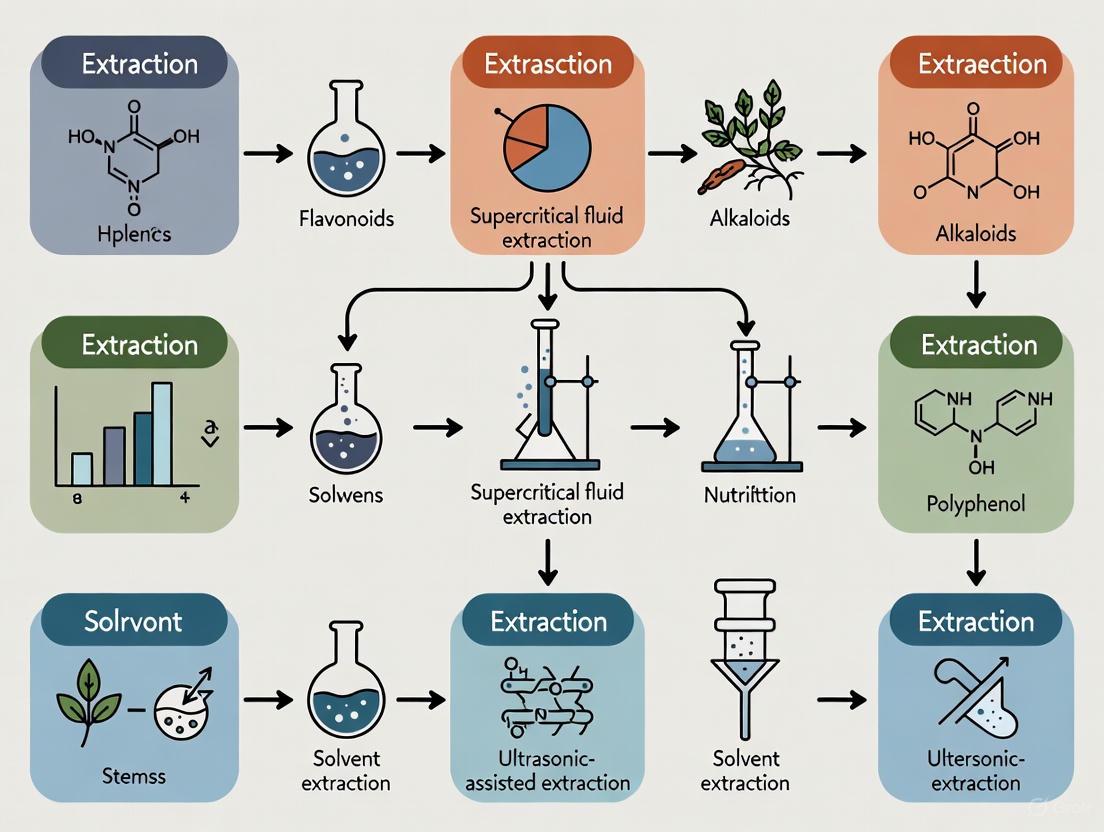
This comprehensive review explores the evolution of extraction techniques for bioactive plant compounds, addressing the critical needs of researchers and drug development professionals.
Modern Extraction Methods for Bioactive Plant Compounds: From Fundamentals to Pharmaceutical Applications
Abstract
This comprehensive review explores the evolution of extraction techniques for bioactive plant compounds, addressing the critical needs of researchers and drug development professionals. It covers foundational principles of phytochemical extraction, details both conventional and advanced green extraction technologies, and provides systematic optimization strategies to enhance yield and purity. The article further examines rigorous validation protocols and comparative analytical techniques essential for ensuring extract quality, reproducibility, and therapeutic efficacy in pharmaceutical and nutraceutical applications.
The Foundation of Plant Bioactives: From Traditional Use to Modern Science
Classification and Natural Origins of Key Bioactive Compounds
Bioactive compounds are extra-nutritional constituents that naturally occur in small quantities in plant and animal products, providing significant health benefits beyond basic nutrition [1] [2]. These compounds demonstrate a wide range of therapeutic effects, mediated through mechanisms such as antioxidant activity, anti-inflammatory responses, modulation of gut microbiota, and enzyme inhibition [1]. The table below summarizes major classes of bioactive compounds, their key functions, and primary natural sources.
Table 1: Major Classes of Bioactive Compounds and Their Sources
| Compound Class | Examples | Major Food Sources | Key Health Benefits |
|---|---|---|---|
| Polyphenols | Quercetin, Catechins, Resveratrol, Chlorogenic Acid | Berries, apples, green tea, coffee, red wine, cocoa | Antioxidant, anti-inflammatory, cardiovascular protection, neuroprotection [1] [3] |
| Carotenoids | Beta-carotene, Lutein, Lycopene | Carrots, tomatoes, spinach, bell peppers, corn | Vision health, immune support, skin protection, antioxidant [1] |
| Omega-3 Fatty Acids | EPA, DHA, ALA | Fatty fish, flaxseeds, walnuts, chia seeds | Cardiovascular health, anti-inflammatory, cognitive function [1] |
| Alkaloids | Caffeine, Morphine, Quinine | Coffee, tea, cacao, opium poppy | Stimulant, analgesic, antimalarial [4] |
| Terpenoids | Monoterpenes, Sesquiterpenes | Citrus peels, thyme, sage, eucalyptus | Antimicrobial, anti-inflammatory, insecticidal [4] |
| Probiotics & Prebiotics | Lactic acid bacteria, Fructooligosaccharides | Yogurt, kefir, kimchi, onions, asparagus | Gut health modulation, immune enhancement, digestive health [1] |
Analytical Techniques for Identification and Characterization
The identification and characterization of bioactive compounds require sophisticated analytical technologies to ensure accuracy, reproducibility, and quality control [5] [6]. The selection of methodology depends on the compound's nature, concentration, and the matrix from which it is extracted.
Chromatographic Techniques
High-Performance Liquid Chromatography (HPLC) is a versatile, robust, and widely used technique for the isolation and quantification of natural products [5]. When coupled with different detectors, it becomes exceptionally powerful:
- HPLC with Quadrupole Time-of-Flight Mass Spectrometry (HPLC-QTOF-MS): This technique provides high-resolution mass measurement, enabling the tentative identification of compounds based on precise molecular formula assignment and fragmentation patterns [7] [3]. For example, it has been successfully used to identify ten compounds, including flavonoids like isoquercetin and amentoflavone, in Juniperus chinensis L. leaves [7].
- HPLC with Photo-Diode Array Detection (HPLC-DAD): Allows for the quantification of compounds based on their UV-Vis spectra and retention times compared to authentic standards [3]. This method was used to quantify parishin A and chlorogenic acid in Maclura tricuspidata fruit [3].
Thin-Layer Chromatography (TLC) serves as a preliminary screening tool to determine the number of components in a mixture. When combined with bio-autography, it becomes a powerful method for localizing antimicrobial compounds directly on the chromatogram, facilitating bioassay-guided isolation [5].
Non-Chromatographic Techniques
- Fourier Transform Infrared Spectroscopy (FTIR): Used to identify functional groups and elucidate the structure of purified compounds [5].
- Immunoassays: Utilize monoclonal antibodies for highly specific detection of target compounds, though their application is more limited [5].
Table 2: Key Research Reagent Solutions for Bioactive Compound Analysis
| Reagent/Material | Function/Application | Examples/Notes |
|---|---|---|
| Extraction Solvents | To solubilize and extract target compounds from plant matrix. | Methanol, Ethanol, Water, Hexane, Ethyl-acetate. Choice depends on compound polarity [5] [6]. |
| Chromatography Columns | To separate complex mixtures of compounds. | C18 reverse-phase columns are standard for HPLC analysis of polyphenols [7] [3]. |
| Mass Spectrometry Standards | For instrument calibration and accurate mass measurement. | Often a mixture of known compounds is infused for constant calibration during QTOF-MS analysis [7]. |
| Authentic Reference Compounds | For positive identification and quantification via retention time and spectral matching. | Commercially available pure compounds (e.g., quercetin, chlorogenic acid) are essential for validation [7] [3]. |
| Bio-autography Agar Media | To culture microorganisms for detecting antimicrobial activity on TLC plates. | Nutrient Agar or Mueller-Hinton Agar seeded with test bacteria like Bacillus subtilis or Escherichia coli [5]. |
Experimental Protocols for Extraction and Analysis
Protocol 1: Ultrasound-Assisted Extraction (UAE) of Polyphenols
Principle: This modern extraction method uses acoustic cavitation to disrupt plant cell walls, facilitating the release of intracellular compounds at lower temperatures, thereby preserving heat-sensitive bioactives and improving efficiency [8] [6].
Materials and Equipment:
- Plant material (dried and finely ground)
- Ethanol (70-80% aqueous solution)
- Ultrasonic bath or probe sonicator
- Centrifuge
- Rotary evaporator
- Analytical balance
Procedure:
- Sample Preparation: Weigh 1.0 g of finely powdered plant material into a conical flask.
- Solvent Addition: Add 20 mL of 70% ethanol to the flask.
- Sonication: Place the flask in an ultrasonic bath and extract for 15-30 minutes at a controlled temperature (e.g., 40°C). Alternatively, use a probe sonicator with controlled pulse cycles.
- Separation: Centrifuge the mixture at 5000 rpm for 10 minutes to separate the solid residue.
- Concentration: Carefully decant the supernatant and concentrate it under reduced pressure using a rotary evaporator at 40°C.
- Reconstitution: Reconstitute the dried extract in a known volume of methanol for subsequent analysis.
- Storage: Store the extract at -20°C if not used immediately.
Advantages: Reduced extraction time, lower solvent consumption, higher yield of thermolabile compounds, and improved antioxidant activity of the extract compared to conventional Soxhlet extraction [6].
Protocol 2: HPLC-QTOF-MS Analysis for Compound Identification
Principle: This protocol combines the separation power of HPLC with the high mass accuracy and structural elucidation capabilities of QTOF-MS to identify unknown compounds in a complex plant extract [7] [3].
Materials and Equipment:
- Crude plant extract
- HPLC-grade solvents (Acetonitrile, Methanol, Water)
- Formic Acid
- UPLC/QTOF-MS system
- C18 reverse-phase column (e.g., 2.1 x 100 mm, 1.7 µm)
Procedure:
- Sample Preparation: Filter the reconstituted extract through a 0.22 µm membrane filter.
- HPLC Conditions:
- Mobile Phase: (A) 0.1% Formic acid in water; (B) 0.1% Formic acid in acetonitrile.
- Gradient: 5% B to 95% B over 25-30 minutes.
- Flow Rate: 0.3 mL/min.
- Column Temperature: 40°C.
- Injection Volume: 2-5 µL.
- QTOF-MS Conditions:
- Ionization Mode: Electrospray Ionization (ESI), both positive and negative modes.
- Mass Range: 50-1500 m/z.
- Capillary Voltage: 3.0 kV.
- Source Temperature: 120°C.
- Desolvation Temperature: 350°C.
- Data Acquisition and Analysis:
- Acquire data in MSE mode (low and high collision energy) to get precursor and fragment ion data simultaneously.
- Process data using dedicated software (e.g., UNIFI, MassLynx).
- Identify compounds by comparing accurate mass, isotopic pattern, and fragmentation spectra with databases (e.g., ChemSpider) and literature. Confirm identities using authentic standards when available [7].
Therapeutic Mechanisms and Signaling Pathways
Bioactive compounds exert their health benefits through interactions with various molecular targets and signaling pathways. The following diagram illustrates key mechanisms, including antioxidant, anti-inflammatory, and antimicrobial actions.
The therapeutic efficacy of these compounds is highly dependent on the extraction technique used, as different methods influence the stability and concentration of the functional phytochemicals [6]. For instance, ultrasound-assisted extraction better preserves heat-sensitive flavonoids, leading to extracts with superior antioxidant and anti-inflammatory activity compared to conventional Soxhlet extraction [6].
Quantitative Analysis and Bioactivity Correlation
Robust quantitative analysis is essential for standardizing extracts and correlating specific compounds with observed bioactivities. Advanced analytical techniques enable precise measurement, as demonstrated in the following studies.
Table 3: Quantitative Analysis of Bioactive Compounds in Selected Plant Studies
| Plant Source | Analytical Method | Key Compounds Quantified | Concentration | Correlated Bioactivity |
|---|---|---|---|---|
| Juniperus chinensis L. Leaves [7] | UPLC-MS/MS | Quercetin-3-O-α-l-rhamnoside | 203.78 mg/g | Antibacterial activity against pathogenic bacteria (e.g., Bordetella pertussis) |
| Amentoflavone | 69.84 mg/g | |||
| Novel Apple Genotypes [9] | HPLC | Catechins, Epicatechins, Quercetin, Rutin | Varies by genotype | Antioxidant activity (DPPH assay); strong correlation between total phenolic content and antioxidative potential |
| Maclura tricuspidata Fruit [3] | HPLC | Parishin A | Highest abundance | Overall antioxidant activities (DPPH, ABTS, FRAP); higher in immature stages |
| Chlorogenic Acid | Significant levels |
The data in Table 3 highlights that the concentration of bioactive compounds can vary significantly between plant species, tissue types, and maturity stages. Furthermore, a direct correlation often exists between the concentration of these compounds, particularly phenolics, and the antioxidant potency of the extract, underscoring their role as primary contributors to bioactivity [9] [3].
The Crucial Role of Extraction in Harnessing Plant-Based Therapeutics
The extraction process serves as the foundational and most critical step in transforming raw plant materials into standardized, therapeutically active agents. This initial stage directly determines the yield, composition, and biological efficacy of the final extract, influencing all subsequent pharmacological testing and clinical applications [10] [5]. Inefficient or inappropriate extraction techniques can compromise the integrity of heat-sensitive bioactive compounds, lead to the co-extraction of undesirable impurities, and ultimately result in inconsistent or suboptimal therapeutic outcomes [6].
Recent advancements have catalyzed a shift from conventional methods towards modern, sustainable techniques such as Ultrasound-Assisted Extraction (UAE) and Microwave-Assisted Extraction (MAE). These innovative approaches are designed to enhance extraction efficiency, reduce solvent consumption, and better preserve the delicate chemical structures of active constituents [8] [11]. The selection of an optimal extraction protocol is therefore paramount, as it must carefully balance maximum yield with the preservation of the native bioactivity profile, ensuring the production of high-quality, reproducible plant-based therapeutics for rigorous scientific evaluation [6].
Conventional vs. Modern Extraction Techniques: A Comparative Analysis
The choice of extraction methodology profoundly impacts the chemical profile of the resulting plant-based therapeutic. Techniques are broadly categorized into conventional and modern methods, each with distinct operational principles, advantages, and limitations.
Conventional Extraction Techniques
Conventional methods have formed the backbone of plant extraction for centuries and are characterized by their reliance on simple equipment, relatively large solvent volumes, and, often, prolonged extraction times [12].
- Maceration: This process involves steeping powdered plant material in a solvent for an extended period, typically several days, with occasional agitation. The mixture is then separated, and the marc (the damp solid residue) is pressed to recover any residual extract [10] [12]. While simple and inexpensive, its main drawbacks are long extraction times and lower efficiency [12].
- Percolation: In this continuous process, the solvent gradually passes through the bed of plant material, extracting soluble constituents as it flows. The resulting liquid, known as the percolate, is collected continuously. This method is generally more efficient than maceration as it maintains a constant concentration gradient between the plant material and the fresh solvent [10] [12].
- Soxhlet Extraction: This is a semi-continuous method where the same solvent is repeatedly recycled through the plant material via distillation and siphoning. It is highly effective for extracting compounds with low solubility and is considered a benchmark for exhaustive extraction. However, its use of prolonged heating at the solvent's boiling point poses a significant risk of thermal degradation for sensitive molecules like certain flavonoids and polyphenols [6] [5].
- Decoction: This method involves boiling plant material, typically hard or woody parts like roots and barks, in water for a sustained period. It is suitable for heat-stable, water-soluble compounds. A key limitation is that the high temperatures can cause hydrolysis or degradation of thermolabile constituents [10] [12].
Modern Extraction Techniques
Modern or "green" extraction technologies have been developed to overcome the limitations of conventional methods. They typically offer improved efficiency, reduced solvent consumption, and shorter processing times, while better preserving the integrity of bioactive compounds [8] [11].
- Ultrasound-Assisted Extraction (UAE): This technique utilizes high-frequency sound waves (typically 20-100 kHz) to create cavitation bubbles in the solvent. The implosion of these bubbles generates intense local shear forces and microturbulence, which disrupts plant cell walls and enhances mass transfer [11]. UAE is renowned for its ability to significantly increase extraction yields of compounds like flavonoids while operating at lower temperatures, thus minimizing thermal damage [6].
- Microwave-Assisted Extraction (MAE): MAE employs microwave energy to heat the water and other polar molecules within plant cells directly. This rapid internal heating creates high pressure within the cells, leading to rupture and the efficient release of intracellular compounds into the surrounding solvent [11]. MAE is highly effective for the rapid extraction of a wide range of phytochemicals [8].
- Supercritical Fluid Extraction (SFE): SFE, most commonly using supercritical CO₂ (scCO₂), leverages the unique gas-like diffusivity and liquid-like density of a supercritical fluid. The solvating power of scCO₂ can be finely tuned by adjusting temperature and pressure, allowing for highly selective extraction. It is particularly advantageous for extracting non-polar compounds like essential oils and terpenoids, and it leaves no toxic solvent residues in the final product [8] [11].
- Enzyme-Assisted Extraction (EAE): This method uses specific enzymes (e.g., cellulase, pectinase) to hydrolyze and break down the structural components of plant cell walls (cellulose, hemicellulose, pectin). This breakdown facilitates the release of bound intracellular compounds, often increasing the yield of target bioactives such as glycosides and polysaccharides [6].
Table 1: Comparison of Common Extraction Techniques for Bioactive Compounds from Plants.
| Extraction Technique | Operational Principle | Key Advantages | Key Limitations | Typical Solvents Used |
|---|---|---|---|---|
| Maceration [10] [12] | Passive soaking of plant material in solvent. | Simple, low equipment cost, suitable for thermolabile compounds. | Long extraction time, low efficiency, high solvent consumption. | Ethanol, Methanol, Water |
| Soxhlet Extraction [6] [5] | Continuous cycling of fresh solvent via distillation. | Exhaustive extraction, high yield for stable compounds. | High temperature degrades thermolabile compounds, high solvent use, long time. | Hexane, Ethanol, Petroleum Ether |
| Ultrasound-Assisted (UAE) [6] [11] | Cell wall disruption via acoustic cavitation. | Rapid, lower temperature, higher yield, reduced solvent. | Potential for free radical formation, scale-up challenges. | Ethanol, Water, Methanol |
| Microwave-Assisted (MAE) [8] [12] | Rapid internal heating and cell rupture via microwave energy. | Very fast, low solvent consumption, high efficiency. | Not ideal for heat-sensitive compounds, uneven heating possible. | Ethanol, Water |
| Supercritical Fluid (SFE) [8] [11] | Solvation using supercritical fluids (e.g., CO₂). | Tunable selectivity, no solvent residue, high purity. | High capital cost, high pressure operation, best for non-polar compounds. | Supercritical CO₂ (with/without modifers) |
| Enzyme-Assisted (EAE) [6] | Enzymatic hydrolysis of cell walls to release compounds. | High selectivity, mild conditions, improves yield of bound compounds. | Enzyme cost, need for optimized conditions (pH, temperature). | Water-based buffers |
Detailed Experimental Protocols for Key Extraction Methods
To ensure reproducibility and high-quality results in research, standardized protocols are essential. Below are detailed methodologies for one conventional and two modern extraction techniques.
Protocol 1: Maceration of Plant Material for Phytochemical Screening
Principle: This method relies on passive diffusion, where the solvent penetrates the plant tissue to dissolve soluble constituents, establishing a concentration equilibrium over time [10] [12].
Materials:
- Plant Material: Dried and finely powdered (e.g., 100 g of Serpylli herba or other relevant herb) [6].
- Solvent: 1 L of 50-70% Ethanol (v/v) in water [10] [12].
- Equipment: Glass container with airtight lid, mechanical shaker (optional), filtration setup (e.g., Buchner funnel and filter paper), rotary evaporator.
Procedure:
- Preparation: Weigh 100 g of accurately weighed, dried, and powdered plant material.
- Maceration: Place the powder in a glass container and add 1 L of 50% ethanol. Seal the container tightly to prevent solvent evaporation.
- Agitation: Allow the mixture to stand at room temperature for a minimum of 3 days, with occasional shaking or stirring to enhance extraction [10]. For improved yield, mechanical shaking can be employed [6].
- Filtration: After 3 days, separate the liquid extract from the solid marc by filtration. Press the marc to recover as much extract as possible.
- Concentration: Combine the filtrates and concentrate under reduced pressure using a rotary evaporator at a temperature not exceeding 40°C to prevent compound degradation.
- Storage: The resulting crude extract can be stored in a sealed, light-resistant container at 4°C for further phytochemical analysis [10].
Protocol 2: Ultrasound-Assisted Extraction (UAE) of Flavonoids from Citrus Peel
Principle: This protocol leverages acoustic cavitation to disrupt plant cell walls, facilitating the rapid and efficient release of intracellular flavonoids like hesperidin at lower temperatures, thereby preserving their antioxidant activity [6].
Materials:
- Plant Material: 10 g of dried and milled citrus peel (e.g., orange or lemon).
- Solvent: 200 mL of 70% Ethanol (v/v) in water [6].
- Equipment: Ultrasonic bath or probe sonicator (with temperature control), analytical balance, filtration setup, rotary evaporator.
Procedure:
- Preparation: Weigh 10 g of dried citrus peel powder and place it in a glass Erlenmeyer flask.
- Solvent Addition: Add 200 mL of 70% ethanol to the flask, ensuring the powder is fully immersed.
- Sonication: Place the flask in an ultrasonic bath (or use a probe sonicator) and sonicate for 20 minutes. Maintain the temperature of the extraction mixture below 40°C by using a circulating water bath or ice, if necessary.
- Filtration: After sonication, filter the mixture immediately to separate the solid residue from the liquid extract.
- Concentration: Concentrate the filtrate under reduced pressure at 40°C using a rotary evaporator.
- Analysis: The dry extract can be analyzed for total flavonoid content and antioxidant activity (e.g., by DPPH assay). Yields are consistently higher and bioactivity better preserved compared to Soxhlet extraction [6].
Protocol 3: Microwave-Assisted Extraction (MAE) of Phenolic Compounds fromCajanus cajanLeaves
Principle: Microwave energy causes rapid and volumetric heating of moisture within plant cells, generating high internal pressure that ruptures the cells and forces out bioactive compounds, drastically reducing extraction time [12] [2].
Materials:
- Plant Material: 5 g of dried and powdered Cajanus cajan leaves.
- Solvent: 100 mL of 80% Methanol (v/v) in water.
- Equipment: Closed-vessel microwave extraction system, Teflon vessels, volumetric flasks, filtration setup, rotary evaporator.
Procedure:
- Preparation: Accurately weigh 5 g of powdered plant material and transfer it to a Teflon microwave vessel.
- Solvent Addition: Add 100 mL of 80% methanol to the vessel and seal it securely.
- Microwave Extraction: Place the vessel in the microwave system and irradiate at a controlled power (e.g., 500 W) for 5 minutes, ensuring the temperature does not exceed 60°C to protect heat-sensitive phenolics.
- Cooling and Filtration: After irradiation, carefully remove the vessel and allow it to cool. Once safe to handle, open the vessel and filter the contents.
- Concentration: Evaporate the solvent from the filtrate using a rotary evaporator at 40°C to obtain the phenolic-rich extract.
- Validation: The efficiency can be validated by quantifying specific markers like orientin and luteolin using HPLC, demonstrating superior yield compared to maceration [2].
Diagram 1: A workflow for selecting an appropriate extraction method based on research objectives, distinguishing between conventional and modern techniques.
The Scientist's Toolkit: Essential Reagents and Materials
Successful extraction relies on a suite of specialized reagents and materials. The selection of solvent is arguably the most critical parameter, as its polarity must align with the target compounds to ensure high solubility and selectivity [10] [5].
Table 2: Key Research Reagent Solutions for Plant Extraction Protocols.
| Reagent/Material | Function/Application | Critical Considerations |
|---|---|---|
| Ethanol [10] | Universal polar solvent for phenolics, flavonoids, alkaloids. | GRAS (Generally Recognized as Safe) status; concentrations of 20-70% are self-preservative. |
| Methanol [10] [5] | Efficient solvent for a broad range of polar phytochemicals. | Higher toxicity compared to ethanol; requires careful handling and disposal. |
| Water [10] | Solvent for polar compounds like polysaccharides and glycosides. | Can hydrolyze some compounds; promotes microbial growth; requires sterilization. |
| Ethyl Acetate [10] | Intermediate polarity solvent; ideal for medium polarity compounds (e.g., many aglycones). | Commonly used in liquid-liquid partitioning of crude extracts. |
| n-Hexane [10] [5] | Non-polar solvent for defatting and extracting lipids, waxes, essential oils. | Highly flammable; used to remove chlorophyll and other non-polar impurities. |
| Supercritical CO₂ [8] [11] | Green, tunable solvent for non-polar compounds in SFE. | Leaves no solvent residue; requires high-pressure equipment. |
| Cellulase/Pectinase Enzymes [6] | Used in EAE to hydrolyze cell wall polymers and release bound compounds. | Requires optimization of pH, temperature, and incubation time. |
Post-Extraction: Isolation and Characterization of Bioactives
Following extraction, the crude mixture requires further processing to isolate and identify the individual bioactive compounds responsible for the observed therapeutic effects. This process typically involves a combination of chromatographic and spectroscopic techniques [10] [5].
Isolation and Purification Techniques
- Thin-Layer Chromatography (TLC): A rapid, cost-effective technique used for the initial phytochemical screening of extracts. It provides a fingerprint of the complex mixture and can be used to guide the development of subsequent separation methods. TLC can be coupled with bioautography to directly locate antimicrobial compounds on the plate [5].
- Column Chromatography (CC): A versatile workhorse for the fractionation of crude extracts. The extract is loaded onto a column packed with a stationary phase (e.g., silica gel, Sephadex), and different compounds are eluted using solvents of increasing polarity. This technique is excellent for separating complex mixtures into simpler fractions [5] [12].
- High-Performance Liquid Chromatography (HPLC): The gold standard for the analytical and preparative separation of natural products. HPLC provides high resolution, sensitivity, and reproducibility, making it ideal for quantifying specific bioactive markers in an extract, which is crucial for standardization and quality control [10] [5].
Characterization and Identification Techniques
Once purified, the structural elucidation of isolated compounds is achieved through spectroscopic methods:
- Mass Spectrometry (MS): Determines the molecular weight and provides fragmentation patterns that offer clues about the compound's structure [5].
- Nuclear Magnetic Resonance (NMR) Spectroscopy: (e.g., ¹H and ¹³C NMR) is indispensable for determining the precise carbon-hydrogen framework and functional groups of a molecule, allowing for full structural assignment [5].
- Fourier Transform Infrared (FTIR) Spectroscopy: Helps identify characteristic functional groups (e.g., hydroxyl, carbonyl) in the molecule [5].
Diagram 2: A bioassay-guided isolation workflow for the discovery of bioactive compounds from a crude plant extract.
The extraction process is undeniably the cornerstone of harnessing the therapeutic potential of plants. It is a sophisticated and multi-faceted operation that directly dictates the quality, efficacy, and safety of the final botanical product. While conventional methods like maceration and Soxhlet extraction provide a historical foundation, the clear trend in research and industry is toward the adoption of modern techniques such as UAE, MAE, and SFE. These advanced methods offer compelling advantages in terms of efficiency, sustainability, and the preservation of delicate bioactive chemistries.
The future of plant-based therapeutic development lies in the strategic integration of these techniques—so-called hybrid approaches—and their optimization using data-driven modeling. By selecting and executing the most appropriate extraction protocol, researchers can ensure the production of standardized, potent, and clinically relevant plant-derived medicines, fully unlocking the promise held within the world's botanical resources.
The extraction of bioactive compounds from plants is a foundational step in natural product research and drug development. Conventional techniques such as maceration, percolation, and Soxhlet extraction have been utilized for decades as standard methods for isolating phytochemicals. These methods employ principles of solubility, diffusion, and continuous displacement to recover target compounds from plant matrices [10]. While modern approaches offer enhanced efficiency, understanding these classical methods remains crucial for developing effective extraction protocols and appreciating the evolution of extraction technologies. This application note provides a detailed examination of these three conventional extraction techniques, including their operational principles, standardized protocols, and comparative performance characteristics to guide researchers in selecting and optimizing methods for specific applications in phytochemical research.
Principles and Mechanisms
Maceration
Maceration is a simple solid-liquid extraction process where powdered plant material is immersed in a solvent within a closed container for a defined period, typically with frequent agitation [10]. The process relies on differential concentration gradients that drive the diffusion of soluble constituents from plant cells into the solvent. As the solvent penetrates the cellular structure, it dissolves the active compounds, creating a concentrated solution that is subsequently separated from the marc (insoluble residue) through filtration or decantation [10]. This method is particularly suitable for heat-sensitive compounds and is characterized by its operational simplicity and minimal equipment requirements.
Percolation
Percolation involves the continuous, downward passage of a solvent through a stationary bed of powdered plant material contained in a specialized vessel known as a percolator [10]. This dynamic process maintains a constant concentration gradient, facilitating more efficient extraction compared to static methods. The solvent gradually saturates the plant matrix as it flows downward, dissolving soluble constituents before being collected as the extract or "micelle" [10]. The continuous solvent flow prevents equilibrium establishment between the plant material and solvent, resulting in more exhaustive extraction. The percolation process exhibits critical behavior where the formation of a connected network allows for continuous flow, with the percolation threshold representing the critical solvent density required for this connectivity [13].
Soxhlet Extraction
Soxhlet extraction represents an automated, continuous approach where the sample is repeatedly exposed to fresh solvent cycles through a unique siphon mechanism [14]. The apparatus consists of three main components: a flask containing the boiling solvent, an extraction chamber housing the sample in a porous thimble, and a condenser for solvent reflux [14]. The process begins with solvent heating and vaporization, followed by condensation and drip-wise passage through the sample. When the solvent level reaches the siphon threshold, the solution containing extracted compounds automatically returns to the flask, leaving the solute while the solvent recommences the cycle [15]. This method enables repeated extraction with relatively small solvent volumes and operates unattended once initiated.
Experimental Protocols
Maceration Protocol
Materials Required:
- Plant material (dried and powdered)
- Selected solvent (e.g., ethanol, methanol, water, or hydroalcoholic mixtures)
- Sealed container (amber glass preferred for light-sensitive compounds)
- Orbital shaker or magnetic stirrer (optional)
- Filtration apparatus (filter paper, Buchner funnel, or muslin cloth)
- Evaporation equipment (rotary evaporator or water bath)
Procedure:
- Plant Preparation: Reduce plant material to fine powder (0.2-0.5 mm particle size) to maximize surface area for solvent contact [10].
- Solvent Selection: Choose appropriate solvent based on target compound polarity (e.g., ethanol for medium-polarity compounds, water for polar compounds) [10].
- Immersion: Combine powdered plant material with solvent in a 1:5 to 1:10 ratio (mass:volume) in a sealed container [16].
- Agitation: Maintain continuous or intermittent agitation at 250 rpm for 24 hours at room temperature to enhance mass transfer [16].
- Separation: After 24 hours, separate the liquid extract from the marc through filtration using Whatman No. 1 filter paper or a Buchner funnel.
- Concentration: Concentrate the filtrate under reduced pressure using a rotary evaporator at temperatures not exceeding 40°C to preserve thermolabile compounds.
- Storage: Store the concentrated extract in airtight, amber glass containers at 4°C until further analysis.
Optimization Notes:
- For exhaustive extraction, repeat the process with fresh solvent on the same marc and combine filtrates.
- Extend maceration time to 3-7 days for hard plant materials or compounds with slow diffusion rates.
- Adjust pH of solvent to enhance extraction of specific compound classes (e.g., acidified solvent for alkaloids).
Percolation Protocol
Materials Required:
- Percolator (cylindrical vessel with controlled outlet)
- Plant material (dried and powdered)
- Selected extraction solvent
- Cotton plug or glass wool
- Collection vessel
Procedure:
- Plant Preparation: Moisten the powdered plant material with a small quantity of solvent and allow to stand for 15-30 minutes to facilitate swelling [10].
- Percolator Packing: Place a cotton plug at the percolator base, then uniformly pack the moistened plant material without creating channels or excessive compaction.
- Solvent Addition: Add sufficient solvent to cover the plant material completely, then open the outlet slightly to allow air escape before closing it again.
- Maceration Phase: Allow the closed system to stand for 24 hours to enable preliminary extraction and solvent penetration [10].
- Continuous Extraction: After the maceration period, open the outlet to maintain a slow, continuous flow (approximately 1-2 mL per minute per 100g of material).
- Collection: Collect the percolate (micelle) in a clean vessel until the plant material is exhausted (typically 3-5 times the material volume).
- Concentration: Concentrate the percolate using a rotary evaporator at appropriate temperatures.
Optimization Notes:
- Maintain a constant solvent layer above the plant material throughout the process.
- Adjust flow rate to balance extraction efficiency and processing time.
- For difficult extractions, consider using a gradient solvent system with increasing polarity.
Soxhlet Extraction Protocol
Materials Required:
- Soxhlet apparatus (flask, extraction chamber, condenser)
- Solvent (low-boiling point preferred)
- Extraction thimbles (cellulose or glass fiber)
- Heating mantle or water bath
- Plant material (dried and powdered)
Procedure:
- Sample Preparation: Accurately weigh 1-10g of dried, powdered plant material and place in a dry extraction thimble [16].
- Apparatus Assembly: Place the thimble in the extraction chamber. Add an appropriate solvent (typically 100-200mL) to the flask, ensuring it will not siphon directly without passing through the sample.
- Extraction Cycle: Heat the flask to maintain a solvent boiling rate that produces 3-6 siphon cycles per hour [14].
- Process Continuation: Continue extraction for 6-24 hours, depending on the sample and target compounds.
- Concentration: After completion, recover the extract from the flask and concentrate using a rotary evaporator.
- Residual Solvent Removal: Remove any remaining solvent from the marc by allowing the thimble to dry completely.
Optimization Notes:
- Select solvents with appropriate boiling points to balance extraction efficiency and compound stability.
- For thermolabile compounds, consider using a cooling system to minimize thermal degradation.
- The number of cycles should be optimized based on the specific plant material and target compounds.
Comparative Analysis
Table 1: Operational Parameters of Conventional Extraction Methods
| Parameter | Maceration | Percolation | Soxhlet Extraction |
|---|---|---|---|
| Extraction Principle | Passive diffusion with agitation | Continuous solvent flow | Repeated washing with fresh solvent via reflux |
| Temperature | Room temperature (25-30°C) | Room temperature (25-30°C) | Solvent boiling point (e.g., 78°C for ethanol) |
| Time Requirement | 24 hours to several days [16] | 24-72 hours | 6-24 hours [14] |
| Solvent Consumption | High (single use) | Moderate | Low (recycled solvent) [15] |
| Efficiency | Moderate | Good to high | High for stable compounds [15] |
| Automation Level | Low (requires manual separation) | Low to moderate | High (continuous operation) [14] |
| Suitable Compounds | Heat-sensitive compounds | Most plant constituents | Thermally stable, non-polar compounds |
Table 2: Applications and Limitations of Conventional Extraction Methods
| Aspect | Maceration | Percolation | Soxhlet Extraction |
|---|---|---|---|
| Optimal Applications | Soft plant tissues, heat-sensitive compounds, traditional tinctures | Medium to hard plant tissues, standardized extracts | Lipids, alkaloids, fixed oils, waxes [14] |
| Advantages | Simple equipment, preserves thermolabile compounds, scalable | Maintains concentration gradient, more efficient than maceration | Continuous process, higher efficiency, minimal supervision [15] |
| Disadvantages | Lengthy process, incomplete extraction, high solvent use | Channeling issues, requires uniform packing | Thermal degradation, not suitable for high-boiling solvents [14] |
| Yield Performance | Moderate (65-75% of available compounds) | Good (75-85% of available compounds) | High (80-95% of available compounds) [15] |
Table 3: Quantitative Comparison of Extraction Efficiency for Propolis (Based on Experimental Data) [16]
| Extraction Method | Extraction Yield (%) | Total Phenolic Content (mg GAE/g) | Extraction Time | Solvent Volume (mL/g) |
|---|---|---|---|---|
| Maceration | 12.5 | 45.2 | 24 hours | 50 |
| Ultrasound-Assisted | 15.8 | 52.7 | 30 minutes | 50 |
| Microwave-Assisted | 14.3 | 48.9 | 2 minutes | 50 |
Research Reagent Solutions
Table 4: Essential Reagents and Materials for Conventional Extraction Methods
| Reagent/Material | Specification | Function in Extraction | Application Notes |
|---|---|---|---|
| Ethanol | 70-95% purity, food/pharma grade | Polar solvent for phenolics, flavonoids, alkaloids | Concentration adjusted based on target compound polarity [16] |
| Methanol | HPLC grade, ≥99% purity | Efficient solvent for broad-range phytochemicals | Toxic; requires proper ventilation and handling [10] |
| Ethyl Acetate | Analytical grade | Medium polarity solvent for medium-polar compounds | Suitable for fractionation and specific compound classes |
| Chloroform | Anhydrous, stabilized | Non-polar solvent for terpenoids, fats, waxes | Carcinogenic; requires strict safety protocols [10] |
| n-Hexane | Technical grade | Lipid and non-polar compound extraction | Highly flammable; effective for defatting procedures |
| Distilled Water | Purified, deionized | Polar solvent for polar compounds, polysaccharides | May require preservatives for extended extraction [10] |
| Extraction Thimbles | Cellulose, size appropriate to apparatus | Sample containment in Soxhlet extraction | Must be compatible with extraction solvent [14] |
| Filter Paper | Whatman No. 1 or equivalent, qualitative grade | Solid-liquid separation after extraction | Particle retention ~11μm for clear filtrate |
Workflow Visualization
Extraction Method Selection Workflow
Soxhlet Extraction Mechanism
Conventional extraction methods including maceration, percolation, and Soxhlet extraction remain fundamentally important in natural product research despite the emergence of modern techniques. Each method offers distinct advantages: maceration for heat-sensitive compounds, percolation for efficient continuous extraction, and Soxhlet for automated exhaustive extraction with solvent recycling. The choice among these methods depends on multiple factors including target compound characteristics, available equipment, time constraints, and desired yield. While these conventional approaches may exhibit limitations in efficiency, solvent consumption, and time requirements compared to emerging technologies, their simplicity, reproducibility, and well-understood mechanisms ensure their continued relevance in phytochemical research and drug development workflows.
The extraction of bioactive compounds from plants is a critical foundational step in natural product research and drug development. The efficiency and success of this process are governed by three interconnected fundamental principles: compound polarity, solvent selection, and mass transfer mechanisms [12]. These principles directly determine the yield, purity, and biological activity of the extracted compounds [6]. Selecting an appropriate solvent based on polarity matching maximizes solubility, while understanding mass transfer principles allows researchers to enhance the diffusion of compounds from the plant matrix into the solvent [17] [12]. This document outlines the core theoretical frameworks and provides standardized protocols to guide researchers in optimizing these parameters for reproducible and high-quality extract production within a research and development context.
Core Principles
The Role of Compound Polarity
Polarity is a fundamental property of molecules that significantly influences their solubility and extraction behavior. The principle of "like dissolves like" is the cornerstone of solvent selection [12]. Bioactive compounds in plants span a wide polarity range; for instance, phenolic compounds and flavonoids are relatively polar, while terpenoids and essential oils are non-polar [18] [6]. The polarity of the target compound dictates the choice of extraction solvent to achieve optimal solubility and yield.
Table 1: Common Bioactive Compound Classes and Their Polarity Characteristics
| Compound Class | General Polarity | Example Compounds | Typical Plant Sources |
|---|---|---|---|
| Alkaloids | Low to Medium Polarity | Vinblastine, Vincristine [18] | Catharanthus roseus [18] |
| Flavonoids | Medium Polarity | Luteolin, Orientoside [12] | Cajanus cajan leaves [12] |
| Terpenoids | Low Polarity | Triterpenes (e.g., in Birch) [19] | Birch bark [19] |
| Saponins | Medium to High Polarity | --- | Sutherlandia frutescens [18] |
| Tannins | High Polarity | --- | Plumbago auriculata [18] |
Solvent Selection Strategy
The solvent is the primary tool for selectively extracting target compounds. Its choice affects not only the yield but also the safety, environmental impact, and downstream processing of the extract.
- Solvent Polarity: Solvents can be categorized by their polarity index. Water, with a high polarity index, is excellent for extracting polar compounds like polysaccharides and tannins. Ethanol and methanol are medium-polarity universal solvents for phytochemical research. Hexane and chloroform, with low polarity, are suitable for lipids and essential oils [17] [12] [20].
- Green Solvent Alternatives: There is a growing shift towards green chemistry in extraction. Bio-based solvents (e.g., ethanol, limonene), supercritical CO₂, and Ionic Liquids/Deep Eutectic Solvents (DES) are being adopted to reduce toxicity and environmental footprint [17] [20]. These solvents can be tailored for specific extraction tasks, offering high selectivity and efficiency [20].
Table 2: Solvent Properties and Selectivity for Compound Classes
| Solvent | Polarity Index | Boiling Point (°C) | Target Compound Classes | Safety & Environmental Notes |
|---|---|---|---|---|
| n-Hexane | 0.1 | ~69 | Lipids, essential oils, pigments [17] | Highly flammable; significant environmental impact [17] |
| Chloroform | 4.1 | ~61 | Alkaloids, terpenoids [20] | Toxic; suspected carcinogen [20] |
| Ethyl Acetate | 4.4 | ~77 | Medium-polarity phenolics, flavonoids [20] | Less toxic; commonly used in labs [20] |
| Ethanol | 5.2 | ~78 | Wide range (polar & non-polar) [12] | Safe for food/pharma; renewable [17] [20] |
| Methanol | 5.1 | ~65 | Alkaloids, flavonoids, glycosides [12] | Toxic; requires careful handling [12] |
| Water | 10.2 | 100 | Polysaccharides, tannins, saponins [12] [19] | Safest solvent; limited ability for non-polar compounds [19] |
Mass Transfer Mechanisms
Mass transfer is the physical process that describes the movement of a solute from the solid plant matrix into the bulk solvent. The process involves three key stages [12]:
- Penetration: The solvent diffuses into the solid plant material.
- Dissolution: The target compounds dissolve into the solvent.
- Diffusion: The dissolved solutes diffuse out of the plant matrix and into the surrounding solvent.
The rate of mass transfer is influenced by several factors [12] [20]:
- Temperature: Higher temperatures increase solubility and diffusion rates but risk degrading thermolabile compounds.
- Particle Size: Smaller particle sizes increase the surface area for solvent penetration, enhancing extraction efficiency.
- Concentration Gradient: Maintaining a high difference in solute concentration between the plant matrix and the solvent drives diffusion. Techniques like percolation and Soxhlet extraction continuously refresh the solvent to maintain this gradient [17] [12].
- Agitation: Stirring or mixing reduces the boundary layer around plant particles, facilitating faster mass transfer.
Diagram 1: Sequential Stages of Mass Transfer during Solid-Liquid Extraction. The process involves multiple steps, each influenced by specific chemical and physical factors (red notes).
Integrated Principles in Practice
The core principles of solvent selection and mass transfer are not independent; they interact synergistically to determine the overall extraction outcome. The correct solvent ensures the target compound can dissolve, while optimized mass transfer conditions ensure it is efficiently removed from the plant matrix. Modern extraction techniques often enhance these natural mass transfer processes. For example, Microwave-Assisted Extraction (MAE) uses microwave energy to rapidly heat the plant material and solvent, creating high internal pressure that ruptures cell walls and accelerates dissolution and diffusion [17] [6]. Ultrasound-Assisted Extraction (UAE) employs ultrasonic cavitation to create microscopic bubbles that implode, generating intense local shear forces that break down cell structures and enhance solvent penetration [20] [6].
Diagram 2: Interrelationship of Core Principles and Techniques. The principles are sequential and interdependent, while modern techniques (red) actively enhance both solvent selection and mass transfer processes to improve final outcomes.
Application Notes & Experimental Protocols
Protocol: Systematic Screening of Solvent Polarity
This protocol is designed to empirically determine the optimal solvent system for extracting target bioactive compounds from a novel plant material.
1. Scope and Application This procedure applies to the initial investigation of plant materials for the recovery of a broad spectrum of phytochemicals. It is particularly useful for identifying the polarity range of unknown bioactive compounds.
2. Principle By using a series of solvents with incrementally increasing polarity, this protocol systematically evaluates extraction efficiency across different chemical classes, from non-polar lipids to highly polar glycosides and sugars [19].
3. Materials and Reagents Table 3: Research Reagent Solutions for Solvent Polarity Screening
| Reagent/Solution | Function/Application in Screening |
|---|---|
| n-Hexane | Extraction of non-polar compounds (e.g., waxes, fixed oils, some terpenoids) [17] |
| Dichloromethane (DCM) | Extraction of medium-to-low polarity compounds (e.g., alkaloids, certain phenolics) [20] |
| Ethyl Acetate | Extraction of medium-polarity compounds (e.g., flavonoids, coumarins) [20] |
| Ethanol (100%) | Broad-spectrum extraction of both polar and semi-polar compounds; considered a green solvent [12] [20] |
| Ethanol-Water (50:50 v/v) | Enhanced extraction of polar compounds (e.g., polyphenols, glycosides, saponins) [19] |
| Deionized Water | Extraction of highly polar compounds (e.g., polysaccharides, tannins, proteins) [12] [19] |
| Ultrasonic Bath (UAE) | Apparatus to enhance mass transfer via cavitation, reducing extraction time and improving yield [20] [6] |
4. Procedure
- Sample Preparation: Reduce the air-dried plant material to a homogeneous powder using a laboratory mill. A standardized particle size (e.g., 0.5-1.0 mm) is recommended for reproducible results [12].
- Weighing: Accurately weigh 1.0 ± 0.01 g of powdered plant material into six separate, labeled glass vials.
- Solvent Addition: Add 30 mL of each screening solvent (n-hexane, DCM, ethyl acetate, 100% ethanol, 50% ethanol, and water) to the respective vials [19].
- Extraction: Seal the vials and place them in an ultrasonic bath. Conduct extraction for 30 minutes at a controlled temperature of 25°C [19].
- Filtration: After extraction, filter the contents of each vial through filter paper (e.g., Whatman No. 1) to remove solid residues.
- Concentration: Evaporate the filtrates to dryness under reduced pressure using a rotary evaporator. Adjust the temperature according to solvent boiling point to prevent degradation of thermolabile compounds.
- Weighing and Analysis: Weigh the dry extracts to determine the percentage yield for each solvent. Reconstitute the extracts in a standardized volume of an appropriate solvent (e.g., 50% methanol) for subsequent chemical analysis (e.g., HPLC, GC-MS) and bioactivity assays [19].
Protocol: Investigating Mass Transfer Kinetics
This protocol provides a method to study the rate of compound extraction, which is crucial for scaling up from laboratory to industrial processes.
1. Scope and Application Used to determine the optimal extraction time and understand the mass transfer limitations for a specific plant material and solvent system.
2. Principle The extraction yield of a target compound over time typically follows a curve: an initial rapid phase (controlled by washing from surfaces and easy-to-access cells) followed by a slower phase (controlled by diffusion from the plant's interior). Modeling this curve helps identify the point of diminishing returns [12].
3. Procedure
- Set up a maceration or ultrasonic-assisted extraction using the optimal solvent identified in Protocol 4.1.
- Sampling: At predetermined time intervals (e.g., 1, 5, 15, 30, 60, 120 minutes), withdraw a small, precise aliquot (e.g., 1 mL) from the extraction mixture.
- Analysis: Immediately filter each aliquot and analyze the concentration of the target compound(s) using a quantitative technique like HPLC-UV or GC-MS.
- Data Modeling: Plot the concentration of the compound against time. Fit the data to established kinetic models (e.g., Fick's second law of diffusion or a first-order kinetic model) to determine the mass transfer rate and the time required to reach equilibrium [21].
The rational design of an extraction process for plant bioactives hinges on a deep understanding of the synergy between compound polarity, solvent selection, and mass transfer principles. By first characterizing the target compounds and then systematically applying these principles through standardized protocols, researchers can significantly enhance extraction efficiency, selectivity, and sustainability. The integration of modern, green techniques that augment mass transfer further propels the field forward. Mastering these fundamentals is essential for producing high-quality, reproducible extracts for advanced pharmaceutical and nutraceutical research and development.
Strengths and Limitations of Traditional Extraction Approaches
Within the research domain of bioactive compound extraction from plants, the selection of an extraction technique is a critical determinant of the yield, composition, and bioactivity of the final extract [6]. Traditional extraction approaches form the historical and practical foundation of phytochemical research. These methods, which include maceration, percolation, reflux extraction, and Soxhlet extraction, are characterized by their reliance on organic solvents and, frequently, the application of heat to facilitate the mass transfer of compounds from plant matrices into solution [17] [20]. While the development of green and advanced technologies has accelerated, a comprehensive understanding of conventional methods remains indispensable for researchers and drug development professionals. These techniques are often the benchmark against which novel methods are evaluated and are still widely employed in both laboratory and industrial settings due to their simplicity and low initial equipment costs [17] [20]. This review provides a systematic analysis of the strengths and limitations of these core traditional extraction technologies, supported by comparative data and detailed experimental protocols.
Principles and Operational Characteristics
Traditional extraction methods operate on the principle of using a solvent to solubilize and remove target compounds from solid plant material. The efficiency of this process is governed by variables such as solvent polarity, temperature, contact time, and particle size [6] [20]. The fundamental steps involve the penetration of the solvent into the plant matrix, the dissolution of active constituents, and the diffusion of the solutes out of the matrix. A key parameter is the partition coefficient (K_d), which defines the equilibrium distribution of a solute between the solid plant material and the solvent phase [20]. Optimizing these parameters is crucial for maximizing yield while preserving the structural integrity of heat-sensitive bioactives.
The following workflow outlines the general decision-making and experimental process for employing traditional extraction methods in a research setting.
Comparative Analysis of Techniques
The selection of an appropriate traditional method depends on the physicochemical properties of the target compounds, the nature of the plant matrix, and considerations of time, cost, and safety. The table below provides a structured comparison of the primary traditional extraction techniques.
Table 1: Comparative Analysis of Traditional Extraction Techniques
| Extraction Technique | Operational Principles | Key Strengths | Inherent Limitations | Typical Applications |
|---|---|---|---|---|
| Maceration [17] | Solvent contact with plant material at room temperature with agitation. | Simple equipment & operation High selectivity with solvent choice Suitable for heat-labile compounds | Time-consuming (long extraction times) High solvent consumption Potential toxic solvent residue | Production of plant absolutes (e.g., violet, osmanthus) [17]; extraction of thermolabile compounds. |
| Percolation [17] | Continuous flow of fresh solvent through a fixed bed of plant material. | Higher efficiency than maceration Maintains concentration gradient Suitable for valuable/toxic compounds | Increased solvent use vs. maceration Channeling can reduce efficiency Can be time-consuming | Traditional Chinese medicine extracts (e.g., belladonna, Polygala) [17]; preparation of high-concentration tinctures. |
| Reflux Extraction [17] | Continuous cycling of boiled and condensed solvent back through the sample. | Avoids solvent loss Higher efficiency for volatile compounds Faster than maceration/percolation | Thermal degradation of heat-sensitive compounds (e.g., some flavonoids, polyphenols) [6] Limited to volatile solvents | Extraction of volatile components like flavonoids and saponins from natural plants [17]. |
| Soxhlet Extraction [17] [20] | Repeated percolation with fresh, condensed solvent in a continuous cycle. | High efficiency (continuous fresh solvent) No filtration required post-extraction Low cost and ease of operation for multiple samples | Very long extraction times High thermal degradation risk [6] Large volumes of toxic solvents | Classic method for lipid extraction; extraction of bioactive compounds from Siraitia grosvenorii and mulberry leaf [17]. |
Detailed Experimental Protocols
Protocol for Maceration Extraction
This protocol is adapted for the extraction of thermolabile phenolic compounds from dried plant leaves [17] [22].
Research Reagent Solutions: Table 2: Essential Materials for Maceration Protocol
| Reagent/Material | Function in Protocol | Example Specifications |
|---|---|---|
| Dried Plant Material | Source of bioactive phytoconstituents. | Dipterocarpus alatus leaves, oven-dried at 70°C [23]. |
| Grinding Mill | Particle size reduction to increase surface area for solvent penetration. | Electric herb miller; target particle size 0.15-0.30 mm [23]. |
| Extraction Solvent (e.g., Ethanol) | Selectively dissolves target compounds based on polarity. | 99.5% Ethanol, suitable for polar and non-polar substances [17] [23]. |
| Orbital Shaker | Provides agitation to enhance mass transfer and prevent channeling. | Capable of 150 rpm, room temperature (20°C) [23]. |
| Buchner Funnel & Filter Paper | Separates the solid marc from the liquid extract. | Whatman filter paper #1 [23]. |
| Rotary Evaporator | Gently removes solvent from the extract under reduced pressure to concentrate bioactives. | Bath temperature 45°C, 50 rpm [23]. |
Step-by-Step Procedure:
- Plant Material Preparation: Wash and oven-dry fresh plant leaves at 70°C until a constant weight is achieved [23]. Grind the dried material using a milling apparatus and sieve to a defined particle size (e.g., 0.15-0.30 mm) to maximize surface area [23] [22].
- Solvent Selection: Choose a solvent based on the polarity of the target compounds. Ethanol is often preferred for its ability to extract a wide range of polar and mid-polar compounds and its relatively low toxicity [17].
- Maceration Process: Precisely weigh 100 g of ground plant material and place it in an Erlenmeyer flask. Add 400 mL of solvent (e.g., 99.5% ethanol) to achieve a defined solid-to-liquid ratio (e.g., 1:4 w/v) [23]. Seal the flask and place it on an orbital shaker. Agitate at 150 rpm at room temperature (20°C) for 24 hours [23].
- Separation and Concentration: After 24 hours, vacuum-filter the mixture using a Buchner funnel lined with filter paper. Transfer the filtrate (the miscella) to a rotary evaporator. Concentrate the extract at 45°C under reduced pressure until the volume is reduced to approximately 10% of the original [23]. Further dry the concentrated extract in an oven at 60°C for 24 hours to obtain a dry paste or powder [23].
- Storage: Store the final crude extract paste in a sealed container at 4°C for subsequent phytochemical analysis and bioactivity testing [23].
Protocol for Soxhlet Extraction
This protocol is suitable for the exhaustive extraction of lipids or stable bioactive compounds from seeds or hardy plant tissues [17] [20].
Step-by-Step Procedure:
- Sample Preparation: Oven-dry and grind the plant material to a fine powder. Place a known weight (e.g., 10-20 g) of the powder into a cellulose or thimble extraction sleeve. Ensure the powder is not packed too tightly to allow for proper solvent flow.
- Apparatus Assembly: Assemble the Soxhlet apparatus, consisting of a boiling flask, the extraction chamber (containing the thimble), and a water condenser. Fill the boiling flask with a volume of solvent (e.g., hexane or ethanol) that is adequate for several extraction cycles, typically 150-200 mL. Ensure all joints are tightly sealed.
- Extraction Cycle: Heat the solvent in the boiling flask until it boils. The solvent vapor rises into the condenser, where it liquefies and drips into the extraction chamber containing the sample. Once the solvent in the extraction chamber reaches the top of the siphon arm, it automatically siphons back into the boiling flask, carrying the extracted compounds with it. This cycle repeats continuously [20].
- Process Completion: Continue the extraction for a predetermined number of cycles or time (often 6-24 hours, depending on the sample). The process is considered complete when the solvent in the siphon tube appears clear, indicating exhaustive extraction.
- Extract Recovery: Disassemble the apparatus once the extraction is complete. The extracted compounds are now concentrated in the boiling flask. Use a rotary evaporator to remove the solvent from the boiling flask, yielding the crude extract.
Impact on Phytochemical Profile and Bioactivity
The choice of traditional extraction method significantly influences the phytochemical composition and, consequently, the therapeutic potential of the plant extract. Prolonged heating in methods like Soxhlet and reflux extraction can degrade thermolabile compounds such as certain flavonoids, polyphenols, and terpenoids, thereby reducing the extract's overall bioactivity [6]. For instance, studies comparing extraction techniques have demonstrated that heat-intensive methods can result in lower antioxidant activities compared to cooler or faster methods, due to the degradation of phenolic compounds responsible for free radical scavenging [6]. The solvent polarity is another critical factor; polar solvents (e.g., ethanol, methanol, water) favor the extraction of hydrophilic compounds like flavonoids and tannins, while non-polar solvents (e.g., hexane, chloroform) are more effective for lipophilic bioactives such as terpenoids and carotenoids [6]. This selectivity directly impacts the resulting bioactivity profile, including antioxidant, anti-inflammatory, and antimicrobial properties [6].
Traditional extraction approaches, despite their limitations, remain cornerstone techniques in the initial stages of plant-based drug discovery and natural product research. Their strengths of operational simplicity, low technological barrier, and high selectivity for specific compound classes make them viable for many research and industrial applications. However, their inherent drawbacks—including long processing times, high solvent consumption, and the risk of thermal degradation—pose significant challenges for the reproducibility, safety, and efficiency of bioactive compound recovery. A thorough understanding of the principles, strengths, and limitations of maceration, percolation, reflux, and Soxhlet extraction is essential for researchers to design rational extraction protocols. This knowledge also provides a critical foundation for the judicious integration of these classical methods with emerging green extraction technologies, paving the way for more sustainable and effective strategies in phytochemical research.
Green Extraction Technologies: Principles and Industrial Applications
Supercritical Fluid Extraction (SFE) is a advanced separation technology that utilizes solvents at temperatures and pressures above their critical point, where distinct liquid and gas phases do not exist [24]. This state creates a supercritical fluid that exhibits unique properties combining the penetrative ability of gases with the solvating power of liquids [25]. Carbon dioxide (CO₂) is the most widely used supercritical fluid due to its accessible critical point (31.1°C and 7.39 MPa), non-toxic nature, non-flammability, and low cost [26]. The technology has gained significant prominence as a green and sustainable extraction method, particularly valuable for obtaining biologically active substances from plant materials and food by-products while eliminating the use of hazardous organic solvents [27].
The fundamental principle of SFE relies on the tunable solvating power of supercritical fluids. By manipulating temperature and pressure, the density and thus the solvating strength of the fluid can be precisely controlled, allowing for selective extraction of target compounds [25]. This technique is especially advantageous for extracting heat-sensitive bioactive compounds because it operates at relatively moderate temperatures, preserving the structural integrity and biological activity of the extracted molecules [27]. The supercritical state provides high diffusivity, low viscosity, and no surface tension, enabling the fluid to penetrate deeply into plant matrices and extract compounds more quickly than liquid solvents [25].
Fundamental Principles of SFE
The Supercritical State
A substance reaches its supercritical state when heated and pressurized above its critical temperature (Tc) and critical pressure (Pc). At this point, the liquid and gas phases converge into a single fluid phase with hybrid properties [26]. The critical temperature is the highest temperature at which a gas can be liquefied by pressure, while the critical pressure is the minimum pressure required to liquefy a substance at its critical temperature [25].
Supercritical CO₂ possesses gas-like properties including high diffusivity and low viscosity, which allow it to rapidly penetrate porous solid matrices. Simultaneously, it exhibits liquid-like density and solvating power, enabling efficient dissolution of materials [25]. The absence of surface tension in supercritical fluids further enhances their ability to penetrate into small pores that are inaccessible to liquids [25].
Solvation Power and Tunability
The solvating power of supercritical fluids is directly related to their density, which can be precisely controlled by adjusting the system pressure and temperature [25]. This tunability is a key advantage of SFE, as it allows operators to selectively extract target compounds by creating specific conditions optimized for different compound classes.
For non-polar and weakly polar compounds such as lipids, essential oils, and terpenes, supercritical CO₂ provides excellent solvation without modification [24]. The extraction of polar compounds like polyphenols and flavonoids typically requires the addition of polar co-solvents such as ethanol or methanol to enhance solubility [27]. This adjustable selectivity enables the development of sophisticated extraction protocols that can target specific compound classes from complex matrices.
Table 1: Critical Parameters of Common Supercritical Fluids
| Fluid | Critical Temperature (°C) | Critical Pressure (MPa) | Common Applications |
|---|---|---|---|
| Carbon dioxide (CO₂) | 31.1 | 7.39 | Most widely used for natural product extraction |
| Water (H₂O) | 374.0 | 22.10 | Environmental remediation, waste treatment |
| Ethane (C₂H₆) | 32.2 | 4.88 | Specialty extractions |
| Propane (C₃H₈) | 96.7 | 4.25 | Lipid extraction |
| Ammonia (NH₃) | 132.5 | 11.40 | Specialty chemical processing |
Carbon Dioxide as a Supercritical Solvent
Properties and Advantages
Supercritical CO₂ (SC-CO₂) has become the solvent of choice for most SFE applications, particularly in the food, pharmaceutical, and cosmetic industries. Its widespread adoption stems from several advantageous properties. SC-CO₂ is non-toxic, non-flammable, and chemically inert, making it safe for processing products for human consumption [27]. The low critical temperature of 31.1°C allows for the extraction of thermolabile compounds without degradation [27]. CO₂ is also readily available in high purity at relatively low cost, and it can be easily recycled and reused within the extraction system [26].
From an environmental perspective, SC-CO₂ extraction eliminates the use of hazardous organic solvents such as hexane, chloroform, and methanol, which pose significant storage, disposal, and environmental concerns [25]. The extracts obtained are free of solvent residues, making them particularly valuable for pharmaceutical, nutraceutical, and food applications where purity is paramount [27]. Furthermore, the simple removal of CO₂ from the extract by depressurization eliminates the need for energy-intensive concentration steps typically required in conventional solvent extraction [27].
Comparison with Traditional Extraction Methods
When compared to traditional extraction methods like Soxhlet extraction or maceration, SFE with CO₂ offers significant advantages in efficiency, selectivity, and environmental impact. Research indicates that SFE can reduce solvent usage by 80-90% and lower energy requirements by 30-50% compared to conventional methods [24]. The extraction process is also faster due to the higher diffusion rates of supercritical fluids, with research showing that lipid extraction can reach more than 90% of the theoretical value in a short time [25].
The quality of SFE extracts is generally superior, with achieved purity of approximately 95% compared to 70-80% typically obtained with traditional solvent extraction methods [24]. This combination of efficiency and selectivity makes SFE particularly valuable for high-value bioactive compounds where preservation of biological activity and elimination of solvent residues are critical considerations.
Table 2: Comparison of SFE-CO₂ with Traditional Extraction Methods
| Parameter | SFE-CO₂ | Soxhlet Extraction | Maceration |
|---|---|---|---|
| Solvent Consumption | Reduced by 80-90% [24] | High | High |
| Energy Requirements | 30-50% lower [24] | High | Moderate |
| Extraction Time | Short (minutes to hours) | Long (hours to days) | Very long (days) |
| Extract Purity | ~95% [24] | 70-80% [24] | 60-75% |
| Solvent Residues | None | Potential residues | Potential residues |
| Thermolabile Compound Preservation | Excellent | Poor | Good |
| Selectivity | Tunable | Limited | Limited |
| Environmental Impact | Low | High | Moderate |
Key Operational Parameters in SFE
The efficiency and selectivity of SFE processes are governed by several interconnected operational parameters that must be optimized for each specific application and raw material.
Pressure and Temperature
Pressure is the most influential parameter in SFE, as it directly controls the density and solvating power of the supercritical fluid [25]. Increasing pressure enhances the solubility of most compounds in SC-CO₂, particularly lipids and non-polar compounds. Studies have demonstrated that extraction yields can increase significantly with pressure, from 3.63 to 18.63 g CO₂ kg⁻¹ when pressure increases from 20 to 60 MPa [25]. The temperature influence is more complex, as it affects both the fluid density and the vapor pressure of the target compounds. Higher temperatures can increase solubility for some compounds while decreasing it for others [25].
The optimal combination of pressure and temperature depends on the specific compounds being targeted. For most lipid and wax extractions, higher pressures (25-50 MPa) and moderate temperatures (40-60°C) are typically employed. For more volatile compounds, lower pressures and temperatures may be preferable to maintain selectivity and prevent co-extraction of unwanted components.
Co-solvents and Modifiers
While pure SC-CO₂ is excellent for non-polar compounds, its ability to dissolve polar molecules is limited. The incorporation of co-solvents (typically 1-15% by volume) significantly enhances the extraction efficiency for polar bioactive compounds [27]. Ethanol is the most commonly used co-solvent in food and pharmaceutical applications due to its safety profile and GRAS (Generally Recognized As Safe) status [27]. Methanol, acetone, and water are also used in specific applications, though their use is more restricted in products for human consumption.
Co-solvents function by modifying the polarity of the supercritical fluid and through specific molecular interactions with target compounds. They can also reduce the required operating pressure and temperature, thereby improving the overall energy efficiency of the process [27]. However, co-solvent selection and concentration must be carefully optimized, as excessive amounts can lead to swelling of plant material or undesirable changes in extract composition [27].
Particle Size and Matrix Preparation
The physical characteristics of the raw material significantly impact SFE efficiency. Reducing particle size increases the surface area available for extraction, while appropriate moisture content is crucial for optimal mass transfer [25]. Excessive moisture can reduce extraction efficiency by creating barriers between the solvent and target compounds, while completely dry matrices may exhibit reduced permeability [25].
Various pretreatment methods can enhance SFE efficiency, including drying, grinding, flaking, and enzymatic or mechanical destructuring [25]. These treatments improve mass transfer by increasing the exchange surface and disrupting cellular structures that contain the target compounds [25]. The optimal particle size represents a balance between increased surface area and potential channeling effects in the extraction bed, typically ranging from 0.25 to 1.5 mm for most plant materials.
Table 3: Optimization of Key SFE Parameters for Different Compound Classes
| Parameter | Lipids & Fixed Oils | Essential Oils & Terpenes | Polar Phenolics | Antioxidants |
|---|---|---|---|---|
| Pressure Range | 25-50 MPa | 8-20 MPa | 20-35 MPa | 15-30 MPa |
| Temperature Range | 40-60°C | 35-50°C | 45-60°C | 40-55°C |
| Co-solvent Requirements | None typically | None typically | Ethanol 5-15% | Ethanol 5-10% |
| Particle Size | 0.3-0.8 mm | 0.5-1.5 mm | 0.2-0.7 mm | 0.3-0.8 mm |
| Moisture Content | <10% | <12% | 5-15% | 5-12% |
| Extraction Time | 1-4 hours | 0.5-2 hours | 1-3 hours | 1-3 hours |
Applications in Bioactive Compound Extraction
SFE with CO₂ has found diverse applications in the extraction of bioactive compounds from plant materials, contributing significantly to the valorization of agricultural by-products and the development of high-value nutraceuticals and pharmaceuticals.
Extraction from Agri-Food By-products
The valorization of agri-food by-products represents a major application area for SFE, aligning with circular economy principles by converting waste streams into value-added products [24]. Global food loss and waste amounts to approximately 1.3 billion tons annually, creating significant environmental and economic challenges [24]. SFE offers an efficient approach to recover bioactive compounds from various plant-based residues, including grape pomace, citrus peels, cereal brans, and other processing by-products [28].
Grape pomace, a by-product of winemaking, contains valuable polyphenols, flavonoids, and anthocyanins that can be efficiently extracted using SFE with ethanol as a co-solvent [28]. Similarly, citrus peels are rich sources of flavonoids and essential oils, while tomato processing by-products contain significant amounts of carotenoids like lycopene [28]. The extraction of these compounds not only generates high-value products but also reduces the environmental impact of agricultural waste.
Pharmaceutical and Nutraceutical Applications
In the pharmaceutical industry, SFE with CO₂ is extensively used for the extraction of active pharmaceutical ingredients (APIs) from natural sources, including plants, herbs, and marine organisms [26]. The technique is particularly valuable for extracting thermolabile compounds that would degrade under conventional extraction conditions. Supercritical fluid chromatography (SFC), a complementary technology, is also gaining traction for the separation and analysis of pharmaceutical compounds with high efficiency and resolution [26].
The nutraceutical industry benefits from SFE's ability to produce solvent-free extracts with preserved biological activity. Bioactive compounds such as antioxidants, anti-inflammatory agents, and metabolic regulators obtained through SFE can be directly incorporated into functional foods and dietary supplements without concerns about solvent residues [28]. Clinical studies have demonstrated that these extracts maintain their efficacy, supporting various health benefits including antioxidant, anti-inflammatory, metabolic-regulating, and prebiotic effects [28].
Experimental Protocols
Standard Operating Procedure for SFE of Bioactive Compounds
Protocol Objective: To provide a standardized method for the extraction of bioactive compounds from plant materials using supercritical CO₂.
Materials and Equipment:
- SFE system with high-pressure pump, extraction vessel, and separation units
- Liquid CO₂ source with dip tube
- Co-solvent reservoir and pump (if required)
- Plant material (properly prepared)
- Collection vials for extracts
- Analytical balance (±0.0001 g precision)
- Temperature and pressure monitoring equipment
Sample Preparation:
- Raw Material Selection: Select appropriate plant material based on target compounds.
- Drying: Reduce moisture content to optimal level (typically 5-12%) using appropriate drying methods.
- Size Reduction: Grind material to particle size of 0.25-1.0 mm using appropriate milling equipment.
- Loading: Weigh exact amount of prepared material (typically 80-100 g for lab-scale systems) and load into extraction vessel.
- Packing: Ensure uniform packing and use glass beads (d = 4.5 mm) at the top and bottom of the vessel for dead space reduction and uniform flow distribution [29].
Extraction Procedure:
- System Preparation: Ensure all valves are closed and the system is clean and leak-free.
- Temperature Setting: Set extractor temperature according to target compounds (typically 40-60°C).
- Pressurization: Pressurize the system slowly to desired operating pressure (typically 15-50 MPa).
- CO₂ Flow: Initiate CO₂ flow at predetermined rate (typically 0.5-2.0 kg/h for lab-scale systems).
- Co-solvent Addition: If required, introduce co-solvent (e.g., ethanol at 10% w/w) using a piston pump [29].
- Extraction Time: Maintain conditions for predetermined time (typically 1-4 hours) or until exhaustive extraction is achieved (e.g., with solvent consumption of 100 kgCO₂/kgbiomass) [29].
- Separation: Direct effluent to separators operating at staged pressures (e.g., 60 and 10 bar) and temperatures (e.g., 8°C) to fractionate extracts [29].
- Collection: Collect extracts in appropriate containers.
- Depressurization: After extraction completion, slowly depressurize the system.
- Recovery: Unload spent plant material and clean the system.
Post-processing:
- Extract Weighing: Determine extract mass using analytical balance.
- Yield Calculation: Calculate extraction yield as percentage of initial dry mass.
- Storage: Store extracts at -18°C until analysis [29].
Protocol for Kinetic Study
For kinetic studies, interrupt experiments at regular time intervals (e.g., 30, 60, 90, 120 minutes) for weight loss measurement. Perform duplicate experiments to determine experimental error [29].
Process Visualization and System Configuration
Diagram 1: SFE System Configuration and Process Flow. The diagram illustrates the major components and flow path of a typical supercritical fluid extraction system with two-stage separation.
The Scientist's Toolkit: Essential Research Reagents and Materials
Table 4: Essential Research Reagents and Materials for SFE
| Item | Specification/Function | Application Notes |
|---|---|---|
| Carbon Dioxide | High purity (≥99.9%), dip tube cylinder for liquid withdrawal | Primary extraction solvent; critical for reproducible results |
| Co-solvents | Ethanol (food/pharma grade), methanol (HPLC grade), water (HPLC grade) | Modifies solvent polarity; ethanol preferred for food applications |
| Extraction Vessels | High-pressure rated (≥50 MPa), internal volumes from 50-1000 mL | Must withstand operational pressures; proper sizing critical |
| Plant Materials | Properly prepared (dried, ground, standardized particle size) | Optimal moisture content 5-12%; particle size 0.25-1.0 mm |
| Glass Beads | 4.5 mm diameter, inert | Reduces dead volume and ensures uniform flow distribution [29] |
| High-Pressure Pumps | Precision metering, CO₂-compatible materials | Provides consistent flow rates and pressure control |
| Pressure Regulators | High-precision, corrosion-resistant | Controls system pressure and separation stages |
| Temperature Controllers | Precision ±1°C, heating jackets/circulators | Maintains critical temperature parameters |
| Collection Vials | Chemically inert, sealed properly | Prevents loss of volatile compounds during collection |
| Analytical Balance | Precision ±0.0001 g | Accurate measurement of extracts and yield calculations |
| Safety Equipment | Pressure relief devices, leak detectors | Mandatory for high-pressure operations |
Economic and Scalability Considerations
The implementation of SFE technology at industrial scale requires careful consideration of economic factors and scalability challenges. While SFE offers significant operational advantages, the initial capital investment is substantial due to the requirement for high-pressure equipment and specialized apparatus [27]. Industrial SFE systems typically operate between 300 and 400 bar to efficiently solubilize and extract bioactive compounds [24].
Economic analyses indicate that SFE can reduce operational costs by up to 89% compared to traditional Soxhlet extraction when implemented at appropriate scales [24]. The economic viability is particularly favorable for high-value products such as pharmaceuticals, nutraceuticals, and specialty chemicals. The technology becomes economically viable at production rates superior to 25% using conditions of approximately 90 atm and 40°C [25].
Scalability presents challenges due to the intricate orchestration required to maintain control and sustained extraction throughput in large-scale systems [27]. Industrial implementation often requires sophisticated engineering solutions to ensure consistent temperature and pressure distribution throughout larger extraction vessels. Additionally, the energy-intensive nature of maintaining supercritical conditions contributes significantly to operational costs [27]. Despite these challenges, the combination of reduced solvent consumption, higher extract quality, and environmental benefits makes SFE an increasingly attractive option for industrial-scale extraction of bioactive compounds.
Supercritical Fluid Extraction with carbon dioxide represents a sophisticated, environmentally sustainable technology for the extraction of bioactive compounds from plant materials. Its unique combination of tunable selectivity, moderate operating temperatures, and elimination of toxic solvent residues makes it particularly valuable for pharmaceutical, nutraceutical, and food applications. The principles of SFE, centered on the controllable solvating power of supercritical CO₂, enable researchers to develop targeted extraction protocols for specific compound classes.
The technology aligns strongly with circular economy principles by facilitating the valorization of agri-food by-products, converting waste streams into high-value extracts rich in bioactive compounds. While challenges remain in terms of initial investment and energy consumption, ongoing technological advancements and increasing regulatory acceptance of SFE-derived ingredients continue to expand its applications. As research advances, further optimization of SFE parameters, development of more efficient co-solvent systems, and integration with complementary extraction technologies will enhance the efficiency and economic viability of this green extraction platform.
The growing demand for natural bioactive compounds from plants for pharmaceutical, nutraceutical, and cosmetic applications has driven the development of efficient and sustainable extraction technologies. Microwave-Assisted Extraction (MAE) has emerged as a superior alternative to conventional methods, offering significant improvements in extraction efficiency, solvent consumption, and preservation of thermolabile compounds [30] [8]. This green extraction technique utilizes microwave energy to rapidly heat plant matrices, facilitating the release of bioactive components through cellular disruption. Unlike conventional Soxhlet extraction or maceration, which require extended processing times and large solvent volumes while risking thermal degradation, MAE provides a faster, more selective, and environmentally friendly approach [31] [32]. The integration of MAE with advanced optimization tools like Response Surface Methodology (RSM) and machine learning further enhances its precision and applicability for research and industrial scale-up, making it particularly valuable for the recovery of high-value phytochemicals from various plant materials and by-products [33] [32]. This article examines the fundamental mechanisms of MAE, provides quantitative efficiency comparisons with conventional methods, and presents detailed protocols for its implementation in research settings focused on bioactive compound recovery.
Theoretical Foundations: The MAE Mechanism
Microwave-Assisted Extraction operates on the principle of dielectric heating, where microwave energy directly interacts with plant materials to generate heat internally. Microwaves are electromagnetic waves with frequencies between 300 MHz and 300 GHz, with 2.45 GHz being the most common frequency used in laboratory equipment [30].
The extraction mechanism involves two simultaneous phenomena that facilitate the release of bioactive compounds from plant cells:
Dipole Rotation: Polar molecules (primarily water within plant cells) continuously align themselves with the rapidly oscillating electric field of microwaves. This molecular rotation generates intense friction and heat throughout the plant matrix [30].
Ionic Conduction: Dissolved ions in the cellular fluid migrate under the influence of the electric field, resulting in collisions that further generate thermal energy [30].
These processes cause rapid temperature increases within the plant cells, leading to vaporization of internal moisture and subsequent buildup of tremendous pressure on the cell wall structure. The combined thermal and mechanical stresses ultimately rupture the cell walls and liberate the bioactive compounds into the surrounding solvent [34]. The efficiency of this mechanism depends on the differential absorption of microwave energy, where the plant material often heats faster than the surrounding solvent, creating an outward transfer of compounds from the plant matrix to the solvent [35].
Figure 1: Mechanism of Microwave-Assisted Extraction showing the pathway from microwave energy application to bioactive compound release through cellular disruption.
Efficiency Gains: Quantitative Comparisons
Multiple studies have demonstrated the significant advantages of MAE over conventional extraction methods in terms of yield, processing time, solvent consumption, and energy efficiency. The following tables summarize key performance metrics from recent research investigations.
Table 1: Comparative Efficiency of MAE vs. Conventional Extraction Methods
| Plant Material | Target Compounds | MAE Advantages | Reference |
|---|---|---|---|
| Piper betel L. leaves | Phenolics, flavonoids | 8.92% extract yield; 77.98 mg GAE/g TPC; 38.99 mg QUE/g TFC; 62.95% antioxidant activity | [31] |
| Stevia leaves | Phenolics, flavonoids | 8.07% higher TPC; 11.34% higher TFC; 5.82% higher AA; 58.33% less extraction time vs. UAE | [32] |
| Buckwheat husk | Polyphenols | 43.6% increased yield compared to conventional acidified methanol extraction | [36] |
| Mandarin peel | Polyphenols, carotenoids, pectin | Higher yields or reduced extraction times for all target compounds; lower energy consumption in 4/5 procedures | [35] |
| Pomegranate peel | Phenolics, tannins | Machine learning-optimized MAE predicted with R² = 0.9998 for total phenolics | [33] |
| Maritime pine bark | Phenolic compounds | 11.13% extract yield; 3.10 mg GAE/mL total phenolics; comparable to commercial Pycnogenol | [37] |
Table 2: Optimization Parameters and Results in Recent MAE Studies (2025)
| Plant Material | Optimal MAE Conditions | Key Results | Reference |
|---|---|---|---|
| Hawthorn leaves/flowers | 65°C, 60% ethanol, 20.4:1 solvent ratio, 10 min | TPC: 116.23 mg GAE/g DM; AA: 237.6 mg TE/g DM | [34] |
| Peperomia pellucida | 50% power, 5 min, NADES ratio 5:1, 6:1 solvent ratio | TPC: 138.29 mg GAE/g sample | [38] |
| Pomegranate peel | 100-300 W, 10-40 min, 35-50°C, 0.25-0.5 g/10 mL ratio | Machine learning achieved R² 0.9998 for phenolic prediction | [33] |
| Stevia leaves | 5.15 min, 284.05 W, 53.10% ethanol, 53.89°C | ANN-GA optimized MAE outperformed UAE with R² 0.9985 | [32] |
The efficiency gains of MAE are further enhanced through optimization techniques. Response Surface Methodology (RSM) has been widely employed, but recent advances incorporate machine learning approaches such as Artificial Neural Networks coupled with Genetic Algorithms (ANN-GA) and LSBoost with Random Forest, which have demonstrated superior predictive accuracy for complex non-linear relationships between extraction parameters and outcomes [33] [32].
Experimental Protocols
Generic MAE Protocol for Plant Materials
Principle: This protocol describes a standardized approach for microwave-assisted extraction of bioactive compounds from various plant materials, utilizing dielectric heating for efficient cell disruption and compound release.
Materials and Equipment:
- Microwave extraction system (e.g., Milestone ETHOS SEL or Biotage Initiator)
- Plant material (dried and ground to 150-500 μm particle size)
- Extraction solvent (ethanol-water mixtures recommended for phenolics)
- Rotary evaporator
- Centrifuge
- Analytical balance
- Filter paper or vacuum filtration system
- Amber storage bottles
Procedure:
- Sample Preparation:
Extraction Setup:
- Accurately weigh plant material (typically 2-10 g) into microwave extraction vessels.
- Add solvent at predetermined solid-to-solvent ratio (commonly 1:10 to 1:30 g/mL) [31].
- Securely seal vessels and place in microwave system.
MAE Parameters:
- Set extraction temperature (typically 50-130°C based on solvent and target compounds) [37] [34].
- Program extraction time (generally 1-40 minutes, with 5-15 minutes being common) [31] [38].
- Set microwave power (100-600 W, often optimized for specific applications) [31] [33].
- Include stirring if available (e.g., 900 rpm) to enhance mass transfer [34].
Post-Extraction Processing:
- After completion, allow vessels to cool before opening.
- Separate solid residue by filtration or centrifugation (5000 rpm, 10 minutes) [34].
- Collect supernatant and concentrate using rotary evaporation at 40°C under reduced pressure [31].
- Transfer concentrated extract to amber bottles and store at 4°C for further analysis.
Analysis:
- Determine extract yield using gravimetric analysis.
- Quantify target bioactive compounds using appropriate analytical methods (HPLC, spectrophotometric assays).
Figure 2: Comprehensive workflow for developing and optimizing Microwave-Assisted Extraction protocols for plant bioactive compounds.
Case Study: MAE of Phenolic Compounds from Hawthorn Leaves and Flowers
Objective: To optimize MAE conditions for maximum recovery of phenolic compounds from hawthorn (Crataegus monogyna L.) leaves and flowers with high antioxidant activity [34].
Specific Materials:
- Hawthorn leaves and flowers (Crataegus monogyna L.)
- Ethanol (50-75% in water)
- Gallic acid, Trolox, Folin-Ciocalteu reagent
- HPLC standards: gallic acid, chlorogenic acid, vitexin, rutin, hyperoside, isoquercetin, quercetin
Optimized Procedure:
- Sample Preparation: Grind hawthorn leaves and flowers to particle size of 160-500 μm.
MAE Parameters:
- Solvent: 60% ethanol in water
- Temperature: 65°C
- Solvent-to-plant ratio: 20.4 mL/g
- Extraction time: 10 minutes
- Stirring rate: 900 rpm
Analysis:
- Total phenolic content: 116.23 ± 2.85 mg GAE/g DM
- Antioxidant activity: 237.6 ± 6.33 mg TE/g DM
- Compound identification: HPLC/UV analysis confirmed gallic acid, chlorogenic acid, isoquercetin, rutin, hyperoside, vitexin, and quercetin
The Scientist's Toolkit: Essential Research Reagents and Materials
Table 3: Essential Research Reagents and Equipment for MAE Implementation
| Category | Specific Items | Function/Application | Recommendations |
|---|---|---|---|
| Extraction Equipment | Closed-vessel microwave system (e.g., Milestone ETHOS, Biotage Initiator) | Controlled MAE under pressure and temperature | Prefer systems with temperature monitoring and power modulation [35] |
| Solvents | Ethanol-water mixtures (50-75%) | Green solvent for phenolic compounds | Optimal for most polyphenols; balance polarity and safety [37] [34] |
| Natural Deep Eutectic Solvents (NADES) | Enhanced extraction of specific compounds | Glucose-citric acid (1:3) effective for polyphenols [38] | |
| Analytical Reagents | Folin-Ciocalteu reagent | Total phenolic content determination | Use fresh reagent; 30 min incubation [31] [34] |
| DPPH (2,2-diphenyl-1-picrylhydrazyl) | Antioxidant activity assessment | Measure absorbance at 517 nm after 30 min incubation [31] [32] | |
| HPLC standards (gallic acid, quercetin, etc.) | Compound identification and quantification | Essential for method validation and compound-specific analysis [34] | |
| Sample Processing | Laboratory grinder | Particle size reduction | Uniform particle size (150-500 μm) critical for reproducibility [31] [34] |
| Rotary evaporator | Extract concentration | Use reduced pressure at 40°C to prevent degradation [31] | |
| Centrifuge | Solid-liquid separation | 5000 rpm for 10 min typically sufficient [34] |
Microwave-Assisted Extraction represents a significant advancement in the recovery of bioactive compounds from plant materials, offering substantial efficiency gains over conventional methods. The mechanism of MAE—based on dipole rotation and ionic conduction—enables rapid, selective extraction with reduced solvent consumption and minimal compound degradation. Quantitative comparisons demonstrate MAE's superiority in extraction yield, time efficiency, and energy consumption across various plant matrices. The integration of MAE with modern optimization approaches like RSM and machine learning further enhances its precision and applicability for research and industrial scale-up. As the demand for natural bioactive compounds continues to grow in pharmaceutical and nutraceutical applications, MAE stands as a robust, sustainable extraction technology aligned with green chemistry principles and circular economy objectives.
Within the framework of extraction methodologies for bioactive compounds from plants, Ultrasound-Assisted Extraction (UAE) has emerged as a pivotal green extraction technology. It addresses multiple limitations of conventional techniques, such as prolonged extraction times, high solvent consumption, and the thermal degradation of heat-sensitive bioactives [39] [17]. The core principle of UAE hinges on the phenomenon of acoustic cavitation, which facilitates the efficient release of intracellular compounds through the physical disruption of plant cell walls [40]. This application note details the underlying mechanisms, optimal parameters, and practical protocols for leveraging UAE in research and development, particularly for scientists in the fields of phytochemistry and drug development.
Principles and Mechanisms of UAE
Ultrasound-assisted extraction utilizes high-frequency sound waves (typically >20 kHz) to enhance the extraction of bioactive components from plant matrices. The process is fundamentally driven by acoustic cavitation [40].
The Cavitation Phenomenon
Ultrasonic waves propagating through a liquid medium consist of successive compression and rarefaction cycles. During rarefaction, the negative pressure can exceed the intramolecular forces of the liquid, creating microscopic cavitation bubbles [40]. These bubbles grow over successive cycles and eventually implode violently during a compression phase. This collapse generates localized extreme conditions, with temperatures estimated at 5000 K and pressures around 1000 atm, forming so-called "hot spots" [40].
Mechanisms of Cell Disruption
The energy released from collapsing cavitation bubbles and the associated physical effects work in concert to disrupt plant cellular structures and enhance mass transfer. The primary mechanisms include:
- Fragmentation and Erosion: Shockwaves from bubble implosions cause physical fragmentation of plant tissue and localized erosion of cell surfaces, increasing the contact area between the solvent and plant matrix [40].
- Sonoporation: Cavitation can lead to the formation of pores in cell membranes, facilitating the release of intracellular compounds [40].
- Capillary Effect and Swelling: Ultrasound enhances the penetration of solvent into the plant capillaries and increases the swelling index of the plant matrix, which promotes the desorption and diffusion of solutes [40].
The following diagram illustrates the sequential workflow of the UAE process and the underlying mechanisms of cavitation-induced cell disruption.
Key Factors Influencing UAE Efficiency
The efficiency of UAE is governed by several interdependent parameters that require optimization for each specific plant matrix and target compound.
Table 1: Key Parameters in Ultrasound-Assisted Extraction and Their Effects
| Parameter | Typical Range/Consideration | Impact on Extraction |
|---|---|---|
| Ultrasonic Power/Amplitude | 20–700 W; 30–80% amplitude [40] | Yield increases to an optimum, then declines due to excessive bubble formation acting as a cushion [40]. |
| Frequency | 20–40 kHz (common for extraction) [40] | Lower frequencies generate larger cavitation bubbles with more violent implosions, enhancing cell disruption [40]. |
| Extraction Temperature | Variable, often 20–60°C [40] | Higher temperature reduces solvent viscosity, aiding diffusion, but can degrade thermolabile compounds. |
| Extraction Time | Minutes to tens of minutes [39] | Shorter times vs. conventional methods; yield typically increases with time to an optimum [39]. |
| Solvent Type | Water, ethanol, hexane, hydroalcoholic mixtures [17] [41] | Choice affects compound solubility and cavitation intensity (vapor pressure, surface tension, viscosity) [17]. |
| Liquid-to-Solid Ratio | Variable depending on material [40] | Affects solvent saturation and mass transfer driving force; requires optimization. |
| Duty Cycle | Pulsed ultrasound (e.g., 50%) [40] | Allows heat dissipation, potentially protecting thermolabile compounds and improving energy efficiency. |
Experimental Protocols
Generic Protocol for UAE of Bioactive Compounds from Plant Materials
This protocol provides a general framework for extracting bioactive compounds like polyphenols and polysaccharides from dried plant material (e.g., leaves, peels, stems) [41] [40] [42].
1. Sample Preparation:
- Air-dry the plant material and grind it to a homogeneous powder (e.g., 40 mesh sieve) [42].
- For fatty matrices, pre-treat with a non-polar solvent like petroleum ether to degrease [42].
2. Extraction Setup:
- Accurately weigh a sample of the powdered plant material.
- Transfer it to an extraction vessel and add a selected solvent (e.g., 50% aqueous ethanol) at a predetermined liquid-to-solid ratio [41] [40].
- Immerse the ultrasonic probe into the mixture, ensuring the tip is centered and sufficiently submerged to avoid aerosol formation.
3. Ultrasonic Treatment:
- Set the ultrasonic device to the optimized parameters (e.g., Power: 150–510 W, Frequency: 20 kHz, Temperature: controlled via water bath, Time: 10–30 minutes) [41] [42].
- Initiate sonication. For extended periods, use a pulsed duty cycle (e.g., 5s on/2s off) to manage temperature.
4. Post-Extraction Processing:
- After sonication, filter the mixture to separate the solid residue from the liquid extract.
- Concentrate the extract under reduced pressure using a rotary evaporator.
- The crude extract can be further purified using techniques such as precipitation, centrifugation, or chromatography [41].
Case Study: UAE of Polysaccharides fromTrollius chinensis BungeStems
This specific protocol resulted in a polysaccharide-rich extract with enhanced antioxidant and moisturizing properties for cosmetic applications [42].
Objective: To optimize the extraction of polysaccharides from waste stems of Trollius chinensis Bunge (TCS) using a combined ultrasonic-microwave method (UEM) [42].
Materials and Reagents:
- Plant Material: Dried and powdered TCS stems (40 mesh).
- Solvent: Distilled water.
- Equipment: Ultrasonic probe system (e.g., with 20 mm tip), microwave oven, water bath.
Optimized Procedure [42]:
- Preparation: Degrease powdered TCS with petroleum ether (1:5 ratio, w/v), reflux for 2–6 hours, filter, and air-dry.
- Ultrasonic-Microwave Extraction: Disperse the degreased TCS in distilled water. Subject the mixture to simultaneous ultrasonic and microwave treatment under the following optimized conditions:
- Ultrasonic Power: 510 W
- Ultrasonic Time: 30 min
- Microwave Time: 15 min
- Separation and Analysis: Filter the extract. The polysaccharide-rich extract (TCSP) obtained was analyzed for yield, antioxidant activity (DPPH and ABTS radical scavenging assays), and moisture retention capacity. The combined UEM method demonstrated superior performance compared to traditional hot water extraction [42].
The Scientist's Toolkit: Essential Research Reagent Solutions
Table 2: Key Reagents and Equipment for UAE Experiments
| Item | Function/Application | Example & Notes |
|---|---|---|
| Ultrasonic Probe System | Delivers high-intensity ultrasound directly into the sample mixture. Preferred over baths for intensive cavitation [40]. | Probe tip diameter (e.g., 2-25 mm) is selected based on sample volume. Provides higher ultrasonic intensity and more efficient cavitation than bath systems [40]. |
| Ultrasonic Bath | Provides a mild ultrasonic energy for cleaning, gentle extraction, or sample degassing. | Economical and easy to use, but has lower reproducibility and extraction efficiency due to non-uniform energy distribution [41] [40]. |
| Polar Solvents (Water, Ethanol, Methanol) | Extraction of medium to high-polarity compounds (e.g., polyphenols, polysaccharides, flavonoids) [41] [40]. | Aqueous ethanol (e.g., 50%) is a common, tunable, and relatively green solvent [41]. Ethanol extracts may yield higher total flavonoids and phenols than methanol [41]. |
| Non-Polar Solvents (Hexane, Petroleum Ether) | Extraction of non-polar compounds (lipids, essential oils) or used for sample defatting prior to primary extraction [17] [42]. | Petroleum ether (boiling point 60–90°C) is commonly used for degreasing plant materials [42]. |
| Aqueous Two-Phase System (ATPS) | Combines extraction and initial purification in one step [41]. | e.g., Ethanol/salt system. Used to extract specific compounds like naringin and synephrine from C. aurantium fruitlets, increasing yield and purity [41]. |
Pressurized Liquid Extraction (PLE) and Enzyme-Assisted Extraction
The increasing demand for natural bioactive compounds from plant materials for pharmaceutical, nutraceutical, and food applications has driven the development of efficient, sustainable extraction technologies. Pressurized Liquid Extraction (PLE) and Enzyme-Assisted Extraction (EAE) represent two advanced techniques that offer significant advantages over conventional methods, including reduced solvent consumption, shorter extraction times, and enhanced extraction efficiency and selectivity [43] [44]. These methods are particularly valuable for isolating thermolabile and biologically active compounds that are often trapped within complex plant matrices [45] [46]. This article provides detailed application notes and protocols for these techniques within the context of bioactive compound research, specifically tailored for drug development professionals and researchers.
Pressurized Liquid Extraction (PLE)
PLE, also known as Accelerated Solvent Extraction (ASE), employs solvents at elevated temperatures and pressures to enhance the extraction efficiency of bioactive compounds from solid and semi-solid samples [44]. The technique operates at conditions that maintain the solvent in a liquid state throughout the extraction process. The fundamental principle involves the application of high pressure and temperature, which collectively alter the physicochemical properties of the extraction solvent by decreasing its viscosity and surface tension while increasing its diffusivity and capacity to solubilize target compounds [44]. This facilitates deeper penetration into the plant matrix and improves mass transfer rates, resulting in rapid extraction with high yields [44]. Automated PLE systems also allow for inline integration of purification steps by including adsorbents within the extraction cell, enhancing selectivity and simplifying downstream processing [44].
Enzyme-Assisted Extraction (EAE)
EAE utilizes specific enzymes, primarily carbohydrases and hydrolases, to degrade the structural components of plant cell walls, such as cellulose, hemicellulose, pectin, and lignin [45] [46]. This enzymatic breakdown disrupts the cell wall integrity, facilitating the release of intracellular bioactive compounds and those bound to the cell wall polymers [45] [46]. The method is characterized by its mild reaction conditions, high substrate specificity, and environmental friendliness, as it often reduces the need for hazardous organic solvents [45]. EAE can significantly improve the extraction yield of phenolic compounds, flavonoids, saponins, and polysaccharides, while also generating novel derivatives like oligosaccharides with prebiotic potential [45] [47].
Comparative Analysis of Advanced Extraction Techniques
The following table summarizes the key characteristics of PLE and EAE alongside other advanced extraction methods, highlighting their relative advantages and limitations.
Table 1: Comparison of advanced extraction techniques for bioactive compounds from plant materials
| Extraction Technique | Organic Solvent Consumption | Process Time | Instrumentation Cost | Key Advantages | Main Disadvantages |
|---|---|---|---|---|---|
| Pressurized Liquid Extraction (PLE) | Low | Short | High | High efficiency, automation, possible inline purification | High initial investment, can be labor-intensive cell preparation |
| Enzyme-Assisted Extraction (EAE) | Low to Moderate | Moderate | Low to Moderate | Mild conditions, high specificity, eco-friendly | Requires optimization for each matrix, enzyme cost |
| Supercritical Fluid Extraction (SFE) | Low | Short | High | Tunable selectivity, solvent-free extracts | High cost, limited polarity range (without modifiers) |
| Microwave-Assisted Extraction (MAE) | Low | Short | Moderate | Rapid heating, high efficiency | Potential thermal degradation, non-uniform heating |
| Ultrasound-Assisted Extraction (UAE) | Low | Short | Low | Simple equipment, effective cell disruption | Potential free radical formation, scalability challenges |
| Conventional (Soxhlet) | High | Long | Low | Simple operation, no filtration required | Long time, high solvent use, potential degradation |
Detailed Experimental Protocols
Protocol for Pressurized Liquid Extraction
This protocol is adapted from applications for extracting phenolic compounds from grape pomace and other plant matrices [48].
4.1.1 Research Reagent Solutions
Table 2: Essential reagents and materials for PLE
| Item | Function/Description |
|---|---|
| Pressurized Liquid Extractor | e.g., Dionex ASE (Thermo Fisher) or Speed Extractor (Büchi) |
| Hydroethanolic Solvent | e.g., 50-75% (v/v) ethanol in water. Acts as the extraction medium. |
| Dispersing Agent | Diatomaceous earth (DE) or quartz sand. Prevents particle aggregation and improves solvent flow. |
| Inert Gas | Nitrogen, for purging extracts from the system lines. |
| Collection Vials | Chemically resistant vials for collecting the extract. |
4.1.2 Step-by-Step Procedure
- Sample Preparation: The plant material (e.g., grape pomace, sea buckthorn leaves) must be dried and ground to a homogeneous particle size. For instance, sieving to a 710 μm mesh is effective [49]. For high-moisture samples, mix with a drying agent like sodium sulfate or diatomaceous earth (typically at a 1:1 to 1:3 sample-to-disperant ratio) to prevent solvent channeling [44].
- Cell Packing: Place a cellulose filter at the bottom of the stainless-steel extraction vessel. Load the vessel with the prepared sample mixed with the dispersing agent. Gently tap to ensure uniform packing without creating preferential pathways. Top with another filter to secure the bed.
- Parameter Setting: Input the optimized operational parameters into the PLE system. Based on the literature, recommended conditions for polyphenols are [48]:
- Temperature: 100–113 °C
- Pressure: 50–100 bar
- Solvent: 54–75% aqueous ethanol
- Static Extraction Time: 5–15 minutes per cycle
- Number of Cycles: 1–3
- Purge Time: 60–90 seconds with inert gas (N₂)
- Extraction: Seal the cell and start the extraction cycle. The system will automatically heat, pressurize, fill the cell with solvent, hold under static conditions, and purge the extract into the collection vial.
- Post-Processing: Combine extracts from multiple cycles if applicable. The extract can be concentrated under vacuum, lyophilized, or directly analyzed.
Protocol for Enzyme-Assisted Extraction
This protocol is optimized for sea buckthorn leaves and grape pomace, demonstrating the need for method customization [47] [48].
4.2.1 Research Reagent Solutions
Table 3: Essential reagents and materials for EAE
| Item | Function/Description |
|---|---|
| Cellulolytic Enzymes | e.g., Viscozyme L (from Aspergillus aculeatus). A complex of arabanase, cellulase, β-glucanase, hemicellulase, xylanase. Degrades cellulose and hemicellulose. |
| Tannase | Hydrolyzes ester and depside bonds in tannins to release gallic acid and other phenolics. |
| Buffer Solutions | e.g., Acetate buffer (for pH 4.5-5.5). Maintains optimal pH for enzyme activity. |
| Water Bath or Incubator | For maintaining constant temperature during enzymatic hydrolysis. |
| Centrifuge | For separating the extract from the spent solid residue. |
4.2.2 Step-by-Step Procedure
- Sample Preparation: Freeze-dry and mill the plant material (e.g., sea buckthorn leaves, grape pomace) into a fine powder to maximize surface area for enzyme contact [47].
- Suspension Preparation: Suspend the powdered material in a buffer or water at the optimal pH for the enzyme. A solid-to-liquid ratio of 1:20 (w/v) is commonly used [47]. Homogenize the suspension thoroughly.
- Enzyme Addition and Hydrolysis: Add the predetermined optimal concentration of enzyme (e.g., 1% Viscozyme L v/w of dry leaves for sea buckthorn, or a cocktail of 0.75 U/mL tannase and 40 U/mL cellulase for grape pomace) [47] [48]. Incubate the mixture under constant agitation at the optimized temperature (e.g., 45 °C for sea buckthorn, 20 °C for grape pomace) for the required time (e.g., 3.25 hours for sea buckthorn, 15 minutes for grape pomace) [47] [48].
- Enzyme Inactivation: After the hydrolysis period, heat the mixture to 90–95 °C for 5–10 minutes to denature and inactivate the enzymes, thus terminating the reaction.
- Separation: Centrifuge the mixture (e.g., at 8000× g for 15 minutes) to separate the liquid extract from the solid residue. The supernatant is the final enzyme-assisted extract.
- Analysis: The extract can be analyzed directly or lyophilized for storage and further use. Techniques like SEM can be used to analyze the residual biomass for cell wall disruption [46] [47].
Optimization and Data Analysis
Key Parameters for Optimization
Successful implementation of PLE and EAE requires systematic optimization of critical parameters.
- For PLE: The most influential factors are temperature (governs solubility and mass transfer), solvent composition (polarity must match target compounds), pressure (maintains solvent in liquid state), static time, and number of cycles [44] [48]. For example, a study on grape pomace achieved optimal polyphenol yield at 113 °C with 54% ethanol over three cycles [48].
- For EAE: The key parameters are pH, temperature, and enzyme concentration, as they directly affect enzyme activity and stability, along with extraction time [47]. Using a central composite design (CCD), the optimal EAE conditions for sea buckthorn leaves were identified as pH 4.9, temperature 45 °C, and 1% Viscozyme L concentration for 3.25 hours [47].
Quantitative Results from Optimized Extractions
The table below summarizes performance metrics achieved under optimized conditions for different plant matrices as reported in the literature.
Table 4: Performance of optimized PLE and EAE protocols on various plant matrices
| Plant Material | Extraction Method | Optimal Conditions | Target Compounds | Yield / Content | Reference |
|---|---|---|---|---|---|
| Pisco Grape Pomace | PLE | 113 °C, 54% EtOH, 3 cycles | Total Polyphenols | 50.03 mg GAE/g dw | [48] |
| Pisco Grape Pomace | EAE | 20 °C, 0.75 U/mL Tannase, 40 U/mL Cellulase, 15 min | Total Polyphenols | 38.49 mg GAE/g dw | [48] |
| Sea Buckthorn Leaves | EAE | 45 °C, pH 4.9, 1% Viscozyme L, 3.25 h | Water-soluble fraction | 28.90 g/100 g dw | [47] |
| Alfalfa (Medicago sativa) | EAE (Pectinase) | Not specified | Phenolic acids, Flavonoids, Medicagenic acid | High utility value (qualitative) | [46] |
| Ora-pro-nobis Leaves | Sequential SFE+PLE | SFE: 40°C, 100-120 bar; PLE: 100°C, 75% EtOH | Lipophilic compounds & Phenolics | SFE yield: 1.09-1.94%; PLE yield: 16.56-19.26% | [49] |
Advanced Applications and Synergistic Approaches
The combination of EAE and PLE with other techniques or their use in sequential extraction workflows presents a powerful strategy for comprehensive biomass valorization, aligning with the biorefinery concept [43] [49].
- Sequential Extraction: A study on Pereskia aculeata leaves demonstrated the effectiveness of a sequential approach. The biomass was first processed with SFE using propane/CO₂ to extract non-polar compounds (e.g., squalene, tocopherols), and the residual biomass was subsequently extracted with PLE using a hydroethanolic solvent to recover polar phenolic compounds (e.g., caffeic acid) [49]. This strategy maximizes resource utilization and yields multiple distinct product streams from a single raw material.
- Integration with Fermentation: Enzyme-assisted extracts can serve as excellent substrates for fermentation processes. The optimized EAE extract from sea buckthorn leaves was successfully fermented using Tibetan kefir grains, leading to a product with high lactic acid bacteria content and potential biopreservation properties, highlighting a pathway for developing functional foods and ingredients [47].
- In-line Purification in PLE: A significant advantage of PLE is the possibility of performing simultaneous extraction and purification by placing adsorbent materials (e.g., C18, Florisil) inside the extraction cell. This in-line clean-up selectively retains interfering compounds during the extraction of target analytes, such as food contaminants, resulting in cleaner extracts ready for analysis with minimal post-processing [44].
PLE and EAE are robust, efficient, and sustainable extraction technologies highly suited for the isolation of bioactive compounds from plant matrices for research and drug development. PLE excels in speed, automation, and the ability to perform integrated clean-up, while EAE offers high specificity and the ability to release bound compounds under mild conditions. The protocols and data presented provide a solid foundation for researchers to implement and optimize these methods. The future of plant-based bioactive extraction lies in the intelligent combination of these techniques in sequential or hybrid processes, offering a powerful framework for the complete valorization of plant resources within a circular bioeconomy model.
The efficacy of research on bioactive compounds from plants is fundamentally governed by the initial extraction step. Selecting an appropriate extraction technique is not a one-size-fits-all endeavor; it is a critical decision that must be tailored to the specific nature of the target compound, its botanical source, and the intended application. Inefficient extraction can lead to low yields, degradation of bioactive components, and failure to isolate the desired molecules, thereby wasting valuable resources and time. Within the broader context of developing a robust thesis on extraction methods, this application note provides a structured framework for researchers to match advanced extraction techniques with specific classes of target compounds. We summarize quantitative performance data for easy comparison and provide detailed, executable protocols to facilitate implementation in the laboratory, empowering scientists to make informed, application-based selections.
Techniques and Applications at a Glance
The choice of extraction method significantly impacts the yield, purity, and bioactivity of the final product. The following table summarizes the primary modern extraction techniques, their core mechanisms, and their ideal applications for different compound classes.
Table 1: Overview of Modern Extraction Techniques and Their Applications
| Extraction Technique | Fundamental Principle | Optimal Compound Classes | Key Advantages | Reported Yields (Examples) |
|---|---|---|---|---|
| Ultrasound-Assisted Extraction (UAE) | Application of high-frequency sound waves causing cavitation, which disrupts cell walls and enhances mass transfer [50]. | Polyphenols, Flavonoids, Phenolic acids [50]. | Reduced extraction time, lower solvent consumption, preservation of thermolabile compounds [50]. | Lipid yield from custard apple: 33.6% (vs. 30.16% control) [50]. |
| Microwave-Assisted Extraction (MAE) | Dielectric heating of moisture within plant cells, generating internal pressure and rupturing cell walls [51]. | Essential oils, terpenoids, alkaloids [51]. | Rapid and volumetric heating, high efficiency, improved yield [51]. | Information missing from search results. |
| Supercritical Fluid Extraction (SFE) | Use of supercritical fluids (e.g., CO₂) as the solvent, with density and solvating power tunable by pressure and temperature [50]. | Carotenoids, essential oils, lipophilic compounds [50]. | Solvent-free (using CO₂), high selectivity, avoids thermal degradation [50]. | Information missing from search results. |
| Pressurized Liquid Extraction | Use of solvents at high temperatures and pressures, keeping them in a liquid state to enhance solubility and kinetics [51]. | A broad range of bioactive compounds [51]. | Fast extraction, reduced solvent use, high reproducibility [51]. | Information missing from search results. |
Detailed Experimental Protocols
Protocol for Ultrasound-Assisted Extraction (UAE) of Polyphenols from Orange Peel
This protocol is adapted from methods used to achieve high extraction yields of bioactive compounds from orange peel, optimizing for ultrasonic power, time, and solvent concentration [50].
3.1.1 Research Reagent Solutions
Table 2: Essential Materials and Reagents
| Item | Specification / Function |
|---|---|
| Plant Material | Dried orange peel (Citrus sinensis), ground to a fine powder (0.5-1.0 mm particle size). |
| Extraction Solvent | Aqueous ethanol (50% v/v). Ethanol is polar and effective for dissolving phenolic acids and flavonoids [50]. |
| Ultrasonication Bath | Ultrasonic bath with temperature control and adjustable power (e.g., 100-400 W) [50]. |
| Centrifuge | Capable of 8,000 rpm for 15 minutes to separate solid residue. |
| Rotary Evaporator | For concentrating the filtrate under reduced pressure. |
| Analytical Balance | For precise weighing of samples. |
3.1.2 Step-by-Step Procedure
- Sample Preparation: Weigh 5.0 g of dried and powdered orange peel sample accurately.
- Solvent Addition: Mix the sample with 100 mL of 50% (v/v) ethanol in water in an Erlenmeyer flask (liquid-solid ratio of 20 mL/g) [50].
- Ultrasonication: Place the flask in the ultrasonic bath. Extract at a power of 400 W and a temperature not exceeding 50°C for 30 minutes [50].
- Separation: After extraction, centrifuge the mixture at 8,000 rpm for 15 minutes to separate the solid residue.
- Filtration: Decant and filter the supernatant through Whatman No. 1 filter paper.
- Concentration: Concentrate the filtrate using a rotary evaporator at 40°C.
- Analysis: The concentrated extract can be lyophilized for a dry powder and stored at -20°C prior to analysis (e.g., HPLC for specific polyphenol quantification).
3.1.3 Workflow Diagram
The following diagram illustrates the logical workflow for the UAE protocol.
Protocol for Target Fishing in Drug Discovery
This protocol outlines a computational "target fishing" approach to identify potential protein targets for a bioactive compound, which is crucial for understanding its mechanism of action in drug discovery [52].
3.2.1 Research Reagent Solutions
Table 3: Essential Materials for Computational Target Fishing
| Item | Specification / Function |
|---|---|
| Chemical Compound | The small molecule or bioactive compound of interest, in a standardized chemical format (e.g., SMILES, SDF). |
| Chemical Databases | Databases of chemical compounds with known target activities (e.g., PubChem, ChEMBL). |
| Descriptor Calculation Software | Software (e.g., PaDEL, RDKit) to generate a topological descriptor-based representation of the compound [52]. |
| Similarity Search Algorithm | Algorithm (e.g., Tanimoto coefficient) to identify structurally similar compounds with known targets [52]. |
| Target Prediction Model | Pre-trained machine learning model (e.g., SVM, Ranking Perceptron) to rank likely targets [52]. |
3.2.2 Step-by-Step Procedure
- Compound Representation: Represent the test chemical compound using a topological descriptor-based representation, which models the compound as a frequency vector of subgraphs present in its molecular graph [52].
- Similarity Assessment: Identify the nearest neighbors of the test compound from a database of compounds with known targets using a structural similarity function [52].
- Target Prioritization: Rank the likely targets for the test compound based on the targets of its nearest neighbors. The ranking can be refined using machine learning models (e.g., Ranking Perceptron) trained to prioritize targets that the compound may show activity against [52].
- Experimental Validation: The top-ranked targets (e.g., top-k) from the computational prediction are considered the most likely and should be selected for further experimental validation (e.g., in vitro binding assays) [52].
3.2.3 Workflow Diagram
The following diagram illustrates the logical workflow for the computational target fishing protocol.
The Scientist's Toolkit: Key Research Reagent Solutions
The following table details essential reagents, materials, and software commonly used in the field of bioactive compound extraction and analysis, as referenced in the provided protocols and literature.
Table 4: Essential Research Reagents and Materials
| Item Name | Function / Application |
|---|---|
| Aqueous Ethanol | A versatile and relatively green solvent for extracting polar to moderately polar bioactive compounds like polyphenols and flavonoids [50]. |
| Supercritical CO₂ | An apolar, solvent-free alternative for extracting lipophilic compounds such as essential oils and carotenoids. Its solvating power is tunable via pressure and temperature [50]. |
| Topological Descriptors | A numerical representation of a chemical compound's structure based on the presence and frequency of specific subgraphs, enabling computational similarity searches and machine learning [52]. |
| Immobilized Affinity Reagents | Small molecules covalently bound to a solid support (e.g., beads) for use in affinity purification experiments to directly isolate and identify protein targets from a complex lysate [53]. |
Integration with Biorefinery Concepts for Zero-Waste Valorization
Application Notes: Principles and Strategic Framework
The integration of bioactive compound extraction into a biorefinery paradigm represents a transformative shift from linear waste disposal to a circular, zero-waste bioeconomy. A biorefinery is defined as a sustainable facility that converts biomass into a spectrum of marketable products and energy, mirroring the comprehensive utilization approach of a petroleum refinery but using renewable biological resources [54]. This framework is strategically vital for managing the large volumes of organic waste generated by agriculture and food processing, which can constitute 40-50% of municipal solid waste [55]. The core objective is the complete valorization of biomass through a multi-stage, integrated processing strategy that ensures no residual waste is sent to landfill.
The zero-waste biorefinery model is conceptually founded on the cascading principle, where biomass is sequentially processed to extract components of the highest possible value at each stage. Initial steps typically target the recovery of sensitive, high-value bioactive compounds (e.g., phenolics, flavonoids, oils), while subsequent steps utilize the resulting extracted residues for the production of bulk chemicals, biopolymers, or energy [56]. This approach not only maximizes resource efficiency but also significantly improves the economics of waste management by generating multiple revenue streams from a single, low-cost feedstock. Furthermore, this model aligns with international sustainability frameworks, such as the UN's Sustainable Development Goals, by promoting affordable clean energy, responsible consumption, and climate action [54].
A key technical advantage of this integrated workflow is the synergistic compatibility between unit operations. For instance, a solvent extraction step designed to recover phytochemicals simultaneously acts as a pretreatment process for the residual biomass. This pretreatment reduces the microbial load on the biomass and can decrease the recalcitrance of lignocellulosic structures, thereby enhancing its biodegradability for subsequent fermentation or enzymatic conversion steps [55]. The confluence of extraction technologies with bioprocessing within a single facility is the cornerstone of an efficient and economically viable biorefinery.
Experimental Protocols
This section provides a detailed, actionable methodology for implementing a two-stage zero-waste valorization protocol, using plant-based organic waste as a model feedstock. The protocol is adapted from established biorefinery research and can be tailored to various lignocellulosic waste streams.
Stage 1: Solvent Extraction of Bioactive Compounds
The initial stage focuses on isolating valuable bioactive molecules from the raw biomass, a process that also sterilizes and modifies the residue for downstream processing.
Materials and Reagents
- Plant Biomass: Dried and powdered waste (e.g., onion peel, rice bran, fruit pomace, sawdust).
- Extraction Solvents: A series of solvents of increasing polarity, such as:
- Equipment: Analytical balance, drying oven, mechanical grinder, ultrasonic bath or microwave extractor, rotary evaporator with vacuum pump, hot plate stirrer, separatory funnels, and vacuum filtration setup.
Step-by-Step Procedure
- Feedstock Preparation: Begin with 50-100 grams of plant waste material. Dry in an oven at 50°C until a constant weight is achieved. Commute the dried material into a fine powder using a mechanical grinder to increase the surface area for solvent contact [55].
- Sequential Solvent Extraction: Subject the powdered biomass to sequential extraction using the series of solvents listed above, from non-polar to polar. For each solvent:
- Mix the biomass with the solvent at a solid-to-liquid ratio of 1:10 to 1:15 (w/v) in a sealed flask.
- Employ an assisted extraction method to enhance efficiency:
- Filter the mixture under vacuum to separate the crude extract from the solid residue.
- Extract Concentration: Consolidate the filtrates for each solvent. Concentrate the extracts by removing the solvent using a rotary evaporator. Standard operating conditions are a water bath temperature of 50°C and reduced pressure [55]. The resulting concentrated crude extracts can be redissolved in a suitable solvent like DMSO for bioactivity assays.
- Residue Collection: The solid residue remaining after the final solvent extraction step is collected. This denatured and sterilized biomass, now depleted of its small molecule bioactives, is the feedstock for Stage 2.
Stage 2: Fermentation of Post-Extraction Residue
The residue from Stage 1 is valorized through microbial fermentation to produce biopolymers or other metabolites.
Materials and Reagents
- Microorganism: Haloferax mediterranei (for polyhydroxybutyrate-valerate production) [56] or Bacillus clausii (for general metabolite production) [55].
- Growth Medium Components: Peptone, yeast extract, mineral salts (e.g., NH₄Cl, MgSO₄, K₂HPO₄), and trace elements. For halophiles, a high salt concentration (e.g., 15-20% w/v sea salt mixture) is required [56].
- Equipment: Autoclave, laminar flow hood, orbital shaker incubator, centrifuge, pH meter, spectrophotometer.
Step-by-Step Procedure
- Media Formulation and Sterilization: Prepare a fermentation medium by fortifying the post-extraction residue with nutrients. A standard formulation includes adding 1-2% (w/v) peptone and essential minerals to the residue [55]. Adjust the pH to the optimum for the selected microorganism (e.g., pH 7.0 for B. clausii). Sterilize the medium by autoclaving at 121°C for 20 minutes.
- Inoculum Preparation: Inoculate a loopful of the production microorganism into a small volume of sterile nutrient broth. Incubate in an orbital shaker overnight to create an active pre-culture.
- Fermentation Process: Aseptically transfer the pre-culture into the sterilized medium containing the post-extraction residue at an inoculation volume of 1-5% (v/v). Incubate the culture in a shaking incubator at the microorganism's optimal temperature (e.g., 30-37°C) for 48-96 hours.
- Harvest and Downstream Processing:
- For intracellular products (e.g., PHBV): Harvest the cells by centrifugation. The polymer can be released from the cells via osmotic shock (for halophiles) or using chemical lysis methods, followed by purification [56].
- For extracellular products (e.g., bioactive supernatants): Separate the fermentation broth by centrifugation. The supernatant, containing secreted metabolites, can be concentrated and tested for bioactivity, such as antimicrobial or anti-odour properties [55].
Quantitative Data and Outcomes
The efficacy of the zero-waste biorefinery model is demonstrated by mass balance and product yield data from validated research. The table below summarizes quantitative outcomes from a rice bran biorefinery study.
Table 1: Mass Balance and Product Yields from a Rice Bran Biorefinery Model [56]
| Processing Stage | Input Material | Output Product | Yield (% of Initial Feedstock) | Key Metric / Application |
|---|---|---|---|---|
| Stage 1 | Rice Bran (100%) | Rice Bran Oil (RBO) | 20.58% | Bioactive Oil: Antioxidant, antifungal activity; used in fruit coatings to reduce post-harvest damage by 15-20%. |
| Defatted Rice Bran | 79.42% | Becomes feedstock for Stage 2. | ||
| Stage 2 | Defatted Rice Bran | Microbial Biomass | 28.75% | Biomass containing biopolymer. |
| Polyhydroxybutyrate-valerate (PHBV) | 12.75% | Bioplastic: Biodegradable polymer alternative to conventional plastics. | ||
| Undigested Residual Biomass | 37.95% | Becomes feedstock for Stage 3. | ||
| Stage 3 | Undigested Residual Biomass | Cellulose | 13.08% | Purified Polymer: For materials, chemicals, or further conversion. |
| Hemicellulose | 14.58% | Purified Polymer: For materials, chemicals, or further conversion. | ||
| Lignin | 10.29% | Purified Polymer: For materials, chemicals, or further conversion. | ||
| Total Recovery | ~100% |
Further research on water hyacinth biorefineries reports that such integrated approaches can reduce the levelized cost of energy (LCOE) by 25%, increase ethanol yields by 40%, and improve sugar release by 50% while offsetting up to 2.5 tons of CO₂ per hectare per year [58].
The Scientist's Toolkit: Research Reagent Solutions
Successful implementation of these protocols relies on key reagents and materials. The following table details essential solutions and their functions.
Table 2: Essential Research Reagents for Zero-Waste Biorefinery Protocols
| Reagent / Material | Function / Rationale | Application Note |
|---|---|---|
| Ethyl Methyl Ketone (MEK) | Medium-polarity solvent effective for extracting flavonoids like quercetin from onion peel; also demonstrates strong sterilization efficacy during extraction. | Preferred for its dual function as extractant and sterilizing agent; requires handling in a fume hood [55]. |
| Methanol / Ethanol | Polar solvents for extracting a wide range of hydrophilic bioactive compounds (phenolic acids, glycosides, tannins). | Ethanol is preferred for green and food-grade applications; methanol offers higher extraction yields for lab analysis [2] [57]. |
| Halophilic Microorganism (e.g., Haloferax mediterranei) | Production strain for biopolymers like PHBV; its requirement for high-salinity media prevents contamination and simplifies downstream cell lysis via osmotic shock. | Reduces fermentation and purification costs; culture media require 15-25% (w/v) salt mixture [56]. |
| Peptone & Mineral Salts | Nitrogen and micronutrient source for fortifying post-extraction residues to support robust microbial growth in fermentation. | Critical for converting nutrient-poor lignocellulosic residues into a viable fermentation feedstock [55]. |
| Deep Eutectic Solvents (DES) | Emerging green solvents for selective extraction of phenolic compounds with minimal co-extraction of undesired impurities. | Offer high selectivity and sustainability; composition can be tailored for specific compound classes [57]. |
Workflow and Pathway Visualizations
The following diagrams illustrate the integrated logic and experimental workflow of the zero-waste biorefinery concept.
Zero-Waste Biorefinery Workflow
The diagram above outlines the sequential, cascading valorization stages that define the zero-waste biorefinery. The process begins with plant biomass waste and progresses through three major stages: 1) the initial extraction of bioactive compounds, 2) the biological conversion of the resulting residue into biopolymers, and 3) the final fractionation of the fermentation residue into purified polymers. The outputs from all stages collectively contribute to the goal of 100% valorization.
Bioactivity Pathways of Recovered Compounds
This diagram maps the logical relationship between specific classes of bioactive compounds recovered in Stage 1, their demonstrated biological activities with underlying mechanisms, and their resulting applications in the pharmaceutical, nutraceutical, and food industries. This value chain justifies the economic and research focus on efficient extraction.
Optimization Strategies and Problem-Solving for Enhanced Recovery
The efficient extraction of bioactive compounds from plants is a critical step in natural product research and drug development. The yield, potency, and chemical profile of the resulting extracts are profoundly influenced by four key operational parameters: temperature, pressure, time, and solvent ratios. Modern extraction technologies have evolved to precisely control these parameters, enabling researchers to optimize the recovery of target compounds while maintaining their structural integrity and bioactivity [17] [59]. This document outlines evidence-based application notes and protocols for controlling these critical parameters within the context of a broader thesis on extraction methods for bioactive compounds from plants.
The shift from conventional methods to green extraction technologies represents a paradigm change in natural product processing. Where traditional techniques like maceration and Soxhlet extraction relied heavily on large solvent volumes and prolonged extraction times, modern approaches such as microwave-assisted extraction (MAE) and ultrasound-assisted extraction (UAE) enable precise parameter control to enhance efficiency while reducing environmental impact [17] [59]. These advanced methods have become increasingly valuable for obtaining extracts rich in bioactive compounds with applications in pharmaceutical, nutraceutical, and cosmetic industries.
Key Extraction Parameters and Their Optimization
Temperature
Temperature significantly influences extraction efficiency by affecting compound solubility, diffusion rates, and mass transfer. However, elevated temperatures can degrade thermolabile bioactive compounds. Optimal temperature ranges vary considerably by extraction method and target compounds:
Microwave-Assisted Extraction (MAE): The thermal effect is generated through microwave energy absorption. For Musa balbisiana peel extraction, a temperature-controlled system maintaining 60°C during incubation proved effective for preserving polyphenols and saponins [60].
Ultrasound-Assisted Extraction (UAE): Optimal temperatures are method-specific. For Licaria armeniaca, room temperature extraction sufficed for antioxidant compounds, while other systems may require controlled heating to enhance solubility without degradation [61].
Supercritical Fluid Extraction (SFE): Temperature works synergistically with pressure. For CO₂-based SFE, temperatures typically range from 31°C to 70°C, with higher temperatures increasing solute vapor pressure but decreasing solvent density [62].
Pressure
Pressure application affects solvent penetration, cell wall disruption, and compound solubility, particularly in closed-system extraction methods:
Supercritical Fluid Extraction (SFE): Pressure is a fundamental parameter. For SFE-CO₂, pressures typically range from 74.8 bar (critical pressure) to 300-500 bar for industrial applications. Higher pressures increase solvent density, enhancing solubility of non-polar compounds [62].
Pressurized Liquid Extraction (PLE): Elevated pressure (typically 35-200 bar) enables solvents to remain liquid at temperatures above their boiling points, improving extraction rates [62].
Microwave-Assisted Extraction (MAE): Closed-vessel MAE systems operate under elevated pressure, allowing temperatures above the solvent's normal boiling point and significantly reducing extraction time [60].
Time
Extraction time must balance completeness of extraction against potential degradation of target compounds and operational efficiency:
MAE: Extraction times are substantially shorter than conventional methods. For M. balbisiana peel, optimal microwave time was 44.54 minutes, combined with a 60-minute incubation at 60°C [60].
UAE: Times vary by matrix complexity. For L. armeniaca, optimal extraction times ranged from 26.07 minutes for leaves to 35 minutes for thick branches [61].
SFE: Extraction times typically range from 30 minutes to several hours, depending on matrix porosity, particle size, and compound solubility [62].
Solvent Ratios
Solvent selection and ratios determine extraction selectivity and efficiency based on compound polarity and solubility:
Ethanol-Water Mixtures: Effective for a wide polarity range. For M. balbisiana peel, 81.09% ethanol concentration optimized polyphenol and saponin recovery [60]. For L. armeniaca, optimal ethanol percentages ranged from 64.88% for leaves to 73.81% for thin branches [61].
Solid-to-Solvent Ratio: Affects concentration gradient and mass transfer. For MAE of M. balbisiana, a ratio of 1:30 (w/v) was optimal [60], while for UAE of L. armeniaca, ratios from 6.23% to 11% (m/v) were used [61].
Supercritical CO₂: Modifiers like ethanol (1-10%) can enhance polarity range. Pure CO₂ is excellent for non-polar compounds; modified CO₂ extends to medium-polarity compounds [62].
Comparative Analysis of Extraction Technologies
Table 1: Comparison of extraction technologies and their optimal parameters for bioactive compound recovery
| Extraction Method | Optimal Temperature Range | Optimal Pressure Range | Optimal Time Range | Recommended Solvent Systems | Target Compound Classes |
|---|---|---|---|---|---|
| Microwave-Assisted Extraction (MAE) | 60-80°C (with controlled incubation) | Elevated in closed vessels | 30-45 minutes (microwave) + 60 minutes incubation | Ethanol-water (70-85% ethanol), solid-liquid ratio 1:30 | Polyphenols, saponins, flavonoids [60] |
| Ultrasound-Assisted Extraction (UAE) | Room temperature to 60°C | Atmospheric | 25-35 minutes | Ethanol-water (65-75% ethanol), solid-liquid ratio 1:10 to 1:15 | Antioxidants, phenolic compounds, alkaloids [61] |
| Supercritical Fluid Extraction (SFE) | 31-70°C | 74.8-500 bar | 30 minutes to 4 hours | Supercritical CO₂, sometimes with ethanol modifiers (1-10%) | Non-polar to moderately polar compounds: flavonoids, coumarins, essential oils [62] |
| Pressurized Liquid Extraction (PLE) | 50-200°C | 35-200 bar | 5-20 minutes | Water, ethanol, ethanol-water mixtures | Broad spectrum including polar compounds [62] |
| Maceration (Conventional) | Room temperature to 40°C | Atmospheric | 24 hours to several days | Ethanol, methanol, ethanol-water mixtures | Broad spectrum but with lower efficiency [17] [59] |
Table 2: Exemplary optimized parameter sets for specific plant materials
| Plant Material | Extraction Method | Optimal Parameters | Yield | Target Compounds |
|---|---|---|---|---|
| Musa balbisiana peel | MAE | Solvent: 81.09% ethanol, Time: 44.54 min microwave + 60 min incubation, Solid-solvent ratio: 1:30, Temperature: 60°C incubation | TPC: 48.82 mg GAE/gDM, TSC: 57.18 mg/gDM | Polyphenols, saponins [60] |
| Licaria armeniaca leaves | UAE | Solvent: 64.88% ethanol, Time: 26.07 min, Solid-solvent ratio: 6.23% (m/v), Temperature: Not specified (ambient assumed) | Significant antioxidant activity (DPPH) | Phenolic compounds, antioxidants [61] |
| Licaria armeniaca thin branches | UAE | Solvent: 73.81% ethanol, Time: 31.34 min, Solid-solvent ratio: 11% (m/v), Temperature: Not specified (ambient assumed) | Significant antioxidant activity (DPPH) | Phenolic compounds, antioxidants [61] |
| Flower seeds | SFE | Temperature: 40-60°C, Pressure: 200-400 bar, Time: 60-180 min, Solvent: Supercritical CO₂ with 5-10% ethanol modifier | Varies by source material | Flavonoids, coumarins [62] |
Experimental Protocols
Protocol 1: Microwave-Assisted Extraction of Polyphenols and Saponins fromMusa balbisianaPeel
Background: This protocol optimizes the recovery of polyphenols and saponins from banana peel using microwave-assisted extraction, based on research demonstrating high yields under optimized conditions [60].
Materials:
- Plant material: Musa balbisiana peel, dried at 60°C to <10% moisture, ground to <80 mesh
- Solvent: Ethanol (96%) and distilled water for preparation of ethanol-water mixtures
- Equipment: Microwave extraction system with controlled power and irradiation cycles, thermostatic water bath, filtration apparatus, UV-Vis spectrophotometer
Procedure:
- Sample Preparation: Weigh 1.0 g of dried M. balbisiana peel powder (accurate to 0.001 g).
- Solvent Addition: Add 30 mL of 81% ethanol-water solution (v/v) to achieve a solid-to-solvent ratio of 1:30 (w/v).
- Microwave Treatment: Transfer the mixture to a microwave vessel. Irradiate at 270-360 W for 44.54 minutes using an irradiation cycle of 4.39 s/min.
- Incubation: After microwave treatment, transfer the mixture to a thermostatic water bath and incubate at 60°C for 60 minutes with occasional agitation.
- Filtration: Filter the mixture through Whatman No. 1 filter paper or equivalent to remove solid residues.
- Analysis: Use the filtrate for quantification of total polyphenol content (Folin-Ciocalteu method at 765 nm) and total saponin content (method of Chen et al.) [60].
Optimization Notes: Response Surface Methodology (RSM) with Box-Behnken design is recommended for optimizing parameters for new plant materials. Critical factors to optimize include solvent concentration (40-80%), microwave power (90-540 W), irradiation time (20-60 min), and irradiation cycle (2-5 s/min) [60].
Protocol 2: Ultrasound-Assisted Extraction of Antioxidant Compounds fromLicaria armeniaca
Background: This protocol describes the optimized UAE of bioactive compounds from L. armeniaca tissues, demonstrating how parameter optimization enhances antioxidant activity and total phenolic content [61].
Materials:
- Plant material: L. armeniaca leaves, thin branches, or thick branches, dried and ground
- Solvent: Ethanol (96%) and distilled water for preparation of ethanol-water mixtures
- Equipment: Ultrasonic bath or probe system, filtration apparatus, spectrophotometer
Procedure:
- Sample Preparation: Weigh plant material to achieve specified solid-liquid ratio (6.23% for leaves, 11% for thin branches).
- Solvent Addition: Add appropriate ethanol-water solution (64.88% for leaves, 73.81% for thin branches, 50% for thick branches).
- Ultrasonic Treatment: Subject the mixture to ultrasound for the optimized time (26.07 minutes for leaves, 31.34 minutes for thin branches, 35 minutes for thick branches).
- Filtration: Filter the extract through filter paper (0.45 μm pore size recommended).
- Analysis: Assess antioxidant activity (DPPH assay) and total phenolic content (Folin-Ciocalteu method) [61].
Optimization Notes: Central Composite Rotational Design (CCRD) with Response Surface Methodology effectively optimizes ethanol percentage, extraction time, and solid-liquid ratio. The desirability function approach helps balance multiple response variables [61].
Protocol 3: Supercritical Fluid Extraction of Flavonoids and Coumarins from Flower Seeds
Background: This protocol outlines the SFE of flavonoids and coumarins from flower seeds, utilizing the tunable properties of supercritical CO₂ for selective extraction [62].
Materials:
- Plant material: Flower seeds (e.g., calendula, sunflower), dried and ground
- Solvent: Food-grade CO₂, ethanol as modifier (if needed)
- Equipment: Supercritical fluid extraction system with pressure and temperature control, collection vessels
Procedure:
- Sample Preparation: Grind flower seeds to appropriate particle size (0.25-0.5 mm recommended) and load into extraction vessel.
- System Pressurization: Pressurize system with CO₂ to desired pressure (200-400 bar for medium-polarity compounds).
- Temperature Adjustment: Set temperature to optimal range (40-60°C for most flavonoids and coumarins).
- Dynamic Extraction: Conduct dynamic extraction for 60-180 minutes at constant flow rate (typically 1-10 g CO₂/min).
- Collection: Depressurize effluent and collect extracts in appropriate solvent or trapping vessel.
- Modifier Addition (if needed): For more polar compounds, add 5-10% ethanol as modifier to enhance solubility [62].
Optimization Notes: Pressure and temperature should be optimized for target compounds. Higher pressures (up to 500 bar) increase solvent density, enhancing solubility of heavier compounds. Higher temperatures increase solute vapor pressure but decrease solvent density [62].
Workflow and Parameter Relationships
The Scientist's Toolkit: Essential Research Reagent Solutions
Table 3: Key research reagents and materials for extraction of bioactive compounds
| Reagent/Material | Function/Application | Usage Notes |
|---|---|---|
| Ethanol (aqueous solutions) | Green solvent for polar to mid-polar compounds; effective for polyphenols, saponins, flavonoids | Typically used at 50-85% concentration in water; optimal concentration varies by plant matrix [60] [61] |
| Supercritical CO₂ | Non-polar solvent for lipids, essential oils, non-polar compounds; tunable with pressure/temperature | Critical point at 31.1°C and 74.8 bar; often modified with ethanol for mid-polarity compounds [62] |
| Folin-Ciocalteu reagent | Quantification of total phenolic content via colorimetric assay | Measures reducing capacity; absorbance at 765 nm; express results as gallic acid equivalents [60] [61] |
| CTAB (Cetyl trimethylammonium bromide) | Surfactant for disrupting cell walls in DNA extraction; also used in some metabolite extractions | Particularly effective for plant tissues high in polysaccharides and polyphenols [63] |
| Polyvinylpyrrolidone (PVP) | Binds and removes phenolic compounds that can interfere with extraction | Added to extraction buffer to prevent oxidation and complexation with target compounds [63] |
| DPPH (2,2-Diphenyl-1-picrylhydrazyl) | Free radical for assessing antioxidant activity of extracts | Measure scavenging activity at 517 nm; lower EC50 indicates higher antioxidant power [61] |
The optimization of temperature, pressure, time, and solvent ratios represents a fundamental aspect of modern phytochemical research. As demonstrated through the protocols and data presented, these parameters interact in complex ways that significantly impact the yield and quality of bioactive compounds extracted from plant materials. The systematic approach to parameter optimization outlined in this document, particularly through statistical design of experiments, provides researchers with a methodology to efficiently maximize extraction performance while minimizing resource consumption.
Future developments in extraction technologies will likely focus on further integration of green chemistry principles, including reduced solvent consumption, energy efficiency, and sustainable sourcing. The combination of advanced extraction methods with systematic parameter optimization represents a powerful approach for unlocking the full potential of plant-derived bioactive compounds in pharmaceutical, nutraceutical, and cosmetic applications.
Response Surface Methodology (RSM) is a powerful collection of statistical and mathematical techniques used for developing, improving, and optimizing processes, particularly when multiple variables influence a response of interest [64] [65]. This methodology employs a sequence of designed experiments to build empirical models that can identify optimal conditions by modeling the relationship between input variables (factors) and output response(s) [64]. In the field of bioactive compound extraction from plants, RSM has proven invaluable for maximizing yield, enhancing compound quality, and improving process efficiency while reducing experimental costs and resource consumption [66] [67].
The fundamental principle of RSM involves using experimental data to fit a mathematical model, typically a second-order polynomial, that approximates the functional relationship between independent variables and the response [64] [65]. The basic mathematical model for a two-variable RSM can be represented as:
y = β₀ + β₁x₁ + β₂x₂ + β₁₂x₁x₂ + β₁₁x₁² + β₂₂x₂² + ε
Where y is the response variable, x₁ and x₂ are independent variables, β are coefficients determined by experimental results, and ε represents the error term [64]. This quadratic model enables researchers to capture linear effects, interaction effects between variables, and curvature in the response surface, which is essential for locating optimal conditions [64] [68].
Key Concepts and Experimental Designs in RSM
Fundamental Statistical Concepts
RSM builds upon several fundamental statistical concepts that form the foundation for effective experimental design and analysis. Experimental design lies at the heart of RSM, with systematic methods allowing planned changes to input factors to observe corresponding output responses [65]. Regression analysis techniques, including multiple linear regression and polynomial regression, are heavily utilized to model and approximate functional relationships between responses and independent input variables [65]. The resulting response surface models serve as mathematical relationships describing how input variables influence the response(s) of interest, enabling navigation of the design space for optimization [65]. Model validation through techniques like ANOVA, lack-of-fit tests, R-squared values, and residual analysis ensures the suitability and accuracy of generated models [65].
Experimental Designs for RSM
Selecting an appropriate experimental design is critical for successful RSM application. The most prevalent designs in bioactive compound extraction studies include:
Central Composite Design (CCD) comprises factorial points, center points, and axial points that allow estimation of both linear and quadratic effects [64] [69]. This design ensures the resulting model is both predictive and reliable, with variations including circumscribed CCD, inscribed CCD, and face-centered CCD [68]. CCD can be arranged to be rotatable, meaning the variance of predicted responses is constant at points equidistant from the center, ensuring uniform precision across the experimental region [68].
Box-Behnken Design (BBD) is a spherical, rotatable design that efficiently explores the factor space with fewer experimental runs than a full factorial design [69] [67]. For three factors, BBD requires only 13 runs (including center points), making it particularly useful when a full factorial experiment is impractical due to resource constraints [68]. The formula for the number of runs in a BBD is given by: Number of runs = 2k × (k - 1) + nₚ, where k is the number of factors and nₚ is the number of center points [68].
Table 1: Comparison of Main Experimental Designs Used in RSM
| Design Type | Key Characteristics | Advantages | Typical Applications |
|---|---|---|---|
| Central Composite Design (CCD) | Includes factorial, center, and axial points; estimates linear, interaction, and quadratic effects | Excellent for fitting quadratic models; rotatable variants provide uniform precision | Widely used in process optimization; suitable when curvature is expected |
| Box-Behnken Design (BBD) | Three-level spherical design with points on midpoints of edges; requires fewer runs | High efficiency for number of runs; avoids extreme conditions simultaneously | Ideal when extreme factor combinations are impractical or hazardous |
| Factorial Design | Investigates all possible combinations of factors and levels | Identifies main effects and interactions; good for preliminary screening | Initial factor screening before RSM optimization |
Application Notes: RSM in Bioactive Compound Extraction
Systematic Workflow for Extraction Optimization
Implementing RSM for optimizing extraction of bioactive compounds from plant sources follows a systematic approach that ensures reliable and reproducible results [65] [67]:
Problem Definition and Response Selection: Clearly define the problem statement, goals, and identify critical response variables to optimize, such as extraction yield, total phenolic content, or antioxidant activity [65] [67].
Factor Screening: Identify key input factors that may influence the response(s) through prior knowledge and screening experiments using techniques like Plackett-Burman designs [65].
Experimental Design and Execution: Select an appropriate experimental design (CCD, BBD) based on the number of factors, resources, and objectives, then conduct experiments according to the design matrix [65].
Model Development and Adequacy Checking: Fit a multiple regression model to the experimental data and analyze the fitted model for accuracy and significance using statistical tests [65].
Optimization and Validation: Use optimization techniques to determine factor settings that optimize the response(s) and validate the results through confirmatory experimental runs [65].
The following workflow diagram illustrates this systematic approach:
Case Study: Ultrasonic Extraction of Poplar Propolis
A recent study demonstrated the application of RSM for optimizing green extraction of poplar type propolis using natural deep eutectic solvents (NADES) [70]. Based on preliminary experiments, extraction parameters including solvent-to-solid ratio, temperature, and time were identified as having strong positive effects on phenolic compound extraction [70].
The researchers employed a Box-Behnken Design with three factors to systematically optimize the process. Through RSM analysis, the optimal conditions were determined as solvent-to-solid ratio of 30 mL/g, ultrasonication time of 39 minutes, and temperature of 65°C [70]. These conditions yielded maximum values for total phenolic content (290.35 mg/g), total flavones and flavonols content (89.48 mg/g), and radical scavenging activity (31.89% RSA) [70].
This case highlights several advantages of RSM in extraction optimization: the ability to identify complex interactions between factors, translate statistical findings into actionable process improvements, and streamline experimental runs by effectively mapping critical factor combinations [64]. The resulting optimized extraction process represents a greener alternative to conventional methods, using eco-friendly solvents while maximizing bioactive compound recovery [70].
Table 2: Optimal Extraction Parameters and Responses in Propolis Case Study
| Extraction Parameter | Range Studied | Optimal Value | Response Variable | Optimal Response Value |
|---|---|---|---|---|
| Solvent-to-Solid Ratio | Not specified | 30 mL/g | Total Phenolic Content (TPC) | 290.35 mg/g |
| Ultrasonication Time | Not specified | 39 minutes | Total Flavones and Flavonols Content (TFC) | 89.48 mg/g |
| Temperature | Not specified | 65°C | Radical Scavenging Activity (RSA) | 31.89% |
Comparative Analysis of Extraction Techniques
RSM has been extensively applied to optimize various extraction techniques for bioactive compounds from plant materials. A comparative study of microwave-assisted extraction (MAE) and ultrasound-assisted extraction (UAE) of stevia secondary bioactive compounds demonstrated the effectiveness of RSM for evaluating and optimizing these advanced techniques [32].
The study developed second-order quadratic models using RSM with a central composite rotatable design, showing strong statistical significance (p < 0.0001) and high adjusted R² values ranging from 0.8893–0.9533 for MAE and 0.9177–0.9326 for UAE, confirming model reliability [32]. The RSM optimization revealed that MAE outperformed UAE, yielding 8.07%, 11.34%, and 5.82% higher total phenolic content, total flavonoid content, and antioxidant activity, respectively, with 58.33% less extraction time [32].
The following diagram illustrates the comparative optimization of these extraction techniques:
Experimental Protocols
Protocol 1: Standard RSM Optimization for Bioactive Compound Extraction
Objective: To optimize extraction parameters for maximizing yield and quality of bioactive compounds from plant materials using Response Surface Methodology.
Materials and Equipment:
- Plant material (dried and powdered)
- Appropriate extraction solvents
- Extraction equipment (ultrasonic bath, microwave reactor, or conventional extraction apparatus)
- Analytical instruments for response measurement (UV-Vis spectrophotometer, HPLC, etc.)
- Statistical software for experimental design and data analysis
Procedure:
Preliminary Factor Screening:
- Conduct single-factor experiments to identify critical parameters influencing extraction efficiency.
- Determine appropriate ranges for each factor based on preliminary results.
- Select the most influential factors for further optimization.
Experimental Design:
- Choose an appropriate RSM design (CCD or BBD) based on the number of factors.
- Use statistical software to generate the experimental design matrix.
- Randomize the run order to minimize systematic error.
Experimental Execution:
- Perform extractions according to the design matrix.
- Measure response variables for each experimental run.
- Replicate center points to estimate experimental error.
Model Fitting and Analysis:
- Fit experimental data to a second-order polynomial model.
- Perform ANOVA to assess model significance.
- Check model adequacy using R², adjusted R², and lack-of-fit tests.
- Analyze residual plots to validate statistical assumptions.
Optimization and Validation:
- Use optimization techniques to identify optimal factor settings.
- Perform confirmation experiments at predicted optimal conditions.
- Validate model predictions by comparing experimental and predicted values.
Protocol 2: Ultrasound-Assisted Extraction Optimization Using CCD
Objective: To optimize ultrasound-assisted extraction parameters for maximum recovery of phenolic compounds from plant materials.
Specific Materials:
- Dried plant material (particle size 250-500 μm)
- Ethanol-water mixtures (concentration range: 30-70%)
- Ultrasonic bath or probe system with temperature control
- Folin-Ciocalteu reagent for total phenolic content determination
- Gallic acid standard for calibration curve
Procedure:
Experimental Design:
- Select a Central Composite Design with 3-5 factors.
- Common factors include: solvent concentration, solvent-to-material ratio, extraction time, temperature, and ultrasonic power.
- Define alpha value for rotatability based on the number of factors.
Extraction Process:
- Weigh precise amounts of plant material into extraction vessels.
- Add extraction solvent at specified concentrations and ratios.
- Conduct extraction under ultrasonic irradiation at controlled temperature.
- Filter extracts and analyze for target responses.
Response Measurement:
- Determine total phenolic content using Folin-Ciocalteu method.
- Measure antioxidant activity using DPPH or ABTS assays.
- Analyze specific bioactive compounds using HPLC or GC-MS if required.
Data Analysis:
- Fit response data to quadratic model: Y = β₀ + ΣβᵢXᵢ + ΣβᵢᵢXᵢ² + ΣβᵢⱼXᵢXⱼ
- Generate response surface plots to visualize factor interactions.
- Identify stationary points for optimization.
The Scientist's Toolkit: Essential Research Reagents and Materials
Table 3: Essential Research Reagents and Materials for RSM Studies in Bioactive Compound Extraction
| Reagent/Material | Function/Application | Examples/Specifications |
|---|---|---|
| Natural Deep Eutectic Solvents (NADES) | Green extraction media for bioactive compounds | Citric acid:1,2-propanediol (1:4); Choline chloride-based solvents [70] |
| Ethanol-Water Mixtures | Conventional extraction solvents with tunable polarity | 30-70% aqueous ethanol for phenolic compound extraction [32] |
| Folin-Ciocalteu Reagent | Quantification of total phenolic content | Spectrophotometric assay based on electron transfer [32] |
| DPPH (2,2-Diphenyl-1-picrylhydrazyl) | Assessment of antioxidant activity | Free radical scavenging assay measured at 515-517 nm [70] [32] |
| Chromatographic Standards | Identification and quantification of specific compounds | Pinocembrin, galangin, chrysin for propolis analysis [70] |
| Statistical Software | Experimental design and data analysis | R (rsm package), Design-Expert, Minitab, JMP [64] [69] |
Advanced Applications and Emerging Trends
Integration with Machine Learning Approaches
Recent advances in optimization methodologies have demonstrated the integration of RSM with artificial intelligence techniques, particularly Artificial Neural Networks (ANN) coupled with Genetic Algorithms (GA) [32] [71]. While RSM remains highly effective for modeling and optimizing extraction processes, studies have shown that ANN-GA hybrid approaches can offer improved predictive accuracy in some applications [32] [71].
In the optimization of stevia bioactive compound extraction, ANN-GA models demonstrated superior predictive capability compared to RSM, with the MAE model achieving an R² of 0.9985 and mean squared error of 0.7029, outperforming the UAE model (R² of 0.9981 and MSE of 0.8362) [32]. Similarly, a comparative study on TIG welding parameters reported higher predictive accuracy for ANN (R² = 97.83%) compared to RSM (R² = 94.49%) [71].
Despite these advancements, RSM maintains distinct advantages in terms of interpretability, requiring fewer experimental runs, and providing clear insights into factor interactions through polynomial equations [64] [65]. The choice between traditional RSM and hybrid approaches depends on specific research objectives, available resources, and the complexity of the system under investigation.
Challenges and Limitations in RSM Applications
While RSM offers numerous benefits for optimization studies, practitioners should be aware of several challenges and limitations:
Model Adequacy: Fitted response surface models must accurately represent the true underlying process behavior, and inadequate models can lead to misleading conclusions [65]. Solution: Perform rigorous model validation through lack-of-fit testing, residual analysis, and confirmation runs [65].
Overfitting: Including too many variables or overly complex terms can lead to models that fit training data well but fail to generalize [64]. Solution: Use appropriate model selection criteria and maintain a sufficient number of experimental degrees of freedom.
Factor Constraints: In many applications, factors are subject to constraints due to physical, economic, or safety limitations [65]. Solution: Incorporate constraints into optimization formulation using techniques like dual response surface method or penalty functions.
Multiple Responses: Processes often involve multiple quality characteristics that need simultaneous optimization, sometimes with conflicting objectives [65]. Solution: Employ desirability functions, overlaying contour plots, or multi-objective optimization algorithms [64].
By recognizing and proactively addressing these challenges, researchers can enhance the reliability and practicality of response surface methodology, ultimately leading to more successful optimization efforts in bioactive compound extraction and related fields.
The extraction of bioactive compounds from plants is a foundational step in natural product research and drug development. A significant challenge in this field is the efficient recovery of thermolabile bioactive compounds, such as certain flavonoids, polyphenols, and alkaloids, which are prone to thermal degradation and often result in low extraction yields when conventional methods are employed [5] [6]. The structural integrity and bioactivity of these compounds are highly influenced by the extraction conditions, making the choice of technique paramount [6]. Within the context of a broader thesis on extraction methods, this application note addresses these critical challenges by evaluating conventional and modern extraction technologies. It provides validated, detailed protocols designed to help researchers optimize the yield and preserve the bioactivity of sensitive phytochemicals, thereby enhancing the quality and reproducibility of their research for pharmaceutical applications.
Impact of Extraction Techniques on Phytochemical Integrity
The selection of an extraction method directly dictates the yield, chemical profile, and subsequent biological activity of the final plant extract. Conventional techniques often impose limitations that are particularly detrimental to thermolabile compounds.
Conventional Techniques and Their Limitations
Traditional methods like Soxhlet extraction, maceration, and reflux extraction have been widely used for decades. However, they share common drawbacks, including high solvent consumption, long extraction times, and the application of prolonged heat [6] [59] [12]. For instance, Soxhlet extraction involves continuous heating at the solvent's boiling point for many hours, which can degrade heat-sensitive flavonoids and polyphenols, reducing both yield and antioxidant capacity [6] [12]. Maceration, while simpler and conducted at room temperature, requires several days and still results in lower extraction efficiency for many intracellular compounds [5] [12].
Advancements with Modern Techniques
Modern, "green" extraction technologies have been developed primarily to overcome these limitations. They enhance extraction efficiency through mechanisms that disrupt plant cell walls more effectively while minimizing thermal exposure and solvent use [8] [59]. Techniques such as Ultrasound-Assisted Extraction (UAE) use acoustic cavitation to break down cell walls, while Microwave-Assisted Extraction (MAE) rapidly heats internal moisture, creating high pressure that fractures cellular structures [6] [72]. Supercritical Fluid Extraction (SFE), particularly with CO₂, offers a non-thermal environment whose solvating power can be finely tuned, making it ideal for lipophilic, thermolabile compounds [59] [72]. These methods not only improve yield but also better preserve the structural integrity and, consequently, the bioactivity of the target compounds [6].
Table 1: Comparative Analysis of Extraction Techniques for Thermolabile Compounds
| Extraction Technique | Principle | Optimal for Compound Type | Advantages | Disadvantages |
|---|---|---|---|---|
| Soxhlet Extraction [5] [12] | Continuous solvent reflux and siphoning | Non-thermolabile lipophiles | Simple, multiple samples, low cost | Long time (3-18 hrs), high solvent use, thermal degradation |
| Maceration [5] [12] | Passive solvent diffusion at room temperature | Wide range, non-urgent extraction | Simple equipment, low temperature | Very long time (3-4 days), low efficiency, high solvent |
| Ultrasound-Assisted (UAE) [6] [72] | Cell wall disruption via acoustic cavitation | Phenolics, flavonoids (thermolabile) | Low temperature, fast, scalable, low energy | May require optimization, potential for radical formation |
| Microwave-Assisted (MAE) [6] [59] | Rapid internal heating via microwave energy | Polar compounds (thermolabile) | Very fast, reduced solvent, high efficiency | Possible hot spots, limited to polar solvents/moist samples |
| Supercritical Fluid (SFE) [59] [72] | Solvation with tunable supercritical CO₂ | Lipophilic compounds (e.g., essential oils, cannabinoids) | Solvent-free, low thermal stress, highly selective | High capital cost, requires technical expertise |
Detailed Experimental Protocols
The following protocols are optimized for the extraction of thermolabile compounds, focusing on maximizing yield while preserving bioactivity.
Protocol 1: Ultrasound-Assisted Extraction (UAE) of Polyphenols
Application Note: This protocol is designed for the efficient extraction of thermolabile polyphenols and flavonoids from plant materials like citrus peels or berry pomace, resulting in higher antioxidant activity compared to conventional methods [6].
Materials & Reagents:
- Plant Material: Dried and finely ground (0.5-1.0 mm particle size) plant tissue.
- Extraction Solvent: Aqueous ethanol (50-70% v/v), chilled.
- Equipment: Ultrasonic bath or probe sonicator, analytical balance, vacuum filtration setup, rotary evaporator.
Step-by-Step Procedure:
- Preparation: Weigh 5.0 g of accurately weighed, dried plant powder.
- Solvent Addition: Mix the powder with 100 mL of chilled 60% aqueous ethanol (solid-to-solvent ratio of 1:20) in an Erlenmeyer flask [5].
- Sonication: Place the flask in an ultrasonic bath. Extract for 15 minutes at a controlled temperature of 30°C ± 5°C. For a probe sonicator, use a power density of 50-100 W/L [6].
- Filtration: After sonication, immediately vacuum-filter the mixture through filter paper to separate the marc.
- Concentration: Concentrate the filtrate under reduced pressure at a temperature not exceeding 40°C using a rotary evaporator.
- Analysis: Reconstitute the dried extract in a known volume of methanol for HPLC or LC-MS analysis to quantify total polyphenol yield and antioxidant activity [5].
Protocol 2: Hybrid Enzyme and Pressurized Liquid Extraction (PLE)
Application Note: This hybrid protocol is highly effective for recovering bioactive compounds embedded in lignocellulosic matrices, such as those found in fruit pomaces or seeds. The enzymatic pretreatment significantly increases yield by breaking down cell walls, allowing subsequent PLE to operate under milder conditions [6] [72].
Materials & Reagents:
- Plant Material: Dried and milled plant biomass.
- Enzymes: Cellulase and Pectinase enzyme complexes.
- Buffer: 0.1 M acetate buffer, pH 4.5-5.0.
- Extraction Solvent: Ethanol-Water mixture (e.g., 70:30 v/v).
- Equipment: Incubator/shaker, Pressurized Liquid Extractor (e.g., ASE), centrifuge.
Step-by-Step Procedure:
- Enzymatic Pretreatment:
- Suspend 2.0 g of plant material in 40 mL of acetate buffer.
- Add 2% (w/w of plant material) of a cellulase-pectinase enzyme mix.
- Incubate at 45°C for 4 hours with constant agitation at 150 rpm [72].
- Enzyme Deactivation: Heat the mixture to 90°C for 5 minutes to deactivate the enzymes.
- Pressurized Liquid Extraction:
- Transfer the pretreated slurry to the PLE cell.
- Extract using 70% aqueous ethanol at 100°C and 1500 psi, with static extraction time of 10 minutes and 2-3 cycles [72].
- Collection and Concentration: Collect the extract in the provided vial, then centrifuge to remove any particulate matter. Concentrate under reduced pressure.
- Analysis: Analyze the extract for target glycosides and aglycones using HPLC-MS to demonstrate enhanced yield from the enzymatic hydrolysis [6].
Table 2: Research Reagent Solutions for Extraction and Analysis
| Reagent/Material | Function/Application | Notes for Use |
|---|---|---|
| Aqueous Ethanol [5] [12] | Versatile solvent for polar and mid-polar compounds (phenolics, flavonoids). | Concentration (50-70%) is adjustable based on target compound polarity. |
| Supercritical CO₂ [59] [72] | Solvent for non-polar, lipophilic compounds (oils, waxes, cannabinoids). | Tunable solvating power with pressure/ temperature; leaves no residue. |
| Cellulase/Pectinase Enzymes [6] [72] | Hydrolyzes plant cell wall polysaccharides to release bound compounds. | Used in Enzyme-Assisted Extraction (EAE); requires optimal pH and temperature. |
| HPLC-MS System [5] [6] | High-resolution separation, identification, and quantification of bioactive compounds. | Essential for chemical profiling and validating extraction efficiency. |
| FTIR Spectrometer [5] | Rapid fingerprinting and functional group analysis of crude extracts. | Useful for initial phytochemical screening and monitoring batch consistency. |
Analytical Methods for Validation
Rigorous analytical validation is critical to confirm the success of an extraction protocol in preserving thermolabile compounds.
Chromatographic Analysis
- HPLC & LC-MS: These are the cornerstone techniques for quantifying specific thermolabile compounds, such as hesperidin from citrus peels. A comparison of extracts from Soxhlet and UAE will typically show a higher concentration of the intact target compound in the UAE sample, demonstrating reduced degradation [5] [6]. The bioactivity of these compounds can be correlated with their concentration using in vitro assays.
Bioactivity Assays
- Antioxidant Activity: The enhanced recovery of polyphenols and flavonoids through optimized extraction directly translates to higher free radical scavenging potential, measurable by assays like DPPH or FRAP [6].
- Bioautography: This TLC-based method is highly effective for linking antimicrobial activity to specific compounds in a complex extract. It combines chromatographic separation with in situ activity determination, guiding the isolation of antimicrobial constituents [5].
Workflow and Pathway Visualizations
The following diagrams illustrate a recommended hybrid workflow and the analytical validation pathway.
Hybrid Extraction and Analysis Workflow
Analytical Validation Pathway
Overcoming the challenges of thermolabile compound degradation and low yield is achievable through the strategic adoption of modern extraction techniques. Methods such as UAE, MAE, and SFE, particularly when deployed in hybrid sequences with enzymatic pretreatments, offer a robust framework for enhancing extraction efficiency while safeguarding bioactive compound integrity [6] [72]. The protocols and analytical validation pathways detailed in this application note provide a concrete foundation for researchers to improve the reproducibility and quality of their extracts. The future of plant extraction lies in the continued optimization and scaling of these integrated, green technologies, which will be instrumental in advancing natural product-based drug discovery and development.
Green Solvent Alternatives and Solvent Reduction Strategies
The extraction of bioactive compounds from plants is a fundamental step in natural product research and drug development. Traditional methods often rely on large volumes of hazardous and environmentally damaging solvents, with n-hexane being a prevalent example due to its effectiveness in extracting non-polar compounds. However, increasing environmental concerns and regulatory pressures are driving the scientific community toward green solvent alternatives and solvent reduction strategies. Framed within the broader context of optimizing extraction methods for bioactive compounds, this application note provides a comprehensive overview of sustainable solvents and modern, efficient techniques. It includes structured quantitative data, detailed experimental protocols, and visual workflows to guide researchers and scientists in implementing these greener approaches in their laboratories.
Green Solvent Alternatives
The principle of "like dissolves like" remains central to solvent selection [10]. Green solvents aim to replace traditional solvents by offering improved sustainability profiles, often characterized by lower toxicity, biodegradability, and derivation from renewable resources [17].
Promising Green Solvents
Recent research has highlighted several high-performance bio-based solvents as viable alternatives.
- 2-Methyloxolane (2-MeOx): A bio-based solvent that has demonstrated superior performance in extracting lipids from camellia oil cakes. It achieved an extraction ratio of 94.79%, outperforming conventional n-hexane (89.50%) and subcritical n-butane (83.75%) [73]. Furthermore, its environmental impact is lower, generating only 0.38 kg of CO₂ emission per unit of process. It also excelled in extracting compounds with high antioxidant value, yielding the highest total phenolic contents [73].
- Natural Deep Eutectic Solvents (NADES): These are eco-friendly, biodegradable solvents composed of natural compounds like betaine and citric acid or choline chloride and glycerol [74]. They operate by forming hydrogen bonds with target compounds, such as proteins, weakening their attachment to the plant matrix. In the extraction of protein from rapeseed waste, a NADES formulation of betaine and citric acid in a 2:1 ratio achieved a protein yield of 53%, significantly higher than the 15% yield from water extraction alone [74].
- Cyclopentyl Methyl Ether (CPME): Identified as another promising bio-based solvent for lipid extraction, showing comparable extractability and selectivity to traditional solvents [73].
- Ethanol and Water-Ethanol Mixtures: As polar solvents, ethanol and its aqueous mixtures are considered green and are widely used. For instance, Accelerated Solvent Extraction (ASE) with 50% ethanol was highly effective for extracting phenolic compounds, flavonoids, and key bioactives like cinnamaldehyde from Cinnamomum zeylanicum [75].
Table 1: Comparison of Green Solvent Performance in Recent Studies
| Solvent | Source Material | Target Compound | Extraction Performance | Key Advantage |
|---|---|---|---|---|
| 2-Methyloxolane (2-MeOx) | Camellia oil cake | Lipids | 94.79% extraction ratio [73] | Highest extraction ratio & high phenolic content |
| NADES (Betaine:Citric Acid) | Rapeseed press cake | Protein | 53% extraction yield [74] | Significantly higher yield vs. water |
| 50% Ethanol (in ASE) | Cinnamomum zeylanicum | Cinnamaldehyde | 19.33 mg/g [75] | High yield of key bioactive |
| Subcritical Water | Shiitake spent substrate | Phenolic Compounds | Effective recovery [76] | High-temperature water as solvent |
Solvent Selection Guide
The polarity of the target bioactive compound should guide the choice of solvent. The following list orders common solvents by increasing polarity, which is a key parameter for selection based on the "like dissolves like" principle [10]:
- n-Hexane (Polarity: 0.009) - Traditional solvent for non-polar compounds.
- Petroleum Ether (0.117)
- Diethyl Ether (0.117)
- Ethyl Acetate (0.228)
- Chloroform (0.259)
- Dichloromethane (0.309)
- Acetone (0.355)
- n-Butanol (0.586)
- Ethanol (0.654)
- Methanol (0.762)
- Water (1.000) - The most polar solvent [10].
Solvent Reduction Strategies
Beyond replacing solvents, minimizing their consumption is a pillar of green chemistry. Modern extraction techniques are designed to achieve this while maintaining or even improving efficiency.
Modern Extraction Techniques
Table 2: Comparison of Extraction Techniques and Solvent Usage
| Extraction Method | Relative Solvent Consumption | Time | Key Principle |
|---|---|---|---|
| Maceration / Percolation | Large [77] [78] | Long [78] | Passive soaking or continuous flow of solvent at atmospheric pressure. |
| Soxhlet Extraction | Moderate [78] | Long [78] | Continuous reflux and siphoning of fresh solvent [17]. |
| Microwave-Assisted (MAE) | Moderate to Low [77] [78] | Short [78] | Microwave energy heats the solvent and sample internally, enhancing efficiency [78]. |
| Ultrasound-Assisted (UAE) | Moderate [78] | Short [78] | Ultrasonic waves cause cavitation, disrupting cells and improving mass transfer [78]. |
| Pressurized Liquid (PLE/ASE) | Small [77] [78] | Short [78] | High temperature and pressure to increase solubility and diffusion [78]. |
| Dispersive Liquid-Liquid (DLLME) | Very Low (microliters) [77] | Short | Uses a disperser solvent to form a cloudy solution with a micro-volume of extraction solvent for rapid mass transfer [77]. |
| Supercritical Fluid (SFE) | None or Small [78] | Short [78] | Uses supercritical CO₂ as a tunable, non-toxic extraction fluid [17]. |
| Solid Phase Extraction (SPE) | Small [77] | Moderate | Uses a solid sorbent to selectively retain analytes from a liquid sample, which are then eluted with a small solvent volume [77]. |
Protocol: Accelerated Solvent Extraction (ASE) for Bioactives
This protocol is adapted from a study comparing the extraction of bioactive compounds from cinnamon (Cinnamomum zeylanicum) [75].
Application: Efficient extraction of total phenolic content (TPC), total flavonoid content (TFC), cinnamaldehyde, eugenol, and cinnamic acid from plant material. Principle: PLE/ASE uses elevated temperatures and pressures to keep the solvent liquid below its boiling point, which enhances the solubility of analytes and the rate of diffusion, leading to fast and efficient extractions with minimal solvent [75] [78].
Materials and Equipment:
- Plant Material: Dried, ground Cinnamomum zeylanicum bark.
- Solvent: 50% (v/v) Ethanol in water.
- Equipment: Accelerated Solvent Extractor (e.g., from vendors like Thermo Fisher Scientific).
- Consumables: Standard ASE extraction cells and cellulose filters.
Procedure:
- Sample Preparation: Homogenize the plant material and load a predetermined mass (e.g., 1-2 g) into the extraction cell.
- System Setup: Place the cell in the ASE instrument. Set the extraction parameters based on the optimized method [75]:
- Temperature: 100-150°C (adjust based on analyte stability).
- Pressure: 1000-2000 psi (maintained constant).
- Heating Time: 5-10 minutes.
- Static Time: 5-10 minutes.
- Flush Volume: 60-100% of the cell volume.
- Purge Time: 60-120 seconds with inert gas (N₂).
- Number of Cycles: 1-3.
- Extraction: Start the extraction cycle. The instrument will automatically heat, pressurize, and perform the static extraction, followed by flushing the extract into a collection vial.
- Post-Processing: Combine the extracts if multiple cycles were used. The solvent can be removed by rotary evaporation or nitrogen evaporation, and the extract can be reconstituted in a suitable solvent for analysis.
Protocol: Solid Phase Extraction (SPE) for Sample Clean-up
Application: Clean-up and concentration of analytes from a crude plant extract, simplifying the matrix and removing interfering compounds [77]. Principle: Analytes are selectively retained on a solid sorbent based on polarity, ionic strength, or other chemical interactions, and then eluted with a stronger solvent [77].
Materials and Equipment:
- Sample: Crude plant extract in a compatible solvent (e.g., aqueous or low-percentage organic).
- SPE Cartridge: Selected based on the analyte's properties (e.g., C18 for reversed-phase).
- Solvents: Conditioning solvent (e.g., methanol), wash solvent (e.g., water or 5-20% methanol), and elution solvent (e.g., acetonitrile or methanol).
- Equipment: Vacuum manifold for processing multiple samples.
Procedure:
- Conditioning: Pass 1-2 column volumes of methanol through the sorbent, followed by 1-2 column volumes of the wash solvent or sample solvent without letting the cartridge go dry.
- Sample Loading: Apply the sample to the cartridge under gentle vacuum.
- Washing: Pass 1-2 column volumes of the wash solvent to remove weakly retained interferences.
- Elution: Pass 1-2 column volumes of the strong elution solvent through the cartridge to collect the target analytes in a clean vial.
- Concentration: Evaporate the eluent to dryness under a gentle stream of nitrogen or using a rotary evaporator. Reconstitute the sample in a small volume of solvent compatible with downstream analysis [77].
Workflow and Solvent Selection Strategy
The following diagram illustrates a decision-making workflow for implementing green solvent and solvent reduction strategies in the extraction of bioactive compounds from plants.
Diagram 1: Green Extraction Workflow for Bioactive Compounds.
The Scientist's Toolkit: Essential Research Reagents and Materials
Table 3: Key Research Reagent Solutions for Green Extraction
| Item | Function/Application | Example/Note |
|---|---|---|
| 2-Methyloxolane (2-MeOx) | Bio-based alternative to n-hexane for non-polar compound extraction (e.g., lipids) [73]. | Demonstrated 94.79% extraction efficiency for camellia seed oil [73]. |
| NADES Components | Formulating tunable, biodegradable solvents for extracting a wide range of compounds, including proteins and polar phenolics [74]. | Betaine, Citric Acid, Choline Chloride, Glycerol. A 2:1 Betaine:Citric acid mix gave 53% protein yield [74]. |
| Ethanol-Water Mixtures | Versatile, relatively green solvent for polar to mid-polar bioactive compounds like phenolics and flavonoids [75] [10]. | 50% Ethanol in ASE was optimal for cinnamon bioactives [75]. |
| Accelerated Solvent Extractor (ASE) | Automated system for Pressurized Liquid Extraction (PLE), enabling fast, efficient extraction with low solvent volumes [75] [78]. | |
| Solid Phase Extraction (SPE) | For post-extraction clean-up and concentration of target analytes, significantly reducing solvent use vs. liquid-liquid extraction [77]. | C18, Ion-Exchange, and Mixed-Mode sorbents are common. |
| Nitrogen Evaporation System | Gentle removal of excess solvent from extracts under a stream of inert gas to concentrate analytes for analysis [77]. | Critical for handling thermolabile compounds. |
The transition to sustainable laboratory practices in the extraction of bioactive plant compounds is both feasible and scientifically robust. Alternatives like 2-Methyloxolane and NADES offer compelling performance and environmental benefits over traditional solvents. When coupled with high-efficiency, low-solvent techniques such as Accelerated Solvent Extraction and Solid Phase Extraction, researchers can achieve superior results while aligning with the principles of green chemistry. The protocols and workflows provided herein offer a practical roadmap for scientists in drug development and natural product research to implement these advanced strategies, thereby enhancing the sustainability profile of their work without compromising on yield or quality.
The extraction of bioactive compounds from plant materials is a critical first step in natural product research, directly influencing the yield, quality, and subsequent biological efficacy of the final extract [79]. Growing demands for sustainable and efficient processes have driven the evolution of extraction technologies beyond conventional methods like Soxhlet extraction and maceration, which often involve long processing times, high solvent consumption, and potential thermal degradation of target compounds [80] [6].
Hybrid or synergistic extraction techniques represent a paradigm shift by integrating two or more individual extraction methods to leverage their combined advantages [81]. This approach aims to achieve significant process intensification, leading to enhanced extraction yields, improved selectivity, reduced processing time and energy consumption, and better preservation of thermo-sensitive bioactive compounds [80] [81]. The fundamental principle involves the synergistic interaction of different physical mechanisms (e.g., acoustic cavitation, electromagnetic radiation, cell wall disruption) to overcome mass transfer limitations more effectively than any single method alone [81]. These advanced strategies are particularly valuable for valorizing residual biomass and agricultural by-products, aligning with the principles of Green Chemistry and the Circular Economy by transforming waste into valuable resources [81].
The Principle of Synergy in Hybrid Extraction
In hybrid extraction, synergy occurs when the combined effect of two or more techniques is greater than the sum of their individual effects. This is typically achieved through complementary mechanisms that enhance the overall extraction process [81]:
- Initial Cell Structure Disruption: One technique, such as microwave irradiation, rapidly heats the plant matrix internally, causing moisture to vaporize and rupture cell walls [80].
- Enhanced Mass Transfer: A subsequent or simultaneous technique, like ultrasound, creates intense cavitation bubbles that implode, generating micro-jets that further fragment the tissue and promote solvent penetration into the damaged cells, facilitating the release of intracellular compounds [80] [81].
Improper combinations can sometimes lead to lower efficiency than individual technologies, making the optimization of process parameters crucial [81]. The success of these hybrid methods depends on a deep understanding of the plant matrix's nature, the chemistry of the target bioactive compounds, and the operating principles of the individual techniques [79].
Promising Hybrid Extraction Combinations and Protocols
Recent research has identified several effective hybrid combinations. The following sections detail specific protocols and applications for some of the most promising synergistic pairs.
Microwave-Ultrasound Assisted Extraction (MUAE)
This hybrid method combines the rapid and selective heating of microwaves with the intense cell disruption caused by ultrasonic cavitation [81]. It is highly effective for extracting polyphenols and flavonoids.
Table 1: Optimization Parameters and Results for MUAE of Bioactives from Citrus limon Peel [82]
| Parameter | Optimized Condition | Impact on Extraction |
|---|---|---|
| Microwave Power | 516.74 W | Causes internal heating and cell rupture |
| Microwave Irradiation Time | 101.86 seconds | Short exposure to prevent degradation |
| Ultrasound Temperature | 40 °C | Maintains stability of thermolabile compounds |
| Ultrasound Duration | 21.033 minutes | Allows for efficient mass transfer |
| Total Phenolic Content (TPC) Yield | 2283.72 mg GAE/100 g | High yield of phenolic compounds |
| Total Flavonoid Content (TFC) Yield | 987.58 mg QE/100 g | High yield of flavonoid compounds |
| DPPH Scavenging Activity | 78.21 % | Indicates high antioxidant potential |
| Energy Consumption | 23.42 % reduction vs. UAE alone | Significant energy savings |
Detailed Experimental Protocol: MUAE for Citrus Peel
Sample Preparation:
- Fresh citrus peels are washed and dried.
- The dried peels are ground to a particle size of 0.5–1.0 mm to increase the surface area for solvent contact [6].
Microwave Pre-treatment:
- A defined weight of ground peel (e.g., 5 g) is mixed with a green solvent, such as a water-ethanol mixture.
- The mixture is placed in a microwave reactor and irradiated at 517 W for 102 seconds.
Ultrasound-Assisted Extraction:
- The pre-treated mixture is immediately transferred to an ultrasonic bath or probe system.
- Extraction is performed at 40°C for 21 minutes.
Separation and Analysis:
- The extract is filtered to separate the solid residue.
- The supernatant is concentrated under reduced pressure and lyophilized.
- The powder is reconstituted and analyzed for TPC, TFC, and antioxidant activity using standard spectrophotometric methods [82].
Supercritical Fluid-Extrusion Combined Extraction
This sequential hybrid uses extrusion as a mechanical pre-treatment to physically disrupt the rigid plant cell wall structure, which dramatically enhances the subsequent efficiency of supercritical fluid extraction (SFE) [81].
Detailed Experimental Protocol: Extrusion-SFE for Plant Biomass
Extrusion Pre-treatment:
- Dry plant biomass is fed into a twin-screw extruder.
- The mechanical shear and pressure within the extruder barrel physically break down the lignocellulosic structure of the biomass.
Supercritical Fluid Extraction:
- The extruded material is placed into a high-pressure extraction vessel.
- Supercritical CO₂ is pumped into the vessel at a predetermined pressure (e.g., 250-350 bar) and temperature (e.g., 40-60°C).
- The CO₂ diffuses easily into the pre-broken cells, solubilizes the target lipophilic compounds (e.g., essential oils, carotenoids), and is then recovered in a separator where pressure is reduced, causing the compounds to precipitate [80] [81].
Enzyme-Assisted Microwave Extraction (EMAE)
This hybrid method integrates biological and physical techniques. Enzymes are used to selectively hydrolyze specific components of the plant cell wall, such as cellulose, hemicellulose, and pectin. This enzymatic loosening of the structural network is then synergistically enhanced by microwave heating, which accelerates the reaction rate and improves solvent access to the intracellular compounds [81].
Detailed Experimental Protocol: EMAE for Glycosides
Enzyme Incubation:
- The plant material is suspended in a buffer at an optimal pH for the enzyme (e.g., cellulase or pectinase).
- The enzyme is added, and the mixture is incubated at its optimal temperature (e.g., 45-50°C) for a set period.
Microwave-Assisted Extraction:
- The enzyme-treated slurry is directly subjected to microwave irradiation at a controlled power and time to further disrupt the matrix without denaturing the enzymes completely.
- The combined action facilitates the release of bound compounds like glycosides.
Enzyme Deactivation and Recovery:
- The extract is heated to 90°C for 5 minutes to deactivate the enzymes.
- The extract is then centrifuged, filtered, and concentrated.
Comparative Analysis of Hybrid vs. Conventional Techniques
The performance of hybrid methods can be quantitatively compared against conventional and single advanced techniques across several key metrics.
Table 2: Performance Comparison of Extraction Techniques for Bioactive Compounds [80] [6] [82]
| Extraction Technique | Total Phenolic Yield (mg GAE/g) | Extraction Time | Solvent Consumption | Energy Consumption | Scalability & Economic Viability |
|---|---|---|---|---|---|
| Soxhlet (Conventional) | Low to Moderate | Very High (4-24 h) | Very High | High | Well-established, but high operational costs |
| Ultrasound-Assisted (UAE) | Moderate | Medium (20-60 min) | Medium | Medium | Good for lab-scale, challenges in scaling up |
| Microwave-Assisted (MAE) | Moderate to High | Low (5-20 min) | Low | Medium | Rapid and efficient, good for continuous flow |
| Supercritical Fluid (SFE) | High (for non-polar) | Medium (30-90 min) | Very Low (CO₂) | High (compression) | High capital cost, but green and scalable |
| Hybrid (e.g., MUAE) | Very High | Low to Medium | Low | Reduced vs. single methods | Promising but requires more pilot-scale validation |
The Researcher's Toolkit: Essential Reagents and Materials
Successful implementation of hybrid extraction protocols requires specific reagents and materials.
Table 3: Essential Research Reagent Solutions for Hybrid Extraction [80] [79] [6]
| Reagent / Material | Function & Application in Hybrid Extraction |
|---|---|
| Deep Eutectic Solvents (DES) & Natural Deep Eutectic Solvents (NADES) | Green, tunable solvents used as replacements for conventional organic solvents. Their polarity and viscosity can be designed to selectively target specific compound classes [80]. |
| Enzymes (Cellulase, Pectinase) | Used in enzyme-assisted hybrid methods to biologically break down cell wall components, increasing the permeability of the matrix for subsequent physical extraction [81] [6]. |
| Supercritical CO₂ (ScCO₂) | A non-toxic, non-flammable, and tunable solvent for SFE. Its density and solvating power are controlled by varying temperature and pressure, making it ideal for sequential hybrid extractions [80] [81]. |
| Ethanol-Water Mixtures | Common green solvent systems for extracting a wide range of polar to moderately polar bioactive compounds like polyphenols and flavonoids [6] [82]. |
| Magnetic Nanoparticles (MNPs) | Can be functionalized with specific ligands and used in conjunction with extraction processes to selectively bind and separate target compounds, easing downstream purification [81]. |
Workflow Visualization of a Hybrid Extraction Process
The following diagram illustrates the logical workflow and decision-making process involved in developing and executing a hybrid extraction protocol, from sample preparation to final extract analysis.
Figure 1: Decision workflow for developing hybrid extraction methods.
Applications in Natural Product Research
The application of hybrid extraction techniques spans various domains of natural product research, directly impacting the quality and efficacy of the final products in pharmaceuticals, nutraceuticals, and functional foods.
- Enhanced Bioactivity Profiles: Extracts obtained through optimized hybrid methods consistently demonstrate superior bioactivity. For instance, the high yield of flavonoids and phenolic compounds from MUAE correlates directly with stronger antioxidant and anti-inflammatory activities, as these compounds are known to modulate pro-inflammatory pathways like NF-κB and COX-2 [6].
- Standardization for Pharmaceutical Applications: The reproducibility and efficiency of hybrid techniques are crucial for overcoming the challenge of batch-to-batch variability in natural product extracts [6]. This is a critical step toward standardizing plant-based extracts for pharmaceutical applications, where consistent bioactivity and safety are paramount.
- Waste Valorization: Hybrid methods are exceptionally suited for the circular economy model. The efficient extraction of bioactive compounds from agricultural and food processing by-products, such as citrus peels, grape pomace, and seed cakes, adds significant value to waste streams [80] [81]. This not only reduces environmental impact but also provides a sustainable and economical source of natural bioactives.
Validation Protocols and Comparative Analysis of Extraction Efficacy
Within the framework of research on extraction methods for bioactive compounds from plants, the accurate characterization of the resulting complex mixtures is a critical step. This process bridges the gap between traditional ethnobotanical knowledge and modern evidence-based science, enabling the discovery and development of new therapeutic agents [5]. The analysis must not only confirm the presence of desired bioactive molecules but also ensure the absence of contaminants and adulterants, which is essential for the safety and efficacy of any potential nutraceutical or pharmaceutical product [83] [84]. This article provides detailed application notes and protocols for four cornerstone analytical techniques—Thin-Layer Chromatography (TLC), High-Performance Liquid Chromatography (HPLC), Gas Chromatography-Mass Spectrometry (GC-MS), and Fourier-Transform Infrared Spectroscopy (FTIR)—guiding researchers through their effective application in the characterization of plant extracts.
Critical Comparison of Analytical Techniques
The selection of an appropriate analytical technique depends on the research objectives, the nature of the target compounds, and available resources. The following table offers a comparative overview of TLC, HPLC, GC-MS, and FTIR.
Table 1: Comparison of Key Analytical Techniques for Plant Extract Characterization
| Technique | Primary Applications | Key Advantages | Key Limitations | Sample Preparation Considerations |
|---|---|---|---|---|
| TLC/HPTLC | Rapid screening, purity check, bioautography, phytochemical fingerprinting [5] [83]. | Low cost, high throughput, multiple samples simultaneously, visual results, minimal equipment [83]. | Semi-quantitative at best without densitometry, lower resolution and sensitivity than HPLC [83]. | Extract may need concentration or solvent exchange for optimal application on plate [83]. |
| HPLC | Isolation, quantitative analysis, and fingerprinting of semi- and non-volatile compounds [5] [84]. | High resolution, precision, and sensitivity; robust quantification; versatile detector options (e.g., MS, UV) [5]. | High cost of equipment and solvents; requires technical expertise; can damage columns with crude extracts [5]. | Often requires pre-filtration; preliminary TLC screening is recommended to prevent column damage [83]. |
| GC-MS | Analysis of volatile compounds, targeted quantification (e.g., pesticides), metabolomics [85] [86]. | Excellent separation with highly sensitive and selective detection; provides structural identification [85]. | Limited to volatile and thermally stable compounds; often requires derivatization for non-volatile analytes [85]. | Extraction with non-polar solvents (e.g., hexane); sample may need concentration or derivatization [85] [87]. |
| FTIR | Functional group identification, biomass composition analysis, monitoring chemical changes [87] [88]. | Fast, non-destructive, minimal sample prep, provides molecular fingerprint, green technique [87] [88]. | Limited to qualitative and semi-quantitative analysis; complex spectra for mixtures require deconvolution [87]. | Can analyze solids (ATR, KBr pellets) or liquids; removal of interfering water (from solvent) is crucial [87]. |
Detailed Experimental Protocols
Protocol 1: Standardized Extraction of Plant Material
This protocol is adapted from a modern laboratory procedure for preparing consistent plant extracts suitable for subsequent analysis by all featured techniques [89].
Materials and Equipment:
- Dried plant material
- Coffee grinder or mill
- 70% Ethanol (HPLC grade) in ultrapure water (extraction solvent)
- 50 mL Falcon tubes
- Vortex mixer
- Ultrasonic bath
- Centrifuge
- SpeedVac concentrator or rotary evaporator
- Personal protective equipment (PPE): lab coat, gloves, safety goggles
Procedure:
- Preparation of Plant Material: Homogeneously grind the entire dried plant material using a coffee grinder until a fine powder is obtained [89] [83].
- Weighing: Accurately weigh 10 grams of the ground powder into a 50 mL Falcon tube.
- First Extraction:
- Add 25 mL of the 70% ethanol extraction solution to the plant material.
- Mix thoroughly using a vortex mixer.
- Sonicate the mixture for 5 minutes in an ultrasonic bath.
- First Centrifugation: Centrifuge at 4000 RPM for 10 minutes at 4°C.
- First Supernatant Collection: Carefully transfer 20 mL of the supernatant to a new, labeled 50 mL Falcon tube.
- Second Extraction:
- Add another 25 mL of extraction solution to the residual plant pellet.
- Vortex for 30 seconds and sonicate for 5 minutes.
- Second Centrifugation and Collection: Centrifuge again as in step 4 and transfer 20 mL of the supernatant to the Falcon tube containing the first supernatant. The total combined volume is approximately 40 mL.
- Aliquot for Analysis: Collect a 500 µL aliquot into a clean, labeled vial for immediate analytical data acquisition.
- Drying for Storage:
- Separate the remaining extract into different tubes.
- Dry the extracts completely using a SpeedVac concentrator.
- Record the weight of the dried extract for concentration calculations and store at appropriate conditions [89].
Protocol 2: Chlorophyll Removal via Solid-Phase Extraction (SPE)
Chlorophyll can interfere with multiple analyses; this scalable SPE protocol efficiently removes it [90].
Materials and Equipment:
- Crude leaf extract (e.g., in methanol or ethyl acetate)
- Commercial SPE cartridges (e.g., reversed-phase C18)
- Solvents: methanol, water, ethyl acetate
- Vacuum manifold for SPE
Procedure:
- Conditioning: Condition the SPE cartridge sequentially with methanol and then water.
- Sample Loading: Load the crude plant extract onto the cartridge.
- Chlorophyll Retention: The chlorophylls are retained by the sorbent in the cartridge.
- Target Compound Elution: Elute the desired bioactive compounds (e.g., less polar compounds) using an appropriate solvent like ethyl acetate. The simplified elution step is a key innovation [90].
- Regeneration: The cartridge can be regenerated and reused for multiple cycles, enhancing cost-effectiveness and sustainability [90].
- Analysis: The eluate, now significantly free of chlorophyll, can be concentrated and analyzed by HPLC, GC-MS, or other techniques without interference.
Application Note: TLC for Phytochemical Fingerprinting and Bioautography
TLC is an indispensable tool for the initial profiling of plant extracts and for locating antimicrobial compounds directly on the chromatogram [5] [83].
Workflow:
- Extract Preparation: Prepare the plant extract as in Protocol 1, using a solvent appropriate for the target compounds (e.g., methanol for polar compounds) [83].
- Plate Selection: Use a TLC plate, such as a silica gel 60 F254 plate, which allows for visualization under UV light [83].
- Sample Application: Apply the sample and appropriate standards as spots on the baseline of the TLC plate.
- Chromatogram Development: Develop the plate in a saturated chamber containing a suitable mobile phase (e.g., a mixture of ethyl acetate and hexane).
- Visualization: Visualize the separated components under UV light (254 nm or 365 nm) or by spraying with specific phytochemical reagents (e.g., vanillin-sulfuric acid for terpenoids) [5] [83].
- Bioautography (for antimicrobial activity):
- For the agar overlay method, a seeded agar medium is applied directly onto the developed TLC plate.
- After incubation, zones of growth inhibition appear where antimicrobial compounds are located.
- The Rf values of these zones guide the targeted isolation of active compounds using preparative TLC or other chromatographic methods [5].
Application Note: FTIR for Rapid Biomass Composition Analysis
FTIR spectroscopy offers a rapid and non-destructive method for quantifying the main chemical constituents in plant biomass, serving as an alternative to labor-intensive wet chemical methods [87].
Workflow:
- Sample Preparation: Dry and grind the plant biomass (e.g., from shoots, leaves) to a fine powder.
- Spectrum Acquisition: Acquire an FTIR spectrum using an Attenuated Total Reflectance (ATR) accessory, which allows for direct measurement of the powder, or by the KBr pellet method [87] [88].
- Spectral Interpretation: Identify key absorption bands associated with major plant components. The following table summarizes critical bands for quantitative analysis as established in recent research [87].
Table 2: Key FTIR Absorption Bands for Quantifying Plant Biomass Components
| Biomass Component | Quantification Peak (cm⁻¹) | Other Characteristic Peaks (cm⁻¹) |
|---|---|---|
| Fats & Lipids | 728 or 720 | 3050–2800 |
| Lignin | 1508 | - |
| Hemicellulose | 850–750 (region) | 1740, 1640, 1245 |
| Cellulose | 895 | - |
| Pectin | 915 | 1640 |
This approach allows for a detailed understanding of plant cellular composition from a single spectrum, facilitating the selection of optimal biomass for specific biotechnological applications [87].
The Scientist's Toolkit: Essential Research Reagents and Materials
The following table details key materials required for the extraction and characterization workflows described in this article.
Table 3: Essential Research Reagents and Materials for Plant Bioactive Compound Analysis
| Item | Function/Application | Examples/Notes |
|---|---|---|
| Silica Gel 60 F254 TLC Plates | Separation and initial analysis of extract components. The F254 indicator fluoresces under UV light. | Standard for most phytochemical analyses; versatile for various compound classes [83]. |
| HPLC-grade Solvents | Mobile phase preparation and sample dilution to ensure high purity and prevent instrument contamination. | Methanol, Acetonitrile, Water. Use high-purity grades for reproducible results [89]. |
| SPE Cartridges | Clean-up and fractionation of crude extracts; specific protocols for chlorophyll removal. | C18 for reversed-phase separation; other phases available for different selectivities [90]. |
| FTIR Standards | Reference materials for spectral comparison and method validation. | Microcrystalline cellulose, alkali lignin, arabinoxylan, pectin [87]. |
| Bioautography Media | Growth medium for microorganisms used in TLC-based antimicrobial detection. | Mueller-Hinton Agar or similar, prepared and seeded with test strains [5]. |
Workflow Visualizations
Plant Extract Analysis Workflow
TLC-Bioautography Workflow
Within the scope of a broader thesis on the extraction of bioactive compounds from plants, the accurate profiling of their biological activities is a critical subsequent step. This document provides detailed application notes and standardized protocols for the in vitro assessment of three key bioactivities: antioxidant, antimicrobial, and anti-inflammatory. These protocols are designed for researchers, scientists, and drug development professionals to ensure consistent, reproducible, and physiologically relevant screening of plant extracts and isolated compounds, thereby facilitating the discovery and development of novel natural products.
Antioxidant Activity Profiling
Antioxidants are crucial for combating oxidative stress, a key contributor to chronic diseases, and for applications in food preservation and nutraceuticals [91]. The antioxidant capacity of plant extracts is typically evaluated using multiple complementary in vitro assays to account for different mechanisms of action.
Standard In Vitro Antioxidant Assays
The following table summarizes the core methodologies for determining the antioxidant potential of bioactive plant extracts.
Table 1: Standard In Vitro Assays for Profiling Antioxidant Activity.
| Assay Name | Mechanistic Principle | Key Reagents & Output | Typical Positive Control |
|---|---|---|---|
| DPPH Radical Scavenging [91] [92] | Hydrogen Atom Transfer (HAT) to stabilize the stable, purple-colored DPPH• radical. | DPPH• in methanol; decrease in absorbance at 517nm; % Inhibition, IC₅₀. | Ascorbic Acid, Trolox |
| ABTS Radical Scavenging [93] [94] | Single Electron Transfer (SET) to decolorize the pre-formed green ABTS•⁺ radical cation. | ABTS, potassium persulfate; decrease in absorbance at 734nm; % Inhibition, TEAC. | Trolox |
| FRAP (Ferric Reducing Antioxidant Power) [93] [95] | Electron transfer to reduce ferric ions (Fe³⁺) to ferrous (Fe²⁺) at low pH. | TPTZ, FeCl₃; increase in absorbance at 593nm; μM Fe(II) equivalents or Trolox Equivalents. | Ascorbic Acid, Trolox |
Detailed Protocol: DPPH Radical Scavenging Assay
This protocol is adapted from established methods for evaluating free radical scavenging capacity [91] [92].
Reagent Preparation:
- DPPH Solution: Prepare a 0.1 mM solution of DPPH in methanol. Protect from light and use fresh.
- Sample Dilutions: Prepare serial dilutions of the plant extract (e.g., 50, 100, 200, 400, 600, 800, 1000 μg/mL) in methanol.
- Standard Curve: Prepare a Trolox or ascorbic acid standard curve in the same concentration range.
Experimental Procedure:
- Combine 2 mL of each sample/standard dilution with 1 mL of the DPPH solution.
- Vortex the mixture thoroughly and incubate in the dark at room temperature for 30 minutes.
- Measure the absorbance of the reaction mixture against a methanol blank at 517 nm using a UV-Vis spectrophotometer.
Data Analysis:
- Calculate the percentage of radical scavenging activity using the formula:
% Inhibition = [(Abs_control - Abs_sample) / Abs_control] × 100whereAbs_controlis the absorbance of the DPPH solution with methanol instead of the sample. - Calculate the IC₅₀ value (concentration required to scavenge 50% of DPPH radicals) using non-linear regression analysis of the % inhibition versus concentration data.
- Calculate the percentage of radical scavenging activity using the formula:
Antimicrobial Activity Profiling
The evaluation of antimicrobial properties is essential for identifying compounds with potential to treat infections or act as natural preservatives. The well diffusion and broth dilution methods are standard for initial screening and quantification of efficacy, respectively [96].
Standard In Vitro Antimicrobial Assays
Table 2: Standard In Vitro Assays for Profiling Antimicrobial Activity.
| Assay Name | Principle & Application | Key Outputs |
|---|---|---|
| Agar Well Diffusion [96] [92] | Qualitative/Semi-quantitative screening. Measures zones of growth inhibition (IZ) around a sample-loaded well in an agar plate seeded with test microbes. | Zone of Inhibition (IZ) in millimeters (mm). |
| Broth Microdilution (MIC/MBC) [93] | Quantitative determination of the minimum inhibitory (MIC) and bactericidal (MBC) concentrations in a liquid medium. | MIC (lowest conc. with no visible growth), MBC (lowest conc. that kills ≥99.9% of inoculum). |
Detailed Protocol: Broth Microdilution for MIC Determination
This protocol outlines the steps for determining the Minimum Inhibitory Concentration (MIC) against a panel of Gram-positive and Gram-negative bacteria [93].
Preparation:
- Inoculum: Prepare a standardized microbial suspension (e.g., 1 x 10⁸ CFU/mL) of the target strain(s) in an appropriate broth (e.g., Mueller-Hinton Broth).
- Sample Dilutions: Prepare a two-fold serial dilution of the plant extract in the same broth in a 96-well microtiter plate.
Experimental Procedure:
- Inoculate each well containing the extract dilution with the standardized microbial suspension. Include growth control (broth + inoculum) and sterility control (broth only) wells.
- Seal the plate and incubate under optimal conditions for the test microbe (e.g., 37°C for 16-24 hours for most bacteria).
Data Analysis:
- After incubation, the MIC is visually identified as the lowest concentration of the extract that completely inhibits visible growth of the microorganism.
- For MBC determination, subculture liquid from wells showing no growth onto fresh agar plates. The MBC is the lowest concentration from which no growth occurs on the subculture.
Anti-inflammatory Activity Profiling
Anti-inflammatory activity can be assessed through protein denaturation inhibition assays or more complex cell-based models that measure the modulation of inflammatory mediators.
Standard In Vitro Anti-inflammatory Assays
Table 3: Standard In Vitro Assays for Profiling Anti-inflammatory Activity.
| Assay Name | Mechanistic Principle | Key Outputs |
|---|---|---|
| Protein Denaturation Inhibition [97] | Measures the ability of a sample to inhibit the heat-induced denaturation of proteins (e.g., Bovine Serum Albumin), mimicking anti-arthritic activity. | % Inhibition of denaturation; IC₅₀. |
| Cell-Based (e.g., LPS-stimulated macrophages) [93] [95] | Uses immune cells (e.g., RAW 264.7 macrophages) stimulated with an inflammatory agent like LPS. Measures the suppression of pro-inflammatory mediators. | Gene expression (e.g., IL-1β, IL-6, COX-2) via qPCR; Nitric Oxide (NO) production via Griess assay. |
Detailed Protocol: Protein Denaturation Inhibition Assay
This biochemical assay is a rapid and simple initial screen for anti-inflammatory potential [97].
Reaction Mixture:
- Prepare a 1% (w/v) solution of Bovine Serum Albumin (BSA) in Tris-HCl buffer (pH 6.5).
- Mix the BSA solution with varying concentrations of the plant extract or standard drug (e.g., diclofenac sodium).
Experimental Procedure:
- Incubate the reaction mixtures in a water bath at 37°C for 30 minutes, then heat at 70°C for 20 minutes to induce denaturation.
- Cool the samples to room temperature and measure the turbidity at 660 nm.
Data Analysis:
- Calculate the percentage inhibition of protein denaturation using the formula:
% Inhibition = [(Abs_control - Abs_sample) / Abs_control] × 100whereAbs_controlis the absorbance of the heated BSA solution without the sample. - Calculate the IC₅₀ value as described for the DPPH assay.
- Calculate the percentage inhibition of protein denaturation using the formula:
The Scientist's Toolkit: Research Reagent Solutions
The following table details essential reagents and materials required to establish the bioactivity profiling protocols described in this document.
Table 4: Essential Research Reagents and Materials for Bioactivity Profiling.
| Reagent/Material | Function & Application | Examples / Specific Types |
|---|---|---|
| Free Radicals & Probes | Act as oxidants or reaction partners in antioxidant assays. | DPPH•, ABTS•⁺, TPTZ (for FRAP) [91] [92]. |
| Reference Standards | Serve as positive controls for quantitative comparison of activity. | Trolox (water-soluble vitamin E analog), Ascorbic Acid (Vitamin C) [91]. |
| Cell Lines | In vitro models for anti-inflammatory and cytotoxicity studies. | RAW 264.7 (murine macrophages), HaCaT (human keratinocytes) [93] [97]. |
| Inflammatory Inducers | Stimulate inflammatory pathways in cell-based assays. | Lipopolysaccharide (LPS) from E. coli [93]. |
| Microbial Strains | Target organisms for antimicrobial susceptibility testing. | Staphylococcus aureus (ATCC), Escherichia coli (ATCC), multidrug-resistant clinical isolates [93] [96]. |
| Analytical Instruments | For quantification and data acquisition in various assays. | UV-Vis Spectrophotometer, Microplate Reader, qPCR Machine [93] [92]. |
The validation of analytical methods for identifying bioactive compounds in plant extracts represents a critical foundation for pharmaceutical and nutraceutical development. As natural products gain increasing prominence in therapeutic applications, demonstrating that analytical methods can reliably detect target compounds while excluding false identifications becomes paramount. These methods must be robust enough to handle the inherent complexity of plant matrices and the chemical diversity of phytochemicals such as polyphenols, flavonoids, alkaloids, and terpenoids [6]. The extraction process itself introduces significant variability that directly impacts downstream identification; factors including extraction technique, solvent polarity, temperature, and duration profoundly influence the phytochemical profile obtained [6]. Consequently, method validation cannot be isolated from extraction optimization, as the resulting extract's composition forms the very substrate upon which analytical methods operate.
This document establishes comprehensive guidelines for validating identification methods specifically within the context of bioactive compound research. It addresses three cornerstone validation parameters: inclusivity (the method's ability to detect target analytes across relevant chemical variations), exclusivity (specificity in distinguishing target compounds from interferents), and probability of identification (statistical likelihood that a positive identification is correct). By framing these parameters around the unique challenges posed by plant-derived bioactive compounds, this protocol provides researchers with a standardized approach to generating reliable, reproducible identification data that meets rigorous scientific and regulatory standards.
Theoretical Framework and Key Definitions
Core Validation Parameters in Phytochemical Analysis
Inclusivity: Also referred to as method comprehensiveness, inclusivity measures the ability of an analytical procedure to detect the intended range of bioactive compounds, accounting for natural structural diversity within a phytochemical class. For example, a method validated for flavonoid identification should successfully detect various subclasses like flavanols, flavanones, and anthocyanidins, despite their structural differences [6]. Inclusivity is challenged by the fact that extraction techniques selectively influence which compounds are present in an extract; ultrasound-assisted extraction may efficiently recover certain flavonoids while being less effective for heat-labile compounds that microwave-assisted extraction might preserve [8].
Exclusivity: Often termed specificity or selectivity, exclusivity demonstrates that the identification method can distinguish target bioactive compounds from other components in a complex plant matrix. This includes discriminating against structurally similar compounds (e.g., quercetin from other flavonols) and matrix interferents from the plant material itself [6]. The exclusivity parameter is profoundly affected by the extraction method, as conventional techniques like Soxhlet extraction often co-extract more interfering compounds compared to selective modern methods like supercritical fluid extraction [8].
Probability of Identification (POI): A statistical measure expressing the confidence level that a compound identification is correct. POI is calculated based on the number of confirming identification points (e.g., retention time, mass-to-charge ratio, fragmentation pattern, UV-Vis spectrum) and is influenced by method precision and reliability [6]. The enhancement of POI requires orthogonal detection methods and robust data analysis protocols that can handle the complex datasets generated from plant extract analyses.
Impact of Extraction Methods on Identification Parameters
The choice of extraction method creates a foundational impact on all subsequent identification validation parameters. Different extraction techniques yield substantially different phytochemical profiles from the same plant material, directly affecting the validation landscape [6]. Conventional methods like maceration and Soxhlet extraction, while simple, often result in thermal degradation of heat-sensitive compounds and co-extraction of impurities, which challenges both inclusivity (through compound loss) and exclusivity (through increased interference) [8] [6]. Conversely, modern techniques like ultrasound-assisted extraction (UAE), microwave-assisted extraction (MAE), and supercritical fluid extraction (SFE) typically provide better preservation of bioactive compounds and cleaner extracts, thereby enhancing the validation parameters [8].
Table 1: Comparative Impact of Extraction Methods on Validation Parameters
| Extraction Method | Effect on Inclusivity | Effect on Exclusivity | Recommended Applications |
|---|---|---|---|
| Maceration | Limited; poor for thermolabile compounds | Low; high co-extraction of impurities | Preliminary screening studies |
| Soxhlet | Moderate; thermal degradation concerns | Moderate; some non-selectivity | Stable, non-polar compounds |
| Ultrasound-Assisted (UAE) | High; efficient cell disruption preserves diverse compounds | High; reduced solvent use minimizes impurities | Flavonoids, phenolics [6] |
| Microwave-Assisted (MAE) | High; rapid heating preserves most compounds | High; good selectivity with parameter optimization | Thermostable polar compounds [8] |
| Supercritical Fluid (SFE) | Tunable; CO₂ polarity adjustable for different compounds | Very high; clean extracts with minimal chlorophyll | Lipophilic compounds, essential oils [8] |
| Enzyme-Assisted (EAE) | Selective; targets specific compound classes | High; minimal damage to target compounds | Glycosides, bound phenolics [6] |
Experimental Protocols
Protocol 1: Comprehensive Inclusivity Testing
Principle: This protocol establishes a systematic approach to verify that an identification method can detect all relevant structural variants within a target phytochemical class, accounting for variations introduced by different extraction techniques.
Materials and Reagents:
- Certified reference standards for target compound class (minimum 5 structurally diverse representatives)
- Plant material positive for target compounds
- Extraction solvents (ethanol, methanol, water, ethyl acetate) of analytical grade
- HPLC-grade solvents for analysis (acetonitrile, methanol, formic acid)
Procedure:
- Standard Solution Preparation: Prepare individual stock solutions (1 mg/mL) of each reference standard in appropriate solvent. Store at -20°C protected from light.
- Multi-Extraction Protocol: Subject identical plant material aliquots (100 mg ± 2 mg) to at least three different extraction methods:
- Extract Processing: Centrifuge all extracts at 5000 × g for 10 minutes, filter through 0.45 μm membrane, and concentrate under nitrogen stream to 1 mL.
- Analysis: Analyze each extract and standard solution in sextuplicate (n=6) using the identification method under validation.
- Data Collection: Record detection responses (peak area/height, mass spectrometry signal) for all target compounds across all extracts.
- Calculation: For each compound, calculate the detection rate (%) as (Number of successful detections / Total number of analyses) × 100.
Acceptance Criterion: A method demonstrates adequate inclusivity when detection rates exceed 95% for all target compounds across extraction methods where the compound is expected to be present based on extraction selectivity.
Protocol 2: Cross-Reactivity Assessment for Exclusivity
Principle: This protocol evaluates method specificity by challenging the identification system with structurally similar compounds and plant matrix components that may cause false-positive identifications.
Materials and Reagents:
- Target analyte reference standards
- Structurally similar compound standards (minimum 3)
- Plant material negative for target compounds but with similar matrix
- Interferent compounds common to plant matrices (chlorophyll, tannins, resins)
Procedure:
- Sample Preparation:
- Prepare solutions containing only interferents (2 mg/mL)
- Prepare mixed solutions containing target analytes and interferents (1:1 ratio)
- Prepare extracts from plant material negative for target compounds
- Chromatographic Separation:
- Inject blank solvent to establish baseline
- Inject individual interferent solutions to record retention positions
- Inject mixed solutions to assess separation efficiency
- Detection Specificity:
- For spectroscopic detection, collect full spectra (200-400 nm for UV, full scan for MS)
- For mass spectrometric detection, monitor unique fragment ions for target compounds
- Data Analysis:
- Measure resolution between target compounds and nearest eluting interferent
- Document spectral purity for all target peaks
- Calculate signal-to-noise ratio for targets in mixed solutions
Acceptance Criterion: Baseline resolution (R > 1.5) between target compounds and all potential interferents; spectral purity match > 95% for target peaks; no false positive identifications in negative plant material extracts.
Protocol 3: Probability of Identification Calculation
Principle: This protocol establishes a standardized approach for calculating the statistical probability that a compound identification is correct, based on multiple orthogonal identification points.
Materials and Reagents:
- Quality control samples containing known concentrations of target analytes
- System suitability standards
Procedure:
- Identification Point System: Establish a weighted identification point system:
- Retention time match (±2%): 1 point
- UV-Vis spectrum match (>90% similarity): 1.5 points
- Exact mass measurement (<5 ppm error): 2 points
- MS/MS spectral library match (>80% similarity): 2.5 points
- Co-chromatography with standard: 1 point
- Method Application: Apply the identification method to quality control samples (n=10) with known composition.
- Data Collection: For each identification, record all available data points and assign points according to the established system.
- Probability Calculation:
- Calculate total identification points for each compound
- Apply Bayesian statistical model: POI = (True Positives) / (True Positives + False Positives)
- Establish receiver operating characteristic (ROC) curve to determine optimal identification point threshold
- Validation: Test the model against independent sample sets to verify calculated probabilities.
Acceptance Criterion: Minimum identification points threshold established to achieve ≥95% probability of correct identification; ROC curve area under curve (AUC) ≥0.98.
Data Analysis and Interpretation
Statistical Treatment of Validation Data
The interpretation of method validation data requires appropriate statistical approaches to ensure robust conclusions. For inclusivity studies, calculate 95% confidence intervals for detection rates using binomial distribution statistics. For exclusivity assessment, employ analysis of variance (ANOVA) to demonstrate that interferents do not significantly affect quantitative results (p > 0.05). The probability of identification should include uncertainty estimates derived from Monte Carlo simulations or bootstrap methods to account for method variability.
Table 2: Method Validation Acceptance Criteria and Data Interpretation Guidelines
| Validation Parameter | Experimental Approach | Statistical Treatment | Acceptance Criteria |
|---|---|---|---|
| Inclusivity | Detection rate across compound variants and extraction methods | 95% confidence interval, binomial exact test | Detection rate ≥95% for all target compounds [6] |
| Exclusivity | Resolution from interferents, false positive rate | ANOVA, signal-to-noise ratio calculation | Resolution R > 1.5, false positive rate <1% |
| Probability of Identification | Orthogonal identification points, ROC analysis | Bayesian statistics, Monte Carlo simulation | POI ≥95%, AUC ≥0.98 |
| Extraction Consistency | Compound yields across different extraction methods | Relative standard deviation (RSD), principal component analysis | RSD <15% for technical replicates |
Documentation and Reporting Standards
Comprehensive documentation is essential for method validation. The validation report should include:
- Complete description of extraction protocols with all critical parameters
- Raw data from all experiments with appropriate metadata
- Statistical analysis outputs and interpretation
- Chromatograms and spectra demonstrating key validation outcomes
- Detailed standard operating procedures for the validated method
- Limitations and scope of application statement
The Scientist's Toolkit: Research Reagent Solutions
Table 3: Essential Reagents and Materials for Bioactive Compound Extraction and Identification
| Item | Function/Application | Technical Considerations |
|---|---|---|
| Ethanol (Food Grade) | Green solvent for extraction of polar compounds | Preferred over methanol for nutraceutical applications; optimal concentration 50-70% [6] |
| Supercritical CO₂ | Non-polar solvent for lipophilic compound extraction | Tunable density controls selectivity; requires specialized equipment [8] |
| Deep Eutectic Solvents | Green, tunable solvents for selective extraction | Can be customized for specific compound classes; reduce environmental impact [8] |
| Enzyme Cocktails (Cellulase, Pectinase) | Cell wall disruption for intracellular compound release | Improve yield of bound phenolics; require optimized pH and temperature [6] |
| Solid-Phase Extraction Cartridges | Extract clean-up prior to analysis | Remove interfering chlorophyll, tannins; improve analytical specificity [6] |
| Certified Reference Standards | Method calibration and compound identification | Essential for validation; should represent structural diversity within target class |
| Stable Isotope-Labeled Internal Standards | Quantification and matrix effect compensation | Correct for extraction efficiency variations; improve method accuracy |
Workflow and Signaling Pathways
Method Validation Workflow for Plant Bioactive Compounds
Probability of Identification Decision Pathway
The selection of an extraction technique is a critical determinant in the recovery of bioactive compounds from plant matrices, directly influencing the yield, chemical profile, and bioactivity of the final extract [6]. For researchers and drug development professionals, optimizing this process involves balancing multiple factors: maximizing the recovery of target compounds, minimizing solvent consumption and energy requirements, and preserving the structural integrity of thermolabile bioactives [17] [98]. This application note provides a systematic, data-driven comparison of contemporary extraction technologies, framing them within the practical context of developing efficient and sustainable laboratory protocols. The shift from traditional, solvent-heavy methods toward green, intensified processes is not merely a trend but a necessary evolution to meet the demands of modern pharmaceutical and nutraceutical applications [72] [98]. We present summarized quantitative data, detailed experimental protocols, and analytical workflows to guide the selection and implementation of these methods, with a special focus on their application in high-value bioactive research.
Comparative Analysis of Extraction Techniques
The efficiency of an extraction method is governed by its fundamental mechanism for disrupting plant cell walls and facilitating mass transfer. The table below provides a comparative overview of key techniques based on recent research findings.
Table 1: Comparative Analysis of Extraction Techniques for Bioactive Compounds
| Extraction Technique | Mechanism of Action | Optimal Yield & Efficiency Findings | Solvent Consumption | Energy Requirements & Operational Notes |
|---|---|---|---|---|
| Soxhlet (SOX) [17] [99] | Continuous reflux and siphoning with organic solvents. | Highest extraction yield (13.93%) from grape pomace; strong antioxidant activity (IC50 = 0.13 mg/mL) [99]. | High; exhaustive solvent use. | High thermal energy; long extraction times; risk of degrading thermolabile compounds [6]. |
| Maceration [17] | Passive soaking using solvent diffusion. | Simple but inefficient; lower yields compared to modern methods [17]. | Very high; large volumes, low efficiency. | Low energy input; but requires long processing times (hours to days). |
| Ultrasound-Assisted (UAE) [99] [100] | Cell wall disruption via acoustic cavitation. | Highest total phenolic content (87.48 mg GAE/g) from grape pomace [99]. High RSV recovery (99.1%) with UAATPE [100]. | Low to moderate; can be used with green solvents (e.g., ethanol) [72]. | Low operating temperatures; reduced processing time; scalable and energy-efficient [6] [100]. |
| Microwave-Assisted (MAE) [72] [100] | Internal heating via dipole rotation and ionic conduction. | High phenolic content and specific RSV yield (1.32 mg/g) from vine shoots [100]. Rapid extraction. | Low; reduced solvent usage due to efficient heating [98]. | Very short processing times (minutes); high energy efficiency but requires polar solvents [101]. |
| Supercritical Fluid (SFE) [72] [98] | Solvation using tunable supercritical CO₂. | Industrial champion for lipophilic compounds (oils, waxes, cannabinoids) [72]. | Solvent-free (CO₂ is inert and recycled). | High capital cost; operates at mild temperatures, preserving bioactives [17] [72]. |
| Pressurized Liquid (PLE) [99] [72] | Enhanced mass transfer with solvents at high pressure/temperature. | High efficiency for polyphenols and anthocyanins, especially from lignified matrices [72]. | Low; automated and efficient. | High pressure/temperature require robust equipment; fast and automatable [72]. |
| Enzyme-Assisted (EAE) [6] [72] | Selective hydrolysis of cell wall polymers (cellulose, pectin). | Improves yield of intracellular compounds; often used as a pretreatment [6] [72]. | Moderate (aqueous systems). | Low energy; mild conditions; high selectivity but requires precise control of pH and temperature [6]. |
Key Trade-offs and Synergies in Technique Selection
The data reveals critical trade-offs. For instance, while Soxhlet extraction achieved the highest gross yield from grape pomace, UAE delivered a superior phenolic content, demonstrating that yield and bioactivity are not directly correlated [99]. The choice of solvent is equally crucial. Green solvents, particularly ethanol, have proven highly effective. Studies show that absolute (anhydrous) ethanol offers high selectivity for less polar compounds, better plant matrix penetration, and improved extract stability by eliminating water and reducing hydrolytic degradation [99].
The greatest potential for optimizing efficiency lies in hybrid and intensified processes [6] [72]. Sequential strategies, such as enzymatic or pulsed electric field (PEF) pretreatment followed by targeted extraction with PLE or SFE, can significantly enhance yield and purity while simultaneously reducing solvent use and processing time [72]. An example workflow for a recalcitrant matrix might be: Enzymatic Pretreatment → Ultrasound-Assisted Extraction → Membrane Filtration [72].
Detailed Experimental Protocols
This section provides standardized protocols for the key extraction techniques discussed, using the recovery of polyphenols from grape pomace as a model system [99].
Protocol 1: Ultrasound-Assisted Extraction (UAE) for Maximizing Phenolic Content
This protocol is optimized for recovering thermolabile phenolic compounds with high efficiency and minimal solvent use [99] [100].
Table 2: Research Reagent Solutions for UAE
| Reagent/Material | Function/Explanation |
|---|---|
| Niágara Rosada Grape Pomace | The model plant matrix, a by-product rich in polyphenols, flavonoids, and anthocyanins [99]. |
| Absolute Ethanol | A GRAS (Generally Recognized as Safe) green solvent. Anhydrous ethanol offers better penetration and selectivity for target bioactives [99]. |
| Ultrasonic Probe System | Equipment that generates acoustic cavitation directly in the mixture, superior to baths for lab-scale intensity [100]. |
| Rotary Evaporator | For gentle solvent recovery post-extraction, preventing thermal degradation of the concentrated extract [17]. |
Workflow:
- Sample Preparation: Dry grape pomace and mill to a particle size of approximately 0.5 mm to increase surface area.
- Extraction Setup: Load 5 g of dried pomace into a glass reactor. Add 100 mL of absolute ethanol (solid-to-solvent ratio of 1:20 w/v).
- Extraction Parameters: Submerge the ultrasonic probe. Operate at 62% amplitude for 6 minutes, maintaining the temperature at 55°C using a water bath [99].
- Separation & Concentration: Filter the mixture under vacuum. Concentrate the filtrate using a rotary evaporator at 40°C. Recover the extract for analysis.
Protocol 2: Microwave-Assisted Extraction (MAE) for Rapid Processing
This protocol leverages microwave energy for rapid, uniform heating, significantly reducing extraction time [100] [101].
Workflow:
- Sample Preparation: Dry and mill grape pomace as in Protocol 1.
- Extraction Setup: Combine 5 g of pomace with 100 mL of 69% aqueous ethanol in a sealed microwave vessel.
- Extraction Parameters: Process using a laboratory microwave system at 80°C for 4 minutes [100]. Note: The use of a closed vessel allows for temperatures above the solvent's boiling point.
- Separation & Concentration: Cool the vessel, filter the mixture, and concentrate the filtrate via rotary evaporation at 40°C.
Protocol 3: Conventional Soxhlet Extraction for Exhaustive Yield
This protocol serves as a conventional benchmark for exhaustive extraction, though it is less green and more time-consuming [99].
Workflow:
- Sample Preparation: Dry and mill grape pomace. Place 5 g into a cellulose thimble.
- Extraction Setup: Assemble the Soxhlet apparatus with a 250 mL flask filled with absolute ethanol.
- Extraction Parameters: Heat the solvent to maintain a reflux cycle. Typical extraction times are 6 to 18 hours until the solvent in the siphon tube runs clear [17] [99].
- Concentration: After the cycles are complete, recover the solvent from the flask using a rotary evaporator to obtain the crude extract.
Analytical Methodology for Efficiency Assessment
To accurately compare the efficiency of the protocols above, the following analytical techniques should be employed:
- Extraction Yield: Calculate the weight percentage of the extracted mass relative to the initial dry plant material [99].
- Formula: Yield (%) = (Weight of dried extract / Weight of dry plant material) × 100
- Total Phenolic Content (TPC): Quantify using the Folin-Ciocalteu method, expressing results as mg of Gallic Acid Equivalents (GAE) per g of extract or dry weight [99].
- Antioxidant Activity: Evaluate via the DPPH (2,2-diphenyl-1-picrylhydrazyl) radical scavenging assay, reporting results as IC₅₀ (concentration required to scavenge 50% of DPPH radicals) [99].
- Chemical Profiling: Identify and quantify individual bioactive compounds using Gas Chromatography-Mass Spectrometry (GC-MS) for volatile compounds or High-Performance Liquid Chromatography (HPLC) for non-volatiles like specific polyphenols [99] [100].
The relationship between extraction parameters and the resulting extract quality is a systems-level process, as illustrated below.
Integration in Drug Development: For early-stage drug discovery focusing on bioactivity screening, UAE and MAE are recommended for their ability to rapidly generate extracts rich in phenolic compounds with high antioxidant potential [6] [100]. For later-stage development requiring strict standardization of a specific lipophilic compound, SFE provides superior reproducibility, purity, and solvent-free credentials [72] [98].
Sustainability Analysis: The environmental impact of extraction processes can be assessed using metrics like the E-factor (kg waste per kg product) and overall energy consumption [72]. While novel techniques like UAE and MAE inherently reduce solvent use and energy, a full life-cycle assessment (LCA) is necessary for a comprehensive evaluation of their green credentials [72].
Conclusion: No single extraction technology is universally superior. The optimal choice is a function of the target compound's polarity, stability, and the intended application. The future of plant extraction for pharmaceuticals lies in the intelligent design of hybrid processes that combine the strengths of individual methods—such as enzymatic pretreatment followed by PLE or UAE—to achieve unparalleled efficiency, sustainability, and extract quality [6] [72]. This systematic, data-driven approach enables researchers to make informed decisions that align with both their scientific and sustainability goals.
Impact on Phytochemical Composition and Final Product Bioactivity
The efficacy of bioactive compounds derived from natural products is intrinsically linked to the extraction techniques employed during their preparation. The choice of method exerts a profound influence on the yield, stability, and pharmacological activity of phytochemicals, thereby affecting the therapeutic potential of the final product [102]. This application note, framed within a broader thesis on extraction methods, provides a structured comparison of quantitative data, detailed experimental protocols, and essential research tools to guide researchers and drug development professionals in selecting and optimizing extraction processes for natural product research.
Comparative Analysis of Extraction Techniques
The selection of an extraction method involves balancing efficiency, selectivity, operational cost, and the preservation of thermo-labile compounds. The following table summarizes the key characteristics, advantages, and limitations of conventional and modern extraction techniques.
Table 1: Comparison of Conventional and Modern Extraction Techniques
| Extraction Technique | Principle | Optimal Conditions | Advantages | Disadvantages |
|---|---|---|---|---|
| Maceration [12] | Solvent diffusion at room temperature. | Solvent: Ethanol/Water; Duration: 24-72 hours; Temp: Room Temp. | Simple, cost-effective, suitable for thermolabile compounds. | Lengthy extraction time, low efficiency, high solvent consumption. |
| Soxhlet Extraction [103] [12] | Continuous solvent cycling via distillation. | Solvent: Ethanol; Duration: 3-24 hours; Temp: Solvent Boiling Point. | High extraction yield, no filtration required, continuous process. | High temperature risks degrading thermolabile compounds, high solvent use. |
| Ultrasound-Assisted Extraction (UAE) [102] [103] | Cell wall disruption via acoustic cavitation. | Solvent: Ethanol; Duration: 15-60 min; Temp: 40°C. | Rapid, reduced solvent consumption, higher yield of sensitive flavonoids. | Potential for free radical formation, requires optimization of frequency. |
| Microwave-Assisted Extraction (MAE) [103] | Selective heating of plant matrix using microwave energy. | Solvent: Ethanol; Duration: 2-6 min; Power: 700 W. | Extremely fast, high efficiency, reduced solvent volume, high selectivity. | Uneven heating if not controlled, not ideal for all compound classes. |
| Supercritical Fluid Extraction (SFE) [104] [12] | Use of supercritical fluids (e.g., CO₂) as solvent. | Solvent: CO₂; Varying Pressure & Temperature. | Green technology, low operating temperatures, high selectivity, solvent-free extract. | High initial equipment cost, high pressure operation. |
Impact on Phytochemical Yield and Bioactivity
The extraction method directly dictates the yield and bioactivity profile of the final extract. A study on Urtica dioica provides a clear quantitative comparison of yields obtained by different methods and solvents, as summarized below [103].
Table 2: Quantitative Extraction Yields (mg) from Urtica dioica using Different Methods and Solvents [103]
| Extraction Method | Petroleum Ether | Chloroform | Ethanol | Distilled Water |
|---|---|---|---|---|
| Maceration (72 hrs) | 38.53 | 45.13 | 79.60 | 303.37 |
| Soxhlet (24 hrs) | 142.33 | 158.67 | 373.67 | 446.33 |
| UAE (60 min) | 125.67 | 136.33 | 338.33 | 405.67 |
| MAE (6 min) | 136.33 | 152.67 | 360.00 | 432.33 |
The data demonstrates that modern techniques like MAE and UAE can achieve yields comparable to or exceeding the conventional Soxhlet method, but in a fraction of the time. Furthermore, the choice of solvent is critical; medium-polarity solvents like ethanol consistently prove effective for a broad range of bioactive compounds, while water, despite high yield, may co-extract a larger amount of polar impurities [103].
The bioactivity is similarly affected. For instance, flavonoid extraction from citrus peels using UAE, which operates at lower temperatures, results in higher recovery of heat-sensitive compounds like hesperidin and consequently superior antioxidant and anti-inflammatory activity compared to conventional Soxhlet extraction [102].
Detailed Experimental Protocols
Objective: To efficiently extract bioactive compounds from aerial parts of U. dioica using MAE.
Materials:
- Plant Material: Dried and powdered leaves/stems of U. dioica.
- Solvents: Petroleum ether, chloroform, ethanol, distilled water.
- Equipment: Household microwave oven (700 W), rotary evaporator, analytical balance, flat-bottomed beakers.
Procedure:
- Sample Preparation: Weigh 1.0 g of powdered plant material into a flat-bottomed beaker.
- Solvent Addition: Add 25 mL of the chosen solvent (e.g., ethanol) to the beaker.
- Microwave Irradiation: Place the beaker in the microwave oven. Irradiate using a pulsed cycle (e.g., 45 seconds power on, 30 seconds power off) for a total irradiation time of 2, 4, or 6 minutes. Note: Pulsed cycling prevents overheating.
- Cooling and Filtration: After irradiation, allow the sample to cool to room temperature. Filter the extract to separate the marc.
- Concentration: Concentrate the filtrate using a rotary evaporator at 40°C under reduced pressure.
- Yield Calculation: Weigh the concentrated crude extract and calculate the extraction yield.
Objective: To purify and isolate bioactive compounds from a crude ethanolic extract.
Materials:
- Crude Extract: Ethanolic extract of the plant material.
- Stationary Phase: Silica gel (60-120 mesh).
- Mobile Phase: Gradients of hexane, ethyl acetate, and methanol.
- Equipment: Glass chromatography column, absorbent cotton/glass wool, fraction collector, TLC plates.
Procedure:
- Column Packing: Place a small plug of glass wool at the bottom of a vertical glass column. Add silica gel suspended in the initial mobile phase (e.g., hexane) carefully to avoid air bubbles. Ensure the solvent level never drops below the silica bed.
- Sample Loading: Mix the crude extract (500 mg - 1 g) with a small amount of silica gel. Evaporate the solvent to create a free-flowing powder. Load this dry-packed sample onto the top of the prepared column.
- Elution: Pass the mobile phase through the column. Begin with a non-polar solvent (e.g., hexane) and gradually increase polarity by adding ethyl acetate, and finally methanol, to elute different classes of compounds.
- Fraction Collection: Collect the eluent in a series of test tubes using an automatic fraction collector.
- Monitoring and Pooling: Analyze each fraction by Thin-Layer Chromatography (TLC). Pool fractions with similar TLC profiles.
- Bioactivity Screening: Subject the pooled fractions to relevant bioactivity assays (e.g., antioxidant, antimicrobial). The most active fractions are selected for further isolation and purification, typically using preparative HPLC [105].
The Scientist's Toolkit: Essential Research Reagents and Materials
Successful extraction and analysis require a suite of reliable reagents and materials. The following table details key solutions and their applications in this field.
Table 3: Key Research Reagent Solutions for Phytochemical Extraction and Analysis
| Reagent/Material | Function/Application | Example Use Case |
|---|---|---|
| Ethanol (Food Grade) | Medium-polarity solvent for extracting a wide range of polyphenols, flavonoids, and alkaloids. | Primary solvent in maceration, Soxhlet, UAE, and MAE for bioactive compound extraction [103] [105]. |
| Silica Gel (60-120 mesh) | Stationary phase for open-column chromatography for fractionation of crude extracts. | Used in the purification stage to separate complex crude extracts into sub-fractions based on polarity [105]. |
| Reverse-Phase C18 Columns | Stationary phase for HPLC/UHPLC analysis and purification; separates compounds by hydrophobicity. | Analytical and preparative separation of polar bioactive compounds like phenolics and carotenoids [106]. |
| Standard Compounds (e.g., Rutin, Quercetin) | Analytical standards for identification and quantification via HPLC by comparing retention times and UV spectra. | Used to identify and quantify specific flavonoids in plant extracts by HPLC-DAD [105]. |
| Methanol & Acetonitrile (HPLC Grade) | Mobile phase components for HPLC/UHPLC analysis; provide high purity to avoid column damage and baseline noise. | Used in gradient elution systems for high-resolution separation of complex plant extracts [106]. |
Analytical Techniques for Quality Control
Following extraction and isolation, rigorous analysis is essential to characterize the phytochemical composition and ensure batch-to-batch consistency [102].
- High-Performance Liquid Chromatography (HPLC/UHPLC): The technique of choice for profiling and quantifying bioactive compounds. Reversed-phase C18 columns with UV or MS detection are most common. The use of sub-2 µm particles and UHPLC systems enhances resolution, efficiency, and sensitivity, allowing for the separation of hundreds of compounds in short run times [106].
- Thin-Layer Chromatography (TLC): A rapid, low-cost method for monitoring fractionation and purification steps during open-column chromatography [105].
- Spectroscopic Techniques: Ultraviolet-Visible (UV-Vis) spectroscopy is routinely used for the quantitative estimation of total phenolic or flavonoid content. More advanced techniques like Mass Spectrometry (MS) and Nuclear Magnetic Resonance (NMR) spectroscopy are critical for the definitive structural elucidation of isolated compounds [107].
Standardization Challenges and Batch-to-Batch Consistency
The reproducibility of scientific and commercial outcomes in the research of bioactive compounds from plants is fundamentally dependent on overcoming standardization challenges and achieving batch-to-batch consistency. The inherent variability of biological raw materials, combined with complex extraction and analytical processes, creates significant hurdles in producing reliable and therapeutically consistent products [108] [109]. In the context of phytopharmaceutical development, product quality is defined as a product that is free of contamination and reproducibly delivers the therapeutic benefit promised on the label [109]. For researchers and drug development professionals, addressing these challenges requires integrated strategies spanning from raw material selection through advanced analytical verification.
Core Standardization Challenges
The journey toward consistent bioactive compound extraction begins with recognizing multiple sources of variability:
- Raw Material Inconsistency: Botanical raw materials exhibit natural variations due to factors including cultivation position, climatic conditions, harvest time, and storage conditions [110] [109]. These factors directly impact both the chemical composition and biological activity of the starting material [109].
- Extraction Process Limitations: Conventional extraction methods often lack the precision needed to compensate for variable starting materials. Multiple process operations (e.g., heating, precipitating, adding acids and bases) may induce complex chemical and physical changes that are not fully predictable or characterized [110].
- Analytical Limitations: Botanical drug products comprise hundreds of compounds with chemical compositions that are not always well characterized [110]. Multiple compounds often work synergistically, and active constituents can be difficult to identify, creating challenges in determining which markers to standardize [110].
Impact on Research and Development
These variability sources present tangible obstacles throughout the development pipeline:
- Translational Gaps: Materials used in early research phases may have different characteristics than those produced under Good Manufacturing Practice (GMP) standards required for clinical applications, creating translation challenges [108].
- Regulatory Hurdles: Regulatory agencies require demonstration of batch-to-batch consistency for approval [108] [109]. One study noted that protocol amendments in Phase III trials cost more than three times those for Phase II trials, highlighting the economic impact of development delays [108].
- Commercial Viability: Long-term commercial success depends on reliably reproducing products with consistent therapeutic benefit [108].
Analytical Framework for Quality Assessment
Chromatographic Fingerprinting with Multivariate Analysis
Chromatographic fingerprinting provides a powerful tool for characterizing the complex chemical composition of botanical extracts when combined with multivariate statistical analysis. This approach enables researchers to evaluate batch-to-batch quality consistency systematically [110].
Table 1: Key Analytical Techniques for Quality Assessment of Bioactive Compounds
| Technique | Application | Advantages | Limitations |
|---|---|---|---|
| HPLC Fingerprinting with Multivariate Analysis | Batch-to-batch consistency evaluation, quality control | Comprehensive chemical profiling, detects subtle variations in multiple components | Requires specialized software and statistical expertise |
| Bio-autography TLC | Identification of antimicrobial compounds in mixtures | Combines separation with activity determination, enables targeted isolation | Limited to microorganisms that grow on TLC plates |
| International Standard (IU) Calibration | Cytokine and growth factor activity measurement | Internationally comparable data, normalized biological activity | Not universally adopted by all suppliers |
| Spectroscopic Methods (NIRS, HSI) | Rapid, non-destructive quality screening | High throughput, minimal sample preparation | Requires extensive calibration with reference methods |
Advanced Methodologies
- Bio-autographic Methods: These combine chromatographic separation with in situ activity determination, facilitating localization and target-directed isolation of active constituents in mixtures. Three main approaches include: direct bio-autography (microorganism grows directly on TLC plate), contact bio-autography (compound transfer to inoculated agar), and agar overlay bio-autography (seeded agar applied to TLC plate) [5].
- International Standard Calibration: For biological activity measurements, the use of International Units (IU) developed by the World Health Organization provides a standardized approach. The activity of cytokines and similar bioactive compounds is normalized against defined WHO standards obtainable from the National Institute for Biological Standards and Control (NIBSC) [108].
Experimental Protocols
Protocol: Multivariate Statistical Analysis for Batch Consistency
This protocol adapts the approach used in quality consistency evaluation of botanical drug products [110] [109]:
Objective: To evaluate batch-to-batch quality consistency of bioactive plant extracts using multivariate statistical analysis of chromatographic fingerprint data.
Materials and Reagents:
- High-performance liquid chromatography (HPLC) system with photodiode array detector
- Reference standard compounds
- Symmetry C18 RP column (4.6 × 250 mm, 5.0 μm)
- Mobile phase: water (A) and acetonitrile (B)
- Plant extract samples from multiple production batches
Procedure:
- Sample Preparation:
- Prepare test samples according to standardized extraction protocols.
- Include appropriate reference standards for system suitability testing.
Chromatographic Analysis:
- Perform HPLC separation with gradient elution: 0-30 min (0-10% B), 30-40 min (10-23% B), 40-50 min (23% B), 50-85 min (23-60% B), 85-95 min (60-100% B).
- Maintain column temperature at 30°C.
- Set detection wavelength appropriate for target compounds (e.g., 203 nm for ginsenosides).
- Use consistent injection volume for all samples.
Data Matrix Construction:
- Identify characteristic peaks in the chromatographic fingerprints.
- Construct data matrix X (N × K) where N is number of batches and K is number of characteristic peaks.
- Record peak areas for all characteristic peaks across all batches.
Data Preprocessing:
- Standardize data using Z-score normalization: subtract mean and divide by standard deviation for each peak.
- Apply variability-based weighting to peaks according to their importance.
Multivariate Statistical Modeling:
- Perform Principal Component Analysis (PCA) on preprocessed data.
- Establish statistical control limits using Hotelling T² and DModX statistics.
- Develop a "golden batch" model using data from confirmed high-quality batches.
Quality Consistency Evaluation:
- Plot multivariate control charts for new batches against established control limits.
- Identify batches falling outside control limits as quality deviations.
Validation: Compare multivariate statistical results with conventional similarity analysis approach to demonstrate enhanced sensitivity to batch variations.
Protocol: Integrated Extraction for Consistent Bioactive Compound Yield
Objective: To maximize extraction efficiency and consistency of bioactive compounds from plant materials using combined novel technologies.
Materials and Reagents:
- Plant material (dried and homogenized)
- Extraction solvents (based on target compound polarity)
- Ultrasound bath or probe sonicator
- Microwave extraction system
- Pressurized liquid extraction system
- Supercritical fluid extraction system (optional)
Procedure:
- Raw Material Standardization:
- Implement rigorous raw material specifications based on chemical and morphological markers.
- Grind plant material to consistent particle size (e.g., 0.5-1.0 mm) to improve extraction kinetics.
Pre-treatment Optimization:
- Apply pulsed electric field (PEF) pretreatment where appropriate: field strength 1-3 kV/cm, pulse number 10-30.
- Consider enzymatic pretreatment for cell wall degradation when targeting intracellular compounds.
Assisted Extraction:
- Ultrasound-assisted Extraction: Treat sample at 40-60°C for 10-30 minutes with ultrasonic power 100-500 W.
- Microwave-assisted Extraction: Follow with microwave treatment at controlled temperature (40-80°C) for 5-15 minutes.
- Pressurized Liquid Extraction: Perform at elevated pressure (500-2000 psi) and temperature (50-200°C) with appropriate solvents.
Process Monitoring:
- Monitor critical process parameters in real-time: temperature, pressure, solvent flow rate.
- Collect samples at predetermined intervals for rapid HPLC analysis to track extraction kinetics.
Post-extraction Standardization:
- Concentrate extracts under controlled conditions.
- Adjust final extracts to standardized marker compound concentrations when necessary.
- Perform comprehensive chemical fingerprinting and bioactivity assessment.
Validation: Compare extraction yield, chemical profile consistency, and biological activity across multiple batches against conventional extraction methods.
Research Reagent Solutions
Table 2: Essential Research Reagents and Materials for Standardization Studies
| Reagent/Material | Function | Application Notes |
|---|---|---|
| Monoclonal Antibodies | High specificity detection in immunoassays | Reduce background noise; provide consistent binding; ideal for quantifying specific protein biomarkers |
| International Reference Standards | Biological activity calibration | Obtain from NIBSC for cytokine activity measurements; essential for IU determination |
| Nitrocellulose Membranes | Platform for lateral flow and binding assays | Various flow rates available; optimize for specific assay requirements; high protein-binding capacity |
| Chromatography Reference Standards | HPLC and TLC system calibration | Use pharmacopeial standards for validated methods; essential for identity confirmation and purity determination |
| Stable Isotope-Labeled Internal Standards | Mass spectrometry quantification | Correct for extraction and ionization variability; improve quantitative accuracy in complex matrices |
Implementation Workflows
Quality Consistency Evaluation Pathway
Raw Material to GMP Transition Strategy
Achieving batch-to-batch consistency in bioactive compound research requires multidisciplinary approach integrating robust raw material controls, optimized extraction methodologies, advanced analytical techniques, and statistical modeling. The implementation of chromatographic fingerprinting combined with multivariate analysis provides a powerful framework for quality consistency evaluation that addresses the complex nature of plant-derived products. Furthermore, adopting international standards for biological activity measurements and implementing "green" extraction technologies can enhance both the reproducibility and sustainability of research outcomes. As the field advances, the integration of real-time monitoring and data analytics will increasingly enable researchers to proactively manage variability and ensure consistent, reliable results throughout the drug development pipeline.
Conclusion
The evolution of extraction technologies from conventional to advanced green methods represents a paradigm shift in natural product research, offering unprecedented opportunities for efficient, sustainable recovery of bioactive plant compounds. The integration of optimized extraction protocols with rigorous validation ensures not only higher yields but also preserved bioactivity and enhanced therapeutic potential. Future directions will focus on hybrid techniques that combine the strengths of multiple methods, intelligent process control via modeling, and the development of standardized protocols that bridge laboratory research with industrial-scale pharmaceutical applications, ultimately accelerating the translation of plant-based extracts into clinically validated therapeutics.
References
- 1. Functional Foods Enriched With Bioactive Compounds [https://pmc.ncbi.nlm.nih.gov/articles/PMC12501769/]
- 2. Plant bioactive compounds: Extraction, biological activities, ... [https://www.frontiersin.org/journals/nutrition/articles/10.3389/fnut.2025.1659743/full]
- 3. Comparison of Bioactive Compounds and Antioxidant ... [https://www.mdpi.com/1420-3049/24/3/567]
- 4. Medicinal plants and human health: a comprehensive ... [https://link.springer.com/article/10.1007/s11101-025-10194-7]
- 5. Extraction, Isolation and Characterization of Bioactive ... [https://pmc.ncbi.nlm.nih.gov/articles/PMC3218439/]
- 6. Impact of extraction techniques on phytochemical ... [https://pmc.ncbi.nlm.nih.gov/articles/PMC12343529/]
- 7. Qualitative and Quantitative Analysis of the Major Bioactive ... [https://pmc.ncbi.nlm.nih.gov/articles/PMC10180426/]
- 8. Conventional and modern techniques for bioactive ... [https://www.sciencedirect.com/science/article/pii/S2468227624004514]
- 9. Differential quantity of key bioactive compounds and their ... [https://www.sciencedirect.com/science/article/pii/S2405844025005286]
- 10. Preparation of Medicinal Plants: Basic Extraction and ... [https://pmc.ncbi.nlm.nih.gov/articles/PMC7398001/]
- 11. A review of innovative extraction technologies for protein ... [https://www.sciencedirect.com/science/article/abs/pii/S0141813025048536]
- 12. Techniques for extraction and isolation of natural products [https://cmjournal.biomedcentral.com/articles/10.1186/s13020-018-0177-x]
- 13. Percolation - an overview | ScienceDirect Topics [https://www.sciencedirect.com/topics/chemistry/percolation]
- 14. A Comparison of advantages and disadvantages ... [https://www.drawellanalytical.com/a-comparison-of-advantages-and-disadvantages-of-soxhlet-extractor/]
- 15. What are the Advantages of Soxhlet Extraction and ... [https://www.hawachfilterpaper.com/what-are-the-advantages-of-soxhlet-extraction-and-general-soaking-extraction/]
- 16. Comparative evaluation of maceration, microwave and ... [https://pmc.ncbi.nlm.nih.gov/articles/PMC6952488/]
- 17. Comparative analysis of extraction technologies for plant ... [https://www.frontiersin.org/journals/chemistry/articles/10.3389/fchem.2025.1536590/full]
- 18. Extraction Methods, Quantitative and Qualitative ... [https://pmc.ncbi.nlm.nih.gov/articles/PMC9370299/]
- 19. Mass Spectral Data of Primary and Secondary Metabolites ... [https://www.nature.com/articles/s41597-025-05262-8]
- 20. Solvent Extraction Techniques [https://www.organomation.com/solvent-extraction-techniques]
- 21. Experimental and theoretical mass transfer transient ... [https://www.sciencedirect.com/science/article/abs/pii/S0376738811005667]
- 22. Extraction and Processing of Bioactive Phytoconstituents ... [https://www.mdpi.com/2223-7747/14/2/206]
- 23. Impact of Grinding and Sorting Particle Size on ... [https://pmc.ncbi.nlm.nih.gov/articles/PMC10756739/]
- 24. Valorization of bioactive compounds from food by-products ... [https://www.sciencedirect.com/science/article/abs/pii/S0308814625015286]
- 25. Carbon Dioxide Supercritical Extraction - an overview [https://www.sciencedirect.com/topics/engineering/carbon-dioxide-supercritical-extraction]
- 26. A Guide to Supercritical Fluid and its Applications Across ... [https://www.buffaloextracts.com/knowledge/a-guide-to-supercritical-fluid-and-its-applications-across-industries/]
- 27. Supercritical Extraction Techniques for Obtaining ... [https://pmc.ncbi.nlm.nih.gov/articles/PMC11171758/]
- 28. Green Extraction of Bioactive Compounds from Plant ... [https://www.mdpi.com/2223-7747/14/23/3597]
- 29. 3.2.1. Supercritical Fluid Extraction (SFE) with CO2 [https://bio-protocol.org/exchange/minidetail?id=17659450&type=30]
- 30. Microwave-assisted extraction of functional compounds from ... [https://bioresources.cnr.ncsu.edu/resources/microwave-assisted-extraction-of-functional-compounds-from-plants-a-review/]
- 31. Microwave-assisted extraction of phytochemicals from ... [https://pmc.ncbi.nlm.nih.gov/articles/PMC12221380/]
- 32. Comparative evaluation and optimization of microwave and ... [https://pubs.rsc.org/en/content/articlehtml/2025/fb/d5fb00329f]
- 33. Machine learning optimization of microwave-assisted ... [https://www.nature.com/articles/s41598-025-04798-4]
- 34. Optimization of Microwave-Assisted Extraction ... [https://pmc.ncbi.nlm.nih.gov/articles/PMC11939473/]
- 35. Microwave-Assisted Extraction of Bioactive Compounds ... [https://www.mdpi.com/2076-3921/14/6/722]
- 36. Setting Up a “Green” Extraction Protocol for Bioactive ... [https://www.mdpi.com/1422-0067/26/15/7407]
- 37. Microwave-Assisted Extraction for the Sustainable ... [https://www.mdpi.com/2673-4079/6/3/26]
- 38. Application of microwave-assisted extraction using glucose ... [https://japsonline.com/abstract.php?article_id=4615&sts=2]
- 39. A comprehensive review of ultrasonic assisted extraction ... [https://www.sciencedirect.com/science/article/pii/S1350417723003589]
- 40. Ultrasound assisted extraction (UAE) of bioactive compounds ... [https://pmc.ncbi.nlm.nih.gov/articles/PMC7786612/]
- 41. 4.4. Ultrasound-Assisted Extraction [https://bio-protocol.org/exchange/minidetail?id=10895557&type=30]
- 42. Optimization of ultrasonic-assisted extraction for enhancing ... [https://pmc.ncbi.nlm.nih.gov/articles/PMC12269439/]
- 43. A Critical Comparison of the Advanced Extraction Techniques ... [https://pmc.ncbi.nlm.nih.gov/articles/PMC9695316/]
- 44. Pressurized Liquid Extraction: A Powerful Tool to ... [https://www.mdpi.com/2304-8158/12/10/2017]
- 45. Enzymes-Assisted Extraction of Plants for Sustainable and ... [https://pmc.ncbi.nlm.nih.gov/articles/PMC8876524/]
- 46. Enzyme-assisted extraction of plant material [https://www.sciencedirect.com/science/article/abs/pii/S0926669022009074]
- 47. Optimization of Enzyme-Assisted Extraction of Bioactive ... [https://pmc.ncbi.nlm.nih.gov/articles/PMC10536544/]
- 48. Efficient Conditions of Enzyme-Assisted Extractions and ... [https://www.mdpi.com/1420-3049/30/14/2977]
- 49. Application of Sequential Extraction Using Pressurized ... [https://pmc.ncbi.nlm.nih.gov/articles/PMC12251725/]
- 50. of Bioactive ‐ Compounds Food: Plant , Isolation... Based Extraction [https://pmc.ncbi.nlm.nih.gov/articles/PMC12152400/]
- 51. from Bioactive and by-products: Novel compounds ... plants extraction [https://www.aimspress.com/article/doi/10.3934/molsci.2024010]
- 52. Target Fishing for Chemical Compounds using Target-Ligand Activity data and Ranking based Methods - PMC [https://www.ncbi.nlm.nih.gov/pmc/articles/PMC2795355/]
- 53. Target identification and mechanism of action in chemical biology and drug discovery - PMC [https://pmc.ncbi.nlm.nih.gov/articles/PMC5543995/]
- 54. The Biorefinery Paradigm: Technologies, Feedstocks, and ... [https://www.mdpi.com/1996-1073/18/22/5919]
- 55. Biorefinery—inspired, two-step valorization strategy to ... [https://www.frontiersin.org/journals/microbiology/articles/10.3389/fmicb.2024.1507918/full]
- 56. Rice Bran Biorefinery: A Zero-Waste Approach to Bioactive ... [https://www.mdpi.com/2071-1050/17/22/10219]
- 57. Approaches to Extracting Bioactive Compounds from Bark ... [https://www.mdpi.com/2223-7747/14/18/2929]
- 58. Advancing circular bioeconomy through systematic review ... [https://www.sciencedirect.com/science/article/pii/S2589004225010685]
- 59. Comparative analysis of extraction technologies for plant ... [https://pmc.ncbi.nlm.nih.gov/articles/PMC11911331/]
- 60. Optimization of extraction and structural characterization of ... [https://www.nature.com/articles/s41598-025-24874-z]
- 61. Optimization of the Extraction of Bioactive Compounds and ... [https://www.mdpi.com/2223-7747/14/20/3158]
- 62. High-Pressure Extraction Techniques for Efficient Recovery ... [https://www.mdpi.com/2227-9717/13/2/300]
- 63. Rapid and Efficient DNA Extraction Protocol from Peruvian ... [https://www.mdpi.com/2409-9279/8/3/50]
- 64. 5 Proven Strategies for Applying Response ... Surface Methodology [https://www.numberanalytics.com/blog/5-proven-strategies-response-surface-methodology]
- 65. (RSM) in Response of Surface ... Methodology Design Experiments [https://www.6sigma.us/six-sigma-in-focus/response-surface-methodology-rsm/]
- 66. as a tool to optimize the Response ... surface methodology extraction [https://pubmed.ncbi.nlm.nih.gov/35833361/]
- 67. Utilization of Response in... | IntechOpen Surface Methodology [https://www.intechopen.com/chapters/59209]
- 68. - Overview... | Neural Concept Response Surface Methodology [https://www.neuralconcept.com/post/response-surface-methodology-overview-applications]
- 69. Unveiling the Power of Response in... | Medium Surface Methodology [https://salsabilabasalamah.medium.com/unveiling-the-power-of-response-surface-methodology-in-process-optimization-b0239643b796]
- 70. Green extraction of poplar type propolis: ultrasonic extraction ... [https://bmcchem.biomedcentral.com/articles/10.1186/s13065-025-01522-1]
- 71. Comparison of Response (RSM) and Artificial... Surface Methodology [https://sciencepublishinggroup.com/article/10.11648/j.ajmme.20250902.11]
- 72. Botanical Innovation: New Extraction Technologies In 2025 [https://bedrockbotanicals.com/botanical-innovation-new-extraction-technologies-in-2025/]
- 73. Exploring alternative solvents to n-hexane for green ... [https://www.sciencedirect.com/science/article/pii/S2590157525002901]
- 74. Green solvents could unlock plant protein from rapeseed ... [https://www.hw.ac.uk/news/2025/green-solvents-could-unlock-plant-protein-from-rapeseed-waste]
- 75. Comparative efficiency of extraction techniques for ... [https://pubmed.ncbi.nlm.nih.gov/40829445/]
- 76. Comparative extraction of bioactive compounds from spent ... [https://www.sciencedirect.com/science/article/pii/S0926669025012968]
- 77. Solvent Reduction Strategies Post Solvent Extraction [https://www.organomation.com/solvent-reduction-strategies-post-solvent-extraction]
- 78. Techniques for extraction and isolation of natural products [https://pmc.ncbi.nlm.nih.gov/articles/PMC5905184/]
- 79. Techniques for extraction of bioactive compounds from ... [https://www.sciencedirect.com/science/article/pii/S0260877413000277]
- 80. Current developments and trends in hybrid extraction ... [https://www.sciencedirect.com/science/article/abs/pii/S1570023225000959]
- 81. New trends in extraction-process intensification: Hybrid ... [https://www.sciencedirect.com/science/article/pii/S0926669023016710]
- 82. Optimization of hybrid green extraction techniques for ... [https://www.sciencedirect.com/science/article/pii/S0023643825009570]
- 83. TLC in the Analysis of Plant Material [https://www.mdpi.com/2227-9717/13/11/3497]
- 84. Advanced sample preparation and chromatographic ... [https://www.sciencedirect.com/science/article/pii/S2772391724000185]
- 85. GC-MS Resources [https://www.thermofisher.com/us/en/home/industrial/mass-spectrometry/mass-spectrometry-learning-center/mass-spectrometry-resource-library/gc-ms-resources.html]
- 86. Application Notes: GC-MS [https://www.chromatographyonline.com/application-notes/application-notes-gc-ms]
- 87. Quantification of plant biomass composition via a single ... [https://link.springer.com/article/10.1007/s13399-025-06858-1]
- 88. Application of Fourier Transform Infrared (FTIR ... [https://www.mdpi.com/1420-3049/30/3/684]
- 89. Extraction Protocol for Collection [https://www.protocols.io/view/extraction-protocol-for-collection-d5ke84te.html]
- 90. A practical and easy‐to‐scale protocol for removing ... [https://pmc.ncbi.nlm.nih.gov/articles/PMC12319715/]
- 91. How to assess antioxidant activity? Advances, limitations, and ... [https://pmc.ncbi.nlm.nih.gov/articles/PMC12572074/]
- 92. Assessment of anti-inflammatory, antioxidant, antimicrobial ... [https://link.springer.com/article/10.1007/s44372-025-00132-4]
- 93. Targeting the antioxidant, antimicrobial and anti-inflammatory ... [https://pmc.ncbi.nlm.nih.gov/articles/PMC12542492/]
- 94. Antimicrobial, Antioxidant, Antitumor, and Anti-Inflammatory ... [https://www.mdpi.com/2076-3921/14/11/1354]
- 95. Antitumor, anti-inflammatory, and antioxidant activities of ... [https://www.sciencedirect.com/science/article/pii/S1756464625003688]
- 96. Antimicrobial and antioxidant properties of Boswellia sacra ... [https://www.frontiersin.org/journals/medicine/articles/10.3389/fmed.2025.1664265/full]
- 97. Anti-inflammatory, cytotoxic, and potential wound healing ... [https://www.nature.com/articles/s41598-025-24111-7]
- 98. Green solvent extraction and eco-friendly novel techniques ... [https://www.sciencedirect.com/science/article/pii/S2772502225007395]
- 99. Comparative efficiency of extraction techniques for ... [https://www.sciencedirect.com/science/article/pii/S0961953425010190]
- 100. Emerging Trends in Green Extraction Techniques ... [https://www.mdpi.com/2076-3921/14/6/654]
- 101. A Review of New Methods for Extracting Oil from Plants to ... [https://www.mdpi.com/2227-9717/13/4/1124]
- 102. Frontiers | Impact of extraction techniques on phytochemical ... [https://www.frontiersin.org/journals/pharmacology/articles/10.3389/fphar.2025.1615338/full]
- 103. Optimization of Extraction Conditions of Bioactive ... [https://pmc.ncbi.nlm.nih.gov/articles/PMC11200305/]
- 104. A review of modern and conventional extraction techniques ... [https://www.sciencedirect.com/science/article/pii/S2468227623000443]
- 105. Annals of Chromatography and Separation Techniques [https://www.jsmcentral.org/article-info/Chromatographic-Techniques-Used-in-the-Bioguided-Isolation-of-Bioactive-Compounds-from-Natural-Products]
- 106. Liquid Chromatographic Strategies for Separation of ... [https://pmc.ncbi.nlm.nih.gov/articles/PMC6320936/]
- 107. Quantitative analysis of phytochemicals: an overview [https://www.sciencedirect.com/science/article/pii/B9780443337109000029]
- 108. Understanding raw material performance: quality and consistency of... [https://www.insights.bio/cell-and-gene-therapy-insights/journal/article/2222/Understanding-raw-material-performance-quality-and-consistency-of-cytokines-fo]
- 109. Reducing Batch-to-Batch Variability of Botanical Drug ... [https://www.sartorius.com/en/knowledge/science-snippets/reducing-batch-to-batch-variability-of-botanical-drug-products-507152]
- 110. Batch-to-Batch Quality Consistency Evaluation of Botanical ... [https://pmc.ncbi.nlm.nih.gov/articles/PMC3665986/]