Network Meta-Analysis of Dietary Patterns for Cardiovascular Risk Reduction: A Comprehensive Evidence Synthesis for Researchers
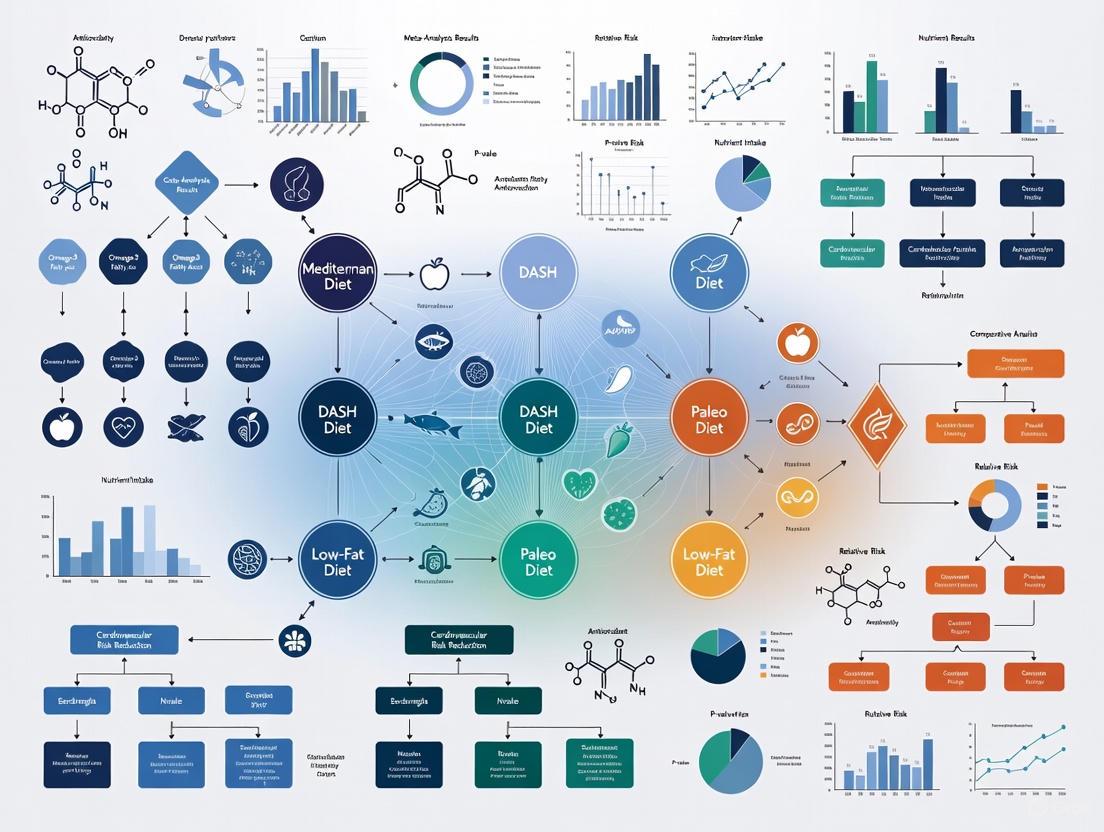
This article provides a comprehensive analysis of network meta-analysis (NMA) applications in comparing dietary patterns for cardiovascular risk management.
Network Meta-Analysis of Dietary Patterns for Cardiovascular Risk Reduction: A Comprehensive Evidence Synthesis for Researchers
Abstract
This article provides a comprehensive analysis of network meta-analysis (NMA) applications in comparing dietary patterns for cardiovascular risk management. It explores the foundational principles of NMA in nutritional research, methodological frameworks for implementation, strategies for addressing common analytical challenges, and comparative effectiveness rankings of popular diets including Mediterranean, DASH, ketogenic, low-carbohydrate, and plant-based patterns. Synthesizing evidence from recent high-quality NMAs, this resource offers researchers and clinical professionals evidence-based insights for designing interventions and advancing nutritional epidemiology through advanced statistical methodology.
The Evolution of Evidence Synthesis: Network Meta-Analysis in Nutritional Science
Network meta-analysis (NMA) represents a significant advancement in evidence synthesis, enabling the simultaneous comparison of multiple interventions. In the field of nutritional science, where numerous dietary patterns compete for clinical relevance, NMA is a powerful tool for informing evidence-based decision-making. This protocol details the application of NMA to evaluate the comparative effectiveness of dietary patterns on cardiovascular risk factors, providing a structured framework for researchers.
A traditional pairwise meta-analysis is limited to comparing two interventions, an approach that is insufficient when clinicians and patients must choose among multiple available dietary options. NMA overcomes this by integrating direct evidence (from head-to-head trials) and indirect evidence (from trials connected via a common comparator) into a single, coherent analysis. This allows for inferences about the relative effects of diets that have never been directly compared in a single trial and provides a hierarchy of their effectiveness [1] [2] [3].
The core objective of this application note is to provide a standardized, transparent protocol for conducting a systematic review and NMA of dietary patterns for cardiovascular risk reduction, ensuring methodological rigor and reproducibility.
Theoretical Framework and Key Assumptions
The validity of an NMA rests on two fundamental assumptions: transitivity and coherence.
Transitivity is a clinical and methodological assumption that forms the basis for making indirect comparisons. It requires that the different sets of studies included in the network are sufficiently similar, on average, in all important factors that may modify the treatment effect (effect modifiers) [2] [3]. In the context of dietary patterns, potential effect modifiers include patient characteristics (e.g., baseline BMI, diabetic status), intervention details (e.g., intensity, support), and outcome measurement methods. The transitivity assumption would be violated if, for example, trials comparing a Mediterranean diet to a usual care involved predominantly diabetic patients with high baseline HbA1c, while trials comparing a low-fat diet to the same usual care involved healthy populations.
Coherence (or consistency) is the statistical manifestation of transitivity. It refers to the agreement between direct and indirect evidence within a network where both types of evidence are available for a given comparison [1] [2]. For instance, if the direct comparison of diets A and B agrees with the indirect estimate obtained via a common comparator C, the network is considered coherent. Incoherence suggests a violation of the transitivity assumption or other methodological biases.
Protocol for Network Meta-Analysis of Dietary Patterns
Definition of the Research Question and Eligibility Criteria
A precisely defined research question is critical. Using the PICO (Population, Intervention, Comparator, Outcomes) framework ensures clarity and guides the study selection process.
- Population: Adults (≥18 years) with or without established cardiovascular disease (CVD). Subgroups may be defined based on diabetes status, obesity, or prior CVD [4] [5] [6].
- Interventions/Comparators: Define and justify the dietary patterns to be investigated. Common nodes include:
- Outcomes: Primary outcomes should include key cardiovascular risk factors:
- Body Composition: Body weight (kg), Body Mass Index (BMI), waist circumference (cm).
- Lipid Profile: Low-density lipoprotein cholesterol (LDL-C), high-density lipoprotein cholesterol (HDL-C), triglycerides (TG).
- Glycemic Control: Fasting glucose, HbA1c.
- Blood Pressure: Systolic and diastolic blood pressure (SBP/DBP) [5] [6].
Systematic Literature Search and Study Selection
- Information Sources: Search multiple electronic databases (e.g., PubMed, Embase, Cochrane Central Register of Controlled Trials, Web of Science, SCOPUS) from inception to the present.
- Search Strategy: Develop a comprehensive search using a combination of Medical Subject Headings (MeSH) and free-text terms related to dietary patterns, cardiovascular disease, and randomized controlled trials (RCTs) [5].
- Study Selection: Follow the Preferred Reporting Items for Systematic Reviews and Meta-Analyses (PRISMA) guidelines. Two independent reviewers should screen titles/abstracts and then full-text articles against the pre-defined eligibility criteria. Disagreements are resolved through consensus or arbitration by a third reviewer.
Data Extraction and Risk of Bias Assessment
- Data Extraction: Use a standardized data extraction form to collect:
- Study identifiers (author, year)
- Participant characteristics (sample size, age, sex, health status)
- Intervention and comparator details (description, duration, adherence)
- Outcome data for all time points (typically 6 and 12 months) [5]. Extract mean change from baseline and standard deviation for each outcome in all intervention groups.
- Risk of Bias Assessment: Assess the methodological quality of included RCTs using the Cochrane Risk of Bias tool (RoB 2.0), which evaluates biases arising from the randomization process, deviations from intended interventions, missing outcome data, outcome measurement, and selection of reported results [5].
Data Synthesis and Statistical Analysis
- Network Geometry: First, create a network plot for each outcome to visualize the available direct comparisons. The size of the nodes is often weighted by the number of participants, and the thickness of the edges by the number of studies making that direct comparison [2].
- Statistical Model: A Bayesian framework is commonly employed, using Markov Chain Monte Carlo (MCMC) simulation in software like JAGS or R. A random-effects model is typically chosen to account for heterogeneity among studies [5].
- Treatment Effects: Results are presented as mean differences (MD) for continuous outcomes with 95% credible intervals (CrI) for all possible pairwise comparisons within the network.
- Ranking of Interventions: The Surface Under the Cumulative Ranking (SUCRA) curve is calculated for each intervention and outcome. SUCRA values range from 0% (completely ineffective) to 100% (certain to be the best) and provide a hierarchical ranking of the diets [5].
- Assessment of Transitivity and Coherence:
- Transitivity: Assessed clinically by comparing the distribution of potential effect modifiers across the different direct comparisons in the network.
- Coherence: Statistically evaluated using local and global methods. Local approaches examine specific loops (e.g., loop-specific approach), while global methods (e.g., design-by-treatment interaction model) assess incoherence across the entire network [1] [2].
Assessment of Confidence in the Evidence
The Confidence in Network Meta-Analysis (CINeMA) framework, based on the GRADE approach, is recommended. It evaluates confidence in estimates across six domains: within-study bias, reporting bias, indirectness, imprecision, heterogeneity, and incoherence [1] [2].
Exemplary Data and Results from Recent Evidence
The following tables synthesize quantitative findings from recent, high-quality NMAs in the field, illustrating the type of results this protocol can generate.
Table 1: Comparative Efficacy of Dietary Patterns on Body Weight and Blood Pressure (6-month follow-up)
| Dietary Pattern | Body Weight Change (kg, MD, 95% CrI) | SUCRA (%) | Systolic BP Change (mmHg, MD, 95% CrI) | SUCRA (%) |
|---|---|---|---|---|
| Ketogenic | -10.5 (-18.0 to -3.05) [5] | 99 [5] | -7.0 (-16.8 to 2.7) [4] | N/A |
| Low Carbohydrate | -4.8 (-6.5 to -3.2) [6] | N/A | N/A | N/A |
| High-Protein | -4.49 (-9.55 to 0.35) [5] | 71 [5] | N/A | N/A |
| DASH | N/A | N/A | -7.81 (-14.2 to -0.46) [5] | 89 [5] |
| Intermittent Fasting | N/A | N/A | -5.98 (-10.4 to -0.35) [5] | 76 [5] |
| Mediterranean | -4.6 (-25.1 to 15.8) [4] | N/A | N/A | N/A |
| Control (Usual Diet) | Reference | Reference | Reference | Reference |
Table 2: Comparative Efficacy of Dietary Patterns on Lipid and Glycemic Markers (6-month follow-up)
| Dietary Pattern | LDL-C Change (mg/dL) | HDL-C Change (mg/dL, MD, 95% CrI) | SUCRA (%) | HbA1c Change (%, MD, 95% CrI) |
|---|---|---|---|---|
| Low Carbohydrate | N/A | 4.26 (2.46 to 6.49) [5] | 98 [5] | N/A |
| Low Fat | N/A | 2.35 (0.21 to 4.40) [5] | 78 [5] | N/A |
| Mediterranean | No significant effect [4] | N/A | N/A | -1.0 (-1.5 to -0.4) [6] |
| All Diets | No significant effect vs. usual diet [6] | N/A | N/A | All diets reduced HbA1c vs. usual diet [6] |
Visualization of Workflows and Relationships
Network Meta-Analysis Workflow for Dietary Patterns
Example Network Geometry of Dietary Comparisons
Table 3: Key Resources for Conducting a Dietary Pattern NMA
| Category | Item / Tool | Function / Description |
|---|---|---|
| Methodological Frameworks | PRISMA-NMA Statement [2] | Guidelines for standardized reporting of systematic reviews incorporating NMA. |
| GRADE / CINeMA Framework [1] [2] | Structured approach to assess the certainty (confidence) of the evidence from an NMA. | |
| Statistical Software & Packages | R (with netmeta, gemtc, BUGSnet packages) |
Open-source environment for statistical computing; these packages perform frequentist and Bayesian NMA. |
| JAGS / OpenBUGS / WinBUGS | Software for Bayesian analysis using MCMC simulation, often called from R. | |
Stata (network suite) |
Commercial software with commands for performing NMA. | |
| Data Management & Visualization | EndNote, Covidence, Rayyan | Tools for managing references, screening studies, and coordinating the review process. |
| Network Graphs (e.g., in R, Stata) | Visualizing the geometry of the treatment network for each outcome [2]. | |
| Risk of Bias Assessment | Cochrane RoB 2.0 Tool [5] [2] | Standard tool for assessing the risk of bias in randomized trials. |
This application note provides a comprehensive protocol for employing network meta-analysis to compare multiple dietary patterns for cardiovascular risk reduction. By adhering to this structured methodology—which emphasizes a systematic literature search, rigorous assessment of assumptions, appropriate statistical synthesis, and systematic evaluation of confidence in the findings—researchers can generate robust, clinically meaningful evidence. This approach directly addresses the limitations of pairwise meta-analysis and provides a definitive hierarchy of dietary interventions to guide personalized medicine and public health recommendations.
Cardiovascular Disease Burden and Modifiable Risk Factors Through Diet
Cardiovascular disease (CVD) persists as the predominant contributor to global morbidity and mortality, representing a critical public health challenge. In 2021 alone, there were approximately 612 million cases of CVD globally, accounting for 26.8% of all deaths [5]. This application note provides researchers and drug development professionals with structured methodologies for evaluating dietary interventions through network meta-analysis (NMA), a sophisticated statistical technique that combines direct evidence from head-to-head comparisons with indirect evidence from shared comparators to determine comparative effectiveness of multiple interventions simultaneously [7] [8]. Unlike conventional pairwise meta-analyses, NMA enables cross-modal evaluation of heterogeneous dietary interventions, providing a powerful tool for guiding precision nutrition strategies in cardiovascular risk management [5] [9].
Cardiovascular Disease Burden and Modifiable Risk Factors
The global burden of cardiovascular disease is intrinsically linked to modifiable risk factors, including obesity, hypertension, dyslipidemia, and hyperglycemia [5]. Current clinical guidelines from major organizations such as the American Heart Association and European Society of Cardiology identify dietary modification as a core strategy for both primary prevention and secondary management of CVD [5]. The acute nature of many cardiovascular events, primarily resulting from blood clots or blockages that restrict blood flow to the heart or brain, underscores that prevention represents the most cost-effective strategy for reducing harm [5].
In secondary prevention populations—patients with established CVD—dietary interventions face unique challenges. Recent evidence suggests that effects observed in medically treated CVD populations may be attenuated compared to primary prevention cohorts, potentially due to concurrent pharmacotherapies or established disease pathophysiology [10]. This highlights the necessity for targeted research in specific patient populations and the importance of understanding how dietary interventions interact with standard medical therapies.
Network Meta-Analysis: Theoretical Framework and Assumptions
Core Principles of Network Meta-Analysis
Network meta-analysis extends principles of conventional meta-analysis to evaluate multiple treatments in a single analysis by combining two types of evidence: (1) direct evidence obtained from randomized controlled trials comparing treatments head-to-head, and (2) indirect evidence obtained through one or more common comparators [8]. The combination of direct and indirect evidence is referred to as mixed evidence [8]. This approach allows for the comparative effectiveness assessment of interventions that have never been directly compared in clinical trials and can provide more precise estimates for those comparisons that have been directly studied [7].
Critical Assumptions for Valid NMA
The validity of any network meta-analysis depends on three fundamental assumptions:
Transitivity: The assumption that there are no systematic differences between the available comparisons other than the treatments being compared [8]. In practical terms, this means that in a hypothetical RCT consisting of all treatments included in the NMA, participants could be randomized to any of the treatments [8]. Violations occur when patient characteristics or study methodologies differ substantially across comparisons.
Coherence (also referred to as consistency): The statistical manifestation of transitivity, requiring that direct and indirect evidence are in agreement [9] [8]. This is typically assessed by examining "closed loops" in the network where treatments have both direct and indirect evidence [9].
Homogeneity: Similar to conventional meta-analysis, this assumes that variability in treatment effects within each direct comparison is due to random chance rather than clinical or methodological differences [8].
Figure 1: Theoretical Framework for Valid Network Meta-Analysis
Protocol for Network Meta-Analysis of Dietary Interventions
Research Question Formulation and Eligibility Criteria
The recommended approach for developing the research question follows the PICO framework (Participants, Interventions, Comparators, Outcomes) [8]. For NMA, the research question should specifically benefit from simultaneous comparison of multiple interventions. In the context of dietary patterns for cardiovascular risk reduction, a properly structured question might be: "What is the comparative effectiveness of major dietary patterns for reducing cardiovascular risk factors in [specific population], and what are their relative rankings?" [8] [5].
Eligibility criteria should explicitly define:
- Population: Adult patients with or at risk of cardiovascular disease, with clear specification of inclusion/exclusion criteria
- Interventions: Defined dietary patterns (e.g., Mediterranean, DASH, ketogenic, low-fat, vegetarian)
- Comparators: Other dietary patterns or minimal dietary interventions
- Outcomes: Primary cardiovascular risk factors (body weight, blood pressure, lipid profiles, glycemic markers)
- Study design: Randomized controlled trials with minimum duration (typically ≥12 weeks) [10]
Comprehensive Search Strategy and Study Selection
A comprehensive literature search should be developed with an informationist or librarian to ensure all potentially relevant treatments are captured [8]. The search strategy should include:
- Multiple bibliographic databases (at minimum PubMed, Web of Science, Embase, and Cochrane Library) [11] [5]
- Search syntax combining Medical Subject Headings (MeSH), Emtree terms, and free-text terms relevant to different dietary patterns and cardiovascular risk factors [5]
- No language or date restrictions initially, with justification for any limits applied
- Supplementary searching including clinical trial registries, reference lists of included studies, and contact with experts [11]
The study selection process should involve:
- Independent dual-reviewer screening of titles/abstracts and full-text articles [5]
- Documentation of exclusion reasons for full-text assessments [10]
- Measures of inter-rater reliability to ensure consistency [11]
Data Extraction and Risk of Bias Assessment
Data extraction should be performed independently by two reviewers using a standardized form [5]. Essential data elements include:
- Study characteristics: first author, publication year, study design, location, sample size
- Participant characteristics: age, gender, baseline BMI, cardiovascular history, medication use
- Intervention details: specific dietary pattern, duration, adherence assessment, support methods
- Outcome data: mean changes and measures of variance for all cardiovascular risk factors
Risk of bias assessment should utilize validated tools such as the Cochrane Risk of Bias Tool 2 [5] [10]. This evaluation should be conducted independently by two reviewers, with disagreements resolved through consensus or third-party adjudication [5].
Quantitative Data Synthesis and Statistical Analysis
The analytical approach for NMA involves several sequential steps:
Pairwise meta-analyses: Conduct conventional meta-analyses for all direct comparisons first to assess statistical heterogeneity within each comparison [8]
Network geometry evaluation: Visualize the treatment network to identify direct and indirect connections [8]
Statistical models: Employ either frequentist or Bayesian approaches using random-effects models to account for expected heterogeneity [5] [10]
Transitivity and coherence assessment: Evaluate clinically and statistically whether the fundamental assumptions are met [8]
Treatment ranking: Calculate probabilities for each treatment being at different ranking positions using Surface Under the Cumulative Ranking Curve (SUCRA) values [5]
Sensitivity analyses: Assess robustness of findings through various stratifications (e.g., study quality, population characteristics) [10]
Figure 2: NMA Workflow from Protocol to Analysis
Comparative Effectiveness of Dietary Patterns: Quantitative Synthesis
Efficacy of Dietary Patterns on Cardiovascular Risk Factors
Table 1: Comparative Effects of Dietary Patterns on Cardiovascular Risk Factors Based on Network Meta-Analysis [5]
| Dietary Pattern | Weight Reduction (kg) | SBP Reduction (mmHg) | HDL-C Increase (mg/dL) | SUCRA Weight | SUCRA SBP |
|---|---|---|---|---|---|
| Ketogenic | -10.5 (-18.0 to -3.05) | - | - | 99 | - |
| High-Protein | -4.49 (-9.55 to 0.35) | - | - | 71 | - |
| DASH | - | -7.81 (-14.2 to -0.46) | - | - | 89 |
| Intermittent Fasting | - | -5.98 (-10.4 to -0.35) | - | - | 76 |
| Low-Carbohydrate | - | - | 4.26 (2.46 to 6.49) | - | - |
| Low-Fat | - | - | 2.35 (0.21 to 4.40) | - | - |
Data presented as mean difference (95% confidence interval); SUCRA values range from 0-100, with higher values indicating better performance; SBP = systolic blood pressure; HDL-C = high-density lipoprotein cholesterol; dashes indicate data not reported in source
Table 2: Efficacy Hierarchy of Dietary Patterns for Specific Cardiovascular Risk Factors [5]
| Cardiovascular Risk Factor | Most Effective Dietary Pattern | Alternative Effective Pattern |
|---|---|---|
| Weight Reduction | Ketogenic (SUCRA 99) | High-Protein (SUCRA 71) |
| Waist Circumference Reduction | Ketogenic (SUCRA 100) | Low-Carbohydrate (SUCRA 77) |
| Systolic Blood Pressure Control | DASH (SUCRA 89) | Intermittent Fasting (SUCRA 76) |
| HDL-C Improvement | Low-Carbohydrate (SUCRA 98) | Low-Fat (SUCRA 78) |
Interpreting NMA-Specific Outputs
Network meta-analyses generate several unique outputs that require proper interpretation:
SUCRA values: Surface Under the Cumulative Ranking Curve provides a numerical representation of the overall ranking probability, with values ranging from 0% (worst) to 100% (best) [5]. These values should be interpreted alongside the actual effect sizes and confidence intervals to avoid overemphasizing small differences between treatments.
Network plots: Visual representations of the evidence base where nodes represent treatments and connecting lines represent direct comparisons [9] [8]. The thickness of lines and size of nodes typically corresponds to the amount of evidence available.
Rankograms: Charts displaying the probability of each treatment achieving particular rankings across all possible positions [9]. These provide a more complete picture of ranking uncertainty than single SUCRA values.
League tables: Matrices presenting all pairwise comparisons between interventions, typically with estimates and confidence intervals [8].
The Scientist's Toolkit: Essential Reagents and Methodologies
Table 3: Essential Research Reagent Solutions for Dietary Intervention NMA
| Research Tool | Function/Application | Implementation Considerations |
|---|---|---|
| Bayesian Statistical Packages (JAGS, gemtc) | Bayesian hierarchical effect modeling using Markov Chain Monte Carlo simulation [5] [10] | Requires specification of burn-in iterations (typically 5,000) and sampling iterations (typically 100,000); convergence assessed via Gelman-Rubin-Brooks plots [10] |
| R Statistical Environment (metafor, gemtc packages) | Comprehensive statistical analysis including random-effects models, heterogeneity assessment, and network visualization [5] | Version 4.0.4 or higher recommended; gemtc package for Bayesian NMA; metafor for conventional meta-analysis [10] |
| Cochrane Risk of Bias Tool 2 | Standardized assessment of methodological quality of randomized trials [5] [10] | Each study classified as low, high, or some concerns risk of bias; critical to assess impact through sensitivity analyses |
| PRISMA-NMA Guidelines | Reporting standards for network meta-analyses ensuring transparency and completeness [5] [9] | 27-item checklist specifically developed for NMA reporting; includes network geometry and inconsistency assessment |
| SUCRA Methodology | Treatment ranking metric summarizing probabilities across all possible positions [5] | Values range 0-100; interpret alongside confidence intervals; avoid overinterpreting small differences |
| Node-Splitting Analysis | Statistical method to detect inconsistency between direct and indirect evidence [10] | Assesses coherence assumption; p-value for inconsistency indicates significant disagreement between evidence sources |
Visualization and Interpretation of NMA Results
Network Geometry and Evidence Structure
The geometry of the evidence network provides critical insights into potential biases in the evidence base [9]. Key considerations when evaluating network geometry include:
- Completeness of connections: Whether all treatments of interest are sufficiently connected to permit reliable indirect comparisons
- Distribution of evidence: Whether certain treatments have been preferentially compared to specific competitors
- Proportion of direct evidence: Whether important comparisons are informed primarily by indirect evidence
Network diagrams should be examined for star-shaped networks (where one treatment serves as the dominant comparator) versus more interconnected networks, as each has implications for the reliability of various comparisons [8].
Clinical Interpretation and Application
When interpreting NMA findings for clinical or research applications, consider:
Diet-specific cardioprotective effects: No single dietary pattern excels across all cardiovascular risk factors [5]. Ketogenic and high-protein diets demonstrate superiority for weight management, while DASH and intermittent fasting excel in blood pressure control, and carbohydrate-restricted diets optimize lipid modulation [5].
Contextualizing ranking results: Treatment rankings should be interpreted alongside absolute effect sizes and confidence intervals [9]. A treatment may rank highly due to large effects in small, low-quality trials while having uncertain estimates.
Population-specific considerations: Effects may differ between primary and secondary prevention populations [10]. In medically treated CVD patients, dietary effects may be attenuated compared to healthier populations.
Long-term sustainability: Short-term effects (typically <6 months) often exceed long-term effects (≥12 months) due to declining adherence over time [10].
Figure 3: Framework for Interpreting Network Meta-Analysis Results
Network meta-analysis represents a powerful methodological advancement for comparing multiple dietary interventions simultaneously, addressing important clinical questions about their comparative effectiveness for cardiovascular risk reduction. The structured approach outlined in this application note provides researchers with a rigorous framework for conducting, interpreting, and applying NMA findings.
The evidence synthesized through NMA reveals distinct cardioprotective profiles of popular dietary patterns, supporting personalized dietary strategies for targeted CVD risk factor management rather than a one-size-fits-all approach [5]. Future research should focus on strengthening the evidence base for underrepresented dietary comparisons, evaluating long-term sustainability of dietary effects, and exploring individual-level factors that modify dietary response to advance the field of precision nutrition for cardiovascular health.
Quantitative Comparison of Major Dietary Patterns
Table 1: Comparative Efficacy of Dietary Patterns on Cardiovascular Risk Factors [5]
| Dietary Pattern | Weight Reduction (kg) | Systolic BP Reduction (mmHg) | HDL-C Increase (mg/dL) | Primary Cardiovascular Strengths |
|---|---|---|---|---|
| Ketogenic (KD) | -10.5 (SUCRA: 99) | - | - | Superior weight and waist circumference reduction |
| High-Protein (HPD) | -4.49 (SUCRA: 71) | - | - | Effective weight management |
| DASH | - | -7.81 (SUCRA: 89) | - | Optimal blood pressure control |
| Intermittent Fasting (IF) | - | -5.98 (SUCRA: 76) | - | Significant blood pressure lowering |
| Low-Carbohydrate (LCD) | - | - | +4.26 (SUCRA: 98) | Favorable HDL-C increase and waist reduction |
| Low-Fat (LFD) | - | - | +2.35 (SUCRA: 78) | Moderate HDL-C improvement |
| Mediterranean (MED) | - | - | - | Pleiotropic benefits including anti-inflammatory effects [12] [5] |
Note: SUCRA (Surface Under the Cumulative Ranking Curve) values indicate relative ranking among interventions (0-100 scale, higher scores indicate better performance). Data derived from network meta-analysis of 21 RCTs (n=1,663 participants). Empty cells indicate the pattern was not among the top performers for that specific outcome. [5]
Definition and Core Components of Dietary Patterns
Table 2: Definition and Cardiometabolic Mechanisms of Major Dietary Patterns [12] [13] [5]
| Dietary Pattern | Core Definition & Components | Proposed Primary Mechanisms of Action |
|---|---|---|
| Mediterranean Diet (MED) | High in: fruits, vegetables, legumes, nuts, whole grains, fish, monounsaturated fats (e.g., olive oil). Low in: red/processed meats, saturated fats. | - Anti-inflammatory: High polyphenols and omega-3 fatty acids reduce inflammatory markers.- Lipid modulation: Replaces saturated fats with unsaturated fats, improving LDL-C and HDL-C profiles.- Vascular function: Polyphenols enhance endothelial function and reduce oxidative stress. |
| DASH Diet | High in: vegetables, fruits, low-fat dairy, whole grains, poultry, fish, nuts. Low in: sodium, red meat, sweets, sugar-sweetened beverages. | - Blood pressure regulation: High potassium, calcium, magnesium, and low sodium intake.- Improved vascular tone: Micronutrient profile supports nitric oxide bioavailability and reduces vasoconstriction. |
| Ketogenic Diet (KD) | Very low carbohydrate (<20g/day or <10% of calories), high fat, moderate protein. | - Metabolic shift: Induction of nutritional ketosis, utilizing ketone bodies for energy.- Appetite suppression: Ketosis may reduce hunger hormones and promote satiety.- Enhanced lipid utilization: Increased fat oxidation reduces adipose tissue storage. |
| Low-Carbohydrate Diet (LCD) | Restricted carbohydrates (typically 20-130g/day or <26% of calories), often higher in protein and/or fat. | - Glycemic control: Reduced carbohydrate intake lowers postprandial glucose and insulin spikes.- Triglyceride reduction: Decreased very-low-density lipoprotein (VLDL) synthesis. |
| Vegetarian Diet | Emphasizes plant-based foods; excludes meat (and sometimes other animal products). | - Cholesterol reduction: Low intake of dietary cholesterol and saturated fat.- Fiber and phytochemicals: High soluble fiber binds bile acids, while antioxidants reduce oxidative damage. |
| Intermittent Fasting (IF) | Cycling between periods of eating and fasting (e.g., 16:8, 5:2 methods). | - Metabolic switching: Alternate between glucose and ketone-based energy, improving metabolic flexibility.- Cellular repair: Fasting triggers autophagy and reduces oxidative stress.- Insulin sensitivity: Regular fasting periods improve insulin response. |
Experimental Protocols for Dietary Pattern Analysis
Protocol for Conducting a Network Meta-Analysis (NMA) of Dietary Patterns
Objective: To compare the relative efficacy of multiple dietary patterns on cardiovascular risk factors using both direct and indirect evidence. [2]
Workflow Diagram:
Materials and Reagents:
- Literature Databases: Access to PubMed, Embase, Cochrane Library, Web of Science, SCOPUS
- Statistical Software: R (with
gemtc,netmeta,BUGS/JAGSpackages), STATA, SAS - Risk of Bias Tools: Cochrane RoB 2.0 tool for randomized trials
- Reporting Guidelines: PRISMA-NMA checklist
Procedure:
- Systematic Search: Execute comprehensive search strategy across multiple databases using MeSH terms and keywords related to dietary patterns ("Mediterranean diet", "DASH diet", "low-carbohydrate diet", etc.) and cardiovascular risk factors ("blood pressure", "lipids", "body weight", etc.). [5] [2]
- Study Selection: Apply pre-defined inclusion/exclusion criteria. Include randomized controlled trials (RCTs) comparing at least one dietary pattern of interest against control or another active intervention in relevant populations.
- Data Extraction: Extract study characteristics (author, year, design, sample size), participant demographics, intervention details (diet composition, duration, adherence), and outcome data (mean changes with measures of variance for continuous outcomes).
- Risk of Bias Assessment: Use Cochrane RoB 2.0 tool to evaluate randomization process, deviations from intended interventions, missing outcome data, outcome measurement, and selection of reported result.
- Network Geometry: Construct network diagram to visualize available direct comparisons. Each node represents a dietary pattern; edges represent direct head-to-head comparisons.
- Transitivity Assessment: Evaluate clinically and methodologically whether studies are sufficiently similar to allow valid indirect comparisons. Examine distribution of potential effect modifiers (e.g., baseline risk, participant characteristics, intervention duration) across treatment comparisons.
- Statistical Analysis:
- Model Fitting: Use random-effects network meta-analysis model within Bayesian or frequentist framework. Account for correlations induced by multi-arm trials.
- Incoherence Check: Use local and global approaches to evaluate disagreement between direct and indirect evidence (e.g., node-splitting).
- Ranking: Calculate ranking probabilities and SUCRA values for each intervention.
- Certainty of Evidence: Use GRADE approach for network meta-analysis to rate confidence in effect estimates.
Protocol for Analyzing Dietary Patterns from Epidemiological Data
Objective: To identify prevalent dietary patterns in population-based studies and examine their association with cardiovascular outcomes.
Workflow Diagram:
Materials and Reagents:
- Dietary Assessment Tools: Validated Food Frequency Questionnaires (FFQs), 24-hour dietary recall protocols, dietary records
- Statistical Software: SAS, R, STATA, SPSS with nutritional epidemiology packages
- Dietary Pattern Calculators: HEI-2020, DASH, aMED, and other diet quality score algorithms
- Nutrient Databases: USDA FoodData Central, country-specific nutrient composition tables
Procedure:
- Dietary Data Collection:
- Administer validated FFQ, 24-hour dietary recalls, or food records to study participants.
- Ensure appropriate training of interviewers and standardization of procedures.
Data Preprocessing:
- Group individual food items into meaningful food groups (e.g., "whole grains," "red meat," "leafy green vegetables").
- Adjust nutrient intakes for total energy intake using regression residual or nutrient density methods.
- Handle missing data using appropriate imputation techniques if needed.
Dietary Pattern Analysis - Investigator-Driven Approach:
- Calculate a priori dietary pattern scores (e.g., Healthy Eating Index [HEI], Dietary Approaches to Stop Hypertension [DASH] score, Mediterranean Diet Score) based on current dietary guidelines. [14] [13]
- Score individual components based on adherence to recommendations (e.g., higher scores for more fruits/vegetables, lower scores for high sodium/saturated fat).
- Sum component scores to create overall pattern score.
Dietary Pattern Analysis - Data-Driven Approach:
- Principal Component Analysis (PCA) / Factor Analysis: [14]
- Apply variance-covariance or correlation matrix of food group intakes.
- Retain factors based on eigenvalue (>1.0), scree plot, and interpretability.
- Rotate factors (e.g., varimax rotation) to improve interpretability.
- Calculate factor scores for each participant representing adherence to each pattern.
- Reduced Rank Regression (RRR):
- Use food groups as predictors and biomarkers or intermediate CVD risk factors as response variables.
- Extract patterns that explain maximum variation in both predictors and responses.
- Principal Component Analysis (PCA) / Factor Analysis: [14]
Statistical Analysis:
- Use multiple linear regression for continuous outcomes (e.g., blood pressure, lipid levels) or Cox proportional hazards models for time-to-event outcomes (e.g., CVD incidence).
- Adjust for potential confounders (age, sex, energy intake, physical activity, smoking, socioeconomic status).
- Examine effect modification by pre-specified subgroups (sex, ethnicity, genetic factors).
Validation:
- Assess internal validity through split-sample methods or bootstrapping.
- Evaluate external validity in independent populations.
- Test reproducibility of patterns over time.
Biological Mechanisms of Dietary Pattern Cardioprotection
Diagram: Integrated Biological Pathways of Dietary Pattern Effects on Cardiovascular Health
Key Mechanistic Pathways: [12] [13] [5]
Lipid Metabolism Modulation:
- Mediterranean diet: High monounsaturated (MUFA) and polyunsaturated fatty acids (PUFA) from olive oil and nuts reduce LDL-cholesterol and improve HDL-function.
- Low-fat diets: Reduce total and LDL-cholesterol through decreased saturated fat intake.
- Low-carbohydrate/ketogenic diets: Markedly reduce triglycerides and increase HDL-C through decreased VLDL production and enhanced lipid clearance.
Blood Pressure Regulation:
- DASH diet: High potassium, calcium, and magnesium content promotes sodium excretion, improves endothelial function, and reduces vascular resistance.
- Mediterranean diet: Polyphenols (e.g., from olive oil, red wine) enhance nitric oxide bioavailability, promoting vasodilation.
Inflammation and Oxidative Stress Reduction:
- Mediterranean diet: Rich in antioxidants (e.g., vitamins C/E, carotenoids, polyphenols) that scavenge free radicals and reduce oxidative damage to lipids and vascular endothelium.
- Plant-based patterns: High phytochemical content downregulates pro-inflammatory cytokines (TNF-α, IL-6) and nuclear factor kappa-B (NF-κB) signaling.
Metabolic and Body Composition Effects:
- Ketogenic/low-carbohydrate diets: Induction of nutritional ketosis enhances fat oxidation, reduces insulin levels, and promotes weight loss through appetite suppression and increased energy expenditure.
- Intermittent fasting: Metabolic switching between fed and fasted states improves insulin sensitivity, promotes autophagy, and reduces visceral adiposity.
Microbiome and Metabolic Endotoxemia:
- High-fiber patterns (Mediterranean, DASH, vegetarian): Dietary fiber fermentation produces short-chain fatty acids (e.g., butyrate) that strengthen gut barrier function, reduce metabolic endotoxemia, and modulate immune function.
The Scientist's Toolkit: Essential Research Reagents and Materials
Table 3: Essential Research Materials for Dietary Pattern and Cardiovascular Research
| Category | Item | Specification / Example | Primary Research Function |
|---|---|---|---|
| Dietary Assessment | Food Frequency Questionnaire (FFQ) | Semi-quantitative, validated (e.g., Block, Willett) | Assess habitual dietary intake over extended periods (months-years) |
| 24-Hour Dietary Recall | Automated self-administered (ASA-24) or interviewer-administered | Collect detailed dietary data for specific days; less reliant on memory | |
| Dietary Record | Weighed food record or estimated food diary | Prospectively document all foods/beverages consumed | |
| Laboratory Analysis | Lipid Profile | LDL-C, HDL-C, triglycerides, total cholesterol | Quantify blood lipids as primary CVD risk biomarkers |
| Inflammatory Markers | High-sensitivity C-reactive protein (hs-CRP), IL-6, TNF-α | Measure low-grade systemic inflammation | |
| Glycemic Markers | Fasting glucose, insulin, HbA1c | Assess glycemic control and insulin resistance | |
| Statistical Analysis | Network Meta-Analysis Software | R packages: netmeta, gemtc; STATA network |
Perform simultaneous comparison of multiple interventions |
| Dietary Pattern Analysis Software | SAS PROC FACTOR, R psych, FactoMineR |
Derive data-driven dietary patterns (PCA, factor analysis) | |
| Diet Quality Calculators | HEI, DASH, aMED scoring algorithms | Calculate a priori dietary pattern adherence scores | |
| Methodological Guidelines | PRISMA-NMA | Preferred Reporting Items for Systematic Reviews incorporating NMA | Standardized reporting of network meta-analyses |
| Cochrane Handbook | Chapter 11: Undertaking network meta-analyses | Authoritative guidance on NMA methodology | |
| USDA NESR Protocols | Systematic review methodology for nutrition guidance | Rigorous, protocol-driven nutrition evidence reviews |
Conceptual Foundation of Transitivity in Network Meta-Analysis
Network meta-analysis (NMA) represents an advanced evidence synthesis methodology that enables simultaneous comparison of multiple interventions within a unified analytical framework. The transitivity assumption provides the foundational premise that legitimizes the indirect treatment comparisons essential to NMA methodology [9]. This principle posits that participants enrolled in trials studying different interventions must be sufficiently similar to be considered "jointly randomizable" across the entire evidence network [9]. When transitivity holds, valid indirect comparisons can be made between interventions that have never been directly compared in head-to-head randomized trials.
The theoretical basis for transitivity rests on the concept of coherence—the statistical manifestation of the transitivity assumption. coherence exists when treatment effects derived from indirect evidence align statistically with those obtained from direct evidence within the same network [9]. In dietary pattern research, this assumption enables researchers to construct connected networks of trials comparing various dietary approaches, thereby generating comprehensive rankings of their relative effectiveness for improving cardiovascular risk factors even when direct comparative evidence is absent or limited.
Practical Assessment of Transitivity in Dietary Pattern Research
Methodological Framework for Evaluating Transitability
Table 1: Key Domains for Transitivity Assessment in Dietary Pattern NMA
| Assessment Domain | Description | Operational Evaluation Method |
|---|---|---|
| Population Similarity | Demographic and clinical characteristics across trials | Baseline comparison of age, sex distribution, CVD risk status, medication use [15] |
| Intervention Definition | Standardization of dietary pattern components | Clear operational definitions for each dietary pattern (e.g., Mediterranean, DASH, low-fat) with specific food composition [16] |
| Outcome Measurement | Consistency in endpoint assessment | Standardized laboratory methods, timing of outcome assessment, and measurement protocols [15] |
| Study Context | Setting and design characteristics | Evaluation of healthcare setting, geographical region, follow-up duration, and year of publication [15] |
| Effect Modifiers | Variables potentially influencing treatment effects | Identification and statistical adjustment for known effect modifiers (e.g., baseline BMI, medication use) [15] |
Applied Transitivity Assessment Protocol
The following experimental protocol provides a systematic approach for evaluating transitivity in NMAs of dietary patterns for cardiovascular risk reduction:
Protocol 1: Transitivity Evaluation in Dietary Pattern Networks
Define Potential Effect Modifiers
- A priori identification of clinical and methodological variables that may modify dietary intervention effects
- Common modifiers in cardiovascular nutrition research: baseline body mass index, age, sex, blood pressure status, lipid-lowering medication use, intervention duration [15]
Systematic Data Collection
- Extract participant characteristics across all included trials using standardized data extraction forms
- Document key population descriptors: median age, sex distribution, prevalence of comorbidities, concomitant medications [15]
- Record intervention details: specific dietary components, delivery method (counseling, provision of foods), adherence assessment methods [17]
Comparative Analysis Across Trial Populations
- Create summary tables comparing clinical and demographic variables across different direct comparisons
- Statistically compare distribution of potential effect modifiers using appropriate tests (χ² for categorical, ANOVA for continuous variables)
- Qualitatively assess clinical relevance of identified differences
Evaluation of Clinical and Methodological Heterogeneity
- Assess variability in study populations, interventions, and outcomes using Cochrane Q statistic and I²
- Explore sources of heterogeneity through meta-regression and subgroup analyses when transitivity concerns exist [15]
Statistical Evaluation of Coherence
- Employ node-splitting methods to compare direct and indirect evidence for specific treatment comparisons [15]
- Utilize design-by-treatment interaction model for global assessment of coherence
- Interpret disagreement between direct and indirect estimates within clinical context
Applied Transitivity Framework in Cardiovascular Nutrition Research
Case Application: Network Meta-Analysis of Dietary Patterns
Recent NMAs in cardiovascular nutrition research demonstrate practical approaches to transitivity assessment. In a 2024 analysis of dietary patterns for secondary CVD prevention, researchers explicitly evaluated transitivity by examining the distribution of potential effect modifiers across the evidence network, including antihypertensive and lipid-lowering medication use, which varied significantly between older and more contemporary trials [15]. This methodological rigor enhances confidence in the NMA results, which suggested that moderate carbohydrate diets had the most beneficial effects on body weight and systolic blood pressure, though considerable uncertainty remained [15].
Table 2: Effect Modifiers in Dietary Pattern NMA for Cardiovascular Risk Factors
| Effect Modifier Category | Specific Variables | Impact on Treatment Effects | Assessment Method |
|---|---|---|---|
| Population Characteristics | Age, sex distribution, baseline BMI | May influence magnitude of dietary effect on weight and metabolic parameters | Subgroup analysis, meta-regression [15] |
| Clinical Status | Established CVD vs. primary prevention, diabetes status | Alters absolute risk reduction potential | Separate analyses for population subgroups [15] |
| Concomitant Treatments | Statin use, antihypertensive medications | May attenuate observed dietary effects on lipids and blood pressure | Medication stratification in analysis [15] |
| Intervention Factors | Delivery method, intensity, duration | Affects adherence and ultimate effectiveness | Categorization by intervention characteristics [17] |
| Methodological Elements | Risk of bias, publication year | Influences overall evidence quality | Sensitivity analyses excluding high-bias studies [15] |
Statistical Coherence Testing Methodology
Protocol 2: Node-Splitting Analysis for Local Coherence Evaluation
Identify Closed Loops
- Locate all treatment comparisons with both direct and indirect evidence
- Document sources of direct and indirect evidence for each comparison
Separate Evidence Sources
- Extract direct evidence from head-to-head trials
- Calculate indirect evidence through common comparator using the Bucher method
- Preserve original study characteristics in both evidence streams
Statistical Comparison
- Estimate difference between direct and indirect effects (inconsistency factor)
- Calculate 95% confidence intervals for inconsistency factor
- Apply Wald test or similar approach to assess statistical significance
Interpretation Framework
- Evaluate clinical significance of any statistical inconsistency
- Investigate potential effect modifiers explaining observed inconsistency
- Consider excluding inconsistent comparisons in sensitivity analyses
Research Reagent Solutions for Transitivity Assessment
Table 3: Methodological Tools for Transitivity Evaluation in Dietary NMA
| Research Tool | Function | Application Context |
|---|---|---|
| CochROB 2.0 Tool | Assesses risk of bias in randomized trials | Quality appraisal of individual studies in network [15] |
| Node-Splitting Analysis | Statistical test comparing direct and indirect evidence | Evaluation of local coherence at specific treatment comparisons [15] |
| Network Geometry Visualization | Graphical representation of evidence connections | Identification of evidence gaps and potential biases in network structure [9] |
| Meta-Regression | Investigates association between effect modifiers and treatment effects | Exploration of transitivity violations and heterogeneity sources [15] |
| SUCRA Values | Surface under cumulative ranking curve provides treatment hierarchy | Interpretation of ranking probabilities with consideration of transitivity [18] |
The transitivity assumption remains the critical theoretical foundation enabling valid indirect comparisons in network meta-analysis of dietary patterns. Through rigorous application of the assessment protocols and methodological tools outlined in this document, researchers can enhance the validity and interpretability of NMA findings in cardiovascular nutrition research. Proper evaluation and reporting of transitivity strengthens the evidence base for dietary recommendations and supports the development of personalized nutrition strategies for cardiovascular risk reduction.
Current Landscape of Published NMAs in Nutrition Research
Network meta-analysis (NMA) has emerged as a powerful methodological tool in evidence-based nutrition science, enabling the simultaneous comparison of multiple dietary interventions and their ranking for specific health outcomes. Within cardiovascular risk research, NMAs provide a sophisticated analytical framework to resolve clinical uncertainty when numerous dietary patterns exist for managing conditions like hypertension, dyslipidemia, and metabolic syndrome. The growing application of NMA in nutritional epidemiology reflects the field's maturation from isolated nutrient studies to complex dietary pattern analyses, acknowledging that foods and nutrients are consumed in combination and interact synergistically or antagonistically to influence health [19]. This document presents current applications, detailed protocols, and methodological considerations for conducting NMAs in nutrition research, specifically focused on cardiovascular risk factor management.
Current Evidence and Quantitative Synthesis
Recent high-quality NMAs have substantially advanced our understanding of how different dietary patterns comparatively influence cardiovascular risk factors. The tables below synthesize quantitative findings from recent systematic reviews and NMAs investigating dietary patterns and cardiovascular health.
Table 1: Comparative Effectiveness of Dietary Patterns on Cardiovascular Risk Factors (6-Month Intervention)
| Dietary Pattern | Weight Reduction (kg) | SBP Reduction (mmHg) | DBP Reduction (mmHg) | HDL-C Increase (mg/dL) | Key Cardiovascular Risk Factor Benefits |
|---|---|---|---|---|---|
| Ketogenic | -10.5 (95% CI: -18.0 to -3.05) [20] | -11.0 (95% CI: -17.56 to -4.44) [19] | -9.4 (95% CI: -13.98 to -4.82) [19] | - | Superior weight reduction, waist circumference reduction, blood pressure lowering |
| Mediterranean | - | - | - | - | Optimal HbA1c reduction (-1.0%) in T2D, cardiovascular event risk reduction (-16%) [6] |
| DASH | - | -5.99 (95% CI: -10.32 to -1.65) [19] | - | - | Effective systolic blood pressure control, beneficial for multiple MetS components [19] |
| Vegan | - | - | - | Best for increasing HDL-C [19] | Superior waist circumference reduction, lipid profile improvement |
| Low-Carbohydrate | -4.8 (95% CI: -6.5 to -3.2) [6] | - | - | 4.26 (95% CI: 2.46-6.49) [20] | Significant weight loss, optimal HDL-C increase |
| Low-Fat | - | - | - | 2.35 (95% CI: 0.21-4.40) [20] | Moderate HDL-C improvement |
Table 2: SUCRA Ranking of Dietary Patterns for Specific Cardiovascular Outcomes
| Dietary Pattern | Weight Reduction | Waist Circumference | Systolic BP | Diastolic BP | HDL-C Improvement |
|---|---|---|---|---|---|
| Ketogenic | 99 [20] | 100 [20] | - | - | - |
| High-Protein | 71 [20] | - | - | - | - |
| Low-Carbohydrate | - | 77 [20] | - | - | 98 [20] |
| DASH | - | - | 89 [20] | - | - |
| Intermittent Fasting | - | - | 76 [20] | - | - |
| Low-Fat | - | - | - | - | 78 [20] |
| Vegan | - | Best [19] | - | - | Best [19] |
Beyond these specific intervention comparisons, large-scale observational evidence consistently demonstrates that dietary patterns characterized by higher intakes of vegetables, fruits, legumes, nuts, whole grains, and unsaturated fats, with lower intakes of red and processed meats, refined grains, and sugar-sweetened foods and beverages, are associated with significantly reduced cardiovascular disease risk across diverse populations [13]. This evidence, graded as strong by the 2025 Dietary Guidelines Advisory Committee, provides the foundational rationale for investigating these specific dietary patterns in NMAs.
Experimental Protocols for Nutrition NMAs
Protocol Development and Registration
Prior to initiating an NMA, a detailed protocol should be developed and registered on platforms like PROSPERO (International Prospective Register of Systematic Reviews) to enhance transparency and reduce reporting bias. The protocol should explicitly define the research question using PICO (Population, Intervention, Comparison, Outcome) elements and outline the complete methodological approach [19]. Adherence to the Preferred Reporting Items for Systematic Reviews and Meta-Analyses extension for NMA (PRISMA-NMA) is essential, with ongoing updates to these guidelines addressing evolving methodological standards, including statistical modeling approaches and assessment of transitivity [21] [22] [23].
Search Strategy and Study Selection
A comprehensive, systematic search should be executed across multiple electronic databases including but not limited to PubMed, Embase, Cochrane Library, Web of Science, Scopus, and relevant regional databases. The search strategy should integrate Medical Subject Headings (MeSH) and free-text terms related to dietary patterns, cardiovascular disease, and risk factors, adapted according to database-specific syntax rules [19].
Example PubMed Search Strategy:
- #1: "dietary patterns" OR "diet therapy" OR "ketogenic diet" OR "Mediterranean diet" OR "DASH diet" OR "vegetarian diet" OR "vegan diet" OR "low-carbohydrate diet" OR "low-fat diet" OR "intermittent fasting"
- #2: "cardiovascular diseases" OR "hypertension" OR "dyslipidemias" OR "metabolic syndrome" OR "body weight" OR "blood pressure" OR "cholesterol" OR "triglycerides"
- #3: "randomized controlled trial" OR "controlled clinical trial"
- #4: #1 AND #2 AND #3
- Filters: English, Chinese language; publication date from inception to current
Two independent reviewers should screen titles/abstracts and subsequently full-text articles against pre-specified eligibility criteria, with discrepancies resolved through consensus or third-party adjudication [13] [19].
Eligibility Criteria
- Population: Adults with or at risk of cardiovascular disease, metabolic syndrome, or type 2 diabetes. Specific definitions should be provided (e.g., ATP-III criteria for metabolic syndrome) [19] [6].
- Interventions: Defined dietary patterns (e.g., DASH: high fruits, vegetables, low-fat dairy, whole grains; fat 27%, carbohydrate 55%, protein 18%; Mediterranean: fat 35-45% mainly monounsaturated, carbohydrate 40-45%, protein 15-18%; Ketogenic: carbohydrate 5-10% of energy) [19].
- Comparators: Other dietary patterns, usual diet, or minimal interventions.
- Outcomes: Primary cardiovascular risk factors: body weight, BMI, waist circumference, systolic and diastolic blood pressure, lipid profiles (LDL-C, HDL-C, triglycerides, total cholesterol), glycemic markers (fasting glucose, HbA1c) [20] [19] [6].
- Study Design: Randomized controlled trials with minimum intervention duration of 4-6 weeks.
Data Extraction and Quality Assessment
A standardized, piloted data extraction form should capture study characteristics (author, year, location, design), participant demographics, intervention and comparator details (diet composition, duration, adherence), outcome data (baseline and follow-up means, measures of dispersion, sample sizes), and funding sources. Two reviewers should extract data independently [13] [19].
Risk of bias assessment should be conducted using the Cochrane Risk of Bias tool (RoB 2.0) for randomized trials, evaluating selection, performance, detection, attrition, and reporting biases. Study quality should be considered when interpreting results and in sensitivity analyses [13].
Statistical Analysis and Synthesis
A frequentist or Bayesian approach to NMA can be implemented using statistical software such as Stata (network package), R (netmeta package), or OpenBUGS. The analysis should:
- Construct Network Geometry: Graphically represent all treatment comparisons, indicating the number of studies per comparison.
- Assess Heterogeneity and Inconsistency: Evaluate statistical heterogeneity using I² statistics and Cochran's Q. Assess disagreement between direct and indirect evidence using node-splitting or design-by-treatment interaction models [22] [23].
- Synthesize Effects: Pool continuous outcomes using mean differences (MD) or standardized mean differences (SMD) with 95% confidence or credible intervals. Dichotomous outcomes should be synthesized using odds ratios or risk ratios.
- Rank Treatments: Rank interventions for each outcome using Surface Under the Cumulative Ranking Curve (SUCRA) values or mean ranks [20].
- Assess Certainty of Evidence: Evaluate confidence in effect estimates using GRADE (Grading of Recommendations, Assessment, Development, and Evaluations) for NMAs.
Table 3: Essential Methodological Tools for Nutrition Network Meta-Analyses
| Tool Category | Specific Tool/Resource | Application in NMA |
|---|---|---|
| Reporting Guidelines | PRISMA-NMA Checklist [21] [22] | Ensures comprehensive reporting of methods and results |
| Statistical Software | Stata (network package) [19] | Frequentist approach NMA with network graphs |
| R (netmeta, gemtc packages) | Bayesian and frequentist NMA implementations | |
| OpenBUGS/JAGS | Bayesian analysis with flexible modeling | |
| Quality Assessment | Cochrane RoB 2.0 Tool | Evaluates risk of bias in randomized trials |
| GRADE for NMA | Assesses certainty (quality) of evidence for each comparison | |
| Dietary Assessment | Dietary Index Calculators (AHEI, DASH, aMED) [24] [25] | Quantifies adherence to predefined dietary patterns |
| Protocol Registration | PROSPERO Registry [19] | Publicly documents review protocol to reduce bias |
Methodological Considerations and Future Directions
The conduct of NMAs in nutrition research presents unique methodological challenges. Nutritional interventions often cannot be blinded, potentially introducing performance and detection biases. Dietary adherence varies substantially and requires careful monitoring through dietary records, biomarkers, or adherence scores. Defining appropriate nodes for the network is particularly challenging in nutrition research, where dietary patterns exist on a continuum with overlapping components [22] [23].
Future methodological developments should focus on component NMAs that evaluate the effects of specific dietary elements across patterns, and individual participant data NMAs that enable more personalized dietary recommendations. The ongoing update of PRISMA-NMA guidelines aims to address these nutrition-specific challenges and improve the transparency and usability of future nutrition NMAs [22] [23].
As the field evolves, NMAs will play an increasingly vital role in translating nutritional evidence into practical, personalized dietary guidance for cardiovascular risk reduction, moving beyond one-size-fits-all recommendations to more nuanced understanding of how different dietary patterns benefit specific risk profiles and patient populations.
Implementing Network Meta-Analysis: Methodological Framework and Analytical Approaches
Bayesian vs Frequentist Approaches in Nutritional NMA
Network meta-analysis (NMA) has emerged as a powerful statistical technique for comparing multiple interventions simultaneously, even when direct head-to-head comparisons are lacking. In nutritional science, where numerous dietary patterns exist for managing conditions like cardiovascular disease, NMA provides a framework for evaluating their comparative effectiveness. The two predominant statistical paradigms for conducting NMA are frequentist and Bayesian approaches, each with distinct philosophical foundations and methodological implementations. This article examines these approaches within the context of cardiovascular risk research, providing application notes and experimental protocols for researchers.
The fundamental principle of NMA is the integration of direct and indirect evidence. Direct evidence comes from studies that compare treatments directly, while indirect evidence allows for comparisons between treatments that have never been directly studied together through a common comparator. For example, if treatment A has been compared to B, and B to C, NMA enables an indirect estimate of A versus C [26]. This is particularly valuable in nutritional research, where numerous dietary patterns have been studied against control diets but rarely against each other.
Theoretical Foundations
Frequentist Approach to NMA
The frequentist approach to NMA is based on the concept of fixed parameters with unknown but fixed true values. Inference is based on sampling distributions - what would happen if the experiment were repeated multiple times. Frequentist NMA typically uses maximum likelihood estimation and produces point estimates with confidence intervals. A key feature is the consistency assumption, which requires that direct and indirect evidence agree within random error [27]. This can be represented as:
dk1,k2 = dbk2 - dbk1
Where b is the baseline treatment, k1 and k2 are other treatments, and d represents the effect size. The transitivity assumption is equally crucial, requiring that patients in one comparison could have been included in another, meaning that study populations and designs are sufficiently similar across the network [26].
Bayesian Approach to NMA
Bayesian statistics incorporates prior knowledge or beliefs into the analysis through Bayes' theorem:
P(θ|Y) ∝ P(Y|θ) × P(θ)
Where P(θ|Y) is the posterior distribution of parameters θ given data Y, P(Y|θ) is the likelihood, and P(θ) is the prior distribution [28]. In Bayesian NMA, this framework is extended to multiple treatments. The random-effects model can be formulated as:
Ykab ~ N(δkab, sk2) δkab ~ N(dab, τ2)
Where Ykab is the observed effect size in study k comparing treatments a and b, δkab is the study-specific true effect, dab is the mean effect for comparison a-b, and τ2 is the between-study variance [28]. Bayesian approaches are particularly valuable when incorporating evidence from single-arm trials or combining individual participant data with aggregate data [29].
Comparative Analysis of Approaches
Table 1: Comparison of Bayesian and Frequentist Approaches to NMA
| Feature | Bayesian Approach | Frequentist Approach |
|---|---|---|
| Philosophical Basis | Probability as degree of belief | Probability as long-run frequency |
| Parameters | Considered random variables | Considered fixed, unknown quantities |
| Inference | Based on posterior distributions | Based on sampling distributions |
| Incorporation of Prior Evidence | Explicit through prior distributions | Not directly incorporated |
| Output | Posterior distributions and credibility intervals | Point estimates and confidence intervals |
| Treatment Ranking | Direct probability statements (SUCRA values) | P-values and confidence intervals |
| Computational Complexity | Higher (MCMC sampling) | Generally lower |
| Handling of Complex Models | More flexible for hierarchical structures | Can be limited |
Bayesian methods currently dominate the NMA landscape, particularly in medical and nutritional research [30]. This preference stems from several advantages: more straightforward implementation of hierarchical models, natural handling of treatment ranking through probabilities, and the ability to incorporate prior evidence. However, frequentist approaches remain valuable for their computational efficiency and more familiar inference framework for many researchers [31].
Application to Nutritional Research for Cardiovascular Risk
Case Study: NMA of Dietary Patterns on Cardiovascular Risk Factors
A recent Bayesian NMA evaluated the comparative effects of eight dietary patterns on cardiovascular risk factors, including 21 randomized controlled trials with 1,663 participants [5]. The analysis compared low-fat, Mediterranean, ketogenic, low-carbohydrate, high-protein, vegetarian, intermittent fasting, and DASH diets against control diets.
The researchers employed a random-effects Bayesian model using Markov Chain Monte Carlo (MCMC) sampling. Treatment effects were ranked using Surface Under the Cumulative Ranking Curve (SUCRA) scores, where higher scores (0-100%) indicate better performance. Key findings included:
Table 2: Efficacy of Dietary Patterns on Cardiovascular Risk Factors [5]
| Outcome | Most Effective Diet(s) | Effect Size (MD) | SUCRA Score |
|---|---|---|---|
| Weight Reduction | Ketogenic | -10.5 kg (-18.0 to -3.05) | 99% |
| High-protein | -4.49 kg (-9.55 to 0.35) | 71% | |
| Waist Circumference | Ketogenic | -11.0 cm (-17.5 to -4.54) | 100% |
| Low-carbohydrate | -5.13 cm (-8.83 to -1.44) | 77% | |
| Systolic Blood Pressure | DASH | -7.81 mmHg (-14.2 to -0.46) | 89% |
| Intermittent Fasting | -5.98 mmHg (-10.4 to -0.35) | 76% | |
| HDL-C Increase | Low-carbohydrate | 4.26 mg/dL (2.46-6.49) | 98% |
| Low-fat | 2.35 mg/dL (0.21-4.40) | 78% |
This case study demonstrates how Bayesian NMA can provide nuanced insights into diet-specific cardioprotective effects, supporting personalized dietary strategies for targeted cardiovascular risk management.
Workflow for Nutritional NMA
The following diagram illustrates the comprehensive workflow for conducting a network meta-analysis of dietary patterns:
NMA Workflow for Dietary Patterns
Detailed Experimental Protocols
Protocol 1: Bayesian NMA of Dietary Patterns
Study Registration and Protocol Development
- Register the systematic review protocol in PROSPERO (CRD42024551289) prior to commencement [5]
- Adhere to PRISMA extension statement for reporting systematic reviews incorporating NMA
- Define explicit inclusion/exclusion criteria for studies and participants
Search Strategy and Study Selection
- Conduct comprehensive searches in multiple databases (PubMed, Web of Science, Embase, Cochrane Library)
- Use combination of Medical Subject Headings and free-text terms for dietary patterns and cardiovascular risk factors
- Implement duplicate independent screening by two researchers with third researcher resolving disagreements
Data Extraction and Management
- Extract study characteristics (author, year, design, population demographics, sample size)
- Record intervention details (diet type, duration, adherence measures)
- Extract outcome data for all cardiovascular risk factors (mean differences with confidence intervals)
- Use standardized data extraction forms with independent duplicate extraction
Risk of Bias Assessment
- Employ Cochrane Risk of Bias Tool 2 for randomized trials
- Classify studies as high risk if any domain rated as high
- Conduct assessment by two independent reviewers
Statistical Analysis Plan
- Implement Bayesian hierarchical models using MCMC sampling
- Use random-effects models to account for heterogeneity
- Run multiple chains (typically 3-4) with sufficient iterations (e.g., 50,000) after burn-in
- Assess convergence using Gelman-Rubin statistics
- Calculate SUCRA values for treatment ranking
- Model implementation in R using JAGS or similar Bayesian software
Protocol 2: Frequentist NMA of Dietary Patterns
Data Preparation and Network Development
- Ensure transitivity assumption holds by examining distribution of effect modifiers across comparisons
- Create network geometry plot to visualize direct comparisons
- Code treatments appropriately for contrast-based synthesis
Model Implementation
- Employ multivariate meta-analysis framework using
mvmetain R or similar packages - Use restricted maximum likelihood (REML) for heterogeneity estimation
- Implement consistency and inconsistency models
- Use design-by-treatment interaction model for global inconsistency assessment
Treatment Effect Estimation
- Calculate relative treatment effects with confidence intervals
- Use net league table to present all pairwise comparisons
- Generate ranking probabilities using frequentist analogues
- Present results using forest plots and league tables
The Scientist's Toolkit: Essential Research Reagents and Materials
Table 3: Essential Tools and Software for Nutritional NMA
| Tool/Software | Function | Application Context |
|---|---|---|
| R Statistical Environment | Primary platform for statistical analysis | Both Bayesian and frequentist analyses |
| JAGS (Just Another Gibbs Sampler) | MCMC sampling for Bayesian models | Bayesian NMA implementation |
| gemtc R package | Bayesian NMA using MCMC | User-friendly Bayesian NMA [28] |
| netmeta R package | Frequentist NMA implementation | Pairwise and network meta-analysis |
| PRISMA-NMA Checklist | Reporting guidelines | Ensuring comprehensive reporting |
| Cochrane Risk of Bias Tool | Methodological quality assessment | Quality appraisal of included studies |
| Stata with network package | Alternative software platform | NMA implementation in Stata |
Analytical Framework and Model Specification
Bayesian Model Specification
The core Bayesian NMA model can be specified as follows for a continuous outcome:
ykab ~ N(δkab, σk2) δkab ~ N(dab, τ2) dab = μab + β·Xk μab = μa - μb
Where ykab is the observed effect in study k comparing a and b, δkab is the study-specific treatment effect, dab is the mean treatment effect, τ2 is the between-study variance, μa and μb are basic parameters for treatments a and b versus a reference treatment, and β·Xk represents covariate adjustments [29] [28].
Frequentist Model Specification
The frequentist approach can be implemented using a multivariate meta-analysis model:
yi = Xiθi + εi εi ~ N(0, Si) θi ~ N(θ, Σ)
Where yi is a vector of observed effects in study i, Xi is a design matrix, θi is a vector of true effects, Si is the within-study covariance matrix, θ is the vector of average treatment effects, and Σ is the between-study covariance matrix [27] [26].
Advanced Methodological Considerations
Handling of Multi-Arm Trials
Both Bayesian and frequentist approaches must account for correlation between treatment effects from multi-arm trials. In Bayesian frameworks, this is typically handled by modeling the effects from a multi-arm trial as coming from a multivariate normal distribution [28]:
$$\begin{pmatrix} \delta{kab1} \ \delta{kab2} \ \vdots \ \delta{kabi} \end{pmatrix} \sim MVN \begin{pmatrix} \begin{pmatrix} d{ab1} \ d{ab2} \ \vdots \ d{abi} \end{pmatrix}, \boldsymbol{\Sigma} \end{pmatrix}$$
Individual Participant Data vs Aggregate Data
Nutritional NMAs can incorporate both individual participant data (IPD) and aggregate data (AD). The one-step IPD approach offers advantages for investigating treatment-covariate interactions and dealing with effect modifiers [27]:
logit(Pjk) = ln(αk/αk') + ψjk'
Where Pjk is the probability of an outcome for treatment j in subgroup k, α terms represent subgroup effects, and ψ represents treatment effects [31].
Bayesian and frequentist approaches to nutritional NMA offer complementary strengths for cardiovascular risk research. Bayesian methods provide intuitive probability statements for treatment rankings and flexible incorporation of prior evidence, while frequentist methods offer familiarity and computational efficiency. The choice between approaches should be guided by research questions, available resources, and analytical requirements. As nutritional science continues to evolve, NMA will play an increasingly important role in synthesizing evidence across multiple dietary interventions for optimal cardiovascular risk management.
Network meta-analysis (NMA) has become an indispensable methodological framework for comparing the relative effectiveness of multiple treatments for the same health condition, especially when direct head-to-head evidence is scarce or unavailable [32]. Within this framework, ranking metrics provide a valuable tool to illuminate the relationships between treatments for a particular outcome. Among these metrics, the Surface Under the Cumulative Ranking Curve (SUCRA) has emerged as a prominent numerical summary of a treatment's relative performance [33].
SUCRA values represent the proportion of competing treatments that a given treatment outperforms, providing a single number between 0% and 100% that summarizes the entire rank probability distribution [32] [34]. A SUCRA value of 100% indicates that a treatment is always the most effective (rank 1), while a value of 0% suggests it is always the least effective (lowest rank) [33]. In the context of dietary intervention research, where multiple dietary patterns compete for clinical relevance in managing cardiovascular risk factors, SUCRA values offer a standardized approach to compare their relative efficacy across multiple outcomes.
Recent methodological advances have highlighted the importance of incorporating minimally important differences (MIDs) into ranking metrics like SUCRA to ensure clinical relevance rather than relying solely on statistical differences [32]. MID-adjusted SUCRA values account for the smallest value in a given outcome that patients or clinicians consider meaningful, thus providing rankings that reflect clinically important differences between dietary interventions [32].
Calculation and Interpretation of SUCRA Values
Mathematical Foundation
The SUCRA value for a treatment j is calculated using the formula derived from the cumulative ranking probabilities [34]:
SUCRAj = Σb=1a-1 cumjb / (a-1)
Where:
- a represents the total number of competing treatments
- b denotes the bth best treatment (1st, 2nd, etc.)
- cumjb represents the cumulative probability that treatment j is among the b best treatments
This calculation requires a rank probability matrix where rows correspond to treatments and columns correspond to ranks (1st, 2nd, etc.), with each cell containing the probability of a treatment achieving a specific rank [34]. The resulting SUCRA values provide a hierarchy of treatments that mostly follows the order of point estimates while accounting for the precision of these estimates [33].
Interpretation Guidelines
Interpreting SUCRA values requires understanding both their numerical and clinical significance:
- Excellent efficacy: SUCRA > 80% indicates a high probability of being among the best treatments
- Good efficacy: SUCRA between 60% and 79% suggests consistently above-average performance
- Moderate efficacy: SUCRA between 40% and 59% represents middle-of-the-range performance
- Poor efficacy: SUCRA < 40% indicates a low probability of being among the better treatments
However, these numerical interpretations must be tempered with clinical judgment. A difference of a few percentage points in SUCRA values between two dietary interventions may not translate to clinically meaningful differences in patient outcomes [32]. Furthermore, statistical uncertainty should be considered through the examination of credible intervals around treatment effects and rank probabilities.
Application to Dietary Intervention Research
Comparative Efficacy of Dietary Patterns
Recent network meta-analyses have applied SUCRA rankings to evaluate dietary interventions for cardiovascular risk reduction. The following table synthesizes findings from a 2025 NMA comparing eight dietary patterns across multiple cardiovascular risk factors [5]:
Table 1: SUCRA Rankings of Dietary Patterns for Cardiovascular Risk Factors
| Dietary Pattern | Weight Reduction | Waist Circumference | Systolic BP | HDL-C |
|---|---|---|---|---|
| Ketogenic | 99% | 100% | - | - |
| High-Protein | 71% | - | - | - |
| Low-Carbohydrate | - | 77% | - | 98% |
| DASH | - | - | 89% | - |
| Intermittent Fasting | - | - | 76% | - |
| Low-Fat | - | - | - | 78% |
This analysis demonstrates the concept of diet-specific cardioprotective effects, where no single dietary pattern excels across all cardiovascular risk domains. Instead, different diets show specialized efficacy: ketogenic and high-protein diets for weight management, DASH and intermittent fasting for blood pressure control, and carbohydrate-restricted diets for lipid modulation [5].
MID-Adjusted SUCRA for Clinical Relevance
Standard SUCRA calculations do not account for the magnitude of difference between treatment effects, potentially leading to rankings that lack clinical meaning [32]. The incorporation of minimally important differences (MIDs) addresses this limitation by establishing thresholds for clinically meaningful differences.
For dietary interventions in cardiovascular research, potential MIDs might include:
- Weight reduction: ≥5% total body weight loss
- Blood pressure: ≥5 mmHg reduction in systolic BP
- Lipids: ≥5 mg/dL increase in HDL-C
MID-adjusted ranking metrics, including MID-adjusted SUCRA values, only consider a treatment superior to another if their effect difference exceeds the predetermined MID threshold [32]. This approach introduces the possibility of ties between treatments, which can be handled using the midpoint method to maintain comparability with standard SUCRA values [32].
Experimental Protocols for SUCRA Analysis
Protocol for Conducting NMA with SUCRA Rankings
Objective: To compare multiple dietary interventions for cardiovascular risk factors using NMA and SUCRA rankings.
Data Collection and Preparation:
- Systematic Literature Search: Conduct comprehensive searches of PubMed, Web of Science, Embase, and Cochrane Library using MeSH terms and free-text terms for dietary patterns and cardiovascular risk factors [5].
- Study Selection: Include randomized controlled trials (RCTs) with participants aged ≥18 years, comparing dietary patterns of interest, and reporting at least one cardiovascular risk factor with corresponding measures of variance.
- Data Extraction: Extract study characteristics, population demographics, intervention details, and outcome data (body composition, lipid profiles, glycemic markers, blood pressure) using standardized forms.
- Risk of Bias Assessment: Evaluate study quality using the Cochrane Risk of Bias Tool 2.
Statistical Analysis:
- Network Meta-Analysis: Conduct random-effects NMA using Bayesian methods with Markov Chain Monte Carlo (MCMC) sampling.
- Rank Probability Calculation: Generate rank probabilities for each treatment and outcome by ranking treatments at each iteration of the MCMC simulation.
- SUCRA Calculation: Compute SUCRA values using the cumulative rank probabilities [34].
- MID Adjustment (Optional): Incorporate predetermined MIDs to calculate clinically relevant SUCRA values [32].
Software Implementation:
- R packages: Use
mid.nma.rankfor MID-adjusted Bayesian ranking metrics ordmetarfor standard SUCRA calculation [32] [34]. - Bayesian computation: Implement using JAGS or similar MCMC sampling software.
Workflow Visualization
The following diagram illustrates the analytical workflow for generating and interpreting SUCRA rankings in dietary intervention NMA:
Diagram 1: SUCRA Analysis Workflow for Dietary Interventions
Research Reagent Solutions
Table 2: Essential Tools for SUCRA Analysis in Dietary Intervention Research
| Tool Category | Specific Solution | Function in Analysis |
|---|---|---|
| Statistical Software | R Statistical Environment | Primary platform for statistical computation and analysis |
| NMA Packages | gemtc, netmeta, mid.nma.rank |
Conduct network meta-analysis and calculate ranking metrics |
| Bayesian Computation | JAGS, Stan | Perform MCMC sampling for Bayesian NMA |
| Data Visualization | ggplot2, Highcharts |
Create network graphs and rankograms |
| Quality Assessment | Cochrane RoB 2 Tool | Evaluate risk of bias in included studies |
| MID Determination | Clinical guidelines, anchor-based methods | Establish thresholds for clinically important differences |
Advanced Applications and Methodological Considerations
Addressing Heterogeneity and Uncertainty
The interpretation of SUCRA rankings must account for several sources of uncertainty:
- Between-study heterogeneity: High heterogeneity may diminish the reliability of SUCRA rankings, necessitating exploration of sources of heterogeneity through subgroup analysis or meta-regression.
- Imprecision in effect estimates: Wide confidence/credible intervals around treatment effects should temper strong conclusions based solely on SUCRA values.
- Sample size limitations: Sparse networks with limited direct comparisons may yield unstable SUCRA rankings.
The attenuation of dietary intervention effects over time, as observed in NMAs where effects at <6 months were more pronounced than at 12 months, further complicates SUCRA interpretation [5]. This underscores the importance of considering the temporal dimension when ranking dietary interventions.
Comparative Visualization of Dietary Intervention Efficacy
The following diagram illustrates the conceptual relationships between different dietary patterns and their efficacy profiles for cardiovascular risk factors, based on SUCRA rankings:
Diagram 2: Dietary Intervention Efficacy Profiles
SUCRA rankings provide a valuable methodological tool for comparing the relative efficacy of dietary interventions in cardiovascular research. By summarizing complex rank probability distributions into single metrics, they facilitate the interpretation of network meta-analysis results. However, researchers must apply SUCRA rankings with methodological sophistication, considering the potential benefits of MID-adjustment for clinical relevance and acknowledging the limitations imposed by heterogeneity, imprecision, and the specialized efficacy profiles of different dietary patterns. When properly implemented and interpreted, SUCRA rankings can inform evidence-based dietary recommendations and guide personalized nutrition strategies for cardiovascular risk management.
Data Extraction and Standardization for Complex Dietary Interventions
Network meta-analysis (NMA) represents a significant methodological advancement in evidence-based research, enabling the simultaneous comparison of multiple interventions by combining direct and indirect evidence across a network of studies [35]. In the specific field of dietary pattern research, this approach allows for the comparative effectiveness evaluation of various nutritional interventions for conditions like metabolic syndrome (MetS), even when direct head-to-head comparisons are lacking in the literature [16] [2]. The application of NMA to complex dietary interventions presents unique methodological challenges, particularly in the phases of data extraction and standardization, where incomplete reporting and heterogeneous intervention descriptions can compromise the validity of findings [36]. This protocol details standardized procedures for extracting and harmonizing data from dietary intervention studies to support valid and reliable network meta-analyses in cardiovascular risk research.
Background and Significance
The Role of Network Meta-Analysis in Dietary Research
Traditional pairwise meta-analyses are limited to direct comparisons between two interventions, which restricts their utility when multiple competing dietary interventions exist for a given condition [2]. Network meta-analysis addresses this limitation by integrating both direct evidence (from studies directly comparing interventions) and indirect evidence (through common comparators), enabling the estimation of relative effects between all interventions in the network, even those never directly compared in primary studies [35] [2]. For cardiovascular risk research, where numerous dietary patterns—including ketogenic, Mediterranean, DASH, vegan, low-carbohydrate, and low-fat diets—may be relevant, NMA provides a powerful analytical framework for determining their relative efficacy on metabolic parameters [16] [19].
Methodological Challenges in Dietary Intervention Synthesis
Dietary interventions present particular challenges for systematic review and meta-analysis due to their inherent complexity, variable implementation, and frequently inadequate reporting [36]. Empirical assessments of nutritional randomized controlled trials have identified significant reporting gaps, with crucial details about intervention components, delivery, and adherence monitoring often missing [36]. These limitations are compounded in NMA by the fundamental assumption of transitivity, which requires that different sets of studies included in the analysis be similar, on average, in all important factors that may affect relative effects, aside from the intervention comparisons being made [2]. Violations of this assumption can lead to biased estimates and misleading conclusions, making rigorous data extraction and standardization procedures essential.
Data Extraction Framework for Dietary Intervention Studies
Core Data Elements for Extraction
The following table outlines the essential data elements requiring extraction from primary studies for inclusion in dietary NMA, organized by domain:
Table 1: Core Data Elements for Extraction from Dietary Intervention Studies
| Domain | Specific Data Elements | Extraction Format | Reporting Guidelines Reference |
|---|---|---|---|
| Study Identification | Author, year, journal, funding source, registration details | Text | CONSORT Item 1, 2, 3, 28 |
| Participant Characteristics | MetS diagnostic criteria used, sample size, age, gender, ethnicity, comorbidities, baseline dietary patterns | Numeric/categorical | CONSORT Item 4, TIDieR Item 4 |
| Intervention Specifications | Dietary pattern type, nutrient composition (% macronutrients), prescribed foods/food groups, dietary restrictions, intervention duration | Text/numeric | TIDieR Items 1-5, 7-9, 11 |
| Comparison Group | Type of control (usual care, placebo, alternative diet), specific instructions provided | Text | TIDieR Items 1-5 |
| Implementation Details | Intervention delivery method (counseling, meal provision, etc.), frequency of contacts, adherence assessment method, fidelity measures | Text | TIDieR Items 6, 10-12 |
| Outcome Data | Mean changes and measures of variance for WC, SBP, DBP, FBG, TG, HDL-C at all measured timepoints | Numeric | CONSORT Items 6, 7, 12-15, 17 |
Dietary Pattern Classification System
Standardizing the classification of dietary patterns is essential for ensuring comparability across studies. Based on recent NMA methodologies [16] [19], the following operational definitions should be applied during data extraction:
- Ketogenic Diet: Characterized by severe carbohydrate restriction (5-10% of total energy intake) with replacement by dietary fat and adequate protein [16] [19].
- Mediterranean Diet: Emphasizes vegetables, fruits, nuts, legumes, whole grains, olive oil, with moderate fish, dairy, and red wine, with fat comprising 35-45% (mainly monounsaturated), carbohydrates 40-45%, and protein 15-18% [16] [19].
- DASH Diet: High intake of fruits, vegetables, low-fat dairy, and whole grains with limited red meat and sugar; typically 27% fat (6% saturated), 55% carbohydrate, and 18% protein [16] [19].
- Vegan Diet: Centered on whole grains, legumes, vegetables, fruits, nuts, mushrooms, and algae, with flexible carbohydrate to protein ratio and unsaturated fats as primary fat source [16] [19].
- Low-Carbohydrate Diet: Restricts carbohydrates to less than 25% of total energy intake without specific fat or protein prescriptions [16] [19].
- Low-Fat Diet: Emphasizes high grain and cereal intake with fat limited to <30% of total energy, carbohydrates 50-60%, and protein 10-15% [16] [19].
Standardization Protocols for Heterogeneous Data
Handling of Missing Data and Variance Measures
Incomplete reporting of variance measures and outcome data represents a common challenge in nutritional RCTs [36]. The following standardized approaches are recommended:
- Missing standard deviations: Implement hierarchical imputation procedures starting with: (1) pooling of variances from similar studies with complete reporting; (2) use of average coefficients of variation from complete studies; (3) last-resort use of the largest reported standard deviation from the same outcome domain.
- Incompletely reported outcome data: Prioritize intention-to-treat analyses where available; document missing participant data and apply sensitivity analyses using conservative imputation methods (e.g., last observation carried forward only when dropout rates are <20%).
- Unit conversions: Establish standardized metric units for all continuous outcomes (cm for waist circumference, mm Hg for blood pressure, mmol/L for lipids and glucose).
Assessment of Reporting Completeness and Risk of Bias
Systematic assessment of reporting quality using validated tools is essential for evaluating potential biases. The following protocol integrates multiple assessment frameworks:
- CONSORT and TIDieR assessment: Evaluate completeness of intervention description using the 12-item TIDieR checklist, with particular attention to items 1 (brief name), 3 (materials), 4 (procedures), and 10 (modification) [36].
- Reproducibility evaluation: Document presence of publicly available protocols, statistical analysis plans, data-sharing statements, and code-sharing statements [36].
- Risk of bias assessment: Utilize Cochrane Risk of Bias tool 2.0 with particular attention to randomization process, deviations from intended interventions, missing outcome data, outcome measurement, and selection of reported results.
The following diagram illustrates the complete workflow for data extraction and standardization:
Diagram 1: Data Extraction and Standardization Workflow for Dietary NMA
Experimental Protocols for Dietary Intervention Assessment
Standardized Data Collection Methodology
The following experimental protocol details the procedure for systematic data extraction from dietary intervention studies:
Protocol: Systematic Data Extraction for Dietary NMA
Pre-extraction Training and Calibration
- Train all extractors using a standardized manual with explicit definitions for each data field
- Conduct independent extraction of 5-10 common studies by all extractors
- Calculate inter-rater reliability (Kappa ≥0.8 required) before proceeding
- Resolve discrepancies through consensus discussion with third-party adjudication
Dual Independent Extraction Process
- Assign two independent extractors to each study
- Use structured electronic data collection forms with predefined response options
- Document reasons for exclusion of potentially relevant studies
- Resolve discrepancies through consensus or third reviewer consultation
Iterative Quality Assurance
- Conduct weekly cross-checks on 10% of completed extractions
- Maintain detailed extraction notes documenting assumptions and decisions
- Implement changes to protocol only with documentation and republication
Transitivity Assessment Protocol
Evaluating the transitivity assumption is critical for valid NMA. The following experimental protocol should be implemented:
Protocol: Transitivity Assessment for Dietary Interventions
Identify Potential Effect Modifiers
- Document study-level characteristics: baseline metabolic parameters, age, gender distribution, intervention duration, follow-up frequency, adherence monitoring methods
- Extract participant-level factors: comorbidities (diabetes, hypertension), medication use, previous dietary behaviors
- Record methodological factors: randomization method, blinding procedures, outcome assessment methods
Evaluate Distribution of Effect Modifiers
- Create cross-tabulations of potential effect modifiers across treatment comparisons
- Assess whether effect modifiers are similarly distributed across direct comparisons
- Use statistical tests (ANOVA, chi-square) to identify significant imbalances
Implement Sensitivity Analyses
- Conduct meta-regression analyses to examine the impact of identified effect modifiers
- Perform subgroup analyses when effect modifier imbalances are detected
- Exclude studies with extreme outliers in important effect modifiers in sensitivity analyses
Research Reagent Solutions for Dietary Intervention NMA
Table 2: Essential Methodological Tools for Dietary Intervention Network Meta-Analysis
| Tool Category | Specific Tool/Resource | Application in Dietary NMA | Implementation Considerations |
|---|---|---|---|
| Reporting Guidelines | CONSORT, TIDieR, PRISMA-NMA | Standardized assessment of primary study reporting completeness; guidance for reporting review methods and findings | Use TIDieR specifically for intervention description assessment; PRISMA-NMA for review reporting [36] |
| Statistical Software Packages | Stata (network package), R (netmeta), OpenBUGS | Performing network meta-analysis with frequentist or Bayesian approaches; generating network plots and ranking estimates | Stata 16.0 used in recent dietary NMA [16] [19]; Bayesian methods preferable for complex evidence networks |
| Quality Assessment Tools | Cochrane RoB 2.0, ROBIS | Evaluating methodological quality of included studies; assessing risk of bias in the review process | RoB 2.0 specifically designed for randomized trials; particularly important for dietary studies with common blinding limitations |
| Data Extraction Platforms | REDCap, Covidence, DistillerSR | Managing the data extraction process; maintaining audit trails; facilitating collaboration between reviewers | REDCap used in recent nutritional methodology research [36]; enables creation of customized extraction forms |
| Network Visualization Tools | NodeXL, Cytoscape, Stata network graphs | Creating network diagrams to illustrate evidence connections; identifying evidence gaps in the network | Width of edges should be proportional to number of studies; node size to participants or studies [35] [2] |
The data extraction and standardization protocols detailed in this application note provide a rigorous methodology for supporting valid network meta-analyses of complex dietary interventions. By implementing systematic approaches to dietary pattern classification, data extraction, quality assessment, and transitivity evaluation, researchers can enhance the reliability of comparative effectiveness research on dietary patterns for cardiovascular risk reduction. The integration of these standardized protocols with appropriate methodological tools will strengthen the evidence base for dietary recommendations and inform clinical practice in managing metabolic syndrome and related conditions. Future methodological developments should focus on standardized approaches for handling complex dietary adherence data and developing more sensitive tools for assessing transitivity assumption violations in nutritional research.
Network meta-analysis (NMA) enables simultaneous comparison of multiple interventions by synthesizing both direct and indirect evidence, revolutionizing evidence-based medicine. The validity of these indirect comparisons fundamentally depends on the structural integrity and statistical appropriateness of the evidence network. In cardiovascular nutrition research, where numerous dietary patterns compete for clinical recommendation, proper evaluation of network geometry and connectivity ensures that resulting rankings and effect estimates are reliable and unbiased. This protocol details methodologies for assessing these critical properties within the context of dietary pattern NMA for cardiovascular risk reduction, providing researchers with practical tools for conducting methodologically sound analyses.
Assessing Network Geometry and Structure
Network Geometry Fundamentals
Network geometry refers to the structural configuration of treatment comparisons within an evidence network. A well-connected network with balanced direct comparisons provides the most reliable foundation for indirect treatment comparisons. The geometry is visually represented as a node-edge diagram where nodes represent interventions (diets) and edges represent direct head-to-head comparisons from randomized controlled trials (RCTs).
Key Geometric Properties:
- Network Density: Ratio of existing edges to potential edges
- Node Distribution: Balance of evidence across interventions
- Comparison Balance: Symmetry in direct comparison frequencies
Quantitative Assessment of Network Geometry
Table: Network Geometry Metrics and Interpretation Guidelines
| Metric | Calculation | Optimal Range | Clinical Interpretation |
|---|---|---|---|
| Network Density | Actual edges / Possible edges | >0.3 | Higher density increases connectivity and precision |
| Mean Degree | Average edges per node | ≥2 | Ensures adequate direct comparison per intervention |
| Diameter | Longest shortest path | ≤4 | Limits propagation of indirect comparison error |
| Clustering Coefficient | Transitivity of connections | 0.2-0.6 | Balanced between connectivity and redundancy |
Experimental Protocols for Network Connectivity Evaluation
Protocol 1: Network Diagram Construction and Assessment
Purpose: To create and evaluate the connectivity of evidence networks for dietary pattern comparisons.
Materials:
- R statistical software (version 4.4.1 or higher)
netmeta,igraph,gemtcpackages- RCT data on dietary interventions
Methodology:
- Data Extraction: Systematically extract intervention comparisons from included RCTs
- Node Definition: Define each unique dietary pattern as a network node
- Edge Creation: Create edges between directly compared interventions
- Connectivity Check: Verify all nodes connect to a single component
- Geometry Documentation: Calculate and record network metrics
Quality Control:
- Validate that all dietary patterns are properly classified according to predefined criteria
- Ensure no disconnected nodes exist in the evidence network
- Confirm edge weights accurately reflect study precision or sample size
Protocol 2: Statistical Evaluation of Network Connectivity
Purpose: To quantitatively assess the strength and balance of network connections.
Procedure:
- Calculate Direct Evidence Proportion:
- Sum direct comparison evidence across the network
- Compute ratio of direct to mixed evidence for each comparison
Assess Inconsistency:
- Employ design-by-treatment interaction model
- Utilize node-splitting method for local inconsistency detection
- Apply side-splitting approach for multi-arm trials
Evaluate Transitivity:
- Verify clinical and methodological similarity across comparisons
- Assess distribution of effect modifiers across treatment comparisons
Application to Dietary Pattern Network Meta-Analysis
Case Study: Cardiovascular Risk Factor Management
Recent NMAs have demonstrated the practical application of network geometry principles in evaluating dietary patterns for cardiovascular risk reduction. The evidence networks typically include 6-8 major dietary patterns with varying degrees of connectivity.
Table: Network Characteristics from Recent Dietary Pattern NMAs
| NMA Study | Interventions | Trials/Participants | Network Density | Key Connectivity Findings |
|---|---|---|---|---|
| Bonekamp et al. (2024) [4] | 5 dietary patterns | 17 RCTs/6,331 patients | 0.40 | Moderate carbohydrate showed greatest weight reduction but high uncertainty |
| Scientific Reports (2025) [5] | 8 dietary patterns | 21 RCTs/1,663 participants | 0.36 | Ketogenic and high-protein diets superior for weight management |
| Lv et al. (2025) [19] | 6 dietary patterns | 26 RCTs/2,255 patients | 0.33 | Vegan, ketogenic and Mediterranean diets most effective for metabolic syndrome |
Network Geometry in Published Dietary NMAs
Analysis of recent dietary NMAs reveals consistent patterns in network geometry:
- Moderate Network Density: Most dietary NMAs demonstrate density values between 0.3-0.4, indicating sufficient connectivity for valid indirect comparisons
- Central Hub Patterns: Mediterranean and low-fat diets often serve as network hubs due to their frequent inclusion in RCTs
- Edge Distribution: Evidence distribution is typically uneven, with some direct comparisons (e.g., Mediterranean vs. low-fat) having substantially more trials than others
The attenuation of effects observed in longer-term interventions (12 months vs. 6 months) highlights the importance of considering time as an effect modifier in network connectivity assessment [4] [6].
Visualization and Reporting Standards
Network Diagram Specification
Diagram Title: Dietary Pattern Evidence Network
Inconsistency Assessment Diagram
Diagram Title: NMA Inconsistency Assessment Workflow
The Scientist's Toolkit: Essential Research Reagents
Table: Critical Methodological Tools for Network Meta-Analysis
| Tool/Resource | Function | Application Context |
|---|---|---|
| R netmeta Package | Statistical implementation of NMA | Primary analysis of network effects and ranking |
| CINeMA Framework | Confidence in NMA assessment | Evaluation of evidence certainty across comparisons |
| GRADE for NMA | Quality assessment of evidence | Rating confidence in effect estimates |
| Stata Network Suite | Network meta-regression and visualization | Advanced modeling of effect modifiers |
| PRISMA-NMA Checklist | Reporting guidelines | Ensuring complete and transparent reporting |
| Consistency Model Tests | Statistical inconsistency detection | Validating coherence between direct and indirect evidence |
| SUCRA Analysis | Treatment ranking quantification | Providing cumulative ranking probabilities |
| Network Geometry Metrics | Connectivity and structure assessment | Evaluating evidence network completeness |
Proper evaluation of network geometry and connectivity is not merely a methodological formality but a fundamental requirement for producing valid indirect treatment comparisons in dietary pattern research. The protocols outlined provide a comprehensive framework for assessing these critical properties, enabling researchers to identify potential limitations in evidence networks and interpret NMA findings appropriately. As nutritional science continues to evolve with new dietary approaches, maintaining rigorous standards for network evaluation will ensure that clinical recommendations for cardiovascular risk reduction remain trustworthy and evidence-based. Future methodological developments should focus on standardized reporting of network properties and improved visualization techniques to enhance accessibility and interpretation for clinical audiences.
Cardiovascular disease (CVD) remains the predominant contributor to global morbidity and mortality, accounting for 26.8% of all deaths globally in 2021 [5]. A cornerstone of CVD prevention and management is dietary modification, with various dietary patterns demonstrating cardiovascular benefits [5] [37]. However, the comparative effectiveness of these patterns for managing specific cardiovascular risk factors has remained unclear, creating a critical knowledge gap for clinical practice [5] [10].
Network meta-analysis (NMA) provides a powerful statistical framework to address this challenge by enabling simultaneous comparison of multiple interventions, even when direct head-to-head trials are unavailable [19]. This case study presents a systematic review and NMA evaluating the effects of eight prominent dietary patterns—low-fat (LFD), Mediterranean (MED), ketogenic (KD), low-carbohydrate (LCD), high-protein (HPD), vegetarian (VG), intermittent fasting (IF), and Dietary Approaches to Stop Hypertension (DASH)—on key cardiovascular risk markers, including body composition, lipid profiles, glycemic markers, and blood pressure [5]. The findings aim to guide researchers and clinicians in developing personalized dietary strategies for targeted CVD risk factor management.
Results
Quantitative Synthesis of Dietary Pattern Efficacy
The NMA synthesized evidence from 21 randomized controlled trials (RCTs) with 1,663 participants, analyzing the comparative effects of eight dietary patterns on cardiovascular risk factors [5]. The results, summarized in the tables below, reveal distinct diet-specific cardioprotective effects.
Table 1: Efficacy of Dietary Patterns on Anthropometric Measures and Blood Pressure
| Dietary Pattern | Weight Reduction (MD, kg) | 95% CI | SUCRA Score | Waist Circumference Reduction (MD, cm) | 95% CI | SUCRA Score | Systolic BP Reduction (MD, mmHg) | 95% CI | SUCRA Score |
|---|---|---|---|---|---|---|---|---|---|
| Ketogenic | -10.5 | -18.0 to -3.05 | 99 | -11.0 | -17.5 to -4.54 | 100 | - | - | - |
| High-Protein | -4.49 | -9.55 to 0.35 | 71 | - | - | - | - | - | - |
| Low-Carbohydrate | - | - | - | -5.13 | -8.83 to -1.44 | 77 | - | - | - |
| DASH | - | - | - | - | - | - | -7.81 | -14.2 to -0.46 | 89 |
| Intermittent Fasting | - | - | - | - | - | - | -5.98 | -10.4 to -0.35 | 76 |
Table 2: Efficacy of Dietary Patterns on Lipid and Glycemic Profiles
| Dietary Pattern | HDL-C Increase (MD, mg/dL) | 95% CI | SUCRA Score | LDL-C Reduction (MD, mg/dL) | 95% CI | SUCRA Score | FBG Reduction (MD, mg/dL) | 95% CI | SUCRA Score |
|---|---|---|---|---|---|---|---|---|---|
| Low-Carbohydrate | 4.26 | 2.46 to 6.49 | 98 | - | - | - | - | - | - |
| Low-Fat | 2.35 | 0.21 to 4.40 | 78 | - | - | - | - | - | - |
| Mediterranean | - | - | - | - | - | - | - | - | 85* |
| Ketogenic | - | - | - | - | - | - | - | - | 92* |
*SUCRA scores for glycemic control from complementary NMAs [19]. FBG: Fasting Blood Glucose.
The analysis demonstrated that ketogenic and high-protein diets showed superior efficacy for weight reduction, while ketogenic and low-carbohydrate diets achieved the greatest reductions in waist circumference [5]. For blood pressure management, the DASH diet was most effective for systolic blood pressure reduction, with intermittent fasting also demonstrating significant effects [5]. Regarding lipid profiles, low-carbohydrate and low-fat diets optimally increased HDL-C levels [5]. A complementary NMA in metabolic syndrome patients indicated the Mediterranean diet is highly effective for regulating fasting blood glucose, while the ketogenic diet excels at lowering triglycerides [19].
Visualization of Comparative Efficacy and Research Workflow
The relationships between dietary patterns and their primary cardiovascular benefits can be visualized through the following network diagram, which highlights the key connections identified in the NMA.
Figure 1: Network of Dietary Patterns and Their Primary Cardiovascular Benefits. KD: Ketogenic Diet; HPD: High-Protein Diet; LCD: Low-Carbohydrate Diet; DASH: Dietary Approaches to Stop Hypertension; IF: Intermittent Fasting; MED: Mediterranean Diet; LFD: Low-Fat Diet; VG: Vegetarian Diet.
The methodological approach for conducting such an NMA follows a rigorous, systematic process to ensure comprehensive evidence synthesis and robust statistical analysis, as detailed below.
Figure 2: Research Workflow for Dietary Pattern Network Meta-Analysis. The process begins with protocol registration and proceeds through systematic review stages to quantitative synthesis and interpretation.
Experimental Protocols
Search Strategy and Study Selection
A comprehensive literature search should be performed across major electronic databases including PubMed, Web of Science, Embase, and the Cochrane Library [5]. The search strategy should incorporate a combination of Medical Subject Headings (MeSH) terms and free-text terms related to both dietary patterns and cardiovascular risk factors [5]. For dietary patterns, search terms should include: "Intermittent Fasting," "Diet, Ketogenic," "Diet, Vegetarian," "Diet, Fat-Restricted," "Diet, Carbohydrate-Restricted," "Diet, High-Protein Low-Carbohydrate," "Diet, Mediterranean," and "Dietary Approaches To Stop Hypertension" [5]. The population of interest should be adults aged 18 years or older, with studies required to report on at least one outcome category: anthropometric measures, lipid profiles, glycemic markers, or blood pressure [5].
The study selection process should follow the Preferred Reporting Items for Systematic Reviews and Meta-Analyses (PRISMA) guidelines [19]. After removing duplicates, reviewers should independently screen titles and abstracts, followed by full-text assessment against predefined inclusion and exclusion criteria [5]. Discrepancies should be resolved through consensus or consultation with a third reviewer [5]. The inclusion criteria should specify randomized controlled trials (RCTs) comparing one of the dietary patterns of interest against a control diet or another active intervention [19].
Data Extraction and Quality Assessment
Data extraction should be performed independently by two researchers using a standardized form [5]. The following information should be extracted from each included study: first author, publication year, study design, population characteristics (sample size, gender, mean age, baseline BMI), intervention duration, and quantitative outcomes for cardiovascular risk factors (body composition, lipid profiles, fasting glucose, blood pressure) [5]. Corresponding 95% confidence intervals should be extracted for all outcome measures [5]. If standard deviations are missing, they should be imputed using established methods [5].
Risk of bias assessment should be conducted using the Cochrane Risk of Bias Tool 2 [5] [10]. Studies should be classified as having high risk of bias if any of the five domains is rated as high [5]. The assessment should be performed by two independent reviewers, with disagreements resolved by consensus or consultation with a senior reviewer [5]. For the overall quality of evidence, the Grading of Recommendations Assessment, Development and Evaluation (GRADE) framework can be applied to rate confidence in the effect estimates [38].
Statistical Analysis and SUCRA Ranking
A Bayesian network meta-analysis should be performed using a random-effects model to account for expected methodological heterogeneity [5] [10]. The analysis can be implemented using statistical software such as R with the JAGS package, employing Markov Chain Monte Carlo (MCMC) sampling [5]. Mean differences (MD) should be used as effect size measures for continuous outcomes, with 95% confidence intervals [5]. Network plots should be generated to visualize the evidence base for each outcome [5].
To rank the comparative efficacy of different dietary patterns for each outcome, the Surface Under the Cumulative Ranking Curve (SUCRA) should be calculated [5] [38]. SUCRA values range from 0% to 100%, with higher values indicating better performance [5]. Ranking should be visualized using rankograms or heatmaps to identify the relatively optimal dietary patterns for specific risk factors [5]. Consistency between direct and indirect evidence should be checked using node-splitting analysis [10]. Comparison-adjusted funnel plots should be used to assess potential publication bias [5].
The Scientist's Toolkit
Table 3: Essential Research Reagents and Computational Tools
| Tool/Resource | Category | Specific Function | Application in Dietary NMA |
|---|---|---|---|
| Cochrane Risk of Bias Tool 2 | Quality Assessment | Evaluates methodological quality of RCTs across 5 domains | Critical appraisal of included studies to identify potential biases [5] [10] |
| PRISMA-NMA Guidelines | Reporting Framework | Standardized reporting for systematic reviews incorporating NMAs | Ensures transparent and complete reporting of methods and findings [19] |
| Bayesian NMA Model | Statistical Framework | Enables simultaneous comparison of multiple interventions | Core analytical approach for comparing all dietary patterns simultaneously [5] [10] |
| SUCRA (Surface Under the Cumulative Ranking Curve) | Ranking Metric | Quantifies relative ranking of interventions (0-100%) | Provides hierarchy of dietary patterns for each cardiovascular outcome [5] [38] |
| R Statistical Software | Computational Environment | Implementation of statistical models and visualization | Primary platform for data synthesis, analysis, and graph generation [5] |
Discussion
This NMA demonstrates the concept of diet-specific cardioprotective effects, suggesting that personalized dietary recommendations based on individual risk profiles may be more effective than a one-size-fits-all approach [5]. For instance, a patient with obesity might benefit most from a ketogenic diet for weight reduction, while a hypertensive patient would achieve greater benefit from the DASH diet [5]. These findings align with contemporary nutritional epidemiology that emphasizes overall diet quality and food sources rather than isolated nutrients [37] [39].
The mechanisms underlying these differential effects likely involve distinct physiological pathways. Ketogenic and low-carbohydrate diets may promote weight loss through enhanced satiety, reduced insulin secretion, and increased metabolic efficiency [5]. The blood pressure-lowering effects of the DASH diet are attributed to its specific nutrient profile—rich in potassium, calcium, magnesium, and fiber while low in saturated fat and sodium [19]. The Mediterranean diet's benefits for glycemic control may stem from its high content of monounsaturated fats, polyphenols, and fiber, which improve insulin sensitivity and reduce inflammation [5] [37].
A notable finding across NMAs is the attenuation of effects over time, with more pronounced benefits observed at 6 months compared to 12-month follow-ups [10] [6]. This pattern highlights the challenge of long-term dietary adherence and suggests that sustainable behavior change strategies are crucial for maintaining cardiovascular benefits [10]. Future research should focus on optimizing adherence support and exploring the combinatorial effects of dietary patterns with pharmacological interventions in high-risk populations.
This case study demonstrates that network meta-analysis provides a powerful methodological framework for comparing the efficacy of multiple dietary patterns across diverse cardiovascular risk factors. The findings reveal distinct diet-specific effects: ketogenic and high-protein diets excel for weight management; DASH and intermittent fasting optimize blood pressure control; and carbohydrate-modified diets favorably impact lipid profiles. These results support a precision nutrition approach to cardiovascular disease prevention, where dietary recommendations can be tailored to individual risk profiles.
For researchers investigating dietary patterns and cardiovascular health, the protocols outlined herein provide a rigorous methodology for evidence synthesis. The combination of systematic review processes, Bayesian network meta-analysis, SUCRA ranking, and comprehensive quality assessment constitutes a robust approach for generating clinically relevant evidence to guide dietary recommendations and future research directions.
Addressing Methodological Challenges and Ensuring Robust NMA Findings
Assessing and Mitigating Heterogeneity in Dietary Intervention Studies
Heterogeneity presents a significant challenge in synthesizing evidence from dietary intervention studies, particularly in network meta-analyses (NMAs) focused on cardiovascular risk research. Inconsistencies in outcomes across studies, such as those observed in analyses of popular diets, are often attributable to underlying methodological and clinical diversity [5]. Understanding, assessing, and mitigating these sources of variation is therefore paramount to producing reliable, comparable, and translatable evidence. This protocol provides a structured framework for researchers to systematically address heterogeneity throughout the lifecycle of a dietary intervention NMA, from planning and data collection to analysis and interpretation. The application of these practices will enhance the validity of findings and support the development of more personalized cardiovascular disease (CVD) prevention strategies.
Heterogeneity in dietary research can be categorized into several key domains, each requiring specific consideration during study design and evidence synthesis.
Intervention-Related Heterogeneity
Dietary interventions are inherently complex, and their definition can vary significantly across studies, leading to intervention-related heterogeneity.
- Dietary Pattern Composition: The same named diet (e.g., "Mediterranean") can have different interpretations and implementations across studies and cultures, varying in the specific foods, nutrients, and dietary restrictions involved [40].
- Intervention Type and Delivery: Diets are often classified as supplementation, exclusion, or complete replacement diets (e.g., enteral nutrition) [40]. Furthermore, modern interventions often incorporate eHealth and mHealth components (e.g., mobile health apps, telemedicine) that utilize various Behaviour Change Techniques (BCTs) [41]. The specific BCTs employed, such as providing feedback or presenting pros and cons, can significantly influence the intervention's effect size and contribute to heterogeneity [41].
- Control Group Composition: The choice of control diet (e.g., usual care, minimal intervention, or another active diet) is a critical source of variation. In NMAs, the structure of the network and the comparisons made (e.g., direct vs. indirect) can influence the perceived efficacy of interventions [5].
Participant-Related Heterogeneity
Biological and lifestyle factors of the study population can dramatically alter the response to a dietary intervention.
- Metabolic Heterogeneity: Individual differences in metabolism can affect how patients respond to dietary interventions. This concept, highlighted in cancer research, is equally relevant to CVD, where factors like insulin sensitivity and baseline microbiota composition can modulate dietary effects [42].
- Disease Status: The comparative effects of diets may differ for primary prevention in healthy at-risk individuals versus secondary prevention in patients with established CVD [4].
- Sociodemographic and Cultural Factors: Age, sex, socioeconomic status, cultural background, and food environment influence dietary compliance and effectiveness, contributing to variation in outcomes across studies [40].
Outcome Measurement Heterogeneity
The methods used to assess dietary intake and cardiovascular risk factors introduce significant measurement-related heterogeneity.
- Dietary Assessment Methods: The choice of assessment tool (e.g., 24-hour recall, food frequency questionnaire, food record) involves trade-offs between cost, participant burden, accuracy, and the ability to capture long-term habitual intake [43]. Each method is subject to different types and magnitudes of random and systematic measurement error.
- Biomarker Variability: While biomarkers can offer objective measures, their use varies. For example, studies may use different lipid subfractions or inflammatory markers (e.g., C-reactive protein) to assess cardiovascular risk [5]. Recovery biomarkers (e.g., for energy and protein) exist but are limited and not widely used [43].
Table 1: Key Sources of Heterogeneity in Dietary Intervention NMA
| Heterogeneity Category | Specific Sources | Impact on NMA |
|---|---|---|
| Intervention-Related | Composition of dietary patterns (e.g., Mediterranean diet variations) | Inconsistent effect estimates for the same named diet |
| Delivery method (e.g., in-person, mHealth) and use of BCTs | Differential effectiveness not attributable to the diet itself | |
| Control group composition (e.g., usual care vs. active diet) | Inconsistency in network comparisons | |
| Participant-Related | Metabolic and genetic predisposition | Variable treatment responses between study populations |
| Disease status (primary vs. secondary prevention) | Effect modification that may not be explored | |
| Cultural, socioeconomic, and adherence factors | Differences in compliance and real-world effectiveness | |
| Methodological-Related | Dietary assessment method (FFQ, 24HR, record) | introduces measurement error and misclassification |
| Choice of cardiovascular risk biomarkers (e.g., LDL-C, CRP) | Incomparable outcome measures across studies | |
| Study duration and risk of bias | Differences in effect sustainability and study quality |
Experimental Protocols for Mitigating Heterogeneity
Protocol for a Systematic Review and NMA on Dietary Patterns and CVD Risk Factors
This protocol outlines a rigorous process for conducting an NMA while actively managing heterogeneity.
Background: Cardiovascular disease remains a leading cause of global mortality, with diet as a modifiable cornerstone of prevention. Numerous dietary patterns demonstrate cardioprotective benefits, but their comparative efficacy is uncertain due to heterogeneity in existing research. This protocol is designed to systematically identify, synthesize, and rank the effects of popular dietary patterns on key CVD risk factors.
Eligibility Criteria
- Study Designs: Include only randomized controlled trials (RCTs), including cluster and crossover RCTs. Exclude quasi-experimental studies to minimize selection bias [41] [5].
- Participants: Focus on adults (≥18 years) for primary or secondary CVD prevention. Define clear inclusion criteria regarding health status, e.g., "healthy," "overweight," or with "established CVD," and report baseline characteristics extensively [4] [5].
- Interventions: Define dietary patterns of interest (e.g., Mediterranean, DASH, ketogenic, low-fat, vegetarian) using pre-established, precise definitions based on existing literature or consensus guidelines (see Table S1 for an example) [5]. Document intervention duration, intensity, and delivery methods.
- Comparators: Include all relevant comparators (e.g., other active diets, minimal intervention, usual care).
- Outcomes: Pre-specify primary and secondary outcomes. For CVD NMA, these typically include:
- Body Composition: Weight, body mass index (BMI), waist circumference [5].
- Lipid Profiles: Triglycerides (TG), total cholesterol (TC), LDL-C, HDL-C [5].
- Glycemic Markers: Fasting glucose, insulin.
- Blood Pressure: Systolic and diastolic blood pressure (SBP, DBP) [5].
- Inflammation: C-reactive protein (CRP) [5].
Information Sources and Search Strategy
- Conduct a systematic search in major electronic databases (e.g., PubMed, Embase, Cochrane Central Register of Controlled Trials, Web of Science) [5].
- Search clinical trial registries (e.g., ClinicalTrials.gov, WHO ICTRP) to identify unpublished data and minimize publication bias [41].
- Use a combination of controlled terms (MeSH, Emtree) and free-text words related to dietary patterns, CVD, and RCTs. The search strategy should be peer-reviewed, for example, using the PRISMA extension for NMA [5].
Study Selection and Data Extraction
- The study selection process should be performed by at least two independent reviewers, with disagreements resolved by a third reviewer [41] [5].
- Develop and pilot a standardized data extraction form to collect:
- Study metadata: author, year, location.
- Participant characteristics: sample size, age, sex, baseline health status, BMI.
- Intervention details: diet type, description, duration, BCTs used (coded using a taxonomy like BCTTv1) [41].
- Outcome data: means, standard deviations, or other statistics for pre-specified outcomes at all reported time points.
- Methodological data: dietary assessment method, risk of bias information.
Risk of Bias and Certainty of Evidence
- Assess the risk of bias for each individual study using the Cochrane Risk of Bias Tool 2 [5].
- Evaluate the certainty of the evidence for each NMA outcome using the GRADE (Grading of Recommendations Assessment, Development and Evaluation) approach for network meta-analyses.
Diagram Title: Systematic Review and NMA Workflow
Analytical Framework for NMA and Heterogeneity Investigation
Data Synthesis and Statistical Analysis
- Pairwise Meta-Analysis: Initially, perform traditional pairwise meta-analyses for direct comparisons where sufficient data exist, using a random-effects model to account for heterogeneity [41] [5].
- Network Meta-Analysis: Conduct a frequentist or Bayesian NMA to synthesize direct and indirect evidence. Use the
RpackagenetmetaorJAGSwith MCMC sampling, respectively [5]. - Ranking of Interventions: Rank the dietary patterns for each outcome using the Surface Under the Cumulative Ranking Curve (SUCRA) [5].
Investigation of Heterogeneity and Inconsistency
- Global Heterogeneity Assessment: Estimate the magnitude of overall heterogeneity (e.g., using I² statistic or its generalized version for NMA).
- Subgroup Analysis and Meta-Regression: Pre-specify and conduct analyses to explore sources of heterogeneity. Key covariates should include:
- Assessment of Inconsistency: Evaluate the statistical disagreement between direct and indirect evidence using local (e.g., side-splitting method) and global approaches (e.g., design-by-treatment interaction model) [5].
- Sensitivity Analyses: Test the robustness of findings by repeating the NMA after excluding studies with a high risk of bias or using different statistical models.
Diagram Title: NMA Heterogeneity and Inconsistency Analysis
The Scientist's Toolkit: Research Reagent Solutions
Table 2: Essential Tools for Dietary Intervention NMA
| Tool or Resource | Category | Function and Application | Example/Reference |
|---|---|---|---|
| BCTTv1 | Taxonomy | Standardizes the reporting of active intervention components (Behaviour Change Techniques), allowing for the analysis of their specific effects. | Michie et al. (2013) [41] |
| ASA-24 | Dietary Assessment | An Automated Self-Administered 24-hour dietary recall system that reduces interviewer burden and cost while collecting detailed dietary data. | [43] |
| NESR | Evidence Synthesis | The USDA's Nutrition Evidence Systematic Review conducts rigorous, protocol-driven systematic reviews to inform dietary guidance. | [44] |
R netmeta package |
Statistical Software | A frequentist framework for conducting network meta-analysis, including network geometry visualization and statistical tests. | [5] |
| JAGS with MCMC | Statistical Software | A Bayesian modeling platform using Markov Chain Monte Carlo sampling for complex NMA models, including component NMA. | [5] |
| GRADE for NMA | Evidence Grading | A framework to rate the certainty of evidence from a network meta-analysis, considering risk of bias, inconsistency, and indirectness. | Puhan et al. (2014) |
| PRISMA-NMA | Reporting Guideline | Ensures transparent and complete reporting of systematic reviews incorporating network meta-analyses. | [41] [5] |
Anticipated Results and Application
Applying this protocol to a field such as cardiovascular nutrition is expected to yield clinically relevant insights. For instance, an NMA might find that ketogenic and high-protein diets show superior efficacy for weight reduction, while the DASH diet is most effective for lowering systolic blood pressure, and low-carbohydrate diets optimally increase HDL-C [5]. These findings underscore the concept of diet-specific cardioprotective effects.
More importantly, the rigorous investigation of heterogeneity will move the field beyond "which diet is best" toward personalized dietary strategies. By understanding how factors like baseline metabolic status, intervention duration, and specific BCTs influence outcomes, researchers and clinicians can deliver the right dietary intervention to the right patient at the right time. The application of Component Network Meta-Analysis (CNMA) is particularly promising, as it can decompose complex dietary interventions into their active elements (BCTs) to estimate the effect size of each technique [41]. This allows for the design of more effective and efficient interventions by focusing on the most impactful components.
Ultimately, the structured approach to mitigating heterogeneity outlined in this protocol will enhance the reliability and clinical utility of evidence syntheses in nutritional research, paving the way for precision nutrition in cardiovascular disease prevention and management.
Network meta-analysis (NMA) enables the simultaneous comparison of multiple interventions by combining direct evidence (from head-to-head trials) and indirect evidence (from a common comparator) in a unified analysis [2]. This methodology is particularly valuable in cardiovascular risk research, where numerous dietary patterns compete for clinical adoption, yet few have been directly compared in randomized trials. The validity of NMA depends critically on the statistical coherence of the evidence network—the agreement between direct and indirect sources of evidence [2]. Incoherence (also termed inconsistency) arises when these different sources of evidence for the same intervention comparison yield materially different effect estimates [45]. Understanding, detecting, and managing such incoherence is fundamental to producing reliable, clinically useful conclusions from NMA, especially in nutritional sciences where intervention complexity is high.
Within the context of dietary pattern research for cardiovascular risk reduction, the assumption of transitivity underpins all indirect comparisons [2]. This assumption requires that the different sets of trials comparing various dietary patterns be sufficiently similar in all important effect modifiers, such as patient characteristics, background therapies, and outcome definitions. For example, an indirect comparison between the ketogenic diet and the DASH diet via a common "usual care" comparator assumes that the trial populations studying ketogenic diet versus usual care are similar to those studying DASH diet versus usual care. Violations of this transitivity assumption can manifest as statistical incoherence in the NMA, potentially leading to erroneous conclusions about the relative efficacy of dietary interventions.
Methodological Frameworks for Inconsistency Detection
Conceptual Foundation: Transitivity and Coherence
The validity of indirect comparisons and NMA rests on two interrelated concepts: transitivity and coherence. Transitivity is a clinical and methodological concept concerning the design of the studies and the aggregation of the studies in the evidence network. It is the underlying assumption that enables valid indirect comparisons. Coherence (or its opposite, incoherence) is the statistical manifestation of the transitivity assumption—it is the degree of agreement between direct and indirect evidence [2]. In practice, evaluating transitivity involves assessing whether studies across different direct comparisons are sufficiently similar in terms of the distribution of effect modifiers. Common effect modifiers in dietary pattern research include baseline cardiovascular risk, intervention duration, intensity of behavioral support, and participant adherence levels.
Statistical Approaches for Detecting Inconsistency
Several statistical methods have been developed to detect and quantify incoherence in NMA. The evidence-splitting approach provides a framework for evaluating direct-indirect evidence inconsistency by properly separating direct from indirect evidence, particularly in networks that include multi-arm trials [45]. This method satisfies the principle of independence when splitting evidence, avoiding potential misleading conclusions that can arise from improper evidence splitting in other models. The approach operates by comparing direct estimates for a particular comparison with the indirect estimates obtained from the entire remaining network.
Alternative methods include the node-splitting approach, which separates evidence on a particular comparison into direct and indirect components and assesses their disagreement statistically. Additionally, global approaches assess inconsistency across the entire network simultaneously, often using design-by-treatment interaction models. The choice among these methods depends on the network structure, the number of trials, and the research question. For dietary pattern NMAs, which often feature sparse networks with limited direct connections, the evidence-splitting approach offers particular advantages in its ability to handle complex evidence structures while maintaining statistical robustness [45].
Application to Network Meta-Analysis of Dietary Patterns
Cardiovascular Risk Factor Outcomes Across Dietary Patterns
Recent NMAs have evaluated the comparative effectiveness of various dietary patterns on cardiovascular risk factors. The table below synthesizes key findings from a 2025 NMA examining eight dietary patterns, highlighting their domain-specific efficacy on critical cardiovascular risk markers [20].
Table 1: Comparative Effects of Dietary Patterns on Cardiovascular Risk Factors
| Dietary Pattern | Weight Reduction (kg) | SBP Reduction (mmHg) | HDL-C Increase (mg/dL) | Waist Circumference (cm) |
|---|---|---|---|---|
| Ketogenic | -10.5 (-18.0 to -3.05) | -11.0 (-17.56 to -4.44) | - | -11.0 (-17.5 to -4.54) |
| High-Protein | -4.49 (-9.55 to 0.35) | - | - | - |
| DASH | - | -7.81 (-14.2 to -0.46) | - | -5.72 (-9.74 to -1.71) |
| Intermittent Fasting | - | -5.98 (-10.4 to -0.35) | - | - |
| Low-Carbohydrate | - | - | 4.26 (2.46 to 6.49) | -5.13 (-8.83 to -1.44) |
| Low-Fat | - | - | 2.35 (0.21 to 4.40) | - |
| Vegan | - | - | - | -12.00 (-18.96 to -5.04) |
A separate NMA focusing specifically on metabolic syndrome management confirmed these domain-specific advantages, with the vegan diet demonstrating superior efficacy for waist circumference reduction, the ketogenic diet for blood pressure and triglyceride reduction, and the Mediterranean diet for fasting blood glucose regulation [19]. These findings illustrate how different dietary patterns may target distinct cardiovascular risk pathways, emphasizing the importance of personalized dietary recommendations based on individual risk profiles.
Inconsistency Assessment in Dietary Pattern Evidence Networks
The application of inconsistency detection methods to dietary pattern NMAs reveals several common challenges. Dietary interventions are inherently complex and multicomponent, often sharing common elements across different named diets [46]. This complexity can lead to violations of transitivity if trials implementing the same nominal dietary pattern differ in their specific components, intensity, or delivery methods. For example, "Mediterranean diet" trials may vary substantially in their emphasis on specific food groups, supplementation with olive oil, or inclusion of alcohol, potentially introducing inconsistency if these variations modify treatment effects.
Visualization tools are particularly valuable for understanding the potential for inconsistency in complex dietary networks. Standard network diagrams often prove inadequate for representing the multicomponent nature of dietary interventions [46]. Novel visualization approaches, including CNMA-UpSet plots, CNMA heat maps, and CNMA-circle plots, offer enhanced capabilities for representing complex evidence structures and identifying potential sources of inconsistency in component network meta-analysis [46]. These tools enable researchers to visualize which component combinations have been directly tested and which represent gaps filled only by indirect evidence, thereby highlighting potential inconsistency hotspots.
Table 2: Common Sources of Inconsistency in Dietary Pattern NMAs
| Source of Inconsistency | Impact on Evidence Network | Detection Strategy |
|---|---|---|
| Heterogeneous Intervention Implementation | Same named diet implemented with meaningfully different components | Component network analysis; Subgroup analysis |
| Patient Characteristic Interaction | Effect modifiers distributed differently across direct comparisons | Meta-regression; Evaluation of transitivity |
| Outcome Definition Variation | Different measurement methods or timing across trials | Sensitivity analysis; Standardized outcome definitions |
| Trial Design/Quality Disparities | Systematic differences in risk of bias across comparisons | Risk of bias assessment; Design-based interaction model |
Experimental Protocols for Inconsistency Evaluation
Protocol 1: Evidence-Splitting Approach for Pairwise Comparisons
The evidence-splitting method provides a direct statistical test for inconsistency in each pairwise comparison within the network [45].
Materials and Software Requirements:
- Statistical software with NMA capabilities (R with
netmetaorgemtcpackages, Stata withnetworksuite) - Dataset structured for NMA (contrast-based or arm-based)
- Computational resources for Markov Chain Monte Carlo (MCMC) sampling (for Bayesian approaches)
Procedure:
- Extract Direct Evidence: Isolate all studies that directly compare interventions A and B. Calculate the direct summary effect estimate (θ̂direct) and its variance (Var(θ̂direct)) using standard pairwise meta-analysis methods.
- Generate Indirect Evidence: Using the entire network except the direct A vs. B studies, compute the indirect estimate (θ̂indirect) and its variance (Var(θ̂indirect)) using the NMA model.
- Assess Discrepancy: Calculate the difference between direct and indirect estimates: θ̂inconsistency = θ̂direct - θ̂_indirect.
- Statistical Testing: Compute the variance of the inconsistency parameter: Var(θ̂inconsistency) = Var(θ̂direct) + Var(θ̂indirect). Then, calculate the Z-statistic: Z = θ̂inconsistency / √Var(θ̂_inconsistency). Under the null hypothesis of consistency, Z follows a standard normal distribution.
- Interpretation: A significant Z-statistic (p < 0.05) suggests statistically significant inconsistency between direct and indirect evidence for that comparison.
Workflow Diagram:
Protocol 2: Component Network Meta-Analysis for Complex Interventions
Dietary patterns represent multicomponent interventions, making them particularly suited to component NMA (CNMA), which models the contributions of individual dietary components rather than treating each diet as a fixed package [46].
Materials:
- Database of included studies with detailed coding of dietary components
- Software supporting CNMA (R with
netmetapackage or specialized CNMA tools) - Visualization tools for complex networks (UpSet plots, heat maps, circle plots)
Procedure:
- Component Decomposition: Deconstruct each dietary pattern into its core components (e.g., carbohydrate restriction, saturated fat reduction, increased fruit/vegetable intake, specific supplementation).
- Evidence Structure Visualization: Create CNMA-UpSet plots to display the distribution of component combinations across trials, identifying which combinations have been directly tested [46].
- Additive Model Fitting: Fit an additive CNMA model that assumes component effects combine linearly without interactions.
- Interaction Assessment: Test for significant two-way interactions between components by comparing fit of interaction models to additive models using likelihood ratio tests or deviance information criterion.
- Inconsistency Detection in CNMA: Use the design-by-treatment interaction model to assess global inconsistency in the CNMA framework. This evaluates whether effects estimated from different study designs (different component combinations) are consistent with the additive (or interaction) model.
- Visualization of Results: Create CNMA-circle plots to visualize which component combinations show evidence of inconsistency, potentially indicating synergistic or antagonistic interactions.
Workflow Diagram:
Table 3: Research Reagent Solutions for NMA Inconsistency Detection
| Tool Category | Specific Tool/Resource | Function in Inconsistency Detection |
|---|---|---|
| Statistical Software | R with netmeta package |
Frequentist NMA with inconsistency detection using net splitting and design-by-treatment interaction models |
| Statistical Software | WinBUGS/OpenBUGS | Bayesian NMA implementation with node-splitting and random-effects models for inconsistency assessment |
| Statistical Software | Stata NMA package suite | Comprehensive NMA implementation with local and global inconsistency tests |
| Visualization Tools | CNMA-UpSet plots | Visualize complex component combinations in dietary interventions and identify evidence gaps [46] |
| Visualization Tools | Network Diagrams | Standard visualization of treatment networks and direct comparison connections |
| Methodological Frameworks | Evidence-Splitting Model | Proper separation of direct and indirect evidence respecting independence principle [45] |
| Reporting Guidelines | PRISMA-NMA Extension | Ensure complete and transparent reporting of NMA methods and inconsistency checks |
Case Study: Inconsistency in Dietary Pattern NMA for Cardiovascular Risk
A practical application of these protocols can be illustrated using a published NMA comparing eight dietary patterns for cardiovascular risk factors [20]. In this analysis, researchers implemented both global and local inconsistency tests to validate their findings.
Implementation Steps:
- Network Construction: Built a connected network of eight dietary patterns using 21 RCTs with 1,663 participants.
- Direct Evidence Extraction: Isolated all head-to-head comparisons between specific diets (e.g., Mediterranean vs. low-fat, DASH vs. vegetarian).
- Indirect Estimation: Generated indirect estimates for all possible comparisons using the remaining evidence.
- Node-Splitting Analysis: Applied evidence-splitting methods to each comparison with both direct and indirect evidence [45].
- Global Inconsistency Check: Used design-by-treatment interaction model to assess whole-network coherence.
Findings: The analysis found generally consistent evidence across the network, with no statistically significant inconsistency detected for primary outcomes. This coherence strengthened confidence in the conclusion that ketogenic and high-protein diets showed superior efficacy for weight reduction, while DASH and intermittent fasting excelled in blood pressure control, and carbohydrate-restricted diets optimized lipid profiles [20].
This case exemplifies the importance of rigorous inconsistency assessment before drawing clinical inferences from NMA. The absence of significant inconsistency supports the validity of transitivity assumptions in this dietary pattern network, suggesting that trials comparing different diets to common comparators were sufficiently similar in their patient populations, intervention implementations, and outcome assessments to permit valid indirect comparisons.
Interpretation and Resolution of Detected Inconsistency
When inconsistency is detected, systematic approaches are required to interpret its likely sources and implement appropriate resolutions.
Interpretation Framework:
- Quantify Impact: Determine the magnitude and clinical importance of the inconsistency, not just its statistical significance.
- Identify Sources: Investigate potential clinical or methodological explanations through subgroup analysis and meta-regression.
- Assess Robustness: Evaluate how the inconsistency affects the NMA conclusions through sensitivity analyses.
Resolution Strategies:
- Network Abstraction: If inconsistency is isolated to specific comparisons, consider presenting these results separately rather than pooling inconsistent evidence.
- Restriction to Direct Evidence: In cases of severe inconsistency, limit analysis to direct evidence only, acknowledging the loss of precision and connectivity.
- Utilization of Component Approaches: For dietary interventions, CNMA models may resolve inconsistency by modeling the effects of individual dietary components rather than complete dietary packages [46].
- Implementation of Inconsistency Models: Use models that explicitly incorporate inconsistency parameters, allowing estimation despite the presence of heterogeneity between direct and indirect evidence.
The ultimate goal of inconsistency detection is not merely statistical testing but ensuring that NMA conclusions are valid and reliable for informing clinical decisions and dietary recommendations in cardiovascular risk management. Through rigorous application of the protocols outlined herein, researchers can enhance the credibility of NMAs comparing dietary patterns and provide more trustworthy evidence for personalizing nutrition interventions based on individual cardiovascular risk profiles.
Accurate assessment of the risk of bias (RoB) in randomized controlled trials (RCTs) is fundamental to the credibility of systematic reviews and network meta-analyses (NMAs). This is particularly critical in nutritional sciences, where research into dietary patterns and cardiovascular risk presents unique methodological challenges not fully addressed by standard assessment tools [47]. The Cochrane RoB tool, now in its second version (RoB 2), represents the current standard for evaluating RCTs, but its application to dietary intervention studies requires specific adaptations and considerations [48] [49].
This application note details the adaptation of the Cochrane RoB 2 tool for the specific context of an NMA of dietary patterns for cardiovascular risk research. It provides structured protocols to help researchers, scientists, and drug development professionals navigate the complexities of RoB assessment in nutritional studies, where issues such as blinding difficulties, adherence monitoring, and dietary measurement errors are prevalent [47].
The Cochrane RoB 2 Tool: Structure and Application
The Cochrane RoB 2 tool provides a structured framework for assessing risk of bias in a specific result from a randomized trial [48]. It moves beyond the domain-based approach of its predecessor (RoB 1) by incorporating signaling questions and algorithms to guide judgments [49].
Core Domains of RoB 2
The tool is structured into five mandatory domains through which bias might be introduced into a result [48]:
- Bias arising from the randomization process
- Bias due to deviations from intended interventions
- Bias due to missing outcome data
- Bias in measurement of the outcome
- Bias in selection of the reported result
Unlike the original tool, RoB 2 does not include an "other bias" domain but instead incorporates an "overall risk of bias" judgment based on the assessments across the five core domains [49]. Each assessment focuses on a specific result, acknowledging that a single trial may contribute multiple results with different RoB profiles [48].
The Judgement Process
For each domain, reviewers answer a series of "signalling questions" with responses: Yes, Probably yes, Probably no, No, or No information [48]. An algorithm then maps these responses to a proposed judgment of "Low" risk of bias, "Some concerns", or "High" risk of bias for that domain [48]. The overall risk of bias for the result is the least favorable assessment across all domains, though reviewers can override this with justification [48].
Specific Challenges in Nutritional RCTs and RoB 2 Adaptations
Nutritional RCTs investigating dietary patterns for cardiovascular risk present specific challenges that directly impact RoB assessment. The table below summarizes key issues and proposed adaptations for the RoB 2 domains.
Table 1: Adapting RoB 2 Domains for Nutritional RCTs on Dietary Patterns
| RoB 2 Domain | Challenges in Nutritional RCTs | Proposed Adaptations & Considerations |
|---|---|---|
| Randomization Process | - Ensuring allocation concealment from participants and staff.- Baseline imbalances in dietary habits, socioeconomic status, or other unmeasured confounders. | - Check if randomization was performed after baseline dietary assessment.- Consider baseline comparability of key nutritional biomarkers and dietary intake. |
| Deviations from Intended Interventions | - Lack of blinding: Participants and personnel cannot be blinded to the assigned dietary pattern in most cases [47].- Adherence: Difficulty maintaining long-term adherence to a specific dietary regimen without intensive support [47].- Contamination: Control group participants may spontaneously adopt components of the intervention diet. | - For the "effect of assignment" (intention-to-treat effect), judge risk based on whether deviations were balanced between groups and whether the analysis appropriately included all randomized participants [48].- Use objective biomarkers of dietary intake (e.g., fatty acid profiles, urinary nitrogen) to corroborate self-reported adherence [47].- Document the intensity of support (e.g., counseling, provided meals) in both groups. |
| Missing Outcome Data | - High dropout rates are common in long-term lifestyle intervention studies.- Missingness may be related to the intervention itself (e.g., difficulty adhering to a restrictive diet). | - Pre-specify thresholds for "high" risk based on the amount and reasons for missing data. For instance, a missingness >20% may warrant "some concerns" and >40% "high risk" for continuous outcomes like weight or cholesterol [50].- Assess whether the analysis used appropriate methods to handle missing data (e.g., multiple imputation). |
| Measurement of the Outcome | - Lack of blinding: Knowledge of the intervention can influence self-reported outcomes (e.g., dietary recalls, quality of life) and even clinician-assessed outcomes (e.g., blood pressure) [47].- Use of subjective outcome measures. | - For self-reported outcomes (e.g., dietary intake), consider risk as "High" if participants were unblinded [50].- For objective outcomes (e.g., LDL-C, blood glucose), risk may remain "Low" even without blinding, provided the measurement method is robust and automated. |
| Selection of the Reported Result | - Selective reporting of favorable outcomes from multiple measurements (e.g., reporting only one of several blood pressure readings).- Lack of a pre-registered, detailed analysis plan specifying how dietary adherence would be defined and handled. | - Scrutinize trial registries and published protocols for pre-specified outcomes and analysis plans.- Be alert to "data dredging" within a wide array of cardiovascular risk factors common in nutritional studies. |
Detailed Protocol for RoB Assessment in an NMA of Dietary Patterns
This protocol outlines the steps for integrating RoB 2 assessments into an NMA of dietary patterns and cardiovascular risk factors, drawing from recent high-quality NMAs [19] [6] [10].
Pre-Assessment Phase
- Define the Effect of Interest: For the NMA, define the effect of interest as the "effect of assignment to intervention" (intention-to-treat effect), as this is most relevant for policy and generalizability questions [48]. This should be stated in the review protocol.
- Select Specific Results for Assessment: Prioritize RoB assessment for the specific results that will be incorporated into the NMA. These typically are the primary outcomes of the review (e.g., body weight, LDL-C, systolic blood pressure) at the primary follow-up time point (e.g., 6 months) [48] [6] [10].
- Pilot the Tool: Select 3-5 representative RCTs and have at least two reviewers independently apply the RoB 2 tool. Use this to calibrate understanding, develop consistent interpretation rules for signaling questions (see Table 1), and create a standardized data extraction form.
Assessment and Consensus Phase
- Independent Assessment: At least two reviewers with expertise in nutrition research methodology should independently assess the RoB for each selected result from each included RCT.
- Source of Information: Use all available public information for the assessment, including the primary publication, trial registry entries, published protocols, and statistical analysis plans. For RoB 2, the focus is on the methods and conduct of the trial, not solely the reporting quality [51].
- Document Justifications: For each signaling question and domain-level judgment, reviewers must provide written justifications, including direct quotes from the source documents. This ensures transparency and reproducibility.
- Reach Consensus: Reviewers meet to compare judgments and justifications. Disagreements should be resolved through discussion or by consulting a third reviewer.
Integration and Reporting Phase
- Incorporate into NMA: Use the overall RoB judgment for each result to inform the NMA. This can involve:
- Stratified Analysis: Presenting separate networks or league tables for results with low vs. high RoB.
- Meta-Regression: Exploring whether the treatment effect size is associated with the RoB.
- Informing Certainty of Evidence: Using RoB assessments as a key input when rating the certainty of evidence for each comparison and outcome using the GRADE (Grading of Recommendations, Assessment, Development, and Evaluations) approach [47].
- Visual Presentation: Present the RoB assessments using the standard "traffic light" plots (for domain-level judgments) and "weighted bar" plots (for overall judgments) generated by tools like robvis [49].
Workflow for Risk of Bias Assessment in a Nutritional NMA
The following diagram visualizes the end-to-end workflow for integrating the adapted RoB 2 assessment into an NMA, from preparation to reporting.
The Scientist's Toolkit: Essential Reagents for RoB Assessment
Successfully implementing this protocol requires both conceptual and practical tools. The following table details key "research reagent solutions" for this process.
Table 2: Essential Toolkit for RoB Assessment in Nutritional NMAs
| Tool / Resource | Function / Purpose | Access / Notes |
|---|---|---|
| Cochrane RoB 2 Tool | The core structured tool with signaling questions and algorithms for judging risk of bias in randomized trials. | Available at www.riskofbias.info [48]. |
| RoB 2 Excel Implementation Tool | A downloadable spreadsheet that automates the judgment algorithms based on answers to signaling questions. | Available on the riskofbias.info website. Facilitates consistent application and record-keeping. |
| robvis (Visualization Tool) | An open-source web app and R package for generating "traffic light" and "weighted bar" plots of RoB assessments. | Available at https://www.riskofbias.info/welcome/robvis [49]. |
| Trial Registries (e.g., ClinicalTrials.gov) | Critical for assessing the "selection of reported result" domain. Used to check for pre-specified outcomes and analysis plans. | Essential for identifying selective outcome reporting. |
| GRADE Framework | A systematic approach for rating the overall certainty of a body of evidence. RoB is a key domain. | Integrating RoB from the NMA into GRADE provides a comprehensive certainty rating for each finding [47]. |
| Reference Management Software (e.g., EndNote) | To manage and screen the large volume of literature retrieved for a systematic review and NMA. | Used in the screening phase, as demonstrated in recent NMAs [19] [16]. |
| Statistical Software (e.g., R, Stata) | To perform the NMA and, if desired, meta-regression analyses to explore the impact of RoB on effect sizes. | Packages like netmeta in R and network in Stata are commonly used. |
Applying the Cochrane RoB 2 tool in nutritional RCTs for an NMA of dietary patterns is a resource-intensive but essential process [50]. By acknowledging the unique challenges of dietary interventions—such as the near-impossibility of blinding, the critical issue of adherence, and the potential for measurement error—and pre-specifying adaptations to the standard RoB 2 criteria, reviewers can achieve a more valid and trustworthy assessment. This detailed protocol provides a roadmap for researchers to enhance the methodological rigor and credibility of their systematic reviews and network meta-analyses in the field of nutrition and cardiovascular risk.
Handling Missing Data and Variable Adherence in Long-Term Dietary Trials
Long-term dietary intervention trials are fundamental for generating high-quality evidence on the role of nutrition in preventing cardiovascular disease (CVD). However, two persistent methodological challenges threaten the validity and interpretation of their findings: missing data and variable participant adherence. Within the specific context of a network meta-analysis (NMA), which simultaneously compares multiple dietary patterns by synthesizing direct and indirect evidence, these challenges are magnified. Inconsistent handling of missing data or reporting of adherence across individual trials can introduce bias and compromise the coherence of the entire evidence network [52] [53]. This application note provides detailed protocols for managing these issues, ensuring robust causal inference and reliable evidence synthesis for cardiovascular risk research.
Handling Missing Data in Dietary Trials
Missing data ubiquitously occur in long-term trials due to participant drop-out, missed visits, or loss to follow-up. Appropriate handling is critical to preserve the unbiased nature of randomization, which is the foundation of causal inference in randomized controlled trials (RCTs) [52].
Missing Data Mechanisms
Understanding the mechanism behind the missing data is the first step in selecting an appropriate statistical method. The mechanisms, as defined by Rubin, are categorized as follows [52]:
- Missing Completely at Random (MCAR): The probability of data being missing is unrelated to both observed and unobserved data. An example is a participant missing a visit due to a random event like bad weather. Analysis of complete cases remains unbiased under MCAR, though it loses statistical power. This is a strong and often unrealistic assumption.
- Missing at Random (MAR): The probability of data being missing is related to observed data but not the unobserved missing values themselves. For instance, if participants with higher baseline BMI are more likely to drop out, but their dropout is not related to their unobserved final weight, the data is MAR. This is the fundamental assumption for most modern missing data methods.
- Missing Not at Random (MNAR): The probability of data being missing is related to the unobserved missing value itself. For example, participants in a weight-loss trial who are not losing weight may be more likely to drop out due to discouragement. MNAR is untestable from the observed data and requires strong, unverifiable assumptions.
Problematic and Recommended Methods
Table 1: Comparison of Methods for Handling Missing Data in Dietary Trials
| Method | Description | Key Assumption | Major Limitations |
|---|---|---|---|
| Complete Case (CC) Analysis | Includes only participants with complete data. | Missing Completely at Random (MCAR). | Can severely bias effect estimates if MCAR is violated; reduces statistical power [52]. |
| Last Observation Carried Forward (LOCF) | Replaces a missing value with the participant's last observed value. | The participant's outcome remains unchanged after dropout. | Biases effect estimates (e.g., underestimates weight regain in obesity trials); underestimates standard errors, providing false precision [52] [54]. |
| Single Imputation (e.g., Mean Imputation) | Replaces missing values with a single value, such as the sample mean. | The missing value is equal to the imputed value. | Dramatically underestimates variability and standard errors; distorts correlations [52]. |
| Multiple Imputation (MI) | Creates multiple plausible versions of the complete dataset by imputing missing values based on observed data. The models are run on each dataset, and results are pooled. | Missing at Random (MAR). | Accounts for uncertainty in the imputation process; provides valid standard errors and p-values under MAR [52] [54]. |
| Full Information Maximum Likelihood (FIML) | Uses all available observed data to compute parameter estimates directly, without imputing data points. | Missing at Random (MAR). | Uses all available information efficiently; produces unbiased estimates under MAR [52]. |
As summarized in Table 1, Complete Case (CC) analysis and Last Observation Carried Forward (LOCF) are problematic and should generally be avoided. CC analysis requires the strict MCAR assumption, which is rarely plausible, and LOCF makes unrealistic assumptions about participant outcomes after dropout [52] [54].
The two recommended methods are Multiple Imputation (MI) and Full Information Maximum Likelihood (FIML). Both operate under the more plausible MAR assumption. MI involves creating several complete datasets, analyzing each one, and pooling the results, which properly accounts for the uncertainty of the imputed values [52]. FIML estimates parameters directly using all available data from each participant, making efficient use of the information [52].
For the most challenging scenario, Missing Not at Random (MNAR), sensitivity analyses are required. These involve specifying different plausible scenarios for the missing data (e.g., that participants with missing outcomes had worse results) to test how robust the study conclusions are to departures from the MAR assumption [52].
Experimental Protocol: Implementing Multiple Imputation
The following protocol outlines the steps for implementing Multiple Imputation in a dietary trial, based on established practices [52] [54].
Protocol 1: Multiple Imputation for Missing Outcome Data
Preparation:
- Define the Analysis Model: Specify the final model (e.g., linear regression for a continuous outcome like weight change).
- Assemble Variables for Imputation: Include all variables in the final analysis model, plus additional "auxiliary variables" that are predictive of either the missing values or the probability of missingness (e.g., baseline characteristics, early outcome measures, lifestyle factors). This strengthens the MAR assumption.
Imputation Phase:
- Choose an Imputation Method: For continuous data, a multivariate normal model or fully conditional specification (FCS, also known as chained equations) are common choices.
- Specify the Model: Use a linear regression model within the imputation algorithm. Include predictors such as intervention group, sex, age, baseline values (e.g., weight, waist circumference), and prior outcome measurements [54].
- Iterate and Generate: Run the imputation algorithm for a sufficient number of iterations (e.g., 500) to ensure stability. Generate multiple (typically 20-100) complete datasets. The number of imputations should be at least equal to the percentage of incomplete cases.
Analysis Phase:
- Analyze each of the
mcompleted datasets using the pre-specified final analysis model.
- Analyze each of the
Pooling Phase:
- Combine the parameter estimates (e.g., regression coefficients) and their standard errors from the
manalyses using Rubin's rules. This yields an overall estimate, a standard error that incorporates both within-imputation and between-imputation variability, and valid confidence intervals.
- Combine the parameter estimates (e.g., regression coefficients) and their standard errors from the
The following diagram illustrates this multi-stage workflow and its key decision points.
Managing Variable Adherence to Dietary Interventions
Variable adherence, where participants do not fully follow the assigned dietary protocol, moves the analysis away from the idealized "per-protocol" effect towards the real-world "as-treated" effect. Accurate measurement and appropriate statistical handling are essential.
Measuring and Characterizing Adherence
Adherence is multi-faceted and should be assessed using multiple methods:
- Objective Biomarkers: Blood, urine, or adipose tissue biomarkers can provide objective evidence of intake (e.g., plasma carotenoids for fruit/vegetable intake, omega-3 fatty acids for fish intake) [55].
- Dietary Recalls/Records: 24-hour recalls or food diaries provide detailed quantitative data on actual food consumption.
- Food Frequency Questionnaires (FFQs): Useful for capturing habitual intake over a longer period but subject to measurement error.
- Adherence Scores: Composite scores based on dietary guidelines (e.g., Dutch Healthy Diet index) [56] or specific dietary patterns (e.g., Portfolio Diet Score) [57] can quantify the degree of alignment with the target diet.
Investigating Determinants of Adherence
Understanding why adherence varies is key to improving trial design and interpretation. Mixed-methods studies, which combine quantitative and qualitative data, are highly effective for this.
- Quantitative Approaches: Questionnaires can identify associations between adherence levels and determinants such as cognitive restraint, habit strength, cooking skills, socio-economic status, and food prices [56].
- Qualitative Approaches: Semi-structured interviews can reveal rich, contextual insights into barriers (e.g., temptation at social events, cost of healthy foods, strong old habits) and facilitators (e.g., family support, hope for health improvement) that quantitative methods may miss [56] [58].
The following diagram outlines a concurrent mixed-methods design for a comprehensive investigation.
Statistical Analysis Accounting for Adherence
- Intention-to-Treat (ITT) Analysis: The primary analysis should be ITT, where participants are analyzed according to their original randomized group, regardless of adherence. This preserves randomization and provides an unbiased estimate of the effectiveness of assigning the diet in a real-world setting. ITT estimates are often conservative.
- Per-Protocol (PP) Analysis: This analysis includes only participants who adhered to the protocol. While it attempts to estimate the efficacy of the diet under ideal conditions, it is highly susceptible to selection bias, as "adherers" often differ systematically from "non-adherers."
- Causal Inference Methods: More sophisticated methods like Instrumental Variable (IV) analysis can be used to estimate the causal effect of the actual treatment received. The randomization group serves as a powerful instrument for the received treatment, helping to account for unmeasured confounding between adherers and non-adherers.
Application in Network Meta-Analysis of Dietary Patterns
For researchers conducting an NMA on dietary patterns for cardiovascular risk, transparent reporting and consistent methodology across included trials are paramount.
Pre-Specification and Data Collection for NMA
When designing an NMA protocol or extracting data from primary studies, the following should be pre-specified:
- Missing Data Handling: Define which methods of handling missing data in primary trials are considered acceptable for inclusion (e.g., MI, FIML). Note if trials used problematic methods (e.g., LOCF) as this may be a source of bias.
- Adherence Definitions: Clearly define how adherence will be measured and categorized for the analysis (e.g., using a specific adherence score threshold). Plan for both ITT and, if appropriate, a sensitivity PP analysis.
- Data Extraction: Systematically extract information from each primary study on:
- The amount and pattern of missing data for all outcomes.
- The statistical method used to handle missing data.
- How adherence was measured and reported.
- The type of analysis performed (ITT, PP, or as-treated).
The Scientist's Toolkit: Software for NMA and Missing Data
Table 2: Essential Software Tools for Implementing NMA and Handling Missing Data
| Tool Name | Environment | Primary Function | Key Features |
|---|---|---|---|
netmeta |
R | Network Meta-Analysis | User-friendly; produces network graphs, forest plots, and inconsistency statistics; based on graph-theoretical methods [59]. |
mvmeta |
STATA | Network Meta-Analysis | Performs multivariate random-effects meta-regression for NMA; allows for complex consistency and inconsistency models [59]. |
GeMTC |
R / GUI | Bayesian Network Meta-Analysis | Facilitates Bayesian NMA; generates code for BUGS/JAGS; includes node-splitting and ranking probabilities [59]. |
MetaInsight |
Web Browser | Interactive NMA | Point-and-click web application; no coding required; ideal for exploration and sensitivity analyses [53]. |
mice |
R | Multiple Imputation | A comprehensive package for creating multiple imputations for multivariate missing data using Fully Conditional Specification (FCS). |
PROC MI |
SAS | Multiple Imputation | A robust procedure for creating multiply imputed datasets for various types of missing data. |
Sensitivity and Subgroup Analyses in NMA
To assess the robustness of the NMA findings, conduct the following sensitivity analyses:
- Sensitivity to Missing Data Assumptions: Run the NMA including only studies that used principled methods (MI/FIML) versus all studies. If possible, use pattern mixture models or other approaches to impute missing outcomes for the entire network under different MNAR assumptions.
- Sensitivity to Adherence: Perform a separate NMA using per-protocol estimates from the primary trials (if available and sufficiently comparable) to see if the relative effectiveness of diets changes.
- Subgroup Analysis by Adherence Level: Investigate whether the relative effects of different diets vary depending on the average level of adherence reported in the trials, though this is an ecological analysis and should be interpreted with caution.
By rigorously applying these protocols for handling missing data and variable adherence, researchers can strengthen the internal validity of individual dietary trials and ensure that subsequent evidence syntheses, such as network meta-analyses, provide reliable and unbiased rankings of dietary patterns for cardiovascular risk reduction.
Network meta-analysis (NMA) has emerged as a powerful statistical methodology for comparing multiple interventions simultaneously by combining direct and indirect evidence within a connected network of trials. In nutritional research, NMAs enable the comparative effectiveness evaluation of various dietary patterns—such as Mediterranean, DASH, ketogenic, and low-fat diets—on cardiovascular risk factors [5] [19]. However, the translation of these findings into clinical practice and dietary guidelines depends heavily on properly assessing the certainty of evidence underlying the results.
The Grading of Recommendations Assessment, Development, and Evaluation (GRADE) framework provides a systematic approach for rating certainty of evidence, but its application to nutritional NMAs presents unique methodological challenges [60]. Nutritional interventions differ fundamentally from pharmaceutical trials in their complexity, implementation constraints, and evidence base. This creates tension between maintaining consistent evidence standards across health fields and accommodating the distinctive characteristics of dietary exposures [60].
This article examines the specific challenges in applying GRADE to nutritional NMAs of dietary patterns for cardiovascular risk research and provides detailed protocols for appropriate implementation. Within the broader thesis on NMA methodology for dietary pattern research, proper evidence grading emerges as the crucial bridge between statistical results and clinically meaningful recommendations.
Theoretical Foundations: GRADE Framework and Nutritional Specificities
Core Principles of the GRADE System
The GRADE system operates on a hierarchical classification of evidence, where randomized controlled trials (RCTs) initially receive a high-quality rating while observational studies begin as low-quality evidence [60]. This hierarchy reflects the inherent protection against confounding provided by randomization in clinical trials. The certainty of evidence can then be downgraded based on five principal domains:
- Risk of bias: Limitations in study design and execution
- Imprecision: Wide confidence intervals suggesting uncertainty about effects
- Inconsistency: Unexplained heterogeneity in results
- Indirectness: Differences between research context and clinical question
- Publication bias: Selective publication of studies based on results
Evidence quality can also be upgraded for observational studies demonstrating large effect sizes, dose-response relationships, or when all plausible confounding would reduce a demonstrated effect [60].
Methodological Challenges in Nutritional Research
Nutritional research presents distinctive challenges that complicate direct GRADE application. Dietary interventions are inherently complex exposures with poor adherence monitoring, high dropout rates, and impractical blinding [60]. Unlike pharmaceutical trials that test isolated compounds, dietary patterns involve synergistic interactions among numerous food components, creating challenges in defining and standardizing interventions [60] [61].
Additionally, most dietary interventions examine surrogate endpoints (e.g., blood lipids, blood pressure) rather than hard clinical outcomes, and long-term trials are often infeasible [60]. The contextual dependence of dietary effects further complicates grading, as the replacement food for an excluded item significantly influences physiological impacts [60].
Table 1: Key Challenges in Applying GRADE to Nutritional NMAs
| Challenge Domain | Specific Issues | Impact on Evidence Certainty |
|---|---|---|
| Intervention Complexity | Multi-component interventions, food substitutions, nutrient interactions | Difficulties in standardizing interventions and establishing causality |
| Methodological Limitations | Poor blinding, high dropout rates, adherence monitoring | Typically leads to downgrading for risk of bias |
| Outcome Measurement | Reliance on surrogate endpoints, short-term trials | Questions about applicability to clinical outcomes |
| Evidence Base Composition | Mix of RCTs and observational studies | Automatic downgrading of observational evidence |
| Contextual Dependence | Effects modified by replacement foods, background diet | Unexplained heterogeneity (inconsistency) |
Alternative Evidence Grading Systems for Nutrition
NutriGrade Approach
The NutriGrade tool was developed specifically to address limitations of standard GRADE for nutritional studies [60]. Unlike GRADE's automatic downgrading of observational evidence, NutriGrade employs a quantitative scoring system across nine components without initial design hierarchy. This approach has demonstrated substantially different evidence assessments compared to GRADE when applied to the same body of nutritional evidence [60].
For example, when evaluating red meat consumption and chronic disease risk, GRADE rated the evidence as "very low to low certainty," while NutriGrade assigned "moderate to high quality" ratings for associations with mortality and type 2 diabetes [60]. This discrepancy highlights how methodological approaches to evidence grading can directly influence dietary recommendations.
HEALM and WCRF Frameworks
Other specialized systems include the Hierarchies of Evidence Applied to Lifestyle Medicine (HEALM) and the World Cancer Research Fund (WCRF) approaches [60]. These frameworks attempt to balance the methodological rigor of traditional evidence hierarchy with recognition of the practical and ethical constraints of lifestyle intervention research. They typically place greater emphasis on biological plausibility and dose-response relationships from observational data while maintaining standards for causal inference.
Practical Application: GRADE Protocol for Dietary Pattern NMAs
Pre-Analysis Protocol Registration and Systematic Review Conduct
Comprehensive Search Strategy:
- Execute systematic searches across multiple databases (PubMed, Embase, Cochrane Library, Web of Science, Scopus) [5] [19]
- Incorporate both Medical Subject Headings (MeSH) and free-text terms for dietary patterns and cardiovascular outcomes [5]
- Apply no language restrictions but document non-English language studies for potential exclusion with justification
- Search clinical trial registries (ClinicalTrials.gov) for unpublished studies
Structured Study Selection:
- Implement dual independent reviewer screening with third reviewer arbitration [5] [19]
- Document exclusion reasons for full-text articles using standardized categories
- Manage citations using reference management software (EndNote X9) with duplicate detection [5]
Standardized Data Extraction:
- Extract study characteristics (design, population, sample size, follow-up duration)
- Record intervention details (dietary pattern definition, delivery method, adherence assessment)
- Collect outcome data (baseline and follow-up means, measures of dispersion, analysis method)
- Document funding sources and author conflicts of interest [5]
Risk of Bias Assessment and Certainty Evaluation
Domain-Specific Bias Evaluation:
- Apply Cochrane Risk of Bias Tool 2.0 with modifications for dietary interventions [5]
- Assess randomization process, deviations from intended interventions, missing outcome data, outcome measurement, and selective reporting [5]
- Evaluate dietary adherence using validated methods (food records, biomarkers) as a key quality indicator [60]
GRADE Application with Nutritional Modifications:
- Rate certainty of evidence for each network comparison and outcome pair
- Consider upgrading for large effect sizes despite nutritional study limitations
- Evaluate dose-response gradients from observational evidence as supporting data
- Assess consistency across different study designs (RCTs and observational)
Table 2: Modified GRADE Criteria for Nutritional NMAs
| GRADE Domain | Standard Application | Nutrition-Specific Modifications |
|---|---|---|
| Risk of Bias | Downgrade for randomization flaws, lack of blinding | Place greater weight on objective outcome measures and adherence assessment |
| Imprecision | Downgrade for wide confidence intervals crossing minimal important difference | Consider clinical significance of surrogate endpoints |
| Inconsistency | Downgrade for unexplained statistical heterogeneity (I² > 50%) | Evaluate whether heterogeneity reflects expected variation in dietary contexts |
| Indirectness | Downgrade for population, intervention, comparator, or outcome differences | Consider applicability of surrogate markers to clinical endpoints |
| Publication Bias | Downgrade for funnel plot asymmetry or trial registry discrepancies | Account for industry funding influence in nutritional research |
Evidence Synthesis and Presentation
NMA Statistical Implementation:
- Conduct frequentist or Bayesian NMA using appropriate software (R, Stata, JAGS) [5]
- Generate network diagrams proportional to study numbers and precision
- Calculate effect estimates (mean differences, standardized mean differences) with confidence/credible intervals
- Rank interventions using Surface Under the Cumulative Ranking Curve (SUCRA) values [5] [19]
Certainty of Evidence Presentation:
- Create evidence profile tables with detailed rationale for grading decisions
- Develop summary of findings tables for key outcomes and comparisons
- Clearly distinguish between statistical significance and clinical importance
- Contextualize surrogate endpoint changes within clinical outcome frameworks
Experimental Workflow and Signaling Pathways
The following diagram illustrates the integrated workflow for conducting and grading nutritional NMAs, incorporating both standard GRADE and nutrition-specific considerations:
Research Reagent Solutions for Nutritional NMAs
Table 3: Essential Methodological Tools for Nutritional Evidence Synthesis
| Tool Category | Specific Solution | Application in Nutritional NMA |
|---|---|---|
| Software Platforms | R (metafor, netmeta), Stata, JAGS | Statistical NMA execution and visualization |
| Quality Assessment | Modified Cochrane RoB 2.0, ROBINS-I | Risk of bias evaluation for RCTs and non-randomized studies |
| Evidence Grading | GRADE framework, NutriGrade, HEALM | Certainty of evidence rating with nutrition-specific adaptations |
| Reporting Guidelines | PRISMA-NMA, TIDieR-Placebo | Transparent reporting of methods and interventions |
| Data Management | EndNote, Covidence, DistillerSR | Systematic review management and data extraction |
| Protocol Registration | PROSPERO, Open Science Framework | A priori specification of methods to reduce bias |
Applying GRADE to nutritional NMAs requires balancing methodological rigor with recognition of the unique characteristics of dietary interventions. The standard GRADE approach requires thoughtful modification to account for complex dietary exposures, practical implementation constraints, and the complementary value of observational evidence. By implementing the detailed protocols outlined in this article, researchers can generate more valid and clinically useful evidence syntheses to inform dietary recommendations for cardiovascular risk reduction.
Future methodology development should focus on validating nutrition-specific evidence grading frameworks and establishing consensus approaches for integrating different study designs. As nutritional NMAs continue to inform clinical guidelines and public health policy, rigorous and appropriate evidence grading remains essential for translating statistical findings into meaningful health recommendations.
Comparative Effectiveness of Dietary Patterns: Evidence Synthesis and Clinical Applications
This document provides a structured, data-driven comparison of the Mediterranean, DASH, and Ketogenic diets, contextualized within a network meta-analysis (NMA) framework for cardiovascular risk research. It is intended to guide experimental design and interpretation for scientists and drug development professionals.
Quantitative Efficacy Profiles from Network Meta-Analyses
The following tables synthesize quantitative findings from recent high-quality NMAs, enabling direct comparison of dietary effects on key cardiovascular and metabolic parameters.
Table 1: Comparative Efficacy on Anthropometrics and Blood Pressure [16] [62] [19]
| Outcome | Most Effective Diet | Mean Difference (MD) vs. Control [95% CI] | Comparative Ranking (SUCRA Score) |
|---|---|---|---|
| Weight Reduction | Ketogenic | MD -10.5 kg [-18.0, -3.05] [62] | 1st (SUCRA 99) [62] |
| High-Protein | MD -4.49 kg [-9.55, 0.35] [62] | 2nd (SUCRA 71) [62] | |
| Waist Circumference | Vegan | MD -12.00 cm [-18.96, -5.04] [16] [19] | Best choice [16] [19] |
| Ketogenic | MD -11.0 cm [-17.5, -4.54] [62] | 1st (SUCRA 100) [62] | |
| Systolic Blood Pressure | DASH | MD -5.99 mmHg [-10.32, -1.65] [16] [19] | 1st (SUCRA 89) [62] |
| Ketogenic | MD -11.00 mmHg [-17.56, -4.44] [16] [19] | Highly effective [16] | |
| Diastolic Blood Pressure | Ketogenic | MD -9.40 mmHg [-13.98, -4.82] [16] [19] | Most effective [16] [19] |
| Intermittent Fasting | MD -5.98 mmHg [-10.4, -0.35] [62] | 2nd (SUCRA 76) [62] |
Table 2: Comparative Efficacy on Metabolic and Lipid Profiles [16] [62] [63]
| Outcome | Most Effective Diet | Mean Difference (MD) vs. Control [95% CI] | Comparative Ranking (SUCRA Score) |
|---|---|---|---|
| Fasting Blood Glucose | Mediterranean | Not quantified in NMA | "Highly effective in regulating FBG" [16] [19] |
| Triglycerides (TG) | Ketogenic | Not quantified in NMA | "Highly effective" [16] [19] |
| HDL-C ("Good" Cholesterol) | Low-Carbohydrate | MD +4.26 mg/dL [2.46, 6.49] [62] | 1st (SUCRA 98) [62] |
| Vegan | Not quantified in NMA | "Best choice" for increasing HDL-C [16] [19] | |
| LDL-C ("Bad" Cholesterol) | Anti-inflammatory Diets* | SMD -0.23 [-0.39, -0.07] [63] | *Includes Med., DASH, Nordic [63] |
Experimental Protocols for Dietary Intervention Studies
This section outlines standardized protocols for designing and implementing randomized controlled trials (RCTs) based on methodologies from the cited NMAs.
Protocol 1: Core Structure of a Dietary Intervention RCT
- 1. Population Definition (P): Recruit adults (≥18 years) with a confirmed diagnosis of Metabolic Syndrome (meeting ≥3 of: abdominal obesity, elevated BP, elevated TG, reduced HDL-C, elevated fasting glucose) [16] [19] or established Cardiovascular Disease (e.g., post-MI, stroke) [10]. Exclude children, pregnant women, and individuals with conditions precluding dietary adherence (e.g., advanced CKD, severe hypercholesterolemia) [64].
- 2. Intervention & Control (I/C):
- Intervention Groups: Assign participants to one of the defined dietary patterns for a minimum of 12 weeks, with longer-term follow-up (e.g., 12 months) to assess sustainability [10].
- Control Group: Use a "usual diet" or "typical national diet" as the reference [16] [19]. The minimal dietary intervention (e.g., pamphlet with general advice) is an alternative control [10].
- 3. Outcome Assessment (O):
- Primary Outcomes: Changes in core cardiovascular risk factors: body weight, waist circumference, systolic and diastolic blood pressure, LDL-C [10].
- Secondary Outcomes: Changes in fasting blood glucose, triglycerides, HDL-C, total cholesterol, and inflammatory markers (e.g., hs-CRP) [16] [63] [10].
- Assessment Timing: Measure outcomes at baseline, short-term (3-6 months), and long-term (≥12 months) [10].
Protocol 2: Diet-Specific Nutritional Composition & Delivery
- Mediterranean Diet:
- Macronutrients: Fat 35-45% (primarily monounsaturated), Carbohydrate 40-45%, Protein 15-18% [16] [19].
- Core Foods: High intake of vegetables, fruits, nuts, legumes, whole grains, and olive oil; moderate fish, dairy, and red wine; limited red/processed meats [16] [65].
- Implementation: Provide personalized counseling, culturally adapted recipes, and shopping lists. Emphasize the lifestyle component, including social meals and physical activity [65].
- DASH Diet:
- Macronutrients: Fat 27% (saturated fat 6%), Carbohydrate 55%, Protein 18% [16] [19].
- Core Foods: High intake of fruits, vegetables, low-fat dairy products, and whole grains; limited intake of red meat, sugar, and sodium [16] [65].
- Implementation: Provide structured meal plans, education on reading food labels for sodium content, and strategies for using herbs and spices as salt alternatives. Target sodium intake <2,300 mg/day [65].
- Ketogenic Diet:
- Macronutrients: Carbohydrate 5-10% (<50 g/day), Fat 55-60%, Protein 25-30% [16] [64] [19].
- Core Foods: Severe restriction of carbohydrates; replacement with dietary fats (both saturated and unsaturated) and adequate protein [16].
- Implementation: Often initiated as a hypocaloric diet. Provide guidance on achieving and monitoring ketosis (e.g., urine or blood ketone strips). Monitor for potential side effects such as the "keto flu" [64] [66].
Visualization of Pathways and Workflows
The following diagrams, generated using Graphviz DOT language, illustrate the core physiological pathways and research workflows relevant to this field.
Diagram 1: Diet Mechanism of Action
Diagram 2: NMA Workflow for Diets
The Scientist's Toolkit: Essential Research Reagents & Materials
Table 3: Key Reagents and Equipment for Dietary Intervention Studies
| Item / Solution | Function / Application in Research |
|---|---|
| Ambulatory Blood Pressure Monitor (ABPM) | Gold-standard for 24-hour blood pressure assessment, capturing daytime, night-time, and mean values [64]. |
| Bioelectrical Impedance Analysis (BIA) | Assesses body composition changes (fat mass, fat-free mass) in response to dietary interventions [64]. |
| High-Sensitivity C-Reactive Protein (hs-CRP) Assay | Quantifies low-grade systemic inflammation; a key biomarker for cardiovascular risk and anti-inflammatory diet effects [63]. |
| Next-Generation Sequencing (NGS) | For gut microbiota analysis, evaluating changes in microbial diversity and composition in response to different diets (e.g., Akkermansia) [66]. |
| Ketone Body Monitoring Kits (Urine strips, blood meters) | Essential for verifying adherence and metabolic state in ketogenic diet intervention groups [64] [66]. |
| Standardized Food Composition Databases | Critical for accurately calculating nutrient intake (macronutrients, sodium, potassium) from dietary records [16] [19]. |
| Validated Dietary Assessment Tools (e.g., FFQs, 24-hr recalls) | Used to monitor and quantify participant adherence to the assigned dietary protocol throughout the study [16]. |
Diet-Specific Effects on Cardiovascular Risk Factor Clusters
Cardiovascular disease (CVD) remains a major global health concern, largely driven by modifiable risk factors including obesity, hypertension, dyslipidemia, and hyperglycemia [20]. While various dietary patterns have demonstrated cardiovascular benefits, their comparative effectiveness on specific clusters of risk factors remains unclear, creating a knowledge gap for clinicians and researchers seeking to implement targeted dietary strategies [20] [67]. Network meta-analysis (NMA) provides a powerful statistical methodology for comparing multiple interventions simultaneously, even when direct head-to-head trials are unavailable [68]. This approach allows for the hierarchical ranking of dietary patterns based on their efficacy for specific cardiovascular risk outcomes, thereby facilitating a more personalized approach to dietary recommendations [20] [19]. These Application Notes and Protocols provide a structured framework for implementing NMA methodologies to evaluate and apply evidence on diet-specific effects for cardiovascular risk factor clusters, offering researchers and clinicians a standardized approach to evidence synthesis and clinical application.
Quantitative Data Synthesis
Comparative Efficacy of Dietary Patterns on Cardiovascular Risk Factors
Table 1: Network Meta-Analysis of Dietary Patterns on Anthropometric and Blood Pressure Outcomes
| Dietary Pattern | Weight Reduction (kg, MD, 95% CI) | SUCRA Score (%) | Waist Circumference Reduction (cm, MD, 95% CI) | SUCRA Score (%) | Systolic BP Reduction (mmHg, MD, 95% CI) | SUCRA Score (%) |
|---|---|---|---|---|---|---|
| Ketogenic | -10.50 (-18.00 to -3.05) | 99 | -11.00 (-17.50 to -4.54) | 100 | -11.00 (-17.56 to -4.44) | N/R |
| High-Protein | -4.49 (-9.55 to 0.35) | 71 | N/R | N/R | N/R | N/R |
| Low-Carbohydrate | N/R | N/R | -5.13 (-8.83 to -1.44) | 77 | N/R | N/R |
| DASH | N/R | N/R | -5.72 (-9.74 to -1.71) | N/R | -7.81 (-14.20 to -0.46) | 89 |
| Intermittent Fasting | N/R | N/R | N/R | N/R | -5.98 (-10.40 to -0.35) | 76 |
| Vegan | N/R | N/R | -12.00 (-18.96 to -5.04) | N/R | N/R | N/R |
Abbreviations: MD: Mean Difference; CI: Confidence Interval; SUCRA: Surface Under the Cumulative Ranking Curve; N/R: Not Reported in the included studies for that specific outcome. Data synthesized from [20] and [19].
Table 2: Network Meta-Analysis of Dietary Patterns on Metabolic Parameters and Lipids
| Dietary Pattern | Diastolic BP Reduction (mmHg, MD, 95% CI) | SUCRA Score (%) | HDL-C Increase (mg/dL, MD, 95% CI) | SUCRA Score (%) | Triglyceride Reduction | Fasting Blood Glucose Regulation |
|---|---|---|---|---|---|---|
| Ketogenic | -9.40 (-13.98 to -4.82) | N/R | N/R | N/R | High efficacy | N/R |
| DASH | N/R | N/R | N/R | N/R | N/R | N/R |
| Low-Carbohydrate | N/R | N/R | 4.26 (2.46 to 6.49) | 98 | N/R | N/R |
| Low-Fat | N/R | N/R | 2.35 (0.21 to 4.40) | 78 | N/R | N/R |
| Mediterranean | N/R | N/R | N/R | N/R | N/R | High efficacy |
| Vegan | N/R | N/R | Best for increasing HDL-C | Best | N/R | N/R |
Abbreviations: BP: Blood Pressure; HDL-C: High-Density Lipoprotein Cholesterol. Data synthesized from [20] and [19]. SUCRA scores range from 0% to 100%, with higher values indicating better performance.
Diet-Specific Risk Factor Cluster Management
Based on the cumulative evidence from the NMAs, the following diet-risk factor pairings represent optimal targeted approaches:
- Weight Management Focus: Ketogenic (SUCRA 99%) and high-protein (SUCRA 71%) diets demonstrate superior efficacy for weight reduction [20].
- Central Adiposity Focus: Ketogenic (SUCRA 100%) and low-carbohydrate (SUCRA 77%) diets achieve the greatest reductions in waist circumference [20].
- Hypertension Management: DASH (SUCRA 89%) and intermittent fasting (SUCRA 76%) diets show significant blood pressure-lowering effects, with ketogenic diet also demonstrating strong efficacy for both systolic and diastolic pressure reduction [20] [19].
- Dyslipidemia Management: Low-carbohydrate (SUCRA 98%) and low-fat (SUCRA 78%) diets optimally increase HDL-C, while ketogenic diet shows high efficacy for triglyceride reduction [20] [19].
- Glycemic Control: Mediterranean diet ranks highest for regulating fasting blood glucose [19].
Experimental Protocols
Protocol for Conducting Network Meta-Analysis of Dietary Patterns
Objective: To systematically compare the efficacy of multiple dietary patterns on cardiovascular risk factor clusters using network meta-analysis methodology.
Eligibility Criteria:
- Population (P): Adults (≥18 years) with or at risk of cardiovascular disease, including those with metabolic syndrome. Exclude children, pregnant women, and lactating women [19].
- Interventions (I): Defined dietary patterns including, but not limited to: Ketogenic, Mediterranean, DASH, Vegetarian/Vegan, Low-Fat, Low-Carbohydrate, High-Protein, and Intermittent Fasting [20] [19].
- Comparators (C): Usual diet, minimal intervention, other active dietary patterns, or no intervention.
- Outcomes (O): Primary outcomes must include anthropometric measures (weight, BMI, waist circumference), blood pressure, lipid profiles (LDL-C, HDL-C, triglycerides, total cholesterol), and glycemic markers (fasting glucose, HbA1c) [20] [19].
- Study Design (S): Randomized controlled trials (RCTs) with a minimum follow-up period of 3 weeks [41].
Search Strategy:
- Information Sources: Search multiple electronic databases including MEDLINE/PubMed, Embase, Cochrane Central Register of Controlled Trials, Web of Science, Scopus, and clinical trial registries [19].
- Search Terms: Combine controlled vocabulary (MeSH terms) and free-text words relating to dietary patterns, cardiovascular disease, and risk factors [19].
- Time Frame: Search from database inception to current date, with no language restrictions, though searches are typically conducted in English [41].
- Supplementary Searching: Implement snowball approach by manually searching reference lists of included studies and relevant review articles [19].
Study Selection Process:
- Initial Screening: Two independent reviewers conduct title and abstract screening using predetermined eligibility criteria [19].
- Full-Text Review: Two independent reviewers assess full-text articles for final inclusion.
- Disagreement Resolution: Conflicts resolved through discussion or consultation with a third reviewer [19].
- Data Management: Use reference management software (e.g., EndNote) to manage records and remove duplicates.
Data Extraction: Extract the following data into a standardized piloted form:
- Study characteristics (author, year, location, design, duration)
- Participant characteristics (sample size, age, gender, baseline health status)
- Intervention details (dietary pattern description, macronutrient composition, delivery method, adherence measures)
- Comparator details
- Outcome data (mean changes, measures of variance, follow-up times) for all relevant endpoints
- Funding sources and declarations of interest
Risk of Bias Assessment:
- Tool: Use Cochrane Risk of Bias tool for randomized trials (RoB 2.0).
- Domains: Assess randomization process, deviations from intended interventions, missing outcome data, outcome measurement, and selective reporting.
- Process: Two independent reviewers with consensus building.
Statistical Analysis:
- Pairwise Meta-Analysis: Conduct for direct comparisons using random-effects models.
- Network Meta-Analysis: Perform within a frequentist framework using random-effects models.
- Inconsistency Assessment: Evaluate using design-by-treatment interaction model or side-splitting approach.
- Ranking: Calculate Surface Under the Cumulative Ranking Curve (SUCRA) values for each intervention and outcome.
- Certainty of Evidence: Assess using GRADE methodology for network meta-analysis.
Software Implementation:
- Conduct analyses using Stata (network meta-analysis package) or R.
- Generate network diagrams and ranking plots for visualization.
Protocol for Implementing Dietary Interventions in Clinical Research
Dietary Pattern Operationalization:
Ketogenic Diet:
- Macronutrient Distribution: Carbohydrate intake limited to 5-10% of total energy intake, replaced by dietary fat and adequate protein [19].
- Foods to Include: Animal proteins, high-fat dairy, nuts, seeds, non-starchy vegetables, healthy oils.
- Foods to Limit/Restrict: Grains, legumes, sugar, sweetened beverages, most fruits, starchy vegetables.
- Monitoring: Measure ketone bodies (blood, urine, or breath) to confirm adherence.
DASH Diet:
- Macronutrient Distribution: Fat ~27% (saturated fat ~6%), carbohydrate ~55%, protein ~18% [19].
- Foods to Emphasize: Fruits, vegetables, low-fat dairy products, whole grains.
- Foods to Limit: Red meat, sugar-sweetened foods and beverages, sodium.
- Sodium Restriction: Aim for <2300 mg/day, with further reduction to 1500 mg/day for enhanced effect.
Mediterranean Diet:
- Macronutrient Distribution: Fat 35-45% (mainly monounsaturated), carbohydrate 40-45%, protein 15-18% [19].
- Foods to Emphasize: Vegetables, fruits, nuts, legumes, whole grains, olive oil, fish.
- Moderate Consumption: Dairy products, red wine.
- Foods to Limit: Red meat, processed foods.
Vegan Diet:
- Composition: Based on whole grains, legumes, vegetables, fruits, nuts, mushrooms, and algae [19].
- Allowed: May include appropriate eggs and milk in some variations.
- Fat Source: Mainly unsaturated fatty acids.
- Flexibility: Ratio of carbohydrate to protein is flexible.
Low-Fat Diet:
- Macronutrient Distribution: Fat <30% of total energy intake, carbohydrate 50-60%, protein 10-15% [19].
- Food Emphasis: High intake of grains and cereals.
Low-Carbohydrate Diet:
- Macronutrient Distribution: Carbohydrate intake strictly limited to <25% of total energy intake [19].
Intervention Delivery:
- Dietary Counseling: Provide individualized or group sessions with registered dietitians.
- Resource Provision: Offer meal plans, recipes, and shopping lists.
- Monitoring Adherence: Use food diaries, 24-hour recalls, or food frequency questionnaires.
- Duration: Minimum 3 weeks for short-term outcomes, with longer-term follow-up recommended for sustained effects [41].
Visualization of Analytical Framework
Network Meta-Analysis Workflow for Dietary Patterns
Title: NMA Workflow for Dietary Pattern Research
Diet-Risk Factor Efficacy Network
Title: Diet to Risk Factor Efficacy Mapping
The Scientist's Toolkit
Table 3: Essential Research Reagent Solutions for Dietary Pattern Network Meta-Analysis
| Research Tool | Function/Application | Specifications/Standards |
|---|---|---|
| Statistical Software (Stata with NMA package) | Conducts pairwise and network meta-analyses, generates SUCRA rankings, and creates network diagrams | Version 16.0 or higher; Requires specialized NMA modules for advanced functionality |
| GRADE Framework for NMA | Assesses certainty of evidence and quality of body of evidence across the network | Modified GRADE approach for network meta-analysis accounting for direct and indirect evidence |
| Cochrane Risk of Bias Tool (RoB 2.0) | Evaluates methodological quality of included randomized controlled trials | Standardized tool assessing randomization, deviations, missing data, measurement, and reporting |
| EndNote Reference Manager | Manages literature search results, removes duplicates, and facilitates collaborative screening | X9 or higher version; Compatible with systematic review workflows |
| Food Frequency Questionnaire (FFQ) | Validated tool for assessing dietary intake patterns in observational studies | Culture-specific validation required; Semi-quantitative format captures habitual intake |
| Surface Under the Cumulative Ranking Curve (SUCRA) | Provides hierarchical ranking of interventions from most to least effective | Values range 0-100%; Higher values indicate better performance |
| Network Diagram Generator | Visualizes evidence base and connections between interventions through direct comparisons | Integrated in NMA software; Shows treatments as nodes and comparisons as edges |
| PRISMA-NMA Checklist | Ensures comprehensive reporting of network meta-analyses | 27-item checklist specifically designed for NMA reporting |
Application Notes
Clinical Implementation Guidance
The NMA results support a targeted, personalized medicine approach to dietary recommendations for cardiovascular risk reduction. Rather than a one-size-fits-all approach, clinicians should match specific dietary patterns to patients' predominant risk factor profiles:
- For patients with hypertension as the primary concern, the DASH diet should be considered first-line dietary therapy, with intermittent fasting as a potential alternative [20].
- For patients with obesity and central adiposity, ketogenic and high-protein diets demonstrate superior efficacy for weight reduction, while ketogenic and low-carbohydrate diets specifically target waist circumference [20].
- For patients with atherogenic dyslipidemia characterized by low HDL-C, low-carbohydrate and low-fat diets show the most significant benefits for raising HDL-C levels [20].
- For patients with combined metabolic syndrome, evidence suggests vegan, ketogenic, and Mediterranean diets have pronounced effects across multiple metabolic parameters [19].
Research Gaps and Future Directions
While current evidence provides substantial guidance for clinical practice, several research gaps remain:
- Long-term Sustainability: Most included trials have relatively short follow-up periods; longer-term studies are needed to evaluate sustainability of dietary effects.
- Combination Therapies: Limited evidence exists on synergistic effects of combining dietary patterns with pharmacological interventions.
- Personalized Nutrition: Future research should explore biomarkers and genetic factors that predict individual responses to specific dietary patterns.
- Mechanistic Studies: Further research is needed to elucidate biological mechanisms underlying the differential effects of dietary patterns on cardiovascular risk factors.
These Application Notes provide a comprehensive framework for evaluating and implementing evidence-based dietary patterns for targeted cardiovascular risk factor management, supporting both research activities and clinical decision-making.
Within cardiovascular disease (CVD) management, dietary intervention serves as a cornerstone of preventive care. However, the efficacy of specific dietary patterns differs significantly between primary prevention (preventing disease onset in at-risk individuals) and secondary prevention (preventing recurrent events in patients with established disease). This application note synthesizes findings from recent network meta-analyses to delineate the differential effects of dietary patterns across these prevention contexts. It further provides detailed experimental protocols for conducting network meta-analyses (NMAs) to evaluate these dietary interventions, framed within broader cardiovascular risk research.
Core Definitions:
- Primary Prevention: Intervention implemented before the development of clinical disease in at-risk individuals, often focusing on risk factor modification [69].
- Secondary Prevention: Intervention initiated after a diagnosis of established disease (e.g., myocardial infarction, stroke) to prevent disease progression or recurrent events [69] [15].
Comparative Efficacy of Dietary Patterns
The following tables summarize the comparative efficacy of various dietary patterns on key cardiovascular risk factors, stratified by prevention context. The data is derived from recent high-quality NMAs.
Table 1: Dietary Pattern Efficacy in Primary Prevention / High-Risk Populations
| Dietary Pattern | Primary Efficacy in Primary Prevention | Key Supporting Evidence (Mean Difference vs. Control Diet) |
|---|---|---|
| Ketogenic Diet | Weight management; Blood pressure reduction | Weight: MD -10.5 kg (95% CI -18.0 to -3.05) [20]SBP: MD -11.0 mmHg (95% CI -17.56 to -4.44) [19] |
| DASH Diet | Blood pressure control | SBP: MD -5.99 mmHg (95% CI -10.32 to -1.65) [19] |
| Vegan Diet | Waist circumference reduction; Improving HDL-C | Waist Circumference: MD -12.00 cm (95% CI -18.96 to -5.04) [19] |
| Mediterranean Diet | Blood glucose regulation | Ranked highly for regulating fasting blood glucose [19] |
| Low-Carbohydrate Diet | Lipid profile modulation | HDL-C: MD +4.26 mg/dL (95% CI 2.46 to 6.49) [20] |
Table 2: Dietary Pattern Efficacy in Secondary Prevention (Established CVD)
| Dietary Pattern | Primary Efficacy in Secondary Prevention | Key Supporting Evidence (Mean Difference vs. Minimal Intervention) |
|---|---|---|
| Moderate Carbohydrate Diet | Weight and blood pressure reduction | Weight: -4.6 kg (95% CrI -25.1; 15.8)SBP: -7.0 mmHg (95% CrI -16.8; 2.7) [15] |
| Mediterranean Diet | Recurrent event risk reduction | Beneficial trends noted, though effects on risk factors may be attenuated long-term [15] |
| Low-Fat Diet | -- | No dietary pattern showed a favorable effect on LDL-C in secondary prevention [15] |
Key Comparative Insight: Interventions like the ketogenic and DASH diets demonstrate strong, quantifiable benefits on weight and blood pressure in primary prevention. In contrast, the overall efficacy of dietary interventions is generally attenuated in secondary prevention populations, who are typically on optimized medical therapy (e.g., statins, antihypertensives), and no single pattern consistently outperforms others across all risk factors [15].
Experimental Protocols for Network Meta-Analysis
This section outlines a standardized protocol for conducting an NMA to evaluate the comparative efficacy of dietary patterns, adaptable for both primary and secondary prevention research.
Protocol 1: Systematic Literature Search and Study Selection
Objective: To identify all relevant randomized controlled trials (RCTs) for inclusion in the NMA.
Materials & Reagents:
- Electronic Databases: PubMed, Embase, Cochrane Central Register of Controlled Trials, Scopus, Web of Science.
- Literature Management Software: EndNote X9 or similar.
- Reporting Guideline: PRISMA-NMA checklist.
Workflow:
- Search Strategy Development:
- Define search terms using a combination of MeSH/subject headings and free-text words related to: Population (e.g., "at risk for CVD", "post-myocardial infarction"), Intervention (e.g., "Mediterranean diet", "DASH diet", "vegan diet"), and Study Design (e.g., "randomized controlled trial").
- A sample PubMed search strategy is adaptable from Lv et al. [19].
- Study Screening and Selection:
- Inclusion Criteria: RCTs with adult human populations (primary or secondary prevention), comparing predefined dietary patterns against control or other active diets, with outcomes including cardiovascular risk factors (e.g., weight, blood pressure, lipids, glucose).
- Exclusion Criteria: Studies involving children, pregnant women, non-RCT designs, or interventions focusing solely on single nutrients or supplements.
- The screening is performed by two independent reviewers, first by title/abstract, then by full-text. Disagreements are resolved by consensus or a third reviewer [15] [19].
Protocol 2: Data Extraction and Critical Appraisal
Objective: To systematically extract data and assess the risk of bias of included studies.
Materials & Reagents:
- Standardized Data Extraction Form: Pre-piloted form in Microsoft Excel or similar.
- Risk of Bias Tool: Cochrane RoB 2.0 tool for randomized trials.
Workflow:
- Data Extraction:
- Extract study characteristics (author, year, country, design), participant details (sample size, age, sex, prevention context), intervention and control diet details, and outcome data.
- For continuous outcomes (e.g., weight change), extract the mean change from baseline, standard deviation, and sample size for each group.
- Risk of Bias Assessment:
- Two reviewers independently assess each study across five domains: randomization process, deviations from intended interventions, missing outcome data, outcome measurement, and selection of the reported result.
- Studies are classified as "low risk," "some concerns," or "high risk" of bias [15].
Protocol 3: Statistical Analysis and Model Implementation
Objective: To synthesize evidence and rank dietary patterns using network meta-analysis.
Materials & Reagents:
- Statistical Software: R (with
gemtcandnetmetapackages), Stata, or WinBUGS/OpenBUGS. - Computing Environment: Standard desktop computer capable of running Markov Chain Monte Carlo (MCMC) simulations.
Workflow:
- Network Geometry:
- Create a network plot to visualize the available direct comparisons between different dietary interventions. This visualizes the evidence base and checks for potential disconnected networks.
Model Fitting and Synthesis:
- Use a Bayesian random-effects NMA model for each outcome of interest.
- Run MCMC simulations (e.g., 4 chains, 50,000 iterations, 5,000 burn-in) to obtain pooled effect estimates (Mean Difference for continuous outcomes) with 95% credible intervals (CrI) for all pairwise comparisons.
- Check for model convergence using trace plots and the Gelman-Rubin-Brooks statistic [15].
Ranking and Inconsistency Check:
- Rank the dietary patterns for each outcome using the Surface Under the Cumulative Ranking Curve (SUCRA). A SUCRA value of 100% indicates the diet is certain to be the best, while 0% indicates it is certain to be the worst.
- Assess the statistical consistency between direct and indirect evidence using node-splitting analysis.
Diagram 1: NMA Workflow. This diagram outlines the key stages in a network meta-analysis, from defining the research question to reporting the results.
The Scientist's Toolkit: Research Reagent Solutions
Table 3: Essential Reagents and Materials for Dietary NMA Research
| Item | Function/Application in Dietary NMA Research |
|---|---|
| EndNote X9 | Manages bibliographic records and facilitates de-duplication during systematic reviews. |
| Cochrane RoB 2.0 Tool | Standardized tool for assessing risk of bias in randomized trials, ensuring quality appraisal. |
| R Statistical Software | Open-source environment for performing complex statistical analyses, including NMA. |
gemtc R Package |
Specifically designed for conducting Bayesian NMA using MCMC simulation. |
| PRISMA-NMA Checklist | Reporting guideline ensuring transparent and complete reporting of NMA methods and findings. |
The efficacy of dietary patterns is highly context-dependent, with clear differential effects observed between primary and secondary prevention. Ketogenic, DASH, and Mediterranean diets show pronounced benefits in primary prevention, while the overall impact is more modest and variable in secondary prevention, likely due to concurrent medical therapies and pathophysiological differences. The experimental protocols provided herein offer a robust, reproducible framework for researchers to quantitatively synthesize evidence and rank dietary strategies, thereby informing the development of personalized, context-specific nutritional guidelines for cardiovascular risk reduction. Future research should focus on long-term outcomes and the integration of omics data to further elucidate the mechanisms behind these differential effects.
Short-term vs Long-term Sustainability of Dietary Interventions
Application Note: Temporal Dynamics in Dietary Efficacy
This application note synthesizes findings from recent network meta-analyses (NMAs) to examine the time-dependent efficacy of dietary interventions on cardiovascular risk factors. Evidence consistently demonstrates that while most dietary patterns produce significant short-term improvements in anthropometric and metabolic parameters, these effects attenuate substantially over longer durations. The Mediterranean diet exhibits the most consistent long-term sustainability for cardiovascular risk reduction, while carbohydrate-modified diets show pronounced short-term effects that diminish by 12 months. These findings have critical implications for designing cardiovascular research trials and developing tiered intervention strategies that address both immediate risk reduction and sustainable long-term maintenance.
Network meta-analysis has emerged as a powerful methodology for comparing multiple interventions simultaneously, even when direct head-to-head comparisons are limited in the literature. Within cardiovascular research, NMAs are particularly valuable for evaluating dietary patterns, where numerous interventions exist with complex comparative effectiveness profiles. This application note examines the temporal patterns of dietary efficacy—a crucial consideration for trial design and clinical translation. The sustainability of dietary effects directly impacts sample size calculations, trial duration, and endpoint selection in cardiovascular outcomes research.
Quantitative Synthesis of Temporal Effects
Table 1: Time-Dependent Effects of Dietary Patterns on Cardiovascular Risk Factors
| Dietary Pattern | Short-Term Effects (<6 months) | Long-Term Effects (≥12 months) | Relative Sustainability |
|---|---|---|---|
| Mediterranean | HbA1c: -1.0% [6]; SBP: -2.5 mmHg [70] | Maintained CV mortality reduction (RR=0.59) [70]; Expected CVD RRR: -16% [6] | High |
| Moderate Carbohydrate | Body weight: -4.6 kg [4]; SBP: -7.0 mmHg [4] | Effects attenuated vs. <6 months [4] | Moderate |
| Low Carbohydrate | Body weight: -4.8 kg [6]; HbA1c: -0.9% [6] | Non-significant effects on most parameters [6] | Low-Moderate |
| Ketogenic | Body weight: -10.5 kg [5]; WC: -11.0 cm [5] | Limited long-term data; potential lipid concerns [5] | Variable |
| DASH | SBP: -7.81 mmHg [5]; WC: -5.72 cm [19] | Maintained BP effects [19] | High |
| Low-Fat | Body weight: -2.5 kg [71]; Improved HDL-C [5] | All-cause mortality benefit [71]; attenuated risk factor effects [4] | Moderate |
Table 2: Diet-Specific Efficacy Rankings for Cardiovascular Risk Factors
| Cardiovascular Risk Factor | Most Effective Dietary Patterns | SUCRA Score/Effect Size | Timeframe |
|---|---|---|---|
| Weight Reduction | Ketogenic [5] | MD -10.5 kg (95% CI -18.0 to -3.05) [5] | Short-term |
| SBP Reduction | DASH [5], Ketogenic [19] | MD -7.81 mmHg [5]; MD -11.0 mmHg [19] | Both |
| HbA1c Reduction | Mediterranean [6], Low Carbohydrate [6] | -1.0% [6]; -0.9% [6] | Short-term |
| HDL-C Increase | Low Carbohydrate [5], Low-Fat [5] | MD 4.26 mg/dL [5]; MD 2.35 mg/dL [5] | Short-term |
| Cardiovascular Mortality | Mediterranean [70] | RR 0.59 (95% CI 0.42-0.82) [70] | Long-term |
Experimental Protocols for Dietary Intervention Research
Protocol 1: Standardized Dietary Intervention Framework for Cardiovascular Risk Reduction
Background: This protocol provides a methodological framework for implementing and comparing dietary interventions in cardiovascular research, with particular attention to temporal measurement intervals to capture both short-term efficacy and long-term sustainability.
Materials and Equipment:
- Standardized dietary assessment tools (FFQs, 24-hour recalls)
- Anthropometric measurement equipment (calibrated scales, stadiometers, waist circumference tapes)
- Phlebotomy supplies for lipid panels, HbA1c, and inflammatory markers
- Ambulatory blood pressure monitoring devices
- Dietary adherence tracking tools (food diaries, digital photography)
Procedure:
- Baseline Assessment (Week 0):
- Collect comprehensive medical history, current medications, and previous dietary patterns
- Perform complete anthropometric measurements (weight, height, waist circumference)
- Conduct fasting blood draw for lipid panel, HbA1c, glucose, and inflammatory markers (CRP)
- Implement 24-hour ambulatory blood pressure monitoring
- Administer validated food frequency questionnaire (FFQ)
Intervention Initiation (Weeks 1-4):
- Provide structured dietary education sessions with culturally appropriate materials
- Implement weekly follow-up for troubleshooting and adherence monitoring
- Conduct brief check-ins for symptom monitoring (especially for ketogenic diets)
Short-Term Assessment (Month 3-6):
- Repeat all baseline measurements
- Assess dietary adherence using validated scales
- Evaluate intervention acceptability and quality of life measures
Long-Term Assessment (Month 12-24):
- Repeat comprehensive biomarker and anthropometric assessment
- Evaluate sustainability through adherence measures and qualitative feedback
- Assess cardiovascular events if trial powered for hard endpoints
Statistical Considerations:
- Power calculations should account for expected attrition (typically 20-30% at 12 months)
- Primary endpoint selection should align with intervention timeframe (intermediate markers at 6 months, hard endpoints at 12+ months)
- Mixed-effects models recommended to handle repeated measures and missing data
Protocol 2: Adherence Optimization Methodology for Long-Term Sustainability
Background: Dietary adherence progressively declines in most interventions, substantially impacting long-term efficacy assessment. This protocol outlines evidence-based strategies to maximize and monitor adherence throughout trial duration.
Adherence Enhancement Strategies:
- Behavioral Components:
- Implement motivational interviewing techniques at baseline and 3-month intervals
- Establish personalized goal setting with participant input
- Utilize self-monitoring tools (digital apps, paper diaries) based on participant preference
Social Support Elements:
- Facilitate group sessions for participants following similar interventions
- Incorporate partner or family involvement when appropriate
- Establish maintained contact through regular check-ins (biweekly for first 3 months, then monthly)
Practical Support:
- Provide recipe guides and meal planning templates
- Offer shopping lists and food preparation demonstrations
- Implement dietary counseling sessions (frequency based on intervention intensity)
Adherence Assessment Methods:
- Biomarker validation (fatty acid profiles for Mediterranean diet, ketone monitoring for ketogenic diets)
- Regular 24-hour dietary recalls (at least 3 per assessment period)
- Adherence questionnaires specifically validated for each dietary pattern
- Pill counts for supplement-based interventions (e.g., olive oil in Mediterranean diet)
Visualization of Temporal Efficacy Patterns
Diagram 1: Temporal Patterns of Dietary Intervention Efficacy
Diagram 2: Diet-Specific Efficacy for Cardiovascular Risk Factors
The Scientist's Toolkit: Essential Research Reagents and Materials
Table 3: Essential Research Materials for Dietary Intervention Studies
| Research Tool Category | Specific Items | Research Application | Validation Requirements |
|---|---|---|---|
| Dietary Assessment Tools | FFQs, 24-hour recalls, food diaries, digital photography | Quantifying dietary adherence and nutrient intake | Must be validated for specific study population and dietary pattern |
| Biomarker Analysis Kits | Lipid panels, HbA1c, CRP, fasting glucose/insulin, apolipoproteins | Objective metabolic outcome assessment | Standardized protocols across study sites; CLIA certification |
| Anthropometric Equipment | Calibrated digital scales, stadiometers, waist circumference tapes, bioelectrical impedance | Body composition and cardiovascular risk assessment | Regular calibration; standardized measurement protocols |
| Blood Pressure Monitoring | Ambulatory BP monitors, calibrated oscillometric devices, appropriate cuff sizes | Cardiovascular risk factor tracking | Device validation per regulatory standards; regular calibration |
| Adherence Monitoring Tools | Diet-specific adherence questionnaires, pill counts (for supplements), urinary/serum biomarkers | Intervention fidelity assessment | Validation against dietary records; established cut-points |
| Data Management Systems | Electronic data capture systems, nutrient analysis software, randomization modules | Data integrity and efficient trial management | 21 CFR Part 11 compliance for clinical trials |
Discussion and Research Implications
Temporal Dynamics in Dietary Efficacy
The quantitative synthesis of NMA evidence reveals a consistent pattern of effect attenuation across most dietary interventions between short-term (typically <6 months) and long-term (≥12 months) follow-up. This phenomenon is particularly pronounced for weight-related outcomes, where initial significant reductions often diminish by 12-month assessments [4] [6]. The mechanisms underlying this attenuation are multifactorial, including reduced dietary adherence over time, metabolic adaptations, and behavioral factors. Notably, the Mediterranean diet demonstrates exceptional sustainability, maintaining significant cardiovascular mortality reduction (RR=0.59) in long-term follow-up [70]. This suggests that palatability, cultural acceptability, and potentially distinct physiological mechanisms may contribute to its sustained efficacy.
Implications for Trial Design
The temporal patterns identified have direct implications for cardiovascular trial methodology:
Endpoint Selection: Trials with <12-month duration should prioritize intermediate endpoints (weight, HbA1c, BP) rather than hard cardiovascular events, with recognition that even these intermediate markers may reflect maximal rather than sustained efficacy.
Power Calculations: Sample size determinations should account for expected effect attenuation, particularly for dietary patterns with steeper decline trajectories (e.g., low-carbohydrate diets).
Adherence Strategies: Trial protocols should incorporate tiered adherence support, with more intensive interventions during the initial 3-6 months when dropout risk is highest, and maintenance-focused strategies thereafter.
Comparison Standards: NMAs should consider time-by-intervention interactions when synthesizing evidence across studies with varying follow-up durations.
Future Research Directions
Critical knowledge gaps remain in understanding the determinants of dietary sustainability. Priority research areas include:
- Mechanistic studies examining physiological adaptations to prolonged dietary interventions
- Behavioral research identifying predictors of long-term adherence
- Development of novel dietary strategies that optimize both efficacy and sustainability
- Personalized nutrition approaches matching individual characteristics to optimal dietary patterns [72]
The integration of both universal dietary recommendations as a foundation with personalization where clinically indicated may provide the most effective, scalable model for nutritional cardiovascular protection across the risk continuum [72].
Precision nutrition represents a transformative shift in dietary recommendations, moving away from a one-size-fits-all approach to strategies that account for individual variability in response to dietary interventions [73] [74]. Emerging evidence supports the promise of precision nutritional approaches for cardiovascular disease (CVD) prevention, with research demonstrating substantial inter-individual variability in responses to diets and dietary components relevant to CVD outcomes [73]. The traditional model of population-wide dietary recommendations has limitations because people differ not only from each other but also from themselves at different points in time, influenced by their specific genetic predispositions, current metabolic phenotype, health status, lifestyle factors, and life circumstances [73]. This document outlines application notes and protocols for implementing precision nutrition strategies within the context of network meta-analysis (NMA) research on dietary patterns for cardiovascular risk reduction.
Key Principles of Precision Nutrition
Precision nutrition focuses on developing personalized dietary strategies based on an individual's unique characteristics, including genetics, epigenetics, microbiota composition, and socio-cultural, environmental, and lifestyle factors [74] [75]. The core premise is that each person may respond differently to specific foods and nutrients, meaning the optimal diet for one individual may differ substantially from that of another [75]. Research such as the PREDICT 1 trial has demonstrated substantial variations in postprandial blood responses of glucose and triglycerides even among individuals consuming identical meals, highlighting the importance of personalized approaches [73] [75].
The practice of precision nutrition involves several key principles:
- Multi-factorial Assessment: Integration of genetic, metabolic, microbiome, and lifestyle data to understand individual responses to dietary interventions [73] [74]
- Dynamic Monitoring: Continuous evaluation of how an individual's response to dietary patterns changes over time and in different contexts [73]
- Targeted Interventions: Development of specific dietary approaches based on individual biomarkers and risk profiles rather than general population recommendations [73]
- Interdisciplinary Collaboration: Combination of nutritional science, genetics, metabolomics, and clinical medicine to create comprehensive personalized nutrition plans [74]
Population-Specific Considerations in Precision Nutrition Research
Genetic Considerations
Genetic polymorphisms significantly influence individual responses to dietary patterns and nutrients. APOE genotype represents one of the most well-studied genetic factors affecting lipid metabolism in response to dietary changes [73]. Research indicates that APOE4 carriers exhibit different metabolic responses to dietary fat modifications compared to APOE3 homozygotes [73]. For instance, the SATgenε study revealed that APOE3/E4 carriers showed greater lowering of triglycerides with high-fat intake supplemented with docosahexaenoic acid and increased C-reactive protein with high saturated fat intake compared to APOE3/E3 carriers [73]. Similarly, the RISCK study found that APOE4 carriers exhibited greater reductions in plasma total cholesterol and apolipoprotein B when saturated fat was replaced with a low-fat, low glycemic index carbohydrate diet compared to APOE3 homozygotes [73].
Table 1: Genetic Factors Influencing Response to Dietary Patterns
| Genetic Factor | Population Impact | Dietary Response | Clinical Implications |
|---|---|---|---|
| APOE E4 allele | 25-30% of population [73] | Greater reduction in total cholesterol and ApoB with low-fat, low-GI diet; increased CRP with high saturated fat [73] | Tailored saturated fat recommendations based on genotype |
| APOE rs1064725 TT homozygous | ~90% of population [73] | Reduced total cholesterol with MUFA replacement of SFA [73] | MUFA preferred over n-6 PUFA for cholesterol reduction |
| Rapid caffeine metabolizers | Variation across populations | Better tolerance to coffee intake; associated with anti-inflammatory effects [75] | Personalized coffee consumption recommendations |
Cardiometabolic Status Considerations
Individuals with specific cardiometabolic conditions demonstrate distinct responses to dietary patterns, necessitating tailored nutritional approaches. Research involving patients with type 2 diabetes has revealed that various dietary patterns produce differential effects on cardiovascular risk factors [6]. A systematic review and NMA of 73 randomized controlled trials (RCTs) found that while all dietary patterns reduced body weight and HbA1c after 6 months compared to usual diet, low carbohydrate diets showed the largest effects on body weight (-4.8 kg), while Mediterranean diets produced the greatest reduction in HbA1c (-1.0%) [6]. The Mediterranean diet also resulted in the largest expected relative risk reduction for cardiovascular events: -16% versus usual diet [6].
For secondary prevention in patients with established cardiovascular disease, the effectiveness of dietary patterns may be modulated by concurrent pharmacotherapy and disease severity. An NMA of 17 RCTs comprising 6,331 participants with established CVD found that a moderate carbohydrate diet had the most beneficial effect on body weight (-4.6 kg) and systolic blood pressure (-7.0 mmHg) compared to minimal intervention, though effects were attenuated after 12 months [10]. Notably, none of the dietary patterns showed favorable effects on LDL cholesterol in this population, potentially due to widespread statin use [10].
Table 2: Dietary Pattern Efficacy by Cardiometabolic Status
| Population | Most Effective Dietary Patterns | Key Efficacy Findings | Protocol Considerations |
|---|---|---|---|
| Type 2 Diabetes | Low carbohydrate, Mediterranean | LC: -4.8 kg body weight; MED: -1.0% HbA1c, 16% CVD risk reduction [6] | 6-month intervention period shows strongest effects |
| Established CVD | Moderate carbohydrate | -4.6 kg body weight, -7.0 mmHg SBP vs. minimal intervention [10] | Effects diminish by 12 months; address long-term adherence |
| Hypertension | DASH, Intermittent fasting | DASH: -7.81 mmHg SBP; IF: -5.98 mmHg SBP [5] | Combine with sodium restriction for enhanced effects |
| Overweight/Obesity | Ketogenic, High-protein | KD: -10.5 kg weight, -11.0 cm WC; HPD: -4.49 kg weight [5] | Monitor lipid profiles with very-low-carbohydrate approaches |
Life Stage and Socio-Cultural Considerations
Life stage significantly influences nutritional requirements and metabolic responses to dietary patterns. Research in children and adolescents has identified distinct relationships between dietary patterns and cardiovascular risk factors compared to adults [76]. A systematic review of 19 studies in children and adolescents found that dietary patterns emphasizing vegetables, fruits, whole grains, fish, legumes, nuts, and unsaturated fats were associated with lower systolic blood pressure, diastolic blood pressure, and triglycerides [76]. However, most studies showed no statistically significant associations between dietary patterns and LDL-C or HDL-C in pediatric populations, suggesting different physiological responses compared to adults [76].
Socio-cultural factors, including food accessibility, cultural food preferences, and socioeconomic position, substantially modify the implementation and effectiveness of dietary patterns [74]. Research indicates that precision nutrition strategies must account for these factors to be effective and equitable [74]. This is particularly important when applying precision nutrition in diverse cultural contexts, such as in the Indian population, where traditional dietary patterns and genetic predispositions may interact differently with dietary interventions [74].
Experimental Protocols for Precision Nutrition Research
Protocol for Network Meta-Analysis of Complex Dietary Interventions
Network meta-analysis provides a powerful statistical framework for comparing multiple dietary interventions simultaneously, even when direct head-to-head comparisons are lacking [77]. The following protocol outlines the key methodological considerations for conducting NMA of complex dietary interventions:
Node-Making Framework for Dietary Pattern NMA The node-making process—how interventions are grouped and defined—represents a critical methodological step in NMA of complex dietary interventions [77]. Based on a systematic review of 102 networks, the following typology of node-making elements should be considered:
- Approach: Decide between "splitting" (narrowly defined interventions) versus "lumping" (broadly defined intervention categories) based on research question and available data [77]
- Ask: Formulate precise research questions regarding comparative effectiveness of dietary patterns
- Aim: Define specific outcomes and timeframes for assessment
- Appraise: Systematically evaluate intervention components and delivery methods across studies
- Apply: Classify interventions into nodes based on predefined criteria
- Adapt: Modify classification systems as needed to accommodate heterogeneous reporting
- Assess: Evaluate transitivity and consistency assumptions across the network [77]
Statistical Analysis Plan
- Implement Bayesian hierarchical effects models using Monte Carlo Markov Chain simulation (4 chains, 5000 burn-in iterations, 100,000 iterations) [10]
- Assess convergence using Gelman-Rubin-Brooks plots
- Evaluate model fit using deviance information criterion and posterior mean residual deviance
- Check consistency assumption using node-splitting analyses
- Rank dietary patterns using Surface Under the Cumulative Ranking Curve (SUCRA) values [5]
- Conduct sensitivity analyses based on study quality, publication year, and population characteristics
Diagram 1: Network Meta-Analysis Workflow for Dietary Patterns. This diagram illustrates the key decision points in conducting NMA of complex dietary interventions, highlighting the node-making process as a critical methodological step.
Protocol for Precision Nutrition Trials with Multi-Omics Integration
Advanced precision nutrition research requires integration of multiple data types to understand individual variations in response to dietary interventions. The following protocol outlines a comprehensive approach:
Participant Characterization
- Genomic Profiling: APOE genotyping, other CVD-relevant genetic variants [73]
- Metabolic Phenotyping: Oral glucose tolerance test, lipid profiling, inflammatory markers (CRP, GlycA) [73] [5]
- Microbiome Analysis: 16S rRNA or shotgun metagenomic sequencing of fecal samples [75]
- Anthropometric Measures: Body weight, BMI, waist circumference, body composition [5]
- Dietary Assessment: Validated food frequency questionnaires, 24-hour recalls, dietary biomarkers [76]
Intervention Protocol
- Implement controlled dietary interventions with specific patterns (Mediterranean, DASH, low-carbohydrate, etc.) [5] [6]
- Include run-in period to standardize baseline diet
- Incorporate dietary adherence monitoring (food diaries, biomarkers)
- Design with crossover or matched-pair approaches when possible to control for inter-individual variability
Outcome Assessment
- Primary Outcomes: Changes in body weight, blood pressure, lipid profiles, glycemic markers [5] [6]
- Secondary Outcomes: Inflammatory markers, microbiome composition, metabolite profiles [73] [75]
- Omics Integration: Correlation of genomic, metabolomic, and microbiomic data with clinical outcomes
Statistical Analysis
- Linear mixed-effects models to account for repeated measures
- Machine learning approaches to identify response subgroups
- Pathway analysis for multi-omics data integration
- Mediation analysis to identify mechanisms of action
Advanced Applications: High-Density Lipoprotein as a Precision Nutrition Target
Emerging research highlights high-density lipoprotein (HDL) as a compelling next-generation target for precision nutrition approaches to CVD prevention [73]. HDL possesses complex structural features including diverse protein components, lipids, size distribution, and extensive glycosylation, all of which influence its anti-inflammatory, antioxidant, and cholesterol efflux properties [73]. Elucidating the nuances of HDL structure and function at an individual level may unlock personalized dietary strategies to optimize HDL-mediated atheroprotection.
HDL Function Assessment Protocol
- Cholesterol Efflux Capacity: Measure ability of HDL to accept cholesterol from macrophages [73]
- Antioxidant Activity: Quantify protection against LDL oxidation
- Anti-inflammatory Function: Assess inhibition of monocyte adhesion
- Particle Characterization: Fractionate HDL into subclasses by size, density, or composition [73]
Precision Nutrition Applications for HDL Optimization
- Tailor dietary patterns based on individual HDL functionality profiles
- Target gut microbiome-HDL interactions through prebiotic and probiotic interventions [73]
- Modulate HDL glycosylation patterns through specific dietary components
- Personalize dietary fat composition based on APOE genotype and HDL characteristics [73]
Diagram 2: Precision Nutrition Targeting of HDL Function. This diagram illustrates the multifactorial influences on HDL structure and function, and how precision nutrition interventions can target specific functional aspects.
The Scientist's Toolkit: Research Reagent Solutions
Table 3: Essential Research Reagents for Precision Nutrition Studies
| Reagent/Technology | Application in Precision Nutrition | Specific Protocol Use |
|---|---|---|
| APOE Genotyping Kits | Stratification by genetic predisposition to lipid responses [73] | Identify APOE4 carriers for tailored fat recommendations |
| HDL Subfractionation Kits | Assessment of HDL particle size distribution and functionality [73] | Evaluate HDL quality beyond cholesterol quantity |
| 16S rRNA Sequencing Kits | Gut microbiome profiling for personalized dietary responses [75] | Identify microbial signatures associated with differential responses to fibers, fats |
| Metabolomic Profiling Panels | Comprehensive assessment of metabolic responses to dietary interventions [75] | Capture individual variations in postprandial metabolism |
| Continuous Glucose Monitors | Real-time glucose monitoring for personalized glycemic responses [75] | Identify individual glycemic variability to standardized meals |
| Multiplex Cytokine Assays | Inflammation profiling in response to dietary patterns [73] | Measure CRP, GlycA, and other inflammatory markers |
| Bayesian NMA Software (gemtc) | Comparative effectiveness ranking of multiple dietary patterns [5] [10] | Calculate SUCRA values for dietary pattern efficacy |
Precision nutrition represents a paradigm shift in nutritional science, moving beyond one-size-fits-all dietary recommendations to personalized approaches that account for individual genetic, metabolic, and lifestyle factors. Population-specific considerations are essential for optimizing cardiovascular risk reduction through dietary interventions. Network meta-analysis provides a powerful methodological framework for comparing multiple dietary patterns simultaneously and identifying optimal approaches for specific population subgroups. The integration of multi-omics technologies, including genomics, metabolomics, and microbiomics, with advanced statistical approaches will further advance the field of precision nutrition, enabling truly personalized dietary recommendations for cardiovascular disease prevention and management.
Conclusion
Network meta-analysis represents a significant advancement in nutritional epidemiology, enabling direct and indirect comparison of multiple dietary patterns for cardiovascular risk reduction. Current evidence demonstrates distinct efficacy profiles: ketogenic and high-protein diets excel in weight management; DASH and Mediterranean diets show superiority for blood pressure control; while carbohydrate-modified and plant-based patterns offer advantages for lipid modulation. Future research should prioritize standardized dietary definitions, longer intervention periods, and exploration of biological mechanisms underlying observed effects. The integration of NMA findings into clinical practice guidelines and personalized nutrition strategies holds promise for optimizing cardiovascular disease prevention through targeted dietary approaches.
References
- 1. Introduction to network meta-analysis: understanding what ... [https://pmc.ncbi.nlm.nih.gov/articles/PMC11879513/]
- 2. Chapter 11: Undertaking network meta-analyses [https://www.cochrane.org/authors/handbooks-and-manuals/handbook/current/chapter-11]
- 3. Is Network Meta-analysis a Revolutionary Statistical Tool ... [https://pmc.ncbi.nlm.nih.gov/articles/PMC10188020/]
- 4. the effect of dietary patterns on cardiovascular risk factors ... [https://pubmed.ncbi.nlm.nih.gov/38331867/]
- 5. Comparative effect of dietary patterns on selected ... [https://www.nature.com/articles/s41598-025-13596-x]
- 6. Effect of dietary patterns on cardiovascular risk factors in ... [https://www.sciencedirect.com/science/article/pii/S016882272201021X]
- 7. Network meta-analysis: a powerful tool for clinicians ... [https://www.sciencedirect.com/science/article/pii/S0895435624002932]
- 8. Network Meta-Analysis: An Introduction for Clinicians - PMC [https://pmc.ncbi.nlm.nih.gov/articles/PMC5247317/]
- 9. 5 Tips For Understanding Network Meta-Analysis [https://absolutelymaybe.plos.org/2024/02/01/5-tips-for-understanding-network-meta-analysis/]
- 10. Diet in secondary prevention: the effect of dietary patterns on ... [https://nutritionj.biomedcentral.com/articles/10.1186/s12937-024-00922-8]
- 11. Ten simple rules for interpreting and evaluating a meta-analysis [https://pmc.ncbi.nlm.nih.gov/articles/PMC10538771/]
- 12. A Review of Healthy Dietary Choices for Cardiovascular ... [https://pmc.ncbi.nlm.nih.gov/articles/PMC10708231/]
- 13. Dietary Patterns and Risk of Cardiovascular Disease - NCBI [https://www.ncbi.nlm.nih.gov/books/n/usdadgac2025sr13/]
- 14. A review of statistical methods for dietary pattern analysis [https://nutritionj.biomedcentral.com/articles/10.1186/s12937-021-00692-7]
- 15. Diet in secondary prevention: the effect of dietary patterns on ... [https://pmc.ncbi.nlm.nih.gov/articles/PMC10851459/]
- 16. Network meta-analysis of the effects of different dietary ... [https://pmc.ncbi.nlm.nih.gov/articles/PMC12585985/]
- 17. A Network Meta-Analysis and Nutritional Geometry Approach [https://www.mdpi.com/2072-6643/15/1/76]
- 18. Beading plot: a novel graphics for ranking interventions in ... [https://pmc.ncbi.nlm.nih.gov/articles/PMC11462909/]
- 19. Network meta-analysis of the effects of different dietary ... [https://www.frontiersin.org/journals/nutrition/articles/10.3389/fnut.2025.1634545/full]
- 20. Comparative effect of dietary patterns on selected ... [https://pubmed.ncbi.nlm.nih.gov/40770255/]
- 21. Update to the PRISMA guidelines for network meta ... [https://pubmed.ncbi.nlm.nih.gov/39829235/]
- 22. Updating the PRISMA reporting guideline for network meta ... [https://www.sciencedirect.com/science/article/pii/S089543562500318X]
- 23. Updating the PRISMA reporting guideline for network meta ... [https://www.medrxiv.org/content/10.1101/2025.02.06.25321746v1]
- 24. Impact of dietary patterns on the survival outcomes ... [https://www.frontiersin.org/journals/nutrition/articles/10.3389/fnut.2025.1535174/full]
- 25. Impact of dietary patterns on the survival outcomes ... [https://pmc.ncbi.nlm.nih.gov/articles/PMC12343251/]
- 26. Chapter 12 Network Meta-Analysis [https://bookdown.org/MathiasHarrer/Doing_Meta_Analysis_in_R/netwma.html]
- 27. A frequentist one-step model for a simple network meta ... [https://pmc.ncbi.nlm.nih.gov/articles/PMC8559936/]
- 28. 11.2 Bayesian Network Meta-Analysis [https://bookdown.org/MathiasHarrer/Doing_Meta_Analysis_in_R/bayesnma.html]
- 29. Bayesian network meta-analysis methods for combining ... [https://bmcmedresmethodol.biomedcentral.com/articles/10.1186/s12874-022-01657-y]
- 30. How to Conduct a Bayesian Network Meta-Analysis - PMC [https://pmc.ncbi.nlm.nih.gov/articles/PMC7248597/]
- 31. A comparison of frequentist and Bayesian approaches to the ... [https://bmcmedresmethodol.biomedcentral.com/articles/10.1186/s12874-025-02537-x]
- 32. Ranking of treatments in network meta-analysis [https://pmc.ncbi.nlm.nih.gov/articles/PMC11892231/]
- 33. Ranking treatments in frequentist network meta-analysis ... [https://bmcmedresmethodol.biomedcentral.com/articles/10.1186/s12874-015-0060-8]
- 34. Calculate the Surface Under the Cumulative Ranking score ... [https://dmetar.protectlab.org/reference/sucra]
- 35. Understanding Network Meta‐Analysis: A Practical ... [https://pmc.ncbi.nlm.nih.gov/articles/PMC12271649/]
- 36. Completeness of Reporting in Diet- and Nutrition-Related ... [https://www.researchprotocols.org/2023/1/e43537/]
- 37. Dietary patterns, dietary nutrients and cardiovascular disease [https://www.imrpress.com/journal/RCM/23/1/10.31083/j.rcm2301017/htm]
- 38. Food groups and intermediate disease markers [https://www.sciencedirect.com/science/article/pii/S000291652202963X]
- 39. Diet and Cardiovascular Disease: Advances and ... [https://pmc.ncbi.nlm.nih.gov/articles/PMC5844273/]
- 40. The Importance and Challenges of Dietary Intervention ... [https://pmc.ncbi.nlm.nih.gov/articles/PMC5250567/]
- 41. Comparative effects of behaviour change techniques using ... [https://pmc.ncbi.nlm.nih.gov/articles/PMC11481145/]
- 42. Take metabolic heterogeneity into consideration when ... [https://www.sciencedirect.com/science/article/pii/S2405844023100223]
- 43. Overview of Dietary Assessment Methods for Measuring ... [https://pmc.ncbi.nlm.nih.gov/articles/PMC8338737/]
- 44. Analysis of the Scientific Methodologies, Review Protocols ... [https://www.ncbi.nlm.nih.gov/books/NBK583913/]
- 45. An evidence-splitting approach to evaluation of direct ... [https://pubmed.ncbi.nlm.nih.gov/33543575/]
- 46. Data visualisation approaches for component network meta ... [https://bmcmedresmethodol.biomedcentral.com/articles/10.1186/s12874-023-02026-z]
- 47. assessing risk of bias and rating the certainty of evidence [https://pmc.ncbi.nlm.nih.gov/articles/PMC8354882/]
- 48. Chapter 8: Assessing risk of bias in a randomized trial [https://www.cochrane.org/authors/handbooks-and-manuals/handbook/current/chapter-08]
- 49. The Cochrane risk of bias assessment tool 2 (RoB 2) ... [https://pmc.ncbi.nlm.nih.gov/articles/PMC11147813/]
- 50. Risk-of-bias assessment using Cochrane's revised tool for ... [https://www.sciencedirect.com/science/article/pii/S0895435623001634]
- 51. Evaluation of the Cochrane tool for assessing risk of bias in ... [https://systematicreviewsjournal.biomedcentral.com/articles/10.1186/s13643-016-0259-8]
- 52. Best (but oft-forgotten) practices: missing methods in randomized... data [https://pmc.ncbi.nlm.nih.gov/articles/PMC6408317/]
- 53. MetaInsight: An interactive web‐based tool for analyzing ... [https://pmc.ncbi.nlm.nih.gov/articles/PMC6973101/]
- 54. Comparison of Results from Different Imputation... | PLOS One [https://journals.plos.org/plosone/article?id=10.1371/journal.pone.0111964]
- 55. What is the relationship between adherence to dietary ... [https://nesr.usda.gov/what-relationship-between-adherence-dietary-guidelinesrecommendations-or-specific-dietary-0]
- 56. Better understanding determinants of dietary guideline ... [https://pmc.ncbi.nlm.nih.gov/articles/PMC10348427/]
- 57. The portfolio dietary pattern and risk of cardiovascular disease ... [https://pmc.ncbi.nlm.nih.gov/articles/PMC12093672/]
- 58. Dietary adherence among persons with type 2 diabetes [https://journals.plos.org/plosone/article?id=10.1371/journal.pone.0302914]
- 59. A Network Meta-Analysis Toolkit [https://methods.cochrane.org/cmi/network-meta-analysis-toolkit]
- 60. Grading nutrition evidence: where to go from here? - PMC [https://pmc.ncbi.nlm.nih.gov/articles/PMC8168365/]
- 61. Dietary Patterns and Non-Communicable Disease Biomarkers [https://pmc.ncbi.nlm.nih.gov/articles/PMC9824098/]
- 62. Comparative effect of dietary patterns on selected ... [https://pmc.ncbi.nlm.nih.gov/articles/PMC12328653/]
- 63. Impact of anti-inflammatory diets on cardiovascular disease ... [https://www.frontiersin.org/journals/nutrition/articles/10.3389/fnut.2025.1549831/full]
- 64. Low-Calorie, High-Protein Ketogenic Diet ... - PubMed Central [https://pmc.ncbi.nlm.nih.gov/articles/PMC12114320/]
- 65. Comparing DASH and Mediterranean Diets: Benefits, ... [https://diet.mayoclinic.org/us/blog/2025/comparing-dash-and-mediterranean-diets-benefits-differences-and-ideal-fit/]
- 66. Impact of Ketogenic and Mediterranean Diets on Gut ... [https://www.mdpi.com/2218-1989/15/1/22]
- 67. Dietary Patterns and Risk of Cardiovascular Disease: A ... - NCBI [https://www.ncbi.nlm.nih.gov/books/n/usdadpcardio/ch1/?report=reader]
- 68. Development and design validation of a novel network ... [https://pmc.ncbi.nlm.nih.gov/articles/PMC9189833/]
- 69. The Role of Diet and Lifestyle in Primary , Secondary , and Tertiary... [https://pmc.ncbi.nlm.nih.gov/articles/PMC2923378/]
- 70. Effects of dietary interventions on cardiovascular outcomes [https://pmc.ncbi.nlm.nih.gov/articles/PMC11082588/]
- 71. Effects of weight control interventions on cardiovascular ... [https://www.nature.com/articles/s41366-025-01860-z]
- 72. The role of nutrition in cardiovascular protection [https://www.sciencedirect.com/science/article/pii/S1050173825001112]
- 73. Precision Nutrition and Cardiovascular Disease Risk ... [https://pmc.ncbi.nlm.nih.gov/articles/PMC10564829/]
- 74. Principles and Guidelines for the Practice of Precision ... [https://pubmed.ncbi.nlm.nih.gov/41206083/?utm_source=FeedFetcher&utm_medium=rss&utm_campaign=None&utm_content=14MpKbWO9zvAeasdR__ANU13Wb_0XmzdDkWFWNOZzBCk4IB5C&fc=None&ff=20251109211903&v=2.18.0.post22+67771e2]
- 75. Precision Nutrition - The Nutrition Source [https://nutritionsource.hsph.harvard.edu/precision-nutrition/]
- 76. Results - Dietary Patterns and Risk of Cardiovascular Disease [https://www.ncbi.nlm.nih.gov/books/NBK612530/]
- 77. A methodological review of network meta-analyses applied ... [https://www.sciencedirect.com/science/article/pii/S0895435625001891]