Regression Calibration for Dietary Measurement Error: A Comprehensive Guide for Biomedical Researchers
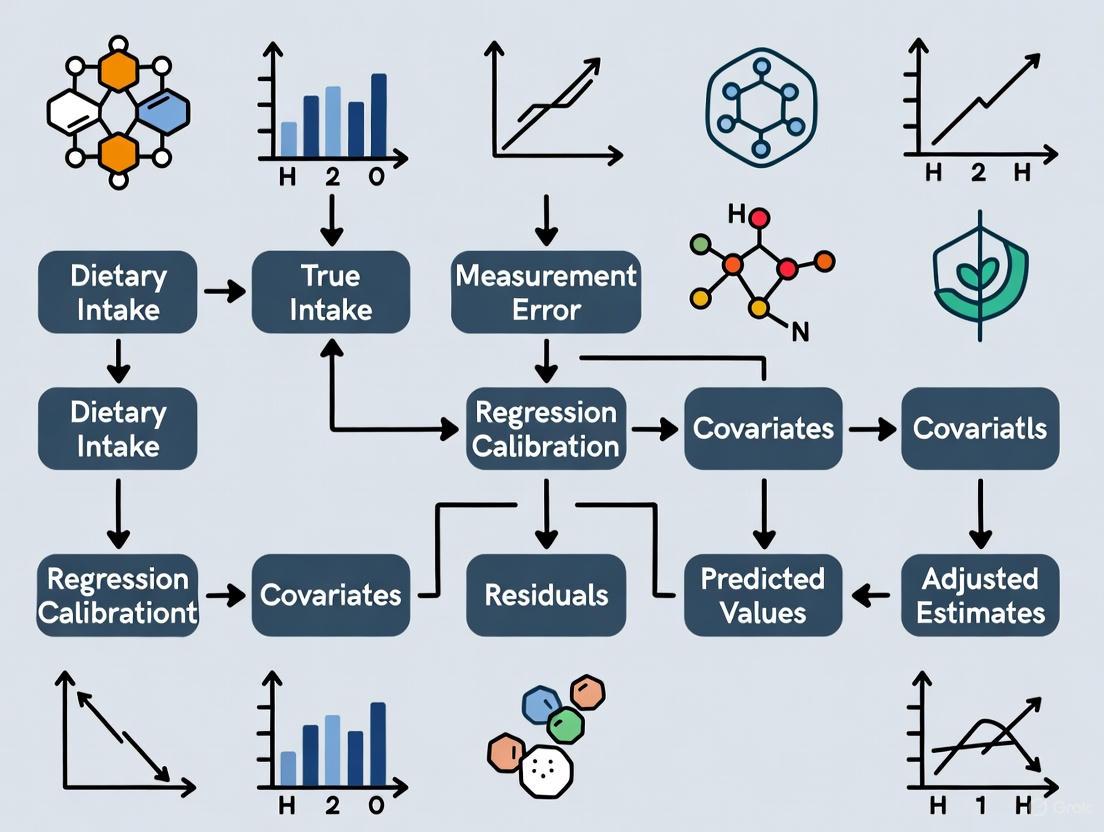
This article provides a comprehensive overview of regression calibration methods to address the pervasive challenge of dietary measurement error in biomedical research.
Regression Calibration for Dietary Measurement Error: A Comprehensive Guide for Biomedical Researchers
Abstract
This article provides a comprehensive overview of regression calibration methods to address the pervasive challenge of dietary measurement error in biomedical research. Tailored for researchers, scientists, and drug development professionals, it explores the foundational concepts of systematic and random error in nutritional data, details methodological applications from standard to advanced survival and high-dimensional techniques, and offers practical strategies for troubleshooting and optimization. The content further covers critical validation study designs and comparative analyses of correction methods, synthesizing current evidence and best practices to strengthen the validity of diet-disease association studies and evidence generation from real-world data.
Understanding and Quantifying Dietary Measurement Error
Defining Systematic vs. Random Error in Dietary Assessment
Accurate dietary assessment is fundamental to nutrition research, enabling the investigation of diet-disease relationships and the formulation of public health policy [1]. However, self-reported dietary intake data are notoriously susceptible to measurement errors that can obscure true associations and compromise research validity [1] [2]. Understanding the fundamental distinction between systematic error (bias) and random error is therefore crucial for designing robust studies and applying appropriate statistical corrections [3]. This document delineates these error types within the context of dietary assessment and outlines protocols for their quantification and adjustment, with particular emphasis on regression calibration methods for measurement error research.
Conceptual Foundations of Measurement Error
Measurement error in dietary assessment can be defined as the difference between the reported dietary intake and the true usual intake. These errors are broadly categorized into systematic error (bias) and within-person random error (day-to-day variation) [2].
Systematic Error (Bias)
Systematic error consistently distorts measurements in a specific direction and does not average out with repeated administrations [2]. Its components include:
- Intake-related bias: The systematic error that is correlated with true intake levels. A key manifestation is the "flattened-slope" phenomenon, where individuals with high true intake tend to under-report, and those with low true intake tend to over-report [2].
- Person-specific bias: The component of systematic error unique to an individual, which may be influenced by characteristics like social desirability or body image [2].
A primary challenge with systematic error is that it cannot be eliminated through averaging multiple measurements or standard statistical modeling without a reference instrument [2].
Within-Person Random Error
Within-person random error refers to the day-to-day variation in an individual's diet and reporting, which causes their reported intake on any single day to deviate from their true long-term usual intake [2]. Unlike systematic error, data affected only by random error are not biased, but imprecise. Averaging multiple 24-hour recalls or food records can reduce the influence of this random variation, providing a better estimate of usual intake [1] [2]. When repeated measures are available, statistical modeling can adjust for day-to-day variation to estimate the usual intake distribution for a population [2].
Table 1: Characteristics of Systematic vs. Random Error in Dietary Assessment
| Feature | Systematic Error (Bias) | Within-Person Random Error |
|---|---|---|
| Definition | Consistent, directional deviation from true value | Day-to-day variation in intake and reporting |
| Impact on Data | Introduces bias | Introduces imprecision |
| Reduction via Averaging | No | Yes |
| Primary Components | - Intake-related bias- Person-specific bias | - Biological day-to-day variation- Measurement error on a given day |
| Correction Methods | Requires a reference instrument (e.g., recovery biomarker) | Statistical modeling of repeated measures |
Quantitative Characterization of Errors Across Assessment Methods
The magnitude and nature of measurement errors vary significantly across different dietary assessment tools. Table 2 summarizes the primary error profiles and key considerations for major methods.
Table 2: Error Profiles of Common Dietary Assessment Instruments
| Method | Primary Systematic Error | Primary Random Error | Key Considerations |
|---|---|---|---|
| 24-Hour Recall (24HR) | Least biased for energy intake; potential under-reporting influenced by interview mode [1] | High day-to-day variation; requires multiple (≥2) non-consecutive administrations to estimate usual intake [1] [2] | Relies on memory; interviewer-administered versions can be costly [1] |
| Food Record | High potential for reactivity (participants change diet when recording) [1] | Day-to-day variation; can be reduced by extending recording period (typically 3-4 days) [1] | Requires a literate, highly motivated population; burden increases with days recorded [1] |
| Food Frequency Questionnaire (FFQ) | Systematic error due to portion size estimation and limited food list; prone to energy under-reporting [1] | Lower random error for habitual intake assessment as it queries a long time period [1] | Designed to rank individuals by intake; not precise for absolute intake values [1] |
| Experience Sampling (ESM) | Potential for reduced reactivity and recall bias through real-time assessment [4] | Error depends on sampling intensity and recall period (e.g., 15 min to 3.5h) [4] | Emerging method; protocol design (duration, prompts) is critical to balance feasibility and accuracy [4] |
The following diagram illustrates the relationship between true intake, the different types of error, and the resulting reported intake across various assessment methods.
Experimental Protocols for Error Quantification
Protocol 1: Validation Study Using Recovery Biomarkers
Objective: To quantify systematic error (bias) in self-reported energy and protein intake. Background: Recovery biomarkers, such as doubly labeled water for energy and urinary nitrogen for protein, are considered unbiased references because they objectively measure metabolized intake, largely independent of self-report [1].
Materials:
- Participants from main study cohort
- Self-report instrument(s) under validation (e.g., 24HR, FFQ)
- Doubly labeled water kits and urine collection equipment
- Protocol for biomarker analysis (e.g., mass spectrometry)
Procedure:
- Recruitment: Recruit a subsample (e.g., 10-20%) from your main study population to form an internal validation study [3].
- Data Collection:
- Administer the self-report dietary instrument (e.g., multiple 24HRs) to participants.
- Concurrently, administer the recovery biomarker protocol:
- Data Analysis:
- Calculate the reported intake from the dietary instrument.
- Calculate true intake from the biomarker measurements using established equations.
- For each participant ( i ), compute the measurement error ( \omegai = X^i - X_i ), where ( X^ ) is self-reported intake and ( X ) is biomarker-based intake.
- Fit a linear measurement error model: ( X^* = \alpha0 + \alphaX X + e ) [3].
- The intercept ( \alpha0 ) indicates location bias, and the slope ( \alphaX ) indicates scale bias. A value of ( \alpha_X < 1 ) is indicative of the "flattened-slope" phenomenon [2] [3].
Protocol 2: Reliability Study for Random Error Estimation
Objective: To estimate the magnitude of within-person random error (day-to-day variation) in a dietary assessment method. Background: Repeated short-term measurements (e.g., 24HRs) on the same individual allow for the decomposition of total variance into between-person and within-person components [2].
Materials:
- Study participants
- Standardized dietary interview protocol or food record application
- Nutrient database for analysis
Procedure:
- Study Design: Conduct repeated administrations of the dietary instrument (e.g., 24HR or food record). A minimum of two non-consecutive days per participant is required, but more repeats (e.g., 3-4) yield more precise estimates [1] [2].
- Data Collection: Collect dietary data on the predetermined, randomized days. If using 24HR, ensure interviews are blinded to previous responses.
- Data Analysis:
- Compute nutrient intakes for each participant and each day.
- Use a random effects analysis of variance (ANOVA) model to partition the total variance ( \sigma^2{Total} ) into:
- Between-person variance (( \sigma^2B )): Variance of the individuals' usual intakes.
- Within-person variance (( \sigma^2_W )): Variance of day-to-day deviations around each individual's usual intake.
- The ratio ( \sigma^2W / \sigma^2B ) informs the number of repeat days needed to estimate usual intake reliably. A high ratio indicates substantial day-to-day variation, necessitating more repeat measures [2].
Regression Calibration for Error Adjustment
Regression calibration is a primary statistical method to correct point and interval estimates in regression models for bias introduced by measurement error [5] [3]. The following workflow details the application of this method.
Procedure:
- Obtain Calibration Data: Perform an internal validation study (Protocol 1) where both the error-prone measurement ( X^* ) (e.g., FFQ intake) and a reference measurement ( X ) (e.g., biomarker or multiple 24HRs) are collected for a subset of participants [3].
- Estimate Calibration Equation: In the validation subset, fit a model predicting the true exposure ( X ) from the mismeasured exposure ( X^* ), often adjusting for covariates ( Z ): ( X = \lambda0 + \lambda1 X^* + \lambda_Z Z + \epsilon ) [5] [3]. This is the calibration equation.
- Compute Calibrated Values: For all individuals in the main study, compute a calibrated exposure value using the coefficients from Step 2: ( \hat{X} = \hat{\lambda}0 + \hat{\lambda}1 X^* + \hat{\lambda}_Z Z ) [3].
- Run Outcome Model: Use the calibrated exposure ( \hat{X} ) in place of ( X^* ) in the primary outcome model (e.g., logistic or Cox regression) relating diet to health outcome [5]. This mitigates bias in the estimated diet-disease association.
This method has been extended for complex outcomes, such as Survival Regression Calibration (SRC) for time-to-event data, which calibrates parameters of survival models rather than applying a simple linear correction to event times [6].
Table 3: Key Resources for Dietary Measurement Error Research
| Resource / Reagent | Function / Application |
|---|---|
| Recovery Biomarkers | Objective, unbiased reference measures for specific nutrients (energy, protein, potassium, sodium) to quantify systematic error in validation studies [1] [2]. |
| ASA-24 (Automated Self-Administered 24HR) | A freely available, web-based tool for collecting multiple 24-hour recalls, reducing interviewer burden and cost, useful for both main studies and as a reference in validation [1]. |
| Dietary Assessment Primer (NCI) | A comprehensive online resource covering dietary assessment concepts, measurement error, and best practices for researchers [2]. |
| Regression Calibration Software (SAS/R Macros) | Specialized statistical code (e.g., as referenced in [5]) to implement measurement error corrections in epidemiological analyses. |
| Validation Study Dataset | An internal or external dataset containing paired measurements of error-prone and reference instruments, essential for estimating calibration equations [3] [6]. |
| Nutrient Database | A detailed database of food composition, required to convert reported food consumption into estimated nutrient intakes for analysis [1]. |
In dietary measurement error research, identifying and mitigating systematic errors is fundamental to obtaining valid findings in nutritional epidemiology and chronic disease studies. The most pervasive challenges in self-reported dietary data are recall bias, social desirability bias, and portion misestimation [7] [8]. These errors distort true diet-disease relationships, leading to attenuated effect estimates, reduced statistical power, and potentially flawed scientific conclusions [7]. Regression calibration methods provide a powerful statistical framework for correcting these biases, using reference measurements to adjust for systematic measurement errors in self-reported data [9]. This paper details the quantitative impacts of these error sources and presents standardized protocols for implementing regression calibration in dietary research.
Quantitative Impacts of Dietary Measurement Errors
The following table summarizes the documented effects of key measurement errors on diet-disease association estimates, as demonstrated in empirical studies:
Table 1: Quantitative Impacts of Measurement Errors on Diet-Disease Associations
| Error Source | Nutrient/Food Example | Impact on Association | Empirical Evidence |
|---|---|---|---|
| Recall Bias & General Measurement Error | Protein & Potassium | Attenuation (AF ≠ 1) | AF of 1.14 (Protein) and 1.28 (Potassium) with standard RC versus uncorrected FFQ [7]. |
| Systematic Underreporting | High-Fat Foods (Bacon, Fried Chicken) | Distorted consumption estimates | Machine learning models identified 78-92% accuracy in classifying underreported entries [8]. |
| Social Desirability Bias | Self-Reported FFQ Data | Systematic under/over-reporting | Associated with individual characteristics like BMI; leads to biases not automatically rectified in analysis [10]. |
Experimental Protocols for Regression Calibration
Core Regression Calibration Protocol
This protocol corrects for systematic measurement error in a Food Frequency Questionnaire (FFQ) using 24-hour dietary recalls (24hR) as a reference instrument [7] [11].
1. Study Design and Population:
- Conduct the study within a large prospective cohort.
- Administer the main instrument (FFQ) to all study participants.
- Select an internal validation sub-sample (e.g., n=150-250) from the cohort.
- Administer the reference instrument (multiple 24hR) to the validation sub-sample. The 24hR should be conducted on non-consecutive days to capture day-to-day variation [11].
2. Data Collection:
- FFQ: A self-administered, semi-quantitative questionnaire assessing habitual diet over the past month or year, capturing food items, frequencies, and portion sizes [7].
- 24hR: Multiple telephone-administered 24-hour recalls using a standardized protocol like the five-step multiple-pass method, conducted by trained dietitians. Foods are coded and nutrient intakes calculated using a standard food composition table [7].
3. Calibration Model Fitting:
- Using data only from the validation sub-sample, fit a linear regression calibration model for the nutrient of interest:
R_i,24hR = α + β * FFQ_i + ε_i[11] where:R_i,24hRis the nutrient intake from the 24hR for participanti.FFQ_iis the nutrient intake from the FFQ for participanti.αis the intercept, representing systematic additive bias.βis the calibration coefficient, quantifying the scaling error.ε_iis the random error term.
4. Application in Main Study:
- For every participant in the full cohort, compute the calibrated intake estimate:
Calibrated_FFQ_i = α + β * FFQ_i[9] - The calibrated values replace the raw FFQ values in subsequent diet-disease risk models.
5. Enhanced Regression Calibration (ERC) Variant:
- When 24hR data are available for the entire cohort, an enhanced method incorporates individual random effects to the calibration model, which accounts for within-person random error in the 24hR and can improve precision [7].
The following workflow diagram illustrates the regression calibration process:
Protocol for High-Dimensional Biomarker Development
This advanced protocol leverages high-dimensional metabolomic data to develop objective biomarkers for dietary components when traditional biomarkers are unavailable [10].
1. Study Design and Population (Three-Stage):
- Sample 1 (Feeding Study - Biomarker Development): A small subgroup undergoes a controlled feeding study where meals are provided with standardized, well-documented nutrient content. Blood and urine measurements (high-dimensional metabolites, W ∈ ℝ^p) are collected [10].
- Sample 2 (Biomarker Sub-Study - Calibration): A separate subgroup from the main cohort has both self-reported dietary data (Q) and high-dimensional objective measurements (W) collected [10].
- Sample 3 (Association Study): The full main cohort with self-reported dietary data for association analysis [10].
2. Data Collection:
- High-Dimensional Metabolites: Mass spectrometry or NMR-based profiling of blood/urine samples from Samples 1 and 2, yielding hundreds to thousands of metabolite features [10].
- Objective Covariates: Age, sex, BMI, and clinical biomarkers (e.g., LDL cholesterol, blood glucose) [10].
3. Biomarker Model Fitting (in Sample 1):
- Use penalized regression techniques like Lasso or SCAD to handle high-dimensionality (p >> n) and select metabolites predictive of the dietary component of interest.
- Train a random forest classifier as an alternative to capture non-linear relationships and rank predictor importance [8].
- Tune model hyperparameters via cross-validation to optimize predictive performance and avoid overfitting [10].
4. Calibration and Variance Estimation:
- Apply the trained biomarker model to Sample 2 to predict the dietary intake.
- Fit a calibration equation relating the predicted biomarker value to the self-reported intake (Q), adjusting for covariates (V).
- Use refitted cross-validation (RCV) or degrees-of-freedom corrected estimators to address challenges in variance estimation introduced by high-dimensional modeling [10].
5. Association Analysis (in Sample 3):
- Use the calibration equation from Sample 2 to compute calibrated intake estimates for the full cohort (Sample 3).
- Use these calibrated estimates in Cox or logistic regression models to assess diet-disease associations [10].
The Scientist's Toolkit: Research Reagent Solutions
Table 2: Essential Materials and Reagents for Dietary Error Research
| Item | Function/Application | Key Features & Considerations |
|---|---|---|
| Semi-Quantitative FFQ | Main dietary assessment instrument in large cohorts; assesses habitual intake. | Should be validated for target population; cost-effective and low-burden [7] [11]. |
| 24-Hour Dietary Recall (24hR) | Reference instrument for regression calibration; assesses short-term actual intake. | Uses multiple-pass method; conducted by trained dietitians; requires multiple non-consecutive days [7]. |
| Urinary Recovery Biomarkers | Unbiased reference measurement for specific nutrients (e.g., protein, potassium). | Objective and free of self-report bias; available for only a limited number of nutrients [7] [9]. |
| High-Dimensional Metabolomics Data | Objective measurements for developing novel biomarkers for a wider range of dietary components. | Mass spectrometry/NMR-based; requires specialized variable selection and modeling techniques [10]. |
| Web-Based Dietary Assessment Platforms | Facilitate administration of 24hR, dietary records, and FFQs in large studies. | Reduces burden and cost; improves data entry standardization [7]. |
| Controlled Feeding Study Data | Provides ground truth data for developing and testing biomarker models. | Logistically complex and costly; provides highly accurate intake data for a short period [10]. |
Recall bias, social desirability bias, and portion misestimation introduce substantial error into nutritional research, but regression calibration provides a robust methodological correction. The successful application of these protocols requires careful study design, appropriate selection of reference instruments, and rigorous statistical modeling. By implementing these detailed protocols and leveraging advanced tools like high-dimensional biomarkers, researchers can significantly reduce measurement error bias, leading to more accurate and reliable estimates of diet-disease relationships.
In nutritional epidemiology and observational research, measurement error is a pervasive challenge that systematically distorts scientific findings. When investigating associations between dietary components and chronic disease risk, error-prone measurements—such as self-reported dietary intake from Food Frequency Questionnaires (FFQs)—introduce bias into effect estimates and diminish the ability to detect true associations. The two primary statistical consequences of measurement error are attenuation of risk estimates and reduced statistical power, both of which can lead to false conclusions about relationships between exposures and health outcomes [3].
Attenuation, also known as "regression dilution bias," describes the phenomenon where observed associations between variables are biased toward the null hypothesis of no association [12]. This occurs because imperfectly measured variables appear less strongly related to outcomes than they truly are, potentially causing researchers to underestimate or completely miss important risk relationships. Simultaneously, measurement error reduces statistical power, increasing the risk of Type II errors (failing to detect genuine effects) and necessitating substantially larger sample sizes to achieve adequate study precision [13].
Theoretical Foundations of Measurement Error
Types of Measurement Error
Measurement error in epidemiological research is formally characterized through specific mathematical models that describe the relationship between true exposure (X) and error-prone measured exposure (X*). Understanding these models is essential for selecting appropriate correction methods.
Table 1: Classification and Properties of Measurement Error Models
| Error Model | Mathematical Formulation | Key Properties | Common Applications |
|---|---|---|---|
| Classical | (X^* = X + e) | Error (e) has mean zero, independent of X; unbiased at individual level | Laboratory measurements, technical replicates [3] |
| Linear | (X^* = \alpha0 + \alphaX X + e) | Includes both random error and systematic bias; depends on true X value | Self-reported dietary data, biased measurements [3] |
| Berkson | (X = X^* + e) | Error (e) independent of X*; unbiased at population level | Assigned group exposures, prediction model scores [3] |
The distinction between differential and non-differential error is equally critical. Error is considered non-differential when the measurement error is independent of the outcome conditionally on the true exposure and other covariates [3]. This means the error provides no additional information about the outcome beyond what the true exposure provides. In prospective studies, non-differential error is often a reasonable assumption, whereas case-control studies with self-reported exposures may suffer from differential error through recall bias.
Mechanisms of Attenuation and Power Reduction
Attenuation occurs because measurement error in an exposure variable adds extraneous variability that obscures its true relationship with an outcome. The correlation between observed variables (rxy) is always less than or equal to the correlation between the true variables (rXY), with the degree of attenuation determined by the reliability of the measurements [12]. Mathematically, this relationship is expressed through the formula:
[ r{xy} = r{XY} \times \sqrt{r{xx} \times r{yy}} ]
where rxx and ryy represent the reliabilities of the X and Y variables, respectively. As these reliabilities decrease from the perfect value of 1.00, the observed correlation becomes increasingly attenuated [12].
Reduced statistical power manifests most dramatically in studies investigating interaction effects. Khandis Blake et al. demonstrated that "even a programmatic series of six studies employing 2 × 2 designs, with samples exceeding N = 500, can be woefully underpowered to detect genuine effects" when measurement error is present [13]. This occurs because error-prone measures increase the variability in the data without adding meaningful signal, effectively diluting the apparent effect size and requiring larger samples to achieve statistical significance.
Table 2: Impact of Measurement Error on Statistical Conclusions
| Statistical Parameter | Impact of Measurement Error | Practical Consequence |
|---|---|---|
| Risk Estimate | Attenuated toward null | Underestimation of true effect size |
| Statistical Power | Reduced | Increased Type II error rate |
| Required Sample Size | Increased | Higher study costs and complexity |
| Confidence Intervals | Widened | Reduced precision in estimates |
Regression Calibration Methods
Fundamental Principles
Regression calibration is a statistical method for adjusting point and interval estimates of effect obtained from regression models for bias due to measurement error [5]. The method involves replacing the error-prone measurements in analytical models with calibrated values that better approximate the true exposures. This approach requires data from a validation study where both the error-prone measurements and reference measurements (or biomarkers) are available for a subset of participants [3].
The method is particularly valuable in nutritional epidemiology for addressing systematic measurement errors in self-reported dietary data. Strong evidence suggests that misreporting of dietary energy intake is associated with individual characteristics such as body mass index (BMI), creating systematic errors that result in estimation biases that cannot be automatically rectified without statistical correction [14].
Implementation Framework
The implementation of regression calibration follows a structured workflow that incorporates data from multiple sources:
The calibration process begins with developing a calibration equation in the validation study by regressing the reference measurements (true values or biomarkers) on the error-prone measurements and other relevant covariates [3]. This equation then gets applied to the entire study population to generate calibrated exposure values that replace the error-prone measurements in the final outcome model.
Advanced Applications
Recent methodological developments have extended regression calibration to address complex research scenarios:
Cox Proportional Hazards Models: Regression calibration has been adapted for estimating incidence rate ratios from time-to-event data, enabling correction of measurement error bias in survival analysis [5]. This approach has been applied to studies of associations between breast cancer incidence and dietary intakes of vitamin A, alcohol, and total energy.
High-Dimensional Biomarker Development: When traditional biomarkers are unavailable for specific dietary components, high-dimensional objective measurements (e.g., metabolomics data) can construct biomarkers for error correction [14]. This approach utilizes variable selection techniques like LASSO or random forests to handle the challenge of high-dimensional data where the number of potential biomarkers exceeds the sample size.
Survival Regression Calibration (SRC): For time-to-event outcomes with measurement error, SRC fits separate Weibull regression models using true and mismeasured outcomes in a validation sample, then calibrates parameter estimates according to the estimated bias in Weibull parameters [6]. This approach addresses limitations of standard regression calibration methods that assume additive error structures inappropriate for censored time-to-event data.
Practical Applications and Protocols
Dietary Assessment Calibration Protocol
The following protocol outlines the application of regression calibration for correcting measurement error in nutritional studies investigating diet-disease associations, based on methodologies employed in the Women's Health Initiative (WHI) and similar large cohorts [14]:
Study Design Requirements:
- Main Cohort: Primary study population with error-prone exposure measurements (e.g., FFQ data)
- Validation Subsample: Representative subset with both error-prone and reference measurements
- Feeding Study (Optional): For biomarker development, providing objective intake data
Data Collection Procedures:
- Collect self-reported dietary data (Q) from entire cohort using standardized FFQ
- Obtain objective biomarker measurements (W) in validation subsample (blood/urine biomarkers)
- In feeding study subsample, collect controlled dietary intake data (X~) with known nutrient composition
- Record relevant covariates (V) including age, BMI, sex, and other potential confounders
Statistical Analysis Workflow:
- Biomarker Development (if needed): Regress controlled intake (X~) on high-dimensional objective measurements (W) in feeding study sample using penalized regression methods
- Calibration Equation Development: Regress reference measurements (X or biomarker-predicted values) on error-prone measurements (Q) and covariates (V) in validation subsample
- Application to Main Study: Apply calibration equation to all participants to generate calibrated exposure values (Zcal)
- Outcome Analysis: Fit final disease model (e.g., Cox regression) using calibrated exposures (Zcal) and covariates (V)
Validation and Sensitivity Analysis:
- Assess transportability of calibration equation between populations
- Conduct bootstrap resampling to estimate standard errors accounting for calibration uncertainty
- Compare results with and without calibration to quantify impact of measurement error correction
Experimental Validation Study Design
To empirically quantify measurement error structure and develop study-specific calibration equations, implement a validation study with the following design:
Sample Size Considerations:
- Minimum of 100-200 participants for reliable calibration equation estimation
- Balance between practical constraints and statistical precision needs
- Stratified sampling to ensure representation across key demographic and exposure ranges
Reference Measurement Selection:
- Biomarkers: Doubly labeled water for energy expenditure, urinary nitrogen for protein intake
- Recovery Biomarkers: Suitable for nutrients with stable urinary excretion
- Concentration Biomarkers: Serum carotenoids for fruit/vegetable intake
- Predictive Biomarkers: Developed from high-dimensional metabolomic data [14]
- Multiple 24-Hour Recalls: As approximation of usual intake in absence of biomarkers
Data Collection Timeline:
- Collect error-prone measurements (FFQ) at baseline
- Obtain reference measurements within temporally relevant window (1-6 months)
- For biomarkers with short-term variability, consider repeated measures
- For long-term exposure assessment, align reference measurements with exposure period of interest
The Scientist's Toolkit
Table 3: Research Reagent Solutions for Measurement Error Correction
| Tool/Resource | Function | Application Context |
|---|---|---|
| SAS Regression Calibration Macros | Implements regression calibration for logistic, Cox, and linear models | Nutritional epidemiology studies [5] |
| High-Dimensional Variable Selection (LASSO, SCAD) | Selects relevant biomarkers from high-throughput metabolomic data | Biomarker development for dietary components [14] |
| Survival Regression Calibration (SRC) | Corrects measurement error in time-to-event outcomes | Oncology real-world evidence studies [6] |
| Weighted Regression Algorithms | Addresses heteroscedasticity in calibration data | Analytical chemistry calibration curves [15] |
| Refitted Cross-Validation (RCV) | Estimates error variance in high-dimensional regression | Prevents overfitting in biomarker models [14] |
| Validation Study Design Templates | Guides collection of appropriate reference measurements | Ensuring transportable calibration equations [3] |
Technical Implementation Considerations
Software and Computational Tools:
- Specialized SAS macros for regression calibration in epidemiological studies [5]
- R packages for high-dimensional regression (glmnet, ncvreg) for biomarker development [14]
- Custom weighted regression spreadsheets for analytical calibration curves [15]
- Bootstrap and resampling procedures for variance estimation of calibrated parameters
Weighting Strategies for Heteroscedastic Data: When analytical measurements exhibit concentration-dependent variance (heteroscedasticity), implement weighted least squares regression with the following weighting schemes:
Evaluation of weighting schemes should utilize both the sum of absolute percentage relative error (Σ%RE) and visual inspection of residual plots to identify the approach that produces the most uniform variance across the concentration range [15].
Measurement error presents a fundamental challenge to the validity of nutritional epidemiology and observational research, systematically attenuating risk estimates and reducing statistical power. Regression calibration methods provide a robust statistical framework for correcting these biases, utilizing validation data to recover estimates that more accurately reflect true exposure-disease relationships. The continued development and application of these methods—including extensions for survival outcomes, high-dimensional biomarker development, and heteroscedastic data—strengthens the evidentiary foundation for dietary recommendations and public health policies. As research increasingly leverages real-world data and complex exposure assessments, rigorous measurement error correction remains essential for generating reliable scientific evidence.
In dietary measurement error research, understanding the nature and structure of error is paramount for developing appropriate correction methods. Measurement error in nutritional epidemiology is ubiquitous due to the challenges in assessing habitual intake, which relies on self-reported instruments like Food Frequency Questionnaires (FFQs) and diet records [16]. These errors, if unaddressed, can severely bias the estimated associations between dietary exposures and health outcomes, leading to flawed scientific conclusions and public health recommendations. The framework for addressing measurement error consists of three core components: the outcome model linking the true exposure to the disease, the measurement error model relating the observed exposure to the true exposure, and the distribution model of the true exposure itself [17].
This article provides a comprehensive introduction to the three fundamental measurement error models—Classical, Berkson, and Linear—that form the theoretical foundation for error correction methodologies, including regression calibration. Accurate specification of the error model is a critical prerequisite for selecting and applying the appropriate statistical correction technique [18] [3]. We detail the mathematical formulations, assumptions, and consequences of each model, with specific applications in nutritional epidemiology, and provide structured protocols for their implementation in dietary research.
Core Error Models: Mathematical Formulation and Comparison
The table below summarizes the key characteristics, mathematical models, and main implications of the three primary error models.
Table 1: Comparison of Key Measurement Error Models
| Error Model | Mathematical Formulation | Bias in Measured Variable | Typical Effect on Regression Coefficient | Common Occurrence in Nutritional Epidemiology |
|---|---|---|---|---|
| Classical | ( X^* = X + U ), where ( E(U)=0 ), ( U \perp X ) [3] | Unbiased at individual level [3] | Attenuation (bias towards null) [16] | Random within-person day-to-day variation [16] |
| Berkson | ( X = X^* + U ), where ( E(U)=0 ), ( U \perp X^* ) [3] | Biased at individual level, unbiased at population level [3] | Little or no bias in coefficient; reduces study power [19] [18] | Assignment of group-level exposure (e.g., average air pollution) [3] |
| Linear | ( X^* = \alpha0 + \alphaX X + U ), where ( E(U)=0 ), ( U \perp X ) [3] | Biased at individual level (systematic error) [3] | Complex bias (can be away from or towards null) [18] | Self-reported dietary intake with systematic bias [3] |
The following diagram illustrates the fundamental structural differences and data flow for each error model, highlighting the distinct relationships between the true exposure (X), the measured exposure (X*), and the error term (U).
Experimental Protocols for Error Model Application
Protocol 1: Handling Classical Measurement Error in Dietary Data
Purpose: To correct for random within-person variation in a dietary exposure (e.g., fruit and vegetable intake) measured by an FFQ, assuming a classical error structure.
Background: The classical error model is applicable when the measurement instrument is unbiased at the individual level but has random error that is independent of the true exposure. In nutrition, this often pertains to day-to-day variation around a person's usual intake [16].
Table 2: Reagent Solutions for Classical Error Protocol
| Item | Specification | Function |
|---|---|---|
| Main Study Data | Cohort with outcome (Y) and error-prone exposure (X*), e.g., from an FFQ. | Provides the primary data for diet-disease association analysis. |
| Replicate Measurements | At least two repeated administrations of the FFQ or multiple 24-hour recalls in a subset. | Quantifies the within-person random error variance. |
| Statistical Software | SAS, R, or Stata with measurement error packages (e.g., simex, rcme). |
Executes regression calibration or SIMEX algorithms. |
Procedure:
- Study Design: Within the main cohort, select a random subsample (the calibration/reliability study). Ensure this subsample is representative of the main study population [18].
- Data Collection: For participants in the calibration study, collect at least two replicate measurements of the dietary exposure using the same instrument (e.g., FFQ) administered at different times. The time interval should be sufficient to capture representative variation but short enough that usual intake is stable [16].
- Error Variance Estimation: Calculate the within-person variance (( \sigma^2u )) and the between-person variance (( \sigma^2x )) of the exposure from the replicate measurements using a random-effects ANOVA model.
- Reliability Ratio: Compute the reliability ratio (( \lambda )) as ( \lambda = \sigma^2x / (\sigma^2x + \sigma^2_u/n) ), where ( n ) is the number of replicates per person. This ratio quantifies the attenuation factor [18].
- Correction Analysis: Apply a correction method such as Regression Calibration:
- Replace the naive exposure value ( X^* ) in the disease model with the expected value of the true exposure given the measured exposure and covariates, ( E(X|X^*) ) [20] [21].
- Alternatively, use the Simulation-Extrapolation (SIMEX) method, which simulates data with increasing error variance and extrapolates back to the case of no error [18].
- Validation: Compare the corrected effect estimate (e.g., odds ratio, hazard ratio) with the naive estimate to assess the impact of correction.
Protocol 2: Correcting for Systematic Bias with the Linear Error Model
Purpose: To adjust for systematic and random error in self-reported dietary data (e.g., protein intake), where the reporting bias may depend on subject characteristics.
Background: The linear error model extends the classical model to account for systematic bias, which is common in self-reported dietary data where individuals may consistently over- or under-report based on factors like body mass index (BMI) [3] [16].
Table 3: Reagent Solutions for Linear Error Protocol
| Item | Specification | Function |
|---|---|---|
| Main Study Data | Cohort with outcome (Y) and error-prone self-report (X*). | Primary data for analysis. |
| Validation Study Data | A subsample with both the self-report (X*) and a reference instrument. | Used to estimate the calibration equation parameters. |
| Reference Instrument | Biomarker (e.g., urinary nitrogen), or multiple diet records. | Serves as a superior measure to approximate true intake (X). |
| Covariate Data | Variables related to systematic error (e.g., BMI, age). | Included in the calibration equation to model systematic bias. |
Procedure:
- Study Design: Establish an internal validation study within the main cohort, where participants provide both the self-reported exposure (X*) and a measurement from a reference instrument considered an unbiased marker of true intake (X) [3] [16].
- Calibration Equation Estimation: In the validation study, fit a linear regression model with the reference instrument measurement as the dependent variable and the self-report (and other relevant covariates, ( Z )) as independent variables: ( X = \alpha0 + \alpha1 X^* + \alpha2 Z + \epsilon ). This estimates the systematic location bias (( \alpha0 )) and scale bias (( \alpha_1 )) [3].
- Calibration Prediction: Use the estimated coefficients from Step 2 to predict the calibrated (corrected) exposure for every individual in the main study: ( \hat{X} = \hat{\alpha0} + \hat{\alpha1} X^* + \hat{\alpha_2} Z ).
- Outcome Analysis: Fit the disease model (e.g., logistic regression, Cox model) using the calibrated exposure ( \hat{X} ) instead of the mismeasured ( X^* ) [5] [21].
- Uncertainty Estimation: Use bootstrapping or sandwich variance estimators to obtain valid confidence intervals that account for the uncertainty in the calibration step [20].
Protocol 3: Managing Exposure with Berkson-Type Error
Purpose: To analyze data where the assigned exposure is a group mean, but the true individual exposure varies around this mean, such as when using a predicted score from a calibration equation.
Background: Berkson error arises when individuals are assigned a exposure value that is an average for their group, or when a predicted value from a model is used. Notably, using a calibrated value from Protocol 2 as a substitute for true intake in a disease model introduces Berkson error [10].
Procedure:
- Error Structure Identification: Confirm the error structure. In Berkson error, the assigned value ( X^* ) is fixed, and the true exposure ( X ) varies around it with error independent of ( X^* ) [3].
- Disease Model Analysis: For linear models, Berkson error does not cause bias in the estimated regression coefficient, but it increases the variance of the estimate, reducing statistical power [19] [18].
- Power Considerations: Plan for a larger sample size to compensate for the loss of power due to the added uncertainty from the Berkson error structure.
- Advanced Correction: For non-linear models (e.g., logistic regression), Berkson error can cause slight bias. In such cases, more complex likelihood-based or simulation-based methods may be required for full correction [18].
The Scientist's Toolkit
Table 4: Essential Research Reagents and Resources for Measurement Error Correction
| Tool / Reagent | Description | Application in Error Correction |
|---|---|---|
| Recovery Biomarkers | Objective measures with a known quantitative relationship to intake (e.g., Doubly Labeled Water for energy, 24-h Urinary Nitrogen for protein) [16]. | Serve as unbiased reference measures (gold standards) in validation studies to estimate parameters of the linear error model. |
| Repeated 24-Hour Recalls | Multiple memory-based assessments of intake over the past 24 hours, collected by a trained interviewer. | Act as an "alloyed gold standard" in calibration studies to estimate within-person random error (classical model) [16]. |
| Food Diaries/Records | Prospective records of all foods and beverages consumed over a specific period (e.g., 7 days). | Used as a high-quality reference instrument in validation studies to model systematic error in FFQs [16]. |
| Regression Calibration Software | Statistical macros and packages (e.g., in SAS or R) specifically designed for measurement error correction [21]. | Implements the regression calibration algorithm to produce corrected effect estimates. |
| SIMEX Algorithm | A simulation-based method available in statistical software (e.g., simex package in R) [18]. |
Corrects for attenuation bias due to classical measurement error without requiring a detailed model of the true exposure. |
| Internal Validation Study | A sub-study nested within the main cohort where both the error-prone measure and a superior reference measure are collected [3]. | Provides the crucial data needed to estimate the parameters of the measurement error model (classical or linear). |
The accurate identification and application of measurement error models—Classical, Berkson, and Linear—are foundational steps in producing valid results in dietary exposure research. Each model carries distinct assumptions and consequences for statistical inference. Regression calibration serves as a powerful and practical correction method, particularly for the classical and linear error models frequently encountered in nutritional epidemiology [20] [21]. The protocols outlined herein provide a structured approach for researchers to diagnose the error structure in their data and implement the appropriate corrective methodology, thereby strengthening the evidential basis for diet-disease relationships.
The Critical Distinction between Within-Person Random Error and Systematic Bias
In dietary measurement error research, understanding the distinct nature and effects of within-person random error and systematic bias is fundamental to selecting appropriate statistical methods and drawing valid scientific conclusions. These two types of error originate from different sources, manifest differently in data, and require fundamentally different correction approaches [2]. Within-person random error refers to the day-to-day variation in an individual's dietary intake and their reporting of it, while systematic bias represents a consistent directional departure from the true intake value [2] [22]. This distinction is particularly critical when applying regression calibration methods, as the effectiveness of these statistical corrections depends heavily on correctly characterizing the error structure present in the data [5] [3]. Misidentification of error types can lead to residual bias, incorrect effect estimates, and ultimately flawed inferences about diet-disease relationships.
Theoretical Foundations of Measurement Error
Defining Within-Person Random Error
Within-person random error, also known as day-to-day variation, represents the difference between an individual's reported intake on a specific occasion and their long-term usual intake [2]. This type of error arises from genuine biological variation in consumption patterns combined with random inaccuracies in reporting. In dietary research, this manifests as the natural fluctuation in what people eat from day to day, which persists even when intake is measured perfectly for each specific day [2] [23].
Data affected solely by within-person random error are unbiased but imprecise [2]. The key characteristic of this error type is that it averages toward zero with repeated measures, following the law of large numbers [22]. When multiple dietary assessments are collected from the same individual, the mean of these measurements provides a better approximation of true usual intake than any single measurement alone [2]. The primary consequence of unaddressed within-person random error in epidemiological studies is reduced statistical power to detect true associations, and in univariate models, attenuation (biasing toward the null) of effect estimates [22].
Defining Systematic Bias
Systematic bias represents consistent, directional departure from true intake values that does not average out with repeated measurements [2]. Unlike random error, systematic bias persists regardless of how many times intake is measured and introduces inaccuracy into dietary assessments. The main elements of systematic error in dietary assessment include:
- Intake-related bias: Systematic error that correlates with true intake level, exemplified by the "flattened-slope" phenomenon where individuals with high true intake tend to under-report, while those with low true intake tend to over-report [2].
- Person-specific bias: Error components related to individual characteristics that affect how a person reports dietary intake, such as social desirability or body image concerns [2].
Systematic bias can also be categorized by whether it operates primarily within individuals or between persons. Between-person systematic error can be additive (constant across all intake levels) or multiplicative (proportional to intake level), with the latter being particularly common in nutritional epidemiology [22] [24].
Comparative Analysis of Error Types
Table 1: Fundamental Characteristics of Within-Person Random Error and Systematic Bias
| Characteristic | Within-Person Random Error | Systematic Bias |
|---|---|---|
| Directional Pattern | Non-directional fluctuations around true value | Consistent directional departure from true value |
| Response to Repeated Measures | Averages toward zero with sufficient replicates | Persists regardless of number of replicates |
| Effect on Mean Estimate | Unbiased with sufficient replicates | Biased even with many replicates |
| Primary Effect on Statistical Power | Reduces power to detect associations | Can bias effects in either direction |
| Correctability via Averaging | Can be reduced by averaging multiple measures | Cannot be reduced by averaging |
| Dependence on True Intake | Independent of true intake level | May be correlated with true intake level |
Implications for Dietary Research and Regression Calibration
Differential Impact on Research Outcomes
The distinct nature of within-person random error and systematic bias leads to different consequences in nutritional research:
- For surveillance and monitoring, within-person random error inflates variance estimates and reduces precision in population-level assessments, while systematic bias distorts the accuracy of prevalence estimates for inadequate or excessive intakes [23].
- In epidemiologic studies, within-person random error typically attenuates diet-disease associations toward the null, whereas systematic bias can distort observed associations in unpredictable directions, potentially creating spurious associations or masking real ones [23] [22].
- In intervention research, within-person random error can mask true intervention effects by adding noise, while systematic bias can introduce differential measurement error if the error structure differs between intervention and control groups [23].
Regression Calibration Approaches for Different Error Types
Regression calibration is a statistical method for adjusting point and interval estimates from regression models for bias due to measurement error [5]. Its application depends critically on correctly identifying the type of measurement error present:
For within-person random error, regression calibration can effectively correct attenuation bias when the error follows the classical measurement error model, where the measured exposure equals the true exposure plus random error independent of the true value [3] [22]. This approach requires replicate measurements on at least a subset of the study population to estimate the within-person variance component [5] [3].
For systematic bias, standard regression calibration approaches require additional information, typically from a validation study that includes a reference instrument providing unbiased intake measurements [2] [3]. When systematic bias follows the linear measurement error model, the calibration equation must account for both location bias (α₀) and scale bias (αₓ) parameters [3].
Table 2: Measurement Error Models and Appropriate Calibration Methods
| Error Model | Mathematical Formulation | Error Type Addressed | Calibration Requirements |
|---|---|---|---|
| Classical Measurement Error | X* = X + e | Within-person random error | Replicate measurements of X* |
| Linear Measurement Error | X* = α₀ + αₓX + e | Systematic bias + random error | Validation study with reference measure |
| Berkson Error | X = X* + e | Assignment error | Known group averages or prediction equations |
The following diagram illustrates the conceptual relationship between error types and the appropriate calibration pathways:
Experimental Protocols for Error Assessment
Protocol for Quantifying Within-Person Random Error
Objective: To estimate the magnitude of within-person random error in dietary assessments for application in regression calibration methods.
Materials and Methods:
- Study Design: Implement a reproducibility study with repeated administrations of the same dietary assessment instrument (e.g., 24-hour recalls) on multiple non-consecutive days [3] [22].
- Sample Size: Include a minimum of 100 participants with at least two replicate measurements per person, though more replicates (≥3) improve precision of variance component estimates [25].
- Data Collection:
- Administer 24-hour recalls on randomly selected days representing both weekdays and weekends to capture habitual variation [1].
- Maintain consistent administration protocols (mode, interviewer, reference period) across assessments [25].
- For food frequency questionnaires, administer the instrument twice with an appropriate interval (e.g., 1-6 months) to assess consistency [22].
- Statistical Analysis:
- Use variance components analysis (e.g., random effects models) to partition total variance into within-person and between-person components [22].
- Calculate the within-person variance (σ²ₐ) and between-person variance (σ²ᵦ).
- Compute the intraclass correlation coefficient (ICC = σ²ᵦ / [σ²ᵦ + σ²ₐ]) to quantify the proportion of total variance due to between-person differences [22].
Protocol for Assessing Systematic Bias Using Recovery Biomarkers
Objective: To quantify systematic bias in self-reported dietary intake through comparison with objective biomarkers.
Materials and Methods:
- Study Design: Conduct a validation study incorporating both self-report dietary assessments and recovery biomarkers in the same participants [2] [22].
- Participants: Recruit a representative subsample (n≥50-100) from the main study population to ensure transportability of results [3].
- Reference Instruments:
- Data Collection:
- Collect self-reported dietary data using the instrument of interest (e.g., FFQ, 24-hour recall).
- Simultaneously administer biomarker protocols according to established guidelines (e.g., DLW dose, 24-hour urine collection) [22].
- Measure potential modifiers of systematic bias (e.g., BMI, age, sex, social desirability) [2].
- Statistical Analysis:
- Apply the method of triads to calculate validity coefficients using the self-report instrument, biomarker, and additional reference method [22].
- Fit linear measurement error models to estimate calibration parameters (α₀ and αₓ) [3].
- Assess intake-related bias by testing correlations between reporting error and true intake levels [2].
The Scientist's Toolkit: Research Reagent Solutions
Table 3: Essential Methodological Tools for Dietary Measurement Error Research
| Tool Category | Specific Instrument/Method | Primary Function | Application Context |
|---|---|---|---|
| Reference Biomarkers | Doubly labeled water (DLW) | Validation of energy intake reporting | Gold standard for energy assessment [22] |
| 24-hour urinary nitrogen | Validation of protein intake | Recovery biomarker for protein [22] | |
| 24-hour urinary potassium | Validation of potassium intake | Objective measure of potassium consumption [25] | |
| Dietary Assessment Platforms | Automated Self-Administered 24-hour Recall (ASA24) | Self-administered 24-hour dietary recall | Reduces interviewer burden, standardized administration [1] |
| USDA Automated Multiple-Pass Method (AMPM) | Interviewer-administered 24-hour recall | Enhances completeness of dietary reporting [23] | |
| GloboDiet (formerly EPIC-SOFT) | Standardized 24-hour recall interface | International standardization of dietary assessment [23] | |
| Statistical Software Tools | SAS Regression Calibration Macros | Implementation of regression calibration | Correcting measurement error bias in epidemiological analyses [5] |
| Multiple Imputation Approaches | Handling differential measurement error | When measurement error depends on outcome or other variables [22] | |
| Moment Reconstruction Method | Addressing differential measurement error | Alternative approach when regression calibration assumptions are violated [22] |
Advanced Methodological Considerations
Addressing Complex Error Structures in Nutritional Epidemiology
In practice, dietary measurement error often involves complex combinations of both within-person random error and systematic bias, requiring sophisticated modeling approaches [22]. The typical error structure in self-reported dietary data includes:
- Simultaneous presence of intake-related bias (systematic) and day-to-day variation (random) [2].
- Correlated errors between different dietary components, complicating multivariate analyses [22].
- Person-specific biases that vary across population subgroups defined by characteristics such as body mass index, age, or cultural background [2].
For these complex scenarios, regression calibration methods must be extended beyond the simple classical error model. The linear measurement error model provides a more flexible framework that accommodates both random and systematic components through the inclusion of calibration parameters α₀ (location bias) and αₓ (scale bias) [3].
Emerging Methods and Future Directions
Recent methodological advances address limitations of traditional regression calibration approaches:
- Multivariate measurement error models that account for correlated errors across multiple nutrients and foods [22].
- Extension to time-to-event outcomes through methods like survival regression calibration (SRC), which addresses measurement error in endpoints such as progression-free survival [6].
- Multiple imputation for measurement error (MIME) that can handle both non-differential and differential measurement error [22].
- Moment reconstruction techniques that transform mismeasured exposures to have the same distribution as true exposures [22].
These advanced methods enhance our capacity to address the critical distinction between within-person random error and systematic bias, ultimately strengthening the validity of nutritional epidemiology and its applications in drug development and public health policy.
Implementing Regression Calibration: From Theory to Practice
Core Principles of the Regression Calibration Approach
Regression calibration is a statistical bias-correction method widely used to address the pervasive challenge of measurement error in epidemiological and nutritional research [26]. When studying the relationship between an exposure (e.g., dietary intake) and a health outcome, researchers often rely on error-prone measurements, such as self-reported dietary data. Using these measurements directly in statistical models yields biased estimates of the association parameters [26]. Regression calibration corrects this bias by replacing the error-prone exposure measurement with a calibrated estimate that better approximates the true, unobserved exposure [5]. This approach is particularly vital in nutritional epidemiology, where systematic and random errors in self-reported dietary data can substantially distort findings [5] [3]. These notes detail the core principles, methodologies, and practical applications of regression calibration, providing a protocol for its proper implementation.
Theoretical Foundations and Error Models
The Measurement Error Problem
The core problem arises when the variable of interest, the true exposure (X), is not directly observed. Instead, an error-prone measurement (X^) is available. The goal is to fit a health outcome model (e.g., linear, logistic, or Cox regression) that relates the outcome (Y) to the true (X) and other covariates (Z), but one can only fit the model using (X^) [26] [3].
- Outcome Model: This is the model of scientific interest, relating the true exposure to the outcome: (g(E(Y)) = \beta0 + \betaX X + \beta_Z Z), where (g) is a link function.
- Non-Differential Measurement Error: A key assumption is that the error is non-differential, meaning the error-prone measurement (X^) provides no additional information about the outcome (Y) beyond what is provided by the true exposure (X) and covariates (Z) [26] [3]. Formally, (Y) is conditionally independent of (X^) given (X) and (Z).
Types of Measurement Error
Understanding the structure of the error is crucial for selecting the appropriate correction method. The following table summarizes the primary measurement error models.
Table 1: Common Measurement Error Models in Epidemiological Research
| Error Model | Mathematical Form | Description | Common Example |
|---|---|---|---|
| Classical | (X^* = X + e) | Random error with mean zero, independent of (X). Unbiased at the individual level. [3] | Laboratory measurements like serum cholesterol. [3] |
| Linear (Berkson-like) | (X^* = \alpha0 + \alphaX X + e) | Allows for systematic bias (location (\alpha0) and scale (\alphaX)) in addition to random error (e). [3] | Self-reported exposures, such as dietary intake from questionnaires. [26] [3] |
| Berkson | (X = X^* + e) | The true value varies randomly around an assigned measured value. Error (e) is independent of (X^*). Unbiased at the population level. [26] [3] | Occupational studies where workers are assigned a group-level exposure. [3] |
Regression calibration is particularly effective when the error-prone measurement (X^) follows a linear or classical error structure, and a validation study is available to estimate the relationship between (X) and (X^) [5] [26].
The Regression Calibration Methodology
Core Principle and Procedure
The fundamental principle of regression calibration is to substitute the unobserved true exposure (X) in the outcome model with its conditional expectation (E(X|X^*, Z)), which is its best unbiased predictor given the available data [26]. This calibrated value, denoted (\tilde{X}), is then used in place of (X) in the outcome model.
The following workflow outlines the standard two-stage regression calibration process.
Key Statistical Insight: Induction of Berkson Error
A logical question is how using another error-prone estimate (\tilde{X}) improves the situation. The answer lies in the type of error in (\tilde{X}). While the original error in (X^) is typically classical, the error in the calibrated value (\tilde{X}) is Berkson-type [26]. By definition, (\tilde{X} = E(X | X^, Z)), so the residual error (X - \tilde{X}) is uncorrelated with (\tilde{X}) and the other covariates (Z) in the outcome model. This property is crucial as it means that using (\tilde{X}) in a linear model will not bias the coefficient estimates, which is the primary goal of the correction [26].
Practical Implementation and Protocols
Successful implementation of regression calibration depends on specific data resources. The following table lists the key "research reagents" required.
Table 2: Essential Components for a Regression Calibration Analysis
| Component | Description | Function & Importance | |
|---|---|---|---|
| Main Study | A large cohort with data on (Y), (X^*), and (Z) for all participants. | Provides the primary data for estimating the exposure-outcome association. | |
| Internal Validation Study | A random subset of the main study where the true exposure (X) (or an unbiased biomarker (W)) is measured in addition to (X^*) and (Z) [26]. | Gold standard. Allows direct estimation of the calibration equation (E(X | X^*, Z)) that is transportable to the main study. |
| Recovery Biomarker | An objective measure (e.g., urinary nitrogen for protein intake) with classical measurement error relative to true intake [27]. | Serves as an unbiased reference measurement (W) in the calibration model when true (X) is unobservable. | |
| Calibration Equation | A regression model (usually linear) predicting the true exposure (X) (or biomarker (W)) using (X^*) and (Z). | The engine for correction. Generates the calibrated exposure values (\tilde{X}) for the main study. | |
| Software with Variance Estimation | Statistical software (e.g., SAS, R) capable of implementing calibration and accounting for the extra uncertainty in (\tilde{X}) (e.g., via bootstrap or multiple imputation) [27] [28]. | Correct standard errors are essential for valid confidence intervals and hypothesis tests. |
Protocol: Applying Regression Calibration in a Dietary Study
This protocol outlines the steps to correct for measurement error in the association between sodium-to-potassium intake ratio (Na/K) and cardiovascular disease (CVD) risk, using a hypothetical cohort with a biomarker substudy [10].
Objective: To estimate the corrected hazard ratio for the association between true Na/K intake and CVD incidence. Materials: Main cohort data (CVD status, self-reported Na/K intake (Q), covariates (Z)), internal validation study data (urinary biomarkers (W) for Na/K, (Q), (Z)).
Procedure:
- Develop the Calibration Equation (Validation Study):
- In the validation study, regress the biomarker-measured Na/K ratio ((W)) on the self-reported Na/K ratio ((Q)) and all relevant covariates ((Z)) from the intended outcome model (e.g., age, sex, BMI).
- Model: (E(Wi | Qi, Zi) = \hat{\alpha}0 + \hat{\alpha}Q Qi + \hat{\alpha}Z Zi)
- This step yields the estimated calibration coefficients (\hat{\alpha}0, \hat{\alpha}Q, \hat{\alpha}_Z).
Predict Calibrated Exposure (Main Study):
- For every participant (i) in the main study, compute their calibrated Na/K intake using the equation from Step 1.
- (\tilde{X}i = \hat{\alpha}0 + \hat{\alpha}Q Qi + \hat{\alpha}Z Zi)
- This value (\tilde{X}_i) is the best estimate of their usual, true Na/K intake.
Fit the Calibrated Outcome Model:
- Fit the Cox proportional hazards model for CVD incidence, using the calibrated exposure (\tilde{X}).
- Model: (\lambda(t) = \lambda0(t) \exp(\hat{\beta}X \tilde{X} + \hat{\beta}_Z Z))
- The coefficient (\hat{\beta}_X) is the corrected log-hazard ratio for the association between the true Na/K ratio and CVD risk.
Calculate Valid Standard Errors:
- The standard errors for (\hat{\beta}_X) obtained directly from the model in Step 3 are incorrect because they ignore the uncertainty in estimating the calibration coefficients.
- Use a resampling method like the bootstrap to obtain valid standard errors and confidence intervals [27] [28].
- Repeatedly resample from the main and validation studies.
- Re-estimate the calibration equation and the outcome model for each bootstrap sample.
- The standard deviation of the (\hat{\beta}_X) estimates across all bootstrap samples is the valid standard error.
Critical Considerations and Advanced Applications
Common Implementation Pitfalls
- Covariate Selection in Calibration: The calibration model must include all covariates (Z) that will be included in the final health outcome model. Omitting a confounder from the calibration equation can reintroduce bias into the corrected estimate [26].
- Transportability of Equations: Calibration equations derived from an external validation study may not be applicable to the main study if the relationship between (X) and (X^*) differs between populations (e.g., due to different variances of (X)) [26] [3]. An internal validation study is strongly preferred.
- Variance Estimation: Failing to account for the uncertainty introduced by estimating the calibration equation will result in overly narrow confidence intervals and inflated type I error rates [26] [27]. Bootstrap or multiple imputation methods are recommended.
Extension to High-Dimensional Biomarkers
A modern challenge in nutritional epidemiology is developing biomarkers for complex dietary components. Traditional recovery biomarkers exist for only a few nutrients. A promising extension of regression calibration involves using high-dimensional metabolomic data (e.g., hundreds of metabolites from blood) to construct predictive biomarkers for a wider array of dietary exposures [10]. The protocol is similar, but the calibration step involves using penalized regression methods (e.g., Lasso) to regress a reference intake measurement from a feeding study onto the high-dimensional metabolite profile. The resulting biomarker prediction is then used in the subsequent calibration step in the main cohort [10]. Special care is required for variance estimation in this high-dimensional setting.
In nutritional epidemiology, establishing valid associations between dietary intake and chronic disease risk is fundamentally challenged by systematic measurement error in self-reported dietary data [10] [29]. Regression calibration has emerged as a predominant statistical method for correcting measurement-error bias in nutritional research [5] [9]. This method adjusts point and interval estimates from regression models to account for biases introduced by measurement error in assessing nutrients or other variables [5]. The successful application of regression calibration, however, is critically dependent on the careful design and implementation of validation and calibration studies that provide the necessary data to understand and correct for measurement error structures [20] [9]. Without these specialized studies, diet-disease association estimates remain vulnerable to distortion from both random and systematic errors inherent in self-reported dietary assessments [3] [30].
Core Concepts and Measurement Error Frameworks
Types of Measurement Error
Measurement error in nutritional epidemiology is typically categorized by its statistical properties and relationship to the true exposure:
- Classical Measurement Error: Describes a scenario where the measured value (X^) equals the true value (X) plus random error (e): (X^ = X + e), where (e) has mean zero and is independent of (X) [3]. This model is often assumed for objective biological measurements.
- Linear Measurement Error: Extends the classical model to include systematic bias: (X^* = \alpha0 + \alphaX X + e), where (\alpha0) represents location bias and (\alphaX) represents scale bias [3]. This model better captures the error structure of self-reported dietary data.
- Berkson Measurement Error: Occurs when the true value (X) varies around the measured value (X^): (X = X^ + e), where (e) has mean zero and is independent of (X^*) [3]. This often arises when subgroup averages are assigned to individuals.
The distinction between these error types is crucial as each requires different correction approaches [3].
Essential Study Designs for Error Correction
Validation and calibration studies provide the additional data required to characterize and correct measurement error:
- Validation Studies: Collect both the error-prone measurement and a reference measurement (the "gold standard" or unbiased measurement) for the same individuals [3]. These can be internal (conducted on a subgroup of the main study population) or external (conducted on a separate population) [9] [3].
- Calibration Studies: Collect a single unbiased measurement without repeated reference measurements [3]. While useful, they cannot estimate all parameters of the measurement error model.
- Reproducibility Studies: Collect repeated measurements of the error-prone measure (X^*) without reference measurements [3]. These are only sufficient for correction when classical measurement error can be assumed.
Table 1: Comparison of Study Designs for Measurement Error Correction
| Study Type | Measurements Collected | Key Assumptions | Limitations |
|---|---|---|---|
| Internal Validation | (X^*) and reference measurement on subgroup of main study | Transportability of error model within study population | Higher cost for reference data collection |
| External Validation | (X^*) and reference measurement on separate population | Transportability of error model between populations | Risk of model miscalibration if populations differ |
| Calibration Study | Single unbiased measurement for subgroup | Partial information on error structure | Cannot estimate all error model parameters |
| Reproducibility Study | Repeated (X^*) measurements | Classical measurement error structure | Cannot detect or correct systematic bias |
Data Requirements for Regression Calibration
Core Data Components
Implementing regression calibration requires specific data components that must be carefully collected through validation studies:
- Main Study Data: Typically includes the health outcome (Y), self-reported (error-prone) exposure (Q), and accurately measured covariates (V) for all participants [29].
- Reference Instrument Data: A superior exposure measurement collected in a validation subsample, which may include recovery biomarkers, 24-hour dietary recalls, food records, or feeding study data [9] [10].
- Replicate Measurements: Multiple assessments of the error-prone exposure (Q) or reference measurements to estimate within-person variation [20].
- Covariate Data: Accurately measured personal characteristics (e.g., body mass index, age, sex) that may relate to measurement error [10] [29].
Quantitative Requirements for Study Design
The statistical precision of regression calibration estimates depends on specific quantitative parameters that must be considered in study design:
Table 2: Key Quantitative Parameters for Regression Calibration Studies
| Parameter | Description | Impact on Calibration | Data Source |
|---|---|---|---|
| Validation Study Size | Number of participants with both error-prone and reference measurements | Affects precision of calibration equation coefficients | Study design |
| Number of Replicates | Repeated reference or self-report measurements per person | Reduces impact of random error in calibration | Study design |
| Correlation between X and X* | Strength of relationship between true and measured exposure | Higher correlation improves calibration performance | Validation study data |
| Variance Components | Ratio of within-person to between-person variance in exposure | Affects degree of attenuation and correction needed | Replicate measurements |
The following diagram illustrates the fundamental relationship between true intake, measured intake, and the calibration process that is quantified in validation studies:
Figure 1: Fundamental Measurement Error and Calibration Relationship. Validation studies quantify the relationship between true and measured intake to develop calibration equations.
Experimental Protocols for Validation Studies
Internal Validation Study with Biomarkers
Objective: To develop calibration equations for correcting measurement error in self-reported dietary data using objective biomarker measurements [9] [10].
Population Requirements:
- Primary cohort: Entire study population with self-reported dietary data (Q) and outcome data [29]
- Validation subsample: 5-20% of cohort with additional biomarker measurements [10]
- Sampling: Random selection stratified by key covariates (e.g., BMI, age) to ensure representativeness
Data Collection Protocol:
- Baseline Data Collection (All Participants):
Validation Subsample Data Collection:
Biomarker Analysis:
Statistical Analysis Plan:
- Calibration Equation Development:
- Regress biomarker measurements on self-report data and covariates: (X = \beta0 + \beta1 Q + \beta_2 V + \epsilon) [9] [10]
- Account for within-person variation in biomarkers using random effects models if replicates available [20]
- Validate model assumptions using residual plots and influence statistics [20]
- Application in Main Study:
Feeding Study for Biomarker Development
Objective: To establish regression-based biomarkers for dietary components when direct biomarkers are unavailable [10] [29].
Population Requirements:
- Controlled feeding study: 50-200 participants [10] [29]
- Inclusion criteria: Willing to consume provided diets for 2-4 weeks [29]
- Consideration: Representativeness to main study population on key characteristics
Study Design Protocol:
- Dietary Assessment Phase (1-2 weeks pre-feeding):
Diet Formulation Phase:
Controlled Feeding Phase (2-4 weeks):
Biospecimen Collection:
Biomarker Development Protocol:
- Data Integration:
Model Building:
Transportability Assessment:
Advanced Methodological Extensions
Survival Regression Calibration for Time-to-Event Outcomes
Traditional regression calibration methods face limitations with time-to-event outcomes common in nutritional epidemiology, such as cancer or cardiovascular disease incidence [6]. Survival Regression Calibration (SRC) extends standard approaches to address measurement error in time-to-event outcomes by leveraging Weibull regression models [6].
Protocol for SRC Implementation:
- Validation Sample Requirement: Collect both true ("gold standard") and mismeasured event times and status for a subset of participants [6]
- Model Fitting: Fit separate Weibull regression models using true and mismeasured outcomes in the validation sample [6]
- Bias Estimation: Quantify the bias in Weibull parameters between true and mismeasured models [6]
- Calibration Application: Apply bias corrections to parameter estimates in the full study population [6]
This approach specifically addresses challenges such as right-censoring and avoids generating negative event times that can occur with standard additive error models [6].
Simultaneous Regression Calibration for Multiple Nutrients
When studying multiple dietary components jointly, individually developed biomarkers may produce biased estimates due to correlated measurement errors and Berkson-type errors [29]. Simultaneous regression calibration addresses these limitations:
Key Protocol Differences from Univariate Calibration:
- Biomarker Development: Develop biomarkers for multiple nutrients simultaneously rather than separately [29]
- Error Structure Accounting: Explicitly model correlated errors between nutrients [29]
- Feeding Study Design: Ensure sufficient variation in joint distribution of target nutrients [29]
The following workflow illustrates the simultaneous regression calibration process for multiple nutrients:
Figure 2: Simultaneous Regression Calibration Workflow for Multiple Nutrients. Joint modeling accounts for correlated measurement errors across nutrients.
Research Reagent Solutions
Table 3: Essential Research Reagents and Instruments for Validation Studies
| Category | Specific Examples | Research Function | Key Considerations |
|---|---|---|---|
| Reference Instruments | 24-hour dietary recalls, Food records, Weighed food records | Superior dietary assessment for calibration equations | Resource-intensive, participant burden [9] |
| Objective Biomarkers | Doubly labeled water (energy), Urinary nitrogen (protein), Urinary sodium/potassium | Gold standard for specific nutrients | Limited availability, expensive [9] [10] |
| Biospecimen Collection | Blood collection tubes, Urine collection containers, Freezer storage systems | Biological sample acquisition for biomarker development | Standardized protocols, stability monitoring [10] |
| Emerging Tools | High-dimensional metabolomics, Gut microbiome profiling, Machine learning corrections | Novel biomarker development [10] [30] | Validation requirements, interpretability [10] [30] |
Validation and calibration studies provide the essential data foundation for implementing regression calibration methods in dietary measurement error research. The protocols outlined herein provide frameworks for generating the necessary data to correct for systematic measurement errors in self-reported dietary assessments, thereby strengthening causal inference in nutritional epidemiology. As methodological advances continue to emerge, including survival regression calibration for time-to-event outcomes and simultaneous calibration for multiple nutrients, the fundamental requirement for carefully designed validation studies remains constant. By adhering to rigorous protocols for validation study design and implementation, researchers can significantly reduce measurement error bias and produce more reliable estimates of diet-disease associations.
Step-by-Step Application for Univariate and Multivariate Dietary Components
Regression calibration is a fundamental statistical method for correcting bias in estimated associations between dietary components and health outcomes that arises due to measurement error in self-reported dietary data [31]. In nutritional epidemiology, measurement error is particularly problematic as it can lead to attenuated risk estimates (underestimation of true effects) or, in multivariate cases, distorted relationships between multiple dietary components and health outcomes [3] [10]. The complex nature of dietary intake data, which is inherently compositional (parts of a whole) and often zero-inflated, presents unique challenges for measurement error correction [32]. This protocol provides comprehensive guidance for implementing regression calibration methods for both univariate and multivariate dietary components within observational nutritional studies.
The core principle of regression calibration involves replacing the error-prone self-reported exposure measurement with its expected value given the true exposure, conditional on auxiliary data such as recovery biomarkers or replicate measurements [31] [3]. This approach requires understanding of different measurement error structures: the classical measurement error model assumes no systematic bias ((X^* = X + e), where (e) has mean zero and is independent of (X)); the linear measurement error model accounts for systematic bias ((X^* = \alpha0 + \alphaX X + e)); and the Berkson measurement error model, where the true value varies around the measured value ((X = X^* + e)) [3]. Each model requires different calibration approaches and assumptions.
Experimental Design and Data Requirements
Study Design Considerations
Implementing regression calibration requires careful study design with specific data components. The optimal approach involves collecting different types of data across nested substudies:
- Main Cohort Study: Contains the primary outcome data, self-reported dietary assessments (e.g., FFQ, 24-hour recalls), and covariates for all participants.
- Biomarker Substudy (Sample 2): A subset of the main cohort where objective biomarkers (e.g., urinary nitrogen for protein, doubly labeled water for energy) are measured alongside self-reports to develop calibration equations.
- Feeding Study (Sample 1): A smaller subgroup participating in a controlled feeding study with known intake composition and biomarker measurements to understand the relationship between true intake and biomarkers [10].
This design allows researchers to develop biomarker-based calibration equations in the feeding study, apply them in the biomarker substudy, and then extend the calibrated values to the entire cohort for association analyses.
Dietary Data Collection Methods
Table 1: Standard Dietary Assessment Methods in Nutritional Studies
| Method | Description | Temporal Coverage | Key Features | Common Uses |
|---|---|---|---|---|
| Food Frequency Questionnaire (FFQ) | Validated tool estimating usual intake over extended periods (1-12 months) [32] | Long-term habitual intake | Fixed food list with frequency options; efficient for large cohorts | Primary exposure assessment in main study sample |
| 24-Hour Dietary Recall | Detailed recall of all foods/beverages consumed in previous 24 hours [32] [33] | Short-term intake (specific day) | Multiple passes to enhance completeness; typically collected via Automated Multiple-Pass Method (AMPM) | Reference method in calibration studies; multiple recalls to estimate usual intake |
| Dietary Records | Real-time recording of foods/drinks as consumed [32] | Short-term intake (multiple days) | Reduced recall bias; high participant burden | Gold standard in feeding studies with controlled intake |
The National Health and Nutrition Examination Survey (NHANES) implements a comprehensive dietary assessment protocol including 24-hour dietary recalls using the Automated Multiple-Pass Method (AMPM), with data structured in Individual Foods Files (multiple records per person for each food consumed) and Total Nutrient Intakes Files (one record per person with daily nutrient totals) [33].
Computational Protocols
Protocol 1: Univariate Regression Calibration
This protocol addresses measurement error correction for a single dietary component of interest (e.g., sodium intake).
Step 1: Specify the Measurement Error Model
For a dietary component Z, define the relationship between self-reported intake Q and true intake Z using the linear measurement error model: [Q = \alpha0 + \alphaZ Z + \alphaV V + \epsilonq] where V represents covariates (e.g., age, BMI, sex), and (\epsilon_q) is random error with mean zero independent of Z and V [10].
Step 2: Develop Calibration Equation Using Biomarker Data
In the biomarker substudy, regress the objective biomarker value W on self-reported intake Q and covariates V: [W = \gamma0 + \gammaQ Q + \gammaV V + \epsilonw] The calibrated intake for individual i is then: [Zi^* = \hat{\gamma}0 + \hat{\gamma}Q Qi + \hat{\gamma}V Vi] where (\hat{\gamma}) represents the estimated coefficients from the biomarker regression [3].
Step 3: Implement Association Analysis
Replace the error-prone self-reported intake Q with the calibrated values (Z^) in the health outcome model. For Cox proportional hazards model: [\lambda(t|Z,V) = \lambda_0(t) \exp(\beta_Z Z^ + \betaV V)] where (\betaZ) represents the association between calibrated dietary intake and disease hazard [31] [10].
Step 4: Estimate Standard Errors and Confidence Intervals
Use bootstrap resampling or sandwich estimators to account for additional uncertainty introduced by the calibration process, as standard errors from conventional regression will be incorrectly narrow [10].
Protocol 2: Multivariate Regression Calibration
This protocol extends the approach to multiple dietary components that may be correlated (e.g., macronutrients or dietary patterns).
Step 1: Specify Multivariate Measurement Error Model
For a vector of dietary components (Z = (Z1, Z2, ..., Zp)), specify the multivariate relationship between self-reported intakes (Q = (Q1, Q2, ..., Qp)) and true intakes: [Q = \alpha0 + AZ Z + AV V + \epsilonq] where (AZ) and (AV) are matrices of coefficients, and (\epsilon_q) is a vector of random errors [10].
Step 2: Develop Multivariate Calibration Equations
When biomarkers (W = (W1, W2, ..., Wp)) are available for all dietary components, use multivariate regression: [W = \Gamma0 + \GammaQ Q + \GammaV V + \epsilonw] The calibrated intake vector is: [Zi^* = \hat{\Gamma}0 + \hat{\Gamma}Q Qi + \hat{\Gamma}V V_i] For high-dimensional settings (more biomarkers than observations), use penalized regression methods like Lasso or SCAD for variable selection [10].
Step 3: Address Partially Available Biomarkers
When biomarkers are available only for some dietary components, use regression calibration where calibrated values for unmeasured components are predicted from measured components and self-reports [10].
Step 4: Implement Multivariate Association Analysis
Replace the vector of self-reported intakes Q with calibrated values (Z^) in the multivariate health outcome model: [\lambda(t|Z,V) = \lambda_0(t) \exp(\beta_Z^T Z^ + \beta_V^T V)]
Protocol 3: High-Dimensional Biomarker Development
This protocol addresses scenarios where high-dimensional metabolomic data are available to construct biomarkers for dietary components lacking established recovery biomarkers.
Step 1: Preprocess High-Dimensional Metabolite Data
Process metabolomic data (e.g., from blood or urine) through quality control, normalization, and batch effect correction procedures.
Step 2: Develop Predictive Biomarker Signature
Using feeding study data where true intake X is known, regress X on high-dimensional metabolites M and covariates V: [X = \delta0 + \DeltaM M + \deltaV V + \epsilonx] Apply high-dimensional variable selection methods such as:
- Lasso regression for sparse biomarker signatures [10]
- Random Forests for ranking predictive metabolites [10]
- SCAD for non-concave penalized likelihood estimation [10]
Step 3: Validate Biomarker Performance
Use cross-validation or refitted cross-validation (RCV) to estimate prediction error and avoid overfitting [10]. Calculate predictive R² to quantify biomarker performance.
Step 4: Apply Biomarker in Calibration Equations
Use the developed biomarker signature W* in place of single biomarkers in the calibration equations described in Protocols 1 and 2.
Figure 1: High-Dimensional Biomarker Development Workflow
Data Analysis and Statistical Methods
Key Statistical Considerations
Table 2: Measurement Error Models and Correction Approaches
| Error Model | Mathematical Formulation | Key Assumptions | Appropriate Correction Methods |
|---|---|---|---|
| Classical | (X^* = X + e) | (E(e) = 0), (Cov(X,e) = 0) | Regression calibration, simulation extrapolation |
| Linear | (X^* = \alpha0 + \alphaX X + e) | (E(e) = 0), (Cov(X,e) = 0) | Regression calibration with bias parameters |
| Berkson | (X = X^* + e) | (E(e) = 0), (Cov(X^*,e) = 0) | Regression calibration, moment reconstruction |
When implementing regression calibration, several statistical nuances require attention:
- Compositional Data Considerations: Dietary data are inherently compositional, as they represent parts of a whole. Increased intake of one food necessitates decreased intake of others [32]. This constraint should be incorporated into multivariate calibration approaches.
- Variance Estimation: Conventional standard errors after calibration are incorrect because they don't account for uncertainty in the calibration parameters. Use bootstrap methods or asymptotic robust variance estimators [10].
- Transportability of Calibration Equations: Ensure calibration equations developed in external studies are applicable to your study population, as differences in population characteristics or true intake distributions can affect calibration performance [3].
Addressing Methodological Challenges
Several methodological challenges require specific approaches in dietary measurement error correction:
- Zero-Inflated Data: Many dietary components (especially specific food groups) have excess zeros. Consider specialized measurement error models for semicontinuous data or use Markov chain Monte Carlo methods for usual intake distributions [32].
- Multivariate Measurement Error: When modeling multiple dietary components simultaneously, account for correlated measurement errors between components to avoid biased association estimates.
- High-Dimensional Biomarkers: With high-dimensional metabolomic data (p > n), use appropriate regularization methods and account for the Berkson-type errors that arise when using predicted biomarker values in subsequent association analyses [10].
Figure 2: Regression Calibration Implementation Workflow
Research Reagent Solutions
Table 3: Essential Resources for Dietary Measurement Error Research
| Resource Category | Specific Tools/Methods | Application in Research | Key References |
|---|---|---|---|
| Dietary Assessment Platforms | ASA24 (Automated Self-Administered 24-hour Recall), NDSR (Nutrition Data System for Research) | Standardized dietary data collection with nutrient calculation | [32] [33] |
| Objective Biomarkers | Doubly labeled water (energy), Urinary nitrogen (protein), Urinary sodium/potassium, Serum carotenoids (fruit/vegetable intake) | Validation of self-reported intake; development of calibration equations | [10] |
| Statistical Software | SAS macros for regression calibration, R packages (e.g., drc, mime, hdm), STATA user-developed commands |
Implementation of measurement error correction methods | [31] [10] |
| Study Design Frameworks | NHANES dietary data collection protocol, Women's Health Initiative (WHI) biomarker substudy designs, Feeding study protocols (e.g., NPAAS-FS) | Templates for implementing validation substudies within larger cohorts | [33] [10] |
| High-Dimensional Data Analysis Tools | Lasso regression, SCAD, Random Forests, Cross-validation techniques | Development of biomarker signatures from metabolomic data | [10] |
Implementation Considerations and Troubleshooting
Successful implementation of regression calibration requires attention to several practical considerations:
- Sample Size Requirements: Validation subsamples must be sufficiently large to precisely estimate calibration equations. For multivariate calibration, larger samples are needed, particularly with high-dimensional biomarkers.
- Missing Data: Address missing biomarker data using multiple imputation methods that appropriately account for the uncertainty in imputed values.
- Model Diagnostics: Check calibration model assumptions through residual analysis, influence diagnostics, and assessment of transportability across population subgroups.
- Software Implementation: Utilize specialized software for complex measurement error corrections, such as the SAS macros referenced in Spiegelman et al. [31] or specialized R packages for high-dimensional biomarker development [10].
When troubleshooting problematic results, consider whether measurement error assumptions are violated, whether the calibration sample is representative of the main study population, and whether there is sufficient variation in true intake to precisely estimate calibration equations. Additionally, in high-dimensional settings, be aware that collinearity among metabolites can lead to spurious correlations and require careful variable selection [10].
Survival Regression Calibration (SRC) represents a significant methodological advancement for addressing measurement error in time-to-event outcomes, particularly when integrating real-world data (RWD) with traditional clinical trial evidence. In nutritional epidemiology and drug development, the increasing reliance on RWD to augment randomized controlled trials introduces substantial measurement error challenges. Unlike standard regression calibration methods designed for continuous or binary outcomes, SRC specifically addresses the unique characteristics of time-to-event data, including right-censoring and non-normal distribution of event times [34] [6].
The fundamental challenge SRC addresses stems from systematic differences in how outcomes are measured between highly controlled trial settings and routine clinical practice. In oncology and chronic disease research, endpoints like progression-free survival (PFS) and overall survival (OS) collected from electronic health records or registries often contain measurement error relative to trial gold standards [6]. These errors arise from heterogeneous assessment schedules, varying diagnostic criteria, missing data, and differences in outcome adjudication processes. When uncorrected, such measurement errors can lead to biased treatment effect estimates and erroneous conclusions about therapeutic efficacy [34] [6].
SRC extends traditional regression calibration by reframing measurement error in terms of Weibull model parameterization, thereby providing a more appropriate framework for time-to-event data than linear additive error models that can produce implausible negative event times [6]. This approach enables researchers to leverage RWD more reliably for constructing external control arms, contextualizing single-arm trials, and generating real-world evidence across the drug development lifecycle.
Quantitative Performance and Simulation Evidence
Extensive simulation studies have demonstrated the performance advantages of SRC over standard regression calibration methods for time-to-event outcomes. The method effectively reduces bias across varying degrees of measurement error, particularly in scenarios relevant to oncology applications.
Table 1: Performance Comparison of SRC Versus Standard Regression Calibration
| Method | Error Structure | Bias Reduction | Applicability to Censored Data | Risk of Negative Event Times |
|---|---|---|---|---|
| SRC | Weibull parameter bias | High | Excellent | None |
| Standard RC | Additive linear | Moderate | Poor | High |
| Multiple Imputation | Misclassified events | Variable | Good | None |
Table 2: SRC Performance in Estimating Median Progression-Free Survival (PFS)
| Measurement Error Level | Uncalibrated Bias | SRC Bias | Bias Reduction | Coverage Probability |
|---|---|---|---|---|
| Low | 0.8 months | 0.1 months | 87.5% | 94% |
| Moderate | 2.1 months | 0.3 months | 85.7% | 93% |
| High | 3.9 months | 0.7 months | 82.1% | 91% |
Simulation evidence indicates that SRC yields greater reduction in measurement error bias than standard regression calibration methods, attributable to its specific suitability for time-to-event outcomes [34]. The method performs robustly even under conditions of high censoring rates, which commonly occur in both trial and real-world settings [6].
Experimental Protocol and Workflow
Core Protocol Framework
The implementation of SRC follows a structured protocol requiring specific data components and analytical steps:
I. Validation Sample Requirement
- Obtain an internal validation sample where both true (trial-like) and mismeasured (real-world-like) outcomes are collected for the same patients [6]
- Ensure the validation sample is representative of the full study population
- Document assessment criteria for both true and mismeasured outcomes
II. Model Fitting Procedure
- Fit separate Weibull regression models using true and mismeasured outcome measures in the validation sample
- Estimate bias parameters characterizing systematic differences between true and mismeasured Weibull parameters
- Apply calibration to parameter estimates in the full study population according to the estimated bias [34] [6]
III. Calibration Implementation
- Calibrate mismeasured outcomes in the full sample using estimated bias parameters
- Validate calibrated estimates against hold-out validation data if available
- Quantify uncertainty in calibrated estimates using appropriate resampling methods
Figure 1: SRC Methodological Workflow
Data Requirements and Validation Structure
Essential Data Components
- True outcome measures (trial standard) for validation subset
- Mismeasured outcome measures (RWD standard) for full population
- Baseline covariates for risk adjustment
- Censoring indicators and times
Validation Study Design Options
- Internal validation: True outcomes collected on a sub-population of the main study
- External validation: True and mismeasured outcomes collected from a separate patient cohort
- Hybrid approaches: Combining elements of internal and external validation [6]
The Scientist's Toolkit: Research Reagent Solutions
Table 3: Essential Methodological Components for SRC Implementation
| Component | Function | Implementation Considerations |
|---|---|---|
| Weibull Regression Models | Captures underlying time-to-event process | Flexible shape parameter accommodates various hazard patterns |
| Validation Sample | Quantifies measurement error structure | Should represent target population; minimum sample ~50-100 patients |
| Bias Parameter Estimation | Characterizes systematic measurement error | Estimated via comparison of true and mismeasured Weibull parameters |
| Calibration Equations | Adjusts mismeasured outcomes | Transforms RWD outcomes to approximate trial standards |
| Censoring Handling | Addresses right-censored observations | Integral to time-to-event methodology; superior to naive approaches |
Integration with Dietary Measurement Error Research
The SRC methodology offers significant potential for advancing dietary measurement error research, particularly in nutritional epidemiology studies investigating time-to-event outcomes such as cancer incidence, cardiovascular events, or mortality.
Adaptation for Nutritional Applications
- Traditional measurement error correction in nutritional epidemiology has focused primarily on continuous intake variables or binary outcomes [5] [3]
- Time-to-event endpoints introduce unique challenges including censoring and non-normal distributions
- SRC provides a framework for addressing measurement error in survival analyses linking dietary patterns to chronic disease risk
Biomarker Integration Opportunities
- High-dimensional metabolomic data can serve as objective biomarkers for dietary intake measurement [10]
- SRC can leverage biomarker-derived intake estimates to correct measurement error in self-reported dietary data
- This integration strengthens causal inference in diet-disease relationships
Figure 2: SRC Integration in Nutritional Epidemiology
Advanced Considerations and Methodological Extensions
Transportability and Generalizability
The validity of SRC depends critically on the transportability of measurement error parameters between validation and target populations [3]. Key considerations include:
- Assessing similarity of measurement error structures across populations
- Evaluating consistency of true outcome variance between studies
- Testing sensitivity of conclusions to transportability assumptions
Censoring Adaptations
SRC incorporates appropriate handling of right-censored observations through its Weibull framework, overcoming limitations of methods that require complete event time data [6]. This represents a significant advantage over naive calibration approaches that ignore censoring mechanisms or require complete case analysis.
Connection to Propensity Score Calibration
Recent advances in calibrated propensity scores for causal effect estimation share theoretical foundations with SRC [35] [36]. Both approaches emphasize that calibration is a necessary condition for unbiased estimation, whether dealing with treatment assignment probabilities or time-to-event outcomes. The mathematical principle that a calibrated model should accurately reflect empirical frequencies (e.g., a predicted 90% probability should correspond to 90% event occurrence) underlies both methodologies [35].
Survival Regression Calibration represents a sophisticated methodological advancement that enables more reliable use of real-world data in time-to-event analyses. By explicitly addressing the limitations of standard regression calibration for survival outcomes, SRC facilitates stronger evidence generation from both nutritional epidemiology and clinical drug development. The method's robust performance under varying measurement error scenarios and censoring patterns makes it particularly valuable for contemporary research contexts requiring integration of diverse data sources. Future methodological developments will likely focus on extensions to more complex survival models, enhanced handling of time-varying measurement error, and integration with machine learning approaches for high-dimensional biomarker data.
Leveraging High-Dimensional Metabolites for Biomarker Development
Regression calibration represents a cornerstone methodological framework for addressing systematic measurement error in nutritional epidemiology [14]. This approach is particularly vital for correcting biases in self-reported dietary data, such as Food Frequency Questionnaires (FFQs), which are notoriously prone to systematic errors correlated with individual characteristics like body mass index (BMI) [14]. The development of objective intake biomarkers via high-dimensional metabolomics profiling has emerged as a transformative solution, enabling researchers to move beyond the limited biomarkers traditionally available for only a few dietary components [14] [37].
The integration of high-dimensional metabolomics data—generated through advanced analytical platforms like mass spectrometry (MS) and nuclear magnetic resonance (NMR) spectroscopy—with regression calibration methodologies creates a powerful synergy [38]. This combination allows for the development of robust biomarker panels for numerous dietary components simultaneously, thereby strengthening diet-disease association studies through improved measurement error correction [14] [39]. This protocol details the systematic application of these integrated approaches for nutritional epidemiologic research.
Background and Significance
The Measurement Error Challenge in Nutritional Epidemiology
Traditional self-reported dietary assessment methods contain both random and systematic errors that substantially complicate diet-disease association studies [14] [40]. Particularly problematic is the systematic under-reporting of energy intake among overweight and obese individuals, with studies revealing 30-40% underestimation among postmenopausal women [40]. These systematic errors cannot be automatically rectified in statistical analyses and, if unaddressed, fundamentally invalidate association studies [14].
Regression Calibration Framework
Regression calibration employs objectively measured biomarkers to correct systematic errors in self-reported dietary data [14]. In the context of high-dimensional metabolomics, the framework involves several interconnected stages:
- Biomarker Development: Using controlled feeding studies to identify metabolite panels predictive of specific dietary intakes [14] [41]
- Calibration Equation Estimation: Developing equations that relate self-reported intake to biomarker-predicted intake in a sub-study [14]
- Disease Association Analysis: Applying calibration equations to the entire cohort to obtain corrected hazard ratios in diet-disease models [14]
The mathematical foundation typically involves Cox proportional hazards models where the hazard function λ(t|Z,V) = λ₀(t)exp((Z,V⊤)θ), with Z representing true dietary intake, V denoting confounding factors, and θ comprising the parameters of interest [14].
Experimental Designs for Biomarker Discovery
Controlled Feeding Studies
Controlled feeding studies represent the gold standard for dietary biomarker development [14] [41]. These studies involve providing participants with standardized meals with well-documented nutrient content, thereby establishing a direct link between known dietary intakes and resulting metabolic profiles [14].
Table 1: Key Controlled Feeding Studies for Biomarker Development
| Study Name | Population | Duration | Key Dietary Components | Metabolomics Platform | Primary References |
|---|---|---|---|---|---|
| WHI NPAAS-FS | Postmenopausal women | 2 weeks | Macronutrients, sodium, potassium | LC-MS, NMR | [14] [41] |
| DBDC Phase 1 | Various populations | Varies | Commonly consumed US foods | LC-MS, GC-MS | [37] |
The Women's Health Initiative Nutrition and Physical Activity Assessment Study Feeding Study (NPAAS-FS) exemplifies this approach, using a design that closely mimics participants' habitual diets while maintaining controlled intake levels [14]. This design facilitates the development of biomarkers that remain relevant to free-living populations.
Multi-Stage Cohort Designs
Large-scale epidemiological studies typically employ multi-stage designs to efficiently integrate biomarker development with association analyses:
- Sample 1 (Feeding Study): Biomarker development using controlled feeding and metabolomic profiling [14]
- Sample 2 (Biomarker Sub-study): Calibration equation development using objective biomarkers [14]
- Sample 3 (Association Study): Application of calibration equations to the full cohort for disease association analysis [14]
This staged approach optimally uses resources by applying expensive metabolomic profiling to smaller, well-characterized subsets while extending findings to larger cohorts through calibration equations.
Analytical Workflows and Protocols
Metabolomics Data Generation
Metabolomic profiling employs two primary analytical platforms, each with distinct advantages and applications:
Table 2: Analytical Platforms for Metabolomic Profiling
| Platform | Principle | Advantages | Limitations | Best Applications |
|---|---|---|---|---|
| Mass Spectrometry (MS) | Ionizes metabolites and separates by mass-to-charge ratio | High sensitivity, broad metabolite coverage | Ion suppression effects, requires separation | Targeted and untargeted discovery |
| Liquid Chromatography-MS (LC-MS) | Separates metabolites in liquid solvent prior to MS detection | Versatile for polar/non-volatile compounds | Requires method optimization | Lipids, carbohydrates, complex mixtures |
| Gas Chromatography-MS (GC-MS) | Separates volatile metabolites or derivatized compounds | High specificity for volatile compounds | Limited to volatile/derivatizable compounds | Organic acids, sugars, amino acids |
| Nuclear Magnetic Resonance (NMR) | Measures nuclear spin alignment in magnetic field | Non-destructive, highly reproducible | Lower sensitivity than MS | Quantitative analysis, structure elucidation |
Data Preprocessing and Normalization
Metabolomics data preprocessing converts raw instrumental data into quantitative metabolite abundances [42]. This critical step includes noise reduction, retention time correction, peak detection and integration, and chromatographic alignment [42].
Data normalization mitigates technical and biological variations to enhance comparability and interpretability [43]. The selection of appropriate normalization methods depends on data characteristics and research objectives:
Table 3: Metabolomics Data Normalization Methods
| Method | Principle | Advantages | Limitations | Performance Rating |
|---|---|---|---|---|
| Variance Stabilization Normalization (VSN) | Stabilizes variance and normalizes to same scale | Handles heteroscedasticity effectively | Complex statistical methods | Superior [44] |
| Probabilistic Quotient Normalization (PQN) | Removes technical biases using probabilistic models | Reduces dilution effects | Assumes constant overall concentration | Superior [44] |
| Quantile Normalization | Forces identical distributions across samples | Effective for sample-to-sample variation | Assumes same metabolite distribution | Variable performance |
| Auto Scaling | Centers to mean and scales to unit variance | Standardizes for statistical comparison | Sensitive to outliers | Moderate performance |
| Log Transformation | Applies logarithmic transformation | Corrects right-skewed distribution | Cannot handle zero values | Superior [44] |
Comparative studies indicate that VSN, PQN, and Log Transformation consistently demonstrate superior performance across diverse sample sizes and study designs [44].
Biomarker Identification and Validation
The process of identifying and validating dietary biomarkers involves multiple analytical stages:
Figure 1: Biomarker Development and Application Workflow
Statistical approaches for biomarker discovery include both univariate and multivariate methods [38]. Multivariate analysis (MVA) is particularly valuable as it incorporates all variables simultaneously to assess relationships and joint contributions to dietary phenotypes [38]. Advanced machine learning methods, including LASSO regression, random forests, and penalized regression techniques, facilitate the selection of optimal metabolite panels from high-dimensional data [14].
Implementation Protocols
Regression Calibration with High-Dimensional Biomarkers
The integration of high-dimensional biomarkers into regression calibration requires specific methodological considerations:
Biomarker Model Development:
Calibration Equation Estimation:
Variance Estimation:
Diet-Disease Association Analysis
The final stage applies calibrated intake estimates to disease association models:
Cox Proportional Hazards Model:
- Specify the hazard function: λ(t|Z,V) = λ₀(t)exp((Z,V⊤)θ) [14]
- Substitute calibrated intake values for true unobserved intake (Z)
Confidence Interval Estimation:
- Account for additional uncertainty introduced by the calibration process
- Use sandwich estimators or bootstrap procedures for valid inference
Research Reagent Solutions
Table 4: Essential Research Reagents and Platforms
| Category | Specific Products/Platforms | Function | Application Notes |
|---|---|---|---|
| Mass Spectrometry Platforms | LC-MS, GC-MS, UPLC-MS | Metabolite separation and detection | LC-MS preferred for lipids; GC-MS for volatile compounds |
| NMR Spectrometers | High-field NMR (≥600 MHz) | Quantitative metabolite profiling | Superior reproducibility; lower sensitivity than MS |
| Chromatography Columns | C18 reverse-phase, HILIC | Compound separation prior to MS detection | Column choice depends on metabolite polarity |
| Internal Standards | Stable isotope-labeled compounds | Quantification and quality control | Essential for correcting technical variations |
| Data Processing Software | XCMS, MZmine, MetaPre | Peak detection, alignment, normalization | XCMS widely used for untargeted metabolomics |
| Statistical Analysis Tools | R packages (metabolomics, MetaboAnalyst) | Statistical analysis and biomarker discovery | MetaboAnalyst provides comprehensive workflow |
Applications in Nutritional Epidemiology
The integration of high-dimensional metabolomics with regression calibration has demonstrated significant utility across numerous nutritional epidemiology applications:
Women's Health Initiative Applications
In the WHI cohorts, this approach has been successfully applied to examine associations between sodium-to-potassium intake ratio and cardiovascular disease risk, revealing significant relationships that were obscured when using self-reported data alone [14] [41]. Similar approaches have clarified associations between total sugar intake and type 2 diabetes risk, where biomarker-calibrated estimates revealed associations not apparent from self-reported data [41].
Dietary Pattern Characterization
Beyond single nutrients, metabolomic biomarkers enable the characterization of overall dietary patterns. Research has identified biomarker signatures associated with Healthy Eating Index scores, allowing development of calibration equations for dietary pattern indices [41]. This application represents a significant advancement beyond nutrient-specific biomarkers.
Protein and Carbohydrate Biomarkers
Studies have evaluated phospholipid fatty acids as biomarkers of dietary fat and carbohydrate intake, and carbon isotope ratios as biomarkers of animal protein intake [41]. These applications demonstrate the versatility of metabolomic approaches across diverse nutrient classes.
Visualizing Analytical Relationships
Figure 2: Regression Calibration Data Flow
The integration of high-dimensional metabolomics with regression calibration methodology represents a transformative advancement in nutritional epidemiology. This approach directly addresses the fundamental challenge of dietary measurement error by developing objective biomarkers for numerous dietary components simultaneously. The protocols outlined herein provide a systematic framework for implementing these methods, from controlled feeding studies through biomarker validation and application in diet-disease association studies. As metabolomic technologies continue to advance and computational methods become more sophisticated, this integrated approach promises to substantially enhance the reliability and precision of nutritional epidemiology research, ultimately strengthening the evidence base for dietary recommendations and public health policies.
Addressing Common Pitfalls and Optimizing Model Performance
Challenges in Variance Estimation with High-Dimensional Biomarkers
In nutritional epidemiology, regression calibration is a cornerstone method for correcting bias in diet-disease association studies introduced by measurement errors in self-reported dietary data [5] [3]. The development of biomarkers from high-dimensional objective measures, such as metabolomic data from blood or urine, presents a transformative opportunity to extend regression calibration to a wider array of dietary components [14] [45]. However, this approach introduces a significant statistical hurdle: obtaining valid variance estimates for the resulting calibrated associations. In high-dimensional settings where the number of variables (p) far exceeds the sample size (n), conventional variance estimation techniques break down due to collinearity, feature redundancy, and the inherent characteristics of penalized regression methods [14] [46] [47]. This application note details these challenges and provides structured protocols for addressing them, framed within the context of dietary measurement error research.
Core Challenges in High-Dimensional Variance Estimation
The transition from low-dimensional to high-dimensional biomarker development fundamentally alters the statistical landscape for variance estimation. The table below summarizes the primary challenges and their implications for regression calibration in nutritional studies.
Table 1: Core Challenges in Variance Estimation for High-Dimensional Biomarkers
| Challenge | Statistical Description | Impact on Regression Calibration |
|---|---|---|
| Collinearity & Feature Redundancy | High correlation among many metabolite measurements creates unstable coefficient estimates in biomarker models [14] [46]. | Inflates variance of calibrated intake estimates, biasing confidence intervals for diet-disease associations [14]. |
| Violation of Classical Error Assumptions | Biomarker model residuals become independent of predicted values, not true intake, introducing Berkson-type error [14]. | Standard variance formulas are no longer valid, requiring specialized techniques to avoid inconsistent inference [14]. |
| Instability of Feature Selection | Small data perturbations can lead to different selected metabolites, a problem exacerbated by one-at-a-time (OaaT) screening [47]. | The final biomarker model is unstable, and variance estimates that ignore this selection process are overconfident [47]. |
| Data-Driven Model Complexity | High-dimensional models (e.g., LASSO, SPLSDA) introduce tuning parameters and adaptive selection that complicate variance estimation [46] [47]. | The sampling distribution of the calibrated estimator becomes non-standard, breaking traditional variance estimation theory [14]. |
Analytical Solutions and Comparative Performance
Several statistical methods have been developed or adapted to provide more reliable variance estimates in the context of high-dimensional regression calibration. The following table compares the operational characteristics of these key methods.
Table 2: Performance and Characteristics of Variance Estimation Methods
| Method | Operational Principle | Reported Performance Metrics | Implementation Considerations |
|---|---|---|---|
| Refitted Cross-Validation (RCV) | Splits data into two parts; uses one for variable selection and the other for variance estimation with the selected model [14]. | Reduces spurious correlation bias, provides less biased error variance estimates in high dimensions [14]. | Requires careful data partitioning. More robust than standard CV when p >> n. |
| Degrees-of-Freedom Corrected Estimators | Adjusts error variance estimates to account for model complexity and the effective degrees of freedom used in fitting [14]. | Improves the accuracy of confidence intervals by correcting for the optimism in standard estimators [14]. | Method-specific (e.g., Generalized Degrees of Freedom). Can be computationally intensive. |
| Bootstrap Resampling | Involves sampling with replacement from the dataset and re-running the entire analysis, including feature selection, for each resample [47]. | Provides confidence intervals for variable ranks, exposes feature selection instability, yields unbiased performance estimates [47]. | Computationally prohibitive for very large p. Critical to repeat all data analysis steps in each resample. |
| Penalized Regression with Stability Selection | Uses subsampling in conjunction with methods like LASSO to identify stable variables and assess selection uncertainty [46] [47]. | Identifies a more stable and parsimonious set of biomarkers, which indirectly improves variance estimation reliability [46]. | Integrates model selection and variance assessment. Methods like ST-CS automate feature selection to reduce subjectivity [46]. |
The following diagram illustrates the logical relationships and workflow between the core challenges and the solutions designed to address them.
Figure 1: Mapping Challenges to Solutions in Variance Estimation
Experimental Protocols
Protocol 1: Implementing Refitted Cross-Validation (RCV) for Variance Estimation
This protocol is designed to mitigate bias from spurious correlations in high-dimensional data [14].
- Data Partitioning: Randomly split the high-dimensional biomarker dataset (e.g., metabolomics data
Wand target dietary intakeZfrom a feeding study) into two independent parts of roughly equal size:Data1andData2. - Variable Selection on First Subset: Apply a variable selection method (e.g., LASSO, SCAD) to
Data1to identify a subset of metabolites,S1, predictive ofZ. - Variance Estimation on Second Subset: Using only the variables in
S1, fit a standard linear regression model ofZonW_S1inData2. Obtain the mean squared error (MSE) from this model as a less biased estimate of the error variance. - Refitting on Swapped Subsets: Repeat steps 2 and 3, but swap the roles of
Data1andData2(i.e., select variablesS2fromData2, estimate variance inData1). - Final Variance Estimate: Average the two variance estimates obtained from steps 3 and 4. This averaged value is the RCV variance estimate for the biomarker model.
Protocol 2: Bootstrap Resampling for Assessing Feature Stability and Variance
This protocol provides a robust, data-driven assessment of uncertainty that accounts for the entire model-building process [47].
- Bootstrap Sample Generation: Generate
Bbootstrap samples (e.g.,B = 1000) by drawing with replacement from the original dataset of sizen. - Full Model Reconstruction: For each bootstrap sample
b = 1, ..., B:- Rerun the entire high-dimensional biomarker development procedure. This includes any hyperparameter tuning (e.g., selecting the LASSO penalty parameter via cross-validation) and variable selection.
- Fit the final model and record the selected metabolites and their coefficients.
- Stability Analysis: Calculate the frequency with which each metabolite is selected across the
Bbootstrap models. Metabolites with high selection frequency (e.g., >80%) are considered stable biomarkers. - Variance and Confidence Interval Estimation:
- For a given metabolite's coefficient, compute the empirical variance and relevant percentiles (e.g., 2.5th and 97.5th) from its bootstrap distribution.
- For the overall diet-disease association parameter (e.g., hazard ratio), apply the calibration equation derived from each bootstrap biomarker model to the main study data. The distribution of the resulting
Bhazard ratios provides a valid confidence interval that incorporates uncertainty from the biomarker development stage.
The Scientist's Toolkit
The following table catalogues essential research reagents and computational tools for implementing high-dimensional regression calibration studies, as derived from cited methodologies.
Table 3: Research Reagent Solutions for High-Dimensional Calibration Studies
| Item Name | Function/Description | Application Context |
|---|---|---|
| NPAAS-FS Feeding Study Design | Provides ground-truth dietary intake data (X~) via provision of standardized meals, enabling biomarker model development [14]. |
Foundational for establishing the link between high-dimensional objective measures (e.g., metabolites) and true nutrient intake. |
| High-Dimensional Metabolite Panel | A panel of p blood and urine measurements (W), where p is large relative to sample size, serving as candidate predictors for biomarker development [14]. |
The raw high-dimensional data from which intake biomarkers for nutrients are constructed. |
| Soft-Thresholded Compressed Sensing (ST-CS) | A hybrid feature selection algorithm that automates biomarker identification from high-dimensional data via 1-bit compressed sensing and K-Medoids clustering [46]. | Achieves superior sparsity and specificity in biomarker discovery compared to LASSO or SPLSDA, leading to more stable models. |
| Internal Validation Sample | A subset of participants from the main cohort study for whom both self-reported data (Q) and high-dimensional objective measures (W) are collected [14] [6]. |
Used to build the calibration equation that corrects self-reported intake in the main study. |
| Stability Selection Algorithm | A resampling-based method that improves the reliability of feature selection in high-dimensional settings [46] [47]. | Used to distinguish robust biomarkers from those selected by chance, reducing the instability of the final model. |
Managing Violations of the Classical Measurement Error Assumption
In nutritional epidemiology and dietary research, the Classical Measurement Error (CME) model is a foundational concept. This model posits that an error-prone measurement, ( W ), is related to the true exposure, ( X ), by the equation ( W = X + e ), where the random error ( e ) has a mean of zero and is independent of ( X ) [3]. A critical and often untestable assumption of this model is that the measurement error is non-differential—that the error provides no additional information about the outcome beyond what the true exposure and other model covariates provide [3] [48].
However, real-world research frequently encounters violations of this classical assumption. The Linear Measurement Error Model, expressed as ( W = \alpha0 + \alphaX X + e ), provides a more flexible framework. It accounts for both location bias (( \alpha0 )) and scale bias (( \alphaX )) [3]. This model acknowledges that measurement error can be both systematic and proportional to the true value, a common scenario in self-reported dietary data. A third model, the Berkson error model, describes an "inverse" situation where the true value is distributed around the measured value (( X = W + e )), frequently encountered in occupational epidemiology or when using prediction equations [3]. Recognizing and correctly diagnosing which of these models applies is the first critical step in managing assumption violations.
Types of Violations and Their Impacts
Differential Measurement Error
The most significant violation occurs when measurement error becomes differential. This arises when the error in the measured exposure, ( W ), is related to the outcome variable, ( Y ) [3] [48]. In case-control studies, this can manifest as recall bias, where participants with a disease (cases) recall or report past exposures differently than healthy controls [3]. For example, individuals who have experienced a health event may report their past dietary habits with systematically different error than those who have not [49]. Differential error violates the non-differential assumption required for standard regression calibration (RC) and, if unaddressed, can lead to severely biased effect estimates [48].
Systematic Scale and Location Bias
The Linear Measurement Error Model explicitly incorporates systematic bias. When ( \alpha0 \neq 0 ), it indicates location bias, where all measurements are shifted by a constant amount. When ( \alphaX \neq 1 ), it indicates scale bias, where the error is proportional to the true value [3]. Self-reported dietary intakes often exhibit both, meaning the measurement is biased at the individual level. While a measurement satisfying the classical model is unbiased at the individual level, a measurement with Berkson error is biased at the individual level but remains unbiased at the population level [3].
Table 1: Comparison of Measurement Error Models and Their Properties
| Model Type | Mathematical Form | Bias at Individual Level | Bias at Population Level | Common Occurrence |
|---|---|---|---|---|
| Classical | ( W = X + e ) | No | No | Laboratory measurements, some objective clinical tests |
| Linear | ( W = \alpha0 + \alphaX X + e ) | Yes | Possible | Self-reported dietary data, lifestyle behaviors |
| Berkson | ( X = W + e ) | Yes | No | Occupational studies, assigned group averages |
Statistical Methods for Managing Violations
When the classical assumption is violated, several advanced statistical methods can be employed to obtain consistent estimates.
Regression Calibration Extensions
Standard RC substitutes the unobserved ( X ) with ( E(X|W) ) [48]. Its validity hinges on the non-differential error assumption. When this is violated, alternative "substitution" methods are required. An Efficient Regression Calibration (ERC) approach combines the usual RC estimator with an estimator that uses only the reference measurements from a calibration study. This hybrid approach is preferable when measurement error is non-differential, offering substantial efficiency gains over other methods [48].
Alternative Substitution Methods
For handling differential measurement error, two principal alternatives are Moment Reconstruction (MR) and Imputation (IM).
- Moment Reconstruction (MR): This method constructs a new variable, ( X{MR}(W, Y) ), designed to have the same distribution as the true ( X ). It is calculated as ( X{MR}(W, Y) = E(X|Y) + G{W - E(W|Y)} ), where ( G ) is a matrix based on the conditional covariance of ( X ) and ( W ) given ( Y ) [48]. By conditioning on the outcome ( Y ), MR directly accounts for differential error.
- Imputation (IM): This approach, including multiple imputation, estimates ( E(X|W, Y) ) and then substitutes this value, often adding a random draw from the residual distribution to create a complete imputed dataset [48]. Like MR, it conditions on ( Y ) and is therefore robust to differential error.
Table 2: Comparison of Methods for Handling Measurement Error
| Method | Handles Differential Error? | Key Requirement | Relative Performance |
|---|---|---|---|
| Standard RC | No | Non-differential error | Can be highly biased if error is differential; unstable with large error [48] |
| Efficient RC (ERC) | No | Non-differential error | Preferable under non-differential error; can have dramatic efficiency gains [48] |
| Moment Reconstruction (MR) | Yes | Estimates of ( E(X|Y) ) and ( E(W|Y) ) | Less biased than RC under differential error, but can have higher variance [48] |
| Imputation (IM) | Yes | Model for ( E(X|W, Y) ) | Less biased than RC under differential error, but can have higher variance [48] |
Experimental Protocols for Method Implementation
Protocol 1: Designing a Validation Study
Purpose: To obtain data necessary for estimating the parameters of a measurement error model, thereby enabling the application of RC, MR, or IM.
Study Design Selection:
- Choose an internal validation study where a random subset of participants from the main cohort undergoes enhanced measurement. This is preferred over an external validation study to ensure the transportability of error model parameters [3].
- The size of the validation sub-study must be sufficient for precise estimation of the calibration equations.
Data Collection:
- For each participant in the validation sample, collect both the error-prone measurement ( W ) (e.g., a Food Frequency Questionnaire) and a reference measurement considered a "gold standard" or unbiased measure of ( X ) [3] [48].
- If a true gold standard is unavailable, an unbiased measurement at the individual level can be used, but it should be repeated over time to estimate its own random error [3].
Parameter Estimation:
- Using the validation data, fit the model relating the true exposure to the mismeasured exposure (e.g., ( X = \lambda0 + \lambdaW W + \epsilon )) to obtain the calibration parameters [48].
- These estimated parameters are then used to compute ( E(X|W) ) for the entire main study population in the subsequent RC analysis.
Protocol 2: Applying Efficient Regression Calibration (ERC)
Purpose: To efficiently correct for non-differential measurement error by combining information from the main study and the validation sub-study.
Estimate Two Calibration Equations:
- Estimator I (Usual RC): Using the internal validation study data, regress the true value ( X ) on the mismeasured value ( W ). Use the fitted model to compute ( E(X|W) ) for all subjects in the main study [48].
- Estimator II (Marker-Only RC): Using only the data from the validation study, perform the regression analysis of the outcome ( Y ) on the true exposure ( X ). This estimator uses only the "marker" information but ignores the main study data with ( W ) [48].
Combine Estimators Efficiently:
- The ERC estimator is an optimally weighted average of Estimator I and Estimator II. The weights are inversely proportional to the variances of the two estimators [48].
- This combined estimator maximizes the use of available information, leading to greater efficiency and precision than using either estimator alone.
Protocol 3: Applying Moment Reconstruction (MR) for Differential Error
Purpose: To correct for differential measurement error by creating a variable that preserves the first two moments of the true exposure distribution, conditional on the outcome.
Model Conditional Expectations:
- Using the validation study data, model ( E(X|Y) ) and ( E(W|Y) ). This typically involves stratifying by or regressing on the outcome variable ( Y ) [48].
- Estimate the covariance matrices ( \text{cov}(X|Y) ) and ( \text{cov}(W|Y) ) from the validation data.
Compute the Reconstruction Matrix:
- Calculate the matrix ( G = {\text{cov}(X|Y)}^{1/2} {\text{cov}(W|Y)}^{-1/2} ) [48].
Construct MR Variable:
- For each subject in the main study (including those outside the validation study), compute the moment-reconstructed value: ( X_{MR}(W, Y) = \hat{E}(X|Y) + \hat{G} { W - \hat{E}(W|Y) } ) [48].
- This new variable ( X_{MR} ) is designed to have the same mean and variance as ( X|Y ).
Final Analysis:
- Perform the standard outcome analysis (e.g., logistic regression of disease status on exposure) using ( X_{MR} ) in place of the unobserved ( X ).
Visualization of Method Selection and Workflow
The following diagram illustrates the logical decision process for selecting and applying the appropriate method based on the nature of the suspected measurement error.
Method Selection Workflow
The Scientist's Toolkit: Essential Research Reagents
Successfully managing measurement error requires specific "research reagents"—both methodological and data-related. The following table details these essential components.
Table 3: Essential Reagents for Measurement Error Analysis
| Reagent / Tool | Category | Function in Analysis | Implementation Notes |
|---|---|---|---|
| Internal Validation Study | Data Source | Provides gold-standard measurements to estimate the relationship between ( X ) and ( W ) [3] [48]. | Crucial for estimating error model parameters; preferred over external studies for transportability. |
| Calibration Model | Statistical Model | Quantifies the systematic and random error in ( W ); often a linear model ( X = \lambda0 + \lambdaW W + \epsilon ) [48]. | The fitted values from this model (( E(X|W) )) are the substitutes in Regression Calibration. |
| Bootstrap Resampling | Computational Tool | Provides robust estimates of standard errors and confidence intervals for RC, MR, and IM estimates [48]. | Necessary because standard errors from naive analysis of substituted data are incorrect. |
| Moment Reconstruction Formula | Computational Tool | Creates a new variable ( X_{MR} ) that matches the first two moments of ( X ) given ( Y ) [48]. | Enables analysis under differential error. Formula: ( X_{MR} = E(X|Y) + G{W - E(W|Y)} ). |
| Multiple Imputation Software | Software Tool | Generates multiple plausible values for the missing ( X )s based on ( W ) and ( Y ), accounting for uncertainty [48]. | Available in major statistical packages (e.g., SAS, R). Requires a correctly specified model for ( f(X|W, Y) ). |
Strategies for Handling Complex Error Structures and Correlated Covariates
Regression calibration is a established statistical method for correcting point and interval estimates of effect for bias caused by measurement error in epidemiological research [5]. In nutritional epidemiology, where variables like dietary intake are frequently self-reported and prone to error, this method adjusts the observed relationships between exposures and outcomes to better approximate the true relationships. Traditional measurement error models often assume errors are independent and follow a classical structure; however, real-world data, particularly in dietary research, frequently present with more complex error structures where errors in the outcome may be correlated with errors in covariates, or where systematic biases exist alongside random error [50]. This document details advanced strategies and protocols for extending regression calibration methodology to address these complex scenarios, providing researchers with practical tools for implementation.
The need for these advanced methods arises because correlated errors in outcome and exposure covariates can introduce bias in any direction in estimates of regression parameters, complicating the interpretation of nutritional studies [50]. Furthermore, when errors in both outcome and covariates are present and correlated, ignoring these errors can lead to severely biased estimates that neither the direction nor magnitude of bias can be easily predicted, potentially invalidating research conclusions.
Statistical Framework and Error Models
Foundational Measurement Error Models
Understanding the basic measurement error models is crucial before addressing complex structures. Three primary models typically occur in epidemiologic work [3]:
- Classical Measurement Error Model: (X^* = X + e), where (e) is a random variable with mean zero independent of (X). This model assumes no systematic bias, only random error.
- Linear Measurement Error Model: (X^* = \alpha0 + \alphaX X + e), where (e) is a random variable with mean zero independent of (X). This extends the classical model to include both random error and systematic bias, allowing the latter to depend on the true value of (X).
- Berkson Measurement Error Model: (X = X^* + e), where (e) is a random variable with mean zero independent of (X^*). This "inverse" model often applies when individuals in subgroups are assigned average exposure values.
Table 1: Comparison of Measurement Error Models and Their Properties
| Error Model Type | Systematic Bias | Individual-level Unbiasedness | Population-level Unbiasedness | Common Applications |
|---|---|---|---|---|
| Classical | No | Yes | Yes | Laboratory measurements, serum cholesterol [3] |
| Linear | Yes | No | Varies | Self-reported exposures, dietary recalls [3] |
| Berkson | Yes | No | Yes | Occupational epidemiology, assigned exposures [3] |
Extended Framework for Correlated Errors
When errors in both the outcome and covariates are present and potentially correlated, the standard models require extension. Consider the linear model for the true data [50]: [Yi = \beta0 + \betax' Xi + \betaz' Zi + \epsiloni] where (Yi) is a continuous outcome, (Xi) is a p × 1 vector of covariates measured with error, (Zi) is a q × 1 vector of accurately observed covariates, and (\epsilon_i) is mean zero random error independent of other variables.
Instead of observing ((Xi, Zi, Yi)), we observe ((Xi^, Z_i, Y_i^)), where (Xi^*) and (Yi^) are error-prone versions. The correlation structure between errors in (X_i^) and (Y_i^*) creates additional complexity beyond traditional measurement error scenarios.
Experimental Designs for Error Correction
Validation Substudies
In a validation substudy, a random subset of participants (typically smaller) undergoes more accurate ("gold standard") measurement of the true variables ((Xi, Yi)), while the main study collects only error-prone measurements ((Xi^*, Yi^*)) [50]. This design requires that:
- The validation subset is randomly selected from the main study population (internal validation)
- The gold standard measurement is feasible to implement on the subset
- Transportability of measurement error parameters between populations can be reasonably assumed
Validation studies are most suitable when a true gold standard exists but is too expensive or burdensome for the entire cohort.
Reliability Substudies
When a gold standard measurement is unavailable or infeasible, reliability substudies collect repeated measurements of the error-prone measures ((X{ij}^*, Y{ij}^)) on a subset of participants [50]. The model for repeated measures is: [X_{ij}^ = Xi + T{ij}] [Y{ij}^* = Yi + \tilde{T}{ij}] where (j = 1, ..., ki) indexes the repetitions, and we allow (cov(T{ij}, \tilde{T}{ij}) \neq 0) but assume independence across different j values.
This design requires at least two repetitions per participant in the reliability subset and assumes the error terms ((T{ij}, \tilde{T}{ij})) are independent of the true values ((Xi, Yi, Z_i)).
Biomarker Substudies
In nutritional epidemiology, objective biomarkers sometimes exist that provide measurements with classical unbiased error [50]. For example:
- Doubly labeled water as a recovery marker for total energy intake
- 24-hour urinary nitrogen as a recovery marker for protein intake
These biomarkers are typically implemented on a subset due to cost and participant burden. The model incorporates these objective measures ((X{Bi}^*, Y{Bi}^)) as: [X_{Bi}^ = Xi + e{Bi}] [Y{Bi}^* = Yi + \tilde{e}{Bi}] where (e{Bi}) and (\tilde{e}_{Bi}) have mean zero and are independent of other variables.
Table 2: Comparison of Substudy Designs for Measurement Error Correction
| Design Aspect | Validation Substudy | Reliability Substudy | Biomarker Substudy |
|---|---|---|---|
| True values measured | Yes | No | No |
| Second measurement type | Gold standard | Repeat error-prone | Objective biomarker |
| Key assumption | Transportability | Error independence from truth | Classical error in biomarker |
| Cost | High | Moderate | Typically high |
| Can address systematic bias | Yes | No | Yes for specific nutrients |
| Example application | Detailed dietary recall vs FFQ | Repeated FFQ administration | Doubly labeled water vs FFQ [50] |
Implementation Protocols
Regression Calibration Algorithm for Correlated Errors
The following protocol implements regression calibration for settings with correlated errors in outcomes and covariates, adaptable to all three substudy designs:
Step 1: Measurement Error Model Estimation
- Using data from the substudy (validation, reliability, or biomarker), estimate the relationship between true and observed variables
- For validation design: Estimate (E(X|X^, Y^, Z)) and (E(Y|X^, Y^, Z)) directly
- For reliability design: Estimate covariance structure of ((T{ij}, \tilde{T}{ij})) from replicates
- For biomarker design: Estimate relationship between biomarker and self-report measures
Step 2: Calibrated Value Prediction
- For all main study participants, predict calibrated values using the estimated measurement error model: [\hat{X}i = \hat{E}(Xi|Xi^*, Yi^, Z_i)] [\hat{Y}_i = \hat{E}(Y_i|X_i^, Yi^*, Zi)]
Step 3: Outcome Model Estimation
- Replace the error-prone values with calibrated values in the outcome model: [Yi = \beta0 + \betax' \hat{X}i + \betaz' Zi + \epsilon_i]
- Estimate parameters using standard regression techniques
Step 4: Variance Estimation and Inference
- Account for additional uncertainty introduced by the calibration step
- Implement bootstrap resampling or asymptotic variance formulas that incorporate estimation error in the calibration parameters
- Construct confidence intervals with appropriate coverage properties
SAS Implementation Protocol
The software implementation for these methods typically uses SAS macros [5]. The basic workflow includes:
- Data Preparation: Organize main study and substudy data with appropriate indicators
- Measurement Error Parameter Estimation: Use PROC MIXED or PROC CALIS for covariance structure estimation
- Calibration: Apply parameter estimates to generate calibrated values for main study
- Outcome Analysis: Run standard regression procedures (PROC REG, PROC PHREG, PROC LOGISTIC) with calibrated values
- Variance Correction: Implement macro for bootstrap variance estimation or sandwich estimators
Applied Example: Nutritional Epidemiology
Case Study: Women's Health Initiative Dietary Modification Trial
The extended regression calibration method has been applied to data from the Women's Health Initiative Dietary Modification Trial to address correlated measurement errors in self-reported dietary outcomes and exposures [50]. In this setting:
- Primary measures: Food Frequency Questionnaire (FFQ) assessments of nutrients, known to have both systematic and random error
- Objective measures: Recovery biomarkers (doubly labeled water for energy, urinary nitrogen for protein) available on a subset
- Challenge: Social desirability bias likely creates correlation in errors across self-reported nutrients
Implementation followed the biomarker substudy protocol, using the objective biomarkers to estimate and correct for the correlated error structure between self-reported energy intake and other self-reported nutrients.
Application to Analysis of Breast Cancer and Dietary Intakes
Regression calibration methods have been used to correct rate ratios describing relationships between breast cancer incidence and dietary intakes of vitamin A, alcohol, and total energy in the Nurses' Health Study [5]. The correction accounted for measurement error in the dietary assessments, providing less biased estimates of the true associations.
The Scientist's Toolkit: Research Reagent Solutions
Table 3: Essential Methodological Tools for Measurement Error Correction
| Tool/Reagent | Function/Purpose | Key Considerations |
|---|---|---|
| SAS Regression Calibration Macros | Implements core calibration algorithms for various regression models | Available for Cox, logistic, and linear models; requires specific data structure [5] |
| Validation Study Data | Provides gold-standard measurements for error model estimation | Requires careful design; internal validation preferred over external [3] |
| Reliability Study Data | Collects replicate measurements for error variance estimation | Must ensure measurements are independent conditional on true values [50] |
| Objective Biomarkers | Provides unbiased reference measurements for specific nutrients | Limited availability; examples include doubly labeled water for energy [50] |
| Bootstrap Resampling Software | Implements variance estimation for calibrated estimates | Computationally intensive; requires appropriate resampling scheme |
| Food Frequency Questionnaires | Primary error-prone exposure measurement | Contains both systematic and random errors; errors often correlated across nutrients [50] |
Limitations and Considerations
While regression calibration provides valuable correction for measurement error, several important limitations must be considered:
- Transportability: Parameters estimated from an external validation study may not apply to the main study population if the distribution of true exposures differs [3]
- Model Specification: Incorrect specification of the measurement error model can introduce additional bias rather than reduce it
- Variance Estimation: Standard errors after calibration must account for the uncertainty in the calibration step, requiring specialized approaches
- Nonlinear Models: Implementation in nonlinear models like Cox regression requires additional assumptions and approximations [5]
The extended regression calibration method for correlated errors provides consistent parameter estimates under the assumption that either a validation subset (where true data are observed) or a reliability subset (where second measurements are available) exists, and that the appropriate measurement error model is correctly specified [50].
In nutritional epidemiology and therapeutic development, accurately measuring exposure or intake is fundamental to establishing valid diet-disease relationships or treatment efficacy. Regression calibration has emerged as a predominant statistical method for correcting biases introduced by measurement error in self-reported dietary data [16] [9]. This methodology relies on calibration studies to quantify and adjust for the discrepancy between error-prone measurements and true exposure values. The design of these calibration studies, particularly the size and composition of the calibration set, directly determines the precision and accuracy of subsequent error corrections in main study findings.
The performance of regression calibration hinges on the principle of using a validation subset within a study population where both the error-prone measurements and superior reference measurements are collected [6] [9]. In ideal circumstances, recovery biomarkers serve as unbiased reference measurements for true intake. However, such biomarkers are available for only a limited number of nutrients [16] [9]. Consequently, most research applications utilize more detailed dietary assessment instruments like 24-hour dietary recalls (24HR) or food records as reference tools in calibration studies [7] [9]. The central challenge researchers face is optimizing the calibration set to be sufficiently large to ensure precise calibration, while simultaneously maintaining representativeness to guarantee generalizability of the correction equations to the broader study population.
Theoretical Framework and Key Concepts
Types of Measurement Error in Dietary Assessment
Understanding the structure of measurement error is prerequisite to designing effective calibration studies. Dietary measurement errors are broadly categorized into random and systematic errors [16]. Random within-person error represents chance fluctuations that average toward zero over many repetitions, conforming to the "classical measurement error model." This error type attenuates effect estimates toward the null hypothesis and reduces statistical power [16]. In contrast, systematic error does not average to zero with repeated measurements and may introduce bias in any direction, potentially distorting dose-response relationships and leading to spurious findings [16].
A critical assumption in most regression calibration applications is nondifferential measurement error, meaning the error structure is independent of the disease outcome under investigation [9]. This condition is most reliably satisfied in prospective study designs where dietary assessment occurs before disease onset [9]. The calibration study must be designed to accurately capture the nature and magnitude of these error structures to enable effective statistical correction.
Fundamental Requirements for Calibration Studies
Successful implementation of regression calibration requires specific data components collected through carefully designed studies:
- Main Study Data: Typically includes the error-prone exposure measurements (e.g., Food Frequency Questionnaire data) and outcome data from the entire study population [9].
- Calibration Substudy: Collects reference measurements (e.g., biomarkers, 24HR) from a subset of the main study participants [16] [9].
- Calibration Equations: Statistical models derived from the substudy that describe the relationship between reference measurements and error-prone measurements [9].
The calibrated intake values, which represent the expected true usual intake given the reported intake and other covariates, then replace the original error-prone measurements in subsequent diet-disease analyses [9].
Quantitative Guidelines for Calibration Set Sizing
Determining the appropriate sample size for calibration studies involves balancing statistical precision with practical constraints. Evidence from methodological research and applied studies provides concrete guidance for calibration set planning.
Table 1: Calibration Set Size Recommendations from Empirical Research
| Source/Context | Recommended Sample Size | Key Rationale | Reference |
|---|---|---|---|
| General Methodological Guidance | 100-300 participants | Provides sufficient precision for estimating calibration equations | [16] |
| Air Pollution Study (MELONS) | 344 participants from 4 cohorts | Enabled robust measurement error quantification across multiple populations | [51] |
| Dietary Protein & Potassium Validation | 236 participants | Adequate for comparing multiple calibration approaches against biomarkers | [7] |
| FFQ Validation Study | 150 participants | Sufficient for establishing calibration equations between FFQ and 24HR | [11] |
Beyond overall sample size, the number of repeated reference measurements per participant significantly influences precision. For dietary recalls, research indicates that incorporating 2-3 non-consecutive 24HR per participant substantially improves the estimate of usual intake compared to single assessments [16] [11]. The scheduling of these assessments should account for seasonal variation in dietary patterns and be appropriately spaced to capture within-person variance.
Table 2: Impact of Calibration Set Characteristics on Statistical Performance
| Calibration Set Characteristic | Effect on Calibration Performance | Practical Recommendation |
|---|---|---|
| Sample Size | Larger samples reduce sampling variability in calibration coefficients | Target ≥150 participants for reliable calibration equations |
| Representativeness | Non-representative samples introduce selection bias | Ensure calibration subset mirrors main study demographics and exposure distributions |
| Number of Repeated Measures | More repeats improve reference measurement precision | Include 2-3 non-consecutive reference assessments per participant |
| Temporal Alignment | Misaligned assessment periods introduce additional error | Ensure reference measurements correspond to the same time frame as main exposures |
Methodological Protocols for Calibration Set Selection
Stratified Sampling Framework for Representative Calibration Sets
Implement a structured sampling approach to ensure calibration set representativeness:
Define Stratification Variables: Identify key characteristics that may modify diet-disease relationships or measurement error structure, including:
- Demographic factors (age, sex, socioeconomic status)
- Clinical characteristics (BMI, disease status)
- Geographical location or study center [51]
- Temporal factors (season of enrollment)
Determine Sampling Fractions: Calculate proportional representation for each stratum based on their distribution in the main study population.
Random Selection Within Strata: Employ random sampling techniques to select participants within each stratum to minimize selection bias.
Validate Representativeness: Compare the distributions of key covariates between the calibration set and the main study population using statistical tests (e.g., chi-square tests for categorical variables, t-tests for continuous variables).
This stratified approach ensures the calibration set captures the full heterogeneity of the study population while maintaining manageable sample sizes through proportional allocation.
Optimally Predictive Calibration Subset (OPCS) Selection Protocol
Recent methodological advances introduce the Optimally Predictive Calibration Subset (OPCS) approach, which selects calibration samples based on statistical criteria rather than mere representativeness [52]. This method prioritizes samples that yield the most precise calibration equations:
OPCS Workflow Implementation:
- Develop Global Model: Fit an initial calibration model using the entire available calibration set ( [52]).
- Rank by Goodness-of-Fit: Calculate residuals for each sample and rank them from smallest to largest absolute residual.
- Iterative Fraction Evaluation: Systematically evaluate enlarging fractions of the best-fitting samples (e.g., top 10%, 20%, etc.).
- Cross Model Validation (CMV): For each fraction, perform CMV to determine the optimal model complexity and predictive ability, applying the "one standard error rule" to avoid overfitting ( [52]).
- Select OPCS: Identify the fraction that provides optimal predictive performance with minimal sample size.
This method has demonstrated significant efficiency improvements, selecting 25-60% fewer samples than traditional approaches like Kennard-Stone method while maintaining equivalent predictive performance [52].
Experimental Protocols for Regression Calibration Implementation
Comprehensive Protocol for Dietary Assessment Calibration
Objective: To establish and validate calibration equations for correcting measurement error in Food Frequency Questionnaire (FFQ) data using 24-hour dietary recalls (24HR) as a reference instrument.
Materials and Reagents:
Table 3: Research Reagent Solutions for Dietary Calibration Studies
| Item | Function/Application | Specifications |
|---|---|---|
| Food Frequency Questionnaire (FFQ) | Main dietary assessment instrument | Validated instrument (e.g., Harvard FFQ, Block 2005) assessing habitual intake over specified period |
| 24-Hour Dietary Recall Protocol | Reference dietary assessment method | Standardized protocol (e.g., 5-step multiple-pass method) administered by trained interviewers |
| Nutritional Analysis Software | Nutrient intake calculation | Utilizes standardized food composition databases (e.g., Dutch food composition table 2011) |
| Biomarker Assays | Objective validation for select nutrients | Urinary nitrogen for protein, doubly labeled water for energy, urinary potassium for potassium intake |
| Data Collection Platform | Unified data capture | Web-based platforms (e.g., ASA24, LimeSurvey) for standardized administration |
Procedural Workflow:
Step-by-Step Implementation:
Calibration Study Design:
- Recruit 150-300 participants using stratified sampling from the target population [11]
- Ensure statistical power to detect clinically relevant differences between assessment methods
- Obtain ethical approval and informed consent from all participants
Dietary Data Collection:
- Administer the FFQ to all participants using standardized protocols
- Collect 2-3 non-consecutive 24HR from calibration subset participants, spaced to account for day-to-day variation and seasonal effects [7]
- Utilize trained dietitians for 24HR administration with quality control measures (e.g., tape recording with permission, standardized coding procedures) [7]
Biomarker Validation (Where Applicable):
Calibration Model Development:
Application to Main Study:
- Apply calibration equation to all main study participants: Calibratedintake = ^α + ^β × FFQintake [9]
- Replace original FFQ values with calibrated values in diet-disease analyses
Validation and Sensitivity Analysis:
- Compare calibrated values with biomarker measurements where available [7]
- Perform sensitivity analyses to evaluate impact of calibration on diet-disease effect estimates
Enhanced Regression Calibration (ERC) Protocol
For studies with both FFQ and reference instrument data on all participants, Enhanced Regression Calibration (ERC) provides superior performance by incorporating individual random effects:
Modification to Standard Protocol:
- Include individual-specific random effects in the calibration model: Referenceintake = α + β × FFQintake + u_i + ε [7]
- This approach accounts for both the systematic calibration relationship and individual-level deviations
- ERC has demonstrated improved precision in estimating protein and potassium intake associations compared to standard regression calibration [7]
Applications Beyond Nutritional Epidemiology
The principles of optimal calibration set design extend to diverse research domains where exposure measurement error presents analytical challenges:
- Environmental Epidemiology: The MELONS study demonstrated substantial bias reduction in air pollution-mortality associations through rigorous measurement error correction using calibration samples of 344 participants [51].
- Oncology Research: Novel methods like Survival Regression Calibration (SRC) address measurement error in time-to-event outcomes when combining randomized trials with real-world data [6].
- Therapeutic Development: Calibration approaches strengthen evidence from external control arms by accounting for differences in outcome assessment between trial and real-world settings [6].
Across these applications, the fundamental requirements remain consistent: sufficient sample size to ensure precise calibration equations, representativeness to enable generalizability, and appropriate reference measurements to accurately capture true exposure-outcome relationships.
Optimal design of calibration sets represents a critical methodological component in measurement error correction research. The evidence-based protocols outlined herein provide a framework for balancing the dual imperatives of statistical efficiency and practical feasibility in calibration study implementation. By adhering to these principles—targeting calibration samples of 150-300 participants, ensuring representativeness through stratified sampling, considering emerging approaches like OPCS selection, and implementing rigorous calibration protocols—researchers can significantly strengthen the validity of findings in nutritional epidemiology, environmental health, and therapeutic development.
In the context of regression calibration methods for dietary measurement error research, evaluating model calibration is paramount for ensuring the validity of inferred diet-disease relationships. Calibration refers to the agreement between predicted probabilities of an outcome and the observed frequencies of that outcome among all similar patients [53]. In nutritional epidemiology, where models often correlate calibrated dietary consumption estimates with health outcomes, poor calibration can lead to substantially biased effect estimates, potentially obscuring true associations or creating spurious ones.
The fundamental challenge in dietary research lies in the presence of measurement error in self-reported intake data, which can be both random and systematic [3] [54]. When these errors are propagated forward in predictive models, they compromise the accuracy of risk predictions. Proper calibration assessment provides the toolkit needed to quantify and correct these discrepancies, thereby strengthening the evidentiary value of nutritional epidemiology findings for drug development and public health recommendations.
Key Metrics for Quantitative Calibration Assessment
A comprehensive evaluation of model calibration requires multiple complementary metrics, each providing unique insight into different aspects of predictive performance.
Table 1: Core Metrics for Assessing Model Calibration
| Metric | Interpretation | Ideal Value | Application Context |
|---|---|---|---|
| Brier Score | Mean squared difference between predicted probabilities and actual outcomes | 0 (perfect) | Overall assessment of prediction accuracy [53] [55] |
| Calibration Intercept | Measures calibration-in-the-large (average prediction vs. average outcome) | 0 | Detects systematic over/under-prediction [53] |
| Calibration Slope | Relationship between predicted log-odds and observed outcomes | 1 | Indicates underfitting (slope<1) or overfitting (slope>1) [53] |
| Expected Calibration Error (ECE) | Weighted average of absolute differences between accuracy and confidence | 0 | Summarizes miscalibration across probability bins [55] |
| Log Loss | Penalizes confident but incorrect predictions more heavily | 0 | Assesses probabilistic prediction quality [55] |
In practical applications, these metrics often reveal significant miscalibration even in models with high discrimination. For instance, in a deployed malnutrition prediction model (MUST-Plus), the initial calibration intercept was -1.17 and slope was 1.37, indicating substantial miscalibration that overestimated risk, particularly for female and Black patients [53]. After logistic recalibration, these metrics improved significantly (intercept: -0.07, slope: 0.88), demonstrating the effectiveness of calibration procedures.
Visual Assessment through Calibration Plots
Calibration plots provide an intuitive visual representation of model calibration by plotting predicted probabilities against observed outcomes. The diagonal line represents perfect calibration, where predicted probabilities exactly match observed frequencies. Deviations from this line indicate miscalibration patterns that metrics alone may not fully capture.
Reliability diagrams, a specific type of calibration plot, are created by binning predictions and plotting the mean predicted value against the true fraction of positive cases for each bin [55]. These visualizations can reveal whether a model is overconfident (points below the diagonal) or underconfident (points above the diagonal). For example, in heart disease prediction models, reliability diagrams showed that isotonic calibration consistently produced curves closer to the ideal diagonal compared to Platt scaling, which sometimes worsened calibration [55].
Experimental Protocol for Calibration Assessment
Protocol: Comprehensive Calibration Evaluation Workflow
Purpose: To systematically evaluate and improve the calibration of predictive models in dietary measurement error research.
Materials and Software Requirements:
- Dataset with outcome variable and predictors
- Statistical software (R, Python, or SAS)
- Validation study data (internal or external) for reference measurements [9]
Procedure:
Data Partitioning
- Split data into training (e.g., 70%), validation (e.g., 15%), and test sets (e.g., 15%)
- Ensure representative distribution of key covariates (age, gender, race) across splits [53]
Baseline Model Fitting
- Fit predictive model (logistic regression, Cox proportional hazards, etc.) on training data
- Generate predicted probabilities for validation and test sets
Calibration Metric Calculation
- Calculate Brier score, calibration intercept, slope, ECE, and log loss on validation set
- Generate calibration plot with 10-20 bins based on sample size
Calibration Assessment
- Visually inspect calibration plot for deviations from diagonal
- Interpret calibration metrics (Table 1) to identify miscalibration patterns
- For dietary models, assess calibration across subgroups defined by characteristics correlated with measurement error (e.g., BMI, age) [54]
Recalibration Procedure
- Apply recalibration methods (Platt scaling, isotonic regression) to validation set
- Platt scaling: Fit logistic regression to original predictions and true outcomes
- Isotonic regression: Fit non-decreasing step function to map predictions to calibrated values [55]
- Select optimal method based on improvement in calibration metrics
Validation and Reporting
- Apply chosen recalibration to test set
- Report all calibration metrics and plots pre- and post-recalibration
- For nutritional epidemiology applications, report calibration performance specifically for the range of predicted risks most relevant to diet-disease associations
Figure 1: Workflow for comprehensive model calibration assessment and improvement, illustrating the sequential process from data preparation through final validation.
Protocol: Regression Calibration for Dietary Measurement Error Correction
Purpose: To correct for measurement error bias in nutritional epidemiology studies using regression calibration methods.
Materials:
- Main study data with FFQ measurements and health outcomes
- Validation study data with reference measurements (recovery biomarkers, 24HR, etc.) [54] [9]
- Statistical software with regression calibration capabilities (SAS macros, R packages)
Procedure:
Validation Study Analysis
- Regress reference measurements (e.g., biomarker values) on FFQ measurements and covariates
- For example: W = b₀ + b₁Q + b₂Vᵀ, where W is biomarker, Q is self-report, V is covariates [54]
- Store coefficient estimates (b₀, b₁, b₂) from this calibration equation
Calibrated Intake Estimation
Disease Risk Model
- Fit disease risk model (Cox regression, logistic regression) using calibrated values Ẑ instead of raw Q
- Include same covariates V in the model to control confounding
Uncertainty Estimation
- Use bootstrap resampling to estimate standard errors that account for uncertainty in calibration equation [5]
- Report corrected confidence intervals for diet-disease association parameters
Table 2: Research Reagent Solutions for Dietary Measurement Error Correction
| Reagent/Resource | Function/Purpose | Example Applications |
|---|---|---|
| Recovery Biomarkers | Objective measures of nutrient intake unbiased by self-report | Doubly-labeled water (energy), urinary nitrogen (protein) [54] |
| Reference Instruments | Detailed dietary assessments as imperfect reference standards | 24-hour recalls, food records [9] |
| Calibration Software | Implements regression calibration methods | SAS macros, R mecor package [5] |
| Validation Study Data | Provides data for estimating measurement error structure | Subsample with both FFQ and reference measurements [3] [9] |
| Gut Microbiome Data | Potential objective marker for diet (emerging method) | METRIC method for error correction [30] |
Advanced Applications in Nutritional Epidemiology
Regression calibration has been successfully applied to correct measurement error in major nutritional studies. In the Nurses' Health Study, this method was used to correct rate ratios describing relationships between breast cancer incidence and dietary intakes of vitamin A, alcohol, and total energy [5]. Similarly, in the Women's Health Initiative, biomarker calibration equations were developed using doubly-labeled water and urinary nitrogen biomarkers to correct self-reported energy and protein consumption estimates [54].
Emerging methods continue to expand the calibration toolkit. The METRIC approach leverages gut microbiome composition to correct random errors in nutrient profiles, operating on the principle that many dietary constituents fuel microbial growth, creating an objective marker of intake [30]. While promising, this method requires further validation against traditional biomarker approaches.
Interpretation Guidelines and Reporting Standards
Effective interpretation of calibration assessment requires understanding the clinical significance of miscalibration. In nutritional epidemiology, even well-calibrated models at the population level may show subgroup miscalibration related to characteristics that affect reporting accuracy (e.g., BMI, age) [53] [54]. Researchers should therefore always report:
- Calibration metrics and plots for the overall population and key subgroups
- The validation study used for calibration and its transportability to the main study
- The range of predicted probabilities where calibration is most critical for the research question
- Any recalibration methods applied and their effect on association estimates
Calibration should be viewed as an ongoing process rather than a one-time assessment, particularly for models deployed in changing populations or for long-term nutritional studies where measurement error characteristics may evolve over time.
Evaluating Method Efficacy and Comparative Performance
Designing Robust Internal and External Validation Studies
In nutritional epidemiology, establishing a valid association between dietary intake and disease risk is fundamentally challenged by measurement error in self-reported dietary data. These errors, if unaddressed, can lead to severely biased estimates of association, obscuring true diet-disease relationships and potentially leading to incorrect public health conclusions [56]. The regression calibration method has emerged as a crucial statistical strategy for correcting these biases, providing more reliable estimates by using objective measures to adjust self-reported data [57]. The successful application of regression calibration, however, is critically dependent on the careful design and execution of internal and external validation studies. These substudies provide the essential data needed to model and correct for the measurement error structure. This protocol details the methodological framework for designing robust validation studies, framed within the context of a broader thesis on advancing measurement error correction methods in dietary research.
Theoretical Foundations
The Measurement Error Problem
In an ideal scenario, a regression model links a true dietary exposure ( Z ) to a disease hazard, as in the Cox proportional hazards model: [ \lambda(t|Z,V) = \lambda0(t)\exp((Z,V^\top)\theta), ] where ( \thetaz ) is the log hazard ratio of interest, and ( V ) represents confounding variables [10]. However, in practice, ( Z ) is often unobserved, and researchers must rely on a self-reported measure ( Q ). This self-reported data is subject to a measurement error model that can often be represented as: [ Q = (1, Z, V^\top)a + \epsilonq, ] where ( a ) is an unknown parameter vector and ( \epsilonq ) is random error [10]. The core issue is that using ( Q ) in place of ( Z ) in the model leads to biased and attenuated estimates of ( \theta_z ).
The Role of Regression Calibration
Regression calibration addresses this by using a calibration equation to predict the unobserved true intake ( Z ) based on the error-prone measure ( Q ) and any other available information (e.g., biomarkers ( W ), personal characteristics ( V )) [58]. The corrected exposure is then used in the primary disease model. The method requires information about the measurement error model and its parameters, which is precisely the data generated by internal and external validation studies [59].
Core Concepts of Validation
Internal Validity
Internal validity refers to the ability of a study to establish a causal relationship between the variables under investigation, free from confounding or other biases [60]. In the context of a validation study, it means that the estimated relationship between the biomarker (or other reference instrument) and the true dietary intake is unbiased and accurate for the study population itself. Achieving high internal validity requires rigorous control over the study conditions, protocols, and participant selection to ensure that the collected data on measurement error is a true reflection of the underlying process.
External Validity
External validity is the extent to which the findings of the validation study—specifically, the parameters of the measurement error model—can be generalized to the broader main study population or to other settings [60] [61]. A validation study is of limited use if its calibration equation does not apply to the participants in the primary cohort study for which diet-disease associations are being investigated.
The Trade-Off and Balance
A key challenge in study design is the inherent trade-off between internal and external validity. Highly controlled validation studies (e.g., feeding studies) maximize internal validity but may be conducted in conditions that are not representative of the free-living main study population, thus compromising external validity [61]. Conversely, a less controlled validation study embedded within the main cohort may have higher external validity but be more susceptible to unmeasured confounding. A robust design strategically balances these two concerns.
Validation Study Designs and Protocols
The choice of validation study design is dictated by the research question, the availability of a reference instrument, and logistical constraints. The following section outlines key designs with detailed protocols.
Internal Validation Study Design
In an internal validation design, a subset of participants from the main cohort is selected to undergo additional, more rigorous dietary assessment alongside the standard self-report instrument (e.g., FFQ).
- Objective: To estimate the relationship between the true (unobserved) dietary intake and the self-reported measure within the main study population.
- Key Feature: The validation subsample is a random subset of the main study cohort, ensuring that the error structure estimated is directly applicable to the rest of the cohort.
- Protocol:
- Participant Selection: Randomly select a representative subset (( nv )) from the main cohort (( n )), where ( nv << n ).
- Data Collection: For participants in the validation subsample, collect data using a high-quality reference instrument (e.g., multiple 24-hour dietary recalls, biomarkers, or feeding studies) in addition to the standard FFQ.
- Model Estimation: Use the data from the validation subsample to fit a calibration model. For example: [ Z = \beta0 + \beta1 Q + \beta_2 V + \epsilon, ] where ( Z ) is the reference measure, ( Q ) is the self-report, and ( V ) are covariates.
- Application: Apply the fitted model to all participants in the main study to obtain calibrated exposure values, which are then used in the disease association model [59] [57].
External Validation Study Design
An external validation study uses a previously conducted study with its own population to inform the measurement error structure in the main study.
- Objective: To borrow the measurement error parameters from a separate, previously conducted validation study and apply them to the main study.
- Key Feature: The external study is conducted on a different population, which may differ in demographic characteristics, culture, or time period from the main study.
- Protocol:
- Study Identification: Identify an external study that has collected both the self-report instrument (e.g., the same or similar FFQ) and a suitable reference measure for the dietary component of interest.
- Parameter Extraction: From the external study, extract the parameters of the calibration model (e.g., the coefficients ( \beta0, \beta1, \beta_2 ) and the residual variance).
- Transportability Assessment: Critically evaluate the comparability of the two populations and the measurement protocols. Statistical tests for heterogeneity should be performed if data is available.
- Application: Apply the imported calibration parameters to the main study data to correct the self-reported exposures, acknowledging the potential for bias if transportability is low [57].
Biomarker-Based Validation Studies
The use of objective biomarkers represents the gold standard for validation, as they are not subject to the same recall and social desirability biases as self-reports [56] [10]. The Women's Health Initiative (WHI) provides a model for a complex, multi-stage biomarker-based validation design.
- Objective: To develop and apply objective biomarkers for calibrating self-reported dietary data in a large cohort.
- Key Feature: Involves multiple, interconnected studies (feeding study, biomarker substudy, main association study) to build a calibration model from high-dimensional objective data.
- Protocol:
- Feeding Study (Biomarker Development): A small subgroup (Sample 1) is provided with a controlled diet. Their objective measurements (e.g., blood/urine metabolites, ( W )) and the known intake (( X )) are used to build a biomarker model: [ X = f(W, V). ] This model predicts true intake from objective measures [10].
- Biomarker Substudy (Calibration Equation Development): A separate, larger subgroup from the main cohort (Sample 2) has both the self-report (( Q )) and the objective biomarker (( W )) measured. The biomarker model from Step 1 is applied here to estimate ( Z ) for these participants. This estimated ( Z ) is then used to develop the final calibration equation relating ( Q ) to ( Z ) [10].
- Association Study (Main Analysis): The calibration equation from Step 2 is applied to the entire main cohort (Sample 3), where only ( Q ) is available, to generate calibrated intake values for the diet-disease analysis [10].
The workflow for this sophisticated design is illustrated below.
Biomarker Validation Workflow
Data Presentation and Quantitative Summaries
Clear presentation of data and results is fundamental. The following tables provide structured summaries of key quantitative information and reagents relevant to validation studies.
Table 1: Summary of Validation Study Designs
| Design Feature | Internal Validation | External Validation | Biomarker-Based (e.g., WHI) |
|---|---|---|---|
| Participant Source | Random subsample of main cohort | Separate, independent study | Multiple coordinated subsamples |
| Key Measurements | Self-report (Q) + Reference (Z) in subsample | Self-report (Q) + Reference (Z) in external study | Self-report (Q), Biomarkers (W), Controlled Diet (X) |
| Primary Advantage | High external validity for main cohort | Logistically simpler, no need for own validation | High internal validity from objective measures |
| Primary Limitation | Costly to implement on a large scale | Risk of bias if populations differ | Complex, expensive, and resource-intensive |
| Best Use Case | Correcting measurement error in the main cohort where resources allow | When a highly comparable external study exists | For high-impact studies where maximum accuracy is critical |
Table 2: Essential Research Reagents and Tools for Dietary Validation Studies
| Research Reagent / Tool | Function in Validation Studies | Examples |
|---|---|---|
| Validated Food Frequency Questionnaire (FFQ) | The primary self-report instrument to be validated; assesses long-term dietary intake. | Harvard FFQ [58] |
| Reference Instrument: 24-Hour Recall | A detailed, short-term dietary assessment method used as a reference to validate the FFQ. | Automated Self-Administered 24-hour Dietary Assessment Tool (ASA24) [58] |
| Reference Instrument: Biomarker | An objective biochemical measure used to validate nutrient intake without self-report bias. | Urinary nitrogen for protein, Doubly labeled water for energy [58] |
| Reference Instrument: Feeding Study | Provides data with known, controlled nutrient intake for developing biomarker models. | WHI Nutrition and Physical Activity Assessment Study (NPAAS) [10] |
| Statistical Software Package | Implements regression calibration and other measurement error correction methods. | mecor R package [59], SAS macros [57] |
Practical Implementation and Statistical Analysis
Implementing Regression Calibration withmecor
The mecor R package is a dedicated tool for correcting for measurement error in linear regression models with a continuous outcome [59]. Its use requires defining the type of validation data available.
Workflow for Internal Validation Data:
- Prepare a dataset containing the outcome (( Y )), the error-prone exposure (( Q )), and covariates (( V )) for the main study.
- For the validation subsample, ensure the true exposure (( Z )) or a reference measure is also available.
- Use the
mecorfunction, specifying the validation subsample, to fit the corrected model. The package will automatically use the validation data to estimate and correct for the measurement error in ( Q ).
Workflow for External Validation Data:
- If using parameters from an external study,
mecorallows for the input of a pre-specified measurement error variance and attenuation factor. - The main study data (( Y, Q, V )) is then analyzed using these external parameters to produce bias-corrected effect estimates.
- If using parameters from an external study,
Addressing Threats to Validity
A robust design proactively identifies and mitigates threats to validity.
Threats to Internal Validity:
- Selection Bias: If the validation subsample is not representative of the main cohort, the calibration equation will be biased. Mitigation: Use random sampling.
- Instrumentation: Changes in the reference instrument or its administration during the study can introduce bias. Mitigation: Standardize protocols rigorously [61].
- Participant Attrition: Differential dropout from the validation study can bias results. Mitigation: Analyze characteristics of dropouts and use appropriate statistical methods (e.g., inverse probability weighting).
Threats to External Validity:
- Sampling Bias: The main study population may differ from the target population. Mitigation: Define clear inclusion/exclusion criteria and document population characteristics [60].
- Hawthorne Effect: Participants in a highly controlled validation study (e.g., feeding study) may alter their behavior because they are being observed. Mitigation: Incorporate run-in periods and ensure protocols are as naturalistic as possible [61].
Designing robust internal and external validation studies is a critical step in producing reliable evidence from nutritional epidemiology. The choice of design—whether internal, external, or a multi-stage biomarker-based approach—involves a careful balance of logistical constraints, cost, and the imperative for both internal and external validity. As research advances, the use of high-dimensional biomarkers and sophisticated statistical methods like those implemented in the mecor package will continue to enhance our ability to correct for measurement error. By adhering to the detailed protocols and principles outlined in this document, researchers can strengthen the validity of their findings and contribute more accurate evidence to the field of diet and health.
Accurately measuring dietary intake is a fundamental challenge in nutritional epidemiology. Self-reported instruments, such as Food Frequency Questionnaires (FFQs) and 24-hour recalls, are susceptible to both random and systematic measurement errors [16]. These errors can substantially bias diet-disease association estimates, potentially leading to invalid conclusions about nutritional influences on health outcomes. Within this context, statistical methods for error-correction have become essential tools for obtaining reliable results.
Regression calibration stands as one of the most established approaches for correcting measurement error in nutritional studies. This method uses a calibration study to establish a relationship between error-prone measurements and a more reliable reference instrument, then applies this relationship to correct estimates in the main study [5] [16]. However, various alternative methods have emerged, each with distinct strengths and applicability depending on the measurement error structure, data availability, and study design.
This analysis provides a comprehensive comparison between regression calibration and its prominent alternatives, evaluating their theoretical foundations, performance characteristics, and practical implementation requirements. We focus specifically on applications within dietary measurement error research, providing structured protocols to guide researchers in selecting and applying appropriate correction methods.
Theoretical Foundations and Methodological Approaches
Regression Calibration Framework
Regression calibration operates by replacing the mismeasured exposure with its conditional expectation given the observed data and other covariates [16]. The standard implementation requires a calibration study where both the error-prone measure (e.g., FFQ) and a reference instrument (e.g., multiple 24-hour recalls, biomarkers, or feeding study data) are available on a subset of participants.
The method assumes that the calibrated variable approximates the true exposure well enough to substantially reduce bias in effect estimates. For continuous dietary exposures, the regression calibration algorithm typically follows these steps:
- In the calibration study, regress the reference instrument values on the error-prone measurements and covariates.
- Use the estimated coefficients to predict "true" exposure for all subjects in the main study.
- Use these predicted values in the final disease model instead of the original mismeasured values.
An important consideration is that regression calibration performs well when the calibration equation fits well, but poor fit can adversely affect statistical power, though it may not necessarily introduce bias in linear models [62].
Alternative Error-Correction Methods
Several alternative approaches address measurement error with different assumptions and requirements:
Simulation-Extrapolation (SIMEX): This method uses simulation to add additional measurement error to the observed data and models how the parameter estimates change as error increases. It then extrapolates back to the case of no measurement error [63]. SIMEX is particularly useful when the measurement error variance is known or can be estimated.
Mixed-Effects Models (MEM): These models account for both within-person and between-person variation in dietary measurements, making them particularly suited for correcting random within-person errors when replicate measurements are available [63].
Survival Regression Calibration (SRC): Recently developed for time-to-event outcomes, SRC addresses limitations of standard regression calibration with survival data by parameterizing the measurement error in terms of Weibull model parameters rather than assuming an additive error structure [6].
Machine Learning Approaches: Emerging methods like METRIC (Microbiome-based nutrient profile corrector) leverage deep learning and auxiliary data (e.g., gut microbiome composition) to correct random errors in nutrient profiles without requiring traditional calibration studies [30].
Table 1: Theoretical Comparison of Error-Correction Methods
| Method | Key Assumptions | Data Requirements | Suitable Outcome Types | Error Types Addressed |
|---|---|---|---|---|
| Regression Calibration | Non-differential error; Calibration study represents main study | Calibration study with reference instrument | Continuous, Binary, Time-to-event (with extensions) | Primarily systematic error; some random error |
| SIMEX | Known/estimable error variance; Functional form of extrapolation | Main study data plus error variance estimate | Continuous, Binary, Survival | Classical measurement error |
| MEM | Normally distributed random effects; Known covariance structure | Repeated measurements on subsample | Continuous, Binary | Random within-person error |
| SRC | Weibull distribution for event times; Non-differential error | Validation sample with true and mismeasured event times | Time-to-event | Outcome measurement error |
| METRIC | Random error with mean zero; Relationship between microbiome and diet | Self-reported diet plus microbiome data | Continuous nutrient profiles | Random error in nutrient estimates |
Performance Comparison and Quantitative Findings
Empirical Performance in Simulation Studies
Recent comparative studies have provided insights into the relative performance of different error-correction methods under varying conditions. A 2025 study comparing MEM and SIMEX for assessing choline intake and coronary heart disease prevalence found that both methods effectively corrected for measurement error-induced biases, with MEM generally outperforming SIMEX in most scenarios [63]. However, when the standard deviation of true exposure exceeded the standard deviation of random measurement error, SIMEX demonstrated comparable or slightly better performance.
Notably, the same study found that the significant inverse association between choline intake and CHD prevalence detected using uncorrected methods (β = -0.39; 95% CI: -0.72, -0.05) became statistically insignificant after measurement error correction with either MEM or SIMEX, highlighting how measurement error can produce spurious significant findings [63].
Table 2: Performance Comparison of Error-Correction Methods from Simulation Studies
| Method | Bias Reduction | Power Preservation | Computational Complexity | Stability with Small Samples |
|---|---|---|---|---|
| Regression Calibration | High when assumptions met | Moderate to high with good calibration fit | Low | Moderate |
| SIMEX | Moderate to high | Moderate | Moderate | Sensitive with small samples |
| MEM | High for random effects | High with sufficient replicates | High | Requires sufficient clusters |
| SRC | High for survival outcomes | Moderate | Moderate | Limited evidence |
| METRIC | High for random errors | Varies by nutrient | High | Requires large training samples |
Handling Special Data Challenges
Dietary data often presents unique challenges that affect method performance. Foods consumed episodically often yield data with many zero values and positive skewness. Research has demonstrated that regression calibration remains valid even with such non-Gaussian data, successfully correcting bias despite poor fit in the calibration model [62]. However, poor fit does adversely affect statistical power, suggesting that more complex calibration models may be warranted when precision is important.
For high-dimensional settings where biomarkers are developed from numerous objective measurements (e.g., metabolomics data), extensions of regression calibration have been developed to address the Berkson-type errors that arise from using predicted values from high-dimensional models [14]. These approaches incorporate techniques like LASSO, SCAD, or random forests for variable selection, with refitted cross-validation for variance estimation.
Application Protocols
Protocol 1: Implementing Regression Calibration for Dietary Data
Purpose: To correct systematic measurement error in self-reported dietary intake using a reference instrument in a calibration study.
Materials and Reagents:
- Primary study data with error-prone exposure (e.g., FFQ)
- Reference instrument data (e.g., multiple 24-hour recalls, biomarkers, or feeding study data) on calibration subset
- Statistical software with regression capabilities (e.g., R, SAS, Stata)
Procedure:
- Calibration Study Phase: Using the calibration subset, fit the model: E(T|Q,V) = α + βQ + γV, where T is the reference instrument value, Q is the error-prone measurement, and V represents covariates.
- Parameter Estimation: Obtain estimated coefficients (α̂, β̂, γ̂) from the calibration model.
- Main Study Application: For all subjects in the main study, compute the calibrated exposure: T̂ = α̂ + β̂Q + γ̂V.
- Disease Model Analysis: Use T̂ in place of Q in the disease model: g(D) = θ₀ + θ₁T̂ + θ₂V + ε.
- Variance Estimation: Apply bootstrap resampling or sandwich estimators to obtain valid confidence intervals that account for the calibration step [62] [16].
Validation Checks:
- Assess calibration model fit using R² and residual plots
- Verify calibration study represents main study population
- Check for non-differential error assumption: f(D|T) = f(D|Q,T)
Protocol 2: Implementing SIMEX for Dietary Measurement Error
Purpose: To correct for measurement error when the error variance is known or can be estimated.
Materials and Reagents:
- Main study data with error-prone exposure
- Estimate of measurement error variance (from reliability study or external source)
- Statistical software with SIMEX capabilities (e.g., R
simexpackage)
Procedure:
- Error Variance Specification: Obtain estimate of measurement error variance (σ²ᵤ) from replicate measurements or external data.
- Simulation Phase: For each of several λ values (e.g., 0.5, 1.0, 1.5, 2.0), create new datasets with added noise: Q̂{b,λ} = Q + √(λ)σᵤZ{b}, where Z_{b} ~ N(0,1), for b = 1,...,B replications.
- Estimation Phase: For each λ and each dataset, estimate parameters of interest (θ̂_{b,λ}).
- Extrapolation Phase: For each parameter, model the relationship between θ̂_{λ} and λ, then extrapolate to λ = -1 (representing no measurement error).
- Output Results: Use extrapolated values as corrected parameter estimates [63].
Validation Checks:
- Assess extrapolation function fit
- Compare results with different extrapolation functions (linear, quadratic)
- Verify error variance estimate is appropriate for main study
Protocol 3: METRIC for Random Error Correction Using Microbiome Data
Purpose: To correct random errors in nutrient profiles using gut microbiome composition data without requiring traditional calibration studies.
Materials and Reagents:
- Self-reported dietary data (e.g., 24-hour recalls, diet records)
- Gut microbiome sequencing data (16S rRNA or metagenomic)
- Python with TensorFlow/Keras or PyTorch
- High-performance computing resources for deep learning
Procedure:
- Data Preparation: Preprocess nutrient profiles and microbiome data (rarefaction, normalization, transformation).
- Network Architecture: Construct neural network with:
- Input layer: corrupted nutrient profiles + microbiome data
- Three hidden layers (256 nodes each) with ReLU activation
- Skip connection adding input directly to output
- Output layer: predicted nutrient profiles
- Training Phase:
- Generate corrupted nutrient profiles: Nc = Na + ε, where ε ~ N(0,σ²)
- Train model to map (Nc + microbiome) to Na
- Use mean squared error loss with Adam optimizer
- Prediction Phase: Apply trained model to assessed nutrient profiles with microbiome data to obtain corrected estimates [30].
Validation Checks:
- Monitor training loss for convergence
- Assess correlation between corrected values and reference values (when available)
- Perform sensitivity analysis on noise level (σ)
Method Selection Workflow
The following diagram illustrates the decision process for selecting an appropriate error-correction method based on study characteristics, data availability, and error structure:
Figure 1: Method Selection Workflow for Error-Correction Approaches
Research Reagent Solutions
Table 3: Essential Research Reagents and Computational Tools for Error-Correction Methods
| Category | Specific Tool/Reagent | Function/Purpose | Application Context |
|---|---|---|---|
| Reference Instruments | Doubly labeled water | Recovery biomarker for energy intake | Gold standard for regression calibration |
| Reference Instruments | 24-hour urinary nitrogen | Recovery biomarker for protein intake | Gold standard for regression calibration |
| Reference Instruments | Multiple 24-hour dietary recalls | Alloyed gold standard for usual intake | Calibration study reference |
| Reference Instruments | Feeding study with controlled diet | Direct measure of short-term intake | Biomarker development for calibration |
| Biomarker Data | Blood/urine metabolomics | Objective measures of dietary exposure | High-dimensional biomarker development |
| Biomarker Data | Gut microbiome sequencing | Microbial predictors of dietary intake | METRIC implementation |
| Software Tools | R simex package |
Implementation of SIMEX algorithm | SIMEX analysis |
| Software Tools | SAS PROC NLMIXED | Fitting nonlinear mixed-effects models | MEM implementation |
| Software Tools | Python TensorFlow/PyTorch | Deep learning framework | METRIC implementation |
| Software Tools | R rms package |
Regression modeling strategies | Regression calibration |
Regression calibration remains a robust and widely applicable method for correcting measurement error in dietary research, particularly when appropriate reference instruments are available in well-designed calibration studies. However, alternative methods each offer unique advantages in specific scenarios: SIMEX when error variance is known, MEM for repeated measures designs, SRC for time-to-event outcomes with mismeasured event times, and machine learning approaches like METRIC when novel data sources like microbiome information are available.
The choice among these methods should be guided by the measurement error structure, data availability, outcome type, and specific research context. Implementation requires careful attention to assumptions, validation of model fit, and appropriate uncertainty quantification. As nutritional epidemiology continues to evolve with new technologies and data sources, the development and refinement of error-correction methods will remain essential for producing valid evidence linking diet to health outcomes.
Assessing Transportability of Calibration Equations Across Populations
In dietary measurement error research, regression calibration is a widely adopted method to correct for bias in exposure-disease associations when true exposure measurements are unavailable [64] [3]. This approach typically relies on validation studies to estimate the relationship between error-prone measurements and true exposure. However, a critical methodological challenge emerges when applying calibration equations derived from one population (the validation study) to another (the main study)—a problem known as transportability [64] [3] [65].
The transportability of calibration equations is not guaranteed and, if violated, can introduce substantial bias into corrected effect estimates [64] [66]. This issue is particularly relevant in nutritional epidemiology where external validation studies are frequently employed due to the high cost and participant burden of collecting biomarker-based reference measurements [16] [65]. This article provides a comprehensive framework for assessing and improving the transportability of calibration equations across populations, with specific application to dietary measurement error research.
Fundamental Concepts and Theoretical Framework
Measurement Error Models in Nutritional Epidemiology
Understanding transportability requires familiarity with the measurement error models commonly used in nutritional epidemiology:
- Classical Measurement Error Model: (X^* = X + e), where (e) has mean zero and is independent of (X) [3]. This model assumes no systematic bias and only random error.
- Linear Measurement Error Model: (X^* = \alpha0 + \alphaX X + e), where (\alpha0) represents location bias and (\alphaX) represents scale bias [3]. This more flexible model accounts for both random and systematic error.
- Berkson Error Model: (X = X^* + e), where error is independent of the measured value [3]. This often occurs when subgroup averages are assigned to individuals.
The transportability challenge differs across these models. Parameters like error variances ((\text{var}(e))) in classical models may be more transportable, while systematic bias parameters ((\alpha0), (\alphaX)) in linear models often show greater population specificity [3].
Defining Transportability in Calibration
Transportability refers to the validity of applying measurement error parameters estimated in a validation study to a different main study population [64] [66]. This requires that the relationship between true exposure ((X)) and measured exposure ((X^*)) remains consistent across populations, or that differences can be adequately accounted for [64] [3].
Transportability failures occur when:
- The distribution of true exposure ((X)) differs between populations
- The measurement error structure varies across populations
- Effect modifiers of the measurement error process are differentially distributed
Table 1: Common Scenarios of Transportability Failure in Nutritional Epidemiology
| Scenario | Impact on Calibration | Example from Literature |
|---|---|---|
| Different variability in true exposure between populations | Calibration slope becomes inappropriate [3] | Main study population has greater dietary diversity than validation study |
| Systematic differences in participant characteristics | Differential bias in self-reporting mechanisms [65] | Validation study participants have higher education than main study |
| Temporal changes in measurement methods | Changes in systematic error components [65] | FFQ versions updated between validation and main study |
| Cultural/regional differences in dietary assessment | Non-transportable systematic bias [16] | Different food composition databases across countries |
Quantitative Assessment of Transportability
Statistical Framework for Transportability Assessment
Li et al. (2025) proposed a novel approach to improve transportability by partial parameter estimation [64]. Rather than fully relying on the external validation study, their method estimates only the measurement error generation process parameters from the validation study, while obtaining the remaining parameters directly from the main study. This hybrid approach ensures better applicability to the main study population [64].
The standard regression calibration transportability assumption can be expressed as:
[ f(X|X^,Z)_{validation} = f(X|X^,Z)_{main} ]
Where (f(X|X^*,Z)) represents the conditional distribution of true exposure given measured exposure and covariates (Z). When this equality holds, transportability is achieved [64].
Simulation-Based Assessment Methods
Simulation studies provide a robust approach to evaluate transportability under controlled conditions. Li et al. demonstrated that their proposed method effectively reduces bias and maintains nominal confidence interval coverage when transportability assumptions are violated [64]. The simulation framework should consider:
- Varying degrees of population heterogeneity
- Different sample sizes for validation and main studies
- Multiple measurement error structures
- Various disease prevalence scenarios
Table 2: Key Parameters for Transportability Assessment in Simulation Studies
| Parameter | Description | Transportability Concern | |
|---|---|---|---|
| Variance ratio(\lambda = \frac{\text{var}(X)}{\text{var}(X^*)}) | Ratio of true exposure variance to measured exposure variance | Differing variance ratios between populations indicates transportability problem [3] | |
| Calibration slope(\beta_{X | X^*}) | Slope in regression of X on X* | Population-specific if var(X) differs between studies [3] |
| Systematic bias parameters(\alpha0, \alphaX) | Intercept and slope in linear measurement error model | May vary with population characteristics [3] | |
| Covariate effects(\gamma_Z) | Effects of covariates Z on measurement error | Differential effects across populations threaten transportability [65] |
Experimental Protocols for Transportability Assessment
Protocol 1: Transportability Evaluation Using Existing Datasets
Purpose: To assess the transportability of calibration equations between an existing validation study and main study.
Materials:
- Validation study dataset with both reference (e.g., biomarker) and error-prone (e.g., FFQ) measurements
- Main study dataset with error-prone measurements
- Covariate data for both studies (e.g., age, sex, BMI, education)
Procedure:
- Characterize both populations descriptively for all available covariates
- Estimate the measurement error model in the validation study:
- Fit model relating reference measurement to error-prone measurement: (X = \beta0 + \beta1 X^* + \beta_Z Z + \epsilon)
- Record all parameter estimates and their variances
- Apply the calibration equation to the main study:
- Generate calibrated exposures: (\hat{X} = \hat{\beta}0 + \hat{\beta}1 X^* + \hat{\beta}_Z Z)
- Evaluate transportability:
- Compare distribution of calibrated exposures to expected distribution
- Assess whether calibrated values are scientifically plausible
- Check for effect modification by covariates not included in original model
- Sensitivity analysis:
- Recalibrate using only parameters expected to be transportable (e.g., error variance)
- Estimate remaining parameters from main study data [64]
Interpretation: Evidence for transportability failure includes implausible calibrated values, poor model fit in the main study, or significant effect modification by population-specific factors.
Protocol 2: Internal Validation Substudy Design
Purpose: To collect necessary data for transportability assessment when only external validation study exists.
Materials:
- Main study population with error-prone measurements
- Resources for collecting reference measurements on a subsample
- Protocol for reference measurement collection (e.g., biomarkers, 24-hour recalls)
Procedure:
- Select a representative subsample from the main study
- Collect reference measurements using the same protocol as the external validation study
- Fit parallel measurement error models in both the internal subsample and external validation study
- Test for heterogeneity in model parameters between the two sources
- Develop integrated calibration model:
- Use external data for parameters showing no significant heterogeneity
- Use internal data for parameters showing heterogeneity
- Validate integrated model using cross-validation within the internal subsample
Interpretation: Significant differences in key parameters (e.g., calibration slope, systematic bias parameters) indicate transportability limitations and necessitate study-specific calibration.
Diagrammatic Representation of Transportability Assessment Workflow
The following workflow provides a systematic approach for assessing transportability of calibration equations:
Workflow for Assessing Transportability of Calibration Equations: This diagram outlines a systematic approach to evaluate whether calibration equations derived from an external validation study can be appropriately applied to a main study population, with key decision points for when additional data collection or integrated modeling is needed.
Table 3: Research Reagent Solutions for Transportability Assessment
| Resource Category | Specific Examples | Role in Transportability Assessment |
|---|---|---|
| Reference Measurements | Recovery biomarkers (doubly labeled water, urinary nitrogen), 24-hour urinary sodium, multiple 24-hour dietary recalls [16] [65] | Provide unbiased measures of true exposure to establish calibration relationships |
| Error-Prone Measurements | Food Frequency Questionnaires (FFQs), 24-hour recalls, food diaries [16] | Represent the practical exposure measurements requiring calibration |
| Covariate Data | Age, sex, BMI, education, socioeconomic status, cultural background [65] | Identify potential effect modifiers and assess population comparability |
| Statistical Software | R packages (e.g., mice, survival, simex), SAS macros, Stata modules [6] |
Implement advanced measurement error correction methods and sensitivity analyses |
| Validation Study Data | OPEN study, PREMIER trial, Men's Lifestyle Validation Study [64] [65] | Provide external calibration parameters for transportability assessment |
Advanced Methodological Considerations
Time-Varying and Treatment-Related Transportability
In longitudinal intervention studies, additional transportability challenges emerge. The measurement error structure may change over time or differ between treatment and control groups [65]. For example, participants in lifestyle interventions may alter their reporting behavior due to increased awareness of dietary intake or social desirability bias [65].
Key definitions for longitudinal contexts include:
- Treatment invariance: (f(Zj | Yj, X, D = 1) = f(Zj | Yj, X, D = 0)) - the calibration model is unchanged by treatment assignment
- Time invariance: (f(Zj | Yj, X, D = d) = f(Zk | Yk, X, D = d)) - the calibration model is stable over time [65]
When these assumptions are violated, transportability is compromised, and study-specific calibration may be necessary.
Outcome Measurement Error Transportability
While most research focuses on exposure measurement error, transportability challenges also apply to outcome measurement error correction. In real-world data contexts, outcomes may be measured with different error structures than in validation studies [6] [66]. The recently proposed Survival Regression Calibration (SRC) method extends regression calibration to time-to-event outcomes, addressing limitations of standard approaches that can produce negative event times [6].
Assessing the transportability of calibration equations is a critical step in dietary measurement error research that should not be overlooked. The methodologies outlined here provide a structured approach to evaluate and improve transportability, ultimately leading to more valid effect estimates in nutritional epidemiology. As the field moves toward greater use of real-world data and combined analysis of multiple studies [6] [67], rigorous transportability assessment will become increasingly important for generating reliable evidence about diet-disease relationships.
Researchers should prioritize the collection of internal validation data whenever feasible and employ sophisticated sensitivity analyses when relying solely on external validation studies. Future methodological development should focus on formal statistical tests for transportability and Bayesian methods that can incorporate uncertainty about transportability assumptions.
Regression calibration is a critical statistical method for addressing systematic measurement error in self-reported dietary data, a pervasive challenge in nutritional epidemiology that can obscure true diet-disease relationships [68] [3]. The Women's Health Initiative (WHI), a major research program involving postmenopausal women, has pioneered the development and application of advanced regression calibration methodologies using objective biomarkers [69]. This case study details the specific protocols and applications of regression calibration within the WHI cohorts, demonstrating how these methods have been implemented to strengthen research on diet and chronic diseases such as breast cancer, cardiovascular disease, and diabetes [68] [70].
WHI Cohort and Dietary Assessment Background
The WHI program, initiated in 1991, encompasses both a randomized controlled clinical trial (CT) and a companion prospective observational study (OS) [69]. The study population consists of postmenopausal women aged 50-79 years at enrollment, recruited across 40 U.S. clinical centers [68] [69].
Key WHI Dietary Studies
Table 1: Major WHI Nutrition Studies Providing Data for Regression Calibration
| Study Name | Acronym | Sample Size | Primary Purpose | Key Measurements |
|---|---|---|---|---|
| Dietary Modification Trial [69] | DM Trial | 48,835 | Test low-fat dietary pattern | FFQs, 4-day food records, clinical outcomes |
| Observational Study [69] | OS | 93,676 | Prospective cohort for association studies | FFQs, clinical outcomes |
| Nutrition and Physical Activity Assessment Study [68] [70] | NPAAS | 450 | Examine measurement properties of self-report | Doubly labeled water, urinary nitrogen, FFQs, physical activity |
| NPAAS Feeding Study [70] | NPAAS-FS | 153 | Develop metabolomics-based biomarkers | Controlled feeding, serum/urine metabolomics |
| Nutrition Biomarker Study [70] | NBS | 544 (from DM Trial) | Early biomarker development | Doubly labeled water, urinary nitrogen |
Dietary assessment in WHI primarily relied on a 122-item Food Frequency Questionnaire (FFQ) administered at baseline and periodically during follow-up [68] [69]. The FFQ collected data on frequency of intake and portion sizes over the preceding 3-month period. Additional dietary assessment methods included 4-day food records (4DFR) and 24-hour dietary recalls (24HR) [68].
Regression Calibration Framework in WHI
Regression calibration in WHI follows a systematic approach to correct for measurement errors in self-reported dietary data, particularly focusing on energy, macronutrients, and specific dietary patterns.
Theoretical Foundation
Measurement error in dietary assessment can follow different models. WHI research accounts for these through specific error models:
- Classical Measurement Error Model: (X^* = X + e), where (e) has mean zero and is independent of X [3]
- Linear Measurement Error Model: (X^* = \alpha0 + \alphaX X + e), accounting for both random error and systematic bias [3]
- Berkson Measurement Error Model: (X = X^* + e), where error is independent of the measured value [3]
The Cox proportional hazards model used in disease association analyses takes the form: [ \lambda(t|Z,V) = \lambda_0(t)\exp((Z,V^\top)\theta) ] where Z represents true dietary intake, V represents confounding variables, and θ contains the parameters of interest [10].
WHI's Three-Stage Calibration Approach
WHI investigators developed a sophisticated three-stage process for implementing regression calibration:
Figure 1: Three-Stage Regression Calibration Workflow in WHI
Experimental Protocols
Protocol 1: Biomarker Development (NPAAS Feeding Study)
Objective: To develop biomarker equations for dietary intakes using metabolomics profiles under controlled feeding conditions.
Participants: 153 postmenopausal women from the WHI Observational Study in the Seattle area (2010-2014) [70].
Procedures:
- Individualized Diet Preparation: Participants received all foods and beverages for a 2-week feeding period, with diets designed to approximate their usual intake patterns to facilitate metabolic stabilization [70].
- Metabolite Profiling:
- Collected serum and 24-hour urine specimens at the end of the feeding period
- Analyzed samples using targeted LC-MS/MS methodology
- Targeted 303 serum metabolites and comprehensive urinary metabolomics [70]
- Biomarker Equation Development:
- Used regression models to relate metabolite concentrations to known nutrient intakes
- Incorporated participant characteristics (e.g., BMI, age) as covariates
- For fat density, employed a subtraction approach: Fat density = 1 - (protein density + carbohydrate density + alcohol density) [70]
Protocol 2: Calibration Equation Development
Objective: To develop equations that correct self-reported dietary data for measurement error using biomarker values.
Participants: 436 women from the NPAAS Observational Study (2007-2009), excluding previous feeding study participants [70].
Procedures:
- Biomarker Assessment:
- Self-Report Data Collection:
- Administered WHI FFQ targeting dietary intake over preceding 3 months
- Collected additional questionnaires on eating behaviors, social desirability, and body image [71]
- Statistical Analysis:
- Developed calibration equations by regressing biomarker values on self-reported intake and participant characteristics
- Addressed correlated errors in outcome and exposure using extended regression calibration methods [72]
- Accounted for Berkson-type errors arising from the feeding study-based biomarker development [10]
Protocol 3: Disease Association Analysis with Calibrated Intakes
Objective: To examine associations between biomarker-calibrated dietary intakes and chronic disease incidence.
Study Population: 81,954 postmenopausal women from WHI DM Trial comparison group and Observational Study [70].
Procedures:
- Application of Calibration Equations:
- Applied calibration equations to self-reported FFQ data from the full cohort
- Generated calibrated intake estimates for each participant
- Outcome Ascertainment:
- Statistical Analysis:
- Used Cox proportional hazards models to estimate hazard ratios
- Adjusted for potential confounders including age, BMI, physical activity, and other dietary factors
- Conducted sensitivity analyses with different covariate adjustments
Key Applications and Findings
Calibrated Energy and Protein Intake
Initial WHI regression calibration applications focused on energy and protein intake using recovery biomarkers (doubly labeled water for energy, urinary nitrogen for protein) [72].
Table 2: Selected Findings from WHI Regression Calibration Applications
| Dietary Factor | Disease Outcome | Uncalibrated HR (95% CI) | Biomarker-Calibrated HR (95% CI) | Reference |
|---|---|---|---|---|
| Total Energy (20% increase) | Postmenopausal Breast Cancer | Not apparent | 1.22 (1.15, 1.30) | [68] |
| Fat Density (40% increase, FFQ) | Postmenopausal Breast Cancer | Not reported | 1.05 (1.00, 1.09) | [68] |
| Fat Density (40% increase, 4-day record) | Postmenopausal Breast Cancer | Not reported | 1.19 (1.00, 1.41) | [68] |
| Fat Density (20% increase) | Breast Cancer | Not reported | 1.16 (1.06, 1.27) | [70] |
| Fat Density (20% increase) | Coronary Heart Disease | Not reported | 1.13 (1.02, 1.26) | [70] |
| Fat Density (20% increase) | Diabetes | Not reported | 1.19 (1.13, 1.26) | [70] |
| Biomarker-calibrated Energy | Various Cancers | Not evident without calibration | Positive associations | [68] |
Advanced Metabolomics-Based Biomarkers
Later WHI research developed more sophisticated biomarkers using high-dimensional metabolomics data [10] [70]. This approach enabled biomarker development for numerous dietary components beyond those with established recovery biomarkers.
Methodological Innovation:
- Used penalized regression techniques (Lasso, SCAD) for high-dimensional variable selection [10]
- Addressed challenges of collinearity among metabolites and spurious correlations
- Implemented refitted cross-validation (RCV) for variance estimation in high-dimensional settings [10]
The Scientist's Toolkit: Research Reagent Solutions
Table 3: Essential Research Reagents and Methods for WHI-Style Regression Calibration
| Tool Category | Specific Tool/Method | Function in Regression Calibration | Example from WHI |
|---|---|---|---|
| Biomarker Assays | Doubly Labeled Water (DLW) | Objective measure of total energy expenditure [68] | Energy intake biomarker |
| Urinary Nitrogen | Objective measure of protein intake [72] | Protein intake biomarker | |
| LC-MS/MS Metabolomics | High-dimensional metabolite profiling [70] | Biomarker development for multiple nutrients | |
| Dietary Assessment | Food Frequency Questionnaire (FFQ) | Self-reported dietary intake assessment [68] | WHI 122-item FFQ |
| 4-Day Food Records | Detailed short-term dietary recording [68] | Eligibility assessment for DM Trial | |
| 24-Hour Dietary Recalls | Multiple short-term dietary assessments [71] | Reference instrument in NPAAS | |
| Statistical Methods | Cox Proportional Hazards | Time-to-event analysis for disease outcomes [68] | Disease risk models |
| Regression Calibration | Correct self-reported data using biomarker equations [68] [70] | Three-stage approach | |
| High-Dimensional Variable Selection | Select relevant metabolites from high-dimensional data [10] | Lasso, SCAD for metabolomics data | |
| Study Designs | Feeding Study | Develop biomarkers under controlled intake [70] | NPAAS-FS (n=153) |
| Biomarker Substudy | Develop calibration equations [70] | NPAAS (n=436) | |
| Large Prospective Cohort | Disease association studies [69] | WHI OS (n=93,676) |
Methodological Considerations and Limitations
WHI's regression calibration approach addresses several important methodological challenges:
Measurement Error Complications
- Systematic Bias: Self-reported energy intake shows systematic underreporting associated with participant characteristics like BMI [68] [10]
- Differential Measurement Error: Errors in self-report may correlate with true intake and other subject characteristics [68]
- Mediator Overcontrol: Controlling for body mass index may overcorrect associations if BMI mediates the relationship between diet and disease [68]
Statistical Innovations
WHI researchers developed specialized methods to address these challenges:
Figure 2: Statistical Challenges and Solutions in WHI Calibration
The WHI cohort applications demonstrate that regression calibration using objective biomarkers substantially strengthens nutritional epidemiology research by addressing critical measurement error challenges. The method has revealed important diet-disease associations that were obscured when using uncorrected self-report data, particularly for total energy and dietary fat in relation to postmenopausal breast cancer, cardiovascular disease, and diabetes [68] [70].
The evolution from recovery biomarkers for energy and protein to metabolomics-based biomarkers for multiple dietary components represents a significant methodological advancement, enabling more comprehensive investigation of dietary patterns and chronic disease risk [10] [70]. The three-stage framework developed in WHI—encompassing biomarker development, calibration equation estimation, and disease association analysis—provides a robust template for future nutritional epidemiologic studies aiming to minimize measurement error bias.
The concordance between findings from the WHI Dietary Modification Trial and observational analyses using biomarker-calibrated intake estimates [70] strengthens evidence for health benefits of a low-fat dietary pattern among postmenopausal women and validates the regression calibration approach for nutritional epidemiology research.
Current Adoption in Epidemiological Research and Gaps in Practice
Epidemiological research is undergoing a significant transformation, driven by the integration of artificial intelligence (AI) and advanced statistical methodologies. Within this evolving landscape, regression calibration has emerged as a critical technique for addressing systematic measurement errors, particularly in nutritional epidemiology where dietary assessment inaccuracies can substantially bias research findings [9]. This application note examines the current adoption trends, provides detailed experimental protocols, and identifies persistent gaps in practice, offering researchers a comprehensive resource for implementing these methods within modern epidemiological studies framed by a broader thesis on regression calibration methods for dietary measurement error research.
Current Adoption and Market Landscape
The adoption of advanced analytical techniques in epidemiology is occurring within the context of rapidly expanding AI integration across healthcare and research sectors. Current market analyses indicate substantial growth in this domain, reflecting increased recognition of these methodologies' value.
Table 1: Artificial Intelligence in Epidemiology Market Overview
| Metric | 2024 Value | 2025 Value | 2030 Projection | CAGR (2025-2030) |
|---|---|---|---|---|
| Global Market Size | USD 702.70 million [73] | USD 894.53 million [73] | USD 2.63 billion [74] | 25.2% [74] |
| U.S. Market Size | USD 221.35 million [73] | - | USD 2.52 billion [73] | 27.53% [73] |
| Cloud-Based Deployment | Dominant segment [73] | - | USD 2.1 billion [74] | 24.7% [74] |
Adoption Drivers and Application Areas
Multiple factors are propelling the adoption of advanced analytical methods in epidemiological research. The rising prevalence of infectious diseases and global need for robust surveillance systems represent primary drivers, with AI-powered platforms enabling real-time monitoring and analysis that improves outbreak response and disease control [74]. Additionally, the growing availability of diverse data streams—including electronic health records, wearable device data, genomic information, and social media data—provides unprecedented material for analysis [74].
Table 2: Key Application Areas by Market Share and Growth
| Application | Market Status | Growth Drivers |
|---|---|---|
| Prediction & Forecasting | Dominant segment (2024) [73] | Early outbreak detection, resource optimization, scenario modeling [73] |
| Disease & Syndromic Surveillance | Highest growth segment [73] | Real-time data integration, comprehensive monitoring systems [73] |
| Infection Prediction & Forecasting | - | AI-driven disease modeling, pathogen monitoring [74] |
The pharmaceutical and biotechnology sector represents the dominant end-user segment, leveraging these advanced analytical capabilities for drug discovery, clinical trial optimization, and understanding disease progression [73]. Research laboratories are anticipated to exhibit significant growth as epidemiological studies increasingly prioritize understanding disease patterns, transmission dynamics, and public health implications [73].
Regression Calibration Protocol for Dietary Measurement Error Correction
Regression calibration stands as the most prevalent method in nutritional epidemiology for adjusting associations between diet and health outcomes for measurement error [9]. This statistical approach corrects point and interval estimates from regression models for bias introduced by measurement error in assessing nutrients or other variables [5].
Theoretical Framework
The regression calibration method addresses systematic measurement errors in self-reported data, which present a critical challenge in association studies of dietary intake and chronic disease risk [10]. In standard analyses, diet-health associations are estimated from risk regression models relating health outcomes to dietary intake, where the coefficient of reported dietary intake represents the estimated diet-health association [9].
The foundational principle involves replacing reported dietary intakes used as explanatory variables in risk models with expected values of true usual intake predicted from reported intakes and other covariates [9]. This approach produces approximately unbiased estimates of true relative risk for dietary intake under the condition that measurement errors in reported dietary intakes are non-differential—independent of disease outcome—a condition most reliably fulfilled in prospective studies where dietary assessment occurs before health outcomes manifest [9].
Experimental Protocol: Implementation Workflow
Diagram 1: Three-Stage Regression Calibration Workflow for Dietary Measurement Error Correction
Stage 1: Biomarker Development (Sample 1 - Feeding Study)
Objective: Establish a calibration equation relating self-reported intake to true usual intake using objective biomarker measurements [10].
Population: Subset of participants (typically 50-200) from the main cohort or a similar population.
Procedures:
- Controlled Feeding Study: Provide participants with standardized food that closely mimics their regular diet, with well-documented nutrient content [10].
- Biological Sample Collection: Collect high-dimensional objective measurements (W ∈ ℝ^p), which may include:
- Blood and urine metabolites
- Other biochemical measurements
- Data Processing:
- Address measurement errors from food packaging and preparation
- Account for short-term versus long-term dietary intake variations
- Biomarker Model Development: Construct biomarkers using high-dimensional objective measurements to establish relationship W = φ(X, V), where X represents true short-term unobserved diet during feeding study [10].
Statistical Considerations:
- High-dimensional variable selection techniques (Lasso, SCAD, random forest) may be necessary when dealing with numerous metabolites [10].
- Address collinearity among covariates and spurious correlations inherent in high-dimensional data [10].
- Variance estimation challenges require specialized approaches (cross-validation, degrees-of-freedom corrected estimators, refitted cross-validation) [10].
Stage 2: Calibration Equation Development (Sample 2 - Biomarker Sub-study)
Objective: Develop calibration equations for self-reported measurements of exposure variables using biomarker-informed data [10].
Population: Internal validation sub-study within the main cohort (typically 500-1000 participants).
Procedures:
- Data Collection:
- Administer main dietary assessment instrument (typically FFQ) to all participants
- Collect repeat administrations of reference instrument (24-hour recalls, food records, or biomarker measurements) in validation subgroup [9]
- Calibration Equation Estimation:
- Relate reference measurements to self-reported data
- Account for confounding variables (V) including age, sex, BMI, and other relevant covariates
- Generate predicted values of true usual intake (Z* = E(Z|Q, V)) [9]
Validation Approaches:
- Internal Validation: Preferred approach using subset of main study population [9]
- External Calibration: Applicable when reference data come from different but similar population using same dietary assessment instruments [9]
Stage 3: Association Study (Sample 3 - Main Cohort)
Objective: Estimate diet-disease associations using calibrated intake values.
Population: Full study cohort.
Procedures:
- Data Preparation: Replace reported dietary intakes (Q) with calibrated values (Z*) in risk regression models [9].
- Model Specification: Implement appropriate statistical models:
- Confounder Adjustment: Include relevant covariates (V) identified during calibration development.
- Variance Estimation: Employ appropriate techniques accounting for measurement error correction:
- Bootstrap resampling
- Sandwich estimators
- Other robust variance estimation approaches
Interpretation: The coefficient of the calibrated dietary intake represents the measurement-error-adjusted estimate of the diet-health association [9].
Advanced Methodological Extensions
High-Dimensional Biomarker Development
Recent methodological advances enable construction of biomarkers from high-dimensional objective measurements, expanding capabilities beyond traditionally limited nutrient biomarkers [10]. This approach addresses the significant research gap in generating reliable calibrated estimates for numerous nutritional variables using single objective measurements.
Implementation Framework:
- Variable Selection: Employ penalized regression techniques (Lasso, SCAD) or random forest to identify most predictive metabolites from high-dimensional data [10].
- Model Building: Develop multivariate biomarker models regressing consumed nutrients on selected biomarkers and personal characteristics.
- Berkson-Type Error Correction: Address violations of classical measurement error assumptions inherent in feeding study-based biomarker development [10].
- Variance Estimation: Implement specialized techniques (refitted cross-validation, degrees-of-freedom corrected estimators) to handle high-dimensional challenges [10].
Multi-Component Calibration
Joint regression calibration approaches enable simultaneous correction of measurement errors for multiple dietary components, addressing the complex interrelationships between nutrients [10]. Studies within the Women's Health Initiative have demonstrated effectiveness of these multivariate approaches when objective biomarkers are available for all modeled dietary intakes [10].
Essential Research Reagents and Materials
Table 3: Research Reagent Solutions for Regression Calibration Studies
| Reagent/Material | Function | Implementation Considerations |
|---|---|---|
| Food Frequency Questionnaire (FFQ) | Primary dietary assessment instrument for large cohorts [9] | Must be validated for specific population; captures long-term usual intake |
| 24-Hour Dietary Recalls (24HR) | Reference instrument for validation studies [9] | Multiple recalls (2-3) needed to estimate usual intake; less biased than FFQ |
| Food Records | Reference instrument for validation studies [9] | Multiple days (3-7) required; high participant burden |
| Recovery Biomarkers | Gold standard reference measurements [9] | Available for few nutrients (e.g., doubly labeled water for energy, urinary nitrogen for protein) |
| High-Dimensional Metabolites | Objective measurements for biomarker development [10] | Mass spectrometry or NMR platforms; requires specialized statistical handling |
| Controlled Feeding Study Meals | Standardized food for biomarker development [10] | Must mimic participants' regular diet; precisely documented nutrient content |
Current Gaps in Practice and Research Needs
Despite established methodology and growing adoption, significant gaps persist in the practical implementation of regression calibration methods in epidemiological research.
Methodological Gaps
Biomarker Limitations: Suitable biomarkers remain unavailable for most macronutrient intakes, necessitating reliance on imperfect reference instruments [9] [10]. Even with high-dimensional metabolites, valid biomarkers cannot be developed for all nutritional variables of interest.
High-Dimensional Inference Challenges: Obtaining valid inferences for biomarkers developed from high-dimensional objective measurements remains methodologically complex, with ongoing research needed to refine variance estimation approaches [10].
Multivariate Complexity: While methods exist for joint calibration of multiple dietary components, implementation complexity increases substantially with additional variables, limiting widespread application [10].
Implementation Gaps
Computational Resources: High-dimensional biomarker development requires specialized statistical expertise and computational resources not universally available in epidemiological research settings [10].
Study Design Complexity: Comprehensive regression calibration requires sophisticated multi-stage study designs (as illustrated in Diagram 1) with substantial resource investments for feeding studies, biomarker assays, and repeated dietary assessments [10].
Reporting Standards: Inconsistent reporting of measurement error correction methods in nutritional epidemiology literature hinders evaluation and comparison across studies.
Regression calibration represents a vital methodology for addressing dietary measurement error in epidemiological research, with established protocols for implementation and emerging advances in high-dimensional biomarker development. Current adoption occurs within a rapidly expanding landscape of AI and advanced analytics in epidemiology, yet significant methodological and practical gaps remain. Future directions should focus on expanding biomarker development, simplifying implementation complexity, and establishing reporting standards to enhance methodological rigor in nutritional epidemiology.
Conclusion
Regression calibration is a powerful and essential methodology for mitigating the biasing effects of dietary measurement error, which otherwise distort risk associations and compromise evidence in nutritional epidemiology and drug development. Successfully implementing these methods requires a clear understanding of error types, careful application of appropriate models—including advanced techniques like Survival Regression Calibration for oncology endpoints and high-dimensional approaches for novel biomarkers—and rigorous validation. Future directions must focus on increasing the adoption of these state-of-the-art statistical techniques in routine practice, developing robust biomarkers for a wider array of dietary components, and creating scalable methods to handle the complexities of real-world data and combined trial/RWD study designs. Embracing these approaches is fundamental to generating reliable evidence on the role of diet in health and disease.
References
- 1. Overview of Dietary Methods for Measuring Intakes of... Assessment [https://pmc.ncbi.nlm.nih.gov/articles/PMC8338737/]
- 2. Types of Measurement Error | Dietary Primer Assessment [https://dietassessmentprimer.cancer.gov/concepts/error/error-types.html]
- 3. Impact on Nutrition Research and Adjustment for its Effects [https://prevention.cancer.gov/tools-resources/measurement-error-impact-nutrition-research-and-adjustment-its-effects]
- 4. Experience Sampling as a dietary assessment method [https://ijbnpa.biomedcentral.com/articles/10.1186/s12966-024-01643-1]
- 5. Regression calibration method for correcting measurement ... [https://www.sciencedirect.com/science/article/pii/S0002916523177331]
- 6. mitigating bias due to measurement error in real-world ... [https://pmc.ncbi.nlm.nih.gov/articles/PMC12464481/]
- 7. Using enhanced regression calibration to combine dietary ... [https://pmc.ncbi.nlm.nih.gov/articles/PMC10260535/]
- 8. Mitigating underreported error in food frequency questionnaire ... [https://bmcmedinformdecismak.biomedcentral.com/articles/10.1186/s12911-023-02262-9]
- 9. Learn More about Regression Calibration [https://dietassessmentprimer.cancer.gov/learn/regression.html]
- 10. Regression calibration utilizing biomarkers developed from ... [https://www.frontiersin.org/journals/nutrition/articles/10.3389/fnut.2023.1215768/full]
- 11. Validating a Dietary Questionnaire with Linear Regression [https://www.fabianschreuder.com/validating-dietary-questionnaire]
- 12. Sage Research Methods - Errors of Measurement: Attenuation [https://methods.sagepub.com/ency/edvol/the-sage-encyclopedia-of-communication-research-methods/chpt/errors-measurement-attenuation]
- 13. Guidelines for Social and Personality Psychologists [https://pubmed.ncbi.nlm.nih.gov/32208875/]
- 14. Regression calibration utilizing biomarkers developed from ... [https://pmc.ncbi.nlm.nih.gov/articles/PMC10433218/]
- 15. Correct weighting for regression analysis in analytical ... [https://www.elementlabsolutions.com/uk/chromatography-blog/post/correct-weighting-for-regression-analysis-in-analytical-calibration]
- 16. Systematic review of statistical approaches to quantify, or ... [https://bmcmedresmethodol.biomedcentral.com/articles/10.1186/s12874-017-0421-6]
- 17. Measurement error models [https://radiologykey.com/measurement-error-models/]
- 18. STRATOS guidance document on measurement error and ... [https://pmc.ncbi.nlm.nih.gov/articles/PMC7450672/]
- 19. Berkson error model [https://en.wikipedia.org/wiki/Berkson_error_model]
- 20. A toolkit for measurement error correction, with a focus on ... [https://pmc.ncbi.nlm.nih.gov/articles/PMC4285313/]
- 21. Regression calibration method for correcting measurement ... [https://pure.johnshopkins.edu/en/publications/regression-calibration-method-for-correcting-measurement-error-bi-3]
- 22. Systematic review of statistical approaches to quantify, or ... [https://pmc.ncbi.nlm.nih.gov/articles/PMC5606038/]
- 23. Measurement Error in Dietary assessment [https://nutritionalassessment.org/errors/]
- 24. Table 1 Types of measurement error [https://bmcmedresmethodol.biomedcentral.com/articles/10.1186/s12874-017-0421-6/tables/1]
- 25. Measurement Errors in Dietary Assessment Using Self- ... [https://www.sciencedirect.com/science/article/pii/S2161831322008274]
- 26. Issues in Implementing Regression Calibration Analyses - PMC [https://pmc.ncbi.nlm.nih.gov/articles/PMC10666971/]
- 27. On the Use of Regression Calibration in a Complex Sampling ... [https://pmc.ncbi.nlm.nih.gov/articles/PMC8245895/]
- 28. Regression calibration [https://bio-protocol.org/exchange/minidetail?id=16557532&type=30]
- 29. USING SIMULTANEOUS REGRESSION CALIBRATION TO ... [https://pmc.ncbi.nlm.nih.gov/articles/PMC10836829/]
- 30. Microbiome-based correction for random errors in nutrient ... [https://www.nature.com/articles/s41467-024-53567-w]
- 31. Regression calibration method for correcting measurement ... [https://pubmed.ncbi.nlm.nih.gov/9094918/]
- 32. A Guide to Dietary Pattern–Microbiome Data Integration [https://pmc.ncbi.nlm.nih.gov/articles/PMC9071309/]
- 33. NHANES Dietary Analyses Module [https://wwwn.cdc.gov/nchs/nhanes/tutorials/dietaryanalyses.aspx]
- 34. mitigating bias due to measurement error in real-world ... [https://pubmed.ncbi.nlm.nih.gov/41019100/]
- 35. Calibrated and Conformal Propensity Scores for Causal Effect ... [https://pmc.ncbi.nlm.nih.gov/articles/PMC12395260/]
- 36. Calibration Strategies for Robust Causal Estimation [https://arxiv.org/html/2503.17290v3]
- 37. The Dietary Biomarkers Development Consortium: An ... [https://www.sciencedirect.com/science/article/pii/S2475299125028951]
- 38. Statistical methods and resources for biomarker discovery ... [https://bmcbioinformatics.biomedcentral.com/articles/10.1186/s12859-023-05383-0]
- 39. 417 - dietary metabolomics [https://www.whi.org/study/417]
- 40. Intake Biomarkers for Nutrition and Health: Review ... [https://www.mdpi.com/2218-1989/14/5/276]
- 41. 498 - NPAAS III [https://whi.org/study/498]
- 42. Guide to Metabolomics Analysis: A Bioinformatics Workflow [https://pmc.ncbi.nlm.nih.gov/articles/PMC9032224/]
- 43. Metabolomics Data Normalization Methods [https://metabolomics.creative-proteomics.com/resource/metabolomics-data-normalization-methods.htm]
- 44. Performance Evaluation and Online Realization of Data ... [https://www.nature.com/articles/srep38881]
- 45. Regression calibration utilizing biomarkers developed from ... [https://pubmed.ncbi.nlm.nih.gov/37599686/]
- 46. Automated sparse feature selection in high-dimensional ... [https://bmcbioinformatics.biomedcentral.com/articles/10.1186/s12859-025-06193-2]
- 47. 20 Challenges of Analyzing High-Dimensional Data [https://hbiostat.org/bbr/hdata]
- 48. A comparison of regression calibration, moment ... [https://pmc.ncbi.nlm.nih.gov/articles/PMC2676235/]
- 49. Understanding Measurement Error: Why Your Data Might ... [https://medium.com/@ailuminastudio/understanding-measurement-error-why-your-data-might-not-tell-the-whole-story-06bb2a0cf008]
- 50. Regression calibration to correct correlated errors in ... [https://pmc.ncbi.nlm.nih.gov/articles/PMC8670514/]
- 51. The London Study (MELONS) - PMC - PubMed Central [https://pmc.ncbi.nlm.nih.gov/articles/PMC12275175/]
- 52. Calibration set reduction by the selection of a subset ... [https://www.sciencedirect.com/science/article/pii/S003991402300694X]
- 53. Assessing calibration and bias of a deployed machine ... [https://pmc.ncbi.nlm.nih.gov/articles/PMC11156633/]
- 54. Calibration Of Self-Reported Dietary Measures Using ... [https://pmc.ncbi.nlm.nih.gov/articles/PMC3832356/]
- 55. Model uncertainty quantification: A post hoc calibration ... [https://www.medrxiv.org/content/10.1101/2025.09.28.25336834v1.full-text]
- 56. Biomarker-assisted reporting in nutritional epidemiology: addressing... [https://pubmed.ncbi.nlm.nih.gov/40455801/]
- 57. for correcting Regression - calibration ... method measurement error [https://pure.johnshopkins.edu/en/publications/regression-calibration-method-for-correcting-measurement-error-bi-3/]
- 58. Minimizing Measurement in Nutritional Epidemiology Studies Error [https://www.numberanalytics.com/blog/minimizing-measurement-error-nutritional-epidemiology]
- 59. mecor: An R package for measurement error correction in ... [https://arxiv.org/abs/2102.04791]
- 60. What is Internal and External Validity | Good Healthy Mind | Medium [https://medium.com/good-healthy-mind/what-is-internal-and-external-validity-good-healthy-mind-2fa5324dc0c2]
- 61. vs. Internal Validity | Understanding Differences & Threats External [https://www.scribbr.com/methodology/internal-vs-external-validity/]
- 62. Regression Calibration When Foods (Measured With Error) ... [https://pmc.ncbi.nlm.nih.gov/articles/PMC3271814/]
- 63. Comparison of two measurement error–correction ... [https://www.sciencedirect.com/science/article/abs/pii/S1047279725001553]
- 64. Improving Transportability of Regression Calibration Under ... [https://arxiv.org/abs/2503.22933]
- 65. Measurement error correction and sensitivity analysis in ... [https://pmc.ncbi.nlm.nih.gov/articles/PMC7593985/]
- 66. Transportability of Outcome Measurement Error Correction [https://www.emergentmind.com/papers/1907.10722]
- 67. When, why and how are estimated effects transported ... [https://pmc.ncbi.nlm.nih.gov/articles/PMC12137380/]
- 68. Regression Calibration in Nutritional Epidemiology [https://pmc.ncbi.nlm.nih.gov/articles/PMC3842904/]
- 69. Diet and Chronic Disease Research in the Women's Health ... [https://pmc.ncbi.nlm.nih.gov/articles/PMC11109020/]
- 70. Metabolomics-Based Biomarker for Dietary Fat and ... [https://pmc.ncbi.nlm.nih.gov/articles/PMC10517226/]
- 71. 218 - WHI nutrition and physical activity assessment study ... [https://www.whi.org/study/218]
- 72. W8 - Nutritional biomarkers study (NBS) [https://whi.org/study/W8]
- 73. Artificial Intelligence (AI) in Epidemiology Market to Reach ... [https://www.precedenceresearch.com/artificial-intelligence-in-epidemiology-market]
- 74. Artificial Intelligence in Epidemiology Strategic Research ... [https://www.businesswire.com/news/home/20250306452283/en/Artificial-Intelligence-in-Epidemiology-Strategic-Research-Report-2025-Global-Market-to-Reach-%242.63-Billion-by-2030---Demand-for-Faster-Disease-Forecasting-Highlights-Growth-Potential---ResearchAndMarkets.com]