The Gut Microbiota Metabolome: Mechanisms and Applications of Bioactive Food Compound Transformation in Human Health and Disease
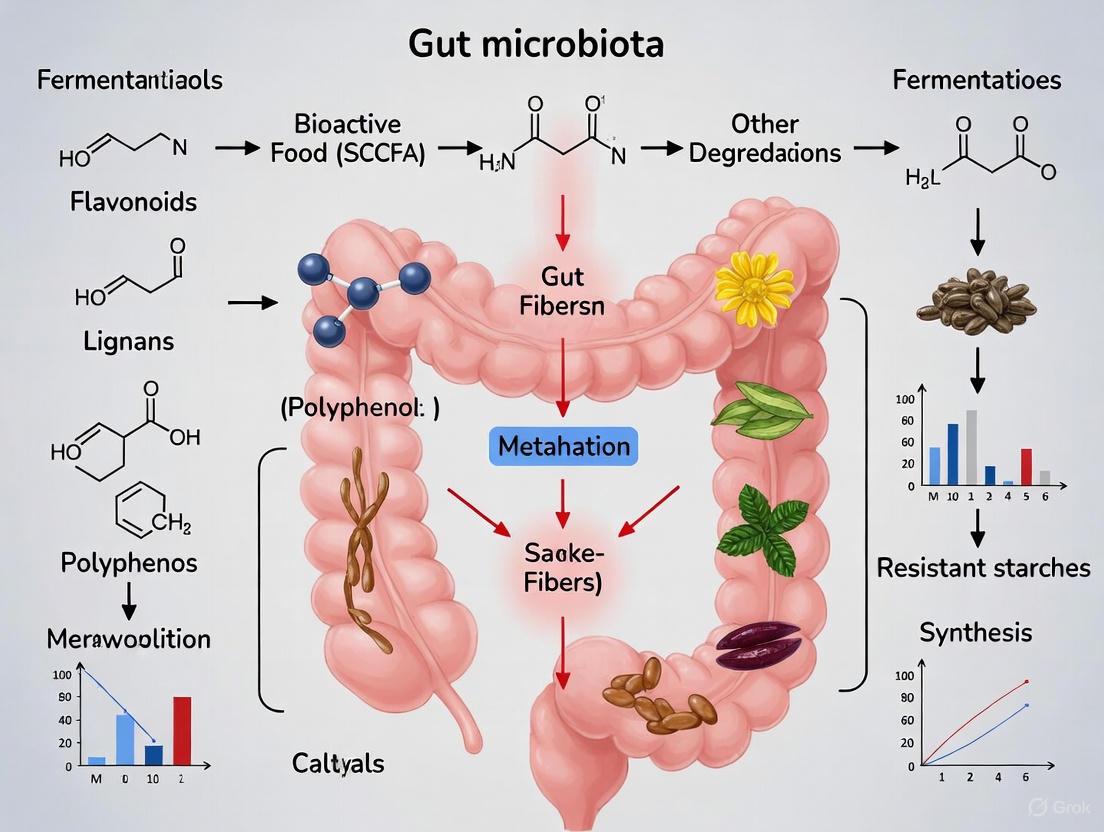
This article provides a comprehensive analysis of the bidirectional interactions between the gut microbiota and dietary bioactive compounds, a critical frontier in nutritional science and therapeutic development.
The Gut Microbiota Metabolome: Mechanisms and Applications of Bioactive Food Compound Transformation in Human Health and Disease
Abstract
This article provides a comprehensive analysis of the bidirectional interactions between the gut microbiota and dietary bioactive compounds, a critical frontier in nutritional science and therapeutic development. We explore the foundational mechanisms by which gut microbial consortia metabolize fibers, polyphenols, proteins, and lipids into key bioactive metabolites like short-chain fatty acids (SCFAs), indole derivatives, and secondary bile acids. For researchers and drug development professionals, we detail advanced methodological approaches including in vitro models, multi-omics integration, and synthetic biology, alongside applications in metabolic health, immunomodulation, and neurological function. The content addresses current research challenges in clinical validation and standardization while evaluating microbiome-based diagnostics against conventional biomarkers. This synthesis establishes the gut microbiota as a transformative target for precision nutrition and next-generation functional food development.
Unraveling Core Mechanisms: How Gut Microbiota Transform Dietary Bioactives into Key Metabolites
The human gastrointestinal tract hosts a complex and dynamic ecosystem, the gut microbiota, which constitutes a vital metabolic "organ" interfacing with host physiology. This community of bacteria, archaea, fungi, and viruses encodes over 3 million genes—a genomic repertoire 150-fold larger than the human genome—enabling extensive metabolic capabilities that the host has not evolved [1]. The concept of the gut as a metabolic interface has emerged from the understanding that this microbial consortium is not a passive passenger but an active participant in regulating host metabolism, immune function, and neurological signaling. Within the context of bioactive food compound research, this interface represents the critical site where dietary components are biotransformed into health-modulating metabolites, governing systemic physiological outcomes through a network of gut-organ axes [2] [3]. The symbiotic relationship between host and microbiota is fundamental to health, with dysbiosis—a disruption in microbial community structure and function—implicated in the pathogenesis of numerous conditions, including metabolic syndrome, cardiovascular disease, neurodegenerative disorders, and immune dysregulation [4] [1].
This whitepaper provides a comprehensive overview of the mechanisms underpinning host-microbe symbiosis at this metabolic interface. It synthesizes current research on how dietary bioactives are processed by gut microbial networks to produce effector molecules that influence host physiology distally. We further detail cutting-edge experimental models and analytical frameworks, such as genome-scale metabolic modeling (GEMs), that are advancing our capacity to decode the complexity of these interactions and accelerate the development of microbiome-targeted therapeutic and nutritional interventions [5].
Core Mechanisms of Host-Microbe Metabolic Symbiosis
The metabolic symbiosis at the gut interface is facilitated by a continuous molecular dialogue, wherein host-derived and dietary compounds are metabolized by the microbiota into a diverse array of signaling molecules and metabolites. These microbial products are essential for maintaining host homeostasis and form the mechanistic basis of the gut-X axes.
Key Microbial Metabolites and Their Systemic Roles
- Short-Chain Fatty Acids (SCFAs): Produced by the bacterial fermentation of dietary fibers, SCFAs like acetate, propionate, and butyrate are among the most well-characterized microbial metabolites. Butyrate serves as a primary energy source for colonocytes and reinforces intestinal barrier integrity by upregulating tight junction proteins [2]. Propionate is primarily involved in gluconeogenesis in the liver, while acetate enters the peripheral circulation to influence lipid metabolism and immune responses. SCFAs also act as histone deacetylase (HDAC) inhibitors, thereby exerting epigenetic regulation on host gene expression [1].
- Trimethylamine-N-Oxide (TMAO): Derived from the microbial metabolism of dietary choline and L-carnitine (abundant in red meat), TMAO is a well-established biomarker and promoter of atherosclerosis pathogenesis. Its production exemplifies how dietary intake can shape microbiota function to influence cardiovascular health [1].
- Secondary Bile Acids: Primary bile acids synthesized by the host liver can be modified by gut bacteria into secondary bile acids. These metabolites act as signaling molecules through host receptors such as the Farnesoid X Receptor (FXR) and G-protein-coupled bile acid receptor 1 (TGR5), regulating not only their own synthesis but also glucose and lipid metabolism [1].
- Indoles and Tryptophan Metabolites: Tryptophan from the diet can be metabolized by host enzymes, gut microbes, or both. Microbial metabolites, including indole and its derivatives, influence intestinal barrier function and immune homeostasis by activating the aryl hydrocarbon receptor (AhR) and modulating inflammation [3].
The Network of Gut-Organ Axes
The systemic effects of microbial metabolites are mediated through specific gut-organ axes, forming an integrated communication network:
- Gut-Liver-Adipose Axis: The liver and adipose tissue are key metabolic organs directly influenced by gut-derived metabolites. Research using advanced in vitro models has demonstrated that specific probiotic and prebiotic combinations can synergistically reduce hepatic lipid accumulation and activate thermogenic pathways in adipocytes, highlighting the therapeutic potential of targeting this axis for metabolic syndrome [2].
- Gut-Brain Axis: A bidirectional communication pathway linking the enteric nervous system with the central nervous system. Microbial metabolites like SCFAs, as well as neurotransmitters produced by bacteria, can signal to the brain via neural, endocrine, and immune pathways. Alterations in this axis are implicated in the pathophysiology of Parkinson's disease and Alzheimer's disease [1].
- Gut-Muscle Axis (Gut-Muscle Axis): Emerging evidence indicates a role for the gut microbiota in musculoskeletal health. Gut dysbiosis can drive systemic inflammation, accelerating muscle protein degradation in sarcopenia. Conversely, SCFA-producing taxa (e.g., Roseburia, Eubacterium) may enhance mitochondrial function and muscle mass [1].
Table 1: Key Microbial Metabolites and Their Physiological Roles
| Metabolite | Dietary Precursor | Producing Taxa (Examples) | Primary Physiological Roles |
|---|---|---|---|
| Butyrate | Dietary Fiber | Faecalibacterium prausnitzii, Roseburia | Colonocyte energy, barrier integrity, HDAC inhibition |
| TMAO | Choline, L-Carnitine | --- | Promotes atherosclerosis, cardiovascular risk |
| Secondary Bile Acids | Primary Bile Acids | --- | FXR/TGR5 signaling, glucose & lipid metabolism |
| Indoles | Tryptophan | --- | AhR activation, immune & barrier regulation |
Methodologies for Investigating Host-Microbe Interactions
Deciphering the complexity of the gut metabolic interface requires a multi-faceted research approach, combining sophisticated in vitro and in vivo models with powerful computational frameworks.
Experimental Models and Protocols
In Vitro Gut-Liver-Adipose Axis Model
A cornerstone methodology for investigating multi-organ interactions without the use of animal models.
- Protocol Overview: This innovative model employs a Transwell co-culture system to house human cell lines representing the intestinal epithelium (Caco-2), liver (HepG2), and adipose tissue (3T3-L1) [2].
- Experimental Workflow:
- Co-culture Establishment: The three cell lines are cultured in a layered configuration that allows for the exchange of soluble mediators, mimicking physiological crosstalk.
- Intervention: The system is treated with a combination of specific probiotics (e.g., Bifidobacterium bifidum GM-25, B. infantis GM-21, Lacticaseibacillus rhamnosus GM-28) and polycosanols.
- Outcome Assessment:
- Intestinal Barrier: Measure Trans-epithelial Electrical Resistance (TEER) and tight junction protein (e.g., occludin, ZO-1) expression in Caco-2 cells.
- Hepatic Lipid Metabolism: Analyze genes and proteins involved in lipid accumulation (e.g., CD36, SREBP-1, PPARγ, AMPK) in HepG2 cells.
- Adipocyte Thermogenesis: Assess activation of thermogenic pathways via UCP1 and PGC-1α levels in 3T3-L1 cells [2].
In Vivo Assessment of Bioactive Compounds
Animal models remain essential for validating the systemic effects of dietary bioactives and probiotics.
- Protocol for Evaluating Hypoglycemic Competence of Polysaccharides:
- Animal Model: Use type 2 diabetic mice (e.g., induced by high-fat diet and streptozotocin).
- Intervention: Administer a defined polysaccharide, such as low molecular weight polysaccharides from Laminaria japonica (LJOO), over a set period.
- Outcome Measures:
- Host Physiology: Monitor fasting blood glucose and insulin levels.
- Microbiota Analysis: Collect cecal or fecal contents for 16S rRNA gene sequencing to assess changes in microbial diversity (e.g., Bacteroidetes/Firmicutes ratio) and abundance of SCFA producers (e.g., Lactobacillus, Bifidobacterium).
- Metabolite Profiling: Quantify cecal SCFA levels using gas chromatography-mass spectrometry (GC-MS) to link microbial shifts to functional outcomes [2].
Computational and Analytical Frameworks
Genome-Scale Metabolic Models (GEMs)
GEMs are powerful computational tools that simulate the metabolic network of an organism or community.
- Application: GEMs enable the exploration of metabolic interdependencies and cross-feeding relationships between the host and its microbiota. By simulating metabolic fluxes, researchers can predict how dietary inputs or microbial perturbations affect community function and host metabolic health [5].
- Workflow: The process involves reconstructing a metabolic network from genomic data, integrating experimental constraints (e.g., transcriptomics, metabolomics), and using constraint-based reconstruction and analysis (COBRA) methods to simulate metabolic behavior under different conditions [5].
Longitudinal Microbiota Analysis in Cohorts
Large-scale longitudinal studies in human cohorts are critical for defining healthy microbiota development and its association with long-term health.
- The Gut Microbiota Wellbeing Index: A recent study of nearly 1000 infants analyzed over 6200 fecal samples to define gut microbiota development trajectories. The research demonstrated that microbiota succession is highly predictable and that deviations from a healthy trajectory (dysbiosis) are associated with adverse health outcomes. This allowed for the creation of an index where specific early-life keystone organisms, such as Bifidobacterium and Bacteroides, consistently predicted positive health outcomes over the first five years of life [6].
Table 2: Core Analytical Techniques in Gut Microbiota Research
| Technique | Application | Key Outputs | Considerations |
|---|---|---|---|
| 16S rRNA Sequencing | Profiling microbial community structure | Taxonomic diversity, relative abundance | Cost-effective; limited functional insight |
| Shotgun Metagenomics | Profiling entire microbial gene content | Functional potential, taxonomic resolution to species level | More expensive; reveals metabolic pathways |
| Metatranscriptomics | Assessing active microbial gene expression | Gene expression profiles, active pathways | Captures real-time activity; technically complex |
| Metabolomics | Quantifying small molecule metabolites | SCFA, TMAO, bile acid levels | Direct functional readout; challenging to link to producers |
| Genome-Scale Modeling (GEMs) | Predicting metabolic fluxes & interactions | In silico simulation of diet/microbe interactions | Hypothesis-generating; requires high-quality data |
The Scientist's Toolkit: Research Reagent Solutions
The following table details essential materials and reagents used in the featured experiments and broader research on host-microbe symbiosis.
Table 3: Essential Research Reagents for Investigating the Gut-Metabolic Interface
| Reagent / Material | Function / Application | Example in Context |
|---|---|---|
| Caco-2 Cell Line | Model of human intestinal epithelium; assesses barrier integrity & transport | Measuring TEER and tight junction expression in co-culture models [2] |
| HepG2 Cell Line | Model of human hepatocyte function; studies hepatic glucose & lipid metabolism | Analyzing reduction in lipid accumulation (e.g., CD36, SREBP-1 modulation) [2] |
| 3T3-L1 Cell Line | Model of adipocyte differentiation & function; studies energy storage & thermogenesis | Quantifying activation of thermogenic markers (UCP1, PGC-1α) [2] |
| Transwell Co-culture Systems | Permits soluble crosstalk between different cell types in a compartmentalized setup | Establishing the in vitro gut-liver-adipose axis model [2] |
| Defined Probiotic Strains | Used as interventions to modulate gut microbiota composition and host physiology | Bifidobacterium bifidum GM-25, B. infantis GM-21, Lacticaseibacillus rhamnosus GM-28 [2] |
| Specific Bioactive Polysaccharides | Purified dietary fibers used to probe microbial metabolic functions and host effects | Low molecular weight polysaccharides from Laminaria japonica (LJOO) for hypoglycemic studies [2] |
| Germ-Free or Gnotobiotic Mice | Animals devoid of microbiota or colonized with defined microbial consortia; establishes causality | Fecal microbiota transplantation (FMT) from hypertensive or diseased donors to test causality [1] |
Signaling Pathways Modulated by Microbial Metabolites
The systemic effects of microbial metabolites are mediated through the modulation of key host signaling pathways. The following diagram synthesizes the primary pathways discussed, illustrating how dietary inputs are transformed into signals that regulate the gut-liver-adipose axis.
Future Directions and Translational Potential
The field of host-microbe symbiosis research is rapidly evolving, with several key challenges and opportunities on the horizon. A primary challenge is the limited clinical validation of findings from preclinical models, necessitating well-designed human trials that link microbial biomarkers to tangible health outcomes [2]. Furthermore, the synergistic effects of multiple food components present a vast, underexplored frontier for developing more effective nutritional interventions; the combination of specific polysaccharides and probiotics, for instance, has shown enhanced anti-aging and antioxidant effects in model organisms, suggesting powerful synergies [2] [3]. To overcome these hurdles, future research must prioritize the integration of multi-omics data through advanced computational frameworks like GEMs and artificial intelligence, enabling predictive bioactivity modeling and personalized nutritional recommendations [2] [5]. Finally, the development of targeted delivery systems, such as microencapsulation, will be crucial to ensure the efficacy of probiotics and bioactive compounds as they transit through the gastrointestinal tract [2]. The continued unraveling of the gut's role as a metabolic interface holds immense promise for the development of next-generation functional foods and microbiome-based therapeutics for metabolic, immune, and age-related diseases.
Short-chain fatty acids (SCFAs) represent the major carbon flux from the diet through the gut microbiome to the host, serving as crucial signaling molecules in the intricate cross-talk between gut microbiota and human physiology [7]. These microbial metabolites, primarily acetate, propionate, and butyrate, are the end products of the anaerobic fermentation of non-digestible carbohydrates (NDC) that escape digestion and absorption in the small intestine [7] [8]. The discovery that SCFAs serve as natural ligands for free fatty acid receptors (FFAR2/3, GPR109A) found on diverse cell types has generated renewed interest in their role in human health and disease [7] [9]. This whitepaper provides a comprehensive technical overview of SCFA production pathways, their regulatory mechanisms, and analytical methodologies relevant to drug development and biomedical research.
Core Production Pathways and Microbial Taxa
Biochemical Pathways of SCFA Formation
SCFA production occurs primarily through saccharolytic fermentation, with distinct biochemical pathways leading to each major SCFA:
Acetate Production: Primarily through acetyl-CoA derived from glycolysis, with acetate production pathways widely distributed among numerous bacterial groups [7] [9]. Acetate can also be enzymatically converted to butyrate via butyryl-CoA:acetyl-CoA transferase [9].
Propionate Production: Occurs primarily through the succinate pathway during glycolysis, as indicated by the widespread distribution of the methylmalonyl-CoA decarboxylase (mmdA) gene in Bacteroidetes and many Negativicutes [9]. Deoxy-sugars (fucose, rhamnose) are particularly propiogenic due to metabolic pathways present to reduce the carbon skeleton via the intermediate 1,2-propanediol in select organisms [7].
Butyrate Production: Derived from carbohydrate fermentation via glycolysis through the combination of two acetyl-CoA molecules to form acetoacetyl-CoA, followed by stepwise reduction to butyryl-CoA [9]. The final step occurs via two different approaches: the butyryl-CoA:acetate CoA-transferase route or the phospho-butyrate and butyrate kinase pathways [9].
Table 1: Primary SCFA Production Pathways and Key Characteristics
| SCFA | Primary Pathway | Key Enzymes | Molar Ratio | Production Site |
|---|---|---|---|---|
| Acetate | Glycolysis via acetyl-CoA | Butyryl-CoA:acetyl-CoA transferase | ~60% | Proximal colon |
| Propionate | Succinate pathway | Methylmalonyl-CoA decarboxylase | ~20% | Throughout colon |
| Butyrate | Acetyl-CoA condensation | Butyryl-CoA:acetate CoA-transferase | ~20% | Distal colon |
SCFA-Producing Microorganisms
The production of SCFAs is characterized by significant functional specialization among gut microbial taxa:
Acetate Producers: Akkermansia muciniphila, Bacteroides spp., and numerous other bacterial groups possess widely distributed acetate production pathways [9].
Propionate Producers: Dominated by relatively few bacterial genera, including Bacteroides, Akkermansia muciniphila, and Roseburia inulinivorans [7] [9]. Species such as Akkermansia muciniphila have been identified as key propionate-producing mucin-degrading organisms [7].
Butyrate Producers: A surprisingly small number of organisms dominate butyrate production, including Faecalibacterium prausnitzii, Eubacterium rectale, Eubacterium hallii, and Ruminococcus bromii [7] [10] [9]. Fermentation of resistant starch is particularly dependent on Ruminococcus bromii, whose absence significantly reduces resistant starch fermentation [7].
Table 2: Key SCFA-Producing Bacterial Taxa and Their Substrate Preferences
| Bacterial Taxon | Phylum | Primary SCFA | Preferred Substrates |
|---|---|---|---|
| Akkermansia muciniphila | Verrucomicrobia | Acetate, Propionate | Mucin |
| Bacteroides spp. | Bacteroidetes | Acetate, Propionate | Diverse polysaccharides |
| Faecalibacterium prausnitzii | Firmicutes | Butyrate | Resistant starch, dietary fibers |
| Eubacterium rectale | Firmicutes | Butyrate | Resistant starch |
| Ruminococcus bromii | Firmicutes | Butyrate | Resistant starch |
| Roseburia inulinivorans | Firmicutes | Propionate | Inulin, diverse fibers |
Molecular Mechanisms of SCFA Signaling and Function
Receptor-Mediated Signaling Pathways
SCFAs exert their physiological effects primarily through two fundamental mechanisms: receptor-mediated signaling and epigenetic regulation:
G Protein-Coupled Receptor (GPCR) Activation:
- FFAR2 (GPR43): Preferentially activated by acetate, modulating immune responses through regulation of neutrophil chemotaxis, reactive oxygen species production, and cytokine expression [10] [9].
- FFAR3 (GPR41): Primarily activated by propionate, influencing metabolic functions including enteroendocrine hormone secretion and energy homeostasis [10] [11].
- GPR109A: Activated by butyrate, contributing to anti-inflammatory signaling and immune cell differentiation, particularly in the maintenance of colonic regulatory T cells [10] [9].
Epigenetic Mechanisms
Histone Deacetylase (HDAC) Inhibition:
- SCFAs, particularly butyrate, function as potent HDAC inhibitors, leading to histone hyperacetylation and altered gene expression patterns [9].
- This mechanism regulates fundamental cellular processes including proliferation, differentiation, and apoptosis, with significant implications for inflammatory diseases and cancer [9].
- HDAC inhibition represents a crucial pathway through which microbial metabolites directly influence host epigenetic regulation [9].
Quantitative Aspects of SCFA Production and Distribution
Production Rates and Physiological Concentrations
The human colon produces approximately 500-600 mmol of SCFAs daily, with significant variation depending on dietary fiber intake, microbiota composition, and gut transit time [8]. The molar ratio of acetate to propionate to butyrate is approximately 60:20:20 in the human colon and feces, though this varies by colonic region and dietary factors [8] [9].
Table 3: SCFA Production and Distribution in Humans
| Parameter | Acetate | Propionate | Butyrate |
|---|---|---|---|
| Daily Production | 300-360 mmol | 100-120 mmol | 100-120 mmol |
| Colonic Lumen Concentration | 60-80 mM | 20-30 mM | 10-20 mM |
| Peripheral Circulation | 50-150 μM | 1-5 μM | 1-5 μM |
| Primary Production Site | Proximal colon | Throughout colon | Distal colon |
| Major Metabolic Fate | Peripheral tissue metabolism | Hepatic gluconeogenesis | Colonocyte energy |
Biological Gradient and Tissue-Specific Exposure
A significant biological gradient exists for SCFAs from the gut lumen to the periphery, creating differential exposure across tissues:
- Colonic Lumen: Highest concentrations (millimolar range) with butyrate serving as the preferred energy source for colonocytes [7].
- Portal Circulation: Moderate concentrations, with significant hepatic extraction of propionate and butyrate [7].
- Systemic Circulation: Lowest concentrations (micromolar range), with acetate representing approximately 75% of total peripheral SCFAs due to limited hepatic extraction [7] [12].
This gradient means that SCFAs function as local signaling molecules in the gut while exerting endocrine effects at distant sites, with varying biological impacts depending on the tissue and concentration [7].
Analytical Methodologies for SCFA Quantification
Sample Preparation and Extraction
Accurate quantification of SCFAs in biological matrices requires specialized sample pretreatment:
- Sample Types: Feces, serum, plasma, tissues, and in vitro fermentation samples [13].
- Extraction Methods: Liquid-liquid extraction, solid-phase extraction, and acidification to protonate SCFAs for improved recovery [13].
- Stabilization: Immediate freezing at -80°C and acid preservation to prevent continued microbial fermentation ex vivo [13].
Separation and Detection Platforms
Advanced analytical approaches for SCFA quantification include:
- Gas Chromatography-Mass Spectrometry (GC-MS): Provides high sensitivity and resolution for SCFA separation, often requiring derivatization to improve volatility [13].
- Liquid Chromatography-Mass Spectrometry (LC-MS): Enables direct analysis without derivatization, with emerging hydrophilic interaction liquid chromatography (HILIC) methods improving retention of polar SCFAs [13].
- Capillary Electrophoresis (CE): Alternative separation technique offering high efficiency with minimal sample requirements [13].
- Nuclear Magnetic Resonance (NMR) Spectroscopy: Provides structural information and absolute quantification without separation, though with lower sensitivity than MS-based methods [14].
Experimental Models and Research Tools
In Vivo Modulation Approaches
Table 4: Research Models for Investigating SCFA Production and Function
| Model System | Key Applications | Advantages | Limitations |
|---|---|---|---|
| Human Trials | Dose-response relationships, Biomarker identification | Physiological relevance, Clinical translation | Limited mechanistic insight, High inter-individual variability |
| Gnotobiotic Mice | Microbial causality, Host-microbe interactions | Controlled microbiota, Genetic manipulation possible | Artificial systems, Limited microbial diversity |
| Antibiotic Depletion [15] | Microbiome function, SCFA supplementation studies | Established protocol, Rapid depletion | Off-target effects, Non-specific depletion |
| In Vitro Fermentation | Metabolic pathways, Substrate utilization | High throughput, Controlled conditions | Simplified system, Lacks host components |
The Scientist's Toolkit: Essential Research Reagents
Table 5: Key Research Reagents for SCFA Investigations
| Reagent/Category | Specific Examples | Research Application | Function |
|---|---|---|---|
| SCFA Receptor Modulators | FFAR2/3 agonists (4-CMTB), antagonists (CATPB) | Receptor mechanism studies | Target validation, Signaling pathway elucidation |
| HDAC Inhibitors | Sodium butyrate, Trichostatin A | Epigenetic mechanism studies | HDAC inhibition controls, Specificity profiling |
| Microbial Inhibitors | Neomycin, Vancomycin, Bacitracin [15] | Microbiome depletion models | Specific taxon inhibition, Community manipulation |
| SCFA Supplementation | Sodium acetate, Sodium butyrate, Sodium propionate [15] | Functional restoration studies | Physiological level repletion, Dose-response studies |
| Transport Inhibitors | MCT1 inhibitors (AZD3965) | Cellular uptake studies | Transporter function, Tissue-specific targeting |
| Stable Isotope Tracers | 13C-acetate, 13C-butyrate | Metabolic flux analysis | Production rate quantification, Tissue distribution |
Implications for Drug Development and Therapeutic Applications
The multifaceted roles of SCFAs in human physiology position them as attractive targets for therapeutic intervention:
- Metabolic Diseases: SCFAs regulate glucose homeostasis through stimulation of glucagon-like peptide-1 (GLP-1) secretion and improvement of insulin sensitivity [7] [9].
- Neurological Disorders: SCFAs modulate microglial function, blood-brain barrier integrity, and neuroinflammation, with implications for Alzheimer's disease, Parkinson's disease, and autism spectrum disorders [8] [10].
- Inflammatory Conditions: Through regulation of Treg differentiation and anti-inflammatory cytokine production, SCFAs demonstrate therapeutic potential in inflammatory bowel disease, arthritis, and other immune-mediated disorders [10] [9].
- Oncological Applications: SCFAs, particularly butyrate, inhibit cancer cell proliferation and induce apoptosis through HDAC inhibition, with promising applications in colorectal cancer prevention and treatment [13] [9].
SCFAs represent crucial mechanistic links between dietary patterns, gut microbiota composition, and host physiological outcomes. Their production through microbial fermentation of dietary fibers and resistant starches illustrates the profound functional importance of the gut microbiome in human metabolism and disease susceptibility. Future research priorities include developing more precise analytical methods for in vivo SCFA flux quantification, elucidating individual genetic factors influencing SCFA responsiveness, and translating microbiome-based interventions into clinically validated therapies. As drug development increasingly recognizes the importance of host-microbiome interactions, SCFA pathways offer promising targets for novel therapeutic strategies across a spectrum of metabolic, inflammatory, and neurological conditions.
Dietary polyphenols, a diverse class of plant-secondary metabolites, have attracted significant scientific interest due to their potential health benefits, including antioxidant, anti-inflammatory, and neuroprotective properties [16] [17]. However, their bioavailability is notoriously low, with only 5-10% of ingested polyphenols absorbed in the small intestine [18] [19]. The remaining 90-95% transit to the colon, where the gut microbiota performs an indispensable role in transforming these complex compounds into bioavailable and often more bioactive metabolites [20] [18] [17]. This biotransformation process, primarily comprising deconjugation, ring fission, and bioactivation, is a critical determinant of the physiological effects of dietary polyphenols. Understanding these microbial-mediated processes is fundamental to research on gut microbiota metabolism of bioactive food compounds, as the resulting metabolites act as key mediators in the diet-microbiota-host axis, influencing immune, metabolic, and neurological pathways [16].
Core Processes of Microbial Biotransformation
The structural complexity of dietary polyphenols necessitates extensive modification before systemic absorption and activity. The gut microbiota facilitates this through a series of enzymatic reactions.
Deconjugation
Most polyphenols exist in food matrices as glycosides, esters, or polymers. Deconjugation is the initial step in their catabolism.
- Mechanism: Glycosidases, esterases, and glucuronidases produced by colonic bacteria hydrolyze sugar moieties, ester bonds, and glucuronide conjugates, releasing aglycones and simpler phenolic acids [20] [19]. Lactase-phlorizin hydrolase (LPH) on the brush border of small intestinal epithelial cells can also deglycosylate some polyphenols [20] [17].
- Microbial Involvement: Bacterial populations across phyla such as Firmicutes, Bacteroidetes, Actinobacteria, and Proteobacteria possess broad O-glycosidase and C-glycosidase activities [20]. Specific bacteria, including E. coli, Bifidobacterium, and Lactobacillus, are known to participate in these hydrolytic processes [19].
- Significance: Deconjugation is a prerequisite for absorption and further microbial ring fission, as aglycones are more lipophilic and accessible to bacterial enzymes [17].
Ring Fission
Following deconjugation, the aromatic rings of the polyphenol aglycones are cleaved. This is a hallmark of microbial catabolism.
- Mechanism: The heterocyclic C-rings of flavonoids and the aromatic rings of non-flavonoids are cleaved by specific microbial enzymes, producing smaller, low-molecular-weight phenolic catabolites [21] [16] [17].
- Products: Typical ring fission catabolites (RFCs) include various phenolic acids, phenylvalerolactones, phenylvaleric acids, and urolithins [21] [16]. For instance, flavan-3-ols from tea and cocoa are converted to phenyl-γ-valerolactones, while ellagitannins yield urolithins [16] [17].
- Significance: Ring fission generates metabolites that are more easily absorbed and frequently exhibit greater bioactivity than their parent compounds [16].
Bioactivation
Biotransformation is not merely a degradative process; it is a crucial mechanism for bioactivation.
- Definition: Bioactivation refers to the microbial or host enzymatic transformations that convert dietary precursors into metabolites with enhanced or novel biological activities [20] [16].
- Examples:
- The simple phenol tyrosol, found in olive oil, is bioactivated by human cytochrome P450 enzymes (CYP2A6 and CYP2D6) to hydroxytyrosol, a potent antioxidant [20].
- The plant lignan secoisolariciresinol diglucoside (SDG) is converted by gut microbiota to the mammalian lignans enterodiol and enterolactone, which possess phytoestrogenic and anticancer properties [16].
- Resveratrol is reduced to dihydroresveratrol, which may have enhanced bioactivity [16].
- Significance: The health effects associated with polyphenol-rich diets are often attributable to these microbially derived bioactive metabolites rather than the native compounds [20] [16].
Table 1: Key Microbial Metabolites and Their Parent Polyphenols
| Parent Polyphenol | Class | Key Microbial Metabolites | Notable Bioactivities |
|---|---|---|---|
| Proanthocyanidins (Condensed Tannins) | Flavan-3-ol polymers | Phenyl-γ-valerolactones, Phenylvaleric Acids, Phenolic Acids (e.g., 5-(3',4'-Dihydroxyphenyl)-γ-valerolactone) | Antioxidant, Cardioprotective, Neuroprotective [16] [17] |
| Ellagitannins (Hydrolysable Tannins) | Gallic acid/Hexahydroxydiphenoyl esters | Urolithins (A, B, C, D, etc.) | Anti-inflammatory, Anticancer, Anti-aging, Neuroprotective [16] [17] |
| Resveratrol | Stilbene | Dihydroresveratrol, Lunularin | Potentiated Antioxidant and Neuroprotective effects [16] |
| Secoisolariciresinol Diglucoside (SDG) | Lignan | Enterodiol, Enterolactone | Phytoestrogenic, Anticancer (hormone-dependent), Antioxidant [16] |
| Isoflavones (e.g., Daidzin) | Flavonoid | Equol, O-Desmethylangolensin (O-DMA) | Estrogenic/Anti-estrogenic, Bone health promotion [18] |
Table 2: Quantitative Profile of Select Polyphenol Metabolites in Humans
| Metabolite | Parent Compound | Peak Plasma Concentration (C~max~) | Time to C~max~ (T~max~) | Apparent Elimination Half-Life (AT~1/2~) |
|---|---|---|---|---|
| Urolithin A glucuronide | Ellagitannins (from Pomegranate, Berries) | ~5–20 µM | 24–48 hours | > 24 hours [21] |
| Dihydroresveratrol sulfate | Resveratrol (from Grapes, Red Wine) | ~1–5 µM | 8–12 hours | ~10 hours [21] |
| 5-(3',4'-Dihydroxyphenyl)-γ-valerolactone | Flavan-3-ols (from Tea, Cocoa) | ~0.1–1 µM | 6–10 hours | ~5 hours [21] |
| Enterolactone glucuronide | Lignans (from Flaxseed, Sesame) | ~10–100 nM | 24–36 hours | > 24 hours [21] |
| Hydroxytyrosol sulfate | Tyrosol/Oleuropein (from Olive Oil) | Low nM range (Metabolites 50-100x higher) | 1–2 hours | Not Specified [20] |
Experimental Protocols for Studying Biotransformation
Research into polyphenol biotransformation relies on a combination of in vitro and in vivo models to elucidate metabolic pathways and quantify metabolites.
In Vitro Fecal Fermentation Models
This protocol simulates the colonic environment to study the microbial metabolism of polyphenols.
Detailed Methodology:
- Sample Collection: Collect fresh fecal samples from healthy human volunteers, ensuring ethical approval. Pool samples from multiple donors to represent microbial diversity or use individual samples to study inter-individual variability.
- Inoculum Preparation: Immediately dilute the fecal sample in an anaerobic, pre-reduced phosphate buffer (0.1 M, pH 7.0) or specific culture medium like YCFA (Yeast Extract-Casein Hydrolysate-Fatty Acids). Homogenize under a constant stream of CO₂ or N₂ to maintain anaerobiosis.
- Fermentation Setup: Combine the fecal inoculum (e.g., 10% v/v) with a polyphenol substrate (e.g., purified compound or plant extract) in a sealed fermentation vessel. Include controls without substrate and without inoculum.
- Incubation: Incubate the vessels anaerobically at 37°C with constant agitation for a period ranging from 0 to 72 hours.
- Sampling: Collect aliquots at predetermined time points (e.g., 0, 6, 12, 24, 48 h). Centrifuge immediately to separate microbial cells from the supernatant.
- Analysis:
- Metabolite Profiling: Analyze the supernatant using Liquid Chromatography coupled with Mass Spectrometry (LC-MS). Use High-Resolution MS (HR-MS) for untargeted metabolite identification and Multiple Reaction Monitoring (MRM) for targeted quantification of known catabolites [21].
- Microbial Analysis: Extract genomic DNA from the pellet for 16S rRNA gene sequencing to track changes in microbial community structure. Alternatively, use quantitative PCR (qPCR) to quantify specific bacterial taxa.
Protocol for Profiling Phenolic Catabolites in Biofluids
This protocol is for identifying and quantifying polyphenol metabolites in plasma and urine from human or animal intervention studies.
Detailed Methodology:
- Study Design: Conduct a controlled intervention study with a defined dose of polyphenol (e.g., 250 mg resveratrol, 1 cup of green tea). Implement a washout period and control diet low in polyphenols prior to the study.
- Sample Collection: Collect blood (e.g., pre-dose, 1, 2, 4, 6, 8, 24, 48 h post-dose) and urine (e.g., pre-dose, 0-24 h, 24-48 h collections). Process plasma by centrifugation and store all biofluids at -80°C.
- Sample Preparation:
- Plasma/Urine Extraction: Thaw samples on ice. For plasma, precipitate proteins by adding cold acetonitrile (e.g., 1:3 v/v sample:ACN), vortex, and centrifuge. Transfer the supernatant.
- Enzymatic Deconjugation: To measure total (free + conjugated) metabolites, incubate an aliquot of the extract or urine with a mixture of β-glucuronidase and sulfatase (e.g., from Helix pomatia) in acetate buffer (pH 5.0) at 37°C for several hours.
- Analysis by LC-MS/MS:
- Chromatography: Use a reverse-phase C18 column with a water-acetonitrile gradient, both acidified with 0.1% formic acid.
- Mass Spectrometry: Operate the mass spectrometer in negative electrospray ionization (ESI-) mode for most phenolic compounds. Use tandem MS (MS/MS) for structural confirmation and a scheduled MRM for high-sensitivity quantification of a predefined list of metabolites [21].
- Quantification: Quantify metabolites using stable isotope-labeled internal standards (e.g., ¹³C- or ²H-labeled analogs of target metabolites) where available, or external calibration curves.
Visualization of Pathways and Workflows
The following diagrams illustrate the core biotransformation pathway and a standard experimental workflow.
Polyphenol Biotransformation Pathway
Diagram 1: Core pathway of microbial biotransformation of dietary polyphenols, involving deconjugation, ring fission, and bioactivation steps.
Experimental Analysis Workflow
Diagram 2: Standard workflow for the analysis of polyphenol metabolites in biological samples.
The Scientist's Toolkit: Essential Research Reagents and Materials
Table 3: Key Research Reagent Solutions for Polyphenol Biotransformation Studies
| Reagent / Material | Function / Application | Specific Examples & Notes |
|---|---|---|
| Fecal Inoculum | Provides a complex community of colonic microbes for in vitro fermentation models. | Fresh or frozen fecal samples from human donors; requires ethical approval. Pooled samples standardize community variability [21]. |
| Anaerobic Chamber/Workstation | Creates and maintains an oxygen-free environment for the cultivation of obligate anaerobic gut bacteria. | Essential for preparing culture media and setting up in vitro fermentations to mimic colonic conditions. |
| Polyphenol Substrates | The test compounds for biotransformation studies. Available as purified standards or extracts. | Purified compounds (e.g., Resveratrol, Epicatechin, Ellagic Acid); Plant/food extracts (e.g., Green Tea Extract, Pomegranate Extract) [16]. |
| Enzymes for Deconjugation | Used in vitro to hydrolyze conjugated metabolites in biofluids, revealing total metabolite levels. | β-Glucuronidase/Sulfatase (e.g., from Helix pomatia); used in sample preparation prior to LC-MS analysis [21]. |
| LC-MS/MS System with UPLC/HPLC | The core analytical platform for separating, identifying, and quantifying polyphenol metabolites. | Liquid Chromatography (UPLC/HPLC) for high-resolution separation. Tandem Mass Spectrometry (MS/MS) for sensitive and selective detection and quantification in MRM mode [21]. |
| Stable Isotope-Labeled Internal Standards | Added to samples before processing to correct for analyte loss during extraction and matrix effects in MS. | ¹³C- or ²H-labeled versions of target metabolites (e.g., ¹³C₆-Quercetin). Crucial for accurate absolute quantification [21]. |
| 16S rRNA Sequencing Kits | To analyze changes in the composition of the gut microbiota in response to polyphenol exposure. | Kits for DNA extraction, PCR amplification of the 16S rRNA gene, and library preparation for next-generation sequencing (e.g., Illumina MiSeq) [22]. |
Bile acids are classic examples of bioactive food compounds whose structure and function are extensively modified by the gut microbiota. The transformation of host-derived primary bile acids into secondary bile acids through the coordinated microbial processes of deconjugation and 7α-dehydroxylation represents a crucial gut-liver signaling axis. This whitepaper provides an in-depth technical analysis of these enzymatic pathways, detailing the biochemical mechanisms, responsible microbial taxa, and experimental approaches for their investigation. Within the broader context of gut microbiota metabolism of bioactive food compounds, understanding these transformations is paramount, as the resulting secondary bile acids function as potent signaling molecules that regulate host metabolic pathways, inflammatory responses, and energy homeostasis. Disruptions in these microbial transformations have been implicated in numerous disease states, making this pathway a significant target for therapeutic intervention in metabolic, hepatic, and gastrointestinal disorders.
Bile acids (BAs) are hepatically synthesized cholesterol derivatives that function not only as dietary surfactant molecules but also as critical endocrine hormones regulating macronutrient metabolism and systemic inflammatory balance [23]. The human gut microbiome, an immensely complex ecosystem containing between 10^13 and 10^14 bacterial cells and up to 1,000 different bacterial species, performs extensive structural modifications to these primary bile acids [24]. The resulting secondary bile acids display altered receptor affinity and signaling capacity, profoundly influencing host physiology.
The biotransformation of primary bile acids to secondary bile acids occurs via a multi-step pathway initiated by deconjugation followed by 7α-dehydroxylation [24]. This review focuses specifically on these fundamental transformations, which greatly enhance the structural diversity and functional range of bile acids in the enterhepatic circulation. The resulting metabolites act as key regulators in the gut-liver axis, influencing pathways relevant to metabolic disease, inflammation, and drug development.
Biochemical Pathways of Microbial Bile Acid Modification
Deconjugation: The Gateway Reaction
Deconjugation is the initial and most widespread microbial modification of bile acids, serving as a prerequisite for most subsequent bacterial transformations [24] [25]. This process involves the hydrolysis of the amide bond linking the bile acid steroid core to the amino acid side chain (typically taurine or glycine in humans).
- Enzyme: Bile salt hydrolase (BSH; EC 3.5.1.24)
- Reaction: Catalyzes the hydrolysis of the C24 N-acyl bond, converting conjugated bile acids (e.g., Taurocholic acid, Glycocholic acid) to free bile acids (e.g., Cholic acid) and free amino acids
- Prevalence: A widespread activity among major gut bacterial phyla; over a quarter of identified bacterial strains in the human gastrointestinal tract demonstrate BSH activity [24]
- Bacterial Sources: Identified in both Gram-positive and Gram-negative species, including Bacteroides, Clostridium, Lactobacillus, Bifidobacterium, and Listeria [24]
The biological rationale for microbial deconjugation may involve bile acid detoxification, nutrient acquisition (taurine/glycine), or as a form of microbial warfare by increasing concentrations of antimicrobial free bile acids [25]. Deconjugation alters the chemical properties of bile acids, reducing their solubility and increasing their passive absorption while enabling further microbial transformations.
7α-Dehydroxylation: Generation of Secondary Bile Acids
The 7α-dehydroxylation pathway represents a more specialized microbial transformation that converts primary bile acids into secondary bile acids by removing the 7α-hydroxyl group [24]. This pathway specifically converts cholic acid (CA) to deoxycholic acid (DCA) and chenodeoxycholic acid (CDCA) to lithocholic acid (LCA) [24] [26].
- Organisms: Primarily identified in anaerobic Firmicutes bacteria within Clostridium clusters IV, XI, and XIVa, including species such as C. scindens, C. hylemonae, and C. hiranonis [26]
- Genetics: Encoded by the bile acid-inducible (bai) operon containing multiple genes (baiB, baiCD, baiE, baiA, baiF, baiG, baiH, baiI, and additional genes including baiJ, baiK, baiL, baiN) [24]
- Mechanism: A multi-step biochemical pathway involving oxidation, dehydration, and reduction reactions that ultimately remove the 7α-hydroxyl group
The resulting secondary bile acids DCA and LCA are more hydrophobic and comprise over 90% of fecal bile acids in healthy individuals [26]. These transformations are critical for determining the overall bile acid pool composition and subsequent signaling through various host receptors.
Figure 1: Microbial Bile Acid Transformation Pathway. Primary bile acids from the host liver undergo sequential microbial modifications: first deconjugation by BSH enzymes, then 7α-dehydroxylation by the bai operon, producing secondary bile acids that signal through host receptors.
Experimental Models and Methodologies
In Vitro Transcriptional Response Assays
RNA-Seq analysis of bile acid 7α-dehydroxylating bacteria (C. hylemonae and C. hiranonis) in the presence and absence of bile acids provides insights into gene regulation of the bai operon [26].
Protocol:
- Culture Conditions: Grow bacterial strains in brain heart infusion broth (BHI) under anaerobic conditions
- Bile Acid Exposure: Supplement medium with cholic acid (CA) or deoxycholic acid (DCA) at physiologically relevant concentrations
- RNA Extraction: Harvest cells during mid-logarithmic growth phase, extract total RNA using appropriate kits
- RNA-Seq: Prepare libraries and sequence using appropriate platform (Illumina)
- Data Analysis: Map reads to reference genomes, identify differentially expressed genes with appropriate thresholds (e.g., >0.58 log₂FC; FDR < 0.05)
Key Findings: Growth with CA results in significant differential expression of 197 genes in C. hiranonis and 118 genes in C. hylemonae, with strong upregulation of the bai operon in the presence of CA but not DCA [26].
Gnotobiotic Mouse Models
Defined bacterial communities in germ-free mice enable the study of bile acid metabolism in a controlled system [26].
Protocol:
- Bacterial Consortium: Assemble defined community (e.g., B4PC2 consortium) including:
- BSH-expressing strains: Bacteroides uniformis, B. vulgatus, Parabacteroides distasonis
- Taurine-respiring bacteria: Bilophila wadsworthia
- 7α-dehydroxylating bacteria: C. hylemonae, C. hiranonis
- Butyrate and iso-bile acid-forming bacteria: Blautia producta
- Colonization: Inoculate germ-free mice with the defined community
- Sample Collection: After established colonization, collect cecum content, serum, and liver tissue
- Analysis:
- 16S rDNA sequencing to determine community structure
- Metatranscriptomics to assess gene expression
- Bile acid metabolomics via LC-MS/MS to quantify bile acid profiles
Key Findings: The synthetic community achieves functional bile salt deconjugation, oxidation/isomerization, and 7α-dehydroxylation, with the Bacteroidetes constituting the majority (84.71%) of cecal reads, while the clostridial 7α-dehydroxylators represent <0.75% of the community yet still produce significant secondary bile acids [26].
Dietary Fiber Intervention Studies
Different fiber types distinctly modulate bile acid metabolism and gut microbiota composition, influencing deconjugation and 7α-dehydroxylation activities [27].
Protocol:
- Dietary Intervention: Feed mice control or 10% (w/w) fiber diets containing various fiber types (cellulose, chitin, resistant starch, pectin, inulin, β-glucan, psyllium, dextrin, or raffinose) for 14 days
- Sample Collection: Collect body weight measurements, cecum weight, fecal samples, liver tissue, intestinal mucosa
- Analysis:
- 16S rRNA sequencing of fecal microbiota
- Bile acid quantification in liver, intestinal mucosa, and feces via LC-MS
- Taurine and conjugate measurements
Key Findings: Fiber types differentially impact bacterial diversity, Akkermansia muciniphila abundance, and bile acid deconjugation efficiency. Inulin and β-glucan result in the highest taurine conjugate levels and reduced intestinal taurine-conjugated BA concentrations, suggesting enhanced BSH activity [27].
Quantitative Data on Bile Acid Transformations
Table 1: Impact of Dietary Fibers on Bile Acid Metabolism and Gut Microbiota [27]
| Fiber Type | Cecum Weight | Microbiota Diversity | Akkermansia Abundance | BA Deconjugation | Key Observations |
|---|---|---|---|---|---|
| Cellulose | Trend decrease | Decreased | Increased | Moderate | Forms distinct microbiome cluster with chitin |
| Chitin | Trend decrease | Decreased | Increased | Moderate | Forms distinct microbiome cluster with cellulose |
| Resistant Starch | Trend decrease | Minimal change | No significant change | Minimal | Least impact on BA concentrations |
| Pectin | Increased | Decreased | Increased | High | Similar microbiota profile to psyllium |
| Inulin | Trend increase | Decreased | Increased | High | Highest taurine conjugate levels |
| β-Glucan | No significant change | Decreased | Increased | High | Reduced intestinal taurine-conjugated BAs |
| Psyllium | Increased | Decreased | Increased | High | Strongest impact on BA-related gene expression |
| Dextrin | Decreased | Decreased | Increased | Moderate | Increased β-muricholic acid in feces |
| Raffinose | No significant change | Decreased | Increased | High | Forms cluster with inulin and β-glucan |
Table 2: Bacterial Genera with Bile Acid Transformation Capabilities [24] [25] [26]
| Bacterial Group | Deconjugation (BSH) | 7α-Dehydroxylation | Other Transformations | Relative Abundance |
|---|---|---|---|---|
| Bacteroides spp. | Yes (strong) | No | Oxidation, epimerization | High (can exceed 80% in models) |
| Clostridium clusters IV, XI, XIVa | Variable | Yes (specialized) | Various | Low (<1% but functionally critical) |
| Lactobacillus spp. | Yes | No | Limited | Variable |
| Bifidobacterium spp. | Yes | No | Limited | Variable |
| Listeria spp. | Yes | No | Unknown | Low |
| Blautia producta | Unknown | No | 7β-HSDH, 3α/3β-HSDH | Variable |
| Bilophila wadsworthia | No | No | Taurine respiration | Can reach 15% in models |
Table 3: Bile Acid Receptor Affinities and Signaling Effects [24] [23] [25]
| Bile Acid | FXR Agonism | TGR5 Agonism | Key Physiological Effects | Relative Potency |
|---|---|---|---|---|
| Cholic Acid (CA) | Weak | Weak | Promotes FGF15/19 secretion | Low |
| Chenodeoxycholic Acid (CDCA) | Strong | Moderate | Regulates BA synthesis, glucose metabolism | High (FXR) |
| Deoxycholic Acid (DCA) | Moderate | Strong | Glucose regulation, energy expenditure | Moderate (FXR), High (TGR5) |
| Lithocholic Acid (LCA) | Weak | Strong | Most potent natural TGR5 agonist | Low (FXR), High (TGR5) |
| Ursodeoxycholic Acid (UDCA) | Weak | Weak | Hepatoprotective, cholestasis treatment | Low |
| Tauro-β-muricholic Acid (TβMCA) | Antagonist | Weak | Blocks FXR signaling in intestine | N/A |
The Scientist's Toolkit: Essential Research Reagents
Table 4: Key Research Reagents for Studying Microbial Bile Acid Metabolism
| Reagent / Material | Function / Application | Example Use | Technical Notes |
|---|---|---|---|
| Gnotobiotic Mice | Provides sterile host for defined microbial communities | Studying specific bacterial functions in vivo | Requires specialized facilities |
| Bile Acid Standards | Quantification and identification via LC-MS/MS | Bile acid metabolomics | Should include primary, secondary, conjugated forms |
| Anaerobic Chamber | Maintains oxygen-free environment for culturing | Growing strict anaerobic bile acid transformers | Essential for Clostridium species |
| bai Gene Primers | Detection and quantification of 7α-dehydroxylation genes | qPCR for bai operon expression | Target multiple genes in operon |
| BSH Activity Assay | Measures bile salt hydrolase activity | Testing bacterial deconjugation capability | Uses conjugated bile acids + detection of freed amino acids |
| RNA Stabilization Reagents | Preserves microbial RNA for transcriptomics | RNA-Seq of bacterial responses to bile acids | Critical for accurate gene expression |
| Defined Bacterial Media | Controlled growth conditions | In vitro bile acid exposure experiments | Can supplement with specific bile acids |
| Germ-Free Verification Kits | Confirms sterility of animal models | Quality control for gnotobiotic studies | Includes culture and molecular methods |
Signaling Pathways and Physiological Implications
The microbial transformation of bile acids has profound implications for host physiology due to the altered signaling capacity of the resulting bile acid species. Secondary bile acids generated through 7α-dehydroxylation function as key regulators of metabolic pathways through their action on specific receptors.
Figure 2: Bile Acid Signaling Pathways Regulated by Microbial Transformations. Secondary bile acids produced by gut microbes signal through FXR and TGR5 receptors, regulating bile acid synthesis and metabolic homeostasis.
Receptor-Mediated Signaling Mechanisms
Farnesoid X Receptor (FXR): A nuclear receptor highly expressed in liver and intestine that regulates bile acid synthesis, lipid metabolism, and glucose homeostasis [24] [23]. Secondary bile acids like DCA function as moderate FXR agonists, while LCA is a weaker agonist. FXR activation induces enteric FGF15/19, which suppresses hepatic CYP7A1, the rate-limiting enzyme in bile acid synthesis.
TGR5 (GPBAR1): A G protein-coupled bile acid receptor expressed in various tissues, including brown adipose tissue and immune cells [24]. Secondary bile acids DCA and LCA are the most potent natural TGR5 agonists. TGR5 activation stimulates energy expenditure, improves glucose tolerance, and exerts anti-inflammatory effects.
The balance between these signaling pathways is crucial for metabolic health, and disruptions in microbial bile acid transformations have been linked to metabolic diseases including type 2 diabetes, obesity, non-alcoholic fatty liver disease (NAFLD), and cardiovascular conditions [24] [23].
The microbial enzymes responsible for bile acid deconjugation and 7α-dehydroxylation represent a critical interface between diet, gut microbiota, and host physiology. These transformations significantly expand the structural and functional diversity of bile acids, creating a complex signaling network that regulates metabolic homeostasis. The experimental approaches outlined here—including gnotobiotic models, transcriptional analyses, and dietary interventions—provide powerful tools for investigating these processes.
Future research directions should focus on elucidating the full diversity of microbial enzymes involved in bile acid metabolism, developing specific modulators of these pathways, and understanding how individual variations in gut microbiota composition influence therapeutic responses. As part of the broader context of gut microbiota metabolism of bioactive food compounds, these microbial transformations represent promising targets for novel therapeutic strategies in metabolic, hepatic, and gastrointestinal disorders. The integration of quantitative metabolomic approaches with microbial community analysis will further advance our understanding of how diet, microbiota, and host health are interconnected through bile acid metabolism.
The gut microbiota has emerged as a pivotal metabolic organ, significantly expanding the host's biochemical capacity. A particularly significant aspect of this symbiotic relationship is the microbial catabolism of aromatic amino acids (AAAs)—tryptophan, phenylalanine, and tyrosine—into a diverse array of bioactive metabolites [28]. These compounds, including indole derivatives, tryptamine, and various neuroactive molecules, serve as essential communicators along the gut-brain axis and beyond, influencing host physiology from intestinal barrier function to cerebral activity [29] [30] [31]. The enzymatic pathways responsible for generating these metabolites are distributed across specific gut bacterial taxa, creating a complex metabolic network that integrates dietary inputs with host health outcomes. This technical guide synthesizes current understanding of AAA catabolism by gut microbiota, with emphasis on pathway mapping, quantitative metabolite profiling, experimental methodologies, and computational tools essential for advancing research in this rapidly evolving field. The implications extend to therapeutic development for conditions including obesity, autism spectrum disorder, and neuropsychiatric diseases, where microbial metabolite signatures are increasingly implicated [30] [31].
Core Metabolic Pathways
Tryptophan Catabolism
Tryptophan serves as a precursor for multiple host and microbial pathways, yielding metabolites with significant neuroactive and immunomodulatory properties. The gut microbiota processes tryptophan through several major routes, each generating distinct classes of metabolites.
Indole and Indole Derivative Pathway: Tryptophan is converted to indole by the enzyme tryptophanase (TnaA), present in numerous Gram-negative and Gram-positive bacteria including Escherichia coli, Clostridium spp., and Bacteroides spp. [29]. Indole subsequently serves as a precursor for various derivatives:
- Indole-3-aldehyde (IAld)
- Indole-3-acetic acid (IAA) via the action of tryptophan monooxygenase in bacteria including Clostridium, Bacteroides, and Bifidobacterium [29]
- Indole-3-propionic acid (IPA) through conversion of indole-3-lactic acid (ILA) by bacteria including Clostridium and Peptostreptococcus possessing the phenyllactate dehydratase gene cluster (fldAIBC) [29]
Tryptamine Pathway: Tryptamine is generated via decarboxylation of tryptophan by tryptophan decarboxylases (TrpDs) present in approximately 10% of human gut bacteria, including species of Clostridium, Ruminococcus, Blautia, and Lactobacillus [29]. Germ-free studies confirm the essential microbial role in tryptamine production, with these mice exhibiting reduced gut tryptamine levels [29].
Kynurenine Pathway: While predominantly a host-mediated pathway (with >90% of tryptophan oxidized via kynurenine in the liver), gut microbiota can influence kynurenine pathway activity [29]. Key neuroactive metabolites include:
- Kynurenic acid (KYNA) - neuroprotective NMDA receptor antagonist
- Quinolinic acid (QUIN) - neurotoxic NMDA receptor agonist The balance between these metabolites (KYNA:QUIN ratio) is crucial in neurological and psychiatric conditions [29].
Serotonin Pathway: Although primarily synthesized by host enterochromaffin cells, certain gut bacteria including Streptococcus, Enterococcus, and Escherichia can produce serotonin, potentially influencing peripheral serotonin pools [32].
Table 1: Key Bacterial Genera and Their Tryptophan Metabolite Pathways
| Bacterial Genus | Tryptophan Metabolites | Key Enzymes |
|---|---|---|
| Clostridium | Indole, IAA, IPA, tryptamine | Tryptophanase, tryptophan monooxygenase, phenyllactate dehydratase, TrpD |
| Bacteroides | Indole, IAA | Tryptophanase, tryptophan monooxygenase |
| Lactobacillus | ILA, tryptamine | Aromatic amino acid aminotransferase, indolelactic acid dehydrogenase, TrpD |
| Bifidobacterium | IAA, ILA | Tryptophan monooxygenase, aromatic amino acid aminotransferase |
| Ruminococcus | Tryptamine | TrpD |
| Streptococcus | Serotonin | Undefined enzymatic pathway |
Phenylalanine and Tyrosine Catabolism
Phenylalanine and tyrosine undergo bacterial transamination via aromatic amino acid aminotransferase, yielding multiple metabolites with systemic effects:
- 4-hydroxyphenylacetic acid (4HPAA) - identified as a top serum metabolite negatively correlated with whole-body fat percentage in human studies [30]
- 4-hydroxyphenylpyruvic acid - direct precursor of 4HPAA, positively correlated with body fat accumulation [30]
- 4-hydroxyphenylethanol (tyrosol)
- 4-methylphenol (p-cresol)
The Clostridium sporogenes pathway generates twelve compounds from all three aromatic amino acids, nine of which accumulate in host serum and affect intestinal permeability and systemic immunity [28].
Pathway Visualization
Quantitative Metabolite Profiling
Understanding the physiological concentrations and correlations of AAA metabolites provides critical context for their potential biological significance.
Table 2: Circulating Metabolite Concentrations and Physiological Correlations
| Metabolite | Reported Concentration | Correlation with Health Parameters | Significance |
|---|---|---|---|
| 4-hydroxyphenylacetic acid (4HPAA) | Sub-millimolar in feces [30] | Negative correlation with whole-body fat percentage, total cholesterol, LDL-C [30] | Anti-obesity effects; regulates intestinal immunity and lipid uptake |
| Kynurenate (KA) | Lower in ASD vs neurotypical children [31] | Associated with altered insular and cingulate cortical activity; correlates with ASD severity [31] | Neuroprotective NMDA antagonist; potential biomarker for ASD |
| Indole-3-propionic acid (IPA) | Reduced in conventional mice vs germ-free [29] | Potent neuroprotective properties against Alzheimer β-amyloid [28] | Blood-brain barrier permeable antioxidant |
| Tryptamine | Reduced in germ-free mice [29] | Influences serotonin response; modulates GI motility [29] | Monoamine with structural similarity to serotonin |
| Serotonin | >90% located in GI tract [29] | Central roles in emotional control, food intake, sleep [29] | Key neurotransmitter; peripheral and central pools distinct |
Table 3: Anti-Obesity Effects of Hydroxyphenyl Metabolites in Mouse Models
| Metabolite | Dosage in Drinking Water | Body Weight Reduction (HFD-fed mice) | Fat Percentage Reduction | Key Findings |
|---|---|---|---|---|
| 4HPAA | 10 mM for 8 weeks | ~45% less weight gain vs control [30] | ~23.6% vs ~36.1% in control [30] | Alleviated adipocyte hypertrophy and hepatic steatosis |
| 3HPP | 1.5 mg/mL for 8 weeks | Significant reduction [30] | Significant reduction [30] | Similar metabolomic pattern to 4HPAA |
| 4HPP | 1.5 mg/mL for 8 weeks | Significant reduction [30] | Significant reduction [30] | Structurally related analogue of 4HPAA |
| Tyrosol | 1.5 mg/mL for 8 weeks | No significant effect [30] | No significant effect [30] | Ineffective in obesity protection |
Experimental Protocols
Metabolite Quantification in Serum and Feces
Sample Preparation:
- Collect serum samples following standardized venipuncture procedures and maintain at -80°C until analysis.
- For fecal samples, homogenize in methanol (1:5 w/v) and centrifuge at 14,000 × g for 15 minutes at 4°C.
- Transfer supernatant for liquid chromatography-tandem mass spectrometry (LC-MS/MS) analysis.
LC-MS/MS Parameters:
- Chromatography: Reverse-phase C18 column (2.1 × 100 mm, 1.8 μm)
- Mobile Phase: A) 0.1% formic acid in water; B) 0.1% formic acid in acetonitrile
- Gradient: 5-95% B over 12 minutes, flow rate 0.3 mL/min
- Mass Detection: Multiple reaction monitoring (MRM) with electrospray ionization in positive and negative modes
- Quantification: Stable isotope-labeled internal standards for each metabolite class [30]
Gnotobiotic Mouse Models
Bacterial Manipulation:
- Generate germ-free mice in flexible film isolators.
- Colonize with defined bacterial communities or specific genetically modified strains (e.g., Clostridium sporogenes with pathway knockouts) [28].
- Verify colonization status through 16S rRNA sequencing and metabolite profiling.
Metabolite Administration:
- Administer test metabolites (e.g., 4HPAA, 3HPP, 4HPP) via drinking water at concentrations of 1.5-10 mg/mL for chronic studies (8-12 weeks) [30].
- Monitor water consumption daily and body weight weekly.
- Assess body composition using EchoMRI or similar technology.
- Collect tissues for histological analysis (H&E staining for adipocyte size, Oil Red O for hepatic lipids).
Immune Cell Profiling
Cell Isolation and Analysis:
- Isolate lamina propria lymphocytes from intestinal tissues using collagenase digestion and density gradient centrifugation.
- For knockout models, utilize Rag2⁻/⁻ (lacking T and B cells) and Rag2⁻/⁻Il2rg⁻/⁻ (lacking T, B, and ILCs) mice [30].
- Analyze immune populations by flow cytometry using antibodies against CD3 (T cells), B220 (B cells), and lineage markers for innate lymphoid cells.
- Measure cytokine production (e.g., IL-22, IL-17) after ex vivo stimulation.
The Scientist's Toolkit
Table 4: Essential Research Reagents and Resources
| Category | Specific Reagents/Resources | Application | Key Function |
|---|---|---|---|
| Bacterial Strains | Clostridium sporogenes (wild-type and engineered) [28] | Gnotobiotic mouse models | Genetic manipulation of AAA pathways |
| Cell Lines | Porcine intestinal epithelial cells (IPEC-J2) [33] | In vitro barrier function studies | Model for host-microbe interactions |
| Antibodies | Anti-CD3, Anti-B220, Anti-lineage markers [30] | Immune cell profiling by flow cytometry | Identification of lymphocyte populations |
| Chemical Inhibitors | NF-κB and MAPK pathway inhibitors [33] | Signal transduction studies | Dissection of inflammatory pathways |
| Analytical Standards | Stable isotope-labeled tryptophan, 4HPAA, kynurenine | LC-MS/MS quantification | Internal standards for precise metabolomics |
| Animal Models | Rag2⁻/⁻, Il2rg⁻/⁻, and Rag2⁻/⁻Il2rg⁻/⁻ mice [30] | Immune mechanism studies | Dissection of immune cell requirements |
Computational Analysis and Visualization
Bioinformatics Workflow
The analysis of gut microbiome data for AAA metabolism potential involves a multi-step computational pipeline:
In Silico Pathway Analysis
Computational analysis of bacterial genomes reveals enrichment of tryptophan metabolism pathways in five gut-associated phyla: Actinobacteria, Firmicutes, Bacteroidetes, Proteobacteria, and Fusobacteria [32]. Specific genera with heightened tryptophan-metabolizing potential include Clostridium, Burkholderia, Streptomyces, Pseudomonas, and Bacillus [32]. This genomic potential can be analyzed through:
- Pathway Reconstruction: Map KEGG and MetaCyc pathways to metagenomic data
- Gut-Brain Module Classification: Cluster biochemical pathways into neuroactive compound production/degradation processes (56 modules identified to date) [34]
- Cross-Cohort Validation: Apply state-of-the-art bioinformatics tools to population cohorts to strengthen links between microbial disturbances and clinical outcomes [34]
The microbial catabolism of aromatic amino acids represents a crucial interface between diet, gut microbiota, and host physiology. The metabolites generated—including indoles, tryptamines, and phenolic compounds—exert profound effects on systemic health, from regulating obesity through intestinal immunity to modulating brain function and behavior. Advanced gnotobiotic models, precise metabolomic profiling, and sophisticated computational tools are enabling unprecedented dissection of these complex host-microbe metabolic interactions. As research progresses, the engineering of specific bacterial pathways to modulate host metabolite pools presents a promising therapeutic avenue for metabolic, neurological, and psychiatric conditions. The coming years will likely see the translation of these insights into targeted interventions that harness microbial metabolic potential for precision medicine applications.
The human gastrointestinal tract hosts a complex ecosystem of microorganisms, the gut microbiota, which performs extensive metabolic functions beyond the host's own enzymatic capabilities [35] [36]. While microbial fermentation of dietary carbohydrates has been extensively studied, the proteolytic fermentation of dietary proteins represents a significant pathway for generating bioactive metabolites with profound effects on host health and disease [35] [37]. This process becomes particularly important with modern dietary patterns characterized by high protein intake, which may exceed daily recommendations by 2-5 times in certain weight loss diets [35]. As dietary protein escapes host enzymatic digestion in the small intestine, it becomes available for microbial metabolism in the colon, where specialized bacteria transform amino acids into a diverse array of bioactive compounds [35] [38].
Among the most significant products of proteolytic fermentation are bioactive amines and phenols, which include compounds such as p-Cresol, phenol, indole, and various amines including histamine, tyramine, and polyamines [35] [38]. These metabolites exhibit dualistic biological roles—while some demonstrate detrimental effects on gut barrier function, immune response, and chronic disease risk, others may confer protective benefits [35]. Understanding the production, regulation, and biological activities of these compounds is essential for researchers and drug development professionals seeking to modulate gut microbiota for therapeutic purposes. This review comprehensively examines the pathways of amine and phenol production during protein fermentation, their health implications, and methodologies for their investigation in light of current scientific evidence.
Microbial Pathways of Protein Fermentation
Proteolytic Cascade and Amino Acid Catabolism
The transformation of dietary protein into bioactive amines and phenols follows a sequential metabolic cascade initiated by microbial proteases and peptidases. Undigested dietary proteins are first hydrolyzed by extracellular bacterial proteases into peptides and free amino acids, which are subsequently transported into bacterial cells for further metabolism [35]. Culture-based experiments indicate that gut bacteria preferentially assimilate and ferment peptides over single amino acids due to greater energetic efficiency [35]. Once internalized, amino acids undergo catabolic transformations through highly specific enzymes performing deamination, decarboxylation, and elimination reactions [35].
The initial deamination step liberates ammonia and keto-acids from amino acids, with the resulting carbon skeletons undergoing further transformation through decarboxylation to generate various microbial metabolites including short-chain fatty acids (SCFAs), branched-chain fatty acids (BCFAs), and other bioactive compounds [35]. The Stickland reaction represents a particularly important paired amino acid catabolism pathway, wherein one amino acid serves as an electron donor (commonly glycine, proline, ornithine, arginine, and tryptophan) while another serves as an electron acceptor (typically alanine, leucine, isoleucine, valine, and histidine) [35] [36]. This coordinated metabolism allows for more efficient energy extraction from amino acids under anaerobic conditions prevalent in the colon.
Table 1: Major Bacterial Pathways for Amino Acid Catabolism in the Gut
| Metabolic Pathway | Key Enzymes | Primary Substrates | Major Products |
|---|---|---|---|
| Deamination | Amino acid dehydrogenases, Transaminases | Most amino acids | Keto-acids, Ammonia |
| Decarboxylation | Amino acid decarboxylases | Aromatic amino acids, Lysine, Ornithine | Biogenic amines, CO₂ |
| Stickland Reaction | D-amino acid dehydrogenases | Paired amino acids (oxidized & reduced) | SCFAs, BCFAs, Ammonia |
| Ehrlich Pathway | Transaminases, Decarboxylases | Branched-chain amino acids | Branched-chain alcohols, aldehydes |
| β-Elimination | C-S lyases | Sulfur-containing amino acids | H₂S, Thiols |
Production of Bioactive Phenols
Phenolic compounds primarily derive from microbial transformation of aromatic amino acids, particularly tyrosine, tryptophan, and phenylalanine [35]. These aromatic amino acids undergo a series of deamination, decarboxylation, and reduction reactions to form various phenols with biological activity. The production of p-Cresol represents a well-characterized pathway beginning with tyrosine, which undergoes transamination to 4-hydroxyphenylpyruvate, followed by decarboxylation to 4-hydroxyphenylacetate, and finally reduction to p-Cresol [35]. Similarly, phenylalanine metabolism yields phenylpropionic acid and phenol through analogous biochemical transformations.
Tryptophan metabolism occurs through multiple pathways yielding diverse metabolites with varying biological activities. The indole pathway involves deamination and decarboxylation reactions producing indole and its derivatives, while alternative pathways generate tryptamine, indole propionic acid, and indole acrylic acid [35]. Notably, certain tryptophan metabolites such as indole-3-propionate demonstrate protective effects on gut barrier function, while others like indoxyl sulfate (derived from indole) exhibit uremic toxicity and pro-inflammatory properties [35]. This duality highlights the complex relationship between proteolytic metabolites and host health.
Generation of Bioactive Amines
Bioactive amines originate primarily through decarboxylation of specific amino acids catalyzed by microbial decarboxylases [35] [38]. These enzymes utilize pyridoxal phosphate as a cofactor to remove carboxyl groups from amino acids, yielding corresponding amines and carbon dioxide. Significant amine-producing bacterial species belong to genera including Bifidobacterium, Clostridium, Lactobacillus, Escherichia, and Klebsiella [35]. The polyamines putrescine, spermidine, and spermine represent particularly important amine classes derived from arginine, ornithine, and methionine through multi-step biochemical pathways involving decarboxylation and aminopropylation reactions [35].
Bacteria utilize polyamines for various physiological functions including RNA synthesis, structural components of cell membranes and peptidoglycan, and protection against oxidative stress and acidic environments [35] [38]. This microbial production of amines during physiological stress can consequently influence bacterial pathogenicity and host susceptibility to infection. Additionally, several biogenic amines including histamine (from histidine), tyramine (from tyrosine), and tryptamine (from tryptophan) function as important signaling molecules with potential to influence host physiological processes including immune response, neurotransmission, and gastrointestinal motility [35].
Table 2: Major Bioactive Amines Derived from Protein Fermentation
| Amine Compound | Precursor Amino Acid | Producing Bacteria | Potential Biological Effects |
|---|---|---|---|
| Histamine | Histidine | Lactobacillus, Enterococcus, Morganella | Immune modulation, Inflammation, Neurotransmission |
| Tyramine | Tyrosine | Enterococcus, Lactobacillus, Carnobacterium | Vasoconstriction, Hypertension, Neurotransmission |
| Tryptamine | Tryptophan | Ruminococcus, Clostridium | Gastrointestinal motility, Serotonergic effects |
| Putrescine | Ornithine, Arginine | Bifidobacterium, Enterobacteriaceae | Cell proliferation, Gut barrier function |
| Spermidine/Spermine | Putrescine, Methionine | Diverse gut microbiota | Anti-aging, Anti-inflammatory, Autophagy induction |
| Cadaverine | Lysine | Bacteroides, Fusobacterium | Cell differentiation, Odor compound |
Figure 1: Metabolic pathway of dietary protein to bioactive phenols and amines through microbial fermentation. Aromatic amino acids yield phenolic compounds, while decarboxylation reactions produce various bioactive amines.
Factors Influencing Production of Bioactive Metabolites
Dietary and Host Factors
Multiple dietary and host factors significantly influence the production of bioactive amines and phenols from protein fermentation. The quantity and source of dietary protein directly impact microbial metabolic activity, with high-protein diets (particularly from animal sources) consistently associated with increased production of proteolytic metabolites including ammonia, p-Cresol, and sulfur-containing compounds [35] [38]. The protein digestibility and presence of inhibitors also modulate the amount of substrate reaching colonic bacteria, with poorly digestible or modified proteins increasing proteolytic fermentation [38].
Dietary composition exerts profound influence on proteolytic activity, particularly the balance between fermentable carbohydrates and protein. Low dietary fiber results in increased proteolytic fermentation due to reduced carbohydrate availability, shifting microbial metabolism toward protein utilization [35] [36]. This carbohydrate-protein interaction creates a competitive environment where saccharolytic fermentation typically predominates when fermentable fibers are abundant. Host factors including gut transit time, intestinal permeability, and digestive efficiency further modulate substrate availability to proteolytic bacteria, creating interindividual variation in metabolite production [35].
Microbial Community Dynamics
The composition and metabolic capabilities of the gut microbiota fundamentally determine the production of bioactive amines and phenols from dietary protein. Proteolytic fermentation involves diverse bacterial taxa primarily within the Firmicutes, Bacteroidetes, and Proteobacteria phyla [35]. Specific species demonstrate specialized metabolic pathways for particular amino acids, creating functional redundancy while maintaining metabolic specialization within the microbial ecosystem.
Bacterial cross-feeding relationships significantly influence the net production and accumulation of proteolytic metabolites [36]. For instance, lactate produced by bifidobacteria during carbohydrate fermentation can be utilized by other bacteria such as Eubacterium hallii to produce butyrate [36]. Similarly, hydrogen cross-feeding between hydrogen-producing and hydrogen-utilizing bacteria affects redox balance and metabolic flux through various fermentation pathways. These complex interactions create metabolic networks where the final metabolic profile depends not only on individual bacterial capabilities but also on community dynamics and interspecies relationships.
Table 3: Microbial Species Associated with Specific Metabolite Production
| Bacterial Species/Group | Metabolic Capability | Key Metabolites Produced |
|---|---|---|
| Bacteroides spp. | Aromatic amino acid metabolism | Phenol, p-Cresol, Indole |
| Clostridium difficile | Stickland reaction, Aromatic metabolism | p-Cresol, Phenol, Amines |
| Bifidobacterium spp. | Amino acid decarboxylation | Polyamines, GABA |
| Lactobacillus spp. | Amino acid decarboxylation | Histamine, Tyramine, Putrescine |
| Enterococcus faecalis | Tyrosine metabolism | Tyramine, p-Cresol |
| Escherichia coli | Tryptophan metabolism | Indole, Tryptamine |
| Fusobacterium spp. | Glutamate, Lysine metabolism | Butyrate, Polyamines |
Health Implications of Bioactive Amines and Phenols
Detrimental Effects and Disease Associations
Bioactive amines and phenols generated through proteolytic fermentation demonstrate significant potential for detrimental health effects, particularly at elevated concentrations. p-Cresol, a predominant phenolic metabolite, exhibits multiple toxicological properties including inhibition of cytochrome P450 enzymes, reduction of mitochondrial oxygen consumption, and disruption of gut barrier function [35]. Sulfur-containing compounds like hydrogen sulfide contribute to impaired colonocyte metabolism and mucosal integrity at high concentrations, potentially promoting inflammatory conditions and carcinogenesis [35].
Epidemiological and experimental evidence links elevated production of proteolytic metabolites to various disease states. Increased systemic levels of p-Cresol sulfate and indoxyl sulfate associate with accelerated progression of chronic kidney disease through promotion of fibrosis, oxidative stress, and endothelial dysfunction [35]. Similarly, proteolytic metabolites demonstrate involvement in inflammatory bowel diseases, with elevated luminal concentrations of hydrogen sulfide, ammonia, and phenolic compounds correlating with increased inflammatory response, tissue permeability, and colitis severity [35]. The development of metabolic diseases including obesity, diabetes, and non-alcoholic fatty liver disease also shows association with altered proteolytic fermentation patterns [35] [39].
Beneficial and Protective Effects
Despite the predominantly negative characterization of proteolytic metabolites, certain amines and phenols demonstrate beneficial effects at physiological concentrations. Polyamines including putrescine, spermidine, and spermine play crucial roles in maintaining gut barrier integrity, supporting immune function, and promoting cellular homeostasis through autophagy induction [35]. These amines contribute to intestinal mucosal maturation and repair, with depletion leading to impaired barrier function and increased susceptibility to injury.
Select tryptophan metabolites including indole-3-propionate and certain indole derivatives demonstrate protective properties through enhancement of gut barrier function and anti-inflammatory activity [35]. Interestingly, tryptophan metabolites have shown ability to attenuate disease severity in experimental models of multiple sclerosis, suggesting potential neuroprotective effects [35]. This duality highlights the concentration-dependent and context-specific nature of bioactive metabolite effects, where balanced production within physiological ranges may support health while excessive accumulation promotes pathology.
Analytical Methods and Experimental Approaches
In Vitro Fermentation Models
In vitro fermentation systems provide controlled environments for investigating protein fermentation and metabolite production without host variables. These models range from simple batch cultures to sophisticated continuous culture systems simulating different gastrointestinal regions [36]. Batch fermentation involves incubating fecal inoculum with protein substrates in sealed vessels, allowing time-course sampling of metabolic products. While simple and high-throughput, batch systems lack continuous nutrient input and waste removal, limiting their physiological relevance.
Continuous culture systems such as the simulator of the human intestinal microbial ecosystem (SHIME) offer more physiologically relevant models with multiple compartments simulating different gastrointestinal regions [36]. These systems maintain complex microbial communities over extended periods, allowing investigation of long-term dietary interventions. When designing in vitro fermentation experiments, key parameters including inoculum preparation, substrate concentration, pH control, anaerobiosis, and sampling strategy must be standardized to ensure reproducible results. Validation of findings using multiple approaches strengthens experimental conclusions.
Table 4: In Vitro Models for Studying Protein Fermentation
| Model Type | Key Features | Advantages | Limitations |
|---|---|---|---|
| Batch Culture | Simple incubation, Closed system | High-throughput, Low cost, Simple operation | Limited duration, Accumulation of inhibitors |
| Continuous Culture | Continuous nutrient input, Waste removal | Stable communities, Long-term studies, Physiological relevance | Higher complexity, Cost, Technical expertise |
| Multistage Reactors | Sequential compartments simulating GI regions | Regional simulation, pH gradients, Microbial succession | Complex operation, High cost |
| Cell-Based Systems | Incorporation of gut epithelial cells | Host-microbe interactions, Barrier function assessment | Simplified microbiology, Limited lifespan |
Analytical Techniques for Metabolite Quantification
Accurate quantification of bioactive amines and phenols requires specialized analytical techniques with appropriate sensitivity and specificity. Gas chromatography-mass spectrometry (GC-MS) and liquid chromatography-mass spectrometry (LC-MS) represent the most widely employed methods for targeted and untargeted analysis of proteolytic metabolites [36]. These techniques offer high sensitivity and the ability to quantify multiple metabolites simultaneously in complex biological matrices.
Sample preparation represents a critical step in metabolite analysis, typically involving protein precipitation, extraction, and often derivatization to improve chromatographic separation or detection sensitivity. For amine analysis, dansyl chloride or benzoyl chloride derivatization enhances LC-MS detection sensitivity, while silylation represents a common approach for GC-MS analysis of phenolic compounds. Method validation should include assessment of linearity, precision, accuracy, recovery, and limits of detection to ensure data reliability.
Molecular Methods for Functional Analysis
Molecular techniques provide powerful approaches for investigating the genetic potential and metabolic activity of microbial communities involved in protein fermentation. Quantitative PCR (qPCR) targeting functional genes encoding key enzymes such as aromatic amino acid transaminases, decarboxylases, and lyases allows quantification of bacterial populations with specific metabolic capabilities [36]. This gene-targeted approach often provides more relevant metabolic information than 16S rRNA gene analysis alone.
Metatranscriptomics enables comprehensive analysis of gene expression patterns within microbial communities, identifying actively expressed pathways under different dietary conditions [36]. Similarly, metaproteomics provides direct information about protein abundance and metabolic activity. Integrating these multi-omics approaches with metabolite measurements offers powerful insights into functional relationships between dietary interventions, microbial metabolism, and metabolite production.
Figure 2: Experimental workflow for investigating protein fermentation and metabolite production, integrating metabolite analysis with microbial community assessment.
Research Reagent Solutions
Table 5: Essential Research Reagents for Protein Fermentation Studies
| Reagent/Category | Specific Examples | Research Application | Key Considerations |
|---|---|---|---|
| Protein Substrates | Casein, Bovine serum albumin, Soy protein isolate, Gelatin | Fermentation substrates for in vitro studies | Purity, Digestibility, Amino acid profile |
| Chemical Inhibitors | D-cycloserine, Vancomycin, Metronidazole | Selective inhibition of bacterial groups | Specificity, Concentration, Solubility |
| Analytical Standards | p-Cresol, Phenol, Indole, Putrescine, Spermidine, Histamine | Metabolite quantification and method validation | Purity, Stability, Storage conditions |
| DNA Extraction Kits | QIAamp PowerFecal Pro DNA Kit, DNeasy PowerLyzer PowerSoil Kit | Microbial community DNA isolation | Yield, Inhibitor removal, Representation |
| qPCR Reagents | SYBR Green master mix, TaqMan assays, Primers for functional genes | Quantification of bacterial groups and functional genes | Specificity, Efficiency, Dynamic range |
| Chromatography Columns | C18 reversed-phase, HILIC, GC capillary columns | Metabolite separation | Selectivity, Resolution, Reproducibility |
| Derivatization Reagents | Dansyl chloride, Benzoyl chloride, BSTFA+TMCS | Analyte detection enhancement in MS | Reaction efficiency, Stability, Byproducts |
Protein fermentation represents a significant microbial metabolic pathway generating diverse bioactive amines and phenols with profound effects on host physiology and disease susceptibility. The production of these metabolites depends on complex interactions between dietary factors, host physiology, and microbial community structure and function. While traditionally viewed as detrimental, contemporary research reveals a more nuanced picture where physiological production of certain metabolites may support health, while excessive accumulation promotes pathology.
Future research directions should focus on elucidating the specific microbial enzymes and pathways responsible for metabolite production, developing targeted strategies to modulate these pathways, and understanding the dose-response relationships and molecular mechanisms underlying metabolite effects. Advanced analytical approaches integrating multi-omics technologies with carefully designed intervention studies will be essential to translate this knowledge into targeted nutritional and therapeutic strategies for managing chronic diseases associated with altered proteolytic fermentation. For drug development professionals, understanding these microbial metabolic pathways offers promising opportunities for developing novel therapeutics that modulate microbial metabolism to improve human health.
Polyunsaturated fatty acid (PUFA) transformation represents a critical biochemical process within microbial metabolism, producing conjugated linoleic acid (CLA) and other bioactive lipids with significant health implications. As research into gut microbiota metabolism of bioactive food compounds advances, the enzymatic pathways and microbial catalysts for PUFA transformation have become a focal point for scientific inquiry. CLAs, comprising a group of positional and geometric isomers of linoleic acid with conjugated double bonds, have attracted considerable research interest due to their demonstrated physiological benefits, including anticancer activity, anti-inflammatory properties, and metabolic regulation [40]. Within the complex ecosystem of the gut microbiota, numerous bacterial species have evolved sophisticated enzymatic machinery to transform dietary PUFAs into these conjugated metabolites, functioning as a detoxification mechanism while generating potentially health-promoting compounds [41]. This technical guide comprehensively examines the current state of knowledge regarding PUFA transformation and CLA synthesis, with particular emphasis on microbial biosynthesis pathways, production strains, experimental methodologies, and the broader implications for functional food development and therapeutic applications.
Microbial Production of Conjugated Linoleic Acid
Production Strains and Conversion Efficiency
Microbial biosynthesis of CLA offers a sustainable alternative to traditional extraction and chemical synthesis methods, providing advantages in stereoselectivity and purification efficiency [40]. Numerous bacterial species, primarily anaerobic and facultative anaerobic microorganisms, demonstrate the capability to convert linoleic acid (LA) into various CLA isomers when cultivated in LA-enriched media. The conversion efficiency and isomeric profile vary significantly between species and strains, influenced by factors including bacterial enzymology, culture conditions, and substrate availability.
Table 1: Microorganisms and Their CLA Production Capabilities
| Strain | Substrate | Biocatalyst | CLA Titer (g/L) | Conversion Rate (%) | Primary Isomers (%) | Reference |
|---|---|---|---|---|---|---|
| Lactobacillus acidophilus AKU1137 | Linoleic acid (5.00 g/L) | Living cells | 4.90 | 98.0 | c9,t11-CLA (100) | [40] |
| Lactobacillus plantarum JCM1551 | Linoleic acid (4.00 g/L) | Resting cells | 2.02 | 50.5 | c9,t11-CLA (100) | [40] |
| Lactobacillus plantarum ZS2058 | Linoleic acid (0.55 g/L) | Living cells | 0.30 | 54.5 | c9,t11-CLA (56), t10,c12-CLA (44) | [40] |
| Bifidobacterium breve NCFB2258 | Linoleic acid (0.55 g/L) | Living cells | 0.40 | 72.4 | c9,t11-CLA (100) | [40] |
| Propionibacterium acnes No. 27 | Linoleic acid (0.02 g/L) | Living cells | 0.02 | 85.0 | t10,c12-CLA (100) | [40] |
| Lactobacillus reuteri ATCC55739 | Linoleic acid (0.55 g/L) | Living cells | 0.35 | 63.6 | c9,t11-CLA (97), t10,c12-CLA (3) | [40] |
The data reveal substantial variability in conversion performance among strains. Lactobacillus acidophilus AKU1137 demonstrates exceptional conversion efficiency (98%) with exclusive production of the c9,t11-CLA isomer, while Propionibacterium acnes No. 27 specializes in t10,c12-CLA production. Lactobacillus plantarum strains show remarkable diversity in isomeric profile, with some strains producing nearly equal proportions of c9,t11 and t10,c12 isomers, suggesting the presence of multiple enzymatic pathways with different regioselectivities [40].
Bifidobacterium breve NCIMB 702258: A Case Study
Bifidobacterium breve NCIMB 702258 exemplifies a high-performance CLA-producing strain with demonstrated efficacy in both model systems and food matrices. This strain exhibits a distinctive capacity to modulate its membrane fatty acid profile in response to PUFA substrates, decreasing stearic and oleic acid concentrations while increasing conjugated metabolites [42]. When cultivated in cys-MRS medium with 0.5 mg/mL linoleic acid, B. breve NCIMB 702258 achieved a 31.12% conversion rate to CLA isomers, while displaying even higher proficiency (68.20% conversion) with α-linolenic acid substrate toward conjugated linolenic acid (CLNA) production [42].
In commercial semi-skimmed milk supplemented with 0.5 mg/mL LA and α-LNA, this strain produced 0.062–0.115 mg/mL CLNA after 24 hours at 37°C, though CLA synthesis was limited under these conditions [42]. The study further revealed that LA concentrations above 0.2% (2 mg/mL) induced sublethal injury to B. breve, completely inhibiting growth at 0.5% LA, highlighting the importance of substrate concentration optimization for efficient biotransformation [42].
Mechanisms of PUFA Biotransformation
Enzymatic Pathways and Detoxification Mechanisms
The biotransformation of PUFAs to CLA in microorganisms primarily occurs through enzymatic isomerization and biohydrogenation pathways. These processes serve as detoxification mechanisms, as high concentrations of PUFAs like linoleic acid can inhibit microbial growth by interfering with native fatty acid biosynthesis, particularly through inhibition of enoyl-ACP reductase [41]. The enzymatic machinery involved in these transformations includes linoleate isomerase, acetoacetate decarboxylase, and dehydrogenase, which collectively catalyze the conversion of LA to various fatty acid derivatives [41].
Diagram 1: Enzymatic Pathways for PUFA Transformation to CLA
The diagram illustrates the primary metabolic routes for PUFA transformation. Linoleate isomerase catalyzes the initial conjugation step, shifting the double bonds to form various CLA isomers. Further transformations include hydration to hydroxy fatty acids, oxidation to oxo fatty acids, and complete biohydrogenation to saturated fatty acids [41]. Lactobacillus plantarum exemplifies this metabolic versatility, converting LA to multiple fatty acid derivatives through a multi-enzyme process that eventually produces saturated monoenes like oleic acid and trans-vaccenic acid as end products [41].
Membrane Adaptation and Stress Response
Microbial response to PUFA exposure involves significant membrane remodeling to maintain fluidity and functionality. When B. breve NCIMB 702258 was exposed to LA, α-LNA, and γ-LNA, the membrane concentrations of stearic and oleic acids decreased significantly, indicating inhibition of fatty acid synthesis [42]. Simultaneously, variations in C18:1 c11 and lactobacillic acid concentrations suggested adaptive changes to maintain membrane fluidity under PUFA-induced stress [42]. This membrane adaptation represents a crucial survival strategy, as alterations in membrane lipid composition directly impact membrane-bound enzyme activity, nutrient transport, and cellular integrity.
Experimental Methodologies for CLA Production and Analysis
Microbial Cultivation and CLA Production Protocol
Objective: To assess the capacity of probiotic strains to produce CLA from linoleic acid substrates.
Materials and Reagents:
- Bacterial strains (e.g., Lactobacillus plantarum 12-3, Bifidobacterium breve NCIMB 702258)
- MRS medium (de Man, Rogosa and Sharpe)
- Linoleic acid (≥99% purity)
- Phosphate buffer (0.1M, pH 7.0)
- Anaerobic chamber or sealed cultivation system
Procedure:
- Strain Activation: Inoculate 10 mL of MRS medium with bacterial strain and incubate at 37°C for 24 hours under anaerobic conditions.
- Inoculum Preparation: Transfer 1.0 mL of activated culture (approximately 9.0 log cfu/mL) to 100 mL of LA-supplemented MRS medium containing varying LA concentrations (0.1-10 mg/mL).
- Biotransformation: Incubate at 37°C for 24-48 hours under anaerobic conditions with mild agitation (150 rpm).
- Sample Collection: Withdraw aliquots at predetermined intervals (0, 6, 12, 24, 36, 48 hours) for analysis.
- Cell Harvesting: Centrifuge cultures at 10,000 × g for 15 minutes at 4°C. Separate supernatant and cell pellet for subsequent analysis [41] [42].
Analytical Methods for CLA Quantification and Identification
Fatty Acid Extraction:
- Acidify supernatant to pH 2.0 using 6M HCl.
- Extract fatty acids with three volumes of hexane:ethyl acetate (1:1, v/v).
- Combine organic phases and evaporate under nitrogen stream.
- Derivatize to fatty acid methyl esters (FAMEs) using boron trifluoride-methanol complex [41].
Gas Chromatography-Mass Spectrometry (GC-MS) Analysis:
- Column: HP-INNOWax polyethylene glycol column (30 m × 0.25 mm × 0.25 μm)
- Carrier Gas: Helium at 1.0 mL/min constant flow
- Temperature Program: 140°C for 2 min, increase to 240°C at 4°C/min, hold for 10 min
- Injector Temperature: 250°C
- Detection: Mass spectrometer in electron impact mode (70 eV)
- Identification: Compare retention times and mass spectra with authentic standards [41].
Membrane Fluidity Assessment:
- Fluorescence Probe Loading: Incubate cells with LipiORDER probe (1 μM) for 30 minutes at 37°C.
- Image Acquisition: Capture fluorescence emissions at 525 nm and 600 nm using confocal microscopy.
- Fluidity Calculation: Determine fluorescence intensity ratio (600/525 nm) with higher ratios indicating increased membrane fluidity [43].
The Scientist's Toolkit: Essential Research Reagents
Table 2: Key Research Reagents for PUFA Transformation Studies
| Reagent/Category | Specific Examples | Function/Application | Technical Notes |
|---|---|---|---|
| Production Strains | Lactobacillus plantarum 12-3, Bifidobacterium breve NCIMB 702258, L. acidophilus AKU1137 | CLA/CLNA production, mechanism studies | Select strains based on desired isomeric profile; maintain in glycerol stock at -80°C |
| PUFA Substrates | Linoleic acid (LA), α-linolenic acid (ALA), γ-linolenic acid (GLA) | Biotransformation substrates | ≥99% purity; store under nitrogen at -20°C to prevent oxidation |
| Culture Media | MRS broth, semi-skimmed milk | Growth medium and biotransformation matrix | Supplement with 0.05-0.5 mg/mL LA; reduce oxygen for anaerobic cultivation |
| Analytical Standards | c9,t11-CLA, t10,c12-CLA, C18:1 c11, lactobacillic acid | GC-MS quantification and identification | Prepare calibration curves (0.01-1.0 mg/mL) for accurate quantification |
| Enzyme Assay Reagents | Linoleate isomerase substrates, acetoacetate decarboxylase buffers | Enzymatic activity measurement | Use cell-free extracts; monitor conjugation shift at 234 nm |
| Membrane Fluidity Probes | LipiORDER, Laurdan, DPH | Membrane physical property assessment | Measure fluorescence polarization or spectral shifts |
| Chromatography Materials | HP-INNOWax column, BF₃-methanol, hexane:ethyl acetate | Fatty acid separation and derivatization | Use antioxidant additives in mobile phases to prevent oxidation |
Gut Microbiota and PUFA Metabolism: Biological Significance
The reciprocal interaction between dietary PUFAs and gut microbiota represents a crucial interface influencing host health. Gut bacteria actively metabolize dietary fatty acids, converting them to various bioactive metabolites that subsequently impact host physiology. Concurrently, PUFAs modulate gut microbial composition, potentially acting as prebiotic substances [44] [45]. This bidirectional relationship positions PUFA transformation as a significant factor in host-microbe crosstalk with implications for systemic health and disease.
Diagram 2: Gut Microbiota in PUFA Transformation and Health
The metabolic capability of gut microbiota to transform PUFAs into CLA introduces a significant dimension to nutritional science, suggesting that the health effects of dietary fats depend not only on their intrinsic properties but also on the individual's gut microbial ecology. Specific bacterial taxa, including lactobacilli and bifidobacteria, contribute to this metabolic potential, with variations in CLA-producing capacity among strains [40] [44]. The resulting CLA isomers exert diverse physiological effects, with c9,t11-CLA demonstrating antitumor properties and t10,c12-CLA reducing lipogenesis [40]. This microbial metabolic activity thus represents a crucial intermediary process influencing the biological outcomes of dietary fat consumption.
Future Perspectives and Research Directions
The field of microbial PUFA transformation continues to evolve with several promising research trajectories emerging. Genetic engineering approaches offer potential for enhancing CLA production through pathway optimization and enzyme engineering. Synthetic biology strategies could enable the design of specialized microbial chassis for high-yield CLA production, addressing current limitations in bioconversion efficiency [40]. Additionally, advanced screening methods for novel CLA-producing strains from diverse ecological niches may yield microorganisms with unique catalytic properties or isomeric specificities.
The application of CLA-producing probiotics in functional foods represents a translational frontier with significant commercial potential. However, challenges remain in optimizing organoleptic properties, as some CLA-enriched fermented products have demonstrated sensory limitations that require resolution before widespread consumer acceptance [42]. Furthermore, clinical validation of the health benefits associated with specific CLA isomers will be essential for substantiating health claims and guiding regulatory frameworks.
As research progresses, the integration of multi-omics approaches (genomics, transcriptomics, proteomics, and metabolomics) will provide comprehensive insights into the molecular mechanisms governing PUFA transformation, enabling more precise manipulation of these biochemical pathways for enhanced production of beneficial conjugated fatty acids.
The human gut microbiota constitutes a complex ecosystem that performs essential functions for host health, including the synthesis of micronutrients that the human body cannot produce. Among these are water-soluble B vitamins and the fat-soluble vitamin K (menaquinone). These microbial-derived vitamins are crucial for host metabolic processes, immune function, and overall physiological homeostasis [46]. While dietary vitamins are primarily absorbed in the small intestine, vitamins produced by the colonic microbiota can also be absorbed and utilized, contributing to the host's nutritional status [46] [47]. The biosynthesis of these vitamins by gut bacteria is not merely a supplement to dietary intake; it represents a critical interface in the diet-microbiome-health axis, influencing everything from individual nutrient status to broader health outcomes [48] [49]. This guide provides a technical overview of the microbial production, bioavailability, and research methodologies surrounding B vitamins and vitamin K, with a specific focus on their relevance to gut microbiota metabolism.
Microbial Biosynthesis of B Vitamins
Biosynthetic Pathways and Key Producing Microbes
B vitamins act as cofactors and coenzymes in numerous metabolic pathways. Most gut microbial B vitamin synthesis is strain-specific, with some bacteria possessing complete biosynthesis pathways while others rely on external acquisition [46] [47].
Table 1: Key Bacterial Producers of B Vitamins in the Gut
| Vitamin | Forms | Producing Bacterial Taxa |
|---|---|---|
| B1 (Thiamine) | Thiamine pyrophosphate (TPP) | Bacteroides fragilis, Prevotella copri, Lactobacillus casei, Bifidobacterium infantis, Clostridium difficile [46] |
| B2 (Riboflavin) | Flavin adenine dinucleotide (FAD), Flavin mononucleotide (FMN) | Bacteroides fragilis, Prevotella copri, Lactobacillus plantarum, Clostridium difficile [46] |
| B3 (Niacin) | Nicotinic acid, Nicotinamide | Bacteroides fragilis, Prevotella copri, Bifidobacterium infantis, Fusobacterium varium [46] |
| B5 (Pantothenic Acid) | Free pantothenic acid | Bacteroides fragilis, Prevotella copri, Ruminococcus torques [46] |
| B6 (Pyridoxine) | Pyridoxal phosphate (PLP) | Bacteroides fragilis, Prevotella copri, Bifidobacterium longum [46] |
| B7 (Biotin) | Free biotin | Bacteroides fragilis, Lactobacillus helveticus, Fusobacterium varium [46] |
| B9 (Folate) | Tetrahydrofolate (THF) | Bacteroides fragilis, Prevotella copri, Lactobacillus plantarum, Bifidobacterium adolescentis [46] |
| B12 (Cobalamin) | Adenosylcobalamin | Bacteroides fragilis, Prevotella copri, Faecalibacterium prausnitzii, Lactobacillus reuteri [46] |
The biosynthesis of B vitamins like biotin (B7) involves highly conserved pathways. For instance, the biotin biosynthetic pathway is a two-stage process: first, the synthesis of a pimelate moiety, which contributes most carbon atoms to the biotin backbone, and second, the assembly of the ureido ring fused to a tetrathiophene ring [50]. Different pathways, such as the BioC/BioH, BioI/BioW, and BioZ/CaiB pathways, have been identified for the synthesis of the pimelate precursor in various microorganisms [50]. The genes for these pathways are often organized into operons, such as the bio operon in E. coli, and their expression is tightly regulated due to the high metabolic cost of biotin synthesis (20 ATP equivalents per molecule) [50].
Metabolic Engineering for Enhanced B Vitamin Production
Chemical synthesis of many B vitamins faces environmental and safety challenges, driving the development of microbial cell factories as a sustainable and cost-effective alternative [51]. Metabolic engineering strategies have been successfully applied to enhance production yields. These strategies include:
- Pathway Engineering: Overexpression of rate-limiting enzymes in the biosynthetic pathway and disruption of competing pathways [50].
- Precursor Pool Amplification: Enhancing the supply of key precursors, such as those from the shikimate pathway for the naphthoquinone ring of vitamin K, which is also relevant for some B vitamin pathways [52].
- Regulatory Manipulation: Alleviating tight regulatory control over vitamin biosynthetic genes to de-repress production [50] [51].
- Cofactor Engineering: Optimizing the availability of essential cofactors like ATP and NADPH that drive biosynthesis [51].
Advanced genome editing tools, particularly CRISPR/Cas systems, are now being deployed to engineer hyper-producing strains of E. coli and Bacillus subtilis for various B vitamins [51].
Microbial Biosynthesis of Vitamin K (Menaquinone)
Forms, Pathways, and Microbial Producers
Vitamin K exists in two primary natural forms: phylloquinone (K1), found in green plants, and menaquinone (K2), produced by bacteria [49] [53]. Menaquinones have a variable polyisoprenyl side chain length, denoted as MK-n (where n is the number of isoprene units, typically 4 to 13) [52]. Long-chain forms like MK-7 to MK-11 are predominantly produced by gut bacteria, with MK-7 being particularly notable for its high bioavailability and long half-life in the human body [52] [53].
The biosynthetic pathway for menaquinone in prokaryotes involves the assembly of a naphthoquinone ring and an isoprene side chain.
- Naphthoquinone Ring Synthesis: This occurs via two main pathways: the classical menaquinone (MK) pathway (found in most aerobic/facultative anaerobic prokaryotes) and the futalosine pathway (found in some anaerobic microorganisms). Both pathways diverge from chorismate, a key intermediate from the shikimate pathway, and converge at menaquinone [52].
- Isoprene Side Chain Synthesis: The side chain is built from isopentenyl diphosphate (IPP) and dimethylallyl diphosphate (DMAPP), produced via the methylerythritol phosphate (MEP) or mevalonate (MVA) pathways [52].
- Final Assembly: The membrane-bound enzymes polyprenyltransferase (MenA) and methyltransferase (MenG) combine the ring and side chain to form vitamin K2 [52].
Table 2: Vitamin K2 Production by Wild-Type Microorganisms
| Strain | Key Strategy | Menaquinone Type | Fermentation Time | Titer | Reference |
|---|---|---|---|---|---|
| Bacillus subtilis natto | Medium optimization (glycerol, yeast extract, soy peptone) | MK-7 | 144 h | 62.32 mg/L | [53] |
| Bacillus subtilis natto | Fed-batch fermentation, glycerol feeding | MK-7 | 144 h | 68.6 mg/L | [53] |
| Bacillus subtilis natto | Bioreactor scale-up, optimized aeration/stirring | MK-7 | 100 h | 226 mg/L | [53] |
| Bacillus natto R127 | Surfactant (soybean oil) supplementation | MK-7 | 24 h | 40.96 mg/L | [53] |
| Lactococcus lactis | Engineered: co-overexpression of mvk, preA, menA | MK-3, -7, -9 | Not Specified | 3x increase vs. WT | [52] |
Engineering Microbes for Enhanced Vitamin K2 Production
Metabolic engineering has been pivotal in overcoming the low yields often associated with wild-type vitamin K2 producers. Key strategies include:
- Enhancing Precursor Supply: Engineering the shikimate pathway to increase chorismate and the MEP/MVA pathways to boost isoprenoid precursors [52] [53].
- Pathway Optimization: Overexpressing critical enzymes in the menaquinone pathway, such as MenA (polyprenyltransferase) [52].
- Membrane Engineering: Modifying membrane composition and physiology, as vitamin K2 is a membrane-associated molecule [52].
- Fermentation Process Optimization: Using biofilm reactors and optimizing aeration, pH, and carbon source (e.g., glycerol) in bioreactors have significantly boosted titers, as shown in Table 2 [53].
Bioavailability of Microbial Vitamins
Bioavailability encompasses the liberation, absorption, distribution, metabolism, and elimination (LADME) of a compound [54]. For microbial vitamins, this process is complex and influenced by multiple factors.
- Bioaccessibility: The vitamin must be released from the microbial cell and the food matrix to become accessible for absorption. For gut microbiota-derived vitamins, this often depends on bacterial cell lysis [54] [47]. In fermented foods, processing can enhance bioaccessibility.
- Absorption Sites and Mechanisms: Dietary B vitamins are primarily absorbed in the small intestine [46]. However, B vitamins and menaquinones produced in the colon can also be absorbed there, as colonic endothelial cells express specific vitamin transporters (e.g., FOLR1 for folate, RFT1 for riboflavin, SMVT for multivitamins) [47].
- The Food Matrix and Processing: The structure of the food matrix significantly impacts bioavailability. For example, fermentation can break down matrices (e.g., in natto or cheese), releasing vitamins and improving their absorption [54] [49].
- Gut Microbiota Composition and Remodeling: The gut microbial community itself can remodel vitamin forms. Studies have shown that supplemented vitamin K quinones can be biotransformed into other menaquinones (e.g., MK-4, MK-10, MK-11) in vivo, suggesting active remodeling by the gut microbiome [55].
- Form of the Vitamin: The chemical form affects bioavailability. For example, bacterial vitamin B1 (thiamine) can be present as free thiamine or thiamine pyrophosphate (TPP). TPP produced in the colon is not hydrolyzed to free thiamine due to the absence of alkaline phosphatase and is absorbed via a specific TPP transporter, suggesting different physiological roles for dietary and bacterial-derived forms [46].
Experimental Methodologies for Research
Metagenomic Analysis of Vitamin Biosynthetic Potential
Shotgun metagenomic sequencing is a powerful cultivation-independent method for assessing the vitamin biosynthetic potential of complex gut microbial communities [47].
Experimental Workflow:
- Sample Collection: Fecal samples from cohorts of interest (e.g., different ages, geographies, health statuses).
- DNA Extraction and Sequencing: Total microbial DNA is extracted and sequenced using high-throughput platforms (e.g., Illumina).
- Bioinformatic Analysis:
- Quality Control: Filtering and trimming of raw reads; removal of host-derived sequences.
- Functional Profiling: Mapping of reads to curated databases (e.g., MetaCyc) of known vitamin biosynthetic genes (e.g., bio genes for biotin, men genes for menaquinone) using tools like HUMAnN or METAnnotatorX2 [50] [47].
- Taxonomic Profiling: Assignment of vitamin-related genes to specific bacterial taxa to identify key producers.
- Statistical Analysis: Comparison of gene abundance and pathway completeness across sample groups using multivariate statistics (PERMANOVA) and network analysis to identify co-occurrence patterns [47].
Diagram Title: Metagenomic Analysis of Vitamin Biosynthesis
In Vivo and In Vitro Models for Vitamin Metabolism
In Vivo Mouse Models:
- Protocol: Mice are fed defined diets (e.g., vitamin-deficient, vitamin-sufficient, or diets supplemented with stable isotope-labeled vitamins like ²H₇-PK or ¹³C₁₁-MK4) [55].
- Analysis: After sacrifice, cecal content is collected for 16S rRNA sequencing to assess microbial community composition. Blood, tissues, and feces are analyzed using LC-MS to quantify vitamin forms and their labeled metabolites, tracing their fate in vivo [55].
In Vitro Fermentation Models:
- Protocol: Systems like batch-culture fermentors or more complex continuous-culture models (e.g., SHIME) are inoculated with human stool. Stable isotope-labeled vitamins or precursors (e.g., ²H₈-menadione) are supplemented [55].
- Analysis: Culture aliquots are sampled over time for LC-MS analysis of vitamin remodeling and for microbial composition profiling (16S sequencing or metagenomics) [55]. This allows for controlled study of microbial vitamin metabolism without host interference.
Analytical Techniques for Quantification
- Liquid Chromatography-Mass Spectrometry (LC-MS): The gold standard for sensitive and specific quantification of vitamins and their metabolites in complex samples like feces, serum, and fermentation broth [55]. It can distinguish between different isoforms (e.g., MK-7 vs. MK-8) and detect isotopically labeled forms.
- Microbiological Assays: Traditional methods that use the growth of vitamin-auxotrophic microorganisms to measure vitamin concentrations in a sample. These are being superseded by chromatographic methods but are still in use.
The Scientist's Toolkit: Essential Research Reagents and Materials
Table 3: Key Research Reagent Solutions
| Reagent/Material | Function/Application | Examples & Notes |
|---|---|---|
| Stable Isotope-Labeled Vitamins | Tracing vitamin metabolism, remodeling, and absorption in vivo and in vitro. | ²H₇-Phylloquinone, ¹³C₁₁-Menaquinone-4 (MK-4); Used in rodent studies and fermentation models [55]. |
| Defined Vitamin-Deficient Diets | Studying the effects of vitamin deficiency and the specific role of microbial synthesis. | Used in murine models to deplete host vitamin stores and isolate microbiota contributions [55]. |
| Gene Databases & Pathway Maps | Bioinformatics analysis of metagenomic data for functional potential. | MetaCyc, KEGG; Curated databases of vitamin biosynthetic genes and pathways (e.g., bio, men operons) [50] [47]. |
| Anaerobic Chamber/Workstation | Culturing oxygen-sensitive gut bacteria and conducting in vitro fermentations under physiologically relevant conditions. | Essential for working with strict anaerobes that produce vitamins like menaquinone [55]. |
| LC-MS/MS Systems | High-sensitivity quantification and identification of vitamin isoforms and metabolites in biological samples. | Critical for validating microbial production and assessing host bioavailability [55] [53]. |
| CRISPR-Cas9 Genome Editing Tools | Metabolic engineering of microbial cell factories for enhanced vitamin production. | Used to knock out competitors and overexpress biosynthetic genes in hosts like E. coli and B. subtilis [50] [51]. |
The microbial production of B vitamins and vitamin K is a cornerstone of the symbiotic relationship between the host and its gut microbiota. Understanding the biosynthetic pathways, key producing organisms, and factors affecting the bioavailability of these microbe-derived vitamins is crucial for advancing nutrition and health research. The integration of modern techniques—from metagenomics and stable isotope tracing to metabolic engineering—provides a powerful toolkit for dissecting this complex field. Future research will continue to elucidate how dietary patterns, microbiome composition, and host physiology interact to determine the functional availability of these essential micronutrients, paving the way for novel therapeutic and nutritional interventions targeting the gut microbiome.
From Bench to Biomarker: Advanced Models and Therapeutic Applications
The gut-liver-adipose axis represents a critical signaling network in systemic metabolic regulation, and its dysregulation is a cornerstone of obesity, metabolic syndrome, and related hepatic disorders [56] [57]. Research focusing on this axis has unveiled the profound influence of gut-derived signals on distant metabolic tissues. Within this framework, the metabolism of bioactive food compounds by the gut microbiota generates metabolites with far-reaching effects on host physiology, presenting a promising therapeutic frontier [58] [59] [60].
The development of in vitro models that recapitulate the complexity of this inter-organ communication is essential for elucidating mechanistic pathways and screening potential therapeutic interventions. This whitepaper details the establishment and application of a sophisticated in vitro gut-liver-adipose axis model to evaluate the synergistic effects of a novel combination of probiotics and polycosanol, providing a technical guide for researchers and drug development professionals [56].
Model System Design and Core Components
Integrated Co-culture System
The in vitro axis model employs a Transwell system to create a multi-compartment environment that facilitates indirect communication between three key cell types via shared media, simulating the portal circulation and systemic hormonal crosstalk found in vivo [56].
- Intestinal Compartment: Utilizes Caco-2 cell lines grown on permeable Transwell inserts to form a polarized, differentiated monolayer that mimics the intestinal epithelial barrier. This model is validated for studying gut barrier integrity, nutrient transport, and the effects of bioactives [56] [61].
- Hepatic Compartment: Features HepG2 cells, a human hepatoma cell line, which retain many hepatocyte-like functions including lipid metabolism, lipoprotein secretion, and insulin responsiveness. They are central for assessing hepatic lipid accumulation and inflammatory responses [56].
- Adipose Compartment: Incorporates 3T3-L1 preadipocytes, which upon differentiation, express classic adipogenic markers and accumulate lipid droplets. This cell line is a robust model for studying adipocyte metabolism, thermogenesis, and endocrine function [56].
This tri-culture system allows for the assessment of complex interactions, where metabolites and signaling molecules secreted by one cell type can influence the physiology of the others, moving beyond the limitations of single-cell-type experiments [56].
Key Bioactive Interventions
The model is designed to test specific interventions with defined mechanisms:
Probiotic Combination:
- Bifidobacterium bifidum GM-25
- Bifidobacterium infantis GM-21
- Lacticaseibacillus rhamnosus GM-28 These strains are selected for their documented roles in improving gut barrier function and modulating host metabolism [56].
Polycosanol: A mixture of long-chain fatty alcohols primarily composed of Octacosanol (62%), Triacontanol (17%), and Hexacosanol (12%). Polycosanol is noted for its potential to influence lipid metabolism and reduce inflammation [56].
The combined treatment, referred to as probiotic-polycosanol, is investigated for synergistic effects on metabolic parameters across all three tissue compartments [56].
Experimental Protocols and Methodologies
Agent Preparation and Dosing
Probiotics are prepared in phenol red-free Dulbecco’s Modified Eagle’s Medium (DMEM) supplemented with 2 mM L-glutamine and without fetal bovine serum (0% FBS). Freeze-dried powders are reconstituted to achieve final concentrations correlating to colony-forming unit (CFU) equivalents, typically ranging from 0.1 to 1.0 × 10^9 CFU, as determined by ISO 4833-1:2013 plate count methods [56].
Polycosanol is tested at concentrations ranging from 0.5 to 50 µg/mL, based on prior studies indicating efficacy within this range [56].
Treatments can be applied directly to the Caco-2 intestinal compartment, allowing processed metabolites to diffuse into the shared medium and interact with the HepG2 and 3T3-L1 cells downstream.
Key Functional Assays
A comprehensive set of assays is employed to evaluate the effects of interventions on each cell type and the system as a whole. The table below summarizes the primary endpoints and corresponding methodological approaches.
Table 1: Core Assays for Evaluating Axis Function and Intervention Effects
| Target Process | Specific Parameter | Assay/Method | Application in Model |
|---|---|---|---|
| Gut Barrier Integrity | Transepithelial Electrical Resistance (TEER) | TEER Measurement | Caco-2 monolayer [56] |
| Tight Junction Integrity | Immunofluorescence/ Western Blot for ZO-1, Occludin | Caco-2 monolayer [56] | |
| Lipid Metabolism | Cellular Lipid Accumulation | Oil Red O Staining & Quantification | HepG2 & 3T3-L1 cells [56] |
| Lipid Metabolism Regulation | Western Blot for CD36, PPARγ, SREBP-1 | HepG2 & 3T3-L1 cells [56] | |
| Energy Sensing & Browning | Metabolic Sensor Activation | Western Blot for p-AMPK/AMPK | HepG2 & 3T3-L1 cells [56] |
| Adipocyte Thermogenesis | Western Blot for UCP1, PGC-1α | 3T3-L1 adipocytes [56] | |
| Oxidative Stress & Inflammation | Intracellular ROS Levels | DCFDA Assay | All cell types [56] |
| Pro-inflammatory Cytokines | ELISA for TNF-α | Cell culture supernatants [56] | |
| Microbial Metabolites | Short-Chain Fatty Acids | GC-MS for Butyrate | Cell culture supernatants [56] |
Signaling Pathways and Mechanistic Insights
The probiotic-polycosanol combination exerts its effects by modulating several key signaling pathways across the gut-liver-adipose axis. The following diagram synthesizes the core mechanistic findings from the research into a primary signaling network.
Figure 1: Core Signaling Pathways Modulated by Probiotic-Polycosanol Treatment. The diagram illustrates how the intervention strengthens the gut barrier and increases beneficial metabolites, which in turn activate key metabolic sensors (AMPK, PPARγ) and inhibit inflammatory pathways in liver and adipose tissue, leading to improved systemic metabolism.
Pathway Crosstalk and Systemic Integration
The effects observed are highly interconnected. The activation of AMPK in the liver, a key energy sensor, inhibits anabolic processes like lipogenesis and promotes catabolic processes like fatty acid oxidation [56] [62]. This is consistent with the observed reduction in SREBP-1, a master transcription factor for lipogenesis, in adipocytes [56]. Concurrently, the activation of PPARγ promotes fatty acid storage and adipocyte differentiation in a more metabolically beneficial manner [56]. The suppression of the NF-κB pathway and subsequent reduction in TNF-α production underscores a critical anti-inflammatory component of the therapy, breaking a key link between obesity and metabolic dysfunction [56] [60]. The induction of UCP1 and PGC-1α in white adipocytes indicates a "browning" effect, where adipose tissue shifts from an energy-storing to an energy-dissipating organ, increasing whole-body energy expenditure [56].
The Scientist's Toolkit: Essential Research Reagents
Successful replication of this model requires specific biologicals, reagents, and assay kits. The following table catalogs the core components of the research toolkit.
Table 2: Essential Research Reagents and Materials for Gut-Liver-Adipose Axis Modeling
| Reagent/Material | Specification/Example | Function in Model |
|---|---|---|
| Cell Lines | Caco-2 (HTB-37), HepG2 (HB-8065), 3T3-L1 (CL-173) | Represent intestinal, hepatic, and adipose tissues, respectively [56]. |
| Probiotic Strains | B. bifidum GM-25, B. infantis GM-21, L. rhamnosus GM-28 | Live biotherapeutics to modulate gut barrier and host metabolism [56]. |
| Polycosanol | Mixture: 62% Octacosanol, 17% Triacontanol, 12% Hexacosanol | Natural extract to modulate lipid metabolism and inflammation [56]. |
| Culture System | Transwell Inserts (e.g., 0.4 µm pore, polyester) | Creates compartmentalized co-culture for indirect cell-cell communication [56]. |
| Differentiation Cocktail | IBMX, Dexamethasone, Insulin | Standard protocol to differentiate 3T3-L1 preadipocytes into mature adipocytes [56]. |
| TEER Meter | e.g., EVOM3 Voltmeter | Quantifies real-time integrity of Caco-2 monolayer [56]. |
| Oil Red O Solution | Commercial stain (e.g., Sigma O0625) | Stains and quantifies neutral lipid droplets in HepG2 and 3T3-L1 cells [56]. |
| Antibodies | Anti-ZO-1, Occludin, p-AMPK, AMPK, PPARγ, SREBP-1, UCP1 | Western blot analysis of key pathway proteins [56]. |
Workflow for Model Implementation and Analysis
A typical experiment involves a sequential process from model establishment to data collection. The workflow below outlines the key stages.
Figure 2: Experimental Workflow for the Gut-Liver-Adipose Axis Model. The process begins with establishing the tri-culture system, followed by intervention, multi-level sample collection, and integrated data analysis to evaluate systemic metabolic effects.
The in vitro gut-liver-adipose axis model provides a powerful, reductionist platform for deconstructing the complex communication between key metabolic organs. The application of this model to a probiotic-polycosanol combination has demonstrated its utility in identifying synergistic, multi-target effects, including enhanced gut barrier integrity, activation of AMPK and PPARγ signaling, suppression of SREBP-1-mediated lipogenesis, and induction of a thermogenic program in adipocytes [56].
This integrated approach, situated within the broader context of gut microbiota metabolism of bioactive compounds, offers a robust framework for the preclinical evaluation of novel nutraceuticals and therapeutics aimed at treating metabolic diseases. The detailed methodologies, signaling pathways, and reagent toolkit outlined herein provide a foundation for researchers to adapt and build upon this model, ultimately accelerating the translation of gut-targeted interventions into clinical strategies for improving human metabolic health.
The gut microbiome represents one of the most complex ecosystems in biology, comprising trillions of microorganisms that dynamically interact with host physiology. While correlative studies have revealed numerous associations between microbial communities and host health, establishing definitive causal relationships between specific microbes and metabolic outcomes remains a fundamental challenge. Gnotobiotic and germ-free model systems have emerged as indispensable tools for deconstructing this complexity, enabling researchers to move beyond association to mechanistic understanding. This technical guide examines the foundational principles, methodological frameworks, and experimental applications of these systems specifically within the context of gut microbiota metabolism of bioactive food compounds. By providing detailed protocols, analytical frameworks, and practical toolkits, this review equips researchers with the necessary resources to design rigorous experiments that can establish causal microbe-metabolite relationships and accelerate the translation of microbiome science toward targeted therapeutic interventions.
The human gut microbiome encodes millions of genes that produce metabolites influencing virtually all aspects of host physiology, yet determining whether these microbial communities drive disease states or merely correlate with them has proven extraordinarily difficult. Observational studies in humans consistently face challenges in distinguishing cause from effect due to countless confounding variables including host genetics, diet, medication use, and environmental exposures [63]. The "dysbiosis deluge" - the surge of studies cataloging microbial associations without establishing mechanistic links - has highlighted the critical need for experimental systems that enable controlled manipulation of microbial variables [63].
Germ-free (GF) animals, raised in sterile isolators without any microorganisms, and gnotobiotic models, colonized with defined microbial communities, provide this necessary experimental control. These systems allow researchers to test specific hypotheses about microbial function by introducing single microbial species or defined communities and measuring resulting metabolic outcomes in the host [64]. The capacity to control microbial exposure with precision makes these models particularly valuable for studying how gut microbiota metabolize bioactive food compounds and influence host physiology through resulting metabolites.
Theoretical Foundations: Establishing Causality in Microbiome-Metabolite Research
Criteria for Causal Inference
Establishing causality between specific microbes and metabolic phenotypes requires satisfying three fundamental criteria derived from epidemiological principles but adapted for gnotobiotic research:
- Temporality: The microbial exposure must precede the metabolic effect in time
- Specificity: The metabolic effect should be reproducibly associated with specific microbial taxa or functions
- Biological Plausibility: The mechanism linking microbes to metabolic outcomes should align with established biological principles
Gnotobiotic systems uniquely satisfy these criteria by enabling controlled microbial exposure followed by longitudinal assessment of metabolic outcomes [64].
Hierarchy of Experimental Models for Causal Inference
Different experimental models offer varying levels of evidence for establishing causal relationships in microbiome research:
| Model Type | Strengths | Limitations | Level of Causal Evidence |
|---|---|---|---|
| In vitro cultures | High throughput, cost-effective | Lack host physiology | Low |
| Organoids/Organ-on-chip | Human-derived, intermediate complexity | Simplified microenvironment | Medium |
| Gnotobiotic models | Controlled communities, host response intact | Limited microbial diversity | High |
| Human microbiota-associated mice | Human-relevant communities | Inter-individual variability | High |
| Human interventions | Direct clinical relevance | Numerous confounding factors | Highest |
Table 1: Experimental models for establishing causal microbiome-metabolite relationships, adapted from consensus recommendations [64]
Germ-Free and Gnotobiotic Model Systems: Technical Foundations
Germ-Free Model Establishment and Validation
Germ-free animals are raised in sterile isolators and maintained without any detectable microorganisms. The technical requirements for establishing and maintaining GF colonies include:
- Sterile flexible-film isolators with double-door transfer systems
- Autoclaved food, water, and bedding with validated sterilization protocols
- Routine sterility testing using culture-based and culture-independent methods
- Barrier integrity monitoring throughout experiments
Recent innovations include isolator-housed metabolic cage systems that allow long-term physiological measurements without contamination risk [65]. These integrated systems enable simultaneous monitoring of O₂ consumption, CO₂ production, food intake, and energy expenditure while maintaining axenic conditions for up to several weeks.
Gnotobiotic Associations with Defined Communities
Gnotobiotic ("known life") models involve colonizing GF animals with defined microbial communities. The OligoMM12 consortium represents a widely adopted model system consisting of 12 cultivable mouse-derived bacterial strains representing five major bacterial phyla in the murine gut [65]. This defined community provides:
- Reproducibility between facilities and research groups
- Metabolic interaction networks that can be systematically studied
- Genetic tractability of component strains
- Community stability over experimental timeframes
The OligoMM12 model has been particularly valuable for identifying specific microbial functions required to maintain normal host metabolism during different phases of the circadian cycle [65] [66].
Methodological Framework for Causality Testing
A robust experimental framework for establishing causal microbe-metabolite relationships involves sequential steps:
Diagram 1: Causality testing workflow
This sequential framework enables researchers to progress from initial observation to mechanistic understanding and potential therapeutic applications.
Experimental Approaches and Methodologies
Metabolic Phenotyping in Gnotobiotic Systems
Comprehensive metabolic phenotyping is essential for quantifying microbial contributions to host metabolism. State-of-the-art approaches include:
Indirect Calorimetry: Advanced systems capable of measuring respiratory exchange ratio (RER), energy expenditure, and substrate utilization over full circadian cycles. The RER (ratio of CO₂ produced to O₂ consumed) provides insights into primary metabolic substrates - lower values indicate preferential fat oxidation while higher values suggest carbohydrate utilization [65].
Body Composition Analysis: EchoMRI systems for quantifying fat and lean mass, though requiring careful interpretation in GF animals due to abnormal cecal size affecting accuracy [65].
Tissue-Specific Metabolic Analysis: Assessment of liver glycogen storage, adipose tissue morphology, and plasma metabolomes to identify tissue-specific effects of microbial colonization.
Circadian Metabolic Profiling
Microbial influences on host metabolism exhibit dramatic variations over the circadian cycle, making longitudinal assessment critical rather than single timepoint measurements. Key findings include:
- GF mice show consistently lower RER than conventionally colonized mice at all times of day, indicating greater reliance on fat oxidation [65]
- OligoMM12-colonized gnotobiotic mice exhibit conventional-like RER during dark (active) phases but GF-like RER during light (resting) phases [65] [66]
- Liver glycogen storage patterns in gnotobiotic mice cluster with GF mice rather than conventionally colonized animals [66]
These findings reveal that incomplete microbial communities fail to support normal host metabolism during fasting periods, highlighting the importance of round-the-clock metabolic assessments.
Multi-Omics Integration
Establishing causal microbe-metabolite relationships requires integrating multiple analytical approaches:
| Omics Layer | Key Technologies | Information Gained |
|---|---|---|
| Metagenomics | Shotgun sequencing, 16S rRNA profiling | Microbial community structure and genetic potential |
| Metatranscriptomics | RNA sequencing | Microbial gene expression and active pathways |
| Metabolomics | LC-MS, GC-MS | Comprehensive metabolite profiling |
| Proteomics | Mass spectrometry | Host and microbial protein expression |
Table 2: Multi-omics approaches for microbe-metabolite relationship mapping
Artificial intelligence approaches are increasingly necessary to integrate these high-dimensional datasets and identify non-obvious relationships between microbial features and metabolic outcomes [63].
Signaling Pathways in Microbe-Metabolite-Host Interactions
The molecular mechanisms through which gut microbiota influence host metabolism involve multiple interconnected signaling pathways:
Diagram 2: Microbial metabolite signaling pathways
Key pathways include:
- Short-chain fatty acid (SCFA) signaling: Microbial fermentation of dietary fiber produces acetate, propionate, and butyrate that activate G-protein coupled receptors (GPR41, GPR43) and inhibit histone deacetylases, influencing glucose homeostasis and inflammation [2]
- Bile acid metabolism: Microbial bile salt hydrolases transform primary bile acids to secondary forms that act as signaling molecules through FXR and TGR5 receptors, regulating lipid metabolism and energy expenditure [33]
- Inflammatory pathway modulation: Microbial metabolites influence NF-κB and MAPK signaling, establishing the inflammatory tone that underlies metabolic disease [33]
The Scientist's Toolkit: Essential Research Reagents and Materials
Success in gnotobiotic research requires specialized reagents and tools. The following table details essential components:
| Category | Specific Examples | Function/Application |
|---|---|---|
| Defined Microbial Communities | OligoMM12 consortium (12 mouse gut strains) | Reproducible colonization model for causal testing |
| Sterilization Equipment | Double-door autoclaves, sterilizable transfer chambers | Maintaining sterile conditions for GF lines |
| Isolation Systems | Flexible-film isolators, positive pressure ventilated racks | Barrier containment for GF and gnotobiotic animals |
| Metabolic Phenotyping | TSE PhenoMaster, CLAMS, EchoMRI | Comprehensive metabolic assessment |
| Analytical Tools | UPLC/MS systems, GC/MS, NMR spectrometers | Metabolite identification and quantification |
| Molecular Biology Reagents | 16S rRNA primers, shotgun sequencing kits, qPCR reagents | Microbial community assessment |
Table 3: Essential research reagents and tools for gnotobiotic studies
The OligoMM12 consortium deserves particular emphasis as it represents a standardized model community that enables reproducible experiments across research facilities while capturing key host-microbe metabolic interactions [65] [66].
Experimental Protocols: Key Methodologies
Protocol: Circadian Metabolic Profiling in Gnotobiotic Mice
This protocol details comprehensive metabolic assessment over circadian cycles:
- Acclimation: House gnotobiotic mice in isolator-housed metabolic cages for 24-36 hours before data collection
- Continuous Monitoring: Record O₂, CO₂, and H₂ concentrations every 24 minutes for minimum 5 days
- Parallel Assessment: Simultaneously monitor food intake, water consumption, and locomotor activity
- Tissue Collection: Euthanize cohorts at multiple Zeitgeber times (ZT) to capture circadian variations
- Sample Processing: Collect and flash-freeze liver, adipose tissue, and plasma for metabolomic analysis
- Glycogen Assessment: Measure liver glycogen content using spectrophotometric or mass spectrometry methods
This approach revealed that OligoMM12-colonized mice fail to maintain normal respiratory quotient during light phases and exhibit GF-like drops in liver glycogen, identifying specific metabolic functions missing from simplified communities [65] [66].
Protocol: Human Microbiota Association Studies
Human microbiota-associated (HMA) mice provide a bridge between human observations and mechanistic studies:
- Donor Selection: Recruit human donors with distinct phenotypic characteristics (e.g., lean vs. obese, healthy vs. diseased)
- Microbiota Preparation: Process fresh fecal samples anaerobically within 30 minutes of collection
- Colonization: Orally gavage GF mice with prepared inoculum (100μL per mouse)
- Validation: Confirm engraftment success via 16S rRNA sequencing of fecal samples collected weekly
- Phenotypic Assessment: Monitor weight, body composition, and metabolic parameters for 8-12 weeks
HMA models have demonstrated that microbiota from obese humans can transmit increased energy harvest phenotypes to GF recipients, providing compelling evidence for causal relationships [64] [63].
Applications to Bioactive Food Compound Metabolism
Gnotobiotic systems have proven particularly valuable for understanding how gut microbiota metabolize dietary components and influence host physiology:
- Dietary fiber fermentation: GF models reveal that SCFA production from dietary fiber is entirely microbiota-dependent, with profound impacts on host energy harvest and metabolism [65]
- Polyphenol metabolism: Many polyphenols are poorly absorbed but extensively transformed by gut microbiota into bioavailable metabolites with enhanced biological activity
- Lipid metabolism: Specific microbial taxa influence host lipid metabolism through bile acid transformation and SCFA production, as demonstrated by gnotobiotic models colonized with bile salt hydrolase-expressing bacteria [33]
These findings highlight how gnotobiotic models can dissect complex diet-microbe-host interactions that would be impossible to unravel in conventional systems with intact microbiota.
Limitations and Future Directions
Despite their power, gnotobiotic models have important limitations that must be considered when interpreting results:
- Simplified microbial communities may not capture ecological complexity of intact microbiota
- Species differences in host physiology limit direct translation to humans
- Artificial housing conditions may influence metabolic and immune parameters
- Limited microbial diversity restricts discovery of novel functions
Future directions should focus on developing more humanized models that better recapitulate human microbial ecology while maintaining experimental tractability. This includes:
- Complex defined communities that incorporate greater phylogenetic and functional diversity
- Organoid and organ-on-chip systems that enable human-specific investigation without whole-animal models
- Multi-omic data integration using AI approaches to identify non-intuitive relationships
- Longitudinal study designs that capture dynamic microbial and metabolic changes
Gnotobiotic and germ-free model systems provide an indispensable experimental foundation for establishing causal relationships between gut microbes, metabolic outputs, and host physiology. By enabling controlled manipulation of microbial variables while measuring metabolic outcomes, these approaches have moved the field beyond correlation to mechanistic understanding. As technical capabilities advance, these model systems will continue to illuminate how microbial metabolism of dietary components influences host health, ultimately enabling targeted interventions that leverage this knowledge for therapeutic benefit. The integration of gnotobiotic models with multi-omic technologies and computational approaches represents the most promising path forward for unraveling the complex causal networks connecting diet, microbes, and host metabolism.
The human gut microbiome functions as a complex metabolic organ, with its collective activities profoundly influencing host health and disease. Understanding how microbial communities metabolize bioactive food compounds requires moving beyond single-layer analysis to an integrated approach. Multi-omics integration combines metagenomics (potential), metatranscriptomics (expression), and metabolomics (output) to provide a comprehensive picture of microbiome function [67] [68]. This triad of technologies enables researchers to bridge the gap between genetic potential and functional output, revealing how dietary components shape microbial community structure and function, and how microbial metabolites in turn influence host physiology [69] [70].
The value of integration stems from the complementary nature of these omics layers. While metagenomics answers "what microorganisms are present and what can they potentially do?", metatranscriptomics reveals "what genes are they actively expressing?", and metabolomics identifies "what metabolites are they actually producing?" [67]. This multi-scale perspective is particularly crucial for understanding the metabolism of bioactive food compounds like anthocyanins, fiber, and polyphenols, as their health benefits are often mediated through microbial transformation [71] [72]. The integration of these datasets paints a more comprehensive picture of the flow of information from genes to function within gut microbial ecosystems [73].
Core Omics Technologies: Principles and Workflows
Metagenomics: Unveiling Genetic Potential
Metagenomics involves sequencing the total DNA extracted from a microbial community, enabling comprehensive profiling of its taxonomic composition and functional genetic potential [67] [69]. This approach provides the foundational layer for understanding which microorganisms are present and what metabolic pathways they encode, including those involved in transforming dietary compounds.
Typical Workflow:
- DNA Extraction: Critical step that can introduce biases based on cell lysis efficiency [73].
- Library Preparation: Either shotgun sequencing (random fragmentation) or 16S rRNA amplicon sequencing (targeting specific marker genes) [69].
- Sequencing: Using short-read (Illumina) or long-read (Nanopore) platforms, each with distinct trade-offs between accuracy, read length, and cost [69].
- Bioinformatic Processing: Quality control, assembly, binning, and annotation against reference databases [67].
Table 1: Comparison of Main Metagenomic Sequencing Approaches
| Feature | 16S rRNA Amplicon Sequencing | Whole-Metagenome Shotgun (WMS) |
|---|---|---|
| Target | Specific marker genes (e.g., 16S rRNA) | All genomic DNA in sample |
| Taxonomic Resolution | Genus to species level | Species to strain level |
| Functional Insights | Limited to prediction | Direct assessment of functional genes |
| Cost & Complexity | Lower | Higher |
| Key Tools | QIIME 2, MOTHUR, DADA2 | MetaPhlAn, Kraken, HUMAnN2 |
Metatranscriptomics: Capturing Gene Expression
Metatranscriptomics sequences the total RNA from a microbial community, revealing which genes are actively being expressed under specific conditions, such as in the presence of particular bioactive food compounds [67]. This approach helps bridge the gap between genetic potential and functional activity.
Typical Workflow:
- RNA Extraction: More challenging than DNA due to RNA instability and need to remove co-extracted DNA.
- rRNA Depletion: Critical for enriching mRNA sequences, typically comprising only 1-5% of total RNA.
- Library Preparation and Sequencing: Similar to DNA-based methods but requiring specialized kits for RNA.
- Bioinformatic Analysis: Read mapping, quantification of transcript abundance, and differential expression analysis [73].
Metabolomics: Profiling Metabolic Output
Metabolomics identifies and quantifies the small molecule metabolites produced by the gut microbiota, providing a direct readout of microbial functional output [68] [70]. These metabolites, including short-chain fatty acids (SCFAs), bile acids, and amino acid derivatives, serve as key signaling molecules that influence host health [72] [70].
Typical Workflow:
- Sample Preparation: Extraction of metabolites from feces, blood, or tissues, requiring immediate quenching of metabolic activity.
- Analysis: Primarily via Mass Spectrometry (MS) or Nuclear Magnetic Resonance (NMR) spectroscopy.
- Data Processing: Peak detection, alignment, and annotation using spectral libraries [73].
Table 2: Key Classes of Gut Microbiota-Derived Metabolites and Their Roles
| Metabolite Class | Dietary Precursors | Key Health Effects | Relevance to Bioactive Food Compounds |
|---|---|---|---|
| Short-Chain Fatty Acids (SCFAs) | Dietary fiber | Gut barrier integrity, immune regulation, energy metabolism [72] | Primary mediators of fiber benefits |
| Bile Acid Derivatives | Primary bile acids | Lipid/glucose metabolism, inflammatory response [72] [70] | Mediate effects of dietary fats |
| Amino Acid Catabolites | Dietary protein | Immune function, vascular function, mucosal homeostasis [72] | Link high-protein diets to health outcomes |
| Polyphenol Metabolites | Dietary polyphenols | Antioxidant, anti-inflammatory activities [71] | Direct transformation of polyphenols |
Integrated Multi-Omics Analysis: Strategies and Methodologies
Data Integration Approaches
Integrating multi-omics data can be approached at different stages of the analysis pipeline, each with distinct advantages and challenges:
- Early Integration: Combines raw or pre-processed data from all omics layers into a single dataset before analysis. This approach preserves global relationships but must handle high dimensionality and data heterogeneity [74].
- Intermediate Integration: Projects each data type into a shared latent space using methods like Multiple Factor Analysis or multi-omics kernel fusion, allowing each dataset to maintain its specific variance while enabling cross-omics correlation analysis [74].
- Late Integration: Analyzes each omics dataset separately and integrates the results at the interpretation stage. This flexible approach accommodates different analytical methods for each data type but may miss subtle cross-omics interactions [74].
Analytical Tools and Frameworks
Several computational frameworks have been developed specifically for multi-omics integration:
- mixOmics: Provides a multivariate framework for integration and visualization, using methods like Projection to Latent Structures (PLS) and its extensions for discriminant analysis [75].
- Deep Learning Approaches: Autoencoders can learn compressed representations of each omics dataset, with architectures designed to extract shared features across modalities [74]. Other models include Multi-Omics Late Integration (MOLI) for outcome prediction [74].
- Network-Based Approaches: Construct correlation networks linking microbial taxa, expressed genes, and metabolites to identify key drivers in microbial communities [67].
Experimental Design and Workflow Considerations
Integrated Experimental Workflow
The diagram below outlines a comprehensive workflow for multi-omics investigation of gut microbiota metabolism:
Critical Experimental Considerations
- Sample Collection and Preservation: Immediate freezing at -80°C or use of preservatives is crucial, especially for RNA and metabolites. Sample collection methods can introduce significant biases [73].
- Sample Splitting: For concurrent multi-omics analysis, the original sample should be split immediately after collection, with each aliquot preserved using optimized methods for each omics type [73].
- Longitudinal Sampling: Capturing dynamic responses to dietary interventions requires multiple sampling time points to distinguish transient from stable changes [75].
- Controls: Include extraction negatives, no-template PCR controls, and internal standards for metabolomics to detect contamination and normalize technical variation [73].
The Scientist's Toolkit: Essential Research Reagents and Solutions
Table 3: Key Research Reagent Solutions for Multi-Omics Gut Microbiome Research
| Reagent Category | Specific Examples | Function & Importance |
|---|---|---|
| Nucleic Acid Protection | RNAlater, DNA/RNA Shield | Preserves nucleic acid integrity during sample storage, critical for metatranscriptomics [73] |
| Inhibitor Removal Kits | PowerSoil DNA/RNA Isolation Kits | Removes PCR inhibitors (e.g., humic acids) common in fecal samples [73] |
| rRNA Depletion Kits | MICROBEnrich, Ribo-Zero | Enriches mRNA by removing abundant ribosomal RNA (>95% of total RNA) [73] |
| Metabolite Quenching Solutions | Cold methanol, acetonitrile | Immediately halts enzymatic activity to preserve metabolic profiles [70] |
| Internal Standards | Stable isotope-labeled compounds (e.g., 13C-SCFAs) | Enables absolute quantification in mass spectrometry-based metabolomics [70] |
| Protein Digestion Reagents | Trypsin/Lys-C mix, RapiGest | Efficiently digests proteins into peptides for metaproteomic analysis (not covered here) |
Applications in Bioactive Food Compound Research
The integration of multi-omics approaches has revealed crucial insights into how gut microbiota metabolize dietary components and influence host health:
- Anthocyanin Metabolism: Multi-omics studies have shown that anthocyanins from foods like berries and purple sweet potatoes are extensively transformed by gut microbiota into absorbable metabolites that exert antioxidant, anti-inflammatory, and metabolic benefits [71]. Metagenomics identifies the bacterial taxa and genes involved, while metabolomics tracks the resulting metabolite profiles.
- Dietary Fiber Fermentation: Integrated analyses have elucidated how different fiber types selectively promote bacteria that produce specific SCFA profiles, with butyrate producers particularly important for gut barrier function and propionate for glucose metabolism [72] [70].
- Personalized Nutrition: Multi-omics signatures can predict inter-individual variations in response to dietary interventions, enabling stratification based on individual microbial community structure and function [68].
Current Challenges and Future Perspectives
Despite significant advances, several challenges remain in multi-omics integration:
- Data Heterogeneity: Different data types (sequence counts, concentration values, spectral intensities) have distinct statistical properties that complicate integration [73].
- Missing Data: Common in metabolomics due to detection limits, requiring sophisticated imputation methods or models that handle missingness [74].
- Biological Interpretation: Translating integrated statistical models into mechanistic biological insights remains challenging [73].
- Causality Establishment: Most multi-omics studies reveal correlations rather than causal relationships, necessitating complementary experimental validation [76].
Future directions include the development of AI-powered multi-scale modeling frameworks that can predict causal genotype-environment-phenotype relationships [76], improved methods for handling longitudinal data [75], and the integration of additional omics layers such as metaproteomics and epigenomics to create even more comprehensive models of microbiome function [74].
As multi-omics technologies continue to evolve and become more accessible, they will increasingly enable researchers to unravel the complex interactions between diet, gut microbiota, and host health, ultimately supporting the development of targeted nutritional interventions and microbiome-based therapeutics.
The colon presents a unique environment for drug delivery, characterized by a dense and diverse microbial population, longer retention times, and a near-neutral pH compared to the upper gastrointestinal tract [77]. The strategic targeting of this region is paramount not only for treating local pathologies but also for harnessing the metabolic power of the gut microbiota to enhance the bioavailability and efficacy of bioactive food compounds [2] [78]. Conventional oral dosage forms often fail to protect these sensitive molecules from the harsh acidic and enzymatic conditions of the stomach and small intestine, resulting in premature degradation and suboptimal therapeutic outcomes [77] [79].
Nanotechnology has emerged as a transformative solution to these challenges. Nano-drug delivery systems (NDDS) are engineered to overcome gastrointestinal barriers, ensuring that bioactive payloads remain intact until they reach the colonic environment [80] [79]. These systems leverage specific physiological triggers of the colon, such as pH changes, microbial enzyme activity, and prolonged transit time, to achieve precise, site-specific release [81] [77]. The integration of NDDS within gut microbiota research opens new avenues for preventive and therapeutic strategies, enabling the direct modulation of the gut ecosystem with unparalleled precision and efficiency [82] [78]. This technical guide explores the core mechanisms, material platforms, and experimental methodologies driving the development of these sophisticated colon-targeted nanocarriers.
Core Mechanisms for Colon-Targeted Nano-Delivery
The design of effective colon-targeted NDDS exploits distinct physiological and pathological features of the gastrointestinal tract. Three primary mechanisms—pH-responsiveness, microbial enzyme-triggered release, and retention effects—form the cornerstone of this targeting strategy.
pH-Responsive Systems
The gastrointestinal tract exhibits a pronounced pH gradient, transitioning from highly acidic in the stomach (pH 1.0–3.0) to neutral in the terminal ileum and colon (pH 6.5–7.4) [77] [79]. This gradient provides a reliable trigger for targeted release. pH-responsive polymers, such as methacrylic acid copolymers (e.g., Eudragit), chitosan, and polyvinyl pyrrolidone, remain intact in the low-pH stomach but undergo dissolution, swelling, or structural changes at colonic pH [77] [79]. For instance, a colon-targeted system for methotrexate used a coating of methacrylic acid-co-methyl methacrylate, which released only 23% of its payload in simulated gastric fluid (pH 1.2) but 75% in simulated colonic conditions (pH 7.4) [79]. The tumor microenvironment in colorectal cancer (CRC) is also weakly acidic (pH 6.5–7.2), allowing for further refinement of targeting within the colon itself [79].
Microbiota-Dependent Targeting
The human colon harbors over 1000 bacterial species that produce a vast repertoire of reductive and hydrolytic enzymes, such as azoreductases, glycosidases, and polysaccharidases, which are absent in the upper GI tract [81] [77]. This enzymatic activity provides a highly specific trigger for colonic release. Natural polysaccharides like guar gum, pectin, chitosan, and dextrin resist digestion by human salivary and pancreatic enzymes but are efficiently degraded by colonic bacterial enzymes [81] [77]. The development of cross-linked mastic gum nanoparticles for 5-fluorouracil (5-FU) delivery exemplifies this approach, where the gum matrix is degraded by the colonic microbiota, leading to controlled drug release [81]. This mechanism ensures that the encapsulated bioactive compounds are released directly into the colonic lumen, where they can interact with the gut microbiota or exert local therapeutic effects.
The Enhanced Permeability and Retention (EPR) Effect
In the context of colorectal cancer, the EPR effect serves as a passive targeting mechanism. Tumors often have leaky, poorly organized vasculature and impaired lymphatic drainage, which allows nanoparticles of a specific size (typically 10–100 nm) to preferentially accumulate and be retained in tumor tissues [81] [80]. This phenomenon is a cornerstone of passive targeting in oncology NDDS, enabling higher local drug concentrations and reducing systemic exposure.
The following diagram illustrates how these core mechanisms are integrated into the journey of a nanocarrier from oral administration to colonic release.
Nanocarrier Platforms for Colon Delivery
A diverse array of nanocarriers has been engineered for colon-targeted delivery, each offering distinct advantages in terms of material composition, drug loading, release profiles, and targeting capabilities.
Polymeric Nanoparticles (PNPs) are among the most extensively studied systems. They can be fabricated from natural polymers like chitosan, alginate, and mastic gum, or synthetic polymers such as PLGA and Eudragit [81] [80]. A seminal study demonstrated the efficacy of cross-linked mastic gum nanoparticles, which achieved an 83.53% encapsulation efficiency for 5-FU and a sustained zero-order release profile, culminating in 95.20% drug release in the colon [81]. These nanoparticles exhibited a spherical morphology and a uniform size of approximately 240 nm, ideal for cellular uptake and tissue penetration [81].
Solid Lipid Nanoparticles (SLNs) and Self-Emulsifying Systems provide enhanced solubility for lipophilic bioactives. SLNs offer superior stability and controlled release, while Self-Microemulsifying (SMEDDS) and Self-Nanoemulsifying (SNEDDS) Drug Delivery Systems significantly improve the oral bioavailability of poorly water-soluble compounds [80].
Albumin Nanoparticles (ANPs) represent a highly biocompatible platform derived from natural proteins like human serum albumin (HSA) or bovine serum albumin (BSA) [83]. Their appeal lies in their biodegradability, low immunogenicity, and ability to exploit endogenous pathways, such as FcRn receptor-mediated transcytosis, to bypass lysosomal degradation and prolong drug retention at diseased sites [83]. ANPs can be further functionalized for active targeting and controlled release in response to the colonic microenvironment.
Inorganic and Hybrid Nanocarriers, including magnetic nanoparticles, gold nanoparticles, and quantum dots, offer unique functionalities such as imaging capabilities, external field-responsive drug release (e.g., magnetic hyperthermia), and high stability [80] [79]. A notable example is the use of aminoclay-gold nanoparticles (AC-Au) coated with a pH-sensitive copolymer for the colon-targeted delivery of methotrexate [79].
Table 1: Summary of Key Nanocarrier Platforms for Colon-Targeted Delivery
| Nanocarrier Type | Key Materials | Mechanism of Action | Key Advantages | Reported Efficacy/Performance |
|---|---|---|---|---|
| Polymeric Nanoparticles (PNPs) | Mastic Gum, Chitosan, PLGA, Eudragit | pH-dependent dissolution, enzyme degradation | High encapsulation efficiency, controlled release | 83.53% EE, 95.20% colonic release of 5-FU [81] |
| Solid Lipid Nanoparticles (SLNs) | Solid lipids, surfactants | Solubilization, enhanced permeability | Improved stability for lipophilic drugs, biocompatibility | Enhanced bioavailability in preclinical studies [80] |
| Albumin Nanoparticles (ANPs) | HSA, BSA, Ovalbumin | FcRn-receptor mediated transcytosis, EPR effect | Innate biocompatibility, active targeting potential | Improved drug retention in IBD and CRC models [83] |
| Inorganic/Hybrid Systems | Gold NPs, Magnetic NPs, Quantum Dots | pH-response, external triggering (e.g., magnet) | Multifunctionality (therapy & imaging) | 75% drug release at colonic pH with AC-Au system [79] |
The Scientist's Toolkit: Essential Reagents and Materials
The development and evaluation of colon-targeted NDDS require a specific set of reagents, biologicals, and analytical tools. The following table details key components of a research toolkit for this field.
Table 2: Research Reagent Solutions for Colon-Targeted NDDS Development
| Reagent/Material | Function/Application | Specific Examples & Notes |
|---|---|---|
| Natural Polymers | Biodegradable matrix for enzyme-triggered release; often biocompatible and low-cost. | Mastic Gum [81], Chitosan [79], Guar Gum, Pectin [77] |
| Synthetic Polymers | Provide pH-dependent release profiles and structural integrity to the nanocarrier. | Eudragit (S100, L100) [79], Polyvinyl pyrrolidone (PVP) [81], PLGA [80] |
| Cross-linking Agents | Enhance the stability of polymeric nanoparticles and control drug release kinetics. | Sodium Trimethyl Phosphate (STMP) [81] |
| Model Bioactive/Drug Compounds | Used as payloads to test and optimize delivery system performance. | 5-Fluorouracil (5-FU) [81], Curcumin [79], Methotrexate [79] |
| Cell Lines for In Vitro Models | Used to simulate the gut barrier, liver metabolism, and target tissues for efficacy and toxicity testing. | Caco-2 (intestinal epithelium), HT-29 (colonic epithelium), HepG2 (liver), 3T3-L1 (adipocytes) [2] |
| Simulated Gastrointestinal Fluids | In vitro testing of NDDS stability and release profile under physiologically relevant conditions. | Simulated Gastric Fluid (SGF, pH 1.2), Simulated Intestinal Fluid (SIF, pH 6.8), Simulated Colonic Fluid (SCF, pH 7.4) [79] |
Experimental Protocol: Formulation and Evaluation of Cross-Linked Mastic Gum Nanoparticles
The following detailed protocol, adapted from a study on 5-fluorouracil-loaded nanoparticles, provides a template for the formulation and in-vitro characterization of a natural polymer-based colon-targeted NDDS [81].
Objective
To develop and characterize cross-linked mastic gum nanoparticles for the colon-targeted delivery of a model bioactive, 5-fluorouracil (5-FU).
Materials
- Active Pharmaceutical Ingredient (API): 5-Fluorouracil (5-FU)
- Polymer: Mastic Gum (MG)
- Cross-linker: Sodium Trimethyl Phosphate (STMP)
- Solvents: Distilled water, ethanol
- Equipment: Homogenizer, magnetic stirrer, scanning electron microscope, FTIR spectrometer, HPLC system.
Methodology
Step 1: Preparation of Aqueous and Organic Phases
- Aqueous Phase: Dissolve 4% (w/v) mastic gum in 10 mL of distilled water. Add the cross-linker STMP and the drug (5-FU) to this solution.
- Organic Phase: Prepare a separate organic phase.
Step 2: Nanoparticle Formation
- Gradually add the aqueous phase to the organic phase under continuous homogenization to form a stable emulsion.
- Subject the emulsion to cross-linking, induced by the addition of STMP, to form solid nanoparticles.
- Recover the nanoparticles by centrifugation and wash thoroughly to remove unreacted reagents and unencapsulated drug.
- Lyophilize the purified nanoparticles to obtain a free-flowing powder for further studies.
Step 3: Characterization of Nanoparticles
- Particle Size and Morphology: Determine the mean particle size and polydispersity index using dynamic light scattering. Analyze morphology via Scanning Electron Microscopy (SEM) to confirm spherical and uniform structure [81].
- Drug-Polymer Interaction Studies: Use Fourier Transform Infrared (FTIR) spectroscopy to confirm successful cross-linking and ensure no adverse chemical interactions between 5-FU and mastic gum.
- Encapsulation Efficiency (EE): Digest a weighed amount of nanoparticles and analyze the drug content using a validated HPLC method. Calculate EE using the formula: EE (%) = (Actual drug content in NPs / Theoretical drug content) × 100 The reported EE for 5-FU in this system was 83.53% [81].
- In Vitro Drug Release Kinetics: Perform drug release studies using a dissolution apparatus equipped with paddles (USP Type II). Place nanoparticles in simulated gastric fluid (pH 1.2) for 2 hours, followed by simulated intestinal fluid (pH 6.8) for 3 hours, and finally in simulated colonic fluid (pH 7.4) for up to 24 hours. Maintain sink condition and temperature at 37±0.5°C. Withdraw samples at predetermined intervals and analyze drug concentration by HPLC. The release profile should demonstrate minimal release in upper GI conditions and sustained, near-complete release (e.g., 95.20%) in colonic conditions, ideally following zero-order kinetics [81].
The workflow for this protocol, from formulation to characterization, is summarized in the diagram below.
Synergy with Gut Microbiota and Health Implications
The intersection of colon-targeted NDDS and gut microbiota research represents a paradigm shift in nutritional and pharmaceutical sciences. The targeted delivery of bioactive compounds directly to the colon maximizes their interaction with the microbial consortia, enabling two powerful, synergistic outcomes.
Firstly, NDDS can be engineered to modulate the gut microbiota composition and function. Prebiotics, probiotics, and specific bioactive compounds (e.g., polyphenols, polysaccharides) can be delivered intact to the colon to stimulate the growth of beneficial bacteria and suppress pathobionts [82] [2]. For instance, nanoencapsulation protects probiotic strains from gastric inactivation, ensuring their viability and metabolic activity upon reaching the colon [82]. This modulation can rectify dysbiosis, a condition implicated in a range of age-related and metabolic disorders, including cognitive decline, cardiovascular diseases, and metabolic syndrome [82].
Secondly, the gut microbiota activates and enhances the efficacy of the delivered bioactives. Many dietary polyphenols and polysaccharides are poorly absorbed but are metabolized by colonic bacteria into postbiotics—such as short-chain fatty acids (SCFAs) like acetate, propionate, and butyrate—which have systemic health benefits [2] [78]. SCFAs are known to strengthen the gut barrier, regulate immune responses, and exert anti-inflammatory and anti-carcinogenic effects [2]. Therefore, a colon-targeted NDDS does not merely deliver a compound; it delivers a substrate for a microbial "bioreactor," amplifying the production of beneficial metabolites and creating a powerful gut-metabolic axis for health promotion [2] [78].
Colon-targeted nanotechnology for bioactive release is a sophisticated and rapidly advancing field that stands at the confluence of pharmaceutical sciences, materials engineering, and gut microbiome research. By leveraging specific physiological cues of the colon, these delivery systems ensure the precise spatial and temporal release of their payload, thereby maximizing therapeutic impact and minimizing off-target effects. As reviewed, a diverse arsenal of nanocarriers—from natural polymer-based nanoparticles to albumin-derived and stimuli-responsive systems—provides researchers with a versatile toolkit to address the unique challenges of colonic delivery.
The integration of these systems within a broader thesis on gut microbiota metabolism is particularly potent. It reframes the colon not as a terminal endpoint for delivery, but as an active bioreactor where targeted bioactives can selectively modulate microbial ecology and, in turn, be transformed by microbes into more active metabolites. Despite the promising preclinical data, the translational path demands a concerted effort to address challenges in scalability, long-term stability, and comprehensive safety evaluation. Future research will likely focus on multi-stimuli responsive systems, personalized nanomedicine based on an individual's microbiome profile, and the convergence of NDDS with other therapeutic modalities like immunotherapy. The continued innovation in this domain holds immense potential to yield next-generation functional foods and targeted therapies for colorectal cancer, IBD, and a host of other conditions linked to the gut-metabolic axis.
The gut-liver axis represents a critical bidirectional communication network that plays a fundamental role in metabolic homeostasis. Emerging evidence demonstrates that disruption of this axis, characterized by gut microbiota dysbiosis, impaired intestinal barrier function, and subsequent inflammatory signaling, is intimately involved in the pathogenesis of metabolic syndrome (MetS) and its hepatic manifestations [84] [85]. This technical review examines the mechanistic foundations of gut-liver axis dysfunction in MetS and details the subsequent therapeutic strategies that target these pathways. We focus on the molecular actions of bioactive compounds, microbiota-directed therapies, and their integration into a precision medicine framework for managing MetS, providing researchers and drug development professionals with advanced experimental insights and methodologies.
The gut-liver axis constitutes a complex, bidirectional communication network between the gastrointestinal tract and the liver, facilitated primarily via the portal vein [85]. This axis functions as a critical regulator of metabolic homeostasis, integrating signals from dietary intake, gut microbiota, and host metabolism. The liver receives approximately 70% of its blood supply from the portal circulation, which contains nutrients, microbial metabolites, and potential pathogens from the intestinal lumen [86] [87]. In metabolic syndrome, this delicate balance is disrupted through multiple interconnected mechanisms, including dysbiosis of the gut microbiota, increased intestinal permeability, and activation of pro-inflammatory pathways that promote insulin resistance, hepatic steatosis, and systemic metabolic dysfunction [84] [39].
The growing understanding of these mechanisms has positioned the gut-liver axis as a promising therapeutic target for MetS. Research within the broader context of gut microbiota metabolism of bioactive food compounds has revealed that dietary components and their microbial metabolites can profoundly influence host metabolism through this axis, offering novel avenues for therapeutic intervention [58] [60]. This review systematically examines the pathophysiological mechanisms, therapeutic targets, and experimental approaches for modulating the gut-liver axis in MetS.
Pathophysiological Mechanisms Linking Gut-Liver Axis Dysfunction to Metabolic Syndrome
Gut Microbiota Dysbiosis and Metabolic Dysregulation
Dysbiosis, defined as an imbalance in the gut microbial ecosystem, is a hallmark of MetS and contributes significantly to its pathogenesis through multiple mechanisms:
Reduced Microbial Diversity: MetS is associated with decreased bacterial richness and distinctive alterations of the metagenome that define subsets of individuals with high-risk metabolic profiles [85]. Taxonomic studies have identified specific microbiome signatures associated with metabolic dysfunction, including increased abundance of Proteobacteria and Fusobacteria phyla, and decreased abundance of Bacteroidetes [85].
Altered Firmicutes/Bacteroidetes Ratio: Long-term intake of polyphenols and other bioactive compounds can alter the gut microbiota, particularly modifying the Firmicutes/Bacteroidetes ratio, which is significantly correlated with improvements in metabolic health [60].
Specific Pathogenic Shifts: Progression of metabolic dysfunction-associated steatotic liver disease (MASLD), the hepatic manifestation of MetS, is linked to increased abundance of Escherichia coli and Bacteroides vulgatus, both of which correlate with increasing body mass index, hemoglobin A1c levels, and insulin resistance [85]. Advanced disease stages show associations with genera Ruminococcus [85].
Table 1: Gut Microbiota Alterations in Metabolic Syndrome
| Microbial Parameter | Change in MetS | Functional Consequences |
|---|---|---|
| Bacterial richness | Decreased | Reduced metabolic flexibility, increased energy harvest |
| Firmicutes/Bacteroidetes ratio | Increased | Enhanced energy harvest from diet, promoting adiposity |
| Akkermansia muciniphila | Decreased | Reduced gut barrier integrity, decreased SCFA production |
| Bifidobacterium spp. | Decreased | Diminished anti-inflammatory signaling, reduced gut barrier support |
| Lactobacillus spp. | Variable | Context-dependent protective or detrimental effects |
| Endotoxin-producing bacteria | Increased | Elevated systemic inflammation, insulin resistance |
Intestinal Barrier Dysfunction and Increased Permeability
The intestinal barrier serves as the first line of defense in the gut-liver axis, preventing translocation of microbial components into circulation [87].
Tight Junction Disruption: Gut dysbiosis damages tight junction proteins (claudins, zonula occludens-1) through mechanisms involving reduced production of short-chain fatty acids (SCFAs), particularly butyrate, which normally provides energy to colonocytes and supports barrier function [86] [85].
Cytokine-Mediated Barrier Disruption: Pro-inflammatory cytokines including TNF-α, IFN-γ, and IL-1β destroy intestinal barrier integrity by downregulating tight junction protein expression [86]. Macrophage activation in close proximity to gut vasculature releases inflammatory substances that promote systemic metabolic dysfunction [86].
Bacterial Translocation: Increased intestinal permeability allows pathogen-associated molecular patterns (PAMPs), such as lipopolysaccharide (LPS), to cross the intestinal mucosa via tight junctions or with the aid of chylomicrons [86]. These components bind to pattern recognition receptors in the liver, activating inflammatory cascades that drive insulin resistance and hepatic steatosis [85].
Microbial Metabolite Signaling in Metabolic Regulation
Gut microbiota produce numerous metabolites that significantly influence host metabolism through the gut-liver axis:
Short-Chain Fatty Acids (SCFAs): Bacterial fermentation of dietary fiber produces acetate, propionate, and butyrate, which exert diverse metabolic effects. Butyrate serves as the primary energy source for colonocytes and enhances gut barrier function [86]. SCFAs activate G-protein coupled receptors (GPR41 and GPR43), stimulating the release of gut peptides like PYY and GLP-1 that regulate appetite, glucose homeostasis, and insulin sensitivity [86].
Bile Acid Metabolism: Gut microbiota deconjugate primary bile acids into secondary bile acids, regulating the Farnesoid X receptor (FXR) and Takeda G protein-coupled receptor 5 (TGR5) signaling pathways [85]. Dysbiosis alters bile acid pool composition, contributing to metabolic abnormalities in MASLD by decreasing FXR intestinal signaling [85].
Other Microbial Metabolites: Metabolites derived from aromatic amino acid metabolism, such as 3-(4-hydroxyphenyl) lactate, associate with advanced metabolic dysfunction, while circulating levels of trimethylamine N-oxide (TMAO) correlate with MetS severity [85].
Therapeutic Targeting of the Gut-Liver Axis
Bioactive Compounds and Their Mechanisms of Action
Bioactive compounds from dietary sources represent promising therapeutic agents for modulating the gut-liver axis in MetS. These compounds regulate the gut microbiota by promoting beneficial bacteria and suppressing harmful ones, leading to production of key microbiota-derived metabolites [60].
Table 2: Bioactive Compounds and Their Effects on Gut-Liver Axis in Metabolic Syndrome
| Bioactive Compound | Dietary Sources | Key Microbial Targets | Metabolic Effects | Proposed Mechanisms |
|---|---|---|---|---|
| Polyphenols | Berries, green tea, cocoa, red wine | ↑ Bifidobacteria, Lactobacilli, Faecalibacterium prausnitzii | Improved insulin sensitivity, reduced hepatic steatosis | Inhibition of NF-κB signaling, enhanced gut barrier function [58] [60] |
| Dietary Fiber | Whole grains, legumes, vegetables | ↑ Bifidobacteria, Lactobacilli; SCFA producers | Improved glycemic control, reduced inflammation | SCFA-mediated GPR41/43 activation, GLP-1 secretion [58] [86] |
| Omega-3 Fatty Acids | Fatty fish, flaxseeds, walnuts | ↑ SCFA-producing bacteria, ↓ inflammatory taxa | Reduced triglycerides, improved insulin sensitivity | Anti-inflammatory effects, modulation of bile acid metabolism [88] |
| Sulfur Compounds | Garlic, onions, cruciferous vegetables | ↑ Beneficial bacteria, ↓ pathogens | Improved lipid metabolism, antioxidant effects | Antimicrobial properties, support of beneficial bacteria [58] |
| Flavanones | Citrus fruits | ↑ Lactobacilli, Bifidobacterium | Reduced abdominal fat, improved barrier function | Enhanced tight junction protein expression (occludin, ZO-1) via AMPK pathway [60] |
Microbiota-Targeted Therapeutic Interventions
Probiotics and Prebiotics: Specific probiotic strains, including Lactobacillus and Bifidobacterium species, demonstrate efficacy in improving metabolic parameters in MetS [86]. Prebiotics such as inulin, oligosaccharides, and resistant starch serve as substrates for beneficial gut bacteria, promoting SCFA production and enhancing gut barrier function [58].
Fecal Microbiota Transplantation (FMT): Preclinical studies demonstrate that microbiota transplantation from healthy donors to recipients with metabolic dysfunction can transfer metabolic phenotypes, highlighting the causal role of gut microbiota in MetS [85]. FMT is emerging as a potential therapeutic strategy for severe metabolic dysfunction.
Synbiotics: Combinations of probiotics and prebiotics (synbiotics) such as VSL#3 and galactooligosaccharides show promise for treating metabolic disorders through synergistic effects on gut microbiota composition and function [86].
Pharmacological Approaches Targeting Gut-Liver Axis
FXR Agonists: Obeticholic acid and other FXR agonists modulate bile acid metabolism and show beneficial effects on insulin sensitivity and liver histology in metabolic liver disease [86].
GLP-1 Receptor Agonists: These agents improve glycemic control, promote weight loss, and directly impact gut-liver axis function by modulating gut hormone secretion and potentially influencing gut microbiota composition [89].
Alpha-Lipoic Acid (ALA): ALA demonstrates antioxidant and anti-inflammatory properties, with supplementation showing beneficial effects on inflammatory markers among patients with metabolic syndrome [89].
Experimental Models and Methodologies for Gut-Liver Axis Research
In Vivo Models and Intervention Protocols
Habit-Based Lifestyle Intervention Protocol (ELM Study) [90]:
- Study Design: Single-blind, individually randomized clinical trial of 618 participants with MetS recruited from 5 locations in the US, followed for 24 months
- Intervention Group Protocol:
- 19 small group in-person meetings over 6 months
- Four core habit formation strategies: vegetables at meals, daily brisk walks, sensory awareness, and emotion regulation
- Individual 60-minute dietary consultations at baseline and 6 months
- Peer support via Fitbit Friends/Community apps for accountability
- Comparator Group: Received education plus activity monitor only
- Primary Outcome: MetS remission at 24 months determined by blinded laboratory evaluation and clinical examination
- Key Findings: 27.8% achieved sustained MetS remission in intervention group vs. 21.2% in comparator (adjusted odds ratio, 1.46; 95% CI, 1.01-2.14)
Preclinical Model of Bioactive Compound Administration [60]:
- Animal Model: High-fat diet induced metabolic dysfunction in mice
- Intervention: Quercetin supplementation (50 mg/kg/day for 8 weeks)
- Assessment Methods:
- Gut microbiota analysis: 16S rRNA sequencing of fecal samples
- Intestinal permeability: FITC-dextran assay
- Gut barrier function: Immunohistochemistry for tight junction proteins (occludin, ZO-1)
- Metabolic parameters: Glucose tolerance test, insulin tolerance test, hepatic lipid quantification
- Key Findings: Quercetin increased abundance of beneficial Bifidobacterium and Akkermansia while reducing Enterococcus and Fusobacterium, improved gut barrier function, and reduced hepatic steatosis
The Scientist's Toolkit: Essential Research Reagents and Methodologies
Table 3: Key Research Reagent Solutions for Gut-Liver Axis Investigation
| Research Tool Category | Specific Reagents/Assays | Research Application | Technical Considerations |
|---|---|---|---|
| Microbiota Analysis | 16S rRNA sequencing, shotgun metagenomics, metabolomics | Characterization of microbial community structure and function | Consider sequencing depth (10,000-50,000 reads/sample for 16S); integrate metabolomic data for functional insights |
| Intestinal Barrier Assessment | FITC-dextran permeability assay, immunohistochemistry for tight junction proteins, serum zonulin measurements | Quantification of gut barrier integrity | Multiplex approach recommended; account for regional differences in permeability along GI tract |
| SCFA Quantification | Gas chromatography-mass spectrometry (GC-MS), liquid chromatography-mass spectrometry (LC-MS) | Measurement of key microbial metabolites | Standardize sample collection (immediate freezing at -80°C); use internal standards for quantification |
| Bile Acid Profiling | LC-MS/MS targeted analysis | Comprehensive bile acid pool characterization | Profile both primary and secondary bile acids; consider tissue-specific differences |
| Gut Hormone Measurement | ELISA for GLP-1, PYY, GIP | Assessment of enteroendocrine function | Timing critical due to pulsatile secretion; stabilize samples with DPP-4 inhibitors for GLP-1 |
| Inflammatory Marker Analysis | Multiplex cytokine assays, Western blot for TLR/NF-κB pathway | Evaluation of immune activation | Consider compartment-specific inflammation (portal vs. systemic) |
Signaling Pathways and Visualization of Gut-Liver Axis in Metabolic Syndrome
Core Pathway: Gut-Liver Axis Signaling in Metabolic Syndrome
Experimental Workflow for Gut-Liver Axis Research
Future Directions and Precision Medicine Applications
The future of gut-liver axis targeting in MetS management lies in personalized approaches that account for individual variations in gut microbiota composition, host genetics, and environmental factors [84]. Key challenges in clinical translation include patient heterogeneity and the absence of reliable biomarkers to guide treatment decisions [84]. Promising directions include:
Microbiome-Based Biomarkers: Development of specific microbial signatures for diagnosis, severity stratification, and treatment monitoring in MetS [85]. These signatures may integrate metagenomic sequencing data with metabolomic profiles of microbial-derived metabolites.
Combination Therapies: Strategic integration of multiple therapeutic approaches, including bioactive compounds, probiotics, and pharmacological agents with complementary mechanisms of action [86] [39].
Chronotherapeutic Approaches: Consideration of circadian rhythms in gut microbiota composition and function, potentially optimizing timing of interventions for maximal efficacy [85].
Nanotechnology Applications: Advanced delivery systems to enhance bioavailability of bioactive compounds and target-specific modulation of gut microbiota and their metabolites [86].
The gut-liver axis represents a promising target for innovative therapeutic strategies in metabolic syndrome. By integrating mechanistic understanding with therapeutic innovation, researchers and clinicians can advance toward personalized approaches for MetS management that address the fundamental role of gut microbiota and their metabolic products in systemic metabolic health.
The gut microbiota modulates host immunity through the metabolic transformation of dietary polysaccharides into bioactive compounds. This whitepaper examines the mechanisms by which microbial polysaccharide formulations influence immune regulation, focusing on the resulting metabolites—particularly short-chain fatty acids (SCFAs)—and their subsequent signaling pathways. We detail the molecular basis for polysaccharide-induced immunomodulation, present structured quantitative data, and provide validated experimental methodologies. The findings underscore the potential of targeted polysaccharide interventions as novel strategies for managing inflammatory and autoimmune disorders within the broader context of gut microbiota and bioactive food compound research.
Within the framework of gut microbiota metabolism research, dietary and microbial polysaccharides represent a primary interface between host nutrition, microbial ecology, and immune function. These complex carbohydrates, resistant to host digestive enzymes, undergo selective fermentation by gut bacteria, yielding a spectrum of immunologically active metabolites [91]. This process links polysaccharide intake directly to the modulation of both mucosal and systemic immunity. The ensuing metabolic products, notably short-chain fatty acids (SCFAs), tryptophan derivatives, and secondary bile acids, function as critical signaling molecules that regulate immune cell differentiation, cytokine profiles, and inflammatory resolution [92] [93]. This review synthesizes current evidence on the mechanisms of polysaccharide-driven immune regulation, providing a technical guide for researchers and drug development professionals exploring microbiota-targeted therapeutic interventions.
Polysaccharides from diverse origins exhibit distinct structural properties that dictate their fermentation kinetics and metabolic outcomes within the gut ecosystem.
Table 1: Sources, Structures, and Key Characteristics of Immunomodulatory Polysaccharides
| Source | Example Polysaccharides | Structural Features | Key Producing Microbes/Enzymes |
|---|---|---|---|
| Plants | Pectin, Inulin, Cellulose, β-Glucan | α-(1–4)-D-galacturonic acid (Pectin); β(2→1) fructose (Inulin); β(1→4)-D-glucose (Cellulose) [91] | Bacteroides, Bifidobacterium, Clostridium [92] |
| Algae | Fucoidans, Carrageenans, Agars | Sulfated polysaccharides; complex heteropolymers [91] | Akkermansia muciniphila [91] |
| Fungi | Ganoderma lucidum polysaccharides, Poria cocos glucans | (1→3)-β-glucans with (1→6)-β-glucose side chains [91] | Gut commensals with broad glycoside hydrolases [91] |
| Bacteria | Capsular Polysaccharides (CPS) | Strain-specific, often high molecular weight heteropolymers | Produced by the bacteria themselves (e.g., Bacteroides fragilis) |
The immunomodulatory potential of these polysaccharides is largely governed by their molecular weight, degree of branching, and functional groups (e.g., sulfation in algal polysaccharides), which influence receptor binding and downstream signaling [91]. These structural features determine their bioavailability as fermentation substrates for specific gut microbes, such as Bacteroides and Bifidobacterium species, which possess extensive enzymatic machinery for polysaccharide degradation [92] [91].
Molecular Mechanisms of Immune Regulation
Gut microbial metabolites derived from polysaccharides, especially SCFAs, regulate host immunity through receptor-mediated signaling and epigenetic modifications. The following diagram illustrates the core immunomodulatory pathways activated by microbial polysaccharide metabolites.
The immunomodulatory effects are mediated through several key mechanisms:
- Receptor-Mediated Signaling: SCFAs like butyrate and propionate are natural ligands for G-protein coupled receptors (GPCRs) such as GPR41, GPR43, and GPR109A [92] [93]. Receptor activation triggers intracellular signaling cascades that promote the differentiation of regulatory T (Treg) cells and enhance epithelial barrier function by upregulating tight junction proteins [92].
- Epigenetic Regulation: Butyrate acts as a potent inhibitor of histone deacetylases (HDACs), leading to hyperacetylation of histones in the promoter regions of genes critical for Treg cell function, such as the Foxp3 gene [92]. This epigenetic modification stabilizes Treg cell lineage and amplifies anti-inflammatory responses.
- Cytokine and Chemokine Modulation: Through these pathways, polysaccharide metabolites promote an anti-inflammatory cytokine milieu characterized by increased IL-10 and TGF-β production, while suppressing pro-inflammatory cytokines such as IL-6 and TNF-α [92] [91].
Table 2: Key Microbial Metabolites and Their Immunoregulatory Mechanisms
| Metabolite Class | Key Examples | Primary Receptors/Pathways | Immune Cell and Cytokine Outcomes |
|---|---|---|---|
| Short-Chain Fatty Acids (SCFAs) | Acetate, Propionate, Butyrate (Typical ratio ~3:1:1 in healthy colon) [92] | GPR41/43/109A; HDAC inhibition [92] [93] | Promotes Treg differentiation; Increases IL-10, TGF-β; Enhances barrier integrity & IgA [92] |
| Tryptophan Derivatives | Indole-3-propionic acid, Indole-3-aldehyde | Aryl hydrocarbon receptor (AhR) [92] [93] | Promotes IL-22 secretion; Supports mucosal defense; Induces Tregs [93] |
| Secondary Bile Acids | Deoxycholic acid (DCA), Lithocholic acid (LCA) | FXR, TGR5 [92] [93] | Modulates Treg/Th17 balance; Regulates IgA immunity [93] |
| Polyamines | Spermidine, Spermine | Modulates autophagy & metabolic reprogramming [93] | Influences T-cell lineage fate; Regulates macrophage polarization [93] |
Experimental Protocols for Mechanistic Investigation
In Vitro Model for SCFA Immunomodulation Assessment
This protocol evaluates the direct immunomodulatory effects of polysaccharide-derived metabolites on immune cells.
- Cell Culture Setup: Isolate human peripheral blood mononuclear cells (PBMCs) from healthy donors using density gradient centrifugation (e.g., Ficoll-Paque). Differentiate naive T cells into various subsets using cytokine cocktails: Tregs (TGF-β + IL-2), Th17 (TGF-β + IL-6 + IL-23), and Th1 (IL-12) [94].
- Treatment Conditions: Treat cells with physiological concentrations of SCFAs (0.5-5mM for butyrate, 1-10mM for acetate) or other metabolites like indoles (10-100µM) dissolved in culture medium. Include controls with vehicle alone. For polysaccharide testing, apply purified polysaccharides (e.g., 100µg/mL β-glucan) in co-culture systems with relevant bacteria (e.g., Bacteroides thetaiotaomicron) [91].
- Analysis and Readouts:
- Flow Cytometry: Analyze surface markers (CD4, CD25, CD127) and intracellular transcription factors (FoxP3 for Tregs, RORγt for Th17) after 3-5 days.
- Cytokine Profiling: Quantify cytokine levels (IL-10, TGF-β, IL-17A, IFN-γ) in supernatants using ELISA or multiplex bead-based arrays.
- Gene Expression: Extract RNA and perform qRT-PCR for genes of interest (e.g., FOXP3, RORC, IL17A).
Gnotobiotic Mouse Model for In Vivo Validation
This methodology investigates the causal role of specific microbes in polysaccharide-mediated immune effects.
- Animal Model Preparation: Utilize germ-free C57BL/6 mice (6-8 weeks old). Colonize with a defined microbial consortium, such as a simplified community of 5-10 strains, with or without a specific polysaccharide-utilizing bacterium (e.g., Bacteroides ovatus for xylan metabolism) [91].
- Dietary Intervention: After 1-week colonization, randomize mice into two groups (n=8-10/group). Feed the experimental group a diet supplemented with the polysaccharide of interest (e.g., 5% w/w inulin, β-glucan, or fucoidan). The control group receives an isocaloric diet with matched macronutrients but using a non-fermentable carbohydrate source (e.g., cellulose) for 4-8 weeks [91].
- Tissue Collection and Analysis: At endpoint, collect blood, mesenteric lymph nodes, spleen, and intestinal tissues (small intestine, colon).
- Immune Phenotyping: Isolate lamina propria lymphocytes and analyze T cell populations by flow cytometry.
- SCFA Quantification: Measure SCFA concentrations in cecal and colonic contents using gas chromatography-mass spectrometry (GC-MS) [92].
- Histology and Immunofluorescence: Assess epithelial barrier integrity in colon sections by staining for tight junction proteins (ZO-1, occludin) and mucins (MUC2).
Metagenomic and Metabolomic Analysis
This integrated approach characterizes the microbial community and its metabolic output in response to polysaccharide interventions.
- DNA Extraction and Sequencing: Extract microbial DNA from fecal samples using a kit designed for Gram-positive and Gram-negative bacteria. Perform shotgun metagenomic sequencing on an Illumina platform to achieve at least 10 million reads per sample.
- Bioinformatic Analysis: Process raw reads for quality control (Trimmomatic). Align to reference genomes or perform de novo assembly. Quantify gene abundances and map to functional databases (e.g., CAZy for carbohydrate-active enzymes, KEGG for metabolic pathways) [91].
- Metabolite Profiling: Prepare fecal and serum samples for liquid chromatography-mass spectrometry (LC-MS) analysis. Use reverse-phase chromatography for polar metabolites (SCFAs, indoles) and hydrophilic interaction liquid chromatography (HILIC) for broader polar metabolite coverage. Identify and quantify metabolites against authentic standards.
The Scientist's Toolkit: Essential Research Reagents and Materials
Table 3: Key Research Reagent Solutions for Polysaccharide-Immune Research
| Reagent/Material | Function/Application | Example Specifications |
|---|---|---|
| Purified Polysaccharides | In vitro and in vivo stimulation; Structure-function studies | ≥95% purity (e.g., β-Glucan from barley, Inulin from chicory, Fucoidan from seaweed) [91] |
| SCFAs & Metabolites | Treatment compounds for mechanistic studies | Sodium butyrate (≥98%), Sodium propionate (≥99%), Indole-3-propionic acid (≥97%) [92] |
| Receptor Antagonists/Agonists | Validating specific signaling pathways | GPR43 antagonist (GLPG0974), AhR antagonist (CH223191), HDAC inhibitor (Trichostatin A) [92] |
| Cell Culture Media | Immune cell differentiation and maintenance | RPMI-1640 supplemented with 10% FBS, 1% Penicillin-Streptomycin, and specific cytokine cocktails [94] |
| Antibodies for Flow Cytometry | Immune cell phenotyping | Anti-mouse/human: CD4, CD25, FoxP3 (Tregs); CD4, IL-17A (Th17) [94] |
| ELISA Kits | Cytokine quantification | IL-10, TGF-β, IL-17A, IFN-γ ELISA kits (high-sensitivity, species-specific) [94] |
| DNA/RNA Extraction Kits | Microbiome and host transcriptome analysis | Kits suitable for bacterial cells and tough-to-lyse tissues (fecal samples) [91] |
| Gnotobiotic Mice | In vivo causal studies of microbial functions | C57BL/6 strain, maintained in flexible film isolators [91] |
Microbial polysaccharide formulations represent a sophisticated intervention strategy for precise immune regulation by harnessing the gut microbiota's metabolic potential. The therapeutic efficacy of these formulations is intrinsically linked to their structural properties, which determine microbial fermentation patterns and subsequent metabolite production. Future research directions should focus on several key areas, including the development of engineered probiotic strains with enhanced polysaccharide utilization capabilities [92], the application of spatial metabolomics to map metabolite distribution in gut microenvironments [93], and the integration of multi-omics data with AI-driven modeling to predict individual responses to prebiotic interventions [92] [95]. Advancing our understanding of the polysaccharide-microbiota-immune axis will facilitate the rational design of targeted nutritional and therapeutic strategies for inflammatory and autoimmune conditions, ultimately bridging the gap between microbial ecology and clinical immunology.
The neurohumoral axis represents a critical bidirectional communication network between the gastrointestinal tract and the central nervous system (CNS). This intricate signaling system, facilitated primarily by microbial metabolites, integrates neural, endocrine, and immune pathways to maintain physiological homeostasis. Emerging research demonstrates that gut microbiota-derived metabolites significantly influence brain function, behavior, and neurological health through multiple mechanisms. This technical review examines the fundamental pathways of gut-brain communication, details key microbial metabolites with neuroactive properties, summarizes experimental methodologies for investigating these interactions, and discusses therapeutic implications for neurological disorders. Understanding these mechanisms provides a transformative framework for developing novel interventions targeting neurodegenerative diseases, neuropsychiatric conditions, and stress-related disorders through precision modulation of the gut microbiome.
The microbiota-gut-brain axis (MGBA) constitutes an intricate, multidirectional communication system that links the cognitive and emotional centers of the brain with peripheral intestinal functions [96]. This axis involves complex interactions between the gut microbiota, the enteric nervous system (ENS), the autonomic nervous system, the hypothalamic-pituitary-adrenal (HPA) axis, and the immune system [97]. The gut microbiota refers to the diverse community of microorganisms residing in the gastrointestinal tract, including bacteria, viruses, fungi, and archaea, which collectively possess a genetic potential that vastly exceeds the human genome [98]. These microbes transform dietary and host-derived substrates into a wide array of bioactive metabolites that can directly and indirectly influence brain physiology and function.
Research conducted over the past decade has established that the gut microbiome plays an essential role in neurodevelopment, neuroinflammation, neurotransmitter synthesis, and blood-brain barrier integrity [97] [99]. The MGBA represents an important regulator of glial functions, making it an actionable target to ameliorate the development and progression of neurodegenerative diseases [97]. Through immune, neural, endocrine, and metabolic signaling pathways, gut microbes can influence brain physiology, while the brain can in turn modulate gut microbial composition via stress hormones and autonomic innervation [96]. This bidirectional communication creates a feedback loop where CNS pathology or stress can alter gut function and microbiota, potentially creating a vicious cycle in neurological disorders [96].
Core Communication Pathways of the Neurohumoral Axis
Neural Pathways
The nervous system provides direct anatomical connections between the gut and brain, with the vagus nerve serving as a primary conduit for rapid signal transmission [96] [98]. Vagal afferents detect mechanical stretch, nutrients, and microbial molecules in the gut, triggering brainstem nuclei that influence mood, appetite, and parasympathetic output [96]. Conversely, vagal efferents carry signals from the brain to modulate gastrointestinal secretion, motility, and local immune responses [96]. Certain gut bacteria can directly stimulate vagal pathways by producing neurotransmitters or neuromodulators such as γ-aminobutyric acid (GABA), serotonin (5-HT), and histamine, which activate vagal afferent endings or ENS neurons [96]. The critical role of neural pathways is exemplified by research showing that specific probiotic strains, including Lactobacillus rhamnosus, reduce anxiety and depressive-like behaviors in a vagus nerve-dependent manner [98].
Endocrine and Neuroendocrine Pathways
The neuroendocrine system facilitates gut-brain communication primarily through the HPA axis and enteroendocrine signaling [96] [98]. In response to stress, the hypothalamus secretes corticotropin-releasing factor (CRF), stimulating the pituitary gland to release adrenocorticotropic hormone (ACTH), which then induces adrenal glucocorticoid production (cortisol in humans, corticosterone in rodents) [98]. Gut microbes significantly influence HPA axis development and function, as demonstrated by studies showing that germ-free mice exhibit elevated HPA responses to restraint stress [98]. Additionally, enteroendocrine cells (EECs) in the intestinal epithelium detect microbial metabolites and release gut hormones such as serotonin, which regulates GI motility, secretion, and visceral sensitivity [98]. Research has revealed that microbial metabolites including isovalerate and butyrate signal through olfactory receptor 558 on EECs, which are electrically excitable and in direct proximity to serotonin-sensitive afferent nerve fibers [98].
Immune and Inflammatory Pathways
The intestinal mucosa hosts approximately 70-80% of the body's immune cells, positioning the gut as a primary site for immunoregulation with systemic implications [96] [97]. Gut microbes profoundly shape host immunity from development through adulthood, with beneficial commensals generally promoting immune tolerance while dysbiosis can provoke systemic inflammation [96]. Microbial-associated molecular patterns (MAMPs), such as lipopolysaccharide (LPS) from Gram-negative bacteria, can breach a compromised intestinal barrier and enter circulation, where they activate innate immune sensors including Toll-like receptors (TLRs) in peripheral tissues and the brain [96]. Even low-grade endotoxin leakage can trigger chronic neuroinflammation through microglial activation via TLR4/NF-κB signaling [96]. Additionally, gut-resident T cells conditioned by the microbiota can traffic to the CNS, as demonstrated in multiple sclerosis models where specific bacteria induce Th17 cells that infiltrate the CNS and worsen inflammation [96].
Table 1: Primary Communication Pathways of the Microbiota-Gut-Brain Axis
| Pathway | Key Components | Signaling Mechanisms | Physiological Effects |
|---|---|---|---|
| Neural | Vagus nerve, Enteric nervous system | Microbial neurotransmitters (GABA, serotonin), Vagal afferent/efferent signaling | Behavior modulation, Gut motility, Anxiety and depression regulation |
| Endocrine | HPA axis, Enteroendocrine cells | Cortisol/corticosterone, Gut hormones (serotonin, CCK, GLP-1) | Stress response, Metabolism, Appetite regulation |
| Immune | Cytokines, Microglia, T-cells | MAMPs (LPS), TLR/NF-κB signaling, T-cell trafficking | Neuroinflammation, Blood-brain barrier integrity, Microglial activation |
| Metabolic | Microbial metabolites | SCFAs, Bile acids, Tryptophan derivatives | Epigenetic regulation, Mitochondrial function, Neurotransmitter synthesis |
Visualizing Core Neurohumoral Communication Pathways
The following diagram illustrates the primary communication pathways comprising the microbiota-gut-brain axis, highlighting the bidirectional nature of these interactions:
MGBA Communication Pathways
Key Microbial Metabolites in Neurohumoral Signaling
Short-Chain Fatty Acids (SCFAs)
Short-chain fatty acids (SCFAs), including acetate, propionate, and butyrate, are produced by bacterial fermentation of dietary fiber in the colon [96] [99]. These metabolites serve as primary mediators between gut microbiota and host physiology, influencing multiple aspects of brain function through various mechanisms. Butyrate exerts epigenetic effects by inhibiting histone deacetylases (HDACs), thereby modifying gene expression in neural and immune cells [96]. SCFAs also strengthen the intestinal barrier by upregulating tight junction proteins and promote blood-brain barrier integrity by influencing endothelial cell function [97]. In the immune system, SCFAs foster the differentiation of regulatory T cells (Tregs) that secrete anti-inflammatory cytokines like IL-10, thereby reducing CNS inflammation [96]. Additionally, SCFAs serve as energy substrates for colonocytes and can influence brain energy metabolism [99].
Tryptophan Metabolites
Tryptophan metabolism occurs through three competing pathways: the kynurenine pathway (95% of tryptophan metabolism), serotonin synthesis, and direct microbial metabolism [96]. Gut microbes significantly influence the balance between these pathways, with profound implications for brain function. Microbial metabolites can either activate the aryl hydrocarbon receptor (AhR), which regulates neuroinflammation and glial function, or inhibit this pathway, leading to neurotoxic effects [99]. The kynurenine pathway generates both neuroprotective (kynurenic acid) and neurotoxic (quinolinic acid) metabolites, with the balance affecting neuronal excitability and survival [96]. Additionally, certain gut bacteria can directly produce serotonin or stimulate its synthesis by enterochromaffin cells, influencing mood, appetite, and gut motility [98].
Bile Acids
Primary bile acids synthesized in the liver are transformed by gut microbes into secondary bile acids through deconjugation and dehydroxylation reactions [96] [97]. These modified bile acids function as signaling molecules that activate nuclear receptors such as the farnesoid X receptor (FXR) and membrane receptors including TGR5 [97]. Through these receptors, bile acids regulate their own synthesis, glucose homeostasis, lipid metabolism, and inflammatory responses [97]. Certain bile acids, particularly tauroursodeoxycholic acid (TUDCA), exhibit neuroprotective properties by inhibiting apoptosis and reducing endoplasmic reticulum stress in neuronal cells [99].
Neurotransmitters and Neuroactive Compounds
Various gut microbes can directly produce or stimulate the production of neurotransmitters, including GABA (primarily by Lactobacillus and Bifidobacterium species), noradrenaline, dopamine, acetylcholine, and serotonin [98]. While most neurotransmitters produced in the gut cannot cross the blood-brain barrier, they can influence the brain indirectly by activating vagal afferents or modulating the activity of enteroendocrine cells [98]. Additionally, gut bacteria can produce other neuroactive compounds such as p-cresol, which has been associated with social behavior deficits and altered dopamine metabolism in preclinical models [99].
Table 2: Key Microbial Metabolites in Gut-Brain Communication
| Metabolite Class | Primary Producers | Receptors/Targets | Neurological Effects |
|---|---|---|---|
| Short-chain fatty acids (Butyrate, Propionate, Acetate) | Bacteroides, Firmicutes, Lactobacillus | HDACs, GPCRs (GPR41, GPR43) | Epigenetic regulation, Anti-inflammatory, BBB integrity, Neuroprotection |
| Tryptophan metabolites (Indole, Kynurenine) | Bacteroides, Bifidobacterium | Aryl hydrocarbon receptor (AhR) | Neuroinflammation modulation, Neurotoxicity/neuroprotection balance |
| Bile acids (Deoxycholic acid, TUDCA) | Multiple species with bile salt hydrolase activity | FXR, TGR5 | Glucose homeostasis, Apoptosis inhibition, ER stress reduction |
| Neurotransmitters (GABA, Serotonin, Dopamine) | Lactobacillus, Bifidobacterium, Escherichia | GABA receptors, 5-HT receptors, Dopamine receptors | Vagal nerve activation, Mood regulation, Gut motility |
Methodological Approaches for Investigating the Neurohumoral Axis
Microbiome Profiling Techniques
16S ribosomal RNA (rRNA) gene sequencing represents a widely used approach for characterizing microbial community composition [100]. This technique involves amplifying and sequencing specific variable regions of the bacterial 16S rRNA gene, followed by clustering sequences into operational taxonomic units (OTUs) or amplicon sequence variants (ASVs) based on similarity thresholds [100]. The 99% similarity threshold is generally accepted as a good proxy for species-level classification, though this resolution may be insufficient for discriminating between closely related species in families such as Enterobacteriaceae and Clostridiaceae [100]. For higher resolution analysis, shotgun metagenomics sequences all microbial DNA in a sample without targeting specific genes, enabling strain-level discrimination and functional profiling of the microbiome [100]. This approach allows researchers to identify specific metabolic pathways encoded by the gut microbiome that may influence neurohumoral signaling.
Metabolomic Analysis
Metabolomic approaches provide a direct readout of microbial functional output by measuring the complete set of metabolites in a biological sample [99]. Liquid chromatography-mass spectrometry (LC-MS) and gas chromatography-mass spectrometry (GC-MS) represent the primary platforms for metabolomic analysis, offering complementary coverage of different metabolite classes [99]. Metabolomic studies have revealed that the gut microbiome is a major determinant of the plasma metabolome, potentially playing a more dominant role than host genetics in shaping circulating metabolite profiles [97]. Integration of metabolomic data with microbiome sequencing results enables researchers to identify microbial genes responsible for producing neuroactive metabolites and to understand how these metabolites influence host physiology [99].
Experimental Models for Mechanistic Studies
Germ-free (GF) mice raised in sterile isolators completely lack microbial colonization, providing a controlled system for investigating microbial contributions to neurohumoral signaling [98]. These models have demonstrated that the absence of gut microbiota alters blood-brain barrier permeability, microglial function, and HPA axis reactivity [97]. Gnotobiotic models, in which germ-free animals are colonized with defined microbial communities, allow for precise manipulation of the microbiome to establish causal relationships between specific microbes and neurological outcomes [98]. For example, studies colonizing germ-free mice with microbiota from patients with neurodegenerative diseases or healthy controls have provided evidence for microbial involvement in disease pathogenesis [97]. Additionally, in vitro systems including gut organoids, blood-brain barrier models, and neuronal cell cultures enable reductionist approaches to investigate specific molecular mechanisms underlying microbiota-host interactions [98].
Visualizing Experimental Workflow for Neurohumoral Axis Research
The following diagram outlines a comprehensive experimental approach for investigating microbial metabolites in gut-brain communication:
MGBA Research Workflow
Table 3: Essential Research Reagents for Neurohumoral Axis Investigations
| Reagent Category | Specific Examples | Research Applications | Technical Considerations |
|---|---|---|---|
| Microbiome Standards | ZymoBIOMICS Microbial Community Standards, Mock Microbial Communities | Method validation, Batch effect control, Protocol optimization | Ensure representative composition including aerobic and anaerobic species |
| Sequencing Reagents | 16S rRNA primers (V3-V4), Shotgun library prep kits, MiSeq reagents | Microbial community profiling, Functional potential assessment | Quality trimming essential; Q30 threshold recommended for reliable data |
| Metabolomics Kits | SCFA analysis kits, Bile acid standards, Tryptophan metabolite panels | Quantitative metabolite profiling, Pathway analysis | Consider derivatization for volatile SCFAs; stable isotope internal standards recommended |
| Cell Culture Models | Caco-2 cells, SH-SY5Y cells, Primary microglia, Gut organoids | Barrier function studies, Neuroinflammation assays, Host-microbe interactions | Physiologically relevant oxygen conditions critical for anaerobic co-cultures |
| Animal Models | Germ-free mice, Gnotobiotic rodents, Humanized microbiome mice | Causal mechanism studies, Therapeutic efficacy testing | Strict control of housing conditions; careful microbiome monitoring essential |
| Immunoassays | Multiplex cytokine panels, LPS detection kits, Hormone assays | Inflammatory status assessment, Endotoxin measurement, HPA axis evaluation | Consider cross-reactivity with microbial components in serological assays |
Therapeutic Implications and Future Directions
Targeting the neurohumoral axis represents a promising therapeutic strategy for various neurological and neuropsychiatric conditions [96] [97]. Several intervention approaches have demonstrated potential in preclinical models and early-stage clinical trials. Probiotic interventions with specific strains, such as Bifidobacterium longum APC1472, have shown anti-obesity effects and attenuation of hypothalamic alterations induced by early-life nutrition in mouse models [34]. Prebiotic fibers including inulin-type fructans and psyllium have demonstrated efficacy in improving chronic constipation and modulating microbial metabolite production [34]. Fecal microbiota transplantation (FMT) has shown promise in animal models of neurodegenerative diseases, with transplantation of healthy microbiota improving disease outcomes [96] [97]. Additionally, dietary interventions rich in polyphenols have been shown to reduce intestinal permeability and lower pro-inflammatory gut bacteria-derived mediators, supporting the importance of diet quality for healthy brain aging [34].
Future research directions should focus on addressing several key challenges in the field, including the considerable inter-individual variability in microbiome composition and function, which highlights the need for personalized approaches [96]. The development of robust biomarkers for monitoring MGBA function and intervention efficacy remains a priority [96]. Additionally, establishing causal relationships between specific microbial metabolites and neurological outcomes requires advanced experimental designs that integrate multi-omics strategies, longitudinal human cohorts, and mechanistic models [96]. As our understanding of the molecular mechanisms underlying gut-brain communication deepens, targeting the neurohumoral axis may provide transformative opportunities to understand and combat neurodegenerative and neuropsychiatric diseases through innovative approaches that bridge neurology, microbiology, and precision medicine [96] [97].
Pharmacomicrobiomics, an emerging field investigating the interplay between microbiome variation and drug response and disposition, represents a paradigm shift in understanding inter-individual heterogeneity in therapeutic efficacy [101]. The human gut microbiome, often termed the "second genome," encodes immense metabolic capacity that directly influences drug pharmacokinetics and pharmacodynamics [102]. This technical guide examines microbiome-mediated bioactivation of pharmaceuticals and nutraceuticals within the broader context of gut microbiota metabolism of bioactive food compounds, providing researchers with methodological frameworks and conceptual approaches for advancing this discipline. While pharmacogenomics has historically dominated personalized medicine research, explaining 20-95% of response variability for individual drugs, pharmacomicrobiomics addresses a significant portion of the unexplained variation through microbial metabolic pathways that differ fundamentally from host hepatic processes [101]. Unlike hepatic metabolism that primarily conducts oxidative and conjugative reactions, gut microbes predominantly perform hydrolytic and reductive transformations of xenobiotics, creating a complementary metabolic system that significantly influences drug bioavailability, bioactivity, and toxicity [101].
Core Mechanisms of Microbial Bioactivation
Direct Enzymatic Transformations
Microbial biotransformation of pharmaceutical compounds occurs through highly specialized enzymatic activities that directly modify drug structures and alter their pharmacokinetic properties. These transformations encompass two primary mechanisms:
Biotransformation involves chemical modifications of drug compounds through microbial enzymatic activity, significantly altering a drug's bioavailability, bioactivity, and toxicity [103]. These reactions are broadly classified into Phase I (oxidation, reduction, and hydrolysis) and Phase II (conjugation) reactions, analogous to hepatic metabolic pathways but employing distinct enzymatic mechanisms [103].
Bioaccumulation represents an alternative mechanism where microorganisms store pharmaceuticals intracellularly without chemical modification, effectively reducing drug availability through sequestration rather than transformation [103].
The microbial metabolism of L-dopa exemplifies these principles through two well-characterized pathways. Bacterial tyrosine decarboxylases (tyrDCs), predominantly found in Enterococcus faecalis and certain Lactobacillus species, decarboxylate L-dopa to dopamine in the gastrointestinal tract [103]. This conversion occurs more rapidly in acidic environments similar to the upper small intestine where L-dopa absorption occurs and cannot be prevented by conventional aromatic amino acid decarboxylase inhibitors like carbidopa [103]. Alternatively, anaerobic metabolism via bacterial deamination transforms L-dopa through aromatic amino acid transaminase to the intermediate 3-(3,4-dihydroxyphenyl) lactic acid (DHPLA), which is further metabolized by dehydrogenases (FldH and AcdA) and a dehydratase (FldABC) to the end product 3-(3,4-dihydroxyphenyl)propionic acid (DHPPA) [103].
Indirect Immunomodulatory Pathways
Beyond direct enzymatic transformation, the gut microbiome indirectly modulates drug responses through host-mediated immunological mechanisms, particularly relevant in cancer immunotherapy and immunomodulatory therapies. The microbiome functions as an immunomodulator by regulating host immune pathways that subsequently influence drug pharmacodynamics [102]. Specific microbial taxa produce metabolites including short-chain fatty acids (SCFAs) that shape the host immune landscape and potentially alter the tumor microenvironment, thereby affecting responses to immunotherapeutic agents [102] [103]. This immunomodulatory capacity presents opportunities for therapeutic intervention, with fecal microbiota transplantation (FMT) demonstrating clinical utility in enhancing immune checkpoint blockade efficacy in oncology [102].
Table 1: Documented Microbial Enzymatic Activities in Pharmaceutical Bioactivation
| Drug/Nutraceutical Class | Example Compounds | Microbial Enzymes | Resulting Metabolites | Bacterial Taxa |
|---|---|---|---|---|
| Antiparkinsonian agents | L-dopa | Tyrosine decarboxylase (tyrDC) | Dopamine | Enterococcus faecalis, Lactobacillus spp. |
| L-dopa | Aromatic amino acid transaminase, dehydrogenases (FldH, AcdA), dehydratase (FldABC) | DHPLA, DHPPA | Clostridium sporogenes | |
| Dopamine | Dopamine dehydroxylase (Dadh) | m-tyramine | Eggerthella lenta | |
| Antibacterial agents | Prontosil | Azoreductase | Sulphanilamide | Gut microbiota |
| Immunotherapeutic agents | Immune checkpoint inhibitors | Indirect via immunomodulation | SCFAs, other metabolites | Multiple commensals |
Experimental Methodologies for Investigating Drug-Microbiome Interactions
In Vitro Screening Approaches
High-throughput in vitro screening represents a foundational methodology for characterizing direct drug-microbiome interactions. The standardized protocol below enables systematic assessment of microbial growth inhibition under pharmaceutical exposure:
Protocol 1: High-Throughput Microbial Growth Inhibition Assay
Strain Selection & Cultivation: Select representative gut bacterial strains (typically 40+ strains covering major phyla) and maintain in anaerobic conditions (e.g., anaerobic chamber with 85% N₂, 10% H₂, 5% CO₂) using appropriate culture media (e.g., Brain Heart Infusion broth supplemented with vitamin K and hemin) [104].
Drug Preparation: Prepare drug solutions in appropriate vehicles (DMSO concentration ≤1% to maintain microbial viability) with serial dilutions spanning clinically relevant concentrations (typically 0.1-100 µM) [104].
Inoculation & Incubation: Inoculate media with standardized microbial suspensions (OD₆₀₀ ≈ 0.01) in 96-well plates, add drug treatments, and incubate anaerobically at 37°C for 24-48 hours [104].
Growth Monitoring: Measure optical density at 600nm (OD₆₀₀) at regular intervals using a plate reader. Include vehicle controls and untreated controls for baseline correction [104].
Data Analysis: Calculate growth inhibition using the formula: Inhibition (%) = [1 - (OD₆₀₀(drug) - OD₆₀₀(blank)) / (OD₆₀₀(control) - OD₆₀₀(blank))] × 100. Determine MIC values where applicable [104].
Data-Driven Predictive Modeling
Machine learning approaches enable prediction of drug-microbiome interactions beyond empirically tested combinations, leveraging chemical and genomic features:
Protocol 2: Machine Learning Framework for Interaction Prediction
Feature Engineering:
- Drug Features: Compute 92 physicochemical properties from SMILES representations including molecular weight, logP, polar surface area, hydrogen bond donors/acceptors, and topological indices [104].
- Microbial Features: Encode 148 KEGG pathway abundances from genomic data representing metabolic capabilities [104].
Model Training: Implement random forest classifier using tenfold cross-validation on known drug-microbe interaction datasets (e.g., 41,519 drug-microbe pairs from published screens) [104].
Validation: Apply leave-one-drug-out and leave-one-microbe-out cross-validation strategies to assess prediction robustness for novel compounds and microbial taxa [104].
Impact Scoring: Generate continuous impact scores (0-1) representing likelihood of growth inhibition, with classification threshold optimization via ROC analysis [104].
This computational framework has demonstrated excellent predictive performance with ROC AUC of 0.972 for known interactions and 0.913 for novel compounds, enabling large-scale mapping of potential drug-microbiome interactions [104].
Diagram 1: ML Model for Drug-Microbiome Interactions
The Scientist's Toolkit: Essential Research Reagents and Methodologies
Table 2: Essential Research Reagents for Pharmacomicrobiomics Investigations
| Reagent/Material | Specifications | Research Application | Technical Considerations |
|---|---|---|---|
| Anaerobic chamber | 85% N₂, 10% H₂, 5% CO₂ atmosphere | Maintaining anaerobic conditions for strict anaerobic gut microbes | Critical for cultivating oxygen-sensitive commensals; requires catalyst for oxygen removal |
| Culture media | Brain Heart Infusion + vitamin K + hemin; defined minimal media | Supporting growth of diverse gut microbial species | Supplementation necessary for fastidious anaerobes; defined media enable metabolic studies |
| 96-well plates | Sterile, clear-bottom for absorbance measurements | High-throughput growth inhibition screening | Enable automated OD measurements; DMSO tolerance testing required for compound solubility |
| Chemical libraries | 1000+ compounds with known structures | Screening for antimicrobial activity of non-antibiotics | SMILES representations enable computational feature extraction |
| Genomic DNA extraction kits | Mechanical and enzymatic lysis protocols | Metagenomic sequencing and strain characterization | Must efficiently lyse Gram-positive bacteria; avoid extraction biases |
| KEGG pathway database | 148 metabolic pathways | Functional annotation of microbial genomes | Enables feature generation for machine learning models |
| Fecal microbiota transplantation materials | Donor screening protocols, delivery vehicles | Modulating recipient microbiome for therapeutic enhancement | Requires rigorous donor screening for pathogens; standardized preparation critical |
Analytical Techniques for Metabolite Characterization
Advanced analytical methodologies enable comprehensive characterization of microbial drug metabolites, providing critical insights into biotransformation pathways:
Protocol 3: Microbial Metabolite Profiling and Identification
Sample Preparation: Incubate drug compound with bacterial cultures or fecal suspensions in anaerobic conditions. Include negative controls (no bacteria) and killed controls (autoclaved inoculum) [103].
Metabolite Extraction: At designated timepoints, extract metabolites using ice-cold acetonitrile:methanol (1:1 v/v) with protein precipitation. Centrifuge at 14,000×g for 15 minutes at 4°C and collect supernatant [103].
LC-MS/MS Analysis:
- Chromatography: Reverse-phase C18 column (2.1 × 100 mm, 1.7 μm), gradient elution with 0.1% formic acid in water (A) and 0.1% formic acid in acetonitrile (B) [103].
- Mass Spectrometry: High-resolution mass spectrometer (Q-TOF preferred) with electrospray ionization in positive and negative modes. Data-dependent MS/MS fragmentation for structural elucidation [103].
Data Processing: Use untargeted metabolomics approaches including peak picking, alignment, and compound identification against authentic standards when available [103].
Diagram 2: Microbial Metabolite Characterization Workflow
Implications for Nutraceutical Bioactivation and Personalized Nutrition
The principles of pharmacomicrobiomics extend directly to nutraceuticals and bioactive food compounds, which undergo similar microbial biotransformations that significantly influence their bioactivity and health impacts. While the search results focus primarily on pharmaceutical compounds, the mechanistic insights and methodological approaches directly apply to nutraceutical research.
Understanding microbiome-mediated nutraceutical metabolism requires characterization of the enzymatic pathways responsible for bioactivation of dietary components including polyphenols, glucosinolates, and fiber-derived metabolites. The experimental frameworks outlined for pharmaceutical compounds—including in vitro screening, microbial cultivation under controlled conditions, and metabolite characterization—provide validated approaches for investigating nutraceutical bioactivation. This intersection represents a crucial research frontier where pharmacomicrobiomics principles enable precision nutrition approaches tailored to an individual's microbial metabolic capacity.
Future Directions and Clinical Translation
The advancing field of pharmacomicrobiomics presents multiple translational opportunities alongside methodological challenges. Key frontiers include:
Microbiome-Based Therapeutic Interventions: Fecal microbiota transplantation (FMT) has demonstrated proof-of-concept in enhancing immunotherapy efficacy, with clinical trials showing its potential to overcome resistance to immune checkpoint blockade [102]. Similar approaches may improve nutraceutical responses in personalized nutrition paradigms.
Predictive Model Development: Expanding machine learning frameworks to incorporate nutraceutical compounds and polymorphic microbial communities rather than single strains will enhance clinical relevance [104]. Integration of pharmacogenomic and pharmacomicrobiomic data represents the next frontier for truly personalized therapeutic recommendations.
Standardization Challenges: Methodological standardization across laboratories remains challenging, requiring consensus on core microbial strain panels, culture conditions, and analytical approaches to enable reproducible investigation of drug and nutraceutical metabolism [104].
As the field matures, pharmacomicrobiomics promises to transform both pharmaceutical development and clinical practice through microbiome-informed treatment optimization, ultimately improving therapeutic outcomes while reducing adverse effects across diverse patient populations.
Navigating Research Challenges: Standardization, Personalization, and Clinical Translation
The human gut microbiota plays an indispensable role in metabolizing dietary bioactive compounds, transforming them into metabolites with varied bioavailability and physiological effects. However, a significant challenge in nutritional science and therapeutic development is the substantial interindividual variation observed in response to identical dietary interventions. This variability stems from complex interactions between host genetics, dietary patterns, and environmental factors that collectively shape gut microbiota composition and function. Understanding these determinants is crucial for advancing personalized nutrition and developing targeted therapies that account for individual differences in gut microbial metabolism. This technical guide synthesizes current evidence on the key factors driving interindividual variability, providing researchers with methodological frameworks for investigating these interactions within the context of gut microbiota metabolism of bioactive food compounds.
Key Determinants of Interindividual Variability
Host Genetic Factors
Host genetics significantly influences gut microbiota composition, with heritability estimates for various microbial taxa ranging widely. Studies in genetically diverse mouse populations have revealed that host genetic background accounts for a substantial fraction of the abundance of many common microbiota, with heritability estimates approaching 0.5 or more for numerous taxa [105]. This genetic influence persists even under controlled environmental conditions, demonstrating that host genotype actively shapes the gut ecosystem.
Specific genetic loci have been identified that interact with microbial abundance. For instance, genetic variation at the LCT locus (associated with lactose digestion) influences Bifidobacterium abundance, but this relationship is modified by dairy intake [106]. Similarly, the FUT2 gene (secretor status) affects levels of Faecalicatena lactaris, particularly in individuals consuming high-fiber diets [106]. These gene-diet-microbiota interactions highlight the complex interplay between host genetics and environmental factors in determining microbial communities.
Research in mouse models has demonstrated that genetic background determines susceptibility to diet-induced metabolic changes. For example, the C57BL/6J strain shows heightened susceptibility to Western diet-induced adiposity and glucose intolerance compared to the resistant A/J strain [107]. This genetic predisposition is mediated through differential effects on gut microbiota, illustrating how host genetics modulates both microbial composition and metabolic responses to dietary challenges.
Dietary Influences
Diet represents one of the most potent modulators of gut microbiota composition and function. Different dietary patterns consistently associate with distinct microbial communities, as demonstrated in studies comparing Mediterranean (MeD), Japanese (JD), ketogenic (KD), and Western (WD) diets [107]. The Western diet, characterized by excess saturated fat, refined grains, and sugar, consistently promotes microbial profiles associated with inflammation and metabolic dysfunction, whereas traditional diets like the Mediterranean and Japanese diets support more beneficial microbial configurations.
The extent of dietary influence on gut microbiota is substantial, with studies indicating that dietary habits explain up to 35% of the variance in certain plasma metabolites [108]. In controlled mouse studies, the same diet produces divergent effects on metabolic health depending on the host's genetic background, demonstrating that diet effects are modified by host genetics [107]. For instance, the ketogenic diet prevented increased adiposity in C57BL/6J and A/J mice but showed no effect in FVB/NJ or NOD/ShiLtJ mice [107].
Dietary metabolites derived from gut microbial processing of food components significantly influence host physiology. Short-chain fatty acids (SCFAs)—including acetate, propionate, and butyrate—produced through microbial fermentation of dietary fiber exhibit considerable intra-individual variability (CV%intra 17.2% for total SCFAs) [109]. This variability reflects both differences in microbial communities and fluctuating dietary inputs, highlighting the dynamic nature of diet-microbiota interactions.
Environmental and Temporal Factors
Environmental factors introduce substantial variability in gut microbiota composition and function. Longitudinal studies in healthy individuals reveal that approximately 23% of the total compositional variance in gut microbiota is attributable to intra-individual variation over time [110]. This temporal variability necessitates repeated sampling to reliably characterize an individual's microbial profile, as single timepoint assessments may not capture stable microbial features.
Seasonal variations represent an important environmental influence on gut microbiota, with studies identifying significant fluctuations in Actinobacteriota, Firmicutes, and Proteobacteria during spring and autumn months [111]. These seasonal changes likely reflect alterations in diet, physical activity, and other environmental exposures that follow cyclical patterns.
Methodological considerations also contribute to observed variability. Stool processing protocols significantly impact measurements of microbial metabolites, with mill-homogenization of frozen feces reducing the coefficient of variation for SCFA measurements from 20.4% to 7.5% compared to simple fecal hammering [109]. This highlights the importance of standardized protocols for minimizing technical variability in gut microbiota research.
Table 1: Proportion of Variance in Plasma Metabolites Explained by Different Factors [108]
| Dominant Factor | Number of Metabolites | Variance Explained Range | Example Metabolites |
|---|---|---|---|
| Diet | 610 | 0.4-35% | Food components |
| Gut Microbiome | 85 | 0.7-25% | Uremic toxins |
| Genetics | 38 | 3-28% | Lipids, Amino acids |
Quantitative Assessment of Variability
Understanding the magnitude and sources of variability is essential for designing robust experiments and interpreting findings in gut microbiota research. The table below summarizes coefficients of variation for key gut health markers based on repeated measurements in healthy adults.
Table 2: Intra-individual Variability of Gut Health Markers in Healthy Adults [109]
| Gut Health Marker | CV%intra (Mean ± SD) | Test-Retest Reliability (ICC) | Biological Significance |
|---|---|---|---|
| Stool consistency | 16.5 ± 14.9 | 0.74 [0.43-0.92] | Proxy for intestinal transit time |
| Water content | 5.7 ± 3.2 | 0.37 [-0.01-0.76] | Hydration status, absorption |
| pH | 3.9 ± 1.7 | 0.56 [0.16-0.85] | Gut environment indicator |
| Total SCFAs | 17.2 ± 13.8 | 0.65 [0.29-0.89] | Microbial fermentation products |
| Total BCFAs | 27.4 ± 15.2 | 0.35 [-0.03-0.74] | Protein fermentation markers |
| Acetic acid | 16.0 ± 11.7 | 0.73 [0.41-0.92] | Primary SCFA |
| Propionic acid | 17.8 ± 12.4 | 0.64 [0.28-0.88] | Gluconeogenic SCFA |
| Butyric acid | 27.8 ± 17.4 | 0.40 [-0.01-0.77] | Energy for colonocytes |
| Total bacteria | 40.6 ± 23.6 | Not reported | Overall microbial abundance |
| Calprotectin | 63.8 ± 28.4 | Not reported | Inflammatory marker |
Microbiota diversity metrics demonstrate different variability patterns, with Phylogenetic Diversity showing relatively low intra-individual variability (CV%intra 3.3%), while the Inverse Simpson index exhibits higher variability (CV%intra 17.2%) [109]. At the genus level, numerous taxa including Bifidobacterium and Akkermansia show variability exceeding 30%, emphasizing the dynamic nature of these microbial populations.
Long-term studies reveal that intraindividual variability in gut microbial composition reaches approximately 40% over a 24-month period, while SCFA profiles remain relatively more stable (20% variability) [111]. Despite this temporal fluctuation, interindividual differences remain substantially larger (75% over two years), supporting the concept of a persistent individual microbial "fingerprint" [111].
Experimental Approaches and Methodologies
Animal Models for Host Genetics-Microbiota Interactions
Mouse models provide powerful systems for dissecting host genetics-microbiota interactions. The use of multiple inbred strains (e.g., C57BL/6J, A/J, FVB/NJ, NOD/ShiLtJ) allows researchers to identify strain-specific responses to dietary interventions [107]. These models demonstrate how genetic background influences susceptibility to diet-induced metabolic changes through modulation of gut microbiota.
Selection experiments in animal models offer compelling evidence for host genetic control of microbiota composition. In pigs, selection for enterotype-defined lines over three generations successfully shifted microbial communities, with the Prevotella and Mitsuokella (PM) enterotype associated with improved growth efficiency during the post-weaning period [112]. This demonstrates that host genetics can shape functional microbial ecosystems with physiological consequences.
Cross-fostering experiments help disentangle genetic and early environmental influences. Studies transferring microbiota from obesity-prone to obesity-resistant mouse strains result in transmission of metabolic phenotypes, confirming the causal role of microbiota in diet-induced metabolic syndrome [105]. Such approaches enable researchers to isolate microbial contributions from host genetic effects.
Human Population Studies
Genome-wide association studies (GWAS) combined with metagenomic sequencing identify specific genetic variants associated with microbial abundance. Large-scale cohorts (e.g., n=5,959) enable detection of significant SNP-taxon associations, such as variants in the LCT locus with Bifidobacterium abundance and MED13L locus with Enterococcus faecalis levels [106]. These associations provide mechanistic insights into host genetic control of specific microbial taxa.
Longitudinal sampling designs capture temporal variability essential for reliable biomarker identification. Studies with repeated sampling over one year reveal that stable microbial features differ from highly variable ones, with butyrate producers like Faecalibacterium prausnitzii demonstrating greater stability than facultative anaerobes such as Escherichia coli [110]. Such designs help distinguish transient fluctuations from stable microbial characteristics.
Standardized protocols for sample collection and processing minimize technical variability. Methods including immediate freezing of samples, mill-homogenization in liquid nitrogen, and avoidance of freeze-thaw cycles significantly reduce variation in SCFA measurements and microbial abundance determinations [109]. Consistent protocols across studies enhance reproducibility and comparability.
Statistical and Computational Approaches
Variance partitioning methods quantify the relative contributions of genetics, diet, and environment to microbial and metabolic phenotypes. Studies applying these methods reveal that for 610 plasma metabolites, diet is the dominant explanatory factor, while the gut microbiome dominates for 85 metabolites, and genetics for 38 metabolites [108]. This prioritization of influences guides mechanistic investigations.
Mendelian randomization and mediation analyses establish putative causal relationships between microbiome, diet, and host metabolism. For example, Mendelian randomization supports a potential causal effect of Eubacterium rectale in decreasing plasma levels of hydrogen sulfite, a cardiovascular toxin [108]. Such approaches move beyond correlation to infer causality in complex diet-microbiome-host interactions.
Linear mixed models with kinship matrices estimate heritability of microbial features while accounting for genetic relatedness. These models reveal substantial heritability for many gut microbiota taxa when assessed under controlled conditions [105]. Heritability estimates provide insight into the degree of genetic control over specific microbial communities.
Research Reagent Solutions and Methodological Toolkit
Table 3: Essential Research Reagents and Platforms for Gut Microbiota Studies
| Reagent/Platform | Function | Application Examples |
|---|---|---|
| 16S rRNA gene sequencing (Illumina MiSeq) | Microbial community profiling | V4 region amplification for bacterial identification and relative abundance [111] |
| Whole-genome metagenomic sequencing | Functional potential assessment | Identification of microbial pathways and enzymes [110] |
| FI-MS (Flow-injection time-of-flight mass spectrometry) | Untargeted plasma metabolomics | Quantification of 1,183 plasma metabolites [108] |
| GC-FID (Gas chromatography with flame ionization detection) | SCFA quantification | Measurement of acetate, propionate, butyrate, and BCFAs in feces [109] [111] |
| MP FastDNA Spin Kit for Feces | DNA extraction from stool | Microbial community analysis via 16S sequencing [111] |
| Custom experimental diets | Diet manipulation studies | Mediterranean, Japanese, Ketogenic, Western diet formulations [107] |
| Greengenes2 database (v.2022.10) | Taxonomic classification | Reference database for 16S rRNA gene sequence analysis [111] |
| KEGG Orthology database | Functional annotation | Analysis of enriched microbial functions between enterotypes [112] |
Integration of Determinants: Conceptual Framework
The complex interactions between host genetics, diet, and environmental factors in shaping gut microbiota and metabolic outcomes can be visualized through the following conceptual framework:
This framework illustrates how host genetics, diet, and environmental factors interact to shape gut microbiota composition, which in turn determines metabolic output and host phenotype. The dashed lines represent modifier effects, where host genetics influences how an individual responds to dietary and environmental exposures.
Implications for Bioactive Food Compound Research
The interindividual variability in gut microbiota has profound implications for research on bioactive food compounds. The effectiveness of these compounds often depends on microbial metabolism to transform them into bioactive forms. For example, the metabolism of polyphenols, phytoestrogens, and fiber varies substantially between individuals based on their microbial ecology [107] [108].
Understanding the determinants of this variability enables better clinical trial design through participant stratification based on relevant genetic, microbial, or environmental factors. Trials that account for these sources of variation are more likely to detect true efficacy of nutritional interventions and identify responsive subpopulations.
Furthermore, the development of personalized nutrition strategies requires comprehensive profiling of an individual's genetic background, microbial ecology, and lifestyle factors. This multi-parameter approach allows for targeted dietary recommendations that maximize the beneficial effects of bioactive food compounds based on an individual's specific characteristics.
Future research should focus on developing integrated models that predict individual responses to specific bioactive compounds based on genetic, microbial, and environmental profiles. Such models would represent a significant advancement in personalized nutrition and therapeutic development, potentially revolutionizing how dietary interventions are prescribed for health promotion and disease prevention.
The goal of metabolomics research applied to fecal samples is to perform metabolic profiling, quantify compounds of interest, and characterize the small molecules produced by gut microbes, which exert a multitude of functions with huge impact on human health and disease [113]. In the context of gut microbiota metabolism of bioactive food compounds, analytical standardization becomes paramount for generating reproducible, comparable, and biologically meaningful data. The metabolome represents the final downstream product of genomic, transcriptomic, and proteomic processes, providing the most functional readout of microbial activity [113] [114]. However, the enormous chemical diversity of metabolites, their wide dynamic range of concentration, and the complex nature of gut microbial ecosystems present significant challenges for accurate profiling and quantification.
Within the meta-omics discipline, gut microbiome is studied by (meta)genomics, (meta)transcriptomics, (meta)proteomics and metabolomics, with the latter facing unique standardization hurdles due to the dynamic nature of metabolic pathways [113]. This technical guide addresses the critical challenges in metabolomic standardization and provides detailed methodologies for overcoming them, specifically framed within research investigating how gut microbiota metabolize dietary bioactive compounds to influence human health.
Critical Analytical Challenges in Gut Metabolomics
Pre-analytical Variability: The Initial Standardization Hurdle
The detection of thousands of metabolites, which show an enormous variety of chemical polarities, begins with proper sample collection and handling. A well-established workflow, based on the integration of different analytical platforms, is key for this task [113]. Biological variation in gut microbiota research presents particular challenges, as metabolite half-lives can be less than one second, requiring careful standardization to avoid monitoring changes extrinsic to the biological question under investigation [114].
Sample Collection Considerations: For fecal samples, which are easily accessible and non-invasive with metabolites originating from host, gut microbiota, and food components, standardized collection protocols must address temperature control, oxygen exposure, and processing timeframes to maintain metabolite stability [113]. Sample collection and storage methods cause drastic variation that ultimately impacts results and biological assumptions [115].
Matrix Complexity: Fecal samples represent a particularly challenging matrix with enormous chemical diversity and complexity. The selection of appropriate sample preparation methods is a fundamental requirement for a reliable analytical platform [113]. Incomplete protein precipitation or metabolite extraction can lead to matrix effects that suppress ionization in mass spectrometry-based approaches.
Analytical Platform Selection and Limitations
No single analytical method can yet measure the full metabolome, requiring researchers to employ a combination of approaches for comprehensive coverage [115]. The two main technologies applied in fecal metabolomics are nuclear magnetic resonance (NMR) spectroscopy and mass spectrometry (MS), each with distinct advantages and limitations for gut microbiota research [113].
Table 1: Comparison of Major Analytical Platforms in Metabolomics
| Analytical Platform | Key Strengths | Major Limitations | Ideal Applications in Gut Research |
|---|---|---|---|
| NMR Spectroscopy | Minimal sample preparation; non-destructive; quantitative nature; structural elucidation capability [113] [115] | Low sensitivity; signal overlap issues [113] | Targeted analysis of abundant metabolites; metabolic flux studies; structure verification |
| GC-MS | High resolution for small molecules (<650 Da); excellent separation efficiency; established compound libraries [115] [114] | Requires volatility/derivatization; limited to thermally stable compounds [114] | SCFA analysis; organic acids; sugars and sugar alcohols; volatile microbial metabolites |
| LC-MS | Broad metabolite coverage (polar & non-polar); no derivatization needed; high sensitivity [115] [114] | Matrix effects; ion suppression; requires method optimization [114] | Untargeted profiling; lipidomics; secondary bile acids; polyphenol metabolites |
| CE-MS | Excellent resolution for polar/charged metabolites; minimal sample volume [115] | Limited robustness; lower throughput | Polar microbial metabolites; ionic compounds; energy metabolism intermediates |
Standardized Methodologies for Gut Metabolomics
Sample Preparation Standardization
Proper sample preparation is critical for reliable metabolomic data. For fecal samples, protocols must be optimized to address the complex matrix while maintaining metabolite integrity [113].
Standardized Fecal Sample Processing Protocol:
- Homogenization: Suspend fecal material in buffer (e.g., phosphate buffer saline) at a consistent ratio (e.g., 1:5 w/v)
- Centrifugation: Remove particulate matter at high speed (e.g., 14,000 × g for 15 min at 4°C)
- Protein Precipitation: Use cold organic solvents (e.g., methanol, acetonitrile) at optimized ratios
- Metabolite Extraction: Employ validated extraction methods for specific metabolite classes (SCFAs, bile acids, etc.)
- Storage: Maintain samples at -80°C until analysis to prevent degradation
Quality Control Measures:
- Include pooled quality control samples from all study samples
- Use internal standards for extraction efficiency monitoring
- Implement process blanks to identify contamination
Quantitative Approaches: Targeted vs. Untargeted Strategies
Metabolomics analysis can be targeted or untargeted, with each approach requiring different standardization strategies [115].
Targeted Metabolomic Profiling:
- Identifies and quantifies a predefined set of analytes (typically <100)
- Employs internal standards to reduce false positives and improve sensitivity
- Provides absolute quantification through calibration curves
- Ideal for validating specific microbial metabolic pathways [115]
Untargeted Metabolomic Profiling:
- Comprehensively analyzes a wide range of metabolites without prior selection
- Provides relative quantification
- Requires validation with orthogonal methods
- Uses data-dependent acquisition (DDA) or data-independent acquisition (DIA) [115]
Table 2: Internal Standards for Quantitative Gut Metabolomics
| Metabolite Class | Recommended Internal Standards | Function in Quantification |
|---|---|---|
| Short-chain Fatty Acids | Deuterated SCFAs (d₃-acetate, d₅-propionate, d₇-butyrate) | Correct for extraction efficiency and ionization variation |
| Bile Acids | Deuterated cholic acid, deuterated chenodeoxycholic acid | Account for matrix effects in LC-MS analysis |
| Polyphenol Metabolites | Deuterated phenolic acids (d₄-ferulic acid, d₆-urolithin A) | Normalize microbial transformation products |
| Amino Acids | ¹³C or ¹⁵N labeled amino acids | Quantify microbial protein fermentation products |
| Lipids | Odd-chain fatty acids, deuterated phospholipids | Standardize complex lipidomic profiling |
Integrated Multi-Omics Workflow Standardization
Integrating metabolomics with other omics technologies provides a more comprehensive understanding of gut microbial functions. Standardized workflows for sample splitting, data integration, and cross-platform normalization are essential [116].
Experimental Protocols for Key Gut Metabolite Classes
Short-Chain Fatty Acid (SCFA) Analysis Protocol
SCFAs including acetate, propionate, and butyrate are crucial microbial metabolites derived from dietary fiber fermentation with significant health implications [58] [60].
Detailed GC-MS Protocol for SCFA Quantification:
- Sample Derivatization:
- Mix 100 μL fecal supernatant with 20 μL internal standard (d₄-acetate, d₅-propionate, d₇-butyrate)
- Add 50 μL of 50% sulfuric acid and 500 μL methanol
- Incubate at 60°C for 30 minutes for methyl ester formation
GC-MS Conditions:
- Column: DB-FFAP (30 m × 0.25 mm ID, 0.25 μm film thickness)
- Oven program: 60°C (hold 1 min), ramp 10°C/min to 120°C, then 20°C/min to 240°C (hold 5 min)
- Injector temperature: 250°C; Transfer line: 280°C
- Ion source temperature: 230°C
- Electron impact ionization: 70 eV
- Acquisition: Selected Ion Monitoring (SIM) mode for quantification
Quantification:
- Use 5-point calibration curves for each SCFA (0.1-100 μg/mL)
- Calculate concentrations using internal standard method with response factors
Bioactive Compound Metabolite Profiling
Dietary bioactive compounds including polyphenols, flavonoids, and carotenoids are metabolized by gut microbiota into bioactive metabolites that influence human health [58] [60].
LC-MS/MS Protocol for Polyphenol Metabolite Analysis:
- Sample Preparation:
- Extract 200 μL fecal sample with 800 μL methanol:acetonitrile (1:1) containing 0.1% formic acid
- Vortex for 60 seconds, sonicate for 15 minutes, centrifuge at 14,000 × g for 15 minutes
- Transfer supernatant and evaporate under nitrogen at 40°C
- Reconstitute in 100 μL initial mobile phase
LC Conditions:
- Column: C18 reversed-phase (100 × 2.1 mm, 1.8 μm)
- Mobile phase A: 0.1% formic acid in water
- Mobile phase B: 0.1% formic acid in acetonitrile
- Gradient: 5-95% B over 25 minutes, hold 5 minutes, re-equilibrate
- Flow rate: 0.3 mL/min; Column temperature: 40°C
MS/MS Conditions:
- Ionization: Electrospray ionization in negative and positive modes
- Nebulizer gas: 40 psi; Dry gas: 10 L/min at 300°C
- Capillary voltage: 3500 V; Fragmentor voltage: 130 V
- Data acquisition: Multiple Reaction Monitoring (MRM) for targeted quantification
The Scientist's Toolkit: Essential Research Reagents and Materials
Table 3: Research Reagent Solutions for Gut Metabolomics
| Reagent/Material | Function/Application | Technical Specifications |
|---|---|---|
| Stable Isotope-Labeled Internal Standards | Quantification normalization; correction for extraction efficiency | ¹³C, ¹⁵N, or ²H (deuterated) labeled compounds; purity >98% |
| Quality Control Pooled Samples | Monitoring instrumental performance; batch-to-batch normalization | Pooled from study samples or commercial quality control materials |
| Derivatization Reagents | Volatilization for GC-MS analysis; enhancement of detection sensitivity | MSTFA (N-Methyl-N-(trimethylsilyl)trifluoroacetamide) for silylation; methoxyamine for oxime formation |
| Solid Phase Extraction (SPE) Cartridges | Sample clean-up; metabolite class fractionation | Reverse-phase (C18), mixed-mode, ion exchange depending on analyte properties |
| HILIC Chromatography Columns | Retention of polar metabolites poorly retained in reversed-phase LC | Amide, silica, or zwitterionic stationary phases; 1.7-3 μm particle size |
| MS Calibration Solutions | Mass accuracy calibration for untargeted metabolomics | Manufacturer-specific calibration solutions covering mass range of interest |
| Anaerobic Culturing Systems | In vitro validation of microbial metabolite production | Anaerobic chambers or工作站 with gas mixture (N₂, H₂, CO₂) |
| Enzyme Assay Kits | Functional validation of microbial metabolic activities | Commercial kits for specific enzymes (β-glucosidase, β-glucuronidase, etc.) |
Data Processing and Bioinformatics Standardization
Metabolomic Data Processing Workflow
Standardized data processing is essential for converting raw instrumental data into biologically meaningful information. The workflow must address both technical variation and biological complexity.
Metabolite Identification Confidence Framework
Standardized reporting of metabolite identification confidence is critical for data interpretation and comparison across studies. The following framework should be implemented:
Level 1: Confidently Identified
- Matching retention time/index to authentic standard analyzed on same platform
- MS/MS spectrum match to reference standard with significant scoring
- Example: Quantification of butyrate using deuterated internal standard
Level 2: Putatively Annotated
- Characteristic MS/MS fragmentation pattern matching library spectra
- Literature evidence for presence in similar biological matrices
- Example: Annotation of urolithin derivatives from ellagitannin metabolism
Level 3: Putatively Characterized
- Chemical class assignment based on mass spectral features
- Evidence from biochemical knowledge or pathway prediction
- Example: Characterization of novel polyphenol metabolites
Level 4: Unknown Compounds
- Differentially abundant features without structural information
- Retention time and m/z for future investigation
Analytical standardization in metabolomic profiling represents the foundation for advancing our understanding of gut microbiota metabolism of bioactive food compounds. By implementing standardized protocols across sample collection, processing, analytical measurement, and data processing, researchers can generate comparable, reproducible data that truly reflects biological variation rather than technical artifacts. The integration of standardized metabolomics with other omics approaches will continue to elucidate the complex relationships between dietary components, gut microbial metabolism, and human health outcomes, ultimately supporting the development of targeted nutritional interventions and therapeutic strategies. As the field advances, continued development and adoption of community standards will be essential for maximizing the translational potential of gut metabolomics research.
The human microbiome, particularly the gut microbiota, has emerged as a critical mediator of human health and disease, influencing everything from metabolic regulation to immune function and neurological development [64]. Despite significant advances in linking microbial composition to various health conditions, a fundamental limitation persists: correlation does not imply causation [117]. This "causality gap" represents a significant challenge in translating microbiome research into clinically actionable interventions and effective policies [117] [64]. While machine learning approaches have demonstrated powerful capabilities in detecting complex microbiome-health associations, predictive performance alone does not establish causal relationships, leaving interventions potentially ineffective or even harmful [117].
Within the specific context of gut microbiota metabolism of bioactive food compounds, establishing causality becomes particularly challenging yet crucial. Bioactive compounds such as anthocyanins, dietary fiber, and unsaturated fatty acids significantly impact gut microbiota composition and function [71] [118]. These compounds are metabolized by gut bacteria into various bioactive metabolites that influence host physiology [70]. However, the complex, multidirectional interactions between dietary components, gut microbiota, and host metabolism create substantial challenges for disentangling causal relationships from mere associations [70]. This whitepaper examines the key limitations in causal inference in microbiome research and provides a comprehensive framework for advancing beyond correlational approaches, with specific emphasis on the metabolism of bioactive food compounds.
Key Methodological Limitations and Confounding Factors
Fundamental Challenges in Establishing Causal Directions
The establishment of causality in microbiome research is hampered by several intrinsic methodological challenges. A primary concern is the pervasive issue of confounding factors that can obscure true causal relationships. As highlighted in recent literature, correlational microbiome studies remain vulnerable to confounding variables such as medications, batch effects in laboratory analyses, extraction methodologies, and host-related factors that can artificially skew microbial profiles and their interpreted associations with health outcomes [117]. For instance, tuberculosis medications have been shown to distort predictions of inflammatory states [117], while sputum extraction methods can bias microbial profiles [117]. In obesity studies, associated cytokines can obscure links to conditions like osteoarthritis [117].
The table below summarizes major confounding factors and their impacts on causal inference in microbiome research:
Table 1: Key Confounding Factors in Microbiome Causal Inference
| Confounding Factor Category | Specific Examples | Impact on Causal Inference |
|---|---|---|
| Medication Use | Proton pump inhibitors, antibiotics, tuberculosis drugs | Alters microbial composition independently of disease state; may reverse causality [117] |
| Technical Artifacts | Batch effects in sequencing, DNA extraction methods, sputum processing | Introduces non-biological variation misinterpreted as biologically significant [117] |
| Host Physiology | Age, BMI, obesity-associated cytokines, hormonal status | Creates spurious associations between microbes and disease outcomes [117] |
| Dietary Patterns | Ultra-processed food consumption, dietary shifts, fasting | Modifies microbiota independently of disease processes [117] [119] |
| Genetic Factors | Host genetic variants affecting immune function and metabolism | Confounds microbiome-disease associations through shared genetic pathways [64] |
Another significant challenge is reverse causation, where it becomes difficult to determine whether microbiome alterations precede disease development or occur as a consequence of the disease process or its treatment [64]. This is particularly evident in conditions like non-alcoholic fatty liver disease (NAFLD), where metabolome-microbiome associations often lack clear directionality [117]. The problem is further compounded by the compositional nature of microbiome data, which presents analytical challenges due to the interdependence of microbial abundances [117].
Technical and Analytical Limitations
Technical limitations in microbiome research create substantial barriers to robust causal inference. Batch effects in datasets, particularly in oral microbiome studies, introduce significant noise that can obscure true biological signals [117]. The high-dimensionality of microbiome data, with thousands of microbial taxa and functional genes, creates statistical challenges for causal modeling, increasing the risk of false discoveries unless properly accounted for [117].
Additionally, limitations in reference databases and assembly biases, particularly for viral sequences, hamper comprehensive characterization of microbial communities [117]. This technical incompleteness limits our ability to identify all potentially relevant microbial actors in disease processes. Integration of multi-omics data (genomics, metabolomics, proteomics) presents both opportunities and challenges, as each data type introduces its own technical artifacts and analytical considerations [70].
Advanced Causal Inference Methodologies
Causal Machine Learning Frameworks
Advanced machine learning frameworks integrated with causal inference principles have emerged as powerful approaches for addressing the limitations of traditional statistical methods in microbiome research. Double Machine Learning (Double ML) has been successfully employed to control for high-dimensional confounders in microbiome-disease associations [117]. This method uses flexible ML models to estimate treatment effects while controlling for confounders, effectively addressing bias from high-dimensional covariates. The Double ML approach involves partitioning the data into two sets: one for estimating the relationship between confounders and the treatment, and another for estimating the relationship between confounders and the outcome, thus providing robust effect estimates.
Causal forests, an extension of random forests for causal inference, have been applied to quantify heterogeneous treatment effects in nutritional studies [117]. This non-parametric method is particularly valuable for identifying how effects of microbiome-targeted interventions vary across different subpopulations. Similarly, Bayesian Additive Regression Trees (BART) offer a flexible approach for estimating causal effects without strong parametric assumptions, making them suitable for the complex, non-linear relationships often observed in microbiome-data [117].
Table 2: Causal Machine Learning Methods in Microbiome Research
| Method | Mechanism | Applications in Microbiome Research |
|---|---|---|
| Double Machine Learning (Double ML) | Partitions confounder and treatment effect estimation using Neyman-orthogonal scores | Controls for high-dimensional confounders in microbiome-disease associations [117] |
| Causal Forests | Extends random forests to estimate heterogeneous treatment effects | Quantifies variable intervention effects across subpopulations in nutritional studies [117] |
| Deep Instrumental Variables (Deep IV) | Combines deep learning with instrumental variable approaches | Addresses non-linear causal effects in high-dimensional microbiome data [117] |
| High-Dimensional Mediation Analysis | Estimates pathway-specific effects through mediator variables | Explores microbial community dynamics as mediators between interventions and health outcomes [117] |
| Restricted Boltzmann Machines (RBMs) | Neural networks for learning probability distributions over inputs | Infers microbial network structures and their causal implications [117] |
The integration of these causal ML approaches with econometric tools like instrumental variables, difference-in-differences, and panel data models provides robust frameworks for validating causal relationships in microbiome research [117]. These hybrid methods enable researchers to address both observed and unobserved confounding, a critical limitation in observational microbiome studies.
Experimental Approaches for Establishing Causality
Beyond analytical methods, several experimental approaches provide pathways for establishing causality in microbiome research. Gnotobiotic animal models, particularly germ-free mice colonized with human microbiota, offer powerful systems for testing causal hypotheses [64]. These models allow researchers to control microbial composition and directly test the effects of specific microorganisms or communities on host physiology.
The following experimental workflow illustrates a comprehensive approach for establishing causal relationships in microbiome research:
Diagram 1: Causal Inference Experimental Workflow
In vitro systems, including continuous culture fermentation models and organoids, provide controlled environments for studying host-microbiome interactions [64]. These systems enable researchers to manipulate individual variables and observe direct effects on microbial communities and host cells. For example, gut-on-a-chip microfluidic devices recreate microenvironmental conditions found in the human body, allowing real-time monitoring of cellular responses to microbial stimuli [64].
Human microbiota-associated (HMA) mouse models involve transferring fecal microbiota from human donors to germ-free animals, creating systems that more closely approximate human microbial ecosystems [64]. These models have been instrumental in establishing causal roles for specific microorganisms in disease processes. However, limitations remain as these models do not entirely replicate the human gut microbiome and their translational potential is consequently constrained [64].
Bioactive Food Compounds: A Case Study in Causal Challenges
Complex Interactions Between Diet and Microbiome
The metabolism of bioactive food compounds by gut microbiota presents a particularly challenging domain for causal inference due to the complex, bidirectional interactions involved. Bioactive compounds such as anthocyanins [71], dietary fiber [118], and polyphenols [118] are metabolized by gut bacteria into various bioactive metabolites that influence host physiology. However, these same compounds also shape the microbial community structure, creating a feedback loop that complicates causal attribution.
Anthocyanins, widely found in colorful fruits and vegetables, demonstrate these challenges. While epidemiological studies associate anthocyanin consumption with various health benefits [71], establishing causal mechanisms requires understanding how specific gut bacteria transform these compounds into active metabolites, and how these metabolites then influence host pathways. The table below outlines key bioactive compounds and their complex interactions with gut microbiota:
Table 3: Bioactive Food Compounds and Causal Challenges in Microbiome Research
| Bioactive Compound | Microbial Transformations | Health Associations | Causal Evidence Gaps |
|---|---|---|---|
| Anthocyanins [71] | Microbial de-glycosylation, ring cleavage, degradation | Antioxidant, cardioprotective, anti-obesity effects [71] | Specific microbial genes/enzymes responsible; causal metabolites; host targets |
| Dietary Fiber [118] | Fermentation to SCFAs (acetate, propionate, butyrate) | Improved metabolic health, enhanced gut barrier function [118] | Individual variation in fiber utilization; specific SCFA receptors involved |
| Protein [118] | Fermentation to branched-chain fatty acids, ammonia, phenolic compounds | Mixed effects depending on protein source and amount [118] | Balance between beneficial and harmful metabolites; dose-response relationships |
| Polyphenols [118] | Deglycosylation, dihydroxylation, ring fission, demethylation | Anti-inflammatory, antioxidant, prebiotic effects [118] | Inter-individual variation in microbial metabolism; causal pathways for health effects |
The interindividual variability in microbial community composition and function further complicates causal inference regarding bioactive food compounds. Different individuals harbor distinct microbial communities that vary in their capacity to metabolize specific bioactive compounds, leading to varied biological effects [118]. This variability poses significant challenges for establishing universal causal mechanisms and developing targeted interventions.
Methodological Approaches for Bioactive Compound Research
Several methodological approaches show promise for advancing causal understanding of bioactive food compound metabolism by gut microbiota. Metabolomic profiling, particularly comparing germ-free and conventional animals, has enabled identification of microbiota-dependent metabolites [70]. For example, comparative metabolomics revealed novel amino acid-conjugated bile acids produced exclusively by gut microbiota [70].
Stable isotope tracing allows researchers to track the fate of specific dietary compounds and their transformation by gut microbiota. By administering isotope-labeled bioactive compounds and tracking their metabolism, researchers can establish direct causal links between specific microbial transformations and biological effects. This approach has been used to demonstrate microbial metabolism of anthocyanins and other polyphenols [71].
Multi-omics integration combining metagenomics, metatranscriptomics, metabolomics, and host response data provides a comprehensive framework for building causal models. Computational approaches such as Sparse Microbial Causal Mediation Model (Sparse MCMM) enable formal testing of causal pathways whereby bioactive food compounds influence health outcomes through specific microbial taxa and functions [117].
The following diagram illustrates the complex causal pathways involved in bioactive food compound metabolism by gut microbiota:
Diagram 2: Bioactive Compound-Microbiome Causal Pathways
Essential Research Reagent Solutions
Advancing causal inference in microbiome research requires specialized research reagents and tools. The following table outlines key solutions specifically relevant to studying causal relationships in gut microbiota metabolism of bioactive food compounds:
Table 4: Research Reagent Solutions for Causal Microbiome Studies
| Reagent/Tool Category | Specific Examples | Research Application |
|---|---|---|
| Gnotobiotic Model Systems | Germ-free mice, Humanized microbiota mice, Gnotobiotic zebrafish | Controlled systems for testing causal effects of specific microbes or communities [64] |
| Organoid/In Vitro Systems | Gut organoids, Gut-on-a-chip, SHIME (Simulator of Human Intestinal Microbial Ecosystem) | Study host-microbe interactions in reduced complexity systems [64] |
| Bacterial isolates | Akkermansia muciniphila, Faecalibacterium prausnitzii, Bacteroides thetaiotaomicron | Specific microbial strains for mechanistic studies [120] |
| Metabolomics Standards | Stable isotope-labeled compounds (13C-anthocyanins, 2H-fiber), Quantitative metabolite standards | Track fate of dietary compounds and quantify microbial metabolites [70] |
| Molecular Probes | GPCR reporter assays, FXR activity assays, GPR43 antagonists | Specific pathway interrogation for mechanistic studies [120] |
| Computational Tools | MiCML platform, Causal forest implementations, Mediation analysis pipelines | Analytical frameworks for causal inference from complex data [117] |
These research reagents enable the implementation of sophisticated experimental designs aimed at establishing causality. For instance, germ-free animal models provide a blank slate for introducing specific microbial communities and testing their causal effects on host physiology [64]. When combined with stable isotope-labeled bioactive compounds, researchers can directly track how specific dietary components are metabolized by defined microbial communities and how resulting metabolites influence host biology [70].
Organoid systems offer a reductionist approach for studying specific host-microbe interactions without the complexity of whole organisms [64]. These systems are particularly valuable for isolating specific causal mechanisms, such as the effects of microbial metabolites on epithelial barrier function or enteroendocrine cell signaling. When combined with specific molecular probes, such as receptor antagonists or activators, researchers can establish necessary and sufficient conditions for specific biological effects [120].
Establishing robust causal relationships in microbiome research, particularly in the context of bioactive food compound metabolism, requires overcoming significant methodological challenges. The complex, ecosystem-like nature of gut microbiota, combined with multidirectional interactions with host physiology and diet, creates substantial barriers to causal inference. However, emerging methodologies offer promising paths forward.
The integration of causal machine learning approaches with traditional experimental methods provides a powerful framework for addressing these challenges [117]. Double Machine Learning and related methods can account for high-dimensional confounding in observational data, while gnotobiotic models and targeted interventions enable direct testing of causal hypotheses [117] [64]. Multi-omics technologies, particularly metabolomics, allow comprehensive characterization of microbial functional outputs and their interactions with host physiology [70].
For research focused on bioactive food compounds, future studies should prioritize isotope tracing approaches to directly track the metabolism of specific dietary components, combined with controlled interventions in humans and model systems. Additionally, accounting for interindividual variability in microbial community composition and function will be essential for developing personalized nutrition approaches based on robust causal understanding.
Addressing these causal inference limitations is not merely an academic exercise but a necessary step toward developing effective, microbiome-targeted interventions for preventing and treating disease. By moving beyond correlation to establish causality, researchers can translate microbial associations into clinically actionable insights and evidence-based policies that leverage the profound influence of gut microbiota on human health [117] [64].
Thermal processing is a cornerstone of modern food preparation, critically altering the physicochemical properties of food proteins and setting in motion a complex sequence of events that culminate in significant effects on the human gut microbiota. This technical guide examines the multifaceted relationship between thermal treatment, protein bioactivity, and microbial dynamics within the context of gut microbiota metabolism of bioactive food compounds. For researchers and drug development professionals, understanding these intricate relationships is paramount for developing novel nutritional therapies and microbiome-based interventions. The processing-induced modifications to food proteins—ranging from structural denaturation to the formation of advanced glycation end products—directly influence protein digestibility, release bioactive peptides, and fundamentally reshape the gut microbial ecosystem, with profound implications for host health and disease states.
Thermal Processing-Induced Modifications to Food Proteins
Structural and Functional Alterations
Thermal processing induces significant changes to the structural hierarchy and functional properties of food proteins, which in turn governs their nutritional and bioactive potential. These modifications occur across multiple levels of protein organization, with specific effects varying according to the intensity and method of thermal treatment applied.
Table 1: Protein Modifications Induced by Different Thermal Processing Methods
| Processing Method | Temperature Range | Key Protein Modifications | Observed Functional Consequences |
|---|---|---|---|
| Ohmic Heating | Variable | Alters fat-protein interactions; enhances proteolysis | Increased bioactive peptide release; improved emulsifying and foaming properties [121] |
| High-Pressure Processing (HPP) | Non-thermal | Modifies secondary structure; affects particle size | Altered coagulation properties; enhanced gelation [121] |
| Pulsed Electric Fields (PEF) | Non-thermal | Modifies protein structure; enhances solubility | Increased protein solubility; structural modification [121] |
| Conventional Boiling | 100°C | Moderate denaturation; limited Maillard reaction | Partial retention of native functionality [122] |
| Grilling/Roasting | 150-300°C | Extensive denaturation; advanced Maillard reaction | Significant structural alteration; potential bioactive compound formation [122] |
| Steaming | 100°C | Controlled denaturation; mild Maillard reaction | Balanced structural and functional modification [123] |
The mechanisms underlying these transformations involve complex molecular events. Ohmic heating, an electro-thermal method, generates heat rapidly throughout the food matrix, affecting protein-fat interactions and triggering enzymatic proteolysis that liberates bioactive peptides with potential antimicrobial, antioxidant, and antihypertensive properties [121]. In contrast, non-thermal methods like high-pressure processing predominantly affect secondary structures and particle size distribution, thereby modifying functional attributes such as gelation capacity without the extensive denaturation characteristic of high-temperature treatments [121]. Conventional thermal methods exist on a spectrum of structural impact, with boiling causing moderate denaturation, while grilling and roasting induce extensive structural reorganization and Maillard reaction products that significantly alter protein functionality and potential bioactivity [122].
Bioactive Peptide Release and Modification
The relationship between thermal processing and bioactive peptide liberation is complex and often paradoxical. While controlled thermal treatment can enhance proteolytic activity and increase bioactive peptide yield, excessive heating may degrade these valuable compounds or impede their release during gastrointestinal digestion.
Ohmic heating of sheep milk demonstrated enhanced proteolysis of casein fractions and whey proteins, resulting in increased production of peptides with confirmed biological activities including antimicrobial, antioxidant, antihypertensive, antithrombotic, and immunomodulatory properties [121]. This effect is attributed to the technology's ability to activate endogenous enzymes or modify protein structures to make them more susceptible to enzymatic cleavage. Similarly, selective thermal processing can positively influence protein functional properties such as water and oil holding capacity, emulsification properties, and foaming characteristics, as observed in ohmic-heated sesame protein isolate [121].
However, the dose-response relationship between heat intensity and bioactivity is not always linear. Intense heating methods such as those used in baking and frying can promote excessive protein aggregation and cross-linking, potentially reducing protein digestibility and limiting the release of bioactive peptides during gastrointestinal transit [123]. The formation of advanced glycation end products (AGEs) during high-temperature processing represents another significant modification that not only alters protein structure but also introduces compounds with specific biological activities that may directly influence host physiology and microbial communities upon consumption [123].
Impact of Thermally Processed Proteins on Gut Microbiota
Microbial Diversity and Community Structure
Thermal processing of food proteins exerts profound influences on the composition and diversity of gut microbial ecosystems, with significant implications for community structure and function. Research comparing thermally processed (TF) and non-thermally processed (NF) foods in both fish (Silurus meridionalis) and mammalian (C57BL/6 mice) models has demonstrated that thermal processing consistently reduces gut microbial diversity, regardless of host species [124]. This reduction in α-diversity represents a fundamental shift in microbial ecosystem complexity that may have downstream consequences for community stability and functional capacity.
Despite this consistent diversity reduction, the specific taxonomic responses to thermal processing vary significantly between host species, indicating host-specific adaptations of gut microbiota to dietary thermal treatment [124]. In murine models, thermally processed diets prompted distinct changes in the relative abundance of specific bacterial phyla, with consistent reduction of Bacteroidetes and balanced Proteobacteria across different food types [124]. However, the response of other dominant gut microbiota differed taxonomically at both phylum and genus levels between fish and mice, suggesting that host evolutionary history and gut physiology play crucial roles in determining microbial responses to processed dietary proteins [124].
Table 2: Gut Microbiota Responses to Different Food Processing Methods
| Processing Method | Microbial Diversity | Key Microbial Changes | Metabolic Consequences |
|---|---|---|---|
| Raw/Non-thermal | Higher α-diversity | Higher Bacteroidetes; Bifidobacterium specific to raw oyster diet [123] | Variable SCFA production |
| Steaming | Moderate reduction | Increased Bifidobacterium, Faecalibaculum, Roseburia [123] | Enhanced SCFA production [123] |
| Baking | Significant reduction | Increased Desulfovibrio, Helicobacter [123] | Reduced SCFAs; increased LPS and inflammation [123] |
| Frying | Significant reduction | Increased Desulfovibrio, Helicobacter; reduced beneficial taxa [123] | Reduced SCFAs; increased LPS and inflammation [123] |
| Grilling/Roasting | Variable effect | Increased Ruminococcus spp., Bifidobacterium spp. (vs. boiling) [122] | Context-dependent SCFA production |
The method of thermal processing significantly influences the direction and magnitude of microbial shifts. Studies investigating different oyster cooking methods revealed that steamed oyster supplementation promoted the abundance of beneficial short-chain fatty acid (SCFA)-producing bacteria including Bifidobacterium, Faecalibaculum, and Roseburia [123]. In contrast, baking and frying generated higher levels of advanced glycation end products (AGEs) and promoted the abundance of inflammation-associated bacteria including Desulfovibrio and Helicobacter [123]. Correlation analyses further confirmed that these bacterial shifts were positively associated with pro-inflammatory cytokines, suggesting a mechanistic link between processing-induced protein modifications, microbial ecology, and host inflammatory responses [123].
Microbial Metabolism and Metabolite Production
The alterations in microbial community structure induced by thermally processed proteins inevitably influence the metabolic output of the gut ecosystem, particularly with respect to key microbial metabolites that mediate host physiological responses. Short-chain fatty acids (SCFAs)—including acetate, propionate, and butyrate—represent a crucial class of microbially derived metabolites that serve as energy sources for colonocytes, regulate immune function, and maintain gut barrier integrity [125].
Thermal processing impacts SCFA production through multiple mechanisms, including modification of protein structures that influence microbial accessibility and fermentation patterns, as well as through the generation of Maillard reaction products that may selectively stimulate or inhibit specific microbial taxa [122]. Butyrate, of particular importance for colonic health, is primarily produced by Firmicutes species including Eubacterium, Ruminococcus, Faecalibacterium, and Roseburia [125]. Thermal processing methods that support these taxa, such as steaming and certain grilling applications, consequently promote butyrogenesis and associated health benefits [123].
In the context of Metabolic dysfunction-Associated Fatty Liver Disease (MAFLD), gut microbiota-derived bioactive compounds including SCFAs play critical roles in disease pathogenesis and progression [125]. Disruptions in microbial metabolic functions resulting from dietary patterns high in extensively processed proteins lead to significant alterations in SCFA profiles, with particularly marked reductions in protective propionate and butyrate [125]. These alterations compromise intestinal barrier function (resulting in "leaky gut"), facilitate translocation of endotoxins such as lipopolysaccharides, and aggravate hepatic inflammation, thereby accelerating disease progression from simple steatosis to nonalcoholic steatohepatitis (NASH) and fibrosis [125].
Molecular Mechanisms and Signaling Pathways
The molecular mechanisms through which thermally modified proteins and their microbial metabolites influence host physiology involve complex interactions with specific cellular receptors and signaling cascades. Short-chain fatty acids derived from microbial fermentation of processed proteins primarily signal through G-protein-coupled receptors (GPCRs), including GPR43 (with high affinity for acetate and propionate) and GPR41 (with high affinity for propionate and butyrate) [125]. These receptors regulate diverse physiological functions including hormone secretion, glucose and lipid metabolism, and immune responses [125].
Butyrate exerts additional effects through inhibition of histone deacetylases (HDACs), leading to altered gene expression patterns in host cells [125]. This epigenetic mechanism influences diverse processes including tight junction formation, mucin secretion, and AMPK pathway activation, ultimately enhancing gut barrier integrity and insulin sensitivity in hepatocytes and adipocytes [125]. The coordinated action of these signaling pathways represents a crucial mechanism through which protein processing-induced microbial changes influence host metabolism and inflammation.
Thermal Processing Impact Pathway
Experimental Methodologies for Assessing Protein-Microbiota Interactions
In Vivo Models and Intervention Designs
Robust experimental models are essential for elucidating the complex relationships between thermally processed proteins and gut microbiota. Controlled animal intervention studies represent a cornerstone methodology, with specific design considerations critical for generating interpretable data.
In a comprehensive investigation examining thermal processing effects across vertebrate species, researchers utilized both southern catfish (Silurus meridionalis) and C57BL/6 mice to discern host-specific responses [124]. The experimental foods included grass carp fillets and stone moroko, with each food type prepared in duplicate—one non-thermally processed (NF) and one thermally processed (TF) via steaming at 100°C for 15 minutes [124]. This paired-food approach controlled for inherent food composition variability while isolating thermal processing as the experimental variable.
The animal intervention followed a standardized protocol: after an initial acclimatization period with gradual introduction of experimental foods, catfish were randomly divided into four groups (n=2 tanks/group) with separate non-recirculating water supplies to prevent cross-contamination of microbiota [124]. Mice were similarly divided into groups with n=2 cages per group [124]. The intervention duration extended for 8 weeks (fish) and 9 weeks (mice), with body weight measurements collected at endpoint [124]. This longitudinal design with appropriate environmental controls allowed for assessment of both microbial and host physiological responses to differentially processed protein sources.
Sample collection protocols were standardized across experiments. For catfish, the posterior intestine (approximately half of the intestinal tract) was aseptically removed after dissection using sterile surgical instruments [124]. For mice, fecal samples were collected before dietary intervention to establish baseline microbiota composition and at endpoint to assess intervention effects [124]. Food samples representing each processing condition were collected approximately every two weeks throughout the experimental period for parallel analysis of food microbiota and nutritional characteristics, including proximate composition and Maillard reaction indicators [124].
Analytical Approaches for Microbial and Metabolite Assessment
Comprehensive characterization of microbial communities and their metabolic outputs requires integrated analytical approaches spanning molecular microbiology and metabolomics.
Microbial community structure is typically analyzed through 16S rRNA gene sequencing, which provides taxonomic characterization of bacterial communities [124] [122]. This approach allows for assessment of α-diversity (within-sample diversity), β-diversity (between-sample diversity), and differential abundance analysis of specific taxonomic groups in response to dietary processing variables.
Metabolomic analyses focus particularly on quantification of short-chain fatty acids as key indicators of microbial metabolic activity [125] [122]. Analytical techniques including gas chromatography and mass spectrometry provide sensitive quantification of acetate, propionate, and butyrate concentrations in fecal samples, portal blood, or cecal contents [125]. Additionally, specific protein modification markers such as furosine, 5-(hydroxymethyl)furfural, and furfural serve as indicators of Maillard reaction extent in processed foods [122].
Advanced integration of these datasets through multivariate statistical approaches, including correlation networks and multi-omics integration, enables researchers to establish connections between processing-induced protein modifications, specific microbial taxa, and metabolic outputs that ultimately influence host physiology.
Research Reagent Solutions and Essential Materials
Table 3: Essential Research Reagents and Materials for Protein-Microbiota Studies
| Category | Specific Reagents/Materials | Research Application | Key Function |
|---|---|---|---|
| Protein Modification Analysis | Furosine, HMF, Furfural standards [122] | Maillard reaction quantification | Markers of thermal processing extent |
| Molecular Biology Tools | 16S rRNA primers (e.g., V3-V4 region) [124] | Microbial community analysis | Taxonomic profiling of gut microbiota |
| Metabolite Analysis | SCFA standards (acetate, propionate, butyrate) [125] | Microbial metabolite quantification | Assessment of microbial metabolic output |
| Cell Culture Models | Caco-2 cells, HT-29 cells | Intestinal barrier function assays | In vitro assessment of gut barrier integrity |
| Animal Models | C57BL/6 mice [124], Southern catfish [124] | In vivo intervention studies | Host response assessment across species |
| Protein Extraction | SDS-PAGE reagents, Western blot materials [126] | Protein characterization | Separation and detection of specific proteins |
| Immunoassays | ELISA kits for cytokines [123] | Inflammation assessment | Quantification of host inflammatory responses |
| DNA Extraction Kits | Commercial microbiome DNA isolation kits | Microbial DNA extraction | Preparation for sequencing analysis |
Thermal processing of food proteins initiates a cascade of structural modifications that profoundly influence protein bioactivity and gut microbial ecology. The processing-induced alterations—ranging from subtle structural rearrangements to extensive denaturation and Maillard reaction product formation—directly impact protein digestibility, bioactive peptide release, and functional properties. These modifications subsequently shape gut microbial community structure, diversity, and metabolic output, with particularly significant effects on SCFA-producing taxa and inflammation-associated microorganisms. The molecular mechanisms through which these microbial changes influence host physiology involve complex interactions with specific receptors (GPCRs) and signaling pathways (HDAC inhibition, AMPK activation) that ultimately modulate gut barrier function, metabolic homeostasis, and inflammatory responses. For researchers and drug development professionals, comprehensive understanding of these intricate relationships provides a foundation for developing targeted nutritional interventions that optimize protein processing parameters to maximize beneficial microbial and host physiological outcomes. Future research directions should focus on elucidating host-specific responses to processed proteins, delineating structure-bioactivity relationships of processing-derived compounds, and developing integrated multi-omics approaches to comprehensively capture the complexity of protein-microbiota-host interactions.
The study of gut microbiota metabolism of bioactive food compounds represents a frontier in nutritional science and therapeutic development. A central, yet often undervalued, challenge in this field lies in navigating the critical intersection between sensory palatability, consumer acceptance, and physiological efficacy. While research has increasingly elucidated how microbial metabolites influence host physiology through complex gut-brain axis signaling pathways, the translational success of these findings depends fundamentally on whether designed interventions are sensorially acceptable for human consumption. This technical guide examines the multifaceted constraints of sensory perception and palatability that impact the development of functional foods and bioactive compounds targeting the gut microbiota. We explore the biological mechanisms through which sensory properties influence consumption behavior and physiological outcomes, present methodological frameworks for evaluating sensory parameters, and provide strategic approaches for balancing these often-competing requirements within the context of gut microbiota research.
The gastrointestinal tract represents not only a metabolic organ but also a primary sensory interface, equipped with specialized chemosensory cells and neuronal networks that continuously monitor luminal contents [127] [128]. This sensory apparatus detects and transduces chemical signals from digested food and microbial metabolites, initiating local reflexes and communicating with central nervous system centers to regulate feeding behavior, metabolism, and even emotional states [129] [128]. Consequently, the sensory attributes of therapeutic food compounds—including taste, texture, and aroma—do not merely represent hedonic qualities but function as biologically active signals within the gut-brain axis. Understanding these mechanisms is paramount for developing effective interventions that patients and consumers will adhere to long-term.
Biological Foundations: Sensory Physiology of the Gut-Brain Axis
The Gut as a Sensory Organ
The gastrointestinal tract contains a sophisticated sensory system that continuously monitors mechanical, chemical, and nutrient signals. This system comprises intrinsic primary afferent neurons (IPANs) within the enteric nervous system and extrinsic sensory neurons with cell bodies in dorsal root ganglia (DRG) and vagal ganglia (nodose/jugular ganglia) [127]. These neuronal populations form intricate networks with enteroendocrine cells (EECs), enteric glial cells, and immune cells, collectively creating a "neuro-glial-immune-microbial axis" that integrates sensory information to maintain gut homeostasis [127].
Intrinsic Primary Afferent Neurons (IPANs) function as the primary sensory units of the gut, characterized morphologically as Dogiel type II multipolar neurons predominantly located within the myenteric plexus [127]. These neurons exhibit specialized electrophysiological properties, including prominent afterhyperpolarization potentials and low-threshold action potentials, allowing sustained responsiveness to subthreshold stimuli [127]. IPANs respond to mechanical deformation via Piezo2 ion channels and to chemical stimuli through transient receptor potential channels such as TRPA1, initiating reflex circuits that regulate motility, secretion, and local defense mechanisms [127].
Extrinsic Sensory Innervation provides the neural infrastructure for gut-brain communication. Vagal afferent neurons project to the brainstem nucleus tractus solitarius (NTS) and form specialized intramuscular arrays in the intestine, primarily encoding mechanical stretch and nutrient-related metabolic information [127]. These neurons express various chemosensory receptors, including transient receptor potential channels and G protein-coupled receptors that function as metabolite sensors [127]. Conversely, spinal afferents (DRG neurons) primarily transmit nociceptive and inflammatory signals through spinal pathways, contributing to visceral pain perception and immune regulation [127].
Microbial Modulation of Sensory Signaling
The gut microbiota actively participates in sensory transduction through multiple mechanisms. Gut bacteria metabolize dietary components to produce short-chain fatty acids, bile acid metabolites, tryptophan derivatives, and neuroactive compounds that directly or indirectly modulate sensory neuron activity [129] [130] [128]. For instance, microbiota-derived acetate can cross the blood-brain barrier and regulate hypothalamic control of appetite, while other microbial metabolites sensitize or desensitize intestinal sensory receptors [128].
Experimental evidence demonstrates that gut microbiota depletion significantly alters behavioral responses to palatable foods. Antibiotic-treated mice show overconsumption of high-sucrose pellets and other palatable foods, with increased motivation to pursue rewards and altered feeding dynamics characterized by longer feeding bouts and more pellets retrieved per bout [129]. These behavioral changes correlate with elevated neuronal activity in mesolimbic brain regions, indicating that gut microbiota normally suppresses hedonic feeding through gut-brain signaling pathways [129]. Specific bacterial taxa, including members of the family S24-7 and the genus Lactobacillus, have been identified as particularly important for suppressing high-sucrose consumption [129].
Table 1: Key Microbial Metabolites Modulating Gut-Brain Axis Signaling
| Metabolite | Microbial Producers | Sensory/Neural Targets | Physiological Effects |
|---|---|---|---|
| Short-chain fatty acids (SCFAs) | Bacteroides, Firmicutes | Enteroendocrine cells, vagal afferents, HDAC inhibition | Appetite regulation, intestinal barrier function, anti-inflammatory effects |
| Tryptophan metabolites | Lactobacillus, Bifidobacterium | Aryl hydrocarbon receptor, serotonin receptors | Enteroendocrine signaling, immune modulation, behavior regulation |
| Secondary bile acids | Bacteroides, Clostridium | TGR5 receptor, FXR receptor | Glucose metabolism, energy expenditure, vagal afferent signaling |
| Neuroactive peptides | Multiple species | Toll-like receptors, neuronal receptors | Direct neuronal activation, neurotransmitter modulation |
Methodological Framework: Assessing Sensory Properties and Consumer Acceptance
Sensory Evaluation Techniques
Comprehensive sensory assessment requires standardized methodologies that generate quantitative, actionable data. The following techniques represent the cornerstone of sensory evaluation in food and pharmaceutical development:
Hedonic Scaling represents the gold standard for measuring product acceptability. The 9-point hedonic scale ranges from "dislike extremely" to "like extremely" with a neutral midpoint, providing a reliable measure of consumer preference that correlates well with consumption behavior [131]. For populations with literacy challenges or children, facial hedonic scales using emoticons effectively capture liking/disliking responses [131]. Studies utilizing these methods have demonstrated that biofortified food products generally achieve acceptability scores ≥70% (deemed "acceptable") when properly developed and presented [131].
Just-About-Right (JAR) Scaling identifies specific sensory attributes that deviate from consumer ideals. Participants rate whether a product has "too little," "too much," or is "just about right" for attributes like sweetness, saltiness, or thickness. This method provides diagnostically valuable data for product reformulation [131].
Quantitative Descriptive Analysis employs trained panels to objectively characterize and quantify a product's complete sensory profile. Panelists develop a standardized vocabulary to describe sensory attributes and rate their intensity, generating comprehensive sensory maps that guide product development [131] [132].
Paired Preference Tests directly compare two products to determine which is preferred. This forced-choice method provides clear direction for product selection but offers less diagnostic information about why one product is preferred [131].
Integrating Sensory with Physiological Measures
Advanced research protocols now integrate traditional sensory testing with physiological and behavioral measures to capture the full spectrum of sensory-gut-brain interactions. These integrated approaches include:
Feeding Behavior Analysis in rodent models precisely characterizes consumption patterns, including meal frequency, duration, bout structure, and microstructure of eating behavior [129]. These measurements reveal how sensory properties influence not only total consumption but also the temporal organization of feeding.
Operant Conditioning Paradigms assess the motivational aspects of food reward by measuring the effort animals will expend to obtain palatable foods. Gut microbiota-depleted mice demonstrate intensified motivation to pursue high-sucrose rewards, indicating enhanced incentive salience [129].
Neural Activity Mapping using techniques such as c-Fos immunohistochemistry or in vivo calcium imaging monitors activation patterns in brain regions involved in reward processing, including the nucleus accumbens, ventral tegmental area, and prefrontal cortex [129]. These methods directly correlate sensory properties with central nervous system responses.
Table 2: Experimental Protocols for Integrated Sensory-Physiological Assessment
| Method | Key Measures | Applications | Considerations |
|---|---|---|---|
| 9-point Hedonic Scale | Overall liking, attribute-specific liking | Consumer acceptance testing, product optimization | Requires ≥60 participants; cultural adaptation may be needed |
| Two-bottle Preference Test | Consumption ratio between two options | Taste preference mapping, formulation comparison | Controls for position and order effects; limited diagnostic information |
| Feeding Microstructure Analysis | Meal patterns, bout structure, ingestion rate | Gut-brain axis communication, satiety signaling | Requires specialized equipment; reveals organizational aspects of feeding |
| Operant Conditioning | Lever presses, break points, progressive ratio performance | Motivation, reward valuation, craving assessment | Distinguishes between liking and wanting; equipment-intensive |
| c-Fos Neural Activation | Immediate early gene expression in brain regions | Central pathway identification, reward system engagement | Provides snapshot of activity; requires tissue collection |
Technical Challenges: Sensory Constraints in Bioactive Compound Delivery
Palatability- Efficacy Tradeoffs in Functional Foods
The development of foods and supplements designed to modulate gut microbiota often faces significant sensory challenges. Many bioactive compounds with demonstrated efficacy against gastrointestinal and neurological disorders possess inherent sensory properties that limit consumer acceptance:
Plant-Based Protein Analogs frequently exhibit undesirable flavor profiles, including beany, bitter, and astringent notes, along with texture limitations that reduce their appeal compared to animal-based counterparts [132] [133]. These sensory defects stem from specific volatile compounds and the effects of processing methods like thermal extrusion cooking [133]. Despite environmental and ethical motivations for consumption, sensory dissatisfaction remains a primary barrier to long-term adoption of plant-based meat and dairy alternatives [132] [133].
Biofortified Foods face visual and textural challenges, as nutrient enhancement often alters appearance and mouthfeel. Provitamin A-enhanced crops typically exhibit yellow or orange pigmentation rather than conventional white, while biofortified orange sweet potato may develop a mushy or soft texture compared to standard varieties [131]. These alterations can trigger consumer rejection despite nutritional advantages.
Microbiota-Targeted Supplements including prebiotics, probiotics, and synbiotics often introduce off-flavors, undesirable textures, and gastrointestinal sensations that limit adherence. Fermentation-derived metabolites may contribute sour, bitter, or savory notes that conflict with established flavor expectations for conventional foods [130].
Metabolic and Sensory Integration
The sensory properties of functional foods interact complexly with their metabolic effects through multiple gut-brain pathways. Sweet-tasting compounds, for example, engage not only taste receptors but also gut sensory pathways that anticipate metabolic consequences, triggering anticipatory metabolic responses [128]. Non-nutritive sweeteners may therefore produce conflicting signals that disrupt glucose homeostasis despite their acceptable sensory profile.
Similarly, bitter-tasting phytochemicals with anti-inflammatory properties activate not only oral taste receptors but also bitter taste receptors in the gastrointestinal tract (e.g., TAS2Rs), which modulate gut motility, hormone secretion, and immune function [127]. This creates a challenging tradeoff between potential efficacy and palatability, as consumers generally reject strongly bitter foods.
Strategic Solutions: Balancing Sensory Appeal with Bioactivity
Formulation Strategies for Sensory Optimization
Advanced food processing and formulation techniques can mitigate sensory challenges while preserving bioactivity:
Flavor-Masking and Modulation technologies include encapsulation to delay release until after oral processing, the use of bitterness blockers that interfere with taste receptor signaling, and the incorporation of flavor modulators that enhance desirable notes while suppressing undesirable ones [133]. These approaches allow delivery of bioactive compounds without compromising palatability.
Texture Engineering addresses mouthfeel challenges through ingredient selection and processing optimization. In plant-based meat analogs, careful balancing of proteins, polysaccharides, and fats can better replicate the fibrous structure and juiciness of animal meat [133]. Emerging technologies like shear cell processing and 3D printing offer unprecedented control over product texture at multiple length scales.
Multi-Sensory Integration approaches strategically combine sensory inputs to enhance overall acceptance. Visual cues like color can modulate perceived flavor intensity, while auditory cues like crunchiness influence freshness perceptions. For biofortified foods, educating consumers about the relationship between color and nutrient content can transform a potential sensory negative into a positive quality marker [131].
Targeted Delivery Systems
Advanced delivery technologies can separate bioactive compound delivery from sensory experience:
Encapsulation Systems using liposomes, cyclodextrins, or polysaccharide matrices protect sensitive compounds during storage and processing, prevent interactions with other food components, and control release timing to avoid sensory detection during oral processing [133].
Colon-Targeted Delivery approaches utilize pH-sensitive coatings, microbiota-activated polymers, or timed-release systems to deliver compounds specifically to the large intestine, bypassing oral and gastric sensory detection while maximizing delivery to colonic microbiota [130].
Nanocarrier Systems can package bioactive compounds in forms that minimize sensory detection while enhancing absorption and targeted delivery to specific gut regions or microbial populations [128].
The Scientist's Toolkit: Essential Research Reagents and Materials
Table 3: Key Research Reagent Solutions for Gut-Brain Axis Sensory Research
| Reagent/Material | Function/Application | Specific Examples |
|---|---|---|
| TRP Channel Modulators | Chemosensory receptor manipulation | TRPV1 antagonists (capsazepine), TRPA1 agonists (allicin) |
| Neurotransmitter Analogs | Neuronal signaling manipulation | CGRP receptor antagonists, substance P analogs |
| Gnotobiotic Animal Models | Microbiota-sensory interaction studies | Germ-free mice, humanized microbiota models |
| Sensory Neuron Reporters | Neural activity mapping | TRPV1-Cre;tdTomato mice, c-Fos immunohistochemistry |
| Microbial Consortia | Probiotic intervention studies | Defined S24-7/Lactobacillus mixtures for feeding studies |
| Sensory Evaluation Tools | Human psychophysical testing | 9-point hedonic scales, gLMS for intensity scaling |
| Gut Organoid Systems | Epithelial-sensory interaction models | Intestinal organoids with enteroendocrine differentiation |
Signaling Pathways: Microbial Metabolites to Neural Responses
The following diagram illustrates the primary signaling pathways through which gut microbiota metabolites influence brain function and behavior, integrating sensory perception with physiological responses:
Diagram 1: Gut-Brain Axis Signaling Pathways
Experimental Workflow: Integrated Sensory-Physiological Assessment
The following diagram outlines a comprehensive experimental approach for evaluating both sensory properties and physiological efficacy of microbiota-targeted interventions:
Diagram 2: Integrated Sensory-Physiological Assessment Workflow
The successful development of foods and supplements that target gut microbiota metabolism requires careful attention to the intricate balance between sensory palatability and physiological efficacy. By understanding the biological mechanisms through which sensory properties influence gut-brain communication, employing comprehensive assessment methodologies that integrate sensory and physiological measures, and implementing strategic formulation approaches that optimize both acceptability and bioactivity, researchers can overcome the significant challenges in this field. Future advances will depend on interdisciplinary collaboration between sensory scientists, neuroscientists, microbiologists, and food technologies to create interventions that consumers will both prefer and benefit from, ultimately translating gut microbiota research into meaningful health outcomes.
Temporal Dynamics in Microbiome Response to Interventions
Understanding the temporal dynamics of the gut microbiome is fundamental to developing effective nutritional and therapeutic interventions. The gut microbiota is a highly dynamic and complex ecosystem that exhibits rapid, time-dependent shifts in response to dietary perturbations [134]. Traditional research approaches relying on cross-sectional study design or pre-to-post intervention comparisons with limited sampling points fail to capture the complete variation of microbiota during a trial, as microbiota can respond to environmental changes within 24 hours of dietary modifications [134]. The investigation of temporal patterns is particularly crucial within the context of gut microbiota metabolism of bioactive food compounds, as the timing and duration of microbial responses directly influence the production of bioactive metabolites that regulate host physiological processes. Emerging evidence suggests that host physiological responses reflect the cumulative effects of dynamic microbial changes throughout an intervention period, rather than solely the microbiota composition at the endpoint [134]. This technical guide synthesizes current methodologies, analytical frameworks, and experimental designs for capturing and interpreting temporal microbiome dynamics, providing researchers with advanced tools to elucidate the complex interplay between dietary interventions, microbial ecology, and host health.
Methodological Framework for Temporal Analysis
High-Frequency Sampling Strategies
Capturing meaningful temporal dynamics requires sampling frequencies aligned with the expected rate of microbial community changes. For dietary interventions targeting the gut microbiome, daily sampling over a period of at least 14 days has proven effective for identifying rapid response patterns that conventional weekly or monthly sampling would miss [134]. This approach enables researchers to detect microbial shifts occurring within 24-48 hours of intervention initiation, as demonstrated in a recent fiber intervention study where significant changes in microbial diversity occurred within the first 3 days [134]. The sampling strategy should encompass a baseline period (typically 1-2 weeks of habitual diet observation), an intervention period (2-4 weeks with frequent sampling), and a follow-up period to assess persistence of changes [134]. This design allows for within-subject comparisons and controls for intrinsic individual variability, which can explain up to 75.03% of observed variation in microbiota composition [134].
Advanced Sequencing and Multi-Omics Technologies
Comprehensive temporal analysis requires integration of multiple sequencing technologies and omics approaches to characterize taxonomic and functional changes throughout an intervention.
Shotgun Metagenomics: This untargeted approach sequences all microbial genomes present within a sample, enabling simultaneous analysis of taxonomic composition and functional potential [135]. Unlike 16S rRNA gene sequencing which targets a specific marker gene, shotgun metagenomics facilitates genome-resolved metagenomics, allowing researchers to assign genes, including antibiotic resistance genes (ARGs) and metabolic pathways, to specific bacterial genomes [136] [135]. Standard workflows involve DNA extraction, library preparation, and sequencing on platforms like Illumina NovaSeq or HiSeq, followed by computational analysis using tools such as MetaPhlAn2 for taxonomic profiling and HUMAnN2 for pathway analysis [135].
Metatranscriptomics: This approach captures the RNA transcribed from microbial cells, enabling assessment of the expression activities of these organisms and their functional responses to interventions over time [135]. The standard workflow involves isolation of total RNA from microbiome samples, RNA enrichment, fragmentation, cDNA synthesis, and preparation of transcriptome libraries for sequencing [135]. Sequencing reads are typically mapped to reference genomes and metabolic pathways (e.g., KEGG) to identify taxonomy of transcriptionally active organisms and their expressed gene functions [135].
Metabolomics: This technology focuses on profiling the metabolites microbiota produce and how these products interact with both microbiota and host metabolism [135]. It typically utilizes mass spectrometry to identify and quantify known metabolites, including short-chain fatty acids (SCFAs), antibiotics, and host-bacterial metabolic intermediates [135]. When integrated with metagenomic and metatranscriptomic data, metabolomics provides a direct readout of microbial functional output and its temporal variation in response to interventions.
Table 1: Core Sequencing Technologies for Temporal Microbiome Studies
| Technology | Target | Temporal Resolution | Key Applications | Limitations |
|---|---|---|---|---|
| Shotgun Metagenomics | Total microbial DNA | Days to weeks | Tracking taxonomic shifts, functional potential, and horizontal gene transfer | Does not distinguish between live/dead bacteria; higher cost than 16S sequencing |
| Metatranscriptomics | Microbial RNA | Hours to days | Measuring real-time functional responses and gene expression dynamics | Rapid RNA degradation requires careful sample handling; computationally intensive |
| Metabolomics | Microbial and host metabolites | Hours | Assessing functional output and host-microbe metabolic interactions | Difficult to trace metabolites to specific microbial taxa; complex data interpretation |
Analytical Approaches for Temporal Data
Time-Series and Change-Point Analysis
Specialized statistical methods are required to extract meaningful biological insights from high-frequency temporal microbiome data. Time-series analysis approaches can identify microbial taxa that exhibit coordinated abundance shifts in response to interventions, with these patterns often linked to their genetic capacities for carbohydrate utilization and transport [134]. Change-point analysis of individual time series data can precisely identify the timing of significant microbial community shifts following intervention initiation, with studies demonstrating detectable changes as early as the second day of a dietary fiber intervention [134]. These methods allow researchers to move beyond simple before-after comparisons to identify critical transition points and cumulative effects that develop over the intervention period.
Guild-Based Co-Abundance Network Analysis
Given the ecological nature of gut microbiota as a complex adaptive system, guild-based analysis (also known as co-abundance groups or CAGs) provides a powerful dimensionality reduction approach that aligns with microbial ecology [134]. This method partitions microbial communities into functional units based on stable inter-microbial relationships, with members within the same guild consistently responding to environmental changes by growing or declining together [134]. The analytical process involves:
- Constructing individual co-abundance networks for each participant
- Retaining significant and consistent correlations across the majority of participants
- Identifying guilds of co-occurring microbial members that exhibit stable interactions
- Characterizing temporal response patterns at the guild level rather than individual taxon level
This approach effectively reduces the high dimensionality of microbiome datasets while maintaining biological relevance, enabling identification of guild-disease phenotype associations and construction of robust predictive models [134].
Inferring Dynamics from Cross-Sectional Data
While longitudinal data are ideal for studying temporal dynamics, generalized Lotka-Volterra models (GLVMs) such as BEEM-Static can infer microbial interactions and dynamics from cross-sectional data when longitudinal studies are not feasible [137]. These models use first-order nonlinear differential equations to predict changes in population abundance through time based on fitted parameters for growth rates, carrying capacities, and interspecific interactions among taxa comprising the microbial community [137]. BEEM-Static facilitates estimation of GLVM parameters from relative abundance data, making it suitable for standard microbiome datasets [137]. Applications of this approach have revealed significant differences in microbial interaction networks between lean and obese individuals, with obese individuals showing more numerous but predominantly negative microbial interactions [137].
Table 2: Key Analytical Methods for Temporal Microbiome Data
| Method | Data Requirements | Primary Output | Biological Insight |
|---|---|---|---|
| Change-Point Analysis | High-frequency longitudinal data | Timing of significant community shifts | Identifies critical transition points following interventions |
| Guild-Based Network Analysis | Longitudinal multi-omics data | Functional units of co-varying microbes | Reveals how microbial consortia collectively respond to perturbations |
| BEEM-Static (gLV models) | Cross-sectional or longitudinal data | Microbial interaction parameters and carrying capacities | Infers ecological dynamics and interactions from snapshot data |
Experimental Evidence and Case Studies
Temporal Dynamics of Early Life Gut Resistome
Longitudinal quantitative metagenomic studies of infant gut development have revealed striking temporal patterns in the acquisition and succession of antibiotic resistance genes (ARGs). Research demonstrates that ARGs are present in the gut microbiota from the first week of life, with a distinct peak in both absolute ARG abundance and richness at 6 months of age [136]. The gut resistome composition shows significant differences among time points, with an early axis and a late axis splitting at approximately 12 months of age [136]. These temporal transitions are strongly influenced by delivery mode, with vaginally delivered infants exhibiting higher ARG abundance due to maternal transmission of Escherichia coli strains harboring extensive resistance repertoires [136]. The dynamic changes in ARG abundance throughout early life highlight the importance of temporal considerations when designing interventions to modulate the infant gut resistome during this vulnerable developmental window.
Microbial Response Dynamics to Dietary Fiber
High-frequency sampling during dietary fiber interventions has revealed diverse temporal response patterns among various microbiota members that are often missed by conventional sampling approaches [134]. A recent study involving daily sampling over a 14-day observational period followed by a 14-day dietary fiber intervention in overweight participants demonstrated that dietary fiber rapidly increased microbial diversity (Shannon index) and richness (strain numbers), with significant changes occurring within the first 3 days of intervention [134]. Microbiota composition shifts were detectable as early as the second day of the intervention, confirmed by Bray-Curtis distance change-point analysis for most participants [134]. These rapid microbial changes preceded improvements in host glycemic control, suggesting a potential causal relationship mediated by microbial metabolites.
Temporal Microbial-Metabolite-Host Interactions
Time-delayed analysis of longitudinal multi-omics data can identify specific metabolites that potentially mediate the beneficial effects of gut microbiota on host metabolism [134]. By integrating daily microbiota composition data with metabolomic profiles and host physiological measurements (e.g., continuous glucose monitoring), researchers can detect time-lagged correlations between microbial abundance shifts, metabolite production, and host health outcomes [134]. This approach has identified novel potential interactions among microbiota, metabolites, and host metabolism, providing reliable targets for subsequent mechanistic investigations and intervention optimization.
Experimental Protocols for Key Methodologies
Protocol: High-Frequency Sampling Dietary Intervention Study
This protocol outlines a comprehensive approach for capturing temporal microbial dynamics in response to dietary interventions, adapted from recent studies with demonstrated efficacy [134].
Study Design:
- Participants: Recruit 20-30 participants per group (e.g., overweight with/without type 2 diabetes)
- Duration: 28-day core study with 4-week follow-up
- Phases:
- Baseline Observation (Days 0-13): Habitual diet with daily sampling
- Low-Dose Intervention (Days 14-20): Dietary supplement at moderate dose
- High-Dose Intervention (Days 21-27): Dietary supplement at higher dose
- Follow-up (Days 28-56): Periodic sampling to assess persistence
Sample Collection:
- Daily Fecal Samples: Collect first-morning void samples using standardized kits with stabilizers
- Host Physiology: Continuous glucose monitoring; weekly blood draws for clinical biomarkers
- Dietary Records: 24-hour dietary recalls every 3 days throughout study
Laboratory Processing:
- DNA Extraction: Use bead-beating mechanical disruption with phenol-chloroform extraction
- Metagenomic Library Preparation: Illumina-compatible libraries with 350bp insert size
- Sequencing: Shotgun metagenomics on Illumina NovaSeq (20-30 million 150bp paired-end reads per sample)
- Metabolomics: LC-MS/MS analysis of SCFAs, bile acids, and other microbial metabolites
Protocol: Time-Series Metatranscriptomic Analysis
This protocol enables assessment of real-time functional responses of gut microbiota to interventions [135].
RNA Extraction and Processing:
- Preserve fecal samples in RNAlater immediately upon collection
- Extract total RNA using commercial kits with DNase treatment
- Enrich microbial RNA using prokaryotic rRNA depletion kits
- Fragment RNA and prepare cDNA libraries using strand-specific protocols
- Sequence on Illumina platform (minimum 50 million 150bp paired-end reads per sample)
Bioinformatic Analysis:
- Quality control of reads using FastQC and Trimmomatic
- Taxonomic profiling of active communities using SAMSA2 pipeline
- Map reads to reference genomes and KEGG pathways using Bowtie2 and HTSeq
- Identify differentially expressed genes across time points using DESeq2
- Construct temporal expression trajectories for key metabolic pathways
Visualization of Temporal Dynamics
Experimental Workflow for Temporal Microbiome Studies
The following diagram illustrates the integrated experimental and computational workflow for studying temporal dynamics in microbiome response to interventions:
High-Frequency Sampling Study Design
Temporal Microbial Succession Patterns
The following diagram illustrates the conceptual patterns of microbial succession and metabolic shifts in response to dietary interventions:
Microbial Succession in Dietary Interventions
Essential Research Reagents and Computational Tools
Table 3: Research Reagent Solutions for Temporal Microbiome Studies
| Category | Specific Tool/Reagent | Application in Temporal Studies |
|---|---|---|
| Sampling & Stabilization | RNAlater, DNA/RNA Shield, Stool Collection Kits with Stabilizers | Preserves nucleic acid integrity for high-frequency sampling and metatranscriptomics |
| DNA Extraction Kits | MagAttract PowerSoil DNA Kit, DNeasy PowerLyzer PowerSoil Kit | Efficient lysis of diverse microbial taxa with minimal bias for metagenomic studies |
| RNA Extraction & Depletion | RiboZero rRNA Depletion Kit, NEBNext Microbiome DNA Enrichment Kit | Enriches microbial transcripts for metatranscriptomic analysis |
| Library Preparation | Illumina DNA Prep, Nextera XT DNA Library Prep Kit, SMARTer Stranded RNA-Seq Kit | Prepares sequencing libraries for metagenomic and metatranscriptomic analysis |
| Bioinformatic Tools | QIIME2, Mothur, DADA2, MetaPhlAn2, HUMAnN2 | Processes raw sequencing data into taxonomic and functional profiles |
| Temporal Analysis Packages | BEEM-Static, microeco, MaAsLin2, STAMP | Identifies time-dependent changes and infers microbial interactions |
| Network Analysis | SpiecEasi, CoNet, igraph, Cytoscape | Constructs and visualizes microbial co-abundance networks across time points |
The systematic investigation of temporal dynamics in microbiome responses to interventions represents a paradigm shift in nutritional science and therapeutic development. The integration of high-frequency sampling, multi-omics technologies, and advanced computational modeling has revealed complex, time-dependent microbial behaviors that were previously undetectable through conventional study designs. As research in this field advances, future efforts should focus on standardizing temporal sampling protocols across studies to enable meaningful cross-study comparisons, developing more sophisticated computational models that can predict individual-specific microbial trajectories, and establishing causal relationships between temporal microbial patterns and host physiological outcomes. The ultimate goal is to leverage this temporal understanding to design precisely timed interventions that can steer microbial ecosystems toward stable, health-promoting states, paving the way for a new era of personalized nutrition and microbiome-targeted therapeutics.
The human gut microbiome, a complex community of over 1,000 bacterial species harboring more than 300,000 metabolic enzymes, possesses immense metabolic capabilities that profoundly influence human health and disease [138]. A key aspect of this influence is the biotransformation of bioactive food compounds and orally administered drugs, which can alter their pharmacological properties, bioavailability, and toxicity [138] [139]. Traditional experimental methods struggle to comprehensively characterize these interactions due to the vast complexity and dynamic nature of gut microbial ecosystems [138]. Consequently, artificial intelligence (AI) and machine learning (ML) have emerged as transformative technologies for predicting the bioactivity of food compounds and their microbial metabolites, enabling researchers to decipher complex host-microbe-diet interactions [140] [141] [139]. This technical guide explores cutting-edge predictive modeling approaches within the context of gut microbiota metabolism, providing researchers and drug development professionals with methodologies to accelerate the discovery of microbiome-targeted therapeutic and nutritional interventions.
Machine Learning Approaches in Microbiome Research
The application of ML in gut microbiome research encompasses diverse algorithms tailored to specific data types and predictive tasks. These approaches generally fall into several categories based on their learning mechanisms and architectural complexity.
Algorithm Categories and Workflows
Supervised learning algorithms dominate predictive modeling tasks where labeled outcomes are available. For classification problems—such as distinguishing disease states based on microbial features—Random Forest, Support Vector Machines (SVM), and XGBoost have demonstrated strong performance [142] [143]. For instance, in predicting Parkinson's disease (PD) status from microbiome data, Ridge regression classifiers achieved an average area under the curve (AUC) of 71.9% across studies, with Random Forest performing particularly well on specific datasets (AUC ≥95%) [142]. Similarly, XGBoost demonstrated the highest predictive accuracy for identifying obesity-associated gut microbiota [143]. For regression tasks such as predicting chronological age from microbiome samples, transformer-based architectures have recently shown remarkable improvements, reducing prediction errors by up to 28% compared to conventional methods [144].
Deep learning approaches, including hybrid architectures that integrate kernel-based attention networks with bidirectional LSTM layers, are increasingly applied to capture complex temporal and contextual dependencies in longitudinal microbiome data [141]. These methods excel at identifying subtle patterns in high-dimensional multi-omics datasets but typically require larger sample sizes for optimal performance.
The standard workflow for developing these predictive models involves (1) data acquisition and preprocessing (quality control, normalization, and handling of missing values); (2) feature selection and engineering to identify the most informative microbial taxa, pathways, or molecular descriptors; (3) model training and optimization using cross-validation techniques to prevent overfitting; and (4) model validation and interpretation using holdout datasets and explainable AI techniques [141] [139] [143].
Comparative Performance of ML Algorithms
Table 1: Performance Comparison of Machine Learning Algorithms in Microbiome Applications
| Algorithm | Application Context | Key Performance Metrics | Reference |
|---|---|---|---|
| Random Forest | Parkinson's disease classification from gut microbiome | Average AUC of 71.9% across studies; up to ≥95% on specific datasets | [142] |
| XGBoost | Obesity prediction from gut microbiota | Highest predictive accuracy among tested algorithms; identified key species including B. pseudocatenulatum | [143] |
| Ridge Regression | Parkinson's disease classification from shotgun metagenomics | Average AUC of 78.3% ± 6.5 across studies | [142] |
| Linear Discriminant Analysis (LDA) | Prediction of bioactivity toward Estrogen Receptor Alpha (ERα) | Accuracy of 89.4%; F1 score of 0.93 using 75 molecular descriptors | [145] |
| Transformer-based RPCA | Chronological age prediction from gut, skin, and oral microbiomes | 28% reduction in prediction error for skin metagenomic data compared to previous methods | [144] |
| Random Forest | Prediction of drug impacts on gut bacteria | ROC AUC of 0.972; PR AUC of 0.907 in predicting drug-microbe interactions | [104] |
Predictive Modeling for Bioactivity Forecasting
Molecular Descriptor-Based Bioactivity Prediction
Predicting the biological activity of food compounds and microbial metabolites toward specific molecular targets represents a crucial application of ML in microbiome research. A systematic approach developed for predicting activity toward estrogen receptor alpha (ERα) exemplifies this methodology [145]. Researchers curated a dataset of compounds with known ERα activity from the ChEMBL database, transforming quantitative IC50 values into binary activity labels using a 1000 nM threshold [145]. For each compound, they computed 75 molecular descriptors encompassing topological, physicochemical, and electronic properties. After evaluating 27 different ML models, Linear Discriminant Analysis (LDA) emerged as the most effective, achieving 89.4% accuracy and an F1 score of 0.93 [145]. Feature importance analysis revealed that FractionCSP3 (representing the fraction of sp³ hybridized carbon atoms) and AromaticProportion were pivotal descriptors for ERα binding, highlighting structural features relevant for metabolite-receptor interactions [145].
This molecular descriptor-based framework can be adapted to forecast bioactivity toward various therapeutic targets beyond ERα. The approach is particularly valuable for screening gut microbial metabolites—such as indole derivatives and phenolic compounds—which are increasingly recognized as modulators of human physiology [145]. The methodology provides a computational foundation for predicting how food compounds, upon microbial transformation, might influence host signaling pathways and disease processes.
Data-Driven Prediction of Compound-Microbiome Interactions
Beyond predicting direct bioactivity toward human targets, ML models can forecast how compounds interact with the gut microbiome itself. A notable framework integrated drug chemical properties and microbial genomic features to predict drug-induced microbiome alterations [104]. This model characterized each drug using 92 physicochemical properties derived from SMILES representations and each microbe by 148 features representing the abundance of KEGG pathways in its genome [104]. Using a Random Forest algorithm, the approach achieved exceptional performance (ROC AUC: 0.972) in predicting which drugs inhibit the growth of specific gut bacterial strains [104]. The model maintained strong predictive power even in leave-one-drug-out validation (ROC AUC: 0.913), demonstrating its ability to generalize to novel compounds [104].
This methodology can be extended to forecast interactions between food bioactive compounds and gut microbes. By inputting chemical descriptors of food compounds and genomic features of gut bacteria, researchers can predict which microbial species might metabolize a given compound or which compounds might promote or inhibit specific bacterial taxa—information crucial for designing personalized nutrition strategies targeting the gut microbiome.
Integrative Multi-Omics for Functional Predictions
Multi-omics integration represents the cutting edge of predictive modeling in microbiome research. By combining metagenomic, metatranscriptomic, metabolomic, and proteomic data, ML models can uncover complex relationships between microbial genes, their expression, and resulting metabolic activities that influence host health [139]. For instance, Visconti et al. identified over 18,000 significant associations between microbial metabolic pathways and blood/fecal metabolites—far more than the associations observed with microbial species abundance alone [139]. This highlights the importance of moving beyond taxonomic profiling to functional characterization when predicting bioactivity.
AI-driven multi-omics analysis has been particularly valuable for identifying microbial metabolic pathways associated with diseases. A large-scale meta-analysis of Parkinson's disease microbiome studies revealed enrichment of microbial pathways for solvent and pesticide biotransformation in PD patients—findings that align with epidemiological evidence linking environmental exposures to PD risk [142]. Such insights would be difficult to obtain without integrative ML approaches that can simultaneously analyze taxonomic and functional data across multiple studies.
Experimental Design and Methodological Protocols
Data Acquisition and Curation
Robust predictive modeling begins with systematic data acquisition and curation. For bioactivity prediction, researchers typically extract compound activity data from authoritative databases such as ChEMBL, which provides quantitative measurements (e.g., IC50 values) for compounds against specific targets [145] [104]. Molecular structures in SMILES (Simplified Molecular Input Line Entry System) format are obtained for each compound, enabling computation of molecular descriptors [145] [104]. For microbiome-focused predictions, data sources include GMrepo for microbial abundance profiles, KEGG for pathway information, and specialized repositories for metagenomic and metabolomic data [104] [143].
Critical data preprocessing steps include:
- Handling missing values: Replacing missing abundance values with zeros or employing imputation methods
- Data normalization: Applying z-score standardization to ensure features are on comparable scales [143]
- Stratified sampling: Ensuring balanced representation of classes (e.g., healthy vs. disease) while accounting for confounding factors like age and gender [143]
- Feature filtering: Retaining only microbial features detected above a minimum prevalence threshold (e.g., in at least 5% of samples) to reduce noise [142]
Model Training and Validation Framework
A rigorous model training and validation framework is essential for developing generalizable predictors. The standard protocol involves:
Feature Selection: Identifying the most predictive features using statistical methods or model-based importance metrics. For microbiome-based classification, typically 40-50 microbial species provide optimal predictive power [143].
Hyperparameter Optimization: Systematically tuning model parameters using GridSearchCV or similar approaches to identify optimal configurations [145] [143]. For XGBoost, this includes optimizing parameters like colsamplebytree, learningrate, maxdepth, and nestimators [143].
Cross-Validation: Implementing k-fold cross-validation (typically 5- or 10-fold) to assess model performance and prevent overfitting [143].
External Validation: Evaluating model performance on completely independent datasets to test generalizability across populations and study designs [142]. Studies show that models trained on multiple datasets generalize better (average leave-one-study-out AUC: 68%) than study-specific models (average cross-study AUC: 61%) [142].
Diagram 1: Predictive Modeling Workflow. This workflow outlines the key stages in developing AI models for bioactivity forecasting, from data collection through model deployment.
Model Interpretation Techniques
Model interpretation is crucial for extracting biological insights from ML predictions. SHAP (Shapley Additive Explanations) analysis has emerged as a powerful technique for quantifying feature importance and direction of effect [141] [143]. For example, in predicting obesity from gut microbiota, SHAP analysis revealed a negative association between the relative abundance of six bacterial species (including Bifidobacterium pseudocatenulatum) and body mass index, guiding subsequent experimental validation [143]. SHAP provides both global interpretation (overall feature importance across all samples) and local interpretation (feature contributions to individual predictions), enabling researchers to understand both population-level and individual-specific determinants of bioactivity.
Essential Research Reagents and Computational Tools
Table 2: Essential Research Reagents and Computational Tools for AI-Driven Bioactivity Prediction
| Category | Specific Tools/Reagents | Function/Application | Reference |
|---|---|---|---|
| Data Resources | ChEMBL database | Source of compound bioactivity data (e.g., IC50 values) for model training | [145] |
| GMrepo database | Repository of curated gut microbiome data from healthy and diseased individuals | [143] | |
| KEGG Pathway database | Microbial pathway information for functional feature generation | [104] | |
| Molecular Descriptors | SMILES representations | Text-based molecular structure encoding for computational analysis | [145] [104] |
| FractionCSP3, AromaticProportion | Key molecular descriptors predictive of receptor binding activity | [145] | |
| ML Algorithms | XGBoost, Random Forest, SVM | High-performance algorithms for classification and regression tasks | [142] [143] |
| Linear Discriminant Analysis (LDA) | Interpretable algorithm effective for bioactivity classification | [145] | |
| Transformer-based architectures | Advanced deep learning for capturing complex patterns in microbiome data | [144] | |
| Model Interpretation | SHAP (SHapley Additive exPlanations) | Game theory-based approach for explaining model predictions | [141] [143] |
| LIME (Local Interpretable Model-agnostic Explanations) | Local approximation of model behavior for individual predictions | [141] | |
| Experimental Validation | Caenorhabditis elegans model | In vivo validation of anti-obesity effects of predicted bioactive strains | [143] |
| C3H10T1/2 cells | In vitro validation of lipid differentiation inhibition by potential probiotics | [143] |
Validation and Translation
Experimental Validation of Computational Predictions
Computational predictions require rigorous experimental validation to confirm biological relevance. A comprehensive approach employed in obesity research exemplifies this process [143]. After ML models identified Bifidobacterium pseudocatenulatum as negatively associated with BMI, researchers conducted in vivo experiments using Caenorhabditis elegans to confirm the strain's ability to reduce lipid accumulation [143]. Complementary in vitro studies with C3H10T1/2 cells demonstrated the strain's capacity to inhibit adipocyte lipid differentiation, providing mechanistic insights into the anti-obesity effects predicted by the ML model [143]. This multilevel validation framework—spanning computational prediction, whole-organism phenotypes, and cellular mechanisms—represents a gold standard for translating AI predictions into biologically meaningful findings.
Diagram 2: Experimental Validation Pipeline. This pipeline outlines the critical steps for validating computational predictions, from initial in vitro testing through clinical translation.
Challenges and Future Directions
Despite considerable advances, several challenges persist in AI-based bioactivity forecasting. Model generalizability remains a significant concern, as models trained on one dataset often show reduced performance when applied to others due to technical variability and population differences [142]. Data quality and standardization issues across studies further complicate model development and integration [140] [141]. Additionally, the interpretability-complexity tradeoff poses challenges, as the most accurate models (e.g., deep neural networks) are often the most difficult to interpret biologically [141].
Future progress will likely come from several emerging approaches. Federated learning enables model training across multiple institutions without sharing raw data, addressing privacy concerns while expanding training datasets [141]. Explainable AI (XAI) methods continue to evolve, providing clearer biological insights from complex models [141]. The integration of synthetic biology with ML predictions offers exciting opportunities for designing engineered probiotics with tailored functionalities [139]. As these technologies mature, AI-driven bioactivity forecasting will play an increasingly central role in developing personalized microbiome-targeted interventions for maintaining health and treating disease.
The human gut microbiota plays a pivotal role in metabolizing bioactive food compounds, influencing host physiology, metabolism, and immunology. This technical guide outlines a systematic framework for developing phenotype-specific microbial consortium formulations to advance predictive and personalized microbiome interventions. We present a combinatorial experimental pipeline that integrates gnotobiotic mouse models, microbial culture collections, and computational feature selection to identify microbial strains that modulate specific host phenotypes. By synthesizing methodologies from recent studies, this whitepaper provides researchers and drug development professionals with standardized protocols for creating targeted microbial consortia with enhanced translational potential for metabolic and immune-related conditions.
Conventional laboratory mice housed under specific pathogen-free (SPF) conditions exhibit significant microbiota variability that contributes to the reproducibility crisis in biomedical research, with irreproducible preclinical studies costing an estimated $28 billion annually in the U.S. alone [146]. This variability stems from repeated germ-free rederivation and recolonization in restrictive laboratory environments, resulting in complete loss of naturally co-evolved microbes [146]. Natural gut microbiota from wild mice possess superior complexity, resilience, and evolutionary adaptation to the mammalian gut, enabling them to outcompete conventional lab microbiota and produce more physiologically relevant host phenotypes [146].
The transition from intact fecal microbiota transplants to defined microbial consortia represents a critical advancement in microbiome research. While transplantation of intact uncultured human gut microbiota can transmit donor phenotypes to germ-free mice [147], identifying specific microbial strains responsible for these effects remains challenging. Personalized microbial consortia offer targeted approaches to modulate specific physiological, metabolic, and immunologic phenotypes through controlled combinations of cultured, sequenced bacterial strains [147]. This precision enables development of reproducible, mechanism-based interventions for modulating host metabolism of bioactive food compounds.
Methodological Framework for Consortium Development
Core Experimental Pipeline
The development of phenotype-specific microbial consortia follows a sequential pipeline that integrates clinical observation, microbial cultivation, combinatorial screening, and computational validation. This systematic approach enables researchers to move from correlative observations to causative microbial formulations.
Table 1: Key Stages in Microbial Consortium Development
| Stage | Primary Objectives | Key Methodologies | Output |
|---|---|---|---|
| Phenotype Identification | Confirm phenotype transmission from human donors to germ-free mice | Human microbiota transplantation to gnotobiotic mice; Phenotypic screening | Validated phenotype of interest (e.g., adiposity, Treg accumulation) |
| Microbial Culture Collection | Generate comprehensive array of cultured, sequenced isolates from donor microbiota | Anaerobic cultivation; Whole-genome sequencing; Strain uniqueness assessment (≥96% shared genome content) | Clonally-arrayed collection representing dominant bacterial phyla |
| Combinatorial Screening | Test random microbial subsets for phenotypic effects | Robotic fractionation; Germ-free mouse colonization with diverse consortia | Phenotypic response data across multiple community configurations |
| Feature Selection | Identify strains predictive of phenotypic variation | Machine learning algorithms; Statistical modeling; Mono-colonization validation | Validated effector strains with defined phenotypic contributions |
The combinatorial screening approach addresses a fundamental challenge in consortium development: with even modest-sized microbial collections, testing all possible combinations becomes computationally and experimentally prohibitive. For example, a 17-strain collection would require over 100,000 recipient mice to test all possible subsets [147]. The combinatorial approach sparsely samples this search space using randomly assembled consortia of varying sizes, enabling statistical identification of effector strains without exhaustive testing.
Computational and Bioinformatic Approaches
Computational methods enable the identification of microbial strains whose presence or absence best explains observed phenotypic variation. Feature selection algorithms analyze patterns across multiple consortium combinations to pinpoint strains that promote phenotype development, assuming at least partially additive effects or limited higher-order interactions [147]. These computational predictions require validation through mono-colonization experiments, where germ-free mice are colonized with individual bacterial strains to confirm their specific phenotypic effects.
Metagenome fragment recruitments offer another bioinformatic tool for identifying well-adapted plant growth-promoting microorganisms (PGPMs) by determining their natural occurrence and prevalence in soil and rhizosphere habitats [148]. This approach helps select microbial strains with enhanced environmental persistence and functional compatibility.
Experimental Protocols and Methodologies
Protocol: Phenotype Transmission Validation
Objective: Confirm that a specific human donor microbiota transmits the phenotype of interest to germ-free mice.
Materials:
- Germ-free C57BL/6J mice (8-10 week old males)
- Human fecal microbiota samples from healthy donors
- Standard autoclaved low-fat, high plant polysaccharide (LF-HPP) mouse chow
- Flexible plastic film gnotobiotic isolators
Procedure:
- House germ-free mice in separate traditional flexible plastic film gnotobiotic isolators (one donor microbiota per group; n=3-10 individually caged mice/group)
- Gavage mice with human fecal microbiota samples from selected donors
- Maintain mice on LF-HPP diet for two weeks post-colonization
- Assess phenotypic outcomes:
- Immunologic profiling: Measure Treg populations in spleen, mesenteric lymph nodes, and intestinal lamina propria using flow cytometry for FoxP3 expression in CD4+ T cells
- Metabolic assessment: Evaluate adiposity through epididymal fat pad weight as proportion of total body weight
- Metabolomic analysis: Profile cecal metabolite concentrations using global metabolomics platforms
Validation Criteria: Significant differences in phenotypic measures compared to germ-free controls, as demonstrated by increased colonic Treg accumulation (e.g., 29.8±2.49% vs. 19.5±1.87% in germ-free controls, P=0.0099) [147]
Protocol: Natural Microbiota Transplantation
Objective: Convert conventional laboratory mice into natural microbiota-based models (TXwildlings) through controlled engraftment of wildling gut microbiota.
Materials:
- Conventional SPF laboratory mice from selected vendors (Taconic Biosciences, The Jackson Laboratory, Charles River, Janvier, Envigo)
- Wildling mice as microbiota donors
- 16S rRNA gene sequencing reagents
- Shotgun and ITS sequencing platforms for non-bacterial microbiome assessment
Procedure:
- Harvest natural gut microbiota from wildling donors
- Perform single oral gavage on fully colonized adult laboratory mice (1:4 co-housing setup)
- Collect fecal pellets from all mice at day 0, and regularly until day 28 post-transplantation
- Assess engraftment success through:
- 16S rRNA gene profiling for bacterial community structure
- Shotgun and ITS sequencing for non-bacterial constituents (fungi, viruses, protists)
- Pathogen profiling using serology and PCR
- Metabolomic analysis of cecal contents
Validation Criteria: Gut microbiota composition of TXwildlings should resemble wildlings and differ significantly from lab mice by day 28 post-transplantation, with successful transfer of non-bacterial microorganisms and characteristic metabolomic profiles [146]
Data Presentation and Analysis
Quantitative Phenotypic Outcomes
Table 2: Phenotypic Effects of Microbial Consortia in Gnotobiotic Models
| Phenotypic Measure | Germ-free Control | Intact Human Microbiota | Defined Consortium | Statistical Significance |
|---|---|---|---|---|
| Colonic Tregs (% of CD4+ T cells) | 19.5 ± 1.87% | 29.8 ± 2.49% | Varies by consortium composition | P=0.0099 (all members vs. germ-free) |
| Adiposity (epididymal fat pad % body weight) | 1.09 ± 0.026% | 1.21 ± 0.059% | Consortium-dependent modulation | P=0.051 (all members vs. germ-free) |
| Microbiota Engraftment Success | N/A | N/A | 100% in TXwildlings across vendors | Significant difference from lab mice (P<0.05) |
| Metabolomic Profile | Distinct cluster | Distinct cluster | TXwildlings resemble wildlings | Significant separation from lab mice |
Enhanced Formulation Efficacy
Table 3: Bioformulation Effects on Plant Metabolic Profiles (Sweet Basil Model)
| Treatment | Total Fresh Weight Increase | Rosmarinic Acid Content | Photosynthetic Efficiency | Key Metabolic Changes |
|---|---|---|---|---|
| BP + 6PP | 26.3% | Baseline | Significantly enhanced | Modified metabolome profile |
| BP + T22 + 76A | 23.6% | +110% increase | Significantly enhanced | Modified metabolome profile |
| T22 + 76A | Not significant | +110% increase | Enhanced | Increased antioxidant compounds |
| Control | Baseline | Baseline | Baseline | Baseline metabolic profile |
The sweet basil model demonstrates how microbial consortia can modulate host metabolic pathways, with specific formulations increasing valuable secondary metabolites like rosmarinic acid by 110% [149]. This principle translates to mammalian systems, where targeted microbial consortia can influence the metabolism of bioactive food compounds and host physiological responses.
Visual Experimental Workflows
Microbial Consortium Development Pipeline
Natural Microbiota Transplantation
The Scientist's Toolkit: Essential Research Reagents
Table 4: Key Research Reagents for Microbial Consortium Development
| Reagent Category | Specific Examples | Function/Application | Experimental Context |
|---|---|---|---|
| Microbial Strains | Trichoderma afroharzianum T22, Azotobacter chroococcum 76A | Plant growth promotion; Induce systemic resistance; Pathogen antagonism | Bioformulation development [149] |
| Bioactive Metabolites | 6-pentyl-α-pyrone (6PP) | Fungal secondary metabolite; Plant growth stimulation; Pathogen containment | Enhanced formulation efficacy [149] |
| Biopolymer Carriers | Carboxymethyl cellulose-based biopolymers | Microbial carrier; Stabilization; Enhanced delivery and persistence | Improved microbial survival and function [149] |
| Gnotobiotic Models | Germ-free C57BL/6J mice | Controlled host environment for microbiota phenotyping | Phenotype transmission studies [147] [146] |
| Analytical Platforms | 16S rRNA sequencing, LC-MS qTOF, Flow cytometry | Microbial community profiling; Metabolomic analysis; Immune phenotyping | Consortium validation and mechanism analysis [147] [149] |
Personalized microbial consortium development represents a paradigm shift in microbiome research and therapeutic development. The methodologies outlined in this whitepaper provide a robust framework for creating phenotype-specific formulations that address the reproducibility crisis in preclinical research while enhancing translational relevance. By integrating combinatorial screening approaches with natural microbiota principles, researchers can develop targeted interventions that modulate host metabolism, immune function, and physiological responses to bioactive food compounds.
Future advancements will likely focus on standardizing natural microbiota transplantation protocols across research institutions, developing more sophisticated computational models for predicting microbial interactions, and establishing quality control metrics for consortium stability and function. As these technologies mature, phenotype-specific microbial consortia will play an increasingly important role in personalized nutrition, preventive health, and therapeutic development.
Biomarker Validation and Diagnostic Performance: Microbiome Signatures vs. Conventional Markers
The human gut microbiome, a complex ecosystem of microorganisms, plays a crucial role in various physiological functions, including food digestion, immune system regulation, and protection against pathogens [150]. Over the past decades, research has highlighted its pivotal role in the onset and progression of a wide range of diseases, making it an excellent source for diagnostic biomarkers [150]. Machine learning (ML) models that integrate gut microbiome composition with patient metadata have demonstrated exceptional efficacy in identifying disease biomarkers and enabling diagnostic prediction across numerous conditions [150]. The integration of multiomics approaches—including metagenomics, metatranscriptomics, metaproteomics, and metabolomics—with machine learning has further enhanced our ability to link microbial composition and function to clinical outcomes [151]. This technical guide explores the performance metrics, methodologies, and practical considerations for developing robust microbiome-based diagnostic models within the broader context of gut microbiota metabolism of bioactive food compounds research.
Performance Metrics and Benchmarking Studies
Key Performance Indicators for Diagnostic Models
When evaluating microbiome-based diagnostic models, several performance metrics are essential for assessing their clinical utility and reliability. The area under the receiver operating characteristic curve (AUC) is the most widely reported metric, providing an aggregate measure of model performance across all classification thresholds [150]. Additional critical metrics include sensitivity (true positive rate), specificity (true negative rate), and accuracy (overall correctness) [152]. These metrics are particularly important for understanding how models will perform in real-world clinical settings where both false positives and false negatives carry significant consequences.
Recent systematic reviews of AI models in irritable bowel syndrome (IBS) diagnosis demonstrate the range of performance achievable with current methodologies. These studies report diagnostic accuracy ranging from 54% to 98%, with AUC values between 0.61 and 0.99, depending on the biomarkers and algorithms used [152]. Models utilizing fecal microbiome data consistently achieved the highest performance, with one study reporting 98% sensitivity and specificity (AUC = 0.99) [152]. This variability underscores the importance of standardized evaluation protocols and comprehensive reporting of multiple performance metrics.
Large-Scale Benchmarking of Methodological Approaches
A comprehensive benchmarking study analyzing 83 gut microbiome cohorts across 20 diseases provides critical insights into optimal methodologies for model construction [150]. The study tested 156 tool-parameter-algorithm combinations and evaluated them based on internal and external AUC values, offering evidence-based guidance for researchers developing diagnostic models.
Table 1: Optimal Methods for Microbiome-Based Diagnostic Model Development
| Modeling Step | Optimal Methods | Performance Notes | Key References |
|---|---|---|---|
| Data Preprocessing | Four specific methods for regression-type algorithms; One method for non-regression-type algorithms | Significantly impacts model performance and generalizability | [150] |
| Batch Effect Removal | "ComBat" function from sva R package | Effective for multi-cohort studies; improves external validation | [150] |
| Machine Learning Algorithms | Ridge and Random Forest | Consistently high performance across multiple diseases | [150] [152] |
| Low-Abundance Taxa Filtering | Thresholds of 0.001%, 0.005%, 0.01%, and 0.05% | Superior to no filtering; reduces noise in data | [150] |
The performance of these optimized workflows has been shown to be comparable to previous exhaustive disease-specific optimization methods while being generally applicable across a wider range of diseases [150]. This is particularly valuable for researchers working on multiple disease contexts or developing generalizable diagnostic platforms.
Experimental Design and Methodological Protocols
Core Experimental Workflow
The development of robust microbiome-based diagnostic models follows a systematic workflow that can be divided into three critical stages: data preprocessing, batch effect removal, and model selection [150]. Each stage requires careful consideration of methodological choices to ensure optimal performance and generalizability.
Data Preprocessing and Normalization Protocols
Data preprocessing is a critical first step that significantly impacts downstream analysis and model performance. The optimal preprocessing workflow includes four key components: removal of low-abundance taxa, data rescaling, normalization, and correction of confounding factors [150]. For filtering low-abundance taxa, thresholds of 0.001%, 0.005%, 0.01%, and 0.05% have been identified as superior to no filtering, with the specific choice depending on the dataset characteristics and algorithm selection [150]. Filtering helps reduce noise in the data, thereby enhancing model stability and reliability [150].
Normalization methods are particularly important for ensuring comparability and reproducibility of results [150]. Six different normalization methods should be tested during method optimization, with the choice significantly affecting model performance [150]. Data rescaling ensures consistent scale across features, facilitating more accurate comparisons and analysis [150]. Additionally, correcting for confounding factors—external variables that may influence the relationship between disease status and gut microbiome—is essential to prevent spurious associations [150].
Batch Effect Removal and Multi-Cohort Integration
Batch effects arising from different sequencing runs, laboratories, or protocols can significantly impact model generalizability. The "ComBat" function from the sva R package has been identified as an effective batch effect removal method for microbiome data [150]. This step is particularly crucial when integrating multiple cohorts for model training and validation, which is essential for developing robust diagnostic tools applicable across diverse populations and settings.
Statistical methods that account for experimental design are increasingly important in microbiome studies. Generalized Linear Models (GLMs) combined with ANOVA simultaneous component analysis (ASCA) offer a powerful approach for analyzing microbiome data in complex experimental designs [153]. The GLM-ASCA method models the unique characteristics of microbiome sequence data while effectively separating the effects of different experimental factors on microbial abundance [153]. This approach is particularly valuable for studies investigating how interventions—such as bioactive food compounds—affect both microbiome composition and host health outcomes.
Machine Learning Algorithm Selection and Training
Algorithm selection significantly impacts model performance and interpretability. Ridge regression and Random Forest algorithms have consistently ranked among the top performers for microbiome-based diagnostic models [150]. These methods offer advantages including high performance with small sample sizes, robustness with complex and heterogeneous data, clear ranking of feature importance, and reduced risk of overfitting through feature selection [150].
Recent studies in IBS diagnosis have applied various AI models including random forests, support vector machines, and neural networks to biomarkers like fecal microbiome composition, gas chromatography data, neuroimaging features, and protease activity [152]. The best-performing models utilized fecal microbiome data, achieving up to 98% sensitivity and specificity (AUC = 0.99) [152]. This highlights the superior discriminative power of microbiome features compared to other biomarker types for certain conditions.
Table 2: Performance of AI Models in IBS Diagnosis Across Different Biomarkers
| Biomarker Type | Algorithms Used | Reported Accuracy Range | AUC Range | Key Findings |
|---|---|---|---|---|
| Fecal Microbiome | Random Forest, SVM, Neural Networks | 76%-98% | 0.81-0.99 | Highest performing biomarker type; one study reported 98% sensitivity and specificity |
| Gas Chromatography Data | Various ML Algorithms | 54%-89% | 0.61-0.87 | Moderate performance with significant variability |
| Neuroimaging Features | Pattern Recognition Algorithms | 62%-83% | 0.68-0.79 | Shows promise but requires validation |
| Protease Activity | Classification Models | 71%-91% | 0.75-0.94 | Good performance in specific patient subsets |
Integration with Bioactive Food Compound Research
Connecting Microbiome Diagnostics to Bioactive Metabolism
The development of microbiome-based diagnostic models is particularly relevant within the context of gut microbiota metabolism of bioactive food compounds. Natural bioactive compounds—including polyphenols, flavonoids, alkaloids, and terpenes—undergo significant microbial transformation in the gut, producing metabolites with distinct biological activities [58] [59]. These microbiota-metabolized compounds can subsequently modulate microbial composition and function, creating a bidirectional relationship that has profound implications for diagnostic model development.
Bioactive compounds from dietary sources have been shown to reduce the destructive effects of inflammation on tissues by inhibiting or modulating inflammatory mediators, offering potential for managing chronic inflammatory disorders like inflammatory bowel diseases, colorectal cancer, and neurodegenerative diseases [58]. The diagnostic models capable of detecting microbial signatures associated with bioactive compound metabolism could enable personalized nutritional interventions tailored to an individual's microbial metabolic capacity.
Multiomics Integration for Functional Insights
While 16S rRNA sequencing provides valuable taxonomic information, shotgun metagenomics offers more comprehensive functional insights by sequencing all microbial genomic content in a sample [151]. This approach enables researchers to link specific microbial functions—including those involved in bioactive compound metabolism—to health outcomes, creating more informative diagnostic models.
The integration of multiple omics technologies (multiomics) represents the cutting edge of microbiome diagnostic research. Combined metagenomics, metatranscriptomics, metaproteomics, and metabolomics approaches elucidate species and strain dynamics, metabolic pathways, and metabolite production within the gut environment [151]. Techniques such as shotgun metagenomics, metagenome-assembled genomes, and pathway mapping reveal associations between dysbiosis and diseases including inflammatory bowel disease, colorectal cancer, cardiometabolic, and neurological disorders [151].
Network analysis and machine learning approaches are particularly powerful for unraveling the complexity of multiomics data. These methods can identify disease-related microbial modules, improve patient stratification, and predict therapeutic responses [151]. Emerging integrative tools like MOFA+, DIABLO, and MintTea strengthen cross-modal analysis and biomarker discovery, enabling researchers to connect microbial metabolic capabilities with host health outcomes [151].
The Scientist's Toolkit: Essential Research Reagents and Computational Tools
Table 3: Essential Research Reagents and Computational Tools for Microbiome-Based Diagnostic Development
| Tool Category | Specific Tools/Reagents | Function/Purpose | Application Notes |
|---|---|---|---|
| Statistical Analysis | PERMANOVA, SIMPER, ALDEx2, ANCOM, DESeq2 | Community-level and differential abundance analysis | Different methods give incongruent results; choice influences biological interpretations [154] |
| Multivariate ANOVA | ASCA, FFMANOVA | Analyze multifactorial experiments; provide community and OTU-level outputs | Flexible for complex experimental designs; good performance in simulation studies [154] |
| Batch Effect Correction | ComBat (sva R package) | Remove technical variation from different batches | Essential for multi-cohort studies; improves external validation performance [150] |
| Machine Learning | Ridge Regression, Random Forest | Model training and prediction | High performance with small sample sizes; robust with complex data [150] [152] |
| Multiomics Integration | MOFA+, DIABLO, MintTea | Integrate data from multiple omics layers | Enable cross-modal correlation detection and mechanistic linking [151] |
| Bioactive Compound Analysis | Polyphenols, Flavonoids, Alkaloids | Modulate gut microbiota composition and function | Affect diagnostic model features; relevant for personalized nutrition [58] [59] |
Challenges and Future Directions
Despite significant advances, several challenges remain in the development and implementation of microbiome-based diagnostic models. Methodological inconsistencies across studies, limited population diversity in validation cohorts, and significant variability in datasets and biomarkers currently limit meta-analysis feasibility and generalizability [152]. Standardized protocols for sample processing, data analysis, and model validation are needed to ensure clinical applicability [152].
The integration of microbiome diagnostics with bioactive food compound research presents unique opportunities for personalized nutrition and preventive healthcare. Diagnostic models that can identify individuals with specific microbial metabolic profiles could guide targeted interventions using bioactive compounds to modulate microbial functions associated with disease [59]. However, this requires a deeper understanding of how different bioactives are metabolized by various microbial communities and how the resulting metabolites influence host physiology.
Future research directions should focus on standardizing sampling protocols, correcting compositional biases in microbiome data, employing interpretable models, and validating findings across multi-site cohorts [151]. Additionally, greater emphasis on in vivo studies—both in animal models and human subjects—is needed to elucidate the real-world physiological relevance of microbiome-bioactive interactions and their implications for diagnostic model development [59].
As the field advances, microbiome-based diagnostic models integrated with multiomics technologies and machine learning will establish a robust framework for translating gut microbiome ecology into clinically relevant biomarkers and precision interventions, ultimately advancing microbiome-based diagnostics and therapeutics in precision medicine [151].
The diagnosis and monitoring of Inflammatory Bowel Disease (IBD) are transitioning from generalized inflammatory markers toward precision microbiome-based tools. While fecal calprotectin (FC) remains the established non-invasive biomarker for detecting gastrointestinal inflammation, novel multibacterial biomarker panels demonstrate superior specificity for distinguishing IBD subtypes and elucidating functional connections to gut microbial metabolism of dietary compounds. This whitepaper provides a technical comparison of these diagnostic approaches, detailing their methodologies, performance characteristics, and relevance to research on bioactive food metabolism. Emerging evidence confirms that integrating multibacterial signatures with functional metabolic pathways offers a powerful framework for developing targeted nutritional interventions and microbiome-based diagnostics for IBD management.
Accurate diagnosis and monitoring of Inflammatory Bowel Disease, encompassing Crohn's disease (CD) and ulcerative colitis (UC), rely on assessing intestinal inflammation. Colonoscopy with biopsy remains the diagnostic gold standard, but its invasive nature, cost, and procedural burden limit its utility for frequent monitoring [155]. Consequently, non-invasive biomarkers have become essential tools in clinical and research settings.
Historically, fecal calprotectin (FC) has been the most widely utilized non-invasive biomarker, serving as a sensitive indicator of neutrophil infiltration into the gut lumen [156]. However, as a general marker of inflammation, FC lacks specificity for IBD and cannot reliably differentiate between CD and UC [157] [158].
Recent advances in microbiome research have catalyzed the development of multibacterial biomarker panels. These panels leverage next-generation sequencing and precise bacterial quantification to identify disease-specific microbial signatures. By focusing on the functional output of the gut microbiome—including its role in metabolizing dietary bioactive compounds—these panels offer a more mechanistic approach to understanding and diagnosing IBD [159] [160].
Technical Comparison of Biomarker Platforms
The table below summarizes the core technical characteristics of fecal calprotectin versus emerging multibacterial biomarker panels.
Table 1: Technical Profile of Fecal Calprotectin vs. Multibacterial Biomarker Panels
| Characteristic | Fecal Calprotectin (FC) | Multibacterial Biomarker Panels |
|---|---|---|
| Analytical Target | Neutrophil-derived protein (S100A8/A9 complex) | Specific bacterial species abundances (e.g., Faecalibacterium prausnitzii, Escherichia coli) [159] |
| Primary Technology | Enzyme-Linked Immunosorbent Assay (ELISA) | Metagenomic sequencing & multiplex ddPCR [159] |
| Key Performance | Sensitivity: ~88%, Specificity: ~80% (for IBD Dx) [156] | AUC: 0.90-0.95 for discriminating IBD subtypes [159] |
| IBD Subtyping (UC vs. CD) | Limited capability | High accuracy with specific species signatures [159] |
| Relation to Diet/Metabolism | Indirect correlate of inflammation | Direct functional link to microbial metabolic pathways [2] [160] |
Fecal Calprotectin: The Established Inflammatory Marker
Experimental Protocol for FC Measurement
Principle: FC is a calcium-binding protein derived predominantly from neutrophils, and its concentration in feces correlates with the degree of intestinal inflammation [156].
Sample Collection and Processing:
- Collection: A dry stool sample is collected.
- Extraction: The sample is homogenized with a phosphate-buffered saline (PBS) extractant buffer at a ratio of 1:9 (e.g., 1g stool to 9mL buffer).
- Centrifugation: The mixture is centrifuged to separate solid fecal matter from the liquid supernatant, which contains the soluble calprotectin.
- Analysis: The supernatant is analyzed, typically via an ELISA kit (e.g., MyBioSource MBS7606803), following the manufacturer's instructions [158].
Interpretation: While a cutoff of >50 μg/g is commonly used to suggest intestinal inflammation, a higher threshold of >250 μg/g is often applied in pediatric populations to improve specificity for IBD and reduce false positives [156].
Limitations in the Context of Gut Metabolism
Despite its clinical utility, FC has significant limitations for advanced research. It is a non-specific marker, with elevations also seen in colorectal cancer, diverticular disease, and NSAID use [157] [156]. Most critically, FC quantifies inflammation but provides no direct insight into the underlying gut microbiome composition or its functional metabolic status, such as the capacity for short-chain fatty acid (SCFA) production or bile acid metabolism [160]. This limits its utility in research focused on the gut-metabolic axis.
Multibacterial Biomarker Panels: A New Paradigm
Discovery and Validation Workflow
The development of multibacterial biomarker panels involves a multi-stage process, from large-scale metagenomic analysis to targeted clinical application.
Figure 1: Development workflow for multibacterial biomarker panels, from discovery to clinical application [159].
Core Bacterial Species in Diagnostic Panels
The identified panels comprise specific bacterial species that are consistently enriched or depleted in IBD patients across different geographies and ethnicities.
Table 2: Core Bacterial Species in UC and CD Diagnostic Panels [159]
| Ulcerative Colitis (UC) Panel | Crohn's Disease (CD) Panel | Status in IBD |
|---|---|---|
| Gemella morbillorum | Bacteroides fragilis | Enriched |
| Blautia hansenii | Escherichia coli | Enriched |
| Actinomyces sp. oral taxon 181 | Actinomyces sp. oral taxon 181 | Enriched |
| Clostridium spiroforme | Roseburia inulinivorans | Depleted |
| Clostridium leptum | Blautia obeum | Depleted |
| Fusicatenibacter saccharivorans | Lawsonibacter asaccharolyticus | Depleted |
| Gemmiger formicilis | Roseburia intestinalis | Depleted |
| Ruminococcus torques | Dorea formicigenerans | Depleted |
| Odoribacter splanchnicus | Eubacterium sp. CAG:274 | Depleted |
| Bilophila wadsworthia | Depleted |
Experimental Protocol: Metagenomic Sequencing and m-ddPCR
A. Metagenomic Sequencing for Discovery
- DNA Extraction: High-throughput DNA isolation from fecal samples.
- Library Prep & Sequencing: Shotgun metagenomic sequencing on platforms like Illumina to sequence all genetic material in a sample, allowing for species-level identification and functional pathway analysis.
- Bioinformatic Analysis: Process raw sequences through pipelines for quality control, taxonomic profiling (using tools like MetaPhlAn), and functional annotation (using databases like KEGG and MetaCyc) [159].
B. Multiplex Droplet Digital PCR (m-ddPCR) for Translation
- Probe Design: Fluorescently labeled TaqMan probes are designed to target the specific bacterial species identified in the diagnostic panels (e.g., from Table 2).
- Partitioning: The PCR reaction mixture, including sample DNA and probes, is partitioned into ~20,000 nanoliter-sized droplets.
- Endpoint PCR: Each droplet undergoes a thermal cycling process.
- Droplet Reading: A droplet reader counts the number of fluorescence-positive droplets (containing the target DNA) and negative droplets. This absolute quantification allows for precise measurement of the bacterial targets without the need for a standard curve [159].
The Gut-Metabolic Axis: Connecting Biomarkers to Bioactive Food Compounds
The bacterial species identified in multibacterial panels are not merely markers of disease; they are functional units in a complex metabolic network. Their abundance directly influences the host's ability to process dietary compounds, creating a critical link between diet, microbial ecology, and intestinal health.
Figure 2: The gut-metabolic axis: How the microbiome transforms dietary compounds into bioactive metabolites that influence host health [2] [160].
- Depleted Bacteria and Metabolic Deficits: Key bacteria that are depleted in IBD, such as Faecalibacterium prausnitzii, Roseburia species, and Eubacterium hallii, are primary producers of the short-chain fatty acid (SCFA) butyrate [159] [2]. Butyrate serves as the primary energy source for colonocytes, strengthens the gut barrier, and has potent anti-inflammatory properties. The loss of these species, as detected by a multibacterial panel, directly indicates a deficiency in this critical metabolic pathway.
- Enriched Bacteria and Pathogenic Metabolism: Conversely, enriched species like E. coli and Bacteroides fragilis* can contribute to a pro-inflammatory environment. Some strains can express toxins or utilize metabolic pathways that lead to the production of harmful compounds like hydrogen sulfide, which can damage the gut lining [159] [160].
- Functional Validation: Research on prebiotic dietary fibers demonstrates that gut microbial consortia metabolize these fibers into distinct SCFA profiles (acetate, propionate, butyrate), which directly modulate mucin secretion and epithelial cell integrity in vitro [2]. This provides a direct mechanistic link between a dietary input, a microbial metabolic output, and a host health outcome.
The Scientist's Toolkit: Essential Research Reagents and Platforms
Table 3: Key Reagents and Platforms for IBD Biomarker and Gut-Metabolic Research
| Reagent / Platform | Function in Research | Example Application |
|---|---|---|
| PAXgene Blood RNA Tubes | Stabilizes intracellular RNA for transcriptomic studies. | Blood-based IBD diagnostic biomarker discovery (e.g., IL4R, EIF5A) [155]. |
| CIBERSORTx Algorithm | Computational deconvolution of immune cell fractions from bulk RNA-seq data. | Identifying increased M0 macrophages and Tregs in IBD blood transcriptomes [155]. |
| Transwell Co-culture Systems | Physiologically relevant in vitro modeling of multi-tissue interfaces. | Modeling the gut-liver-adipose axis to test probiotic-polycosanol synergies [2]. |
| Droplet Digital PCR (ddPCR) | Absolute quantification of nucleic acid targets without a standard curve. | Translating metagenomic panels into a clinical-grade test for IBD-associated bacteria [159]. |
| MyBioSource ELISA Kits (e.g., MBS7606803) | Quantification of protein biomarkers like calprotectin in fecal supernatants. | Standardized measurement of fecal calprotectin for inflammation monitoring [158]. |
The integration of multibacterial biomarker panels into the IBD diagnostic and research toolkit represents a significant advance over conventional inflammatory markers like fecal calprotectin. By providing a direct window into the functional capacities of the gut microbiome, these panels enable a more nuanced understanding of disease subtyping, progression, and interaction with dietary factors.
Future research must focus on standardizing these panels for widespread clinical use and further elucidating the causal relationships between specific bacterial taxa, their metabolic outputs, and host inflammation. The ultimate goal is to move beyond diagnosis to predictive and personalized interventions, where a patient's microbial profile can guide targeted nutritional strategies or precision probiotics to restore metabolic balance and maintain remission.
The gut microbiota, often referred to as the host's "second genome," has emerged as a pivotal regulator of systemic metabolic homeostasis [161]. Through the production of a diverse array of metabolites, this complex microbial ecosystem mediates critical host-microbe interactions that influence physiological processes ranging from energy harvest and immune function to neuroendocrine signaling [161] [162]. Among these microbial metabolites, short-chain fatty acids (SCFAs) and bile acids (BAs) have garnered significant scientific attention for their profound influence on host metabolism and their potential utility as predictive biomarkers for metabolic diseases [161] [163] [164].
SCFAs, primarily acetate, propionate, and butyrate, are produced by anaerobic fermentation of dietary fibers in the colon. These metabolites serve not only as energy sources but also as signaling molecules that influence lipid metabolism, glucose homeostasis, and inflammatory responses through activation of G-protein coupled receptors (GPR41, GPR43) and modulation of epigenetic markers [161]. Concurrently, the gut microbiota profoundly shapes the bile acid pool by metabolizing primary bile acids (cholic acid and chenodeoxycholic acid) into secondary bile acids (deoxycholic acid and lithocholic acid) [163]. These microbially modified bile acids then act as signaling molecules that activate nuclear receptors such as the Farnesoid X Receptor (FXR) and the G protein-coupled bile acid receptor TGR5, thereby regulating metabolic pathways in distant organs [163].
This technical review synthesizes current evidence on the interplay between SCFA ratios and bile acid profiles as integrated biomarkers for metabolic diseases. Framed within the broader context of gut microbiota metabolism of bioactive food compounds, we examine the mechanistic foundations of these metabolites, detail standardized methodologies for their quantification, and explore their clinical applications in disease prediction and monitoring for research scientists and drug development professionals.
Short-Chain Fatty Acid Profiles in Metabolic Health and Disease
Physiological Roles and Signaling Mechanisms
SCFAs are organic acids with 1-6 carbon atoms, with acetate (C2), propionate (C3), and butyrate (C4) being the most abundant, comprising approximately 90-95% of the total SCFA pool in the colon [161]. These metabolites are produced through microbial fermentation of non-digestible carbohydrates, primarily dietary fibers, with their relative proportions varying based on substrate availability, gut microbiota composition, and colonic transit time [165].
The physiological impacts of SCFAs are mediated through multiple interconnected mechanisms:
- Receptor-mediated signaling: SCFAs activate the G-protein coupled receptors FFAR2 (GPR43) and FFAR3 (GPR41), which are expressed on various cell types including intestinal epithelial cells, immune cells, and adipocytes [161]. Activation of these receptors modulates inflammatory responses, hormone secretion, and energy expenditure.
- Epigenetic regulation: Butyrate functions as a potent histone deacetylase (HDAC) inhibitor, influencing gene expression patterns in host cells by altering chromatin structure [161].
- Energy metabolism: SCFAs serve as important energy sources for colonic epithelial cells (particularly butyrate) and peripheral tissues, contributing approximately 5-10% of daily energy requirements in humans [161].
SCFA Ratios as Metabolic Indicators
Emerging evidence suggests that absolute SCFA concentrations alone provide limited predictive value, while SCFA ratios offer more robust indicators of metabolic status. The acetate-to-butyrate ratio (ABR) and butyrate-to-propionate ratio (BPR) have demonstrated particular utility in distinguishing metabolic phenotypes across various clinical contexts, as summarized in Table 1.
Table 1: SCFA Ratios as Biomarkers in Metabolic Disorders
| Condition | SCFA Pattern | Associated Microbiota | Proposed Mechanism |
|---|---|---|---|
| IBS with Diarrhea (IBS-D) | Increased total SCFAs; Higher acetate proportion [165] | ↑Dorea sp. CAG:317, ↑Bifidobacterium pseudocatenulatum [165] | Accelerated transit reduces SCFA absorption; Microbial dysbiosis enhances saccharolytic fermentation |
| IBS with Constipation (IBS-C) | Reduced total SCFAs; Lower acetate-to-butyrate ratio [165] | ↑Akkermansia muciniphila, ↑Prevotella copri [165] | Prolonged transit enhances SCFA absorption; Altered microbial composition reduces SCFA production |
| Metabolic Syndrome | Reduced fecal SCFAs; Lower butyrate proportion [166] | Reduced SCFA-producing taxa (Clostridium, Butyrivibrio) [161] | Impaired gut barrier function; Systemic inflammation; Reduced microbial diversity |
| Crohn's Disease | Decreased butyrate-producing species [164] | ↓Faecalibacterium prausnitzii, ↓Ruminococcus [164] | Depletion of keystone SCFA producers; Inflammation-driven microbiota alterations |
The functional implications of altered SCFA ratios extend beyond mere compositional changes. In Irritable Bowel Syndrome (IBS), the number and strength of microbe-SCFA associations vary significantly between subtypes, with IBS-D demonstrating the greatest number of microbe-SCFA relationships [165]. This suggests that SCFA ratios may reflect underlying differences in microbial metabolic networks that drive clinical heterogeneity.
Bile Acid Metabolism and Signaling in Metabolic Regulation
Enterohepatic Circulation and Microbial Transformation
Bile acids are synthesized from cholesterol in the liver, conjugated with glycine or taurine, and stored in the gallbladder before secretion into the duodenum following meal ingestion [163]. The gut microbiota profoundly modifies the bile acid pool through a series of enzymatic transformations:
- Deconjugation: Bile salt hydrolases (BSH) produced by various bacterial genera (including Lactobacillus, Bifidobacterium, and Clostridium) remove glycine and taurine moieties from conjugated primary bile acids [163].
- Dehydroxylation: 7α-dehydroxylase activity, primarily found in Clostridium species, converts primary bile acids (cholic acid and chenodeoxycholic acid) into secondary bile acids (deoxycholic acid and lithocholic acid) [163].
- Oxidation and epimerization: Hydroxysteroid dehydrogenases (HSDH) interconvert hydroxyl groups between α and β orientations, creating iso-bile acids with altered receptor affinities [163].
These microbial transformations significantly impact the signaling properties of bile acids, as secondary bile acids often exhibit different receptor affinities and physiological effects compared to their primary precursors.
Receptor Activation and Metabolic Effects
Bile acids function as potent signaling molecules through activation of specific receptors:
- Farnesoid X Receptor (FXR): A nuclear receptor highly expressed in the liver and intestine that regulates bile acid synthesis, lipid metabolism, and glucose homeostasis [163].
- Takeda G-protein Receptor 5 (TGR5): A membrane-bound receptor that stimulates energy expenditure and glucagon-like peptide-1 (GLP-1) secretion [163].
Dysregulation of the gut microbiota-bile acid-receptor axis has been implicated in various metabolic disorders. In Inflammatory Bowel Disease (IBD), patients demonstrate significant alterations in their plasma bile acid profiles, characterized by decreased secondary bile acids and increased primary bile acids compared to healthy controls [164]. Specifically, individuals with Crohn's disease show reductions in secondary bile acids and derivatives such as iso-lithocholic acid (ILCA), taurolithocholic acid-3-sulfate (TLCA-3S), and hyodeoxycholic acid (HDCA) [164]. These alterations correlate with depletion of key bile acid-transforming bacteria, establishing a direct link between microbial dysbiosis and impaired bile acid signaling in disease pathogenesis.
Table 2: Characteristic Bile Acid Profile Alterations in Metabolic Diseases
| Condition | Primary BAs | Secondary BAs | Key Microbial Correlates | Functional Consequences |
|---|---|---|---|---|
| Crohn's Disease | Increased CDCA [164] | Decreased ILCA, TLCA-3S, HDCA [164] | ↓Clostridium sp CAG 167, ↓Roseburia sp CAG 309 [164] | Reduced FXR antagonism; Increased inflammation |
| Ulcerative Colitis | Variable | Decreased secondary BAs [164] | ↓Akkermansia muciniphila, ↓Eubacterium sp CAG 38 [164] | Impaired barrier function; Mucosal inflammation |
| Metabolic Dysfunction-Associated Steatotic Liver Disease (MASLD) | Increased TCA, TCDCA, GCA [167] | Altered LCA, DCA profiles [167] | General dysbiosis with reduced diversity | Hepatic inflammation; Fibrosis progression |
| Depressive Disorder (in Obesity) | Increased CDCA derivatives [167] | Increased GDCA, LCA [167] | Specific taxa not characterized | Altered gut-brain signaling; Neuroinflammation |
| Type 2 Diabetes | Increased conjugated BAs | Reduced secondary BAs | Reduced 7α-dehydroxylating bacteria | Impaired GLP-1 secretion; Glucose intolerance |
Analytical Methodologies for Biomarker Quantification
SCFA Measurement Protocols
Accurate quantification of SCFAs requires careful sample collection and analytical techniques due to their volatility and rapid absorption in the gastrointestinal tract.
Stool Sample Processing:
- Collection: Collect fresh stool samples in pre-weighed sterile containers and immediately freeze at -80°C or place in anaerobic transport media if processing cannot occur within 1 hour [165].
- Extraction: Homogenize 50-100 mg of stool in acidified water (pH 2-3) or phosphate buffer containing internal standards (e.g., 2-ethylbutyric acid). Centrifuge at high speed (14,000 × g, 15 minutes, 4°C) and filter supernatant through 0.22μm or 0.45μm membranes [165].
- Analysis: Utilize gas chromatography (GC) with flame ionization detection (FID) or mass spectrometry (MS). GC-FID provides robust quantification, while GC-MS offers superior sensitivity and compound identification [165].
Plasma SCFA Measurement:
- Collection: Draw blood into EDTA-containing tubes, centrifuge promptly (2,000 × g, 10 minutes, 4°C), and store plasma at -80°C [167].
- Extraction: Precipitate proteins with acetonitrile or methanol, then derivatize with agents such as N-tert-butyldimethylsilyl-N-methyltrifluoroacetamide (MTBSTFA) to improve volatility and detection [167].
Bile Acid Profiling Techniques
Comprehensive bile acid profiling requires techniques capable of separating and detecting a diverse array of compounds with varying hydrophobicity and conjugation states.
Liquid Chromatography-Mass Spectrometry (LC-MS) Protocol:
- Sample Preparation: Extract 50-100 μL of plasma or 10-50 mg of feces with methanol (typically 3-5 volumes) containing deuterated internal standards (e.g., d4-GCA, d4-CA, d4-CDCA). Vortex thoroughly, sonicate for 15 minutes, and centrifuge (14,000 × g, 15 minutes, 4°C) [164] [167].
- Chromatographic Separation: Employ reverse-phase C18 columns (2.1 × 100 mm, 1.7-1.8 μm) with mobile phases consisting of 0.1% formic acid in water (A) and acetonitrile or methanol with 0.1% formic acid (B). Utilize a gradient elution from 20% to 95% B over 15-20 minutes [164].
- Mass Spectrometric Detection: Operate in negative electrospray ionization mode with multiple reaction monitoring (MRM) for enhanced sensitivity and specificity. Monitor specific transitions for each bile acid and corresponding internal standards [164].
Shotgun Metagenomic Sequencing for Functional Potential:
- DNA Extraction: Use bead-beating protocols for comprehensive cell lysis (e.g., QIAamp PowerFecal Pro DNA Kit) [164] [165].
- Library Preparation and Sequencing: Fragment DNA, attach Illumina adapters, and sequence on platforms such as Illumina NovaSeq to obtain ≥10 million reads per sample [164].
- Bioinformatic Analysis: Process reads through quality filtering, host DNA removal, and assembly. Annotate genes against databases like KEGG and MetaCyc to identify bile acid and SCFA metabolic pathways [164] [165].
Integrated Metabolic Signaling Pathways
The following diagram illustrates the core signaling pathways through which microbially modulated SCFAs and bile acids regulate host metabolism, highlighting potential intervention points for therapeutic development.
Experimental Workflow for Biomarker Discovery
The following diagram outlines a comprehensive workflow for identifying and validating SCFA and bile acid biomarkers, integrating multi-omics approaches with clinical phenotyping.
The Scientist's Toolkit: Essential Research Reagents and Platforms
Table 3: Essential Research Tools for SCFA and Bile Acid Biomarker Studies
| Category | Specific Product/Platform | Key Application | Technical Notes |
|---|---|---|---|
| DNA Extraction | QIAamp PowerFecal Pro DNA Kit (Qiagen) | Microbial community DNA isolation | Includes bead-beating for comprehensive lysis of Gram-positive bacteria |
| Metagenomic Sequencing | Illumina NovaSeq 6000 | High-depth shotgun metagenomic sequencing | Aim for ≥10 million reads/sample; Enables strain-level resolution |
| Bile Acid Analysis | LC-MS/MS systems (e.g., Sciex 6500+, Thermo Orbitrap) | Comprehensive bile acid profiling | Negative ionization mode; Use deuterated internal standards for quantification |
| SCFA Analysis | GC-MS/FID systems (e.g., Agilent 8890/5977C) | Volatile fatty acid measurement | Derivatization recommended; Acidification preserves SCFA integrity |
| Multi-omics Integration | DIABLO (MixOmics R package) | Integrative analysis of metabolomic and metagenomic datasets | Identifies correlated features across data types; Superior for biomarker discovery |
| Machine Learning | Random Forest, XGBoost (scikit-learn, XGBoost packages) | Predictive model development for disease classification | Handles high-dimensional data; Provides feature importance metrics |
| Cell-based Assays | FXR (NR1H4) and TGR5 (GPBAR1) reporter assays | Functional validation of bile acid receptor activity | Assess ligand potency and efficacy of microbial bile acid metabolites |
| GPR41/43 Assays | cAMP and β-arrestin recruitment assays | SCFA receptor signaling quantification | Determine EC50 values for SCFAs and analogs |
The integration of SCFA ratios and bile acid profiles as complementary biomarkers represents a paradigm shift in our approach to metabolic disease diagnostics and therapeutics. Rather than existing in isolation, these metabolite classes interact within a complex physiological network, with microbial SCFA production influencing intestinal pH and thereby shaping the microbial communities responsible for bile acid transformations [161] [163]. This crosstalk creates a metabolic feedback loop that profoundly impacts host health.
Future research directions should focus on establishing standardized reference ranges for these biomarkers across diverse populations, accounting for variables such as age, sex, ethnicity, and dietary patterns. Additionally, longitudinal studies are needed to determine whether these metabolite signatures precede disease onset or merely reflect established pathology. From a therapeutic perspective, interventions targeting the gut microbiota-bile acid-SCFA axis—including prebiotics, probiotics, fecal microbiota transplantation, and targeted dietary interventions—hold promise for restoring metabolic homeostasis [161] [166] [163].
The emerging field of personalized nutrition will particularly benefit from these biomarker approaches. The recently developed Dietary Index for Gut Microbiota (DI-GM), which quantifies dietary patterns based on their impact on microbial community structure and function, demonstrates one practical application of this knowledge [166] [168]. As we continue to unravel the complex relationships between diet, gut microbiota, and host metabolism, SCFA ratios and bile acid profiles will undoubtedly play an increasingly important role in both clinical management and pharmaceutical development for metabolic diseases.
The integration of gut microbiome research into precision medicine has revealed significant limitations in the generalizability of diagnostic models across diverse populations. Transethnic validation has emerged as a critical methodological imperative to ensure that biomarkers and diagnostic signatures derived from gut microbiota metabolism of bioactive food compounds demonstrate robust performance across ancestral groups. This process addresses fundamental challenges in biomarker development, including population-specific genetic variations, differential microbial community structures, and environmental influences that collectively impact model transferability.
Current evidence indicates that predictive performance of microbiome-based biomarkers often attenuates in non-European populations, creating substantial equity concerns in the translation of research findings to clinical practice [169] [170]. This attenuation stems from numerous factors, including methodological variability, limited functional annotation of microbial genes, underrepresentation of global populations in research cohorts, and insufficient accounting for population-specific linkage disequilibrium patterns [169]. The emerging consensus emphasizes that without rigorous transethnic validation frameworks, promising diagnostic models from gut microbiota research may fail to deliver equitable health benefits across diverse patient populations.
Methodological Framework for Transethnic Validation
Foundational Principles and Definitions
Transethnic validation extends beyond simple performance assessment in different populations, requiring systematic evaluation of a model's conceptual and functional equivalence across ancestries. According to established biomarker qualification frameworks, this process must distinguish between analytical validation (assessing assay performance characteristics) and clinical qualification (establishing evidence linking the biomarker to biological processes and clinical endpoints) [171]. The validation process must demonstrate that gut microbiota-derived biomarkers maintain predictive accuracy, clinical utility, and biological relevance across diverse genetic backgrounds and environmental contexts.
The Biomarkers, EndpointS, and other Tools (BEST) resource categorization provides essential definitions for different biomarker types relevant to transethnic validation [172]. These include susceptibility/risk biomarkers that identify individuals at risk, diagnostic biomarkers that confirm disease presence, prognostic biomarkers that predict disease trajectory, and predictive biomarkers that forecast therapeutic response [172]. Each category requires specific validation approaches to ensure transethnic applicability, particularly for biomarkers derived from gut microbiota metabolism.
Technical Challenges in Microbiome-Based Diagnostic Translation
The translation of gut microbiome research into clinically applicable diagnostics faces several technical barriers that disproportionately impact model generalizability across populations. Methodological variability in sequencing protocols, bioinformatics processing, and statistical analyses can introduce population-specific biases that compromise model transferability [169]. Additionally, the vast reservoir of uncharacterized microbial genomes and limited functional annotation of microbial genes presents particular challenges for understanding population-specific microbial functions [169].
Perhaps most significantly, the underrepresentation of global populations in gut microbiome research creates fundamental limitations in developing truly generalizable diagnostic models [169]. This disparity results in limited understanding of the full spectrum of microbial diversity across human populations and its relationship to disease risk and progression. Furthermore, the absence of a universally accepted definition of a "healthy" microbiome complicates the establishment of transethnic biomarker reference ranges [169].
Table 1: Key Challenges in Transethnic Validation of Microbiome-Based Diagnostics
| Challenge Category | Specific Limitations | Impact on Transethnic Validation |
|---|---|---|
| Methodological Variability | Non-standardized sequencing protocols, bioinformatics pipelines, and analytical methods | Introduces technical artifacts that correlate with ancestry rather than biology |
| Microbial Diversity | Uncharacterized microbial genomes, limited functional annotation | Hampers understanding of population-specific microbial functions and pathways |
| Population Representation | Underrepresentation of non-European populations in research cohorts | Creates blind spots in model development and validation |
| Biological Complexity | Diet-environment-microbiome interactions, host-genetic influences | Complicates disentanglement of causal relationships from correlations |
| Reference Standards | Lack of universally accepted "healthy" microbiome definition | Challenges establishment of transethnic reference ranges |
Computational and Statistical Approaches
Advanced Polygenic Modeling Methods
Bayesian polygenic modeling approaches have demonstrated particular utility in transethnic validation by enabling more accurate effect size estimation through information sharing between populations while accommodating ancestry-specific genetic architectures. The PRS-CSx method represents a significant advancement through its use of a shared continuous shrinkage prior that couples genetic effects across populations while allowing for correlated but varying effect sizes [170]. This approach leverages linkage disequilibrium diversity across ancestral groups to improve causal variant fine-mapping and effect estimation.
The PRS-CSx framework incorporates population-specific allele frequencies and LD patterns from the 1000 Genomes Project reference panels, employing efficient Gibbs sampling algorithms for posterior inference without requiring hyperparameter tuning [170]. This method outputs variant weights that can be applied to genotyped individuals not included in the discovery genome-wide association studies, enabling polygenic risk calculation across diverse populations. Validation studies have demonstrated that this transancestry approach maintains predictive accuracy while minimizing performance attenuation in underrepresented populations [170].
Post-Hoc Ancestry Adjustment Methods
To facilitate clinical implementation of transethnic models, post-hoc ancestry adjustment methods have been developed that express polygenic risk on the same scale across ancestrally diverse individuals. These methods eliminate major distributional differences in risk scores across ancestries without compromising predictive performance, enabling the use of single risk thresholds to identify high-risk individuals across populations [170]. This approach represents a practical solution for implementing transethnic validation in clinical settings where diverse patient populations are served.
The technical implementation typically involves calculating ancestry-specific principal components and incorporating them as covariates in the model adjustment, followed by standardization of risk scores within ancestry groups to a common reference distribution. This process facilitates direct comparison of risk percentiles across populations while preserving the predictive power of the original model [170].
Experimental Design and Validation Protocols
Multi-Ethnic Cohort Selection and Harmonization
Robust transethnic validation requires careful consideration of cohort selection to ensure adequate representation of target populations. The Electronic Medical Records and Genomics (eMERGE) network provides a exemplary framework, incorporating diverse US medical research institutions to establish protocols for improved genetic risk assessment across populations [170]. Essential cohort characteristics should include ancestry diversity, sufficient sample size for stratified analysis, detailed phenotypic data, and appropriate ethical oversight.
Phenotypic harmonization across cohorts presents particular challenges in transethnic validation of gut microbiome biomarkers. The eMERGE approach employed electronic medical record-based phenotyping algorithms validated across participating sites to ensure consistent case definitions [170]. For microbiome studies, this should extend to standardized specimen collection, processing protocols, and metadata collection encompassing dietary patterns, medication use (particularly antibiotics and metformin), and environmental exposures that influence microbiota composition [169] [173].
Analytical Validation Protocols
Comprehensive analytical validation must establish assay performance characteristics across diverse populations, including sensitivity, specificity, reproducibility, and reliability. The STrengthening the Organization and Reporting of Microbiome Studies (STORMS) checklist provides guidelines for standardized reporting of microbiome studies to enhance reproducibility and cross-study comparability [169]. Additionally, the use of validated reference materials, such as the National Institute of Standards and Technology (NIST) stool reference, enables quality control and methodological harmonization across laboratories [169].
For gut microbiota-derived biomarkers, analytical validation should specifically address technical variability in DNA extraction, sequencing depth, batch effects, and bioinformatic processing across different population cohorts. This requires implementing negative and positive controls throughout the analytical pipeline and demonstrating consistent performance across ancestry groups [169].
Table 2: Essential Methodological Components for Transethnic Validation
| Component | Technical Requirements | Quality Metrics |
|---|---|---|
| Cohort Design | Multi-center participation, prospective recruitment, diverse ancestry representation | Balanced ancestry distribution, adequate sample size for stratified analysis |
| Laboratory Methods | Standardized DNA extraction, sequencing protocols, reference materials | Inter-laboratory reproducibility, low batch effects, high sample quality metrics |
| Bioinformatic Processing | Harmonized pipelines, population-specific reference databases | Consistent variant calling, minimal technical artifacts, high data completeness |
| Statistical Analysis | Ancestry-aware methods, correction for population structure | Minimal genomic inflation, consistent effect sizes across ancestries |
| Clinical Validation | Prospective design, diverse clinical settings | Consistent predictive values, clinical utility across populations |
Case Study: Transethnic Validation of Type 2 Diabetes Polygenic Risk Scores
Study Design and Implementation
A landmark transethnic validation study integrated genome-wide association studies from European, African, and East Asian populations to construct a trans-ancestry type 2 diabetes (T2D) polygenic risk score using Bayesian polygenic modeling methods [170]. The research employed PRS-CSx to jointly model GWAS summary statistics from three large-scale studies: (1) a European descent GWAS (74,124 T2D cases, 824,006 controls), (2) the MEta-analysis of type 2 Diabetes in African Americans (MEDIA) Consortium (8,284 cases, 15,543 controls), and (3) the Biobank Japan (BBJ) study (45,383 cases, 132,032 controls) [170].
The validation framework incorporated multiple independent cohorts, including the multi-ethnic Electronic Medical Records and Genomics (eMERGE) study (11,945 cases; 57,694 controls), four Black cohorts (5,137 cases; 9,657 controls), and the Taiwan Biobank (4,570 cases; 84,996 controls) [170]. This comprehensive approach enabled robust assessment of model performance across diverse genetic backgrounds and environmental contexts, addressing a critical limitation of previous European-centric models.
Key Findings and Implications
The trans-ancestry T2D PRS demonstrated significant association with T2D status across all ancestral groups examined, with the top 2% of the PRS distribution identifying individuals with approximately 2.5-4.5-fold increased T2D risk—comparable to the increased risk observed in first-degree relatives of affected individuals [170]. The implementation of post-hoc ancestry adjustment successfully eliminated major distributional differences in PRS across ancestries without compromising predictive performance, facilitating clinical implementation using uniform risk thresholds [170].
This case study highlights both the feasibility and necessity of transethnic validation for clinically implementable risk prediction models. The findings demonstrated that through sophisticated statistical methods and diverse cohort inclusion, it is possible to develop predictive models that maintain performance across populations, addressing equity concerns in precision medicine implementation [170].
Gut Microbiota Metabolism and Transethnic Considerations
Microbial Metabolite Pathways in Health and Disease
Gut microbiota-derived bioactive compounds play crucial roles in metabolic diseases, with significant implications for transethnic diagnostic development. Key metabolite classes include short-chain fatty acids (SCFAs) like acetate, propionate, and butyrate produced through microbial fermentation of dietary fibers; secondary bile acids generated through microbial biotransformation; tryptophan derivatives including indolepropionic acid; and bacterial extracellular vesicles that mediate host-microbe communication [125] [174]. Each of these metabolite classes demonstrates both microbial and host genetic influences that may vary across populations.
Research has demonstrated that gut microbiota dysbiosis characterized by reduced microbial diversity and compositional imbalance alters the production of key metabolites in metabolic diseases like MAFLD [125]. Specifically, protective SCFAs (particularly propionate and butyrate) are markedly decreased in portal vein, peripheral blood, and fecal samples from affected individuals [125]. These alterations compromise intestinal barrier integrity, facilitate endotoxin translocation, and exacerbate hepatic inflammation, creating measurable metabolic signatures with diagnostic potential [125].
Population-Specific Factors in Microbiome-Metabolome Interactions
Transethnic validation of microbiota-based diagnostics must account for population-specific factors influencing microbiome-metabolome interactions. Dietary patterns represent a primary modifier, with culturally determined food preferences significantly impacting substrate availability for microbial metabolism [174]. Additionally, host genetic polymorphisms in metabolic pathways, immune recognition receptors, and metabolite transporters can create population-specific host-microbe metabolic interactions [174].
A tissue-wide metabolomics study comparing germ-free and conventionally-raised mice demonstrated the extensive impact of gut microbiota on mammalian biochemistry across 13 different tissues, with statistically significant modulation of metabolites from multiple metabolic pathways [174]. The study revealed that the absence of gut microbiota resulted in increased levels of arginine and proline metabolism (urea cycle), oligopeptides, carbohydrates, and energy metabolism, while decreasing bile acids, acylcarnitines, fatty amides, aromatic amino acids, and polyamine metabolism [174]. These findings highlight the complex interplay between microbial metabolites and host physiology that must be considered in transethnic diagnostic development.
The Scientist's Toolkit: Essential Research Reagents and Platforms
Table 3: Key Research Reagent Solutions for Transethnic Validation Studies
| Reagent/Platform | Specifications | Research Application |
|---|---|---|
| NIST Stool Reference Material | Standardized microbial community composition, defined metabolite levels | Quality control, inter-laboratory calibration, technical variability assessment |
| PRS-CSx Software | Bayesian polygenic modeling with continuous shrinkage priors | Trans-ancestry polygenic risk score development, cross-population effect estimation |
| Multi-Ethnic Reference Panels | 1000 Genomes Project, population-specific LD patterns | Ancestry-aware analysis, population structure correction, imputation accuracy |
| Genome-Scale Metabolic Models (GSMM) | Constraint-based modeling of microbial metabolism | Prediction of microbiota metabolic capabilities, host-microbe metabolic interactions |
| Organoid/PDX Models | 3D culture systems, patient-derived xenografts | Human-relevant biomarker validation, functional assessment of microbial metabolites |
| AI/ML Integration Platforms | Machine learning algorithms for multi-omics data integration | Pattern recognition in heterogeneous datasets, predictive model development |
Transethnic validation represents an essential methodological framework for advancing equitable implementation of gut microbiota-based diagnostics in diverse populations. Through sophisticated computational approaches, rigorous experimental design, and comprehensive validation protocols, researchers can develop diagnostic models that maintain performance across ancestral groups. The integration of transethnic principles throughout the biomarker development pipeline—from initial discovery through clinical implementation—will be critical for realizing the full potential of gut microbiome research to benefit global populations.
Future directions should emphasize the development of standardized frameworks for transethnic validation, increased representation of underrepresented populations in microbiome research, and enhanced computational methods for modeling complex gene-environment-microbiome interactions across diverse genetic backgrounds. Only through these concerted efforts can the promise of precision medicine based on gut microbiota metabolism be fully realized for all patient populations.
This technical guide examines the critical distinction between functional and taxonomic biomarkers within gut microbiota research, with a specific focus on the metabolism of bioactive food compounds. Where taxonomic biomarkers identify which microorganisms are present through species identity and phylogenetic markers, functional biomarkers reveal what the microbiota is doing through measurements of pathway abundance, gene expression, and metabolite production. This whitepaper provides researchers and drug development professionals with comparative analysis frameworks, detailed experimental methodologies for assessing both biomarker types, and visualization tools to advance predictive models in nutritional science and therapeutic development.
The human gut microbiota constitutes a complex ecosystem of microorganisms developing important metabolic and immune functions with marked effects on the host's nutritional and health status [58]. Within this ecosystem, bioactive compounds (BCs)—including polyphenols, prebiotics, and polyunsaturated fatty acids—undergo extensive transformation by gut bacteria, generating metabolites with significant physiological impacts [44]. Understanding these interactions requires robust biomarkers that accurately reflect microbial community structure and function.
Taxonomic biomarkers traditionally serve as indicators of microbial presence and abundance, typically utilizing 16S rRNA gene sequences or other phylogenetic markers to identify specific bacterial taxa. In contrast, functional biomarkers measure the collective metabolic activities of the microbial community, including pathway abundances, enzyme activities, and metabolite profiles that directly influence host physiology [44]. The distinction is crucial: while taxonomic composition reveals community structure, functional potential determines the actual metabolic outcomes affecting human health.
The gut microbiota–brain axis (GMBA) exemplifies this relationship, where microbial metabolism of dietary components generates neuroactive metabolites that influence host physiology and behavior [58]. This guide explores methodologies for characterizing both biomarker types, their applications in bioactive compound research, and integrative approaches for comprehensive understanding of diet-microbiota-host interactions.
Comparative Analysis: Functional vs. Taxonomic Biomarkers
Definitional Frameworks and Measurement Approaches
Table 1: Core Characteristics of Taxonomic and Functional Biomarkers
| Characteristic | Taxonomic Biomarkers | Functional Biomarkers |
|---|---|---|
| Primary Measurement | Species presence/abundance (16S rRNA, phylogenetic markers) | Metabolic pathway abundance, gene expression (metatranscriptomics), metabolite production (metabolomics) |
| Typical Assays | 16S rRNA sequencing, qPCR, FISH | Metabolomics (MS, NMR), metatranscriptomics, metaproteomics, functional metagenomics |
| Temporal Resolution | Community structure over time | Real-time metabolic activity, pathway flux |
| Relationship to Bioactive Compounds | Association between specific taxa and compound metabolism | Direct measurement of compound transformation and metabolite production |
| Informatics Challenges | Taxonomic assignment, phylogenetic analysis, diversity metrics | Pathway mapping, integration with taxonomic data, metabolite identification |
| Biological Interpretation | Indicates potential for function based on known genomic capabilities | Direct evidence of functional activity and metabolic output |
Applications in Bioactive Compound Research
Different categories of bioactive compounds interact distinctively with gut microbiota, necessitating appropriate biomarker selection:
- Polyphenols and Flavonoids: These compounds are extensively metabolized by gut bacteria into bioavailable metabolites. Functional biomarkers directly measure the production of specific metabolites like urolithins from ellagitannins and equol from daidzein, providing more accurate predictors of physiological effects than the mere presence of bacterial taxa with these capabilities [58].
- Prebiotics and Dietary Fibers: These compounds serve as substrates for microbial fermentation. Functional biomarkers including short-chain fatty acid (SCFA) production (acetate, propionate, butyrate) provide direct measures of prebiotic effect, while taxonomic biomarkers track associated shifts in bacterial populations such as Bifidobacterium and Faecalibacterium prausnritzii [58].
- Sulfur-Containing Compounds: Found in garlic, onions, and cruciferous vegetables, these compounds undergo enzymatic transformation by gut bacteria. Functional biomarkers detect resulting metabolites like allicin and sulforaphane, which possess antimicrobial and health-promoting properties [58].
Experimental Methodologies for Biomarker Assessment
Taxonomic Profiling Protocols
16S rRNA Gene Amplicon Sequencing:
- DNA Extraction: Use mechanical lysis with bead-beating for comprehensive cell wall disruption across diverse bacterial taxa. Employ extraction kits with inhibition removal steps suitable for complex gut microbiota samples.
- Library Preparation: Target the V3-V4 hypervariable regions of the 16S rRNA gene using primers 341F (5'-CCTACGGGNGGCWGCAG-3') and 805R (5'-GACTACHVGGGTATCTAATCC-3'). Include unique dual-index barcodes for sample multiplexing.
- Sequencing: Perform paired-end sequencing (2×300 bp) on Illumina MiSeq or similar platforms, including 20% PhiX control to address low-diversity issues.
- Bioinformatic Processing: Use QIIME2 or Mothur pipelines for demultiplexing, quality filtering, denoising, and amplicon sequence variant (ASV) calling. Classify sequences against curated databases (Greengenes, SILVA) for taxonomic assignment.
- Quality Control: Include extraction blanks, PCR negatives, and mock communities with known composition to monitor contamination and technical variability.
Quantitative PCR (qPCR) for Absolute Quantification:
- Design species-specific primers targeting functional genes or taxonomic markers of interest (e.g., Bifidobacterium spp., Lactobacillus spp., Akkermansia muciniphila).
- Generate standard curves using cloned target genes or genomic DNA from reference strains.
- Perform reactions in triplicate with appropriate negative controls.
- Normalize to total bacterial load using universal 16S rRNA primers or to sample weight/DNA concentration.
Functional Assessment Workflows
Metabolomics for Functional Biomarker Discovery:
- Sample Preparation: Extract metabolites from fecal samples (100 mg) or bacterial cultures using methanol:water:chloroform (2:1:2) with ceramic bead homogenization. Include internal standards for quantification.
- LC-MS Analysis:
- Reverse-Phase Chromatography: For moderate to non-polar compounds (polyphenol metabolites, bile acids) using C18 column (100 × 2.1 mm, 1.8 μm) with water-acetonitrile gradient (0.1% formic acid).
- HILIC Chromatography: For polar metabolites (SCFAs, amino acids) using amide column (100 × 2.1 mm, 1.8 μm) with water-acetonitrile gradient (10 mM ammonium acetate).
- Mass Spectrometry: Operate in both positive and negative ionization modes with data-dependent acquisition (DDA) or data-independent acquisition (DIA).
- Data Processing:
- Use software packages (XCMS, MZmine3, MAVEN) for peak detection, alignment, and integration [175].
- Perform compound identification by matching to authentic standards (Level 1 identification) or spectral libraries (Level 2 annotation) following Metabolomics Standards Initiative guidelines [175].
- Apply quality control measures including pooled quality control samples, internal standards, and technical replicates.
Metatranscriptomics for Pathway Activity Assessment:
- RNA Extraction: Use specialized kits with DNase treatment to recover bacterial mRNA from complex samples. Preserve samples immediately in RNA stabilization reagents.
- Library Preparation: Deplete ribosomal RNA using targeted probes. Prepare strand-specific libraries with unique dual indexes.
- Sequencing: Perform high-depth sequencing (Illumina NovaSeq, 50-100 million reads/sample) to capture low-abundance transcripts.
- Bioinformatic Analysis:
- Remove host contamination (if present) and quality trim reads.
- Align to reference genomes or perform de novo assembly.
- Map reads to functional databases (KEGG, MetaCyc) to quantify pathway expression.
- Normalize transcript counts using appropriate factors (TPM, RPKM).
Table 2: Research Reagent Solutions for Biomarker Analysis
| Reagent/Category | Specific Examples | Function in Analysis |
|---|---|---|
| DNA Extraction Kits | DNeasy PowerSoil Pro Kit, QIAamp DNA Stool Mini Kit | Efficient bacterial cell lysis and inhibitor removal for reliable taxonomic profiling |
| 16S rRNA Primers | 341F/805R, 515F/806R | Amplification of hypervariable regions for taxonomic classification and diversity analysis |
| RNA Stabilization Reagents | RNAlater, DNA/RNA Shield | Preservation of microbial RNA for metatranscriptomic studies of functional activity |
| Metabolite Internal Standards | Stable isotope-labeled compounds (e.g., d4-succinate, 13C-acetate) | Quantification normalization and recovery monitoring in metabolomic analyses |
| Chromatography Columns | C18 (reverse-phase), HILIC (hydrophilic interaction) | Separation of diverse metabolite classes prior to mass spectrometry detection |
| Reference Databases | SILVA, Greengenes (taxonomic); KEGG, MetaCyc (functional) | Taxonomic assignment and functional pathway annotation for biomarker interpretation |
Data Integration and Visualization Approaches
Analytical Workflows for Multi-Omics Integration
The integration of taxonomic and functional data requires specialized bioinformatics approaches:
Correlation Network Analysis:
- Calculate Spearman or Pearson correlations between taxonomic features (ASVs, species) and functional metabolites.
- Construct networks using Cytoscape or Gephi with nodes representing taxa and metabolites, and edges representing significant correlations.
- Identify hub features with high connectivity that may represent key mediators in bioactive compound metabolism.
Multivariate Statistical Modeling:
- Apply Principal Component Analysis (PCA) to reduce dimensionality and visualize sample clustering based on combined taxonomic and functional profiles.
- Use Partial Least Squares-Discriminant Analysis (PLS-DA) to identify features that best discriminate between treatment groups or clinical outcomes.
- Implement multiblock methods (DIABLO, MOFA) to explicitly model relationships between different data types.
Pathway-Centric Integration:
- Map detected metabolites to biochemical pathways (KEGG, MetaCyc) and overlay taxonomic information to identify contributing organisms.
- Calculate pathway enrichment scores to identify metabolic processes significantly altered by bioactive compound interventions.
- Visualize results using pathway diagrams with highlighted metabolites and associated microbial taxa.
Visualization of Biomarker Relationships
Biomarker Analysis Workflow Diagram illustrating the parallel processing of taxonomic and functional data from bioactive compound exposure through to integrated predictive modeling.
Biomarker Comparison Diagram showing how taxonomic and functional biomarkers provide complementary information from bioactive compound exposure through to physiological effects.
Applications in Drug Development and Clinical Translation
The strategic application of functional and taxonomic biomarkers significantly enhances drug development processes, particularly for compounds targeting or modulated by gut microbiota:
Patient Stratification and Personalized Nutrition:
- Use taxonomic biomarkers to identify individuals with microbial communities predisposed to specific metabolic capabilities (e.g., equol producers, responsive to prebiotic interventions).
- Apply functional biomarkers to monitor metabolic responses and adjust interventions based on actual biological effects rather than compositional potential alone.
- Develop predictive models combining both biomarker types to optimize bioactive compound dosing and timing for individual patients.
Mechanism of Action Elucidation:
- Track the transformation of bioactive compounds through specific metabolic pathways using functional biomarkers.
- Identify key microbial taxa responsible for observed metabolic activities through integrated taxonomic and functional analysis.
- Demonstrate dose-response relationships through quantitative functional biomarkers, as exemplified by the successful Phase III trial of a microbiome-based therapeutic that utilized targeted bile acid profiling [176].
Safety and Efficacy Assessment:
- Monitor functional biomarkers such as SCFA profiles, bile acid transformations, and inflammatory metabolite levels to assess both efficacy and potential adverse effects.
- Apply validated safety biomarkers qualified through regulatory processes, similar to the renal safety biomarkers qualified through FDA/EMA collaboration [177].
- Establish biomarker signatures that predict long-term clinical outcomes based on short-term functional responses.
The integration of functional and taxonomic biomarkers represents a paradigm shift in understanding gut microbiota metabolism of bioactive food compounds. While taxonomic biomarkers reveal the potential actors in this complex ecosystem, functional biomarkers provide direct evidence of metabolic activities that ultimately determine physiological outcomes. The future of this field lies in developing standardized methodologies for functional biomarker assessment, establishing validated panels for specific bioactive compound classes, and creating computational frameworks that effectively integrate multiple data types to predict individual responses to nutritional interventions.
As research progresses, functional biomarkers measuring pathway abundance and metabolic output will increasingly complement and, in some contexts, surpass the predictive value of traditional taxonomic approaches. This evolution will enable more precise targeting of nutritional interventions, accelerate the development of microbiota-modulating therapeutics, and ultimately deliver on the promise of personalized nutrition based on comprehensive understanding of individual microbial metabolic capabilities.
The human gut microbiota, often termed the "forgotten organ" or "second genome," represents a complex ecosystem comprising over 100 trillion microbial cells with gene content exceeding the human genome by approximately 100-fold [4] [178]. This vast microbial community possesses extensive metabolic capabilities that significantly influence host physiology and response to therapeutic interventions. The emerging field of pharmacomicrobiomics explores the correlation between microbiota variation and individual variability in drug response (IVDR), addressing a critical gap in precision medicine [178]. While human genetic factors explain only 20-95% of drug response variability (depending on the drug class), the gut microbiota constitutes an important additional factor contributing to therapeutic outcomes [178]. This technical review examines how microbial metabolic capacities shape drug response biomarkers, focusing specifically on the context of gut microbiota metabolism of bioactive food compounds and their implications for predicting therapeutic efficacy.
The metabolic functions of gut microbiota extend beyond nutrient processing to include biotransformation of both endogenous compounds and xenobiotics, including pharmaceutical agents [179]. Through direct and indirect mechanisms, microbial metabolites can significantly alter drug pharmacokinetics and pharmacodynamics, thereby serving as potential biomarkers for predicting therapeutic efficacy [180] [178]. Understanding these microbial metabolic pathways is particularly relevant when considering the intersection between dietary components, gut microbiota, and drug responses, as bioactive food compounds can simultaneously modulate microbial composition and function while serving as substrates for microbial metabolism.
Major Classes of Microbial Metabolites with Biomarker Potential
Classification and Origins of Microbial Metabolites
Gut microbiota metabolites can be broadly categorized based on their origin: (1) metabolites produced by gut microbiota directly from dietary components; (2) metabolites generated by the host and modified by gut microbiota; and (3) metabolites produced de novo by microbial synthesis [181]. The table below summarizes the major classes of microbial metabolites with documented roles in drug response modulation.
Table 1: Major Classes of Gut Microbiota Metabolites with Biomarker Potential
| Metabolite Class | Typical Metabolites | Primary Origins | Key Targets/Receptors | Potential Biomarker Applications |
|---|---|---|---|---|
| Short-chain fatty acids (SCFAs) | Acetate, propionate, butyrate | Dietary fiber fermentation | GPR41, GPR43, GPR109A, HDACs | Immunotherapy response, metabolic disease treatment efficacy [181] [182] |
| Bile acids | Deoxycholate, lithocholate, ursodeoxycholate | Host bile acid modification | FXR, VDR, PXR, TGR5 | Liver disease therapeutics, metabolic syndrome treatments [181] [180] |
| Tryptophan and indole derivatives | Indole-3-lactic acid, indole acetic acid, IPA | Tryptophan metabolism | AhR, PXR | Inflammatory disease therapy, neurologic treatment response [181] [182] |
| Choline metabolites | TMA, TMAO | Dietary choline and carnitine | NF-κB, NLRP3 inflammasome | Cardiovascular drug efficacy, metabolic therapy monitoring [181] [182] |
| Neurotransmitters | GABA, serotonin, dopamine | Amino acid metabolism | GABA receptors, 5-HT receptors | Neurologic and psychiatric treatment response [181] |
Key Microbial Metabolites in Therapeutic Response
Short-chain fatty acids (SCFAs), including acetate, propionate, and butyrate, are produced primarily through microbial fermentation of dietary fibers and demonstrate significant immunomodulatory effects [182]. Butyrate, in particular, exerts concentration-dependent effects on therapeutic responses—at lower concentrations (0.1 mM), it exhibits anti-inflammatory properties by inhibiting LPS-induced TNF-α production in macrophages, while higher concentrations (10 mM) promote pro-inflammatory responses and cell death [182]. These differential effects have implications for drug responses in inflammatory conditions and cancer immunotherapy.
Bile acids undergo extensive microbial modification in the gut, resulting in secondary bile acids that activate multiple nuclear receptors and regulate lipid, glucose, and energy metabolism [181]. The bile acid pool composition has emerged as a potential biomarker for predicting responses to therapies targeting metabolic diseases and liver conditions, as specific bile acid profiles can modulate drug metabolism and signaling pathways relevant to therapeutic efficacy [180].
Tryptophan-derived metabolites serve as ligands for the aryl hydrocarbon receptor (AhR), modulating immune responses and intestinal barrier function [181] [182]. The ratio of different tryptophan metabolites has shown promise as a biomarker for predicting responses to immunotherapy and inflammatory disease treatments, particularly given their role in balancing regulatory T cells and Th17 cell responses [182].
Mechanisms of Microbial Influence on Drug Response
Direct Microbial Biotransformation of Pharmaceuticals
Gut microbiota directly modulates drug metabolism through enzymes that promiscuously catalyze substrates with structural similarities to their native substrates [179]. This direct biotransformation can lead to:
- Drug inactivation: Microbial metabolism can reduce drug efficacy, as observed with the cardiac drug digoxin, which is inactivated by Eggerthella lenta through reduction of its lactone ring [179] [178].
- Prodrug activation: The immunosuppressant sulfasalazine requires microbial azoreduction to release its active component, 5-aminosalicylic acid [178].
- Toxic metabolite generation: Gut microbiota can convert drugs to harmful metabolites, as seen with the chemotherapeutic agent irinotecan, which is reactivated by microbial β-glucuronidases, causing severe diarrhea [178].
The following diagram illustrates the primary mechanisms through which gut microbiota and their metabolites influence drug response:
Diagram 1: Microbial influence on drug response mechanisms
Immunomodulatory Mechanisms Affecting Therapeutic Efficacy
Microbial metabolites significantly shape host immune responses, indirectly influencing drug efficacy, particularly for immunotherapies. SCFAs like butyrate promote regulatory T cell differentiation through inhibition of histone deacetylases (HDACs) and activation of G-protein coupled receptors (GPR43, GPR109A) [182]. This immunomodulatory effect can enhance or suppress responses to cancer immunotherapies depending on context and tumor type. Similarly, tryptophan metabolites activate the aryl hydrocarbon receptor (AhR) in immune cells, modulating inflammatory responses and potentially affecting therapeutic outcomes in autoimmune diseases and cancer [181] [182].
The balance between different microbial metabolites creates an immunological milieu that determines treatment success. For instance, in cancer immunotherapy, patients with favorable microbial compositions show enhanced dendritic cell maturation and tumor-specific CD8+ T cell activity, leading to improved responses to immune checkpoint inhibitors [183].
Experimental Approaches for Identifying Microbial Metabolic Biomarkers
Methodologies for Metabolite Profiling and Functional Analysis
Table 2: Experimental Methods for Microbial Metabolic Biomarker Discovery
| Method Category | Specific Techniques | Key Applications | Considerations |
|---|---|---|---|
| Metabolite Profiling | GC-MS, LC-MS/MS, NMR | Quantitative measurement of microbial metabolites in biological samples | Requires standardized collection protocols; reference libraries needed for identification [180] |
| Microbial Genomics | Shotgun metagenomics, 16S rRNA sequencing | Assessment of microbial community structure and genetic potential | Functional predictions may not reflect actual metabolic activity [183] |
| Multi-omics Integration | Metagenomics with metabolomics, metatranscriptomics | Correlation of microbial taxa with metabolic functions | Computational challenges in data integration; requires specialized bioinformatics [184] [185] |
| In Silico Prediction | GutBugDB, metabolic network modeling | Prediction of strain-level biotransformation capabilities | Experimental validation required; limited by database completeness [179] |
| Gnotobiotic Models | Germ-free animals colonized with defined microbiota | Establishing causal relationships between microbes and drug metabolism | High cost; may not fully recapitulate human physiology [178] |
Protocol for Validating Microbial Biomarkers of Drug Response
The following detailed protocol outlines a comprehensive approach for validating microbial metabolic biomarkers for drug response prediction:
Step 1: Cohort Establishment and Sample Collection
- Recruit patient cohorts based on specific inclusion criteria (disease status, drug regimen, demographics)
- Collect baseline fecal samples for microbial analysis using standardized DNA extraction protocols
- Obtain serum/plasma samples for metabolomic profiling using appropriate collection tubes with enzyme inhibitors
- Record detailed metadata including diet, medication history, and clinical parameters
Step 2: Multi-omics Data Generation
- Perform shotgun metagenomic sequencing of fecal DNA to assess microbial community structure and genetic potential
- Conduct untargeted metabolomics on plasma samples using UPLC-MS/MS platforms
- Apply targeted metabolomics for quantitative analysis of specific metabolite classes (SCFAs, bile acids, tryptophan metabolites)
Step 3: Bioinformatics and Integration Analysis
- Process sequencing data using tools like QIIME 2 or HUMAnN2 for taxonomic and functional profiling
- Analyze metabolomics data with platforms such as XCMS for feature detection and MetaboAnalyst for statistical analysis
- Integrate multi-omics datasets using multivariate statistical methods and machine learning approaches
- Construct correlation networks to identify microbe-metabolite-drug response relationships
Step 4: In Vitro and In Vivo Validation
- Establish in vitro culturing systems with bacterial strains identified as potential biomarkers
- Assess drug metabolism capabilities using HPLC or LC-MS to quantify parent compounds and metabolites
- Utilize gnotobiotic mouse models colonized with defined microbial communities to establish causal relationships
- Evaluate physiological and immune responses through histology, cytokine profiling, and flow cytometry
Step 5: Clinical Assay Development
- Develop targeted MS-based assays for clinical measurement of validated biomarker panels
- Establish cutoff values for biomarker levels predictive of treatment response
- Validate assay performance in independent patient cohorts
The following workflow illustrates the key steps in microbial metabolic biomarker discovery and validation:
Diagram 2: Microbial metabolic biomarker discovery workflow
Table 3: Essential Research Tools for Investigating Microbial Biomarkers of Drug Response
| Tool Category | Specific Examples | Primary Applications | Key Features |
|---|---|---|---|
| Database Resources | GutBugDB, MiMe DB, HMDB | Prediction of microbial biotransformation; metabolite reference | Strain-level metabolism predictions; curated microbial metabolite data [179] |
| Analytical Standards | Stable isotope-labeled SCFAs, bile acids, TMAO | Quantitative metabolomics; isotope dilution mass spectrometry | Enables precise quantification; internal standards for MS analysis [180] |
| Cell Culture Systems | Enteroid models; anaerobic bacterial culturing | In vitro simulation of gut environment; microbial metabolism studies | Maintains physiological relevance; enables controlled experimentation [178] |
| Animal Models | Germ-free mice; gnotobiotic models | Establishing causal mechanisms; in vivo validation | Controlled microbial exposure; establishes causality [178] [183] |
| Bioinformatics Tools | MetaboAnalyst, QIIME 2, HUMAnN2 | Multi-omics data analysis; statistical integration | Specialized workflows for microbiome and metabolome data [184] |
Clinical Applications and Therapeutic Areas
Cancer Immunotherapy
The most advanced applications of microbial metabolic biomarkers exist in cancer immunotherapy, particularly for predicting response to immune checkpoint inhibitors (ICIs) [183]. Specific microbial metabolites have been identified as modulators of immunotherapy efficacy:
- Short-chain fatty acids: Butyrate and propionate enhance the efficacy of anti-PD-L1 and anti-CTLA-4 therapies by promoting dendritic cell maturation and CD8+ T cell activation in tumor microenvironments [183].
- Bile acids: Specific secondary bile acids such as deoxycholate correlate with improved response to anti-PD-1 therapy in melanoma patients by enhancing the function of tumor-infiltrating T cells [183].
- Tryptophan metabolites: Indole-3-aldehyde and other AhR ligands modulate inflammatory responses in the tumor microenvironment, affecting immunotherapy outcomes [182].
Clinical studies have demonstrated that patients with favorable microbial metabolic profiles show significantly improved response rates to ICIs across multiple cancer types, including melanoma, non-small cell lung cancer, and renal cell carcinoma [183]. Fecal microbiota transplantation from responders to non-responders can restore therapeutic efficacy, providing direct evidence for the causal role of microbiota in treatment outcomes [183].
Cardiovascular and Metabolic Diseases
Microbial metabolites serve as biomarkers for predicting responses to drugs used in cardiovascular and metabolic diseases:
- TMAO: Elevated levels of trimethylamine N-oxide predict both cardiovascular disease risk and reduced efficacy of certain antiplatelet therapies [181] [178].
- Bile acids: The composition of the bile acid pool affects responses to FXR agonists and other metabolic drugs, with specific bile acid ratios predicting therapeutic outcomes [180].
- SCFAs: Propionate and butyrate levels correlate with improved metabolic responses to antidiabetic medications, potentially through their effects on insulin sensitivity and glucose metabolism [181] [182].
Microbial metabolic biomarkers represent a promising frontier in precision medicine, offering novel approaches to predict individual drug responses and optimize therapeutic outcomes. The integration of microbial metabolic profiling with pharmacogenomics provides a more comprehensive understanding of individual variability in drug response, moving beyond the limitations of human genetic testing alone [178].
Future directions in this field include the development of point-of-care testing for microbial metabolic biomarkers, standardized protocols for clinical sampling and analysis, and targeted interventions to modulate microbial metabolism for improved therapeutic efficacy [179] [185]. As research progresses, microbial metabolic biomarkers are poised to become integral components of precision medicine frameworks, enabling truly personalized therapeutic strategies based on an individual's unique microbial metabolic capacity.
The convergence of dietary science, microbiology, and pharmacology in this field highlights the importance of considering bioactive food compounds not only as nutrients but as modulators of microbial metabolic functions that ultimately influence drug response. This integrated perspective offers exciting opportunities for optimizing therapeutic outcomes through targeted dietary interventions tailored to an individual's microbial metabolic profile.
The reductionist approach of focusing on single microbial species has provided foundational knowledge in gut microbiology. However, a paradigm shift is underway toward a more holistic analysis of microbial consortia—complex communities of microorganisms acting in concert. This whitepaper delineates the critical methodological and conceptual advancements demonstrating that the collective metabolic potential of microbial consortia provides superior insights into gut ecosystem function compared to single-species indicators. Framed within research on gut microbiota metabolism of bioactive food compounds, we detail how consortia analysis reveals emergent properties, including division of labor, cross-feeding, and community-level resilience, which are fundamental to understanding host-microbe interactions and developing targeted therapeutic interventions.
The human gut microbiota functions as a complex, interconnected ecosystem where metabolic outcomes arise from multi-species interactions. While single-species studies have identified key microbial players and their individual metabolic capabilities, this approach fails to capture the emergent properties and synergistic relationships that define community behavior [186]. The metabolism of dietary bioactive compounds, such as polyphenols, fibers, and prebiotics, is often not the purview of a single bacterium but a distributed metabolic process across a consortium [2] [58]. For instance, the conversion of complex polysaccharides into bioavailable short-chain fatty acids (SCFAs) requires a coordinated sequence of enzymatic activities seldom found in one organism.
Analyzing consortia rather than individual species is therefore paramount for accurately predicting the gut-metabolic axis outcomes. This shift is driven by the recognition that multi-species communities exhibit greater metabolic versatility, stability, and functional redundancy. This technical guide provides researchers with the frameworks and tools to transition from single-species indicators to community-level metabolic potential analysis.
Comparative Analysis: Consortia vs. Single-Strain Efficacy
Evidence from multiple studies underscores the functional superiority of microbial consortia. The table below summarizes quantitative comparisons of single-strain versus consortium-based interventions in metabolic and bioremediation contexts.
Table 1: Quantitative Efficacy of Single-Strain vs. Consortium Inoculation
| Application Domain | Performance Metric | Single-Strain Inoculation | Consortium Inoculation | Reference |
|---|---|---|---|---|
| Agricultural Biofertilization | Plant Growth Promotion | 29% increase | 48% increase | [187] |
| Environmental Bioremediation | Pollution Remediation | 48% increase | 80% increase | [187] |
| Metabolic Health (In Vitro) | Reduction in Hepatic Lipid Accumulation | Moderate (strain-dependent) | Synergistic enhancement with probiotic-polycosanol combo | [2] |
| Gut Barrier Function | Intestinal Barrier Integrity (TEER) | Moderate improvement | Significant synergy, upregulation of tight junction proteins | [2] |
A global meta-analysis of 51 live-soil studies confirmed that consortium inoculation consistently outperforms single-strain applications, with a statistically significant increase in efficacy for both biofertilization and bioremediation [187]. This performance advantage is attributed to the diversity of inoculants and synergistic effects between specific microbial pairs, such as Bacillus and Pseudomonas [187].
In gut-metabolism research, an innovative in vitro gut-liver-adipose axis model demonstrated that a consortium of Bifidobacterium bifidum GM-25, B. infantis GM-21, and Lacticaseibacillus rhamnosus GM-28, when combined with polycosanols, synergistically enhanced intestinal barrier integrity and reduced hepatic lipid accumulation. This effect was not achievable with individual strains to the same degree, highlighting the promise of multi-targeted approaches [2].
Methodological Frameworks for Consortium Analysis
Metabolic Network Modeling
Genome-scale metabolic models (GSMs) are pivotal computational tools for predicting the metabolic potential of microbial communities. They move beyond mere genomic repertoires by accounting for the network context that shapes gene function [188]. Sensitivity correlation is a key metric in this framework, quantifying the similarity of predicted metabolic network responses to perturbations across different species or communities.
Table 2: Core Methods for Analyzing Community Metabolic Potential
| Method Category | Specific Technique | Key Function | Application in Gut Microbiome Research |
|---|---|---|---|
| Computational Modeling | Genome-Scale Metabolic Models (GSMs) | Predict system-level metabolic fluxes and outcomes | Modeling SCFA production from dietary fiber by a community [186] |
| Sensitivity Correlation Analysis | Quantify functional similarity of reactions in different network contexts | Identify conserved and variable metabolic functions across 245 bacterial species [188] | |
| Network Theory | Co-occurrence Network Analysis | Infer ecological interactions from abundance data | Identify keystone "hub" taxa critical for community stability [189] |
| Individual-Specific Networks (ISNs) | Construct personalized microbial interaction networks | Track microbial neighborhood dynamics in response to diet [190] | |
| Omics Integration | Metagenomics | Profile taxonomic and genetic potential of a community | Link taxonomic shifts to changes in metabolic pathways [2] |
| Metabolomics | Profile metabolite output of a community | Link microbial shifts to altered fecal metabolomes (e.g., 30 metabolites altered by JGGA formulation) [2] |
The functional comparison of metabolic networks via sensitivity correlations provides a consistent functional complement to genomic information, capturing how network context shapes gene function. This enables phylogenetic inference and the identification of conserved and variable metabolic functions across species [188]. Constraint-based reconstruction and analysis (COBRA) methods leverage GSMs to characterize and understand the metabolic capabilities of microbial communities, providing insights into interactions and how they influence community productivity [186].
Experimental Protocol: In Vitro Gut-Liver-Adipose Axis Model
The following detailed methodology is adapted from a cornerstone study that evaluated the anti-obesity potential of a novel probiotic-polycosanol combination [2].
1. Co-culture System Setup:
- Cell Lines: Utilize a Transwell co-culture system integrating human colorectal adenocarcinoma cells (Caco-2), human hepatocellular carcinoma cells (HepG2), and mouse embryonic fibroblast-adipose like cells (3T3-L1).
- Rationale: This setup mimics the critical interfaces of the gut-liver-adipose metabolic axis, allowing for the study of nutrient absorption, hepatic metabolism, and adipose tissue storage in an interconnected manner.
2. Consortium and Treatment Application:
- Probiotic Consortium: Combine specific strains Bifidobacterium bifidum GM-25, B. infantis GM-21, and Lacticaseibacillus rhamnosus GM-28.
- Bioactive Compound: Use polycosanols.
- Application: Introduce the probiotic consortium and polycosanols to the apical side of the Caco-2 intestinal barrier layer.
3. Key Outcome Measurements:
- Intestinal Barrier Integrity:
- Transepithelial Electrical Resistance (TEER): Measure regularly to quantify paracellular permeability.
- Tight Junction Protein Expression: Analyze expression of proteins like ZO-1 and occludin via qPCR or immunofluorescence.
- Hepatic Lipid Metabolism:
- Gene Expression Analysis: Quantify mRNA levels of key lipid-regulatory genes (CD36, SREBP-1, PPARγ, AMPK) in HepG2 cells using RT-qPCR.
- Lipid Accumulation: Assess via Oil Red O staining in HepG2 cells.
- Adipocyte Thermogenesis:
- Gene Expression Analysis: Measure expression levels of thermogenic markers UCP1 and PGC-1α in 3T3-L1 adipocytes.
This protocol allows for the direct evaluation of how a microbial consortium, in synergy with a bioactive compound, modulates a multi-tissue metabolic axis, providing a more physiologically relevant picture than single-cell-line experiments.
Visualization of Analytical Workflows
The following diagram illustrates the integrated computational and experimental workflow for analyzing community metabolic potential, from data acquisition to biological insight.
Integrated Workflow for Consortium Metabolic Analysis
The Scientist's Toolkit: Essential Research Reagents and Solutions
Table 3: Key Research Reagent Solutions for Microbial Consortia Analysis
| Reagent / Material | Function & Application | Example Use-Case |
|---|---|---|
| Transwell Co-culture Systems | Physically separates different cell types while allowing soluble factor exchange. | Modeling the gut-liver-adipose axis with Caco-2, HepG2, and 3T3-L1 cell lines [2]. |
| Defined Probiotic Consortia | Multi-strain microbial communities with known genomic and metabolic profiles. | Evaluating synergistic effects of Bifidobacterium and Lactobacillus strains on barrier function [2]. |
| Prebiotic Dietary Fibers | Non-digestible food ingredients that selectively stimulate beneficial gut bacteria. | Studying SCFA production by gut microbial consortia (e.g., from grains, mushrooms) [2]. |
| SILVA SSU Database | Curated database of aligned ribosomal RNA gene sequences for taxonomic classification. | Reference for annotating 16S rRNA sequencing data, including "microbial dark matter" [189]. |
| Gene-Protein-Reaction (GPR) Maps | Core components of GSMs linking genes to metabolic reactions. | Enabling context-specific functional predictions in metabolic models [188]. |
| LIONESS Algorithm | Linear Interpolation to Obtain Network Estimates for Single Samples; constructs individual-specific networks (ISNs). | Building personalized co-occurrence networks to study individual variation in gut communities [190]. |
The analysis of microbial consortia represents a fundamental advancement over single-species indicators for elucidating the gut microbiota's role in metabolizing bioactive food compounds. By employing genome-scale metabolic models, co-occurrence network analysis, and sophisticated in vitro models, researchers can decode the community metabolic potential that dictates host physiological outcomes. The consistent finding that microbial consortia outperform single strains across multiple metrics underscores the necessity of this community-level approach.
Future research must prioritize the clinical validation of consortium-based hypotheses, address sensory and palatability challenges in functional food development, and leverage emerging technologies like artificial intelligence for predictive bioactivity modeling and nanotechnology for targeted delivery [2]. Integrating multi-omics data with advanced computational models will further enable the design of personalized microbial consortia interventions, paving the way for a new era of precision nutrition and microbiome-based therapeutics.
The profound connection between gut microbiota metabolism and human health is revolutionizing our approach to disease diagnostics and therapeutics. Research increasingly demonstrates that the gut ecosystem serves as a critical interface between dietary components and systemic health, particularly through the metabolism of bioactive food compounds [2]. This complex interaction creates opportunities for novel diagnostic approaches targeting the gut-metabolic axis. The compilation "Dietary Fiber and Gut Microbiota" presents pioneering studies elucidating the mechanisms and therapeutic potential of diverse bioactive compounds, probiotics, prebiotics, and dietary fibers, highlighting their role in metabolic diseases, immune dysfunction, and age-related degeneration [2]. Despite these significant advances, translating microbiome research into clinical diagnostics faces substantial technical and regulatory hurdles that must be addressed for successful implementation in clinical pathology laboratories [191].
Technical Challenges in Microbiome Diagnostic Implementation
Preanalytical Variables and Contamination Control
Significant preanalytical variation and contamination may result from events occurring even before specimens arrive at the pathology laboratory [191]. For all patient biospecimens, proper handling is crucial, as specimens need to be preserved under appropriate conditions [191]. While immediate freezing at -80°C is the gold standard, this is often impractical for self-collected samples or smaller collection centers. Storage buffers and preservatives can stabilize microbial structures at -20°C and even at room temperature, providing more reliable sample storage and transport for mass clinical testing [191].
Table 1: Control Measures for Preanalytical Variables in Microbiome Testing
| Preanalytical Factor | Challenge | Recommended Control Measure |
|---|---|---|
| Sample Collection | Introduction of microbial DNA by personnel | Use protective clothing and equipment covering all exposed surfaces [191] |
| Sample Storage | Preservation of microbial structures | Immediate freezing at -80°C or use of appropriate storage buffers [191] |
| Sample Processing | Environmental contamination | Treat tools with ≥3% sodium hypochlorite and UV radiation [191] |
| Low Microbial Biomass | Human DNA overwhelming microbial signal | Add benzonase to selectively lyse human cells [191] |
| Reagent Contamination | Microbial DNA in "DNA-free" consumables | UV treatment of reagents and use of physically isolated workstations [191] |
Contamination represents a particularly significant challenge, especially for tissues with low microbial biomass that are highly vulnerable to contamination from multiple sources [191]. Environmental microbiota, laboratory personnel, and even reagents labeled "DNA-free" (which usually contain significant amounts of microbial DNA) can introduce confounding signals [191]. The CEN/TS 17626:2021 standard provides preanalytical guidelines for human microbiome diagnostics, and adopting similar standards will be indispensable for developing improved methodologies [191].
Method Selection and Analytical Considerations
The choice of testing methodology presents another significant challenge, as each available technique carries distinct advantages and limitations for clinical diagnostic applications [191].
Table 2: Comparison of Microbiome Testing Methodologies for Clinical Diagnostics
| Technique | Advantages | Limitations | Clinical Diagnostic Relevance |
|---|---|---|---|
| Culture | Inexpensive; provides viable microorganism quantification; supplies reference genomes | Labor intensive; bias in isolation; cannot identify rarer microbes; low throughput | Limited for comprehensive microbiome analysis but valuable for specific pathogens |
| Amplicon Sequencing (16S/18S rRNA, ITS) | Inexpensive; quick preparation; cultivation-independent; works with host-contaminated samples | PCR amplification and primer bias; low taxonomic resolution; cannot distinguish live/dead organisms | Suitable for initial community profiling but limited species/strain differentiation |
| Metagenomics | Comprehensive; identifies bacteria, viruses, fungi; provides functional capability data | Higher cost; complex bioinformatics; requires significant computational resources | Emerging for comprehensive diagnostic applications but requires standardization |
Each method presents different strengths for clinical applications. Amplicon sequencing of the 16S rRNA gene remains popular due to its lower cost and simpler bioinformatics requirements, but it has limitations in taxonomic resolution and cannot distinguish between closely related species or strains [191]. The specific hypervariable region targeted can also introduce bias, with different V regions potentially yielding different taxonomic profiles [192]. Metagenomic sequencing provides more comprehensive data but at higher cost and computational complexity [191].
The ideal specimen source for diagnosing diseases using microbial studies is neither intuitive nor well-established [191]. Whole blood, plasma, fecal samples, urine, saliva, and tissue can each be used for microbial testing, with differing diagnostic benefits and challenges. For example, whole blood has a higher ratio of human DNA compared to plasma, which can dilute pathogen reads to undetectable levels unless human genomic material is depleted [191].
Analytical Validation and Benchmarking
Addressing Compositionality and Sampling Depth Biases
Metagenomic sequencing data presents two fundamental challenges for clinical interpretation: compositionality and variable sampling depth. Compositionality refers to the proportional nature of sequencing data, where relative abundances are not independent, and changes in one taxon inherently affect the representation of others [193]. This limitation impacts all downstream microbiome analyses and can induce negative correlation bias [193].
Sampling depth (the ratio between sequenced cells and total microbial load) presents another significant challenge, with metagenomic analyses characterized by shallow sampling depths that contribute to data sparsity and complicate distinguishing true absence from non-detection [193]. Benchmarking studies have demonstrated that quantitative approaches, including experimental procedures to incorporate microbial load variation, perform significantly better than computational strategies designed to mitigate data compositionality and sparsity [193]. These methods not only improve identification of true positive associations but also reduce false positive detection [193].
Microbiome Data Analysis Method Comparison
Reference Ranges and Geographic Considerations
Establishing appropriate reference ranges for microbiome diagnostics presents unique challenges due to the substantial geographic variation in gut microbial composition. Research has demonstrated that geography substantially affects which bacterial genera dominate the guts of specific populations [192]. One study found that the genus Prevotella was dominant in non-Western, rural populations with plant-based diets, while the genus Bacteroides was dominant in Western populations with higher meat and fat contents in their diets [192].
Despite this variability, research suggests there is a core microbiome—a subset of gut microbes present in most healthy individuals regardless of geography and diet [192]. Analysis of 15 taxonomy tables from 13 studies across four continents revealed that of 354 total genera identified, 25 were shared across all V regions and continents, potentially representing genera commonly found in healthy gut microbiomes [192]. This understanding is crucial for developing appropriate diagnostic reference ranges that account for geographic and methodological variability.
Regulatory Pathway and Clinical Validation
Current Regulatory Landscape
The regulatory pathway for microbiome diagnostics remains complex, with the U.S. Food and Drug Administration (FDA) recommending that multiple control types—external (positive and negative) and internal controls—be run in parallel with testing samples to ascertain specimen and nucleic acid quality, and test accuracy [191]. Additionally, preemptive use of additional controls is suggested in certain cases if specific external interference is suspected or deviation from set guidelines occurs in the collection/testing process [191].
Despite promising evidence in diagnostics and therapeutics, microbiome research is not yet widely implemented into clinical medicine [194]. Several initiatives, including the standardization of microbiome research, refinement of microbiome clinical trial design, and development of communication between microbiome researchers and clinicians, are crucial to move microbiome science toward clinical practice [194].
Clinical Utility and Interpretation Challenges
The interpretation of data generated by microbiome testing and its value in making patient care decisions represents a significant hurdle for clinical implementation [191]. Unlike traditional diagnostics with clear pathogenic thresholds, microbiome diagnostics often involve more complex ecological assessments that must be interpreted in the context of the individual's clinical presentation.
Cost considerations also present barriers to implementation, as comprehensive microbiome testing typically requires more extensive sample processing, sequencing, and bioinformatics analysis compared to conventional diagnostic tests [191]. This necessitates careful consideration of the clinical utility and cost-effectiveness of microbiome diagnostics compared to existing diagnostic approaches.
The Scientist's Toolkit: Essential Research Reagent Solutions
Table 3: Key Research Reagent Solutions for Microbiome Diagnostics Development
| Reagent/Kit | Function | Application in Microbiome Diagnostics |
|---|---|---|
| Mo Bio PowerMag with ClearMag beads | DNA extraction optimized for low biomass samples | Provides accurate results for challenging samples with low microbial load [191] |
| Benzonase | Selective lysis of human cells | Reduces human DNA background to improve microbial detection in host-rich samples [191] |
| Ethylene oxide | Decontamination of plasticware | Reduces microbial signal from external sources in "DNA-free" consumables [191] |
| Sodium hypochlorite (≥3%) + UV treatment | Equipment decontamination | Minimizes interference from background equipment DNA in sample processing [191] |
| Protoblocks | Standardized reference materials | Controls for environmental contamination during tissue processing [191] |
| Dual Indexing Systems | Sample multiplexing | Reduces index swapping during sequencing and minimizes cross-contamination [191] |
Experimental Protocols for Diagnostic Development
Protocol for Quantitative Microbiome Profiling
Title: Integrated Protocol for Quantitative Microbiome Analysis with Microbial Load Determination
Principle: This protocol combines sequencing with microbial load quantification to address compositionality biases, enabling transformation of relative proportions into absolute counts for more clinically relevant interpretations [193].
Materials:
- Fecal or tissue samples
- DNA extraction kit (e.g., Mo Bio PowerMag with ClearMag beads)
- Quantitative PCR reagents
- Flow cytometry equipment (optional)
- Next-generation sequencing platform
- Buffer solutions for sample preservation
Procedure:
- Sample Collection and Preservation: Collect specimens using appropriate protective equipment. Immediately freeze at -80°C or preserve in appropriate storage buffers if immediate freezing is impractical [191].
- Microbial Load Quantification: Determine total microbial load through either:
- Quantitative PCR targeting universal 16S rRNA genes
- Flow cytometry for direct cell counting [193]
- DNA Extraction: Perform nucleic acid extraction using protocols optimized for low biomass samples if applicable. Include benzonase treatment to reduce human DNA background [191].
- Library Preparation and Sequencing: Prepare sequencing libraries using appropriate kits for either 16S rRNA amplicon sequencing or shotgun metagenomics. Implement dual indexing to minimize cross-contamination [191].
- Data Transformation: Convert relative abundance data to absolute counts using the formula: Absolute Count = Relative Abundance × Microbial Load [193].
- Quality Control: Process positive and negative controls in parallel, including sampling blank controls to account for environmental contamination [191].
Calculation: Absolute Abundance (cells/gram) = (Relative Abundance from Sequencing) × (Total Microbial Load from qPCR or Flow Cytometry)
Protocol for Diagnostic Assay Validation
Title: Analytical Validation Protocol for Microbiome-Based Diagnostic Tests
Principle: Comprehensive validation of analytical performance characteristics including precision, accuracy, sensitivity, specificity, and reproducibility following regulatory guidelines [191].
Materials:
- Reference microbial communities
- Clinical specimens with known status
- DNA extraction and quantification reagents
- Sequencing platform
- Bioinformatics pipeline
Procedure:
- Precision and Reproducibility Assessment:
- Process replicate samples across multiple runs, operators, and days
- Calculate coefficient of variation for taxonomic abundances across replicates
- Analytical Sensitivity Determination:
- Perform limit of detection studies using serial dilutions of reference communities
- Establish the minimum microbial load required for reliable detection
- Analytical Specificity Evaluation:
- Test against closely related species to assess discrimination capability
- Evaluate cross-reactivity with human DNA and common contaminants
- Accuracy Assessment:
- Compare results with reference methods where available
- Use spike-in controls with known quantities of target microbes
- Reference Range Establishment:
- Collect data from appropriate healthy control populations
- Stratify by relevant demographic factors as needed [192]
The path to clinical implementation of microbiome diagnostics requires careful attention to technical standardization, analytical validation, and regulatory considerations. While significant challenges remain in preanalytical standardization, method selection, and data interpretation, the growing understanding of the gut-metabolic axis provides a strong scientific foundation for diagnostic development. By addressing compositionality biases through quantitative approaches, establishing appropriate reference ranges that account for geographic variation, and implementing robust quality control measures, the field can advance toward clinically useful microbiome diagnostics that leverage the intricate relationship between gut microbiota metabolism and human health. The convergence of standardized methodologies, regulatory clarity, and demonstrated clinical utility will be essential for translating promising research findings into effective diagnostic tools that can guide personalized interventions targeting the gut-metabolic axis.
Conclusion
The intricate metabolic interplay between gut microbiota and dietary bioactive compounds represents a paradigm shift in nutritional science and therapeutic development. The convergence of evidence establishes that microbial transformation of food components generates key metabolites—SCFAs, indoles, and secondary bile acids—that systemically influence host metabolism, immunity, and neurological function. While advanced models and multi-omics approaches have accelerated mechanistic understanding, significant challenges remain in clinical validation, standardization, and personalization. The emerging capability to develop microbiome-based diagnostics with performance rivaling conventional biomarkers underscores the translational potential of this research. Future directions must prioritize large-scale human trials establishing causal health outcomes, integration of AI for predictive bioactivity modeling, and development of targeted delivery systems that account for interindividual microbial variability. For researchers and drug development professionals, harnessing the gut microbiota's metabolic potential offers unprecedented opportunities for precision nutrition, novel therapeutic targets, and microbiome-informed diagnostic strategies that bridge nutrition science with clinical medicine.
References
- 1. The human gut microbiota is associated with host lifestyle [https://www.frontiersin.org/journals/microbiology/articles/10.3389/fmicb.2025.1549160/full]
- 2. Food Bioactive for Gut-Metabolic Axis Regulation and ... [https://pmc.ncbi.nlm.nih.gov/articles/PMC12346129/]
- 3. The interaction between various food components and ... [https://pubs.rsc.org/en/content/articlehtml/2025/fo/d4fo04430d]
- 4. Global research trends in gut microbiota and cellular ... [https://pmc.ncbi.nlm.nih.gov/articles/PMC12364940/]
- 5. Metabolic modeling of host-microbe interactions [https://www.sciencedirect.com/science/article/pii/S2001037025004076]
- 6. Gut microbiota wellbeing index predicts overall health in a ... [https://www.nature.com/articles/s41467-024-52561-6]
- 7. Formation of short chain fatty acids by the gut microbiota and ... [https://pmc.ncbi.nlm.nih.gov/articles/PMC4939913/]
- 8. The Role of Short-Chain Fatty Acids From Gut Microbiota in ... [https://www.frontiersin.org/journals/endocrinology/articles/10.3389/fendo.2020.00025/full]
- 9. Short-chain fatty acids in diseases [https://biosignaling.biomedcentral.com/articles/10.1186/s12964-023-01219-9]
- 10. Short-Chain Fatty-Acid-Producing Bacteria - PubMed Central [https://pmc.ncbi.nlm.nih.gov/articles/PMC10180739/]
- 11. The role of short-chain fatty acids in the interplay between ... [https://www.sciencedirect.com/science/article/pii/S0022227520351245]
- 12. Short Chain Fatty Acid Metabolism in Relation to Gut ... [https://www.mdpi.com/2072-6643/14/24/5361]
- 13. Determination of short-chain fatty acids as putative biomarkers ... [https://pmc.ncbi.nlm.nih.gov/articles/PMC10334191/]
- 14. Small molecule metabolites: discovery of biomarkers and ... [https://www.nature.com/articles/s41392-023-01399-3]
- 15. Microbial short-chain fatty acids regulate drug seeking and ... [https://pmc.ncbi.nlm.nih.gov/articles/PMC10724273/]
- 16. Polyphenols Bioactive Metabolites, and Their Anti-Biofilm ... [https://www.mdpi.com/2304-8158/14/22/3976]
- 17. Role of Intestinal Microbiota in the Bioavailability and ... [https://pmc.ncbi.nlm.nih.gov/articles/PMC6359708/]
- 18. 肠道微生态在膳食多酚防治肥胖中作用的研究进展 [https://slyyx.whuznhmedj.com/journal/229.html]
- 19. 基于肠道吸收机制的膳食多酚代谢研究进展 [https://www.spkx.net.cn/fileup/HTML/20170742.shtml]
- 20. Contribution of Biotransformations Carried Out by the ... [https://pmc.ncbi.nlm.nih.gov/articles/PMC8634308/]
- 21. Exploring and disentangling the production of potentially ... [https://www.sciencedirect.com/science/article/pii/S2213231724000442]
- 22. 2024-2025微生物组70篇必读论文和中国十大研究 [https://www.chinagut.cn/articles/ss/b8d0a2bcd28c4bc8b53aacee5c360c72]
- 23. Bile acid metabolism and signaling in health and disease [https://www.nature.com/articles/s41392-024-01811-6]
- 24. The 7-α-dehydroxylation pathway: An integral component of ... [https://pmc.ncbi.nlm.nih.gov/articles/PMC9868651/]
- 25. Review: microbial transformations of human bile acids [https://microbiomejournal.biomedcentral.com/articles/10.1186/s40168-021-01101-1]
- 26. The 'in vivo lifestyle' of bile acid 7α-dehydroxylating bacteria [https://pmc.ncbi.nlm.nih.gov/articles/PMC7524365/]
- 27. Comparative analysis of dietary fiber impact on bile acid ... [https://www.nature.com/articles/s44355-025-00041-z]
- 28. A gut bacterial pathway metabolizes aromatic amino acids into ... [https://pubmed.ncbi.nlm.nih.gov/29168502/]
- 29. Tryptophan Metabolism: A Link Between the Gut Microbiota ... [https://pmc.ncbi.nlm.nih.gov/articles/PMC7231603/]
- 30. Human gut microbial aromatic amino acid and related ... [https://www.nature.com/articles/s42255-025-01246-5]
- 31. Relationships between brain activity, tryptophan-related ... [https://www.nature.com/articles/s41467-025-58459-1]
- 32. Tryptophan Metabolism by Gut Microbiome and Gut-Brain- ... [https://www.frontiersin.org/journals/neuroscience/articles/10.3389/fnins.2019.01365/full]
- 33. Editorial: Lactic acid bacteria and their bioactive compounds [https://www.frontiersin.org/journals/microbiology/articles/10.3389/fmicb.2025.1720803/full]
- 34. Nutrition & microbiome research highlights NeuroGASTRO ... [https://www.gutmicrobiotaforhealth.com/nutrition-and-microbiome-research-highlights-from-neurogastro-2025/]
- 35. Microbial Fermentation of Dietary Protein: An Important Factor ... [https://pmc.ncbi.nlm.nih.gov/articles/PMC6352118/]
- 36. Gut microbiota functions: metabolism of nutrients and other ... [https://pmc.ncbi.nlm.nih.gov/articles/PMC5847071/]
- 37. Review Dietary protein and the intestinal microbiota [https://www.sciencedirect.com/science/article/pii/S2589004222015851]
- 38. Effect of Dietary Protein and Processing on Gut Microbiota ... [https://www.mdpi.com/2072-6643/14/3/453]
- 39. Modulation of gut microbiota by bioactive compounds for ... [https://www.sciencedirect.com/science/article/pii/S0753332222005376]
- 40. Biosynthesis of conjugated linoleic acid: current status and ... [https://pmc.ncbi.nlm.nih.gov/articles/PMC12254105/]
- 41. Biotransformation of linoleic acid into different metabolites ... [https://www.sciencedirect.com/science/article/abs/pii/S0963996921003690]
- 42. Effect of Pufa Substrates on Fatty Acid Profile ... [https://www.nature.com/articles/s41598-018-33970-2]
- 43. Polyunsaturated fatty acids in lipid membranes regulate ... [https://pmc.ncbi.nlm.nih.gov/articles/PMC12152501/]
- 44. Interactions of gut microbiota with functional food ... [https://www.sciencedirect.com/science/article/abs/pii/S1043661809002709]
- 45. Editorial: Polyunsaturated fatty acids and gut microbiota [https://www.frontiersin.org/journals/nutrition/articles/10.3389/fnut.2023.1256817/full]
- 46. Metabolism of Dietary and Microbial Vitamin B Family in the ... [https://pmc.ncbi.nlm.nih.gov/articles/PMC6478888/]
- 47. Exploring the vitamin biosynthesis landscape of the human ... [https://pmc.ncbi.nlm.nih.gov/articles/PMC11494892/]
- 48. Dietary diversity, microbial synthesis, and human health [https://www.sciencedirect.com/science/article/pii/S1931312823004997]
- 49. Vitamin K and Hallmarks of Ageing: Focus on Diet and Gut ... [https://www.mdpi.com/2072-6643/15/12/2727]
- 50. Advances and prospects in microbial production of biotin - PMC [https://pmc.ncbi.nlm.nih.gov/articles/PMC11089781/]
- 51. Microbial cell factories for the sustainable manufacturing of ... [https://www.sciencedirect.com/science/article/pii/S0958166918300740]
- 52. New aspects of microbial vitamin K2 production by expanding ... [https://microbialcellfactories.biomedcentral.com/articles/10.1186/s12934-021-01574-7]
- 53. Production of Vitamin K by Wild-Type and Engineered ... [https://pmc.ncbi.nlm.nih.gov/articles/PMC8954062/]
- 54. Bioavailability of bioactive food compounds: a challenging ... [https://pmc.ncbi.nlm.nih.gov/articles/PMC3575927/]
- 55. Dietary vitamin K is remodeled by gut microbiota and ... [https://pmc.ncbi.nlm.nih.gov/articles/PMC7928036/]
- 56. An In Vitro Gut–Liver–Adipose Axis Model to Evaluate the ... [https://pmc.ncbi.nlm.nih.gov/articles/PMC12154259/]
- 57. The gut–adipose/pancreas axis: a novel perspective on ... [https://www.frontiersin.org/journals/endocrinology/articles/10.3389/fendo.2025.1664233/full]
- 58. Exploring Bioactive Compounds and the Gut Microbiota - PMC [https://pmc.ncbi.nlm.nih.gov/articles/PMC10452544/]
- 59. Natural bioactives, Gut microbiome, and human metabolism [https://www.nature.com/collections/ihecbjhhdd]
- 60. Reinventing gut health: leveraging dietary bioactive ... [https://www.frontiersin.org/journals/nutrition/articles/10.3389/fnut.2024.1491821/full]
- 61. The Health Benefits of Nutrients and Bioactive Compounds ... [https://www.mdpi.com/2072-6643/17/23/3679]
- 62. New Insight into the Probiotics for the Gut-Liver Axis | PLOS One [https://journals.plos.org/plosone/article?id=10.1371/journal.pone.0063388]
- 63. From microbiome to metabolism: Bridging a two-decade ... [https://www.sciencedirect.com/science/article/abs/pii/S1550413125004450]
- 64. A Consensus Statement on establishing causality ... [https://www.nature.com/articles/s41575-025-01041-3]
- 65. Metabolic reconstitution of germ-free mice by a gnotobiotic ... [https://pmc.ncbi.nlm.nih.gov/articles/PMC9488797/]
- 66. Metabolic reconstitution of germ-free mice by a gnotobiotic ... [https://journals.plos.org/plosbiology/article?id=10.1371/journal.pbio.3001743]
- 67. Metagenomics, Metatranscriptomics, and Metabolomics ... [https://pmc.ncbi.nlm.nih.gov/articles/PMC4869604/]
- 68. Advances in the integration of metabolomics and ... [https://www.sciencedirect.com/science/article/pii/S0165993623003357]
- 69. Advances in multi-omics integrated analysis methods ... [https://www.frontiersin.org/journals/microbiology/articles/10.3389/fmicb.2024.1509117/full]
- 70. 菌源代谢物挖掘与膳食营养干预 [https://cjb.ijournals.cn/html/cjbcn/2025/6/05240681.htm]
- 71. 花色苷调控肠道微生物的研究进展| 食品营养化学 [https://cae.usp-pl.com/index.php/zhfnc/article/view/88]
- 72. 综述:肠道微生物群代谢物在调节家禽免疫代谢中的作用 [https://www.ebiotrade.com/newsf/2025-11/20251124174842522.htm]
- 73. Integrated multi-omics analyses of microbial ... - RSC Publishing [https://pubs.rsc.org/en/content/articlehtml/2023/mo/d3mo00089c]
- 74. Deep learning-based approaches for multi-omics data ... [https://biodatamining.biomedcentral.com/articles/10.1186/s13040-024-00391-z]
- 75. Author: klecao [https://mixomics.org/author/klecao/]
- 76. AI-driven multi-omics integration for multi-scale predictive ... [https://arxiv.org/abs/2407.06405]
- 77. Colon-Targeted Oral Drug Delivery Systems [https://pmc.ncbi.nlm.nih.gov/articles/PMC4508299/]
- 78. Novel therapeutic strategies and recent advances in gut ... [https://www.sciencedirect.com/science/article/pii/S2590006425001590]
- 79. Targeted and intelligent nano-drug delivery systems for ... [https://pmc.ncbi.nlm.nih.gov/articles/PMC12061940/]
- 80. Recent insights and applications of nanocarriers-based ... [https://www.sciencedirect.com/science/article/abs/pii/S1040842825000344]
- 81. Enhanced colon-targeted drug delivery through ... - Nature [https://www.nature.com/articles/s41598-025-03533-3]
- 82. Nanobiotechnology Unveils the Power of Probiotics [https://pmc.ncbi.nlm.nih.gov/articles/PMC11990693/]
- 83. Recent advances in albumin-based nanoparticle drug delivery ... [https://pmc.ncbi.nlm.nih.gov/articles/PMC12446670/]
- 84. Gut-liver axis in diabetes: Mechanisms and therapeutic ... [https://pubmed.ncbi.nlm.nih.gov/40809928/]
- 85. The Role of the Gut-Liver Axis in Metabolic Dysfunction ... [https://www.frontiersin.org/journals/immunology/articles/10.3389/fimmu.2021.660179/full]
- 86. Gut liver brain axis in diseases: the implications for ... [https://www.nature.com/articles/s41392-023-01673-4]
- 87. The Role of Intestinal Microbiota and Their Metabolites in ... [https://www.gutnliver.org/journal/view.html?pn=current_issue&uid=2289&vmd=Full]
- 88. The Gut-Liver Axis in MASLD: Microbiome, Metabolism ... [https://www.frontiersin.org/research-topics/70609/the-gut-liver-axis-in-masld-microbiome-metabolism-disease-progression-and-therapeutic-pathwaysundefined]
- 89. Pharmacological Management of Metabolic Syndrome in ... [https://ifnmujournal.com/gmj/article/view/e-GMJ2025-A27]
- 90. Lifestyle Intervention for Sustained Remission of Metabolic ... [https://pmc.ncbi.nlm.nih.gov/articles/PMC12598583/]
- 91. The role of polysaccharides in immune regulation through ... [https://www.frontiersin.org/journals/immunology/articles/10.3389/fimmu.2025.1555414/full]
- 92. Immunomodulatory role of gut microbial metabolites [https://www.frontiersin.org/journals/microbiology/articles/10.3389/fmicb.2025.1675065/full]
- 93. Immunomodulatory role of gut microbial metabolites [https://pmc.ncbi.nlm.nih.gov/articles/PMC12484209/]
- 94. Immunomodulatory functional foods and their molecular ... [https://pmc.ncbi.nlm.nih.gov/articles/PMC8787967/]
- 95. Functional Foods Enriched With Bioactive Compounds [https://pmc.ncbi.nlm.nih.gov/articles/PMC12501769/]
- 96. Microbiota–gut–brain axis in neurodegenerative diseases [https://pmc.ncbi.nlm.nih.gov/articles/PMC12436269/]
- 97. Microbiota–gut–brain axis and its therapeutic applications ... [https://www.nature.com/articles/s41392-024-01743-1]
- 98. Microbiota Signaling Pathways that Influence Neurologic ... [https://pmc.ncbi.nlm.nih.gov/articles/PMC5794708/]
- 99. Microbiota-derived metabolites as drivers of gut–brain ... [https://pmc.ncbi.nlm.nih.gov/articles/PMC9341364/]
- 100. Characterization of the Gut Microbiome Using 16S or ... [https://pmc.ncbi.nlm.nih.gov/articles/PMC4837688/]
- 101. Pharmacomicrobiomics: a novel route towards personalized ... [https://pmc.ncbi.nlm.nih.gov/articles/PMC5960471/]
- 102. Pharmacomicrobiomics: The Role of the Gut Microbiome in ... [https://www.sciencedirect.com/science/article/pii/S0016508525007553]
- 103. Pharmacomicrobiomics: a new field contributing to optimizing ... [https://pmc.ncbi.nlm.nih.gov/articles/PMC11776486/]
- 104. A data-driven approach for predicting the impact of drugs ... [https://www.nature.com/articles/s41467-023-39264-0]
- 105. Genetic and environmental control of host-gut microbiota ... [https://pmc.ncbi.nlm.nih.gov/articles/PMC4579341/]
- 106. Combined effects of host genetics and diet on human gut ... [https://www.nature.com/articles/s41588-021-00991-z]
- 107. Gut microbiota and host genetics modulate the effect of ... [https://pmc.ncbi.nlm.nih.gov/articles/PMC9434023/]
- 108. Influence of the microbiome, diet and genetics on inter ... [https://www.nature.com/articles/s41591-022-02014-8]
- 109. Evaluation of inter- and intra-variability in gut health ... [https://www.nature.com/articles/s41598-024-75477-z]
- 110. Dynamics of the normal gut microbiota: A longitudinal one- ... [https://www.sciencedirect.com/science/article/pii/S1931312822001317]
- 111. Two-Year Study on the Intra-Individual Dynamics of Gut ... [https://pmc.ncbi.nlm.nih.gov/articles/PMC11357285/]
- 112. Driving gut microbiota enterotypes through host genetics [https://microbiomejournal.biomedcentral.com/articles/10.1186/s40168-024-01827-8]
- 113. Challenges of metabolomics in human gut microbiota ... [https://www.sciencedirect.com/science/article/abs/pii/S1438422116300212]
- 114. Metabolomic Profiling for Identification of Novel Potential ... [https://pmc.ncbi.nlm.nih.gov/articles/PMC3022229/]
- 115. Methods for Metabolomics [https://frontlinegenomics.com/methods-for-metabolomics/]
- 116. Integrating metagenomics and metabolomics to study the gut ... [https://pmc.ncbi.nlm.nih.gov/articles/PMC12048592/]
- 117. Beyond just correlation: causal machine learning for the ... [https://pmc.ncbi.nlm.nih.gov/articles/PMC12521120/]
- 118. The Effects of Food Nutrients and Bioactive Compounds on ... [https://pubmed.ncbi.nlm.nih.gov/38731716/]
- 119. 水平基因转移/IBD噬菌体/工程菌抗癌突破|热心肠日报 [https://view.inews.qq.com/a/20251123A03T2Z00]
- 120. 菌群研究和产业化的因果命门在哪里?请细看这5900字 [https://www.chinagut.cn/articles/ss/31187b14bd144e95b112eaaae672c092]
- 121. Exploring the Effects of Novel Food Processing Methods on ... [https://pmc.ncbi.nlm.nih.gov/articles/PMC12152504/]
- 122. Effect of Food Thermal Processing on the Composition ... [https://pubmed.ncbi.nlm.nih.gov/30346155/]
- 123. Thermal processed Crassostrea gigas impact the mouse ... [https://www.sciencedirect.com/science/article/pii/S1756464620304783]
- 124. Thermal processing of food reduces gut microbiota diversity of ... [https://pmc.ncbi.nlm.nih.gov/articles/PMC5984331/]
- 125. Molecular mechanisms and clinical applications of gut ... [https://pmc.ncbi.nlm.nih.gov/articles/PMC12580114/]
- 126. Protein Analysis Techniques: A New Era of Detection and ... [https://www.uprtek.com/en/blogs/protein-analysis-techniques]
- 127. neurons as regulators of neuro-immune-microbial... Gut sensory [https://jneuroinflammation.biomedcentral.com/articles/10.1186/s12974-025-03500-9]
- 128. –neuroepithelial signalling across the Microbiota –brain axis gut [https://www.nature.com/articles/s41579-024-01136-9?error=cookies_not_supported&code=b4629694-dce1-47be-866d-9763dba9ca0a]
- 129. Gut microbiota suppress feeding induced by palatable foods [https://pmc.ncbi.nlm.nih.gov/articles/PMC9839363/]
- 130. Frontiers | Editorial: Gut in health and disease microbiota [https://www.frontiersin.org/journals/gastroenterology/articles/10.3389/fgstr.2025.1568509/full]
- 131. Sensory acceptability of biofortified foods and food products [https://pmc.ncbi.nlm.nih.gov/articles/PMC11163453/]
- 132. Sensory properties and consumer acceptance of plant ... [https://www.frontiersin.org/journals/sustainable-food-systems/articles/10.3389/fsufs.2023.1268068/full]
- 133. Sensory Science as the Key to Unlocking Consumer ... [https://digital.teknoscienze.com/agrofood_industry_hi_tech_35_3_2024/column_-_consumer_perspective_sensory_science_as_the_key_to_unlocking_consumer_acceptance_in_sustainable_products]
- 134. Temporal response patterns of human gut microbiota to ... [https://pmc.ncbi.nlm.nih.gov/articles/PMC12371261/]
- 135. Tools for Analysis of the Microbiome - PMC [https://pmc.ncbi.nlm.nih.gov/articles/PMC7598837/]
- 136. Temporal dynamics and microbial interactions shaping the ... [https://www.nature.com/articles/s41467-025-63401-6]
- 137. Predicting gut microbiota dynamics in obese individuals ... [https://www.frontiersin.org/journals/cellular-and-infection-microbiology/articles/10.3389/fcimb.2025.1485791/full]
- 138. Application of artificial intelligence approaches to predict the ... [https://pmc.ncbi.nlm.nih.gov/articles/PMC10728657/]
- 139. Machine learning for data integration in human gut microbiome [https://microbialcellfactories.biomedcentral.com/articles/10.1186/s12934-022-01973-4]
- 140. Health promotion and optimization for industrial applications [https://www.sciencedirect.com/science/article/abs/pii/S0924224425004455]
- 141. Smart Microbiomes: How AI Is Revolutionizing ... [https://pmc.ncbi.nlm.nih.gov/articles/PMC12466996/]
- 142. Machine learning-based meta-analysis reveals gut ... [https://www.nature.com/articles/s41467-025-56829-3]
- 143. Machine learning prediction of obesity-associated gut ... [https://www.frontiersin.org/journals/microbiology/articles/10.3389/fmicb.2024.1488656/full]
- 144. New AI Model Predicts Age from Human Microbiomes with ... [https://cmi.ucsd.edu/2025/08/06/new-ai-model-predicts-age-from-human-microbiomes-with-improved-accuracy/]
- 145. Development of a Predictive Model for the Biological ... [https://www.mdpi.com/2504-2289/9/4/86]
- 146. Laboratory mice engrafted with natural gut microbiota ... [https://www.nature.com/articles/s41467-025-60554-2]
- 147. Identifying Gut Microbe-Host Phenotype Relationships ... [https://pmc.ncbi.nlm.nih.gov/articles/PMC3973144/]
- 148. Identification of Beneficial Microbial Consortia and Bioactive ... [https://pmc.ncbi.nlm.nih.gov/articles/PMC7922931/]
- 149. Bioformulations with Beneficial Microbial Consortia, a ... [https://www.mdpi.com/2076-0817/10/7/870]
- 150. Best practices for developing microbiome-based disease ... [https://pmc.ncbi.nlm.nih.gov/articles/PMC11980492/]
- 151. Microbiome Based Precision Medicine through Integrated ... [https://www.sciencedirect.com/science/article/abs/pii/S094450132500343X]
- 152. Diagnostic accuracy and quality of artificial intelligence ... [https://pubmed.ncbi.nlm.nih.gov/40575334/]
- 153. Analysis of microbiome high-dimensional experimental ... [https://www.frontiersin.org/journals/microbiomes/articles/10.3389/frmbi.2025.1584516/full]
- 154. Analysing microbiome intervention design studies [https://pmc.ncbi.nlm.nih.gov/articles/PMC8601541/]
- 155. Biomarker discovery for non-invasive diagnosis of ... [https://www.frontiersin.org/journals/immunology/articles/10.3389/fimmu.2025.1570374/full]
- 156. Fecal Calprotectin for the Evaluation of Inflammatory Bowel ... [https://www.aafp.org/pubs/afp/issues/2021/0900/p303.html]
- 157. Research progress on the diagnostic value of fecal ... [https://pmc.ncbi.nlm.nih.gov/articles/PMC12283657/]
- 158. Fecal Calprotectin and CRP: Noninvasive Biomarkers in IBD [https://biomedpharmajournal.org/vol18no3/fecal-calprotectin-and-crp-noninvasive-biomarkers-in-ibd/]
- 159. Noninvasive, microbiome-based diagnosis of inflammatory ... [https://www.nature.com/articles/s41591-024-03280-4]
- 160. Emerging concepts and shifting paradigms for understanding ... [https://pmc.ncbi.nlm.nih.gov/articles/PMC12404754/]
- 161. Advances in understanding the role of gut microbiota in fat ... [https://pmc.ncbi.nlm.nih.gov/articles/PMC12625718/]
- 162. A bibliometric analysis of global research status and trends ... [https://www.frontiersin.org/journals/microbiology/articles/10.3389/fmicb.2025.1559926/full]
- 163. The functions of gut microbiota-mediated bile acid ... [https://www.sciencedirect.com/science/article/pii/S2090123225003078]
- 164. Associations of the intestinal microbiota with plasma bile ... [https://www.nature.com/articles/s41598-025-18106-7]
- 165. Microbiota and short chain fatty acid relationships underlie ... [https://www.nature.com/articles/s41598-025-19363-2]
- 166. Association Between the Dietary Index for Gut Microbiota and ... [https://pmc.ncbi.nlm.nih.gov/articles/PMC12603787/]
- 167. Differential Profiles of Gut Microbiota-Derived Metabolites ... [https://www.mdpi.com/1467-3045/47/5/353]
- 168. Association between dietary index for gut microbiota and ... [https://www.nature.com/articles/s41598-025-99396-9]
- 169. Gut microbiome metagenomics in clinical practice [https://pmc.ncbi.nlm.nih.gov/articles/PMC12562794/]
- 170. Development and validation of a trans-ancestry polygenic risk ... [https://genomemedicine.biomedcentral.com/articles/10.1186/s13073-022-01074-2]
- 171. Validation of Analytical Methods for Biomarkers Employed ... [https://pmc.ncbi.nlm.nih.gov/articles/PMC2744124/]
- 172. Discovery and validation of biomarkers to aid the ... [https://www.nature.com/articles/s41582-020-0362-2]
- 173. Harnessing gut-derived bioactives and AI diagnostics for ... [https://www.frontiersin.org/journals/endocrinology/articles/10.3389/fendo.2025.1699954/full]
- 174. Tissue-wide metabolomics reveals wide impact of gut ... [https://www.nature.com/articles/s41598-022-19327-w]
- 175. Guide to Metabolomics Analysis: A Bioinformatics Workflow [https://pmc.ncbi.nlm.nih.gov/articles/PMC9032224/]
- 176. Metabolomics Study Analysis, Interpretation, and Insights [https://www.metabolon.com/study-design/chapter-6-metabolomics-study-analysis-interpretation-insights/]
- 177. Biomarkers: Opportunities and Challenges for Drug ... [https://pmc.ncbi.nlm.nih.gov/articles/PMC7727038/]
- 178. Drug-microbiota interactions: an emerging priority for ... [https://www.nature.com/articles/s41392-023-01619-w]
- 179. GutBugDB: a web resource to predict the human gut microbiome-mediated biotransformation of biotic and xenobiotic molecules - PMC [https://pmc.ncbi.nlm.nih.gov/articles/PMC11810598/]
- 180. Gut microbial metabolites: Shaping future diagnosis and ... [https://www.sciencedirect.com/science/article/pii/S1043661824003189]
- 181. Functions of Gut Microbiota Metabolites, Current Status and Future Perspectives - PMC [https://pmc.ncbi.nlm.nih.gov/articles/PMC9286904/]
- 182. Microbial metabolites in tumor metabolic reprogramming ... [https://www.frontiersin.org/journals/cellular-and-infection-microbiology/articles/10.3389/fcimb.2025.1706040/full]
- 183. Gut microbiota shapes cancer immunotherapy responses [https://www.nature.com/articles/s41522-025-00786-8]
- 184. In-silico investigation reveals microbial metabolic ... [https://pmc.ncbi.nlm.nih.gov/articles/PMC12354970/]
- 185. Global research dynamics in metabolic biomarkers and cancer [https://pmc.ncbi.nlm.nih.gov/articles/PMC12589725/]
- 186. Modelling microbial communities: Harnessing consortia for ... [https://pmc.ncbi.nlm.nih.gov/articles/PMC8441623/]
- 187. Inoculated microbial consortia perform better than single ... [https://www.sciencedirect.com/science/article/pii/S0929139323002093]
- 188. Functional comparison of metabolic networks across species [https://www.nature.com/articles/s41467-023-37429-5]
- 189. A network approach to elucidate and prioritize microbial ... [https://www.nature.com/articles/s41396-020-00777-x]
- 190. Capturing the dynamics of microbial interactions through ... [https://pmc.ncbi.nlm.nih.gov/articles/PMC10225591/]
- 191. Challenges for pathologists in implementing clinical ... [https://pmc.ncbi.nlm.nih.gov/articles/PMC11407905/]
- 192. Comparing Published Gut Microbiome Taxonomic Data ... [https://pmc.ncbi.nlm.nih.gov/articles/PMC8740627/]
- 193. Benchmarking microbiome transformations favors ... [https://www.nature.com/articles/s41467-021-23821-6]
- 194. The microbiome for clinicians [https://www.sciencedirect.com/science/article/pii/S0092867425004489]